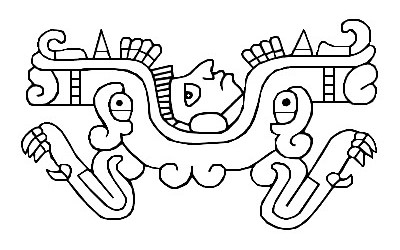
In the couple months since my last posting about the Maid in New Orleans, my self-incarceration for the Corona virus has made it easy to focus on the last chapters of my second memoir “Lord Wind” (soon to be posted for free download), and drawing on Icon #19: Tezcatlipoca, the Smoking Mirror, for the coloring book YE GODS!
Like the 18 previous deities in the series, this icon is modelled on images from the few surviving Aztec codices and reflects the mythology summarized in my illustrated encyclopedia of the Aztec pantheon. The icon will present several visions of Tezcatlipoca, who is sometimes called The Black One. I offer here two of the vignettes as “teasers.”
The first is Tezcatlipoca as an eagle, which is based on an image from a calendar week in Codex Rios. I’ve re-created this unusual manifestation of the deity using the stylistics of Codex Nuttall and certain motifs from Codex Borgia. (The eagle is a symbol of power and dominance.)
Tezcatlipoca as eagle
The second is Tezcatlipoca manifesting as Itztlacoliuhqui (Curved Obsidian Blade), who is the god of stone, cold, sin, punishment, objectivity, and blind justice. This surreal image is a re-working of one from Codex Borbonicus, though similar, sometimes even more surreal, details can be found in other codices as well. It presents some striking innovations in the stylebook of Aztec iconography and raises questions about certain motifs. Your guess about what they mean is as good as mine.
Tezcatlipoca as Itztlacoliuhqui
One of these solitary days I’ll finish this icon. I’m still waiting for some final tweaks on the vectors for Icon #18: Xochipilli, Prince of Flowers. Meanwhile, like everything else, my show of larger icons at the Ohkay Casino and Conference Center has been locked down… In this “unprecedented” viral situation, the show of smaller icons lies in storage with no prospective venues.
I have no options but to keep on with the drawing—next will be Tlaloc, the Storm God—and like Candide, work in my garden. My 35 varieties of iris are just now coming into bloom to bring joy to this best of all possible worlds.
On the 100th anniversary of her canonization, St. Joan of Arc appeared in New Orleans in a miraculous vision to the fortunate multitudes in the 2,100-seat Mahalia Jackson Theater, and I was privileged to be among them. The New Orleans Opera Association’s production of Tchaikovsky’s “Joan of Arc” was presented there February 7 & 9, 2020 under the artistic direction and musical baton of Maestro Robert Lyall. For the unfortunate multitudes who couldn’t be there to experience Joan’s epiphany, I want tell you all about it.
As the translator of Tchaikovsky’s Russian libretto of “Joan of Arc” into English, I’m probably as close as anybody alive to this work. The first translation was done for performances by the Canadian Opera Company in 1978, and though I thoroughly revised it afterwards, Michigan Opera Theatre used the first version for their 1979 production in Detroit. For New Orleans Opera Association’s production in 2020, I substantially revised it yet again.
Having seen the two earlier productions, I feel eminently qualified to critique the New Orleans production. “Maid of Orleans,” or “Joan of Arc,” was the composer’s foray into the field of French Grand Opera, and in my humble opinion, its grandiosity is incomparable. Connoisseurs of the genre, please feel free to differ…
As a Russian scholar, I’ll just say that in my translation the music sounds like it was written for my straight-forward and poetic English words, rather than for Tchaikovsky’s convoluted, many-syllabled Russian syntax. But I also thank Maestro Lyall for his superb edits smoothing out rough edges and much improving the “sing-ability” of some phrases.
In the same vein, I applaud Lyall for masterfully abridging Tchaikovsky’s sprawling libretto (which if performed in its entirety, would run for well over four hours!), into two hours and forty minutes of magnificent music and inspired drama. I also applaud his clever use of supertitles during overtures and entr’actes with brief texts to set true historical contexts and to link the disparate scenes into a cohesive narrative and easily followed story.
This translator’s view will be largely that of a discerning audience member with a long life in theater and opera. Necessarily, I’ll have to leave detailed musical analysis to the musicologists, but I’ll strive for objectivity in my descriptions.
The Production
In the four acts of the opera, scenes were all framed simply but ornately as though they were paintings. (In his libretto, Tchaikovsky called the Scenes “Pictures.”) The sets in the Pictures were pleasantly simple and effective, abstract constructions of planks and platforms—call it “plank and platform style,” adaptable and easy to alternate and to execute rapid scene changes.
The backdrops were beautifully “painterly.” That in the first act was particularly so with a hazy landscape and only an outline of a small church that was very symbolic. In later pictures we saw an elegant stained-glass window and then a vast iconic painting of a woman’s face. I thought at first it was Joan, but considering the halo, it made more sense for it to be the Virgin Mary. Whichever, it was an appropriately religious symbol and I hope Scenic Designer Steven C. Kemp is justly proud of his success!
The noted Stage Director, Jose Maria Condemi, should also take pride in his smooth handling of the numerous large crowd scenes and of his sensitive direction of the characters’ movements and interactions within the Pictures. The tableaux, ranging from pastoral to ornate cathedral, were beautifully composed, and all very subtly yet dramatically lit by Lighting Designer Don Darnutzer. Maybe it won’t be a spoiler if I praise his fiery pyre in the opera’s finale.
Joan of Arc at the stake – Photo: Brittney Werner
Let me offer my sincere compliment for the fantastic musicians of the Louisiana Philharmonic Orchestra, directed by Maestro Lyall. They poured Tchaikovsky’s immortal music out over the audience in powerful and heart-wrenching waves. While not a qualified music critic, I can only observe that it sounded really great!
But I do have more than a few clues about some other things. In my past I did a bit of Russian vocal coaching for singers (and for the Paul Hill Chorale to sing Kabalevsky’s “Requiem”). An important component of “Joan of Arc” is that it’s an enormously “choral” opera. Those large crowds mentioned earlier belted out several numbers that rattled the rafters, laments, prayers, fight songs, triumphal marches… What really blew me away was the Hymn in Act One. Prepared by Chorus Master Carol Rausch, the opera chorus sang with remarkable clarity and precision, delicately modulated to balance with the soloists, yet with startling power.
Having been in my long ago past an extra in the ballet “Coppelia” (and a life-long avocational dancer), I’ll claim to know about dance. The obligatory ballet number in Act Two was truly what the King ordered, a jolly entertainment, and likely a lot jollier and sprightlier than it would have been at any French court six hundred years ago. Choreographer Gretchen Erickson melded three superb dancers into an exciting athletic, even gymnastic, frolic. Of the three ballet numbers Tchaikovsky wrote for the opera, Maestro Lyall definitely chose to include the jolliest.
I must also commend the Fight Director Mike Yahn for the various sword fights and attendant mayhem. Avoiding flashy displays, he kept the violence to a realistic and convincing minimum, the way people actually try to stab each other with swords. And I’ll wind up my remarks on the physical production by praising the beautifully detailed period costumes for the peasants, nobles, and military, created by the talented Costumer Julie Winn. Joan’s armor alone was a marvelously medieval piece of work!
The Performances
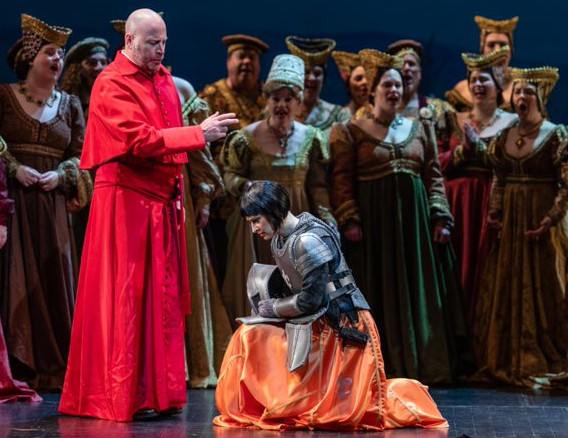
As the heavenly-inspired peasant girl Joan of Arc, Hilary Ginther completely commanded the stage from the moment of her angelic inspiration through the triumphs, soul-wrenching romance, crushing tragedy and divine enlightenment to her ultimate immolation. This tiny but mighty mezzo Maid filled Mahalia’s huge house with the glory of her prophecies, prayers, spiritual anguish, religious fervor, heroic valor, tender love, and ultimate martyrdom. It is difficult to describe the glorious musicality of Ginther’s performance, but it was a tour de force, a true epiphany. I hope Joan of Arc can become this incredible artist’s signature role, and other opera companies should sign Hilary for many more productions of this masterpiece.
Blessing Joan to lead the troops – Photo: Brittney Werner
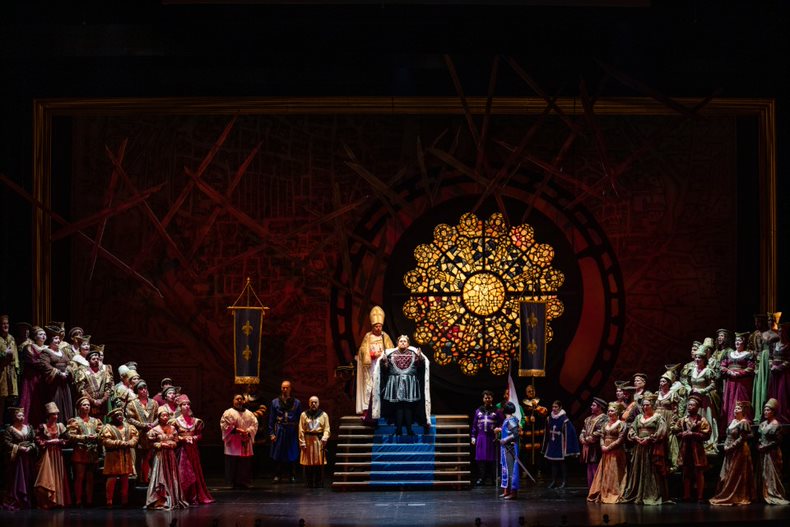
In commenting on tenor Casey Candebat’s performance as the Dauphin (King Charles VII), it’s hard not to resort to even more superlatives. In a word, he WAS superlative. With touching humanity, Casey’s rich, clear voice carried all the majesty, romance, and elements of Charles’ personal struggle between cowardice and bravery that Tchaikovsky had written into this role. His coronation address to Joan was a marvel of reverent adoration. Then, convinced by a few presumably divine claps of thunder, he, too, was swept up in the chorus’ orgy of fear and superstition. Abandoning Joan, he rushed off with his newly-won crown, ending the King’s role in her dramatic story that had been wonderfully sung.
Coronation of Charles VII – Photo: Brittney Werner
There are lots of other characters in this opera, and the performances of each and every one were outstanding.
The pivotal role of Thibaut, Joan’s father, was sung by bass Kevin Thompson who, as noted by others, has “a mountain of a voice.” That voice perfectly embodied the element of superstition on which the opera turns. Kevin’s remarkable bass voice, aided by those aforementioned divine thunderclaps, created a true avalanche of fear, hatred, and stupidity that swept Joan from her exalted heights into a pit of despair and exile—the ultimate parental guilt trip. No wonder that during the bows Kevin earned the audience’s heartfelt boos!
Soprano Elana Gleason, playing Agnès Sorel, the King’s affectionate mistress, expertly delivered her extremely difficult love arietta with the King—with its very high notes!—with great delicacy and tenderness. We should all have such generous mistresses!
The role of Dunois, duc d’Orléans, was impressively fulfilled by dramatic baritone Michael Chioldi, who served as the conscience and inspiration for the King. In all of his scenes, Michael’s resonant voice drove the action, his nobility instilling courage and resolve. It is a complicated role with its aspects of conflicting loyalty and heroic determination.
The role of the romantic male lead, the Burgundian knight Lionel, was performed by baritone Joshua Jeremiah. Lionel is a pivotal role, a man who turns from French traitor into passionate lover, who first abuses Joan as a demon and then becomes her protector. In the final love duet, Joshua’s heroic voice blended perfectly with Joan’s mezzo in praise of God’s heavenly gift of love. (Unfortunately, he had to die—but did so grandly.)
I was thrilled by bass Raymond Aceto’s Archbishop who narrated to the court with ecclesiastical majesty Joan’s first appearance with the French troops, her leading them into battle, and their victory over the English. Raymond’s every word was crystal clear and weighty with the miracle of it all. He brought the same musical authority to all his other scenes, whether urging the people to believe or interrogating Joan’s virtue, or even when proving to be just as stupidly superstitious as everybody else.
In Act One, Kameron Lopreore movingly played Raymond, a village suitor whom Joan rejected; his tenor solo line in the Hymn was sung with plaintive force. Bertrand, a peasant refugee, was sung with immense pathos by baritone Ken Weber, and his solo line in the Hymn was a profound lament. The unnamed Warrior played by baritone David Murray dramatically narrated his narrow escape from the battle of Orleans and confirmed Joan’s first prophecy. In Act Two a dying soldier named Loree was sung by Frank Convit. His lines urging the King to join the fray and his final words “I’ve done my duty now…” were sung with all the poignant power of a seasoned soloist. All four of these roles were expertly delivered.
Concluding Remarks
You’re probably wondering if the preceding descriptions can be called objective, but I assure you they were—I could find nothing even vaguely negative to say! But, though I’d love to say that the New Orleans production of “Joan of Arc” was flawless, I admit there was one challenging detail.
Three times Joan hears the heavenly voices, and the angelic messages are crucial to the very structure of the opera. First, they send her forth on her mission, and second, they proclaim her mission accomplished and call her to come to glory (where a virgin martyr’s crown awaits, as well as rapture in God’s divine embrace). Then, third, they welcome Joan into heaven.
The off-stage voices of the angels, necessarily somewhat muted and baffled by curtains, largely got drowned out, sometimes by the enthusiastic orchestration and at other times by competing vocal lines. Fortunately, the words appeared on the supertitle screen—albeit quite briefly—allowing audience members to some degree to follow what they were supposed to be hearing sung and to sort it out from the other competing vocal lines.
What I could hear of Julia Tuneberg’s lovely soprano was ethereal, but her single voice was mostly lost in the melee. If that was anyone’s fault, it was the composer’s. Julia’s vocal lines being absolutely the most important element of the sequences, and given the traditional limitations and challenges of writing for off-stage voices, Tchaikovsky’s rich orchestration and vocal writing probably should have taken that more into consideration.
A modern solution for future productions, (of which I hope there will be many—my English translation gratis), would be to forget the back-stage and off-stage voice placement and send their sound through speakers from the ceiling of the house, even sending the separate vocal lines down from either side, antiphonally if you will. The audience should ideally hear surreal voices coming from heaven—and understand the words.
On that note, let me strongly advocate for performing operas in translation. Operatic puritans’ desire to preserve the musical sound of a composer’s work is admirable, but by opposing performances in translation, they often discount the verbal sound and deny “foreign” audiences a full appreciation of the drama in a work, especially so in this one. As a Russian scholar, I observe that with its intensely poetic language (i.e., twisted word order and obscure, stylized vocabulary—not to mention some wild musical calisthenics on important words), Tchaikovsky’s Russian libretto for “Joan of Arc” verges on the unintelligible even for native speakers of that language. In some respects, the composer seems to have chosen to rely on the visual scenes (Pictures) to suggest most of the theater in his work and considered the verbal fine points of the drama as more or less negligible.
Yet, Joan’s drama is the truly grand part of this grand opera. Like the angel voices, audiences deserve to comprehend fully her inspiration, heroism, moral anguish, triumph, and apotheosis. Her story is of vast import even for today: a woman of incredible strength and determination who literally saved her country, a powerful spirit who transcended medieval superstition and ignorance to achieve Sainthood—her true moral victory. All the more astounding for happening six centuries ago, Joan’s victory needs not be reduced to mere musical fireworks and orchestral magnificence. To convey all the grandeur, her glorious words should be readily comprehensible.
That’s why I’ve devoted creative energy to this amazing work for more than forty years. And that’s why I now urge opera companies in English-speaking countries everywhere to produce it—now readily available in translation—and to thrill us with the brilliance of Joan’s glory, as so beautifully done by the New Orleans Opera Association.
#
{Several years later, I came to a decision about my new version of the libretto. See this blog for details.}
Richard Balthazar is a former Russian scholar, arts administrator, and vendor of used plants, now happily retired as a writer and artist. He can be reached at rbalthazar@msn.com.
I’m proud to announce finishing my latest Aztec icon, #18: Xochipilli, Prince of Flowers—by the end of 2019. Working in and around other projects, I spent 6 months on drawing it, rather longer than it took on any of the preceding 17 for the coloring book Ye Gods! Small wonder…
Now that the basic drawing is done, I can at least offer a small version here for your wonder and amazement. To post it on the coloring book page, I’ll have to do a caption page with model images from the codices and get it turned into vectors for sizable printing. All in good time…
Xochipilli, Prince of Flowers
No doubt you notice immediately that this icon is a lot different than the others. As a matter of fact, it’s seriously iconoclastic, breaking several of the canons of Aztec-codex iconography. But first let me explain the elements.
As detailed in the Aztec Pantheon, XOCHIPILLI (Prince of Flowers) {sho-chee-peel-lee}, is a very appealing deity: the god of art, dance, laughter, happiness, beauty and peace, flowers, ecstasy, sleep, and dreams/hallucinations, as well as a god of fertility (agricultural produce and gardens). Hence all the blossoms and vegetation which are far more intense and decorative than you’ll find in any of the codices. That’s my first departure from the Aztec style, but I couldn’t pass up the perfect opportunity to indulge in floral display.
The Prince is also the patron of the sacred ballgame tlachtli (seen in the structure behind him), of the day Monkey (which cavorts by his left foot), and of homosexuals and male prostitutes. In the cameos above and below the deity are his various lovers, a fairly polyamorous assortment.
Upper left is Opochtli, left-handed god of hunters; upper center is the Old Coyote, Huehuecoyotl (see also Icon #6), god of music, dance, and sex; and upper right is the god of writing, painting and song Chicome Xochitl, Seven Flower.
Lower right is the god of music, games, and feasting Macuil Xochitl, Five Flower; lower center is Pilzintecuhtli, the Young Lord, god of the planet Mercury; and lower left is the Prince’s twin sister-wife Xochiquetzal, the Flower Feather, goddess of love and female sexuality. As a note, I’m going use this cameo sketch of Xochiquetzal when I get to doing her icon.
The most iconoclastic feature of this icon is the figure of Xochipilli himself. In the codices, almost without exception, human figures are presented in profile, but my Prince is seen here full-frontal with only his face in profile. His intentionally sensual posture is an echo of much earlier Maya iconography. The angle of his chair/seat and new perspectives on his limbs, feet, and etc. forced me be fairly realistic in drawing the physical details. (See that right hand and his un-Aztec eye!)
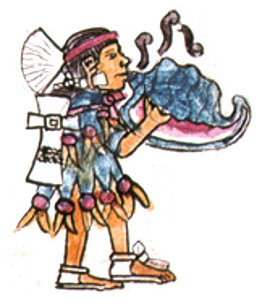
The most subtle element of this icon is that Xochipilli is also the patron of the number seven. With the god in his circular wreath of flowers as a central “dot,” the six cameos around him comprise that numeral. My only regret is that I couldn’t find a way to include a procession (as shown in Codex Magliabechiano) with a little guy blowing on a conch-shell trumpet:
The above image of Five Flower, Macuil Xochitl (God of games, feasting, merry-making, music and dance) is simply click-bait. He’s shown here in a cameo included in Icon #18–which is really, really close to being done. Hope to post it for you in the next week or so. Meanwhile…
All this fall my Aztec icon show Ye Gods! has on display again, first occupying our local Las Vegas for a month (hosted by Highlands University) and then hanging out at Santa Fe’s public library branch on the south side for six weeks. Not sure how many folks really viewed them in either place, but at least that got their banners out of my garage and up on some walls, which is of course the point of it all.
Last week I arranged for the bunch to make a return appearance in early January to nearby Española, where last fall they’d made considerable noise at Northern NM College. Now they’ll be partying at the Ohkay Casino—Ohkay Owingeh used to be San Juan Pueblo—where the conference center is being redesigned with a huge lobby/hallway. My proud deities will each have a vast wall from which to lord it over the conferring crowds.
In general, I’m thrilled silly to display my icons to multitudes of people, like the 2-3,000 expected for a conference on January 18. In particular, I’m totally pumped that these crowds will be what one might call “normal” folks who aren’t necessarily museum- or gallery-goers. My weird gods and goddesses are bound catch their innocent eyes, and the fascinating captions might even get read. I might well hit the visitation jackpot!
Even more specifically, I’m overjoyed that the casino folks want the show to be up for a long time—at least through the coming summer! Ye gods! Imagine having one’s show up for nine months… I’ve told them it can just hang there until they get tired of it. It makes great décor.
Considering those vast walls, I plan to increase the size of the icons so they don’t get lost in all that space. They’ll bump up from 3’ X 4’ to 4’ X 5’, i.e. 1/3 larger, and will no doubt be at least that much more imposing. I’m also inspired to add QR code-blocks to the captions for folks to scan and download the vector drawings. Might as well get with the technology…
That will leave me with the smaller, original show to hang in less spacious spaces, and my first target will be our local Institute of American Indian Arts (IAIA). I’d approached them back when first planning the show and basically got ignored. Now that they actually have a gallery director, maybe there’s a chance, especially considering the show’s history of venues.
When Ohkay does eventually get tired of my rowdy crew, there are several other casinos and conference centers around where this deep Native American history might be appreciated. But in the meantime, I’m dreaming even bigger for the Big Show—the National Museum of Anthropology in Mexico City. Wish me luck.
It has been over a year since I posted an announcement of plans by the New Orleans Opera to produce my English translation of Tchaikovsky’s opera “Joan of Arc” (“Maid of Orleans”). Coincidentally, Joan is the patron saint of New Orleans. Those plans have now been finalized, and it’s in production for performances at the Mahalia Jackson Center for the Performing Arts on the evening of Friday, February 7, 2020 and as a matinee on Sunday, February 9.
In my earlier posting I’d remarked on plans to clean up the old translation (performed by the Canadian Opera Company in 1978) by September of 2018, but the work actually lasted through November of that year. The revisions were so complex that I now in all good conscience can claim that the New Orleans Opera production will technically be a World Premiere!
Here’s why. This past September I was invited by the Krewe of Joan of Arc (a Mardi Gras organization with their parade scheduled for January 6—Joan’s birthday) to give a talk about the opera at their annual Salon de Jeanne d’Arc. Significantly, 2020 will be the 100th anniversary of her canonization. In my talk I discussed a serious “literary” problem in the libretto (written by Tchaikovsky himself), specifically the Love Duet in Act IV.
In my first translation, I’d been a slavish Slavic literalist, translating what Tchaikovsky wrote verbatim, if that means anything in a translation. Though I hadn’t been at all pleased with the duet, what could a mere translator do? I explained to the Krewe:
“You’re probably aware that historically the saintly Joan actually never fell in love with anybody. But to follow the operatic convention and satisfy his intensely romantic nature, Tchaikovsky hauled in a love theme with the Burgundian knight Lionel—which runs head on into Joan’s vow of chastity. I do believe that detail was also Tchaikovsky’s invention to turn the inspired peasant girl into a terrible sinner. That way he could project his own angst and guilt over being a homosexual onto the poor maiden’s head, pun intended.
“Joan’s enormously conflicted feelings—and those of Petr Ilyich himself—led into a love duet that just plain didn’t work. Joan had to sing about how miserable she was and agonize about breaking her holy vow, abandoning all hope of heaven, by loving Lionel. A real downer…
“While indisputably Tchaikovsky was a giant among composers, I’m afraid as a struggling poet he fell flat on his face in this obligatory love duet. Maybe you’ll think I’m betraying the role of translator—my sincere apologies—but I’ve almost totally rewritten the love duet. So sue me!
“There was a brief phrase in it, ‘marvelous gift of love.’ Tchaikovsky apparently wrote those words recalling a charming but depressing chorus of minstrels in Act Two. They sang that love’s a gift from God, a flower sent from heaven, a magic talisman that enchants us and enthralls the soul with rapture, etc., etc.
“Since turnabout is supposedly fair play, I took the romantic sentiments of that early chorus and turned them into an ecstatic love duet. It may not be Shakespeare, but now it works, by golly.”
I suppose simply rewriting a love duet isn’t alone enough to make a world premiere. What I didn’t tell the Krewe was that to make the new duet work I had to adjust a number of lines in Acts III and IV to redeem Joan from Tchaikovsky’s casting her as a terrible sinner, to provide her with spiritual enlightenment, and to re-frame her execution at the stake as not an ignoble punishment for moral failure but as an apotheosis, a virgin martyr’s crown and the rapture of God’s divine embrace awaiting her in heaven.
Therein lies the rationale for calling the New Orleans Opera production of my new translation a world premiere. Nobody has ever seen this now truly grand opera before.
Here we go again! My informational art exhibit YE GODS! ICONS OF AZTEC DEITIES will show for the fourth time at NEW MEXICO HIGHLANDS UNIVERSITY in beautiful Las Vegas NM from September 30 to November 2, 2019 at BURRIS HALL GALLERY, 903 National Avenue.
In 2018 the first 15 icons showed at El Museo Cultural de Santa Fe and at Northern New Mexico College in Española, and in 2019, with the addition of #16 (TECCIZTECATL & METZTLI, Deities of the Moon), they were displayed at Santa Fe Community College. This iteration at NMHU will include another new icon, #17: TEPEYOLLOTL, Heart of the Mountain, the god of caves, volcanoes, and a bunch of other neat stuff.
Currently working on the next icon for the coloring book, #18: XOCHIPILLI, Prince of Flowers, I’ve broken out of my alphabetical sequence to manifest the splendid deity that I consider my personal patron (appearing above in my website banner). I’m also breaking several Aztec iconographic conventions for this one, not the least of which is running wild with floral motifs. One of my favorite details is a tiny Aztec bee:
Aztec Bee
You’ll just have to wait a while to see the rest of this literally iconoclastic icon.
Along with the NMHU show, I’ll give a slide lecture on the Aztec Codices for their Art in the Americas class and a gallery talk for their Día de los Muertos celebration on November 1, just ahead of a concert to be directed by my music prof friend Andre Garcia-Nuthmann. Of course, Mictlantecuhtli, Lord of the Land of the Dead, will be featured, as will Tepeyollotl, Heart of the Mountain, who guards the entrance to Mictlan. That dire place is always shown as the mouth of the monstrous, hermaphroditic Lord of the Earth, Tlaltecuhtli:
Entrance to Mictlan
Meanwhile efforts continue to line up more venues for the show, including other educational institutions around New Mexico. If anybody out there has hot ideas for presenters anywhere else, sic them on me! I’ve been trying to interest places in surrounding states but so far have struck out. (Read that as: My approaches have been roundly ignored.) I’d really love to hang the show at Mexico City’s National Museum of Anthropology, but I expect the materials should be translated into Spanish, actually not such a bad idea…
I’m totally exultant! Yesterday I discovered that in July wonderful WordPress has started registering downloads. This is a ginormous deal since for the past five years all I could do was hope (pray and wish) that you folks out there were taking the fabulous stuff I’ve been trying to give away on this website. Now I’m jubilant that you apparently are indeed and may actually have been accepting my gifts in the past. Not to be greedy, but I’d love to get some comments back about my artwork and writing—appreciation, criticism, gratitude, or whatever.
There were some splendid surprises in the first six weeks of download data. I’d been pleased with getting an enormous number of hits (from literally all over the world) on my Aztec materials, and now I find that they’re being downloaded like hotcakes. To my joy, the treatise The Aztec Codicesand encyclopedia The Aztec Pantheonseem hugely popular, but even better, the YE GODS! coloring book is flying out the door, both as the collection, The Aztec Icons, and as individual black and white images.
Through Google Image searches, I’d already observed that my earlier four-color images of Aztec deities were being used for various purposes like T-shirt designs and other graphics, and now I see that they’re still being downloaded frequently. As hoped, my art is now truly taking on a life of its own in the wide world—beyond the several exhibitions of icons I’ve managed to organize. The next show will be at New Mexico Highlands University in Las Vegas NM this October.
Suddenly I’ve found something dramatic and significant to add to the burgeoning trans phenomenon. As a plain old faggot I haven’t been involved, but I’ve always welcomed the T in our LGBT acronym. The QA+ETC simply go without saying…
Anyhow, this goes back to that book I mentioned in an earlier post called Chinese Myths and Legends, edited by Jake Jackson. Sorry I can’t give a full citation or authoritative quotes because I gave the book to the library at my grandson’s high school. After some horrific legends of dragons, monsters, vengeance and murderous arbitrary fury, I was pleased to come upon a very curious legend of the goddess Kwan Yin.
Some may not be familiar with this goddess, who is known and venerated all across the orient and even India. I’ve been collecting her statues/figurines for lo these many and gathering her lore. Kwan Yin is a complex deity: goddess of compassion, travellers, sailors, children, motherhood, wisdom and enlightenment. She’s the female Buddha—who achieved nirvana but declined to go “there” until all humanity can accompany her. In that respect, I think we should also call her the goddess of patience. She’ll need it!
Back to the curious legend. It struck me on the reading, but only now have I realized what an important piece of LGBT cultural history it is. At some time way back in ancient history among the imperial BC dynasties, a virtuous young prince took to the spiritual/religious life and became a nun, who eventually got deified. That’s right: The young man became a young woman. As I recall, the legend didn’t go into any detail about this primordial transsexual process, but he became the goddess.
Representations of Kwan Yin (unless heretical), always show her dressed as a beautiful woman without breasts. Many show her bare-chested, and there are no mammaries there. Here are six such figures of the legendary trans deity:
I really must devote a word or two to a favorite detail from my Aztec Icon #17, Tepeyollotl—just in case it slipped your notice. It’s my rendition of the Jaguar of the Night, one of the various manifestations of the Heart of the Mountain. The divine Jaguar leaps at the rising sun, greeting it with its roars (those odd wavy sound symbols).
Jaguar of the Night
From Icon #17 Model from Codex Nuttall
One reason I’m showing you this drawing is to sing the praises of my sweet graphics program, GIMP. (You can Google it for free download!) It really makes me feel like a magician. I took the splendid image of a jaguar from Codex Nuttall and with a few adjustments in proportions and position turned the rampant figure into a leaping one. Of course there were many pixels to wrestle with, but that’s the name of the digital drawing game.
Also: I’m quite pleased with this drawing of my totem animal and rather proud of it. Hope you like it too.
So… It’s been another long haul to complete the next icon for my coloring book YE GODS! Something like four months, but no apologies. I’ve had to take a lot of sanity breaks—to continue writing on my next memoir and to deal with the sorrows of life. Namely, in late March, at the tender age of 18 my eldest grandson Ike chose to end his life. We know nothing about why but can only respect, accept, and lament his decision. That’s my reason for tearfully dedicating this Icon #17 – Tepeyollotl, Heart of the Mountain to him.
Tepeyollotl, Heart of the Mountain
Tepeyollotl (Heart of the Mountain) {te-pe-yol-lotł} is the god of caves/mines and echoes and causes earthquakes, avalanches, and volcanos. As the Lord of Jewels and underground treasures, he is the male spirit of the earth and a nagual of the hermaphroditic Tlaltecuhtli, Lord of the Earth. A deity of witchcraft, he cures and causes diseases and guards the entrance to Mictlan (the Land of the Dead). Tepeyollotl is the ancestral were-jaguar and may be the God L of the Maya. Also a nagual of Tezcatlipoca, he is the Jaguar of the Night whose roaring heralds the sunrise, and as 8th lord of the night he is sometimes depicted as a jaguar leaping toward the rising sun.
I’ve already posted a couple pieces about this icon in process, The Divine Volcanoes and Jaguars Changing Spots, and the above caption gives the rest of the information I’ve learned about this deity. On the coloring book page I’ve now listed a free download of it with caption and models, and when it comes back home to me in vectors from Bangladesh, I’ll add the two versions for sizable prints.