Nowadays we sometimes think (and some of us worry) about the planet Earth, this infinitesimal speck of dust in the infinite cosmos, as our mother—and quite reasonably so. In scientific fact, like all life, we’re indeed children of the female Earth sired by the male Sun. However, the ancient Egyptians believed we’re the offspring of the male Geb (earth) and the female Nut (sky).
In the Judeo-Christian, Islamic, and Hindu traditions, people were purportedly created magically (asexually like amoebas?) by a male deity with the Earth playing no role except as a location to hold dominion over. Characteristically, Buddhists don’t have a creation story since they consider the notion of origins meaningless. Take your pick because it doesn’t really matter anyway.
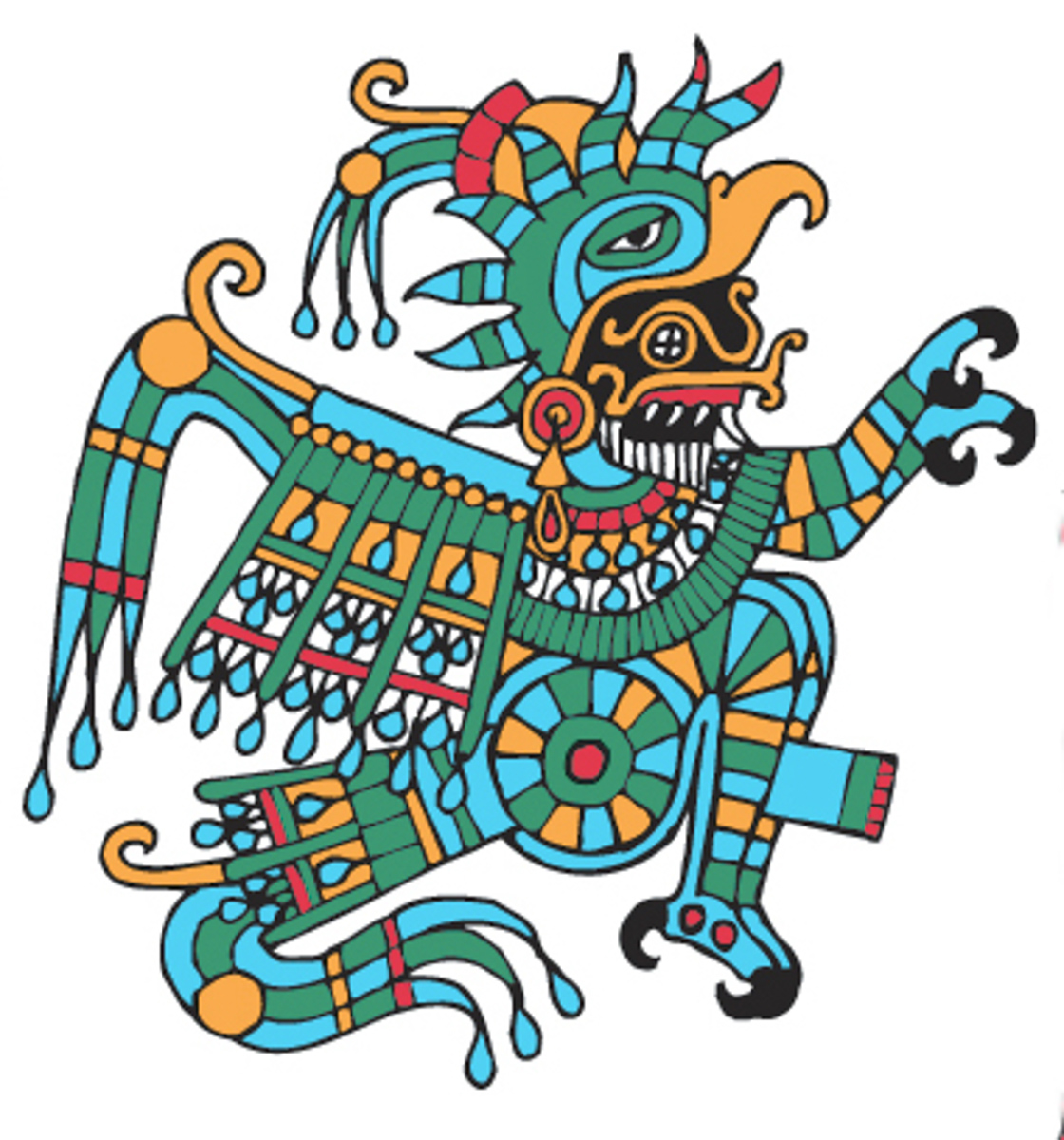
Meanwhile, ancient Mesoamericans believed people were created by the Earth as a deity named Tlaltecuhtli, which was conveniently a hermaphrodite—and not at all anthropomorphic. Most often it was depicted as a huge, gaping maw, a two-way street through which people were born and then on death passed back into the Underworld, the Earth being the mystical source and destination of all life. Creation wasn’t considered a one-shot deal but an ongoing process.
When not a mouth spitting out or devouring people, the deity of the Earth was generally shown as a monster with impressive fangs and claws. Its species was apparently the crocodile (caiman), a creature called Cipactli (also the name of the first day of the month in their calendar).
The Mesoamerican Earth Monster
I drew this surreal image of the Earth Monster as a detail in my next icon for the coloring book YE GODS! It’s based on a smaller version in the Codex Borgia. In some other instances in the codices, Tlaltecuhtli/Cipactli has no limbs, but the fanged jaw was put to good use in biting off the left foot of the god Tezcatlipoca. That’s another story.
Of the various creation fantasies, I much prefer the Mesoamerican narrative since it recognizes that our planet Earth is the parent of life and illustrates the principle of dust to dust. It really does matter after all to acknowledge that our Earth is a living creature, a metaphorical monster not to be dominated but to be cherished and nurtured. Remember, even planets can die!
What with increasing urgency in the Corona virus calamity, it has become clear to me that I’m going to have to change my mode of operation in writing my memoirs. Before, I always waited until a volume was complete before publishing (posting) it on my website—in order to have the luxury of skipping back to earlier sections to add, delete, or tweak the material.
Now that I really can’t predict how long I’ll hang around on this planet, I’m going to post chapters serially as they’re completed, adding them to the Table of Contents for individual access. Too bad for second-thought revisions, but that’s how this wretched Covid cookie is crumbling.
While writing on Chapter 6 of the current volume, I found the appropriate title for this memoir. It’s the registered name for a spectacular variety of iris I used to sell at the Farmers Market a long time back when I was the famous Iris Man:
GAY GEISHA
As I told a dear friend, these two words are the most cogent description I can imagine of who and what I was in the 1970s in Washington DC. My third real memoir (actually the sixth volume in the story of my unique life), GAY GEISHA covers 1972-80, a time of glorious gay liberation, when I lived and graciously entertained gentlemen in a grand Victorian mansion at historic Logan Circle.
GAY GEISHAprovides the dramatic and often lurid details behind that old summary of my fifth persona which I prophetically entitled “Courtesan.” As possible, I’ll keep adding chapters and hopefully live to finish this volume. (As of 2/20/22, I’ve now posted twenty-four chapters covering through September 1980.)
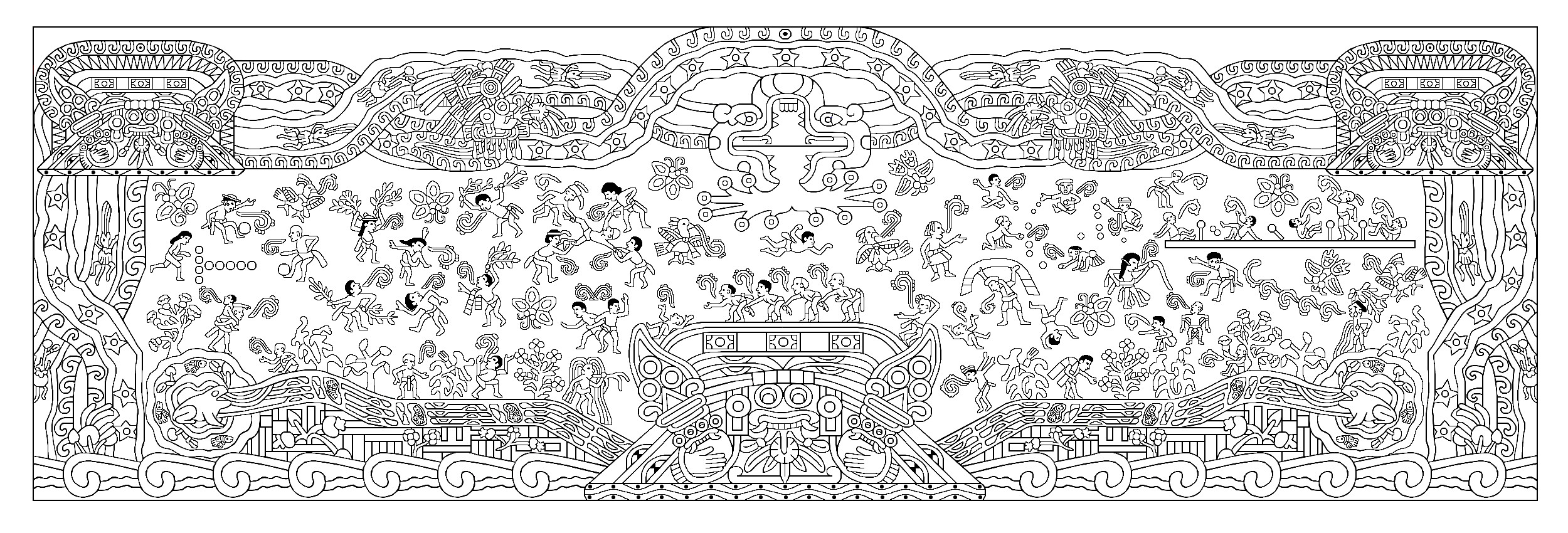
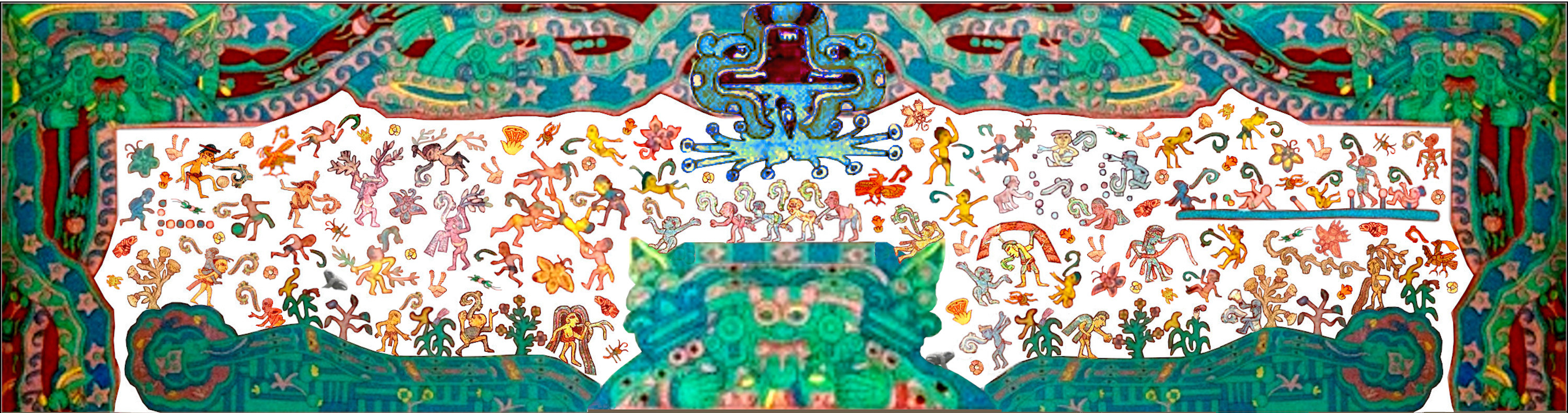
After showing you my reconfiguration of the Teotihuacan mural of Tlalocan in early July, it took me these past three months to turn it into a black-and-white drawing. As such, it will become the lower register in Icon #20 for my digital coloring bookYE GODS!
For several centuries the enormous city-state of Teotihuacan “ruled” central Mexico (and parts of the Maya world as well). Painted about 1,500 years ago, the tremendously ornate mural is a fascinating window into that vanished metropolis, a panorama of its people enjoying afterlife in the paradise of their water (storm) god—whom a thousand years later the Aztecs called Tlaloc. My drawing gives you an intimate look at the actual people who lived in the Place of the Gods. (It’s greatly reduced in this illustration, but you can click here to download a full-scale image—at almost three feet long and one foot high.)
Tlalocan – The Paradise of Tlaloc
Within that eye-boggling border, the first telling detail to notice is that there are no women, which may say something about a sexist society in Teotihuacan. Of course Tlaloc’s Eighth Heaven was reserved for victims of drowning and children sacrificed for life-giving rain, but one thinks maybe some women might also have drowned and girl-children been sacrificed too. In all likelihood (if the eschatology of Teotihuacan is reflected in that of the Aztecs), women may well have had their own paradise among the thirteen heavens. But there’s no mural of that one.
The Aztecs definitely inherited the concept of Tlalocan from Teotihuacan, and the iconography of the ancestral water (storm) god is also clearly reflected in that of the much later Aztecs.
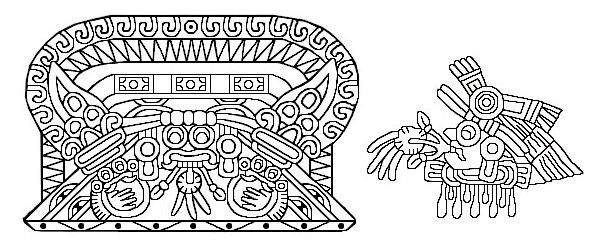
Teotihuacan Water and Rain Gods
Tlaloc’s goggle-eyes and fangs crossed the centuries into the figure from Codex Borgia, as well as the head-pitcher he holds for pouring out water:
Aztec Tlaloc and Quiahuitl Day-signs
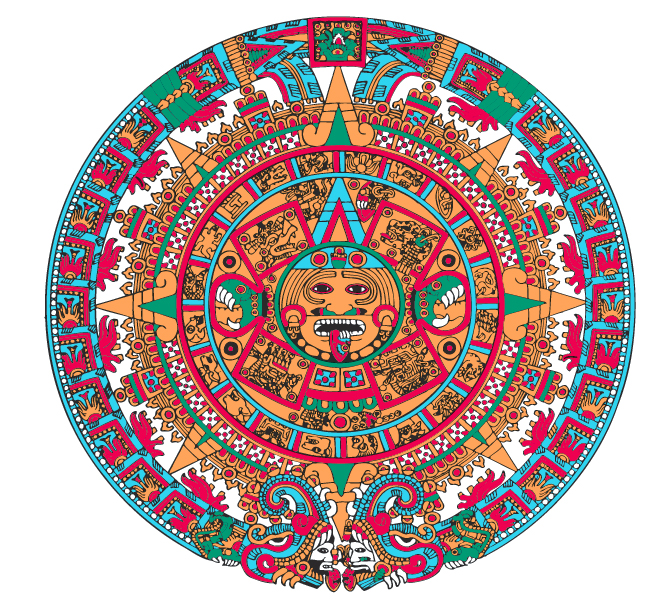
Teotihuacan’s rain-god image carries over directly into the Aztecs’ golden Four Rain sign (day-name of the Third Sun) on their Stone of the Suns. The Rain day-sign to its right is based on it—drawn thirty years ago for my book of days before I ever learned of the raindrops on the Teotihuacan image. The two lower signs are stylized versions for the calendars in the Fejervary-Mayer and Vaticanus codices; those in other calendars are similar, but often less formal.
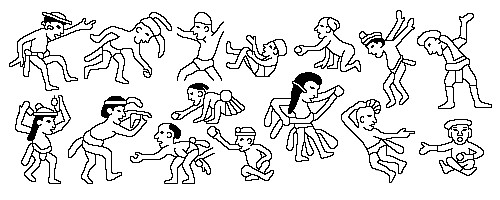
Now let’s look into this window on the people of Teotihuacan. First, check out their quite varied fashions in clothing:
Teotihuacan Fashions
Not surprising are the loincloths or breechclouts worn by figures on the left with varying numbers of sashes. Note that children can be nude or just wear “panties.” But then the costumes get weird, like the top center fellow wearing a midriff T-shirt and toreador pants and the guy just below with a full-length T. The runner to his right may be wearing similar pants, but he also has gloves. The guy below is wearing “clam-digger” pants with breechclout; the guy with the tears (ignore those for now) only wears gloves and socks/slippers, as does the cross-legged kid below. On the far right the top figure wears shirt and pants under a loincloth, and the lower figure wears pants/leggings under a kilt with sash.
The variety of outfits may have to do with social classes—or maybe not. But I can say that the cross-legged kid in gloves and socks is remarkably unique in being presented full-face. All the other faces are done in profile—the standard view used by the Aztecs for faces and bodies as well. However, the ancient artist made free to show figures frontally and from many other realistic angles, an iconographic freedom apparently lost over the centuries.
Note also the varying hairstyles: Figures are frequently bald (or with shaved heads?), but many have hairdos of various lengths. The kilted fellow on lower right may be an elder with receding hairline and gray hair. In the mural you can’t tell if the guy at center-top has a topknot or feather headdress. Speaking of hairstyles and headdresses, there is also a wide assortment of such on other figures which again may have something to do with class or occupation—or maybe not.
Teotihuacan Headgear
Here we see several types of hats, headbands, skullcaps, and turbans. Notable is the figure on the upper left wearing an ear-flare, the only one in the whole mural—a fashion that became almost universal under the Aztecs—but there are no nose ornaments. Again, note the cross-legged kid on the lower right wearing what looks like a slightly cocked beret. The flirtatious fellow to his left possibly sports a half-Mohawk crest—or a feathered hat?
So now we know what (at least male) Teotihuacanos looked like! Here are a couple vignettes of their playful activities:
Teotihuacan Dancers
Teotihuacan Toss
Both of these group activities well illustrate the ancient artist’s stylistic freedom, as well as elements of perspective that the Aztecs would never have attempted. (The curlicues are shouts or songs of joy—a convention that totally carried over into Aztec iconography.) The scene of the tossing is probably celebratory—as happens in many cultures—and not a punishment like that undergone by Sancho Panza in “Don Quixote.”
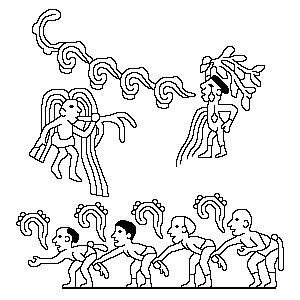
Now we come to some distinctly odd images that I have a hard time parsing:
Teotihuacan Oddities
This guy with the tears (in gloves and socks) seems to be singing loudly or shouting, but why is he crying and waving a branch, and what’s he got flowing from his chest? In the mural the flow doesn’t seem to be blood, and why should it be? The guy with the long stuff flowing from his head (hair?) seems to be chewing on a stick (sugarcane?). The four fellows holding each other’s wrists maybe are playing some game? Since this is in Tlalocan, whatever’s going on must surely be joyful fun.
I hope my little drawing has given you some visual notion of the lost and almost forgotten world of Teotihuacan.
The icon I’m working on right now is for Tlaloc, God of Storms (as well as rain and weather in general), a very ancient deity with antecedents among the Maya as Chak and in Teotihuacan, his actual name unknown, at least a thousand years before the Aztecs. In conceptualizing the icon, I’m including as the base register an image of Tlalocan, the Paradise of Tlaloc, adapted from a mural at Teotihuacan (c. 500 CE).
In my process, I first gather, massage and manipulate source material to create a layout. After settling on the composition, I turn the images into line drawings. Working with a mural from Teotihuacan—and snitching a neat piece of Codex Vindobonensis—I’ve reconfigured it to be what I call the Tlalocan, the Paradise of Tlaloc, restoring the heavily damaged left half:
Teotihuacan Mural Reconfigured by Richard Balthazar
Keep in mind that the Teotihuacan mural (with an obfuscating deep red background), was painted some 1,500 years ago—before European monks ever started illuminating manuscripts.
Some scholars argue that this mural represents the sacred Water Mountain—Cerro Gordo behind the city—and was associated with the (also nameless) Great Goddess. While her mural is positioned right above this one, I heartily disagree and have removed the arguable “mountain,” moving in the centerpiece from the upper border (enlarged), an indubitable image of the fanged, goggle-eyed deity the later Aztecs dubbed Tlaloc.
The deity also holds “head”-pitchers like those Tlaloc holds in Codex Borgia pouring water onto the maize-fields. As well, the dedication to Tlaloc is tripled by the matching busts of the iconic water deity in the upper corners. In upper center, I’ve installed an anachronistic Mouth of the Earth pouring forth water (from Vindobonensis). The name Tlaloc means “He of the Earth.”
I have no problem with Cerro Gordo being the sacred Water Mountain of Teotihuacan. That nearby massif may well have sourced lots of springs and streams, and I gather there’s evidence of intensive agricultural terracing and other works on its slopes and summit. The original Water Mountain image in the mural I assert to be in fact the way of entry into the afterlife of Tlalocan. The figures in its waters aren’t just gaily swimming around but struggling, sinking, maybe drowning, and ultimately erupting into the Paradise of the god later known as Tlaloc. Note the attempted life-saving. I found the image nice but unnecessary. After all we’re worshipping LKA Tlaloc here.
“Water Mountain” from Original Mural at Teotihuacan
Circumstantially, priority entry into Tlalocan, a joyful place of games, butterflies and flowers, was granted to victims of drowning, then to children sacrificed to Tlaloc—note the many children in the mural’s pastiche—and only afterwards to victims of certain diseases such as leprosy. Those less than enviable passports aside, Tlaloc’s 8th heaven (out of the 13), was a great place to wind up, all dancing, singing, and having fun. In the other heavens, not so much…
If you squint at the little figures in the mural, you’ll see groups engaging in several games. On the far left it’s with soccer-type balls while another guy runs in perhaps a hybrid of bowling and hopscotch. Moving to the right, we come to a bunch of dancers, and beside them a guy getting tossed into the air. On the deity’s crest, four fellows play perhaps some version of leapfrog. On their right, kids play marbles, and four guys play on something maybe related to a teeter-totter.
Historically significant are those little curlicues issuing from the figures’ mouths, the symbol for song: These folks are rejoicing, singing out their joy. Even the birds I lifted from the Great Goddess mural are singing as on far right. (In the original a tiny worm also sings!) I know this symbol because it’s widespread in the Aztec codices of a thousand years later meaning the same.
I’m taken with the little guy on the lower right bending to admire a flower. This stretch of plants and figures has been called a scene of farming, but that’s just nonsense. Farming in heaven? The man standing on the far right might be yodeling, and the kid under the bush is merrily waving a flower, not particularly agrarian activities. Various other figures scattered around seem to be telling stories or doing tricks. A good time is being had by all.
Generally, I try not to engage in much speculation, but this time it’s terribly tempting. Let me suggest an intriguing possibility. Perhaps with the Water Mountain adjacent to their prosperous city the Teotihuacanos came to think of their world as literally Tlalocan on earth. Maybe they didn’t, but Mesoamerican history could have—taking that long-gone civilization into their cosmology as the Third Sun, Four Rain.
According to the Aztecs, Four Rain was ruled by Tlaloc while consorting with Xochiquetzal (Flower Feather), who might have been the Great Goddess, though She was usually seen as the proto-Chalchiuhtlicue (Jade Skirt). Lore has it that when Tezcatlipoca (The Smoking Mirror) abducted his goddess, Tlaloc raged and destroyed the Third Sun in a rain of fire.
This apocalyptic detail suggests another possibility. I’ve read that right around 600 CE there was a major eruption of Popocatepetl which, besides raining fire, spread a pyroclastic flood of toxic gases all over the valley of Anahuac (Mexico). Is it just coincidence that at exactly this time the civilization and people of Teotihuacan vanished?
In this dire virus situation, we are all looking death in the face, but we can’t really see what it looks like wearing a mask and standing at a sociable distance. So I tried to get an up-close look at the face of death through the sanitized lens of Aztec art. They were intimate with that inevitable fact of life and drew many detailed pictures of it.
In their calendars, the Aztecs represented the day Death, Miquitzli, the sixth in their 20-day month, as a skull, often fancifully ornamented:
Signs for the Aztec Day Death
While the examples from Codex Cospi are the most varied and almost playful, they’re not exactly “fun” or amenable. Not that they were supposed to be… By the way, notice the tassels fed through the earlobes. Ears on a skull? This could become a new fashion fad!
The Aztecs also personified, or if you will, deified death as Mictlantecuhtli, Lord of the Land of the Dead (Mictlan). He was portrayed in various styles with many common motifs as a skeleton, often with a sacrificial knife for a nose and a semi-circular headdress, usually with a central spike. (Note two incipient examples of the spike among the Cospi signs above.) In Codex Borgia, he often wears a hand as a tassel through his earlobe. In the display below I skipped the skeletons and show only the skulls. None of them is particularly warm and cuddly, but again I guess Death’s heads simply aren’t.
Heads of Aztec Lord of Death
These gruesome images, which underlie many Day of the Dead graphics, weren’t especially frightening for the Aztecs who had a deep reverence for Mictlantecuhtli, even to the point of ritual cannibalism. I felt a similar, though not so hungry, reverence a few years ago when I drew the icon for the Lord of Death. He’s existentially pretty grand, but his beckoning gesture isn’t very enticing. Note the spiked ornament and the Magliabechiano headdress. Besides a vaguely realistic jaguar pelt, I used my artistic license to hang that spider web across his midriff. Oh, and those are eyeballs hanging from his cape. They do look a bit like googly eyes.
Aztec Lord of Death
These boney specters were the way I saw the Aztec face of Death until quite recently when I decided to re-create the book of days (tonalamatl) in the Codex Rios. I suddenly got glimpses of his real face instead of a fleshless skull.
They say that Codex Rios (one of the zillions of documents held by the Vatican Library) is a 16th-century Italian copy of the more or less pre-conquest codex called Telleriano-Remensis. As a copy it wasn’t terribly faithful, taking many liberties with images—some really worked; some didn’t—and making several mistakes in the numbering of days. But it was good that Rios took liberties because T-R is crude artistically speaking, though at times the copy itself was sloppy.
The T-R tonalamatl was drawn in pieces, each 13-day week (trecena) laid out with the first five days and main patron on one page and the last eight on another with the second patron/symbol. Rios followed that format exactly. In my re-creation, the weeks will be presented whole on their own pages to give an integral view of the time periods and supernatural characteristics.
The T-R and Rios tonalamatls include the nine Lords of the Night in sequence with the days, a cycle taking many years to complete (9 Lords/260 days). These Lords also appear (very sketchily) in Codex Cospi and in the complicated layouts of Codex Borbonicus and Tonalamatl Aubin along with Lords of the Day and totem birds, but in T-R/Rios the Lords of the Night are shown prominently alone in distinctive portrait busts.
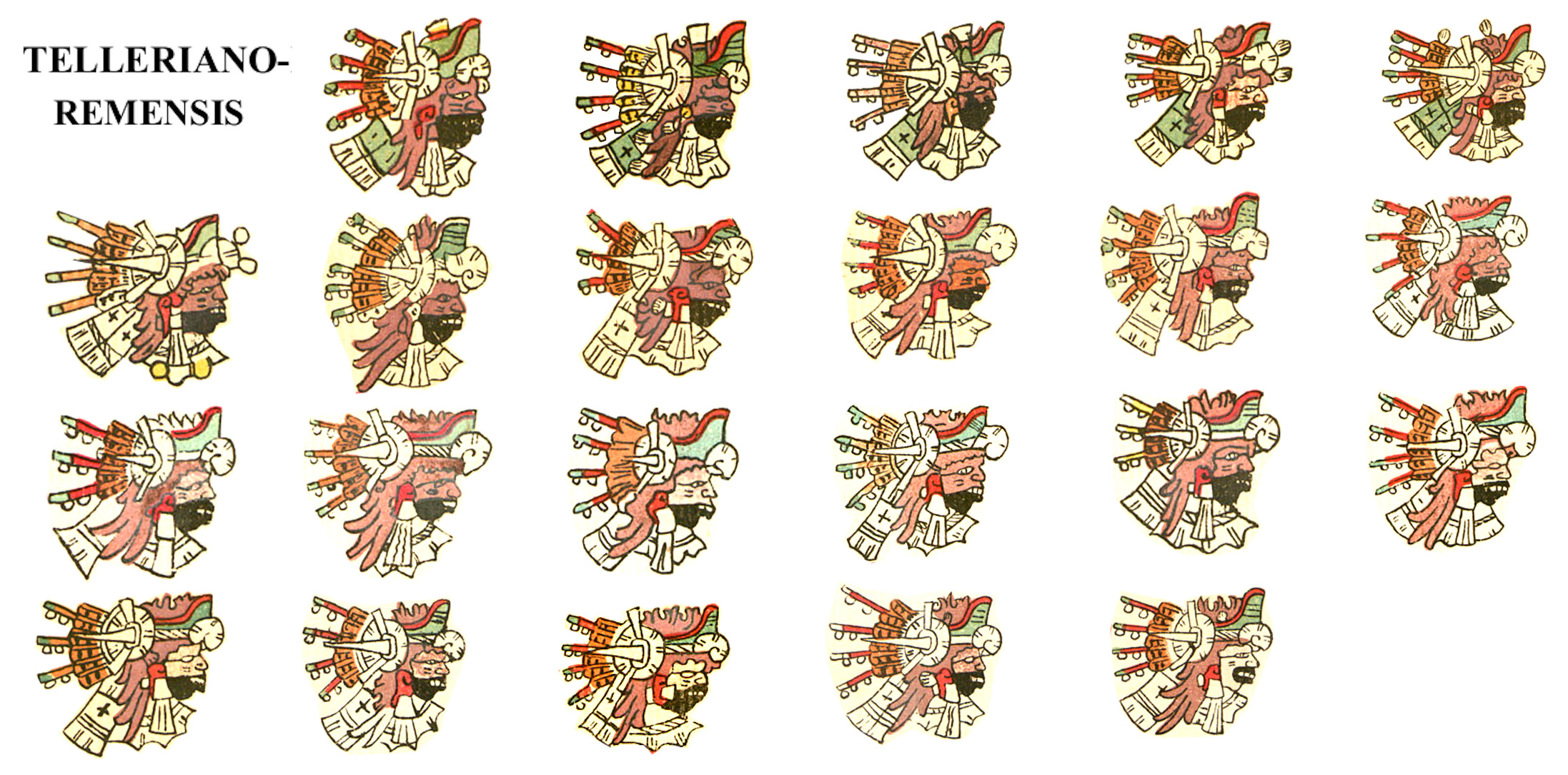
The fifth Lord of the Night—and Lord of the fifth (mid-night) hour of the night—is none other than Mictlantecuhtli. He occurs 29 times during most of the 260-day years. In T-R he’s rendered as a full-fleshed “person” with remarkably consistent accoutrements. There are only 22 faces of Lord Death below because I don’t have copies of a few of the T-R pages. I doubt the missing pages will contain any surprises:
Faces of the Lord of Mictlan (Codex Telleriano-Remensis)
Again, the headdress with spiked ornament is standard, as well as a black lower face. Since these are given in order, there seems to be a greater finesse in the first several busts, if only for the green on the scarf “flaps.” The artist probably got tired as the days rolled by.
Note the plus signs on most of the scarves—they’re NOT crosses but a geometric motif possibly having to do with the four directions and center. Most consistent are the profiles of the Lord. The protruding mouth and often pendulous lower lip must have some iconographic significance, but unless it’s meant to convey menace, I haven’t a clue. Note also the almost identical noses—which appear on several other T-R Lords of the Night. This ancient artist had a clear template.
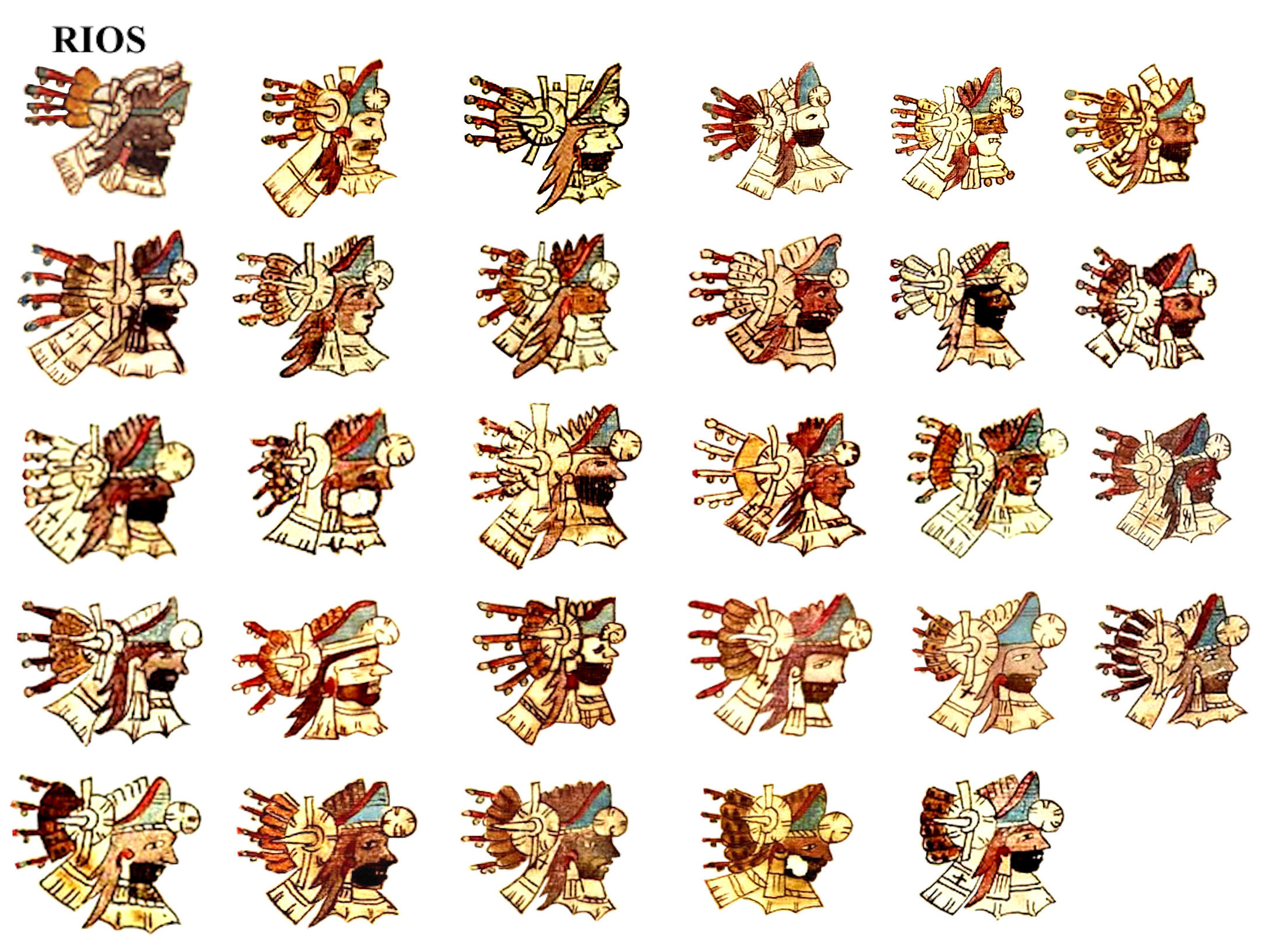
On the other hand, the artist(s) of the Codex Rios copy did not have a standard physiognomy for Mictlantecuhtli. Even standard formats in Rios tend to vary widely in execution and detail. As well, the artist(s) had to squeeze the day- and deity-images to accommodate notes (in Italian) naming the days and good, bad, or indifferent luck. With mostly consistent traditional ornamentation, the faces of Death in Rios are strongly individual:
Faces of the Lord of Mictlan (Codex Rios)
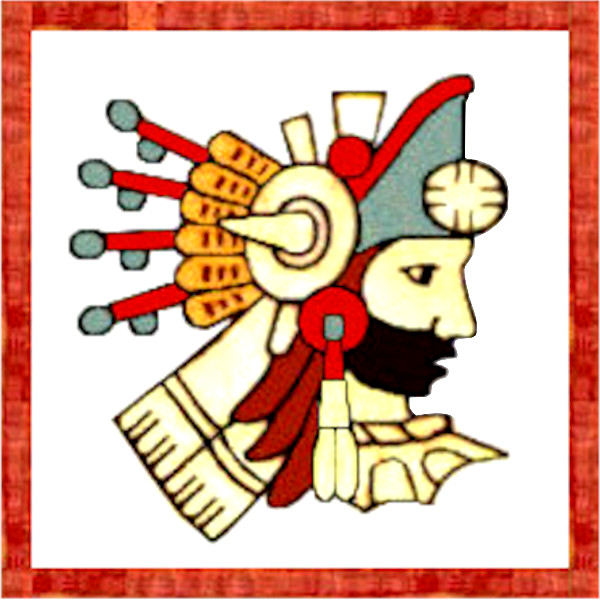
In my re-creation of the Rios tonalamatl, I won’t render all the variant images of the deities but will repeat an established portrait of each one using the modern magic of copying. I cherry-picked among the above 29 images to choose my favorite details and distilled them down to this interpretation of Mictlantecuhtli, the face of Death.
Lord of Mictlan
When I peered through Aztec art and discovered this evocative human face, I fell in love with lovely Death. Now I can look this beautiful Lord in the eye and happily know he awaits. I plan on making him wait for a great long while, but when he beckons, it will be good to fall into his arms.
Over the past few years I’ve switched back and forth between drawing Aztec icons for my coloring book and writing on my second memoir. At last I’ve wrapped the latter up and have just added it to the growing list of my Writings. Note that I don’t copyright my writing; people shouldn’t have to pay to enjoy my art, graphic or literary. So I post it for free download and avoid noxious commercialism. The more folks to read or see my work the better. Or to do something with it if they so feel like…
LORD WIND is the memoir of my second coming out in Milwaukee in 1970. My first coming out was in New Orleans in 1961 (in the gay Stone Age when we lived in caves of secrecy), and I’ve written about my unusual life as a gay man both in my (semi-fictional) novels BAT IN A WHIRLWIND and DIVINE DEBAUCH and in my first (also semi-fictional) memoir THERE WAS A SHIP. The latter (1964-66), was my scandalous tale of going back into the closet.
Now the purely non-fictional LORD WIND (1970-72), picks up again after years of wedlock when I escaped from my cage—and discovered that gay life had evolved into a (Post-Stonewall) Neolithic Era. As a former French Quarter faerie/slut, and now a divorced father and esoteric scholar of 28, I had to deal with the realities of the strange gay “civilization” and make a new life for myself in it.
Richard Balthazar in December, 1970–newly come out for the second time
No longer an outlaw, I still wasn’t exactly socially condoned, but in the new gay atmosphere of openness and promiscuity, I quickly found romantic/sexual entanglements to complicate life. In those two years I learned a heck of a lot about loving men and several hard lessons in maturity.
I’m trying a new format with this book on the web—for ease of access. The webpage is actually its Title page and chapter list, and each can be directly accessed through its link. No more bulky .pdf files of entire texts. I’ll try to convert the others to it too. Early on I issued each chapter of BAT IN A WHIRLWIND separately in blogposts, so that one will be easy to convert.
Wrapping up this book is a really great feeling for me. With it I’ve now built a four-volume saga (epic?) of my life from innocent adolescent through lascivious, debauched youth and responsible, though philandering, husband to a maybe more mature, but at least way more experienced, gay man of 30. This is gay ancient history according to moi… Now I can start the third memoir covering the 70s in Washington DC. In many ways that decade was a Classic Age of gay life and DC an epicenter, and I was right in the middle of it.
However, before I write a word of it, I’ve got to make some good progress on the next icon (#20) of the God of Storms, Tlaloc. While on that subject, you’ll notice that I simply had to use my drawing of Ehecatl, Aztec God of the Wind as a most appropriate title image for LORD WIND.
BTW, my YE GODS! Show is still under lockdown at the Ohkay Conference Center. There’s nothing else I can do with it, so why not?
In isolation at a care-home in Spain where she’s been living for 20 years, Maria Branyas (113) survived Covid-19. For The Guardian, she reflected on what the world may look like after the pandemic: “…I think nothing will be the same again, and don’t think about redoing, recovering, rebuilding. It will have to be done all over again and differently. … You need a new order, a change in the hierarchy of values and priorities, a New Human Age…”
The old order which Maria rejects is, of course, the economic system that informs and directs society. But the Oxford Dictionary defines “economy” as: 1) “the wealth and resources of a country or region, especially in terms of the production and consumption of goods and services” and 2) “careful management of available resources.” Note no mention here of an “order” or “system,” and “management” is simply an undefined process.
Our old order has been in place for millennia. Ever since humans lived in trees, on savannahs, or in caves, there’s been only one rule for management of resources: Take what you can get and keep it. The sole modus operandi for humanity’s economic activity has been private enterprise.
Since absolutely forever, private enterprise has been the only game in town. Political systems will sometimes tweak the rules—and simply complicate matters and magnify existing inequities and injustices. Maria is totally correct about doing it all over again and differently. We don’t need to change the rules of the old game but to start a whole new ball-game!
As the old order, private enterprise has now outlived its effectiveness for managing resources and providing for the common good. In a new ball-game, the wealth and resources of countries or regions can no longer be private property of individuals but public property. And the people can manage their resources themselves, with benefits accruing to the public at large.
A new order of public enterprise and benefit can focus on the common good, supporting, embodying and perfecting democracy. Vigorously and very likely violently opposed by the entrenched old order, such a systemic switch of values and priorities for a “New Human Age” will not come easily. And I’m certainly not the one to say how to make it happen.
After the pandemic devastates economically all but the (corporate) elite, for at least a decade, they say, the old order will try to redo, recover and rebuild. Fantasizing about a future on a global, monopolistic scale, the obsolete system of private enterprise will surely prove even less productive of common good then with the world’s population essentially infinite in number.
If it doesn’t kill us first, this wretched pandemic ironically offers us a now-or-never opportunity to birth a New Human Age. At this unprecedented crux in human history, maybe we can at last create a truly humane society.
In Codices Borgia and Vaticanus, the 13-day ceremonial week (trecena) is laid out in a complex day-count (tonalpohualli) with a panel presenting its divine ruler(s) or patron(s). In Codex Borbonicus and Tonalamatl Aubin, both the Lords of the Day (with their totem birds) and Lords of the Night are included but aren’t very easy to differentiate/identify. In its spreadsheet-format calendar, Codex Cospi also inserts the Lords of the Night in equally sketchy heads and symbols.
Meanwhile, Codices Telleriano-Remensis and Rios (an Italian copy of the former) accompany the trecena day-counts with the nine Lords of the Night. They appear in a super-cycle sequence that takes several 260-day ceremonial years (calendar rounds) to complete. In that sequence, each one presides over the whole night, and in the same sequence, one presides over each of the nine hours of the night. (Point of curious information: The Aztecs counted 13 daylight hours and 9 hours of darkness, so the actual length of an hour varied proportionately and by season.)
In the T-R and Rios codices, the Night Lords are sloppily drawn, even slap-dash, though with consistent, if careless, motifs. I’ve chosen to refine their iconographic images, giving them more realistic faces like in Codices Fejervary-Mayer and/or Laud:
1st Lord—Xiuhtecuhtli—Lord of the Turquoise/Fire. The peaked headdress and red ribbon are standard emblems of this deity who represents the center of time and space.
2nd Lord—Itztli—Obsidian (Knife). I don’t know what the standard black markings on his face might signify, but those things in his “hat” are sacrificial knives.
3rd Lord—Pilzintecuhtli—Young Lord, God of the planet Mercury. He’s also a “sun-lord” as shown by the sun in his headdress.
4th Lord—Centeotl—God of Maize. Check out the indicative cobs of maize in his headdress.
5th Lord—Mictlantecuhtli—Lord of the Land of the Dead. This human image is most unusual for a face of death; usually he’s a skull on a skeleton. (See my Icon #10.)
6th Lord—Chalchiuhtlicue—Jade Skirt, Goddess of Flowing Water. (See my Icon #2.) Females could also be Lords since tecuhtli actually means more like “ruler.” (She may be the ancestral Great Goddess from ancient Teotihuacan.)
7th Lord—Tlazolteotl—Goddess of Filth (literally). Her mouth is black from eating people’s filth/sins. In her headdress are spindles of spun cotton and tassels of unspun, showing that she’s also the goddess of weaving.
8th Lord—Tepeyollotl—Heart of the Mountain, God of Caves/Volcanos/Earthquakes and Jaguar of the Night. I can’t explain his tri-color face in these calendars. (See my Icon #17.)
9th Lord—Tlaloc—God of Storms. His goggle-eyed, long-toothed visage is emblematic in most codex contexts. (See my Icon #20.)
For the 2nd Lord of the Night, some sources name Tezcatlipoca, the Smoking Mirror (See my Icon #19) in place of Itztli, but that’s based solely on his image on the Night Lord page in Codex Borgia (p. 14) showing them in full figure. In fact, Itztli is a principal nagual (manifestation) of the “Black One,” who’s supposedly invisible. The Borgia figure has a sacrificial knife as one of his feet, so it clearly intends to be Itztli.
#
Recently my knowledgeable Mayanist friend mentioned that the unusual 52-count of solar years (“Aztec Century”) in Codex Borbonicus accompanies each year with a Night Lord, though in a strange sequence/cycle unlike that for the day-count, and he explained the basis for it. I’d never paid that year-count much attention, and his explanation was an eye-opener. The 52- count of solar years (not of 260-day ceremonial years!) in that codex appears on two pages (pp. 21 & 22), each with 26 years in their ritual count in a system related to the day-count.
Four of the days in the 20-day month of the solar calendar are (for very complicated, but comprehensible reasons) are chosen as “year-bearers:” Rabbit, Reed, Flint, and House. In that order, they’re counted in cycles of 13, i.e. One Rabbit, Two Reed, Three Flint, Four House, Five Rabbit, Six Reed, etc. Like the trecena process in the ceremonial day-count, this produces four trecenas of years, which I call “trecades.”
Curiously, the century cycle is structured just like a cross-counted deck of playing cards with Rabbit = Clubs, Reed = Diamonds, Flint = Hearts (appropriately), and House = Spades. In this correspondence, the numbers work as well: 1 = Ace, 11 = Jack, 12 = Queen, and 13=King. By the way, in the following image of the first half of the cycle, the central panel portrays the goddess of the night Oxomoco (on the left, strewing stars like seeds) and the god of the day Cipactonal (on the right, burning incense).
First Half of the Aztec “Century” Count, Codex Borbonicus, p. 21
This first page of the count lays out the One Rabbit and One Reed sequences, each with a Night Lord as principle divine patron of that year:
Clockwise from lower left One Rabbit—Mictlantecuhtli Two Reed—Piltzintecuhtli Three Flint—Tlaloc Four House—Tlazolteotl Five Rabbit—Centeotl Six Reed—Xiuhtecuhtli Seven Flint—Tepeyollotl Eight House—Mictlantecuhtli Nine Rabbit—Piltzintecuhtli Ten Reed—Tlaloc Eleven Flint—Chalchiuhtlicue Twelve House—Centeotl Thirteen Rabbit—Xiuhtecuhtli
Clockwise from upper right One Reed—Tepeyollotl Two Flint—Mictlantecuhtli Three House—Piltzintecuhtli Four Rabbit—Tlaloc Five Reed—Chalchiuhtlicue Six Flint—Centeotl Seven House—Piltzintecuhtli Eight Rabbit—Tepeyollotl Nine Reed—Mictlantecuhtli Ten Flint—Itztli Eleven House—Tlaloc Twelve Rabbit—Chalchiuhtlicue Thirteen Reed—Centeotl
The little glyphs of these Night Lords are fairly consistent, though sometimes hard to recognize. Note the three stylized place symbols (for Seven Flint, One Reed, and Eight Rabbit), which represent a mountain with a heart emblem (i.e., Tepeyollotl, Heart of the Mountain). Also note that 10 Flint is accompanied by a stylized sacrificial knife (i.e., Itztli).
The busts of the other Lords are mostly recognizable by their regalia, except for confusing variations in the four differing instances of Pilzintecuhtli (Two Reed, Nine Rabbit, Three House, and Seven House) and the two of Xiuhtecuhtli (Six Reed and Thirteen Rabbit). Further confusion is caused by the fact that Xiuhtecuhtli in Six Reed and Pilzintecuhtli in Seven House are both singing/speaking. We just have to learn to live with these inconsistencies.
The second half of the count occurs on p. 22, presenting the One Flint and One House sequences, each year again with its patron Night Lord in an entirely different selection. You can make your own list of patrons. The system for assigning annual Night Lord patrons is another tie-in with the ceremonial day-count. Each year (like One Rabbit, Two Reed, etc.) is paired with the Night Lord for the corresponding numbered day in its trecena (Mictlantecuhtli, Pilzintecuhtli, etc.)
Because of the nine-cycle of Night Lords in the tonalpohualli and the 52 years in the century, the year patrons don’t work out evenly or in a logical pattern. Some appear 6 times, some 5. Of course, the nine-cycle also doesn’t quite fit in the tonalpohualli itself (260 / 9 = 28.89), and it can only accomplish a full cycle in 9 years (28.89 X 9 = 260). That means that the first ceremonial year ends with Tepeyollotl on Thirteen Flower, and the second year starts with Tlaloc on one Crocodile. The ninth year will finally end with Tlaloc on Thirteen Flower.
Consequently, the sequence of Night Lords from which the annual patrons are selected exists only in the first calendar round of the standard tonalpohualli. In the next eight rounds, the days all have different Lords of the Night as patrons. Does this mean that the years in the next eight centuries had different patrons too? Then the tenth century returns to the first distribution. This odd cycle means that the Aztecs may have counted a “nonennium” of 468 years (9 X 52 = 468), or perhaps the repeating tenth century constituted a true millennium of 520 years.
Perhaps they did—I’ve seen somewhere that they considered the previous four Suns/eras (Four Jaguar, Four Wind, Four Rain, and Four Water) to have lasted 520 years. In that case, since we don’t know exactly when the Fifth Sun (Four Earthquake) began, it probably ended officially at some point in the 16th or 17th Gregorian century.
I have no difficulty personally in construing the Fifth Sun as starting on or around 1000 CE during the Toltec dominance and ending in 1519 CE when the invaders obliterated the Aztec empire. If so, a Sixth Sun (which for obvious symbolic reasons I would choose to call Four Death) may have begun in 1520—to end in or around 2040 CE. In another 16 years, we may move into a Seventh Sun (which I would hopefully call Four Flower). Once again, we could be looking at a Mesoamerican cycle ending, this time as an Aztec prophecy.
In Aztec culture, notions of time are central and perhaps inordinately important in terms of fate. Life was embedded in and permeated by strict divisions of divinatory time, starting with the agricultural and ceremonial calendars, in which respectively the 20 named days of the “month” (vientena) were counted in 13 numbered days of the “week” (trecena). The basic division of the day was, of course, between day and night (with Cipactonal as god of the daytime and Oxomoco as goddess of the nighttime). This is where things get strange from our modern perspective.
Having no clocks per se to measure passing time, the Aztecs decided there were 13 “hours” in the daytime and 9 in the night. (No doubt, this reflects their 13 heavens and 9 levels of the Underworld.) With only an amorphous measure for a “minute,” they probably never even thought about an Aztec “second.” Their 22-hour diurnal cycle meant their hour in our terms averaged 65½ minutes long, the day lasting 14.18 and night 9.82 of our hours. In any case, their hours must have been only approximate and varied in actual length.
Anyway, a deity was in charge of each day of the trecena, 13 gods or goddesses called Lords of the Day, a list about which, in scholarly fact, there’s some disagreement. The 13 numerals themselves are also ruled by deities, but apparently in a different list. There are also deities in charge of each numbered heaven, but again that list seems to differ substantially. I’ve only seen confused references to various heavens and suspect that the 9 Night Lords might correspond to the 9 levels of the Underworld. But probably not since Mictlantecuhtli is the ruler of not the 5th, but the 9th (lowest) level of Mictlan. Nobody ever said that mythology has to be consistent, and I don’t care to sort out so many lists.
Figuring out the Lords of the Day is work enough. The sequence of full-figured Lords in Codex Borbonicus seems the same as the sketchy heads in Tonalamatl Aubin (with some odd problems there). Looking at an ostensibly authoritative list on Wikipedia, I found a problem in Borbonicus itself: #11 (identified there as Mictlancihuatl, Lady of Mictlan), is evidently not a female and wears a pointy headdress like the one usually associated with Mictlantecuhtli, her consort already listed earlier. Another problem there is with #13 (identified as Citlalicue, Star Skirt), who looks a lot like Mictlancihuatl in Codex Magliabechiano, though I believe Citlalicue is sometimes shown as an Underworld goddess too.
With those questions, I checked the online Mexicolore.co.uk, which complicates the list even further. Instead of #5, Tlazolteotl, they list some deity I’d never heard of: Tonaleque. Instead of #7, Centeotl, they cite Tonacatecuhtli, Lord of Sustenance; for #11, Mictlancihuatl, they insert Yoaltecuhtli, God of Darkness (an odd sort of deity for Day Lord); and for #13, Citlalicue, they propose Ometecuhtli, Lord of Two and the same deity as Tonacatecuhtli–a male. I’m left still wondering about the masculine Mictlancihuatl.
Puzzled, I consulted the premiere authoritative source, “Cycles of Time and Meaning in the Mexican Books of Fate” by Elizabeth Hill Boone, and she helped clarify. For #11, she lists Chalmecatl, He of Chalma, a god of some level of the Underworld indeed related to Mictlantecuhtli. For the feminine #13, Boone’s suggested Ilamatecuhtli should actually be Ilamacihuatl, which is simply another name for Omecihuatl/Tonacacihuatl. As half of Ometeotl, the Deity of Two, the creative pair who birthed the principal gods, co-patron of the Crocodile trecena, and co-ruler of the 13th heaven, she well deserves a slot as a Lord of the Day, especially as #13. I’ve not seen her depicted before as a skeletal deity of the Underworld, but I suppose it could well be she.
I’m happy to include Boone’s #11 and #13 (adjusted) in my roster of the Lords of the Day.
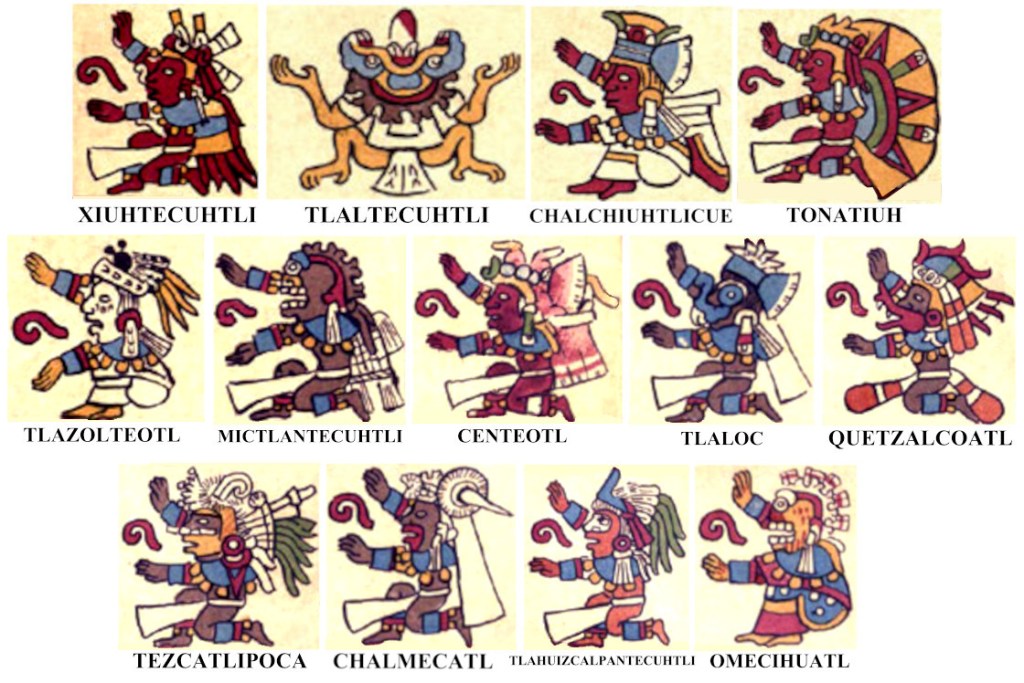
Xiuhtecuhtli, Lord of Fire/Turquoise
Tlaltecuhtli, Lord of the Earth
Chalchiuhtlicue, the Jade Skirt, Goddess of Flowing Water
Tonatiuh, God of the Fifth Sun
Tlazolteotl, Goddess of Filth
Mictlantecuhtli, Lord of the Land of the Dead (Mictlan)
Centeotl, God of Maize
Tlaloc, God of Storms
Quetzalcoatl, the Plumed Serpent
Tezcatlipoca, The Smoking Mirror
Chalmecatl, He of Chalma, an Underworld deity
Tlahuizcalpantecuhtli, Lord of the House of the Dawn (Morning Star)
Omecihuatl, Lady of Two
Here below is my rogues’ gallery of Day Lords as seen in Codex Borbonicus:
Lords of the Day from Codex Borbonicus
Whoever they are for real, I suggest that these same Day Lords rule the respective 13 daytime hours. Striving for elusive mythological consistency, I’ve also proposed that the 9 nighttime hours are ruled by the 9 Lords of the Night. Maybe, maybe not… The Aztecs tended to complicate their paradigms, some might say unnecessarily.
However, we do know for sure the numerical sequence of totems for the Lords of the Day. These totems are called in the jargon “volatiles” because they’re things that fly: birds and a butterfly. (Apparently other deities also have volatiles, like the bat or vulture of Itzpapalotl, but I’m not all that up on the finer details of Aztec ornithology.) Here are my versions of the volatile totems for the 13 Lords of the Day (whoever they really are), the 13 days of the trecena, and (possibly) the 13 daytime hours. They are drawn on models from Codex Borgia, plate 71.
I’m happy to announce the completion of Icon #19 – Tezcatlipoca, the Smoking Mirror. Once again, the designs and motifs in this icon are drawn from images in the surviving pre-Conquest Aztec codices. It and the preceding 18 icons can be downloaded as .pdf files with captions from the YE GODS! coloring book page.
Tezcatlipoca, the Smoking Mirror
First, I should offer some tips for coloring if you’re so inclined:
1) The black stripes on the faces of the upper left and right figures should be paired with yellow, which is the emblematic color-scheme for this deity; in the original, the upper central figure is mostly white with a few color highlights—at your discretion.
2) All those sacrificial knives (flints) in the borders are supposed to be half white and half red, in whatever pattern you choose.
3) The patterns on the limbs and face of the main figure are supposed to be red tattoos; I should also note that in the original he has brown hair.
4) The hair-like figure flowing from the head of the monster should be red blood as well as the apparent stream from the deity’s severed leg. The rest of the colors are up to you.
The horned owl at top center is Tezcatlipoca’s personal “volatile” symbol (many deities have one). The upper figures are some of his various manifestations. The main scene is the story of the god’s battle with the Earth Monster (Cipactli) in which he lost a foot and then created the First Sun (or world), Four Jaguar, on her back. The day-signs along the bottom are those representing the direction North, with Jaguar numbered as four to name the Sun being created just above. The dots along the side are the numeral 10, of which Tezcatlipoca is patron, and they also indicate that he is the 10th lord of the Day.
That should be enough to get you going. As soon as I can, I’ll post the icon on the coloring book page in vectors so it can be sized freely with no change in line quality. Now, when I’ve caught my breath, I’ll move on to Icon #20 – Tlaloc, the Storm God.