An Aerobic Insight

Most of my penetrating insights come while peacefully tromping the treadmill (lengthening those pesky telomeres to counteract aging—which I’ve done more than enough of in eight decades of breathing). Nearing the mile mark the other day, I suddenly considered that our abominable chief executive might well have a death wish.

On further consideration, I saw that my amateur psychoanalysis of the beast should be more complicated than that. The vile creature probably doesn’t wish for death as a release but as an apotheosis, quite possibly its ultimate goal.

I understand that its campaign goal was purported to be to “Make America Great Again,” but I also understand ‘great’ in its diabolical terms to mean ‘a rich (old) white man’s country.’ That would be just like America used to be under the heartless oligarch’s favorite president, Andrew Jackson, with whom it shares many biographical and attitudinal characteristics.

Not the least of those is being a megalomaniac real-estate rustler, cynical and dishonest game-player, and unscrupulous persecutor of non-rich and non-white populations. All its policies and actions show unambiguously that our rogue leader is in no way a humanitarian, but an aristocratic despot engaged in a class and racial war.

Its now-failed attempt to extort funds from Congress for a barrier to human freedom by closing down the government was intentionally designed to damage the economic security of the non-rich and people of color and deepen the class and racial divides.

Even with the government re-opened, that social divide will remain much deeper than before. In its misanthropic view, that political atrocity was still a battle essentially won.  In future battles, its strategy will be the same and tactics just as inhumane and ruthless.

The hubristic autocrat will see the people’s suffering, unrest, and possible resistance as futile. Winning the class and race war is to be its historic contribution to society, human and cultural costs be damned.  For the amoral, the ends justify the means.

Total victory would of course be to re-institute slavery, re-establish a nobility, and address the population situation with genocidal solutions—the true essence of conservatism. Should resistance not prove futile and someone manage to eliminate it, the monster would probably consider that the best-case scenario.

I’ll bet the demagogue is psychotically jealous of the eternal glory that Lincoln and Kennedy achieved through being assassinated—or more grandiosely of the immortal fame of Julius Caesar. (For the tragically murdered, all faults and sins are apparently forgiven.)

If so, the unbelievable genius would become not only a messiah for rich (old) white men, but a sainted martyr. Let’s call the spade a self-anointed second Jesus Christ—sacrificed for the sins of humanity.  Sad.

If these are truly the demon’s delusional ambitions, we have to ask which would be preferable: for the scoundrel to win its inhuman war or for it to become a glorious hero?  I would opt instead for the slight chance that it might lose the war and go down in history as an unparalleled villain.

#


Aztec Icon #16 – TONATIUH and METZTLI, Deities of the Sun and Moon

It’s been about nine months since the last addition to my coloring book YE GODS! Icons of Aztec Deities, #15, Quiahuitl, God of Rain. After completing it back last April, I had to focus on setting up the two-month Ye Gods! exhibition in Santa Fe, as well as prepare and deliver several lectures.  Then everything else, including work on my second memoir, had to be put on hold while I concentrated for three months on re-translating an opera from Russian (which will be produced by the New Orleans Opera in February, 2020).  Meanwhile I also set up the exhibition for another month in nearby Española.  Busy boy, no?

Finally by late November, I got back to drawing, and now I’m thrilled to announce that #16 is finished at last. (At first I thought it was Tecciztecatl and Metztli, Deities of the Moon, but much later I’ve now discovered that it is Tonatiuh and Metztli, Deities of the Sun and Moon.)

TONATIUH & METZTLI

At first I worte that Tecciztecatl {tek-seez-te-katł}, the son of Tlaloc and Chalchiuhtlicue, is a god of hunters and appears as things shining in the night. In the Nahua cosmology, when Quetzalcoatl and Ehecatl created the current Fifth Sun, Tecciztecatl wanted to become the new sun, but he hesitated to jump into the sacred fire, whereupon the young god Nanahuatzin leapt into the flames to become Tonatiuh, the Fifth Sun.  When Tecciztecatl followed, he took second place as the moon. Well, it turns out that the little guy throwing himself into the fire here is actually Nanahuatzin, and the male deity here is Tonatiuh, the sun, in the pair with the moon.

Metztli {mets-tłee} is the ancestral moon goddess probably inherited from ancient Teotihuacan and/or the Maya’s lunar goddess Ix Chel.  Long after the Nahuas demoted Metztli to merely being the consort of Tecciztecatl (in Tonalamatl Aubin), and replaced her with Tecciztecatl in several other codices, the later Aztecs tried to replace her completely with (the severed head of) Coyolxauhqui, the sister dismembered by their supreme god Huitzilopochtli.

Tecciztecatl was stuck into the sacred calendar (tonalpohualli) as one of the patrons, frequently in the company of Tonatiuh, of the thirteen-day week One Death, which is shown in the encircling day-signs.  It should be noted that there are thirteen days between the full and dark of the moon.  The Mesoamerican cultures saw a rabbit in the full moon (top), and the serpent of the night devouring the rabbit (bottom) represents the dark of the moon.  Incidentally, the nocturnal jaguar was closely connected with the moon, and the conch shell was the standard symbol of the moon.

I fired the drawing off to my dear friend Sagar in Bangladesh for him to work his vectorizing magic on it, and he did the trick.  I’m currently (in January) posting the jpeg version with caption and sources on the coloring book page and have now (in April) have added the vectorized versions to the list of various sizes available for free download.

In my strict alphabetical sequence, the next deity to tackle is Tepeyollotl, Heart of the Mountain, who has several dramatic aspects.  You can check out my earlier image of this god among the Aztec images from the old book on the calendar.  If the creek don’t rise, I’d like to get his icon done by April.  Once again meanwhile, in my multi-tasking fashion, I’ll be arranging more venues for the expanded exhibition and lectures—and forging onward in my memoir. Call me driven, but I’d love to finish that by next year.

A Roar of Jaguars

In the past few years, I’ve realized that, in the Native American tradition, I seem to have an animal totem, the jaguar. This past year when I started my second memoir, I understood my deep connection to this apex predator of the Americas and included an illustration:

My Totem Jaguar

I also realized that this magnificent feline has been lurking in my background for at least 35 years. At a yard sale I’d bought a carved-wood figurine and stashed it away as a curiosity.  Later I gave it as a birthday gift to a friend, who returned it explaining that there was some spirit in it which didn’t “resonate” with him.  Stashed away again, it sat on a shelf for decades—following me around to various domiciles.  Then about a year ago I recognized it for a jaguar-priest or shaman from some South or Meso-American tradition.

My Jaguar Priest Figurine

It suddenly made sense that this jaguar figurine was probably why some 30 years ago I’d gotten so involved in the Aztec milieu. I soon learned that this New World King of Beasts had originally roamed throughout most of the South and Meso-American jungles and even ranged north into the American Southwest (apparently now making a comeback in southern Arizona!).

I also learned that the noble jaguar was central to the mythologies of basically all the ancient civilizations of the New World (just as the lion was to those of the Old). First off, I found it in the Aztec calendar, as the 14th day of their agricultural month and in the second week of their ceremonial count of days (tonalpohualli).  Starting with the day Ce Ocelotl – One Jaguar (those with this birth day-name coincidentally being destined for sacrifice), that second week was under the patronage of the god Quetzalcoatl, the Plumed Serpent.

I already knew that the Aztec ceremonial calendar had been more or less inherited from the much earlier Maya and then discovered that it, just like its patron deity, was also revered by the even earlier Olmec. Then about three years ago in considering that maybe the sacred calendar’s count of days had originated in the still earlier Chavín civilization in Peru, I learned that the jaguar was for them also a major deity, often seen as an ornate man-jaguar.  Do note this Chavín were-jaguar’s startling snake-locks!

Chavin Were-Jaguar

If my suggestion that the count of days originated at Chavín de Huantar is correct, that ritual (more like a religion), was carried north by trader-missionaries to populations along the Pacific coast. Ultimately they crossed the Isthmus of Tehuantepec and proselytized the Olmec with the sacred way of telling time.  Many surviving Olmec sculptures are of infant were-jaguars.

Coincidentally, earliest calendar lore has it being brought by a god, namely the Plumed Serpent, who was also the bringer of maize (and culture). Between the calendar, the jaguar, and this legendary civilizer deity, they had a rather well-rounded theosophy, even if some rituals might have involved sacrifices frowned on nowadays.

It’s now become reasonable to think that the early Maya were “civilizing” in Yucatan at much the same time as the Olmec were hard at it in Veracruz. More mercenary missionary work was probably what took the calendar to the Maya.  They hugely elaborated and ornamented the new “faith” with their own deities and even started writing about it in glyphs.

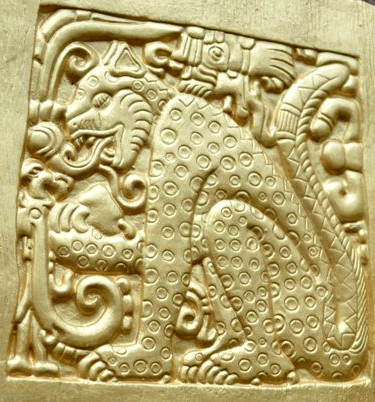
Along with calendar, the jaguar deity (B’alam) came to the Maya, but their representations of it were generally not anthropomorphized.  I found a spectacular relief at Chichen Itza on Google Images, apparently a repro in gold (!), that’s both naturalistic and stylized.  Not to gross you out, but I bet that’s a heart it’s holding in its paw and licking.

Mayan Jaguar from Chichen Itza

Of course, the third part of the religion was the Plumed Serpent, the civilizer deity whom they called Kukulcan (or Gugumatz).  This Triad then moved west and north to early Teotihuacan, where the Serpent likely became known as Quetzalcoatl, or maybe that was amongst the later Toltecs.  That calendar religion reigned across the centuries and other areas of Mexico, as shown by this jaguar totem from the Zapotecs, possibly a funerary urn.

Zapotec Jaguar

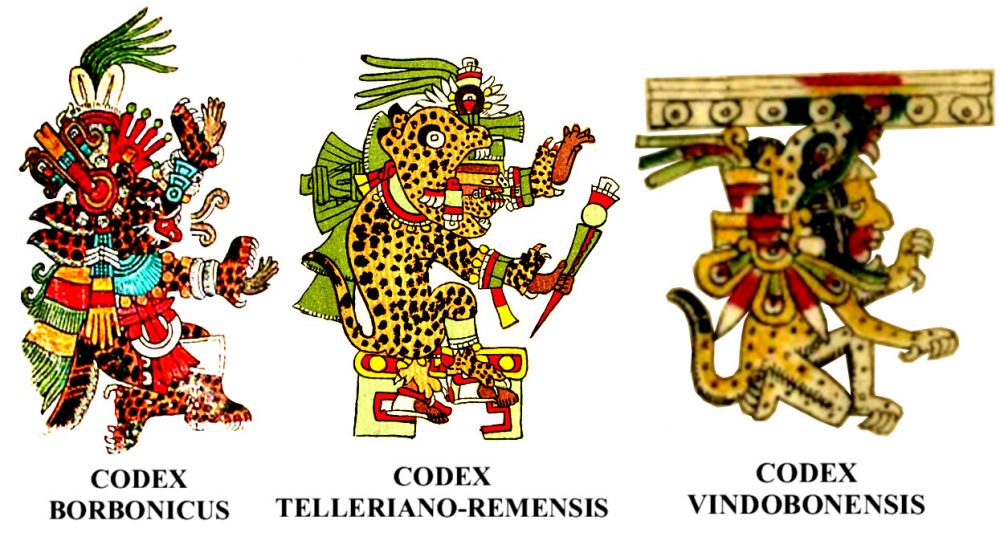
Eventually, the barbarian Aztecs came out of the north and adopted the local religion, and it came to be known and misunderstood as the “Aztec Calendar.” In their historical or genealogical picture-books, many of which were from other cultures like the Mixtec, the were-jaguar shows up as jaguar warriors.  These “jaguar-weres” were simply humans wearing jaguar pelts.

Perhaps the most dramatic Aztec jaguar is a sculpture (receptacle for sacrificial hearts!), now in the Museum of Anthropology:

Aztec Jaguar

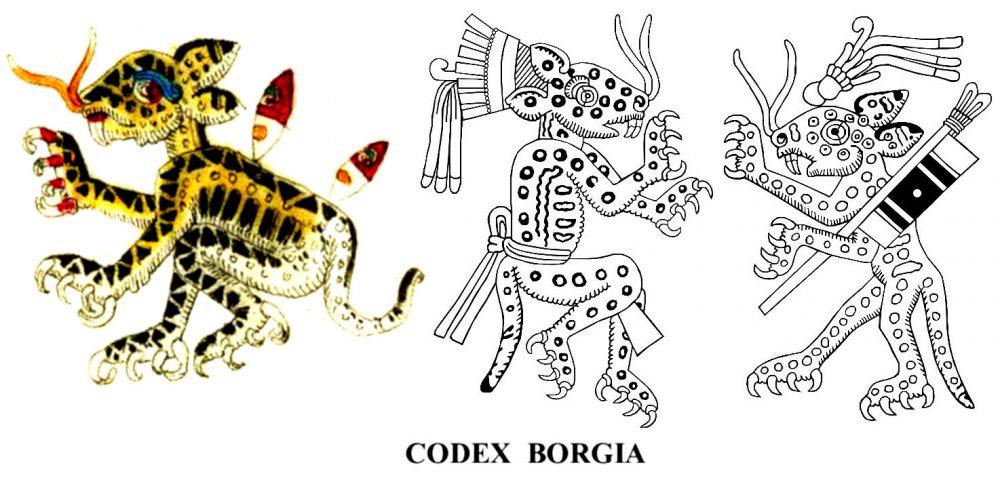
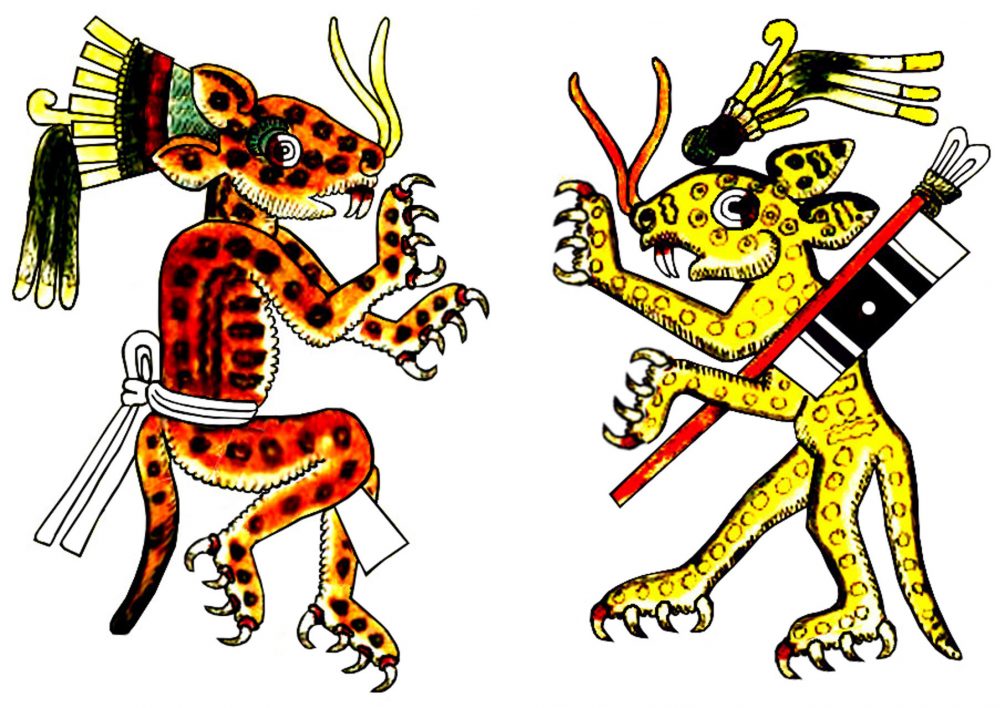
In their religious documents, the jaguar is generally depicted as a divine animal such as these two from Codex Borgia, (adjusted and adapted to prepare for drawings in my next icon).  By the way, those wavy figures represent the jaguar’s roar.

Jaguars from Codex Borgia

Modelling mine on the image on the left, several years ago as my first attempt at drawing on computer, I drew a jaguar with a realistically patterned pelt (and more aggressive demeanor). Intended to be the apotheosis of the Lord of the Animals, the drawing had to wait some three years to be enthroned in YE GODS! Icon #11 – OCELOTL.

My Jaguar–Lord of the Animals

But I’m not done with this roar of jaguars! Recalling that the historical range of the jaguar reached up into North America, there is the possibility that the creature may have been known, or at least recalled, by populations outside of the desert Southwest.  I’m talking about my other favorite topic, the Mississippian “civilization.”

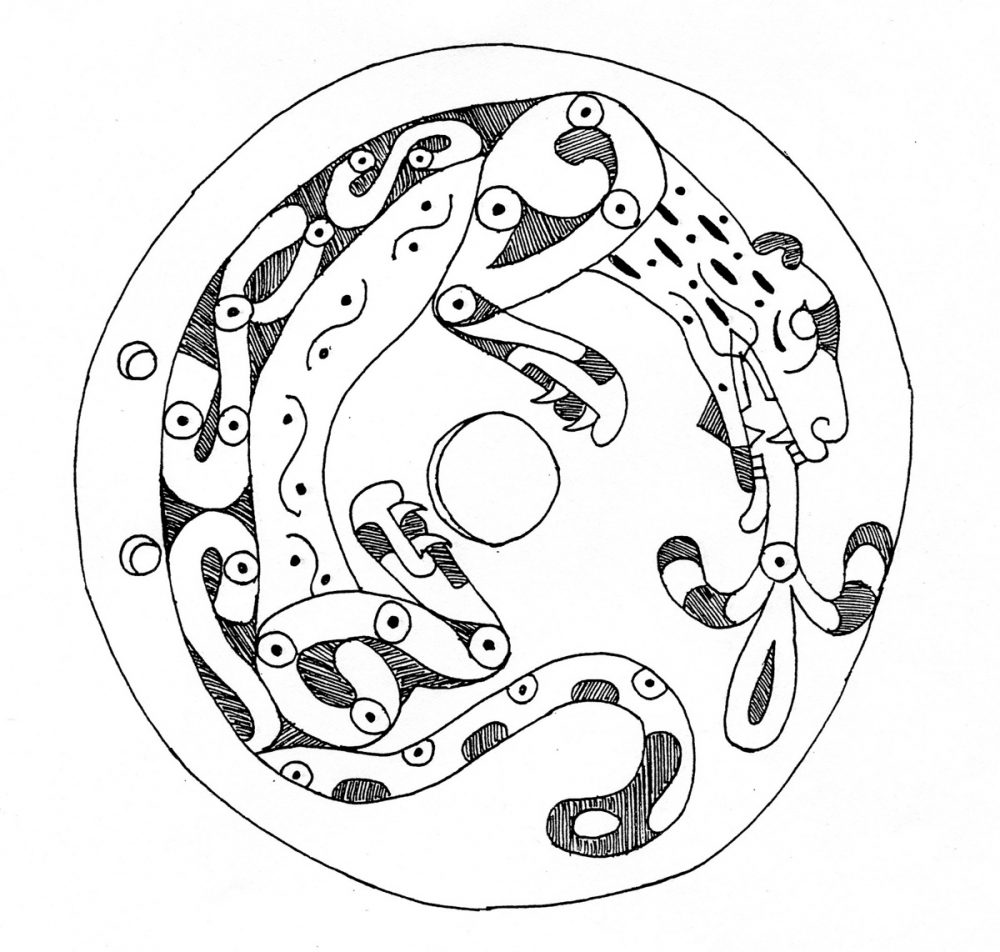
I found a trace of the calendar and image of a heavily stylized man-jaguar in the Southeast and drew this fanciful animal below from a shell gorget (from Fairfield MO across the river from Cahokia) for a book on the Indian mounds.  (See my Gallery of Pre-Columbian Artifacts.)

Jaguar Gorget – Fairfield MO

In the magazine “Ancient American,” Vol. 21, No. 116, I wrote about the cult of the Plumed Serpent in North America, which shows that the trinity of Calendar-Jaguar-Serpent was a Pan-American “religion.”  Small wonder I feel the jaguar my totem—it’s the totem for all Americans.

#


Ancient America-Asia Coincidences

Recently I came across two historical coincidences worthy of comment. Both may be archaeologically, or at least anthropologically, significant.

  1. The Rabbit in the Moon.

Readers should be advised that I’ve “studied” (more like “obsessed with”) things Mesoamerican for about 30 years now, and have become fairly conversant about their mythology and art, mainly of the Aztecs. More about that in a moment.

Some decades ago I learned that the Mesoamerican peoples saw a rabbit in the moon. This “moon rabbit” was famous amongst the early Maya, shown here with the moon goddess Ix Chel:

The image of a rabbit in the moon occurs in two of the surviving pre-Conquest Aztec codices (picture-books) and in one of the post-Conquest documents.

Aztec Rabbits in the Moon

Learning about this lunar bunny, I checked out the full moon and immediately saw it clearly. Before, I’d never really been able to see a face in the moon (the European tradition), and now I can see nothing but the rabbit.  In my Aztec obsession, I’ve spent the past several years drawing icons of their deities and am now working on the god of the moon, Tecciztecatl.  As a detail for that icon, I’ve concocted my own Moon Rabbit in an Aztec style and in the orientation I’ve scientifically observed.

Imagine my surprise when I read a book about Chinese myths and legends and discovered that the ancient Chinese also saw a rabbit in the moon. Under “Moon Rabbit” on Wikipedia, I learned that in their inscrutable oriental way, the image the Chinese saw was a rabbit facing to the right—and anthropomorphically using a mortar and pestle to pound herbs or medicines (that equipment occupying the area of my bunny’s bottom).

The entry advised that this traditional image also spread to Japan and Korea and added, “Legends of moon rabbits exist among some of the indigenous peoples of the Americas.” Then the entry states categorically:  “These legends were not influenced by Asian cultures.”  This gratuitous pronouncement smacks of a polemical personal opinion designed to forestall any further discussion of the subject.  Typical…

Now, I’m not arguing that this coincidence necessarily shows any America-Asia connection. It’s quite reasonable that the two widely separated peoples could see the same familiar creature (in differing perspectives) in the Rorschach blur on the moon’s orb.  The bunny could well be a pure coincidence (though some say there are no coincidences).

  1. The Ten Suns

In the same book of Chinese myths and legends, one struck me as surpassingly surreal. The god of the eastern sky, Di Jun was the father of ten suns [sic!] which took turns crossing the sky on each of the ten days of the week.  But they got bored with the routine and one day decided to ride in their chariots all together across the sky, which heat caused great damage to the earth and its creatures.  Unable to make his suns behave properly, Di Jun summoned the Divine Archer Yi and gave him a magic bow and arrows to make the suns resume their rotating duties.  Yi shot down nine of them, leaving only one to cross the sky every day.  That solution greatly distressed Di Jun, who condemned Yi to live a mortal life.  Curious tale…

A few months later I read a book called “Native American Myths and Legends,” which was published by Arcturus Publishing Ltd. in London (2017). The stories were recorded by a range of different writers/ethnographers from the 19th and early 20th centuries.

The story that stopped me in my tracks was attributed to a tribe called “Shastika” and taken from a book by Katharine Berry Judson, “Myths and Legends of California and the Old Southwest (1912). That tribe from northern California/southern Oregon is now called simply Shasta or Shastan and logically relates to the magical Mount Shasta. Per Wikipedia, by the early years of the 20th century perhaps only 100 Shasta individuals existed, and some few Shasta descendants apparently still reside in various reservations with other tribes.

The story is called “Old Mole’s Creation.” (Forgive my disrespectful levity, but the title calls to mind a character from that ancient comic strip “Pogo”—Ol’ Mole was blind as a mole and an avid bird-watcher!) Anyway, first “Old Mole burrowed underneath Somewhere and threw up the earth which forms the world.” Then, “in the beginning, Sun had nine brothers, all flaming hot like himself. But Coyote killed the nine brothers and so saved the world from burning up.” Those two simplified sentences are an obvious restatement of the Chinese legend of the ten suns.

But the Shasta tale does the Chinese one better by adding a parallel plot: “But Moon also had nine brothers, all made of ice like himself, and the Night People almost froze to death.” So as the Moons arose, Coyote killed nine of them with his flint-stone knife saved the Night People. Native American story-telling loves coyotes and symmetry.

These two tales of the ten suns are simply too counter-intuitive (and weird) to have developed independently. So I’ll boldly claim that they prove an ancient cultural connection between Asia and America. (They clearly support Gavin Menzies’ book “1421: The Year China Discovered America” and Laurie Bonner-Nickless’ interminably titled book about Chinese exploration of North America in 1433-34, which was just reviewed in “Ancient American,” Issue 121.)

Cue the academic inquisitors!

#

Ancestors, My Fore-Folks

So I’m finally getting around to following up on my earlier blog: Ancestors, Level 1, My Parents. To be gender-neutral, this one will be a composite about my “Fore-Folks” going back a few generations.  On my maternal side, I’ve had the enormous help of second cousin Gus who at 94 still lives in Baltimore and has been keeping track of all the descendants of his grandfather (and my great-grandfather) Eugene Trinité.  He has sent me photos of even more fore-folks.  But let me proceed properly:  backwards.

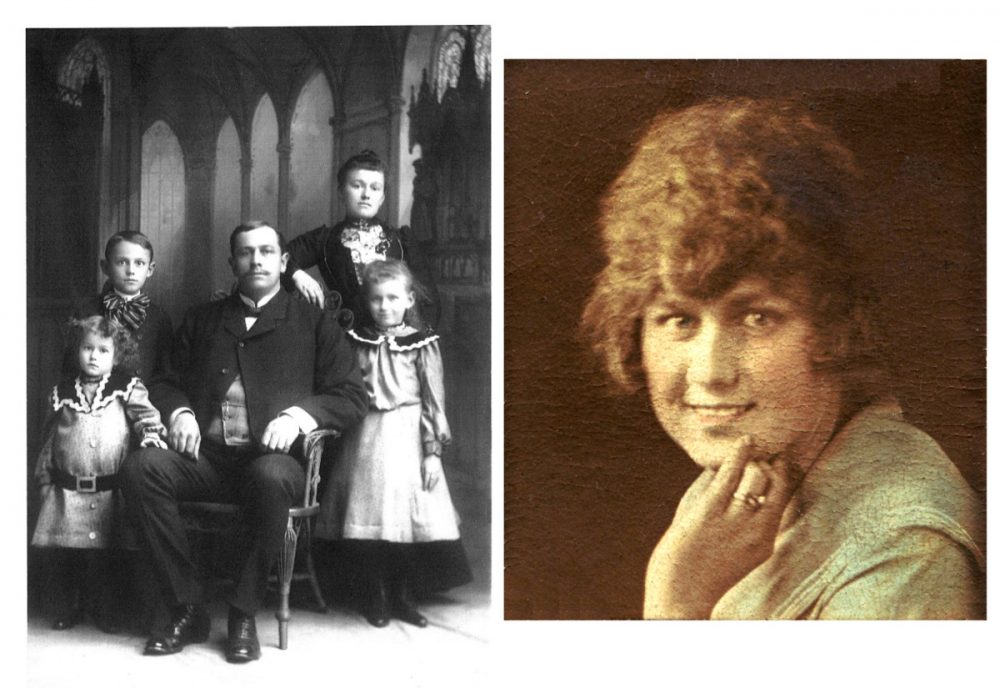
My maternal grandmother Freda Marie Rosenbauer was born March 20, 1895. Freda’s father was Otto William Rosenbauer (great-grandfather), who was born in Austria in 1868. It seems his wife Marie (née Pemsel) was born in 1869 in Germany.  Probably around 1890 they immigrated to Baltimore, Maryland, met, and early in that decade were married.  Otto was a Victorian silversmith and a partner in A. G. Schultz & Co.  That famous company made repoussé sterling hollowware that now sells for large sums.  That’s as far back as I can take Freda’s line.

Otto and Marie Rosenbauer with family, 1905; Freda Rosenbauer, 1910

My maternal grandfather George Marius Trinité, was born on May 15, 1890 in Providence RI. He married Freda on March 29, 1917, just in the nick of time before the US entered WWI.  Just saying…

George and Freda Trinite, 1956

George had a printing shop which I well remember from our rare visits to Baltimore (Ballmer). What I remember most fondly was their big house on Elsinore Avenue (near Druid Hill “Droodle” Park)—and tricking Grampa George by emptying out walnuts (his favorite treat) and gluing the shell-halves back together. Out in the hall, I laughed secretly at his startled exclamations each time he cracked a nut and found it empty.  Freda passed in 1970 and George in 1975.

With my cousin’s help, I have a bit more about George’s line. His parents were Eugene Charles Trinité (b. 10/27/1857) and Johanna Von Euw (b. 8/4/1863) (great-grandparents).
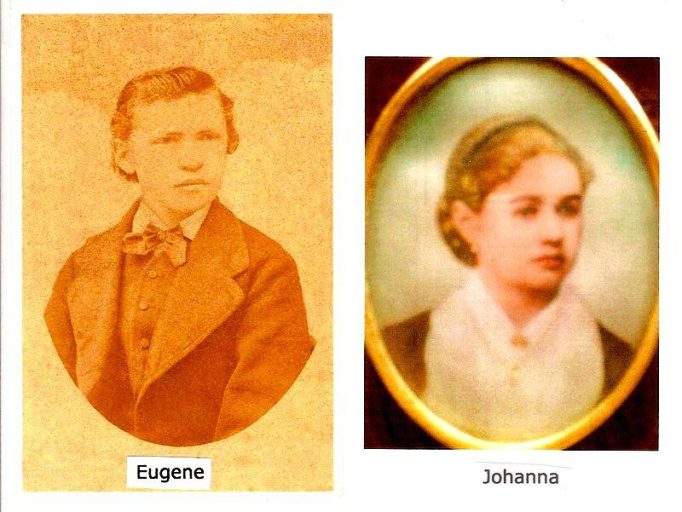
Eugene Trinite and Johanna Von Euw

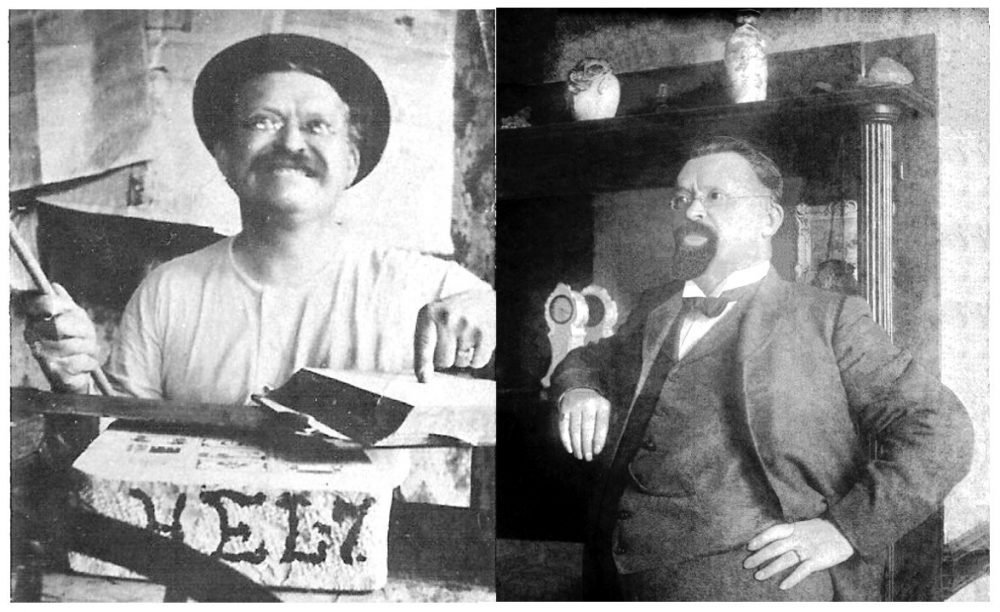
I’m not sure when exactly, but somewhere in the 1880’s Eugene left Paris and moved to the US, I assume meeting Johanna in Rhode Island and proceeding to have several children, including George and the mother of Cousin Gus, Jeannette. In Paris and in Baltimore, Eugene was a lithographer, which makes George’s choice of a printing career something of a tradition, I guess.

Eugene Trinite as lithographer in Paris; Eugene at mantel in Baltimore

Gus also sent me old photos of two of my great-great-grandmothers, Eugene’s mother Marie Josephine Carlavan and Johanna’s mother Rosa Von Euw. I know virtually nothing about these imposing ladies except that someone has laboriously traced Rosa’s line way back to something like 1204!  It would be fascinating to know who Eugene’s father and Mr. Von Euw (great-great-grandfathers) were and from whom they came, but no such luck.
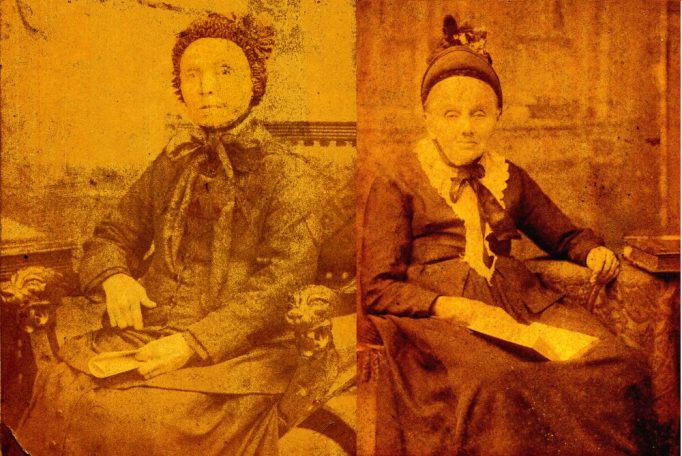
Great-great-grandmothers Marie Josephine Carlavan and Rosa Von Euw

On the Wisconsin paternal side, I have fewer photos, but a bit more genealogical information. My father’s mother Ella Josephine Perry (Paré) was born as ninth of ten children on May 21, 1893.  Meanwhile, Joseph Raymond Balthazor (AKA Jody), was born a month earlier as fourth of eleven children on April 25, 1893.  I learned somewhere that Jody was a bar-keep (saloon owner).  There were, of course, myriad taverns all over Wisconsin—until Prohibition nixed that line of work.  Adaptable, Grampa Jody transitioned to being a storekeeper.  I never saw much of my Balthazor grandparents, except when I was quite small.  Ella passed in 1958, and Jody in 1960.

Jody and Ella Balthazor

Jody’s mother was Melvina Joubert (born 4/9/1870), and Ella’s mother was Delsina Joubert. Since Melvina and Delsina (great-grandmothers) apparently were sisters, my grandparents were cousins.  We have to remember that Bear Creek was a tiny town…  Ella’s father was Louis (Loudacicus) Paré (great-grandfather), who was born 5/1/1844 in Canada, but there’s no further information on this branch of the family tree.

Jody’s father was John Balthazor (born 3/22/1865—great-grandfather) of New London, Wisconsin.  He was the son of Joseph Balthazar (born 11/28/1841—great-great-grandfather) and Margaret Guyette (b. 10/9/1843), whose parents were Joseph Guyette (born 10/19/1810 in Montreal—great-great-great-grandfather) and Madaleine LaValk (birthdate unavailable).
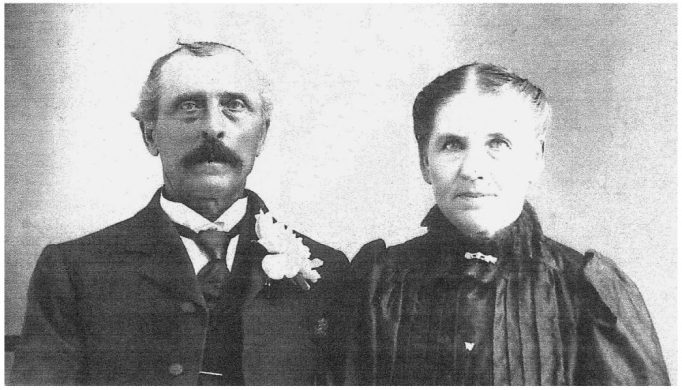
Joseph and Margaret Balthazar (Great-great-grandparents

Note how the spelling changed, probably due to the illiteracy of the parties involved—and watch what happens as we go back in time. Joseph Balthazar was the son of Michel (Mitchell) Beltazar/Beltezar (b. 1816—great-great-great-grandfather) and Rosalie Plante (b. 1815) of Iberville, Quebec.  And Michel was the son of Martin Balthazard (great-great-great-great-grandfather) and Sophie Herbert (dates unknown).

Somewhere I’ve filed (and lost) materials on the generations of B-lt-z-rs during the 17th and 18th centuries who came from central France to Canada early in the 1600’s, most likely to Quebec City (f. 1608).  For US-historical reference, Jamestown and Santa Fe both were founded in 1607.

Those early fore-fathers went by very French names like Jean Baptiste Balthazar. In the many generations leading up to Martin in Wisconsin, the tribe spread to Montreal (f. 1642), the nearby little town of Iberville, and across Canada.  Some of the family must have also been amongst the Acadians who were expelled from Nova Scotia to Louisiana by the British in 1751—since Balthazar is not an unusual name amongst modern Cajuns.  In all likelihood, my fore-folks were also involved in 1775 defense of Quebec and Montreal against the invasion by the Revolutionary American Colonists.  Meanwhile, those pioneer generations before Martin in the wild woods of Canada almost certainly involved Native American mothers, tribes unknown.

I have to ask myself what I’ve inherited from that horde of fore-folks besides the exotic name. Well, for one thing, I’ve got a slightly darker skin-tone than most white guys, and for another, my “artistic” inclination may be inherited from Otto, Eugene, and George.  But beyond that, I can’t say where my “brains” came from.  I suspect they’re my own creation.

What I really have to wonder is who all those fore-folks really were. They lived in worlds utterly different from this one I live in and undoubtedly lived lives utterly different than my own.  I’m sure my own grandsons in their new worlds wonder the same about me.  And the lives they’re living are definitely different than mine.

###

My Rock of Ages

Indulging in memories of long ago, like those of my parrot Lorro, impresses me with the bittersweet transience of such moments and beings that now are only immanent images in my aging mind. But I woke up in the wee hours of this morning thinking of a memory that still very much exists in the present.  I call it my rock of ages.

At least 40 years ago (curious how 40 years seems to create a natural cycle!), I was even then a “plant freak.” After visiting the stupendous bonsai collection at the National Arboretum (a gift to the US from Japan for the Bicentennial), I decided to try my hand at bonsai and determined to create one in a naturalistic setting.

One Saturday afternoon while sunbathing with the hedonistic crowd at P Street “Beach”, I explored along the banks of Rock Creek and among the jumbled granite chunks found an ideal rock—more like a boulder weighing maybe 75 lb. Balancing it on my bicycle frame, I walked it home to the Four Belles at Logan Circle, lugged it upstairs to my sky-lit conservatory and made  a miniature mountain with a tiny tree growing out of a mossy slope.  Aurora the Aralia.

Aurora the Aralia

Aurora flourished on her mountainside for several years, including a sojourn in the window of a 19th floor apartment in New York.  Then in 1981 the mountain came with me to New Mexico, where I had to lodge it with an acquaintance in his greenhouse. I’m mortified that I cannot recall who the fellow was or where it was, but that winter it got hideously cold, and the host forgot to turn on his heaters.  Poor Aurora froze to death!  The jade tree I’d also left there froze down to a stub, but it re-sprouted and in 25 years grew into a huge beauty.

Rejuvenated Jade Tree and Me

In my grief, I took the honored rock with me to my new home on West Alameda in Santa Fe and set it out in the “yard”—more like a gravelly field. A couple years later, a sculptor friend (Gretchen Berggren) asked to install one of her works along my terrace wall, a metal-grate “river” with boulders like one she’d done for outside the College of Santa Fe’s Fogelson Library.  Seeing my beautiful rock, she wanted to include it in her sculpture, and I was happy to agree.

For at least 25 years, my rock parted those sculptural streams—until I left that place and once again lifted it from its “creek,” which by that time had fallen into serious disrepair. Behind my new apartment was a boulder-strewn drainage/walkway where I built several terraces (for iris beds) and prominently included my rock in one of them as keystone for “Rock Creek Lane.”

Four years later (1 ½ years ago), when I moved to Alicia Street, my rock of ages came with me and has since sat meditating under my almond tree, probably resting from its botanical, artistic, and architectural labors.

My Rock of Ages

I can’t really say if I might set it to another purpose in the future, maybe not, but it will be with me as long as I can lift it. I feel totally blest to have had this special relationship with a mineral entity, or if you will, spirit.  When I’m gone, let it remain as my monument.

#


Reminder of Logan Circle

This afternoon in the sauna I was chatting with a friend about pets and commented that the only pet I’ve had in the past sixty years was a parrot in the late 70’s in DC—while I was living in the Four Belles at Logan Circle. Its name was Lorro, which is Spanish for “parrot” and a masculine noun.  However, we called it “she,” though Lorro never laid any eggs…  It’s not always easy to determine the gender of a bird, especially a yellow-headed Amazonian.

Yellow-headed Amazonian (like my parrot Lorro)

Lorro was originally my housemate Charles’ pet, but he had a way of losing interest in his whims and wound up giving me the bird, so to speak. It proved to be very little work being a parrot-master as long as I kept the food coming, and she was pleasant company hanging around on her cage in the parlor in the round bay by our ancient (unplayable) Bechstein piano.  Lorro had a penchant for talking to herself.

According to Charles, she was raised in a simple Mexican family, which made sense because Lorro had a whole routine of a crying baby and a concerned mother trying to calm it with a lullaby (in Spanish). In addition, she’d sing snatches of Mexican revolutionary songs apparently learned from the radio.  Over time the lyrics got a bit garbled.

I guess my voice was too low for Lorro to care for, but she quickly learned to laugh (giggle) just like me. It was weird to be in the dining room and hear myself burst into peals of laughter in the parlor.  She also had an unnerving talent for mimicking the veritable symphony of sirens one heard every night there in our epicenter of the slum, now epicenter of chic.  She was right on key doing the sirens of the police, fire-engines, and ambulances, and with my laughter mixed in, it sounded rather mad.

Unfortunately, Lorro was a bit developmentally disabled. For some reason she never grew true flight feathers in her wings, and what tried to grow, she assiduously pulled out.  Vets said there was nothing we could do…  That’s why she just hung around on her cage, singing, laughing, and blaring her sirens.  Sometimes I’d take her out riding on my bicycle:  As we rolled down the avenue, she’d sit on the basket and flap her stubby wings, shrieking at the top of her lungs.

I think it was the fall of 1979 when Charles went on an extended trip round the ruins of Guatemala. While he was away, I got up one morning to find Lorro lying on the parlor floor as dead as a doornail.  Assuming she’d had a heart attack or some such, I mourned and tried to figure out what to do with her corpse till Charles’ return from the jungles (which, by the way, played a large role in his manic “nervous breakdown” that winter).

The solution I came up with was to wrap her gently in plastic wrap and put her in the freezer. To be thorough, I also put the book on parrot care in there with her.  When Charles got back, he didn’t want to deal with funerals and anyway quickly proceeded to lose his mind.  Over the next year we wound up having to sell the Four Belles, and the new owners inherited a frozen parrot and book on parrot care.  I often wonder what they thought when they opened that freezer.

#


Balthazar’s Seven Redeeming Virtues

After recently carrying on about the majority of humanity being possessed by demons (the seven deadly sins), I got to wondering about that minority of folks who aren’t. Probably under the influence of my early Catholic upbringing, I think they’re the virtuous ones.

Since my catechism lessons had always concentrated on the sins and said very little about virtue, I had to Google virtuous qualities and was surprised to find a wide range of lists with varying numbers of items. Pope Gregory counted seven; another scholarly opinion figures eight; the catechism lists four cardinal virtues; Buddhists and Bushido (Samurai) teach seven differing ones; the Stoics (Aristotle, Plato, etc.) consider four; general theology lists only three; and the Sikhs and Confucius offer five in different sets.

There was lots of overlap and redundancy in the several lists. I threw them all into a semantic blender, and the seven categories that settled out were most similar to Gregory’s. While that Pope was a whiz with his calendar revision and new style of chanting, his philosophy was less than rigorous, and his seven virtues really boil down to only five.

In my agnostically authoritative list I’ve added in parentheses all the definitions, synonyms, aspects, and corollaries that I could pull out of my vocabulary. You might easily think of more to add, but I bet you won’t find a new category.  If you do, please let me know!

Here then are Balthazar’s Seven Redeeming Virtues:

CHARITY (Generosity, Sacrifice, Altruism, Philanthropy, Helpfulness, Sharing)

COMPASSION (Patience, Kindness, Love, Mercy, Sympathy, Tolerance)

COURAGE (Diligence, Fortitude, Confidence, Valor, Perseverance, Hope, Initiative)

HUMILITY (Honor, Respect, Modesty, Renunciation, Gratitude, Contentment)

HONESTY (Justice, Sincerity, Fidelity, Truth, Faith, Integrity)

MODERATION (Temperance, Chastity, Morality, Self-discipline, Prudence)

PERSPICACITY (Wisdom, Insight, Discernment, Understanding, Perceptive)

Humility Redeems All Species.

Apart from Humility being the best antidote for Pride and Courage curing Sloth, the rest of these virtues are a great medical cocktail for treating the other deadly sins. But how can we convince the demon-possessed majority to acknowledge their addictions and take their medicine?  If only there were some way to inoculate folks with Honesty and Compassion, a pill to take for Charity and Moderation, or an operation that would activate the Perspicacity gland!

I’ve seen a poster that exhorts: TEACH TOLERANCE!  But I’m not sure one can actually teach virtues.  Obviously, the deadly sins can be taught though.  They are modelled and encouraged by our economic system, by the entertainment and advertising industries, and in almost all our personal and political relationships.  Sadly, virtues don’t sell well nowadays, and folks who practice them are mostly seen as boring do-gooders—or naïve fools.

And about virtue being its own reward: I don’t buy that old saw.  I sincerely believe that the reward of virtue is peace and joy.  At least that’s why I try to practice it.

###

Hog Heaven

An earlier mention of my prize-winning Poland China hog named Cornpone (the Magnificent) made me a bit sentimental about pigs. So, I went to my archive of photos and pulled out the snapshot I took of him dated September 28, 1957.

Cornpone, Champion Poland China hog, 1957

Oddly, after these 61 years the Kodacolor print has taken on the true color of the subject, a magenta-toned sepia. It lends the memory a certain monumentality.  He is standing by his trough in which I would dump a daily bucket of slops (scraps from our truck stop café across the highway) and mix nice messes of special mash to make him fat.

Cornpone’s pen was a good-sized area next to that for Daddy’s twelve brindle hunting hounds. The picture was taken from the edge of his wallow in the foreground.  I’d also bring buckets of water every day to keep it suitably muddy, and he’d loll around in the muck, grunting and snorting.  That’s where I learned the truth of the old saw “happy as a pig in hot mud.”

We kept our herd of several hogs (the pinker variety) in a pen down past the pasture at the edge of the woods—where their stench couldn’t reach up to the house or yard. It was also my exhausting duty to haul many buckets of slops to them each day and to keep their wallow wet.

Periodically we’d slaughter maybe three of the herd at a time, and neighbor folks from around helped with the hot and heavy work. First, Daddy would lean over the fence with his rifle and shoot a hog between the eyes.  It would drop like a rock.  Then he’d jump in and slit its throat, letting the blood run into the wallow.

A few of the men would drag the carcass out of the pen and up the hill to where some huge iron pots were boiling on wood fires. They’d haul the hog up on ropes over a tree limb and lower it into the boiling water for a moment to scald the hair off.  Then they’d hang it up from another branch for the butchering.

When they’d spit the stomach open, I was always grossed out by the cascade of guts but had to help with sorting out the intestines for sausage-casings. Brandishing great knives, they’d toss slabs of hog-fat into another iron pot to render out the lard and make chitlings (pork rinds).

The butchering would take most of a day, and it was quite a community party. We’d wrap up the cuts of hams, loins, and so on to put in our big walk-in cooler, and folks would take turns on the big grinder making sausage.  The neighbors were happy to get shares of the meat and buckets of lard for their work.  And we had loads of fresh pork to sell in the café.

Cornpone didn’t share the rustic fate of our common hogs. That fall we took him to the Sevier County Fair in DeQueen, Arkansas, where he won the Blue Ribbon.  After his big win, he went to a more sophisticated hog heaven.  Being a simple country boy of fifteen, I sold my champion hog to a meatpacker and bought myself a pair of cowboy boots with turquoise tops.  My young feet outgrew them within a year.

#

The Stuff of Dreams

I’ve just finished reading Ursula Le Guin’s 1971 novel “The Lathe of Heaven” for the first time. Way back then/when, I read “The Left Hand of Darkness” but can’t remember a thing about it—so I’ll definitely have to grab that one again.  In LofH, she blew me away with the prescience of her sci-fi details of over-population, climate change, and the quality of life which are now so much a part of modern life.  It’s unfortunate that some of them (like kicking the automobile addiction), haven’t yet come true.  But I’m glad that she wasn’t sadistic enough to envision the smart-phone!  At least the people in her future world(s) were still human…

The novel’s theme of dreaming was a genius twist on the subject: a guy has “effective” dreams that affect objective reality.  Not to spoil a great story, I won’t say any more about that, but it put me in mind of the concept of “conscious dreaming,” which some decades ago was a big new-age thing.  Maybe it still is?

One of the themes in the Don Juan novels of Carlos Castañeda, the notion fascinated me. In about 1985, a “dream analyst” friend explained that the best method for achieving consciousness in a dream was to look at one’s hands and actually see them.  That sounded simple enough.

In a vivid dream about walking down a path to a beach (I was an inveterate, if infrequent, beach bum), the friend’s instruction came into my dreaming mind. I stopped on the sand and looked at my hands.  They were in the minutest detail my real hands, all the wrinkles on my knuckles and nails exactly like they were that day, including the longer nails on my pinkies.  And there on the third finger of my right hand was my gold ring with its slab of lapis lazuli—with the exact tiny streak of gold in the stone.  Then I knew that I was conscious.  Not awake, but conscious.

The problem was that as I looked at my real hands, the gold and lapis of my ring began to spread like an incrustation across my fingers. Consciously, I thought, “Oh, no, you don’t!”  With an effort of will, I forced the precious stuff back into the ring.  Confident now in my control of the dream, I looked around the beach at the expanse of sand and the undulant waves.

Dream of a Beach

I bent down and picked up some sand, letting it run quite realistically through my very real fingers. Then I decided I wanted to find a beautiful shell, and I walked along the frothy wave-lines on the beach feeling the utter reality of the scene.  Quickly I found a perfect small conch-like shell, and holding it in my right hand, I admired its whorl, as beautiful as any I’d ever seen.

In my throes of admiration, suddenly the shell started spreading over my hand, covering it with gleaming mother-of-pearl. I tried to command the transformation to stop but couldn’t manage.  The vision was utterly enthralling and joyous, and like happens with the approach of sexual climax, I could do nothing but abandon myself to the ecstasy of the dream.

I can’t remember where the dream went from there. But those moments of consciousness seized in the midst of it have remained vivid all these years since.  I’m not sure why I haven’t tried that trick again.  Maybe because it’s never crossed my dreaming mind to look at my hands again?

#