Jaguar of the Night

I really must devote a word or two to a favorite detail from my Aztec Icon #17, Tepeyollotl—just in case it slipped your notice. It’s my rendition of the Jaguar of the Night, one of the various manifestations of the Heart of the Mountain.  The divine Jaguar leaps at the rising sun, greeting it with its roars (those odd wavy sound symbols).

Jaguar of the Night

                             From Icon #17                                          Model from Codex Nuttall

One reason I’m showing you this drawing is to sing the praises of my sweet graphics program, GIMP.  (You can Google it for free download!)  It really makes me feel like a magician.  I took the splendid image of a jaguar from Codex Nuttall and with a few adjustments in proportions and position turned the rampant figure into a leaping one.  Of course there were many pixels to wrestle with, but that’s the name of the digital drawing game.

Also: I’m quite pleased with this drawing of my totem animal and rather proud of it.  Hope you like it too.

#


Icon #17 – TEPEYOLLOTL, Heart of the Mountain

So… It’s been another long haul to complete the next icon for my coloring book YE GODS! Something like four months, but no apologies.  I’ve had to take a lot of sanity breaks—to continue writing on my next memoir and to deal with the sorrows of life.  Namely, in late March, at the tender age of 18 my eldest grandson Ike chose to end his life.  We know nothing about why but can only respect, accept, and lament his decision.  That’s my reason for tearfully dedicating this Icon #17 – Tepeyollotl, Heart of the Mountain to him.

Tepeyollotl, Heart of the Mountain

Tepeyollotl (Heart of the Mountain) {te-pe-yol-lotł} is the god of caves/mines and echoes and causes earthquakes, avalanches, and volcanos.  As the Lord of Jewels and underground treasures, he is the male spirit of the earth and a nagual of the hermaphroditic Tlaltecuhtli, Lord of the Earth.  A deity of witchcraft, he cures and causes diseases and guards the entrance to Mictlan (the Land of the Dead). Tepeyollotl is the ancestral were-jaguar and may be the God L of the Maya. Also a nagual of Tezcatlipoca, he is the Jaguar of the Night whose roaring heralds the sunrise, and as 8th lord of the night he is sometimes depicted as a jaguar leaping toward the rising sun.  

I’ve already posted a couple pieces about this icon in process, The Divine Volcanoes and Jaguars Changing Spots, and the above caption gives the rest of the information I’ve learned about this deity. On the coloring book page I’ve now listed a free download of it with caption and models, and when it comes back home to me in vectors from Bangladesh, I’ll add the two versions for sizable prints.

###

Fictional Truth About Gay History

I’ve been trying to control my urge to blather about whatever, mostly focusing on things Aztec, but occasionally—out of desperation?—holding forth on things political. Of course, the latter is just more hot air.  But this time I’m going to indulge in things literary.  (In the distant past I had some experience in critiquing various classic works of Russian literature.)

Recently, my old friend Don turned me on to a novel by an Irish writer, “A Long Long Way” by Sebastian Barry, about a young man from Dublin in the trench warfare in Flanders during WWI. With little exposure to contemporary literature, I was stunned by both the writer’s ability to render that horrendous time rather long before his own birth—and the character of a youth in a situation unlike anything he could have personally experienced.  Without exaggeration, it was a tour de force.

Just as I finished reading the novel, Don and I went to a lecture (one of a long series sponsored by the Lannan Foundation) featuring none other than Sebastian Barry. It was an inspiring presentation including readings from both “A Long Long Way” and Barry’s newer novel “Days Without End.”  The author explained that he’d written that in honor of his son who had courageously come out as gay.

Don quickly bought us a copy of “Days Without End,” and I read it with scarcely a pause for breath. The story of two young men experiencing America in the mid-19th century, it’s even more stunning in its reality, in its humanity, and in the finesse of its narrative technique.  I can only concur with one of its cover blurbs that the work is a ‘masterpiece.’  Elsewhere someone has astutely remarked that it is the ‘great American novel’—written by an Irishman!

Above and beyond those kudos, I have to say that Barry’s novel opens an entire chapter in gay history with the truth only fiction can achieve. It should be put at the top of any LGBT+ reading list!  And at the risk of sounding politically stupid (but with a lot more justification than certain recent claimants), I think it should be nominated for a Nobel Prize!

Corroboration of my opinion has also come from a different quarter. While I’m not so sure about the predictive nature of horoscopes, I’ve found that the weekly sign-based messages in Rob Brezsny’s “Free Will Astrology”  are often right on as insightful interpretations of the immediate past.  For the week after I finished “Days Without End,” the astrologist suggested that I (as a Taurus) seek out stories that have the power to heal.  If ever a story has had that power, it’s “Days Without End.”

Please forgive me now for a brief vanity break: About 30 years ago I wrote a story called “Traveling Men”.  I can’t claim that it has the power to heal but do believe it’s fictionally true about gay history.  I’d be honored if you’d care to read it and agree.

###

Jaguars Changing Spots

I seem to be at my stellar best when I’m boring folks with useless information—or at least with stuff they don’t give a rat’s patootie about. The following verbiage may well fall into both categories.  And since it’s on the Internet, there’s the distinct possibility (but minuscule probability) of boring millions of readers to tears.  What more could I hope for as I hold forth on jaguars’ spots?  I bet you’ve never given that esoteric subject even a nanosecond’s thought.

But I have. For some years, as you likely don’t know, I’ve been drawing digital icons of Aztec deities for a coloring book called YE GODS! Since the jaguar is a major mythological figure for most of the ancient cultures of the Americas (see A Roar of Jaguars), I had to come to terms with how it was depicted in the iconography of those cultures.  In fact, as the Lord of the Animals, the jaguar was my first try at digital drawing.

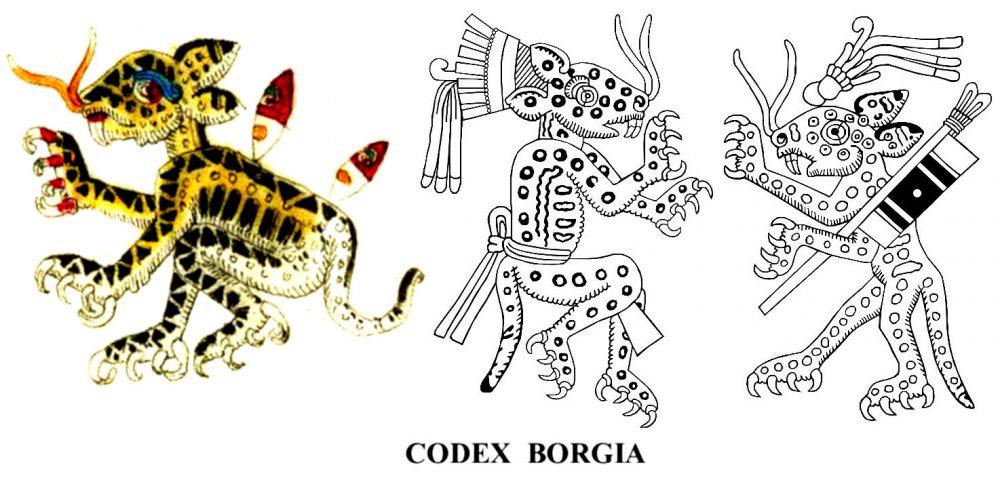
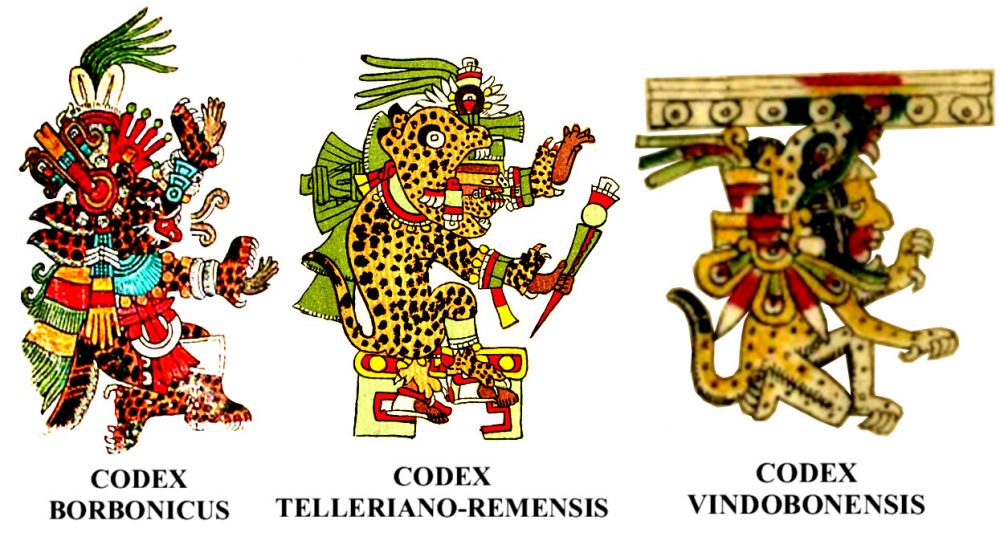
Already well versed in the iconography of the few Aztec codices that survived the Conquest of that empire by the Spanish, I wasn’t terribly impressed by their renderings of the unique and complex pattern of the jaguar’s pelt. For the most part the ancient Aztec artists made do with a simple scattering of spots looking a lot like those of the Old World leopard.In the Codex Borgia, a more elaborate picture-book, the pelt was sometimes depicted in greater complexity. I chose to use two of those stronger patterns for figures in my later icon of the deities of the moon, but the first pattern was just too weirdly abstract, if oddly more realistic.

For my first digital drawing (eventually used in the icon for OCELOTL), I pompously tried to reproduce a naturalistic jaguar pelt—and believe I did a decent job. It convinced me of the amazing power of computer imaging and kicked off the whole coloring book project.  Having mastered the pattern, I used it also for a seat-cushion in the icon for the goddess CHANTICO (also see the icon for MICTLANTECUHTLI), and for a detail of a jaguar-warrior in that for the god CHALCHIUHTOTOLIN.

Chantico and Jaguar Warrior

At present I’m in the final throes of the icon for TEPEYOLLOTL (see The Divine Volcanoes), who is a were-jaguar (an anthropomorphic creature), appearing in a number of the codices.

Here comes another sneak preview. There are two jaguars in this icon.  I chose to use the Nuttall jaguar, radically restructured, for the leaping one and the Vindobonensis figure as model for the god himself—with a pelt based on one of the Borgia examples.

Leaping Jaguar and Tepeyollotl

This illustration shows that I haven’t yet completed Tepeyollotl’s face, though I have already given him an aesthetic nose-job. While the open-ring pattern may not be any more naturalistic than the plain spots on the Vindobonensis model, I did that on purpose—for the coloring.

I’ve only given explicit directions for coloring the icons in a few cases. First, for the pelt in OCELOTL, I described the animal’s range of coloration from rusty gold to white.  For the icon of EHECATL, I explained that scallop shells come in black, white, and all shades of the rainbow, though very dark and dusky like in the last hues of twilight.  For TEPEYOLLOTL, I will direct the colorist to make those open rings various colors as in these almost hallucinatory images:

In this second Telleriano example, the spots are inexplicably green, and in the psychedelic Aubin figure red, blue, and gold. (By the way, the general Aubin style of illustration might most kindly be called “casual:” Note the incomplete claws, stubby tail, and curious wrinkles on its back.)

The rationale for vari-colored spots on my Tepeyollotl (which was completed in June 2019) is that, among several other mythical qualities, he’s the Lord of Jewels. Also, any deity worth its salt really should be hallucinatory, psychedelic, and/or surreal.

###

The Divine Volcanoes Popocatepetl and Itzaccihuatl

For too long I’ve telling folks I’m still plugging away on Icon #17 for the YE GODS! coloring book, and now I can change my tune. At last I’m on the home stretch!  Just one more vignette and the figure of Tepeyollotl Himself, the Heart of the Mountain.  (I seem to have been keeping the deity itself for the last to be informed by the story of the surrounding details.)

So now it’s high time I give you something in the way of a sneak preview of #17: the Mountain.  Actually it’s the two divine volcanoes that loom dangerously over Ciudad de México, deified as Popocatepetl (Smoking Mountain) and Itzaccihuatl (Obsidian Lady).

Popocatepetl and Itzaccihuatl

Here they are shown in the style of Codex Nuttall, Popocatepetl in its smoking majesty and Itzaccihuatl as a bonafide, stern-visaged goddess. Her codex model is iconographically notable being one of the few full-faced figures to be found in Aztec 2-D graphic art.  The Maya also preferred profiles (those marvelous foreheads!).  3-D sculpture was of course a different story.

The stylized sigils appearing in each of the “hills” are authentic names of real places. Apart from the self-evident symbol for Popocatepetl, I don’t have a clue what places the others intend.

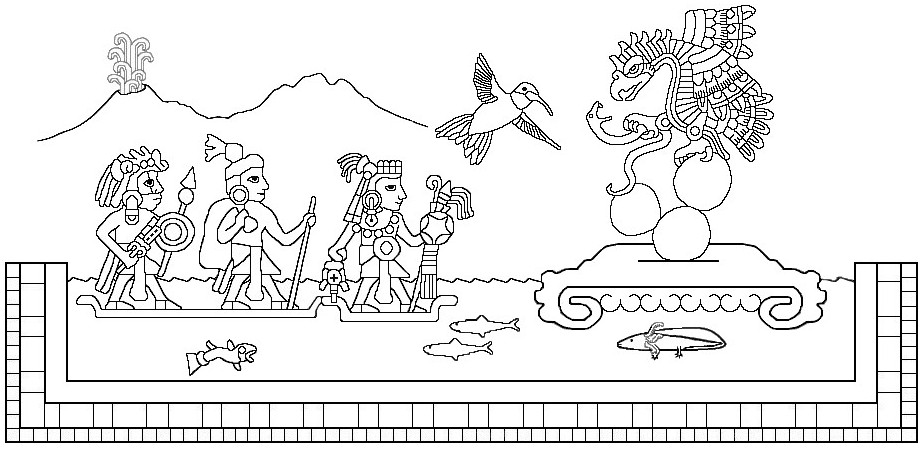
The above is my second treatment of the divine volcanoes. The first was for a vignette in Icon #7 Huitzilopochtli, Hummingbird of the South, showing the arrival of the Aztecs at Tenochtitlan:

Arrival of Aztecs at Tenochtitlan

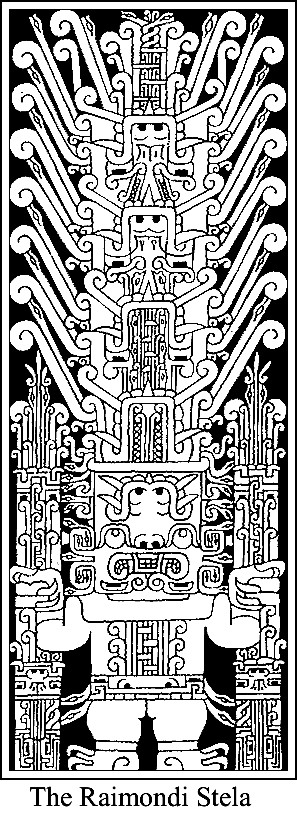
In the upcoming icon, beneath these volcanoes resides the Heart of the Mountain. Don’t let this be a spoiler, but you need to know that Tepeyollotl, as most often depicted in the Aztec codices, will be a were-jaguar, an ancient mythological being with possible roots three thousand years before in Peru.  Check out this boggling image of the Raimondi Stela from Chavín de Huantar.

###

The Primal Flaw

Here I go again with another quasi-political pronouncement!

Ever since this whole debacle started, I’ve been asking myself what exactly the problem is with our country. At first I looked for what’s wrong in our economic system and found many truly fatal flaws.  But then I realized that to find the primal flaw one must look on the meta-level—at the country itself as a social organization.

As a career organizational administrator (long retired), I know how crucial it is for any organized undertaking to have plans for operations and future directions. As a country, the US supposedly has a detailed plan for operations, or at least guidelines for such, in our revered Constitution.  However, we have nothing that tells us which way or where our country is supposed to go.

A notion of future directions is necessary to accomplish any purpose or achieve a mission. Believe it or not, our founding sages never articulated a mission for their new country.  The only thing I can find in the Constitution even vaguely regarding a purpose is in Article I, Section 8: “The Congress shall have Power To [lay and collect Taxes, Duties, Imposts and Excises, to pay the Debts and] provide for the common Defence and general Welfare of the United States…”

Note that this section merely gives Congress the power to do various things; it doesn’t charge the government as a whole with responsibility to do those things. And what’s more, “Defence” and “Welfare” relate only to the country/government itself, not to its citizens.

I can find no constitutional parallel to Lincoln’s famous Gettysburg comment about the US being a government of the people, by the people, and for the people.  Here Lincoln says explicitly what the mission should be for our country as an organization:  The purpose of the government is to provide for the common defense and promote the general welfare of the citizens of the United States.

More simply, the government should operate for the benefit of all the people and move in directions that protect and improve all our lives.  But in regrettable statistical fact, our government serves only some of the people, those with (heavily) vested interests.

So that’s my well-considered diagnosis. Let me think for a while on what to prescribe for this serious Social Systemic Disorder (SSD).  It’s an unsustainable, life-threatening condition that will definitely require radical treatment to save the patient.

An Aerobic Insight

Most of my penetrating insights come while peacefully tromping the treadmill (lengthening those pesky telomeres to counteract aging—which I’ve done more than enough of in eight decades of breathing). Nearing the mile mark the other day, I suddenly considered that our abominable chief executive might well have a death wish.

On further consideration, I saw that my amateur psychoanalysis of the beast should be more complicated than that. The vile creature probably doesn’t wish for death as a release but as an apotheosis, quite possibly its ultimate goal.

I understand that its campaign goal was purported to be to “Make America Great Again,” but I also understand ‘great’ in its diabolical terms to mean ‘a rich (old) white man’s country.’ That would be just like America used to be under the heartless oligarch’s favorite president, Andrew Jackson, with whom it shares many biographical and attitudinal characteristics.

Not the least of those is being a megalomaniac real-estate rustler, cynical and dishonest game-player, and unscrupulous persecutor of non-rich and non-white populations. All its policies and actions show unambiguously that our rogue leader is in no way a humanitarian, but an aristocratic despot engaged in a class and racial war.

Its now-failed attempt to extort funds from Congress for a barrier to human freedom by closing down the government was intentionally designed to damage the economic security of the non-rich and people of color and deepen the class and racial divides.

Even with the government re-opened, that social divide will remain much deeper than before. In its misanthropic view, that political atrocity was still a battle essentially won.  In future battles, its strategy will be the same and tactics just as inhumane and ruthless.

The hubristic autocrat will see the people’s suffering, unrest, and possible resistance as futile. Winning the class and race war is to be its historic contribution to society, human and cultural costs be damned.  For the amoral, the ends justify the means.

Total victory would of course be to re-institute slavery, re-establish a nobility, and address the population situation with genocidal solutions—the true essence of conservatism. Should resistance not prove futile and someone manage to eliminate it, the monster would probably consider that the best-case scenario.

I’ll bet the demagogue is psychotically jealous of the eternal glory that Lincoln and Kennedy achieved through being assassinated—or more grandiosely of the immortal fame of Julius Caesar. (For the tragically murdered, all faults and sins are apparently forgiven.)

If so, the unbelievable genius would become not only a messiah for rich (old) white men, but a sainted martyr. Let’s call the spade a self-anointed second Jesus Christ—sacrificed for the sins of humanity.  Sad.

If these are truly the demon’s delusional ambitions, we have to ask which would be preferable: for the scoundrel to win its inhuman war or for it to become a glorious hero?  I would opt instead for the slight chance that it might lose the war and go down in history as an unparalleled villain.

#


Aztec Icon #16 – TONATIUH and METZTLI, Deities of the Sun and Moon

It’s been about nine months since the last addition to my coloring book YE GODS! Icons of Aztec Deities, #15, Quiahuitl, God of Rain. After completing it back last April, I had to focus on setting up the two-month Ye Gods! exhibition in Santa Fe, as well as prepare and deliver several lectures.  Then everything else, including work on my second memoir, had to be put on hold while I concentrated for three months on re-translating an opera from Russian (which will be produced by the New Orleans Opera in February, 2020).  Meanwhile I also set up the exhibition for another month in nearby Española.  Busy boy, no?

Finally by late November, I got back to drawing, and now I’m thrilled to announce that #16 is finished at last. (At first I thought it was Tecciztecatl and Metztli, Deities of the Moon, but much later I’ve now discovered that it is Tonatiuh and Metztli, Deities of the Sun and Moon.)

TONATIUH & METZTLI

At first I worte that Tecciztecatl {tek-seez-te-katł}, the son of Tlaloc and Chalchiuhtlicue, is a god of hunters and appears as things shining in the night. In the Nahua cosmology, when Quetzalcoatl and Ehecatl created the current Fifth Sun, Tecciztecatl wanted to become the new sun, but he hesitated to jump into the sacred fire, whereupon the young god Nanahuatzin leapt into the flames to become Tonatiuh, the Fifth Sun.  When Tecciztecatl followed, he took second place as the moon. Well, it turns out that the little guy throwing himself into the fire here is actually Nanahuatzin, and the male deity here is Tonatiuh, the sun, in the pair with the moon.

Metztli {mets-tłee} is the ancestral moon goddess probably inherited from ancient Teotihuacan and/or the Maya’s lunar goddess Ix Chel.  Long after the Nahuas demoted Metztli to merely being the consort of Tecciztecatl (in Tonalamatl Aubin), and replaced her with Tecciztecatl in several other codices, the later Aztecs tried to replace her completely with (the severed head of) Coyolxauhqui, the sister dismembered by their supreme god Huitzilopochtli.

Tecciztecatl was stuck into the sacred calendar (tonalpohualli) as one of the patrons, frequently in the company of Tonatiuh, of the thirteen-day week One Death, which is shown in the encircling day-signs.  It should be noted that there are thirteen days between the full and dark of the moon.  The Mesoamerican cultures saw a rabbit in the full moon (top), and the serpent of the night devouring the rabbit (bottom) represents the dark of the moon.  Incidentally, the nocturnal jaguar was closely connected with the moon, and the conch shell was the standard symbol of the moon.

I fired the drawing off to my dear friend Sagar in Bangladesh for him to work his vectorizing magic on it, and he did the trick.  I’m currently (in January) posting the jpeg version with caption and sources on the coloring book page and have now (in April) have added the vectorized versions to the list of various sizes available for free download.

In my strict alphabetical sequence, the next deity to tackle is Tepeyollotl, Heart of the Mountain, who has several dramatic aspects.  You can check out my earlier image of this god among the Aztec images from the old book on the calendar.  If the creek don’t rise, I’d like to get his icon done by April.  Once again meanwhile, in my multi-tasking fashion, I’ll be arranging more venues for the expanded exhibition and lectures—and forging onward in my memoir. Call me driven, but I’d love to finish that by next year.

A Roar of Jaguars

In the past few years, I’ve realized that, in the Native American tradition, I seem to have an animal totem, the jaguar. This past year when I started my second memoir, I understood my deep connection to this apex predator of the Americas and included an illustration:

My Totem Jaguar

I also realized that this magnificent feline has been lurking in my background for at least 35 years. At a yard sale I’d bought a carved-wood figurine and stashed it away as a curiosity.  Later I gave it as a birthday gift to a friend, who returned it explaining that there was some spirit in it which didn’t “resonate” with him.  Stashed away again, it sat on a shelf for decades—following me around to various domiciles.  Then about a year ago I recognized it for a jaguar-priest or shaman from some South or Meso-American tradition.

My Jaguar Priest Figurine

It suddenly made sense that this jaguar figurine was probably why some 30 years ago I’d gotten so involved in the Aztec milieu. I soon learned that this New World King of Beasts had originally roamed throughout most of the South and Meso-American jungles and even ranged north into the American Southwest (apparently now making a comeback in southern Arizona!).

I also learned that the noble jaguar was central to the mythologies of basically all the ancient civilizations of the New World (just as the lion was to those of the Old). First off, I found it in the Aztec calendar, as the 14th day of their agricultural month and in the second week of their ceremonial count of days (tonalpohualli).  Starting with the day Ce Ocelotl – One Jaguar (those with this birth day-name coincidentally being destined for sacrifice), that second week was under the patronage of the god Quetzalcoatl, the Plumed Serpent.

I already knew that the Aztec ceremonial calendar had been more or less inherited from the much earlier Maya and then discovered that it, just like its patron deity, was also revered by the even earlier Olmec. Then about three years ago in considering that maybe the sacred calendar’s count of days had originated in the still earlier Chavín civilization in Peru, I learned that the jaguar was for them also a major deity, often seen as an ornate man-jaguar.  Do note this Chavín were-jaguar’s startling snake-locks!

Chavin Were-Jaguar

If my suggestion that the count of days originated at Chavín de Huantar is correct, that ritual (more like a religion), was carried north by trader-missionaries to populations along the Pacific coast. Ultimately they crossed the Isthmus of Tehuantepec and proselytized the Olmec with the sacred way of telling time.  Many surviving Olmec sculptures are of infant were-jaguars.

Coincidentally, earliest calendar lore has it being brought by a god, namely the Plumed Serpent, who was also the bringer of maize (and culture). Between the calendar, the jaguar, and this legendary civilizer deity, they had a rather well-rounded theosophy, even if some rituals might have involved sacrifices frowned on nowadays.

It’s now become reasonable to think that the early Maya were “civilizing” in Yucatan at much the same time as the Olmec were hard at it in Veracruz. More mercenary missionary work was probably what took the calendar to the Maya.  They hugely elaborated and ornamented the new “faith” with their own deities and even started writing about it in glyphs.

Along with calendar, the jaguar deity (B’alam) came to the Maya, but their representations of it were generally not anthropomorphized.  I found a spectacular relief at Chichen Itza on Google Images, apparently a repro in gold (!), that’s both naturalistic and stylized.  Not to gross you out, but I bet that’s a heart it’s holding in its paw and licking.

Mayan Jaguar from Chichen Itza

Of course, the third part of the religion was the Plumed Serpent, the civilizer deity whom they called Kukulcan (or Gugumatz).  This Triad then moved west and north to early Teotihuacan, where the Serpent likely became known as Quetzalcoatl, or maybe that was amongst the later Toltecs.  That calendar religion reigned across the centuries and other areas of Mexico, as shown by this jaguar totem from the Zapotecs, possibly a funerary urn.

Zapotec Jaguar

Eventually, the barbarian Aztecs came out of the north and adopted the local religion, and it came to be known and misunderstood as the “Aztec Calendar.” In their historical or genealogical picture-books, many of which were from other cultures like the Mixtec, the were-jaguar shows up as jaguar warriors.  These “jaguar-weres” were simply humans wearing jaguar pelts.

Perhaps the most dramatic Aztec jaguar is a sculpture (receptacle for sacrificial hearts!), now in the Museum of Anthropology:

Aztec Jaguar

In their religious documents, the jaguar is generally depicted as a divine animal such as these two from Codex Borgia, (adjusted and adapted to prepare for drawings in my next icon).  By the way, those wavy figures represent the jaguar’s roar.

Jaguars from Codex Borgia

Modelling mine on the image on the left, several years ago as my first attempt at drawing on computer, I drew a jaguar with a realistically patterned pelt (and more aggressive demeanor). Intended to be the apotheosis of the Lord of the Animals, the drawing had to wait some three years to be enthroned in YE GODS! Icon #11 – OCELOTL.

My Jaguar–Lord of the Animals

But I’m not done with this roar of jaguars! Recalling that the historical range of the jaguar reached up into North America, there is the possibility that the creature may have been known, or at least recalled, by populations outside of the desert Southwest.  I’m talking about my other favorite topic, the Mississippian “civilization.”

I found a trace of the calendar and image of a heavily stylized man-jaguar in the Southeast and drew this fanciful animal below from a shell gorget (from Fairfield MO across the river from Cahokia) for a book on the Indian mounds.  (See my Gallery of Pre-Columbian Artifacts.)

Jaguar Gorget – Fairfield MO

In the magazine “Ancient American,” Vol. 21, No. 116, I wrote about the cult of the Plumed Serpent in North America, which shows that the trinity of Calendar-Jaguar-Serpent was a Pan-American “religion.”  Small wonder I feel the jaguar my totem—it’s the totem for all Americans.

#


Ancient America-Asia Coincidences

Recently I came across two historical coincidences worthy of comment. Both may be archaeologically, or at least anthropologically, significant.

  1. The Rabbit in the Moon.

Readers should be advised that I’ve “studied” (more like “obsessed with”) things Mesoamerican for about 30 years now, and have become fairly conversant about their mythology and art, mainly of the Aztecs. More about that in a moment.

Some decades ago I learned that the Mesoamerican peoples saw a rabbit in the moon. This “moon rabbit” was famous amongst the early Maya, shown here with the moon goddess Ix Chel:

The image of a rabbit in the moon occurs in two of the surviving pre-Conquest Aztec codices (picture-books) and in one of the post-Conquest documents.

Aztec Rabbits in the Moon

Learning about this lunar bunny, I checked out the full moon and immediately saw it clearly. Before, I’d never really been able to see a face in the moon (the European tradition), and now I can see nothing but the rabbit.  In my Aztec obsession, I’ve spent the past several years drawing icons of their deities and am now working on the god of the moon, Tecciztecatl.  As a detail for that icon, I’ve concocted my own Moon Rabbit in an Aztec style and in the orientation I’ve scientifically observed.

Imagine my surprise when I read a book about Chinese myths and legends and discovered that the ancient Chinese also saw a rabbit in the moon. Under “Moon Rabbit” on Wikipedia, I learned that in their inscrutable oriental way, the image the Chinese saw was a rabbit facing to the right—and anthropomorphically using a mortar and pestle to pound herbs or medicines (that equipment occupying the area of my bunny’s bottom).

The entry advised that this traditional image also spread to Japan and Korea and added, “Legends of moon rabbits exist among some of the indigenous peoples of the Americas.” Then the entry states categorically:  “These legends were not influenced by Asian cultures.”  This gratuitous pronouncement smacks of a polemical personal opinion designed to forestall any further discussion of the subject.  Typical…

Now, I’m not arguing that this coincidence necessarily shows any America-Asia connection. It’s quite reasonable that the two widely separated peoples could see the same familiar creature (in differing perspectives) in the Rorschach blur on the moon’s orb.  The bunny could well be a pure coincidence (though some say there are no coincidences).

  1. The Ten Suns

In the same book of Chinese myths and legends, one struck me as surpassingly surreal. The god of the eastern sky, Di Jun was the father of ten suns [sic!] which took turns crossing the sky on each of the ten days of the week.  But they got bored with the routine and one day decided to ride in their chariots all together across the sky, which heat caused great damage to the earth and its creatures.  Unable to make his suns behave properly, Di Jun summoned the Divine Archer Yi and gave him a magic bow and arrows to make the suns resume their rotating duties.  Yi shot down nine of them, leaving only one to cross the sky every day.  That solution greatly distressed Di Jun, who condemned Yi to live a mortal life.  Curious tale…

A few months later I read a book called “Native American Myths and Legends,” which was published by Arcturus Publishing Ltd. in London (2017). The stories were recorded by a range of different writers/ethnographers from the 19th and early 20th centuries.

The story that stopped me in my tracks was attributed to a tribe called “Shastika” and taken from a book by Katharine Berry Judson, “Myths and Legends of California and the Old Southwest (1912). That tribe from northern California/southern Oregon is now called simply Shasta or Shastan and logically relates to the magical Mount Shasta. Per Wikipedia, by the early years of the 20th century perhaps only 100 Shasta individuals existed, and some few Shasta descendants apparently still reside in various reservations with other tribes.

The story is called “Old Mole’s Creation.” (Forgive my disrespectful levity, but the title calls to mind a character from that ancient comic strip “Pogo”—Ol’ Mole was blind as a mole and an avid bird-watcher!) Anyway, first “Old Mole burrowed underneath Somewhere and threw up the earth which forms the world.” Then, “in the beginning, Sun had nine brothers, all flaming hot like himself. But Coyote killed the nine brothers and so saved the world from burning up.” Those two simplified sentences are an obvious restatement of the Chinese legend of the ten suns.

But the Shasta tale does the Chinese one better by adding a parallel plot: “But Moon also had nine brothers, all made of ice like himself, and the Night People almost froze to death.” So as the Moons arose, Coyote killed nine of them with his flint-stone knife saved the Night People. Native American story-telling loves coyotes and symmetry.

These two tales of the ten suns are simply too counter-intuitive (and weird) to have developed independently. So I’ll boldly claim that they prove an ancient cultural connection between Asia and America. (They clearly support Gavin Menzies’ book “1421: The Year China Discovered America” and Laurie Bonner-Nickless’ interminably titled book about Chinese exploration of North America in 1433-34, which was just reviewed in “Ancient American,” Issue 121.)

Cue the academic inquisitors!

#