Aztec Deities At It Again!

Announcement:

YE GODS! Icons of Aztec Deities

October 22 – November 16, 2018

NICK SALAZAR CENTER FOR THE ARTS

Northern New Mexico College

The Nick Salazar Center for the Arts in Española, New Mexico, presents an exhibition by local artist Richard Balthazar, who was formerly the Used Plant Man (or Iris Man) at the Santa Fe Farmers Market and once upon a time sold plants at the Española Farmers Market. Presented in large-scale format on vinyl banners, his 15 black and white drawings are designed for a coloring book, and prints for coloring and/or framing are available for free download from his website:

www.richardbalthazar.com.

Ehecatl, Aztec God of the Wind

The icons were drawn digitally (using a computer graphics program), allowing the artist to achieve a rare level of fine detail. The deities are so striking and startling that everyone will surely exclaim, “YE GODS!

Essentially a crash course in Aztec myth, history, and culture, the deities are portrayed in their full contexts, in authentic Aztec iconography.

Each deity is accompanied by a description and images from the surviving Aztec codices (picture-books) that served as models or themes and show the authentic colors used by Aztec scribes.

Cultural and educational groups are cordially invited to contact Mr. Balthazar to arrange for tours of the exhibit and gallery talks on the mythology and history of the images.

For more information or tour arrangements, contact Richard Balthazar at rbalthazar@msn.com.


Souvenirs of Logan Circle

On reading my most recent blog about gay life in Washington DC in the Neolithic (the 1970’s) in our faerie castle the Four Belles (1320 Rhode Island Ave NW), a friend suggested that I write more about the Centennial chandelier. I’m happy to do so, but actually I want to write more in general about memories of Logan Circle and my salvage activities.

(At that time, DC was in the throes of urban renewal and tearing down entire blocks of abandoned Victorian houses. Our most urgent battle around Logan Circle was to keep that from happening to the mansions and apartment buildings there.)

Four Belles carving and 1 & 2 Logan Circle

The photo on the left is a close-up of the carving of four hands with bells from which we took the name of our house. In fact, I found out several years ago from the current owner that the original builder had indeed named it the Four Belles—for his wife and three daughters.  The Second Empire wedding cake house on the right was owned by Lewis Kleiman, the guy who took my publicity shot mentioned before.  I occasionally helped him work on restoring the place, like stripping woodwork and such—but it was like spitting in the sea.

Copper Peak, 1320 RI Ave NW

Lewis also helped me in my salvaging. Early one morning we went in my old blue van (Lavenia Van Dodge) to a ruinous house on Sixth Street and rescued its copper peak to put on the Four Belles.  To get to it, we had to climb the bannister of the collapsed staircase and scramble through a rotten hole in the roof!  The peak is 4 or 5 ft. tall and maybe 6 ft. across the base.


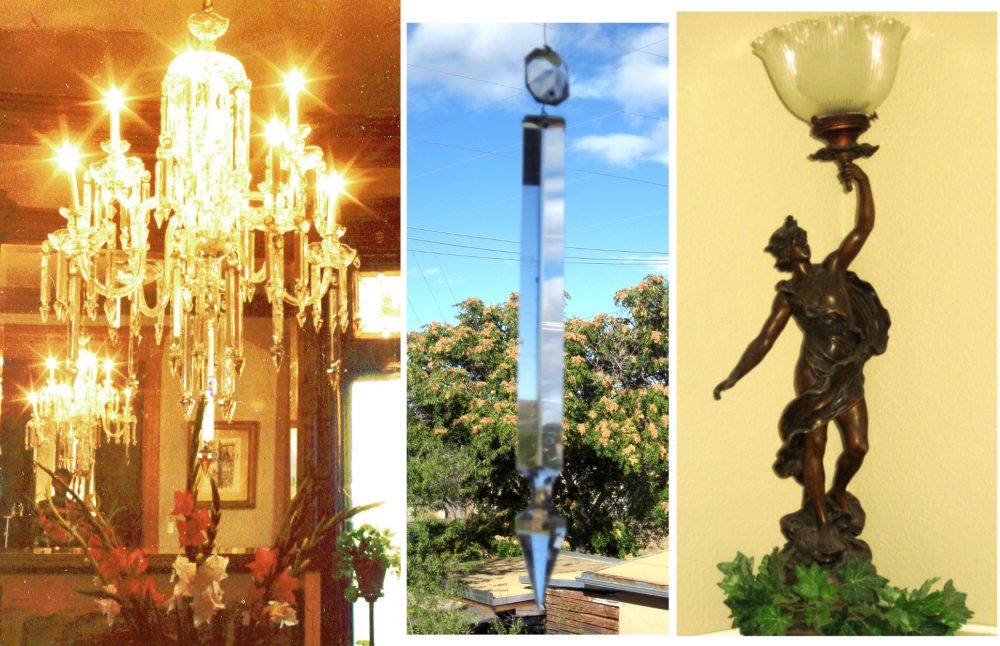
But to return to that Centennial chandelier: As remarked before, it was a gift from France along with the Statue of Liberty.  My housemate Charles, being a historic preservation bigwig, got inside on the renovation of an area in Independence Hall where the Centennial chandelier had been hung and nabbed it for our castle.

Victorian Elegance at the Four Belles

In the photo, the huge Eastlake mirror behind the chandelier was rescued from a doomed house on M Street, along with two fabulous mantles and another mirror in black lacquer. When found, it and its beveled glass had been painted white! It now lives in the Library at Santa Fe’s posh inn and spa at La Posada. So I can occasionally visit my old friend.

In the middle is one of the Baccarat prisms (about 18 in. long) hanging on my porch.  On the right is a lamp (purchased in an antique shop), which is also here in my apartment.  By the French sculptor Auguste Moreau, it sat on the newel post of the tiger-eye oak staircase in our grand reception hall.  A few shadows of the Victorian elegance of the Four Belles.

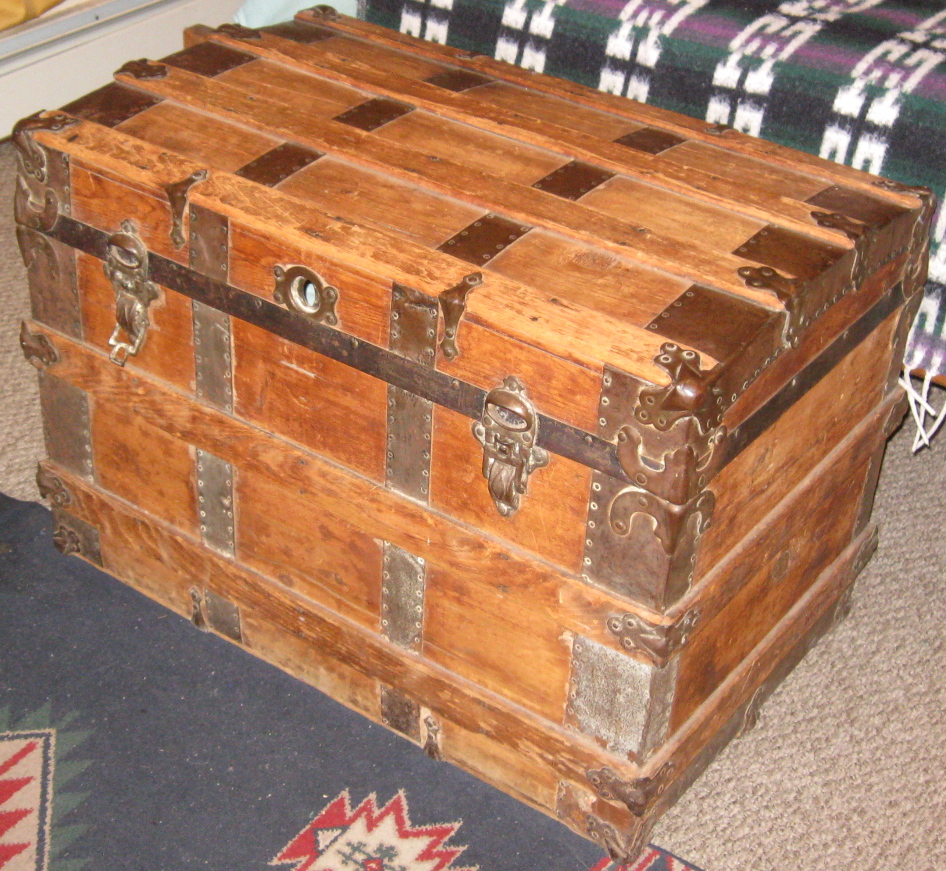
And to return to my salvage activities: Another piece I still have is a trunk I found in 1974 on like the sixth floor of the wracked-out Iowa building also previously mentioned.  I had to remove its shredded canvas covering and live with the raw wood, but after all these decades, it still holds my blankets and linens.  Like that beautiful building, it has survived!

Trunk Found in the Iowa, 1974

There are naturally many stories to be told about salvaging, but I’ll only impose on you with a few. The first was an adventure of saving a plaster ceiling medallion like the one shown below, though I recalling it being a bit more ornate, if you can imagine that:

Victorian Ceiling Medallion

The derelict house was just a few doors down M Street from the one with the mirrors and mantles. I hauled my ladder into its crumbling dining room and proceeded to the cautious work of removing the ceiling medallion.  In the middle of the job, the entire ceiling of plaster and lathe let go of the joists.  There I was standing at the top of the ladder like Atlas holding up a very heavy sky!  With extreme trepidation and caution I tilted the slab to rest one edge on the floor, and with the other side propped on the ladder, I climbed down.  Then it was a fairly simple job to remove the prize and haul it away in trusty old Lavenia Van Dodge.

After untold hours of cleaning and restoration, I gave the medallion to one of the new urban pioneer neighbors around the Circle. Can’t recall who…  That’s what I did with the mantles, fancy woodwork, and such that I salvaged as welcome-wagon gifts.

A major salvage accomplishment was getting into a gorgeous Greek Revival building at, I believe, 12th and O (former home of DC’s black Masonic Lodge), the day before it came down.  They’d abandoned their library, and my friends and I loaded it out of the back window into Lavenia.  In the horde I found among other fascinating volumes a huge tome called “Ancient Monuments of the Mississippi Valley” by Squier and Davis, which led to my 1992 book “Remember Native America.”  (I’d just seen the old public library on Maryland Avenue get knocked down with all the books still in it!)

And one more anecdote: After salvaging some mantles and sets of fabulous glazed tiles from the fireplace surrounds from another house, I went to a dinner party with the family of a lady friend in Alexandria.  Her aged grandmother was our hostess and was fascinated to hear about all my salvaging activity.  When I mentioned the address of that day’s rescues, the grandmother almost had a cardiac:  It was the house where she’d been a little girl, and the room with the green tiles had been her bedroom.  I came back the next day and gave her one of them as a souvenir.

Victorian Glazed Tile from Fireplace Surround

Later, in 1982, I installed several of the tiles around the kitchen sink in my next Victorian, a little Queen Anne in Denver, with this one left over.

#

Heretical History

During my recent exhibition (entitled YE GODS! Icons of Aztec Deities), I gave a series of 15 lectures on the Aztec codices and Aztec mythology, culture, and history, branching out in later sessions to New World history in general. From the beginning, I stressed to my listeners that as an independent researcher and theoretical historian (a “historician”), I like to consider probable answers for puzzling questions which the academic establishment refuses even to recognize. I warned them to get ready to hear some historical heresy.

For example, in lecture 10 (Continuity of Culture and Art in Mesoamerica), I discussed the continuity of the ceremonial calendar from the Olmec through the Maya and into the cultures of central Mexico (culminating in the “Aztec calendar”). Then I proposed that the calendar may well have been invented at Chavín de Huantar in Peru.  I published the convincing circumstantial evidence in the article “Source of the Mesoamerican Ceremonial Calendar” in the magazine Ancient American (Issue No. 115) and noted probable diffusion via sea-farers sailing north up the Pacific coast to reach the early Olmec.  That was Heresy No. 1.

Then in lecture 12 (Mesoamerican Relations with Mississippi), I broke some startling news which was corroborated by the website www.peopleofonefire.com, issued by Richard Thornton, a researcher of Native American heritage.  He has discovered convincing linguistic, DNA, and archaeological evidence that populations from Meso- and South America migrated into the Southeast of North America hundreds of years before the European “discovery.”

Independently, I had previously identified a shell gorget from northwestern Alabama depicting the Mesoamerican Fifth Sun, Four Earthquake, and in my article “Mesoamerican Influences in Mississippi” in Ancient American (Issue 118), I presented ethnographic testimony that (probably under pressure from the aggressive imperialism of the Toltecs), a tribe of Totonacs from Vera Cruz had migrated into the Muscle Shoals area to become the Chikasa (Chickasaw).  Though well-documented, that was Heresy No. 2.

In lecture 14 (Mesoamerican Relations with the Anasazi), I expanded on a proposal by Frank Joseph in “Advanced Civilizations of Prehistoric America” that the Huari of Peru (likely an evolution/reincarnation of the more than three millennia-old culture of Tiwanaku from Lake Titicaca) had migrated up the Pacific coast, through the Sea of Cortez, and up the Colorado River to become the Anasazi of Chaco Canyon. So I was merely guilty of repeating Heresy No. 3.

However, in that context I uttered my own Heresy No. 4: that some populations from the west coast of Mexico may possibly have sailed up the coast and “colonized” the Pacific Northwest.  As I noted to my audience, I made this heretical proposal simply on the basis of a linguistic coincidence (something I generally don’t much appreciate in others’ arguments).

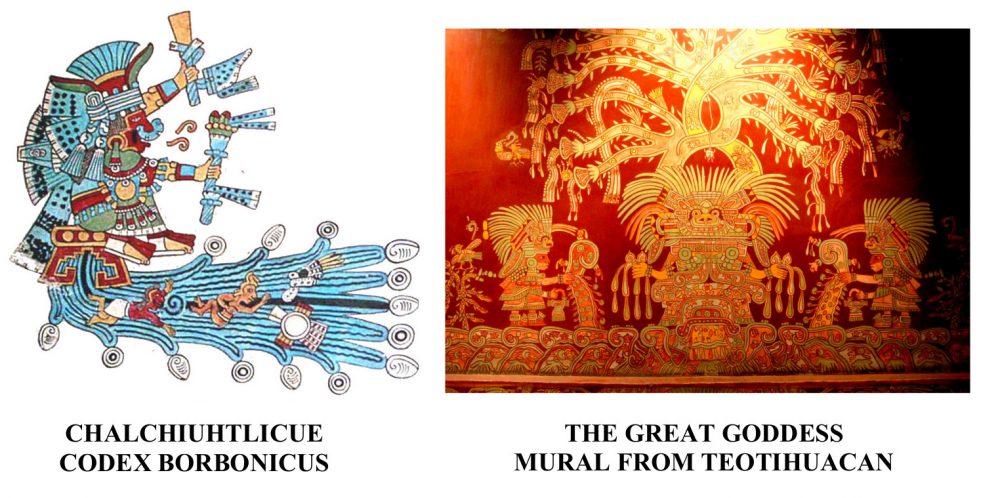
Namely, the city of Seattle was supposedly named for the “chief” of a Native American tribe on the Olympic Peninsula. Well, it just so happens that Ce Atl is the Nahuatl day-name (One Water) of the goddess of water, Chalchiuhtlicue, the Jade Skirt.  She was earlier the Great Goddess of Teotihuacan, likely with the same calendrical name, which may have also held for the Maya goddess of water, but deity names in that even earlier culture are rather confused.

Mesoamerican goddesses of water

As a name for the Pacific Northwest area, a people, an important “town,” or even a chief, One Water seems a legendarily appropriate name for a Mesoamerican “colony” in that area. Such a colony might have happened due to social turmoil amongst the classic Maya, to later aggression by the Toltecs on populations in western Mexico, or even as more recent Aztec (Nahua) imperial “exploration.”  In any case, my heretical suggestion was basically a frivolous “teaser.”

For a couple weeks, that’s what it was for me too, simply an intriguing possibility—until I started reading “The Journals of Lewis and Clark” (edited by Bernard DeVoto). Their first mentions of the Salishan (“Flathead”) tribes in the western Rocky Mountains didn’t give me pause, but when that characteristic kept appearing amongst the tribes down the Columbia River, I had to stop and wonder.

While that exploratory expedition wintered at the mouth of the Columbia, they had much communication and commerce with the many coastal tribes. On March 19, 1805, Captain Lewis took the time (in his fairly “scientific” manner) to write:

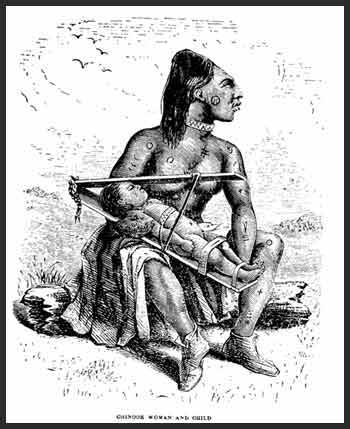
“The Killamucks, Clatsops, Chinooks, Cathlahmahs, and Wâc-ki-a-cums resemble each other as well in their persons and dress as in their habits and manners. their complexion is not remarkable, being the usual copper brown of most of the tribes of North America.  they are low in statu[r]e, reather diminutive, and illy shapen; poss[ess]ing thick broad flat feet, thick ankles, crooked legs wide mouths thick lips, nose moderately large, fleshey, wide at the extremity with large nostrils, black eyes and black coarse hair.  their eyes are sometimes of a dark yellowish brown the puple black.  the most remarkable trait in their physiognomy is the peculiar flatness and width of forehead which they artificially obtain by compressing the head between two boards while in a state of infancy and from which it never afterwards perfectly recovers.  this is a custom among all the nations we have met with West of the Rocky mountains.  I have observed the heads of many infants, after this singular bandage has been dismissed, or about the age of 10 or eleven months, that were not more than two inches thick about the upper edge of the forehead and reather thiner still higher.  from the top of the head to the extremity of the nose is one straight line.  this is done in order to give a greater width to the forehead, which they much admire.  this process seems to be continued longer with their female than their mail children, and neither appear to suffer any pain from the operation.  it is from this peculiar form of the head that the nations East of the Rocky mountains, call all the nations on this side, except the Aliohtans or snake Indians, by the generic name of Flatheads.”

Chinook woman and child

Surely I am not the first to note that Captain Lewis has described in exquisite detail the traditional Maya practice of skull deformation. (That same practice also occurred in other parts of the world and among certain tribes of the American Southeast who—per Heresy No. 2 above—migrated there from Mesoamerica.)  With this official testimony, it seems more than probable that this widespread cultural practice in the Pacific Northwest came from a coastal colony of the Maya. The also widespread practice of nose-piercing (as in the Nez Perce tribe and others) could just as easily have disseminated from such or later Mexican settlements.

Considering this distinct possibility, I believe it’s high time someone ran a DNA study of the surviving Northwest tribes to see if they actually do have markers of Mesoamerican populations. Likewise, it would make sense for someone with the expertise to compare the languages of those tribes with those of Mesoamerican peoples. There is a distinctly Nahuatl-ish sound to the names of the Tlingit and Kwakiutl tribes…

But even without such genetic or linguistic evidence, I will now make bold to propose that there was indeed a Mesoamerican colony (or colonies) on the Pacific Northwest coast. And having uttered that blasphemy, I’ll prepare for the academic inquisition to try and burn me at the stake.

Another Rather Large Whoop!

You’re probably not interested in hearing the involved backstory of this exciting post, but I’m going to tell you anyway.

Forty years ago, I was working for OPERA America, a service organization for opera companies. That was how I came by a commission from Lotfi Mansouri of the Canadian Opera Company to translate Tchaikovsky’s Russian libretto for his opera “Maid of Orleans.”  To be sung in English, their production (1978) in Toronto and Ottawa was called more simply “Joan of Arc.”  Attending its rehearsals, revelling in the performances, and lecturing about the work were the pinnacle of my academic career in Russian (which I’d abandoned some years before).

The next year (1979) David DiChiera of the Michigan Opera Theatre chose to mount another production, which I attended with greatest pleasure. And then the translation lay on my shelf for four decades. In January of this year, probably because forty years is a somehow hallowed cycle, I must have sensed that the iron was hot and decided to strike.

Out of the New Mexico blue I wrote a concise letter proposing that in view of the city’s great connection with La Pucelle de Orleans, the New Orleans Opera should do a production of Tchaikovsky’s opera. As encouragement, I added that the company would be welcome to use my English translation gratis.

Robert Lyall of NOO and I had phone conversations of great interest, and in May he called me to say that they had indeed decided to produce the opera in their 2019-2020 season—using my translation. I was totally delighted and offered to “polish” the translation up a bit—after forty years, I figured I might have matured a mite as a poet—especially the love duet…

So that’s my rather large whoop! JOAN OF ARC WILL RIDE AGAIN!  Exact dates TBA.

“Polishing” the translation has been a renewed joy. I can still hear the singers from forty years ago singing the lines and can easily make the words sound better!  Perversely, perhaps the most fulfilling part of re-translating is using my graphics program to set the printed language in the score.  In 1978, over white-out tape, I had hand-printed the translation on the pages, quite legible but still sloppy.  Now it looks for printed real!

I waited till July when my schedule with the YE GODS! show had normalized to start in on Joan again, and by the end of that month had completed Act I, which is one big honking act. This month I’ve been plugging along on the hefty Act II and hope to finish it in a couple weeks.  Acts III and IV are shorter, about the length of Act II, so I’ll be able to knock them off in September.  If the creek don’t rise…

For example, here is a page of the angels singing from Joan’s Aria with the Angels (the lines of which I included in my public library as an example of my translations). There were only minor language changes in this new version:

Page from Joan’s Aria with the Angels

But that’s not all! Apropos YE GODS!, I fully intend to finagle somehow doing an exhibition at New Orleans’ Delgado Museum of Art (in City Park) at the same time as the Joan production (in the Mahalia Jackson Theater).  Why not make it a double-barreled homecoming?  Prodigal New Orleans son (more or less) and Tulane grad brings a spectacular opera and an exceptional art show back home!

I insist on thinking positively!

YE GODS! There Was a Ship…

It’s been a couple (few?) months since I raised a big whoop about my show of black and white Aztec icons (for a coloring book), and that’s what mostly has occupied me lo that many moons.

Richard Balthazar at opening of YE GODS!

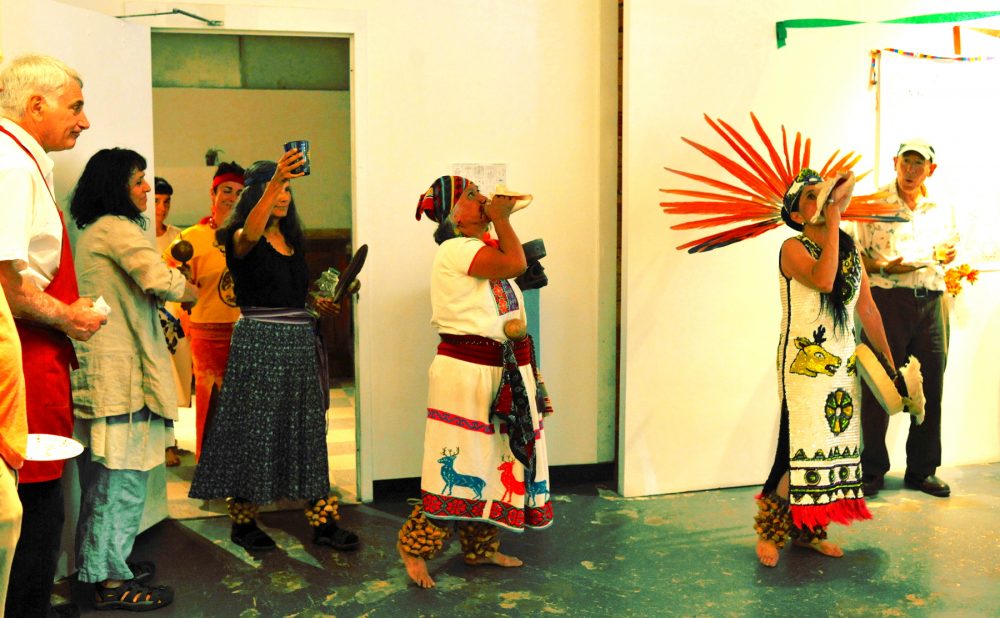
Actually, June and July at my show were splendid! YE GODS! opened on June 1 with a wonderful crowd.  There was delicious food (catered by my old Backstreet Bistro and spa buddy David Jacoby and his wife Melanie as our lovely “soda server”) and a marvelous group of female dancers, Danza Azteca, who blessed the icons (and me) and danced ceremonies around a big Aztec drum (the huehuetl).  They even got some in the crowd to join in a friendship dance.

Throughout the run of the show I spent a couple hours each afternoon at El Museo Cultural (de Santa Fe), just to be there and talk to visitors—but also to give the inexhaustible Maria Martinez a bit of a break from staffing the gallery to attend to her many other duties around the nearly 2-acre cultural facility. She is the peaceful animus of the Museo, and I am deeply grateful for all her help and encouragement.

Entrance of Danza Azteca: David Jacoby and Maria Martinez on left, Concha Garcia y Allen center

By the way, the above photos are to be credited to my friend Seth Roffman, who is editor of “Greenfire Times.”

Visitation at the show was steady, even without publicity during July. I greatly enjoyed meeting folks of all walks—and bending their ears about the icons, their mythology, and elements of history.  In particular, I stressed that only one icon in the show was actually a genuine Aztec deity (Huitzilopochtli).  The rest were from long before the arrival of the Mexica (Aztecs), who simply adopted the culture, mythology, and cosmology of the peoples living there already.

What I enjoyed most of all was the series of 15 lectures I slapped together and delivered off the top of my head. Half were about the Aztec codices (picture books), showing pages and discussing their mythology, iconography, and social implications.  The other half were focused on cultural and historical subjects that went from Aztec-specific through general Mesoamerican to all the Americas and then into probable interactions between those societies. I was blessed to have a corps of several interested listeners who came to most of my talks.  After the finale on Codex Vindobonensis, six of them took me out to dinner, and we had a long, leisurely chat about our lives—and of course, some follow-up questions about the whole Aztec thing.

Now that it is over and the icons are stored in my garage, I’m intending to approach many places here in NM and around the country (and internationally?) about hanging YE GODS! It’s a fantastic educational (informational) show, after all, and I’d offer it to presenters free (charging only for the minimal shipping).  I’d also be available to do my scalable series of lectures (for expenses), and presenters could sell the separate prints for coloring.  WHAT A DEAL!

#

Meanwhile, several other things transpired. Most must wait for later posts, but I’ve totally got to let you know right now about another BIG DEAL!  My memoir THERE WAS A SHIP can be reached by clicking here.

#

BIG WHOOP!

Time to make BIG WHOOPEE!  After plugging away for over four years at drawing Aztec gods and goddesses for my coloring book, I’m having an exhibition of my fifteen epiphanies!

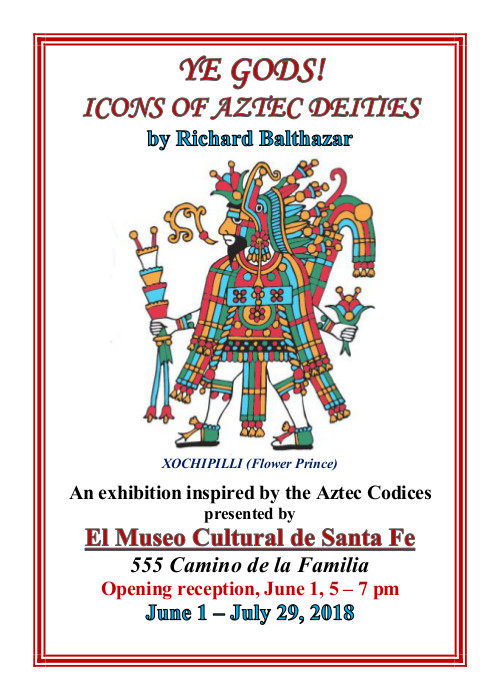
Here’s the flyer for the show with dates, location, and all that.

The large-scale icons (3’ x 4’) are black and white drawings, but I’ve put my colorful patron god Xochipilli on the flyer, poster, and show-banner to catch the eye. And of course, the Flower Prince has been my “insignia” for a long time, including on the banner for this website.

I know you all can’t come to Santa Fe for this art event of the century, but maybe some… In any case, let all your social media know about this great opportunity to see bona fide weirdness!

Aztec Icon #15 – QUIAHUITL, God of Rain

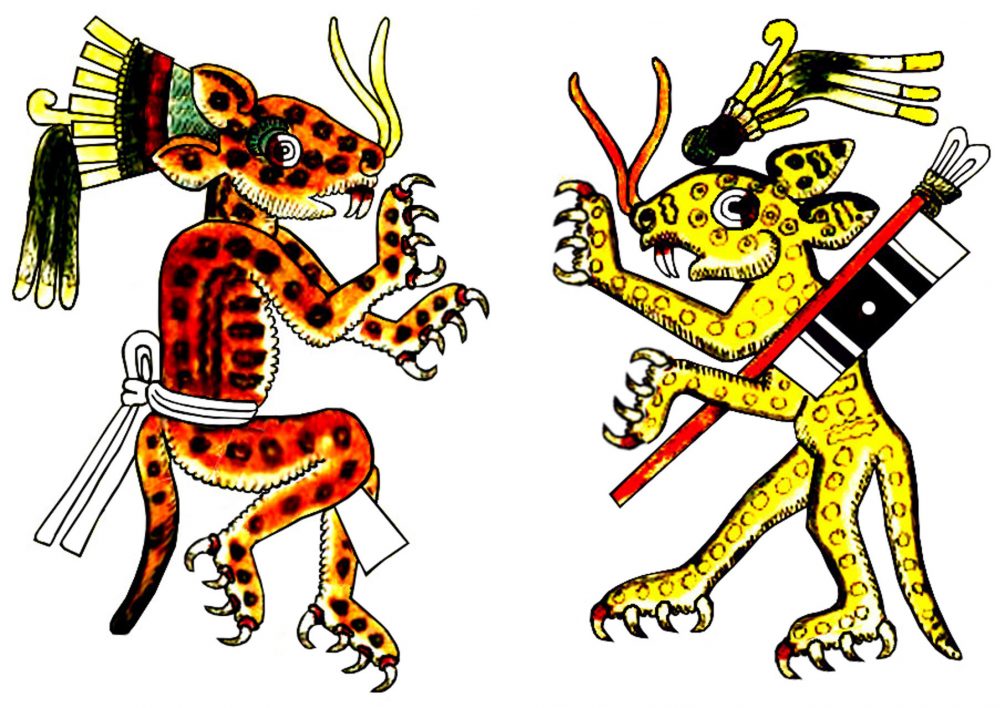
I’ve just checked the date when I posted Icon #14, Quetzalcoatl, for my serialized coloring book YE GODS! and must hang my head in shame that it’s taken me nearly six months to finish Icon #15, Quiahuitl, God of Rain. I understand that nobody out there has been waiting with baited breath to see my latest work of genius, but I managed to draw the earlier deities much more quickly, 14 of them in 3 ½ years.  My excuses are that this past winter I spent a lot of time on my second memoir, and for what it’s worth, this icon turned out to be just about as detailed as Icon #11, Ocelotl (Jaguar).  There’s a lot going on in it.

Quiahuitl, God of Rain

This icon is available as 8X10 with a caption/sources page by clicking here.

In the central image, Quiahuitl {kee-a-hweetł} is shown emerging from the Underworld, rising up out of the maw of the Earth Monster.  The Aztecs understood that moisture mysteriously rises from the earth to the sky (the crest across the top), where the god turns it into rain.  Every locale had its own Quiahuitl to conjure and appease, as indicated by drops falling on trees which symbolize the cardinal directions.

Quiahuitl is of crucial importance to the cultivation of maize, and the lower panel is a homage to that crop. In the center, the plant grows out of another Earth Monster, and on it perches a mythical bird, which is actually a motif inherited from the ancient Maya, Itzamnaaj—the Bird of the Sun.  Just above it is another nod to the Maya, the head of a centipede which they saw as the face of the Underworld.  On the left is Chicomecoatl (Seven Snake), chief of the several goddesses of maize, and on the right is Centeotl, the main god of maize.

But that’s not all. The four big dots indicate that the god is also a day-sign in the ritual calendar, Four Rain (Nahui Quiahuitl).  You’ve already seen the same thing in the icons of Four Water, Four Wind, and Four Jaguar.  I haven’t yet made it alphabetically to the god Tonatiuh and Four Earthquake, the Fifth Sun, our current era.

Anyway, Four Rain is the day-name of the earlier Third Sun (era), a paradise ruled by the Storm God Tlaloc. However, when Tezcatlipoca abducted his wife Xochiquetzal, Tlaloc destroyed that world in a rain of fire.  Its poor humans were turned into butterflies, birds, dogs, and turkeys—which I rather doubt was a great deal of help in the rain of fire.

As I said before, there’s a lot going on in this icon, and there were times I wondered if I was ever going to complete it. Besides, all these past months we’ve been suffering severe drought, and I started to fear it was because I hadn’t finished the god’s icon.  Well, I finally did it last night—and it still hasn’t rained!  I’ve done what I could…

This morning I fired #15 off to my digital wizard in Bangladesh to be turned into a vector drawing, which will be added to the coloring book page.  Then it will follow the other 14 to my print shop. At Santa Fe Signs & Images, they’re being printed on 3’ x 4’ vinyl banners for my upcoming exhibition.

NEWS FLASH!

I’ve recently arranged to have a show of my coloring book pages to be called YE GODS! Icons of Aztec Deities.  It will be at El Museo Cultural de Santa Fe, opening June 1, 2018 and running through July 29.  There’s much to be done in preparation, of course, and I’ve at least gotten calendar listings out to the media.

Now come the million details, and I seriously doubt that I’ll even get started on Icon #16, Tecciztecatl, God of the Moon, till later in the summer. According to the original project plan, I’ve still got 11 icons to go, which at this rate will take a minimum of three more years, maybe four.  What the hell!  I’ll only be 80!

###

Aztec Gods of the Directions

When they founded Tenochtitlan c. 1325 CE, the Aztec barbarians adopted the traditional Mesoamerican temporal and spatial concepts of ceremonial calendar and cardinal directions.

The 260-day Aztec Turquoise Year or tonalpohualli (ceremonial count of days) is based on 20 numbered sets of 13 called trecenas, through which the 20 named days of the solar month are counted cyclically. That’s about as clearly as I can describe it. Some of the few surviving codices (ancient documents) include individual pages of the trecenas with their patron deities.

Some codices also have pages with the 260 days laid out in spreadsheet fashion with five rows of 52 columns in four sets of 13, Here’s a sample section from Codex Vaticanus laying out the first set of 13 columns (trecenas 1, 5, 9, 13 and 17):

vaticanus first section

First Section of Spreadsheet Calendar, Codex Vaticanus

One reads left to right starting with day One Crocodile on the bottom row at lower left; after counting the 52 days in that row, we come back to the second row from the bottom beginning with Reed. Repeating that process, the count returns to the first column to resume with the days One Snake, One Earthquake, and One Water. The blocks of four columns of five days repeat 13 times—only in varying internal sequences—symbolizing the four cardinal directions:

days of direction - Vaticanus

Vaticanus Day-Signs Corresponding to Cardinal Directions

Numbered per their position in the 20-day “month,” these are East: Crocodile, Snake, Water, Reed, Earthquake; North: Wind, Death, Dog, Jaguar, Flint; West: House, Deer, Monkey, Eagle, Rain; South: Lizard, Rabbit, Grass, Vulture, and Flower.

These four cardinal directions are also characterized by colors: East—red; North—black; West—white; and South—blue. This color scheme correlates to the emblematic colors of the Aztec gods of the directions: Xipe Totec, God of the East—the Red Tezcatlipoca; Tezcatlipoca, God of the North—the Black Tezcatlipoca; Quetzalcoatl, God of the West—the White Tezcatlipoca; and Huitzilopochtli, God of the South—the Blue Tezcatlipoca.

Aztec Gods of the Directions

The traditional spatial matrix inherited by the Aztecs also included a fifth direction—the Center—which they saw as ruled by Xiuhtecuhtli, the Lord of Fire/Turquoise.

Xiuhtecuhtli - Lord of the Turquoise - (God of Fire)

XIUHTECUHTLI, God of the Center

With the Mexica’s tribal War God Huitzilopochtli ruling the South, this is emphatically the Aztec empire’s imperial vision of the divine quartet/quintet. Wondering what earlier deity may have ruled the South before, I looked at p. 1 of Codex Fejervary-Mayer, a document thought to have originated in the Veracruz region. It lays out the directions with pairs of patrons, totemic trees, and birds. However here, it’s Tezcatlipoca dominating the Center. (Apologies for the scruffy image, but I’ve got neither time nor energy to “re-create” it.)

fm01

The Five Directions, Codex Fejervary-Mayer, p. 1

The orientation of the directions is a bit different than our common Eurocentric model, rotated one notch counterclockwise. Here East is at the top, West at the bottom; South is on the right, North on the left. Besides the totemic birds and trees, the busy diagram includes much calendrical symbolism, including the days of the directions, year-bearers, and what-not.

By the way, the South tree is a “sacred” Theobroma (Food of the Gods) cacao tree with its chocolate pods. The totem on the North is a spiky ceiba tree (Kapok) which the Maya saw as the great tree at the center of the world—connecting the Underworld and the Sky World (heavens), its trunk representing the world of humans, animals, etc.

The pairs of patron deities in each lobe include only two of our divine quartet of Tezcatlipocas. In the top East lobe, on the right stands Xipe Totec, our Red Tezcatlipoca, with his Flint headdress, and I’d bet his companion is the sun god Tonatiuh, god of the Fifth Sun. In the left North lobe, the upper deity is a simple version of our Black Tezcatlipoca, and the lower one looks like the mighty Tlaloc, God of Storms. The rest of the patrons are different.

The South lobe on the right tells us who must have ruled that direction before the Aztecs inserted their Huitzilopochtli: the upper Mictlantecuhtli, Lord of the Land of the Dead, and the lower Centeotl, God of Maize. The Aztecs gave them both the boot… In addition, the West lobe on the bottom holds no White Tezcatlipoca, Quetzalcoatl, showing instead a surprising pair of patrons from pre-Aztec mythology. On the right (upside down) is Chalchiuhtlicue, the Jade Skirt, Goddess of Water, and on the left Tlazolteotl, Goddess of Filth, a major mother deity.

The reputedly misogynist Aztecs seem to have impeached these two great goddesses to install the famous Maya/Teotihuacan/Toltec Plumed Serpent as their deity of the West, as the White Tezcatlipoca. Speaking of misogyny, in another religious coup, the new empire tried to depose the Goddess of the Moon (Ixchel to the Maya and Metztli in Teotihuacan) from her traditional role as patron of the calendar’s Death Trecena and then made their own Tecciztecatl into the God of the Moon. (Metztli can still be seen in the calendar in Codex Telleriano-Remensis.)

The Aztecs were also conservative, if not reactionary, in other ways, like in celebrating their culture as the culmination of the “golden” ages of Teotihuacan and the Toltecs. Witness their great cult of Quetzalcoatl and abject “idolatry” of Tezcatlipoca, also inherited from the Toltecs. Since time immemorial, he and Quetzalcoatl were seen as each other’s twin and nemesis, and in their roster of the gods of the directions, the Aztecs enshrined that primordial conflict. That they apparently replaced the Smoking Mirror with Xiuhtecuhtli as God of the Center is surprising, and it’s even more so that they didn’t make Huitzilopochtli Center and give someone else South. But winners always get to write their own version of history—and religion.

###

Aztec Icon #14 – QUETZALCOATL, Plumed Serpent

Sorry to take so long to finish the 14th icon for my coloring book YE GODS!  My work was delayed by that time-consuming thing called life.  Anyway, the icon’s done and my digital wizard has turned it into vector drawings for free sizing.  Here you have the most famous Aztec deity of all, QUETZALCOATL, the Plumed Serpent:

Quetzalcoatl, Plumed Serpent

QUETZALCOATL (Plumed Serpent) {ke-tsal-ko-atł} is the god of intelligence, learning, writing, arts and crafts, the calendar, priests, and merchants and was the bringer of maize to mankind.  Opposed to human sacrifice, he is called the White Tezcatlipoca and is the 9th lord of the day and god of the West. As the planet Venus, he is known as Tlahuizcalpantecuhtli, the morning star, and his twin Xolotl is the evening star.  He ruled the Second Sun (Four Wind) and created the current Fifth Sun (Four Earthquake) by using his own blood to give new life to the bones in Mictlan.  He was known as Kukulcan to the Maya and a major deity in Teotihuacan, and Quetzalcoatl was the traditional name/title of the Toltec rulers of Tula.

This icon is available as 8X10 with a caption/sources page by clicking here.  The freely sizable vector versions are available by clicking here.

By way of explaining this new icon, I must first thank Eliseo Rosales, a tattoo artist in California, for his suggestions, particularly for the design on the pedestal and for the important theme of maize.

The central figure of Quetzalcoatl is based on an image from Codex Borbonicus with details of costume and accoutrements mostly from Codex Magliabechiano, though the serpent on his back is adapted from those on the Stone of the Suns. Don’t be surprised by his beard, which occurs in other codex images:  According to some, he was supposedly blond and white-skinned.

In his left hand, the deity holds the weapon known as Xiuhcoatl (Fire Serpent), and on his shield is his standard ‘cross’ symbol. His peaked cap of jaguar pelt is apparently a Huastec influence.  Sprouting from his forehead is a ritual ‘blooming shinbone,’ the significance of which escapes me.  The numeral by his left foot is Nine, of which he is the patron, and the day-sign One Reed directly over his head is his ceremonial day-name.

Now for the other motifs. The pedestal, as mentioned above, illustrates the depth of the history of the Plumed Serpent.  It comes from the frieze on the Temple of Quetzalcoatl in Xochicalco (c. 1000 AD), which was a city/culture that arose in the aftermath of the Classic civilizations of the Maya and Teotihuacan.  As evidence of his even deeper history, the two heads flanking his day-name are views of sculptures on the Temple of Quetzalcoatl in Teotihuacan (c. 600 AD).  The paired feathered serpents on his either side are taken from Codex Borbonicus and Codex Telleriano-Remensis, and the paired quetzal birds are merely grace-notes.

The border design is adapted from one of his images in Codex Telleriano-Remensis. The day-signs embedded in it represent the ceremonial calendar which the deity brought into Mexico in the dim past.  Each group of five days represents a direction in the Aztecs’ odd world-view.  At the bottom is West, of which he is the patron.  At the top is East, on the left North, and on the right South, the standard Aztec spatial orientation as it was also for the Maya.

Drawn respectively from the Cospi, Vaticanus, and Borgia codices, the standing deities in the upper section are: on the left, Tlahuizcalpantecuhtli, Lord of the House of Dawn (as the Morning Star), on the right Xolotl (as the Evening Star), and at the top his nagual (manifestation) as Ehecatl, God of the Wind.

In the upper corners are scenes representing his gift of maize to mankind. On the left is Tlaloc, the Storm (Rain) God, nurturing the goddess of maize Chicomecoatl, and on the right is the goddess of flowing water Chalchiuhtlicue tending the god of maize Centeotl.

That’s all the mythology I could manage to cram into this icon. Surely it’s enough.

#

Another note of interest about Quetzalcoatl. In the September, 2017 issue of ANCIENT AMERICAN magazine, my article just appeared entitled “The Plumed Serpent in North America.”  Click here to check out a copy.

My Jubilee

Recently having turned 75, I think that respectable age qualifies for a jubilee celebration. At least I’m jubilant.  To celebrate this auspicious occasion, I had a portrait taken by the talented local photographer Carolyn Wright of the Photography Studio.  For the first time ever, I must say that this picture does me justice, and I’ve already featured it on my homepage.

Richard Balthazar, Writer and Artist

I jubilate in celebration of my many blessings:

First, having grown up, had a family, and gotten old in this country (USA)—where I’ve been ostensibly free, in spite of spending most of my life as an outlaw (gay), and could make a reasonable living doing what I like (arts, education, horticulture…). That covers many bases.

Next, having been in extraordinarily good health all my life. There have been a few medical emergencies and curable conditions, but especially in these later years I seem to have crafted a very healthful diet and regimen of physical activity (gym and dancing).  I try not to be too proud of my deceptively youthful (and handsome) appearance above and am more than happy to tell anyone my anti-aging secret (Kombucha).

Also, having had such exciting experiences, like trips all over around this country and into Canada and Mexico, fascinating festivals (esp. Mardi Gras and lots of Gay Pride celebrations), and wonderful performances by fantastic artists. I’ve lived a culturally rich life style.

On this my jubilee, I also jubilate big time over the exceptional things I’ve accomplished, though they may not have made me rich or famous. My jubilee is the perfect time to toot my own horn—since nobody else is going to.  So here goes:  Toot!

  1. Won an essay contest in high school (1958) and represented Arkansas representative at the First National Youth Conference on the Atom in Atlantic City. I still have my essay on atomic energy, and its blue-ink penmanship still reads intelligently, if archaically.
  2. Sailed gaily through college at Tulane in the early 1960’s with a double major in Russian and French Quarter debauchery and made Phi Beta Kappa.
  3. Wrote a Master’s thesis and a few doctoral dissertations in the later 60’s, contributing exactly nothing to world knowledge, but they got me a job teaching at a university.
  4. Appeared in theatrical productions: ballet (peasant in Coppelia, 1970), play (sailor in The Tempest, 1971), and operas (extra in Prokofiev’s War and Peace at Wolftrap, 1975, and supernumerary cardinal in Lalo’s Le Roi d’Ys, 1980, on Broadway, no less).
  5. Coached the Paul Hill Chorale to sing Kabalevsky’s Requiem in Russian at the Kennedy Center In 1975 and translated for the composer in interviews and social occasions.
  6. Was a stage interpreter with the Bolshoi Opera in Lincoln and Kennedy Centers In 1976 and got to watch their repertoire many times over (from down-stage left).
  7. Translated Tchaikovsky’s opera Maid of Orleans into English for productions by the Canadian Opera Company, 1978, and Detroit Opera Theatre, 1979. This was my first truly artistic achievement, a triumph of rhymed triplets in iambic pentameter. Toot-toot!  I’ve included a poetical excerpt in my Public Library for your enjoyment.
  8. Wrote the play The Special Case, a detective drama drawn from Dostoevsky’s novel Crime and Punishment, which was produced by the Santa Fe Community Theatre in 1990 and ran for two weeks to no reviews. An actor praised it as “a Russian Colombo.” Yes.  It can be read (and is available free for production) in my Public Library.
  9. Discovered the suppressed subject of the Indian Mounds, spent about 15 years researching them, and finally published Remember Native America, a mound travelogue, in 1992. It has since been superseded by much more research and revision of timelines, but all the same, it’s available here for free download.
  10. Discovered the neglected subject of the Aztec calendar, spent some five years drawing, and published Celebrate Native America, a new book of days, in 1993 with my artwork and an abortive attempt to proclaim a Sixth Sun, also available here for free download.
  11. Created a unique and exciting profession in 1997, spending 15 years as the Used Plant Man  (or the Iris Man in summer), a plant recycler at the Farmers Market, maybe not an artistic achievement, but I spread beautiful iris all over town. Good enough.
  12. Built an innovative greenhouse in 2000, a semi-subterranean, ecologically efficient structure for raising cacti, succulents, and ornamentals for market. Again maybe not artistic, but it was definitely an architectural achievement .
  13. Wrote the novella Bat in a Whirlwind (over about 30 years), an autobiographical story of almost coming out in the backwoods, published electronically on this website, 2015. Click here for free download.
  14. Wrote the novel Divine Debauch (over maybe 25 years), fictionalizing my dissolute years in the French Quarter, published by AuthorHouse.com , 2005. It really needs a rewrite, but I haven’t the energy or time. Meanwhile, it’s still a great gay read.
  15. Wrote the handbook Getting Get, a glossary of the English verb, (after 40 years of linguistic research), published by AuthorHouse.com , 2006, but also available electronically for free by clicking here.  Frankly, it’s my work of genius.
  16. Wrote the memoir There Was a Ship covering my time in in Seattle (1965-66), published electronically on this website, 2016. Click here for free download. It’s the story of a gay man going (kicking and screaming) back into the closet.
  17. Wrote the biography Ms. Yvonne, the secret life of my mother, published electronically on this website, 2016. Click here for free download. It was fascinating detective work and much photo restoration to uncover the life of a survivor of Hurricane Katrina.
  18. Wrote the unique reference on the Aztecs, YE GODS! an illustrated encyclopedia of deities, an essay on the surviving Pre-Conquest codices, and a coloring book of thirteen of my icon drawings based on images in the codices, published electronically on this website, 2017. Click here for free download of the separate sections.

Goodness! That was almost a whole horn concerto of jubilee toots.


I won’t be able toot about anything else for a while. I’ve only just begun a second memoir, this one about gay life in the carefree 1970’s, and there are still 13 more icons to draw for YE GODS!  You’ll be the first to hear about any new achievements.