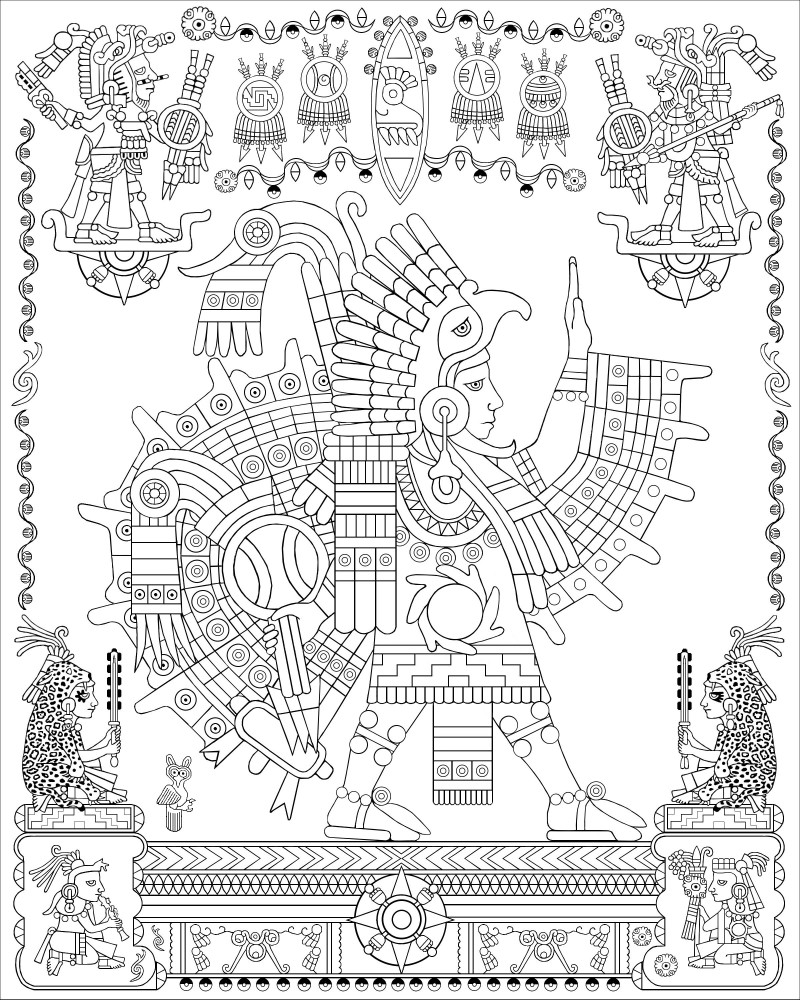
Aztec Icon #8 – Itzpapalotl, The Obsidian Butterfly

It’s been about two months since I’ve been able to celebrate completion of an icon, but here at last is the next in the series for the coloring book  YE GODS! Hooray!  Besides the many days of maniacal drawing, I suffered through some sickness and enjoyed two days in the hospital with a collapsed lung.  Now totally fixed.  So much for daily diary matters.

I think you’ll agree that this icon of the goddess Itzpapalotl, the Obsidian Butterfly, is startling and disturbing, if not frightening, but you should also know that these demonic images are absolutely authentic. Check out google images for Codex Borgia. This lady of mystery and death is a good example of how Aztec deities are a mix-up of what we nowadays rather simplistically call good and evil.  The Aztec aesthetic embraces both the beautiful and hideous, just as their philosophy affirms both life and death.

(You can still see or download the previous seven icons by clicking on them in the list on the page for the coloring book .)

ICON #8: ITZPAPALOTL

(The Obsidian Butterfly)

To download this icon as a pdf file with a page of caption and model images from the Aztec Codices, right click here and select “Save Target (or Link) As.”  You can also download it in freely sizable vector drawings from the coloring book page.

Itzpapalotl, The Obsidian Butterfly

Itzpapalotl, The Obsidian Butterfly

ITZPAPALOTL {eets-pa-pa-lotł} is the ancestral goddess of the stars (Milky Way), lady of mystery and death, but also of beauty and fertility. Patron of the day Cozcacuauhtli (Vulture), she is a fearsome warrior who rules over the paradise of Tamoanchan for victims of infant mortality.  She may be the mother of Mixcoatl, the Cloud Serpent, and is patron of the Cihuateteo, harmful spirits of women who died in childbirth.  She is also one of the Tzitzimime, star demons that devour people during solar eclipses.  She is usually depicted as a skeletal figure with butterfly, eagle, or bat wings but can also be a beautiful, seductive woman.  Sometimes she’s known as the Clawed Butterfly.

Violence and Fear in America

I’m really upset—I’ve had it with all this violence.  Here comes my rant.

Actually I’ve been bothered and tormented about violence for 14 years—ever since the catastrophe of 9/11.  That was a social blow we could well have quickly recovered from, had not the terrified powers that were (and still are) used it (and still use it) to terrorize the population (ever since).  In truth, that apocalyptic event was a decisive and lasting victory for the reputed “terrorists,” whoever they may have been (or be).

Those Powers That Be (PTB) have been terrorizing our people by constantly reminding us of the threat of random violence at any time or place.  Any exposure to violence gives it a toehold in our consciousness, an inroad into our awareness, and that is in no way a good thing.  Violence is as contagious as any black plague, maybe more, and way more lethal.

It almost goes without saying that the normal animal and human emotional response to violence is fear.  How one manifests that emotion makes all the difference:  resistance, defense, retreat, or terror (surrender).  These are all fear-based reactions.

Fear has now become the basis of our whole culture or if you will, civilization.  It’s really big business embracing our whole way of life.  Actually it’s several mega-industries:  the insurance industry, the security and policing industries, the medical and pharmaceutical industries, the military industry, the political industry, the media and advertising industries, and the entertainment and sports industries.  Those are just the big kahunas in the economic ocean of fear.  I won’t even try to list all the other fish in this frightful sea.

To return to those constant reminders of the threat of random violence, just think for a moment on how in the past 14 years news reporting has been ramping up intensity and volume of stories about horrific slaughters and atrocities, now with mass shootings almost a weekly spectacle.

Sensational coverage of this supposedly important news has been commandeering the airwaves with continuous mind-numbing video loops and litanies of ominous, hypnotic memes.  And now with the San Bernardino abomination, it has suddenly turned into a reality show with live feeds to the gory details of police action, investigation, supposition, and philosophical commentary.  The insistent message is simple:  This could happen to you.  Be afraid—be very afraid.

Heeding that warning, people now seem to be hiding themselves away in their safe-haven homes.  Sadly, rather than use this private time for interpersonal or personal relations or activities, most turn to the TV and Internet for immersive, violence-based entertainment.  This is a vicious circle, a self-reinforcing mechanism for terrorizing folks.  Plain and simple, we’re being brain-washed, no, make that force-fed, with images and thoughts of violence at every turn, news programs, action dramas, sitcoms, and even in commercials.

Of course, this begs the question:  Why do folks willingly, even compulsively, watch violence?   Frankly, I believe that watching violence is the same as watching pornography—just as vicarious and shameful.  They both pander to the negative, atavistic side of the human being and awaken similar bestial emotions.  And both are super-addictive.

So where does a fearful population go from here?  Seems to me, there are three ways to go.  My preference is to close my eyes and ears to the insidious message, living my life without fear of threats and surviving or not.  Of course, you could always retreat like Gollum deeper into the bowels of the earth with your precious screen still spewing its poison, but then there is nowhere to go but even deeper down.

The third option might be to negotiate with the PTB, trading off our rights and humanity for security.  Maybe that’s what the PTB have had in mind all along.  Just saying.

Such horrible bargains have been struck many times in the course of history.  Remember the Romans’ pacification of their population with bread and circus (which was simply glorified violence)?  Nowadays it’s junk food and TV (even more vilely violent).  Don’t forget the relative social security of medieval feudalism or the prosperity of empires, of course at the cost of personal liberty.  Some monarchs or dictators have occasionally provided reasonable peace and security at the cost of social freedom, and theocratic states still sell protection for total control of their people’s thoughts and behavior.

Personally I’m not going to settle for any of those raw deals.  Again, my choice is to live without fear.  Whether or not I fear it, my future lies solely in the hands of Providence.  We get what we’ll get, and pre-emptive fear of dire possibilities is a miserable waste of time.  Most won’t even happen, and if one does, well, that’s the way the cookie crumbles.

My personal mantra is Frank Herbert’s transcendent dictum in “Dune:” “I must not fear. Fear is the mind-killer. Fear is the little-death that brings total obliteration. I will face my fear. I will permit it to pass over me and through me. And when it has gone past I will turn the inner eye to see its path. Where the fear has gone there will be nothing. Only I will remain.”

To break this cycle of fear-inducing violence, we’ve got to deny it any place in our spirit, banish it from our thoughts and fantasies, and quell our instinctual fears.  We must shut out society’s pervasive drone of violence and create a new personal music, a true entertainment for our fearless minds.  For my own part, I’ve recently taken up nonchalant whistling.

Again it almost goes without saying that my strong (and realistically rational) opinions about today’s atmosphere of fear aren’t going to change squat.   My only (perfectly realistic) fear is that the terrorized people of the world might surrender their lives and liberty to the PTB for a pittance of dubious security.  Believe me, folks, surrender won’t banish fear—or violence.

Meanwhile I’ll just whistle a happy tune, letting that fear pass over and through me, and only I will remain, a free human being.

Aztec Icon #7 – HUITZILOPOCHTLI, Hummingbird of the South

Let’s get back to my coloring book of Aztec icons called YE GODS!  THE AZTEC ICONS.  Here comes the big guy, the patron deity of the Aztec tribe (the Mexica), a war god, oddly named for a tiny bird.

In all good conscience, I must apologize for the exuberance of miniature detail in this drawing, but it’s all necessary to tell his story. The motifs in the icon are modelled on images from several codices too numerous to mention.  If you find the vignettes too tiny to work with, all I can suggest is to blow the image up to maybe 200X.

Meanwhile, since this icon is so detailed, I’ll give some more notes below, after the caption.

Don’t worry, you can still see or download the previous six icons by clicking on them in the list on the page for the coloring book .

ICON #7: HUITZILOPOCHTLI

(Hummingbird of the South)

To download this icon as a pdf file with a page of caption and model images from the Aztec Codices, right click here and select “Save Target (or Link) As.”  You can also download it in freely sizable vector drawings from the coloring book page.

huitzilopochtli

HUITZILOPOCHTLI {hwee-tsil-o-poch-tłee} is the god of war, power, force, action, accomplishment, and nobility, as well as patron of the city of Tenochtitlan and god of the South. As patron god of the Mexica (Aztecs), he was credited with both their victories and defeats on the battlefield, requiring sacrificial human hearts in either case. He is sometimes called the Blue Tezcatlipoca, the sun at mid-day, and as Lord of the warriors of the day, the Eagle Knights, he wields the Xiuhcoatl (Fire Snake) with which he slew his 400 brothers.  Son of Coatlicue (Snake Skirt), he led the Mexica people on their epic migration from legendary Chicomoztoc (Seven Caves) into the Valley of Anahuac.

###

NOTES TO ICON #7:

The god surmounts a symbol of the sun at zenith. Central above him rises the Tree (cacao) of the South in which sits an unidentified Bird of the South.  To the left of it crouches an Eagle Knight, and to the left is the god’s birth day-name, One Flint.

The figured frame, starting on the upper left and running traditionally counterclockwise, presents episodes in the many-year migration of the Mexica. Largely it reflects Fray Durán’s account in his 16th-century “History of the Aztecs.”  The vignettes down the left side represent:

  • Departure from the mythical homeland of Aztalan and long wandering in the desert.
  • Settling down in Chicomoztoc (Seven Caves) for many years.
  • Birth there of Huitzilopochtli (including the beheading of the god’s mother Coatlicue and slaughter of his multitudinous brothers).
  • Migrating on and conquering the Red City (probably Gran Chichimec in Sonora).
  • Abandoning the god’s sorceress sister Malinalxochitl.
  • Settling down at Coatepec and executing the god’s conspirator sister Coyolxauhqui.
  • Migrating on and killing the god’s nephew Copil, son of Malinalxochitl.
  • Flaying the “Woman of Discord,” daughter of the king of the city of Colhuacan.
  • The five day-signs, Lizard, Rabbit, Grass, Vulture, and Flower (bottom center) are symbols of the South as well, noting the direction of the migration.

Rising from the lower right, the vignettes represent:

  • Arrival of the Mexica at Tenochtitlan, Place of the Cactus, an island in Lake Texcoco (with volcanoes Popocatepetl and Itzacihuatl in the background).
  • Merchants (pochteca) with their god Yacatecuhtli trading with many cities.
  • Warriors conquering many other cities.
  • Warriors capturing prisoners for sacrifice.
  • Priest sacrificing people atop the double temple of Huitzilopochtli and the storm god Tlaloc, now known as El Templo Mayor in Mexico City.

Aztec Icon #6 – HUEHUECOYOTL, The Old Coyote

I guess it’s time to post the next Aztec icon in my coloring book called YE GODS!  THE AZTEC ICONS.  Looking almost Egyptian with the animal head, this one emphasizes dancing, music, and sex, which is a combination close to my heart. I must admit to identifying closely with this deity while drawing him. It’s full of the music of Aztec instruments and singing, all shown in graphic symbols. Details are based on various codices, but mostly Codex Borbonicus.

Don’t worry, you can still see or download the previous five icons by clicking on them in the list on the page for the coloring book.

ICON #6: HUEHUECOYOTL

(The Old Coyote)

To download this icon as a pdf file with a page of caption and model images from the Aztec Codices, right click here and select “Save Target (or Link) As.”  You can also download it in freely sizable vector drawings from the coloring book page.

huehuecoyotl icon

HUEHUECOYOTL (Old Coyote) {hwe-hwe-koy-otł} is the trickster god of mischief and pranks and can lead one into trouble. (His tricks on other gods often backfired.) Patron of the day Lizard, along with Macuil Cuetzpallin (Five Lizard), he’s a deity of sexual indulgence, and with XOCHIPILLI and Macuil Xochitl (Five Flower), he’s also a deity of music, dance, storytelling, and choral singing. Personifying astuteness, pragmatism, worldly wisdom, male beauty, sexuality, and youth, he’s a balance of old and new, worldly and spiritual, male and female, and youth and old age. He is a shape-shifter, turning into animals or humans with sexual partners female or male of any species. Among his male lovers were XOCHIPILLI and Opochtli, god of hunting. He brings unexpected pleasure, sorrow, and strange happenings, and people appealed to him to mitigate or reverse their fates.

Aztec Icon #5 – EHECATL, God of Wind

Hold on to your hats! Here comes a wild wind. Actually the fifth icon for the coloring book YE GODS! THE AZTEC ICONS is the Aztec God of Wind, Ehecatl. My apologies that he’s going to be crazy to color, but I didn’t exactly make him up. The deity’s image is quite authentic, based on one with very similar detail from Codex Borgia.

Don’t worry, you can still see or download the previous four icons by clicking on them in the list on the coloring book page.

ICON #5: EHECATL

(God of the Wind)

To download this icon as a pdf file with a page of caption and model images from the Aztec Codices, right click here and select “Save Target (or Link) As.”  You can also download it in freely sizable vector drawings from the coloring book page.

ehecatl icon

EHECATL {e-he-katł} is the deified element of air and the breath of life. He’s a nagual of QUETZALCOATL, whom he helped create the current Fifth Sun by breathing life back into the bones in Mictlan. He is the god of secrets and mystery, intelligence, and spiritual life. Only smoke, feathers, and birds should be sacrificed to him. His temples were round, sometimes with protruding masks for the wind to blow through. His breath moves the sun and drives the high clouds and rain across the sky. Ehecatl is the 2nd day of the month, and Nahui Ehecatl (Four Wind) was the day-name for the Second Sun, a world ruled by QUETZALCOATL. When that Sun was destroyed by the eponymous wind (hurricane), its people were turned into monkeys.

Aztec Icon #4 – CHANTICO, Lady of the House

In the eternal struggle between life and art, I’ve been much occupied recently by life, the daily doing of things, most with pleasure, and some with stoic duty. So it’s been a while since I last managed to post something. Now with my ailing computer almost healed, I’ll launch the fourth Aztec icon for my coloring book YE GODS!  THE AZTEC ICONS.

Remember, that’s 4 of a planned 26. At the moment I’ve mostly completed the fifth and sixth and am half-way through the seventh. Don’t worry, you can still see the third icon by clicking here or any of the first three through the list on the coloring book page.

ICON #4: CHANTICO

(The Lady of the House)

To download this icon as a pdf file with a page of caption and model images from the Aztec Codices, right click here and select “Save Target (or Link) As.”  You can also download it in freely sizable vector drawings from the coloring book page.

Chantico icon

CHANTICO, The Lady of the House {chan-tee-ko} is the goddess of fire in the family hearth and fire of the spirit, as well as fire of the earth (volcanoes), and logically the wife of XIUHTECUHTLI, the god of fire. Patroness of cooking, eating, domesticity, and weaving she represents the feminine side of life, fertility, and the waters of birth. She is also the goddess of precious things, the lady wealth and jewels, defensive of her possessions and vindictive with gods or mortals who take her treasures. Her own particular omen-bird (parrot?) is attached to her headdress. (Each deity has one.) The jaguar-pelt seat indicates a divine or royal being.

Aztec Icon #3 – CHALCHIUHTOTOLIN, The Jade Turkey

It’s been long enough now that Aztec Icon #2: Chalchiuhtlicue, The Jade Skirt, has been hanging out here in the ether waiting for someone to look at her.  So I’ll gently retire her to the YE GODS!  THE AZTEC ICONS coloring book pasture along with Atl, God of Water .  If you care to, you can still see or download them through the links.

Now take a gander at this strange bird.  To download this icon as a pdf file with a page of caption and model images from the Aztec Codices, just right click here and select “Save Target (or Link) As.”  You can also download it in freely sizable vector drawings from the coloring book page.

ICON #3:  CHALCHIUHTOTOLIN

(The Jade Turkey)

Chalchiuhtotolin, The Jade Turkey

Chalchiuhtotolin, The Jade Turkey

CHALCHIUHTOTOLIN (Jade Turkey or Jewelled Fowl) {chal-chewh-to-to-leen} is a nagual of TEZCATLIPOCA.  Often called the Green Tezcatlipoca, he’s the magnificent patron of the Jaguar warriors of the night and of power and glory for warriors in general, cleansing them of contamination, absolving them of guilt, and overcoming their fates.  Appropriately he’s the patron of the deified day Tecpatl (Flint), the sacramental knife.  (Besides for political domination, Aztec wars were waged to harvest food for the gods—human hearts.)  A powerful sorcerer, he’s also a trickster who plays a flute in the night to lead people astray.  Whoever chances to see him should make bold to seize him and demand to be granted a wish.  Significantly, he’s also god of disease and pestilence.  (The Aztec civilization, like that of the Inca, was destroyed more directly by plagues than by the military conquests of the Spaniards.)

###


New Aztec Icon – CHALCHIUHTLICUE

Well, I haven’t heard anybody squawk about my going another couple weeks without a new posting.  Site stats show very few visits to this blog, though a respectable number of visitors every day to my earlier Aztec deity and calendar images.  Usually somebody even takes a look at my Indian mound photos or drawings of Pre-Columbian artifactsI guess this erratic blog is simply a matter of writing, as we used to say, to hear myself talk.  So be it.

This time I’ve been quiet for other than busy-ness, though there’s been plenty of that in any case.  Now I’ve simply not been able to spend much time online because my grandson visited a couple weeks ago and in one evening of YouTube managed to use up most of the monthly data allotment on my wireless connection—a subject you don’t want to read about, I assure you.

Writing on my memoir is moving along into Chapter 5, so that’s progress.  Drawing for the free coloring book is proceeding at its usual slow pace.  For sanity’s sake, I try to switch back and forth between the subjects every week or so and am now closing in on the sixth Aztec icon of Huehuecoyotl, the Old Coyote.  There are only a few vignettes and musical details to finish.  The problem is not thinking about the next icon for Huitzilopochtli, the Hummingbird of the South, which will also show the legendary migration of the Aztecs from Aztalan to Tenochtitlan.  Please be patient, all you colorists out there.  I’m working as fast as I can.

Meanwhile, here’s the second icon for the coloring book:  CHALCHIUHTLICUE, the goddess of flowing (fresh) water as in rivers, streams, and lakes.  (The goddess of the sea or salt water is Huixtocihuatl.)  To download this icon as a pdf file with a page of caption and model images from the Aztec Codices, just right click here and select “Save Target (or Link) As.”  You can also download freely sizable vector drawings from the coloring book page.

ICON #2:  CHALCHIUHTLICUE

(She of the Jade Skirt) {chal-chewh-tłee-kwe}

Chalchiuhtlicue, The Jade Skirt, Goddess of Flowing Water

Chalchiuhtlicue, The Jade Skirt, Goddess of Flowing Water

CHALCHIUHTLICUE is goddess of flowing water, rivers, and streams, as well as of youthful beauty and ardor with a birth day-name of Ce Atl (One Water).  She is patron of women in labor, childbirth, children, and motherhood.  Certain of her purification rites struck Spanish clergy as similar to the sacrament of baptism.  As goddess of storms and forces of nature, she can be dangerous.  She is the 6th lord of the night (which has 9 hours), and the 3rd lord of the day (of the 13-day week).  The wife of TLALOC and/or possibly XIUHTECUHTLI and mother of TECCIZTECATL and/or the twins QUETZALCOATL and XOLOTL, she destroyed the Third Sun (Four Rain) and ruled the Fourth Sun (Four Water).

###


FREE COLORING BOOK

YE GODS!  THE AZTEC ICONS

­An Outrageous Coloring Book

Icons of Aztec Deities and Commentary

By Richard Balthazar

ICON #1  ATL – GOD OF WATER

For free download as a pdf file, right click here and select “Save Target (or Link) As.”

ATL, Aztec God of Water

ATL, Aztec God of Water

ATL {atł} is the deified element of water, and is a nagual (manifestation or bodhisattva) of TLALOC, the ancient God of Storms (Rain).  In the tonalpohualli or ceremonial count of days, also called the Turquoise Year, Atl is 9th of the 20 named days in the month, a lucky day.  As above, Nahui Atl (Four Water), the 4th of the 13 numbered days in one of the weeks, is the day-name of the Fourth Sun, a previous world ruled by CHALCHIUHTLICUE and destroyed by Water.  Its humans were turned into fish.  The four dots are the Aztec numeral 4.  The extended upper lip (harelip?) has been traditional for Mesoamerican water deities ever since the Olmec.

###

 Rather long ago for my book CELEBRATE NATIVE AMERICA, I originally drew the Aztec deities for the ceremonial calendar.  Now I’m redrawing in the digital medium and expanding them into full-scale icons.  And believe it or not, the YE GODS!  THE AZTEC ICONS coloring book is offering you these amazing neo-Aztec icons for FREE.  That’s right—at no risk—not even any postage.

Color them in as you wish with my compliments.  The wrinkle is that this coloring book will be posted serially as each icon is completed.  That could well take the next couple years—a good reason to keep checking back with me.  At the moment only one is available, but there are four more almost ready for posting, and a sixth is well on the way.

The Aztec deities are a fascinating crowd of inter-related personalities involved in a soap-opera mythology of creation/destruction, love/strife, and life/death that makes the gods of Olympus look like wimps.  Perhaps the confusing dramas, frequent aliases, and surreal images are due to the fact that the Aztecs and their deities indulged in psychoactive drugs like alcoholic pulque, peyote, hallucinogenic mushrooms, and other psychedelic herbs.  So hold on to your hats for some challenging images to color, such as the current posting above.

Using only a bit of my artistic license, I’m basing YE GODS!  THE AZTEC ICONS on extant Aztec artifacts and their surviving picture-booksYou can use these almost authentic Aztec icons as cartoons for large-scale murals, smaller-scale tattoos, needlepoint patterns, and other design or illustration needs.

YE GODS!  THE AZTEC ICONS should also be seen as a free and unique teaching tool for classes not only in art, but also in cultural and historical studies.  In addition, YE GODS!  THE AZTEC PANTHEON is an illustrated encyclopedia of Aztec deities that comprises a crash course in Aztec cosmology, mythology, ritual, society, and history.

Don’t be shy.  Make lots of copies to experiment on.  You’ll need to.

###

Free Book on AZTEC CALENDAR

CELEBRATE NATIVE AMERICA!

An Aztec Book of Days

By Richard Balthazar (Five Flower Press, 1993, out of print)

CNA cover

For free download as a pdf file, right click here and select “Save Target (or Link) As.” 

I recently announced  that I’ve put my old out-of-print book on the Aztec ritual or ceremonial calendar up for free download.  Anyone with interest in art, mythology, history, or horoscopy will find it an unusual experience.  You’ll learn some weird stuff you never ever imagined, money-back guarantee.

The book presents the 260-day sacred Turquoise Year, which was used for divination and prophesy, in color plates of their 13 ‘months’ of 20 days spread over 20 ‘weeks’ of 13 days.  My weekly illustrations also include their patron gods or goddesses in images based on surviving Aztec books, primarily the Codices Borbonicus, Borgia, Nuttall, Fejervary-Mayer, Kingsborough, and Vindobensis.

For free download as a pdf file, right click here and select “Save Target (or Link) As.” 

If you don’t want the book itself, all its illustrations are up for individual free download from my galleries of godsdays, and weeks on this site.  Do whatever with them with my blessing.

The Turquoise Year was an evolution of the earlier Mayan calendar of similar structure with roots among the even earlier Olmec.  It was the ancient Mesoamerican horoscope.  The birth day-name was a person’s ceremonial and official name, and the deities who ruled the numbers, days, weeks, and months, each with light and dark sides, controlled individual and societal fates.

By the way, you can quickly find out your Aztec name by going to azteccalendar.com, and while there, you can even pick up your Aztec horoscope, which I admit will be much more detailed than what you’ll find in my old book.

For free download as a pdf file, right click here and select “Save Target (or Link) As.” 

READERS: Please disregard the final chapter and its mind-boggling concordance.  My hubristic attempt to start up a new Sixth Sun at the fall of Tenochtitlan was at best poetic, but that calendar has now run out anyway.  Forget about it.

Another note:  I exercised my artist’s license on the 20th week, One Rabbit, naming as its patron a far more appetizing deity, Xochipilli, the Prince of Flowers.  The actual patron was a quasi-deity called Tecpatl (Flint—the sacrificial knife).  Feeling like a nagual (or bodhisattva) of Xochipilli, I’ve dared to use his image in the banner on this website.