Free Book on Indian Mounds

GIVEAWAY #1

REMEMBER NATIVE AMERICA! The Earthworks of Ancient America

By Richard Balthazar

Five Flower Press, 1992

I’m pleased and proud to announce that I’ve now scanned the pages of this long out-of-print book for digital distribution.  It’s available now for free download as a pdf file.  All you have to do is right click here and select “Save Target (or Link) As.”

Surveying the periods and traditions of earthworking in Eastern North America, the book is an album of more than 120 monumental earthworks in 20 states:  conical burial mounds, embanked circles and geometrical figures, animal effigies, platforms, and pyramids.

These earthworks are shown in rare surveys, maps, drawings, and photographs, many reprinted from “Ancient Monuments of the Mississippi Valley” (1841), by E. G. Squier and E. H. Davis, which is itself now available online.  Others come from “Report on the Mound Explorations” by Cyrus Thomas (in the 1890-91 Annual Report of the Bureau of Ethnology) which is also now available online.  One of my favorite Squier surveys is the map of Newark works in Ohio:

Newark Works, Ohio

Newark Works, Ohio

Some of the photographs of mounds are my own, and those and many others I’ve taken of mound sites since are included on this website in my Gallery of Indian Mounds.  Here’s one of the newer ones, a shot of the splendid Pocahontas Mound, a pyramid in Mississippi.

MS Pocahontas pyramid

MS Pocahontas pyramid

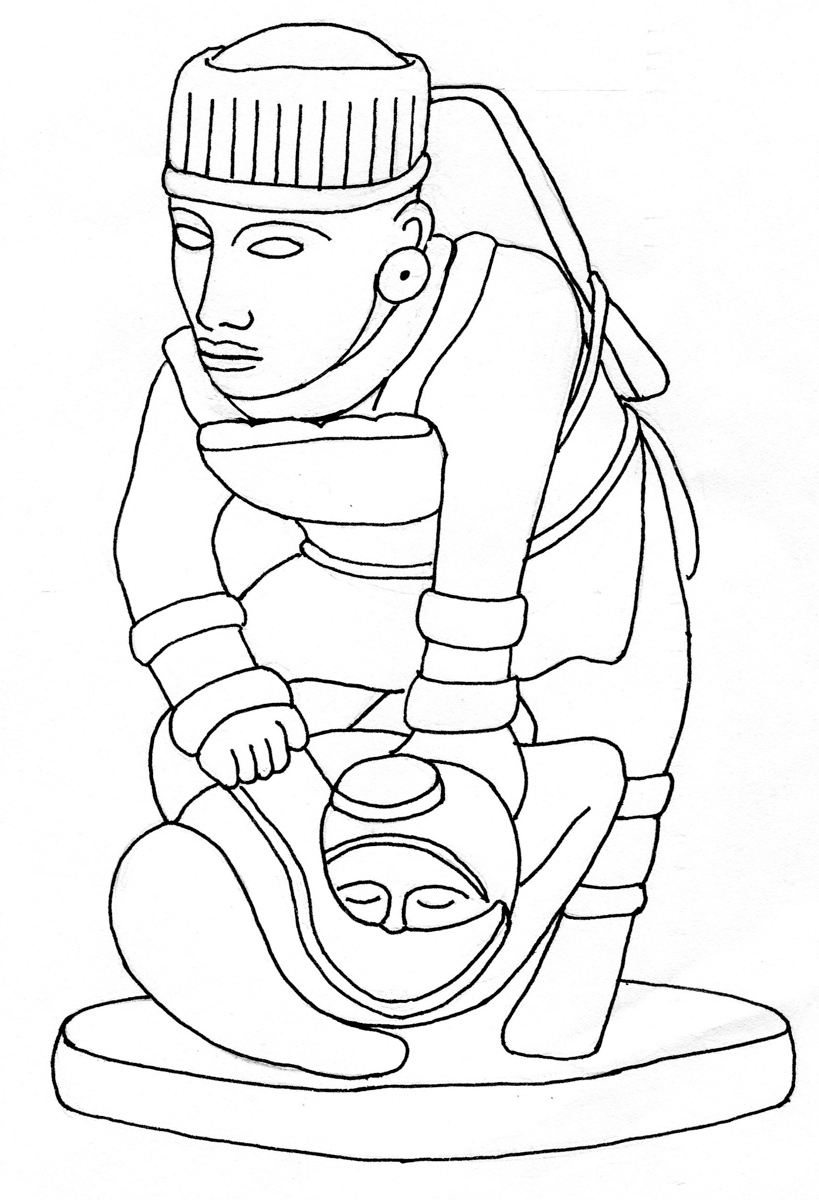
In addition, the book presents a bunch of my line-drawings of artifacts found in mound excavations.  They and many more are up for easy individual download in my Gallery of Pre-Columbian Artifacts.  One of my favorites, albeit disturbing, is a curiously Toltec-looking warrior about to behead a captive.

Warrior, Spiro OK

Warrior, Spiro OK

For free download of REMEMBER NATIVE AMERICA! as a pdf file, just right click here and select “Save Target (or Link) As.”

Now I’m going to steal this opportune moment and bore you with my rant about earthworking, which I believe is a truly primordial human instinct.  Man, the animal who makes things, had to start somewhere.  Originally, of course, things could only be made out of animal material, plant material, stone, or earth, and most of that only after first making the tools or utensils necessary for the manufacture.  Since anything that worked, even plain old stones and sticks, would suffice for the job of moving dirt around, I suspect that the first implements (besides clubs for bonking folks and things) were probably whatever could be used to dig up food roots or enlarge shelters.

It’s but one short step from moving dirt around to piling it up.  As far as we know, people started constructing earthworks several thousand years ago in most parts of the world.  Everywhere you look, they raised piles of dirt in one form or another, often as tomb monuments.  The ziggurats of Sumer were simply piles of mud bricks.  Did the ancient Egyptians build in stone because you can’t effectively pile up sand?  Just wondering.

The impetus to heap up piles of dirt may well have come from observing nature.  Anthills and all that.  Also, it stand to reason that if you’re digging a hole for some reason, you’ve got to put the dirt somewhere.  What’s more, the primordial mind probably saw hills and mountains as the handiwork of some deity or other, and so raising earthen mounds likely had religious purpose, sympathetic magic and such.  Piling the dirt in special shapes would only add to the symbolism, and it seems that the very location and orientation of the piles often was astronomically or socially significant.

I’ll end this rant by noting that ceramic technology is also in fact earthworking, another part of Man’s artistic relationship with the Earth.


Reading a Chasuble

You may recall my recent post about an embroidered scene of the Last Supper, which I presented there with no context.  Sorry about that.  In a consignment store recently I bought a chasuble which I consider a masterpiece of ecclesiastical embroidery.  It’s labeled “Fraefel & Co., St. Gall., Switzerland established 1888.”  An over-vestment worn by priests in celebrating Mass, the chasuble has a treasure of fine embroidered details on the frontal columnar design and on the cruciform design on the back.

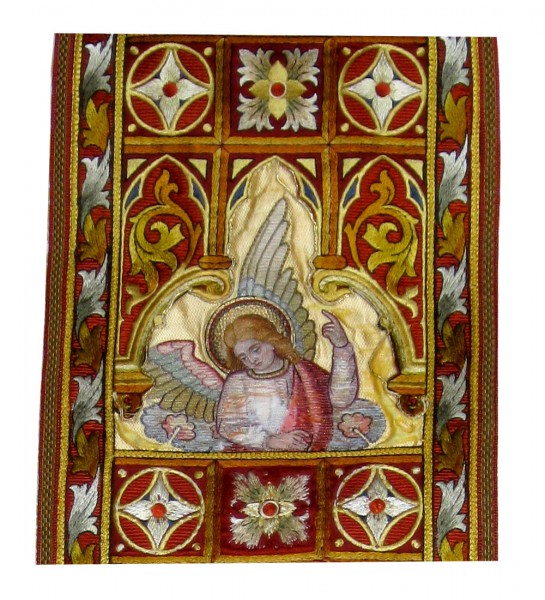
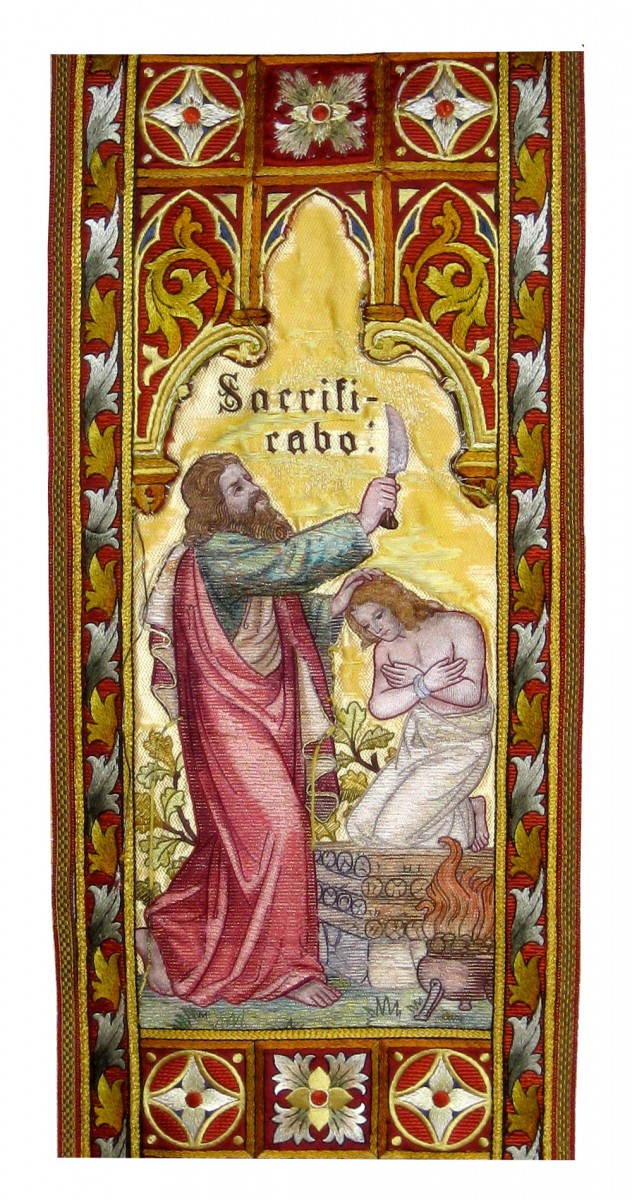
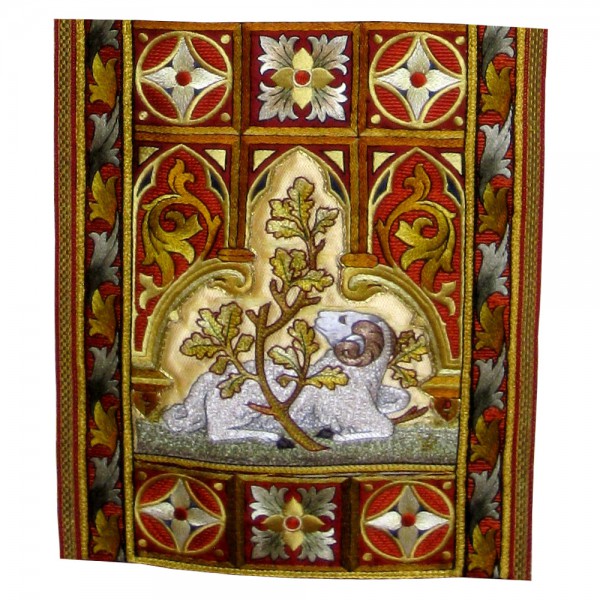
Oddly, on the narrower front are framed scenes from the Old Testament, at the top an angel, in the middle Abraham  preparing to sacrifice his son Isaac, and at the bottom a ram waiting to take the boy’s place on the altar.  I personally think the ram is one of the most magnificent details on the piece.

Angel, Fraefel & Co.

Angel, Fraefel & Co.


Abraham Sacrificing Isaac, Fraefel & Co.

Abraham Sacrificing Isaac, Fraefel & Co.

Ram for Sacrifice, Fraefel & Co.

Ram for Sacrifice, Fraefel & Co.

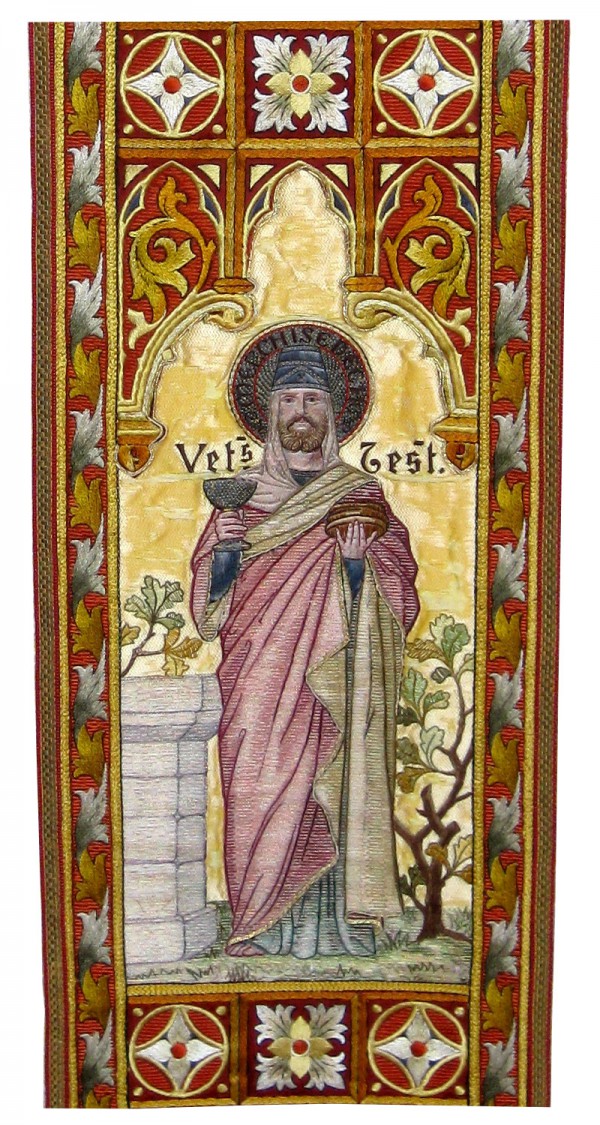
I really wondered about this Old Testament thing on the front of a Catholic vestment.  Then, when I looked at the broader back again and managed to tear my eyes away from the riveting Last Supper scene, I found the two details on the lower part of the cross even more intriguing.

Melchisedech, Fraefel & Co.

Melchisedech, Fraefel & Co.

The imposing fellow is identified in his “halo” as Melchisedech.  When I checked him out, I discovered that he was basically the first priest of the Elohim back in Genesis times.  The name actually means the Righteous (or Rightful?) King, and it was the title of successive priest-kings of the Semitic peoples, including King David.  The iconic ritual of these priests of the order of Melchisedech was the sharing of bread and wine.

Incidentally, according to the Bible, it was a Melchisedech who blessed Abraham after the Battle of the Kings (which may have happened around 2000—1800 BC).  This is something I’ve long been intending to look into.  The late and oft disputed writer Sitchin offered an interpretation of Abraham’s Sumerian origins which begs serious consideration.

The depiction of this primordial priest of the Elohim just beneath the sacramental Last Supper scene I take to symbolize that Jesus (of the House of David) was a priest of the High God in direct line from the first Melchisedech appointed by the Elohim as Rightful King.  This message is an unusual twist on Christianity in that it weaves the Christ into the divine myths in the Old Testament.  Similarly, the Jesus story is another strand in the long tradition of dying gods.

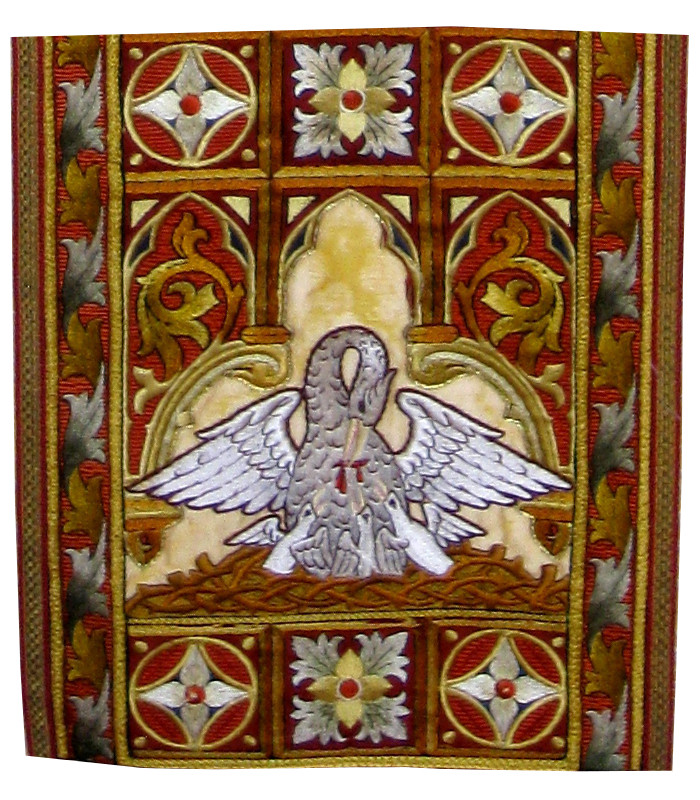
Pelican Piercing Breast, Fraefel & Co.

Pelican Piercing Breast, Fraefel & Co.

The other little detail, the pelican piercing its breast to feed its young, has long been seen as a Christian emblem of self-sacrificing love.  So what if pelicans don’t really do that?  It’s the thought that counts.  However, I recently discovered that this altruistic pelican is also a powerful symbol in Masonic rites.  Only they show seven little chicks, having something to do with the planets or other mystical concordance.  Does the “hidden” symbol indicate a Masonic element in this deep historical perspective on the Christ?  Might this stunning chasuble be a secret and wondrous heresy?

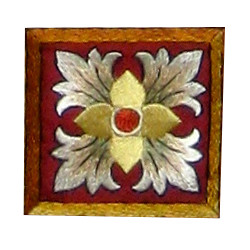
Before I let this go, I’ve really got to exclaim some more about the exquisite needlework on this chasuble.  The embroidery’s delicate shadings and the almost spider-web threads used (by motivated nuns) for details like lips and the irises of eyes is in a word, phenomenal.  Can you imagine any human being sewing this amazingly 3-D floret in a two-inch square?

Embroidered Floret, Fraefel & Co.

Embroidered Floret, Fraefel & Co.


Another Masterpiece Last Supper

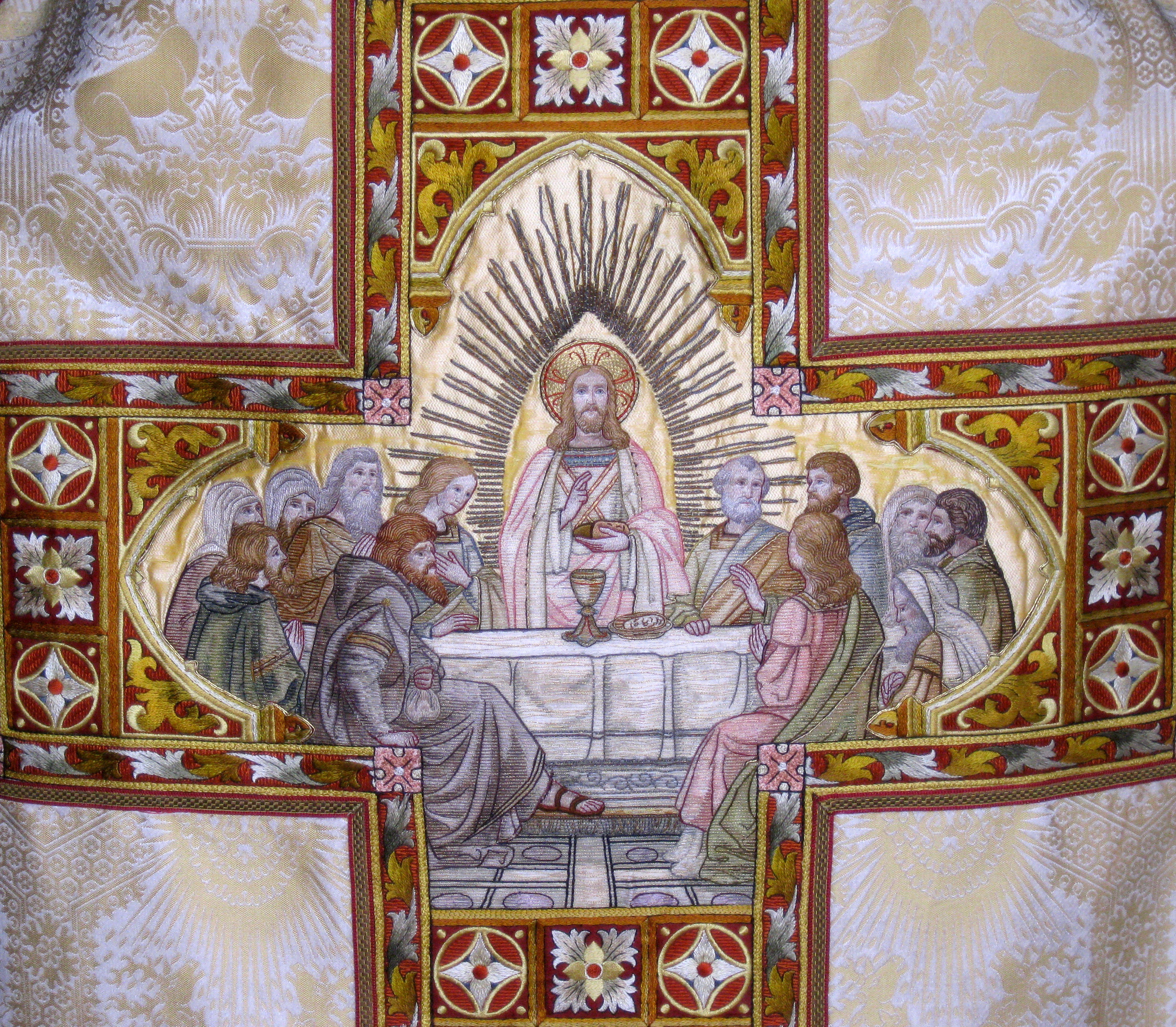
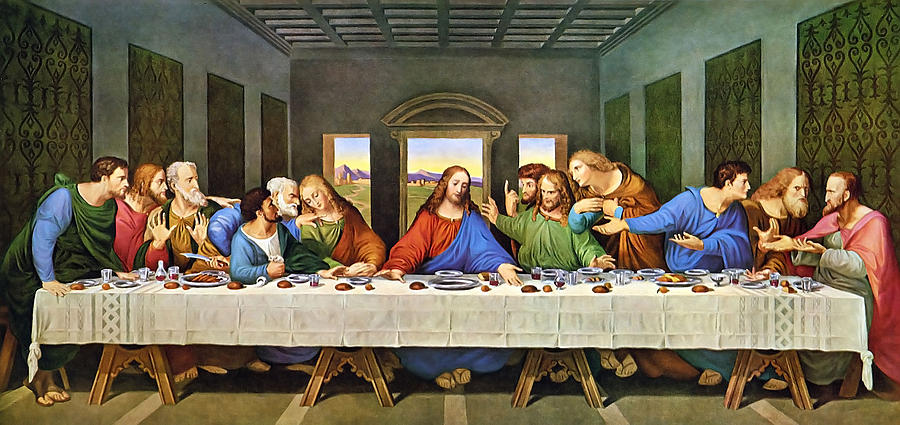
Roll over, Da Vinci!  Not to sound pretentious, but I’ve just discovered another masterwork of the Last Supper.  Apparently from the late 19th century, this one is probably the artistry of an anonymous nun in a Swiss convent, and it wasn’t painted on a wall but embroidered on a liturgical vestment.  Take a look at this baby:

Last Supper embroidery by Fraefel & Co.

Last Supper embroidery by Fraefel & Co.

The photo is high-resolution, so you can probably zoom in to see the incredible delicacy of the stitchery and execution of the figures.

Of course, it immediately begs comparison with Leonardo’s own masterwork.  I’m not sure what similarities there are beyond the groupings on either side of Jesus, with Mary Magdalene on his right.  Both works show “The Twelve” counting her, and the Judas figure clutches a bag (of silver pieces) in both, though less clearly in the painting.

The Disciples are presented as quite different physical types in the two artworks.  (Check out their incredible faces in those almost microscopic threads!)  You can’t really see eye color in the Da Vinci painting, but in the embroidery, most of the figures’ eyes are incongruously blue, and if not grey, in both works most of them have brown or russet hair.  Definitely a Eurocentric view of this crowd of ethnically Semitic types.

As well, the energies of the dinner groups are vastly different.  Da Vinci’s garrulous, talkative, argumentative apostles surround a resigned, pensive, very human Jesus is seated at a table covered with the remnants of the meal.  It is the eloquently human aftermath of the Communion, and just about time to go to the garden of Gethsemane.  The painting is a poignant personal moment in the passion of Jesus the man.

In the embroidery they cluster reverently around the table where a divine Jesus stands (in a glorious aura and halo) to bless their Communion of bread and wine.  This is the sacramental moment when Jesus the god says, “Take this and eat—this is my body.”  This is why I’d really rather call this artwork the New Covenant.

How does all that sound from a life-long fanatical agnostic?  Actually, whether you hold by it or not, you’ve got to respect a big honking myth that’s hung on for many thousands of years.  The myth of the dying and resurrecting god has been, if you will, resurrected several times in as many parts of the world since mankind began.  Often the divine deaths have been much more gruesome than a straight-forward crucifixion.  And at least one goddess came back:  Inanna/Ishtar/Astarte.

In my humble opinion, it’s human nature to try to explain the inexplicable, to embody the ineluctable, to describe the indescribable, to understand the incomprehensible, and to delimit the infinite—by creating myths.  Okay then, if you want to split hairs—by creating religions.

Often beautiful and inspiring (like the present masterpiece of embroidery), these imaginings or faiths, if you prefer, have provided the fabric of all human civilizations, guidance for people to live with one another (or not), answers for life’s unanswerable questions, a focus for spiritual growth and fulfilment, and a sense of the individual’s place (insignificant though it may be) in the cosmos.  You’ve got to give them that.  But please, we must also weigh those blessings against the immeasurable oppression, death, and destruction that reputedly enlightened faiths still cause in the name of merciful, loving deities.  Is that a fair trade?  But then life, like trade, isn’t always fair.

In any case, for purposes of encompassing the divinity, I agnostically think that any faith you care to concoct will be no more effective than spitting in the sea.


FALCON WARRIORS IN TENNESSEE

After those last two effusions about Latin and Greek music, I was planning to write about one of my true loves, classical music.  All in good time.

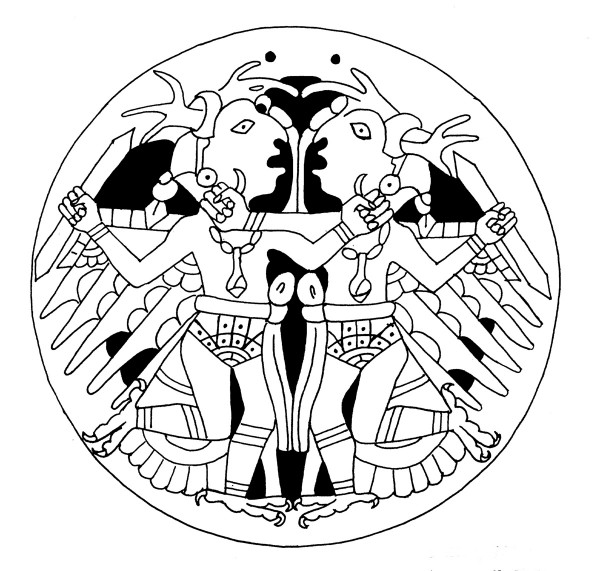
Instead, I feel like writing something about another, my love for the subject of pre-Columbian Native America.  There’s a piece of Mississippian shell art, a gorget from Hamilton County, Tennessee (AD 1200-1400), that I personally consider the most evocative image I’ve ever found from that lost world.

I gather that the gorget now resides at the McClung Museum at the University of Tennessee, but I made bold to do a line drawing of it for my old book, which I’ve included in my Gallery of Artifacts.  It presents a pair of “falcon” warriors.

Falcon warriors - Tennessee

Falcon warriors – Tennessee

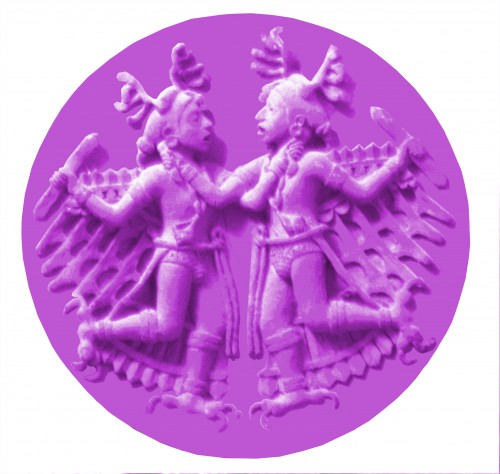
So what if it’s rendered in a rather “primitive,” or better, unsophisticated, manner.  The original artist was working with the tools and materials available and did a remarkable job.  It’s the concept behind the image that fascinates me.  So much so that almost thirty years ago, I re-visioned these warriors as a bas relief in modeling clay in a, shall we say, more modern or sophisticated manner.

Falcon warriors

Falcon warriors

The model has lurked around (actually quite prominently) on my bookshelves, desks, etc. ever since, suffering a tiny bit of damage to the antlers and the seashell pendants, and growing an intriguing darkened glaze on its still soft surfaces.  That just makes it more existentially real.

Still in love with the underlying concept, I recently played around with the above photo on my freeware program (GNU Image Manipulation Program) to try and bring out the image better.  Apologies that I love purple and amethysts.

Falcon Warriors from Tennessee

Falcon Warriors from Tennessee

I rather like the depth of the figures and wings, don’t you?  It’s great to contemplate the details, like the pattern on the feathers, reminiscent of the barred pattern of the peregrine falcon.  The claw-feet are quite like those frequently found in early Mexican iconography, and their flint “swords” have apparently been unearthed at many archaeological sites.  The bun hairstyle and beaded forelock would seem to be standard fashion as they’re found in images from all over the Southeast and even on shell art from the Spiro site in Oklahoma.  The deer-antler headdress is also rather frequent and may just possibly relate to the Celtic horned god of nature and fertility, Cernunnos.

Most intriguing is the fact that these warriors have each seized hold of a lock of the other’s hair.  It’s tempting to think of this as perhaps a form of “counting coup” on each other in a battle, but I’m inclined to think it’s more of an affectionate connection, maybe between twin brothers who comprise the falcon.  You could run on about duality and all that, I guess, but whatever.

And in that case, I really have to wonder if this warrior pair might possibly be a faint, distant echo of the Maya Hero twins Hunahpu and Xbalanque.  Just saying.

###


The Gin Mill, a Greek Sailor Bar

Once an elegy gets going, it’s not easy to shut off.  I can’t help but reminisce about another sailor bat in New Orleans.  I danced for years in the early 60’s in the Gin Mill, a supremely dissolute Greek sailor bar on the second block of Decatur across from the monumental Customs house.  For a change of tone, we carousers would stagger nightly up the street from La Casa de los Marinos to this Dionysian temple of dance.  The ancient place won’t be found anymore, even on the Internet.  If you remember, upstairs was the Acropolis Restaurant.  Maybe that’s still there. (To visit this lost temple, check out my autobiographical novel DIVINE DEBAUCH.)

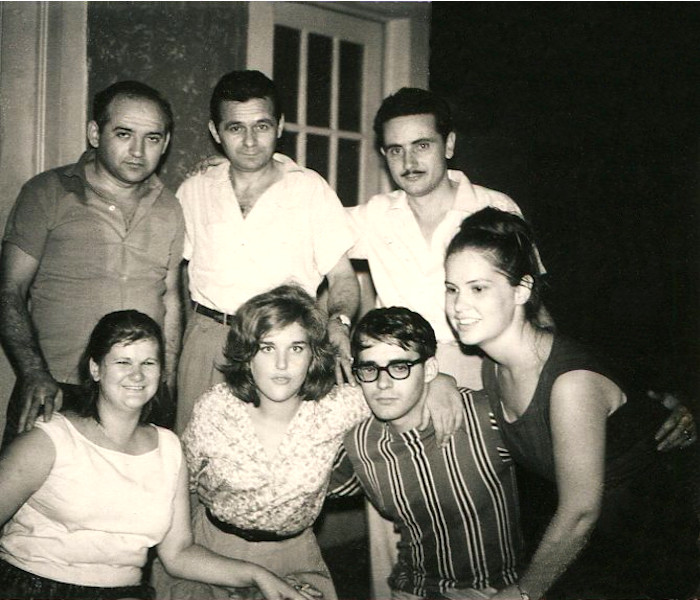
You entered the Gin Mill between a long bar and a row of booths, past a bellowing juke box, and then came to the larger room with more booths and tables around the dance floor.  Only ghostly traces of a former grid of tiles remained on the worn concrete floor.  The place was generally overflowing—if a ship was in port, and there usually was one—with swarthy sailors, friendly ladies of the night, and at least one equally friendly faerie.  Yours truly. Recently I found an ancient polaroid photo of me and my beautiful dear Jane with fellow debauchees:

gin mill bunch

Jane and Rich (center) with the Gin Mill Bunch

The landmark of the Gin Mill was its barmaid (and bouncer), Jackie, who weighed in at well over 300 pounds and had a lover on every Greek ship.  (Greek sailors loved fat women—and skinny boys.)  Jackie kept a motherly eye out for the safety of my skinny Tulane student body, but I still managed to put it in many delicious positions of jeopardy.

The great attraction of the Gin Mill, besides the seafood offerings, was the fact that Greek sailors would dance alone—or with each other.  Even before the incredible “Zorba the Greek”  hit the big screen, I was doing those fantastic Greek dances and feeling like a gay Melina Mercouri, but I’d do it on Sunday too.

The song I found most poignant for some reason was “Thessaloniki mou, but just those first evocative notes of Mikis Theodorakis’ Zorba suite can bring me to tears.  (I’d give a link to it, but the computer god won’t let me.)

I learned so long ago in the Gin Mill to cut that rope and soar free.  In La Casa I was initiated into the ecstasy of dance, but it was in the Gin Mill that I learned its philosophy and experienced its liberation.

This seems to have turned into an elegy for the fantastic New Orleans that once was, that bawdy old river port with its international culture of sailor dives along waterfront Decatur.  In my own time, the river still ran right behind the levee at the front of Jackson Square, and there were wharves along behind the French Market.  The beautiful Jax Brewery was in full, fragrant brew right across from my beloved La Casa de los Marinos.  The Gin Mill just up the street…

How terrifically blessed I was to carouse then in those legendary dives, how privileged to know the joy of pristine debauchery worthy of a novel by Jean Genet Back then I felt just like Our Lady of the Flowers.  But that wild world has been swept off away down the eternal river.  Sigh.  During the 70’s the glorious old city finally got transmogrified by twentieth century commerce, and the historic waterfront became one huge shopping mall.

A few years ago, for old times’ sake, I escaped from the cold New Mexico winter and spent a few warm months in a slave quarter apartment in the Vieux Carré.  It was just up St. Peter Street from what used to be Dixie’s Bar of Music, a legendary gay bar where I’d met a number of paramours (now a deafening karaoke palace).  Only later did I learn that while I was there, Miss Dixie herself passed on at 101. The sentimental sojourn proved very graphically and painfully that the past only exists in my mind, and it’s uniquely my own.  That’s what makes it so precious.

La Casa de los Marinos

Friday night I went out to what was billed as PACHANGA, an evening of Latin dance at the Blue Rooster.  It promised me pachanga, cumbia, merengue y más, la música de mi juventud.  And it delivered magnificently—to a room of young folks who knew what they were doing.

It was almost overwhelming to watch them dancing with expressions of glee, passion, and beauty, and to relive the rapture of those rhythms of so long ago.  Fifty years…  My eyes flooded with the body memory of all those wild dances with my beautiful Jane.

Though only couples were dancing, just as I’d do back then, I started dancing by myself to a splendid cumbia, and soon some other exuberant guys joined me.  I wanted to shout out my joy.  There followed some heart-rending merengues and a boisterous pachanga that almost did me in.

Once, the DJ called out something about la casa de música, and for a blessed moment I was back in La Casa de los Marinos   I was again a demented dervish in the House of the Sailors in that ruinous building at Toulouse and Decatur, a waterfront dive aka La MarinaVamos a La Casa!

La Casa de los Marinos - New Orleans

La Casa de los Marinos – New Orleans

Sorry, but I feel an elegy coming on.  For the legendary La Marina was swept away by the relentless tides of years.  Many others besides me must still remember the glory of that dark and disreputable Latin sailor bar, that temple of dance lost forever. (I’ve celebrated that long-lost glory in my autobiographical novel DIVINE DEBAUCH.)

I don’t know when the bar first opened, but my blessed time to carouse in its three mystical rooms was the early 60’s.  By the later 60’s I heard it had been written up in some big magazine as the chic lowlife place to go, and very soon thereafter La Marina ceased to be.

Those three rooms were steeped in darkness and wrapped in music, tremendously loud Latin music, and the roar of voices and laughter.  High above the crush of carousers and dancers, in deep shadows by the ceilings, blades of fans slowly swam around like circling sharks.

The three rooms were each special shrines.  In the first more or less civilized one, you’d socialize with drinks and shouted talk.  The second room was the place for group celebrations, being less crowded than the third and better for a formal dance like the pasa doble or the leaping pachanga.

The third room had its own even more powerful juke box and a hallucinatory mural on the walls over the crowd.  Around the room in a dreamlike swirl ran a dark flood of writhing nudes, racing motorcycle, matador with sword, and charging bull.  As above, so below.

It was here in the dense throngs of the third room that the ecstasy happened, the Dionysian transports of merengues and cumbias.  The clock was forever stopped at ten of three, though that was usually an early hour in an evening’s revelry.  We’d dance till dawn, even after.

A few years ago, when I visited New Orleans again, I lunched in the stylish Café Maspero  that used to be La Casa and sat in what once was the be back corner of the second room.  I told the waitress about its history, and she remarked that they had thought it had been a pirate joint before.  In a way it was.

More Auld Friends

Arriving in Seattle in the middle 60’s, I found no lasting friends, but my family, about whom I’ll write something soon, found me.  For the rest of that decade, besides my academic career, they were the focus of my life.  I do regret not having even one close friend from those years, just the family.  At least frequent letters to and from Lee in New Orleans were an emotional connection to the world outside the ever-growing family.

In Milwaukee in the summer of 1970 when my wife and I split up, I rather quickly I found gay friends.  Make that lovers, who became lasting friends.  They’re gone now, Ken and Kenny, my simultaneous loves.  Ken and I were close through many decades, particularly the 70’s in DC, until he passed away around 2010.  My dancing boy Kenny only survived until around 1994.  The plague, of course.  Both will be in a future memoire about my Hippie Poet persona.

As far as the 70’s in DC went, Lee/Chas and Ken, from New Orleans and Milwaukee respectively, were my old comrades.  As was Charles from Tulane, my platonic partner in the house and myriad interests.  I had some very special lovers then, but either the affairs or they themselves ended far too soon.  I hope someday that all these lost friends can live again in a memoire about my Courtesan persona.

After a brief sojourn in New York, I arrived in Santa Fe in 1981 as a mature gay gentleman and ran smack dab into my lover/partner of the next 11 years.  That’s also a tale that must await a memoire—if I live long enough and the creek don’t rise.

As you may notice, my two high school friends, Cookie and Dennis, and two “lady friends,” Jane and Frances, all mentioned in the previous post, are my only surviving auld friends. However, you couldn’t really call them close after so long and across all the distance.

Besides my family, here in Santa Fe I now have newer close friends.  Don, now 83, may qualify as auld, or at least old.  He and I met at a gay dinner group years ago and started our own dining tradition most Monday evenings.  We share many opinions, concerns, perspectives, previously married backgrounds, and a healthy appreciation of nubile youths.  Don is amused that I go out dancing and imagines that some night some guy is going to snap me up.  I don’t.

There is one other amigo here in New Mexico you might call auld, or at least viejo, though he’s a bit younger than I.  Douglas and I met back in 1981 when he was the roommate of that partner mentioned above, and our friendly association drifted lackadaisically along through the 80’s.

After I got single again in the 90’s, we forged a real, warm friendship, sharing events, trips, and outings all over the place.  Witness the silly fact that I call him by affectionate nicknames.  He calls himself Doogie, but I’ve gone through Doogaloo and Dugalug to Great Doogly-Moogly (per The Simpsons).  All along I’d considered the Dugless One an appealing and interesting Santa Fe new-age type, not too whacked out, and charmingly peace-love and nature connected.  Doogie’s spiritual enterprise has long been running a program of intercultural outings called Earthwalks, and he’s focusing on it again in his retirement.

Well, I guess that’s it for any auld friends.  Thank goodness I haven’t lost them all yet.  Those lost ones are always with me, be they long-time or only temporary human connections.  Often when this old dame goes out, like I will tonight to Molly’s Kitchen, they’ll come and ride with me in this old but still kicking body, living again in our dance.

 HAPPY NEW YEAR!

Auld Lang Friends

Like always, as I wind down this Old Year, I’m mindful of all the wonderful friends and lovers in my life.  Of course, many of them have gone to their rewards, but they still live on in me.  Fortunately, some from my past still live on in fact.

Just the other day I phoned Cookie, a high school neighbor friend in Arkansas, and we happily reported that we’re both still kicking, though as she said, not very high.  She married my best friend in junior high, who deceased several years ago.  My best friend in high school was Dennis, and we’ve been in loose touch again since our 50th Reunion back in 2010.  After the Navy, he married and, like Cookie, made a full life in those woods I left behind in 1960.  I visited them a year or so ago and hope to do so again this spring coming.

Lasting friends from New Orleans were fewer than one might think, given my social history there.  Those still kicking are actually women friends.  I’ve never “dated” a girl—just “went out” with them.  Gorgeous blonde Jane and I spent most nights in La Casa de los Marinos dancing mad merengues—or resting in the Gin Mill a few blocks away, and saw countless dazed dawns over Decatur Street.  She now lives in San Miguel de Allende and visited with me in Santa Fe some years ago.  We email periodically.

Another from that period is Frances, now living in Seattle.  She was an Art History grad whom my beloved Indian Desai and I met one night in Cosimo’s, a jazz place on Burgundy, and took to the Gin Mill to see the lowlife.  They got together, and I got alone.  Frances and I have kept in touch through the other chapters in our lives with visits, cards, and emails.  Desai went back to India where he married, and we lost touch in the 70’s.  I sure hope he’s still kicking.

I also “went out” to La Casa de los Marinos with another woman, Martha, a student from Southeastern in Hammond with wild blonde hair and arresting blue eyes.  She and I created a leaping dance we called “The President Kennedy.”  Martha lives (I hope) in Arcata CA, a militant vegan lesbian grandmother known locally as Granny Green Genes.  We haven’t been in touch for a few years, but at this late date, I’m afraid to check on her.

A platonic friend from back then was Lee (later Chas).  Faithful correspondents through the rest of the 60’s, we hung out together when I moved back to New Orleans in ’71.  In ’72 we moved to Washington DC together and were close neighbors throughout that decade.  But when I moved off to New York, we lost contact for some fifteen years.  In the late 90’s he got back in contact, and we resumed our old closeness.  For several years he came out to Santa Fe in the summers for the Santa Fe Opera  season and would stay the weeks with me.  He died in 2003.

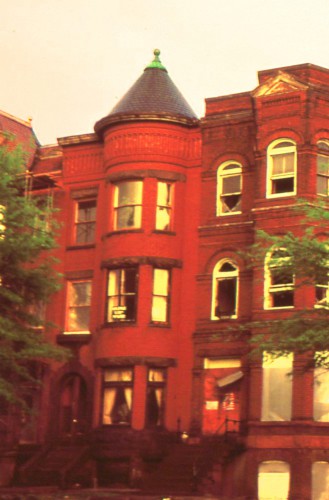
Not quite so lengthy was my platonic friendship with Charles, a faerie sister from Tulane.  We weren’t all that close in New Orleans but accidentally re-connected in an elevator in a Chicago hotel some years later.  When I went back to Ann Arbor in ’72 for dissertation work, I moved in with him and his lover for a couple months.  Then Charles moved to Washington DC right after Chas and I did, and we wound up buying a Victorian house together at Logan Circle.

1320 Rhode Island Avenue NW--The Four Belles

1320 Rhode Island Avenue NW–The Four Belles

Charles is a special story unto himself, a tragic drama lasting till he passed on in 1992.  On that sad note, I’m getting all choked up, so let me save other memorials for another time.  Sniffle.


Tattoo Rant


Now that I’ve let everybody in on one of my most intimate eccentricities, I don’t imagine that the rest of them would shock you.  So I’ll leave those disclosures for another time.  Instead, I’ll save you the trouble of reminding me and do a rant right now from my un-inked perspective about tattoos, relying largely on my spa experience.

Besides the physical exercise, going to the gym in the daytime (as well as out dancing at night), provides many eyefuls of the tattooed and otherwise ornamented bodies of young folk.  Sadly, I usually can’t discern details of the vast (and idiosyncratic) patterns or appreciate the artistic statements, since staring isn’t polite.

(As a sociological observation, I’ve been noting now at the EDM sessions of the local twenty-somethings that they don’t seem to be quite as taken with tattoos and piercings as are their elders.  I’m even seeing more “kids” nowadays at the Spa without a mark on their bods.)

Certainly some folks of my vintage have tats, but I think I’ll make do with my cockadoodle.  What I can’t quite grasp is the frame of mind somebody must be in to post some of the weird things I see as tattoos.  Of course, chacun á son weird.  Personally, I like more of the ornamental design stuff than the pictorial or narrative.  (One guy has a fox chasing a rabbit across his belly.)

By me there’s something classy about the patterned armband or ankle-band, but for some reason I find those maniacal Maori shoulders and orientally intricate sleeves personally disturbing.  But some of the full-back tableaus are impressive.  Aesthetically, I’d prefer more cohesive patterns, something more of an overall design.

In my historical wanderings, I’ve run across lots of tattoos amongst Native Americans.  There were some spectacular full-body tattoos amongst the extinct Timucua  people in northern Florida.  They were painted by the artist Jacques le Moyne  (around 1565) while at the ill-fated French settlement of Fort Caroline.  The best I can do for an illustration is a detail from an engraving of one of his lost paintings.

Timucuan full-body tattoo

Timucuan full-body tattoo

Full-body patterns like that are probably more than most folks could put up with, I suppose.  But I do wonder why facial tattoos are so neglected.  They would be a sure way to (modestly) get people look at your body art.  While enthralled long ago by the Indian mounds, I ran across some great line-art engraved on shell from the Mississippian site called Spiro Mounds in Oklahoma, some of which can be seen re-drawn in my Gallery of Pre-Columbian Artifacts.  My favorite is the head of a warrior with the so called “forked-eye” tattoo and a remarkable hairdo and headdress.

Warrior Head with forked eye tattoo

Warrior Head with forked eye tattoo

In my Aztec obsession I’ve run across any number of facial tattoos.  Frequently faces were sectioned in different solid colors, and they used eye embellishments.  It would seem that such designs were the identifying “signatures” or “trademarks” of specific individuals.  Talk about having an unmistakable identity.  Here are four I’ve drawn on authority of the marvelous Codex Nuttall  which is admittedly of Mixtec origin, but what the hay!  Don’t miss the other details including the (real) beards.

Aztec/Mixtec facial tattoos

Aztec/Mixtec facial tattoos

Native American tattooing traditions continued long after European contact and the colonies.  In the late 18th century a young Creek gentleman named merely John combined ink and jewelry in an elegant fashion statement.  Here’s my rendition of a 1790 drawing of John by the early American artist John Trumbull.

John the Creek

John the Creek

By the way, I have a superb suggestion for truly personalizing tattoos.  Considering the Aztec picture-writing of dates in their ceremonial calendar, folks could very easily sport their personal Aztec birthday-names as identity-tattoos.  All you’d need to do is consult the tonalpohualli to find out your number-day name, grab one of my day-signs, slap the appropriate number of dots in whatever arrangement around it, and there you go.  Here’s one for someone born on the day Five Flower (which is also the day-name of their god of games and parties).

Five Flower

Five Flower

Not to belabor the subject, though I will, I rather think that some of my Aztec deities would love to ride on somebody’s bare back.  Take for instance, Itzpapalotl, The Obsidian Butterfly (or Clawed Butterfly), the goddess of the night and stars.

Itzpapalotl, The Obsidian Butterfly

Itzpapalotl, The Obsidian Butterfly

Go for it—the colors are entirely up to you.


THE AZTECS ARE BACK!

In case you guys wonder why I let several months go by after my first posting, it was because I was working on both the next instalment of memoir and on drawing.  I decided that my Aztec deity images  and book on the ceremonial calendar  weren’t of much use to anyone in those formats.  People should have some way to get involved in the images and learn about the Aztec gods and goddesses, I figured, and what better way than to work with them the way I did (with such fun) coloring them for the book.

So I’m doing a coloring book.  It’s a rather intensive project to rework the images into full-scale icons in the barbaric splendor of the historical codices.  (In a weird way, I feel like a “santero,” the traditional New Mexico painter of saints.)  I’m calling it rather appropriately YE GODS!  THE AZTEC ICONS and also planning an illustrated encyclopedia of the Aztec deities to be called YE GODS!  THE AZTEC PANTHEON.

Shooting for a total of 26, I have most of the basic images, but turning them into the icons is taking a while.  The project could easily take another year—or more.  And it gives me something to do in my dotage.  Presently I’m in the middle of the third in alphabetical order, so at least I can give you the first as an example:  ATL, the deified element of Water.

ATL, Aztec God of Water

ATL, Aztec God of Water

Click here to download the icon with a caption page and model images from the Aztec Codices.

It is also available in freely sizable vector drawings on the coloring book page. 

§§