FREE COLORING BOOK

YE GODS!  THE AZTEC ICONS

­An Outrageous Coloring Book

Icons of Aztec Deities and Commentary

By Richard Balthazar

ICON #1  ATL – GOD OF WATER

For free download as a pdf file, right click here and select “Save Target (or Link) As.”

ATL, Aztec God of Water

ATL, Aztec God of Water

ATL {atł} is the deified element of water, and is a nagual (manifestation or bodhisattva) of TLALOC, the ancient God of Storms (Rain).  In the tonalpohualli or ceremonial count of days, also called the Turquoise Year, Atl is 9th of the 20 named days in the month, a lucky day.  As above, Nahui Atl (Four Water), the 4th of the 13 numbered days in one of the weeks, is the day-name of the Fourth Sun, a previous world ruled by CHALCHIUHTLICUE and destroyed by Water.  Its humans were turned into fish.  The four dots are the Aztec numeral 4.  The extended upper lip (harelip?) has been traditional for Mesoamerican water deities ever since the Olmec.

###

 Rather long ago for my book CELEBRATE NATIVE AMERICA, I originally drew the Aztec deities for the ceremonial calendar.  Now I’m redrawing in the digital medium and expanding them into full-scale icons.  And believe it or not, the YE GODS!  THE AZTEC ICONS coloring book is offering you these amazing neo-Aztec icons for FREE.  That’s right—at no risk—not even any postage.

Color them in as you wish with my compliments.  The wrinkle is that this coloring book will be posted serially as each icon is completed.  That could well take the next couple years—a good reason to keep checking back with me.  At the moment only one is available, but there are four more almost ready for posting, and a sixth is well on the way.

The Aztec deities are a fascinating crowd of inter-related personalities involved in a soap-opera mythology of creation/destruction, love/strife, and life/death that makes the gods of Olympus look like wimps.  Perhaps the confusing dramas, frequent aliases, and surreal images are due to the fact that the Aztecs and their deities indulged in psychoactive drugs like alcoholic pulque, peyote, hallucinogenic mushrooms, and other psychedelic herbs.  So hold on to your hats for some challenging images to color, such as the current posting above.

Using only a bit of my artistic license, I’m basing YE GODS!  THE AZTEC ICONS on extant Aztec artifacts and their surviving picture-booksYou can use these almost authentic Aztec icons as cartoons for large-scale murals, smaller-scale tattoos, needlepoint patterns, and other design or illustration needs.

YE GODS!  THE AZTEC ICONS should also be seen as a free and unique teaching tool for classes not only in art, but also in cultural and historical studies.  In addition, YE GODS!  THE AZTEC PANTHEON is an illustrated encyclopedia of Aztec deities that comprises a crash course in Aztec cosmology, mythology, ritual, society, and history.

Don’t be shy.  Make lots of copies to experiment on.  You’ll need to.

###

Free Book on AZTEC CALENDAR

CELEBRATE NATIVE AMERICA!

An Aztec Book of Days

By Richard Balthazar (Five Flower Press, 1993, out of print)

CNA cover

For free download as a pdf file, right click here and select “Save Target (or Link) As.” 

I recently announced  that I’ve put my old out-of-print book on the Aztec ritual or ceremonial calendar up for free download.  Anyone with interest in art, mythology, history, or horoscopy will find it an unusual experience.  You’ll learn some weird stuff you never ever imagined, money-back guarantee.

The book presents the 260-day sacred Turquoise Year, which was used for divination and prophesy, in color plates of their 13 ‘months’ of 20 days spread over 20 ‘weeks’ of 13 days.  My weekly illustrations also include their patron gods or goddesses in images based on surviving Aztec books, primarily the Codices Borbonicus, Borgia, Nuttall, Fejervary-Mayer, Kingsborough, and Vindobensis.

For free download as a pdf file, right click here and select “Save Target (or Link) As.” 

If you don’t want the book itself, all its illustrations are up for individual free download from my galleries of godsdays, and weeks on this site.  Do whatever with them with my blessing.

The Turquoise Year was an evolution of the earlier Mayan calendar of similar structure with roots among the even earlier Olmec.  It was the ancient Mesoamerican horoscope.  The birth day-name was a person’s ceremonial and official name, and the deities who ruled the numbers, days, weeks, and months, each with light and dark sides, controlled individual and societal fates.

By the way, you can quickly find out your Aztec name by going to azteccalendar.com, and while there, you can even pick up your Aztec horoscope, which I admit will be much more detailed than what you’ll find in my old book.

For free download as a pdf file, right click here and select “Save Target (or Link) As.” 

READERS: Please disregard the final chapter and its mind-boggling concordance.  My hubristic attempt to start up a new Sixth Sun at the fall of Tenochtitlan was at best poetic, but that calendar has now run out anyway.  Forget about it.

Another note:  I exercised my artist’s license on the 20th week, One Rabbit, naming as its patron a far more appetizing deity, Xochipilli, the Prince of Flowers.  The actual patron was a quasi-deity called Tecpatl (Flint—the sacrificial knife).  Feeling like a nagual (or bodhisattva) of Xochipilli, I’ve dared to use his image in the banner on this website.

Tattoo Rant


Now that I’ve let everybody in on one of my most intimate eccentricities, I don’t imagine that the rest of them would shock you.  So I’ll leave those disclosures for another time.  Instead, I’ll save you the trouble of reminding me and do a rant right now from my un-inked perspective about tattoos, relying largely on my spa experience.

Besides the physical exercise, going to the gym in the daytime (as well as out dancing at night), provides many eyefuls of the tattooed and otherwise ornamented bodies of young folk.  Sadly, I usually can’t discern details of the vast (and idiosyncratic) patterns or appreciate the artistic statements, since staring isn’t polite.

(As a sociological observation, I’ve been noting now at the EDM sessions of the local twenty-somethings that they don’t seem to be quite as taken with tattoos and piercings as are their elders.  I’m even seeing more “kids” nowadays at the Spa without a mark on their bods.)

Certainly some folks of my vintage have tats, but I think I’ll make do with my cockadoodle.  What I can’t quite grasp is the frame of mind somebody must be in to post some of the weird things I see as tattoos.  Of course, chacun á son weird.  Personally, I like more of the ornamental design stuff than the pictorial or narrative.  (One guy has a fox chasing a rabbit across his belly.)

By me there’s something classy about the patterned armband or ankle-band, but for some reason I find those maniacal Maori shoulders and orientally intricate sleeves personally disturbing.  But some of the full-back tableaus are impressive.  Aesthetically, I’d prefer more cohesive patterns, something more of an overall design.

In my historical wanderings, I’ve run across lots of tattoos amongst Native Americans.  There were some spectacular full-body tattoos amongst the extinct Timucua  people in northern Florida.  They were painted by the artist Jacques le Moyne  (around 1565) while at the ill-fated French settlement of Fort Caroline.  The best I can do for an illustration is a detail from an engraving of one of his lost paintings.

Timucuan full-body tattoo

Timucuan full-body tattoo

Full-body patterns like that are probably more than most folks could put up with, I suppose.  But I do wonder why facial tattoos are so neglected.  They would be a sure way to (modestly) get people look at your body art.  While enthralled long ago by the Indian mounds, I ran across some great line-art engraved on shell from the Mississippian site called Spiro Mounds in Oklahoma, some of which can be seen re-drawn in my Gallery of Pre-Columbian Artifacts.  My favorite is the head of a warrior with the so called “forked-eye” tattoo and a remarkable hairdo and headdress.

Warrior Head with forked eye tattoo

Warrior Head with forked eye tattoo

In my Aztec obsession I’ve run across any number of facial tattoos.  Frequently faces were sectioned in different solid colors, and they used eye embellishments.  It would seem that such designs were the identifying “signatures” or “trademarks” of specific individuals.  Talk about having an unmistakable identity.  Here are four I’ve drawn on authority of the marvelous Codex Nuttall  which is admittedly of Mixtec origin, but what the hay!  Don’t miss the other details including the (real) beards.

Aztec/Mixtec facial tattoos

Aztec/Mixtec facial tattoos

Native American tattooing traditions continued long after European contact and the colonies.  In the late 18th century a young Creek gentleman named merely John combined ink and jewelry in an elegant fashion statement.  Here’s my rendition of a 1790 drawing of John by the early American artist John Trumbull.

John the Creek

John the Creek

By the way, I have a superb suggestion for truly personalizing tattoos.  Considering the Aztec picture-writing of dates in their ceremonial calendar, folks could very easily sport their personal Aztec birthday-names as identity-tattoos.  All you’d need to do is consult the tonalpohualli to find out your number-day name, grab one of my day-signs, slap the appropriate number of dots in whatever arrangement around it, and there you go.  Here’s one for someone born on the day Five Flower (which is also the day-name of their god of games and parties).

Five Flower

Five Flower

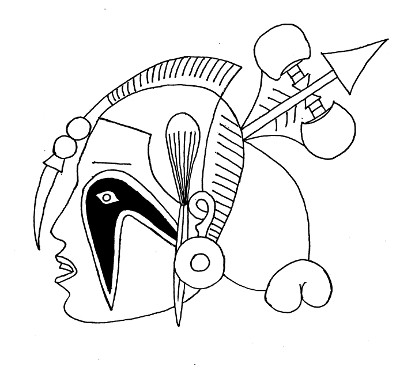
Not to belabor the subject, though I will, I rather think that some of my Aztec deities would love to ride on somebody’s bare back.  Take for instance, Itzpapalotl, The Obsidian Butterfly (or Clawed Butterfly), the goddess of the night and stars.

Itzpapalotl, The Obsidian Butterfly

Itzpapalotl, The Obsidian Butterfly

Go for it—the colors are entirely up to you.