Aztec Gods of the Directions

When they founded Tenochtitlan c. 1325 CE, the Aztec barbarians adopted the traditional Mesoamerican temporal and spatial concepts of ceremonial calendar and cardinal directions.

The 260-day Aztec Turquoise Year or tonalpohualli (ceremonial count of days) is based on 20 numbered sets of 13 called trecenas, through which the 20 named days of the solar month are counted cyclically. That’s about as clearly as I can describe it. Some of the few surviving codices (ancient documents) include individual pages of the trecenas with their patron deities.

Some codices also have pages with the 260 days laid out in spreadsheet fashion with five rows of 52 columns in four sets of 13, Here’s a sample section from Codex Vaticanus laying out the first set of 13 columns (trecenas 1, 5, 9, 13 and 17):

vaticanus first section

First Section of Spreadsheet Calendar, Codex Vaticanus

One reads left to right starting with day One Crocodile on the bottom row at lower left; after counting the 52 days in that row, we come back to the second row from the bottom beginning with Reed. Repeating that process, the count returns to the first column to resume with the days One Snake, One Earthquake, and One Water. The blocks of four columns of five days repeat 13 times—only in varying internal sequences—symbolizing the four cardinal directions:
days of direction - Vaticanus

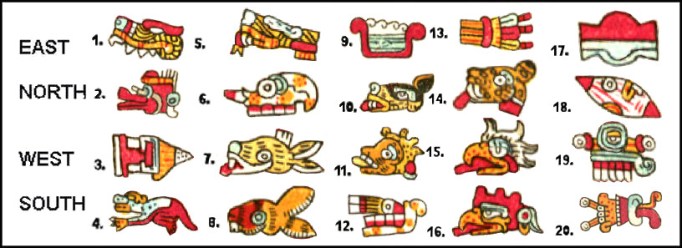
Vaticanus Day-Signs Corresponding to Cardinal Directions

Numbered per their position in the 20-day “month,” these are East: Crocodile, Snake, Water, Reed, Earthquake; North: Wind, Death, Dog, Jaguar, Flint; West: House, Deer, Monkey, Eagle, Rain; South: Lizard, Rabbit, Grass, Vulture, and Flower.

These four cardinal directions are also characterized by colors: East—red; North—black; West—white; and South—blue. This color scheme correlates to the emblematic colors of the Aztec gods of the directions: Xipe Totec, God of the East—the Red Tezcatlipoca; Tezcatlipoca, God of the North—the Black Tezcatlipoca; Quetzalcoatl, God of the West—the White Tezcatlipoca; and Huitzilopochtli, God of the South—the Blue Tezcatlipoca.

Aztec Gods of the Directions

The traditional spatial matrix inherited by the Aztecs also included a fifth direction—the Center—which they saw as ruled by Xiuhtecuhtli, the Lord of Fire/Turquoise.

Xiuhtecuhtli - Lord of the Turquoise - (God of Fire)

XIUHTECUHTLI, God of the Center

With the Mexica’s tribal War God Huitzilopochtli ruling the South, this is emphatically the Aztec empire’s imperial vision of the divine quartet/quintet. Wondering what earlier deity may have ruled the South before, I looked at p. 1 of Codex Fejervary-Mayer, a document thought to have originated in the Veracruz region. It lays out the directions with pairs of patrons, totemic trees, and birds. However here, it’s Tezcatlipoca dominating the Center. (Apologies for the scruffy image, but I’ve got neither time nor energy to “re-create” it.)

fm01

The Five Directions, Codex Fejervary-Mayer, p. 1

The orientation of the directions is a bit different than our common Eurocentric model, rotated one notch counterclockwise. Here East is at the top, West at the bottom; South is on the right, North on the left. Besides the totemic birds and trees, the busy diagram includes much calendrical symbolism, including the days of the directions, year-bearers, and what-not.

By the way, the South tree is a “sacred” Theobroma (Food of the Gods) cacao tree with its chocolate pods. The totem on the North is a spiky ceiba tree (Kapok) which the Maya saw as the great tree at the center of the world—connecting the Underworld and the Sky World (heavens), its trunk representing the world of humans, animals, etc.

The pairs of patron deities in each lobe include only two of our divine quartet of Tezcatlipocas. In the top East lobe, on the right stands Xipe Totec, our Red Tezcatlipoca, with his Flint headdress, and I’d bet his companion is the sun god Tonatiuh, god of the Fifth Sun. In the left North lobe, the upper deity is a simple version of our Black Tezcatlipoca, and the lower one looks like the mighty Tlaloc, God of Storms. The rest of the patrons are different.

The South lobe on the right tells us who must have ruled that direction before the Aztecs inserted their Huitzilopochtli: the upper Mictlantecuhtli, Lord of the Land of the Dead, and the lower Centeotl, God of Maize. The Aztecs gave them both the boot… In addition, the West lobe on the bottom holds no White Tezcatlipoca, Quetzalcoatl, showing instead a surprising pair of patrons from pre-Aztec mythology. On the right (upside down) is Chalchiuhtlicue, the Jade Skirt, Goddess of Water, and on the left Tlazolteotl, Goddess of Filth, a major mother deity.

The reputedly misogynist Aztecs seem to have impeached these two great goddesses to install the famous Maya/Teotihuacan/Toltec Plumed Serpent as their deity of the West, as the White Tezcatlipoca. Speaking of misogyny, in another religious coup, the new empire tried to depose the Goddess of the Moon (Ixchel to the Maya and Metztli in Teotihuacan) from her traditional role as patron of the calendar’s Death Trecena and then made their own Tecciztecatl into the God of the Moon. (Metztli can still be seen in the calendar in Codex Telleriano-Remensis.)

The Aztecs were also conservative, if not reactionary, in other ways, like in celebrating their culture as the culmination of the “golden” ages of Teotihuacan and the Toltecs. Witness their great cult of Quetzalcoatl and abject “idolatry” of Tezcatlipoca, also inherited from the Toltecs. Since time immemorial, he and Quetzalcoatl were seen as each other’s twin and nemesis, and in their roster of the gods of the directions, the Aztecs enshrined that primordial conflict. That they apparently replaced the Smoking Mirror with Xiuhtecuhtli as God of the Center is surprising, and it’s even more so that they didn’t make Huitzilopochtli Center and give someone else South. But winners always get to write their own version of history—and religion.

###

Aztec Icon #14 – QUETZALCOATL, Plumed Serpent

Sorry to take so long to finish the 14th icon for my coloring book YE GODS!  My work was delayed by that time-consuming thing called life.  Anyway, the icon’s done and my digital wizard has turned it into vector drawings for free sizing.  Here you have the most famous Aztec deity of all, QUETZALCOATL, the Plumed Serpent:

Quetzalcoatl, Plumed Serpent

QUETZALCOATL (Plumed Serpent) {ke-tsal-ko-atł} is the god of intelligence, learning, writing, arts and crafts, the calendar, priests, and merchants and was the bringer of maize to mankind.  Opposed to human sacrifice, he is called the White Tezcatlipoca and is the 9th lord of the day and god of the West. As the planet Venus, he is known as Tlahuizcalpantecuhtli, the morning star, and his twin Xolotl is the evening star.  He ruled the Second Sun (Four Wind) and created the current Fifth Sun (Four Earthquake) by using his own blood to give new life to the bones in Mictlan.  He was known as Kukulcan to the Maya and a major deity in Teotihuacan, and Quetzalcoatl was the traditional name/title of the Toltec rulers of Tula.

This icon is available as 8X10 with a caption/sources page by clicking here.  The freely sizable vector versions are available by clicking here.

By way of explaining this new icon, I must first thank Eliseo Rosales, a tattoo artist in California, for his suggestions, particularly for the design on the pedestal and for the important theme of maize.

The central figure of Quetzalcoatl is based on an image from Codex Borbonicus with details of costume and accoutrements mostly from Codex Magliabechiano, though the serpent on his back is adapted from those on the Stone of the Suns. Don’t be surprised by his beard, which occurs in other codex images:  According to some, he was supposedly blond and white-skinned.

In his left hand, the deity holds the weapon known as Xiuhcoatl (Fire Serpent), and on his shield is his standard ‘cross’ symbol. His peaked cap of jaguar pelt is apparently a Huastec influence.  Sprouting from his forehead is a ritual ‘blooming shinbone,’ the significance of which escapes me.  The numeral by his left foot is Nine, of which he is the patron, and the day-sign One Reed directly over his head is his ceremonial day-name.

Now for the other motifs. The pedestal, as mentioned above, illustrates the depth of the history of the Plumed Serpent.  It comes from the frieze on the Temple of Quetzalcoatl in Xochicalco (c. 1000 AD), which was a city/culture that arose in the aftermath of the Classic civilizations of the Maya and Teotihuacan.  As evidence of his even deeper history, the two heads flanking his day-name are views of sculptures on the Temple of Quetzalcoatl in Teotihuacan (c. 600 AD).  The paired feathered serpents on his either side are taken from Codex Borbonicus and Codex Telleriano-Remensis, and the paired quetzal birds are merely grace-notes.

The border design is adapted from one of his images in Codex Telleriano-Remensis. The day-signs embedded in it represent the ceremonial calendar which the deity brought into Mexico in the dim past.  Each group of five days represents a direction in the Aztecs’ odd world-view.  At the bottom is West, of which he is the patron.  At the top is East, on the left North, and on the right South, the standard Aztec spatial orientation as it was also for the Maya.

Drawn respectively from the Cospi, Vaticanus, and Borgia codices, the standing deities in the upper section are: on the left, Tlahuizcalpantecuhtli, Lord of the House of Dawn (as the Morning Star), on the right Xolotl (as the Evening Star), and at the top his nagual (manifestation) as Ehecatl, God of the Wind.

In the upper corners are scenes representing his gift of maize to mankind. On the left is Tlaloc, the Storm (Rain) God, nurturing the goddess of maize Chicomecoatl, and on the right is the goddess of flowing water Chalchiuhtlicue tending the god of maize Centeotl.

That’s all the mythology I could manage to cram into this icon. Surely it’s enough.

#

Another note of interest about Quetzalcoatl. In the September, 2017 issue of ANCIENT AMERICAN magazine, my article just appeared entitled “The Plumed Serpent in North America.”  Click here to check out a copy.

Coloring Book Overhaul – The Aztec Icons

BIG NEWS FOR ALL YOU COLORING ENTHUSIASTS! Whether you’re new to this website, have just been keeping your eye on it, or have actually colored some of my unusual icons of Aztec deities, you’ll find my overhauled coloring book now has a lot more to offer.

There are 13 icons currently completed (but there will be 19 by May, 2020!), each is now accompanied by a page with its descriptive caption and full-color images from the Aztec Codices that served as models for drawing the icon. Those images will give a good idea of the varying styles of the ancient picture-books and maybe even suggest authentic colors to use in your own coloring.

Check out this example of the caption/model page for CHALCHIUTLICUE, the Jade Skirt.

caption-model page for Chalchiuhtlicue

As before, all the icons can be viewed or downloaded individually from the coloring book page, either as a pdf file with caption/models page or as freely sizable vector drawings. But now they are also all bundled together into an actual book:  YE GODS!  THE AZTEC ICONS.

But that’s almost the least of the overhauls. In addition to that book, there is now a major revision and expansion of the earlier catalog and appendix—a complete illustrated encyclopedia of essentially all the Aztec deities:  YE GODS!  THE AZTEC PANTHEON.

Its 88 alphabetical entries include some 1,300+ divinities (depending on how you count), and there’s usually an authentic image for each selected from the Aztec Codices. Again, the images illustrate their varying styles and provide even more suggestions for coloring the icons.

Here’s a sample page from the encyclopedia:

sample page – The Aztec Pantheon

Of itself, YE GODS! THE AZTEC PANTHEON amounts to a crash course in ancient Mexican mythology, history, culture, and art.  YE GODS!  THE AZTEC ICONS takes this another step further—into illustrating details of Aztec society.

For perhaps excessive example, with Huehuecoyotl, the Old Coyote, there are vignettes of people playing musical instruments, singing, and dancing; with Huitzilopochtli, Hummingbird of the South, there’s a pictorial narrative of the legendary migration of the Aztecs to Tenochtitlan; with Mictlantecuhtli, Lord of the Land of the Dead, there’s a vague map of the soul’s way to Mictlan; and with Patecatl, God of Medicine, there are scenes of medical practices and medicinal herbs. Each icon contains its own type of social commentary.

I haven’t quite started on Aztec Icon #14: Quetzalcoatl, the Plumed Serpent, but hope to do so shortly.  In the meantime, I’m working on yet a third component of my Aztec project, another section on the Aztec Codices themselves.  It will be a description of and commentary on each of the 15 surviving picture-books, including sample pages and Internet sources to view the whole documents.  I perhaps unrealistically hope to complete it in the next couple months, and guess what:  I’ll call it YE GODS!  THE AZTEC CODICES.  Watch for a post announcing it.

###

Aztec Icon #13 – PATECATL, God of Medicine

So—six weeks now seems to be my new average to produce an Aztec icon for the coloring book YE GODS! Here’s Icon #13, PATECATL, which I drew on my old system (GNU) and believe it or not, using the mouse in my left hand.  Back while drawing #12 I started getting pains in my right hand from all the clicking—so I switched.  Nothing to it!

This is a standard pixelated image, and it’s currently winging its electronic way to my graphic wizard for conversion to vectors. The vectorized files for #12, OMETEOTL, have now been added to the list on the coloring book page, where you can also view and download all the previous icons.

To download this one as a pdf file with a page of caption and model images from the Aztec Codices, just right-click here and select “Save as.”  You can also download it in freely sizable vector drawings from the coloring book page.

Patecatl, God of Medicine

Patecatl, God of Medicine

PATECATL

God of Medicine

PATECATL {pa-te-katł} is the god of healing and fertility, medicine (herbology) and surgery, who gives comfort in illness. Logically he is patron of day Grass.  Husband of MAYAUEL, he is the father of the Centzon Totochtin (400 Rabbits), the gods of drunkenness led by Ome Tochtli (Two Rabbit). As well as being a pulque god like his wife, he’s the deity of intoxication by peyote, hallucinogenic mushrooms, and psychotropic herbs such as datura (jimson weed), morning glory, and marijuana. These plants were used in healing, fortune telling, shamanic magic, and public religious ceremonies, hopefully also to tranquilize sacrificial victims and enhance the sacramental nature of the ritual.

***

There are several points of interest in this icon:

  1. The god’s physiognomy is iconographically authentic, quite the way he appears in Codex Borgia, nose, buck-teeth, and all. His eye is just as baleful in the model, where (as is often the case with gods, male and female) it’s horribly blood-shot. I won’t even guess what that’s all about.  Also, since it’s so obvious here, in general the Aztecs didn’t bother with the difference between right and left feet, but they usually tried to distinguish between right and left hands.
  2. The vignettes in the upper section of the icon are based on medicinal scenes from various codices, including Nuttall, Borgia, Fejervary-Mayer, Vaticanus, and even the post-Conquest Florentine Codex.
  3. The vignette of nose-piercing is remarkable for two reasons. In the Nuttall model, the patient is not only bearded, but black. Throughout the codices there are frequent black personages, both human and divine, and indisputable beards.  Make of that what you will.
  4. The plants scattered around the icon are actual medicinals, several adapted from early herbal illustrations, from Nuttall, and from nature.
  5. Meant as a House of Healing, the temple in the upper right may be a bit over the top ornamentally, but it’s stylistically real.  The figure of the snake ingesting a rabbit is based on a page from Vaticanus, where an eagle is also seizing the snake.  I’ve included it to symbolize life as a food cycle, very much the way the Aztecs saw it.

Aztec Icon #11 – OCELOTL (Jaguar), Lord of the Animals

At long last –Aztec Icon #11: OCELOTL, Lord of the Animals.  In the midst of other projects and family stuff, it’s taken me all summer to finish this icon for the coloring book YE GODS!  THE AZTEC ICONS.  Not for lack of effort but the enormous amount thereof.  Actually I’d already done the jaguar rampant a couple years ago, my first drawing directly to digital.  Thanks to my freeware graphics program GIMP, in rendering this boggling Mesoamerican zoo, I’ve discovered almost godlike powers over pixels.  But I try to be a beneficent deity.

The vast amount of effort came first in locating historical images of creatures in the ancient codices for stylistic models. Those I couldn’t find had to be drawn from photographed nature.  Actually, my iconic jaguar is a departure from Aztec style in its naturalistic treatment.  While there are many jaguars in the codices, in my opinion they all look too “cartoonish” to make an impressive deity.  Besides, I liked the challenge of creating the pelt pattern for the little Jaguar Knights in the Chalchiuhtotolin icon.  The regalia indicates the creature’s divine nature, and the wavy fork at its muzzle is the symbol of its howl.

Please note the large “dots” at each corner of the icon. They are the Aztec number four, and this is the calendrical day-name Four Jaguar, the First Sun (World) in the Mesoamerican cosmological sequence.  That very first YE GODS! icon of Atl was the day-name Four Water, the Fourth Sun, and the fifth icon of Ehecatl was the day-name Four Wind, the Second Sun.  You’ll have to wait a bit for the third and fifth Suns later in this series.

Ocelotl is lord of all animals:  those belonging to Huixtocihuatl, Lady of Salt (Goddess of the Sea on the upper left); those belonging to Tlaltecuhtli, the hermaphroditic Lord of the Earth (on upper right); and those of the air ruled by Quetzalcoatl, the Plumed Serpent (at top).

The split circle over the deity’s head is the traditional symbol of day and night, showing its lordship over diurnal and nocturnal animals, the jaguar itself being nocturnal. The eagle to the left represents the Aztecs’ main god Huitzilopochtli as the sun at midday, and my very own “batterfly” on the right is Itzpapalotl, Goddess of the Night Sky, who was often depicted as butterfly, bat, and/or bird.

Ocelotl is also lord of the strange animal Man, as can be seen in the vignette at the bottom depicting the legendary creation of man from a primordial tree as shown in Mixtec codices.

By the way, I’ll note that the Aztecs adopted most of their cosmology and “religion” from the peoples living then and earlier in central Mexico like the Mixtec, Zapotec, Huastec, Toltec, etc., etc.—as had they from the even more ancient Teotihuacan and Maya. In the long history of Mesoamerican civilizations, their underlying myths have mostly been related, even inherited.

Ocelotl, the Jaguar, is a mythology from deep in history. The earliest (in Mesoamerica) Olmec famously revered the Jaguar (jaguar-headed babies?), and may have named the day in the calendar for it.  Or maybe not.  Elsewhere I’ve suggested that the Mesoamerican calendar could have come from South America, from the even earlier Chavín civilization, and curiously, the Jaguar-Man was also a prominent feature of that culture.  Just saying…  Deep history.

Some other notes on my Mexican menagerie: I can’t even identify some of the animals or birds, especially the silly little bugs.  That odd creature at the end of the deity’s tail is the salamander called in Nahuatl axolotl.  My Monarch butterfly (center left, just above the stunning Turkey) is geographically appropriate, as are my several other nature drawings of Mexican fauna, including the quetzal birds (top right).  Don’t overlook the Xoloitzcuintli, national dog of Mexico, at the Jaguar’s left foot.  Can you identify any more of the critters in this montage?

(You can still see or download the previous ten icons in the YE GODS! series by clicking on them in the list on the page for the coloring book.)

ICON #11: OCELOTL

(Lord of the Animals)

To download this icon as a pdf file with a page of caption and model images from the Aztec Codices, right click here and select “Save Target (or Link) As.”  You can also download it in freely sizable vector drawings from the coloring book page.

OCELOTL (Jaguar), Lord of the Animals

OCELOTL (Jaguar), Lord of the Animals

OCELOTL {o-se-lotł} (Jaguar) is the Aztecs’ deity of all animals of land, sea, and air. It is a nagual of the god TEZCATLIPOCA who created the First Sun, Nahui Ocelotl (Four Jaguar), a world peopled by giants who were devoured by divine jaguars.  Ocelotl, the 14th day of the month, was usually a lucky day, but anyone born on the day Ce Ocelotl (One Jaguar) was destined for sacrifice to one god or another.  OCELOTL is patron of scouts and warriors, and the elite corps of warriors of the night were known as the Jaguar Knights.  Ever since the Maya, in Mesoamerica jaguar pelts in shades of tawny gold to white were the sacred possessions of priests and royalty.


Huixtocihuatl and Mictlancihuatl, Aztec goddesses

No, I haven’t been on vacation since the middle of May. Well, actually I did go away with family for a week at the beginning of July to a beach house in Galveston.  Just a week though.  Otherwise I’ve been making good progress on the eleventh icon (Ocelotl-Jaguar) for my YE GODS! coloring book and restoring photographs by the dozen for a biography of my mother, which I hope to finish by October and publish under Writing.  As if that weren’t enough of an excuse for no blog postings these three months, I’ve also been dealing with some medical issues I won’t bore you with, except to say they involved surgery and prescription for a blood thinner.  No fun whatsoever.

Meanwhile, I’ve wondered what to write about next. I considered a lament about the current sad climate for dance in Santa Fe, but you don’t want to read about my withering opinion of what they’re calling nightlife and dance music nowadays.  Rants about today’s absurd political situation seemed particularly egregious, and philosophical essays seemed pointless.  I’ve been planning to write about 30 years ago, but that purely autobiographical subject, while formative and somewhat dramatic, isn’t all that exciting.  So I’ll fall back on my eccentric art for a topic.

Sorry about taking so long on the Ocelotl icon, but it demands an exorbitant number of elements. The Jaguar being the Aztec’s main animal deity, lord of the animals, I’ve got to include as many of the animals indigenous to Mexico as I can manage.  It’s been a hoot drawing them:  armadillo, peccary, xoloitzcuintli, quetzal, turkey, iguana, tortoise, coati, etc. There are several yet to go, like pelican and giant anteater. It will present the Mesoamerican biota of creatures of the land, air, and sea.

To show this inclusiveness, I’ve drawn Tlaltecuhtli, the androgynous deity of the earth (the land); Quetzalcoatl, the composite deity of the sky (the air); and Huixtocihuatl, the Lady of Salt (the sea). In addition, in the tenth icon of Mictlantecuhtli I included a new cameo of the Lady of the Land of the Dead, Mictlancihuatl.

Since these two divine Ladies don’t figure in the Aztec ceremonial calendar, they didn’t make it into my batch of illustrations for that 1993 book. So here for your delectation are images of two more Aztec goddesses:

Huixtocihuatl, Lady of Salt, and Mictlancihuatl, Lady of the Land of the Dead

Huixtocihuatl, Lady of Salt, and Mictlancihuatl, Lady of the Land of the Dead


Aztec Icon #10 – MICTLANTECUHTLI, Lord of the Land of the Dead

Though there were times when I wondered if I’d ever finish this drawing, I’ve actually managed to complete the next icon in the series for the coloring book YE GODS!  THE AZTEC ICONS.

This icon of the Lord of Mictlan, the Land of the Dead, contains a lot more mythological narrative than even hinted in the caption.  Starting at the upper left and moving clockwise around the temple, dead persons enter Mictlan at the mouth of the Underworld.  Then the monstrous deity Xolotl serves as their guide (psychopomp), and the dog Itzcuintli is their companion through Mictlan, where they must climb eight hills and cross nine rivers (in four days).  The realm of Mictlantecuhtli is an empty place of darkness, dust, and vermin/vile insects (centipedes and scorpions among others), but that’s where most people had to go after death.  I wonder why they ever bothered to struggle over all those hills and rivers just to get to a nowhere like that.

Meanwhile, in the center of the lower register the wind deity Ehecatl (nagual of Quetzalcoatl) negotiates with the Lady of the Land of the Dead, Mictlancihuatl, for the bones from the Fourth Sun (Four Water).  He then breathes life into those bones to create the people for the current Fifth Sun (Four Earthquake).

(You can still see or download the previous nine icons by clicking on them in the list on the page for the coloring book.)

ICON #10: MICTLANTECUHTLI

(Lord of the Land of the Dead)

To download this icon as a pdf file with a page of caption and model images from the Aztec Codices, right click here and select “Save Target (or Link) As.”  You can also download it in freely sizable vector drawings from the coloring book page.

Mictlantecuhtli, Lord of the Land of the Dead

Mictlantecuhtli, Lord of the Land of the Dead

MICTLANTECUHTLI {meek-tłan-te-kooh-tłee} is the most prominent of several deities of death, 5th lord of the night, and 6th lord of the day.  His worship reputedly involved ritual cannibalism.  (Counter-intuitively, skulls and skeletons were symbols of fertility, health, and abundance.) His wife is Mictlancihuatl.  Only souls who died normal deaths went to the Land of the Dead, Mictlan; souls of heroes, warriors, sacrificial victims, or who die in childbirth joined TONATIUH in the Fourth Heaven, and those who drown went to TLALOC’s Eighth Heaven, the paradisiacal Tlalocan.

Aztec Icon #9. – MAYAUEL, Goddess of Pulque

After along haul of boggling detail, I’ve completed another icon in the series for the coloring book YE GODS!  THE AZTEC ICONS.  That makes nine in two years.  Only 17 to go.  Good thing I’m patient—and persistent.

The icon of this popular goddess of drunkenness (as well as intoxication by other drugs), was a lot of fun to draw if only because of all the drunken rabbits. She herself is based on an image from Codex Rios with details from Codex Laud and Codex Nuttall, and the vignettes come from various other sources like Codex Vindobonensis.  It was also a rare chance to draw the other hallucinogens:  psilocybin mushrooms, Datura and morning glory flowers, peyote cactus, and marijuana leaves.  The two little blooming peyotes are drawn from plants I used to have in my greenhouse.  The flowers are pink.

(You can still see or download the previous eight icons by clicking on them in the list on the page for the coloring book.)

ICON #9: MAYAUEL

(Goddess of Pulque)

To download this icon as a .pdf file with a page of caption and model images from the Aztec Codices, right click here and select “Save Target (or Link) As.”  You can also download it in freely sizable vector drawings from the coloring book  page.

mayauel icon

MAYAUEL is the personification of the maguey plant and a maternal and fertility goddess connected with nourishment. Besides fibers for ropes and cloth, the most important maguey product is the alcoholic beverage pulque (or octli).  As a pulque goddess, she is often depicted with many breasts to feed her children, the Centzon Totochtin (400 Rabbits), octli gods that cause drunkenness.  (Drinking was generally only permitted in ceremonies, but the elderly were free to drink whenever they wished.  There were rabbit deities for all kinds of intoxication.)  With the birth-name of Eight Flint, she also protects mature wombs and probably is the wife of PATECATL.


Rediscovered Sculptures and Artist Statements

While I was digging around in the piles of stuff we surround ourselves with, I was very pleased to find some forgotten photos and rediscover some more pieces of my sculpture, which I’ve just added to the gallery. Check it out.

Since I’m now in a leisurely mood, I think I’ll run off at the keyboard about the newly remembered pieces with attempts at artist statements. In case they’re helpful in inspiring your aesthetic appreciation.

Boy on a Dolphin (sold)

Boy on a Dolphin (sold)

Boy on a Dolphin:      This is the first piece I ever sold—at my first show.  It’s composed of two pieces of old iron (like plow-points or teeth of some kind) on a micaceous stone wave.  The upright boy was found in the DC area in the 70’s, the dolphin was found in New Mexico in the 80’s.  When I put the two pieces together, they echoed that prehistoric/modern Cycladic art of the Minoan era from around the Aegean Sea.  Though at the time I didn’t know from Cycladic, I heard the Art loud and clear.

Dark of the Moon (sold)

Dark of the Moon (sold)

Dark of the Moon:      The most complex of all my assemblages, this shrine includes wood, stone, metal, glass, magnets, ceramics, lava, white sand, and (apparently) rubber, all on a slate panel.  It’s one of my favorite pieces, but it sold in my second show and moved to California.  Zoom in on the surreal details, like the ball-bearing stars.  There are even piston rings.  The true enigma is the figure on the altar with the dark visage (rubber?).  I once found a similar piece, but less detailed, and the “head” was empty.  The centered “dark moon” globe on the “sky” backdrop is a spherical lava geode, and the 13 irregular porcelain “white moons” are for the visible stages.

What does the dark of the moon mean to you? To me it’s connected with a verse of Robert Herrick’s poem “The Night Piece, to Julia” that I’ve quoted elsewhere.  Starting, “Let not the darke thee cumber, / What though the Moon do’s slumber?” the verse embodies my refusal to live in fear, which I mentioned emphatically in a recent blog on fear and violence.

Cipactli - Earth Monster (sold)

Cipactli – Earth Monster (sold)

Cipactli:         Being an inveterate curiosity collector, one of my stash piles was of interesting weathered wood.  Over the years I’d walk by and occasionally add another piece as inspiration seized me to the plank lying on the ground, and either the pile or the sandy New Mexico dirt (spontaneously?) spawned this Earth Monster of Aztec cosmology, cipactli, the first day of the month.  The primordial one that ate Tezcatlipoca’s left footwhen the Black God defeated it and created the First Sun (world) on its back.  I like its mythic animistic Art.  The Monster went from my first show to a friend of my Farmers Market days.

Tepeyollotl - Heart of the Mountain (sold)

Tepeyollotl – Heart of the Mountain (sold)

Tepeyollotl:         Another Aztec shrine, this is the Heart of the Mountain.  I can’t resist listing the components on the board:  two axe-heads, one broken; broken hammer-head, fragment of gear-wheel, sheet-iron triangle, and multiple piston rings and pieces.  In the foreground stands a heavily rusted chisel-pointed spike on a magnet with fallen rust flakes clinging to it, and the base is a grindstone from an electric drill.  It went to another Farmers Market friend.

(Forgive me for this for parenthetical sentimentalism: I gave that (Sears) drill to my late father for his birthday when I was 10.  You do the math.  Then, believe it or not, that drill in its little red box became my only legacy from him.  And then in the late 80’s, when I had some workers doing something around the house, the heirloom drill disappeared, less its battered red box and accessory bits, which I still have hanging about somewhere.)

Signifires (sold)

Signifires (sold)

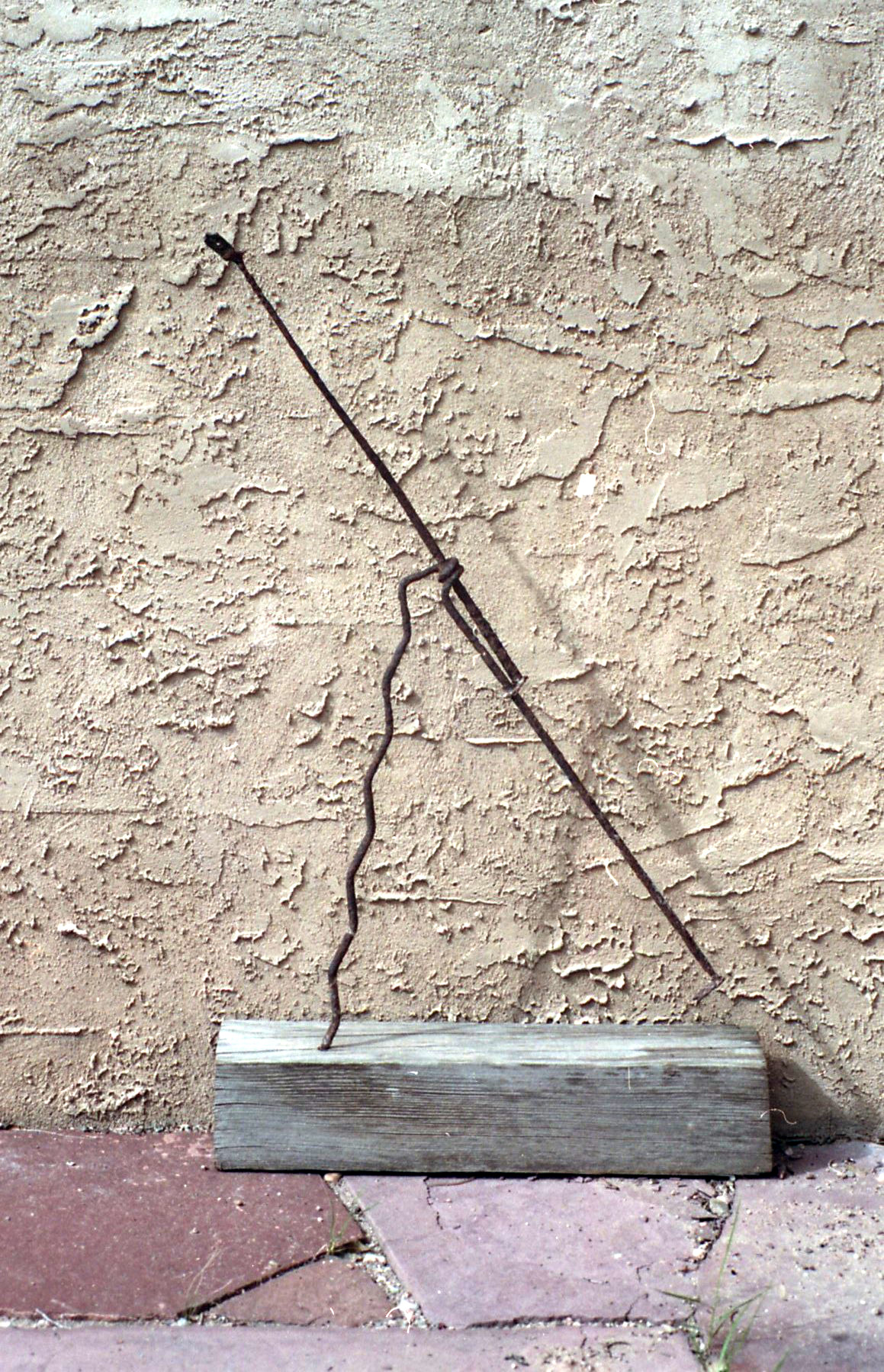
Signifires:                   Regrettably the clumsy photo shows only two of the three installations on weathered wooden posts mounted on a long, narrow board, another of my favorite early pieces.  On a much shorter piece of wood and at a greater distance, the missing third is an identical rusty nail with identically twisted wire around it with loop and free ends waving like flames or smoke in the wind, signal fires.  At least that’s my artist’s rationale for the feeble neologistic title.  But of course they might also be misspelled signifiers.  But then what might they signify?

I find the back-story on this one astounding. Over the course of many (20?) years, I found and kept each of the (identical) flaming/smoking nails singly in open/wild places in far-flung locales I’ve now forgotten.  Probably one here in NM.  Maybe Florida?  But identical!  Same gauge nail and wire, same wire-end and loop length and orientation.

(Twice being coincidence, what’s thrice? Magic?  Spontaneously Generated Art (SGA)?  Otherwise, what arcane rural or ritual need might give rise to identical artifacts in such widely disparate locations?  I’m talking identical!  In my book, finding those three nails bearing aloft their signifires like torches amounted to a minor miracle, or at least a miraculous event.)

Nevertheless, someone bought the tri-incidental (or is that transcendental?) Signifires from my first show. I treasure the poor photo for the messages its two fires still convey.

Strident (sold)

Strident (sold)

Strident:             Here’s another piece of SGA, more proof that Art, like Beauty, is in the seeing.  What I see in this inscrutably functional found object, in helpful combination with its multi-layered title of course, is Art on a par with that of Giacometti.  I can justifiably claim such excellence because I didn’t make it.  I merely came serendipitously along, saw its Art lying in the weeds, and called its name.  That late world-famous sculptor probably wouldn’t have minded the impertinent comparison.  A discerning Santa Fe collector bought it from my second show.

#

While we’re on the topic of SGA (Spontaneously Generated Art), I want to pull a couple pieces out of the gallery to show what I mean about seeing the Art in things you find by the roadside of life. In both bent and mutilated found objects I saw their inherent Art, a transformation they had spontaneously achieved through an unknown, but clearly violent, history.  SGA, if I may presume to define it, is initially a creation of human hands, but then it is transformed by time and elements, i.e., by cause and effect, or more crassly chance, into something that somebody, often me, sees as SGA.  Remember, Art’s in the eye of the beholder, and seeing it creates it.

Rainbow Man

Rainbow Man

Rainbow Man:             Lying in the dust of a path, the Rainbow Man waved to me, and I instantly recognized his Zuni attitude.  His curly head now bows over a clump of cactus on my balcony.  I don’t know what to make of him.  Do you?

Predator

Predator

Predator:                     I’ll try and sneak this into SGA, since I only added that tiny prey dangling from its beak.  It’s meant merely as a grace note on the Art espied in this metal something mangled by mysterious forces, which I found rusting in the middle of a field.  The avian predator is visible from several angles and is particularly effective perched on a rock.  As one of the more primordial elements of reality, predation still has terrible meaning in our dog-eat-dog world.  It’s both inevitable and inescapable, the process by which all life lives. On permanent loan, that’s how this raptor is installed in the backyard of a neighborly friend.

That was rather fun rummaging through my amazing sightings of Spontaneously Generated Art. Maybe I’ll devote another blog to it sometime when I feel like blathering again.

Coyote Art and Stone Sculpture

After all the work these past several months finishing and posting two literary pieces (the novella BAT IN A WHIRLWIND and my gay memoir THERE WAS A SHIP), completing and posting my next Aztec icon (ITZPAPALOTL, the Obsidian Butterfly) for the accumulating coloring book YE GODS!, surviving fairly merry holidays, and starting a happy, hopeful new year, I’m now taking a breather of sorts. However, constitutionally incapable of totally disengaging, I’ve shifted writing gears and in my idle time started in on a sci-fi epic inspiration from my box of intriguing ideas.

In the unaccustomed leisure of the past week, I’ve also played in some of my other artistic frivolities, like manipulating photographs. At some point I’ll be able to post some improved shots in my photo gallery.  Check out the current stuff anyway.  In the past few days I’ve photographed some more of my collection of others’ art for a future blog post, probably quite soon.  In digging around, I stumbled on a couple interesting sculptural items of my own proud handiwork to add to my sculpture gallery.

First, I’ve got to confess very contritely to doing something that most artists in Santa Fe won’t admit to doing—as too trite and commercial: Coyote Art.  But I won’t recant.  Recently, I brazenly posted my Aztec icon of HUEHUECOYOTL, the Old Coyote, which I dare say far transcends the trite and commercial.  But this wasn’t my first offense.

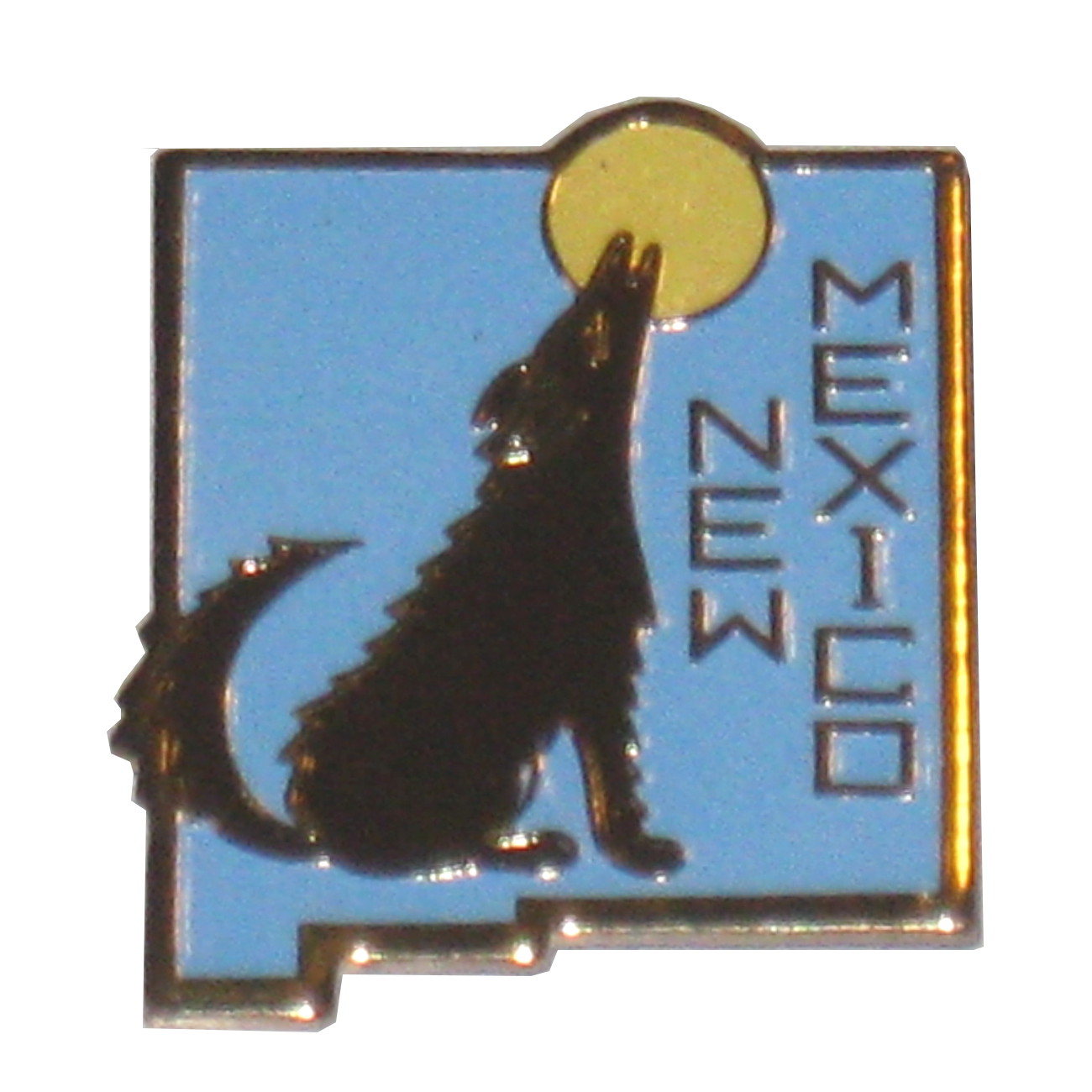
Way back when I was simply a Mature Gay Professional (maybe 1991), a dear lady I worked with asked me to design a commemorative pin for her installation as the Grand Worthy Matron of the Order of the Eastern Star. Even for gratis, I call that a splendidly official commission.  She wanted a coyote.  I shamelessly framed it in New Mexico with an obligatory moon:

Coyote Pin

Coyote Pin

Later on, when I was becoming a Grandfatherly Gay Character (around 1996), I wore out a lot of files and chisels on a sculpture that was dictated by the medium itself. It was a stone with a thin stratum of lighter stone into which I gnawed out an intaglio of the Serpent Mound in Adams County, Ohio, more or less per the Squier survey as it appears in my old book REMEMBER NATIVE AMERICA.  There’s something about its emphatic reality that I really appreciate:

Serpent Mound intaglio

Serpent Mound intaglio

So, although I claim to be a sculptor of found object assemblages, in fact I’ve done a few things in good, old-fashioned stone, though some of those are also assemblages. These are already shown in my sculpture gallery, but let me highlight them here.

Canyon Viejo

Canyon Viejo

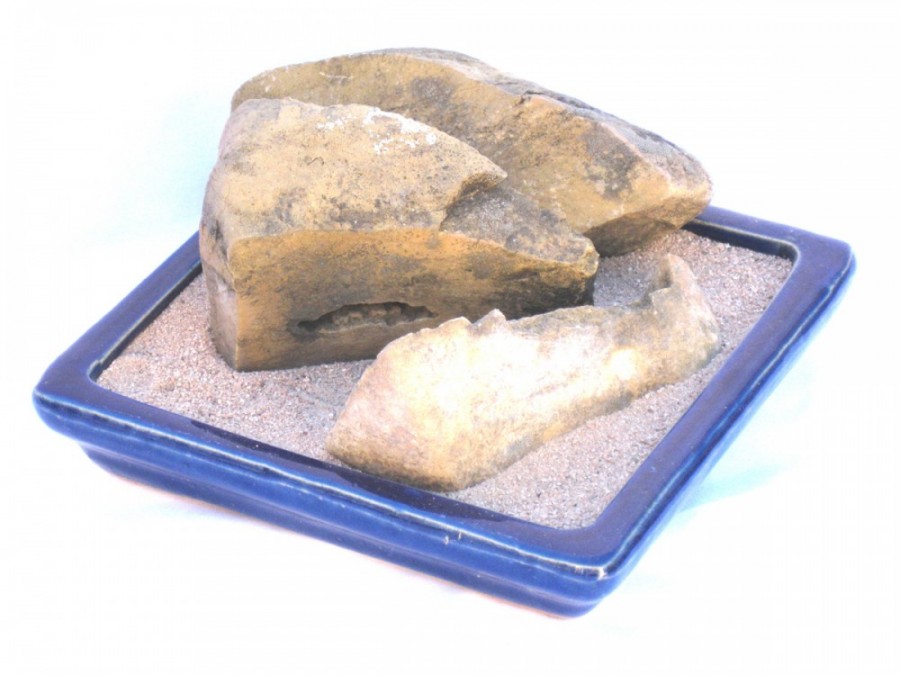
Canyon Viejo is a split piece of stone in a bowl of sand that makes for a miniature Zen sculpture of a cliff-dwelling in homage to Canyon de Chelly.

Creeping Creature and Calf

Creeping Creature and Calf

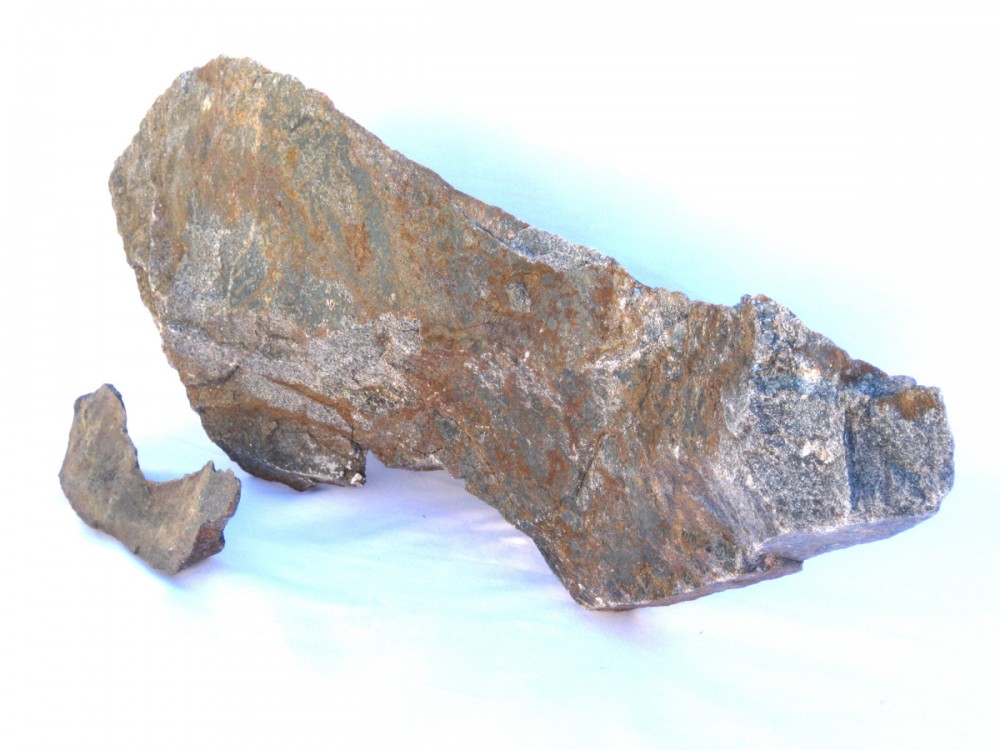
Creeping Creature and Calf is two eccentric fragments of stone found in widely separate locations that called out to me that they are family.

Crouching Creature with Cub

Crouching Creature with Cub

Crouching Creature with Cub is another pair of strange pieces of stone that are clearly related.

Lair of the Bear

Lair of the Bear

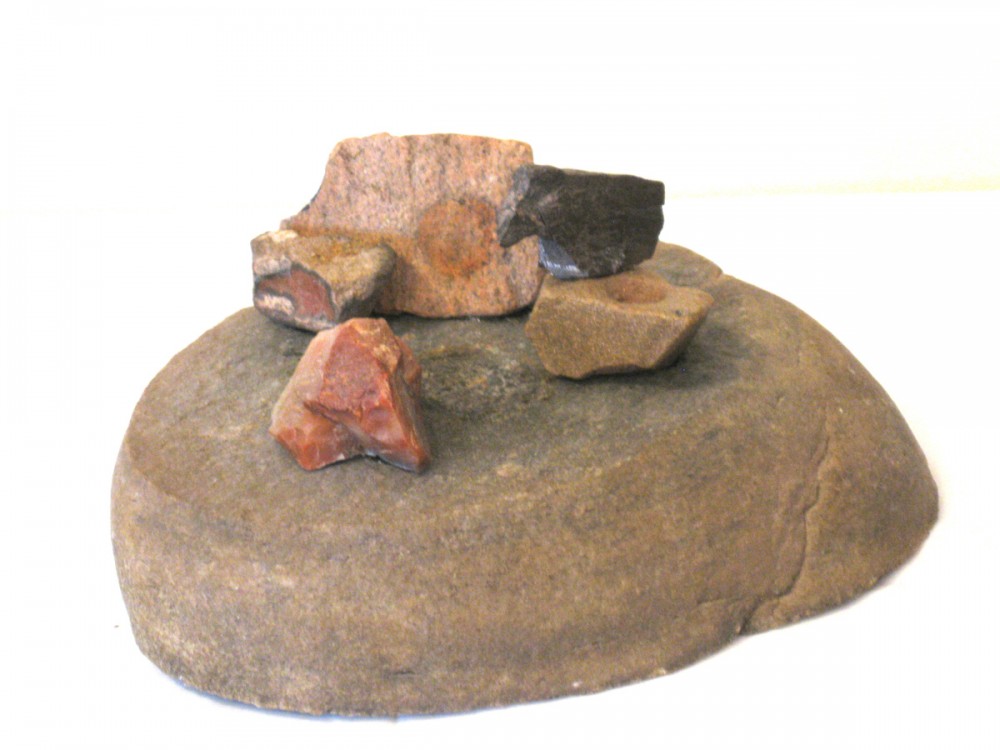
Lair of the Bear assembles a few ursine and otherwise anomalous stones found in many locations over the years to create a mythical environment.

As maybe you can tell, I think art is where you find it.