The Aztec Calendar – My Obsession

The Aztec count of days (tonalpohualli in the Nahuatl language) is commonly called the “Aztec Calendar,” a ritual cycle of 260 days in 20 13-day “weeks” or trecenas, its purpose divinatory or prophetic. Like the well-known zodiacal system of horoscopes in which a person is born in one of 12 “houses” with character and fate influenced thereby, the Aztec day on which one is born is that person’s ceremonial name and is believed to determine their character and fate. (You can discover your own Aztec day-name by entering your birth-date at www.azteccalendar.com.)

Calling the Tonalpohualli “Aztec” is in fact a historical misnomer. They inherited the basic ritual of the calendar from the ancient Maya, who in their turn adopted it from the even earlier Olmec. I have found circumstantial evidence that the roots of this Mesoamerican ceremonial calendar may reach still deeper into the past, possibly originating in distant South America. See my blog posting on this iconoclastic theory:  Source of Aztec Calendar.

The way my obsession with the Tonalpohualli came about is a long and probably tedious story, but I’m going to tell it—if only as a cautionary tale about unbridled enthusiasm. Over several decades, my possession by the Aztec muse happened gradually, simple curiosity growing into bemused fascination, to an eccentric fixation, and then to a full-fledged obsession.

Like most folks, in high school I learned about the conquest of the heathen Aztecs by the devout Catholic Conquistador Hernando Cortez in 1519, supposedly thanks merely to his miraculous horses and muskets. (Only in the 90s did I learn that his dramatic victory was actually thanks to10,000 Tlaxcalan warrior allies, and that the godly Conquest destroyed a monumental city, an efflorescent culture on a par with the Roman empire, and untold millions of native peoples.)

In the later 70s I came across a later16th-century narrative by Fray Diego Duran about the arduous legendary migration of the barbarian Aztecs into the Valley of Mexico and was intrigued by the intertwined story of their war-god Huitzilopochtli, Hummingbird of the South. For a while I sketched out a pseudo-sci-fi novel about that journey but finally abandoned the project.

About ten years later, a friend passed me the book “The King Danced in the Marketplace” by Frances Gilmore which gave me somewhat more information on the Conquest, though hardly less fanciful or slanted. In the story of the Aztec ruler Montezuma, the author also made an off-hand comment that the Aztec “century” was only 52 years long, counted in four sequences of thirteen. Being a crypto-mathematician, I was struck by the numerical system—and by the curious fact that it sounded exactly like a deck of playing cards.

That inspiration triggered a creative frenzy in the later 80s. On the model of the century-count, I laid out a deck of cards with eight intersecting suits called Palli for the four 13-year periods. Then, discovering that the ceremonial year was counted in 20 sequences of 13 numbered days, I created another deck called Tonalli (days) to reflect that cycle. Having nowhere to go with these “inventions,” I forged on to design a Tarot-type fortune-telling deck called Ticitl (priest/teacher), a couple unworkable board games, and a set of six-sided dice. I wrote out detailed rules, but frankly, these thirty years later, I can’t remember how the games were supposed to be played.

Samples of Early Games Based on Aztec Calendar

Palli                                     Tonalli                                Ticitl                                    Aztec Dice

Only much later did I come to understand the complicated connection between the 52-year century, the 260-day Tonalpohualli, and the solar year with 18 months of 20 named days. However, in the course of working on those games, I’d drawn all the day signs and several deities, mostly on popular models from the Codex Borbonicus, and when I decided in the early 90s to create my own Aztec Book of Days (published in 1993), all I had to do was lay out the trecenas and draw the other patron deities. Coloring them was time-consuming but great fun.

In those BI (Before Internet) years, finding authentic models for those other Aztec deities was almost impossible. Fortunately, in the University of New Mexico library I found a rare facsimile of the Codex Nuttall, which I photographed and studied for figures, regalia, and paraphernalia. (More than a decade later I happened upon “The Codex Nuttall” in a 1975 Dover edition.)

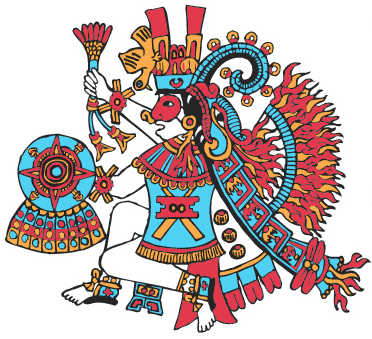
I had no way of knowing at the time that Nuttall was actually a historical document rather than a ritual model. As a result, my images of the deities largely reflected that secular iconography. However, my skewed artistic inspiration produced 20 trecenas with eye-catching deities which are often viewed on my website www.richardbalthazar.com under “Aztec Images.” (Visitors have often used them with my compliments for design purposes on clothing, other products, and even tattoos.) One of my more imaginative Nuttall-inspired creations was the God of the Moon:

Tecciztecatl – (God of the Moon)

Resting on these Aztec artistic laurels, for the next dozen years or so I turned to sculpture (found-object assemblages). Though focusing on sculpture, I still had the Aztec bug, and amongst many abstract works, I created figures of various Aztec-deities and day-signs. By 2008. my enthusiasm for sculpture faded, and I reverted to my old Aztec obsession, creating another deck of cards. “Six Snake” was much simpler than my earlier calendrical fantasies, composed of 54 cards with six suits of nine in the colors of the rainbow. Intended as a game for children to learn math, it worked on the closed numerological system of collapsing numbers to a single digit, 1 to 9. But the elegant idea proved to be flawed because it could only handle addition and multiplication; subtraction and division were beyond its scope.

After that, in the later AI (After Internet) years, I assembled a complete collection of the other Aztec codices that survived the book-burnings after the Conquest of Mexico and wrote a summary treatise on them: Ye Gods! The Aztec Codices. Studying these hundreds of ancient pages, I identified the vast Aztec assortment of gods and goddesses and posted an illustrated encyclopedia of them on my website: Ye Gods! The Aztec Pantheon.

Over the next several years I used these authentic images to create digital black-and-white icons of 20 deities for a coloring book called Ye Gods! The Aztec Icons.

Detail from Icon for Ehecatl, Aztec God of the Wind

In the midst of these painstaking digital drawings, in 2018 I was once again seized by the mania for cards and made a deck reflecting both the Tonalpohualli and the Aztec concept of specific gods and groups of days representing the cardinal directions. Those cards turned out to be too complicated to play with reasonably, but I presented them in a blog entitled “Aztec Gods of the Directions,” which for some odd reason has become far and away the most popular of my posts.

Aztec Gods of the Directions

Early in that same year, I had my icons printed on large-scale vinyl banners for an informational exhibition called Ye Gods! Icons of Aztec Deities. The exhibition was shown for two years in six venues before tragically being closed down by the covid pandemic in March 2020.

After eight years of drawing icons, this year I turned to re-creating the book of days (tonalamatl) pages from the Codex Borgia for Canadian friend Marguerite Paquin’s use in her blog on current Mayan trecenas, that calendar of course being quite the same as the Aztec. Only last year did I see the faithful full-color restoration/facsimile of the entire Codex Borgia published in 1993 by Gisele Díaz & Alan Rodgers (Dover Publications), but my digital re-creations are much freer in color and “rectified” detail, creating images essentially impossible for the ancient Aztec artists.

Chalchiuhtotolin, The Jade Turkey

In tandem with my Tonalamatl Borgia re-creations, I’m also compiling and re-creating the trecenas from the related Telleriano-Remensis and Rios codices, which both present them on two separate pages. The latter codex is a later 16th-century Italian (slap-dash) copy of the (awkwardly sketchy) former document, and my compiled re-creation attempts visually sophisticated images of their unique day-signs and deities. As this Book of Days also includes the cycle of the nine Lords of the Night, I’m calling it the Tonalamatl Yoal (Night).

As the various trecenas of the Tonalamatls Borgia and Yoal are completed, I’ll post them along with those from my 1993 Tonalamatl Balthazar, present Dr. Paquin’s notes on their auguries, and remark on their iconography.

The obsession endures. When I’ve completed the Tonalamatls (should I live that long), I intend to create another series of 20 icons, this time in color—of the day-signs with their patrons and divinatory details. After that (if the creek don’t rise), I plan to build a complete mandala of the complex Aztec concept of time and space.

#

The Faces of Death

In this dire virus situation, we are all looking death in the face, but we can’t really see what it looks like wearing a mask and standing at a sociable distance. So I tried to get an up-close look at the face of death through the sanitized lens of Aztec art. They were intimate with that inevitable fact of life and drew many detailed pictures of it.

In their calendars, the Aztecs represented the day Death, Miquitzli, the sixth in their 20-day month, as a skull, often fancifully ornamented:

Signs for the Aztec Day Death

While the examples from Codex Cospi are the most varied and almost playful, they’re not exactly “fun” or amenable. Not that they were supposed to be… By the way, notice the tassels fed through the earlobes. Ears on a skull? This could become a new fashion fad!

The Aztecs also personified, or if you will, deified death as Mictlantecuhtli, Lord of the Land of the Dead (Mictlan). He was portrayed in various styles with many common motifs as a skeleton, often with a sacrificial knife for a nose and a semi-circular headdress, usually with a central spike. (Note two incipient examples of the spike among the Cospi signs above.) In Codex Borgia, he often wears a hand as a tassel through his earlobe. In the display below I skipped the skeletons and show only the skulls. None of them is particularly warm and cuddly, but again I guess Death’s heads simply aren’t.

Heads of Aztec Lord of Death

These gruesome images, which underlie many Day of the Dead graphics, weren’t especially frightening for the Aztecs who had a deep reverence for Mictlantecuhtli, even to the point of ritual cannibalism. I felt a similar, though not so hungry, reverence a few years ago when I drew the icon for the Lord of Death. He’s existentially pretty grand, but his beckoning gesture isn’t very enticing. Note the spiked ornament and the Magliabechiano headdress. Besides a vaguely realistic jaguar pelt, I used my artistic license to hang that spider web across his midriff. Oh, and those are eyeballs hanging from his cape. They do look a bit like googly eyes.

Aztec Lord of Death

These boney specters were the way I saw the Aztec face of Death until quite recently when I decided to re-create the book of days (tonalamatl) in the Codex Rios. I suddenly got glimpses of his real face instead of a fleshless skull.

They say that Codex Rios (one of the zillions of documents held by the Vatican Library) is a 16th-century Italian copy of the more or less pre-conquest codex called Telleriano-Remensis. As a copy it wasn’t terribly faithful, taking many liberties with images—some really worked; some didn’t—and making several mistakes in the numbering of days. But it was good that Rios took liberties because T-R is crude artistically speaking, though at times the copy itself was sloppy.

The T-R tonalamatl was drawn in pieces, each 13-day week (trecena) laid out with the first five days and main patron on one page and the last eight on another with the second patron/symbol. Rios followed that format exactly. In my re-creation, the weeks will be presented whole on their own pages to give an integral view of the time periods and supernatural characteristics.

The T-R and Rios tonalamatls include the nine Lords of the Night in sequence with the days, a cycle taking many years to complete (9 Lords/260 days). These Lords also appear (very sketchily) in Codex Cospi and in the complicated layouts of Codex Borbonicus and Tonalamatl Aubin along with Lords of the Day and totem birds, but in T-R/Rios the Lords of the Night are shown prominently alone in distinctive portrait busts.

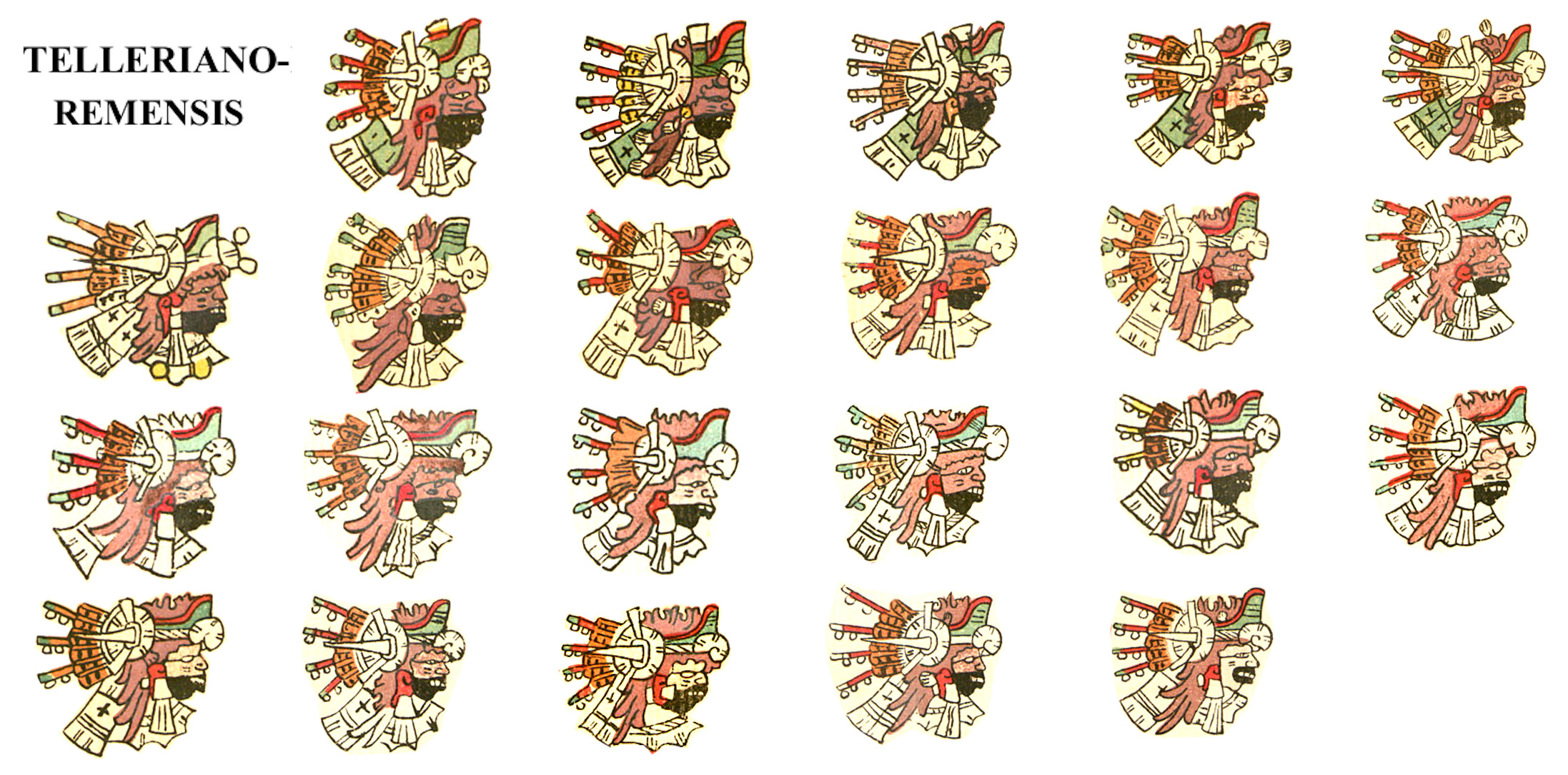
The fifth Lord of the Night—and Lord of the fifth (mid-night) hour of the night—is none other than Mictlantecuhtli. He occurs 29 times during most of the 260-day years. In T-R he’s rendered as a full-fleshed “person” with remarkably consistent accoutrements. There are only 22 faces of Lord Death below because I don’t have copies of a few of the T-R pages. I doubt the missing pages will contain any surprises:

Faces of the Lord of Mictlan (Codex Telleriano-Remensis)

Again, the headdress with spiked ornament is standard, as well as a black lower face. Since these are given in order, there seems to be a greater finesse in the first several busts, if only for the green on the scarf “flaps.” The artist probably got tired as the days rolled by.

Note the plus signs on most of the scarves—they’re NOT crosses but a geometric motif possibly having to do with the four directions and center. Most consistent are the profiles of the Lord. The protruding mouth and often pendulous lower lip must have some iconographic significance, but unless it’s meant to convey menace, I haven’t a clue. Note also the almost identical noses—which appear on several other T-R Lords of the Night. This ancient artist had a clear template.

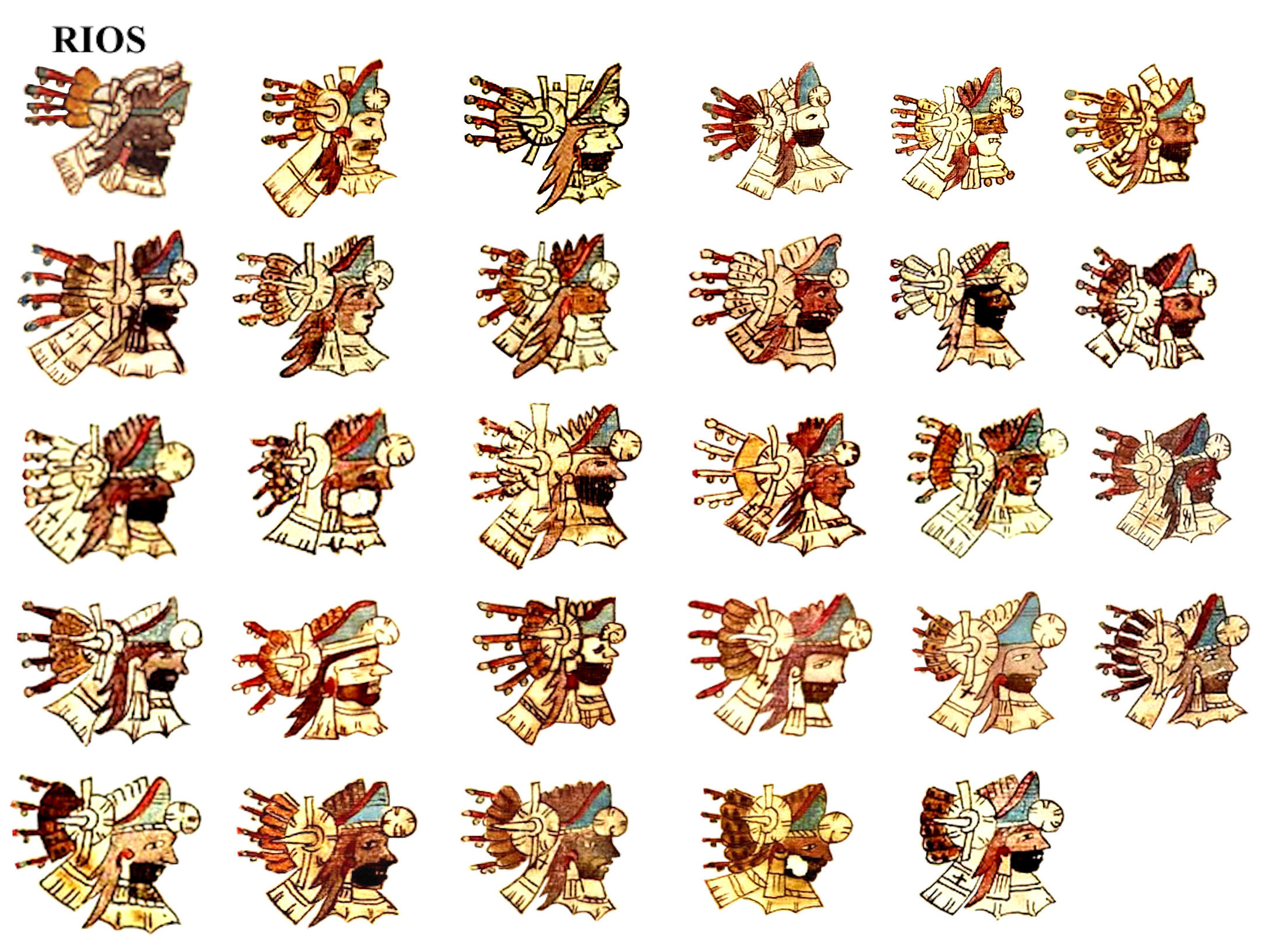
On the other hand, the artist(s) of the Codex Rios copy did not have a standard physiognomy for Mictlantecuhtli. Even standard formats in Rios tend to vary widely in execution and detail. As well, the artist(s) had to squeeze the day- and deity-images to accommodate notes (in Italian) naming the days and good, bad, or indifferent luck. With mostly consistent traditional ornamentation, the faces of Death in Rios are strongly individual:

Faces of the Lord of Mictlan (Codex Rios)

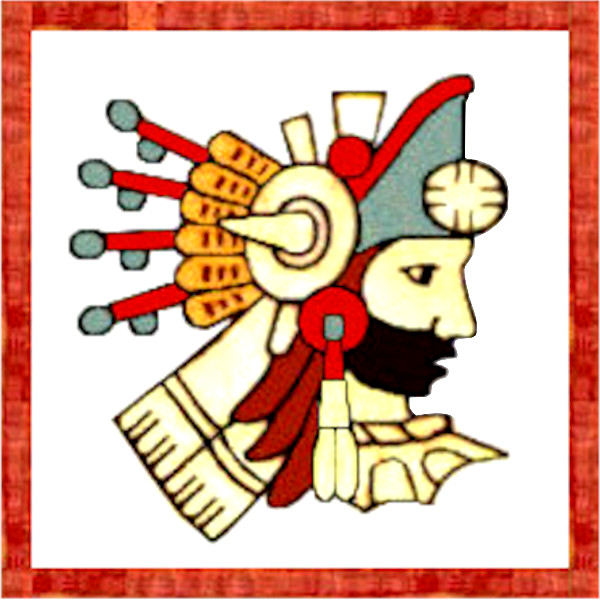
In my re-creation of the Rios tonalamatl, I won’t render all the variant images of the deities but will repeat an established portrait of each one using the modern magic of copying. I cherry-picked among the above 29 images to choose my favorite details and distilled them down to this interpretation of Mictlantecuhtli, the face of Death.

Lord of Mictlan

When I peered through Aztec art and discovered this evocative human face, I fell in love with lovely Death. Now I can look this beautiful Lord in the eye and happily know he awaits. I plan on making him wait for a great long while, but when he beckons, it will be good to fall into his arms.

#

Totems of the Aztec Lords of the Day

In Aztec culture, notions of time are central and perhaps inordinately important in terms of fate. Life was embedded in and permeated by strict divisions of divinatory time, starting with the agricultural and ceremonial calendars, in which respectively the 20 named days of the “month” (vientena) were counted in 13 numbered days of the “week” (trecena). The basic division of the day was, of course, between day and night (with Cipactonal as god of the daytime and Oxomoco as goddess of the nighttime). This is where things get strange from our modern perspective.

Having no clocks per se to measure passing time, the Aztecs decided there were 13 “hours” in the daytime and 9 in the night. (No doubt, this reflects their 13 heavens and 9 levels of the Underworld.) With only an amorphous measure for a “minute,” they probably never even thought about an Aztec “second.” Their 22-hour diurnal cycle meant their hour in our terms averaged 65½ minutes long, the day lasting 14.18 and night 9.82 of our hours. In any case, their hours must have been only approximate and varied in actual length.

Anyway, a deity was in charge of each day of the trecena, 13 gods or goddesses called Lords of the Day, a list about which, in scholarly fact, there’s some disagreement. The 13 numerals themselves are also ruled by deities, but apparently in a different list. There are also deities in charge of each numbered heaven, but again that list seems to differ substantially. I’ve only seen confused references to various heavens and suspect that the 9 Night Lords might correspond to the 9 levels of the Underworld. But probably not since Mictlantecuhtli is the ruler of not the 5th, but the 9th (lowest) level of Mictlan. Nobody ever said that mythology has to be consistent, and I don’t care to sort out so many lists.

Figuring out the Lords of the Day is work enough. The sequence of full-figured Lords in Codex Borbonicus seems the same as the sketchy heads in Tonalamatl Aubin (with some odd problems there). Looking at an ostensibly authoritative list on Wikipedia, I found a problem in Borbonicus itself: #11 (identified there as Mictlancihuatl, Lady of Mictlan), is evidently not a female and wears a pointy headdress like the one usually associated with Mictlantecuhtli, her consort already listed earlier. Another problem there is with #13 (identified as Citlalicue, Star Skirt), who looks a lot like Mictlancihuatl in Codex Magliabechiano, though I believe Citlalicue is sometimes shown as an Underworld goddess too.

With those questions, I checked the online Mexicolore.co.uk, which complicates the list even further. Instead of #5, Tlazolteotl, they list some deity I’d never heard of: Tonaleque. Instead of #7, Centeotl, they cite Tonacatecuhtli, Lord of Sustenance; for #11, Mictlancihuatl, they insert Yoaltecuhtli, God of Darkness (an odd sort of deity for Day Lord); and for #13, Citlalicue, they propose Ometecuhtli, Lord of Two and the same deity as Tonacatecuhtli–a male. I’m left still wondering about the masculine Mictlancihuatl.

Puzzled, I consulted the premiere authoritative source, “Cycles of Time and Meaning in the Mexican Books of Fate” by Elizabeth Hill Boone, and she helped clarify. For #11, she lists Chalmecatl, He of Chalma, a god of some level of the Underworld indeed related to Mictlantecuhtli. For the feminine #13, Boone’s suggested Ilamatecuhtli should actually be Ilamacihuatl, which is simply another name for Omecihuatl/Tonacacihuatl. As half of Ometeotl, the Deity of Two, the creative pair who birthed the principal gods, co-patron of the Crocodile trecena, and co-ruler of the 13th heaven, she well deserves a slot as a Lord of the Day, especially as #13. I’ve not seen her depicted before as a skeletal deity of the Underworld, but I suppose it could well be she.

I’m happy to include Boone’s #11 and #13 (adjusted) in my roster of the Lords of the Day.

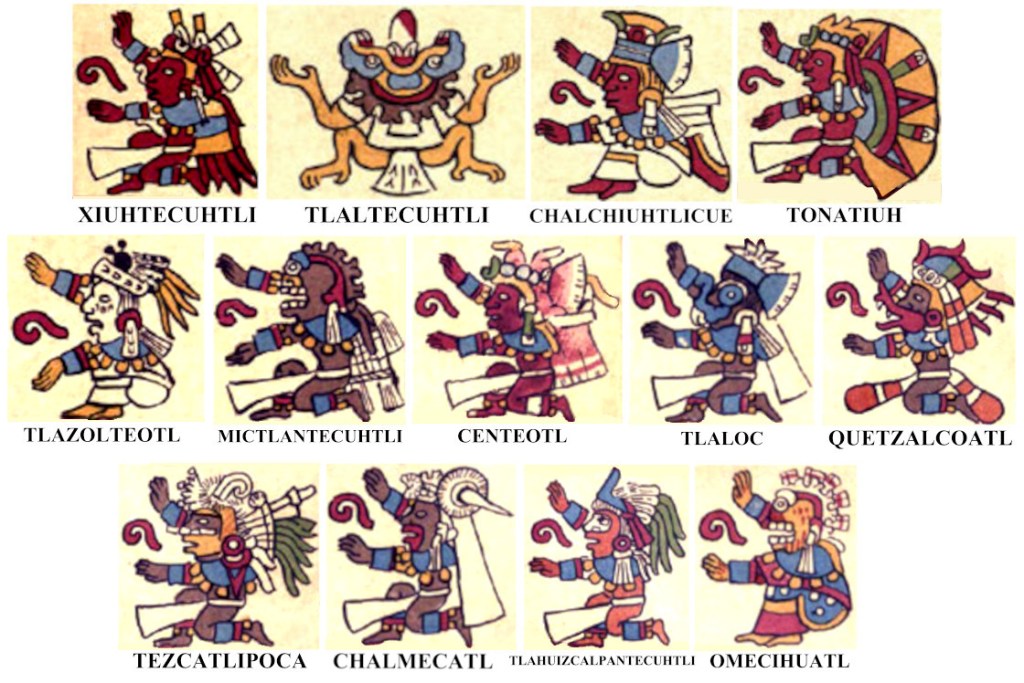
    1. Xiuhtecuhtli, Lord of Fire/Turquoise
    2. Tlaltecuhtli, Lord of the Earth
    3. Chalchiuhtlicue, the Jade Skirt, Goddess of Flowing Water
    4. Tonatiuh, God of the Fifth Sun
    5. Tlazolteotl, Goddess of Filth
    6. Mictlantecuhtli, Lord of the Land of the Dead (Mictlan)
    7. Centeotl, God of Maize
    8. Tlaloc, God of Storms
    9. Quetzalcoatl, the Plumed Serpent
    10. Tezcatlipoca, The Smoking Mirror
    11. Chalmecatl, He of Chalma, an Underworld deity
    12. Tlahuizcalpantecuhtli, Lord of the House of the Dawn (Morning Star)
    13. Omecihuatl, Lady of Two

Here below is my rogues’ gallery of Day Lords as seen in Codex Borbonicus:

Lords of the Day from Codex Borbonicus

Whoever they are for real, I suggest that these same Day Lords rule the respective 13 daytime hours. Striving for elusive mythological consistency, I’ve also proposed that the 9 nighttime hours are ruled by the 9 Lords of the Night. Maybe, maybe not… The Aztecs tended to complicate their paradigms, some might say unnecessarily.

However, we do know for sure the numerical sequence of totems for the Lords of the Day. These totems are called in the jargon “volatiles” because they’re things that fly: birds and a butterfly. (Apparently other deities also have volatiles, like the bat or vulture of Itzpapalotl, but I’m not all that up on the finer details of Aztec ornithology.) Here are my versions of the volatile totems for the 13 Lords of the Day (whoever they really are), the 13 days of the trecena, and (possibly) the 13 daytime hours. They are drawn on models from Codex Borgia, plate 71.

###

A Roar of Jaguars

In the past few years, I’ve realized that, in the Native American tradition, I seem to have an animal totem, the jaguar. This past year when I started my second memoir, I understood my deep connection to this apex predator of the Americas and included an illustration:

My Totem Jaguar

I also realized that this magnificent feline has been lurking in my background for at least 35 years. At a yard sale I’d bought a carved-wood figurine and stashed it away as a curiosity.  Later I gave it as a birthday gift to a friend, who returned it explaining that there was some spirit in it which didn’t “resonate” with him.  Stashed away again, it sat on a shelf for decades—following me around to various domiciles.  Then about a year ago I recognized it for a jaguar-priest or shaman from some South or Meso-American tradition.

My Jaguar Priest Figurine

It suddenly made sense that this jaguar figurine was probably why some 30 years ago I’d gotten so involved in the Aztec milieu. I soon learned that this New World King of Beasts had originally roamed throughout most of the South and Meso-American jungles and even ranged north into the American Southwest (apparently now making a comeback in southern Arizona!).

I also learned that the noble jaguar was central to the mythologies of basically all the ancient civilizations of the New World (just as the lion was to those of the Old). First off, I found it in the Aztec calendar, as the 14th day of their agricultural month and in the second week of their ceremonial count of days (tonalpohualli).  Starting with the day Ce Ocelotl – One Jaguar (those with this birth day-name coincidentally being destined for sacrifice), that second week was under the patronage of the god Quetzalcoatl, the Plumed Serpent.

I already knew that the Aztec ceremonial calendar had been more or less inherited from the much earlier Maya and then discovered that it, just like its patron deity, was also revered by the even earlier Olmec. Then about three years ago in considering that maybe the sacred calendar’s count of days had originated in the still earlier Chavín civilization in Peru, I learned that the jaguar was for them also a major deity, often seen as an ornate man-jaguar.  Do note this Chavín were-jaguar’s startling snake-locks!

Chavin Were-Jaguar

If my suggestion that the count of days originated at Chavín de Huantar is correct, that ritual (more like a religion), was carried north by trader-missionaries to populations along the Pacific coast. Ultimately they crossed the Isthmus of Tehuantepec and proselytized the Olmec with the sacred way of telling time.  Many surviving Olmec sculptures are of infant were-jaguars.

Coincidentally, earliest calendar lore has it being brought by a god, namely the Plumed Serpent, who was also the bringer of maize (and culture). Between the calendar, the jaguar, and this legendary civilizer deity, they had a rather well-rounded theosophy, even if some rituals might have involved sacrifices frowned on nowadays.

It’s now become reasonable to think that the early Maya were “civilizing” in Yucatan at much the same time as the Olmec were hard at it in Veracruz. More mercenary missionary work was probably what took the calendar to the Maya.  They hugely elaborated and ornamented the new “faith” with their own deities and even started writing about it in glyphs.

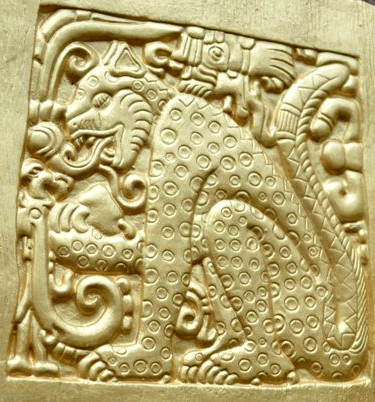
Along with calendar, the jaguar deity (B’alam) came to the Maya, but their representations of it were generally not anthropomorphized.  I found a spectacular relief at Chichen Itza on Google Images, apparently a repro in gold (!), that’s both naturalistic and stylized.  Not to gross you out, but I bet that’s a heart it’s holding in its paw and licking.

Mayan Jaguar from Chichen Itza

Of course, the third part of the religion was the Plumed Serpent, the civilizer deity whom they called Kukulcan (or Gugumatz).  This Triad then moved west and north to early Teotihuacan, where the Serpent likely became known as Quetzalcoatl, or maybe that was amongst the later Toltecs.  That calendar religion reigned across the centuries and other areas of Mexico, as shown by this jaguar totem from the Zapotecs, possibly a funerary urn.

Zapotec Jaguar

Eventually, the barbarian Aztecs came out of the north and adopted the local religion, and it came to be known and misunderstood as the “Aztec Calendar.” In their historical or genealogical picture-books, many of which were from other cultures like the Mixtec, the were-jaguar shows up as jaguar warriors.  These “jaguar-weres” were simply humans wearing jaguar pelts.

Perhaps the most dramatic Aztec jaguar is a sculpture (receptacle for sacrificial hearts!), now in the Museum of Anthropology:

Aztec Jaguar

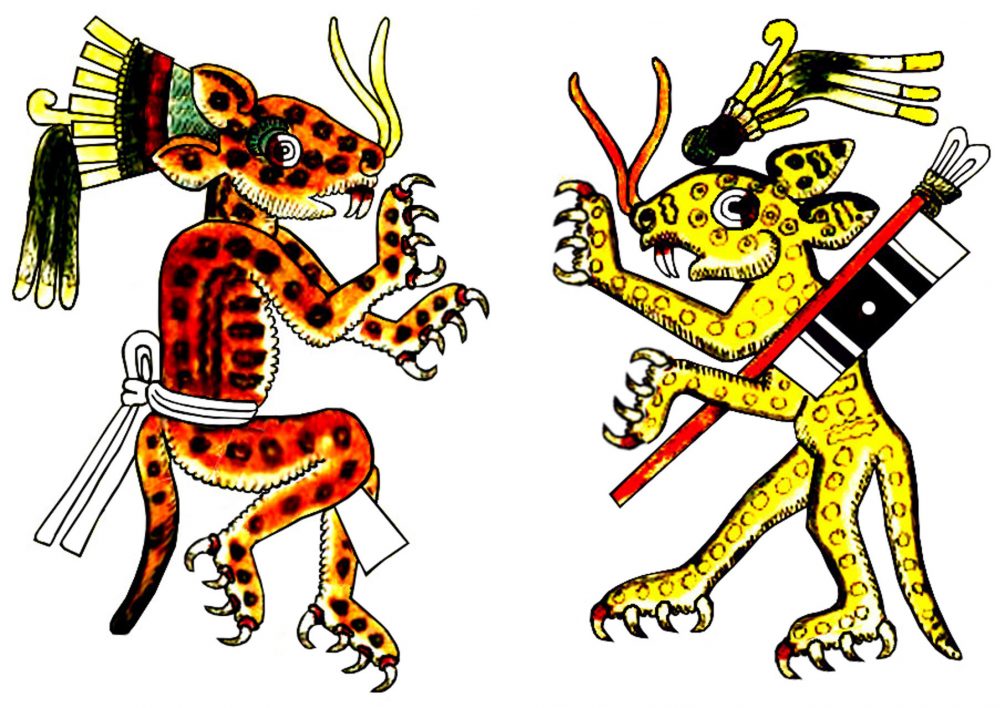
In their religious documents, the jaguar is generally depicted as a divine animal such as these two from Codex Borgia, (adjusted and adapted to prepare for drawings in my next icon).  By the way, those wavy figures represent the jaguar’s roar.

Jaguars from Codex Borgia

Modelling mine on the image on the left, several years ago as my first attempt at drawing on computer, I drew a jaguar with a realistically patterned pelt (and more aggressive demeanor). Intended to be the apotheosis of the Lord of the Animals, the drawing had to wait some three years to be enthroned in YE GODS! Icon #11 – OCELOTL.

My Jaguar–Lord of the Animals

But I’m not done with this roar of jaguars! Recalling that the historical range of the jaguar reached up into North America, there is the possibility that the creature may have been known, or at least recalled, by populations outside of the desert Southwest.  I’m talking about my other favorite topic, the Mississippian “civilization.”

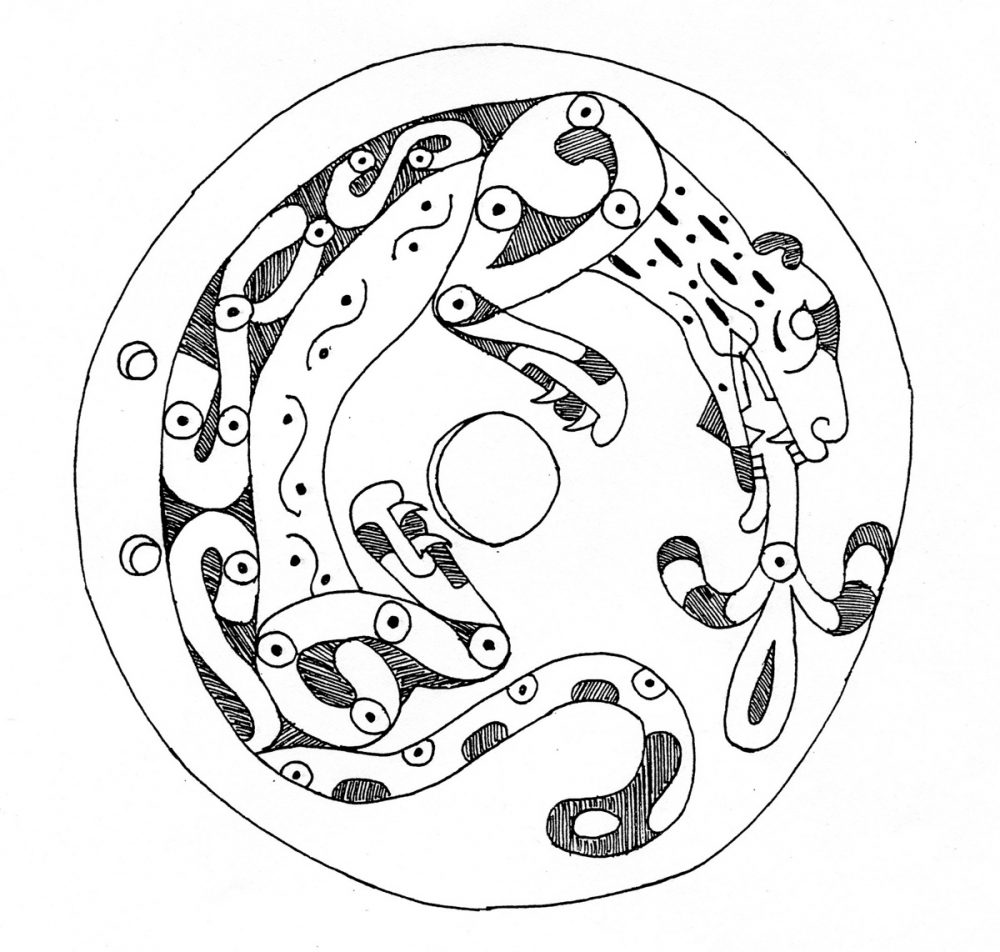
I found a trace of the calendar and image of a heavily stylized man-jaguar in the Southeast and drew this fanciful animal below from a shell gorget (from Fairfield MO across the river from Cahokia) for a book on the Indian mounds.  (See my Gallery of Pre-Columbian Artifacts.)

Jaguar Gorget – Fairfield MO

In the magazine “Ancient American,” Vol. 21, No. 116, I wrote about the cult of the Plumed Serpent in North America, which shows that the trinity of Calendar-Jaguar-Serpent was a Pan-American “religion.”  Small wonder I feel the jaguar my totem—it’s the totem for all Americans.

#


Aztec Gods of the Directions

When they founded Tenochtitlan c. 1325 CE, the Aztec barbarians adopted the traditional Mesoamerican temporal and spatial concepts of ceremonial calendar and cardinal directions.

The 260-day Aztec Turquoise Year or tonalpohualli (ceremonial count of days) is based on 20 numbered sets of 13 called trecenas, through which the 20 named days of the solar month are counted cyclically. That’s about as clearly as I can describe it. Some of the few surviving codices (ancient documents) include individual pages of the trecenas with their patron deities.

Some codices also have pages with the 260 days laid out in spreadsheet fashion with five rows of 52 columns in four sets of 13, Here’s a sample section from Codex Vaticanus laying out the first set of 13 columns (trecenas 1, 5, 9, 13 and 17):

vaticanus first section

First Section of Spreadsheet Calendar, Codex Vaticanus

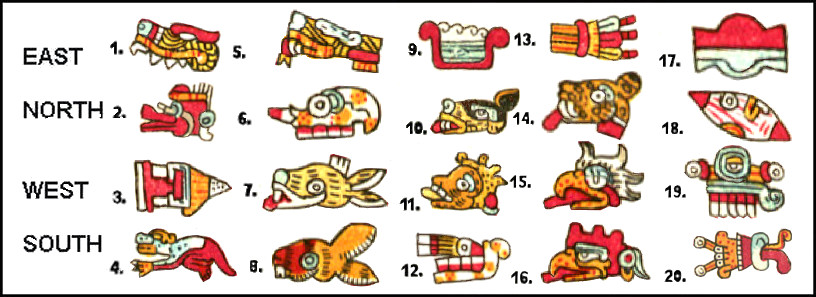
One reads left to right starting with day One Crocodile on the bottom row at lower left; after counting the 52 days in that row, we come back to the second row from the bottom beginning with Reed. Repeating that process, the count returns to the first column to resume with the days One Snake, One Earthquake, and One Water. The blocks of four columns of five days repeat 13 times—only in varying internal sequences—symbolizing the four cardinal directions:

days of direction - Vaticanus

Vaticanus Day-Signs Corresponding to Cardinal Directions

Numbered per their position in the 20-day “month,” these are East: Crocodile, Snake, Water, Reed, Earthquake; North: Wind, Death, Dog, Jaguar, Flint; West: House, Deer, Monkey, Eagle, Rain; South: Lizard, Rabbit, Grass, Vulture, and Flower.

These four cardinal directions are also characterized by colors: East—red; North—black; West—white; and South—blue. This color scheme correlates to the emblematic colors of the Aztec gods of the directions: Xipe Totec, God of the East—the Red Tezcatlipoca; Tezcatlipoca, God of the North—the Black Tezcatlipoca; Quetzalcoatl, God of the West—the White Tezcatlipoca; and Huitzilopochtli, God of the South—the Blue Tezcatlipoca.

Aztec Gods of the Directions

The traditional spatial matrix inherited by the Aztecs also included a fifth direction—the Center—which they saw as ruled by Xiuhtecuhtli, the Lord of Fire/Turquoise.

Xiuhtecuhtli - Lord of the Turquoise - (God of Fire)

XIUHTECUHTLI, God of the Center

With the Mexica’s tribal War God Huitzilopochtli ruling the South, this is emphatically the Aztec empire’s imperial vision of the divine quartet/quintet. Wondering what earlier deity may have ruled the South before, I looked at p. 1 of Codex Fejervary-Mayer, a document thought to have originated in the Veracruz region. It lays out the directions with pairs of patrons, totemic trees, and birds. However here, it’s Tezcatlipoca dominating the Center. (Apologies for the scruffy image, but I’ve got neither time nor energy to “re-create” it.)

fm01

The Five Directions, Codex Fejervary-Mayer, p. 1

The orientation of the directions is a bit different than our common Eurocentric model, rotated one notch counterclockwise. Here East is at the top, West at the bottom; South is on the right, North on the left. Besides the totemic birds and trees, the busy diagram includes much calendrical symbolism, including the days of the directions, year-bearers, and what-not.

By the way, the South tree is a “sacred” Theobroma (Food of the Gods) cacao tree with its chocolate pods. The totem on the North is a spiky ceiba tree (Kapok) which the Maya saw as the great tree at the center of the world—connecting the Underworld and the Sky World (heavens), its trunk representing the world of humans, animals, etc.

The pairs of patron deities in each lobe include only two of our divine quartet of Tezcatlipocas. In the top East lobe, on the right stands Xipe Totec, our Red Tezcatlipoca, with his Flint headdress, and I’d bet his companion is the sun god Tonatiuh, god of the Fifth Sun. In the left North lobe, the upper deity is a simple version of our Black Tezcatlipoca, and the lower one looks like the mighty Tlaloc, God of Storms. The rest of the patrons are different.

The South lobe on the right tells us who must have ruled that direction before the Aztecs inserted their Huitzilopochtli: the upper Mictlantecuhtli, Lord of the Land of the Dead, and the lower Centeotl, God of Maize. The Aztecs gave them both the boot… In addition, the West lobe on the bottom holds no White Tezcatlipoca, Quetzalcoatl, showing instead a surprising pair of patrons from pre-Aztec mythology. On the right (upside down) is Chalchiuhtlicue, the Jade Skirt, Goddess of Water, and on the left Tlazolteotl, Goddess of Filth, a major mother deity.

The reputedly misogynist Aztecs seem to have impeached these two great goddesses to install the famous Maya/Teotihuacan/Toltec Plumed Serpent as their deity of the West, as the White Tezcatlipoca. Speaking of misogyny, in another religious coup, the new empire tried to depose the Goddess of the Moon (Ixchel to the Maya and Metztli in Teotihuacan) from her traditional role as patron of the calendar’s Death Trecena and then made their own Tecciztecatl into the God of the Moon. (Metztli can still be seen in the calendar in Codex Telleriano-Remensis.)

The Aztecs were also conservative, if not reactionary, in other ways, like in celebrating their culture as the culmination of the “golden” ages of Teotihuacan and the Toltecs. Witness their great cult of Quetzalcoatl and abject “idolatry” of Tezcatlipoca, also inherited from the Toltecs. Since time immemorial, he and Quetzalcoatl were seen as each other’s twin and nemesis, and in their roster of the gods of the directions, the Aztecs enshrined that primordial conflict. That they apparently replaced the Smoking Mirror with Xiuhtecuhtli as God of the Center is surprising, and it’s even more so that they didn’t make Huitzilopochtli Center and give someone else South. But winners always get to write their own version of history—and religion.

###

Aztec Icon #11 – OCELOTL (Jaguar), Lord of the Animals

At long last –Aztec Icon #11: OCELOTL, Lord of the Animals.  In the midst of other projects and family stuff, it’s taken me all summer to finish this icon for the coloring book YE GODS!  THE AZTEC ICONS.  Not for lack of effort but the enormous amount thereof.  Actually I’d already done the jaguar rampant a couple years ago, my first drawing directly to digital.  Thanks to my freeware graphics program GIMP, in rendering this boggling Mesoamerican zoo, I’ve discovered almost godlike powers over pixels.  But I try to be a beneficent deity.

The vast amount of effort came first in locating historical images of creatures in the ancient codices for stylistic models. Those I couldn’t find had to be drawn from photographed nature.  Actually, my iconic jaguar is a departure from Aztec style in its naturalistic treatment.  While there are many jaguars in the codices, in my opinion they all look too “cartoonish” to make an impressive deity.  Besides, I liked the challenge of creating the pelt pattern for the little Jaguar Knights in the Chalchiuhtotolin icon.  The regalia indicates the creature’s divine nature, and the wavy fork at its muzzle is the symbol of its howl.

Please note the large “dots” at each corner of the icon. They are the Aztec number four, and this is the calendrical day-name Four Jaguar, the First Sun (World) in the Mesoamerican cosmological sequence.  That very first YE GODS! icon of Atl was the day-name Four Water, the Fourth Sun, and the fifth icon of Ehecatl was the day-name Four Wind, the Second Sun.  You’ll have to wait a bit for the third and fifth Suns later in this series.

Ocelotl is lord of all animals:  those belonging to Huixtocihuatl, Lady of Salt (Goddess of the Sea on the upper left); those belonging to Tlaltecuhtli, the hermaphroditic Lord of the Earth (on upper right); and those of the air ruled by Quetzalcoatl, the Plumed Serpent (at top).

The split circle over the deity’s head is the traditional symbol of day and night, showing its lordship over diurnal and nocturnal animals, the jaguar itself being nocturnal. The eagle to the left represents the Aztecs’ main god Huitzilopochtli as the sun at midday, and my very own “batterfly” on the right is Itzpapalotl, Goddess of the Night Sky, who was often depicted as butterfly, bat, and/or bird.

Ocelotl is also lord of the strange animal Man, as can be seen in the vignette at the bottom depicting the legendary creation of man from a primordial tree as shown in Mixtec codices.

By the way, I’ll note that the Aztecs adopted most of their cosmology and “religion” from the peoples living then and earlier in central Mexico like the Mixtec, Zapotec, Huastec, Toltec, etc., etc.—as had they from the even more ancient Teotihuacan and Maya. In the long history of Mesoamerican civilizations, their underlying myths have mostly been related, even inherited.

Ocelotl, the Jaguar, is a mythology from deep in history. The earliest (in Mesoamerica) Olmec famously revered the Jaguar (jaguar-headed babies?), and may have named the day in the calendar for it.  Or maybe not.  Elsewhere I’ve suggested that the Mesoamerican calendar could have come from South America, from the even earlier Chavín civilization, and curiously, the Jaguar-Man was also a prominent feature of that culture.  Just saying…  Deep history.

Some other notes on my Mexican menagerie: I can’t even identify some of the animals or birds, especially the silly little bugs.  That odd creature at the end of the deity’s tail is the salamander called in Nahuatl axolotl.  My Monarch butterfly (center left, just above the stunning Turkey) is geographically appropriate, as are my several other nature drawings of Mexican fauna, including the quetzal birds (top right).  Don’t overlook the Xoloitzcuintli, national dog of Mexico, at the Jaguar’s left foot.  Can you identify any more of the critters in this montage?

(You can still see or download the previous ten icons in the YE GODS! series by clicking on them in the list on the page for the coloring book.)

ICON #11: OCELOTL

(Lord of the Animals)

To download this icon as a pdf file with a page of caption and model images from the Aztec Codices, right click here and select “Save Target (or Link) As.”  You can also download it in freely sizable vector drawings from the coloring book page.

OCELOTL (Jaguar), Lord of the Animals

OCELOTL (Jaguar), Lord of the Animals

OCELOTL {o-se-lotł} (Jaguar) is the Aztecs’ deity of all animals of land, sea, and air. It is a nagual of the god TEZCATLIPOCA who created the First Sun, Nahui Ocelotl (Four Jaguar), a world peopled by giants who were devoured by divine jaguars.  Ocelotl, the 14th day of the month, was usually a lucky day, but anyone born on the day Ce Ocelotl (One Jaguar) was destined for sacrifice to one god or another.  OCELOTL is patron of scouts and warriors, and the elite corps of warriors of the night were known as the Jaguar Knights.  Ever since the Maya, in Mesoamerica jaguar pelts in shades of tawny gold to white were the sacred possessions of priests and royalty.


Huixtocihuatl and Mictlancihuatl, Aztec goddesses

No, I haven’t been on vacation since the middle of May. Well, actually I did go away with family for a week at the beginning of July to a beach house in Galveston.  Just a week though.  Otherwise I’ve been making good progress on the eleventh icon (Ocelotl-Jaguar) for my YE GODS! coloring book and restoring photographs by the dozen for a biography of my mother, which I hope to finish by October and publish under Writing.  As if that weren’t enough of an excuse for no blog postings these three months, I’ve also been dealing with some medical issues I won’t bore you with, except to say they involved surgery and prescription for a blood thinner.  No fun whatsoever.

Meanwhile, I’ve wondered what to write about next. I considered a lament about the current sad climate for dance in Santa Fe, but you don’t want to read about my withering opinion of what they’re calling nightlife and dance music nowadays.  Rants about today’s absurd political situation seemed particularly egregious, and philosophical essays seemed pointless.  I’ve been planning to write about 30 years ago, but that purely autobiographical subject, while formative and somewhat dramatic, isn’t all that exciting.  So I’ll fall back on my eccentric art for a topic.

Sorry about taking so long on the Ocelotl icon, but it demands an exorbitant number of elements. The Jaguar being the Aztec’s main animal deity, lord of the animals, I’ve got to include as many of the animals indigenous to Mexico as I can manage.  It’s been a hoot drawing them:  armadillo, peccary, xoloitzcuintli, quetzal, turkey, iguana, tortoise, coati, etc. There are several yet to go, like pelican and giant anteater. It will present the Mesoamerican biota of creatures of the land, air, and sea.

To show this inclusiveness, I’ve drawn Tlaltecuhtli, the androgynous deity of the earth (the land); Quetzalcoatl, the composite deity of the sky (the air); and Huixtocihuatl, the Lady of Salt (the sea). In addition, in the tenth icon of Mictlantecuhtli I included a new cameo of the Lady of the Land of the Dead, Mictlancihuatl.

Since these two divine Ladies don’t figure in the Aztec ceremonial calendar, they didn’t make it into my batch of illustrations for that 1993 book. So here for your delectation are images of two more Aztec goddesses:

Huixtocihuatl, Lady of Salt, and Mictlancihuatl, Lady of the Land of the Dead

Huixtocihuatl, Lady of Salt, and Mictlancihuatl, Lady of the Land of the Dead


Source of Aztec Calendar

A friend mentioned that the Aztec ceremonial calendar of 260 days might be based on the zenithal passage of the sun at some particular latitude. I calculated:  260 calendar days / 365.25 solar days = 0.7118 of the annual cycle X 93.6 degrees per year (back and forth between the Tropics) = 66.62834 X .5 = 33.3142 degrees – 23.4 from Tropic of Capricorn to Equator = 9.9142 degrees N (9o 54’ 51”).  I was surprised that this latitude runs through Costa Rica.

Reading the book “Cycles of the Sun, Mysteries of the Moon” by Vincent H. Malmström (University of Texas Press, 1997), I was even more surprised that the professor of geography announced the latitude as 14.8 degrees N, without showing calculations. He then identified the pre-Olmec site of Izapa as where the calendar was probably invented.  By my count, at 14.8 degrees N, the southern lap of the sun’s cycle lasts about 297 days.  That’s way off.

Let’s assume that the invention of the calendar happened 1400—1100 BC to allow time for it to get to Izapa and, as Malmström so reasonably proposes, cross over the Isthmus of Tehuantepec into the early Olmec area. But there were pre-Olmec cultures all along the Pacific coast from Mexico through Guatemala, El Salvador, Honduras, Nicaragua, and down into Costa Rica.  As a matter of fact, in Costa Rica the Las Mercedes site (from 1500 BC) lies on the slope of the (active) Turrialba volcano at 10.167 degrees N.  It’s worth noting that Turrialba’s peak is at 10.01 degrees N, so Las Mercedes is directly east, which would make for a huge gnomon.

Now I read in “The Art of Mesoamerica” by Mary Ellen Miller (Third Edition, Thames & Hudson, 2001) that the unworkable Izapa proposition has survived in scholarship for at least four more years. But this author proposes the human nine-month birth cycle as more likely.  I calculate 9 x 30 days = 270—close but no cigar, and too variable.  Miller argues that a zenithal source of the ceremonial count “seems an unlikely basis for a calendar first recorded to the north of the 15-degree latitude.”  Given the astronomical bent of the ancients, I’d say it’s an exquisitely likely basis for a calendar, whenever or wherever first conceived or recorded.

IF the 260-day ceremonial calendar was based on the sun’s zenithal passage, THEN it must have been invented at a latitude where that time period obtained—approximately 9.9 degrees.  That latitude also runs along the Caribbean across the northern sections of Colombia and Venezuela, but there don’t seem to be any significant culture sites in those areas from appropriate times.

If not in Costa Rica, then how about at 9.9142 degrees South? That imaginary line runs across the Amazon basin just slightly north of the Beni region in Brazil and Bolivia —which by the way hosted an enormous hydrological culture from 4000 BC to 1300 AD(!).  Though they built canals, causeways, raised fields and living sites, we essentially know nothing about them.

That latitude also crosses the Andes in Peru, running right through Chavín de Huantar in the Ancash valley. It was the main site of the earliest South American civilization (1200—400 BC), which occupied many other sites in the region and along the coast.  Other sites were even older though, like El Paraíso (2500—1100 BC).  But the Chavín culture was the first to produce distinctive art and ceremonial architecture, specifically truncated pyramids.  Chavín de Huantar lies directly east of an Andean peak which again could serve as a magnificent gnomon.

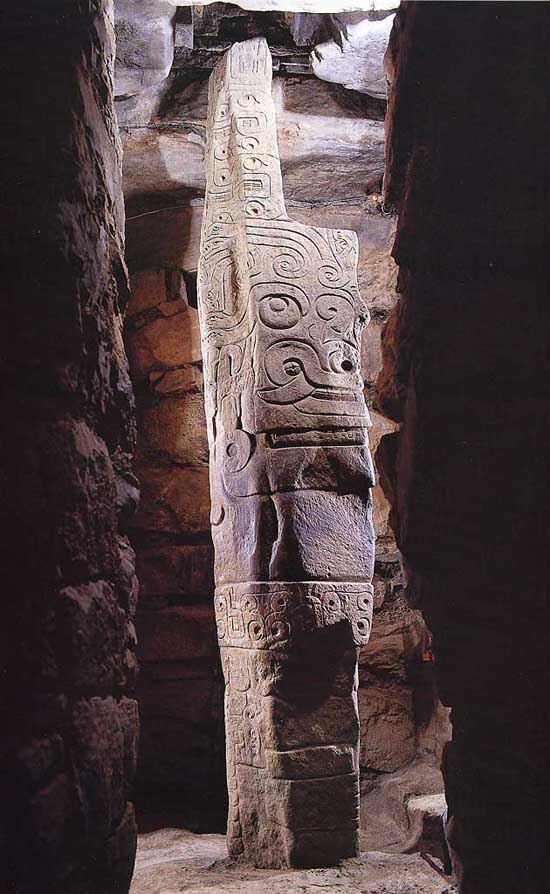
Significantly, there are many obelisk– and slab-shaped stelae/gnomons at the site, the main one being the Lanzon stela, a 15+-foot stone spire with wonderful decorative carvings. It stands within a pit in the “temple” and extends up through a hole in the roof, a foolproof way to demonstrate the exact zenithal passage of the sun.  By the way, the figure carved on the stela points eloquently upward with one hand and downward with the other.  Of course, this site’s 260 days between the sun’s passages are on its northern lap between the Tropics.

I propose that Chavín de Huantar was the birthplace of the 260-day calendar, which probably was what caused its rise in ceremonial importance around 1200 BC, turning it into the cultural and religious hub of that first civilization and a destination for pilgrimages and rituals. Even though no archaeological traces of a 260-day calendar have been found amongst these non-literate Andean civilizations, they may well have observed it religiously alongside the solar calendar, which is precisely how it worked later in Mexico.  And it got to Mexico by sea.

The Chavín and other even earlier Pacific coastal cultures were accomplished sea-faring folk using balsa-wood rafts and boats. (Balsa trees grow all along the coasts of South and Central America.)  There was a lot of maritime activity, trade, and exchange among the various cultures long before the Chavín.  In the dim past maize was brought from Mexico to the Andes, and the art of metal-working passed in the opposite direction. The Pacific coast from western Mexico down to northern Chile was one enormous “economic zone” of productive ecologies between sea and mountains.  The Chavín were the first efflorescence of those cultures (fertilized by contacts with the Beni?), and wherever they went, they understandably preached their religious calendar.

Besides the calendar, the Chavín spread other concepts of their culture and art all along the coast. Their pyramids and intricate figures and motifs of jaguars, caimans, and serpents bear a distinct resemblance to the architecture, themes, and imagery of the later Maya and other Mexican cultures.  The Chavín anthropomorphic jaguar and truncated pyramid must surely have accompanied the ceremonial calendar across the Isthmus of Tehuantepec to inspire the Olmec—and subsequent Mesoamerican cultures.

FREE COLORING BOOK

YE GODS!  THE AZTEC ICONS

­An Outrageous Coloring Book

Icons of Aztec Deities and Commentary

By Richard Balthazar

ICON #1  ATL – GOD OF WATER

For free download as a pdf file, right click here and select “Save Target (or Link) As.”

ATL, Aztec God of Water

ATL, Aztec God of Water

ATL {atł} is the deified element of water, and is a nagual (manifestation or bodhisattva) of TLALOC, the ancient God of Storms (Rain).  In the tonalpohualli or ceremonial count of days, also called the Turquoise Year, Atl is 9th of the 20 named days in the month, a lucky day.  As above, Nahui Atl (Four Water), the 4th of the 13 numbered days in one of the weeks, is the day-name of the Fourth Sun, a previous world ruled by CHALCHIUHTLICUE and destroyed by Water.  Its humans were turned into fish.  The four dots are the Aztec numeral 4.  The extended upper lip (harelip?) has been traditional for Mesoamerican water deities ever since the Olmec.

###

 Rather long ago for my book CELEBRATE NATIVE AMERICA, I originally drew the Aztec deities for the ceremonial calendar.  Now I’m redrawing in the digital medium and expanding them into full-scale icons.  And believe it or not, the YE GODS!  THE AZTEC ICONS coloring book is offering you these amazing neo-Aztec icons for FREE.  That’s right—at no risk—not even any postage.

Color them in as you wish with my compliments.  The wrinkle is that this coloring book will be posted serially as each icon is completed.  That could well take the next couple years—a good reason to keep checking back with me.  At the moment only one is available, but there are four more almost ready for posting, and a sixth is well on the way.

The Aztec deities are a fascinating crowd of inter-related personalities involved in a soap-opera mythology of creation/destruction, love/strife, and life/death that makes the gods of Olympus look like wimps.  Perhaps the confusing dramas, frequent aliases, and surreal images are due to the fact that the Aztecs and their deities indulged in psychoactive drugs like alcoholic pulque, peyote, hallucinogenic mushrooms, and other psychedelic herbs.  So hold on to your hats for some challenging images to color, such as the current posting above.

Using only a bit of my artistic license, I’m basing YE GODS!  THE AZTEC ICONS on extant Aztec artifacts and their surviving picture-booksYou can use these almost authentic Aztec icons as cartoons for large-scale murals, smaller-scale tattoos, needlepoint patterns, and other design or illustration needs.

YE GODS!  THE AZTEC ICONS should also be seen as a free and unique teaching tool for classes not only in art, but also in cultural and historical studies.  In addition, YE GODS!  THE AZTEC PANTHEON is an illustrated encyclopedia of Aztec deities that comprises a crash course in Aztec cosmology, mythology, ritual, society, and history.

Don’t be shy.  Make lots of copies to experiment on.  You’ll need to.

###

Free Book on AZTEC CALENDAR

CELEBRATE NATIVE AMERICA!

An Aztec Book of Days

By Richard Balthazar (Five Flower Press, 1993, out of print)

CNA cover

For free download as a pdf file, right click here and select “Save Target (or Link) As.” 

I recently announced  that I’ve put my old out-of-print book on the Aztec ritual or ceremonial calendar up for free download.  Anyone with interest in art, mythology, history, or horoscopy will find it an unusual experience.  You’ll learn some weird stuff you never ever imagined, money-back guarantee.

The book presents the 260-day sacred Turquoise Year, which was used for divination and prophesy, in color plates of their 13 ‘months’ of 20 days spread over 20 ‘weeks’ of 13 days.  My weekly illustrations also include their patron gods or goddesses in images based on surviving Aztec books, primarily the Codices Borbonicus, Borgia, Nuttall, Fejervary-Mayer, Kingsborough, and Vindobensis.

For free download as a pdf file, right click here and select “Save Target (or Link) As.” 

If you don’t want the book itself, all its illustrations are up for individual free download from my galleries of godsdays, and weeks on this site.  Do whatever with them with my blessing.

The Turquoise Year was an evolution of the earlier Mayan calendar of similar structure with roots among the even earlier Olmec.  It was the ancient Mesoamerican horoscope.  The birth day-name was a person’s ceremonial and official name, and the deities who ruled the numbers, days, weeks, and months, each with light and dark sides, controlled individual and societal fates.

By the way, you can quickly find out your Aztec name by going to azteccalendar.com, and while there, you can even pick up your Aztec horoscope, which I admit will be much more detailed than what you’ll find in my old book.

For free download as a pdf file, right click here and select “Save Target (or Link) As.” 

READERS: Please disregard the final chapter and its mind-boggling concordance.  My hubristic attempt to start up a new Sixth Sun at the fall of Tenochtitlan was at best poetic, but that calendar has now run out anyway.  Forget about it.

Another note:  I exercised my artist’s license on the 20th week, One Rabbit, naming as its patron a far more appetizing deity, Xochipilli, the Prince of Flowers.  The actual patron was a quasi-deity called Tecpatl (Flint—the sacrificial knife).  Feeling like a nagual (or bodhisattva) of Xochipilli, I’ve dared to use his image in the banner on this website.