Aztec Calendar – Dog Trecena

The fourteenth trecena (13-day “week”) of the Aztec Tonalpohualli (ceremonial count of days) is called Dog for its first numbered day, which is the 10th day of the veintena (20-day “month”). In the Nahuatl language, Dog is Itzcuintli, and it’s known as Ok in Yucatec Maya and Tz’i’ in Quiché Maya.

Understandably, the day Dog is connected anatomically with the nose (i.e., the olfactory sense) and symbolizes protection, loyalty, companionship, comfort, compassion, watchfulness, and devotion. It guards households and lineages as well as the portal between worlds, conducting the sun through Underworld at night and leading souls of the dead to Mictlan. In those functions, Dog represents a light in the dark and night vision. As the psychopomp (guide) in Mictlan, that Dog is a breed called Xoloitzcuintli, the “Mexican hairless” dog, named for the dog-god Xolotl, also an Underworld figure. Meanwhile, the Xoloitzcuintli is Mexico’s national dog and a symbol of Mexico City. Per Fr. Duran’s 16th-century account, people born on a Dog day will be courageous and generous, ascend in the world, and have many children.

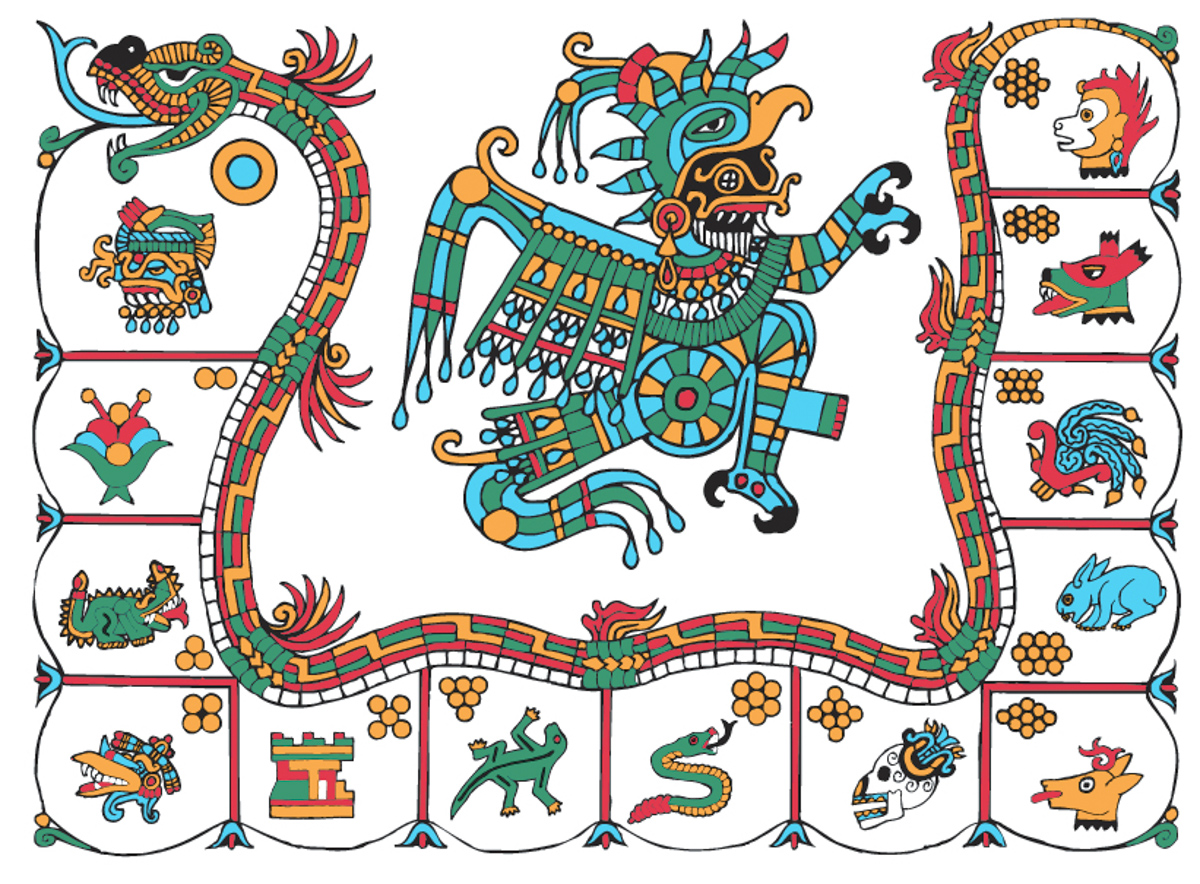
In line with the Dog’s duties in the Underworld, the patron of that day is Mictlantecuhtli, Lord of the Land of the Dead (See Icon #10), a patron of the Flint trecena.

PATRON DEITY RULING THE DOG TRECENA

The patron of the Dog Trecena is Xipe Totec, god of liberation, rebirth, and springtime. He’s the lord of nature, agriculture, and vegetation and patron of gold- and silver-smiths and the day Eagle. Counter-intuitively he’s the god that invented warfare. In another paradox, as lord of the sunset, Xipe Totec is called the Red Tezcatlipoca (a nagual of that god) but also seen—along with Tlahuizcalpantecuhtli (see Snake trecena)—as a god of the East. Symbolizing renewal, like an ear of maize stripped out of its husk, he (and his cult’s priests) often wore the skins of flayed sacrificial victims. He brings and cures rashes, boils, pimples, inflammations, and eye infections.

AUGURIES OF DOG TRECENA

By Marguerite Paquin, author of “Manual for the Soul: A Guide to the Energies of Life: How Sacred Mesoamerican Calendrics Reveal Patterns of Destiny”
https://whitepuppress.ca/manual-for-the-soul/

Overseen by the Lord of Renewal and the life-affirming Feathered Serpent, this fire-oriented trecena tends to be oriented around the renewal of leadership, the forging of new directions, and the restoration of life. One of the key symbols associated with this time frame is a dog holding a torch, bringing light into darkness and showing the way. As guidance, justice, and forgiveness tend to be prominent themes in this period, it’s a good time to slough off the old, burn away transgressions, and take steps towards new possibilities.

Further to how these energies connect with world events, see the Maya Count of Days Horoscope blog at whitepuppress.ca/horoscope/  Look for the Ok trecena.

THE 13 NUMBERED DAYS IN THE DOG TRECENA

The Aztec Tonalpohualli, like the ancestral Maya calendar, is counted through the sequence of 20 named days of the agricultural “month” (veintena), of which there are 18 in the solar year. Starting with the 10th day of the current veintena, 1 Dog, this trecena counts: 2 Monkey, 3 Grass, 4 Reed, 5 Jaguar, 6 Eagle, 7 Vulture, 8 Earthquake, 9 Flint, 10 Rain, 11 Flower, 12 Crocodile, and 13 Wind.

Special days in the Dog trecena:

One Dog (in Nahuatl Ce Itzcuintli)—According to the Florentine Codex, this was a great feast day dedicated to Xiuhtecuhtli, the lord of fire, when people fed the fire with offerings (including decorative paper arrays) and incense. On this day rulers were elected, a court of justice sentenced wrong-doers, and minor offenders were released and absolved of transgressions.

Four Reed (in Nahuatl Nahui Acatl) was known as “the ruler’s day sign,” the day when new lords and rulers were installed, and tribute was paid to them. It was also a propitious day for the drilling of a New Fire because nahui acatl also meant “fire drills in all 4 directions.”

THE TONALAMATL (BOOK OF DAYS)

Several of the surviving so-called Aztec codices (some originating from other cultures like the Mixtec) have Tonalamatl sections laying out the trecenas of the Tonalpohualli on separate pages. In Codex Borbonicus and Tonalamatl Aubin, the first two pages are missing; Codex Telleriano-Remensis and Codex Rios are each lacking various pages (fortunately not the same ones); and in Codex Borgia and Codex Vaticanus all 20 pages are extant. (The Tonalpohualli is also presented in a spread-sheet fashion in Codex Borgia, Codex Vaticanus, and Codex Cospi, but that format apparently serves other purposes.)

TONALAMATL BALTHAZAR

As described in my earlier blog The Aztec Calendar – My Obsession, some thirty years ago—on the basis of very limited ethnographic information and iconographic models —I presumed to create my own version of a Tonalamatl, publishing it in 1993 as Celebrate Native America!
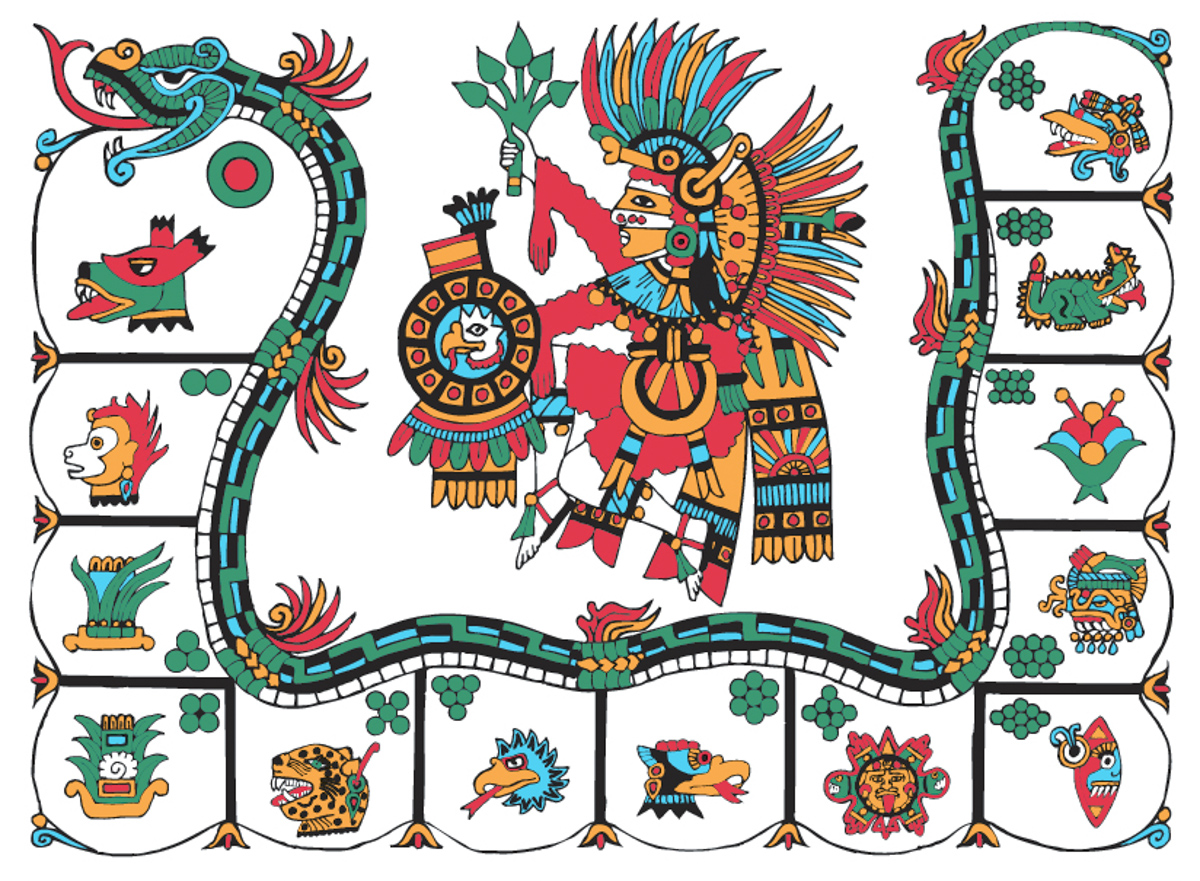
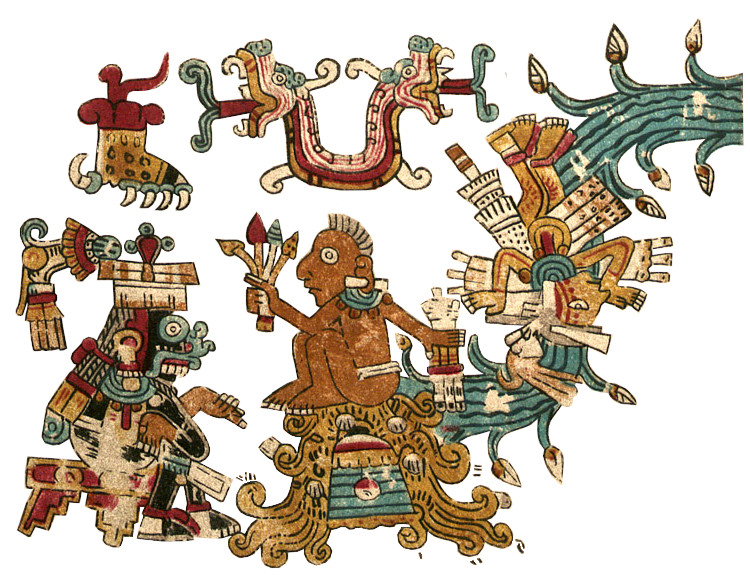
Aztec Calendar – Dog trecena – Tonalamatl Balthazar

In my image of Xipe Totec, modelled on Codex Borbonicus (see below), I stuck close to its form but in my ignorant enthusiasm played with psychedelic colors that broke iconographic traditions. Instead of the usual yellow or brown flayed skin and red body, I chose a dramatic red skin and white body; unaware of the cultural significance of his green quetzal plumes, I gave him multi-colored crests; and rather than his standard red-and-white streamers and scarf, I fancied him up with wildly colorful decorations. Note the sunset scene on his back-flap, the eagle on his shield (as patron of that day-sign), and other unwitting departures from tradition. Inspired by the spring connection, I gave him a nice “bouquet” of greenery to hold, indicating his lordship of nature and vegetation. Despite all the heresies (blasphemies?), I think my Xipe Totec is a great vision of this outrageous divinity. Now for some “dogmatic” views.

#

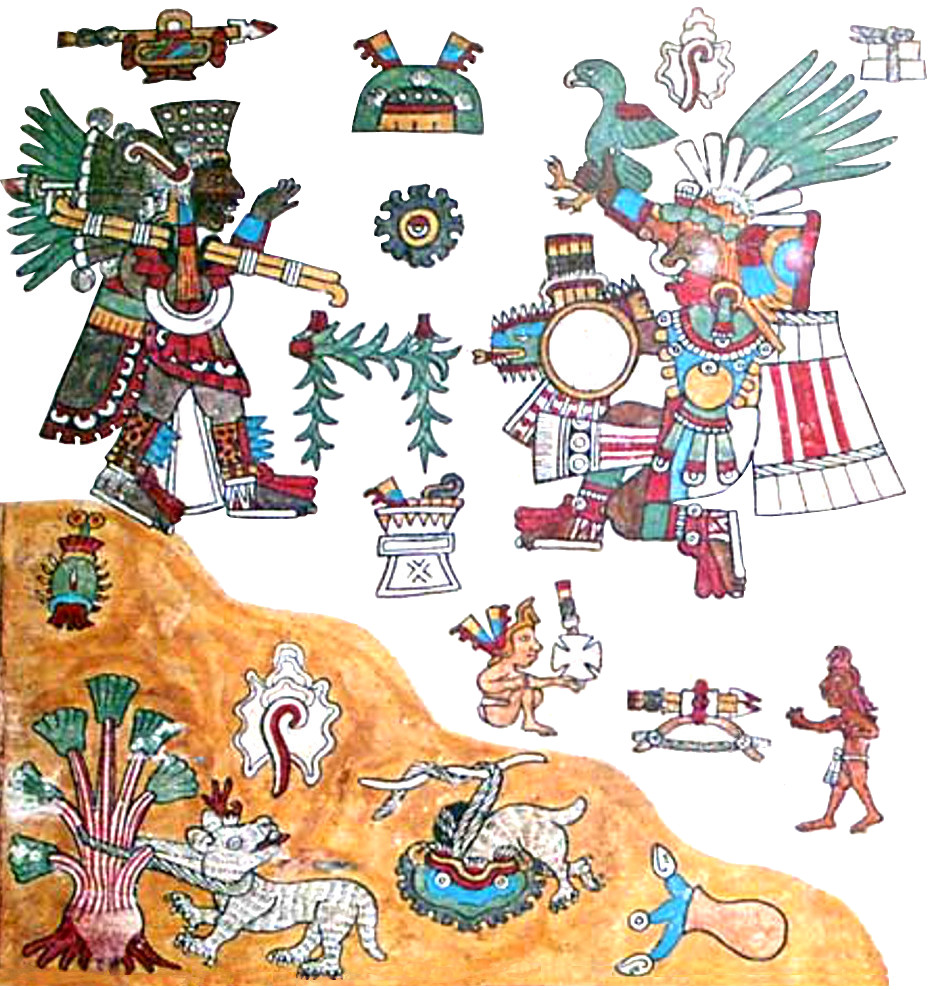
TONALAMATL BORGIA (re-created by Richard Balthazar from Codex Borgia)

Aztec Calendar – Dog trecena – Tonalamatl Borgia

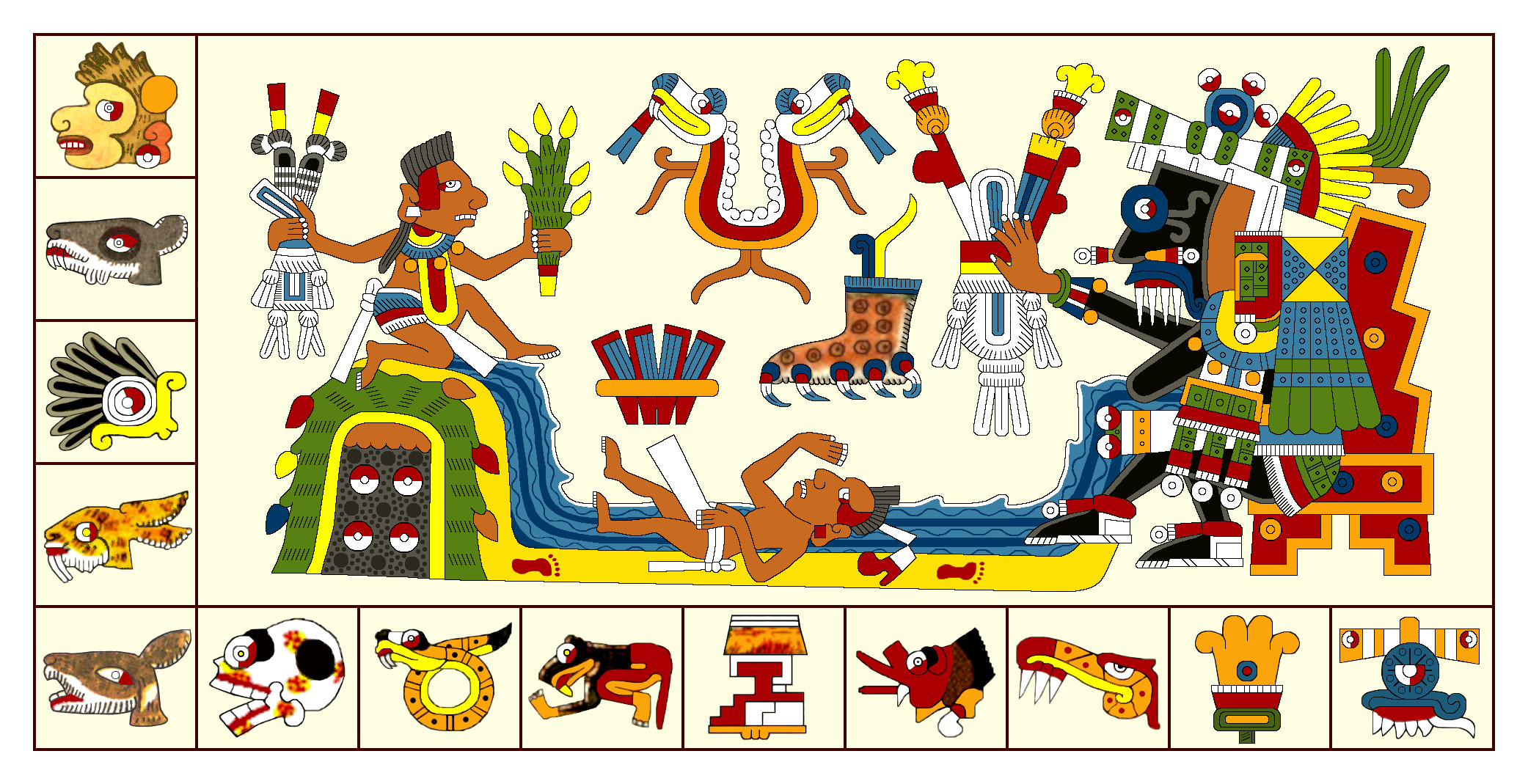
Though this elegant Borgia image of Xipe Totec on the left doesn’t wear a victim’s flayed skin, he displays his standard red-and-white accessories. Some other traditional motifs are the convex red curve down his face and the bundle of arrows in his hand (signaling his connection to warfare and lordship). Most unusual is his stupendous crown, unlike anything I’ve ever seen elsewhere on any deity. His strange Y-shaped nosepiece only occurs in some of his Borgia portraits (including in the final Rabbit trecena). It’s another unique puzzle.

Amongst the ritual items in the center of this panel, the pointed red-and-white striped scepter is an emblem of Xipe Totec in his images in many codices. In some, it’s a full-scale staff with one or two points and in some the circular motif is an open oblong shape. Beyond a diagnostic of this deity, I’ve yet to figure out the significance of this scepter/staff and probably never will.

The figure on the right Dr. Paquin and many scholars see as a Feathered Serpent (Quetzalcoatl), a deity of “many faces.” (See Icon #14). I find it puzzling, first because if it’s supposed to be “life-affirming,” why is it eating the little guy? That doesn’t seem to embody the trecena’s theme of forgiveness. But I mostly question why it has a claw-footed leg (one only!) and a crocodilian head (without a snake’s fangs). Frankly, it looks to me more like an Earth Monster (Cipactli) shown often in the codices with a single leg and crocodilian snout and representing the mouth of the Underworld which both devours and produces life. That ties in well with the themes of renewal and rebirth. Another interpretation is that it may be a fire-serpent (Xiuhcoatl) relating to Xipe Totec’s militarism. In any case, I won’t presume to decide this eminently debatable issue.

Looking for an answer to the puzzle of that Y-shaped nosepiece, I checked out other images of Xipe Totec and found another Borgia portrait of him as patron of the day Eagle.

Xipe Totec as Patron of Day Eagle
(Codex Borgia)

Imagine my revulsion to see him holding a severed arm, the hand pinching his nose as though to block a stench. In fact, the wearing of a (rotting) human skin must have stunk to high heaven. Like a clothespin, that Y-shaped nosepiece must have served the same purpose. And then just imagine my surprise to see again in the upper register the one-clawed serpent, this time either eating or spitting out a rabbit. As the parallel day-Eagle patron panel in Codex Vaticanus portrays these very same motifs, there must be a deeper relationship between Xipe Totec and the ambiguous creature beyond their companionship in the Dog trecena. Again, renewal and rebirth?

#

TONALAMATL YOAL (compiled and re-created by Richard Balthazar on the basis of
Codex Telleriano-Remensis and Codex Rios)
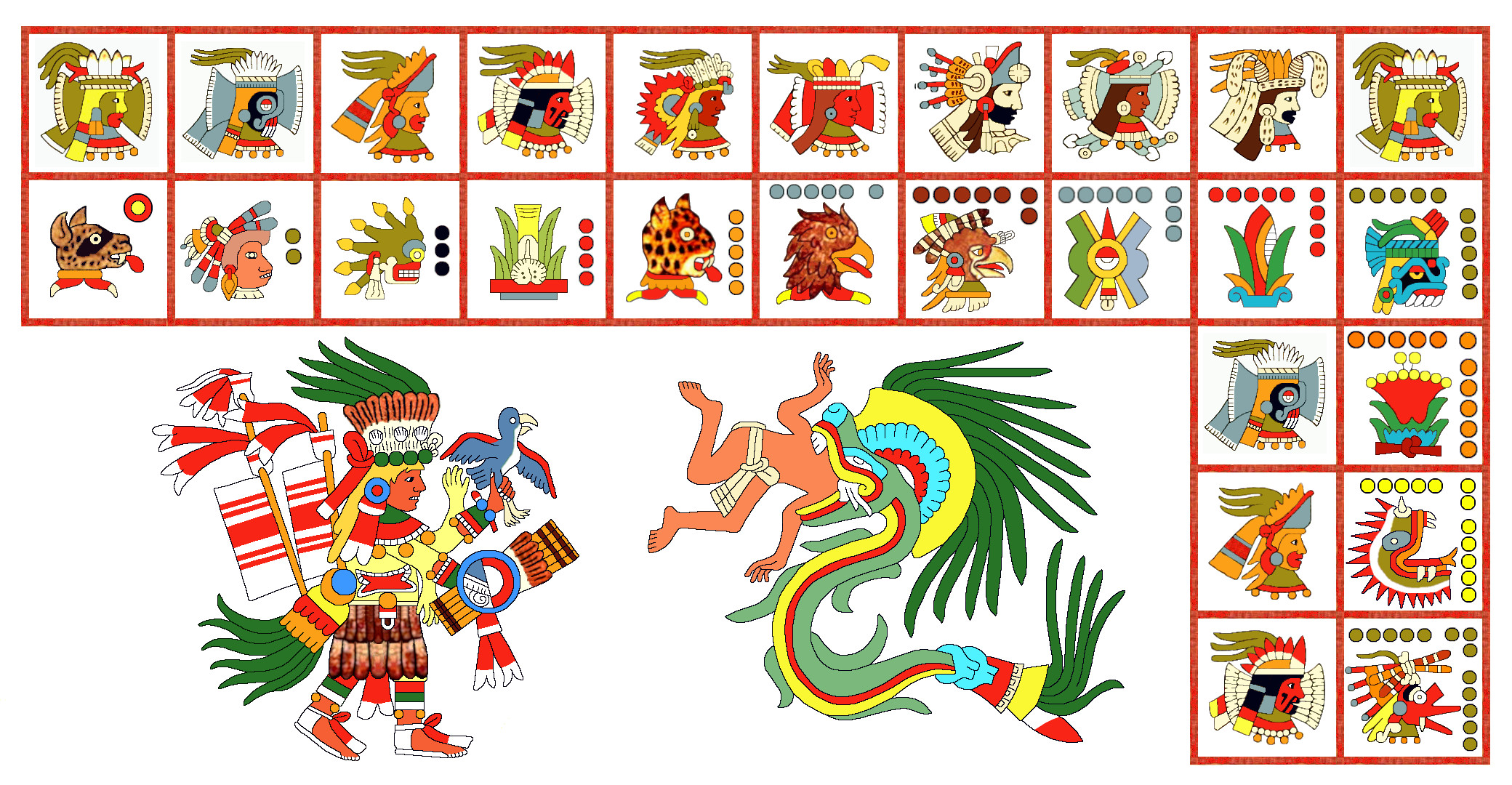
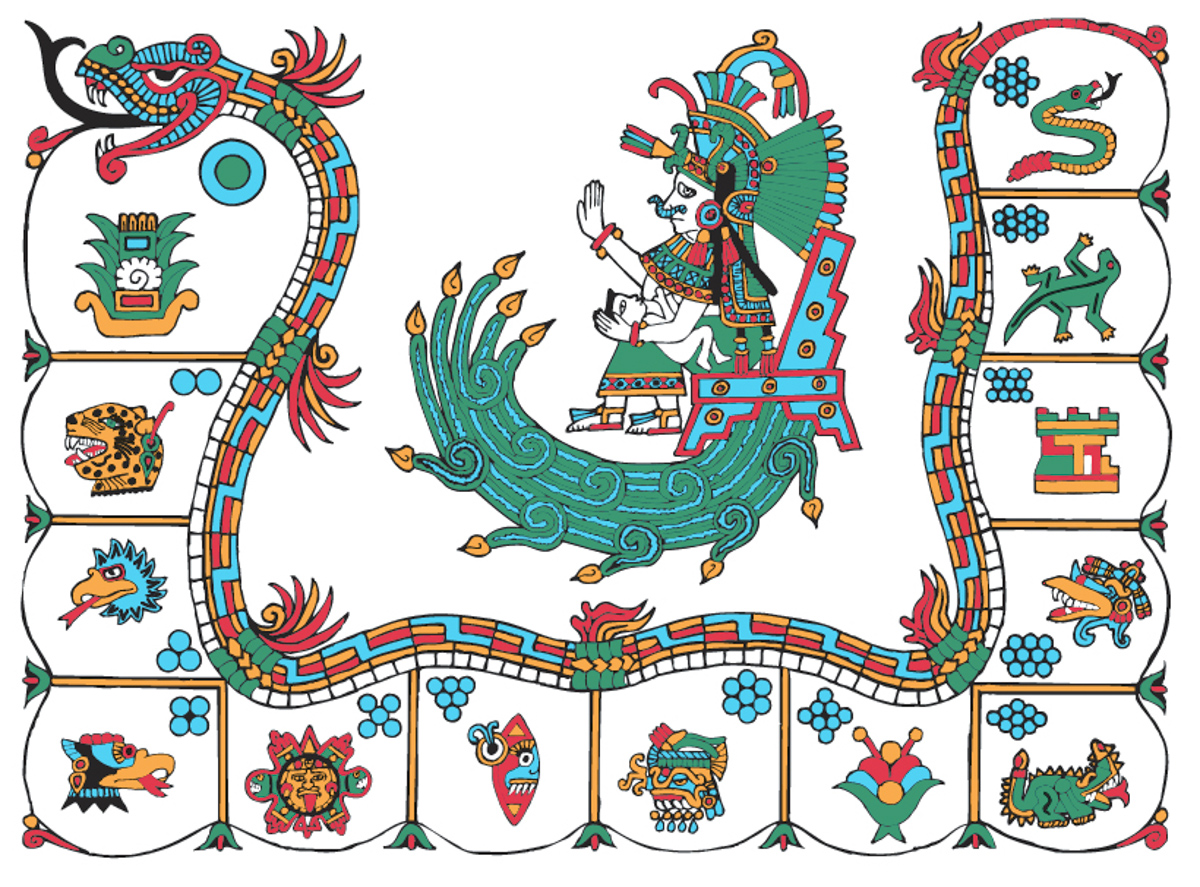
Aztec Calendar – Dog trecena – Tonalamatl Yoal

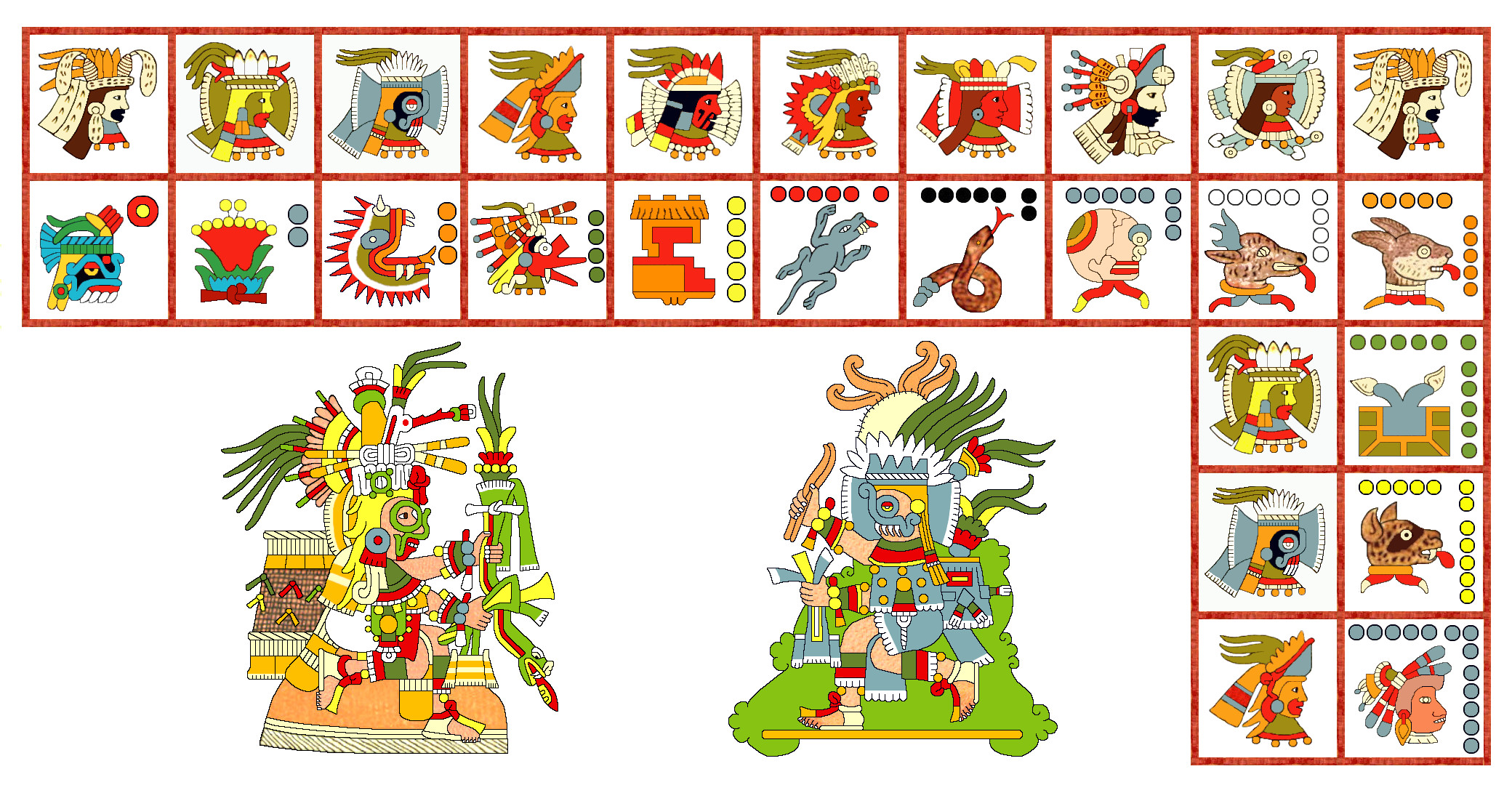
This dramatic image on the right is virtually identical in both source codices, a plumed, legless serpent devouring a little guy. Its head looks more like a snake, but it still lacks a serpent’s fangs. No doubt this is the good reason scholars see it as the Feathered Serpent (Quetzalcoatl). The discrepancy may lie in slight doctrinal differences between the areas where the codices were drawn, but either way, I figure the creature/deity still represents renewal and rebirth.

On the other hand, in terms of iconographic detail, the figure of Xipe Totec on the left is much more “dogmatic” than those in Borgia. In particular, he wears the (stinky) flayed skin, here in a pale yellow like that worn by Tlazolteotl in the Earthquake trecena, and I’ve given him the brown eagle-feathered skirt which Rios will give him later in the Rabbit trecena.

Most intriguing is his shield with the unusual, divided device, and I’m puzzled by the bundle of arrows (reeds) without arrow heads. Since his Telleriano-Remensis page is missing, I had to rely on the Rios copy, and instead of its murky brownish tones, I’ve colored many of his ornaments in his trademark red-and-white. My big question is how come, when Xipe Totec isn’t a lord of the day, he’s holding a totem bird? Such a blue bird is normally brandished by Xiuhtecuhtli, but in that case it should more properly be a blue hummingbird and not a parrot. I suppose this might simply be another instance of doctrinal difference—or iconographic confusion.

#

OTHER TONALAMATLS
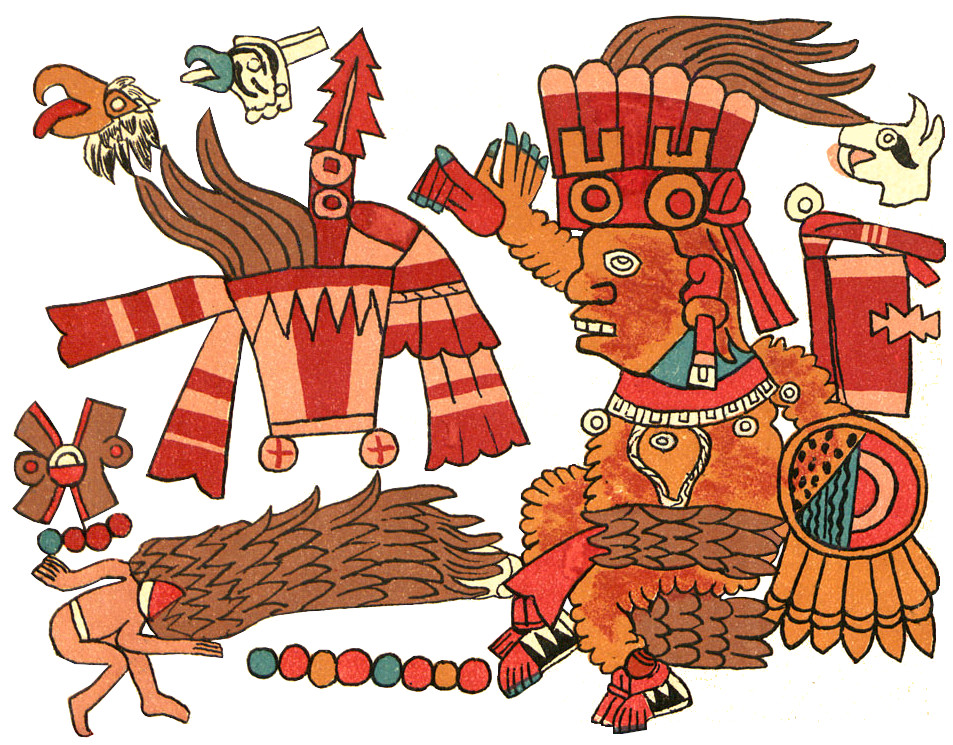
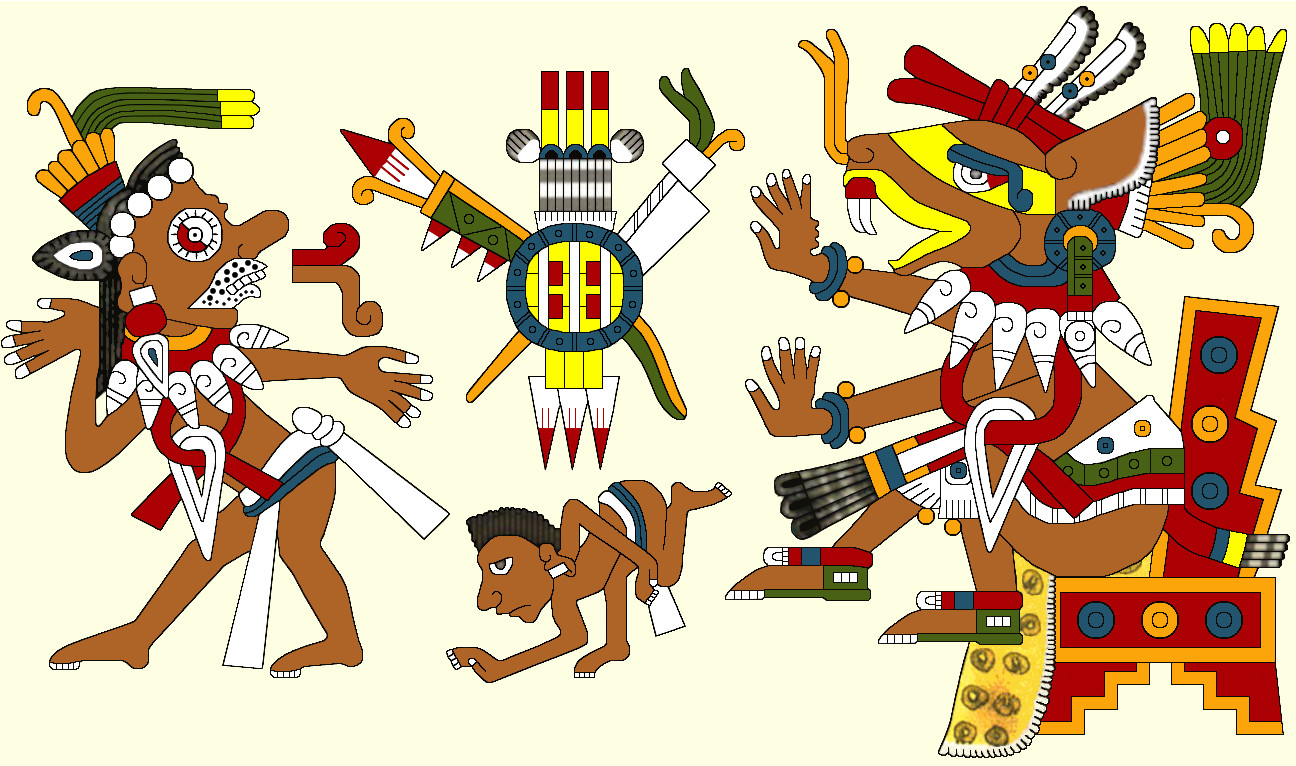
Tonalamatl Aubin patron panel for Dog trecena

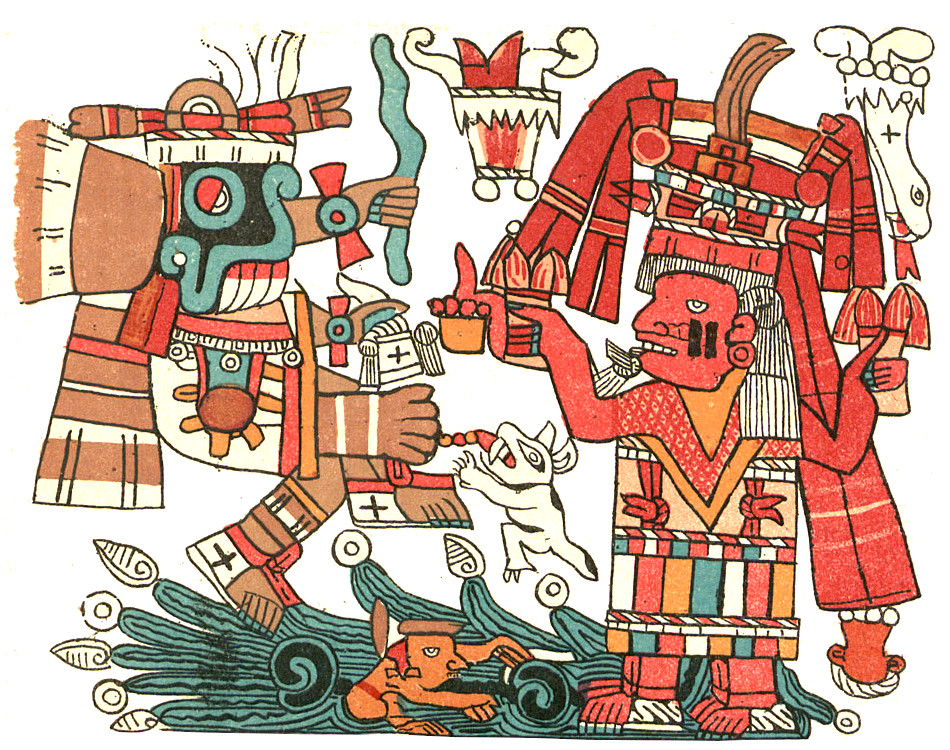
Speaking of iconographic confusion, in this patron panel from Tonalamatl Aubin, the expected Feathered Serpent or Earth Monster is now a hungry (fanged) blob of eagle feathers, so we can’t tell which it’s meant to be. Xipe Totec here wears another flayed skin and more brown eagle feathers and carries a shield with a divided device, different than the one in Yoal but similar.

Note the dog behind his head for the trecena, the eagle in the upper left for his day, and that extraneous blue-beaked bird-head. Apropos extraneous, what’s that “Four Earthquake” day-sign on the left? That’s the name of the current Fifth Sun, and Xipe Totec has no connection to that legend. Even more inexplicable is the number eight at the bottom unattached to any day-sign.

#

Codex Borbonicus patron panel for Dog trecena

Here’s the Codex Borbonicus model for my trippy Xipe Totec. Even without my psychedelic colors, he’s at least as dramatic and much more authentically detailed. One thing I didn’t understand in my version was the smoking mirror on his head (symbolic of his being the Red Tezcatlipoca). I didn’t and still don’t recognize the scepter in this image, and that was another excuse for giving mine the bouquet of greenery.

The odd little symbol on the banner is totally unfamiliar, but it must be rather important being attached to the concentric shield smack in the middle of the composition. A sort of two-legged ankh? Meanwhile, the One Dog day-sign attached to the shield makes sense for the trecena. Again, I’m mystified by the Four Earthquake day-sign attached to his foot and wonder if that Three Eagle day-sign might be his day-name. I haven’t run across any for him before.

Observe the suggestive bucket of blood by his left foot and the inscrutable item with ten dots and the peak of his traditional staff on top. In the upper right corner is a decapitated green parrot-like bird which I assume means birds may have been a premium sacrifice to the deity. (This detail may well explain that bird-head in the Aubin panel above.)

Since it has no leg at all, we probably should accept Xipe Totec’s plumed companion as the Feathered Serpent/Quetzalcoatl, a clue to that identity being the adjacent double-headed serpent seen in Quetzalcoatl’s headdress in the Jaguar trecena. However, this feathered creature’s head, nose, and dentition are distinctly feline. In any case, the mystical creature fits beautifully into the long history of images of the Plumed Serpent.

#
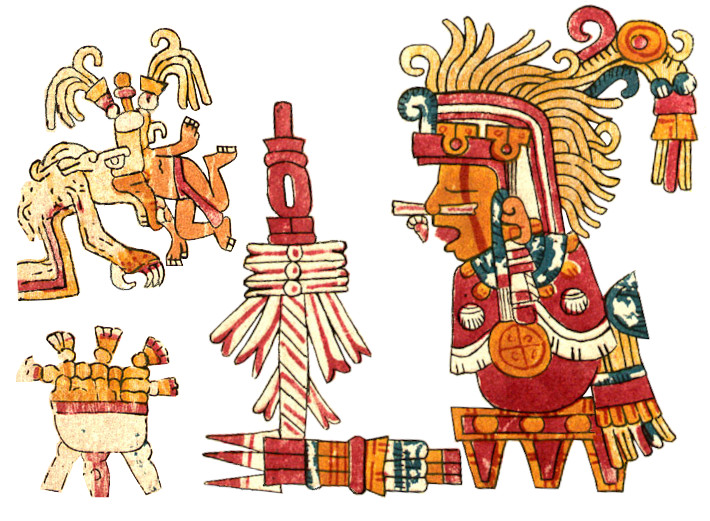
Codex Vaticanus patron panel for Dog trecena

This patron panel from Codex Vaticanus I’ve rectified and restored slightly. Regarding Xipe Totec on the right, one wonders if the Vaticanus artist simply got on an easy “corpse-bundle” kick after Itztlacoliuhqui in the Lizard trecena and similarly bundling up Tlazolteotl in the Earthquake trecena. (The same funerary device will be used later for some reason for Xolotl in the Vulture trecena.) However, here I think it may signify Xipe Totec’s powers of rebirth. To be reborn, I suppose even a deity would have to die. Though he wears no emblematic regalia beyond the red stripe down his face, this god is well identified by his traditional candy-striped staff and standard bundle of arrows. On the left we once again find a one-legged Earth Monster reiterating the ambiguity of this subsidiary patron of the Dog trecena. For the purpose of divination, take your pick.

#

Something about these images of Xipe Totec troubles me. Namely, if he’s supposed to be the deity of springtime, nature, agriculture, and vegetation, there are no iconographic references to any of that. Apart from a suspiciously intimate relationship with the Earth Monster, all I see are military and lordship symbols. Perhaps the underlying message of nature is dramatized by the monster/serpent creature eating the little guy (and rabbit)—showing that philosophically speaking, life lives on life. Or if I might use a stronger, but still appropriate idiom: dog eat dog. So, my invented bouquet of greenery in the deity’s hand turns out to be quite apropos.

As for that ambiguous serpentine creature, I’ve concluded that its one leg is actually an epitome of intentional ideoplastic art. As remarked in the Jaguar trecena, that’s an image meant to be understood in intended detail rather than as optically accurate. Here the viewer’s quick brain automatically, unconsciously creates an invisible second leg immediately behind the one in front, a neat trick that makes drawing things in natural perspective conveniently unnecessary.

###

You can view all the calendar pages I’ve completed up to this point in the Tonalamatl gallery.

On Migrations Across the Americas

Arrival of the Mexica at Tenochtitlan

Recently there have been a bunch of media stories about new twists on the out-of-Africa theories of the spread of early humans across the globe, and I’m surprised that invested anthropological authorities are actually considering alternatives to their sacrosanct interpretations about human history. Even more surprising is their grudging recognition that human populations seem to have left Asia and crossed Beringia into the Americas long before 12,000 BC, that set-in-stone date they gamble their scholarly reputations on.

It seems that writing history is actually a game of creating explanations to be assumed true until proven mistaken. In fact, like all things past or future, history is purely immanent—existing only in the mind, and that immanent universe is truly infinite, everything possible. Historians can guess with impunity about past events, and the burden of disproof lies with those who disagree.

I have no difficulty with human populations leaving Asia whenever and spreading south down the American continents (all the way to Tierra del Fuego!), nor with of dozens of primordial populations coming across oceans to the “New World” from Asia, Africa, the Middle East, and Europe. Scholars vociferously deny or simply ignore most of them. Recently, their denial of well-documented Pre-Columbian Viking voyages has been faltering—and they’ve started romanticizing these murderous marauders as handsome, heroic explorers. But you have only to read “The Farfarers” by Farley Mowat to learn the ugly truth about the rapacious Northmen.

Wherever they came from, it’s clear that roving bands of feral humans spread thickly across the American continents. For the most part, those populations seem to have settled permanently into their new locales like water filling low places. But there’s also been a great deal of sloshing around, overflowing into other catchments, draining in various directions, and even drying up or soaking into the earth, often leaving only their “ruins” and cultural artifacts.

My decades of interest in Panamerican prehistory have led me to learn of (and conjure up) some immanent cases of that inter- and intracontinental slosh of peoples on the move. I will now pull together what I think I know about the migrations and interchanges of peoples in the Americas. We need to discuss this immanently important, rarely mentioned subject. Let me begin.

#

Chapter I: The Pacific Littoral

The spectacularly long Pacific coastline (from Tierra del Fuego north to Alaska) has been a sailing route for millennia but is rarely mentioned by historians except for the travels of later European mariners/explorers. From earliest times, the peoples of Peru, Ecuador, and Colombia were seafarers, sailing the shores for fishing and trade. The route north to Mesoamerica is how the art of metalworking came there from the Andes and how the staple crop maize was taken south from Guatemala to South America.

Story #1: CIRCUMSTANTIAL EVIDENCE

Through geographical detective work, I deduced that boatloads of missionaries, merchants, and/or migrants from Chavín de Huantar in Peru (c. 1,500 BC) brought the sacred ceremonial calendar and other cultural concepts probably to Mesoamerica, possibly to ancient Izapa in Guatemala. From there, the complex is thought to have crossed the Isthmus of Tehuantepec into the Vera Cruz lowlands to the timeless Olmecs.  I’ve already told this quite believable story in back in 2018.

Story #2: RELIABLE TESTIMONY

In the first millennium AD when the Maya civilization was in full Classic swing with warring kingdoms in Yucatan and Guatemala, I claim that refugee Maya peoples fled by boat along the Pacific littoral, settling at spots in western Mexico and farther north on the California and Pacific Northwest coasts. I base my claim on the report of Capt. Meriwether Lewis in “The Journals of Lewis and Clark” (ed. Bernard DeVoto) from March 19, 1805, where he wrote (sic!):

The Killamucks, Clatsops, Chinooks, Cathlahmahs, and Wâc-ki-a-cums resemble each other as well in their persons and dress as in their habits and manners. their complexion is not remarkable, being the usual copper brown of most of the tribes of North America. they are low in statu[r]e, reather diminutive, and illy shapen; poss[ess]ing thick broad flat feet, thick ankles, crooked legs wide mouths thick lips, nose moderately large, fleshey, wide at the extremity with large nostrils, black eyes and black coarse hair. their eyes are sometimes of a dark yellowish brown the puple black. the most remarkable trait in their physiognomy is the peculiar flatness and width of forehead which they artificially obtain by compressing the head between two boards while in a state of infancy and from which it never afterwards perfectly recovers. this is a custom among all the nations we have met with West of the Rocky mountains. I have observed the heads of many infants, after this singular bandage has been dismissed, or about the age of 10 or eleven months, that were not more than two inches thick about the upper edge of the forehead and reather thiner still higher. from the top of the head to the extremity of the nose is one straight line. this is done in order to give a greater width to the forehead, which they much admire. this process seems to be continued longer with their female than their mail children, and neither appear to suffer any pain from the operation. it is from this peculiar form of the head that the nations East of the Rocky mountains, call all the nations on this side, except the Aliohtans or snake Indians, by the generic name of Flatheads.

As others surely have, I’ll note Capt. Lewis has described here in exquisite detail the traditional Maya practice of skull deformation. It seems reasonable to me that this widespread cultural practice in the American West could have come from coastal colonies of refugee Maya. The also widespread practice of nose-piercing (as in the Nez Perce tribe and others) could just as easily have been brought by such “civilized” immigrants to the northern forests and mountains.

Story #3: A WILD GUESS

Toltec pressure and even later Aztec aggression no doubt also drove other peoples of western Mexico north in their boats along the ancient Maya route to the Pacific Northwest. I base this intuitive hunch on a linguistic coincidence (which I usually tend to dismiss).

The city of Seattle was named for the “chief” of a Native American tribe on the Olympic Peninsula. Phonetically, “Seattle” amounts to se-atl, and Ce Atl is the Nahuatl day-name (One Water) of the goddess of water, Chalchiuhtlicue, the Jade Skirt. As a name for a “town” or chief, One Water seems quite appropriate for a Nahua “colony” in that eminently watery area. But again, I’ve already told this and Story #2 back in 2018.

DNA tests should be run on Northwest tribes to look for markers of Mesoamerican populations. It would also make sense to compare the languages of those tribes with those of Mesoamerican peoples. (There’s a distinctly Nahuatl-ish sound to the names of the Tlingit and Kwakiutl tribes.)

Story #4: AN EPIC ESCAPE

Let’s back up some centuries and return to the Andes. In book “Advanced Civilizations of Prehistoric America,” Frank Joseph, an independent researcher cold-shouldered by academics, discusses the Huari of the Lake Titicaca area (often called the Wari) and the neighboring Llacuaz people, observing that their principle currency was the spiny oyster Spondylus princeps shell.

That seashell was sometimes found along their coast, but their main source was from the distant north in the Sea of Cortez. In the latter centuries of the first millennium CE, Joseph proposes that these peoples sailed those thousands of miles to collect their “money” and meanwhile “explored” up the Colorado and Green Rivers across Arizona. The Llacuaz established colonies in the Green River basin, and the Huari pushed on into northwestern New Mexico where, by the early ninth century, they started building vast structures at Chaco Canyon.

Joseph suggests that when the Chimu (possibly Chinese!) invaded Peru c. 1,000 CE, establishing a civilization centered at Chan Chan, they drove the Huari and Llacuaz out of their Lake Titicaca home area. Many thousands of refugees boarded their reed boats and balsa rafts and fled north to their distant colonies in North America. The Llacuaz, superb hydrological engineers, became the Hohokam civilization—whose descendants are the Pima and Papago tribes.

The refugee Huari people must have exploded the population at Chaco Canyon, and these “Anasazi” spread out across the Four Corners area, an ancestral culture for the present-day Puebloan peoples. Joseph points out that Chaco architecture (like Pueblo Bonito) replicates their traditional styles in Peru—the D-shaped, multi-storied “apartment complexes” and particularly the round, sunken “kivas” which are now culturally central to their Puebloan descendants.

This is the only “origin story” I’ve found for the ancient civilizations of the American Southwest. Though it involves migration across mind-boggling distances (think of the vast spread of the Indo-Europeans out of Central Asia across Europe and India!), it makes ultimate sense and comes with some dramatic evidence. Until someone offers a better story, I’ll go with this one.

#

Chapter II: The Gulf of Mexico

The Gulf of Mexico and Caribbean Sea, enclosed by the archipelago of the Greater and Lesser Antilles, amounted to a prehistoric American “mediterranean” arena of cultures. Sea-faring peoples like the Maya of Mesoamerica and the Arawaks and Caribes of the South and Central American coasts roved around the basin, not unlike Old World traffic on its Mediterranean Sea.

Story #5: THE SANCTUARY

As well as along the Pacific littoral, Maya refugees from civil violence (like the Itza and other Maya peoples) also fled into the American Southeast. In Florida, Georgia, Tennessee, and along the Gulf coast, they settled among resident “natives.” As early as 200 CE, the immigrants brought their mound/pyramid and artistic traditions, contributing to Mississippian culture. See my “Remember Native America!” and my ethnographic essay. I should note that the skull-deformation and nose-piercing mentioned above in Story #2 also occurred in many parts of the world, including among early immigrants into the American Southeast.

Another independent researcher (of Creek heritage), Richard Thornton, writes a blog called “The Americas Revealed,” which I’ve followed for several years. Though vociferously opposed and denied by academic authorities, he discusses the Maya, Arawaks, and Caribes also penetrating in early centuries into the Southeast, and as an accomplished city planner and archaeologist, he has modelled their traditional towns and architecture at archaeological sites in the area.

As well as the early Maya, Thornton says that later Mesoamericans such as the Totonacs and Huastecs also fled the depredations of Toltec and Aztec imperialists and trekked around the Gulf into the Southeast, adding their cultures into the melting pot that would produce the Native American stew of tribes like the Creek, Choctaw, Chickasaw, Caddo, and others. Some retained legends of their migrations from specific locales in Mesoamerica.

In addition, citing serious linguistic evidence, Thornton says that a South American people called the Panoans migrated from Ecuador and Peru into the Southeast and brought their own seasoning into the melting pot. At first there seemed not to have been much friction or violence between the many disparate cultures, each group continuing their ethnic lifeways in their own immigrant communities. Densely scattered across the landscape, they were like the Maya’s decentralized urban pattern of town-states, some bonafide cities with pyramid/temple and plaza complexes.

#

Chapter III: Cross-Country Migrations

Thus far we’ve seen sea-rovers on the Pacific littoral and around the American Mediterranean Gulf, and now let’s talk about the land-roving folk within the continents. I know virtually nothing about peoples moving around in South America but suspect a considerable flow between the Amazonian and Pacific slopes of the Andes. However, I’ve just read somewhere that in distant millennia the first peoples of Mesoamerica migrated there from South America. I think they’re talking around 6,000 BP, so that sounds perfectly feasible. Why not?

Story #6: LATECOMERS

Meanwhile, I do know bits and pieces about the land-rovers of North America (besides all that about primordial folk from Asia spreading south through the continents). One bit is a widely discussed issue in American archaeology: Very late, around 13-1400 AD, a small group of Athabaskans (originally of course from Siberia) left their subarctic home in far northwest North America and migrated into the American Southwest, specifically into the Four Corners area, to become today’s Navajo and Apache tribes.

Strategically, these Athabaskans arrived soon after the Chaco civilization “disappeared,” and they were bitter enemies of the remnant populations of Anasazi, the Pueblos along the Rio Grande, and the Hopi in Arizona. In view of this historical migration, I find it curious that Navajo mythology has that people emerging from under the earth somewhere, maybe near Shiprock (a volcanic core mountain) in northwestern New Mexico. However, many peoples the world over claim to have come into this world from the underworld.

Story #7: THE STEW

Meanwhile, in the same centuries, as the Mississippian civilization in the American Southeast (and the Caribe kingdoms in the Antilles) grew more warlike with rival city-states (much like the earlier Maya situation perhaps), various peoples moved around to elude their oppressors. Many migrated across the Mississippi River onto the plains. Thornton tells of the People of the Eagle (Kansa) from central Georgia who moved into what would become Kansas.

By the early 1600s, under pressures of aggressive neighbors and newcoming land-hungry European invaders, some Mississippian folks evacuated the Carolina coast and moved way out onto the plains of the Dakotas. In that strange new environment, they mastered the Europeans’ horse culture and became the Sioux, the quintessential Plains Indian.

Over the centuries, many other ethnic communities in the vast Southeastern woodlands certainly must have upped and gone somewhere else for whatever reason, stirring up the stew of peoples. For instance, in the early 18th century various Southeastern peoples pressed south into La Florida (by then thoroughly depopulated by disease and Spanish occupation) to become the Seminoles.

In the 17th and 18th centuries, probably inspired by contacts with European concepts, many polities in the central Southeast coalesced into the Creek Confederacy, which for a long time constituted an autonomous “country” west of the European colonies along the Atlantic coast. After battling these “Five Civilized Tribes” for several years in the Creek (and Seminole) Wars, General Andrew Jackson became President of the US of A and in one of the hugest land-grabs in history, exiled the Southeastern peoples to the new “Indian Territory,” part of the recent Louisiana Purchase. Between 1830 and 1850, some 60,000 native people took the Trail of Tears hundreds of miles west to Oklahoma, a forced migration on which thousands died.

During the 18th century, before the coastal European colonies had fully occupied Appalachia, a large tribe from the Canadian Maritimes spread south down the mountain chain and by late in the century had encountered the confederated tribes, probably with considerable friction. These were the Cherokee, who now claim to have lived in the Southeast “for thousands of years” and would usurp the history of the diverse “native” tribes. Indeed, some Cherokee joined them on the Trail of Tears. Those remaining in the western Carolinas and elsewhere soon were accepted by the US of A as a “civilized” (pacified) tribe, and in turn they accepted the new country’s dominion.

Story #8: RITUAL JOURNEYS

The culture and cosmology of the Hopi people, an affiliation of several clans now living in northeastern Arizona, is based on migrations. A legend has them migrating from somewhere in the far south, either South America, Central America, or Mexico. In the first case, they may have left Peru along with the Huari and Llacuaz refugees (Story #4), having settled on the desert mesas at roughly the same time in the late first millennium CE when the others were colonizing southern Arizona and Chaco Canyon. Significantly, Hopi architecture with its multi-storied communal dwellings and circular kivas closely reflects Chaco traditions.

Coincidentally, their migration seems also to have involved a long ocean voyage, but some folks theorize that the Hopi sailed all the way from Asia or elsewhere. For linguistic reasons, I incline to the Peruvian story. We don’t know what language was spoken by the immigrant Chaco people, but I bet it was one of the Uto-Aztecan family—since the linguistically related Utes and Shoshoni tribes were likely early offshoots of the Chaco civilization, and the Hopi language is also Uto-Aztecan. (I’m not sure how the Puebloan languages would fit into this matrix.)

On another hand, in the same way as the Navajo and many other peoples, the Hopi “mythology” has their clans emerging from a hole in the earth (cave?) called the “sipapu” located somewhere near those same desert mesas. Then their principle deity Masau-u then sent the many clans on individual ritual migrations to the four ends of the earth and back in order to find their promised land. Surprisingly, after hiking from seas to shining seas, the clans eventually converged again on those same desolate mesas, founding their town of Oraibi around 1100 CE.

Each migrating to the four ends of the earth, the several Hopi clans must have encountered many other peoples, like the Toltecs in Mexico and the Mississippian cities in the Southeast. The possible histories of cultural contacts are legion. Meanwhile, those migrating clans often left petroglyphic evidence of their passing through many areas with their identifying symbols.

Story #9: LEGENDARY MIGRATION

When I ran across “The History of the Indies of New Spain” by Fr. Diego Durán (1537-1588) around 50 years ago, I was enchanted by his detailed account of the legendary migration of the Aztecs into Anahuac (the Valley of Mexico).

The migration legend is intertwined with the mythology of the Mexica’s main deity, the war god Huitzilopochtli, Hummingbird of the South. Leaving their previous home around 1200 CE, he led the Mexica migration for well over a century to finally find their promised land on a swampy island in Lake Texcoco in 1325 CE. Within a century, they’d built a huge city on that island called Tenochtitlan, Place of the Cactus, and had begun assembling an empire based on trade and military might—which in 1519 fell victim to Cortez and his Spanish conquistadores.

The legend describes the impossibly violent birth of Huitzilopochtli at a place where the Mexica were living called Chicomoztoc (Seven Caves) and his autocratic and arbitrary leadership of the nomadic migrants, who settled down in various places for lengthy periods to sow and harvest crops. On their travels, they pillaged the “Red City” (possibly the site in Chihuahua known as Casas Grandes or Paquimé), and they vandalized many resident populations, gaining a reputation as utterly uncivilized barbarians. For an egregiously atrocious offense against the ruler of a city on the lake, they were driven out onto the island where they found the prophesied eagle on a cactus eating a snake. That iconic image is now an official symbol of the Mexican state.

It’s intriguing to know that during their migration and in Anahuac, the Mexica spoke essentially the same language as resident populations, a dialect of Nahuatl—because those peoples had earlier also migrated south from Chicomoztoc. Duran tells us that by 820 CE the first six “nations” (tribes or clans) started sequentially leaving the Seven Caves: the Xochimilca, Chalca, Tecpanecs, Colhua, Tlalhuica, and Tlaxcalans. Settled down again after long wanderings, the several clans established large cities around Lake Texcoco and in various other central areas of Mexico. The Mexica were just the long last tribe to leave the Caves.

This shared history of migration seems to say that the language of the Chaco civilization must have in fact been (as suggested in Story #8) Uto-Aztecan, another dialect of Nahuatl, and it raises again the question of the Huari (Peruvian) language. That question gets complicated by the fact that the Toltec civilization (900-1160 CE) also spoke Nahuatl. An “empire” centered at Tula just north of Lake Texcoco and at Chichen Itza in the Yucatan, they could have also been migrants from the far north—or just as easily, like Chaco, an early invasion or colonization of Huari from Peru, refugees or otherwise. The time frames suggest maybe the earlier Seven Caves migrants had a hand in the destruction of the Toltecs. Remember, history is but an immanent story.

This is not to imply that Chicomoztoc might have been Chaco Canyon. At Chaco, there may have been seven great-house pueblos, but they were nothing like caves. My radical theory is that Chicomoztoc was the several cliff-dwelling towns of Mesa Verde, a major outlier of the Chaco civilization with a real road connecting the centers. That makes vastly more sense to me than the mound-site in Wisconsin ridiculously called Aztalan or some vague spot lost in the deserts of Sonora/Chichimeca. Until someone can convince me otherwise, I’ll go with Mesa Verde.

A deeper legend has the Mexica (and other tribes) coming originally from a place called Aztlan, a “place of whiteness” or “place of herons.” Some speculate it’s somewhere in northwestern Mexico or the American Southwest. In that legend, the peoples lived at a large lake and were driven out by enemies, forced to make a long sea-voyage and then wander lost in deserts—before finally getting to Chicomoztoc. This “place of herons” scenario closely parallels the Huari fleeing before the Chimu from Lake Titicaca to Chaco, and if Chicomoztoc was in fact Mesa Verde, all the puzzle pieces fall neatly into place. Ergo, Aztlan looks like it was Lake Titicaca, and the Huari probably spoke a version of Nahuatl. That story works just fine for me.

#

Epilogue

In Story #7: The Stew, I unavoidably remarked on some migrations spurred by cultural pressure of post-Columbian European invaders, like that of the Sioux and the tragic Trail of Tears in the 19th century, but the countless forced migrations of native peoples in recent centuries (like the Navajo to Bosque Redondo) are far more than I can bear to think about.

When Cristóbal Colón arrived in 1492, he and his family immediately started colón-izing the indigenes of the Greater Antilles (Cuba, Puerto Rico, Jamaica, and Hispaniola) by enslaving, slaughtering, and driving them to escape into the interiors of North and South America. As soon as they were decimated or totally wiped out, black slaves were imported from Africa to work the Spanish mines and sugar plantations on the islands. This was just the first small step in the European displacement and destruction of native populations across the American hemisphere.

###

My First Attempt at Science Fiction

I’ve recently been fascinated by global news and couldn’t resist putting the alarming phenomena into perspective in the brief sketch below, my first attempt at science fiction. I hurry to post it—before it can be disproven by subsequent events—or even worse, proven prophetic.

###

Phantom Galaxy

BAD TO WORSE

            News stories of these recent weeks had been horrifying: about the earth’s core stopping and possibly reversing its rotation, about inexplicable solar eruptions, and about a crowd of asteroids threatening our planet. Like a good disaster-buff, I kept those stories on my news feed. My attention was rewarded with remarkable scientific discoveries.

            By late February, astronomers were reporting solar flares creating a ginormous vortex off the surface of the sun. Geologists were meanwhile wondering what the effects would be of a stationary planetary core, which they calculated would happen in another month. If it started rotating in the opposite direction, I figured it would cause a reversal of Earth’s poles, probably with significant rearrangement of land masses and, I suspected, a change in the length of day. In fact, geologists were now tracking changes in the Earth’s surface rotation rate and seasonal tilt.

            On the solstice in March, scientists declared that the core had indeed stopped rotating in the usual direction, and a few days later they announced that it was starting to move in reverse, the Earth now in internal retrograde. Earthquakes had already started in mid-February, first the huge one in Turkey and Syria, and soon hundreds of them around the globe, like the Earth was shuddering. At the same time, the poles switched in early April, immediately throwing the world’s weather into drastic confusion. Along with many quake-induced tsunamis, the melting, shattering, and scattering of the polar icesheets brought apocalyptic destruction to coastal communities. There was no time or means to cope with or calculate human casualties.

            While we long-suffering humans tried to cope with the ubiquitous chaos of earthquakes which were growing alarmingly in magnitude, overhead our star kept flaring up around its surface, like flames waving into space. I expected that the flares would soon show a pattern, which AI detected on my birthday near the end of April—roughly a circle about three times the diameter of the Earth. In early May, that circle began to bulge on the sun’s surface, a slow swelling over the course of a few months, while I watched closely the video reportage of the condition of our celestial body.

            Those next few months were more than busy enough with basically futile global disaster-recovery efforts, and most survivors had no time to worry about our Sun acting up. While helping every day with my disaster-relief cohort—to the extent of my octogenarian ability—I checked my news feed often for solar system updates, feeling like Akhenaten in communion with the Aten. Our Sun was now found to be increasing in brightness, noticeably hotter on exposed skin—when one wasn’t drenched in arbitrary storms. There was probably no connection, but the many Unidentified Aerial Phenomena that began being noticed (and shot down) already in February became even more numerous over the next months. All we needed now was to piss off the aliens and have them retaliate. And more meteors kept falling to earth, many ejected with the Sun’s flares, blowing out huge craters and killing millions.

            My news feed died with the Internet in late June, a casualty of an electron burst from the sun which fried telecommunications everywhere, including most cell-phone towers. No TV, but there was still radio, if anyone had one. Fortunately, I did and through the near-hysterical remnants of NPR’s Morning Edition learned of increasing tectonic activity opening deep fissures across the Middle East and along Africa’s rift valley. That geological pressure in Indonesia and the Andes was causing more earthquakes and volcanoes, and meteors kept impacting in heavily populated areas. Earth was becoming an inimical habitat for humanity!

            Shortly after I lost electricity and water in my old adobe house, a meteor strike nearby brought it crumbling down. I’d fortunately run outside and watched in safety while it collapsed. Salvaging what little I could, I took shelter in a still-standing corner of a nearby school, sharing the space with several traumatized young students. However, we had nothing else to share, and each day we foraged in the ruins for anything edible. Potable water was a critical need, rarely met except for catching rainwater, that often fouled. Totally cut off from any newscasts or social communications, I had no idea what was going on outside of our miserable refuge, either on the Earth or up in the Heavens. However, the glaring, inflamed Sun told me that momentous things were transpiring up there.

            In my foraging one day, I found a half-collapsed, metal-framed factory where about a dozen workers were trying to survive. They had a working radio (powered by a small generator), and I was advised by frantic NPR correspondents that the bulge on the sun’s surface had erupted and was ejecting a planet-sized ball of flaming gaseous matter into space—like Athena springing from the brow of Zeus. Scientists projected its trajectory away from Earth but toward Venus, thought its monstrous speed and paths of planetary rotation could easily shoot it close by Jupiter.

            In spite of this supposedly good news, the morale of us few local survivors bottomed out. I explained to the starving workers that even without a direct collision, the Earth was going to get jerked around dramatically by this new mass at play in the solar system. Orbits of all the planets would probably change, as well as distances from the Sun as the system tries to find a new equilibrium. And even if the new mass doesn’t collide with anything, it would probably enter an extended orbit around the Sun like a comet, returning regularly to wreak havoc on the planets and then only at some time in a future epoch settle into an obedient planetary orbit.

            With this less than optimistic expectation, lethally inclement weather, starvation, thirst, and advanced age, I will lay my helpless head down in the rubble, leaving the savage future to others of my species who might survive this end of the Earth as we’ve known it.

###

Aztec Calendar – Rain Trecena

The seventh trecena (13-day “week”) of the Aztec Tonalpohualli (ceremonial count of days) is called Rain for its first numbered day, which is also the 19th day of the veintena (20-day “month”). In the Nahuatl language Rain is Quiahuitl, and it’s known as Kawak in Yucatec Maya and Kawoq in Quiché Maya.

For the Aztecs, the day Rain signified quiet plenty and peace and was connected anatomically with the left eye. The patron of the day is Chantico, the Lady of the House, goddess of fire in the family hearth and fire of the spirit, as well as fire in the earth (volcanoes). Patron of cooking, eating, domesticity, and weaving, she represents the feminine side of life, fertility, and the waters of birth. She is also the goddess of precious things, the lady wealth and jewels.

PATRON DEITY RULING THE TRECENA

Without exception, the principal patron of the Rain trecena is Tlaloc (God of Storms), bringer of rain, lightning, thunder, and general weather and responsible for both floods and droughts. (See my Icon #20.) He was an important deity of unknown name in ancient Teotihuacan and revered by the Maya as Chac. A beneficent god of fertility, vegetation, and sustenance, he’s associated with springs and caves, and his worship involved child sacrifice. Tlaloc ruled over the Third Sun (Four Rain—which he destroyed in a rain of volcanic fire), and the joyful Eighth Heaven of Tlalocan. He’s 9th lord of the night and 8th lord of the day with the Eagle as his totem bird.

In some codices other deities appear as apparent secondary patrons of the trecena, possibly regional variants, but I’ll discuss them in their specific contexts below.

AUGURIES OF RAIN TRECENA

By Marguerite Paquin, author of “Manual for the Soul: A Guide to the Energies of Life: How Sacred Mesoamerican Calendrics Reveal Patterns of Destiny”
https://whitepuppress.ca/manual-for-the-soul/

Generally aligned with energies that bring abundance, this trecena was traditionally associated with fertility, particularly as it related to agriculture. Since Tlaloc and Nahui Ehecatl (4 Wind) serve as patrons, with their emphasis on rain and wind, there is the suggestion (with evidence) that highly volatile, changeable, and often intense, weather-related events can occur during this period (such as Hurricane Katrina). As much as these energies were seen as beneficent catalysts for agriculture, they can often trigger great turbulence, and the events that they foment can also trigger great compassion. Ancient records indicate that individuals born under this influence traditionally could have a penchant for “sorcery.”

Further to how these energies connect with world events, see the Maya Count of Days Horoscope blog at whitepuppress.ca/horoscope/. Look for the Kawak (Storm) trecena.

THE 13 NUMBERED DAYS IN THE RAIN TRECENA

The Aztec Tonalpohualli, like the ancestral Maya calendar, is counted through the sequence of 20 named days of the agricultural “month” (veintena), of which there are 18 in the solar year. Starting with the 19th day of the current veintena, Rain, this trecena proceeds through 2 Flower, 3 Crocodile, 4 Wind, 5 House, 6 Lizard, 7 Snake, 8 Death, 9 Deer, 10 Rabbit, 11 Water, 12 Dog, and 13 Monkey.

There are several important days in the Rain trecena:
One Rain (in Nahuatl Ce Quiahuitl), according to some scholars, is “the day on which sacrifices were made to increase the king’s strength.” Ce Quiahuitl is also the day-name of one of the Cihuateteo goddesses who accordingly should represent peace and plenty.

Two Flower (in Nahuatl Ome Xochitl) and Three Crocodile (in Nahuatl Yeyi Cipactli) are the day-names of two goddesses who celebrate the intoxicating drink pulque.

Four Wind (in Nahuatl Nahui Ehecatl) is the day-name of the Second Sun ruled by Ehecatl, which was destroyed by wind (hurricane), its people turned into monkeys. See the discussion of Tonalamatl Yoal below for an anomalous deity of this name.

Seven Snake (in Nahuatl Chicome Coatl) is the day-name of the goddess of maize (and food in general). See the discussion of the Borbonicus tonalamatl below for more on this goddess.

THE TONALAMATL (BOOK OF DAYS)

Several of the surviving so-called Aztec codices (some originating from other cultures like the Mixtec) have Tonalamatl sections laying out the trecenas of the Tonalpohualli on separate pages. In Codex Borbonicus and Tonalamatl Aubin, the first two pages are missing; Codex Telleriano-Remensis and Codex Rios are each lacking various pages (fortunately not the same ones); and in Codex Borgia and Codex Vaticanus all 20 pages are extant. (The Tonalpohualli is also presented in a spread-sheet fashion in Codex Borgia, Codex Vaticanus, and Codex Cospi, but that format apparently serves other purposes.)

TONALAMATL BALTHAZAR

As described in my earlier blog The Aztec Calendar – My Obsession, some thirty years ago—on the basis of very limited ethnographic information and iconographic models —I presumed to create my own version of a Tonalamatl, publishing it in 1993 as Celebrate Native America!

For my old tonalamatl, I used the complicated glyphs from the lobes of Four Earthquake on the Stone of the Suns as the day-signs for Rain and Wind. Meanwhile, knowing only that Tlaloc was supposed to have a black face, curious curving mask, goggle eyes, and fangs, I concocted an image of the Storm god based on one in the familiar Codex Nuttall that looked like an eagle, a surreal but unwittingly appropriate motif, with decorative raindrops. Though quite inauthentic, this image has been viewed frequently on my website, perhaps because it’s far more attractive than his authentic, fairly gruesome representations in the ancient codices.

Aztec Calendar – Rain trecena – Tonalamatl Balthazar

#

TONALAMATL BORGIA (re-created by Richard Balthazar from Codex Borgia)

Aztec Calendar – Rain Trecena – Tonalamatl Borgia

Talk about gruesome, check out this Rain trecena page from the Codex Borgia with its imposing figure of Tlaloc with black face, goggle eyes, and bodacious fangs. For some reason he’s missing the symbolic curving mask, but there’s no mistaking his identity. A question is begged by the warding gesture of his right hand that overlaps the incense bag and ritual objects—as though rejecting them. Another is why the stream of water runs toward the god (as opposed to that flowing away from Chalchiuhtlicue in the Reed trecena).

The little human figures can scarcely be construed as additional patrons of this trecena, and their significance is mysterious. Other questions also abound. 1) What are the two footprints on the ‘riverbank?’ 2) What is the strange ‘haystack’ encasing a starry night sky? (In the Deer trecena we’ve seen Tepeyollotl seated on one just like it.) 3) What is that odd packet of red and blue ‘boards?’ And 4) why does the white-faced double-headed serpent bear watery waves on its back? Your guesses are probably at least as good as mine.

#

TONALAMATL YOAL (compiled and re-created by Richard Balthazar on the basis of
Codex Telleriano-Remensis and Codex Rios)

Aztec Calendar – Rain trecena – Tonalamatl Yoal

The much gentler Tlaloc in the Tonalamatl Yoal (on the right) is perhaps the most widely known image of the god; it’s based solely on the Rios version because that page in Telleriano-Remensis is missing. His primacy as patron of the trecena is possibly indicated by being on the right side because, as posited by David Stuart in his 2021 book “King and Cosmos,” the right half of symmetry was more important than the left. This bears out in many Borgia trecenas, but not all, and only occasionally in other tonalamatls, so it can hardly be considered a rule of thumb.

On the left and supposedly secondary side of the panel is a puzzling image of an anomalous deity which the Spanish and Italian annotations in the two codices identify as “Nahui Ehecatl,” Four Wind, who to my knowledge doesn’t appear in any other context. Perhaps it’s a reflection of the special Second Sun day-name in the trecena, but its iconographic paraphernalia suggests various deities. 1) The snake it grasps could be Tlaloc’s lightning serpent, but for some reason it ambiguously has a blooming tail. 2) The mask and oversized goggles suggest that this could be Quiahuitl, god of rain, but it lacks that god’s standard fangs. (See the One Rain day-sign above.) And 3) the top-heavy headdress is just like that of Quetzalcoatl/Ehecatl in the Jaguar trecena (as well as the basket on its back). The images in both codices are so nearly identical that they offer no clues. I have to wonder if the knobbed circle in the headband (a symbol of the planet Venus) might also include Tlahuizcalpantecuhtli, Lord of the House of the Dawn, in this amalgam. In any case, this Four Wind deity as secondary patron of the trecena is of little use as an augury and would seem simply to be a religious fantasy/hallucination.

#

OTHER TONALAMATLS

Tonalamatl Aubin patron panel for Rain trecena

The patrons of the Rain trecena in Tonalamatl Aubin are also unorthodox. While the primary Tlaloc is shown in more or less standard detail, he’s on the left (supposedly secondary) side and slightly smaller than the other figure. Somewhere I’ve seen the larger deity on the right identified as Xilonen, goddess of flowering maize, but I don’t believe that for a moment. The two black stripes on her cheek are specific emblems of Chalchiuhtlicue, as is the water streaming from her skirt. The image is strongly reminiscent of that in the panel for the Reed trecena. In addition, the goddess isn’t holding ears of maize but, for some psychedelic reason, mushrooms. Perhaps the Aubin artist had a special reverence for Chalchiuhtlicue and included her in the panel because she was the spouse of Tlaloc, and the streaming water (seen in the Borgia panel) made more sense issuing from her eponymous skirt. Artistic license?

#

Codex Borbonicus patron panel for Rain trecena

This panel in Codex Borbonicus is nicely laid out with highlights of the special blue and a prominent, ornate figure of Tlaloc (again on the left). Here the water streams away from him, endangering the figure of an apparent nobleman instead of the common human in the Borgia panel. On the upper right is a slightly smaller secondary patron deity who could easily be the god of rain, Quiahuitl, judging by the fanged mask and snake in his grasp with its tail of rain-drop strips. Why they’re both speaking/singing must remain a mystery. Among the well-organized extraneous items, in the lower left is the small (blurry) image of Chicomecoatl, the principal goddess of maize, indicating that she’s perhaps a tertiary patron, but her image is more likely just a celebration of her day-sign occurring in the trecena.

#

Codex Vaticanus patron panel for Rain trecena

The Codex Vaticanus panel is an unsurprising mash-up of familiar elements. Its most notable feature is the prominently central ‘little guy’ perched on Borgia’s ‘haystack,’ which has become something of a muddy-water swirl—and his holding a bunch of magic mushrooms. Feel free to make what you will of these odd details for divination.

#

This review of the Rain trecena impresses me only with the fact that its patron is indisputably the Storm god Tlaloc. Apart from the evident connection to weather and water, Aztec dogma about this time period seems rather diffuse, confused, and fantastical—maybe from doing so many entheogenic shrooms?

#

UPCOMING ATTRACTION

The calendar’s eighth trecena will be that of Grass, the principal patron of which is the ultimate party girl Mayauel, goddess of pulque. Stay tuned.

#

Gay Pride 2022 – Back to Fiction

This June 2022 being Gay Pride Month, I’m inspired to think about myself, to coin a new, easily deciphered adjective, as an “elgibaitique” writer. (And an antique one at that.) Apart from a few legitimately nonfiction books, my writing has been in a decidedly gay vein, an old queen reminiscing about his scandalous youth before we gays became an accepted part of society, if we have indeed done so yet.

Now that I’ve memorialized the dramatic first half of my life, I’m not inclined to belabor the mundane second half, no matter its fascinating mature experiences. Instead, I’ve been feeling the urge to write fiction and have been chewing on some grandiose historical ideas that I may not be able to accomplish. Nevertheless, I’ll probably give them a try someday.

To stretch my imaginative, creative muscles, I’ve taken a shot at a short story—my first short fiction since “Traveling Men” over 30 years ago. Obeying the old maxim to “write what you know about,” I set it amongst real details of my ageing queen’s current monastic life and invented events that could easily but most certainly won’t happen. That’s a wide-open field for taletelling. This story called “Whatever Works” springs from one of my few remaining social activities, ecstatic dance.

Aztec God Five Flower Dancing Ecstatically (and Singing)

For many decades, gay bars were the best and often only venue for socializing and cutting rugs. Now that we’ve supposedly been absorbed into broader society, those gay institutions don’t exist anymore. Like everyone else, gay folks must rely on distanced electronic media for socializing. Now my only outlet for the ecstasy of dance is in world music and modern rhythms, shoeless, wordless, unchoreographed, and uninhibited. The crowds are wild mixes of ages, genders, inclinations, attitudes, and dance styles, paying no attention to the idiosyncratic moves of others. I wish I’d discovered ecstatic dance sixty years ago, but in fact, that’s what I was doing as a solitary teenager—dancing all by myself in our living room to American Bandstand on the TV.

Remember my motto:

THERE’S DANCE IN THE OLD DAME YET!

###

Gay Pride 2022 – Xochipilli, Flower Prince

This month of June is Gay Pride 2022, and it’s mete and just that we parade and party. It would be great to have a patron “saint” to celebrate (“saint” being the title the dominant creed uses to replace the earlier gods of paganism). I want to glorify a patron god of gays, not a vengeful and homophobic deity whose devotees revile and condemn us.

There once was indeed such a god of gays in the distant past, beautiful boy named Antinous, who was deified by the Roman Emperor Hadrian. By sacrificing himself to the River Nile to bring his imperial lover good fortune, the divine ephebe became a god of beauty and love.

Head of Antinous from Hadrian’s Villa

Temples, statues, and even an entire city in Egypt were raised for beneficent Antinous, and as an honest-to-god deity, he was for a good while a strong candidate for the title of humanity’s savior—much more appropriate than the heavily marketed Messiah from Judea, who was merely (and messily) executed for rabble-rousing. The cult of Antinous was soon eradicated by righteous believers in less tolerant traditions, and I still mourn the loss.

But nowadays, as ever, it takes a lot more than an imperial decree to become a god. Anyway, beautiful Antinous probably qualifies more as a divine hero than a deity. We can always use more of them. Personally, I’m not into sacrifice and salvation (for and from what?) and prefer to revere a powerful deity with a positive attitude about being gay. It just so happens that in spite of their gruesome fixation on sacrifice, the ancient Aztecs had just such a one, a handsome divinity called the Flower Prince, Xochipilli.

This divine Prince is specifically the patron of homosexuals and an important god of fertility (agricultural produce and gardens). He’s also the god of art, dance, laughter, happiness, beauty and peace, flowers, ecstasy, sleep, and dreams/hallucinations, as well as of the sacred ball-game tlachtli. As patron of writing, painting, and song, he’s known as Chicomexochitl (Seven Flower), and as god of music, games, feasting, and frivolity, he’s called Macuilxochitl (Five Flower). That’s a rather impressive portfolio if you ask me, well worth glorifying.

Long ago before I’d ever seen any picture of Xochipilli, I drew one based on that portfolio and images of males from the Codex Nuttall—for my Aztec calendar as patron of the 20th trecena, Rabbit. (See my 1993 book Celebrate Native America!) As an arrogant humanistic artist, I was offended by the patron of that trecena, Tecpatl (flint—the sacrificial knife) and installed the more appetizing Flower Prince in that ceremonial role in an artistic coup d’état.

My early drawing is startling for the figure’s beard, which I saw in Codex Nuttall images of the historical ruler Eight Deer, and which was a not-infrequent trait of Nahuatl males. Besides loading my figure down with stylized flowers, I added a curlicue song-symbol, the cuciatl. Even that long ago, I recognized in Xochipilli my favorite Aztec deity for a patron and adopted his image for my website banner, little realizing how in-authentic my colorful iconography is.

Now 30 years later, in the codices I’ve found several authentic images of Xochipilli, which don’t look much at all like my invention. They had no ‘literate’ language, so the codices didn’t label the deities, though Spanish annotators did—sometimes with mistakes. It happens.

The image from Codex Laud can be assumed to be of Xochipilli, judging by all the flowers and the seven dots, the Prince being the patron of the number seven and his day-name Seven Flower. In the same way, also lacking identifying regalia or insignias, the Codex Fejervary-Mayer image must be the Prince, judging from the seven flowers adorning his temple. (The round fan he holds, or whatever it is, may be intended as indicative.)

The image from Codex Vaticanus (with only three flowers) I’m taking to be Xochipilli as well, given its similarity to the former—and the fact that both enthroned figures occur in pairs with an enthroned Huehuecoyotl (Old Coyote), who is one of the Prince’s lovers. The Codex Borgia image isn’t explicitly the Prince, unless one notes the flower emblem floating by his head; but this scene occurs in a sequence of calendar days with their patron deities, and he’s also patron of the day Monkey (Ozomatli).

The much different image from Codex Magliabechiano is one of two, both with the red-parrot headdress, and I’ve relied on that motif for my recent portrait of the Flower Prince:

Xochipilli – The Flower Prince

Those familiar with my YE GODS! coloring book will observe that I’ve extracted the central portion of my Icon #18 with the tlachtli ballcourt, worked that black-and-white drawing over a bit, and colored it in with a rainbow of iridescent hues. The psychedelic hummingbird and bee are there to suggest the surreal beauty of Xochipilli’s ecstatic heaven called the Flower World. The most iconoclastic aspects of this “icon” are his physical realism and frontal position, reflecting the posture of ancient Maya figures. I haven’t a clue what kind of flowers those are.

To celebrate Gay Pride 2022, I would like to see my illustration of Xochipilli enthroned appear on cards and in publications and become a celebratory poster or community mural—an emblem of LGBTQ+ dignity, love, and beauty perhaps on a par with our glorious rainbow flag.

I welcome entrepreneurs or afficionados to freely use the image for respectful purposes. To be frank, I’m extraordinarily proud of my modest picture, and I’d be greatly gratified for as many folks as possible to see our great gay deity—and pay the Flower Prince due homage. After all, our gods live on attention, devotion, and love.

As I’ve fortunately had the opportunity to say for some decades:

Happy Gay Pride everybody!

—and thank Xochipilli for our new freedom!

###

Aztec Calendar – Death Trecena

The sixth trecena (13-day “week”) of the Aztec Tonalpohualli (ceremonial count of days) is called Death for its first numbered day, which is also the 6th day of the veintena (20-day “month”). In the Nahuatl language Death is Miquitzli, and it’s known as Kimi in Yucatec Maya and Kame’ in Quiché Maya.

For the Aztec significance of the day Death, it is important to put aside the Old-World notions of death as a dire ending. In Mesoamerican philosophy, Death is a positive process, signifying the cycle of life and death, rebirth and renewal. The patron of the day is Tecciztecatl, God of the Moon (also a new patron of the trecena, see below), and the day corresponds anatomically to the forehead (skull), appearing in the codices with various ornaments. Such images are still frequently seen in art for the Day of the Dead (Día de los Muertos).

PATRON DEITIES RULING THE TRECENA

The principal patron of the Aztecs’ Death trecena is the sun-god Tonatiuh, nowadays most familiar as the grimacing face in the center of the Stone of the Suns. He is the deity of the Fifth Sun, in Aztec cosmology the fifth world or era known as Four Earthquake, the day-sign for which is the figure on the Stone containing the face. In its lobes are the day-signs of the four preceding eras: Four Jaguar, Four Wind, Four Rain, and Four Water. To become the deity of the Fifth Sun, Tonatiuh, a minor god named Nanahuatzin sacrificed himself by leaping into the creative conflagration ignited by Quetzalcoatl/Ehecatl.

For the ancient Maya, the patron of this trecena was their goddess of the moon Ix Chel. This female patron deity carried over into later centuries as the goddess Metztli. With the rise of the Nahuatl culture’s Fifth Sun cosmology, the new god Tonatiuh was added to the trecena as the main patron, creating the symbolic pair of Sun and Moon. (See my Icon #16.)

However, with increasing Nahuatl dominance, specifically a misogynistic Aztec hegemony, the Moon Goddess was largely replaced in the calendar by a male lunar deity named Tecciztecatl. Another minor deity, he had hesitated to leap into the creative conflagration, and when he finally decided to follow Nanahuatzin, he was made the god of the moon in consolation. In the surviving codices, Metztli only appears once unambiguously as patron of the Death trecena. Tecciztecatl for all intents and purposes shot the Moon.

AUGURIES OF DEATH TRECENA

By Marguerite Paquin, author of “Manual for the Soul: A Guide to the Energies of Life: How Sacred Mesoamerican Calendrics Reveal Patterns of Destiny”

This trecena’s theme of death strongly suggests returning to the source in order to regenerate. Although there is a sacrificial component, traditionally there was also a sense of luck associated with Kimi, perhaps because Kimi is associated with the idea of restoration and renewal, a letting go of restrictions in order to achieve a higher level of evolution. This trecena could be seen as a good time to step back, get rid of whatever is no longer wanted or needed, retreat to a place of calm, and allow for the renewal of spirit.

Further to how these energies connect with world events, see the Maya Count of Days Horoscope blog at whitepuppress.ca/horoscope/. Look for the Kimi (Death) trecena.

THE 13 NUMBERED DAYS IN THE DEATH TRECENA

The Aztec Tonalpohualli, like the ancestral Maya calendar, is counted through the sequence of 20 named days of the agricultural “month” (veintena), of which there are 18 in the solar year. Starting with the 6th day of the current veintena, 1 Death, this trecena completes with the 18th day, 13 Flint, (proceeding through 2 Deer, 3 Rabbit, 4 Water, 5 Dog, 6 Monkey, 7 Grass, 8 Reed, 9 Jaguar, 10 Eagle, 11 Vulture, and 12 Earthquake).

There are a couple important days in the Death trecena (besides 8 Reed, which is the birth-sign of my twin grandsons and two of my close friends):

One Death (in Nahuatl Ce Miquitzli), like Seven Death mentioned in the Flower trecena, was another of the highest lords of the Maya underworld Xibalba, who tried to defeat the Hero Twins. In Mixtec culture the solar deity Tonatiuh was known as One Death, sometimes depicted with Jaguar symbolism. In addition, the deity Tezcatlipoca, mentioned in the Reed trecena as patron of the day Reed, was day-named One Death in the Florentine Codex, which notes that anyone born on One Death “would prosper and be rich.”

(I have no way of knowing, but I’d bet that Three Rabbit (in Nahuatl Yeyi Tochtli) is another god of some kind of intoxication. Maybe datura or salvia?)

Four Water (in Nahuatl Nahui Atl), the 4th day, is the day-name of the Fourth Sun or era, which was ruled by the goddess Chalchiuhtlicue, patron deity of the Reed trecena, and destroyed unsurprisingly by flood.

THE TONALAMATL (BOOK OF DAYS)

Several of the surviving so-called Aztec codices (some originating from other cultures like the Mixtec) have Tonalamatl sections laying out the trecenas of the Tonalpohualli on separate pages. In Codex Borbonicus and Tonalamatl Aubin, the first two pages are missing; Codex Telleriano-Remensis and Codex Rios are each lacking various pages (fortunately not the same ones); and in Codex Borgia and Codex Vaticanus all 20 pages are extant. (The Tonalpohualli is also presented in a spread-sheet fashion in Codex Borgia, Codex Vaticanus, and Codex Cospi, but that format apparently serves other purposes.)

TONALAMATL BALTHAZAR

As described in my earlier blog The Aztec Calendar – My Obsession, some thirty years ago—on the basis of very limited ethnographic information and iconographic models —I presumed to create my own version of a Tonalamatl, publishing it in 1993 as Celebrate Native America!

For my tonalamatl so long ago, I didn’t know anything about the sun-god as patron—or about the late insertion of Tecciztecatl into the calendar’s Death trecena. I’d simply read somewhere that the patron was called “Old Man Moon,” and I knew of no images of him. So, once again I resorted to the style of Codex Nuttall to concoct a figure in traditional half-kneeling position with assorted regalia. Also unaware of Aztec moon symbology, I slyly made his face an Old-World version of the “man in the moon.” In spite of these ill-informed concepts, I think my illustration for the Death trecena succeeded. At least, it gets frequent views on my website.

Aztec Calendar – Death trecena – Tonalamatl Balthazar

Though I was ill-informed about so many things, I managed to ornament the Death day-sign skull appropriately with the authentic mystical symbol called “burning water.”

#

TONALAMATL BORGIA (re-created by Richard Balthazar from Codex Borgia)

Aztec Calendar – Death trecena – Tonalamatl Borgia

The Death trecena page from the Codex Borgia is a prime example of the Aztecs’ historical revisionism, presenting Tonatiuh with Tecciztecatl as patrons. The figure of the sun-god on the right is one of the more ornate representations of that deity, though with little in the way of regalia to identify him. Perhaps the blue bird’s head on his ‘bustle’ and the odd plaque-like pendant are identifiers as they occur in other Borgia images of the god, but the war-butterfly in his headdress is the same marker of divinity as we saw earlier with Tonacatecuhtli in the Crocodile trecena and Chalchiuhtlicue in the Reed trecena. His most unique detail would seem to be the curved red line around his eye with dot on the cheek—which will recur in a very similar image in the later Flint trecena, not yet re-created.

Meanwhile, the figure of Tecciztecatl on the left, possibly an elder personage, apparently has no feature to identify him. We might take the curved blue blade in his hand as symbolic of the crescent moon, but that’s a stretch of imagination. In my amateur opinion, the usurper is such a new-comer to the pantheon that he hadn’t found any iconographic insignias yet—or there’s some arcane meaning behind that ceremonial-looking blade, one better not imagined.

The assorted items in the center of the panel are mostly familiar motifs, except for the rabbit in the square, which I assume refers to the Mesoamerican vision of a rabbit in the full moon. (That was another detail I didn’t know when I drew my Death trecena.) In fact, the Maya Moon Goddess Ix Chel was depicted with a rabbit. The dot-numeral 12 might refer to either the rabbit or the flint as day-names, but both days are anomalous, neither occurring in this trecena.

#

TONALAMATL YOAL (compiled and re-created by Richard Balthazar on the basis of

Codex Telleriano-Remensis and Codex Rios)

Aztec Calendar – Death trecena – Tonalamatl Borgia

Both Codex Telleriano-Remensis and Codex Rios must have been of an old-believer school. As the second patron of the Death trecena, they present the orthodox lunar goddess Metztli (right). On her back she wears a stylized conch-shell, the standard symbol of the moon. In her headdress, she wears a curious band of fleur-de-lys designs that I’ve never seen elsewhere in Aztec pictography. The Rios copy is in such bad shape that one can’t really make them out.

While we’re on the subject of the moon, I should point out that some scholars of the Aztec calendar—which I’m not, just an interested artist—suggest that the 13-day “week” is derived from the cycles of the moon. Given that the lunar cycle is really 28 days, at first glance that suggestion sounds dubious, but there’s another way of looking at it. If we consider the day of the full moon and that of the dark of the moon as “nodes,” there are indeed 13 days between them, the days of waxing and waning. For a source of the trecena count, that seems as good as any.

Meanwhile, Tonatiuh as the sun-patron (left) is more recognizable here than in Borgia. Here he brandishes his usual omen-bird, a blue parrot, and sports an elegant solar disc on his back, an identifier often seen in Borgia elsewhere. You may notice that the Lord of the Night in the upper corners, Pilzintecuhtli, the Young Lord, also wears a similar, if smaller, disc. He’s the god of the planet Mercury and consequently closely related to the sun, viewed in some quarters as a nagual or manifestation of Tonatiuh.

There’s also a strong solar connection for the god Xochipilli, the Prince of Flowers—(See Icon #18 and the Jaguar trecena for a discussion of his artsy nagual Chicomexochitl.)—and young Pilzintecuhtli could be the Prince’s nagual too, or maybe just his lover. In some heretical western, non-Aztec cults, Xochipilli himself is seen as the sun-god and ruler of a joyful paradise called the Flower World, but he has no role in the canonical calendar.

#

OTHER TONALAMATLS

Tonalamatl Aubin patron panel for Death trecena

After that scattered commentary on Tonalamatl Yoal’s elegant patrons, we come upon them in Aubin in that tonalamatl’s idiosyncratic style, something less than magnificent or realistic. The big-plumed guy on the right must intend Tonatiuh, though without identifiers, unless you count the beribboned circle pendant, but that’s a frequent adornment on many deities. In Aztec art, both genders wore skirts, so the figure on the upper left is ambiguous—Metztli or Tecciztecatl, take your pick. Again, the big conch adjacent to “their” nose symbolizes the moon, the question-mark red squiggle representing the living mollusk notwithstanding.

The other floating objects are recognizable sketches of familiar motifs, and then at the bottom there’s that tethered cloven-hoofed creature, very like a piglet. I’m no authority, but I’d wager it’s a young peccary. With it inside a standard place symbol are two inscrutable objects, possibly hieroglyphs identifying a specific location. Is the peccary-piggie tethered for sacrifice? I assume it relates to the self-sacrifices to become heavenly bodies. Or not…

#

Codex Borbonicus patron panel for Death trecena

The patron panel for the Death trecena in Codex Borbonicus is unusual, if only for including a place-area with assorted creatures. The tethered one is clawed and patterned like a jaguar—that red stuff on his head I figure is a sign of sacrifice. There are the same markings on the poor critter being half-eaten by Tlaltecuhtli, Lord of the Earth, a devouring maw also symbolic of the entrance to Mictlan, the Underworld. Besides the delicate conch-moon, the cactus with flower and spilling water may again be hieroglyphs of location. Maybe not…

The floating miscellany of objects each symbolize something or other important, but I’m not terribly interested in them. Most enigmatic is the abstract kachina-like item at top-center that I wouldn’t mind understanding. The Tonatiuh on the right has much in common with the one in Yoal, including his blue parrot and heavy-duty pendant, but he wears no solar disc. Maybe the bright design behind his head is supposed to be one. To confuse matters further, that’s another moon-conch hanging directly over his head. I’ve also got to wonder why on earth he’s wearing Tlazolteotl’s lunar-crescent nose-ornament.

On the upper left is unquestionably a very dark Tecciztecatl, either levitating like the god he is, or with one foot touching the ground, perhaps intending night or the dark of the moon? After all, the good old conch is over there in the daytime with the sun. Immediately obvious is the god’s packet of two knob-ended staffs nicely banded and carried over his shoulder; I’ve seen similar bundles in codex scenes of a new-fire ceremony, which may have happened at night. Those spots in his headdress/crest are likely stars. Again, the circular pendant is pretty common god-bling.

#

Codex Vaticanus patron panel for Death trecena

Right up front, I’ll confess that I was bothered by the scattered and skewed images in the Codex Vaticanus patron panel and “rectified” the layout, keeping the distribution of images the same, making minor reconstructions, and repairing various lines. I must say that the Vaticanus artist(s) were rather poor draftsmen—couldn’t even color inside the lines!—but they sure knew how to cleave to dogma. Here they’ve switched the gods, Tonatiuh on the left seated on a divine jaguar throne looking all stern (and/or powerful?) His arms are painfully contorted, and those may be tattoos. But there’s no red curve or dot on his face like we saw in Borgia. He bears no identifying marks or symbols, except that over-worked war-butterfly on his forehead.

On the right, Tecciztecatl sits on a standard Borgia-like throne, definitely looking like Old Man Moon with a protruding tooth. (There are many such-toothed codex figures, especially in Codex Vindobonensis, which sadly has no tonalamatl.) Note that his headdress contains three nested flowers, reminiscent of the god’s two in the Borgia panel, whatever that may mean. The curved “rod” he clutches also echoes that ominous blue blade in Borgia. Can we hope maybe it’s just an old geezer’s cane?

The floating stuff is a repeat of the Borgia motifs—except for the dot-numeral 12 now being inarguably associated with the rabbit in the box (full of stars). I think that what we’ve got here is the Aztec day-name of the rabbit in the moon: Twelve Rabbit. It’s a good bet he’s also the patron of some kind of intoxication. Lunacy?

#

It was fascinating to look at how a new-comer deity usurped the title of lunar deity. And what’s more, a male! We know Alice Walker’s famous contention that all lunar deities are supposed to be female. However, I know of a Sumerian god of the moon surprisingly named Nanna or Sin in Akkadian. It’s tremendously important that Tonalamatl Yoal and its codex antecedents preserve an image of the primordial Mesoamerican moon goddess, especially this one so grand—dare I say iconic? When you get right down to it, she’s a not bad-looking woman. And now we even know the name of her pet bunny-rabbit!

#

UPCOMING ATTRACTION

The next trecena will be that of Rain with the mighty Tlaloc, the God of Storms, as its patron. Stay tuned!

#

My Life as History

I’m proud to announce that now just before my 80th birthday, I’ve wrapped up my third memoir covering eight extraordinary years in 25 chapters. This might at first seem an unremarkable achievement, but I conceitedly consider my life to be an important chronicle of gay history.

Gay Geisha

This third memoir describes my glamorous and scandalous life in Washington DC in the 1970s, a period I call the Golden Age of Gay Liberation. I feel perfectly justified in calling that special time nothing less than a Golden Age because during my eight decades, I’ve experienced several successive ages of gay liberation.

In the 1950s, the Gay Stone Age, when I was an innocent adolescent unaware of being gay and imprisoned in a cave of superstition. No one would ever “say gay” or acknowledge that any alternative sexuality even existed. (See my first novel BAT IN A WHIRLWIND.)

When I came out in 1961 into the Gay Neolithic Age, I learned first thing that I was a despicable outlaw and went to live in the French Quarter gay ghetto as a lowlife pariah, one step ahead of the Vice Squad, scandal, and/or jail. (See my second novel DIVINE DEBAUCH.)

Moving in 1964 to respectable Seattle trapped me in a straight marriage. (See my first memoir THERE WAS A SHIP.) During my Middle-American Captivity in the later 60s, elsewhere the gay phenomenon was breaking its chains, most symbolically in the Stonewall Riot in 1969.

After my divorce in 1970, I came out again into a whole new world, a Gay Age of Enlightenment when being gay was a unique mark of bravery and individualism, though we gay folk were still handicapped by social and legal discrimination. (See my second memoir LORD WIND.)

In 1973, the year after I moved there, the DC City Council passed a landmark human rights law prohibiting discrimination based on sexual orientation. We gay people were validated at last, legalized and made part of society at large, albeit still as second-class citizens, and set free to live the lives we chose. This sea-change brought on that Golden Age—when I was no longer an outlaw, living and loving with impunity at the Four Bells (as told in this, my third memoir, GAY GEISHA).

I feel terrifically privileged to have witnessed these early ages of Gay Liberation and hope that my novels and memoirs do them justice. My works are about ancient gay history before the plague of AIDS almost destroyed us all. Gay folks under the age of forty or fifty are usually only aware of our history starting in the mid-80s with that epochal catastrophe. I hope they will read my chronicles and learn how we “prehistoric” gays lived our lives through the earlier eras of oppression and homophobia, surviving to enjoy at last our Golden Age in the 1970s.

#

Aztec Calendar – Reed Trecena

The fifth trecena (13-day “week”) of the Aztec Tonalpohualli (ceremonial count of days) is called Reed for its first numbered day, which is the 13th day of the veintena (20-day “month”). In the Nahuatl language Reed is Acatl, and it’s known as B’en in Yucatec Maya and Aj in Quiché Maya. For the Aztec, the reed was used to make arrows and darts, whence a military undertone in its significance. The day Reed is the symbol of personal authority and closely associated with rulers and potentates, and the patron of the day is the Black One, Tezcatlipoca, the Smoking Mirror, who is one of the most powerful deities. (See my Icon #19.) In the anatomical scheme, the day Reed is identified with the heart (as the seat of the soul and/or power). The symbol for the day Reed varies between a single arrow, a bunch of them, or an ornamented “potted” plant, which can be seen in the various tonalamatls below. One just has to get used to which symbol is being used, and there can be variation within individual codices.

PATRON DEITY RULING THE TRECENA

There is total agreement that the patron of the Reed trecena is the goddess Chalchiuhtlicue, the Jade Skirt, the deity of flowing water, rivers, streams, and lakes, as well as of youthful beauty and ardor, and her iconography is remarkably consistent. (See my Icon #2.) Every stream or lake had its own local chalchiuhtlicue. As goddess of storms and forces of nature, she’s dangerous, drowning people indiscriminately. With the day-name Ce Atl (One Water), she is patron of the number 3, women in labor, childbirth, children, and motherhood, and the 5th lord of the night.

Chalchiuhtlicue is commonly considered the wife of Tlaloc but also reputed to be the wife of Xiuhtecuhtli. From one or the other of those marriages, she supposedly became the mother of Tecciztecatl and the twins Quetzalcoatl and Xolotl, but keep in mind how dicey the family trees of the Aztec deities are. During the Third Sun, Four Rain, a millennium before the Aztecs, she may have been the Great Goddess of Teotihuacan, though I’d personally vote for Xochiquetzal in that role. Meanwhile, Chalchiuhtlicue ruled the Fourth Sun—Four Water—until she ended it by drowning everybody in a flood. Certain of her purification rites struck Spanish clergy as similar to the sacrament of baptism, but that didn’t stop them from considering her a demon.

The Reed trecena possibly has a second patron deity, Tlazolteotl, Goddess of Filth (last seen in the Deer trecena). In Tonalamatl Yoal, she appears like an abstract logo as a surreal head with no eyes, and in Tonalamatl Aubin, Chalchiuhtlicue holds what might be her head. With no evidence of her in the other tonalamatls, who knows how important she really was in this context?

AUGURIES OF REED TRECENA

By Marguerite Paquin, author of “Manual for the Soul: A Guide to the Energies of Life: How Sacred Mesoamerican Calendrics Reveal Patterns of Destiny”

Associated with robust growing corn, the B’en trecena is aligned with strong self-determination and tenacious personal authority. Exhibiting great intensity, this trecena tends to generate events associated with significant social or political adjustment, often associated with “cleansing” or “purifying.” Individuals born during this period often have a strong sense of purpose and can become deeply involved with the world at large, with the force of their character or personal convictions forging new directions in terms of world-shifting or world-shaping. This is a good trecena for pushing forward towards one’s goals.

Further how these energies connect with world events, see the Maya Count of Days Horoscope blog at whitepuppress.ca/horoscope/. Look for the B’en (Reed) trecena.

THE 13 NUMBERED DAYS IN THE REED TRECENA

The Aztec Tonalpohualli, like the ancestral Maya calendar, is counted through the sequence of 20 named days of the agricultural “month” (veintena), of which there are 18 in the solar year. Starting with the 13th day of the current veintena, 1 Reed, this trecena completes it with 2 Jaguar, 3 Eagle, 4 Vulture, 5 Earthquake, 6 Flint, 7 Rain, and 8 Flower, and then starts the next vientena with 9 Crocodile, 10 Wind, 11 House, 12 Lizard, and 13 Snake.

The Reed trecena contains only one culturally significant day that I know of:

One Reed (Ce Acatl) is the birth day-name of Tlahuizcalpantecuhtli, Lord of the House of the Dawn, who’s a nagual of Quetzalcoatl as the Morning Star and a god of war. Some say he’s the patron of the number 12, though others say this is Ehecatl—which is just more of the nagual confusion. Some say he’s the god of the East, which would make sense—but others say Xipe Totec is the god of that direction. Not that any of that really matters… His greatest quality is having perhaps the longest name of any deity! The light of the morning star was considered very dangerous, and he’s depicted with “lightning eyes” attacking people and places.

As a historical footnote, One Reed was also the birth day-name of Topiltzin-Quetzalcoatl, the mostly mythological ruler of Tollan (Tula) and the Toltec Empire in the 10th century. According to legends, he set sail eastward in a canoe, promising to return someday, which is what underlies the myth of Quetzalcoatl’s return that caused such confusion with the appearance of Cortez. After his reign, new rulers of Tollan used Quetzalcoatl as their name/title to ensure legitimacy.

Another important day in the trecena—significant only for me personally—is Eight Flower. It’s the day-name of my younger daughter. I’ve found out the day-names of everyone in my family so folks can enjoy more than one birthday each year. You can discover your own Aztec ceremonial day-name and a horoscopic reading by going to www.azteccalendar.com and entering your month, day, and year of birth. For instance, my own day-name is Two Reed, coincidentally the same as that of the god Tezcatlipoca, for whatever that may be worth.

THE TONALAMATL (BOOK OF DAYS)

Several of the surviving so-called Aztec codices (some originating from other cultures like the Mixtec) have Tonalamatl sections laying out the trecenas of the Tonalpohualli on separate pages. In Codex Borbonicus and Tonalamatl Aubin, the first two pages are missing; Codex Telleriano-Remensis and Codex Rios are each lacking various pages (fortunately not the same ones); and in Codex Borgia and Codex Vaticanus all 20 pages are extant. (The Tonalpohualli is also presented in a spread-sheet fashion in Codex Borgia, Codex Vaticanus, and Codex Cospi, but that format apparently serves other purposes.)

TONALAMATL BALTHAZAR

As described in my earlier blog The Aztec Calendar – My Obsession, some thirty years ago—on the basis of very limited ethnographic information and iconographic models —I presumed to create my own version of a Tonalamatl, publishing it in 1993 as Celebrate Native America!

For my tonalamatl so long ago, I drew Chalchiuhtlicue based on the only image I knew of her back then—from Codex Borbonicus—using more Nuttall regalia and clearing away the poor drowning victims in her jade skirt. As a nod to her role as a goddess of motherhood, I also gave her a suckling babe, which I lifted from a nursing figure in Codex Fejervary-Mayer, probably Xochiquetzal. Note that I adopted the “potted plant” form of the day-sign for Reed. All in all, if I do say so myself, I think my vision of the goddess is rather elegant.

Aztec Calendar – Reed trecena – Tonalamatl Balthazar

TONALAMATL BORGIA (re-created by Richard Balthazar from Codex Borgia)

Aztec Calendar – Reed Trecena – Tonalamatl Borgia

This Codex Borgia vision of Chalchiuhtlicue is by far the most elaborate and intricate of the several images of the Reed trecena. Besides her ornate clothing, she sports a double-serpent nose-piece and an earth-monster headdress frequently seen in other images of this goddess. That odd little head mounted on her forehead is an ancient symbol of divinity inherited from the Maya, a “war-butterfly,” which appears in the headdresses of many Aztec deities. The two green lines on her cheek/jaw are also identifying marks of Chalchiuhtlicue.

Note the curious twin-peaked coiffure on the little guy on the left; it must have some significance because we’ll see other examples below. Like the seductive One House in the Flower trecena, this little woman in the middle is topless. As the Aztecs didn’t believe in brassieres, they were prime candidates for a National Geographic spread on uncivilized natives. Even great goddesses like Tlazolteotl in the Deer trecena and Chalchiuhtlicue here let their breasts swing free. For the most part men wore loincloths, but many also wore skirts over them.

Now I should explain something about this “re-creation” process. Some of the codex images only survived in rough shape, scraped, flaked, torn, and even burnt! Re-creating the images from Codex Borgia meant dealing with lacunae as in this selection of the original Chalchiuhtlicue’s earplug and parts of her headdress, where whole details had to be re-created.

—————–Earplug Section —————————————- Section of Jade Skirt

Here’s my theory about interpreting original colors that have deteriorated over the several centuries. The lower parts of the feather spray on the upper right of the earplug section were originally a green now faded to a brownish gold easily distinguished from the “real” gold of decorative details. Similarly, I’ve assumed that most of the medium-to-lighter greys started out as various shades of blue that have darkened. It’s easy to recognize the “real” blacks.

Acting on this intuitive theory, I’ve re-imagined items seen in other contexts, and reviving the greens and blues certainly makes an impressive difference in her Jade Skirt. Meanwhile, the cochineal red (made from insects!) has only faded a bit. It would be interesting to learn the vegetable and mineral sources of the Aztec colors, especially of that splendid Borbonicus blue, but I’m content with re-visioning what they once were. Besides, someone somewhere knows.

TONALAMATL YOAL (compiled and re-created by Richard Balthazar on the basis of

Codex Telleriano-Remensis and Codex Rios)

Aztec Calendar – Reed Trecena – Tonalamatl Yoal

In Tonalamatl Yoal, we find the most explicit evidence of Tlazolteotl as the secondary patron of the Reed trecena. I’ve used the facial outline from Rios. In the original Telleriano-Remensis, her head is only a free-floating mouth and nosepiece with the headdress.

This image of the Jade Skirt gets more explicit about the drowning danger, and here she holds a threatening blade of sorts in her right hand. In her left is a spindle of thread for weaving like those in Tlazolteotl’s headdress, which I take as corroboration of their connection for this trecena. After all, they sit side by side in the lords of the night sequence. I won’t ask why Chalchiuhtlicue’s face is red. But I will share my sneaking suspicion that these patron figures were made by a different artist than those in the preceding Yoal trecenas. Besides the intense abstraction of the head, the mouths are unusual with clenched teeth, and the Jade Skirt’s whole figure is stylistically much different. Though orthodox in her iconography and monumental in her own way, she’s not as dynamic or profusely ornate as other deities in Tonalamatl Yoal.

OTHER TONALAMATLS

Tonalamatl Aubin patron panel for Reed trecena

As might be expected, the Aubin Chalchiuhtlicue is an awkward restatement of the Jade Skirt theme with two little folks being swept away in the flood. The item between them recalls the beaded band held by the woman in the Borgia panel, but it’s no more decipherable here. My guess is that the head she’s holding belongs to Tlazolteotl, and I’ll note that the floating items bear motifs like the head’s headband that recall the abstract head in Tonalamatl Yoal. The lack of ornamentation and symbolic items in the deity’s regalia is disappointing.

#

Codex Borbonicus patron panel for Reed trecena

This Borbonicus image of the Jade Skirt, while lacking the earth-monster headdress, does the goddess full justice with exuberant detail and that striking blue. Note her perfectly divine raiment in the Borgia panel as opposed to an entirely different style here. This Borbonicus goddess is arrayed in the kind of costume worn by a ceremonial impersonator of the deity—made largely of folded blue paper (origami!) with black spots of liquid rubber representing drops of water. The object in her lower left hand is most likely a rain-stick.

Again there are two little folks being washed away, one of whom has that twin-peaked coiffure noticed in Borgia, which must indicate a certain class. The shield probably intimates that she’s also a danger for soldiers. Again, my best guess is that the object in her skirt with a handle and feather-crest, also appearing in the upper right corner, must relate to Tlazolteotl. Note that here, as in the Yoal and Aubin images and in the following one from Vaticanus, Chalchiuhtlicue’s face is red. Maybe she’s angry?

#

Codex Vaticanus patron panel for Reed trecena

This Vaticanus image has lost a lot of the paler blue in the Jade Skirt, but it ties in closely with the Borgia image with the little woman and roped box, a string of beads, and the guy standing on the end with another twin-peaked hairdo! (Maybe he’s a priest?) I can’t make out what the item in the flood under her throne might be, but I’m happy to see the goddess wearing the typical earth-monster headdress. The box-like item at top center seems to be another version of the inexplicable plumed item in Borgia.

In summation, Chalchiuhtlicue is the undisputed patron of the Reed trecena, vague references to Tlazolteotl notwithstanding. The many stylistically consistent items in her panels must surely have a much larger story to tell, but I’m no divinatory authority to unpack it.

#

UPCOMING ATTRACTION

The next trecena will be that of Death with a pair of astronomical patrons who have a lot of dramatic back-story. Stay tuned!

#

Dance with Joy

We don’t know who she is, where she comes from, or why, but when Joy asks you to dance, never say no. Let her lead your body and mind into her perfect world. I’ve just come home from two hours dancing with her, and it was well worth the two years of waiting. So long in solitary confinement, albeit in the ivory tower of my penthouse, my old face hidden from friend and foe, nowhere fun to go… I could easily deal with making my own meals and soon came to prefer them to eating out. It’s not the lifting of the mask mandate that brought Joy to my dance, but the simple opportunity to dance again.

She’s had little reason for Joy to visit me these plague years, and Lord knows, there’s nothing to invite her over considering the present world situation with democracy and Ukraine under attack. Perhaps Joy dropped in on me because tomorrow is Mardi Gras! Vive Mardi Gras!

Last night, I spent a splendid while in her trance (influenced by my current obsession with things Aztec), when I felt myself a nagual (embodiment) of Five Flower, the god of music, dance, games, singing, and lots of other cool things. Here’s what he looks like in Codex Borgia dancing (on left) for Huehuecoyotl, the Old Coyote, the great god of Fun. Vive Mardi Gras!

Five Flower Dancing for Huehuecoyotl

Usually, I’ve felt myself an incarnation of Dionysus (Bacchus), and I think I’ve done a rather divine job of the imposture over the many decades of my history. Hey! I’ve just realized that Joy is probably the daughter of Terpsichore, the Greek Muse of Dance. Vive Mardi Gras!

In case you’re not familiar with my gay life or my treasured avocation, my motto is “There’s Dance in the Old Dame Yet!” I guess you could say I started dancing 70 years ago: first as a plump 10-year-old (miserable) square-dancer, and by 13, I was rocking round the clock, so to speak. My teens were ruled by American Bandstand. I won’t bore you with the many dancing styles that led up to these later years of ecstatic dance. But Joy seems to like the way this old man dances, and she really cut a rug with me yesterday evening. Vive Mardi Gras!

#