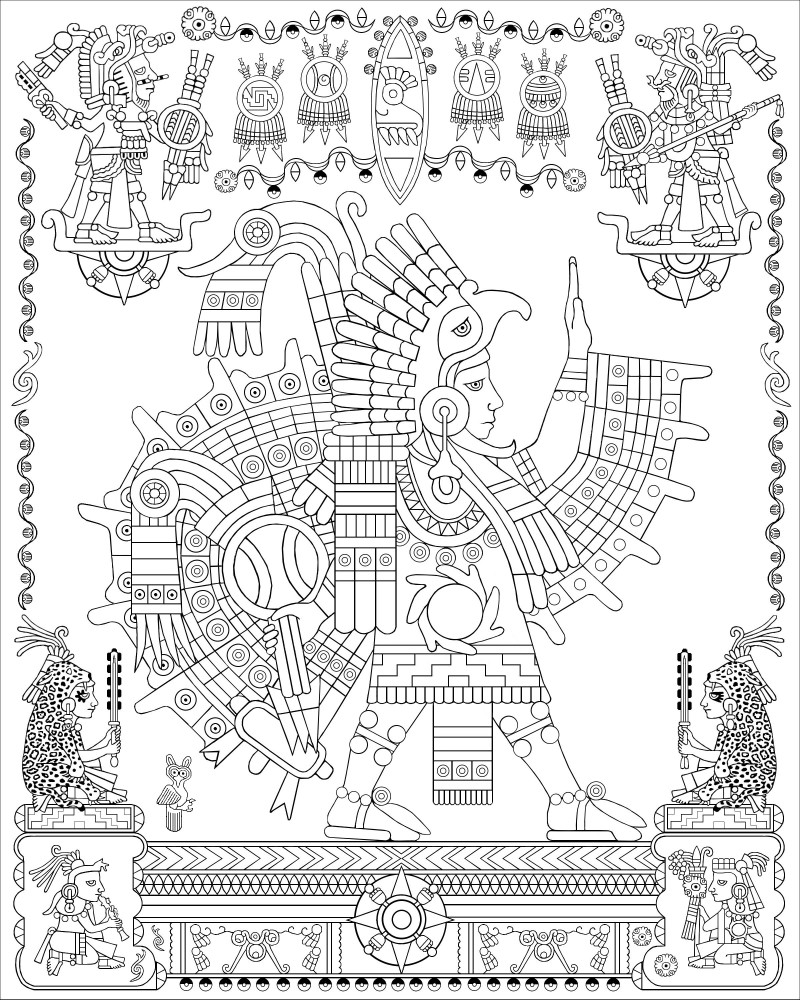
Aztec Icon #5 – EHECATL, God of Wind

Hold on to your hats! Here comes a wild wind. Actually the fifth icon for the coloring book YE GODS! THE AZTEC ICONS is the Aztec God of Wind, Ehecatl. My apologies that he’s going to be crazy to color, but I didn’t exactly make him up. The deity’s image is quite authentic, based on one with very similar detail from Codex Borgia.

Don’t worry, you can still see or download the previous four icons by clicking on them in the list on the coloring book page.

ICON #5: EHECATL

(God of the Wind)

To download this icon as a pdf file with a page of caption and model images from the Aztec Codices, right click here and select “Save Target (or Link) As.”  You can also download it in freely sizable vector drawings from the coloring book page.

ehecatl icon

EHECATL {e-he-katł} is the deified element of air and the breath of life. He’s a nagual of QUETZALCOATL, whom he helped create the current Fifth Sun by breathing life back into the bones in Mictlan. He is the god of secrets and mystery, intelligence, and spiritual life. Only smoke, feathers, and birds should be sacrificed to him. His temples were round, sometimes with protruding masks for the wind to blow through. His breath moves the sun and drives the high clouds and rain across the sky. Ehecatl is the 2nd day of the month, and Nahui Ehecatl (Four Wind) was the day-name for the Second Sun, a world ruled by QUETZALCOATL. When that Sun was destroyed by the eponymous wind (hurricane), its people were turned into monkeys.

Aztec Icon #4 – CHANTICO, Lady of the House

In the eternal struggle between life and art, I’ve been much occupied recently by life, the daily doing of things, most with pleasure, and some with stoic duty. So it’s been a while since I last managed to post something. Now with my ailing computer almost healed, I’ll launch the fourth Aztec icon for my coloring book YE GODS!  THE AZTEC ICONS.

Remember, that’s 4 of a planned 26. At the moment I’ve mostly completed the fifth and sixth and am half-way through the seventh. Don’t worry, you can still see the third icon by clicking here or any of the first three through the list on the coloring book page.

ICON #4: CHANTICO

(The Lady of the House)

To download this icon as a pdf file with a page of caption and model images from the Aztec Codices, right click here and select “Save Target (or Link) As.”  You can also download it in freely sizable vector drawings from the coloring book page.

Chantico icon

CHANTICO, The Lady of the House {chan-tee-ko} is the goddess of fire in the family hearth and fire of the spirit, as well as fire of the earth (volcanoes), and logically the wife of XIUHTECUHTLI, the god of fire. Patroness of cooking, eating, domesticity, and weaving she represents the feminine side of life, fertility, and the waters of birth. She is also the goddess of precious things, the lady wealth and jewels, defensive of her possessions and vindictive with gods or mortals who take her treasures. Her own particular omen-bird (parrot?) is attached to her headdress. (Each deity has one.) The jaguar-pelt seat indicates a divine or royal being.

Aztec Icon #3 – CHALCHIUHTOTOLIN, The Jade Turkey

It’s been long enough now that Aztec Icon #2: Chalchiuhtlicue, The Jade Skirt, has been hanging out here in the ether waiting for someone to look at her.  So I’ll gently retire her to the YE GODS!  THE AZTEC ICONS coloring book pasture along with Atl, God of Water .  If you care to, you can still see or download them through the links.

Now take a gander at this strange bird.  To download this icon as a pdf file with a page of caption and model images from the Aztec Codices, just right click here and select “Save Target (or Link) As.”  You can also download it in freely sizable vector drawings from the coloring book page.

ICON #3:  CHALCHIUHTOTOLIN

(The Jade Turkey)

Chalchiuhtotolin, The Jade Turkey

Chalchiuhtotolin, The Jade Turkey

CHALCHIUHTOTOLIN (Jade Turkey or Jewelled Fowl) {chal-chewh-to-to-leen} is a nagual of TEZCATLIPOCA.  Often called the Green Tezcatlipoca, he’s the magnificent patron of the Jaguar warriors of the night and of power and glory for warriors in general, cleansing them of contamination, absolving them of guilt, and overcoming their fates.  Appropriately he’s the patron of the deified day Tecpatl (Flint), the sacramental knife.  (Besides for political domination, Aztec wars were waged to harvest food for the gods—human hearts.)  A powerful sorcerer, he’s also a trickster who plays a flute in the night to lead people astray.  Whoever chances to see him should make bold to seize him and demand to be granted a wish.  Significantly, he’s also god of disease and pestilence.  (The Aztec civilization, like that of the Inca, was destroyed more directly by plagues than by the military conquests of the Spaniards.)

###


New Aztec Icon – CHALCHIUHTLICUE

Well, I haven’t heard anybody squawk about my going another couple weeks without a new posting.  Site stats show very few visits to this blog, though a respectable number of visitors every day to my earlier Aztec deity and calendar images.  Usually somebody even takes a look at my Indian mound photos or drawings of Pre-Columbian artifactsI guess this erratic blog is simply a matter of writing, as we used to say, to hear myself talk.  So be it.

This time I’ve been quiet for other than busy-ness, though there’s been plenty of that in any case.  Now I’ve simply not been able to spend much time online because my grandson visited a couple weeks ago and in one evening of YouTube managed to use up most of the monthly data allotment on my wireless connection—a subject you don’t want to read about, I assure you.

Writing on my memoir is moving along into Chapter 5, so that’s progress.  Drawing for the free coloring book is proceeding at its usual slow pace.  For sanity’s sake, I try to switch back and forth between the subjects every week or so and am now closing in on the sixth Aztec icon of Huehuecoyotl, the Old Coyote.  There are only a few vignettes and musical details to finish.  The problem is not thinking about the next icon for Huitzilopochtli, the Hummingbird of the South, which will also show the legendary migration of the Aztecs from Aztalan to Tenochtitlan.  Please be patient, all you colorists out there.  I’m working as fast as I can.

Meanwhile, here’s the second icon for the coloring book:  CHALCHIUHTLICUE, the goddess of flowing (fresh) water as in rivers, streams, and lakes.  (The goddess of the sea or salt water is Huixtocihuatl.)  To download this icon as a pdf file with a page of caption and model images from the Aztec Codices, just right click here and select “Save Target (or Link) As.”  You can also download freely sizable vector drawings from the coloring book page.

ICON #2:  CHALCHIUHTLICUE

(She of the Jade Skirt) {chal-chewh-tłee-kwe}

Chalchiuhtlicue, The Jade Skirt, Goddess of Flowing Water

Chalchiuhtlicue, The Jade Skirt, Goddess of Flowing Water

CHALCHIUHTLICUE is goddess of flowing water, rivers, and streams, as well as of youthful beauty and ardor with a birth day-name of Ce Atl (One Water).  She is patron of women in labor, childbirth, children, and motherhood.  Certain of her purification rites struck Spanish clergy as similar to the sacrament of baptism.  As goddess of storms and forces of nature, she can be dangerous.  She is the 6th lord of the night (which has 9 hours), and the 3rd lord of the day (of the 13-day week).  The wife of TLALOC and/or possibly XIUHTECUHTLI and mother of TECCIZTECATL and/or the twins QUETZALCOATL and XOLOTL, she destroyed the Third Sun (Four Rain) and ruled the Fourth Sun (Four Water).

###


FREE COLORING BOOK

YE GODS!  THE AZTEC ICONS

­An Outrageous Coloring Book

Icons of Aztec Deities and Commentary

By Richard Balthazar

ICON #1  ATL – GOD OF WATER

For free download as a pdf file, right click here and select “Save Target (or Link) As.”

ATL, Aztec God of Water

ATL, Aztec God of Water

ATL {atł} is the deified element of water, and is a nagual (manifestation or bodhisattva) of TLALOC, the ancient God of Storms (Rain).  In the tonalpohualli or ceremonial count of days, also called the Turquoise Year, Atl is 9th of the 20 named days in the month, a lucky day.  As above, Nahui Atl (Four Water), the 4th of the 13 numbered days in one of the weeks, is the day-name of the Fourth Sun, a previous world ruled by CHALCHIUHTLICUE and destroyed by Water.  Its humans were turned into fish.  The four dots are the Aztec numeral 4.  The extended upper lip (harelip?) has been traditional for Mesoamerican water deities ever since the Olmec.

###

 Rather long ago for my book CELEBRATE NATIVE AMERICA, I originally drew the Aztec deities for the ceremonial calendar.  Now I’m redrawing in the digital medium and expanding them into full-scale icons.  And believe it or not, the YE GODS!  THE AZTEC ICONS coloring book is offering you these amazing neo-Aztec icons for FREE.  That’s right—at no risk—not even any postage.

Color them in as you wish with my compliments.  The wrinkle is that this coloring book will be posted serially as each icon is completed.  That could well take the next couple years—a good reason to keep checking back with me.  At the moment only one is available, but there are four more almost ready for posting, and a sixth is well on the way.

The Aztec deities are a fascinating crowd of inter-related personalities involved in a soap-opera mythology of creation/destruction, love/strife, and life/death that makes the gods of Olympus look like wimps.  Perhaps the confusing dramas, frequent aliases, and surreal images are due to the fact that the Aztecs and their deities indulged in psychoactive drugs like alcoholic pulque, peyote, hallucinogenic mushrooms, and other psychedelic herbs.  So hold on to your hats for some challenging images to color, such as the current posting above.

Using only a bit of my artistic license, I’m basing YE GODS!  THE AZTEC ICONS on extant Aztec artifacts and their surviving picture-booksYou can use these almost authentic Aztec icons as cartoons for large-scale murals, smaller-scale tattoos, needlepoint patterns, and other design or illustration needs.

YE GODS!  THE AZTEC ICONS should also be seen as a free and unique teaching tool for classes not only in art, but also in cultural and historical studies.  In addition, YE GODS!  THE AZTEC PANTHEON is an illustrated encyclopedia of Aztec deities that comprises a crash course in Aztec cosmology, mythology, ritual, society, and history.

Don’t be shy.  Make lots of copies to experiment on.  You’ll need to.

###

Free Book on AZTEC CALENDAR

CELEBRATE NATIVE AMERICA!

An Aztec Book of Days

By Richard Balthazar (Five Flower Press, 1993, out of print)

CNA cover

For free download as a pdf file, right click here and select “Save Target (or Link) As.” 

I recently announced  that I’ve put my old out-of-print book on the Aztec ritual or ceremonial calendar up for free download.  Anyone with interest in art, mythology, history, or horoscopy will find it an unusual experience.  You’ll learn some weird stuff you never ever imagined, money-back guarantee.

The book presents the 260-day sacred Turquoise Year, which was used for divination and prophesy, in color plates of their 13 ‘months’ of 20 days spread over 20 ‘weeks’ of 13 days.  My weekly illustrations also include their patron gods or goddesses in images based on surviving Aztec books, primarily the Codices Borbonicus, Borgia, Nuttall, Fejervary-Mayer, Kingsborough, and Vindobensis.

For free download as a pdf file, right click here and select “Save Target (or Link) As.” 

If you don’t want the book itself, all its illustrations are up for individual free download from my galleries of godsdays, and weeks on this site.  Do whatever with them with my blessing.

The Turquoise Year was an evolution of the earlier Mayan calendar of similar structure with roots among the even earlier Olmec.  It was the ancient Mesoamerican horoscope.  The birth day-name was a person’s ceremonial and official name, and the deities who ruled the numbers, days, weeks, and months, each with light and dark sides, controlled individual and societal fates.

By the way, you can quickly find out your Aztec name by going to azteccalendar.com, and while there, you can even pick up your Aztec horoscope, which I admit will be much more detailed than what you’ll find in my old book.

For free download as a pdf file, right click here and select “Save Target (or Link) As.” 

READERS: Please disregard the final chapter and its mind-boggling concordance.  My hubristic attempt to start up a new Sixth Sun at the fall of Tenochtitlan was at best poetic, but that calendar has now run out anyway.  Forget about it.

Another note:  I exercised my artist’s license on the 20th week, One Rabbit, naming as its patron a far more appetizing deity, Xochipilli, the Prince of Flowers.  The actual patron was a quasi-deity called Tecpatl (Flint—the sacrificial knife).  Feeling like a nagual (or bodhisattva) of Xochipilli, I’ve dared to use his image in the banner on this website.

Free Book on Indian Mounds

GIVEAWAY #1

REMEMBER NATIVE AMERICA! The Earthworks of Ancient America

By Richard Balthazar

Five Flower Press, 1992

I’m pleased and proud to announce that I’ve now scanned the pages of this long out-of-print book for digital distribution.  It’s available now for free download as a pdf file.  All you have to do is right click here and select “Save Target (or Link) As.”

Surveying the periods and traditions of earthworking in Eastern North America, the book is an album of more than 120 monumental earthworks in 20 states:  conical burial mounds, embanked circles and geometrical figures, animal effigies, platforms, and pyramids.

These earthworks are shown in rare surveys, maps, drawings, and photographs, many reprinted from “Ancient Monuments of the Mississippi Valley” (1841), by E. G. Squier and E. H. Davis, which is itself now available online.  Others come from “Report on the Mound Explorations” by Cyrus Thomas (in the 1890-91 Annual Report of the Bureau of Ethnology) which is also now available online.  One of my favorite Squier surveys is the map of Newark works in Ohio:

Newark Works, Ohio

Newark Works, Ohio

Some of the photographs of mounds are my own, and those and many others I’ve taken of mound sites since are included on this website in my Gallery of Indian Mounds.  Here’s one of the newer ones, a shot of the splendid Pocahontas Mound, a pyramid in Mississippi.

MS Pocahontas pyramid

MS Pocahontas pyramid

In addition, the book presents a bunch of my line-drawings of artifacts found in mound excavations.  They and many more are up for easy individual download in my Gallery of Pre-Columbian Artifacts.  One of my favorites, albeit disturbing, is a curiously Toltec-looking warrior about to behead a captive.

Warrior, Spiro OK

Warrior, Spiro OK

For free download of REMEMBER NATIVE AMERICA! as a pdf file, just right click here and select “Save Target (or Link) As.”

Now I’m going to steal this opportune moment and bore you with my rant about earthworking, which I believe is a truly primordial human instinct.  Man, the animal who makes things, had to start somewhere.  Originally, of course, things could only be made out of animal material, plant material, stone, or earth, and most of that only after first making the tools or utensils necessary for the manufacture.  Since anything that worked, even plain old stones and sticks, would suffice for the job of moving dirt around, I suspect that the first implements (besides clubs for bonking folks and things) were probably whatever could be used to dig up food roots or enlarge shelters.

It’s but one short step from moving dirt around to piling it up.  As far as we know, people started constructing earthworks several thousand years ago in most parts of the world.  Everywhere you look, they raised piles of dirt in one form or another, often as tomb monuments.  The ziggurats of Sumer were simply piles of mud bricks.  Did the ancient Egyptians build in stone because you can’t effectively pile up sand?  Just wondering.

The impetus to heap up piles of dirt may well have come from observing nature.  Anthills and all that.  Also, it stand to reason that if you’re digging a hole for some reason, you’ve got to put the dirt somewhere.  What’s more, the primordial mind probably saw hills and mountains as the handiwork of some deity or other, and so raising earthen mounds likely had religious purpose, sympathetic magic and such.  Piling the dirt in special shapes would only add to the symbolism, and it seems that the very location and orientation of the piles often was astronomically or socially significant.

I’ll end this rant by noting that ceramic technology is also in fact earthworking, another part of Man’s artistic relationship with the Earth.


FALCON WARRIORS IN TENNESSEE

After those last two effusions about Latin and Greek music, I was planning to write about one of my true loves, classical music.  All in good time.

Instead, I feel like writing something about another, my love for the subject of pre-Columbian Native America.  There’s a piece of Mississippian shell art, a gorget from Hamilton County, Tennessee (AD 1200-1400), that I personally consider the most evocative image I’ve ever found from that lost world.

I gather that the gorget now resides at the McClung Museum at the University of Tennessee, but I made bold to do a line drawing of it for my old book, which I’ve included in my Gallery of Artifacts.  It presents a pair of “falcon” warriors.

Falcon warriors - Tennessee

Falcon warriors – Tennessee

So what if it’s rendered in a rather “primitive,” or better, unsophisticated, manner.  The original artist was working with the tools and materials available and did a remarkable job.  It’s the concept behind the image that fascinates me.  So much so that almost thirty years ago, I re-visioned these warriors as a bas relief in modeling clay in a, shall we say, more modern or sophisticated manner.

Falcon warriors

Falcon warriors

The model has lurked around (actually quite prominently) on my bookshelves, desks, etc. ever since, suffering a tiny bit of damage to the antlers and the seashell pendants, and growing an intriguing darkened glaze on its still soft surfaces.  That just makes it more existentially real.

Still in love with the underlying concept, I recently played around with the above photo on my freeware program (GNU Image Manipulation Program) to try and bring out the image better.  Apologies that I love purple and amethysts.

Falcon Warriors from Tennessee

Falcon Warriors from Tennessee

I rather like the depth of the figures and wings, don’t you?  It’s great to contemplate the details, like the pattern on the feathers, reminiscent of the barred pattern of the peregrine falcon.  The claw-feet are quite like those frequently found in early Mexican iconography, and their flint “swords” have apparently been unearthed at many archaeological sites.  The bun hairstyle and beaded forelock would seem to be standard fashion as they’re found in images from all over the Southeast and even on shell art from the Spiro site in Oklahoma.  The deer-antler headdress is also rather frequent and may just possibly relate to the Celtic horned god of nature and fertility, Cernunnos.

Most intriguing is the fact that these warriors have each seized hold of a lock of the other’s hair.  It’s tempting to think of this as perhaps a form of “counting coup” on each other in a battle, but I’m inclined to think it’s more of an affectionate connection, maybe between twin brothers who comprise the falcon.  You could run on about duality and all that, I guess, but whatever.

And in that case, I really have to wonder if this warrior pair might possibly be a faint, distant echo of the Maya Hero twins Hunahpu and Xbalanque.  Just saying.

###


Tattoo Rant


Now that I’ve let everybody in on one of my most intimate eccentricities, I don’t imagine that the rest of them would shock you.  So I’ll leave those disclosures for another time.  Instead, I’ll save you the trouble of reminding me and do a rant right now from my un-inked perspective about tattoos, relying largely on my spa experience.

Besides the physical exercise, going to the gym in the daytime (as well as out dancing at night), provides many eyefuls of the tattooed and otherwise ornamented bodies of young folk.  Sadly, I usually can’t discern details of the vast (and idiosyncratic) patterns or appreciate the artistic statements, since staring isn’t polite.

(As a sociological observation, I’ve been noting now at the EDM sessions of the local twenty-somethings that they don’t seem to be quite as taken with tattoos and piercings as are their elders.  I’m even seeing more “kids” nowadays at the Spa without a mark on their bods.)

Certainly some folks of my vintage have tats, but I think I’ll make do with my cockadoodle.  What I can’t quite grasp is the frame of mind somebody must be in to post some of the weird things I see as tattoos.  Of course, chacun á son weird.  Personally, I like more of the ornamental design stuff than the pictorial or narrative.  (One guy has a fox chasing a rabbit across his belly.)

By me there’s something classy about the patterned armband or ankle-band, but for some reason I find those maniacal Maori shoulders and orientally intricate sleeves personally disturbing.  But some of the full-back tableaus are impressive.  Aesthetically, I’d prefer more cohesive patterns, something more of an overall design.

In my historical wanderings, I’ve run across lots of tattoos amongst Native Americans.  There were some spectacular full-body tattoos amongst the extinct Timucua  people in northern Florida.  They were painted by the artist Jacques le Moyne  (around 1565) while at the ill-fated French settlement of Fort Caroline.  The best I can do for an illustration is a detail from an engraving of one of his lost paintings.

Timucuan full-body tattoo

Timucuan full-body tattoo

Full-body patterns like that are probably more than most folks could put up with, I suppose.  But I do wonder why facial tattoos are so neglected.  They would be a sure way to (modestly) get people look at your body art.  While enthralled long ago by the Indian mounds, I ran across some great line-art engraved on shell from the Mississippian site called Spiro Mounds in Oklahoma, some of which can be seen re-drawn in my Gallery of Pre-Columbian Artifacts.  My favorite is the head of a warrior with the so called “forked-eye” tattoo and a remarkable hairdo and headdress.

Warrior Head with forked eye tattoo

Warrior Head with forked eye tattoo

In my Aztec obsession I’ve run across any number of facial tattoos.  Frequently faces were sectioned in different solid colors, and they used eye embellishments.  It would seem that such designs were the identifying “signatures” or “trademarks” of specific individuals.  Talk about having an unmistakable identity.  Here are four I’ve drawn on authority of the marvelous Codex Nuttall  which is admittedly of Mixtec origin, but what the hay!  Don’t miss the other details including the (real) beards.

Aztec/Mixtec facial tattoos

Aztec/Mixtec facial tattoos

Native American tattooing traditions continued long after European contact and the colonies.  In the late 18th century a young Creek gentleman named merely John combined ink and jewelry in an elegant fashion statement.  Here’s my rendition of a 1790 drawing of John by the early American artist John Trumbull.

John the Creek

John the Creek

By the way, I have a superb suggestion for truly personalizing tattoos.  Considering the Aztec picture-writing of dates in their ceremonial calendar, folks could very easily sport their personal Aztec birthday-names as identity-tattoos.  All you’d need to do is consult the tonalpohualli to find out your number-day name, grab one of my day-signs, slap the appropriate number of dots in whatever arrangement around it, and there you go.  Here’s one for someone born on the day Five Flower (which is also the day-name of their god of games and parties).

Five Flower

Five Flower

Not to belabor the subject, though I will, I rather think that some of my Aztec deities would love to ride on somebody’s bare back.  Take for instance, Itzpapalotl, The Obsidian Butterfly (or Clawed Butterfly), the goddess of the night and stars.

Itzpapalotl, The Obsidian Butterfly

Itzpapalotl, The Obsidian Butterfly

Go for it—the colors are entirely up to you.