On Migrations Across the Americas

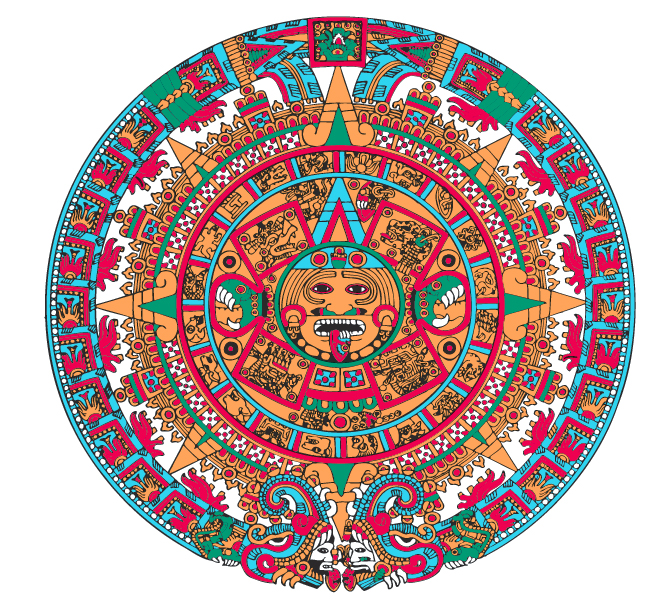
Arrival of the Mexica at Tenochtitlan

Recently there have been a bunch of media stories about new twists on the out-of-Africa theories of the spread of early humans across the globe, and I’m surprised that invested anthropological authorities are actually considering alternatives to their sacrosanct interpretations about human history. Even more surprising is their grudging recognition that human populations seem to have left Asia and crossed Beringia into the Americas long before 12,000 BC, that set-in-stone date they gamble their scholarly reputations on.

It seems that writing history is actually a game of creating explanations to be assumed true until proven mistaken. In fact, like all things past or future, history is purely immanent—existing only in the mind, and that immanent universe is truly infinite, everything possible. Historians can guess with impunity about past events, and the burden of disproof lies with those who disagree.

I have no difficulty with human populations leaving Asia whenever and spreading south down the American continents (all the way to Tierra del Fuego!), nor with of dozens of primordial populations coming across oceans to the “New World” from Asia, Africa, the Middle East, and Europe. Scholars vociferously deny or simply ignore most of them. Recently, their denial of well-documented Pre-Columbian Viking voyages has been faltering—and they’ve started romanticizing these murderous marauders as handsome, heroic explorers. But you have only to read “The Farfarers” by Farley Mowat to learn the ugly truth about the rapacious Northmen.

Wherever they came from, it’s clear that roving bands of feral humans spread thickly across the American continents. For the most part, those populations seem to have settled permanently into their new locales like water filling low places. But there’s also been a great deal of sloshing around, overflowing into other catchments, draining in various directions, and even drying up or soaking into the earth, often leaving only their “ruins” and cultural artifacts.

My decades of interest in Panamerican prehistory have led me to learn of (and conjure up) some immanent cases of that inter- and intracontinental slosh of peoples on the move. I will now pull together what I think I know about the migrations and interchanges of peoples in the Americas. We need to discuss this immanently important, rarely mentioned subject. Let me begin.

#

Chapter I: The Pacific Littoral

The spectacularly long Pacific coastline (from Tierra del Fuego north to Alaska) has been a sailing route for millennia but is rarely mentioned by historians except for the travels of later European mariners/explorers. From earliest times, the peoples of Peru, Ecuador, and Colombia were seafarers, sailing the shores for fishing and trade. The route north to Mesoamerica is how the art of metalworking came there from the Andes and how the staple crop maize was taken south from Guatemala to South America.

Story #1: CIRCUMSTANTIAL EVIDENCE

Through geographical detective work, I deduced that boatloads of missionaries, merchants, and/or migrants from Chavín de Huantar in Peru (c. 1,500 BC) brought the sacred ceremonial calendar and other cultural concepts probably to Mesoamerica, possibly to ancient Izapa in Guatemala. From there, the complex is thought to have crossed the Isthmus of Tehuantepec into the Vera Cruz lowlands to the timeless Olmecs.  I’ve already told this quite believable story in back in 2018.

Story #2: RELIABLE TESTIMONY

In the first millennium AD when the Maya civilization was in full Classic swing with warring kingdoms in Yucatan and Guatemala, I claim that refugee Maya peoples fled by boat along the Pacific littoral, settling at spots in western Mexico and farther north on the California and Pacific Northwest coasts. I base my claim on the report of Capt. Meriwether Lewis in “The Journals of Lewis and Clark” (ed. Bernard DeVoto) from March 19, 1805, where he wrote (sic!):

The Killamucks, Clatsops, Chinooks, Cathlahmahs, and Wâc-ki-a-cums resemble each other as well in their persons and dress as in their habits and manners. their complexion is not remarkable, being the usual copper brown of most of the tribes of North America. they are low in statu[r]e, reather diminutive, and illy shapen; poss[ess]ing thick broad flat feet, thick ankles, crooked legs wide mouths thick lips, nose moderately large, fleshey, wide at the extremity with large nostrils, black eyes and black coarse hair. their eyes are sometimes of a dark yellowish brown the puple black. the most remarkable trait in their physiognomy is the peculiar flatness and width of forehead which they artificially obtain by compressing the head between two boards while in a state of infancy and from which it never afterwards perfectly recovers. this is a custom among all the nations we have met with West of the Rocky mountains. I have observed the heads of many infants, after this singular bandage has been dismissed, or about the age of 10 or eleven months, that were not more than two inches thick about the upper edge of the forehead and reather thiner still higher. from the top of the head to the extremity of the nose is one straight line. this is done in order to give a greater width to the forehead, which they much admire. this process seems to be continued longer with their female than their mail children, and neither appear to suffer any pain from the operation. it is from this peculiar form of the head that the nations East of the Rocky mountains, call all the nations on this side, except the Aliohtans or snake Indians, by the generic name of Flatheads.

As others surely have, I’ll note Capt. Lewis has described here in exquisite detail the traditional Maya practice of skull deformation. It seems reasonable to me that this widespread cultural practice in the American West could have come from coastal colonies of refugee Maya. The also widespread practice of nose-piercing (as in the Nez Perce tribe and others) could just as easily have been brought by such “civilized” immigrants to the northern forests and mountains.

Story #3: A WILD GUESS

Toltec pressure and even later Aztec aggression no doubt also drove other peoples of western Mexico north in their boats along the ancient Maya route to the Pacific Northwest. I base this intuitive hunch on a linguistic coincidence (which I usually tend to dismiss).

The city of Seattle was named for the “chief” of a Native American tribe on the Olympic Peninsula. Phonetically, “Seattle” amounts to se-atl, and Ce Atl is the Nahuatl day-name (One Water) of the goddess of water, Chalchiuhtlicue, the Jade Skirt. As a name for a “town” or chief, One Water seems quite appropriate for a Nahua “colony” in that eminently watery area. But again, I’ve already told this and Story #2 back in 2018.

DNA tests should be run on Northwest tribes to look for markers of Mesoamerican populations. It would also make sense to compare the languages of those tribes with those of Mesoamerican peoples. (There’s a distinctly Nahuatl-ish sound to the names of the Tlingit and Kwakiutl tribes.)

Story #4: AN EPIC ESCAPE

Let’s back up some centuries and return to the Andes. In book “Advanced Civilizations of Prehistoric America,” Frank Joseph, an independent researcher cold-shouldered by academics, discusses the Huari of the Lake Titicaca area (often called the Wari) and the neighboring Llacuaz people, observing that their principle currency was the spiny oyster Spondylus princeps shell.

That seashell was sometimes found along their coast, but their main source was from the distant north in the Sea of Cortez. In the latter centuries of the first millennium CE, Joseph proposes that these peoples sailed those thousands of miles to collect their “money” and meanwhile “explored” up the Colorado and Green Rivers across Arizona. The Llacuaz established colonies in the Green River basin, and the Huari pushed on into northwestern New Mexico where, by the early ninth century, they started building vast structures at Chaco Canyon.

Joseph suggests that when the Chimu (possibly Chinese!) invaded Peru c. 1,000 CE, establishing a civilization centered at Chan Chan, they drove the Huari and Llacuaz out of their Lake Titicaca home area. Many thousands of refugees boarded their reed boats and balsa rafts and fled north to their distant colonies in North America. The Llacuaz, superb hydrological engineers, became the Hohokam civilization—whose descendants are the Pima and Papago tribes.

The refugee Huari people must have exploded the population at Chaco Canyon, and these “Anasazi” spread out across the Four Corners area, an ancestral culture for the present-day Puebloan peoples. Joseph points out that Chaco architecture (like Pueblo Bonito) replicates their traditional styles in Peru—the D-shaped, multi-storied “apartment complexes” and particularly the round, sunken “kivas” which are now culturally central to their Puebloan descendants.

This is the only “origin story” I’ve found for the ancient civilizations of the American Southwest. Though it involves migration across mind-boggling distances (think of the vast spread of the Indo-Europeans out of Central Asia across Europe and India!), it makes ultimate sense and comes with some dramatic evidence. Until someone offers a better story, I’ll go with this one.

#

Chapter II: The Gulf of Mexico

The Gulf of Mexico and Caribbean Sea, enclosed by the archipelago of the Greater and Lesser Antilles, amounted to a prehistoric American “mediterranean” arena of cultures. Sea-faring peoples like the Maya of Mesoamerica and the Arawaks and Caribes of the South and Central American coasts roved around the basin, not unlike Old World traffic on its Mediterranean Sea.

Story #5: THE SANCTUARY

As well as along the Pacific littoral, Maya refugees from civil violence (like the Itza and other Maya peoples) also fled into the American Southeast. In Florida, Georgia, Tennessee, and along the Gulf coast, they settled among resident “natives.” As early as 200 CE, the immigrants brought their mound/pyramid and artistic traditions, contributing to Mississippian culture. See my “Remember Native America!” and my ethnographic essay. I should note that the skull-deformation and nose-piercing mentioned above in Story #2 also occurred in many parts of the world, including among early immigrants into the American Southeast.

Another independent researcher (of Creek heritage), Richard Thornton, writes a blog called “The Americas Revealed,” which I’ve followed for several years. Though vociferously opposed and denied by academic authorities, he discusses the Maya, Arawaks, and Caribes also penetrating in early centuries into the Southeast, and as an accomplished city planner and archaeologist, he has modelled their traditional towns and architecture at archaeological sites in the area.

As well as the early Maya, Thornton says that later Mesoamericans such as the Totonacs and Huastecs also fled the depredations of Toltec and Aztec imperialists and trekked around the Gulf into the Southeast, adding their cultures into the melting pot that would produce the Native American stew of tribes like the Creek, Choctaw, Chickasaw, Caddo, and others. Some retained legends of their migrations from specific locales in Mesoamerica.

In addition, citing serious linguistic evidence, Thornton says that a South American people called the Panoans migrated from Ecuador and Peru into the Southeast and brought their own seasoning into the melting pot. At first there seemed not to have been much friction or violence between the many disparate cultures, each group continuing their ethnic lifeways in their own immigrant communities. Densely scattered across the landscape, they were like the Maya’s decentralized urban pattern of town-states, some bonafide cities with pyramid/temple and plaza complexes.

#

Chapter III: Cross-Country Migrations

Thus far we’ve seen sea-rovers on the Pacific littoral and around the American Mediterranean Gulf, and now let’s talk about the land-roving folk within the continents. I know virtually nothing about peoples moving around in South America but suspect a considerable flow between the Amazonian and Pacific slopes of the Andes. However, I’ve just read somewhere that in distant millennia the first peoples of Mesoamerica migrated there from South America. I think they’re talking around 6,000 BP, so that sounds perfectly feasible. Why not?

Story #6: LATECOMERS

Meanwhile, I do know bits and pieces about the land-rovers of North America (besides all that about primordial folk from Asia spreading south through the continents). One bit is a widely discussed issue in American archaeology: Very late, around 13-1400 AD, a small group of Athabaskans (originally of course from Siberia) left their subarctic home in far northwest North America and migrated into the American Southwest, specifically into the Four Corners area, to become today’s Navajo and Apache tribes.

Strategically, these Athabaskans arrived soon after the Chaco civilization “disappeared,” and they were bitter enemies of the remnant populations of Anasazi, the Pueblos along the Rio Grande, and the Hopi in Arizona. In view of this historical migration, I find it curious that Navajo mythology has that people emerging from under the earth somewhere, maybe near Shiprock (a volcanic core mountain) in northwestern New Mexico. However, many peoples the world over claim to have come into this world from the underworld.

Story #7: THE STEW

Meanwhile, in the same centuries, as the Mississippian civilization in the American Southeast (and the Caribe kingdoms in the Antilles) grew more warlike with rival city-states (much like the earlier Maya situation perhaps), various peoples moved around to elude their oppressors. Many migrated across the Mississippi River onto the plains. Thornton tells of the People of the Eagle (Kansa) from central Georgia who moved into what would become Kansas.

By the early 1600s, under pressures of aggressive neighbors and newcoming land-hungry European invaders, some Mississippian folks evacuated the Carolina coast and moved way out onto the plains of the Dakotas. In that strange new environment, they mastered the Europeans’ horse culture and became the Sioux, the quintessential Plains Indian.

Over the centuries, many other ethnic communities in the vast Southeastern woodlands certainly must have upped and gone somewhere else for whatever reason, stirring up the stew of peoples. For instance, in the early 18th century various Southeastern peoples pressed south into La Florida (by then thoroughly depopulated by disease and Spanish occupation) to become the Seminoles.

In the 17th and 18th centuries, probably inspired by contacts with European concepts, many polities in the central Southeast coalesced into the Creek Confederacy, which for a long time constituted an autonomous “country” west of the European colonies along the Atlantic coast. After battling these “Five Civilized Tribes” for several years in the Creek (and Seminole) Wars, General Andrew Jackson became President of the US of A and in one of the hugest land-grabs in history, exiled the Southeastern peoples to the new “Indian Territory,” part of the recent Louisiana Purchase. Between 1830 and 1850, some 60,000 native people took the Trail of Tears hundreds of miles west to Oklahoma, a forced migration on which thousands died.

During the 18th century, before the coastal European colonies had fully occupied Appalachia, a large tribe from the Canadian Maritimes spread south down the mountain chain and by late in the century had encountered the confederated tribes, probably with considerable friction. These were the Cherokee, who now claim to have lived in the Southeast “for thousands of years” and would usurp the history of the diverse “native” tribes. Indeed, some Cherokee joined them on the Trail of Tears. Those remaining in the western Carolinas and elsewhere soon were accepted by the US of A as a “civilized” (pacified) tribe, and in turn they accepted the new country’s dominion.

Story #8: RITUAL JOURNEYS

The culture and cosmology of the Hopi people, an affiliation of several clans now living in northeastern Arizona, is based on migrations. A legend has them migrating from somewhere in the far south, either South America, Central America, or Mexico. In the first case, they may have left Peru along with the Huari and Llacuaz refugees (Story #4), having settled on the desert mesas at roughly the same time in the late first millennium CE when the others were colonizing southern Arizona and Chaco Canyon. Significantly, Hopi architecture with its multi-storied communal dwellings and circular kivas closely reflects Chaco traditions.

Coincidentally, their migration seems also to have involved a long ocean voyage, but some folks theorize that the Hopi sailed all the way from Asia or elsewhere. For linguistic reasons, I incline to the Peruvian story. We don’t know what language was spoken by the immigrant Chaco people, but I bet it was one of the Uto-Aztecan family—since the linguistically related Utes and Shoshoni tribes were likely early offshoots of the Chaco civilization, and the Hopi language is also Uto-Aztecan. (I’m not sure how the Puebloan languages would fit into this matrix.)

On another hand, in the same way as the Navajo and many other peoples, the Hopi “mythology” has their clans emerging from a hole in the earth (cave?) called the “sipapu” located somewhere near those same desert mesas. Then their principle deity Masau-u then sent the many clans on individual ritual migrations to the four ends of the earth and back in order to find their promised land. Surprisingly, after hiking from seas to shining seas, the clans eventually converged again on those same desolate mesas, founding their town of Oraibi around 1100 CE.

Each migrating to the four ends of the earth, the several Hopi clans must have encountered many other peoples, like the Toltecs in Mexico and the Mississippian cities in the Southeast. The possible histories of cultural contacts are legion. Meanwhile, those migrating clans often left petroglyphic evidence of their passing through many areas with their identifying symbols.

Story #9: LEGENDARY MIGRATION

When I ran across “The History of the Indies of New Spain” by Fr. Diego Durán (1537-1588) around 50 years ago, I was enchanted by his detailed account of the legendary migration of the Aztecs into Anahuac (the Valley of Mexico).

The migration legend is intertwined with the mythology of the Mexica’s main deity, the war god Huitzilopochtli, Hummingbird of the South. Leaving their previous home around 1200 CE, he led the Mexica migration for well over a century to finally find their promised land on a swampy island in Lake Texcoco in 1325 CE. Within a century, they’d built a huge city on that island called Tenochtitlan, Place of the Cactus, and had begun assembling an empire based on trade and military might—which in 1519 fell victim to Cortez and his Spanish conquistadores.

The legend describes the impossibly violent birth of Huitzilopochtli at a place where the Mexica were living called Chicomoztoc (Seven Caves) and his autocratic and arbitrary leadership of the nomadic migrants, who settled down in various places for lengthy periods to sow and harvest crops. On their travels, they pillaged the “Red City” (possibly the site in Chihuahua known as Casas Grandes or Paquimé), and they vandalized many resident populations, gaining a reputation as utterly uncivilized barbarians. For an egregiously atrocious offense against the ruler of a city on the lake, they were driven out onto the island where they found the prophesied eagle on a cactus eating a snake. That iconic image is now an official symbol of the Mexican state.

It’s intriguing to know that during their migration and in Anahuac, the Mexica spoke essentially the same language as resident populations, a dialect of Nahuatl—because those peoples had earlier also migrated south from Chicomoztoc. Duran tells us that by 820 CE the first six “nations” (tribes or clans) started sequentially leaving the Seven Caves: the Xochimilca, Chalca, Tecpanecs, Colhua, Tlalhuica, and Tlaxcalans. Settled down again after long wanderings, the several clans established large cities around Lake Texcoco and in various other central areas of Mexico. The Mexica were just the long last tribe to leave the Caves.

This shared history of migration seems to say that the language of the Chaco civilization must have in fact been (as suggested in Story #8) Uto-Aztecan, another dialect of Nahuatl, and it raises again the question of the Huari (Peruvian) language. That question gets complicated by the fact that the Toltec civilization (900-1160 CE) also spoke Nahuatl. An “empire” centered at Tula just north of Lake Texcoco and at Chichen Itza in the Yucatan, they could have also been migrants from the far north—or just as easily, like Chaco, an early invasion or colonization of Huari from Peru, refugees or otherwise. The time frames suggest maybe the earlier Seven Caves migrants had a hand in the destruction of the Toltecs. Remember, history is but an immanent story.

This is not to imply that Chicomoztoc might have been Chaco Canyon. At Chaco, there may have been seven great-house pueblos, but they were nothing like caves. My radical theory is that Chicomoztoc was the several cliff-dwelling towns of Mesa Verde, a major outlier of the Chaco civilization with a real road connecting the centers. That makes vastly more sense to me than the mound-site in Wisconsin ridiculously called Aztalan or some vague spot lost in the deserts of Sonora/Chichimeca. Until someone can convince me otherwise, I’ll go with Mesa Verde.

A deeper legend has the Mexica (and other tribes) coming originally from a place called Aztlan, a “place of whiteness” or “place of herons.” Some speculate it’s somewhere in northwestern Mexico or the American Southwest. In that legend, the peoples lived at a large lake and were driven out by enemies, forced to make a long sea-voyage and then wander lost in deserts—before finally getting to Chicomoztoc. This “place of herons” scenario closely parallels the Huari fleeing before the Chimu from Lake Titicaca to Chaco, and if Chicomoztoc was in fact Mesa Verde, all the puzzle pieces fall neatly into place. Ergo, Aztlan looks like it was Lake Titicaca, and the Huari probably spoke a version of Nahuatl. That story works just fine for me.

#

Epilogue

In Story #7: The Stew, I unavoidably remarked on some migrations spurred by cultural pressure of post-Columbian European invaders, like that of the Sioux and the tragic Trail of Tears in the 19th century, but the countless forced migrations of native peoples in recent centuries (like the Navajo to Bosque Redondo) are far more than I can bear to think about.

When Cristóbal Colón arrived in 1492, he and his family immediately started colón-izing the indigenes of the Greater Antilles (Cuba, Puerto Rico, Jamaica, and Hispaniola) by enslaving, slaughtering, and driving them to escape into the interiors of North and South America. As soon as they were decimated or totally wiped out, black slaves were imported from Africa to work the Spanish mines and sugar plantations on the islands. This was just the first small step in the European displacement and destruction of native populations across the American hemisphere.

###

Official Disinformation

Disinformation can be presented in many forms. Besides outright untruths, perhaps the most insidious are incomplete or cherry-picked facts, often legitimized by subtle weasel words, distractions from the matter at hand, and unsubstantiated conclusions.

A case in point is a brief reader-question and expert-answer in a prestigious national magazine popularizing history, science, etc. The reader asked if American Indians had a written language. That question should have opened up a very large can of worms. The responding “cultural specialist” from an important museum framed the answer narrowly by stating: “The Timucua were among the first to have a written system…”

Without identifying the Timucua, the respondent hid behind the weasel word “among” to remark on a Franciscan missionary in 1595 at St. Augustine in Florida developing that system for the native population. This was followed by remarks sanctified by ethnographic authorities on the Cherokee syllabary invented by Sequoyah over 200 years later in 1821. This simple answer was perhaps factual but essentially dis-informative.

Perhaps there was an early Franciscan missionary in that fanatically Jesuit Spanish colony on the Florida coast, but his using the Latin alphabet to write their language was of dubious and short-lived benefit for the natives themselves. By 1600, the Timucua people had been exterminated by diseases and genocidal violence.

Behind that weasel word “among,” several facts of singular importance to the reader’s question were omitted. In “America B.C.” by Barry Fell (1976), a scholarly book denigrated and dismissed by said ethnographic authorities, a lengthy discussion with comparative examples shows that the Micmac peoples of Maine and the Canadian Maritimes had a hieroglyphic writing system with clear relations to the Egyptian! In the early 1700s, a French cleric rendered Psalm 116 in the Micmacs’ well-developed system. Meanwhile, the ancient Egyptian hieroglyphs were not deciphered until 1823 by Champollion. I can’t begin to explain how or when this happened, but the Micmac had at some time long before 1595 clearly made this writing system their own.

The most subtle weasel word involved in the cultural specialist’s answer to the reader’s question was “American Indian.” The expert quickly limited the question to North American indigenous peoples, conveniently ignoring indigenes of the rest of the Americas. I’ve not encountered any evidence of writing systems in South America, but the late Michael Coe and several other noted scholars of Mesoamerica have now decoded the hieroglyphic writing system of the Maya, revealing detailed histories of their lost worlds from some two thousand years ago.

To return to the famous Cherokee syllabary created by Sequoyah, there has been fascinating research on the Pre-Columbian peoples of the (North) American Southeast by Richard Thornton (https://apalacheresearch.com) showing that the peoples of the Creek Confederacy had in earlier centuries developed a syllabary of their own. Apparently, Sequoyah used that unique creation in formulating his system. This appropriation of native history to the Cherokee nation is part and parcel of their wider cultural/historical imperialism. In spite of their claim to have lived in the area “for thousands of years,” the Cherokee only immigrated into the Southeast (from Canada) in the 19th century after the United States government had mostly cleared it of other indigenous tribes following the Creek Wars and the Trail of Tears.

But I’m not through exposing official disinformation. The Timucua people in the specialist’s answer were a major mound-building culture in the Southeast well beyond the St. Augustine area. We know most about them from the artist, Jacques LeMoyne, who accompanied the refugee Huguenots who were (among) the first French to settle in the New World.

Under Rene de Laudonniére, they established Fort Caroline in 1564; the Spanish founded St. Augustine in 1565 and proceeded to slaughter and/or drive the French out. LeMoyne painted scenes of the Timucua like this later engraving of Laudonniére with Atore, son of the native “king of kings” Satouriona, at the column raised by the earlier French explorer Jean Ribault, image courtesy of Wikipedia:

Now we come to official disinformation in the form of alternative truth. Jean Ribault reportedly planted this column at the mouth of what he called the River May. Establishment dogma was that this was the St. John’s River in Florida, and in the first half of the last century the impartial State of Florida and City of Jacksonville jumped on that interpretation to “reconstruct” Fort Caroline there as a historical attraction. Again through the research of Richard Thornton, it’s now clear that Fort Caroline was in fact built at the mouth of the Altamaha River in southern Georgia near present-day Savannah. For purposes of the almighty tourist dollars, however, the official disinformation still stands.

My point in this tirade is that we shouldn’t blindly accept simple answers to complicated questions. Behind every supposedly historical fact, there’s usually a whole world of extenuating circumstances and alternative explanations that are derided and denied by establishment authorities. We always have to dig deeper to discover the real truth—and try to figure out who benefits how by promoting official disinformation.

###

Tlalocan II – The Drawing

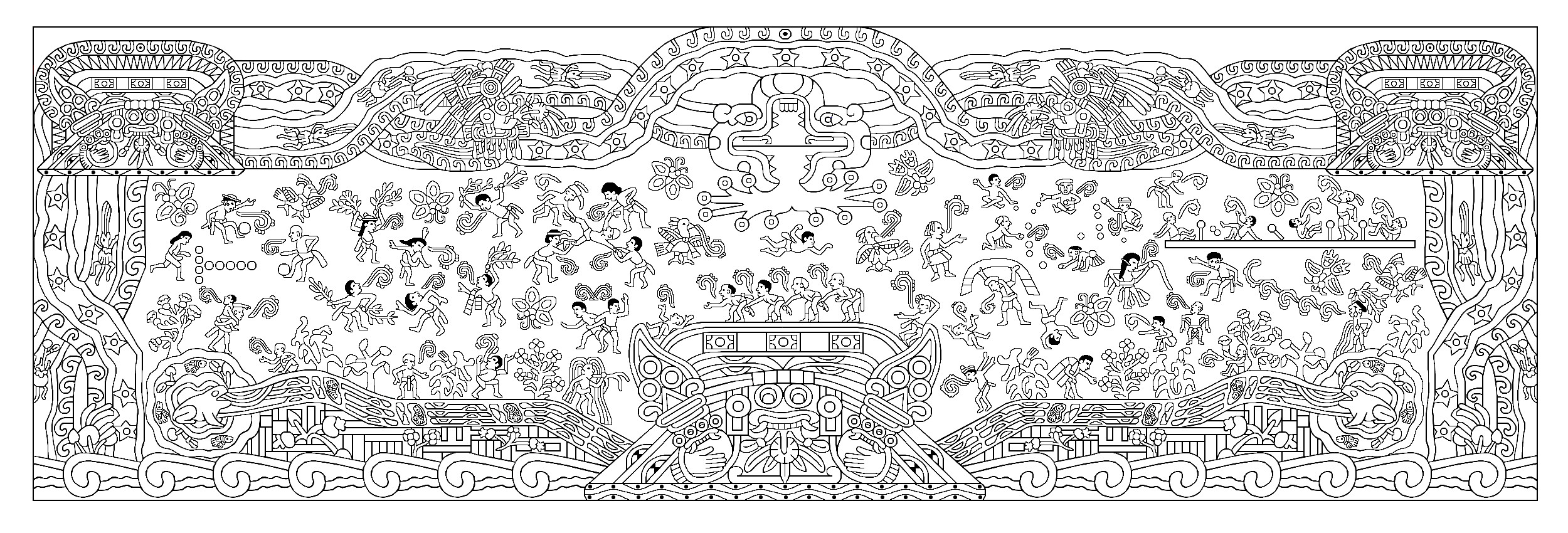
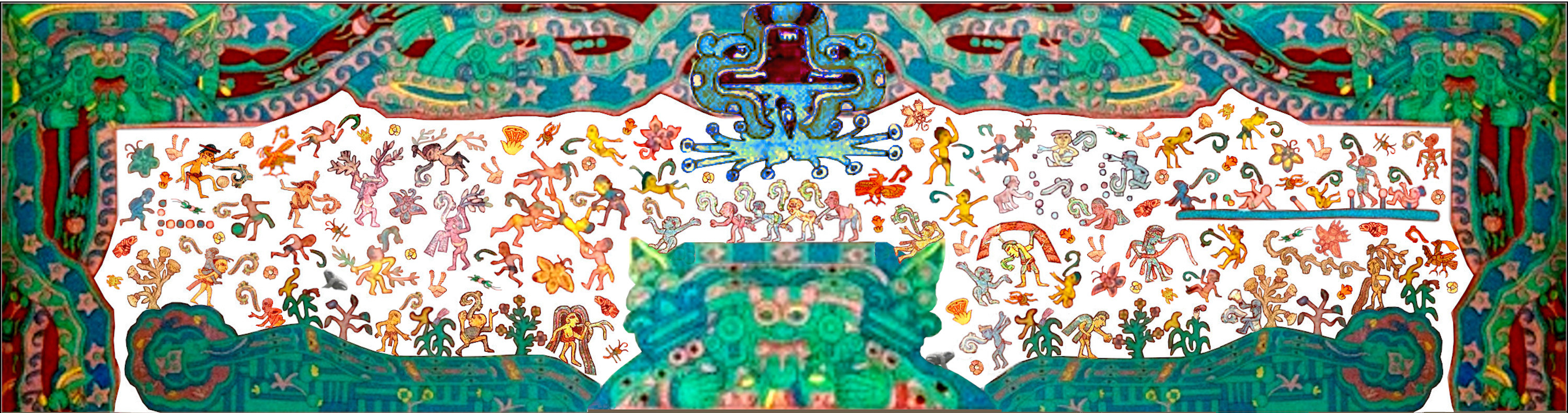
After showing you my reconfiguration of the Teotihuacan mural of Tlalocan in early July, it took me these past three months to turn it into a black-and-white drawing. As such, it will become the lower register in Icon #20 for my digital coloring book YE GODS!

For several centuries the enormous city-state of Teotihuacan “ruled” central Mexico (and parts of the Maya world as well). Painted about 1,500 years ago, the tremendously ornate mural is a fascinating window into that vanished metropolis, a panorama of its people enjoying afterlife in the paradise of their water (storm) god—whom a thousand years later the Aztecs called Tlaloc. My drawing gives you an intimate look at the actual people who lived in the Place of the Gods. (It’s greatly reduced in this illustration, but you can click here to download a full-scale image—at almost three feet long and one foot high.)

Tlalocan – The Paradise of Tlaloc

Within that eye-boggling border, the first telling detail to notice is that there are no women, which may say something about a sexist society in Teotihuacan. Of course Tlaloc’s Eighth Heaven was reserved for victims of drowning and children sacrificed for life-giving rain, but one thinks maybe some women might also have drowned and girl-children been sacrificed too. In all likelihood (if the eschatology of Teotihuacan is reflected in that of the Aztecs), women may well have had their own paradise among the thirteen heavens. But there’s no mural of that one.

The Aztecs definitely inherited the concept of Tlalocan from Teotihuacan, and the iconography of the ancestral water (storm) god is also clearly reflected in that of the much later Aztecs.

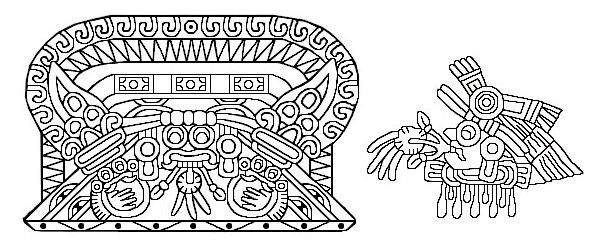
Teotihuacan Water and Rain Gods

Tlaloc’s goggle-eyes and fangs crossed the centuries into the figure from Codex Borgia, as well as the head-pitcher he holds for pouring out water:

Aztec Tlaloc and Quiahuitl Day-signs

Teotihuacan’s rain-god image carries over directly into the Aztecs’ golden Four Rain sign (day-name of the Third Sun) on their Stone of the Suns. The Rain day-sign to its right is based on it—drawn thirty years ago for my book of days before I ever learned of the raindrops on the Teotihuacan image. The two lower signs are stylized versions for the calendars in the Fejervary-Mayer and Vaticanus codices; those in other calendars are similar, but often less formal.

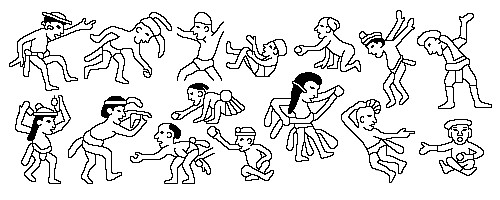
Now let’s look into this window on the people of Teotihuacan. First, check out their quite varied fashions in clothing:

Teotihuacan Fashions

Not surprising are the loincloths or breechclouts worn by figures on the left with varying numbers of sashes. Note that children can be nude or just wear “panties.” But then the costumes get weird, like the top center fellow wearing a midriff T-shirt and toreador pants and the guy just below with a full-length T. The runner to his right may be wearing similar pants, but he also has gloves. The guy below is wearing “clam-digger” pants with breechclout; the guy with the tears (ignore those for now) only wears gloves and socks/slippers, as does the cross-legged kid below. On the far right the top figure wears shirt and pants under a loincloth, and the lower figure wears pants/leggings under a kilt with sash.

The variety of outfits may have to do with social classes—or maybe not. But I can say that the cross-legged kid in gloves and socks is remarkably unique in being presented full-face. All the other faces are done in profile—the standard view used by the Aztecs for faces and bodies as well. However, the ancient artist made free to show figures frontally and from many other realistic angles, an iconographic freedom apparently lost over the centuries.

Note also the varying hairstyles: Figures are frequently bald (or with shaved heads?), but many have hairdos of various lengths. The kilted fellow on lower right may be an elder with receding hairline and gray hair. In the mural you can’t tell if the guy at center-top has a topknot or feather headdress. Speaking of hairstyles and headdresses, there is also a wide assortment of such on other figures which again may have something to do with class or occupation—or maybe not.

Teotihuacan Headgear

Here we see several types of hats, headbands, skullcaps, and turbans. Notable is the figure on the upper left wearing an ear-flare, the only one in the whole mural—a fashion that became almost universal under the Aztecs—but there are no nose ornaments. Again, note the cross-legged kid on the lower right wearing what looks like a slightly cocked beret. The flirtatious fellow to his left possibly sports a half-Mohawk crest—or a feathered hat?

So now we know what (at least male) Teotihuacanos looked like! Here are a couple vignettes of their playful activities:

                    Teotihuacan Dancers

  Teotihuacan Toss

 Both of these group activities well illustrate the ancient artist’s stylistic freedom, as well as elements of perspective that the Aztecs would never have attempted. (The curlicues are shouts or songs of joy—a convention that totally carried over into Aztec iconography.) The scene of the tossing is probably celebratory—as happens in many cultures—and not a punishment like that undergone by Sancho Panza in “Don Quixote.”

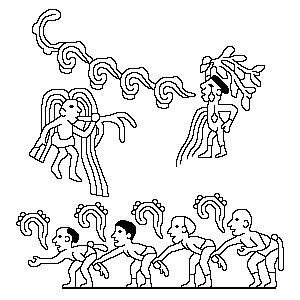
Now we come to some distinctly odd images that I have a hard time parsing:

             Teotihuacan Oddities

This guy with the tears (in gloves and socks) seems to be singing loudly or shouting, but why is he crying and waving a branch, and what’s he got flowing from his chest? In the mural the flow doesn’t seem to be blood, and why should it be? The guy with the long stuff flowing from his head (hair?) seems to be chewing on a stick (sugarcane?). The four fellows holding each other’s wrists maybe are playing some game? Since this is in Tlalocan, whatever’s going on must surely be joyful fun.

I hope my little drawing has given you some visual notion of the lost and almost forgotten world of Teotihuacan.

#

Tlalocan – The Paradise of Tlaloc

Occasionally I’ve interrupted drawing for my coloring book to remark on particularly interesting details (like the Divine Volcanoes and Visions of Tezcatlipoca), and here I go again.

The icon I’m working on right now is for Tlaloc, God of Storms (as well as rain and weather in general), a very ancient deity with antecedents among the Maya as Chak and in Teotihuacan, his actual name unknown, at least a thousand years before the Aztecs. In conceptualizing the icon, I’m including as the base register an image of Tlalocan, the Paradise of Tlaloc, adapted from a mural at Teotihuacan (c. 500 CE).

In my process, I first gather, massage and manipulate source material to create a layout. After settling on the composition, I turn the images into line drawings. Working with a mural from Teotihuacan—and snitching a neat piece of Codex Vindobonensis—I’ve reconfigured it to be what I call the Tlalocan, the Paradise of Tlaloc, restoring the heavily damaged left half:

Teotihuacan Mural Reconfigured by Richard Balthazar

Keep in mind that the Teotihuacan mural (with an obfuscating deep red background), was painted some 1,500 years ago—before European monks ever started illuminating manuscripts.

Some scholars argue that this mural represents the sacred Water Mountain—Cerro Gordo behind the city—and was associated with the (also nameless) Great Goddess. While her mural is positioned right above this one, I heartily disagree and have removed the arguable “mountain,” moving in the centerpiece from the upper border (enlarged), an indubitable image of the fanged, goggle-eyed deity the later Aztecs dubbed Tlaloc.

The deity also holds “head”-pitchers like those Tlaloc holds in Codex Borgia pouring water onto the maize-fields. As well, the dedication to Tlaloc is tripled by the matching busts of the iconic water deity in the upper corners. In upper center, I’ve installed an anachronistic Mouth of the Earth pouring forth water (from Vindobonensis). The name Tlaloc means “He of the Earth.”

I have no problem with Cerro Gordo being the sacred Water Mountain of Teotihuacan. That nearby massif may well have sourced lots of springs and streams, and I gather there’s evidence of intensive agricultural terracing and other works on its slopes and summit. The original Water Mountain image in the mural I assert to be in fact the way of entry into the afterlife of Tlalocan. The figures in its waters aren’t just gaily swimming around but struggling, sinking, maybe drowning, and ultimately erupting into the Paradise of the god later known as Tlaloc. Note the attempted life-saving. I found the image nice but unnecessary. After all we’re worshipping LKA Tlaloc here.

“Water Mountain” from Original Mural at Teotihuacan

Circumstantially, priority entry into Tlalocan, a joyful place of games, butterflies and flowers, was granted to victims of drowning, then to children sacrificed to Tlaloc—note the many children in the mural’s pastiche—and only afterwards to victims of certain diseases such as leprosy. Those less than enviable passports aside, Tlaloc’s 8th heaven (out of the 13), was a great place to wind up, all dancing, singing, and having fun. In the other heavens, not so much…

If you squint at the little figures in the mural, you’ll see groups engaging in several games. On the far left it’s with soccer-type balls while another guy runs in perhaps a hybrid of bowling and hopscotch. Moving to the right, we come to a bunch of dancers, and beside them a guy getting tossed into the air. On the deity’s crest, four fellows play perhaps some version of leapfrog. On their right, kids play marbles, and four guys play on something maybe related to a teeter-totter.

Historically significant are those little curlicues issuing from the figures’ mouths, the symbol for song: These folks are rejoicing, singing out their joy. Even the birds I lifted from the Great Goddess mural are singing as on far right. (In the original a tiny worm also sings!) I know this symbol because it’s widespread in the Aztec codices of a thousand years later meaning the same.

I’m taken with the little guy on the lower right bending to admire a flower. This stretch of plants and figures has been called a scene of farming, but that’s just nonsense. Farming in heaven? The man standing on the far right might be yodeling, and the kid under the bush is merrily waving a flower, not particularly agrarian activities. Various other figures scattered around seem to be telling stories or doing tricks. A good time is being had by all.

Generally, I try not to engage in much speculation, but this time it’s terribly tempting. Let me suggest an intriguing possibility. Perhaps with the Water Mountain adjacent to their prosperous city the Teotihuacanos came to think of their world as literally Tlalocan on earth. Maybe they didn’t, but Mesoamerican history could have—taking that long-gone civilization into their cosmology as the Third Sun, Four Rain.

According to the Aztecs, Four Rain was ruled by Tlaloc while consorting with Xochiquetzal (Flower Feather), who might have been the Great Goddess, though She was usually seen as the proto-Chalchiuhtlicue (Jade Skirt). Lore has it that when Tezcatlipoca (The Smoking Mirror) abducted his goddess, Tlaloc raged and destroyed the Third Sun in a rain of fire.

This apocalyptic detail suggests another possibility. I’ve read that right around 600 CE there was a major eruption of Popocatepetl which, besides raining fire, spread a pyroclastic flood of toxic gases all over the valley of Anahuac (Mexico). Is it just coincidence that at exactly this time the civilization and people of Teotihuacan vanished?

Just wondering…

#

A New Human Age

Maria Branyas, survivor

In isolation at a care-home in Spain where she’s been living for 20 years, Maria Branyas (113) survived Covid-19. For The Guardian, she reflected on what the world may look like after the pandemic: “…I think nothing will be the same again, and don’t think about redoing, recovering, rebuilding. It will have to be done all over again and differently. … You need a new order, a change in the hierarchy of values and priorities, a New Human Age…”

The old order which Maria rejects is, of course, the economic system that informs and directs society. But the Oxford Dictionary defines “economy” as: 1) “the wealth and resources of a country or region, especially in terms of the production and consumption of goods and services” and 2) “careful management of available resources.” Note no mention here of an “order” or “system,” and “management” is simply an undefined process.

Our old order has been in place for millennia. Ever since humans lived in trees, on savannahs, or in caves, there’s been only one rule for management of resources: Take what you can get and keep it. The sole modus operandi for humanity’s economic activity has been private enterprise.

Since absolutely forever, private enterprise has been the only game in town. Political systems will sometimes tweak the rules—and simply complicate matters and magnify existing inequities and injustices. Maria is totally correct about doing it all over again and differently. We don’t need to change the rules of the old game but to start a whole new ball-game!

As the old order, private enterprise has now outlived its effectiveness for managing resources and providing for the common good. In a new ball-game, the wealth and resources of countries or regions can no longer be private property of individuals but public property. And the people can manage their resources themselves, with benefits accruing to the public at large.

A new order of public enterprise and benefit can focus on the common good, supporting, embodying and perfecting democracy. Vigorously and very likely violently opposed by the entrenched old order, such a systemic switch of values and priorities for a “New Human Age” will not come easily. And I’m certainly not the one to say how to make it happen.

After the pandemic devastates economically all but the (corporate) elite, for at least a decade, they say, the old order will try to redo, recover and rebuild. Fantasizing about a future on a global, monopolistic scale, the obsolete system of private enterprise will surely prove even less productive of common good then with the world’s population essentially infinite in number.

If it doesn’t kill us first, this wretched pandemic ironically offers us a now-or-never opportunity to birth a New Human Age. At this unprecedented crux in human history, maybe we can at last create a truly humane society.

Let’s do it!

#

JOAN OF ARC: The Maid in New Orleans

The Translator’s View by Richard Balthazar

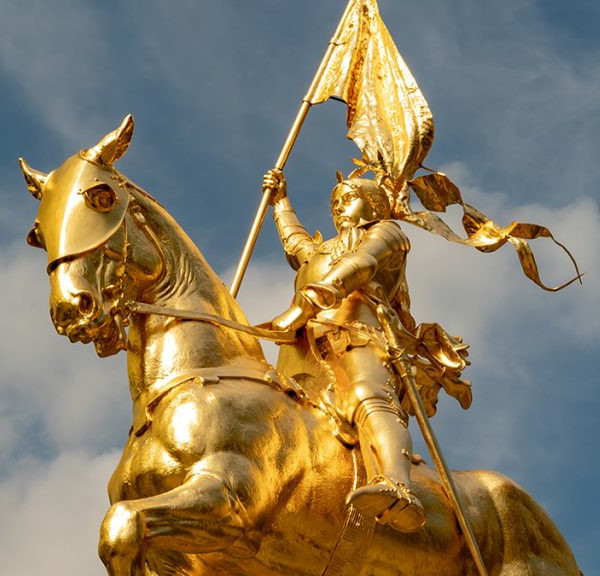
Statue of Joan of Arc in New Orleans

On the 100th anniversary of her canonization, St. Joan of Arc appeared in New Orleans in a miraculous vision to the fortunate multitudes in the 2,100-seat Mahalia Jackson Theater, and I was privileged to be among them. The New Orleans Opera Association’s production of Tchaikovsky’s “Joan of Arc” was presented there February 7 & 9, 2020 under the artistic direction and musical baton of Maestro Robert Lyall. For the unfortunate multitudes who couldn’t be there to experience Joan’s epiphany, I want tell you all about it.

As the translator of Tchaikovsky’s Russian libretto of “Joan of Arc” into English, I’m probably as close as anybody alive to this work. The first translation was done for performances by the Canadian Opera Company in 1978, and though I thoroughly revised it afterwards, Michigan Opera Theatre used the first version for their 1979 production in Detroit. For New Orleans Opera Association’s production in 2020, I substantially revised it yet again.

Having seen the two earlier productions, I feel eminently qualified to critique the New Orleans production. “Maid of Orleans,” or “Joan of Arc,” was the composer’s foray into the field of French Grand Opera, and in my humble opinion, its grandiosity is incomparable. Connoisseurs of the genre, please feel free to differ…

As a Russian scholar, I’ll just say that in my translation the music sounds like it was written for my straight-forward and poetic English words, rather than for Tchaikovsky’s convoluted, many-syllabled Russian syntax. But I also thank Maestro Lyall for his superb edits smoothing out rough edges and much improving the “sing-ability” of some phrases.

In the same vein, I applaud Lyall for masterfully abridging Tchaikovsky’s sprawling libretto (which if performed in its entirety, would run for well over four hours!), into two hours and forty minutes of magnificent music and inspired drama. I also applaud his clever use of supertitles during overtures and entr’actes with brief texts to set true historical contexts and to link the disparate scenes into a cohesive narrative and easily followed story.

This translator’s view will be largely that of a discerning audience member with a long life in theater and opera. Necessarily, I’ll have to leave detailed musical analysis to the musicologists, but I’ll strive for objectivity in my descriptions.

The Production

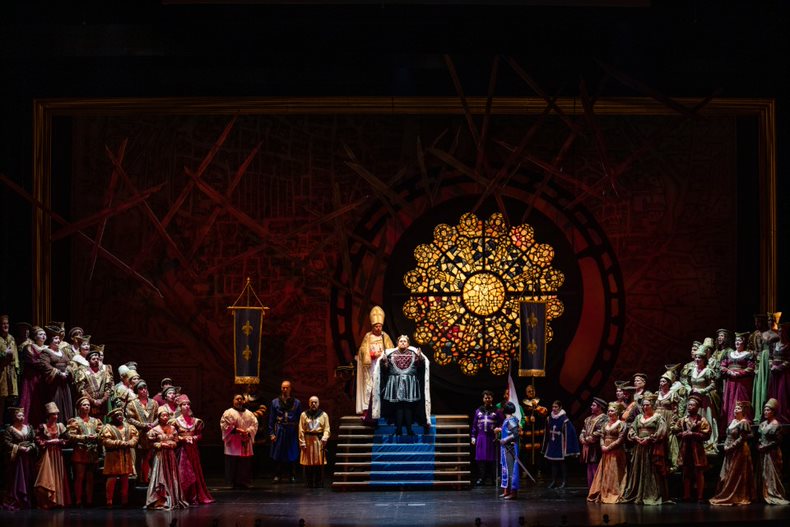
In the four acts of the opera, scenes were all framed simply but ornately as though they were paintings. (In his libretto, Tchaikovsky called the Scenes “Pictures.”) The sets in the Pictures were pleasantly simple and effective, abstract constructions of planks and platforms—call it “plank and platform style,” adaptable and easy to alternate and to execute rapid scene changes.

The backdrops were beautifully “painterly.” That in the first act was particularly so with a hazy landscape and only an outline of a small church that was very symbolic. In later pictures we saw an elegant stained-glass window and then a vast iconic painting of a woman’s face. I thought at first it was Joan, but considering the halo, it made more sense for it to be the Virgin Mary. Whichever, it was an appropriately religious symbol and I hope Scenic Designer Steven C. Kemp is justly proud of his success!

The noted Stage Director, Jose Maria Condemi, should also take pride in his smooth handling of the numerous large crowd scenes and of his sensitive direction of the characters’ movements and interactions within the Pictures. The tableaux, ranging from pastoral to ornate cathedral, were beautifully composed, and all very subtly yet dramatically lit by Lighting Designer Don Darnutzer. Maybe it won’t be a spoiler if I praise his fiery pyre in the opera’s finale.

Joan of Arc at the stake – Photo: Brittney Werner

Let me offer my sincere compliment for the fantastic musicians of the Louisiana Philharmonic Orchestra, directed by Maestro Lyall. They poured Tchaikovsky’s immortal music out over the audience in powerful and heart-wrenching waves. While not a qualified music critic, I can only observe that it sounded really great!

But I do have more than a few clues about some other things. In my past I did a bit of Russian vocal coaching for singers (and for the Paul Hill Chorale to sing Kabalevsky’s “Requiem”). An important component of “Joan of Arc” is that it’s an enormously “choral” opera. Those large crowds mentioned earlier belted out several numbers that rattled the rafters, laments, prayers, fight songs, triumphal marches… What really blew me away was the Hymn in Act One. Prepared by Chorus Master Carol Rausch, the opera chorus sang with remarkable clarity and precision, delicately modulated to balance with the soloists, yet with startling power.

Having been in my long ago past an extra in the ballet “Coppelia” (and a life-long avocational dancer), I’ll claim to know about dance. The obligatory ballet number in Act Two was truly what the King ordered, a jolly entertainment, and likely a lot jollier and sprightlier than it would have been at any French court six hundred years ago. Choreographer Gretchen Erickson melded three superb dancers into an exciting athletic, even gymnastic, frolic. Of the three ballet numbers Tchaikovsky wrote for the opera, Maestro Lyall definitely chose to include the jolliest.

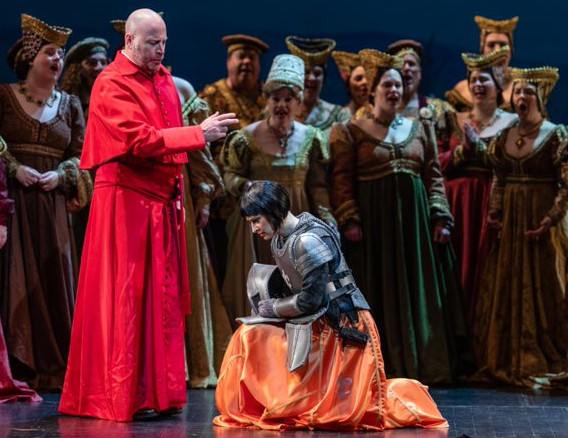
I must also commend the Fight Director Mike Yahn for the various sword fights and attendant mayhem. Avoiding flashy displays, he kept the violence to a realistic and convincing minimum, the way people actually try to stab each other with swords. And I’ll wind up my remarks on the physical production by praising the beautifully detailed period costumes for the peasants, nobles, and military, created by the talented Costumer Julie Winn. Joan’s armor alone was a marvelously medieval piece of work!

The Performances

As the heavenly-inspired peasant girl Joan of Arc, Hilary Ginther completely commanded the stage from the moment of her angelic inspiration through the triumphs, soul-wrenching romance, crushing tragedy and divine enlightenment to her ultimate immolation. This tiny but mighty mezzo Maid filled Mahalia’s huge house with the glory of her prophecies, prayers, spiritual anguish, religious fervor, heroic valor, tender love, and ultimate martyrdom. It is difficult to describe the glorious musicality of Ginther’s performance, but it was a tour de force, a true epiphany. I hope Joan of Arc can become this incredible artist’s signature role, and other opera companies should sign Hilary for many more productions of this masterpiece.

Blessing Joan to lead the troops – Photo: Brittney Werner

In commenting on tenor Casey Candebat’s performance as the Dauphin (King Charles VII), it’s hard not to resort to even more superlatives. In a word, he WAS superlative. With touching humanity, Casey’s rich, clear voice carried all the majesty, romance, and elements of Charles’ personal struggle between cowardice and bravery that Tchaikovsky had written into this role. His coronation address to Joan was a marvel of reverent adoration. Then, convinced by a few presumably divine claps of thunder, he, too, was swept up in the chorus’ orgy of fear and superstition. Abandoning Joan, he rushed off with his newly-won crown, ending the King’s role in her dramatic story that had been wonderfully sung.

Coronation of Charles VII – Photo: Brittney Werner

There are lots of other characters in this opera, and the performances of each and every one were outstanding.

The pivotal role of Thibaut, Joan’s father, was sung by bass Kevin Thompson who, as noted by others, has “a mountain of a voice.” That voice perfectly embodied the element of superstition on which the opera turns. Kevin’s remarkable bass voice, aided by those aforementioned divine thunderclaps, created a true avalanche of fear, hatred, and stupidity that swept Joan from her exalted heights into a pit of despair and exile—the ultimate parental guilt trip. No wonder that during the bows Kevin earned the audience’s heartfelt boos!

Soprano Elana Gleason, playing Agnès Sorel, the King’s affectionate mistress, expertly delivered her extremely difficult love arietta with the King—with its very high notes!—with great delicacy and tenderness. We should all have such generous mistresses!

The role of Dunois, duc d’Orléans, was impressively fulfilled by dramatic baritone Michael Chioldi, who served as the conscience and inspiration for the King. In all of his scenes, Michael’s resonant voice drove the action, his nobility instilling courage and resolve. It is a complicated role with its aspects of conflicting loyalty and heroic determination.

The role of the romantic male lead, the Burgundian knight Lionel, was performed by baritone Joshua Jeremiah. Lionel is a pivotal role, a man who turns from French traitor into passionate lover, who first abuses Joan as a demon and then becomes her protector. In the final love duet, Joshua’s heroic voice blended perfectly with Joan’s mezzo in praise of God’s heavenly gift of love. (Unfortunately, he had to die—but did so grandly.)

I was thrilled by bass Raymond Aceto’s Archbishop who narrated to the court with ecclesiastical majesty Joan’s first appearance with the French troops, her leading them into battle, and their victory over the English. Raymond’s every word was crystal clear and weighty with the miracle of it all. He brought the same musical authority to all his other scenes, whether urging the people to believe or interrogating Joan’s virtue, or even when proving to be just as stupidly superstitious as everybody else.

In Act One, Kameron Lopreore movingly played Raymond, a village suitor whom Joan rejected; his tenor solo line in the Hymn was sung with plaintive force. Bertrand, a peasant refugee, was sung with immense pathos by baritone Ken Weber, and his solo line in the Hymn was a profound lament. The unnamed Warrior played by baritone David Murray dramatically narrated his narrow escape from the battle of Orleans and confirmed Joan’s first prophecy. In Act Two a dying soldier named Loree was sung by Frank Convit. His lines urging the King to join the fray and his final words “I’ve done my duty now…” were sung with all the poignant power of a seasoned soloist. All four of these roles were expertly delivered.

Concluding Remarks

You’re probably wondering if the preceding descriptions can be called objective, but I assure you they were—I could find nothing even vaguely negative to say! But, though I’d love to say that the New Orleans production of “Joan of Arc” was flawless, I admit there was one challenging detail.

Three times Joan hears the heavenly voices, and the angelic messages are crucial to the very structure of the opera. First, they send her forth on her mission, and second, they proclaim her mission accomplished and call her to come to glory (where a virgin martyr’s crown awaits, as well as rapture in God’s divine embrace). Then, third, they welcome Joan into heaven.

The off-stage voices of the angels, necessarily somewhat muted and baffled by curtains, largely got drowned out, sometimes by the enthusiastic orchestration and at other times by competing vocal lines. Fortunately, the words appeared on the supertitle screen—albeit quite briefly—allowing audience members to some degree to follow what they were supposed to be hearing sung and to sort it out from the other competing vocal lines.

What I could hear of Julia Tuneberg’s lovely soprano was ethereal, but her single voice was mostly lost in the melee.  If that was anyone’s fault, it was the composer’s.  Julia’s vocal lines being absolutely the most important element of the sequences, and given the traditional limitations and challenges of writing for off-stage voices, Tchaikovsky’s rich orchestration and vocal writing probably should have taken that more into consideration.

A modern solution for future productions, (of which I hope there will be many—my English translation gratis), would be to forget the back-stage and off-stage voice placement and send their sound through speakers from the ceiling of the house, even sending the separate vocal lines down from either side, antiphonally if you will. The audience should ideally hear surreal voices coming from heaven—and understand the words.

On that note, let me strongly advocate for performing operas in translation. Operatic puritans’ desire to preserve the musical sound of a composer’s work is admirable, but by opposing performances in translation, they often discount the verbal sound and deny “foreign” audiences a full appreciation of the drama in a work, especially so in this one. As a Russian scholar, I observe that with its intensely poetic language (i.e., twisted word order and obscure, stylized vocabulary—not to mention some wild musical calisthenics on important words), Tchaikovsky’s Russian libretto for “Joan of Arc” verges on the unintelligible even for native speakers of that language. In some respects, the composer seems to have chosen to rely on the visual scenes (Pictures) to suggest most of the theater in his work and considered the verbal fine points of the drama as more or less negligible.

Yet, Joan’s drama is the truly grand part of this grand opera. Like the angel voices, audiences deserve to comprehend fully her inspiration, heroism, moral anguish, triumph, and apotheosis. Her story is of vast import even for today: a woman of incredible strength and determination who literally saved her country, a powerful spirit who transcended medieval superstition and ignorance to achieve Sainthood—her true moral victory. All the more astounding for happening six centuries ago, Joan’s victory needs not be reduced to mere musical fireworks and orchestral magnificence. To convey all the grandeur, her glorious words should be readily comprehensible.

That’s why I’ve devoted creative energy to this amazing work for more than forty years. And that’s why I now urge opera companies in English-speaking countries everywhere to produce it—now readily available in translation—and to thrill us with the brilliance of Joan’s glory, as so beautifully done by the New Orleans Opera Association.

#

Richard Balthazar is a former Russian scholar, arts administrator, and vendor of used plants, now happily retired as a writer and artist. He can be reached at rbalthazar@msn.com.                


The Primal Flaw

Here I go again with another quasi-political pronouncement!

Ever since this whole debacle started, I’ve been asking myself what exactly the problem is with our country. At first I looked for what’s wrong in our economic system and found many truly fatal flaws.  But then I realized that to find the primal flaw one must look on the meta-level—at the country itself as a social organization.

As a career organizational administrator (long retired), I know how crucial it is for any organized undertaking to have plans for operations and future directions. As a country, the US supposedly has a detailed plan for operations, or at least guidelines for such, in our revered Constitution.  However, we have nothing that tells us which way or where our country is supposed to go.

A notion of future directions is necessary to accomplish any purpose or achieve a mission. Believe it or not, our founding sages never articulated a mission for their new country.  The only thing I can find in the Constitution even vaguely regarding a purpose is in Article I, Section 8: “The Congress shall have Power To [lay and collect Taxes, Duties, Imposts and Excises, to pay the Debts and] provide for the common Defence and general Welfare of the United States…”

Note that this section merely gives Congress the power to do various things; it doesn’t charge the government as a whole with responsibility to do those things. And what’s more, “Defence” and “Welfare” relate only to the country/government itself, not to its citizens.

I can find no constitutional parallel to Lincoln’s famous Gettysburg comment about the US being a government of the people, by the people, and for the people.  Here Lincoln says explicitly what the mission should be for our country as an organization:  The purpose of the government is to provide for the common defense and promote the general welfare of the citizens of the United States.

More simply, the government should operate for the benefit of all the people and move in directions that protect and improve all our lives.  But in regrettable statistical fact, our government serves only some of the people, those with (heavily) vested interests.

So that’s my well-considered diagnosis. Let me think for a while on what to prescribe for this serious Social Systemic Disorder (SSD).  It’s an unsustainable, life-threatening condition that will definitely require radical treatment to save the patient.

An Aerobic Insight

Most of my penetrating insights come while peacefully tromping the treadmill (lengthening those pesky telomeres to counteract aging—which I’ve done more than enough of in eight decades of breathing). Nearing the mile mark the other day, I suddenly considered that our abominable chief executive might well have a death wish.

On further consideration, I saw that my amateur psychoanalysis of the beast should be more complicated than that. The vile creature probably doesn’t wish for death as a release but as an apotheosis, quite possibly its ultimate goal.

I understand that its campaign goal was purported to be to “Make America Great Again,” but I also understand ‘great’ in its diabolical terms to mean ‘a rich (old) white man’s country.’ That would be just like America used to be under the heartless oligarch’s favorite president, Andrew Jackson, with whom it shares many biographical and attitudinal characteristics.

Not the least of those is being a megalomaniac real-estate rustler, cynical and dishonest game-player, and unscrupulous persecutor of non-rich and non-white populations. All its policies and actions show unambiguously that our rogue leader is in no way a humanitarian, but an aristocratic despot engaged in a class and racial war.

Its now-failed attempt to extort funds from Congress for a barrier to human freedom by closing down the government was intentionally designed to damage the economic security of the non-rich and people of color and deepen the class and racial divides.

Even with the government re-opened, that social divide will remain much deeper than before. In its misanthropic view, that political atrocity was still a battle essentially won.  In future battles, its strategy will be the same and tactics just as inhumane and ruthless.

The hubristic autocrat will see the people’s suffering, unrest, and possible resistance as futile. Winning the class and race war is to be its historic contribution to society, human and cultural costs be damned.  For the amoral, the ends justify the means.

Total victory would of course be to re-institute slavery, re-establish a nobility, and address the population situation with genocidal solutions—the true essence of conservatism. Should resistance not prove futile and someone manage to eliminate it, the monster would probably consider that the best-case scenario.

I’ll bet the demagogue is psychotically jealous of the eternal glory that Lincoln and Kennedy achieved through being assassinated—or more grandiosely of the immortal fame of Julius Caesar. (For the tragically murdered, all faults and sins are apparently forgiven.)

If so, the unbelievable genius would become not only a messiah for rich (old) white men, but a sainted martyr. Let’s call the spade a self-anointed second Jesus Christ—sacrificed for the sins of humanity.  Sad.

If these are truly the demon’s delusional ambitions, we have to ask which would be preferable: for the scoundrel to win its inhuman war or for it to become a glorious hero?  I would opt instead for the slight chance that it might lose the war and go down in history as an unparalleled villain.

#


A Roar of Jaguars

In the past few years, I’ve realized that, in the Native American tradition, I seem to have an animal totem, the jaguar. This past year when I started my second memoir, I understood my deep connection to this apex predator of the Americas and included an illustration:

My Totem Jaguar

I also realized that this magnificent feline has been lurking in my background for at least 35 years. At a yard sale I’d bought a carved-wood figurine and stashed it away as a curiosity.  Later I gave it as a birthday gift to a friend, who returned it explaining that there was some spirit in it which didn’t “resonate” with him.  Stashed away again, it sat on a shelf for decades—following me around to various domiciles.  Then about a year ago I recognized it for a jaguar-priest or shaman from some South or Meso-American tradition.

My Jaguar Priest Figurine

It suddenly made sense that this jaguar figurine was probably why some 30 years ago I’d gotten so involved in the Aztec milieu. I soon learned that this New World King of Beasts had originally roamed throughout most of the South and Meso-American jungles and even ranged north into the American Southwest (apparently now making a comeback in southern Arizona!).

I also learned that the noble jaguar was central to the mythologies of basically all the ancient civilizations of the New World (just as the lion was to those of the Old). First off, I found it in the Aztec calendar, as the 14th day of their agricultural month and in the second week of their ceremonial count of days (tonalpohualli).  Starting with the day Ce Ocelotl – One Jaguar (those with this birth day-name coincidentally being destined for sacrifice), that second week was under the patronage of the god Quetzalcoatl, the Plumed Serpent.

I already knew that the Aztec ceremonial calendar had been more or less inherited from the much earlier Maya and then discovered that it, just like its patron deity, was also revered by the even earlier Olmec. Then about three years ago in considering that maybe the sacred calendar’s count of days had originated in the still earlier Chavín civilization in Peru, I learned that the jaguar was for them also a major deity, often seen as an ornate man-jaguar.  Do note this Chavín were-jaguar’s startling snake-locks!

Chavin Were-Jaguar

If my suggestion that the count of days originated at Chavín de Huantar is correct, that ritual (more like a religion), was carried north by trader-missionaries to populations along the Pacific coast. Ultimately they crossed the Isthmus of Tehuantepec and proselytized the Olmec with the sacred way of telling time.  Many surviving Olmec sculptures are of infant were-jaguars.

Coincidentally, earliest calendar lore has it being brought by a god, namely the Plumed Serpent, who was also the bringer of maize (and culture). Between the calendar, the jaguar, and this legendary civilizer deity, they had a rather well-rounded theosophy, even if some rituals might have involved sacrifices frowned on nowadays.

It’s now become reasonable to think that the early Maya were “civilizing” in Yucatan at much the same time as the Olmec were hard at it in Veracruz. More mercenary missionary work was probably what took the calendar to the Maya.  They hugely elaborated and ornamented the new “faith” with their own deities and even started writing about it in glyphs.

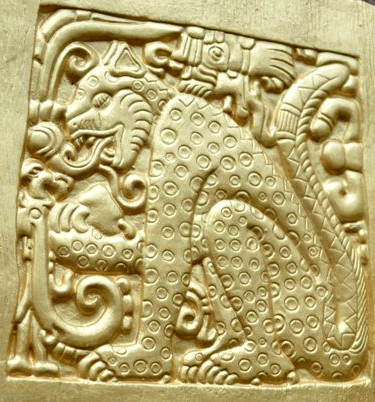
Along with calendar, the jaguar deity (B’alam) came to the Maya, but their representations of it were generally not anthropomorphized.  I found a spectacular relief at Chichen Itza on Google Images, apparently a repro in gold (!), that’s both naturalistic and stylized.  Not to gross you out, but I bet that’s a heart it’s holding in its paw and licking.

Mayan Jaguar from Chichen Itza

Of course, the third part of the religion was the Plumed Serpent, the civilizer deity whom they called Kukulcan (or Gugumatz).  This Triad then moved west and north to early Teotihuacan, where the Serpent likely became known as Quetzalcoatl, or maybe that was amongst the later Toltecs.  That calendar religion reigned across the centuries and other areas of Mexico, as shown by this jaguar totem from the Zapotecs, possibly a funerary urn.

Zapotec Jaguar

Eventually, the barbarian Aztecs came out of the north and adopted the local religion, and it came to be known and misunderstood as the “Aztec Calendar.” In their historical or genealogical picture-books, many of which were from other cultures like the Mixtec, the were-jaguar shows up as jaguar warriors.  These “jaguar-weres” were simply humans wearing jaguar pelts.

Perhaps the most dramatic Aztec jaguar is a sculpture (receptacle for sacrificial hearts!), now in the Museum of Anthropology:

Aztec Jaguar

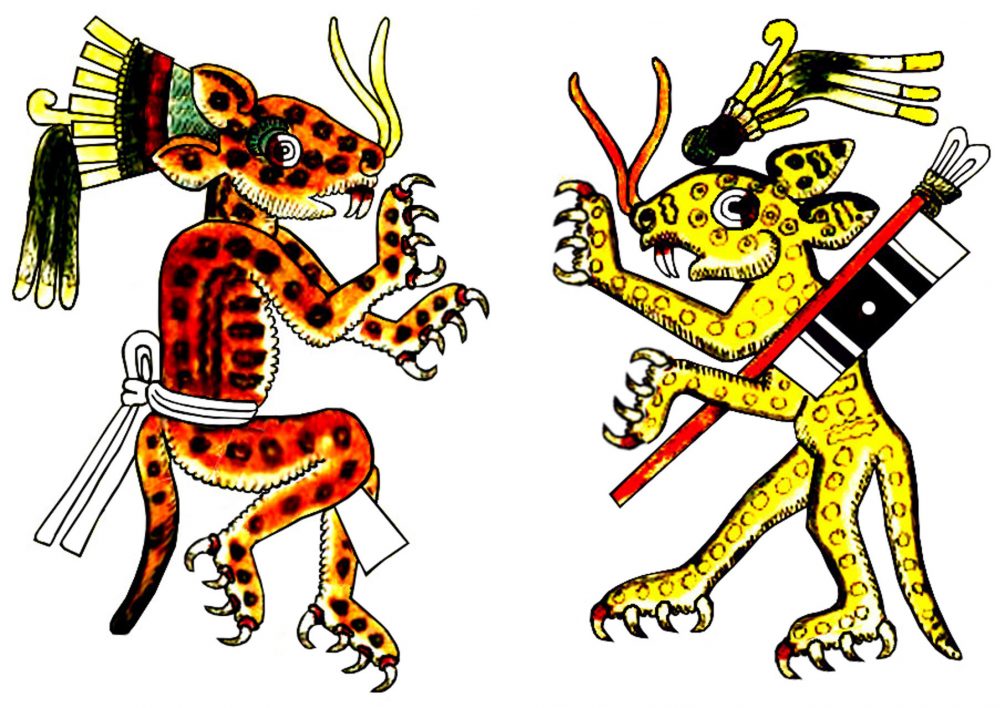
In their religious documents, the jaguar is generally depicted as a divine animal such as these two from Codex Borgia, (adjusted and adapted to prepare for drawings in my next icon).  By the way, those wavy figures represent the jaguar’s roar.

Jaguars from Codex Borgia

Modelling mine on the image on the left, several years ago as my first attempt at drawing on computer, I drew a jaguar with a realistically patterned pelt (and more aggressive demeanor). Intended to be the apotheosis of the Lord of the Animals, the drawing had to wait some three years to be enthroned in YE GODS! Icon #11 – OCELOTL.

My Jaguar–Lord of the Animals

But I’m not done with this roar of jaguars! Recalling that the historical range of the jaguar reached up into North America, there is the possibility that the creature may have been known, or at least recalled, by populations outside of the desert Southwest.  I’m talking about my other favorite topic, the Mississippian “civilization.”

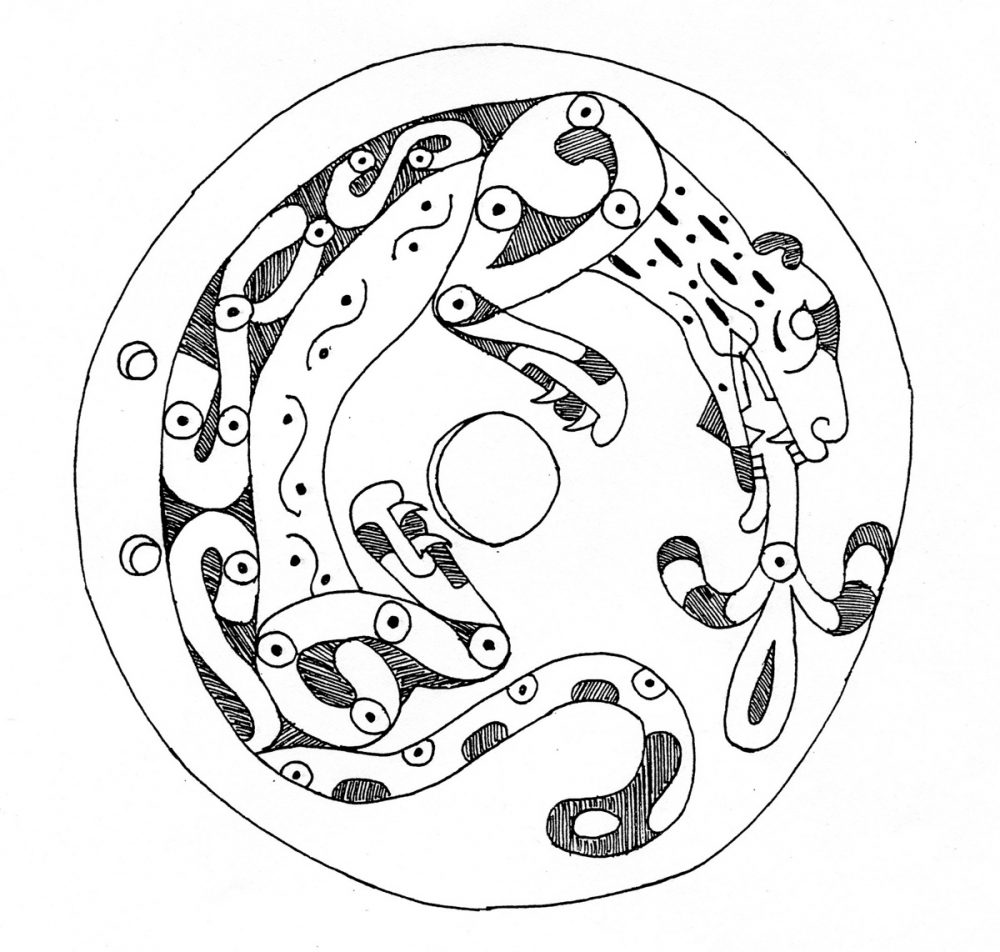
I found a trace of the calendar and image of a heavily stylized man-jaguar in the Southeast and drew this fanciful animal below from a shell gorget (from Fairfield MO across the river from Cahokia) for a book on the Indian mounds.  (See my Gallery of Pre-Columbian Artifacts.)

Jaguar Gorget – Fairfield MO

In the magazine “Ancient American,” Vol. 21, No. 116, I wrote about the cult of the Plumed Serpent in North America, which shows that the trinity of Calendar-Jaguar-Serpent was a Pan-American “religion.”  Small wonder I feel the jaguar my totem—it’s the totem for all Americans.

#


Ancient America-Asia Coincidences

Recently I came across two historical coincidences worthy of comment. Both may be archaeologically, or at least anthropologically, significant.

  1. The Rabbit in the Moon.

Readers should be advised that I’ve “studied” (more like “obsessed with”) things Mesoamerican for about 30 years now, and have become fairly conversant about their mythology and art, mainly of the Aztecs. More about that in a moment.

Some decades ago I learned that the Mesoamerican peoples saw a rabbit in the moon. This “moon rabbit” was famous amongst the early Maya, shown here with the moon goddess Ix Chel:

The image of a rabbit in the moon occurs in two of the surviving pre-Conquest Aztec codices (picture-books) and in one of the post-Conquest documents.

Aztec Rabbits in the Moon

Learning about this lunar bunny, I checked out the full moon and immediately saw it clearly. Before, I’d never really been able to see a face in the moon (the European tradition), and now I can see nothing but the rabbit.  In my Aztec obsession, I’ve spent the past several years drawing icons of their deities and am now working on the god of the moon, Tecciztecatl.  As a detail for that icon, I’ve concocted my own Moon Rabbit in an Aztec style and in the orientation I’ve scientifically observed.

Imagine my surprise when I read a book about Chinese myths and legends and discovered that the ancient Chinese also saw a rabbit in the moon. Under “Moon Rabbit” on Wikipedia, I learned that in their inscrutable oriental way, the image the Chinese saw was a rabbit facing to the right—and anthropomorphically using a mortar and pestle to pound herbs or medicines (that equipment occupying the area of my bunny’s bottom).

The entry advised that this traditional image also spread to Japan and Korea and added, “Legends of moon rabbits exist among some of the indigenous peoples of the Americas.” Then the entry states categorically:  “These legends were not influenced by Asian cultures.”  This gratuitous pronouncement smacks of a polemical personal opinion designed to forestall any further discussion of the subject.  Typical…

Now, I’m not arguing that this coincidence necessarily shows any America-Asia connection. It’s quite reasonable that the two widely separated peoples could see the same familiar creature (in differing perspectives) in the Rorschach blur on the moon’s orb.  The bunny could well be a pure coincidence (though some say there are no coincidences).

  1. The Ten Suns

In the same book of Chinese myths and legends, one struck me as surpassingly surreal. The god of the eastern sky, Di Jun was the father of ten suns [sic!] which took turns crossing the sky on each of the ten days of the week.  But they got bored with the routine and one day decided to ride in their chariots all together across the sky, which heat caused great damage to the earth and its creatures.  Unable to make his suns behave properly, Di Jun summoned the Divine Archer Yi and gave him a magic bow and arrows to make the suns resume their rotating duties.  Yi shot down nine of them, leaving only one to cross the sky every day.  That solution greatly distressed Di Jun, who condemned Yi to live a mortal life.  Curious tale…

A few months later I read a book called “Native American Myths and Legends,” which was published by Arcturus Publishing Ltd. in London (2017). The stories were recorded by a range of different writers/ethnographers from the 19th and early 20th centuries.

The story that stopped me in my tracks was attributed to a tribe called “Shastika” and taken from a book by Katharine Berry Judson, “Myths and Legends of California and the Old Southwest (1912). That tribe from northern California/southern Oregon is now called simply Shasta or Shastan and logically relates to the magical Mount Shasta. Per Wikipedia, by the early years of the 20th century perhaps only 100 Shasta individuals existed, and some few Shasta descendants apparently still reside in various reservations with other tribes.

The story is called “Old Mole’s Creation.” (Forgive my disrespectful levity, but the title calls to mind a character from that ancient comic strip “Pogo”—Ol’ Mole was blind as a mole and an avid bird-watcher!) Anyway, first “Old Mole burrowed underneath Somewhere and threw up the earth which forms the world.” Then, “in the beginning, Sun had nine brothers, all flaming hot like himself. But Coyote killed the nine brothers and so saved the world from burning up.” Those two simplified sentences are an obvious restatement of the Chinese legend of the ten suns.

But the Shasta tale does the Chinese one better by adding a parallel plot: “But Moon also had nine brothers, all made of ice like himself, and the Night People almost froze to death.” So as the Moons arose, Coyote killed nine of them with his flint-stone knife saved the Night People. Native American story-telling loves coyotes and symmetry.

These two tales of the ten suns are simply too counter-intuitive (and weird) to have developed independently. So I’ll boldly claim that they prove an ancient cultural connection between Asia and America. (They clearly support Gavin Menzies’ book “1421: The Year China Discovered America” and Laurie Bonner-Nickless’ interminably titled book about Chinese exploration of North America in 1433-34, which was just reviewed in “Ancient American,” Issue 121.)

Cue the academic inquisitors!

#