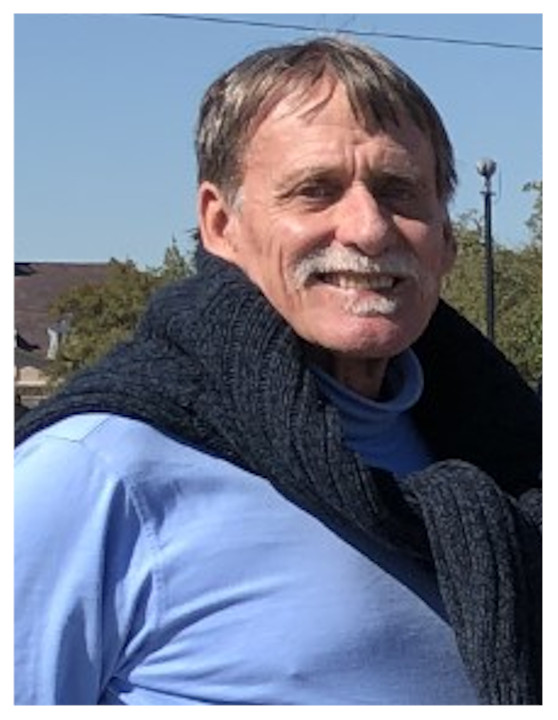
Almost Twelve

This fifth chapter of KID STUFF deals with a single year of my juvenile life.

SOUTHLAWN II – A DORKIER DORK describes the brief, busy year when I was eleven. Though widely read, I was still cluelessly naïve about life, love, and the world and was just starting to discover the wonders of music, song, and dance. It was a splendidly exciting time.

Not that I was a prodigy, but I had inspiration and aspirations that could have gone somewhere. When Daddy suddenly took us away from Southlawn Circle, at almost twelve, my promising childhood ended abruptly—like a budding flower yanked out of the ground by its roots.

###

The Girl I Should’ve Loved – In Memoriam Jane Rose Sallis

Jane Rose in Newcomb College Picture, 1963

Once again, I find it my old man’s duty to write in memoriam about a beloved spirit from long ago who has now left me behind on this plane of existence. Jane Rose Sallis (November 12, 1942-August 14, 2024) and I were students respectively at Newcomb College and Tulane University in New Orleans. We caroused frantically in the French Quarter, tremendously close friends and dancing partners, all through the spring, summer, and fall of 1962. It was her dire misfortune that Jane fell in love with me, a wild queer boy too besotted by my newly realized homosexuality to recognize this golden chance to love her back.

Many years later, I wrote in “Divine Debauch” about my dissolute youth in the sailor bars on Decatur Street, a memoir in the form of a semi-epistolary, multiple-narrator novel. The chapter covering Jane’s and my still-born romance is called “November Someteenth.” (Click HERE to read or download the chapter.) I dared to write it in her voice, telling exactly in truth how it played out, trying to understand that powerful experience from her point of view. While it’s the sordid tale of my own depravity, I believe looking at it through her eyes was as close and intimate as we ever got.

Being in a novel, her character was named Rose, and my name as protagonist was Tommy Youngblood, stolen from a real friend from high school. Tommy appeared in a cameo in my other memoir-novel “Bat in a Whirlwind.” Meanwhile, the Ben who kept watch over Rose had previously been me as the protagonist of that book, now a Tulane student. I brought him in to give Rose and Ben the beautiful romance Jane and I never had. Such is the special magic allowed the novelist-memoirist. Sadly, I can’t go back and write in a great love affair for us.

Jane and I in the Gin Mill, 1962

After we split up that evening in the Napoleon House, Jane retreating to her quiet, sane life and I off to debauch in La Marina, we remained friends for two more years till graduation. Once graduated, she married an aspiring writer named Jim and moved away to Iowa City for his writing career. I went to Seattle for graduate school (and profound trauma—as narrated in my memoir “There Was a Ship).”

At the end of 1965 I passed through Iowa City and visited Jane over a cup of tea, learning that she’d just had a baby boy. It was awkward, considering that I too was now married—and expecting a child. I doubt Jane appreciated my apparent reversion to heterosexuality, but I couldn’t explain how it was a terrible trap I’d fallen into. Consequently, neither of us spoke much about the past—or the present, and afterwards we lost contact.

Honest to John, I have no idea how we re-connected, but in the early 90s we did. Jane came to visit Santa Fe, and we spent several afternoons together catching up. She’d divorced Jim many years before, lost her son Dylan to suicide when he was around 15, started working in one of Seattle’s serious wealth-producing industries, retired well-provided for, and bought a house in San Miguel de Allende, Mexico. Our talks as 50-year-olds were warm but again focused solely on present concerns and plans. I sensed her lack of surprise that I’d left my wife and family long before to resume gay relationships. After her visit, for the next 30 years we remained in close, if sporadic, email touch.

Jane Rose Sallis at her Birthday Party, 2020

When I finished the first version of “Divine Debauch” in like 2000, I sent Jane a copy, pointing out her chapter. She wrote back that she’d read that chapter, and that was indeed how she remembered our misbegotten love affair. Our time together in the sailor bars had been the most exciting experience in her life, but she tried never to think about the past. I suppose she felt hers was too boring and painful, but my gay past felt endlessly fascinating.

In our communications, I never reminisced with Jane, simply reporting on my odd plant-vendor work and progress on writing projects—and sending her an occasional piece of my weird Aztec artwork. I was pleased that her comfortable, beautiful life in splendid San Miguel was so full of philanthropic activity and blest with puppies that always featured on her Christmas cards.

When I sent my recent birthday wishes and heard nothing back, I soon learned that my “first girlfriend” had passed away. We’d never kissed.

###

Nine Cycles – Eight Personas

Significantly, in the Aztec calendar March 6, 2024, was the day Ome Acatl (Two Reed) and my 115th birthday in that ceremonial cycle of 260-day years. In our western calendar, I’ve recently celebrated my 81st birthday, wrapping up nine cycles of nine Gregorian years and starting in on my tenth cycle. The nine include a first inchoate period of childhood and eight discrete personas. For lack of a better description, I’m calling this new ninth persona the venerable iconographer, researcher, and/or historical theorist. We’ll just have to wait and see how that pans out.

Here’s an illustrated summary of my nine cycles for easy reference.

Cowboy at 3 or 4

Inchoate Childhood in almost rural Indiana (9 years)—Little can be said about Dickie except that he was the bright but spoiled son of Yvonne and Ray. You can read about him between the lines of my memoir-biography “Ms. Yvonne, the Secret Life of My Mother.”

Class Picture at 15

Cute, clueless kid in the backwoods of Arkansas (9 years)—At 15 with a stylish flattop hairdo, Richard was an outstanding student, accomplished loner, and an avid rock’n’roll dancer, usually solo. He had the misfortune of being raised Catholic and being futilely in love with Annette Funicello. You can read about my adolescent traumas in my semi-fictional novel “Bat in a Whirlwind.”

At 21 in the House of the Rising Sun

Wild faerie slut in New Orleans’ French Quarter (5 years)—Shown here in 1963 in his apartment at 387 Audubon Street, Rick had just turned 21, was majoring in Russian at Tulane University, spent nights dancing in Latin and Greek sailor bars, and had urges to art and literature. In this photo he’s stunned by frenzied sex with a football-player named Tom. Such sordid adventures are described in my second semi-fictional novel “Divine Debauch.”

Early 1968 with Aimee

Reluctant father and Slavic scholar in northern universities (6 years)—Richie is pictured here in early 1968 at 25 with younger daughter Aimée in apartment on East Kingsley in Ann Arbor MI. On my marriage to Barbara and birth of older daughter Jacqueline, read my first real memoir “There Was a Ship.”

Single again in 1970 in Milwaukee

Hippie poet, footloose and feckless (2 years)—Photographed in December 1970 at 28 in his Bellevue apartment in Milwaukee by his mother on a visit, Richie was again stunned, first by the welcome shock of being divorced and second, by a passionate affair with a ballet dancer named Kenny. These two years of that and other love affairs are detailed in my second memoir “Lord Wind.”

In 1978 at Logan Circle

Courtesan in a Victorian mansion at Logan Circle in Washington DC (9 years)—Shown in 1978 at 36 in publicity photo for performance of his translation of Tchaikovsky’s opera “Joan of Arc” by the Canadian Opera Company in Toronto, Richard was now a professional arts administrator with OPERA America. My libidinous lifestyle in the 70s, DC’s golden age of gay liberation, is celebrated in my third memoir “Gay Geisha.”

At Gay Freedom Parade in Denver

Mature gay gentleman working in various glamorous cities (16 years)—Taken in 1982 when Richard was 40 at the Denver Gay Freedom Parade in a Denver Post front-page picture—with his partner Ernesto. He’d been working for the Central City Opera House and later would work in other arts organizations. Recent exposure to ancient American earthworks eventually led to my first nonfiction book in 1992, “Remember Native America!” Discovery of the Aztec Calendar in the late 80s led to my second in 1993: “Celebrate Native America!

In 2006 with Baby Jade Tree

Grandfatherly gay character, the Used Plant Man of Santa Fe (16 years)—Taken in 2006 at 64 for an article in The New Mexican on Babylon Gardens, Richard had now become a grandfather four times over. I’d also written another nonfiction book, “Getting Get,” was still an avid disco dancer, gave shows of my sculpture (found-object assemblage), and was working on the above novels and memoirs.

Widely unknown elder writer and artist (10 years)—Pictured here in 2020 at the age of 78 in New Orleans for a new production of “Joan of Arc” (by the New Orleans Opera), Richard was retired from business and now spent his time in (Aztec) drawing and finishing the above novels and memoirs. In the later 20-teens, my show YE GODS! (Icons of Aztec Deities) enjoyed seven venues across NM before being closed down by the pandemic. It also hampered my ecstatic dance activities, but the solitude facilitated my blogging and artwork on Aztec themes.

###

Another Dancing Fantasy

This third story about dancing has taken quite a long time—since last September. In the course of realizing the inspiration, I had to manage my move to a new house—and the transfer of my collection of 50 varieties of iris to the new yard. Not to mention wrapping up the Snake and Flint trecenas of the Aztec Calendar and a few blogs on miscellaneous subjects (dance, lunar bunny, and science fiction). If nothing else, that shows I’m a persistent cuss…

Ecstatic Dancer

This third piece of fiction is another old man’s fantasy about ecstatic dancing and encounters with young folks of his ilk. Entitled “Bo Peep’s Sheep,” it’s perhaps a little utopian but draws on the scary aspects of being a youngster nowadays.

Enjoy, and here’s hoping I can manage the next story rather more quickly. Wait for it!

#

Divine Dance

Significantly, in the Aztec calendar March 6, 2024, was the day Ome Acatl (Two Reed) and my 115th birthday in that ceremonial cycle of 260-day years. In our western calendar, I’ve recently celebrated my 81st birthday, wrapping up nine cycles of nine Gregorian years and starting in on my tenth cycle. The nine include a first inchoate period of childhood and eight discrete personas. For lack of a better description, I’m calling this new ninth persona the venerable iconographer, researcher, and/or historical theorist. We’ll just have to wait and see how that pans out.

This ninth Id-Entity will naturally continue my life-long focus on dance—ever since 1952 at the pudgy age of ten dancing in squares. My life of twinkling toes in many ethnic styles is amply discussed elsewhere. For at least 50 years, I’ve danced (mostly by myself) in an array of gay bars—the only place usually to find good dance rhythms—and in 2018, I discovered ecstatic dance. One moves as moved by the music, and the resulting ecstasy can be of a very spiritual nature, or at the very least psychically exhilarating.

Understandably, after decades obsessed with Aztec mythology and iconography, in my dance ecstasy I quite naturally began to personify Aztec deities. For the summer of 2022, I got inspired to dance as Xochipilli, the Flower Prince. Here he is from my Icon #18 drawn in 2020, one of the few icon-details from my YE GODS! coloring book and exhibition that I personally colored. By the way, the monkey is because the Prince is the patron of the day Monkey in the calendar, and the parrot-headdress is emblematic of this god of fertility, crops, flowers, arts, festivity and pleasure (including dance—and sex!).

However, by August that year, I found myself dancing happily as Huehuecoyotl, the Old Coyote (See Icon #6 from 2015), the principal god of dance—and again sex (though for me this activity has been merely hypothetical for number of decades). In the drawing, he dances with rattle and scepter, and his regalia displays his patronage of feather-workers. I particularly love the wavy sound symbols of his howling but regret giving him that inappropriate tail. It’s too naturalistic and actually not at all iconographically authentic. This shape-shifting god was great fun to dance (and howl).

By early the next year, 2023, I started dancing ecstatically as Macuilxochitl (Five Flower), another god of dance and music and a famous manifestation of Xochipilli (a divine being called a nagual). Here he poses in a cameo detail from the 2020 Icon #18. His regalia is standard-issue divine finery, and instead of the hands on his loin-flaps, in traditional iconography, he should have a hand painted over his mouth. Odd fashion, but I didn’t have to wear any of this in our dance for the next several months.

By later last year, I began to realize that I myself was a nagual descendant of Huehuecoyotl—a new old-man deity ironically named Pilzincoyotl (Young Coyote). I began manifesting this divine Pilzincoyotl with rattle and fan in a drawing of an Aztec dancer. But as time went by, our divine lineage was revealed to me: a composite nagual of Xochipilli and Huehuecoyotl, born of a cross-species romantic liaison, on April 26, 1942, with the ceremonial day-name Ome Acatl (Two Reed). With that same day-name, Tezcatlipoca, the Smoking Mirror, is our powerful patron-godfather (See Icon #19).

Now, please understand that naguals only mature after living a full cycle of 52 solar years. So, we became a full-fledged nagual in 1994—just as I went back to a regular regimen of dancing. Our formal divination was by Tezcatlipoca on the day Ce Ollin (One Movement) in that year, ordaining us a deified spirit of dance. A half-cycle (26 years) later in 2020—just before the Pandemic—we were canonized as an official deity of dance with the rank of Quetzalcoyotl. Worshippers should address us as Ollintecuhtli, Lord of Motion, (esp. Earthquakes—when the earth itself dances), but you can just call us Quake.

Just last month, I finally completed my drawing of Pilzincoyotl, a self-portrait in neo-Aztec style. I should explain that at our ordination, we were also dubbed a deity of the rainbow, Cozamalotecuhtli. The fluttering curlicues are the sounds of the music for our divine dance.

Pilzincoyotl (Ce Ollin) Dancing in the Flower World

Please don’t think these are psychotic delusions. They’re not delusions but illusions, sur-realities. (Besides, reality itself is simply a construct of illusions.) Actually, my illusions of divinity may be psychotic, but they’re perfectly harmless. I don’t need anyone else to worship or believe in me. Just knowing I’m a god is plenty good enough. Precious few folks realize that they’re in fact deities.

###

Another Story about the Old Man Dancing

After taking a break to complete the Grass trecena illustrations and blog, I’ve managed to wrap up my second short story about the dance in this old dame yet, incorporating the valuable comments of an old friend who’s a respected writer in her own right. She thinks, as do I, that I’m crossing some lines in the usual treatment of the relationship between the (much) older and the newest generation.

In fact, these aren’t stories about me, but sheer fictions about young folks I supposedly encounter in my ecstatic dance evenings (usually at least twice a week). This second story is entitled “Better Buy a Dozen,” about the old man offering grandfatherly advice to a young fellow who doesn’t know what kind of guy he should think of himself as.

Since I have no image specific for this story, I think I’d best simply use the old picture of Five Flower dancing again–like a logo for the short-story series I’m planning on the theme of the Old Man Dancing. He comes from my re-creation of the Codex Borgia Flower trecena:

Aztec God Five Flower Dancing Ecstatically (and Singing)

###

JOAN OF ARC: The Maid in New Orleans

The Translator’s View by Richard Balthazar

Statue of Joan of Arc in New Orleans

On the 100th anniversary of her canonization, St. Joan of Arc appeared in New Orleans in a miraculous vision to the fortunate multitudes in the 2,100-seat Mahalia Jackson Theater, and I was privileged to be among them. The New Orleans Opera Association’s production of Tchaikovsky’s “Joan of Arc” was presented there February 7 & 9, 2020 under the artistic direction and musical baton of Maestro Robert Lyall. For the unfortunate multitudes who couldn’t be there to experience Joan’s epiphany, I want tell you all about it.

As the translator of Tchaikovsky’s Russian libretto of “Joan of Arc” into English, I’m probably as close as anybody alive to this work. The first translation was done for performances by the Canadian Opera Company in 1978, and though I thoroughly revised it afterwards, Michigan Opera Theatre used the first version for their 1979 production in Detroit. For New Orleans Opera Association’s production in 2020, I substantially revised it yet again.

Having seen the two earlier productions, I feel eminently qualified to critique the New Orleans production. “Maid of Orleans,” or “Joan of Arc,” was the composer’s foray into the field of French Grand Opera, and in my humble opinion, its grandiosity is incomparable. Connoisseurs of the genre, please feel free to differ…

As a Russian scholar, I’ll just say that in my translation the music sounds like it was written for my straight-forward and poetic English words, rather than for Tchaikovsky’s convoluted, many-syllabled Russian syntax. But I also thank Maestro Lyall for his superb edits smoothing out rough edges and much improving the “sing-ability” of some phrases.

In the same vein, I applaud Lyall for masterfully abridging Tchaikovsky’s sprawling libretto (which if performed in its entirety, would run for well over four hours!), into two hours and forty minutes of magnificent music and inspired drama. I also applaud his clever use of supertitles during overtures and entr’actes with brief texts to set true historical contexts and to link the disparate scenes into a cohesive narrative and easily followed story.

This translator’s view will be largely that of a discerning audience member with a long life in theater and opera. Necessarily, I’ll have to leave detailed musical analysis to the musicologists, but I’ll strive for objectivity in my descriptions.

The Production

In the four acts of the opera, scenes were all framed simply but ornately as though they were paintings. (In his libretto, Tchaikovsky called the Scenes “Pictures.”) The sets in the Pictures were pleasantly simple and effective, abstract constructions of planks and platforms—call it “plank and platform style,” adaptable and easy to alternate and to execute rapid scene changes.

The backdrops were beautifully “painterly.” That in the first act was particularly so with a hazy landscape and only an outline of a small church that was very symbolic. In later pictures we saw an elegant stained-glass window and then a vast iconic painting of a woman’s face. I thought at first it was Joan, but considering the halo, it made more sense for it to be the Virgin Mary. Whichever, it was an appropriately religious symbol and I hope Scenic Designer Steven C. Kemp is justly proud of his success!

The noted Stage Director, Jose Maria Condemi, should also take pride in his smooth handling of the numerous large crowd scenes and of his sensitive direction of the characters’ movements and interactions within the Pictures. The tableaux, ranging from pastoral to ornate cathedral, were beautifully composed, and all very subtly yet dramatically lit by Lighting Designer Don Darnutzer. Maybe it won’t be a spoiler if I praise his fiery pyre in the opera’s finale.

Joan of Arc at the stake – Photo: Brittney Werner

Let me offer my sincere compliment for the fantastic musicians of the Louisiana Philharmonic Orchestra, directed by Maestro Lyall. They poured Tchaikovsky’s immortal music out over the audience in powerful and heart-wrenching waves. While not a qualified music critic, I can only observe that it sounded really great!

But I do have more than a few clues about some other things. In my past I did a bit of Russian vocal coaching for singers (and for the Paul Hill Chorale to sing Kabalevsky’s “Requiem”). An important component of “Joan of Arc” is that it’s an enormously “choral” opera. Those large crowds mentioned earlier belted out several numbers that rattled the rafters, laments, prayers, fight songs, triumphal marches… What really blew me away was the Hymn in Act One. Prepared by Chorus Master Carol Rausch, the opera chorus sang with remarkable clarity and precision, delicately modulated to balance with the soloists, yet with startling power.

Having been in my long ago past an extra in the ballet “Coppelia” (and a life-long avocational dancer), I’ll claim to know about dance. The obligatory ballet number in Act Two was truly what the King ordered, a jolly entertainment, and likely a lot jollier and sprightlier than it would have been at any French court six hundred years ago. Choreographer Gretchen Erickson melded three superb dancers into an exciting athletic, even gymnastic, frolic. Of the three ballet numbers Tchaikovsky wrote for the opera, Maestro Lyall definitely chose to include the jolliest.

I must also commend the Fight Director Mike Yahn for the various sword fights and attendant mayhem. Avoiding flashy displays, he kept the violence to a realistic and convincing minimum, the way people actually try to stab each other with swords. And I’ll wind up my remarks on the physical production by praising the beautifully detailed period costumes for the peasants, nobles, and military, created by the talented Costumer Julie Winn. Joan’s armor alone was a marvelously medieval piece of work!

The Performances

As the heavenly-inspired peasant girl Joan of Arc, Hilary Ginther completely commanded the stage from the moment of her angelic inspiration through the triumphs, soul-wrenching romance, crushing tragedy and divine enlightenment to her ultimate immolation. This tiny but mighty mezzo Maid filled Mahalia’s huge house with the glory of her prophecies, prayers, spiritual anguish, religious fervor, heroic valor, tender love, and ultimate martyrdom. It is difficult to describe the glorious musicality of Ginther’s performance, but it was a tour de force, a true epiphany. I hope Joan of Arc can become this incredible artist’s signature role, and other opera companies should sign Hilary for many more productions of this masterpiece.
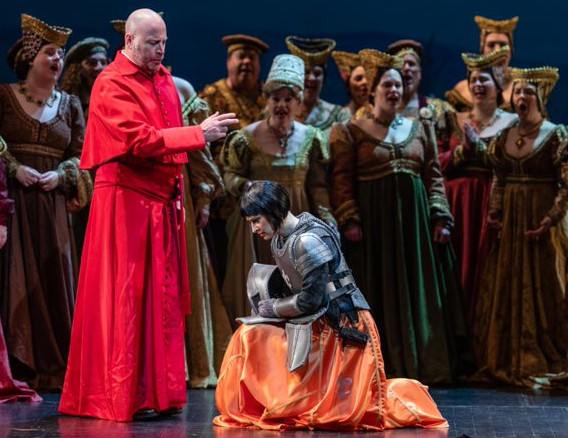
Blessing Joan to lead the troops – Photo: Brittney Werner

In commenting on tenor Casey Candebat’s performance as the Dauphin (King Charles VII), it’s hard not to resort to even more superlatives. In a word, he WAS superlative. With touching humanity, Casey’s rich, clear voice carried all the majesty, romance, and elements of Charles’ personal struggle between cowardice and bravery that Tchaikovsky had written into this role. His coronation address to Joan was a marvel of reverent adoration. Then, convinced by a few presumably divine claps of thunder, he, too, was swept up in the chorus’ orgy of fear and superstition. Abandoning Joan, he rushed off with his newly-won crown, ending the King’s role in her dramatic story that had been wonderfully sung.
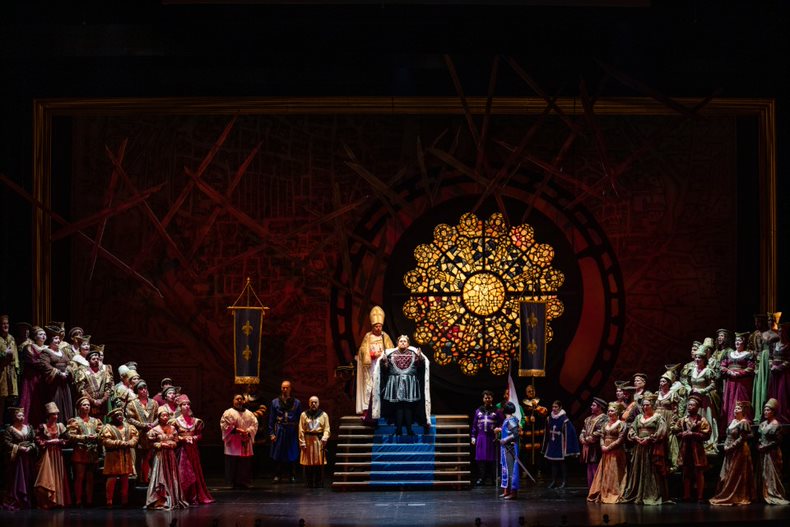
Coronation of Charles VII – Photo: Brittney Werner

There are lots of other characters in this opera, and the performances of each and every one were outstanding.

The pivotal role of Thibaut, Joan’s father, was sung by bass Kevin Thompson who, as noted by others, has “a mountain of a voice.” That voice perfectly embodied the element of superstition on which the opera turns. Kevin’s remarkable bass voice, aided by those aforementioned divine thunderclaps, created a true avalanche of fear, hatred, and stupidity that swept Joan from her exalted heights into a pit of despair and exile—the ultimate parental guilt trip. No wonder that during the bows Kevin earned the audience’s heartfelt boos!

Soprano Elana Gleason, playing Agnès Sorel, the King’s affectionate mistress, expertly delivered her extremely difficult love arietta with the King—with its very high notes!—with great delicacy and tenderness. We should all have such generous mistresses!

The role of Dunois, duc d’Orléans, was impressively fulfilled by dramatic baritone Michael Chioldi, who served as the conscience and inspiration for the King. In all of his scenes, Michael’s resonant voice drove the action, his nobility instilling courage and resolve. It is a complicated role with its aspects of conflicting loyalty and heroic determination.

The role of the romantic male lead, the Burgundian knight Lionel, was performed by baritone Joshua Jeremiah. Lionel is a pivotal role, a man who turns from French traitor into passionate lover, who first abuses Joan as a demon and then becomes her protector. In the final love duet, Joshua’s heroic voice blended perfectly with Joan’s mezzo in praise of God’s heavenly gift of love. (Unfortunately, he had to die—but did so grandly.)

I was thrilled by bass Raymond Aceto’s Archbishop who narrated to the court with ecclesiastical majesty Joan’s first appearance with the French troops, her leading them into battle, and their victory over the English. Raymond’s every word was crystal clear and weighty with the miracle of it all. He brought the same musical authority to all his other scenes, whether urging the people to believe or interrogating Joan’s virtue, or even when proving to be just as stupidly superstitious as everybody else.

In Act One, Kameron Lopreore movingly played Raymond, a village suitor whom Joan rejected; his tenor solo line in the Hymn was sung with plaintive force. Bertrand, a peasant refugee, was sung with immense pathos by baritone Ken Weber, and his solo line in the Hymn was a profound lament. The unnamed Warrior played by baritone David Murray dramatically narrated his narrow escape from the battle of Orleans and confirmed Joan’s first prophecy. In Act Two a dying soldier named Loree was sung by Frank Convit. His lines urging the King to join the fray and his final words “I’ve done my duty now…” were sung with all the poignant power of a seasoned soloist. All four of these roles were expertly delivered.

Concluding Remarks

You’re probably wondering if the preceding descriptions can be called objective, but I assure you they were—I could find nothing even vaguely negative to say! But, though I’d love to say that the New Orleans production of “Joan of Arc” was flawless, I admit there was one challenging detail.

Three times Joan hears the heavenly voices, and the angelic messages are crucial to the very structure of the opera. First, they send her forth on her mission, and second, they proclaim her mission accomplished and call her to come to glory (where a virgin martyr’s crown awaits, as well as rapture in God’s divine embrace). Then, third, they welcome Joan into heaven.

The off-stage voices of the angels, necessarily somewhat muted and baffled by curtains, largely got drowned out, sometimes by the enthusiastic orchestration and at other times by competing vocal lines. Fortunately, the words appeared on the supertitle screen—albeit quite briefly—allowing audience members to some degree to follow what they were supposed to be hearing sung and to sort it out from the other competing vocal lines.

What I could hear of Julia Tuneberg’s lovely soprano was ethereal, but her single voice was mostly lost in the melee.  If that was anyone’s fault, it was the composer’s.  Julia’s vocal lines being absolutely the most important element of the sequences, and given the traditional limitations and challenges of writing for off-stage voices, Tchaikovsky’s rich orchestration and vocal writing probably should have taken that more into consideration.

A modern solution for future productions, (of which I hope there will be many—my English translation gratis), would be to forget the back-stage and off-stage voice placement and send their sound through speakers from the ceiling of the house, even sending the separate vocal lines down from either side, antiphonally if you will. The audience should ideally hear surreal voices coming from heaven—and understand the words.

On that note, let me strongly advocate for performing operas in translation. Operatic puritans’ desire to preserve the musical sound of a composer’s work is admirable, but by opposing performances in translation, they often discount the verbal sound and deny “foreign” audiences a full appreciation of the drama in a work, especially so in this one. As a Russian scholar, I observe that with its intensely poetic language (i.e., twisted word order and obscure, stylized vocabulary—not to mention some wild musical calisthenics on important words), Tchaikovsky’s Russian libretto for “Joan of Arc” verges on the unintelligible even for native speakers of that language. In some respects, the composer seems to have chosen to rely on the visual scenes (Pictures) to suggest most of the theater in his work and considered the verbal fine points of the drama as more or less negligible.

Yet, Joan’s drama is the truly grand part of this grand opera. Like the angel voices, audiences deserve to comprehend fully her inspiration, heroism, moral anguish, triumph, and apotheosis. Her story is of vast import even for today: a woman of incredible strength and determination who literally saved her country, a powerful spirit who transcended medieval superstition and ignorance to achieve Sainthood—her true moral victory. All the more astounding for happening six centuries ago, Joan’s victory needs not be reduced to mere musical fireworks and orchestral magnificence. To convey all the grandeur, her glorious words should be readily comprehensible.

That’s why I’ve devoted creative energy to this amazing work for more than forty years. And that’s why I now urge opera companies in English-speaking countries everywhere to produce it—now readily available in translation—and to thrill us with the brilliance of Joan’s glory, as so beautifully done by the New Orleans Opera Association.

#

Richard Balthazar is a former Russian scholar, arts administrator, and vendor of used plants, now happily retired as a writer and artist. He can be reached at rbalthazar@msn.com.                


Still Dancing


Aztec God of Dance – The Old Coyote

When I started this multi-faceted blog back in early 2014, I wrote the first couple posts about my life-long OCD (obsessive-compulsive dancing). First was the one explaining my personal motto: There’s dance in the old dame yet. The second was about nightlife and my history of dancing in dives and jive-joints.  Then I got distracted by subjects in history, politics, and art.  Now it’s high time to catch up on public dancing in Santa Fe (NM—not CA, FL, TX, or elsewhere).

I last wrote on the subject four years ago when we actually had two dance clubs in town: the gay bar Blue Rooster (successor to the Rouge Cat) and a new straight nightclub called the Skylight.  To my dismay, within a few months the Blue Rooster closed down (cold-cocked?), and I had no choice but to dance among the straight young things at the Skylight to considerably less danceable music.  Any port in a storm.

Happily, the SCOTUS decision legalizing gay marriage soon caused a sea-change in social attitudes about gays, and we became much more accepted in straight venues like the Skylight. It wasn’t uncommon to see guys and gals dancing with each other, respectively—or even sharing PDAs (public displays of affection).  In this newly comfortable environment, I’d go out to dance almost weekly (whenever the old man has the energy) for many wonderful carouses.

The only fly in the ointment at the Skylight was the music. In my adolescence I’d been an avid American Bandstand rock’n’roll-er and then switched to Latin wildness for a few years in college.  Only much later, I got hooked on disco, and that was my main style for some decades.  However, disco music at the Skylight was only painfully occasional.

The more frequent music there was hip-hop, rap, and metal, which didn’t particularly ring my bell. Fortunately, at times they played Latin (called Hispanic here), which took me back to my debauched youth in frenetic cumbias and exuberant merengues.  And with an effort of sheer will, I tried to get into the new EDM (electronic dance music), which only sometimes was danceable.  Like the little girl with the curl, when it was good, it was excellent, but when it was bad, it was perfectly horrid—and way too loud.

All my life dancing has been a philosophical thing (I dance, therefore I am!)  Or maybe better, a spiritual practice (To dance is to live!).  Spiritually speaking, I’m a dervish.  As I’ve explained in my second memoir (in process), “…unlike ball-room and folk dancing, both Apollonian in their structure, synchronization, and impeccability of movement, my dance is free-form and unrestrained, responding on a visceral level to rhythms and melodies and surrendering to the divine frenzy of Dionysius.”  Call me a maenad!

Then came that Saturday night in early December last when I ambled down Don Gaspar happily anticipating another divine frenzy. Only to find the Skylight’s big iron gates closed up with a huge chain and padlock!  Stunned, I staggered up San Francisco Street to the Plaza (with its outrageous holiday lights), and ran into Brandi, Santa Fe’s prima donna drag celebrity, who confirmed that our nightclub was indeed closed down totally.  Nowhere to go but home, bereft.

After a few weeks of complaining to all and sundry about the loss of the Skylight and dancing at home in solitary splendor to reggae and Salsa Sabrosa (on KUNM), a dear friend mentioned a group called Embody Dance that meets weekly on Thursdays at the Railyard Performance Space. Their website sounded very like a group I’d visited back last spring for a splendid ecstatic experience.  Though I’d put myself on their mailing list, I never heard from them again.

The last Thursday of 2017 I showed up for a session of Embody Dance and was thrilled to find the perfect venue for my OCD: shoeless, unspeaking, and idiosyncratically undisciplined, with adventurous and dance-inspiring music.  In the delightfully diverse company of some sixty folks, for two non-stop hours I surrendered to the divine frenzy and left feeling perfectly fulfilled.

The next Thursday, the first in 2018, I went back to Embody Dance and jubilated again with an even larger crowd, some of whom were maybe even as old as I! After sixty years of dancing, I finally feel like I’ve come home.  Tonight I’ll be doing the mad maenad thing again.

#

Aztec Icon #6 – HUEHUECOYOTL, The Old Coyote

I guess it’s time to post the next Aztec icon in my coloring book called YE GODS!  THE AZTEC ICONS.  Looking almost Egyptian with the animal head, this one emphasizes dancing, music, and sex, which is a combination close to my heart. I must admit to identifying closely with this deity while drawing him. It’s full of the music of Aztec instruments and singing, all shown in graphic symbols. Details are based on various codices, but mostly Codex Borbonicus.

Don’t worry, you can still see or download the previous five icons by clicking on them in the list on the page for the coloring book.

ICON #6: HUEHUECOYOTL

(The Old Coyote)

To download this icon as a pdf file with a page of caption and model images from the Aztec Codices, right click here and select “Save Target (or Link) As.”  You can also download it in freely sizable vector drawings from the coloring book page.

huehuecoyotl icon

HUEHUECOYOTL (Old Coyote) {hwe-hwe-koy-otł} is the trickster god of mischief and pranks and can lead one into trouble. (His tricks on other gods often backfired.) Patron of the day Lizard, along with Macuil Cuetzpallin (Five Lizard), he’s a deity of sexual indulgence, and with XOCHIPILLI and Macuil Xochitl (Five Flower), he’s also a deity of music, dance, storytelling, and choral singing. Personifying astuteness, pragmatism, worldly wisdom, male beauty, sexuality, and youth, he’s a balance of old and new, worldly and spiritual, male and female, and youth and old age. He is a shape-shifter, turning into animals or humans with sexual partners female or male of any species. Among his male lovers were XOCHIPILLI and Opochtli, god of hunting. He brings unexpected pleasure, sorrow, and strange happenings, and people appealed to him to mitigate or reverse their fates.

The Gin Mill, a Greek Sailor Bar

Once an elegy gets going, it’s not easy to shut off.  I can’t help but reminisce about another sailor bat in New Orleans.  I danced for years in the early 60’s in the Gin Mill, a supremely dissolute Greek sailor bar on the second block of Decatur across from the monumental Customs house.  For a change of tone, we carousers would stagger nightly up the street from La Casa de los Marinos to this Dionysian temple of dance.  The ancient place won’t be found anymore, even on the Internet.  If you remember, upstairs was the Acropolis Restaurant.  Maybe that’s still there. (To visit this lost temple, check out my autobiographical novel DIVINE DEBAUCH.)

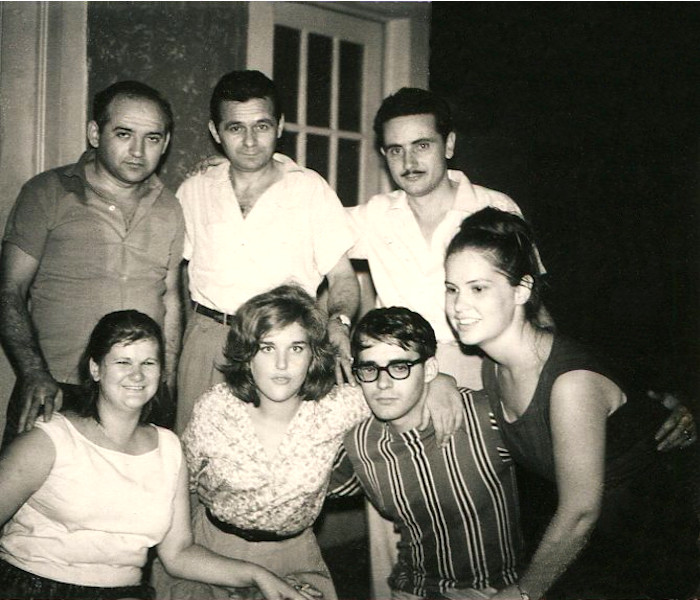
You entered the Gin Mill between a long bar and a row of booths, past a bellowing juke box, and then came to the larger room with more booths and tables around the dance floor.  Only ghostly traces of a former grid of tiles remained on the worn concrete floor.  The place was generally overflowing—if a ship was in port, and there usually was one—with swarthy sailors, friendly ladies of the night, and at least one equally friendly faerie.  Yours truly. Recently I found an ancient polaroid photo of me and my beautiful dear Jane with fellow debauchees:

gin mill bunch

Jane and Rich (center) with the Gin Mill Bunch

The landmark of the Gin Mill was its barmaid (and bouncer), Jackie, who weighed in at well over 300 pounds and had a lover on every Greek ship.  (Greek sailors loved fat women—and skinny boys.)  Jackie kept a motherly eye out for the safety of my skinny Tulane student body, but I still managed to put it in many delicious positions of jeopardy.

The great attraction of the Gin Mill, besides the seafood offerings, was the fact that Greek sailors would dance alone—or with each other.  Even before the incredible “Zorba the Greek”  hit the big screen, I was doing those fantastic Greek dances and feeling like a gay Melina Mercouri, but I’d do it on Sunday too.

The song I found most poignant for some reason was “Thessaloniki mou, but just those first evocative notes of Mikis Theodorakis’ Zorba suite can bring me to tears.  (I’d give a link to it, but the computer god won’t let me.)

I learned so long ago in the Gin Mill to cut that rope and soar free.  In La Casa I was initiated into the ecstasy of dance, but it was in the Gin Mill that I learned its philosophy and experienced its liberation.

This seems to have turned into an elegy for the fantastic New Orleans that once was, that bawdy old river port with its international culture of sailor dives along waterfront Decatur.  In my own time, the river still ran right behind the levee at the front of Jackson Square, and there were wharves along behind the French Market.  The beautiful Jax Brewery was in full, fragrant brew right across from my beloved La Casa de los Marinos.  The Gin Mill just up the street…

How terrifically blessed I was to carouse then in those legendary dives, how privileged to know the joy of pristine debauchery worthy of a novel by Jean Genet Back then I felt just like Our Lady of the Flowers.  But that wild world has been swept off away down the eternal river.  Sigh.  During the 70’s the glorious old city finally got transmogrified by twentieth century commerce, and the historic waterfront became one huge shopping mall.

A few years ago, for old times’ sake, I escaped from the cold New Mexico winter and spent a few warm months in a slave quarter apartment in the Vieux Carré.  It was just up St. Peter Street from what used to be Dixie’s Bar of Music, a legendary gay bar where I’d met a number of paramours (now a deafening karaoke palace).  Only later did I learn that while I was there, Miss Dixie herself passed on at 101. The sentimental sojourn proved very graphically and painfully that the past only exists in my mind, and it’s uniquely my own.  That’s what makes it so precious.