I’ve recently been fascinated by global news and couldn’t resist putting the alarming phenomena into perspective in the brief sketch below, my first attempt at science fiction. I hurry to post it—before it can be disproven by subsequent events—or even worse, proven prophetic.
###
Phantom Galaxy
BAD TO WORSE
News stories of these recent weeks had been horrifying: about the earth’s core stopping and possibly reversing its rotation, about inexplicable solar eruptions, and about a crowd of asteroids threatening our planet. Like a good disaster-buff, I kept those stories on my news feed. My attention was rewarded with remarkable scientific discoveries.
By late February, astronomers were reporting solar flares creating a ginormous vortex off the surface of the sun. Geologists were meanwhile wondering what the effects would be of a stationary planetary core, which they calculated would happen in another month. If it started rotating in the opposite direction, I figured it would cause a reversal of Earth’s poles, probably with significant rearrangement of land masses and, I suspected, a change in the length of day. In fact, geologists were now tracking changes in the Earth’s surface rotation rate and seasonal tilt.
On the solstice in March, scientists declared that the core had indeed stopped rotating in the usual direction, and a few days later they announced that it was starting to move in reverse, the Earth now in internal retrograde. Earthquakes had already started in mid-February, first the huge one in Turkey and Syria, and soon hundreds of them around the globe, like the Earth was shuddering. At the same time, the poles switched in early April, immediately throwing the world’s weather into drastic confusion. Along with many quake-induced tsunamis, the melting, shattering, and scattering of the polar icesheets brought apocalyptic destruction to coastal communities. There was no time or means to cope with or calculate human casualties.
While we long-suffering humans tried to cope with the ubiquitous chaos of earthquakes which were growing alarmingly in magnitude, overhead our star kept flaring up around its surface, like flames waving into space. I expected that the flares would soon show a pattern, which AI detected on my birthday near the end of April—roughly a circle about three times the diameter of the Earth. In early May, that circle began to bulge on the sun’s surface, a slow swelling over the course of a few months, while I watched closely the video reportage of the condition of our celestial body.
Those next few months were more than busy enough with basically futile global disaster-recovery efforts, and most survivors had no time to worry about our Sun acting up. While helping every day with my disaster-relief cohort—to the extent of my octogenarian ability—I checked my news feed often for solar system updates, feeling like Akhenaten in communion with the Aten. Our Sun was now found to be increasing in brightness, noticeably hotter on exposed skin—when one wasn’t drenched in arbitrary storms. There was probably no connection, but the many Unidentified Aerial Phenomena that began being noticed (and shot down) already in February became even more numerous over the next months. All we needed now was to piss off the aliens and have them retaliate. And more meteors kept falling to earth, many ejected with the Sun’s flares, blowing out huge craters and killing millions.
My news feed died with the Internet in late June, a casualty of an electron burst from the sun which fried telecommunications everywhere, including most cell-phone towers. No TV, but there was still radio, if anyone had one. Fortunately, I did and through the near-hysterical remnants of NPR’s Morning Edition learned of increasing tectonic activity opening deep fissures across the Middle East and along Africa’s rift valley. That geological pressure in Indonesia and the Andes was causing more earthquakes and volcanoes, and meteors kept impacting in heavily populated areas. Earth was becoming an inimical habitat for humanity!
Shortly after I lost electricity and water in my old adobe house, a meteor strike nearby brought it crumbling down. I’d fortunately run outside and watched in safety while it collapsed. Salvaging what little I could, I took shelter in a still-standing corner of a nearby school, sharing the space with several traumatized young students. However, we had nothing else to share, and each day we foraged in the ruins for anything edible. Potable water was a critical need, rarely met except for catching rainwater, that often fouled. Totally cut off from any newscasts or social communications, I had no idea what was going on outside of our miserable refuge, either on the Earth or up in the Heavens. However, the glaring, inflamed Sun told me that momentous things were transpiring up there.
In my foraging one day, I found a half-collapsed, metal-framed factory where about a dozen workers were trying to survive. They had a working radio (powered by a small generator), and I was advised by frantic NPR correspondents that the bulge on the sun’s surface had erupted and was ejecting a planet-sized ball of flaming gaseous matter into space—like Athena springing from the brow of Zeus. Scientists projected its trajectory away from Earth but toward Venus, thought its monstrous speed and paths of planetary rotation could easily shoot it close by Jupiter.
In spite of this supposedly good news, the morale of us few local survivors bottomed out. I explained to the starving workers that even without a direct collision, the Earth was going to get jerked around dramatically by this new mass at play in the solar system. Orbits of all the planets would probably change, as well as distances from the Sun as the system tries to find a new equilibrium. And even if the new mass doesn’t collide with anything, it would probably enter an extended orbit around the Sun like a comet, returning regularly to wreak havoc on the planets and then only at some time in a future epoch settle into an obedient planetary orbit.
With this less than optimistic expectation, lethally inclement weather, starvation, thirst, and advanced age, I will lay my helpless head down in the rubble, leaving the savage future to others of my species who might survive this end of the Earth as we’ve known it.
The tenth trecena (13-day “week”) of the Aztec Tonalpohualli (ceremonial count of days) is called Flintfor its first numbered day, which is also the 18th day of the veintena (20-day “month”). In the Nahuatl language Flint is Tecpatl, and it’s known asEtz’nab’ in Yucatec Maya and Tijax (Knife-edge) in Quiché.
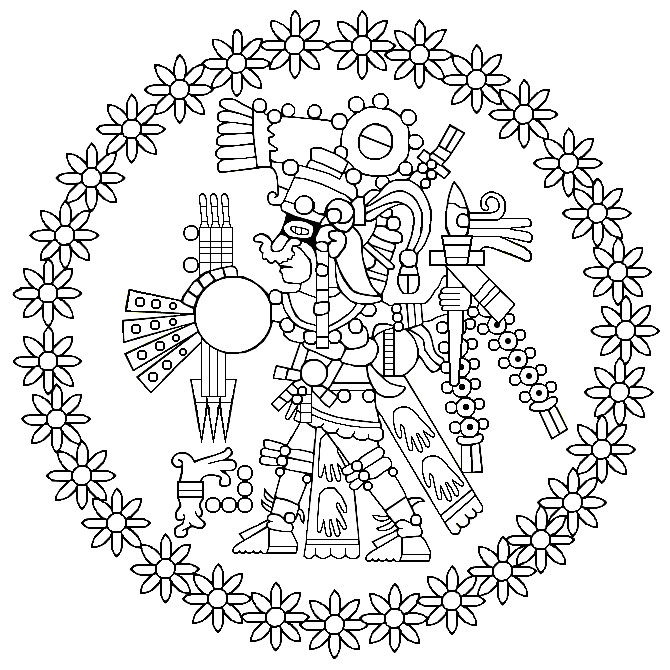
The day Flint portends great riches and pride but also destruction and punishment. It’s almost logically associated anatomically with the teeth. The usual day-sign (or glyph) for Flint is the sacrificial knife with a face, including teeth (fangs), and sometimes divine ornaments. The flint knife is personified (or deified) as a nagual of Tezcatlipoca, Itztlacoliuhqui,Curved Obsidian Blade, god of stone, cold, sin, and human misery, but also of objectivity and blind justice. (See vignette at top center in Icon #19, and the Blade will be met again soon as a patron of the 12thtrecena Lizard.) The day Flint’s patron is Chalchiuhtotolin, the Jade Turkey (See Icon #3), also a nagual of Tezcatlipoca and patron of the power and glory of young warriors, particularly of the famous Jaguar Warriors of the Night. He’ll be seen later as patron of the 17thtrecena Water, the “Turkey” in his name relating to the little known, brilliantly colored ocellated turkey.
PATRON DEITIES RULING THE TRECENA
A patron of the Flint trecena is Mictlantecuhtli, Lord of the Land of the Dead (Mictlan) the most prominent of several deities of death, 5thLord of the Night, Lord of Number Six, and patron of the day Dog. (See Icon #10.) Images in Codex Magliabechiano show that the Death Lord’s worship involved ritual cannibalism. Counter-intuitively, in the Aztec view, skulls and skeletons were symbols of fertility, health, and abundance, a sentiment still evident in the Mexican holiday Día de los Muertos. Souls of those who die normal deaths (i.e., are not ritually commended to some god’s heaven), must climb eight hills and cross nine rivers in four days to reach Mictlan, an empty place of darkness. The owl (as a symbol of sorcery and the night) and vile insects like spiders and millipedes are closely associated with Mictlan.
Another patron of the trecena is Tonatiuh, god of the current Fifth Sun (Four Earthquake), whose visage reputedly glares from the center of the Stone of the Suns. (Also see him in Icon #16 in company with the lunar goddess Metztli.) In the creation of the Fifth Sun, a young god named Nanahuatzin leapt into the cosmic conflagration to become the sun (Tonatiuh). Lord of Number Four with a Quail as his totem bird, Tonatiuh rules the idyllic Fourth Heaven for the souls of heroes, warriors killed in battle, heart-sacrifices to ensure the continuation of the sun, and those dying in childbirth. I assume that means both babies and mothers, so the five warrior spirits, the dangerous Cihuateteo, probably dwell in the Fourth Heaven as well.
AUGURIES OF FLINT TRECENA
By Marguerite Paquin, author of “Manual for the Soul: A Guide to the Energies of Life: How Sacred Mesoamerican Calendrics Reveal Patterns of Destiny” https://whitepuppress.ca/manual-for-the-soul/
The theme of this trecena is Sacrifice and Separation. The symbols of knife, knife-edge, and flint represent the opening energies of this period, a time-frame tending to highlight sudden change. The flint’s dramatic sharpness and flashiness can manifest itself through “shocking” events, often involving conflict or dualities between opposing forces, as reflected by the trecena’s patrons (life-sun vs death-darkness). Although separation and difference is a strong theme at this time, these energies can also be the spark to initiate new thoughts or actions.
Further to how these energies connect with world events, see the Maya Count of Days Horoscope blog at whitepuppress.ca/horoscope/. The Maya equivalent is the Etz’nab’ trecena.
THE 13 NUMBERED DAYS IN THE FLINT TRECENA
The Aztec Tonalpohualli, like the ancestral Maya calendar, is counted through the sequence of 20 named days of the agricultural “month” (veintena), of which there are 18 in the solar year. Starting with the 18th day of the current veintena, 1 Flint, this trecena continues with 2 Rain, 3 Flower, 4 Crocodile, 5 Wind, 6 House, 7 Lizard, 8 Snake, 9 Death, 10 Deer, 11 Rabbit, 12 Water, and 13 Dog.
Again there are several important days in the Flint trecena:
One Flint (in Nahuatl Ce Tecpatl) is the ceremonial day-name of Huitzilopochtli, Hummingbird of the South, the principal god of the Aztec nation. It’s also an alternate day-name for Mixcoatl, the Cloud Serpent, a major deity of the Mixtec who retained much cultural and doctrinal independence from the imperial Aztec. For the official cult, Quetzalcoatl and Tezcatlipoca were born of the creative pair Ometeotl on other days, but for another they were born on One Flint of the celestial goddess Citlalicue, the Star Skirt, as depicted in Plate 32 of Codex Borgia. As a year-name, in the Aztecs’ deep mythology/history One Flint was the first historic year when the Mexica came into power in Tenochtitlan and thus a symbol of their imperial destiny. In that function it appears near the center on the Stone of the Suns.
Four Crocodile (in Nahuatl Nahui Cipactli) is another of Xiuhtecuhtli’s ceremonial day-names (besides One Rabbit as noted in the Snake trecena).
Five Wind (in Nahuatl Macuil Ehecatl) is the Mixtec day-name of Tlaloc.
Nine Death (in Nahuatl Chicnahui Miquitztli) I read somewhere long ago was either the day-name of Mictlantecuhtli himself or of another important Death Lord. Whichever…
Thirteen Dog (in Nahuatl Mahtlactli Ihuan Yeyi Itzcuintli) in Maya mythology as 13 Ok was associated with the birth of their Maize God Hun Hunahpu. Even after several centuries, the Aztecs probably associated the day with their own maize god Centeotl. (See the Grass trecena.)
THE TONALAMATL (BOOK OF DAYS)
Several of the surviving so-called Aztec codices (some originating from other cultures like the Mixtec) have Tonalamatl sections laying out the trecenas of the Tonalpohualli on separate pages. In Codex Borbonicus and Tonalamatl Aubin, the first two pages are missing; Codex Telleriano-Remensis and Codex Rios are each lacking various pages (fortunately not the same ones); and in Codex Borgia and Codex Vaticanus all 20 pages are extant. (The Tonalpohualli is also presented in a spread-sheet fashion in Codex Borgia, Codex Vaticanus, and Codex Cospi, but that format apparently serves other purposes.)
TONALAMATL BALTHAZAR
As described in my earlier blog The Aztec Calendar – My Obsession, some thirty years ago—on the basis of very limited ethnographic information and iconographic models —I presumed to create my own version of a Tonalamatl, publishing it in 1993 as Celebrate Native America!
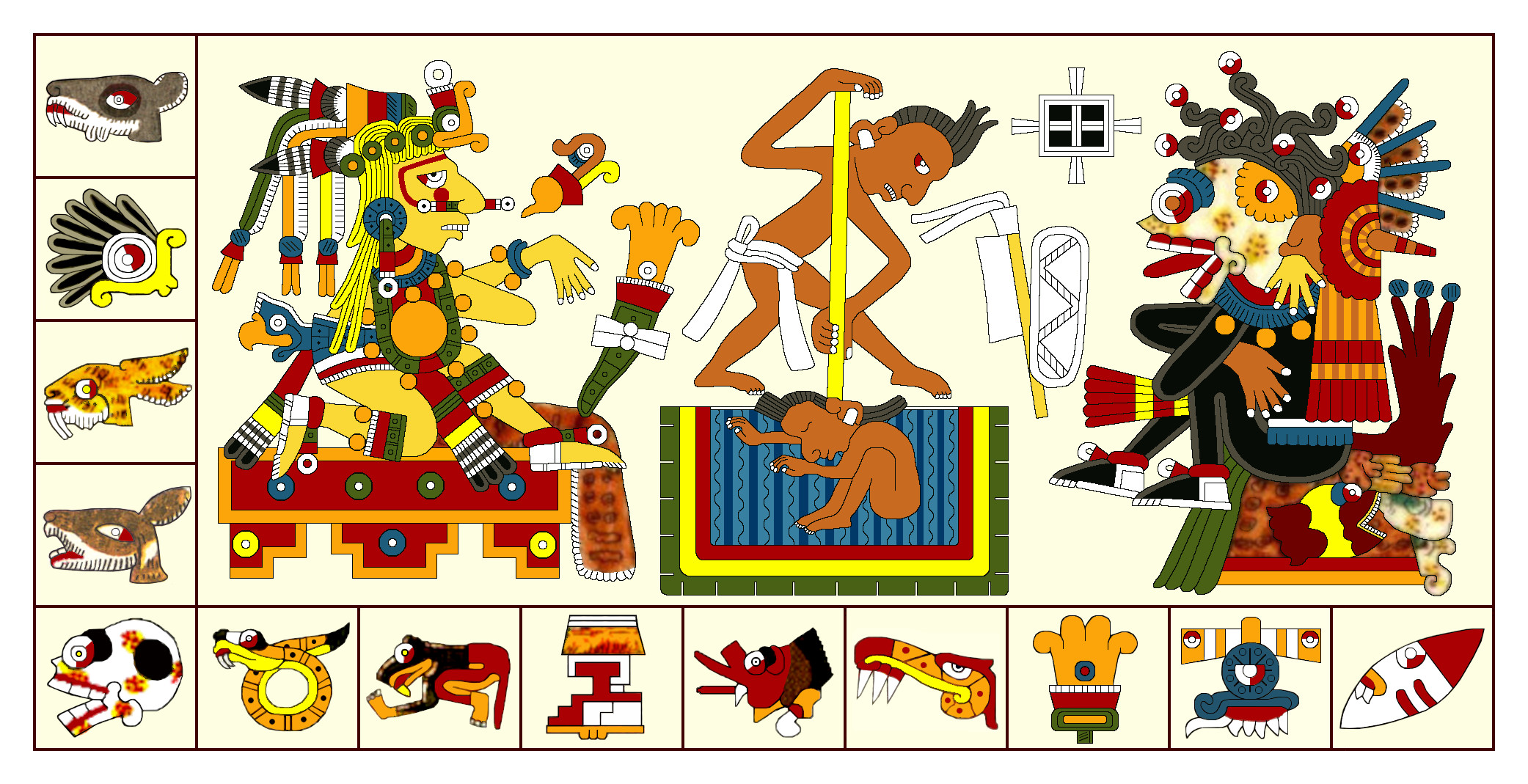
When I made my version of the Flint trecena back around 1990, I didn’t know about Tonatiuh being another of its patrons and simply focused on Mictlantecuhtli. As usual in that uninformed time, I relied heavily on Codex Nuttall for image (and posture), working with regalia from various figures. At least I knew him as patron of the day Dog and invented an appropriately canine headdress. As Death Lords go, I think mine shows a good bit of skeletal glory.
In this trecena, we encounter the sun-god Tonatiuh for the second time: He was the primary patron of the earlier Death trecena on the right side of the panel. There he wears vaguely different regalia and is in the classical “dancing” pose, but in both of these images his red face-paint pattern is the same. The main differences are in their pendants and the thematic flints in this one’s headdress. This one’s odd “flower” on a stalk must mean something about this trecena, and the unusual version of speech symbol (cuciatl) likely does too.
Here Tonatiuh is on the left side of the panel, but I don’t think that means he’s necessarily the “secondary” patron. Though on the right side, Mictlantecuhtli may not be really the “primary” patron. Considering the auguries of this trecena, these two deities probably share primacy, balanced as they are on the flint’s knife-edge of opposing forces.
As the only image of Mictlantecuhtli in the tonalamatl, this one is outstanding in its gruesome glory. I particularly love his medusa-like locks with stars which probably imply that he’s a Night Lord. The pointy thing in his headdress, his usual ornament, is almost irrelevant in view of his standard bare skull (with spots of rot). Besides the surreal eyes in the skull, the detail that really gives me the creeps is that long, pointy tongue! Less disturbing is the fountain of blood rising behind him. We’re all familiar with how bloodthirsty death is…
In general, the iconography of figures in Tonalamatl Borgia is superbly detailed, if often badly obscured by damage to the pages. The lower part of this page has suffered terribly; particularly the original details of Mictlantecuhtli’s jaguar throne are barely discernible. Consequently, this re-creation is improvised from the blurred confusion of splotches and lacunae. I settled on a combination of the Diaz & Rogers imagination and that in the anonymous facsimile, both of which came up with an inexplicable fat fish.
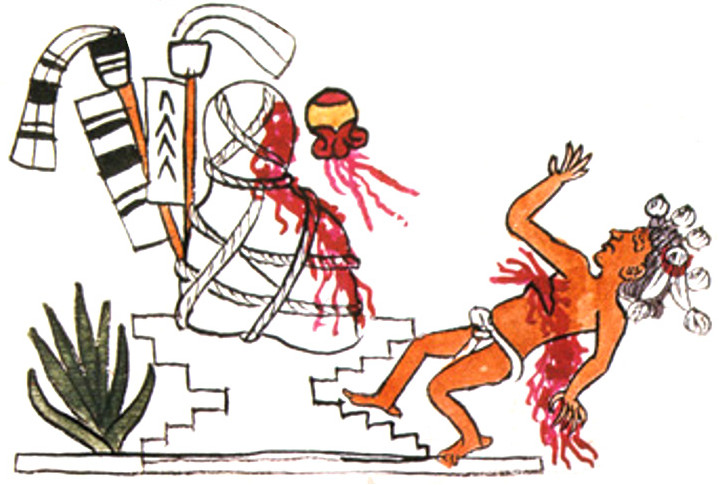
I can only guess at the fish’s significance: Maybe those other artists intended it to relate to the eerily similar stylized human heart in sacrifice scenes like that in Codex Magliabechiano, p. 133:
Heart-sacrifice Scene from Codex Magliabechiano
Viewing the area under high magnification, I can almost see the blur as a skull with gaping jaws like those of the Death Lord above, which would make sense since the Lord often sits on a skull or has one in his “bustle” (like mine above).
Such speculation aside, I won’t even guess at the meaning of the tasseled square figure and flag-like item with patterned piece that hang in front of Mictlantecuhtli. But the central scene is unmistakably a ritual sacrifice by drowning, tying right in with the trecena’s other theme of sacrifice. Both patrons watch with obvious approval of the ritual, but one wonders why.
The soul of the drowned sacrifice won’t be going either to Tonatiuh’s idyllic Fourth Heaven or to Mictlantecuhtli’s desolate Mictlan, but to the joyful Eighth Heaven of Tlaloc, Tlalocan. I suspect that the act of sacrifice itself goes to keeping the Fifth Sun up in the sky as well as to slaking the blood-thirst of Death. In this context, it’s tempting to suggest that as he’s Lord of Number Six, Mictlantecuhtli’s miserable Mictlan might actually be the Sixth Heaven, so to speak…
#
TONALAMATL YOAL (compiled and re-created by Richard Balthazar on the basis of Codex Telleriano-Remensis and Codex Rios)
Aztec Calendar – Flint trecena – Tonalamatl Yoal
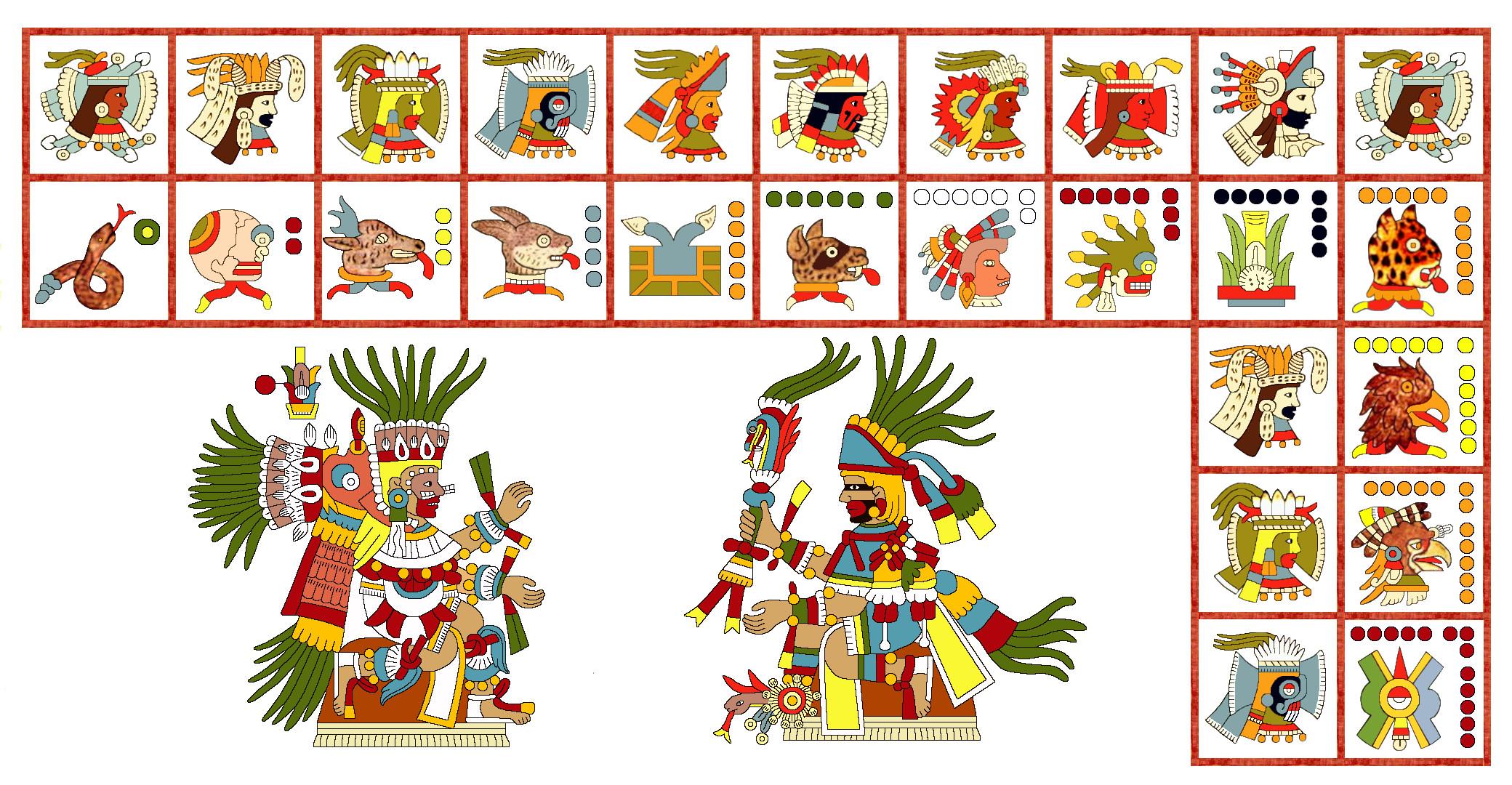
In Codex Telleriano-Remensis, the left-hand page of the Flint trecena with Tonatiuh is missing, so this image is based solely on the Codex Rios copy which goes wild with his divine regalia. With the major sunburst on his back as an unmistakable identifier, he lacks Borgia’s red face-paint design, likely because in the Rios image his whole body is dark red. I’ve chosen a ruddy flesh tone to avoid losing detail in monochrome darkness and have changed only the awkward length of his arms and angle of his scepter, which may be a version of the Fire Serpent.
However, the right-hand pages with Mictlantecuhtli still exist in both codices, the original and copy being almost identical in detail of regalia, skeletal limbs, and partially hidden skull beneath. But in Telleriano-Remensis, there’s a skull in his “bustle,” and in Rios (as here) it’s a dog’s head to indicate the day of which he’s patron. The circular orange items may intend marigolds, which are still considered a flower related to the Underworld.
In this Yoal image, I’ve changed the Death Lord’s ghastly brown and black visages with skeletal jaws to give him the human face of his bust above (top row, fifth from left) as Lord of the Night since they already share many details of headdress. As I’ve discussed in a blog “The Faces of Death,” this “living” face of the Night Lord is a break with the iconographic tradition of his face being almost everywhere else a skull. Another unusual detail is his blue-peaked cap—for some reason just like that of Xiuhtecuhtli in the first and tenth positions.
#
OTHER TONALAMATLS
Tonalamatl Aubin patron panel for Flint trecena
The patron deities in the Tonalamatl Aubin are the usual suspects—with a few differences from the preceding Flint trecenas. On the left, Tonatiuh has no throne and only a few red marks on his face, and part of the regalia on his back has been omitted, apparently for lack of space on the page. Oddly, he has only one arm… Tonatiuh now wears a recognizable pendant but has no other identifiers—except for the partial sun-symbol below. On the right, this Mictlantecuhtli also has a “living” face as well as fleshed-out limbs, and at least the pointy thing in his headdress is familiar. (I can’t imagine what the Aubin artist had in mind to make his left foot black.)
The central scene of sacrifice presents a curious variation. The victim clings to a “tree” of some ceremonial sort, apparently to eventually sink into the water and drown. I wonder why part of the “basin” was painted green and about that bundle beside it with someone’s hindquarters sticking out—quite puzzling. Even more puzzling are the two snakes, the brown living one with Tonatiuh and the clearly defunct white one under Mictlantecuhtli. But there’s no one to ask…
#
Codex Borbonicus patron panel for Flint trecena
The patron panel for the Flint trecena in Codex Borbonicus explicitly shows the ordeal nature of the drowning sacrifice. Here the victim clings to a smooth pole, possibly even a greased one, until sliding down into the water to provide an entertaining public spectacle. The attendant patrons “dance” in celebration of the ritual. This short-armed Mictlantecuhtli on the right has both skull and skeletal limbs, as well as a mop of dark hair with stars.
On the other hand, this Tonatiuh on the right isn’t as recognizable; his Fire Serpent scepter is no sure identifier. Rather than a sun-symbol, the semi-circular thing on his back looks more like that strange thing on Tlahuizcalpantecuhtli in the Snake trecena, but this one has an out-of-place skull on it. Even the semi-circle at top center isn’t a sun symbol, but one of the night, relating to the Night Lord Mictlantecuhtli. Apparently, the patrons are considered much less important than the central sacrifice scene.
Meanwhile, the profusion of other items in this panel suggests other considerations. Take for instance the vignette on the upper left of a person half-engulfed in some container, which harks back to the “packaged” body in the Aubin panel. When a motif appears again in separate situations, one has to assume that it has important symbolic significance—and when it’s repeated like the two blue creatures (also seen before) or the two pots of water. Those repetitive blue symbols around the pole of sacrifice surely aren’t there for gratuitous decoration, but I’m at a total loss for their meanings.
Note the little spear-bearer on the lower left. I’d bet he’s there to indicate the Flint trecena with his flint spearhead. However, I can’t explain the presence of that Venus-related scorpion over his head. It’s the same as the one with the Morning Star in the Snake panel. Has the Borbonicus artist gotten his dogmas mixed up? As a grace note, check out the little snake hovering over Tonatiuh’s head—reminiscent of that Aubin snake with him. But there’s no one to ask…
#
Codex Vaticanus patron panel for Flint trecena
The Codex Vaticanus patron panel for the Flint trecena is a slight rearrangement of what we saw in the Borgia panel, switching sides for the patrons but adding nothing new. The original panel was laid out with much wider spaces, squeezing off parts of Mictlantecuhtli’s regalia like what may have been another “pointy thing” in his headdress. For convenience and aesthetics, I brought the elements closer together and touched up several broken lines and blotched colors. Again, the central ritual sacrifice seems of exceeding importance, and once again the victim’s drowning is being graciously assisted. After all, his death will keep Tonatiuh turning in the sky, and Mictlantecuhtli will be happy to take his bones home to Mictlan.
#
This survey of the Flint trecena’s patron panels certainly corroborates Dr. Paquin’s main themes of sacrifice and separation and well illustrates canonical (if at times confused) iconography across the various codices. Stylistic differences ultimately don’t really matter all that much.
#
UPCOMING ATTRACTION
The calendar’s eleventh trecena will be that of Monkey, its patron being Patecatl, god of medicine as well as of intoxicants like pulque and psychedelic herbs. Stay tuned.
#
You can view all the calendar pages I’ve completed up to this point in the Tonalamatl gallery.
The ninth trecena (13-day “week”) of the Aztec Tonalpohualli (ceremonial count of days) is called Snakefor its first numbered day, which is also the 5th day of the veintena (20-day “month”). In the Nahuatl language Snake is Coatl, and it’s known asChikchan in Yucatec Maya and Can in Quiché.
For the Aztecs the Snake symbolizes mystical power, and it’s probably no accident that it was associated with the male genitalia. The patron of the day Snake is Chalchiuhtlicue, goddess of flowing water (see Reed trecena). Images of the snake are frequent in the codices simply as reminders of divine power. It’s often a manifestation of Quetzalcoatl, the Plumed Serpent, and the core element of the divine weapon wielded by many deities, the Xiuhcoatl or Fire Serpent.
PATRON DEITIES RULING THE TRECENA
The principal patron of the Snake trecena is Xiuhtecuhtli, the Lord of Fire—or alternatively, of Turquoise (a homonym). As the latter, he is the lord of time and the sacred calendar, the Turquoise Year (tonalpohualli), in which capacity he determines mortals’ day of death and watches over departed souls on their journey to Mictlan. Also lord of the blue sky of day, Xiuhtecuhtli symbolizes the unfathomable, the limitless, unity, and completion. In Aztec astronomy, he’s lord of the Pole Star, the center of all things, and spindle of the universe. In addition, he’s both the Lord of the number 1 (with the Blue Hummingbird as his totem bird) and first Lord of the Night. Historically, Xiuhtecuhtli is a new, younger version of the ancestral deity of fire, Huehueteotl (the Old God). His birth day-name is One Rabbit.
The secondary patron of this trecena is Tlahuizcalpantecuhtli (Lord of the House of the Dawn), a nagual of Quetzalcoatl representing the planet Venus as the Morning Star. He’s symbolic of re-emergence, of the triumph of life over death. Meanwhile, he’s a dangerous deity, his gaze very destructive for both mortals and gods. Legend has him shooting a dart at the Sun, Tonatiuh, who throws it back at him but hits instead Itztlacoliuhqui (Curved Obsidian Blade), the god of stone and cold, a nagual of Tezcatlipoca. After Tlahuizcalpantecuhtli periodically disappears from the eastern morning sky to descend into the Underworld, he’s replaced in the western evening sky by Xolotl, the Evening Star. The Lord of the number 12 with (logically) the Quetzal as his totem bird, Tlahuizcalpantecuhtli’s birth day-name is One Reed.
AUGURIES OF SNAKE TRECENA
By Marguerite Paquin, author of “Manual for the Soul: A Guide to the Energies of Life: How Sacred Mesoamerican Calendrics Reveal Patterns of Destiny” https://whitepuppress.ca/manual-for-the-soul/
This dynamic trecena’s theme is emergence and liberation. The energies associated with this trecena are strongly aligned with Lifeforce, Fertility, Sacred Authority, Justice, Liberation, Cyclical Regeneration, and the promulgation of higher knowledge. A sense of new vitality or awakening to new ideas often accompanies this time frame, suggesting that transcendent events, possibly of a world-shaping nature, could manifest during this period, opening up the realm of new possibilities.
Further to how these energies connect with world events, see the Maya Count of Days Horoscope blog at whitepuppress.ca/horoscope/. The Maya equivalent is the Chikchan trecena.
THE 13 NUMBERED DAYS IN THE SNAKE TRECENA
The Aztec Tonalpohualli, like the ancestral Maya calendar, is counted through the sequence of 20 named days of the agricultural “month” (veintena), of which there are 18 in the solar year. Starting with the 5th day of the current veintena, 1 Snake, this trecena continues with 2 Death, 3 Deer, 4 Rabbit, 5 Water, 6 Dog, 7 Monkey, 8 Grass, 9 Reed, 10 Jaguar, 11 Eagle, 12 Vulture, and 13 Earthquake.
There are four important days in the Snake trecena:
One Snake (in Nahuatl Ce Coatl) was noted in the Florentine Codex as traditionally a favorable day for merchants/traders (pochteca), travelers, and armies to “set forth to far lands.” In that spirit, the Codex indicates that One Snake was often the occasion for declaring of war. It is significant that in 1521 this was the day the Aztecs surrendered to Hernan Cortés and his conquistadores at Tenochtitlan after being defeated in a fierce battle.
Seven Monkey (in Nahuatl Chicome Ozomatli)is traditionally associated with wealth and prosperity. This day-sign appears on the Aztec Calendar Stone, below the central face.
Eight Grass (in Nahuatl Chicueyi Malinalli), according to some sources, is an alternate birth day-name of the goddess Chalchiuhtlicue, generally called One Water (again see Reed Trecena).
Nine Reed (in Nahuatl Chicnahui Acatl) is the birth day-name of the Earth Goddess Tlazolteotl, Goddess of Filth (see Deer Trecena). On this day, gifts of cacao, precious feathers, and flowers are offered to her.
THE TONALAMATL (BOOK OF DAYS)
Several of the surviving so-called Aztec codices (some originating from other cultures like the Mixtec) have Tonalamatl sections laying out the trecenas of the Tonalpohualli on separate pages. In Codex Borbonicus and Tonalamatl Aubin, the first two pages are missing; Codex Telleriano-Remensis and Codex Rios are each lacking various pages (fortunately not the same ones); and in Codex Borgia and Codex Vaticanus all 20 pages are extant. (The Tonalpohualli is also presented in a spread-sheet fashion in Codex Borgia, Codex Vaticanus, and Codex Cospi, but that format apparently serves other purposes.)
TONALAMATL BALTHAZAR
As described in my earlier blog The Aztec Calendar – My Obsession, some thirty years ago—on the basis of very limited ethnographic information and iconographic models —I presumed to create my own version of a Tonalamatl, publishing it in 1993 as Celebrate Native America!
My version of the Snake trecena portrays Xiuhtecuhtli in a wild interpretation of his image in Codex Borbonicus, mixing a fancy snake on his back from the Stone of the Suns with a flaming crest much like Quetzalcoatl’s plumes in the Jaguar Trecena. Obviously, I took the turquoise and fire homonyms to heart in the coloration and wisely incorporated his traditional pendant plaque. I really should have made the bird totem on his forehead blue, and I have no idea where I got the shield design with the sun motif. Though I hadn’t seen any other images of the deity, I think my fantasy makes a very convincing Lord of Fire.
The Snake trecena page in Codex Borgia is the busiest one in its tonalamatl and raises a huge number of questions, both mythological and iconographic. It definitely begs a narrative.
Let’s start with the primary patron (the big red guy on the right), Xiuhtecuhtli himself enthroned and looking very pensive or stern/aggravated. In the original, his image is quite deteriorated, his regalia blurred and spotty. In their restoration of the Codex Borgia (Dover Publications, 1993), Gisele Diaz & Alan Rodgers have been inventive in restoring his ornaments, some of which I’ve used; another anonymous facsimile made other choices; and I’ve made my own in some places.
The best example is the feathery thing on his back, the top of which in the original is basically blank (or worn away?). Diaz and Rodgers fill it with rows of short lines; the other facsimile intimates a spiral of same. My close study of the blankness found tiny indications of a possible second row of lines, but I’ve left the rest blank. Another problematic motif is that odd thing on his forehead, maybe a bird, which would make sense as his totem, but it looks nothing like any other bird I’ve ever seen in any of the codices.
When we consider the mass of material adjacent to the deity, things get really mysterious, like that slanting bundle of jaguar hide and spotted blue strips (with a surreal bird’s head) running behind Xiuhtecuhtli’s shoulder. We’ll see something similar in the Vaticanus patron panel later. Does it mean something that the water (from above) flows into the bundle and deity, rather than away from him as from Tlaloc in the Rain Trecena and Chalchiuhtlicue in the Reed Trecena? The two arrows in the stream are almost to be expected as power symbols.
However, that ornamental scorpion is a major enigma. Since the scorpion apparently has had obscure connections with the planet Venus ever since Maya times, Tlahuizcalpantecuhtli being the Morning Star is probably the key. The scorpion’s sting would be a fine material metaphor for the Morning Star’s divinely destructive gaze. Also, I’m puzzled by the patterns of squared and spiral water flowing at/onto Xiuhtecuhtli.
Briefly, the other major enigma is the central vacant throne, the jaguar pelt indicating that there should be some deity sitting there. Who?
Now let’s talk about the secondary patron with the tongue-twisting name, Tlahuizcalpantecuhtli, sitting gingerly on the jaguar seat on the left. The only evidence of his identity is the headdress with the long spokes and feathery crown. Otherwise, he’s just an innocent little blond guy with standard Aztec finery. His hands-in-the-air gesture certainly must mean something like, “I know nothing about it!” “What did you expect?” “Who cares?” Or perhaps a hundred other probably dismissive comments relating to the vacant throne or to the flood dousing the Lord of Fire. Between Xiuhtecuhtli’s pout/glower and Tlahuizcalpantecuhtli’s nonchalance, some story is definitely going on in this page, but it would take an Aztec priest to provide an exegesis.
I must confess that I made the personal choice to color the Morning Star’s “mask” in a pleasant light blue as opposed to the depressing grey or brown to be seen in images that follow. The little flag on his nose-piece is actually indicative of Tezcatlipoca, but this might just be a convenient decoration. Meanwhile, his predominantly white body and clothing are most unusual for deities in Codex Borgia. Maybe the artist simply left him unfinished—too busy with Xiuhtecuhtli? In any case, we’ll see more detail in later images of this god.
#
TONALAMATL YOAL (compiled and re-created by Richard Balthazar on the basis of Codex Telleriano-Remensis and Codex Rios)
Aztec Calendar – Snake Trecena – Tonalamatl Yoal
Speaking of detail, the image of Tlahuizcalpantecuhtli on the left in this Telleriano-Remensis and Rios vision has them in spades, including a little One Reed identifier hovering overhead. The toothy feathered snake-monster on his back probably underlines his relationship to Quetzalcoatl (whose birth day-name is Nine Wind but sometimes called One Reed). As they will also occur in later images, the tear-drop motifs in his headdress (and in the snake’s) are other identifiers. Note his brown mask and mostly white raiment. Here his hand-gestures seem simply formulaic for his “dancing” or sitting posture on the standard place symbol/glyph.
On the right, Xiuhtecuhtli also “dances” or sits on a place symbol and wears ornate regalia. His headdress is very like that on his bust as Night-Lord (fifth from the left in the top row). The Telleriano-Remensis page with his image is missing, and I’ve had to base this representation on the uninspired Rios copy, supplementing it with details from elsewhere in T-R—like the fiery Xiuhcoatl he wields in his raised right hand. In his image in both T-R and Rios for the Pachtontli (Teotleco) solar vientena, Xiuhtecuhtli wears a flaming serpent on his back, but I thought that would be a little too much here. However, in both of those images one of his feet is the mystical water-fire symbol (atl-tlachinolli), which I’ve inserted as the Fire Lord’s right foot. Note his red and black face-paint as in the Borgia version—and in the following examples.
#
OTHER TONALAMATLS
Tonalamatl Aubin patron panel for Snake Trecena
Once again, the patron panel in Tonalamatl Aubin gives one serious aesthetic pause. It’s got most of the canonical elements, but they seem viewed through a strange (psychedelic?) lens. Of course, there’s fair reason to believe that psychoactive drugs were involved. Here, the patrons of the trecena have switched sides and seats, and the head of Tlahuizcalpantecuhtli (recognizable by the brown mask and teardrop ornaments in his headdress) is grossly distorted. Borgia’s vast flow of water has now become a mere spurt as part of the Morning Star’s headdress—another instance of the atl-tlachinolli water-fire symbol.
Meanwhile, Xiuhtecuhtli on the left has the standard red and black face and a fire-snake “cape,” and he holds his blue bird totem, which is by no stretch of the imagination a hummingbird. And by the way, I sort of hoped to see an empty throne and miss the scorpion.
Most startling is the fact that Tlahuizcalpantecuhtli has been flayed—sacrificially skinned! (In his Rios copy he is also flayed, but in the T-R original, only his hand shows the red stripes. I chose to ignore those details in Tonalamatl Yoal as too much information.) Here there’s no way around the ritual flaying of this deity. In fact, in several Borgia images of Tlahuizcalpantecuhtli he’s been skinned. In Vaticanus there are also many such images, as well as a section of five panels with the flayed deity attacking various people, places, and even a jaguar. In each of those he wears an odd eyepiece representing his dangerous gaze. (These five panels also appear in Codex Cospi in much different style and similar detail but without the flaying.)
The consistent representation of Tlahuizcalpantecuhtli as flayed suggests a close relationship with Xipe Totec, the Flayed God, whom we will see later as a patron of the 20th trecena, Rabbit. His virtues of fertility, renewal, and spring are broadly discussed in the “The Flayed God” by Roberta H. and Peter T. Markman (HarperSanFrancisco, 1992), who note that several other deities are also shown in the codices as flayed. I’ve found many skinned images of Tlaloc, Mixcoatl, Tlazolteotl, and even some of the Cihuateteo and Ahuiateteo.
I think the flaying of victims and deities must have been a transcendent sign/symbol of holiness—like the ubiquitous western tradition of the halo—and suspect that Xipe Totec, who usually only wears their skins, is the “high priest” of the bloody sect. Tlahuizcalpantecuhtli seems to be the principal flayed god in the pantheon. I wonder why he, the Morning Star, would be chosen for such grisly glory. Maybe because he’s a nagual of the great god Quetzalcoatl?
#
Codex Borbonicus patron panel for Snake Trecena
That being said, in the tonalamatl of Codex Borbonicus, Tlahuizcalpantecuhtli (back on the left side) is once again white-skinned in largely white clothes—maybe meaning his Borgia image was in fact completed. He wears his usual brown mask and has teardrop designs in his headdress, appearing in a constellation of motifs: water flowing at/onto the Lord of Fire (with arrows); some kind of a watery link (like the odd item at the center of the Aubin panel) to a throne (vacant but for a pile of ritual offerings); and what looks like a spider but is really a scorpion, both arachnids. Under high magnification one can see a tail/stinger curved up across its body. This is all stuff we already know from the Borgia panel, but I’ve never seen that surreal blue pointy-nose mask-thing on the back of his head before. Might it relate to his dangerous gaze?
With all that symbolic paraphernalia, Tlahuizcalpantecuhtli seriously overshadows Xiuhtecuhtli, who sports only that fire-snake on his back (the model for my own trecena above), the beautiful Borbonicus-blue totem bird on his brow and plaque-pendant. The artist apparently didn’t care much about this supposedly primary patron, grotesquely distorting his torso and shrinking his arms and hands—in contrast to complex and careful execution of the secondary patron.
As a post-script to this description, note the snake in the lower left denoting the trecena and the blue creature on the lower right. Whatever its species, it’s the same as the blue animal held by Tlahuizcalpantecuhtli in the Aubin panel. Like the vacant throne and scorpion, such repeated motifs surely must mean something integral to the implied narrative.
#
Codex Vaticanus patron panel for Snake Trecena
The Codex Vaticanus patron panel for the Snake trecena is obviously badly “weathered,” and I’ve tried to touch it up, restoring most faded and broken lines and filling in some of the color, except for the spotty flow of water. The patrons have switched sides once more, Xiuhtecuhtli in a divinely complex headdress brooding over Tlahuizcalpantecuhtli, who’s appropriately flayed now. We’ve again got the main narrative motifs, including Borgia’s strange staff with curls (but no weird bird’s head), the flow of water with scorpion and arrows, and the vacant throne—clearly a retelling of the same old story. The staff and flow of water being placed subtly in the foreground in this panel tells me they’re probably the main theme of the implied narrative.
But here the scorpion- and arrow-laden flood (apparently summoned by Tlahuizcalpantecuhtli) no longer flows at/onto Xiuhtecuhtli, instead getting “swallowed up” by the staff itself. Perhaps that motif is the Fire Lord’s symbolic “spindle of the universe” neutralizing the flood—or maybe the smoke-like staff is a stylized column of his divine fire? If the latter, then we’re again looking at an enormous atl-tlachinolli, which I’m told is a symbol of war. Does that mean the Morning Star is challenging the Pole Star for supremacy (the empty throne) of the sky? Or maybe that’s way too metaphysical.
#
Let me try another reading: perhaps this is all about Tlahuizcalpantecuhtli trying to take over the primary patronage of the trecena from Xiuhtecuhtli, in the Borgia panel sitting nonchalantly on his modest jaguar seat but ready to jump onto the empty throne, while Xiuhtecuhtli scowls at him and fends off his flood. In the Yoal panel, the Fire Lord is still on the prominent right, but One Reed displays imposing glitz with his serpent-monster cape. The two have switched sides in the Aubin panel, where Tlahuizcalpantecuhtli now sits on the primary throne, with Xiuhtecuhtli on the secondary jaguar seat. Back on the left side in Borbonicus, Tlahuizcalpantecuhtli with all his paraphernalia has basically usurped the panel from the battered Xiuhtecuhtli, having physical possession of the throne at least, and in Vaticanus he holds off the Fire Lord with the huge war symbol, the trecena’s throne now his for the taking.
Such are my amateur shots at playing Aztec priest, whether or not either of these stories is true. Either way, the roles of primary and secondary patron of this trecena aren’t exactly clear-cut, not that it makes a great deal of difference.
The flayed Tlahuizcalpantecuhtli is the main evidence I see of Dr. Paquin’s ancient Maya themes for this trecena of fertility, emergence, and liberation. Xiuhtecuhtli’s divinatory significance for authority, justice, and higher knowledge is nebulous. And my tentative readings have little to do with any Maya themes. After the several intervening centuries, I wouldn’t be surprised if the later Aztec iteration of this trecena’s themes might be substantially different than the Maya. Perhaps now it’s about confrontation, ambition, and power. After all, the Snake’s all about power, One Snake’s a great day for a war, and Tlahuizcalpantecuhtli is well known as a very aggressive deity, a holy terror. Maybe Xiuhtecuhtli represents the unified center of reality, and the bellicose Morning Star represents the antithetical force of chaos and anarchy, another elemental dichotomy like water and fire. Maybe not…
#
UPCOMING ATTRACTION
The calendar’s tenth trecena will be that of Flint, its patrons being the existential Lord of the Land of the Dead, Mictlantecuhtli, and the mighty Tonatiuh, God of the Fifth Sun. Stay tuned.
#
You can view all the calendar pages I’ve completed up to this point in the Tonalamatl gallery.
Besides for my motto, I’m indebted to the alley cat Mehitabel (“Archy & Mehitabel” by Don Marquis—1928) for stating our existential problem: “the eternal struggle between art and life.”
In early September I got word I had to move out of my penthouse apartment on Alicia Street. That same day I arranged with my daughter to rent the house she owns on Gilmore Street next door to her place. Moving there took some three months, meanwhile putting my projects on the back burner. Said projects included the ninth in my series of re-creations of trecena pages from the Aztec calendar (see the eighth, the Grass trecena) and a third short story about the old man dancing (see the second story “Better Buy a Dozen”).
Shortly before Thanksgiving when I’d finally gotten on top of the domestic trauma, I came down with Covid, fortunately only a mild case of exhaustion and congestion, with some ten days in isolation/recuperation. Off and on during the month, I managed to play with a few pixels on the Snake trecena re-creation from Codex Borgia (see “The Aztec Codices”) and to sketch out a couple paragraphs on the story.
“Clean” again (and resettled), I jumped back into the artistic fray, already making good progress on the Snake trecena. In addition, yesterday I posted a blog on 12/6/22 in the Aztec calendar as the day Ce Ollin (One Earthquake), when I became Pilzincoyotl (the Young Coyote), a deity of dance and nagual of Xochipilli (the Flower Prince).
While we’re on the subject of the current trecena in the Aztec calendar, I note that this Friday, 12/9/22 will be the day Nahui Xochitl (Four Flower). That’s the day-name in my private universe for the Sixth Sun—as proclaimed in my post “The Old Queen’s Proclamation,” which means we will have completed four cycles of the new era. You’re free to celebrate as you will this day of hope for a beautiful new world.
Now let me add some Aztec information that my devoted readers may have missed. Nearly four years ago in 2018, I posted “Ancient America-Asia Coincidences” about the Mesoamerican concept of a Rabbit in the Moon. At that point, I was working on Icon #16 (for my YE GODS! coloring book) and presented my drawing of the full moon:
Back then I was intending that icon to represent the god and goddess of the moon, Tecciztecatl and Metztli, but early last year (1/21) I discovered that I’d been mistaken (see my blog post “To Err is Human”)—that the god in the Codex Telleriano-Remensis whom I’d used for a model wasn’t Tecciztecatl but Tonatiuh, the god of the sun. Oh, well…
After that, back in May 2022, while working on the Death trecena re-creation, I discovered that the calendrical day-name of the Rabbit in the Moon is apparently 12 Rabbit! That day comes up in the current trecena on 12/17/22—a great day to celebrate the lunar bunny:
Significantly, in the Aztec calendar March 6, 2024, was the day Ome Acatl (Two Reed) and my 115th birthday in that ceremonial cycle of 260-day years. In our western calendar, I’ve recently celebrated my 81st birthday, wrapping up nine cycles of nine Gregorian years and starting in on my tenth cycle. The nine include a first inchoate period of childhood and eight discrete personas. For lack of a better description, I’m calling this new ninth persona the venerable iconographer, researcher, and/or historical theorist. We’ll just have to wait and see how that pans out.
This ninth Id-Entity will naturally continue my life-long focus on dance—ever since 1952 at the pudgy age of ten dancing in squares. My life of twinkling toes in many ethnic styles is amply discussed elsewhere. For at least 50 years, I’ve danced (mostly by myself) in an array of gay bars—the only place usually to find good dance rhythms—and in 2018, I discovered ecstatic dance. One moves as moved by the music, and the resulting ecstasy can be of a very spiritual nature, or at the very least psychically exhilarating.
Understandably, after decades obsessed with Aztec mythology and iconography, in my dance ecstasy I quite naturally began to personify Aztec deities. For the summer of 2022, I got inspired to dance as Xochipilli, the Flower Prince. Here he is from my Icon #18 drawn in 2020, one of the few icon-details from my YE GODS! coloring book and exhibition that I personally colored. By the way, the monkey is because the Prince is the patron of the day Monkey in the calendar, and the parrot-headdress is emblematic of this god of fertility, crops, flowers, arts, festivity and pleasure (including dance—and sex!).
However, by August that year, I found myself dancing happily as Huehuecoyotl, the Old Coyote (See Icon #6 from 2015), the principal god of dance—and again sex (though for me this activity has been merely hypothetical for number of decades). In the drawing, he dances with rattle and scepter, and his regalia displays his patronage of feather-workers. I particularly love the wavy sound symbols of his howling but regret giving him that inappropriate tail. It’s too naturalistic and actually not at all iconographically authentic. This shape-shifting god was great fun to dance (and howl).
By early the next year, 2023, I started dancing ecstatically as Macuilxochitl (Five Flower), another god of dance and music and a famous manifestation of Xochipilli (a divine being called a nagual). Here he poses in a cameo detail from the 2020 Icon #18. His regalia is standard-issue divine finery, and instead of the hands on his loin-flaps, in traditional iconography, he should have a hand painted over his mouth. Odd fashion, but I didn’t have to wear any of this in our dance for the next several months.
By later last year, I began to realize that I myself was a nagual descendant of Huehuecoyotl—a new old-man deity ironically named Pilzincoyotl (Young Coyote). I began manifesting this divine Pilzincoyotl with rattle and fan in a drawing of an Aztec dancer. But as time went by, our divine lineage was revealed to me: a composite nagual of Xochipilli and Huehuecoyotl, born of a cross-species romantic liaison, on April 26, 1942, with the ceremonial day-name Ome Acatl (Two Reed). With that same day-name, Tezcatlipoca, the Smoking Mirror, is our powerful patron-godfather (See Icon #19).
Now, please understand that naguals only mature after living a full cycle of 52 solar years. So, we became a full-fledged nagual in 1994—just as I went back to a regular regimen of dancing. Our formal divination was by Tezcatlipoca on the day Ce Ollin (One Movement) in that year, ordaining us a deified spirit of dance. A half-cycle (26 years) later in 2020—just before the Pandemic—we were canonized as an official deity of dance with the rank of Quetzalcoyotl. Worshippers should address us as Ollintecuhtli, Lord of Motion, (esp. Earthquakes—when the earth itself dances), but you can just call us Quake.
Just last month, I finally completed my drawing of Pilzincoyotl, a self-portrait in neo-Aztec style. I should explain that at our ordination, we were also dubbed a deity of the rainbow, Cozamalotecuhtli. The fluttering curlicues are the sounds of the music for our divine dance.
Pilzincoyotl (Ce Ollin) Dancing in the Flower World
Please don’t think these are psychotic delusions. They’re not delusions but illusions, sur-realities. (Besides, reality itself is simply a construct of illusions.) Actually, my illusions of divinity may be psychotic, but they’re perfectly harmless. I don’t need anyone else to worship or believe in me. Just knowing I’m a god is plenty good enough. Precious few folks realize that they’re in fact deities.
After taking a break to complete the Grass trecena illustrations and blog, I’ve managed to wrap up my second short story about the dance in this old dame yet, incorporating the valuable comments of an old friend who’s a respected writer in her own right. She thinks, as do I, that I’m crossing some lines in the usual treatment of the relationship between the (much) older and the newest generation.
In fact, these aren’t stories about me, but sheer fictions about young folks I supposedly encounter in my ecstatic dance evenings (usually at least twice a week). This second story is entitled “Better Buy a Dozen,” about the old man offering grandfatherly advice to a young fellow who doesn’t know what kind of guy he should think of himself as.
Since I have no image specific for this story, I think I’d best simply use the old picture of Five Flower dancing again–like a logo for the short-story series I’m planning on the theme of the Old Man Dancing. He comes from my re-creation of the Codex Borgia Flower trecena:
Aztec God Five Flower Dancing Ecstatically (and Singing)
The eighth trecena (13-day “week”) of the Aztec Tonalpohualli (ceremonial count of days) is called Grassfor its first numbered day, which is also the 12th day of the veintena (20-day “month”). In the Nahuatl language Grass is Malinalli, and it’s known as Eb’ in Yucatec Maya and E orEy in Quiché Maya.
According to references I found long ago, for the Aztecs the day Grass signified penance and self-flagellation as an offering to the gods; though it may be no reflection on such suffering, the day Grass is anatomically connected to the bowels. The patron of the day Grass is Patecatl, the god of medicine (herbology), healing and fertility, and surgery. A pulque deity like his wife Mayauel, he’s the god of intoxication by hallucinogenic mushrooms, peyote, and psychotropic herbs such as datura (jimson weed), morning glory, and marijuana, as well as of plants used in healing, fortune telling, shamanic magic, and public religious ceremonies.
PATRON DEITIES RULING THE TRECENA
There’s unanimity that the principal patron of the Grass trecena is Mayauel (the aforementioned wife of Patecatl), a maternal and fertility goddess connected with nourishment who personifies the maguey plant, a member of the agave family. (See my Icon #9.) Besides fibers for ropes and cloth, the most important maguey product is the alcoholic beverage pulque (or octli). As a pulque goddess, Mayauel is the mother of the Centzon Totochtin (400 Rabbits), patrons of drunkenness by all forms of intoxication. (Drinking was generally only permitted in ceremonies, but the elderly were free to drink whenever they wished.) Her day-name is Eight Flint.
On the other hand, there’s considerable confusion about the secondary patron of this trecena. In most tonalamatls the male personage accompanying Mayauel bears no identifying emblems, but in the related Telleriano-Remensis and Rios codices (sources of Tonalamatl Yoal below), it’s unambiguously Centeotl, the god of maize, the 4th lord of the night and the 7th lord of the day.
AUGURIES OF GRASS TRECENA
By Marguerite Paquin, author of “Manual for the Soul: A Guide to the Energies of Life: How Sacred Mesoamerican Calendrics Reveal Patterns of Destiny” https://whitepuppress.ca/manual-for-the-soul/
This trecena’s theme is vitality and fertility. Given that both patrons are oriented towards celebration, this period encompasses energies related to abundance and the promulgation of life. Many born during this time frame may easily tap into the generative and celebratory nature of these energies through feasting, dancing, and pleasure-seeking. Although both vision and empowerment are associated with these energies, caution might be needed to avoid issues created through excess, particularly during the intense final days of the trecena.
Further to how these energies connect with world events, see the Maya Count of Days Horoscope blog at whitepuppress.ca/horoscope/. The Maya equivalent is the Eb’ trecena.
THE 13 NUMBERED DAYS IN THE GRASS TRECENA
The Aztec Tonalpohualli, like the ancestral Maya calendar, is counted through the sequence of 20 named days of the agricultural “month” (veintena), of which there are 18 in the solar year. Starting with the 12th day of the current veintena, Grass, this trecena continues with 2 Reed, 3 Jaguar, 4 Eagle, 5 Vulture, 6 Earthquake, 7 Flint, 8 Rain, 9 Flower, 10 Crocodile, 11 Wind, 12 House, and 13 Lizard.
There are several important days in the Grass trecena: One Grass (in Nahuatl Ce Malinalli) is the day-name of one of the tzitzimime (star demons), evil spirits who devour people during solar eclipses. The goddess Itzpapalotl is the principle tzitzimitl, as well as the patron of the Cihuateteo (as discussed earlier in the Deer trecena), which may indicate a relationship between these two categories of supernatural beings.
Two Reed (in Nahuatl Ome Acatl) is the day-name of the creator god Tezcatlipoca, though in his various manifestations other day-names are sometimes cited. As Ome Acatl (Omacatl), he was seen as patron of celebrations, often shown seated on a rush bundle symbolic of his role as the god of banquets. Two Reed was also one of the days when New Fire ceremonies are traditionally held (every 52 years).
Two Reed is also important for me personally as my day-name; I don’t pretend any relation to the god other than having a fondness for celebrations. In this personal context, the next day Three Jaguar (in Nahuatl Yeyi Ocelotl) is the day-name of my youngest grandson.
Five Vulture (in Nahuatl Macuil Cozcacuauhtli) is the day-name of one of the Ahuiateteo, the gods of pleasure and excess. Judging from the augury of the day Vulture, he’s the god of the joys of wealth and conversely of financial woes like poverty, (and oppressive responsibilities of great riches). Usually paired with the Cihuateotl One Eagle (Ce Cuauhtli), a goddess of bravery, Five Vulture is also one of the Macuitonaleque, patrons of calendar diviners.
Seven Flint (in Nahuatl Chicome Tecpatl) is the day-name of one of the several goddesses of tender young maize. (There are deities for all growth aspects of this staple crop.)
Ten Crocodile (in Nahuatl Mahtlactli Cipactli) is noted in the Florentine Codex as a day especially associated with wealth, happiness, and contentment.
THE TONALAMATL (BOOK OF DAYS)
Several of the surviving so-called Aztec codices (some originating from other cultures like the Mixtec) have Tonalamatl sections laying out the trecenas of the Tonalpohualli on separate pages. In Codex Borbonicus and Tonalamatl Aubin, the first two pages are missing; Codex Telleriano-Remensis and Codex Rios are each lacking various pages (fortunately not the same ones); and in Codex Borgia and Codex Vaticanus all 20 pages are extant. (The Tonalpohualli is also presented in a spread-sheet fashion in Codex Borgia, Codex Vaticanus, and Codex Cospi, but that format apparently serves other purposes.)
TONALAMATL BALTHAZAR
As described in my earlier blog The Aztec Calendar – My Obsession, some thirty years ago—on the basis of very limited ethnographic information and iconographic models —I presumed to create my own version of a Tonalamatl, publishing it in 1993 as Celebrate Native America!
My version of the Grass trecena featured a Nuttall-inspired image of the goddess Mayauel, and I showed her holding out a pot of pulque, a frequent motif in that codex. At the time I didn’t know about her personification of the maguey (or about any secondary patron) and resorted to the crocodile headdress and jaguar throne of one of the Nuttall ladies (Six Wind). I at least knew enough to include a cute little rabbit as a deity of drunkenness. If I might say so myself—and I will—the page achieves a rather iconic effect.
The cultural importance of pulque is clearly indicated by the elegant, ornamented brew-pot in the center of the panel, almost overshadowing the trecena patron Mayauel on the right. She sports some intricate, unique regalia but is identifiable by the stylized maguey plant behind her. In that context, I prefer to think of these stylized realizations more as ‘surrealizations,’ not attempting a naturalistic representation but a universal image. More such ‘surrealized’ magueys will follow. So much for my half-baked artistic theory—which I would also apply to Aztec art in general.
I must confess to doing serious graphic surgery on the proportions of her legs, which in the original were so undersized that she looked like a hydrocephalic infant. Perhaps the Borgia artist’s aesthetic was impaired by drinking too much pulque? Also, I added standard wristbands to connect to the long tassels. Most curious is the blue on the lower half of her face.
As noted earlier, the secondary patron on the left isn’t identifiable by anything in his regalia, though his throne and jaguar pelt show that he’s definitely a deity. I’m impressed by the dainty, naturalistic way he sips from his bowl of pulque. Other drinkers are usually more formally posed as in this pulque party in Codex Vindobonensis (from an incomplete facsimile):
Pulque Party from Codex Vindobonensis
This party was likely a formal/ceremonial affair involving important personages, some even masked, who were labelled with their day-names. One wonders about the two who stir their drinks with something (a celery stick?) and must note that the standard froth on their cups appears on the Borgia brew-pot but not on the unknown fellow’s cup.
One item in the background is of disturbing significance for divination: the heart on a stick. Does this imply that heart-sacrifice is part of the pulque ritual? I haven’t seen any scholarly mention of such—or maybe it’s a mysterious emblem of the drinker? If so, it’s no help at all in identifying this secondary patron of the trecena.
#
TONALAMATL YOAL (compiled and re-created by Richard Balthazar on the basis of Codex Telleriano-Remensis and Codex Rios)
Aztec Calendar – Grass Trecena – Tonalamatl Yoal
This image of Mayauel on the left is based on that from Codex Rios; her page in Telleriano-Remensis is missing. Here she rises up out of the maguey, which is ornamented by odd flowers and fruits. Again, she’s shown with a blue lower face, and speaking of ornaments, her over-sized headdress (also in blue and white as in Codex Borgia) is topped with three mushrooms indicating her interest in that means of entheogenic intoxication as well.
The secondary patron in these two codices, as also noted earlier, is unambiguously Centeotl, god of maize, as indicated by the bag of maize-ears on his back. In the interest of transparency, I admit to performing radical plastic surgery to make Centeotl look realistically human on a par with Mayauel. The two original images, while very similar to each other, were both far too sketchy (and short-armed) to hold their own against the elegance of the goddess:
Centeotl in Telleriano-Remensis (l.) and Rios (r.)
In addition (or subtraction!), I omitted the white banner they inexplicably hold behind the fancy feathered one. Whatever it signifies, I don’t care. Meanwhile, the sloppy Rios image makes me wonder if maybe the Italian copy of the Aztec codex might have involved a number of artists, some more competent than others. The qualitative variation in Rios images is striking.
#
OTHER TONALAMATLS
Tonalamatl Aubin patron panel for Grass trecena
The patron panel in Tonalamatl Aubin is replete with the motifs we saw in Codex Borgia, plus some. The figure of Mayauel is enthroned with a highly abstracted maguey on its back, and part of her headdress is in blue and white, but there is only a vague indication of a blue lower jaw. Curiously, she doesn’t hold a pulque bowl but an incense bag. The pulque brew-pot appears within the night symbol at the top.
The secondary patron on the left is again unidentifiable, except that he holds the same flowered banner as Centeotl in Tonalamatl Yoal, and wears that disturbing skewered heart. Is that banner enough to signify Centeotl? In any case, there’s no awkward white banner… New are the little couple at the bottom apparently having a great party—either drinking or regurgitating. At least they add a little drama to the tableau.
#
Codex Borbonicus patron panel for Grass trecena
This patron panel for the Grass trecena in Codex Borbonicus is typically cluttered with symbolic items, among which are frothy pots of pulque, the brew-pot included in the night symbol like in Tonalamatl Aubin, a little guy on the lower right apparently vomiting, and another on the lower left with snake and shield who defies interpretation. I’m intrigued by the fat spider, a creature usually encountered in connection with Mictlan, the Land of the Dead. A good priest or calendar diviner would probably know what to make out of this mixed bag of symbols.
The image of Mayauel on the left is particularly striking with that special blue on the maguey leaves and her whole face and body. The flowers in her headdress complete the personification of the plant, and the swatch of rope she holds is another important product of the maguey. The secondary patron on the right is a puzzle. He brandishes Centeotl’s banners, the white one included, and looking like Centeotl’s in Yoal, his headdress includes a skewer with two hearts—like a shish-ka-bob. But he carries no bag of maize, so again we can’t be sure who he is. In any case, he’s a fairly impressive guy.
#
Codex Vaticanus patron panel for Grass trecena
Speaking of impressive, in the Codex Vaticanus patron panel the out-sized pulque brew-pot is even more so than even the ornamented one in Codex Borgia, what with the mystical snake coiled around its base, its decorative cordage, and the overflowing frothy head.
As patron of the trecena, the smaller figure of Mayauel on the right takes second place to the pot, sitting now (awkwardly) within the blooming maguey. Her headdress contains another blue and white crest, and her blue lower face and nosepiece look a lot like those in the Borgia panel. We can assume that a blue lower face is emblematic of the goddess. Maybe it’s a cross-cultural reference to drinking oneself ‘blue in the face?’
On the left side, the secondary patron is even less identifiable, but I love his pointing approvingly at his foaming cup of pulque. Beneath him is another skewered heart for whatever it’s worth, but the white object hovering over his head is perfectly inscrutable. Once again, we need a calendar diviner (like Five Vulture) to sort these symbols out.
#
Perhaps the lesson to be taken from this review of Grass trecena is that secondary patrons aren’t actually all that important, whoever they may be. Consequently, I probably shouldn’t be taken to task for omitting them from my old tonalamatl. My earlier ignorance seems forgivable now. I just wish I knew what those shish-ka-bobs are all about.
#
UPCOMING ATTRACTION
The calendar’s ninth trecena will be that of Snake, the principal patron of which is the transcendent god of fire Xiuhtecuhtli. Stay tuned.
The seventh trecena (13-day “week”) of the Aztec Tonalpohualli (ceremonial count of days) is called Rainfor its first numbered day, which is also the 19th day of the veintena (20-day “month”). In the Nahuatl language Rain is Quiahuitl, and it’s known as Kawak in Yucatec Maya and Kawoqin Quiché Maya.
For the Aztecs, the day Rain signified quiet plenty and peace and was connected anatomically with the left eye. The patron of the day is Chantico, the Lady of the House, goddess of fire in the family hearth and fire of the spirit, as well as fire in the earth (volcanoes). Patron of cooking, eating, domesticity, and weaving, she represents the feminine side of life, fertility, and the waters of birth. She is also the goddess of precious things, the lady wealth and jewels.
PATRON DEITY RULING THE TRECENA
Without exception, the principal patron of the Rain trecena is Tlaloc (God of Storms), bringer of rain, lightning, thunder, and general weather and responsible for both floods and droughts. (See my Icon #20.) He was an important deity of unknown name in ancient Teotihuacan and revered by the Maya as Chac. A beneficent god of fertility, vegetation, and sustenance, he’s associated with springs and caves, and his worship involved child sacrifice. Tlaloc ruled over the Third Sun (Four Rain—which he destroyed in a rain of volcanic fire), and the joyful Eighth Heaven of Tlalocan. He’s 9th lord of the night and 8th lord of the day with the Eagle as his totem bird.
In some codices other deities appear as apparent secondary patrons of the trecena, possibly regional variants, but I’ll discuss them in their specific contexts below.
AUGURIES OF RAIN TRECENA
By Marguerite Paquin, author of “Manual for the Soul: A Guide to the Energies of Life: How Sacred Mesoamerican Calendrics Reveal Patterns of Destiny” https://whitepuppress.ca/manual-for-the-soul/
Generally aligned with energies that bring abundance, this trecena was traditionally associated with fertility, particularly as it related to agriculture. Since Tlaloc and Nahui Ehecatl (4 Wind) serve as patrons, with their emphasis on rain and wind, there is the suggestion (with evidence) that highly volatile, changeable, and often intense, weather-related events can occur during this period (such as Hurricane Katrina). As much as these energies were seen as beneficent catalysts for agriculture, they can often trigger great turbulence, and the events that they foment can also trigger great compassion. Ancient records indicate that individuals born under this influence traditionally could have a penchant for “sorcery.”
Further to how these energies connect with world events, see the Maya Count of Days Horoscope blog at whitepuppress.ca/horoscope/. Look for the Kawak (Storm) trecena.
THE 13 NUMBERED DAYS IN THE RAIN TRECENA
The Aztec Tonalpohualli, like the ancestral Maya calendar, is counted through the sequence of 20 named days of the agricultural “month” (veintena), of which there are 18 in the solar year. Starting with the 19th day of the current veintena, Rain, this trecena proceeds through 2 Flower, 3 Crocodile, 4 Wind, 5 House, 6 Lizard, 7 Snake, 8 Death, 9 Deer, 10 Rabbit, 11 Water, 12 Dog, and 13 Monkey.
There are several important days in the Rain trecena: One Rain (in Nahuatl Ce Quiahuitl), according to some scholars, is “the day on which sacrifices were made to increase the king’s strength.” Ce Quiahuitl is also the day-name of one of the Cihuateteo goddesses who accordingly should represent peace and plenty.
Two Flower (in Nahuatl Ome Xochitl) and Three Crocodile (in Nahuatl Yeyi Cipactli) are the day-names of two goddesses who celebrate the intoxicating drink pulque.
Four Wind (in Nahuatl Nahui Ehecatl) is the day-name of the Second Sun ruled by Ehecatl, which was destroyed by wind (hurricane), its people turned into monkeys. See the discussion of Tonalamatl Yoal below for an anomalous deity of this name.
Seven Snake (in Nahuatl Chicome Coatl) is the day-name of the goddess of maize (and food in general). See the discussion of the Borbonicus tonalamatl below for more on this goddess.
THE TONALAMATL (BOOK OF DAYS)
Several of the surviving so-called Aztec codices (some originating from other cultures like the Mixtec) have Tonalamatl sections laying out the trecenas of the Tonalpohualli on separate pages. In Codex Borbonicus and Tonalamatl Aubin, the first two pages are missing; Codex Telleriano-Remensis and Codex Rios are each lacking various pages (fortunately not the same ones); and in Codex Borgia and Codex Vaticanus all 20 pages are extant. (The Tonalpohualli is also presented in a spread-sheet fashion in Codex Borgia, Codex Vaticanus, and Codex Cospi, but that format apparently serves other purposes.)
TONALAMATL BALTHAZAR
As described in my earlier blog The Aztec Calendar – My Obsession, some thirty years ago—on the basis of very limited ethnographic information and iconographic models —I presumed to create my own version of a Tonalamatl, publishing it in 1993 as Celebrate Native America!
For my old tonalamatl, I used the complicated glyphs from the lobes of Four Earthquake on the Stone of the Suns as the day-signs for Rain and Wind. Meanwhile, knowing only that Tlaloc was supposed to have a black face, curious curving mask, goggle eyes, and fangs, I concocted an image of the Storm god based on one in the familiar Codex Nuttall that looked like an eagle, a surreal but unwittingly appropriate motif, with decorative raindrops. Though quite inauthentic, this image has been viewed frequently on my website, perhaps because it’s far more attractive than his authentic, fairly gruesome representations in the ancient codices.
TONALAMATL BORGIA (re-created by Richard Balthazar from Codex Borgia)
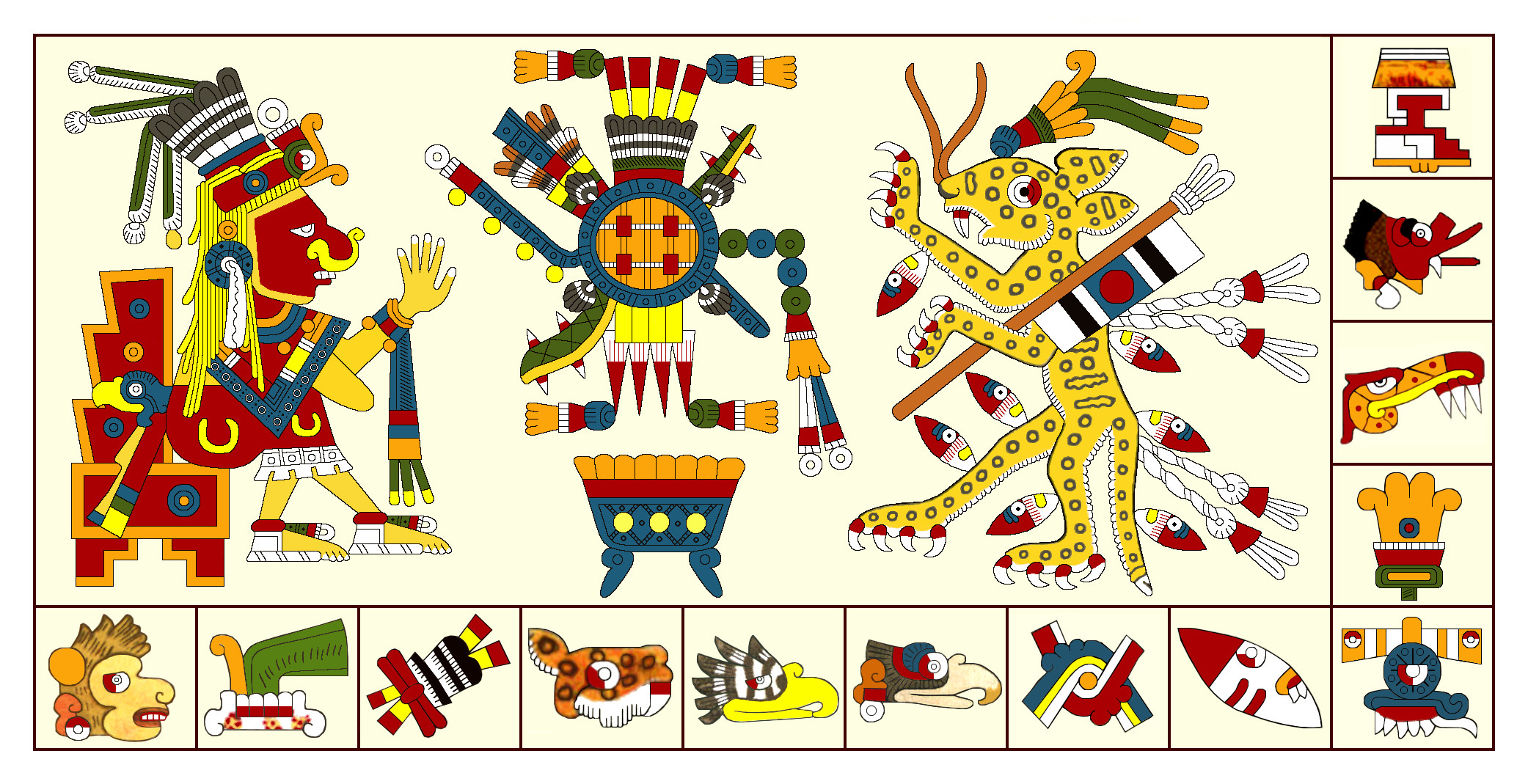
Aztec Calendar – Rain Trecena – Tonalamatl Borgia
Talk about gruesome, check out this Rain trecena page from the Codex Borgia with its imposing figure of Tlaloc with black face, goggle eyes, and bodacious fangs. For some reason he’s missing the symbolic curving mask, but there’s no mistaking his identity. A question is begged by the warding gesture of his right hand that overlaps the incense bag and ritual objects—as though rejecting them. Another is why the stream of water runs toward the god (as opposed to that flowing away from Chalchiuhtlicue in the Reed trecena).
The little human figures can scarcely be construed as additional patrons of this trecena, and their significance is mysterious. Other questions also abound. 1) What are the two footprints on the ‘riverbank?’ 2) What is the strange ‘haystack’ encasing a starry night sky? (In the Deer trecena we’ve seen Tepeyollotl seated on one just like it.) 3) What is that odd packet of red and blue ‘boards?’ And 4) why does the white-faced double-headed serpent bear watery waves on its back? Your guesses are probably at least as good as mine.
#
TONALAMATL YOAL (compiled and re-created by Richard Balthazar on the basis of Codex Telleriano-Remensis and Codex Rios)
Aztec Calendar – Rain trecena – Tonalamatl Yoal
The much gentler Tlaloc in the Tonalamatl Yoal (on the right) is perhaps the most widely known image of the god; it’s based solely on the Rios version because that page in Telleriano-Remensis is missing. His primacy as patron of the trecena is possibly indicated by being on the right side because, as posited by David Stuart in his 2021 book “King and Cosmos,” the right half of symmetry was more important than the left. This bears out in many Borgia trecenas, but not all, and only occasionally in other tonalamatls, so it can hardly be considered a rule of thumb.
On the left and supposedly secondary side of the panel is a puzzling image of an anomalous deity which the Spanish and Italian annotations in the two codices identify as “Nahui Ehecatl,” Four Wind, who to my knowledge doesn’t appear in any other context. Perhaps it’s a reflection of the special Second Sun day-name in the trecena, but its iconographic paraphernalia suggests various deities. 1) The snake it grasps could be Tlaloc’s lightning serpent, but for some reason it ambiguously has a blooming tail. 2) The mask and oversized goggles suggest that this could be Quiahuitl, god of rain, but it lacks that god’s standard fangs. (See the One Rain day-sign above.) And 3) the top-heavy headdress is just like that of Quetzalcoatl/Ehecatl in the Jaguar trecena (as well as the basket on its back). The images in both codices are so nearly identical that they offer no clues. I have to wonder if the knobbed circle in the headband (a symbol of the planet Venus) might also include Tlahuizcalpantecuhtli, Lord of the House of the Dawn, in this amalgam. In any case, this Four Wind deity as secondary patron of the trecena is of little use as an augury and would seem simply to be a religious fantasy/hallucination.
#
OTHER TONALAMATLS
Tonalamatl Aubin patron panel for Rain trecena
The patrons of the Rain trecena in Tonalamatl Aubin are also unorthodox. While the primary Tlaloc is shown in more or less standard detail, he’s on the left (supposedly secondary) side and slightly smaller than the other figure. Somewhere I’ve seen the larger deity on the right identified as Xilonen, goddess of flowering maize, but I don’t believe that for a moment. The two black stripes on her cheek are specific emblems of Chalchiuhtlicue, as is the water streaming from her skirt. The image is strongly reminiscent of that in the panel for the Reed trecena. In addition, the goddess isn’t holding ears of maize but, for some psychedelic reason, mushrooms. Perhaps the Aubin artist had a special reverence for Chalchiuhtlicue and included her in the panel because she was the spouse of Tlaloc, and the streaming water (seen in the Borgia panel) made more sense issuing from her eponymous skirt. Artistic license?
#
Codex Borbonicus patron panel for Rain trecena
This panel in Codex Borbonicus is nicely laid out with highlights of the special blue and a prominent, ornate figure of Tlaloc (again on the left). Here the water streams away from him, endangering the figure of an apparent nobleman instead of the common human in the Borgia panel. On the upper right is a slightly smaller secondary patron deity who could easily be the god of rain, Quiahuitl, judging by the fanged mask and snake in his grasp with its tail of rain-drop strips. Why they’re both speaking/singing must remain a mystery. Among the well-organized extraneous items, in the lower left is the small (blurry) image of Chicomecoatl, the principal goddess of maize, indicating that she’s perhaps a tertiary patron, but her image is more likely just a celebration of her day-sign occurring in the trecena.
#
Codex Vaticanus patron panel for Rain trecena
The Codex Vaticanus panel is an unsurprising mash-up of familiar elements. Its most notable feature is the prominently central ‘little guy’ perched on Borgia’s ‘haystack,’ which has become something of a muddy-water swirl—and his holding a bunch of magic mushrooms. Feel free to make what you will of these odd details for divination.
#
This review of the Rain trecena impresses me only with the fact that its patron is indisputably the Storm god Tlaloc. Apart from the evident connection to weather and water, Aztec dogma about this time period seems rather diffuse, confused, and fantastical—maybe from doing so many entheogenic shrooms?
#
UPCOMING ATTRACTION
The calendar’s eighth trecena will be that of Grass, the principal patron of which is the ultimate party girl Mayauel, goddess of pulque. Stay tuned.
This June 2022 being Gay Pride Month, I’m inspired to think about myself, to coin a new, easily deciphered adjective, as an “elgibaitique” writer. (And an antique one at that.) Apart from a few legitimately nonfiction books, my writing has been in a decidedly gay vein, an old queen reminiscing about his scandalous youth before we gays became an accepted part of society, if we have indeed done so yet.
Now that I’ve memorialized the dramatic first half of my life, I’m not inclined to belabor the mundane second half, no matter its fascinating mature experiences. Instead, I’ve been feeling the urge to write fiction and have been chewing on some grandiose historical ideas that I may not be able to accomplish. Nevertheless, I’ll probably give them a try someday.
To stretch my imaginative, creative muscles, I’ve taken a shot at a short story—my first short fiction since “Traveling Men” over 30 years ago. Obeying the old maxim to “write what you know about,” I set it amongst real details of my ageing queen’s current monastic life and invented events that could easily but most certainly won’t happen. That’s a wide-open field for taletelling. This story called “Whatever Works” springs from one of my few remaining social activities, ecstatic dance.
Aztec God Five Flower Dancing Ecstatically (and Singing)
For many decades, gay bars were the best and often only venue for socializing and cutting rugs. Now that we’ve supposedly been absorbed into broader society, those gay institutions don’t exist anymore. Like everyone else, gay folks must rely on distanced electronic media for socializing. Now my only outlet for the ecstasy of dance is in world music and modern rhythms, shoeless, wordless, unchoreographed, and uninhibited. The crowds are wild mixes of ages, genders, inclinations, attitudes, and dance styles, paying no attention to the idiosyncratic moves of others. I wish I’d discovered ecstatic dance sixty years ago, but in fact, that’s what I was doing as a solitary teenager—dancing all by myself in our living room to American Bandstand on the TV.
This month of June is Gay Pride 2022, and it’s mete and just that we parade and party. It would be great to have a patron “saint” to celebrate (“saint” being the title the dominant creed uses to replace the earlier gods of paganism). I want to glorify a patron god of gays, not a vengeful and homophobic deity whose devotees revile and condemn us.
There once was indeed such a god of gays in the distant past, beautiful boy named Antinous, who was deified by the Roman Emperor Hadrian. By sacrificing himself to the River Nile to bring his imperial lover good fortune, the divine ephebe became a god of beauty and love.
Head of Antinous from Hadrian’s Villa
Temples, statues, and even an entire city in Egypt were raised for beneficent Antinous, and as an honest-to-god deity, he was for a good while a strong candidate for the title of humanity’s savior—much more appropriate than the heavily marketed Messiah from Judea, who was merely (and messily) executed for rabble-rousing. The cult of Antinous was soon eradicated by righteous believers in less tolerant traditions, and I still mourn the loss.
But nowadays, as ever, it takes a lot more than an imperial decree to become a god. Anyway, beautiful Antinous probably qualifies more as a divine hero than a deity. We can always use more of them. Personally, I’m not into sacrifice and salvation (for and from what?) and prefer to revere a powerful deity with a positive attitude about being gay. It just so happens that in spite of their gruesome fixation on sacrifice, the ancient Aztecs had just such a one, a handsome divinity called the Flower Prince, Xochipilli.
This divine Prince is specifically the patron of homosexuals and an important god of fertility (agricultural produce and gardens). He’s also the god of art, dance, laughter, happiness, beauty and peace, flowers, ecstasy, sleep, and dreams/hallucinations, as well as of the sacred ball-game tlachtli. As patron of writing, painting, and song, he’s known as Chicomexochitl (Seven Flower), and as god of music, games, feasting, and frivolity, he’s called Macuilxochitl (Five Flower). That’s a rather impressive portfolio if you ask me, well worth glorifying.
Long ago before I’d ever seen any picture of Xochipilli, I drew one based on that portfolio and images of males from the Codex Nuttall—for my Aztec calendar as patron of the 20th trecena, Rabbit. (See my 1993 book Celebrate Native America!) As an arrogant humanistic artist, I was offended by the patron of that trecena, Tecpatl (flint—the sacrificial knife) and installed the more appetizing Flower Prince in that ceremonial role in an artistic coup d’état.
My early drawing is startling for the figure’s beard, which I saw in Codex Nuttall images of the historical ruler Eight Deer, and which was a not-infrequent trait of Nahuatl males. Besides loading my figure down with stylized flowers, I added a curlicue song-symbol, the cuciatl. Even that long ago, I recognized in Xochipilli my favorite Aztec deity for a patron and adopted his image for my website banner, little realizing how in-authentic my colorful iconography is.
Now 30 years later, in the codices I’ve found several authentic images of Xochipilli, which don’t look much at all like my invention. They had no ‘literate’ language, so the codices didn’t label the deities, though Spanish annotators did—sometimes with mistakes. It happens.
The image from Codex Laud can be assumed to be of Xochipilli, judging by all the flowers and the seven dots, the Prince being the patron of the number seven and his day-name Seven Flower. In the same way, also lacking identifying regalia or insignias, the Codex Fejervary-Mayer image must be the Prince, judging from the seven flowers adorning his temple. (The round fan he holds, or whatever it is, may be intended as indicative.)
The image from Codex Vaticanus (with only three flowers) I’m taking to be Xochipilli as well, given its similarity to the former—and the fact that both enthroned figures occur in pairs with an enthroned Huehuecoyotl (Old Coyote), who is one of the Prince’s lovers. The Codex Borgia image isn’t explicitly the Prince, unless one notes the flower emblem floating by his head; but this scene occurs in a sequence of calendar days with their patron deities, and he’s also patron of the day Monkey (Ozomatli).
The much different image from Codex Magliabechiano is one of two, both with the red-parrot headdress, and I’ve relied on that motif for my recent portrait of the Flower Prince:
Xochipilli – The Flower Prince
Those familiar with my YE GODS! coloring book will observe that I’ve extracted the central portion of my Icon #18 with the tlachtli ballcourt, worked that black-and-white drawing over a bit, and colored it in with a rainbow of iridescent hues. The psychedelic hummingbird and bee are there to suggest the surreal beauty of Xochipilli’s ecstatic heaven called the Flower World. The most iconoclastic aspects of this “icon” are his physical realism and frontal position, reflecting the posture of ancient Maya figures. I haven’t a clue what kind of flowers those are.
To celebrate Gay Pride 2022, I would like to see my illustration of Xochipilli enthroned appear on cards and in publications and become a celebratory poster or community mural—an emblem of LGBTQ+ dignity, love, and beauty perhaps on a par with our glorious rainbow flag.
I welcome entrepreneurs or afficionados to freely use the image for respectful purposes. To be frank, I’m extraordinarily proud of my modest picture, and I’d be greatly gratified for as many folks as possible to see our great gay deity—and pay the Flower Prince due homage. After all, our gods live on attention, devotion, and love.
As I’ve fortunately had the opportunity to say for some decades: