The Divine Volcanoes Popocatepetl and Itzaccihuatl

For too long I’ve telling folks I’m still plugging away on Icon #17 for the YE GODS! coloring book, and now I can change my tune. At last I’m on the home stretch!  Just one more vignette and the figure of Tepeyollotl Himself, the Heart of the Mountain.  (I seem to have been keeping the deity itself for the last to be informed by the story of the surrounding details.)

So now it’s high time I give you something in the way of a sneak preview of #17: the Mountain.  Actually it’s the two divine volcanoes that loom dangerously over Ciudad de México, deified as Popocatepetl (Smoking Mountain) and Itzaccihuatl (Obsidian Lady).

Popocatepetl and Itzaccihuatl

Here they are shown in the style of Codex Nuttall, Popocatepetl in its smoking majesty and Itzaccihuatl as a bonafide, stern-visaged goddess. Her codex model is iconographically notable being one of the few full-faced figures to be found in Aztec 2-D graphic art.  The Maya also preferred profiles (those marvelous foreheads!).  3-D sculpture was of course a different story.

The stylized sigils appearing in each of the “hills” are authentic names of real places. Apart from the self-evident symbol for Popocatepetl, I don’t have a clue what places the others intend.

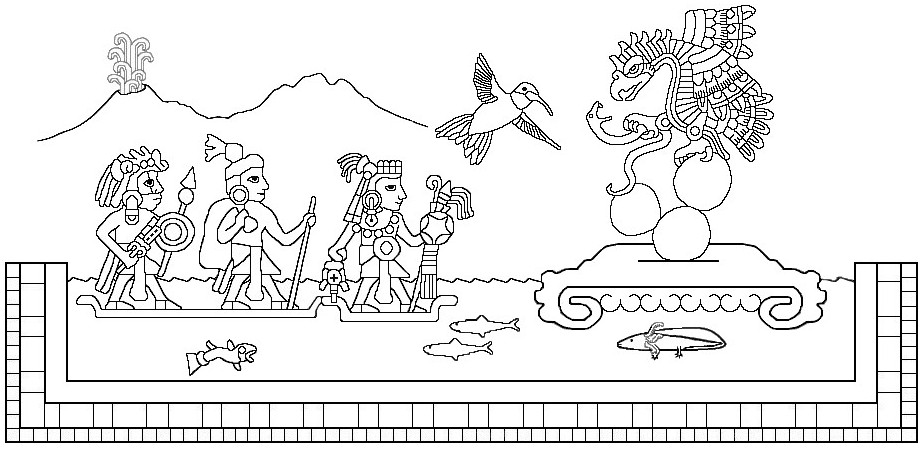
The above is my second treatment of the divine volcanoes. The first was for a vignette in Icon #7 Huitzilopochtli, Hummingbird of the South, showing the arrival of the Aztecs at Tenochtitlan:

Arrival of Aztecs at Tenochtitlan

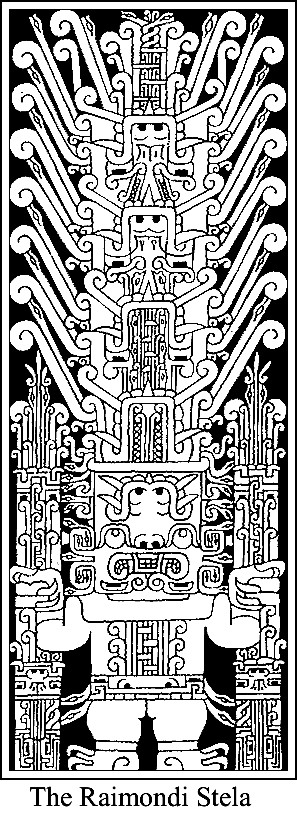
In the upcoming icon, beneath these volcanoes resides the Heart of the Mountain. Don’t let this be a spoiler, but you need to know that Tepeyollotl, as most often depicted in the Aztec codices, will be a were-jaguar, an ancient mythological being with possible roots three thousand years before in Peru.  Check out this boggling image of the Raimondi Stela from Chavín de Huantar.

###

Aztec Icon #16 – TONATIUH and METZTLI, Deities of the Sun and Moon

It’s been about nine months since the last addition to my coloring book YE GODS! Icons of Aztec Deities, #15, Quiahuitl, God of Rain. After completing it back last April, I had to focus on setting up the two-month Ye Gods! exhibition in Santa Fe, as well as prepare and deliver several lectures.  Then everything else, including work on my second memoir, had to be put on hold while I concentrated for three months on re-translating an opera from Russian (which will be produced by the New Orleans Opera in February, 2020).  Meanwhile I also set up the exhibition for another month in nearby Española.  Busy boy, no?

Finally by late November, I got back to drawing, and now I’m thrilled to announce that #16 is finished at last. (At first I thought it was Tecciztecatl and Metztli, Deities of the Moon, but much later I’ve now discovered that it is Tonatiuh and Metztli, Deities of the Sun and Moon.)

TONATIUH & METZTLI

At first I worte that Tecciztecatl {tek-seez-te-katł}, the son of Tlaloc and Chalchiuhtlicue, is a god of hunters and appears as things shining in the night. In the Nahua cosmology, when Quetzalcoatl and Ehecatl created the current Fifth Sun, Tecciztecatl wanted to become the new sun, but he hesitated to jump into the sacred fire, whereupon the young god Nanahuatzin leapt into the flames to become Tonatiuh, the Fifth Sun.  When Tecciztecatl followed, he took second place as the moon. Well, it turns out that the little guy throwing himself into the fire here is actually Nanahuatzin, and the male deity here is Tonatiuh, the sun, in the pair with the moon.

Metztli {mets-tłee} is the ancestral moon goddess probably inherited from ancient Teotihuacan and/or the Maya’s lunar goddess Ix Chel.  Long after the Nahuas demoted Metztli to merely being the consort of Tecciztecatl (in Tonalamatl Aubin), and replaced her with Tecciztecatl in several other codices, the later Aztecs tried to replace her completely with (the severed head of) Coyolxauhqui, the sister dismembered by their supreme god Huitzilopochtli.

Tecciztecatl was stuck into the sacred calendar (tonalpohualli) as one of the patrons, frequently in the company of Tonatiuh, of the thirteen-day week One Death, which is shown in the encircling day-signs.  It should be noted that there are thirteen days between the full and dark of the moon.  The Mesoamerican cultures saw a rabbit in the full moon (top), and the serpent of the night devouring the rabbit (bottom) represents the dark of the moon.  Incidentally, the nocturnal jaguar was closely connected with the moon, and the conch shell was the standard symbol of the moon.

I fired the drawing off to my dear friend Sagar in Bangladesh for him to work his vectorizing magic on it, and he did the trick.  I’m currently (in January) posting the jpeg version with caption and sources on the coloring book page and have now (in April) have added the vectorized versions to the list of various sizes available for free download.

In my strict alphabetical sequence, the next deity to tackle is Tepeyollotl, Heart of the Mountain, who has several dramatic aspects.  You can check out my earlier image of this god among the Aztec images from the old book on the calendar.  If the creek don’t rise, I’d like to get his icon done by April.  Once again meanwhile, in my multi-tasking fashion, I’ll be arranging more venues for the expanded exhibition and lectures—and forging onward in my memoir. Call me driven, but I’d love to finish that by next year.

YE GODS! There Was a Ship…

It’s been a couple (few?) months since I raised a big whoop about my show of black and white Aztec icons (for a coloring book), and that’s what mostly has occupied me lo that many moons.

Richard Balthazar at opening of YE GODS!

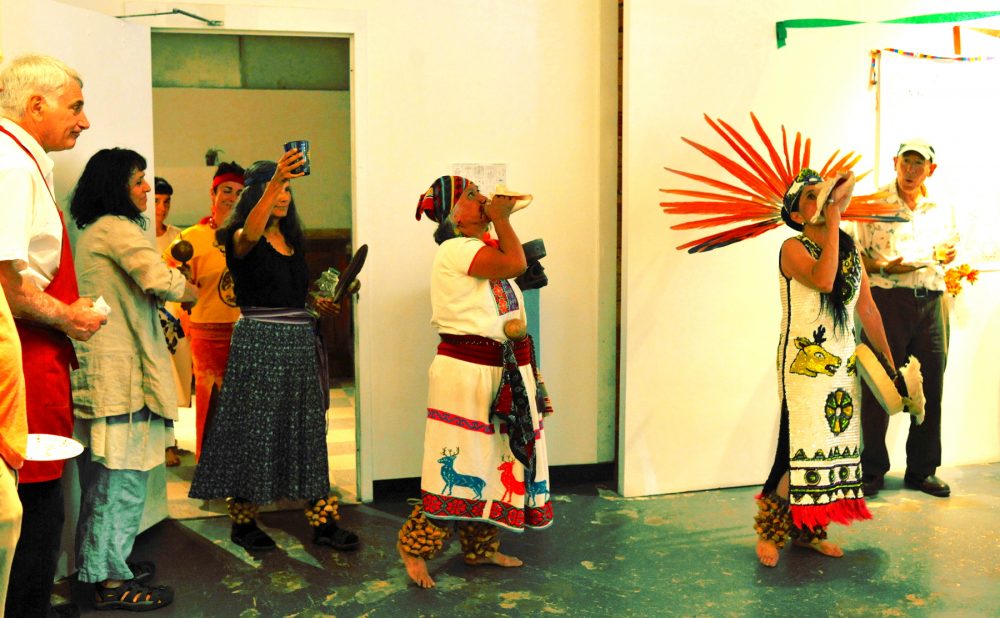
Actually, June and July at my show were splendid! YE GODS! opened on June 1 with a wonderful crowd.  There was delicious food (catered by my old Backstreet Bistro and spa buddy David Jacoby and his wife Melanie as our lovely “soda server”) and a marvelous group of female dancers, Danza Azteca, who blessed the icons (and me) and danced ceremonies around a big Aztec drum (the huehuetl).  They even got some in the crowd to join in a friendship dance.

Throughout the run of the show I spent a couple hours each afternoon at El Museo Cultural (de Santa Fe), just to be there and talk to visitors—but also to give the inexhaustible Maria Martinez a bit of a break from staffing the gallery to attend to her many other duties around the nearly 2-acre cultural facility. She is the peaceful animus of the Museo, and I am deeply grateful for all her help and encouragement.

Entrance of Danza Azteca: David Jacoby and Maria Martinez on left, Concha Garcia y Allen center

By the way, the above photos are to be credited to my friend Seth Roffman, who is editor of “Greenfire Times.”

Visitation at the show was steady, even without publicity during July. I greatly enjoyed meeting folks of all walks—and bending their ears about the icons, their mythology, and elements of history.  In particular, I stressed that only one icon in the show was actually a genuine Aztec deity (Huitzilopochtli).  The rest were from long before the arrival of the Mexica (Aztecs), who simply adopted the culture, mythology, and cosmology of the peoples living there already.

What I enjoyed most of all was the series of 15 lectures I slapped together and delivered off the top of my head. Half were about the Aztec codices (picture books), showing pages and discussing their mythology, iconography, and social implications.  The other half were focused on cultural and historical subjects that went from Aztec-specific through general Mesoamerican to all the Americas and then into probable interactions between those societies. I was blessed to have a corps of several interested listeners who came to most of my talks.  After the finale on Codex Vindobonensis, six of them took me out to dinner, and we had a long, leisurely chat about our lives—and of course, some follow-up questions about the whole Aztec thing.

Now that it is over and the icons are stored in my garage, I’m intending to approach many places here in NM and around the country (and internationally?) about hanging YE GODS! It’s a fantastic educational (informational) show, after all, and I’d offer it to presenters free (charging only for the minimal shipping).  I’d also be available to do my scalable series of lectures (for expenses), and presenters could sell the separate prints for coloring.  WHAT A DEAL!

#

Meanwhile, several other things transpired. Most must wait for later posts, but I’ve totally got to let you know right now about another BIG DEAL!  My memoir THERE WAS A SHIP can be reached by clicking here.

#

Aztec Icon #15 – QUIAHUITL, God of Rain

I’ve just checked the date when I posted Icon #14, Quetzalcoatl, for my serialized coloring book YE GODS! and must hang my head in shame that it’s taken me nearly six months to finish Icon #15, Quiahuitl, God of Rain. I understand that nobody out there has been waiting with baited breath to see my latest work of genius, but I managed to draw the earlier deities much more quickly, 14 of them in 3 ½ years.  My excuses are that this past winter I spent a lot of time on my second memoir, and for what it’s worth, this icon turned out to be just about as detailed as Icon #11, Ocelotl (Jaguar).  There’s a lot going on in it.

Quiahuitl, God of Rain

This icon is available as 8X10 with a caption/sources page by clicking here.

In the central image, Quiahuitl {kee-a-hweetł} is shown emerging from the Underworld, rising up out of the maw of the Earth Monster.  The Aztecs understood that moisture mysteriously rises from the earth to the sky (the crest across the top), where the god turns it into rain.  Every locale had its own Quiahuitl to conjure and appease, as indicated by drops falling on trees which symbolize the cardinal directions.

Quiahuitl is of crucial importance to the cultivation of maize, and the lower panel is a homage to that crop. In the center, the plant grows out of another Earth Monster, and on it perches a mythical bird, which is actually a motif inherited from the ancient Maya, Itzamnaaj—the Bird of the Sun.  Just above it is another nod to the Maya, the head of a centipede which they saw as the face of the Underworld.  On the left is Chicomecoatl (Seven Snake), chief of the several goddesses of maize, and on the right is Centeotl, the main god of maize.

But that’s not all. The four big dots indicate that the god is also a day-sign in the ritual calendar, Four Rain (Nahui Quiahuitl).  You’ve already seen the same thing in the icons of Four Water, Four Wind, and Four Jaguar.  I haven’t yet made it alphabetically to the god Tonatiuh and Four Earthquake, the Fifth Sun, our current era.

Anyway, Four Rain is the day-name of the earlier Third Sun (era), a paradise ruled by the Storm God Tlaloc. However, when Tezcatlipoca abducted his wife Xochiquetzal, Tlaloc destroyed that world in a rain of fire.  Its poor humans were turned into butterflies, birds, dogs, and turkeys—which I rather doubt was a great deal of help in the rain of fire.

As I said before, there’s a lot going on in this icon, and there were times I wondered if I was ever going to complete it. Besides, all these past months we’ve been suffering severe drought, and I started to fear it was because I hadn’t finished the god’s icon.  Well, I finally did it last night—and it still hasn’t rained!  I’ve done what I could…

This morning I fired #15 off to my digital wizard in Bangladesh to be turned into a vector drawing, which will be added to the coloring book page.  Then it will follow the other 14 to my print shop. At Santa Fe Signs & Images, they’re being printed on 3’ x 4’ vinyl banners for my upcoming exhibition.

NEWS FLASH!

I’ve recently arranged to have a show of my coloring book pages to be called YE GODS! Icons of Aztec Deities.  It will be at El Museo Cultural de Santa Fe, opening June 1, 2018 and running through July 29.  There’s much to be done in preparation, of course, and I’ve at least gotten calendar listings out to the media.

Now come the million details, and I seriously doubt that I’ll even get started on Icon #16, Tecciztecatl, God of the Moon, till later in the summer. According to the original project plan, I’ve still got 11 icons to go, which at this rate will take a minimum of three more years, maybe four.  What the hell!  I’ll only be 80!

###

Aztec Icon #14 – QUETZALCOATL, Plumed Serpent

Sorry to take so long to finish the 14th icon for my coloring book YE GODS!  My work was delayed by that time-consuming thing called life.  Anyway, the icon’s done and my digital wizard has turned it into vector drawings for free sizing.  Here you have the most famous Aztec deity of all, QUETZALCOATL, the Plumed Serpent:

Quetzalcoatl, Plumed Serpent

QUETZALCOATL (Plumed Serpent) {ke-tsal-ko-atł} is the god of intelligence, learning, writing, arts and crafts, the calendar, priests, and merchants and was the bringer of maize to mankind.  Opposed to human sacrifice, he is called the White Tezcatlipoca and is the 9th lord of the day and god of the West. As the planet Venus, he is known as Tlahuizcalpantecuhtli, the morning star, and his twin Xolotl is the evening star.  He ruled the Second Sun (Four Wind) and created the current Fifth Sun (Four Earthquake) by using his own blood to give new life to the bones in Mictlan.  He was known as Kukulcan to the Maya and a major deity in Teotihuacan, and Quetzalcoatl was the traditional name/title of the Toltec rulers of Tula.

This icon is available as 8X10 with a caption/sources page by clicking here.  The freely sizable vector versions are available by clicking here.

By way of explaining this new icon, I must first thank Eliseo Rosales, a tattoo artist in California, for his suggestions, particularly for the design on the pedestal and for the important theme of maize.

The central figure of Quetzalcoatl is based on an image from Codex Borbonicus with details of costume and accoutrements mostly from Codex Magliabechiano, though the serpent on his back is adapted from those on the Stone of the Suns. Don’t be surprised by his beard, which occurs in other codex images:  According to some, he was supposedly blond and white-skinned.

In his left hand, the deity holds the weapon known as Xiuhcoatl (Fire Serpent), and on his shield is his standard ‘cross’ symbol. His peaked cap of jaguar pelt is apparently a Huastec influence.  Sprouting from his forehead is a ritual ‘blooming shinbone,’ the significance of which escapes me.  The numeral by his left foot is Nine, of which he is the patron, and the day-sign One Reed directly over his head is his ceremonial day-name.

Now for the other motifs. The pedestal, as mentioned above, illustrates the depth of the history of the Plumed Serpent.  It comes from the frieze on the Temple of Quetzalcoatl in Xochicalco (c. 1000 AD), which was a city/culture that arose in the aftermath of the Classic civilizations of the Maya and Teotihuacan.  As evidence of his even deeper history, the two heads flanking his day-name are views of sculptures on the Temple of Quetzalcoatl in Teotihuacan (c. 600 AD).  The paired feathered serpents on his either side are taken from Codex Borbonicus and Codex Telleriano-Remensis, and the paired quetzal birds are merely grace-notes.

The border design is adapted from one of his images in Codex Telleriano-Remensis. The day-signs embedded in it represent the ceremonial calendar which the deity brought into Mexico in the dim past.  Each group of five days represents a direction in the Aztecs’ odd world-view.  At the bottom is West, of which he is the patron.  At the top is East, on the left North, and on the right South, the standard Aztec spatial orientation as it was also for the Maya.

Drawn respectively from the Cospi, Vaticanus, and Borgia codices, the standing deities in the upper section are: on the left, Tlahuizcalpantecuhtli, Lord of the House of Dawn (as the Morning Star), on the right Xolotl (as the Evening Star), and at the top his nagual (manifestation) as Ehecatl, God of the Wind.

In the upper corners are scenes representing his gift of maize to mankind. On the left is Tlaloc, the Storm (Rain) God, nurturing the goddess of maize Chicomecoatl, and on the right is the goddess of flowing water Chalchiuhtlicue tending the god of maize Centeotl.

That’s all the mythology I could manage to cram into this icon. Surely it’s enough.

#

Another note of interest about Quetzalcoatl. In the September, 2017 issue of ANCIENT AMERICAN magazine, my article just appeared entitled “The Plumed Serpent in North America.”  Click here to check out a copy.

Coloring Book Overhaul – The Aztec Icons

BIG NEWS FOR ALL YOU COLORING ENTHUSIASTS! Whether you’re new to this website, have just been keeping your eye on it, or have actually colored some of my unusual icons of Aztec deities, you’ll find my overhauled coloring book now has a lot more to offer.

There are 13 icons currently completed (but there will be 19 by May, 2020!), each is now accompanied by a page with its descriptive caption and full-color images from the Aztec Codices that served as models for drawing the icon. Those images will give a good idea of the varying styles of the ancient picture-books and maybe even suggest authentic colors to use in your own coloring.

Check out this example of the caption/model page for CHALCHIUTLICUE, the Jade Skirt.

caption-model page for Chalchiuhtlicue

As before, all the icons can be viewed or downloaded individually from the coloring book page, either as a pdf file with caption/models page or as freely sizable vector drawings. But now they are also all bundled together into an actual book:  YE GODS!  THE AZTEC ICONS.

But that’s almost the least of the overhauls. In addition to that book, there is now a major revision and expansion of the earlier catalog and appendix—a complete illustrated encyclopedia of essentially all the Aztec deities:  YE GODS!  THE AZTEC PANTHEON.

Its 88 alphabetical entries include some 1,300+ divinities (depending on how you count), and there’s usually an authentic image for each selected from the Aztec Codices. Again, the images illustrate their varying styles and provide even more suggestions for coloring the icons.

Here’s a sample page from the encyclopedia:

sample page – The Aztec Pantheon

Of itself, YE GODS! THE AZTEC PANTHEON amounts to a crash course in ancient Mexican mythology, history, culture, and art.  YE GODS!  THE AZTEC ICONS takes this another step further—into illustrating details of Aztec society.

For perhaps excessive example, with Huehuecoyotl, the Old Coyote, there are vignettes of people playing musical instruments, singing, and dancing; with Huitzilopochtli, Hummingbird of the South, there’s a pictorial narrative of the legendary migration of the Aztecs to Tenochtitlan; with Mictlantecuhtli, Lord of the Land of the Dead, there’s a vague map of the soul’s way to Mictlan; and with Patecatl, God of Medicine, there are scenes of medical practices and medicinal herbs. Each icon contains its own type of social commentary.

I haven’t quite started on Aztec Icon #14: Quetzalcoatl, the Plumed Serpent, but hope to do so shortly.  In the meantime, I’m working on yet a third component of my Aztec project, another section on the Aztec Codices themselves.  It will be a description of and commentary on each of the 15 surviving picture-books, including sample pages and Internet sources to view the whole documents.  I perhaps unrealistically hope to complete it in the next couple months, and guess what:  I’ll call it YE GODS!  THE AZTEC CODICES.  Watch for a post announcing it.

###

Aztec Icon #13 – PATECATL, God of Medicine

So—six weeks now seems to be my new average to produce an Aztec icon for the coloring book YE GODS! Here’s Icon #13, PATECATL, which I drew on my old system (GNU) and believe it or not, using the mouse in my left hand.  Back while drawing #12 I started getting pains in my right hand from all the clicking—so I switched.  Nothing to it!

This is a standard pixelated image, and it’s currently winging its electronic way to my graphic wizard for conversion to vectors. The vectorized files for #12, OMETEOTL, have now been added to the list on the coloring book page, where you can also view and download all the previous icons.

To download this one as a pdf file with a page of caption and model images from the Aztec Codices, just right-click here and select “Save as.”  You can also download it in freely sizable vector drawings from the coloring book page.

Patecatl, God of Medicine

Patecatl, God of Medicine

PATECATL

God of Medicine

PATECATL {pa-te-katł} is the god of healing and fertility, medicine (herbology) and surgery, who gives comfort in illness. Logically he is patron of day Grass.  Husband of MAYAUEL, he is the father of the Centzon Totochtin (400 Rabbits), the gods of drunkenness led by Ome Tochtli (Two Rabbit). As well as being a pulque god like his wife, he’s the deity of intoxication by peyote, hallucinogenic mushrooms, and psychotropic herbs such as datura (jimson weed), morning glory, and marijuana. These plants were used in healing, fortune telling, shamanic magic, and public religious ceremonies, hopefully also to tranquilize sacrificial victims and enhance the sacramental nature of the ritual.

***

There are several points of interest in this icon:

  1. The god’s physiognomy is iconographically authentic, quite the way he appears in Codex Borgia, nose, buck-teeth, and all. His eye is just as baleful in the model, where (as is often the case with gods, male and female) it’s horribly blood-shot. I won’t even guess what that’s all about.  Also, since it’s so obvious here, in general the Aztecs didn’t bother with the difference between right and left feet, but they usually tried to distinguish between right and left hands.
  2. The vignettes in the upper section of the icon are based on medicinal scenes from various codices, including Nuttall, Borgia, Fejervary-Mayer, Vaticanus, and even the post-Conquest Florentine Codex.
  3. The vignette of nose-piercing is remarkable for two reasons. In the Nuttall model, the patient is not only bearded, but black. Throughout the codices there are frequent black personages, both human and divine, and indisputable beards.  Make of that what you will.
  4. The plants scattered around the icon are actual medicinals, several adapted from early herbal illustrations, from Nuttall, and from nature.
  5. Meant as a House of Healing, the temple in the upper right may be a bit over the top ornamentally, but it’s stylistically real.  The figure of the snake ingesting a rabbit is based on a page from Vaticanus, where an eagle is also seizing the snake.  I’ve included it to symbolize life as a food cycle, very much the way the Aztecs saw it.

Aztec Icon #12 – OMETEOTL, Deity of Two

Well, in a mere three months I’ve managed to finish Icon #12, OMETEOTL for the coloring book YE GODS!  Actually it took only about six weeks because I spent the other six weeks trying to work out a computer system upgrade.  I’ve been using the freeware GIMP (Gnu Image Manipulation Program), but a fantastic artist-friend convinced me to buy an iMac and look into another program for drawing.

After some weeks taking a community college course in Adobe Photoshop, I took a preliminary look at Adobe Illustrator—without being particularly impressed. I still have to take tutorials in Illustrator, particularly about drawing in vectors, but in the meantime I’m continuing my artwork on GIMP (on my PC) and relying on my graphic magician to turn stuff into vectors for me.

So herewith I’m posting the standard .pdf of this icon, and when my wizard has done his trick, I’ll provide the vector drawing in the various sizes. (Again, if you want his contact for similar vectorizing work, contact me at “rbalthazar” @ msn.com.)  You can also view and download the previous 11 icons from the coloring book page.

To download this one as a pdf file with a page of caption and model images from the Aztec Codices, just right-click here and select “Save as.”  You can also download it in freely sizable vector drawings from the coloring book page.


Ometeotl, Deity of Two

Ometeotl, Deity of Two

OMETEOTL

Deity of Two

 OMETEOTL {o-me-te-otł} is the creative pair of Omecihuatl (Lady of Two) and Ometecuhtli (Lord of Two), conjoined as the supreme creator and parent(s) of the primary Aztec gods.  This deity of duality is transcendental, without cult, rites, or temples and exists somewhere beyond the stars.  Also known as Tonacacihuatl and Tonacatecuhtli (Lady/Lord of Sustenance), as Ilamacihuatl and Ilamatecuhtli (Lady/Lord of Creation), and as Citlalicue and Citlalatonac (deities of the stars), OMETEOTL represents unity through sexual dualism. The pair rules the highest (13th) heaven of Omeyocan where unborn souls reside. Omecihuatl chooses the days for their birth and consequently their fates.

***

I should probably explain a few things about this icon. First off, the 20 symbols arrayed around the periphery are the day-names of the month.  The Aztecs named the days of their month and counted the days of their week (13).

The sequence starts with the second up from the bottom on the right side and proceeds counter-clockwise to end in the lower right corner: Cipactli (Crocodile), Ehecatl (Wind), Calli (House), Cuetzpallin (Lizard), Coatl (Snake), Miquitzli (Death), Mazatl (Deer), Tochtli (Rabbit), Atl (Water), Itzcuintli (Dog), Ozomatli (Monkey), Malinalli (Grass), Acatl (Reed), Ocelotl (Jaguar), Cuauhtli (Eagle), Cozcacuauhtli (Vulture), Ollin (Earthquake), Tecpatl (Flint), Quiahuitl (Rain), and Xochitl (Flower).

The days in the middle of each side are also the year-bearers for the 52-year count, starting at the top and again going counter-clockwise: Rabbit, Reed, Flint, and House.

Meanwhile, the little creatures being “spit out” by the odd serpents all wear the traditional mask of Ehecatl, God of the Wind, (See Icon #5), who is the life spirit. So these “breezes” represent the new (or recycled?) souls being born.  They have claws, I assume, because most supernatural beings seem to have them.  They are based on images from Codex Borgia.

The four smaller gods represent the primary god-descendants of Ometeotl. Again counter-clockwise from lower right:  Tlaloc (based on Codex Borgia), Quetzalcoatl (based on Codex Borbonicus), and Tlahuizcalpantecuhtli (based on Codex Borbonicus).  I had intended the last to be Xiuhtecuhtli, but I made a mistake in identification.

The medallion at top center is based on an enigmatic design from Codex Borgia which I take to represent the concept of duality. The dual image of Ometeotl is drawn from Codex Fejervary-Mayer, the only image I’ve ever been able to find of that transcendent deity.  Otherwise, I haven’t a clue about the horn-like thing that Omecihuatl holds or what it may signify.


Aztec deities in vector drawings

Great news for all you coloring enthusiasts out there! I’ve now managed to get the icons of Aztec deities for the coloring book YE GODS! turned into vector drawings.  This may not sound like a big deal, but it actually is because the lines are now clean-edged, and the .pdf files can be enlarged or shrunk without affecting line-quality.  At least that’s what they tell me…

(The work of converting all my insane pixel drawings into vectors was done magnificently and quickly by a brave young fellow in a distant country, saving me many months of boggling labor. Contact me, rbalthazar at msn.com, for his details.)

On the coloring book page, as well as below, I now include three free download options for the icons completed thus far. The regular download is still for the original 8X10 pixel-image with title and caption.  In addition, you can choose an 8X10 vector drawing or another at 16X20, which will no doubt be much better for coloring the intricate details.  But you can also size these vectorized images however you wish.  Go for it!

(to download, right-click on link and select “Save as”)

(Images on pages are in pixels and sized at 8” x 10” w/ captions for legal paper at 300 dpi.  You can also download the images as vector drawings in two sizes which can be enlarged or shrunk with consistent line quality.)

#1 Atl                                      Page 1 with caption         8X10 vector           16X20 vector

#2 Chalchiuhtlicue              Page 2 with caption         8X10 vector           16X20 vector

#3 Chalchiuhtotolin            Page 3 with caption         8X10 vector           16X20 vector

#4 Chantico                          Page 4 with caption         8X10 vector           16X20 vector

#5 Ehecatl                             Page 5 with caption         8X10 vector           16X20 vector

#6 Huehuecoyotl                 Page 6 with caption         8X10 vector           16X20 vector

#7 Huitzilopochtli               Page 7 with caption         8X10 vector           16X20 vector

#8 Itzpapalotl                      Page 8 with caption         8X10 vector           16X20 vector

#9 Mayauel                          Page 9 with caption         8X10 vector           16X20 vector

#10 Mictlantecuhtli            Page 10 with caption       8X10 vector           16X20 vector

#11 Ocelotl                            Page 11 with caption       8X10 vector           16X20 vector

***

By the way, here’s a progress report on the next icon for YE GODS! I’m about half-way through Aztec icon #12, OMETEOTL, the Deity of Two.  A “duity” (duality) deity, if you will, it’s a composite of Ometecuhtli and Omecihuatl, the Lord and Lady of Two.  Here’s a little detail which I interpret from a page in Codex Borgia as a symbol of duity.

Aztec duity symbol

Aztec duity symbol


Aztec Icon #11 – OCELOTL (Jaguar), Lord of the Animals

At long last –Aztec Icon #11: OCELOTL, Lord of the Animals.  In the midst of other projects and family stuff, it’s taken me all summer to finish this icon for the coloring book YE GODS!  THE AZTEC ICONS.  Not for lack of effort but the enormous amount thereof.  Actually I’d already done the jaguar rampant a couple years ago, my first drawing directly to digital.  Thanks to my freeware graphics program GIMP, in rendering this boggling Mesoamerican zoo, I’ve discovered almost godlike powers over pixels.  But I try to be a beneficent deity.

The vast amount of effort came first in locating historical images of creatures in the ancient codices for stylistic models. Those I couldn’t find had to be drawn from photographed nature.  Actually, my iconic jaguar is a departure from Aztec style in its naturalistic treatment.  While there are many jaguars in the codices, in my opinion they all look too “cartoonish” to make an impressive deity.  Besides, I liked the challenge of creating the pelt pattern for the little Jaguar Knights in the Chalchiuhtotolin icon.  The regalia indicates the creature’s divine nature, and the wavy fork at its muzzle is the symbol of its howl.

Please note the large “dots” at each corner of the icon. They are the Aztec number four, and this is the calendrical day-name Four Jaguar, the First Sun (World) in the Mesoamerican cosmological sequence.  That very first YE GODS! icon of Atl was the day-name Four Water, the Fourth Sun, and the fifth icon of Ehecatl was the day-name Four Wind, the Second Sun.  You’ll have to wait a bit for the third and fifth Suns later in this series.

Ocelotl is lord of all animals:  those belonging to Huixtocihuatl, Lady of Salt (Goddess of the Sea on the upper left); those belonging to Tlaltecuhtli, the hermaphroditic Lord of the Earth (on upper right); and those of the air ruled by Quetzalcoatl, the Plumed Serpent (at top).

The split circle over the deity’s head is the traditional symbol of day and night, showing its lordship over diurnal and nocturnal animals, the jaguar itself being nocturnal. The eagle to the left represents the Aztecs’ main god Huitzilopochtli as the sun at midday, and my very own “batterfly” on the right is Itzpapalotl, Goddess of the Night Sky, who was often depicted as butterfly, bat, and/or bird.

Ocelotl is also lord of the strange animal Man, as can be seen in the vignette at the bottom depicting the legendary creation of man from a primordial tree as shown in Mixtec codices.

By the way, I’ll note that the Aztecs adopted most of their cosmology and “religion” from the peoples living then and earlier in central Mexico like the Mixtec, Zapotec, Huastec, Toltec, etc., etc.—as had they from the even more ancient Teotihuacan and Maya. In the long history of Mesoamerican civilizations, their underlying myths have mostly been related, even inherited.

Ocelotl, the Jaguar, is a mythology from deep in history. The earliest (in Mesoamerica) Olmec famously revered the Jaguar (jaguar-headed babies?), and may have named the day in the calendar for it.  Or maybe not.  Elsewhere I’ve suggested that the Mesoamerican calendar could have come from South America, from the even earlier Chavín civilization, and curiously, the Jaguar-Man was also a prominent feature of that culture.  Just saying…  Deep history.

Some other notes on my Mexican menagerie: I can’t even identify some of the animals or birds, especially the silly little bugs.  That odd creature at the end of the deity’s tail is the salamander called in Nahuatl axolotl.  My Monarch butterfly (center left, just above the stunning Turkey) is geographically appropriate, as are my several other nature drawings of Mexican fauna, including the quetzal birds (top right).  Don’t overlook the Xoloitzcuintli, national dog of Mexico, at the Jaguar’s left foot.  Can you identify any more of the critters in this montage?

(You can still see or download the previous ten icons in the YE GODS! series by clicking on them in the list on the page for the coloring book.)

ICON #11: OCELOTL

(Lord of the Animals)

To download this icon as a pdf file with a page of caption and model images from the Aztec Codices, right click here and select “Save Target (or Link) As.”  You can also download it in freely sizable vector drawings from the coloring book page.
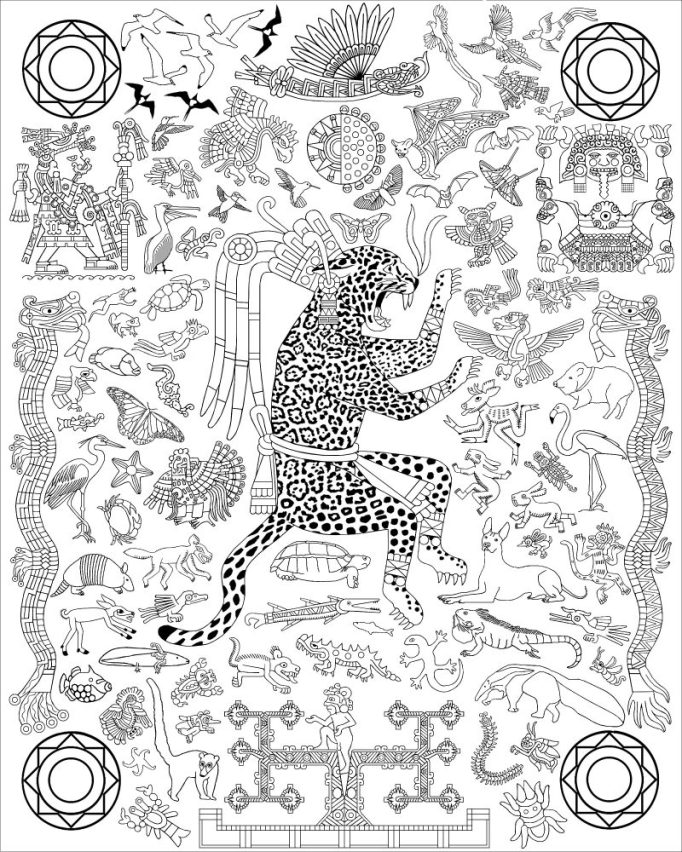
OCELOTL (Jaguar), Lord of the Animals

OCELOTL (Jaguar), Lord of the Animals

OCELOTL {o-se-lotł} (Jaguar) is the Aztecs’ deity of all animals of land, sea, and air. It is a nagual of the god TEZCATLIPOCA who created the First Sun, Nahui Ocelotl (Four Jaguar), a world peopled by giants who were devoured by divine jaguars.  Ocelotl, the 14th day of the month, was usually a lucky day, but anyone born on the day Ce Ocelotl (One Jaguar) was destined for sacrifice to one god or another.  OCELOTL is patron of scouts and warriors, and the elite corps of warriors of the night were known as the Jaguar Knights.  Ever since the Maya, in Mesoamerica jaguar pelts in shades of tawny gold to white were the sacred possessions of priests and royalty.