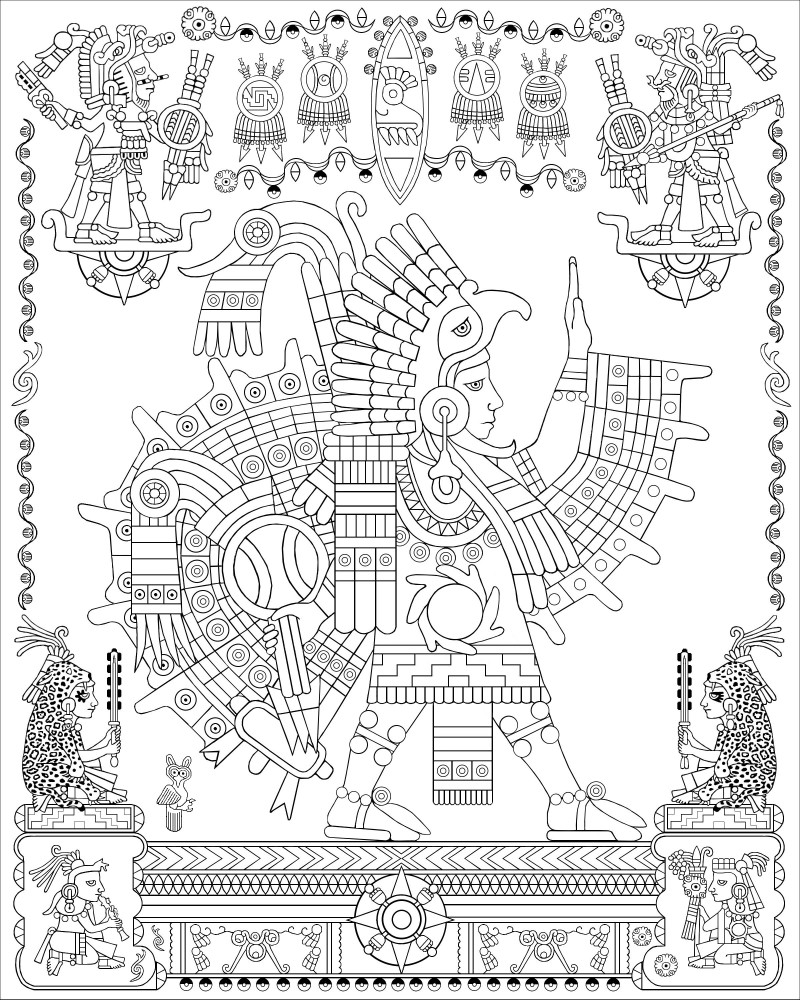
Aztec Icon #11 – OCELOTL (Jaguar), Lord of the Animals

At long last –Aztec Icon #11: OCELOTL, Lord of the Animals.  In the midst of other projects and family stuff, it’s taken me all summer to finish this icon for the coloring book YE GODS!  THE AZTEC ICONS.  Not for lack of effort but the enormous amount thereof.  Actually I’d already done the jaguar rampant a couple years ago, my first drawing directly to digital.  Thanks to my freeware graphics program GIMP, in rendering this boggling Mesoamerican zoo, I’ve discovered almost godlike powers over pixels.  But I try to be a beneficent deity.

The vast amount of effort came first in locating historical images of creatures in the ancient codices for stylistic models. Those I couldn’t find had to be drawn from photographed nature.  Actually, my iconic jaguar is a departure from Aztec style in its naturalistic treatment.  While there are many jaguars in the codices, in my opinion they all look too “cartoonish” to make an impressive deity.  Besides, I liked the challenge of creating the pelt pattern for the little Jaguar Knights in the Chalchiuhtotolin icon.  The regalia indicates the creature’s divine nature, and the wavy fork at its muzzle is the symbol of its howl.

Please note the large “dots” at each corner of the icon. They are the Aztec number four, and this is the calendrical day-name Four Jaguar, the First Sun (World) in the Mesoamerican cosmological sequence.  That very first YE GODS! icon of Atl was the day-name Four Water, the Fourth Sun, and the fifth icon of Ehecatl was the day-name Four Wind, the Second Sun.  You’ll have to wait a bit for the third and fifth Suns later in this series.

Ocelotl is lord of all animals:  those belonging to Huixtocihuatl, Lady of Salt (Goddess of the Sea on the upper left); those belonging to Tlaltecuhtli, the hermaphroditic Lord of the Earth (on upper right); and those of the air ruled by Quetzalcoatl, the Plumed Serpent (at top).

The split circle over the deity’s head is the traditional symbol of day and night, showing its lordship over diurnal and nocturnal animals, the jaguar itself being nocturnal. The eagle to the left represents the Aztecs’ main god Huitzilopochtli as the sun at midday, and my very own “batterfly” on the right is Itzpapalotl, Goddess of the Night Sky, who was often depicted as butterfly, bat, and/or bird.

Ocelotl is also lord of the strange animal Man, as can be seen in the vignette at the bottom depicting the legendary creation of man from a primordial tree as shown in Mixtec codices.

By the way, I’ll note that the Aztecs adopted most of their cosmology and “religion” from the peoples living then and earlier in central Mexico like the Mixtec, Zapotec, Huastec, Toltec, etc., etc.—as had they from the even more ancient Teotihuacan and Maya. In the long history of Mesoamerican civilizations, their underlying myths have mostly been related, even inherited.

Ocelotl, the Jaguar, is a mythology from deep in history. The earliest (in Mesoamerica) Olmec famously revered the Jaguar (jaguar-headed babies?), and may have named the day in the calendar for it.  Or maybe not.  Elsewhere I’ve suggested that the Mesoamerican calendar could have come from South America, from the even earlier Chavín civilization, and curiously, the Jaguar-Man was also a prominent feature of that culture.  Just saying…  Deep history.

Some other notes on my Mexican menagerie: I can’t even identify some of the animals or birds, especially the silly little bugs.  That odd creature at the end of the deity’s tail is the salamander called in Nahuatl axolotl.  My Monarch butterfly (center left, just above the stunning Turkey) is geographically appropriate, as are my several other nature drawings of Mexican fauna, including the quetzal birds (top right).  Don’t overlook the Xoloitzcuintli, national dog of Mexico, at the Jaguar’s left foot.  Can you identify any more of the critters in this montage?

(You can still see or download the previous ten icons in the YE GODS! series by clicking on them in the list on the page for the coloring book.)

ICON #11: OCELOTL

(Lord of the Animals)

To download this icon as a pdf file with a page of caption and model images from the Aztec Codices, right click here and select “Save Target (or Link) As.”  You can also download it in freely sizable vector drawings from the coloring book page.

OCELOTL (Jaguar), Lord of the Animals

OCELOTL (Jaguar), Lord of the Animals

OCELOTL {o-se-lotł} (Jaguar) is the Aztecs’ deity of all animals of land, sea, and air. It is a nagual of the god TEZCATLIPOCA who created the First Sun, Nahui Ocelotl (Four Jaguar), a world peopled by giants who were devoured by divine jaguars.  Ocelotl, the 14th day of the month, was usually a lucky day, but anyone born on the day Ce Ocelotl (One Jaguar) was destined for sacrifice to one god or another.  OCELOTL is patron of scouts and warriors, and the elite corps of warriors of the night were known as the Jaguar Knights.  Ever since the Maya, in Mesoamerica jaguar pelts in shades of tawny gold to white were the sacred possessions of priests and royalty.


Huixtocihuatl and Mictlancihuatl, Aztec goddesses

No, I haven’t been on vacation since the middle of May. Well, actually I did go away with family for a week at the beginning of July to a beach house in Galveston.  Just a week though.  Otherwise I’ve been making good progress on the eleventh icon (Ocelotl-Jaguar) for my YE GODS! coloring book and restoring photographs by the dozen for a biography of my mother, which I hope to finish by October and publish under Writing.  As if that weren’t enough of an excuse for no blog postings these three months, I’ve also been dealing with some medical issues I won’t bore you with, except to say they involved surgery and prescription for a blood thinner.  No fun whatsoever.

Meanwhile, I’ve wondered what to write about next. I considered a lament about the current sad climate for dance in Santa Fe, but you don’t want to read about my withering opinion of what they’re calling nightlife and dance music nowadays.  Rants about today’s absurd political situation seemed particularly egregious, and philosophical essays seemed pointless.  I’ve been planning to write about 30 years ago, but that purely autobiographical subject, while formative and somewhat dramatic, isn’t all that exciting.  So I’ll fall back on my eccentric art for a topic.

Sorry about taking so long on the Ocelotl icon, but it demands an exorbitant number of elements. The Jaguar being the Aztec’s main animal deity, lord of the animals, I’ve got to include as many of the animals indigenous to Mexico as I can manage.  It’s been a hoot drawing them:  armadillo, peccary, xoloitzcuintli, quetzal, turkey, iguana, tortoise, coati, etc. There are several yet to go, like pelican and giant anteater. It will present the Mesoamerican biota of creatures of the land, air, and sea.

To show this inclusiveness, I’ve drawn Tlaltecuhtli, the androgynous deity of the earth (the land); Quetzalcoatl, the composite deity of the sky (the air); and Huixtocihuatl, the Lady of Salt (the sea). In addition, in the tenth icon of Mictlantecuhtli I included a new cameo of the Lady of the Land of the Dead, Mictlancihuatl.

Since these two divine Ladies don’t figure in the Aztec ceremonial calendar, they didn’t make it into my batch of illustrations for that 1993 book. So here for your delectation are images of two more Aztec goddesses:

Huixtocihuatl, Lady of Salt, and Mictlancihuatl, Lady of the Land of the Dead

Huixtocihuatl, Lady of Salt, and Mictlancihuatl, Lady of the Land of the Dead


Aztec Icon #10 – MICTLANTECUHTLI, Lord of the Land of the Dead

Though there were times when I wondered if I’d ever finish this drawing, I’ve actually managed to complete the next icon in the series for the coloring book YE GODS!  THE AZTEC ICONS.

This icon of the Lord of Mictlan, the Land of the Dead, contains a lot more mythological narrative than even hinted in the caption.  Starting at the upper left and moving clockwise around the temple, dead persons enter Mictlan at the mouth of the Underworld.  Then the monstrous deity Xolotl serves as their guide (psychopomp), and the dog Itzcuintli is their companion through Mictlan, where they must climb eight hills and cross nine rivers (in four days).  The realm of Mictlantecuhtli is an empty place of darkness, dust, and vermin/vile insects (centipedes and scorpions among others), but that’s where most people had to go after death.  I wonder why they ever bothered to struggle over all those hills and rivers just to get to a nowhere like that.

Meanwhile, in the center of the lower register the wind deity Ehecatl (nagual of Quetzalcoatl) negotiates with the Lady of the Land of the Dead, Mictlancihuatl, for the bones from the Fourth Sun (Four Water).  He then breathes life into those bones to create the people for the current Fifth Sun (Four Earthquake).

(You can still see or download the previous nine icons by clicking on them in the list on the page for the coloring book.)

ICON #10: MICTLANTECUHTLI

(Lord of the Land of the Dead)

To download this icon as a pdf file with a page of caption and model images from the Aztec Codices, right click here and select “Save Target (or Link) As.”  You can also download it in freely sizable vector drawings from the coloring book page.

Mictlantecuhtli, Lord of the Land of the Dead

Mictlantecuhtli, Lord of the Land of the Dead

MICTLANTECUHTLI {meek-tłan-te-kooh-tłee} is the most prominent of several deities of death, 5th lord of the night, and 6th lord of the day.  His worship reputedly involved ritual cannibalism.  (Counter-intuitively, skulls and skeletons were symbols of fertility, health, and abundance.) His wife is Mictlancihuatl.  Only souls who died normal deaths went to the Land of the Dead, Mictlan; souls of heroes, warriors, sacrificial victims, or who die in childbirth joined TONATIUH in the Fourth Heaven, and those who drown went to TLALOC’s Eighth Heaven, the paradisiacal Tlalocan.

Aztec Icon #9. – MAYAUEL, Goddess of Pulque

After along haul of boggling detail, I’ve completed another icon in the series for the coloring book YE GODS!  THE AZTEC ICONS.  That makes nine in two years.  Only 17 to go.  Good thing I’m patient—and persistent.

The icon of this popular goddess of drunkenness (as well as intoxication by other drugs), was a lot of fun to draw if only because of all the drunken rabbits. She herself is based on an image from Codex Rios with details from Codex Laud and Codex Nuttall, and the vignettes come from various other sources like Codex Vindobonensis.  It was also a rare chance to draw the other hallucinogens:  psilocybin mushrooms, Datura and morning glory flowers, peyote cactus, and marijuana leaves.  The two little blooming peyotes are drawn from plants I used to have in my greenhouse.  The flowers are pink.

(You can still see or download the previous eight icons by clicking on them in the list on the page for the coloring book.)

ICON #9: MAYAUEL

(Goddess of Pulque)

To download this icon as a .pdf file with a page of caption and model images from the Aztec Codices, right click here and select “Save Target (or Link) As.”  You can also download it in freely sizable vector drawings from the coloring book  page.

mayauel icon

MAYAUEL is the personification of the maguey plant and a maternal and fertility goddess connected with nourishment. Besides fibers for ropes and cloth, the most important maguey product is the alcoholic beverage pulque (or octli).  As a pulque goddess, she is often depicted with many breasts to feed her children, the Centzon Totochtin (400 Rabbits), octli gods that cause drunkenness.  (Drinking was generally only permitted in ceremonies, but the elderly were free to drink whenever they wished.  There were rabbit deities for all kinds of intoxication.)  With the birth-name of Eight Flint, she also protects mature wombs and probably is the wife of PATECATL.


Aztec Icon #8 – Itzpapalotl, The Obsidian Butterfly

It’s been about two months since I’ve been able to celebrate completion of an icon, but here at last is the next in the series for the coloring book  YE GODS! Hooray!  Besides the many days of maniacal drawing, I suffered through some sickness and enjoyed two days in the hospital with a collapsed lung.  Now totally fixed.  So much for daily diary matters.

I think you’ll agree that this icon of the goddess Itzpapalotl, the Obsidian Butterfly, is startling and disturbing, if not frightening, but you should also know that these demonic images are absolutely authentic. Check out google images for Codex Borgia. This lady of mystery and death is a good example of how Aztec deities are a mix-up of what we nowadays rather simplistically call good and evil.  The Aztec aesthetic embraces both the beautiful and hideous, just as their philosophy affirms both life and death.

(You can still see or download the previous seven icons by clicking on them in the list on the page for the coloring book .)

ICON #8: ITZPAPALOTL

(The Obsidian Butterfly)

To download this icon as a pdf file with a page of caption and model images from the Aztec Codices, right click here and select “Save Target (or Link) As.”  You can also download it in freely sizable vector drawings from the coloring book page.

Itzpapalotl, The Obsidian Butterfly

Itzpapalotl, The Obsidian Butterfly

ITZPAPALOTL {eets-pa-pa-lotł} is the ancestral goddess of the stars (Milky Way), lady of mystery and death, but also of beauty and fertility. Patron of the day Cozcacuauhtli (Vulture), she is a fearsome warrior who rules over the paradise of Tamoanchan for victims of infant mortality.  She may be the mother of Mixcoatl, the Cloud Serpent, and is patron of the Cihuateteo, harmful spirits of women who died in childbirth.  She is also one of the Tzitzimime, star demons that devour people during solar eclipses.  She is usually depicted as a skeletal figure with butterfly, eagle, or bat wings but can also be a beautiful, seductive woman.  Sometimes she’s known as the Clawed Butterfly.

Aztec Icon #7 – HUITZILOPOCHTLI, Hummingbird of the South

Let’s get back to my coloring book of Aztec icons called YE GODS!  THE AZTEC ICONS.  Here comes the big guy, the patron deity of the Aztec tribe (the Mexica), a war god, oddly named for a tiny bird.

In all good conscience, I must apologize for the exuberance of miniature detail in this drawing, but it’s all necessary to tell his story. The motifs in the icon are modelled on images from several codices too numerous to mention.  If you find the vignettes too tiny to work with, all I can suggest is to blow the image up to maybe 200X.

Meanwhile, since this icon is so detailed, I’ll give some more notes below, after the caption.

Don’t worry, you can still see or download the previous six icons by clicking on them in the list on the page for the coloring book .

ICON #7: HUITZILOPOCHTLI

(Hummingbird of the South)

To download this icon as a pdf file with a page of caption and model images from the Aztec Codices, right click here and select “Save Target (or Link) As.”  You can also download it in freely sizable vector drawings from the coloring book page.

huitzilopochtli

HUITZILOPOCHTLI {hwee-tsil-o-poch-tłee} is the god of war, power, force, action, accomplishment, and nobility, as well as patron of the city of Tenochtitlan and god of the South. As patron god of the Mexica (Aztecs), he was credited with both their victories and defeats on the battlefield, requiring sacrificial human hearts in either case. He is sometimes called the Blue Tezcatlipoca, the sun at mid-day, and as Lord of the warriors of the day, the Eagle Knights, he wields the Xiuhcoatl (Fire Snake) with which he slew his 400 brothers.  Son of Coatlicue (Snake Skirt), he led the Mexica people on their epic migration from legendary Chicomoztoc (Seven Caves) into the Valley of Anahuac.

###

NOTES TO ICON #7:

The god surmounts a symbol of the sun at zenith. Central above him rises the Tree (cacao) of the South in which sits an unidentified Bird of the South.  To the left of it crouches an Eagle Knight, and to the left is the god’s birth day-name, One Flint.

The figured frame, starting on the upper left and running traditionally counterclockwise, presents episodes in the many-year migration of the Mexica. Largely it reflects Fray Durán’s account in his 16th-century “History of the Aztecs.”  The vignettes down the left side represent:

  • Departure from the mythical homeland of Aztalan and long wandering in the desert.
  • Settling down in Chicomoztoc (Seven Caves) for many years.
  • Birth there of Huitzilopochtli (including the beheading of the god’s mother Coatlicue and slaughter of his multitudinous brothers).
  • Migrating on and conquering the Red City (probably Gran Chichimec in Sonora).
  • Abandoning the god’s sorceress sister Malinalxochitl.
  • Settling down at Coatepec and executing the god’s conspirator sister Coyolxauhqui.
  • Migrating on and killing the god’s nephew Copil, son of Malinalxochitl.
  • Flaying the “Woman of Discord,” daughter of the king of the city of Colhuacan.
  • The five day-signs, Lizard, Rabbit, Grass, Vulture, and Flower (bottom center) are symbols of the South as well, noting the direction of the migration.

Rising from the lower right, the vignettes represent:

  • Arrival of the Mexica at Tenochtitlan, Place of the Cactus, an island in Lake Texcoco (with volcanoes Popocatepetl and Itzacihuatl in the background).
  • Merchants (pochteca) with their god Yacatecuhtli trading with many cities.
  • Warriors conquering many other cities.
  • Warriors capturing prisoners for sacrifice.
  • Priest sacrificing people atop the double temple of Huitzilopochtli and the storm god Tlaloc, now known as El Templo Mayor in Mexico City.

Aztec Icon #6 – HUEHUECOYOTL, The Old Coyote

I guess it’s time to post the next Aztec icon in my coloring book called YE GODS!  THE AZTEC ICONS.  Looking almost Egyptian with the animal head, this one emphasizes dancing, music, and sex, which is a combination close to my heart. I must admit to identifying closely with this deity while drawing him. It’s full of the music of Aztec instruments and singing, all shown in graphic symbols. Details are based on various codices, but mostly Codex Borbonicus.

Don’t worry, you can still see or download the previous five icons by clicking on them in the list on the page for the coloring book.

ICON #6: HUEHUECOYOTL

(The Old Coyote)

To download this icon as a pdf file with a page of caption and model images from the Aztec Codices, right click here and select “Save Target (or Link) As.”  You can also download it in freely sizable vector drawings from the coloring book page.

huehuecoyotl icon

HUEHUECOYOTL (Old Coyote) {hwe-hwe-koy-otł} is the trickster god of mischief and pranks and can lead one into trouble. (His tricks on other gods often backfired.) Patron of the day Lizard, along with Macuil Cuetzpallin (Five Lizard), he’s a deity of sexual indulgence, and with XOCHIPILLI and Macuil Xochitl (Five Flower), he’s also a deity of music, dance, storytelling, and choral singing. Personifying astuteness, pragmatism, worldly wisdom, male beauty, sexuality, and youth, he’s a balance of old and new, worldly and spiritual, male and female, and youth and old age. He is a shape-shifter, turning into animals or humans with sexual partners female or male of any species. Among his male lovers were XOCHIPILLI and Opochtli, god of hunting. He brings unexpected pleasure, sorrow, and strange happenings, and people appealed to him to mitigate or reverse their fates.

Aztec Icon #5 – EHECATL, God of Wind

Hold on to your hats! Here comes a wild wind. Actually the fifth icon for the coloring book YE GODS! THE AZTEC ICONS is the Aztec God of Wind, Ehecatl. My apologies that he’s going to be crazy to color, but I didn’t exactly make him up. The deity’s image is quite authentic, based on one with very similar detail from Codex Borgia.

Don’t worry, you can still see or download the previous four icons by clicking on them in the list on the coloring book page.

ICON #5: EHECATL

(God of the Wind)

To download this icon as a pdf file with a page of caption and model images from the Aztec Codices, right click here and select “Save Target (or Link) As.”  You can also download it in freely sizable vector drawings from the coloring book page.

ehecatl icon

EHECATL {e-he-katł} is the deified element of air and the breath of life. He’s a nagual of QUETZALCOATL, whom he helped create the current Fifth Sun by breathing life back into the bones in Mictlan. He is the god of secrets and mystery, intelligence, and spiritual life. Only smoke, feathers, and birds should be sacrificed to him. His temples were round, sometimes with protruding masks for the wind to blow through. His breath moves the sun and drives the high clouds and rain across the sky. Ehecatl is the 2nd day of the month, and Nahui Ehecatl (Four Wind) was the day-name for the Second Sun, a world ruled by QUETZALCOATL. When that Sun was destroyed by the eponymous wind (hurricane), its people were turned into monkeys.

Aztec Icon #4 – CHANTICO, Lady of the House

In the eternal struggle between life and art, I’ve been much occupied recently by life, the daily doing of things, most with pleasure, and some with stoic duty. So it’s been a while since I last managed to post something. Now with my ailing computer almost healed, I’ll launch the fourth Aztec icon for my coloring book YE GODS!  THE AZTEC ICONS.

Remember, that’s 4 of a planned 26. At the moment I’ve mostly completed the fifth and sixth and am half-way through the seventh. Don’t worry, you can still see the third icon by clicking here or any of the first three through the list on the coloring book page.

ICON #4: CHANTICO

(The Lady of the House)

To download this icon as a pdf file with a page of caption and model images from the Aztec Codices, right click here and select “Save Target (or Link) As.”  You can also download it in freely sizable vector drawings from the coloring book page.

Chantico icon

CHANTICO, The Lady of the House {chan-tee-ko} is the goddess of fire in the family hearth and fire of the spirit, as well as fire of the earth (volcanoes), and logically the wife of XIUHTECUHTLI, the god of fire. Patroness of cooking, eating, domesticity, and weaving she represents the feminine side of life, fertility, and the waters of birth. She is also the goddess of precious things, the lady wealth and jewels, defensive of her possessions and vindictive with gods or mortals who take her treasures. Her own particular omen-bird (parrot?) is attached to her headdress. (Each deity has one.) The jaguar-pelt seat indicates a divine or royal being.

Aztec Icon #3 – CHALCHIUHTOTOLIN, The Jade Turkey

It’s been long enough now that Aztec Icon #2: Chalchiuhtlicue, The Jade Skirt, has been hanging out here in the ether waiting for someone to look at her.  So I’ll gently retire her to the YE GODS!  THE AZTEC ICONS coloring book pasture along with Atl, God of Water .  If you care to, you can still see or download them through the links.

Now take a gander at this strange bird.  To download this icon as a pdf file with a page of caption and model images from the Aztec Codices, just right click here and select “Save Target (or Link) As.”  You can also download it in freely sizable vector drawings from the coloring book page.

ICON #3:  CHALCHIUHTOTOLIN

(The Jade Turkey)

Chalchiuhtotolin, The Jade Turkey

Chalchiuhtotolin, The Jade Turkey

CHALCHIUHTOTOLIN (Jade Turkey or Jewelled Fowl) {chal-chewh-to-to-leen} is a nagual of TEZCATLIPOCA.  Often called the Green Tezcatlipoca, he’s the magnificent patron of the Jaguar warriors of the night and of power and glory for warriors in general, cleansing them of contamination, absolving them of guilt, and overcoming their fates.  Appropriately he’s the patron of the deified day Tecpatl (Flint), the sacramental knife.  (Besides for political domination, Aztec wars were waged to harvest food for the gods—human hearts.)  A powerful sorcerer, he’s also a trickster who plays a flute in the night to lead people astray.  Whoever chances to see him should make bold to seize him and demand to be granted a wish.  Significantly, he’s also god of disease and pestilence.  (The Aztec civilization, like that of the Inca, was destroyed more directly by plagues than by the military conquests of the Spaniards.)

###