Aztec Icon #10 – MICTLANTECUHTLI, Lord of the Land of the Dead

Though there were times when I wondered if I’d ever finish this drawing, I’ve actually managed to complete the next icon in the series for the coloring book YE GODS!  THE AZTEC ICONS.

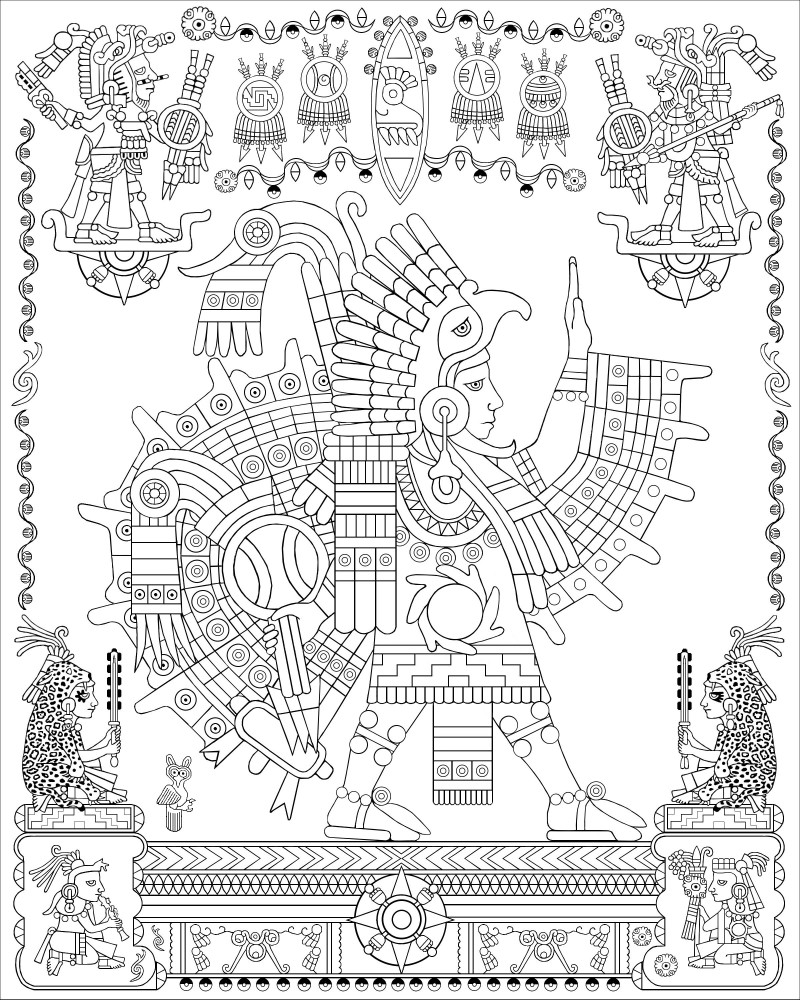
This icon of the Lord of Mictlan, the Land of the Dead, contains a lot more mythological narrative than even hinted in the caption.  Starting at the upper left and moving clockwise around the temple, dead persons enter Mictlan at the mouth of the Underworld.  Then the monstrous deity Xolotl serves as their guide (psychopomp), and the dog Itzcuintli is their companion through Mictlan, where they must climb eight hills and cross nine rivers (in four days).  The realm of Mictlantecuhtli is an empty place of darkness, dust, and vermin/vile insects (centipedes and scorpions among others), but that’s where most people had to go after death.  I wonder why they ever bothered to struggle over all those hills and rivers just to get to a nowhere like that.

Meanwhile, in the center of the lower register the wind deity Ehecatl (nagual of Quetzalcoatl) negotiates with the Lady of the Land of the Dead, Mictlancihuatl, for the bones from the Fourth Sun (Four Water).  He then breathes life into those bones to create the people for the current Fifth Sun (Four Earthquake).

(You can still see or download the previous nine icons by clicking on them in the list on the page for the coloring book.)

ICON #10: MICTLANTECUHTLI

(Lord of the Land of the Dead)

To download this icon as a pdf file with a page of caption and model images from the Aztec Codices, right click here and select “Save Target (or Link) As.”  You can also download it in freely sizable vector drawings from the coloring book page.

Mictlantecuhtli, Lord of the Land of the Dead

Mictlantecuhtli, Lord of the Land of the Dead

MICTLANTECUHTLI {meek-tłan-te-kooh-tłee} is the most prominent of several deities of death, 5th lord of the night, and 6th lord of the day.  His worship reputedly involved ritual cannibalism.  (Counter-intuitively, skulls and skeletons were symbols of fertility, health, and abundance.) His wife is Mictlancihuatl.  Only souls who died normal deaths went to the Land of the Dead, Mictlan; souls of heroes, warriors, sacrificial victims, or who die in childbirth joined TONATIUH in the Fourth Heaven, and those who drown went to TLALOC’s Eighth Heaven, the paradisiacal Tlalocan.

Aztec Icon #9. – MAYAUEL, Goddess of Pulque

After along haul of boggling detail, I’ve completed another icon in the series for the coloring book YE GODS!  THE AZTEC ICONS.  That makes nine in two years.  Only 17 to go.  Good thing I’m patient—and persistent.

The icon of this popular goddess of drunkenness (as well as intoxication by other drugs), was a lot of fun to draw if only because of all the drunken rabbits. She herself is based on an image from Codex Rios with details from Codex Laud and Codex Nuttall, and the vignettes come from various other sources like Codex Vindobonensis.  It was also a rare chance to draw the other hallucinogens:  psilocybin mushrooms, Datura and morning glory flowers, peyote cactus, and marijuana leaves.  The two little blooming peyotes are drawn from plants I used to have in my greenhouse.  The flowers are pink.

(You can still see or download the previous eight icons by clicking on them in the list on the page for the coloring book.)

ICON #9: MAYAUEL

(Goddess of Pulque)

To download this icon as a .pdf file with a page of caption and model images from the Aztec Codices, right click here and select “Save Target (or Link) As.”  You can also download it in freely sizable vector drawings from the coloring book  page.

mayauel icon

MAYAUEL is the personification of the maguey plant and a maternal and fertility goddess connected with nourishment. Besides fibers for ropes and cloth, the most important maguey product is the alcoholic beverage pulque (or octli).  As a pulque goddess, she is often depicted with many breasts to feed her children, the Centzon Totochtin (400 Rabbits), octli gods that cause drunkenness.  (Drinking was generally only permitted in ceremonies, but the elderly were free to drink whenever they wished.  There were rabbit deities for all kinds of intoxication.)  With the birth-name of Eight Flint, she also protects mature wombs and probably is the wife of PATECATL.


Rediscovered Sculptures and Artist Statements

While I was digging around in the piles of stuff we surround ourselves with, I was very pleased to find some forgotten photos and rediscover some more pieces of my sculpture, which I’ve just added to the gallery. Check it out.

Since I’m now in a leisurely mood, I think I’ll run off at the keyboard about the newly remembered pieces with attempts at artist statements. In case they’re helpful in inspiring your aesthetic appreciation.

Boy on a Dolphin (sold)

Boy on a Dolphin (sold)

Boy on a Dolphin:      This is the first piece I ever sold—at my first show.  It’s composed of two pieces of old iron (like plow-points or teeth of some kind) on a micaceous stone wave.  The upright boy was found in the DC area in the 70’s, the dolphin was found in New Mexico in the 80’s.  When I put the two pieces together, they echoed that prehistoric/modern Cycladic art of the Minoan era from around the Aegean Sea.  Though at the time I didn’t know from Cycladic, I heard the Art loud and clear.

Dark of the Moon (sold)

Dark of the Moon (sold)

Dark of the Moon:      The most complex of all my assemblages, this shrine includes wood, stone, metal, glass, magnets, ceramics, lava, white sand, and (apparently) rubber, all on a slate panel.  It’s one of my favorite pieces, but it sold in my second show and moved to California.  Zoom in on the surreal details, like the ball-bearing stars.  There are even piston rings.  The true enigma is the figure on the altar with the dark visage (rubber?).  I once found a similar piece, but less detailed, and the “head” was empty.  The centered “dark moon” globe on the “sky” backdrop is a spherical lava geode, and the 13 irregular porcelain “white moons” are for the visible stages.

What does the dark of the moon mean to you? To me it’s connected with a verse of Robert Herrick’s poem “The Night Piece, to Julia” that I’ve quoted elsewhere.  Starting, “Let not the darke thee cumber, / What though the Moon do’s slumber?” the verse embodies my refusal to live in fear, which I mentioned emphatically in a recent blog on fear and violence.

Cipactli - Earth Monster (sold)

Cipactli – Earth Monster (sold)

Cipactli:         Being an inveterate curiosity collector, one of my stash piles was of interesting weathered wood.  Over the years I’d walk by and occasionally add another piece as inspiration seized me to the plank lying on the ground, and either the pile or the sandy New Mexico dirt (spontaneously?) spawned this Earth Monster of Aztec cosmology, cipactli, the first day of the month.  The primordial one that ate Tezcatlipoca’s left footwhen the Black God defeated it and created the First Sun (world) on its back.  I like its mythic animistic Art.  The Monster went from my first show to a friend of my Farmers Market days.
Tepeyollotl - Heart of the Mountain (sold)

Tepeyollotl – Heart of the Mountain (sold)

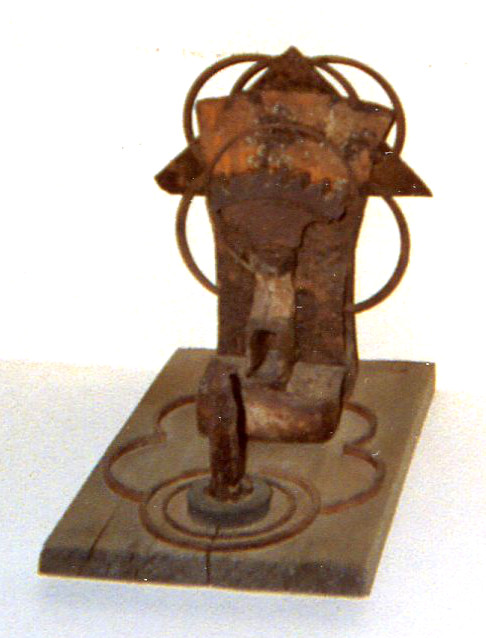
Tepeyollotl:         Another Aztec shrine, this is the Heart of the Mountain.  I can’t resist listing the components on the board:  two axe-heads, one broken; broken hammer-head, fragment of gear-wheel, sheet-iron triangle, and multiple piston rings and pieces.  In the foreground stands a heavily rusted chisel-pointed spike on a magnet with fallen rust flakes clinging to it, and the base is a grindstone from an electric drill.  It went to another Farmers Market friend.

(Forgive me for this for parenthetical sentimentalism: I gave that (Sears) drill to my late father for his birthday when I was 10.  You do the math.  Then, believe it or not, that drill in its little red box became my only legacy from him.  And then in the late 80’s, when I had some workers doing something around the house, the heirloom drill disappeared, less its battered red box and accessory bits, which I still have hanging about somewhere.)
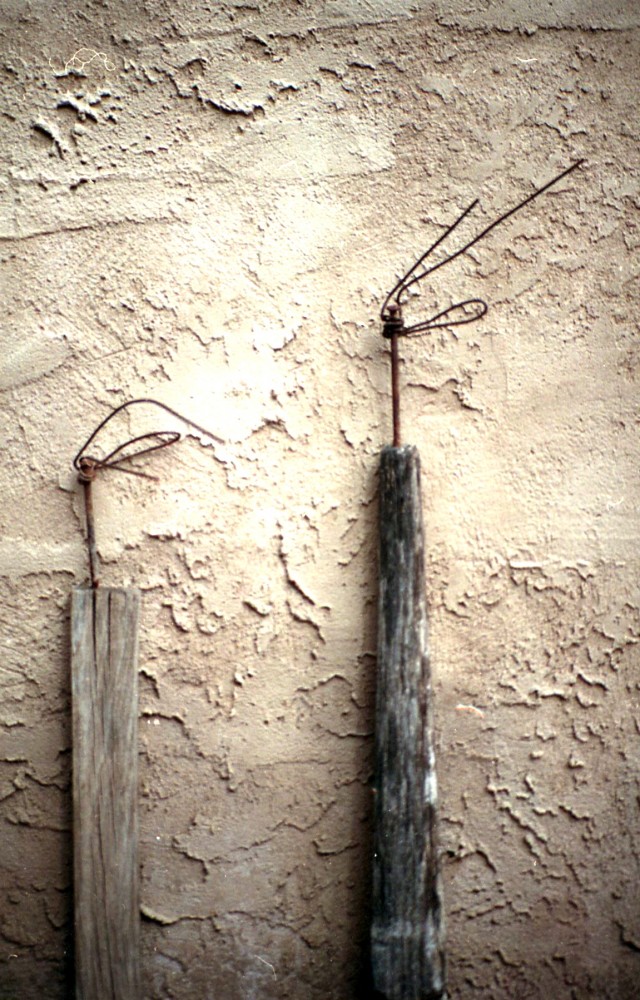
Signifires (sold)

Signifires (sold)

Signifires:                   Regrettably the clumsy photo shows only two of the three installations on weathered wooden posts mounted on a long, narrow board, another of my favorite early pieces.  On a much shorter piece of wood and at a greater distance, the missing third is an identical rusty nail with identically twisted wire around it with loop and free ends waving like flames or smoke in the wind, signal fires.  At least that’s my artist’s rationale for the feeble neologistic title.  But of course they might also be misspelled signifiers.  But then what might they signify?

I find the back-story on this one astounding. Over the course of many (20?) years, I found and kept each of the (identical) flaming/smoking nails singly in open/wild places in far-flung locales I’ve now forgotten.  Probably one here in NM.  Maybe Florida?  But identical!  Same gauge nail and wire, same wire-end and loop length and orientation.

(Twice being coincidence, what’s thrice? Magic?  Spontaneously Generated Art (SGA)?  Otherwise, what arcane rural or ritual need might give rise to identical artifacts in such widely disparate locations?  I’m talking identical!  In my book, finding those three nails bearing aloft their signifires like torches amounted to a minor miracle, or at least a miraculous event.)

Nevertheless, someone bought the tri-incidental (or is that transcendental?) Signifires from my first show. I treasure the poor photo for the messages its two fires still convey.

Strident (sold)

Strident (sold)

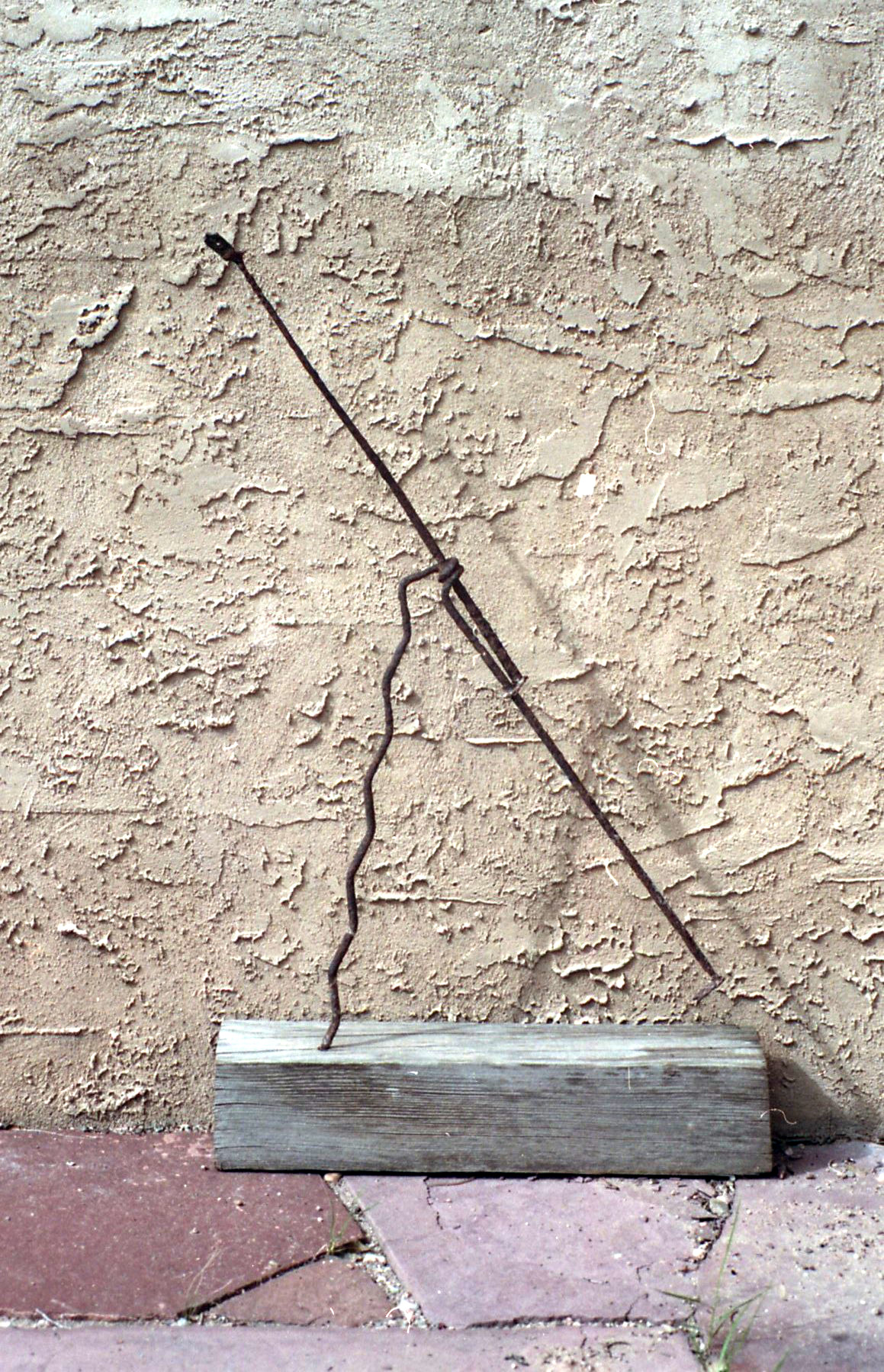
Strident:             Here’s another piece of SGA, more proof that Art, like Beauty, is in the seeing.  What I see in this inscrutably functional found object, in helpful combination with its multi-layered title of course, is Art on a par with that of Giacometti.  I can justifiably claim such excellence because I didn’t make it.  I merely came serendipitously along, saw its Art lying in the weeds, and called its name.  That late world-famous sculptor probably wouldn’t have minded the impertinent comparison.  A discerning Santa Fe collector bought it from my second show.

#

While we’re on the topic of SGA (Spontaneously Generated Art), I want to pull a couple pieces out of the gallery to show what I mean about seeing the Art in things you find by the roadside of life. In both bent and mutilated found objects I saw their inherent Art, a transformation they had spontaneously achieved through an unknown, but clearly violent, history.  SGA, if I may presume to define it, is initially a creation of human hands, but then it is transformed by time and elements, i.e., by cause and effect, or more crassly chance, into something that somebody, often me, sees as SGA.  Remember, Art’s in the eye of the beholder, and seeing it creates it.

Rainbow Man

Rainbow Man

Rainbow Man:             Lying in the dust of a path, the Rainbow Man waved to me, and I instantly recognized his Zuni attitude.  His curly head now bows over a clump of cactus on my balcony.  I don’t know what to make of him.  Do you?
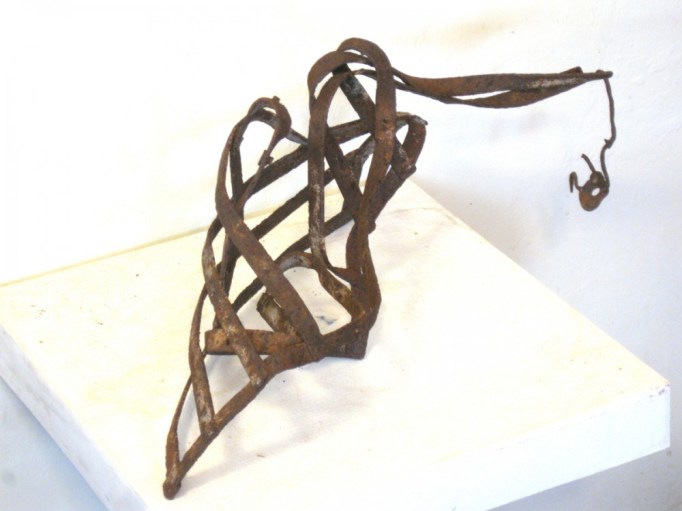
Predator

Predator

Predator:                     I’ll try and sneak this into SGA, since I only added that tiny prey dangling from its beak.  It’s meant merely as a grace note on the Art espied in this metal something mangled by mysterious forces, which I found rusting in the middle of a field.  The avian predator is visible from several angles and is particularly effective perched on a rock.  As one of the more primordial elements of reality, predation still has terrible meaning in our dog-eat-dog world.  It’s both inevitable and inescapable, the process by which all life lives. On permanent loan, that’s how this raptor is installed in the backyard of a neighborly friend.

That was rather fun rummaging through my amazing sightings of Spontaneously Generated Art. Maybe I’ll devote another blog to it sometime when I feel like blathering again.

Coyote Art and Stone Sculpture

After all the work these past several months finishing and posting two literary pieces (the novella BAT IN A WHIRLWIND and my gay memoir THERE WAS A SHIP), completing and posting my next Aztec icon (ITZPAPALOTL, the Obsidian Butterfly) for the accumulating coloring book YE GODS!, surviving fairly merry holidays, and starting a happy, hopeful new year, I’m now taking a breather of sorts. However, constitutionally incapable of totally disengaging, I’ve shifted writing gears and in my idle time started in on a sci-fi epic inspiration from my box of intriguing ideas.

In the unaccustomed leisure of the past week, I’ve also played in some of my other artistic frivolities, like manipulating photographs. At some point I’ll be able to post some improved shots in my photo gallery.  Check out the current stuff anyway.  In the past few days I’ve photographed some more of my collection of others’ art for a future blog post, probably quite soon.  In digging around, I stumbled on a couple interesting sculptural items of my own proud handiwork to add to my sculpture gallery.

First, I’ve got to confess very contritely to doing something that most artists in Santa Fe won’t admit to doing—as too trite and commercial: Coyote Art.  But I won’t recant.  Recently, I brazenly posted my Aztec icon of HUEHUECOYOTL, the Old Coyote, which I dare say far transcends the trite and commercial.  But this wasn’t my first offense.

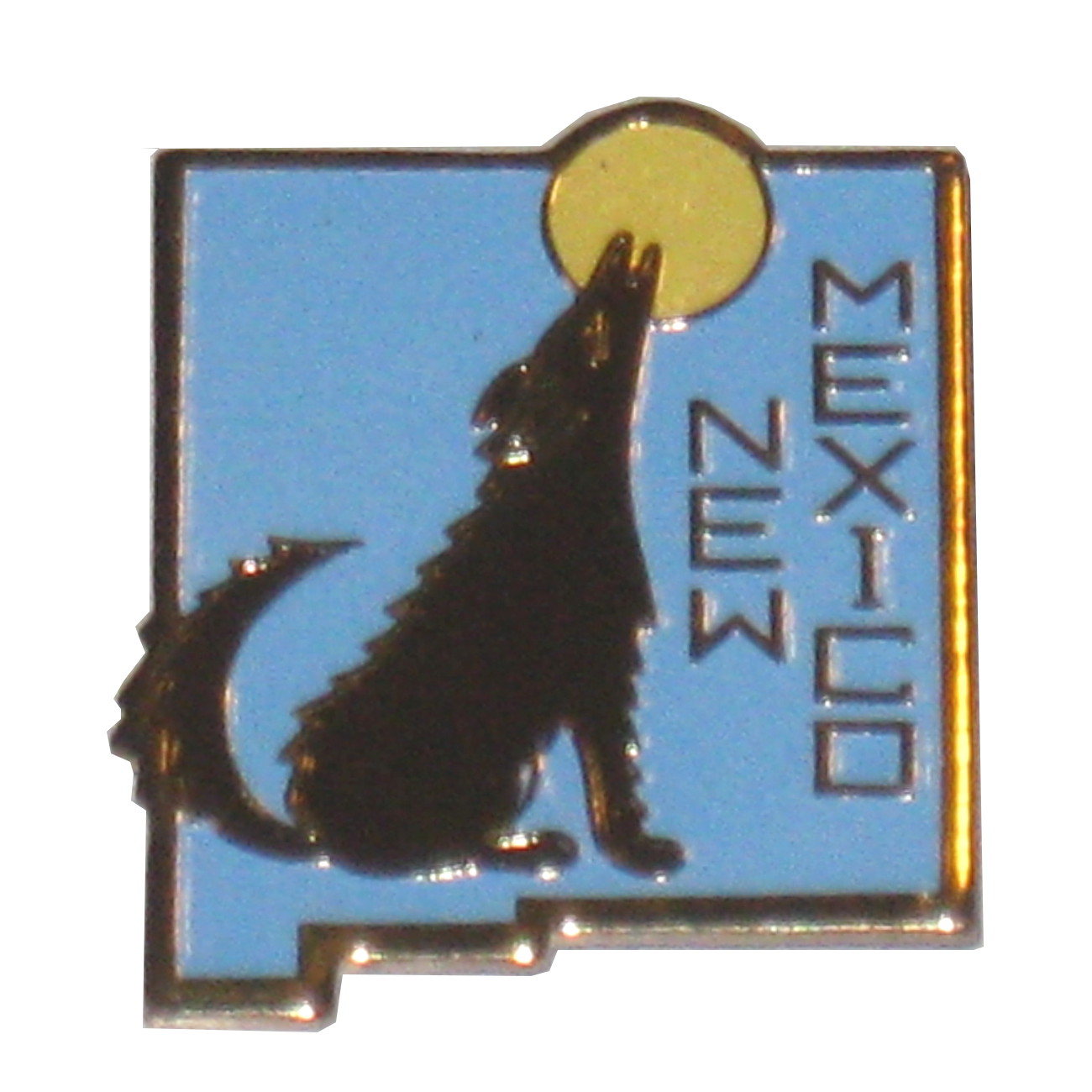
Way back when I was simply a Mature Gay Professional (maybe 1991), a dear lady I worked with asked me to design a commemorative pin for her installation as the Grand Worthy Matron of the Order of the Eastern Star. Even for gratis, I call that a splendidly official commission.  She wanted a coyote.  I shamelessly framed it in New Mexico with an obligatory moon:

Coyote Pin

Coyote Pin

Later on, when I was becoming a Grandfatherly Gay Character (around 1996), I wore out a lot of files and chisels on a sculpture that was dictated by the medium itself. It was a stone with a thin stratum of lighter stone into which I gnawed out an intaglio of the Serpent Mound in Adams County, Ohio, more or less per the Squier survey as it appears in my old book REMEMBER NATIVE AMERICA.  There’s something about its emphatic reality that I really appreciate:

Serpent Mound intaglio

Serpent Mound intaglio

So, although I claim to be a sculptor of found object assemblages, in fact I’ve done a few things in good, old-fashioned stone, though some of those are also assemblages. These are already shown in my sculpture gallery, but let me highlight them here.

Canyon Viejo

Canyon Viejo

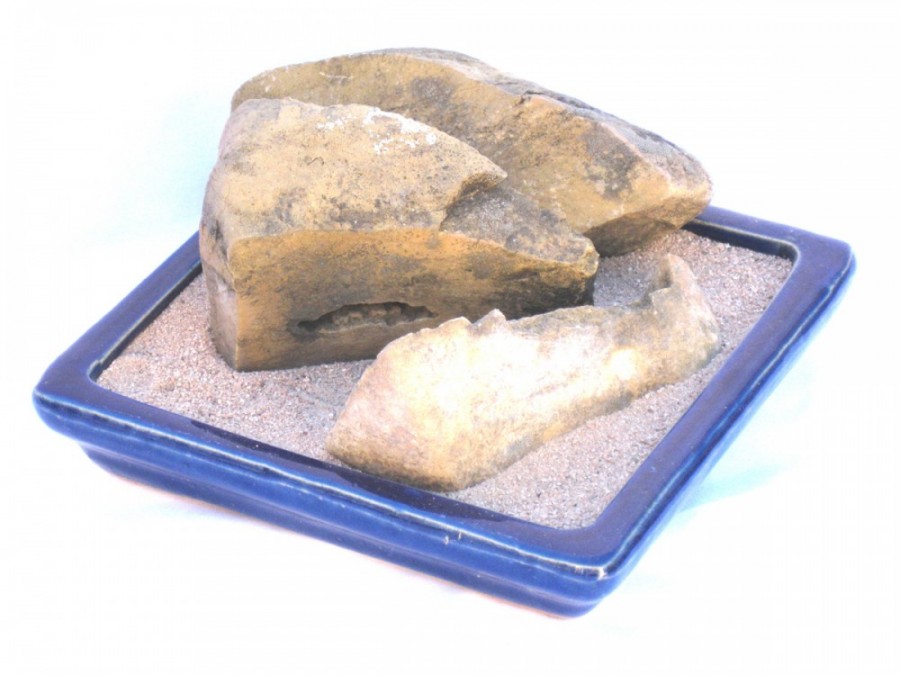
Canyon Viejo is a split piece of stone in a bowl of sand that makes for a miniature Zen sculpture of a cliff-dwelling in homage to Canyon de Chelly.

Creeping Creature and Calf

Creeping Creature and Calf

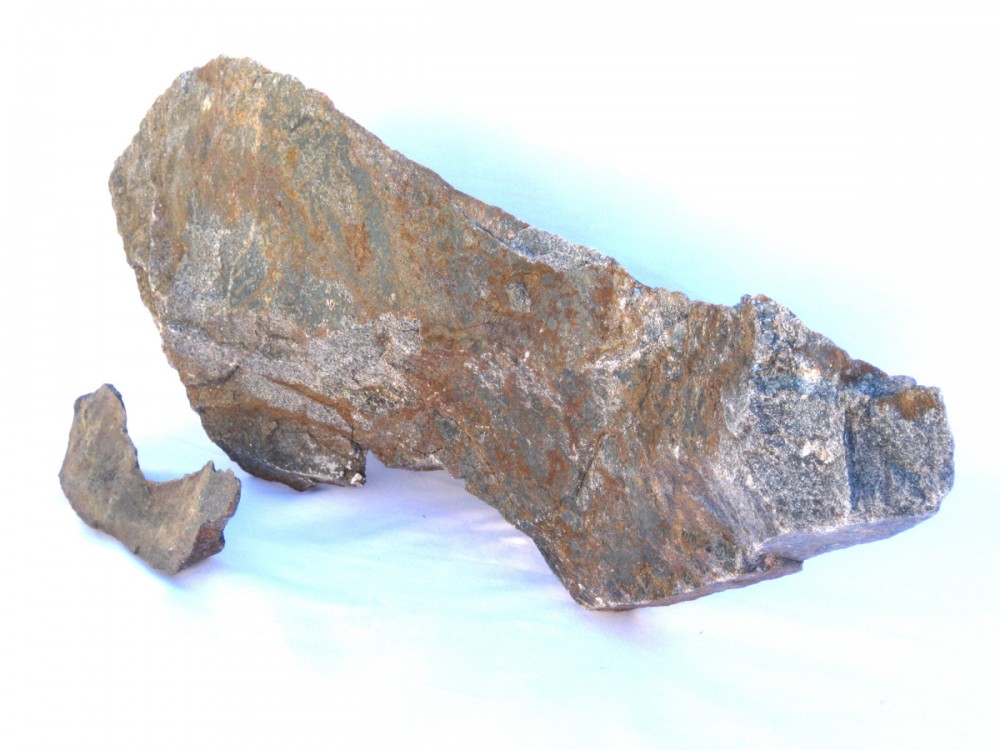
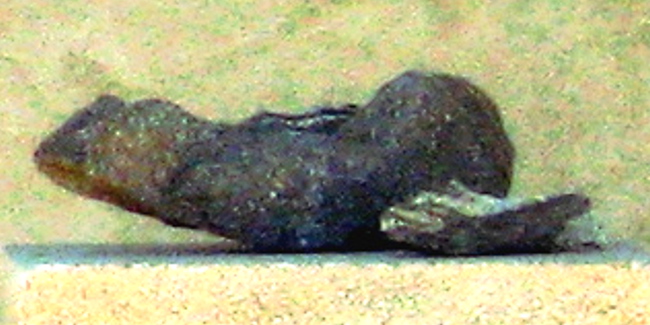
Creeping Creature and Calf is two eccentric fragments of stone found in widely separate locations that called out to me that they are family.

Crouching Creature with Cub

Crouching Creature with Cub

Crouching Creature with Cub is another pair of strange pieces of stone that are clearly related.

Lair of the Bear

Lair of the Bear

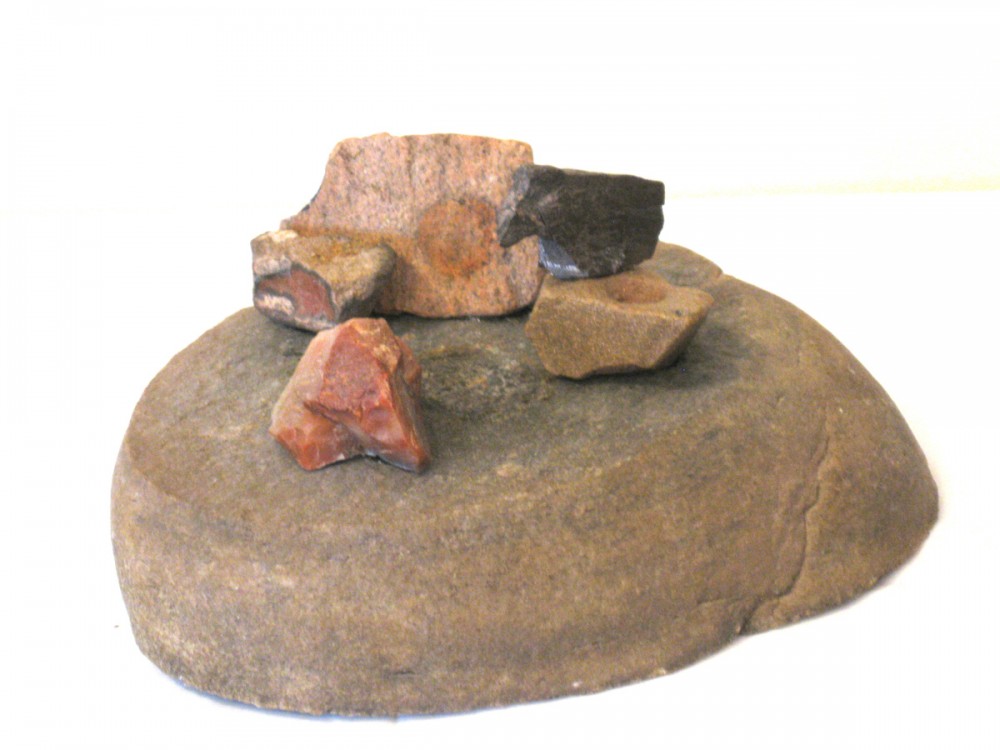
Lair of the Bear assembles a few ursine and otherwise anomalous stones found in many locations over the years to create a mythical environment.

As maybe you can tell, I think art is where you find it.

Aztec Icon #7 – HUITZILOPOCHTLI, Hummingbird of the South

Let’s get back to my coloring book of Aztec icons called YE GODS!  THE AZTEC ICONS.  Here comes the big guy, the patron deity of the Aztec tribe (the Mexica), a war god, oddly named for a tiny bird.

In all good conscience, I must apologize for the exuberance of miniature detail in this drawing, but it’s all necessary to tell his story. The motifs in the icon are modelled on images from several codices too numerous to mention.  If you find the vignettes too tiny to work with, all I can suggest is to blow the image up to maybe 200X.

Meanwhile, since this icon is so detailed, I’ll give some more notes below, after the caption.

Don’t worry, you can still see or download the previous six icons by clicking on them in the list on the page for the coloring book .

ICON #7: HUITZILOPOCHTLI

(Hummingbird of the South)

To download this icon as a pdf file with a page of caption and model images from the Aztec Codices, right click here and select “Save Target (or Link) As.”  You can also download it in freely sizable vector drawings from the coloring book page.

huitzilopochtli

HUITZILOPOCHTLI {hwee-tsil-o-poch-tłee} is the god of war, power, force, action, accomplishment, and nobility, as well as patron of the city of Tenochtitlan and god of the South. As patron god of the Mexica (Aztecs), he was credited with both their victories and defeats on the battlefield, requiring sacrificial human hearts in either case. He is sometimes called the Blue Tezcatlipoca, the sun at mid-day, and as Lord of the warriors of the day, the Eagle Knights, he wields the Xiuhcoatl (Fire Snake) with which he slew his 400 brothers.  Son of Coatlicue (Snake Skirt), he led the Mexica people on their epic migration from legendary Chicomoztoc (Seven Caves) into the Valley of Anahuac.

###

NOTES TO ICON #7:

The god surmounts a symbol of the sun at zenith. Central above him rises the Tree (cacao) of the South in which sits an unidentified Bird of the South.  To the left of it crouches an Eagle Knight, and to the left is the god’s birth day-name, One Flint.

The figured frame, starting on the upper left and running traditionally counterclockwise, presents episodes in the many-year migration of the Mexica. Largely it reflects Fray Durán’s account in his 16th-century “History of the Aztecs.”  The vignettes down the left side represent:

  • Departure from the mythical homeland of Aztalan and long wandering in the desert.
  • Settling down in Chicomoztoc (Seven Caves) for many years.
  • Birth there of Huitzilopochtli (including the beheading of the god’s mother Coatlicue and slaughter of his multitudinous brothers).
  • Migrating on and conquering the Red City (probably Gran Chichimec in Sonora).
  • Abandoning the god’s sorceress sister Malinalxochitl.
  • Settling down at Coatepec and executing the god’s conspirator sister Coyolxauhqui.
  • Migrating on and killing the god’s nephew Copil, son of Malinalxochitl.
  • Flaying the “Woman of Discord,” daughter of the king of the city of Colhuacan.
  • The five day-signs, Lizard, Rabbit, Grass, Vulture, and Flower (bottom center) are symbols of the South as well, noting the direction of the migration.

Rising from the lower right, the vignettes represent:

  • Arrival of the Mexica at Tenochtitlan, Place of the Cactus, an island in Lake Texcoco (with volcanoes Popocatepetl and Itzacihuatl in the background).
  • Merchants (pochteca) with their god Yacatecuhtli trading with many cities.
  • Warriors conquering many other cities.
  • Warriors capturing prisoners for sacrifice.
  • Priest sacrificing people atop the double temple of Huitzilopochtli and the storm god Tlaloc, now known as El Templo Mayor in Mexico City.

Aztec Icon #6 – HUEHUECOYOTL, The Old Coyote

I guess it’s time to post the next Aztec icon in my coloring book called YE GODS!  THE AZTEC ICONS.  Looking almost Egyptian with the animal head, this one emphasizes dancing, music, and sex, which is a combination close to my heart. I must admit to identifying closely with this deity while drawing him. It’s full of the music of Aztec instruments and singing, all shown in graphic symbols. Details are based on various codices, but mostly Codex Borbonicus.

Don’t worry, you can still see or download the previous five icons by clicking on them in the list on the page for the coloring book.

ICON #6: HUEHUECOYOTL

(The Old Coyote)

To download this icon as a pdf file with a page of caption and model images from the Aztec Codices, right click here and select “Save Target (or Link) As.”  You can also download it in freely sizable vector drawings from the coloring book page.

huehuecoyotl icon

HUEHUECOYOTL (Old Coyote) {hwe-hwe-koy-otł} is the trickster god of mischief and pranks and can lead one into trouble. (His tricks on other gods often backfired.) Patron of the day Lizard, along with Macuil Cuetzpallin (Five Lizard), he’s a deity of sexual indulgence, and with XOCHIPILLI and Macuil Xochitl (Five Flower), he’s also a deity of music, dance, storytelling, and choral singing. Personifying astuteness, pragmatism, worldly wisdom, male beauty, sexuality, and youth, he’s a balance of old and new, worldly and spiritual, male and female, and youth and old age. He is a shape-shifter, turning into animals or humans with sexual partners female or male of any species. Among his male lovers were XOCHIPILLI and Opochtli, god of hunting. He brings unexpected pleasure, sorrow, and strange happenings, and people appealed to him to mitigate or reverse their fates.

Aztec Icon #5 – EHECATL, God of Wind

Hold on to your hats! Here comes a wild wind. Actually the fifth icon for the coloring book YE GODS! THE AZTEC ICONS is the Aztec God of Wind, Ehecatl. My apologies that he’s going to be crazy to color, but I didn’t exactly make him up. The deity’s image is quite authentic, based on one with very similar detail from Codex Borgia.

Don’t worry, you can still see or download the previous four icons by clicking on them in the list on the coloring book page.

ICON #5: EHECATL

(God of the Wind)

To download this icon as a pdf file with a page of caption and model images from the Aztec Codices, right click here and select “Save Target (or Link) As.”  You can also download it in freely sizable vector drawings from the coloring book page.

ehecatl icon

EHECATL {e-he-katł} is the deified element of air and the breath of life. He’s a nagual of QUETZALCOATL, whom he helped create the current Fifth Sun by breathing life back into the bones in Mictlan. He is the god of secrets and mystery, intelligence, and spiritual life. Only smoke, feathers, and birds should be sacrificed to him. His temples were round, sometimes with protruding masks for the wind to blow through. His breath moves the sun and drives the high clouds and rain across the sky. Ehecatl is the 2nd day of the month, and Nahui Ehecatl (Four Wind) was the day-name for the Second Sun, a world ruled by QUETZALCOATL. When that Sun was destroyed by the eponymous wind (hurricane), its people were turned into monkeys.

Aztec Icon #4 – CHANTICO, Lady of the House

In the eternal struggle between life and art, I’ve been much occupied recently by life, the daily doing of things, most with pleasure, and some with stoic duty. So it’s been a while since I last managed to post something. Now with my ailing computer almost healed, I’ll launch the fourth Aztec icon for my coloring book YE GODS!  THE AZTEC ICONS.

Remember, that’s 4 of a planned 26. At the moment I’ve mostly completed the fifth and sixth and am half-way through the seventh. Don’t worry, you can still see the third icon by clicking here or any of the first three through the list on the coloring book page.

ICON #4: CHANTICO

(The Lady of the House)

To download this icon as a pdf file with a page of caption and model images from the Aztec Codices, right click here and select “Save Target (or Link) As.”  You can also download it in freely sizable vector drawings from the coloring book page.

Chantico icon

CHANTICO, The Lady of the House {chan-tee-ko} is the goddess of fire in the family hearth and fire of the spirit, as well as fire of the earth (volcanoes), and logically the wife of XIUHTECUHTLI, the god of fire. Patroness of cooking, eating, domesticity, and weaving she represents the feminine side of life, fertility, and the waters of birth. She is also the goddess of precious things, the lady wealth and jewels, defensive of her possessions and vindictive with gods or mortals who take her treasures. Her own particular omen-bird (parrot?) is attached to her headdress. (Each deity has one.) The jaguar-pelt seat indicates a divine or royal being.

Aztec Icon #3 – CHALCHIUHTOTOLIN, The Jade Turkey

It’s been long enough now that Aztec Icon #2: Chalchiuhtlicue, The Jade Skirt, has been hanging out here in the ether waiting for someone to look at her.  So I’ll gently retire her to the YE GODS!  THE AZTEC ICONS coloring book pasture along with Atl, God of Water .  If you care to, you can still see or download them through the links.

Now take a gander at this strange bird.  To download this icon as a pdf file with a page of caption and model images from the Aztec Codices, just right click here and select “Save Target (or Link) As.”  You can also download it in freely sizable vector drawings from the coloring book page.

ICON #3:  CHALCHIUHTOTOLIN

(The Jade Turkey)

Chalchiuhtotolin, The Jade Turkey

Chalchiuhtotolin, The Jade Turkey

CHALCHIUHTOTOLIN (Jade Turkey or Jewelled Fowl) {chal-chewh-to-to-leen} is a nagual of TEZCATLIPOCA.  Often called the Green Tezcatlipoca, he’s the magnificent patron of the Jaguar warriors of the night and of power and glory for warriors in general, cleansing them of contamination, absolving them of guilt, and overcoming their fates.  Appropriately he’s the patron of the deified day Tecpatl (Flint), the sacramental knife.  (Besides for political domination, Aztec wars were waged to harvest food for the gods—human hearts.)  A powerful sorcerer, he’s also a trickster who plays a flute in the night to lead people astray.  Whoever chances to see him should make bold to seize him and demand to be granted a wish.  Significantly, he’s also god of disease and pestilence.  (The Aztec civilization, like that of the Inca, was destroyed more directly by plagues than by the military conquests of the Spaniards.)

###


New Aztec Icon – CHALCHIUHTLICUE

Well, I haven’t heard anybody squawk about my going another couple weeks without a new posting.  Site stats show very few visits to this blog, though a respectable number of visitors every day to my earlier Aztec deity and calendar images.  Usually somebody even takes a look at my Indian mound photos or drawings of Pre-Columbian artifactsI guess this erratic blog is simply a matter of writing, as we used to say, to hear myself talk.  So be it.

This time I’ve been quiet for other than busy-ness, though there’s been plenty of that in any case.  Now I’ve simply not been able to spend much time online because my grandson visited a couple weeks ago and in one evening of YouTube managed to use up most of the monthly data allotment on my wireless connection—a subject you don’t want to read about, I assure you.

Writing on my memoir is moving along into Chapter 5, so that’s progress.  Drawing for the free coloring book is proceeding at its usual slow pace.  For sanity’s sake, I try to switch back and forth between the subjects every week or so and am now closing in on the sixth Aztec icon of Huehuecoyotl, the Old Coyote.  There are only a few vignettes and musical details to finish.  The problem is not thinking about the next icon for Huitzilopochtli, the Hummingbird of the South, which will also show the legendary migration of the Aztecs from Aztalan to Tenochtitlan.  Please be patient, all you colorists out there.  I’m working as fast as I can.

Meanwhile, here’s the second icon for the coloring book:  CHALCHIUHTLICUE, the goddess of flowing (fresh) water as in rivers, streams, and lakes.  (The goddess of the sea or salt water is Huixtocihuatl.)  To download this icon as a pdf file with a page of caption and model images from the Aztec Codices, just right click here and select “Save Target (or Link) As.”  You can also download freely sizable vector drawings from the coloring book page.

ICON #2:  CHALCHIUHTLICUE

(She of the Jade Skirt) {chal-chewh-tłee-kwe}

Chalchiuhtlicue, The Jade Skirt, Goddess of Flowing Water

Chalchiuhtlicue, The Jade Skirt, Goddess of Flowing Water

CHALCHIUHTLICUE is goddess of flowing water, rivers, and streams, as well as of youthful beauty and ardor with a birth day-name of Ce Atl (One Water).  She is patron of women in labor, childbirth, children, and motherhood.  Certain of her purification rites struck Spanish clergy as similar to the sacrament of baptism.  As goddess of storms and forces of nature, she can be dangerous.  She is the 6th lord of the night (which has 9 hours), and the 3rd lord of the day (of the 13-day week).  The wife of TLALOC and/or possibly XIUHTECUHTLI and mother of TECCIZTECATL and/or the twins QUETZALCOATL and XOLOTL, she destroyed the Third Sun (Four Rain) and ruled the Fourth Sun (Four Water).

###