Totems of the Aztec Lords of the Day

In Aztec culture, notions of time are central and perhaps inordinately important in terms of fate. Life was embedded in and permeated by strict divisions of divinatory time, starting with the agricultural and ceremonial calendars, in which respectively the 20 named days of the “month” (vientena) were counted in 13 numbered days of the “week” (trecena). The basic division of the day was, of course, between day and night (with Cipactonal as god of the daytime and Oxomoco as goddess of the nighttime). This is where things get strange from our modern perspective.

Having no clocks per se to measure passing time, the Aztecs decided there were 13 “hours” in the daytime and 9 in the night. (No doubt, this reflects their 13 heavens and 9 levels of the Underworld.) With only an amorphous measure for a “minute,” they probably never even thought about an Aztec “second.” Their 22-hour diurnal cycle meant their hour in our terms averaged 65½ minutes long, the day lasting 14.18 and night 9.82 of our hours. In any case, their hours must have been only approximate and varied in actual length.

Anyway, a deity was in charge of each day of the trecena, 13 gods or goddesses called Lords of the Day, a list about which, in scholarly fact, there’s some disagreement. The 13 numerals themselves are also ruled by deities, but apparently in a different list. There are also deities in charge of each numbered heaven, but again that list seems to differ substantially. I’ve only seen confused references to various heavens and suspect that the 9 Night Lords might correspond to the 9 levels of the Underworld. But probably not since Mictlantecuhtli is the ruler of not the 5th, but the 9th (lowest) level of Mictlan. Nobody ever said that mythology has to be consistent, and I don’t care to sort out so many lists.

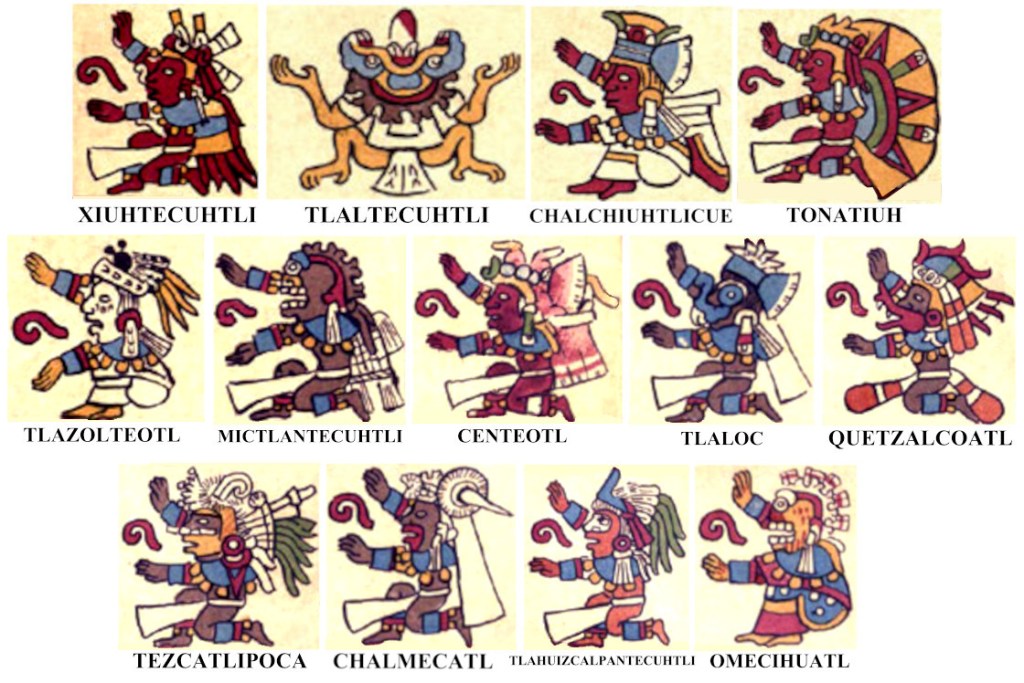
Figuring out the Lords of the Day is work enough. The sequence of full-figured Lords in Codex Borbonicus seems the same as the sketchy heads in Tonalamatl Aubin (with some odd problems there). Looking at an ostensibly authoritative list on Wikipedia, I found a problem in Borbonicus itself: #11 (identified there as Mictlancihuatl, Lady of Mictlan), is evidently not a female and wears a pointy headdress like the one usually associated with Mictlantecuhtli, her consort already listed earlier. Another problem there is with #13 (identified as Citlalicue, Star Skirt), who looks a lot like Mictlancihuatl in Codex Magliabechiano, though I believe Citlalicue is sometimes shown as an Underworld goddess too.

With those questions, I checked the online Mexicolore.co.uk, which complicates the list even further. Instead of #5, Tlazolteotl, they list some deity I’d never heard of: Tonaleque. Instead of #7, Centeotl, they cite Tonacatecuhtli, Lord of Sustenance; for #11, Mictlancihuatl, they insert Yoaltecuhtli, God of Darkness (an odd sort of deity for Day Lord); and for #13, Citlalicue, they propose Ometecuhtli, Lord of Two and the same deity as Tonacatecuhtli–a male. I’m left still wondering about the masculine Mictlancihuatl.

Puzzled, I consulted the premiere authoritative source, “Cycles of Time and Meaning in the Mexican Books of Fate” by Elizabeth Hill Boone, and she helped clarify. For #11, she lists Chalmecatl, He of Chalma, a god of some level of the Underworld indeed related to Mictlantecuhtli. For the feminine #13, Boone’s suggested Ilamatecuhtli should actually be Ilamacihuatl, which is simply another name for Omecihuatl/Tonacacihuatl. As half of Ometeotl, the Deity of Two, the creative pair who birthed the principal gods, co-patron of the Crocodile trecena, and co-ruler of the 13th heaven, she well deserves a slot as a Lord of the Day, especially as #13. I’ve not seen her depicted before as a skeletal deity of the Underworld, but I suppose it could well be she.

I’m happy to include Boone’s #11 and #13 (adjusted) in my roster of the Lords of the Day.

    1. Xiuhtecuhtli, Lord of Fire/Turquoise
    2. Tlaltecuhtli, Lord of the Earth
    3. Chalchiuhtlicue, the Jade Skirt, Goddess of Flowing Water
    4. Tonatiuh, God of the Fifth Sun
    5. Tlazolteotl, Goddess of Filth
    6. Mictlantecuhtli, Lord of the Land of the Dead (Mictlan)
    7. Centeotl, God of Maize
    8. Tlaloc, God of Storms
    9. Quetzalcoatl, the Plumed Serpent
    10. Tezcatlipoca, The Smoking Mirror
    11. Chalmecatl, He of Chalma, an Underworld deity
    12. Tlahuizcalpantecuhtli, Lord of the House of the Dawn (Morning Star)
    13. Omecihuatl, Lady of Two

Here below is my rogues’ gallery of Day Lords as seen in Codex Borbonicus:

Lords of the Day from Codex Borbonicus

Whoever they are for real, I suggest that these same Day Lords rule the respective 13 daytime hours. Striving for elusive mythological consistency, I’ve also proposed that the 9 nighttime hours are ruled by the 9 Lords of the Night. Maybe, maybe not… The Aztecs tended to complicate their paradigms, some might say unnecessarily.

However, we do know for sure the numerical sequence of totems for the Lords of the Day. These totems are called in the jargon “volatiles” because they’re things that fly: birds and a butterfly. (Apparently other deities also have volatiles, like the bat or vulture of Itzpapalotl, but I’m not all that up on the finer details of Aztec ornithology.) Here are my versions of the volatile totems for the 13 Lords of the Day (whoever they really are), the 13 days of the trecena, and (possibly) the 13 daytime hours. They are drawn on models from Codex Borgia, plate 71.

###

Icon #19 – TEZCATLIPOCA, the Smoking Mirror

I’m happy to announce the completion of Icon #19 – Tezcatlipoca, the Smoking Mirror. Once again, the designs and motifs in this icon are drawn from images in the surviving pre-Conquest Aztec codices. It and the preceding 18 icons can be downloaded as .pdf files with captions from the YE GODS! coloring book page.

Tezcatlipoca, the Smoking Mirror

First, I should offer some tips for coloring if you’re so inclined:

1) The black stripes on the faces of the upper left and right figures should be paired with yellow, which is the emblematic color-scheme for this deity; in the original, the upper central figure is mostly white with a few color highlights—at your discretion.

2) All those sacrificial knives (flints) in the borders are supposed to be half white and half red, in whatever pattern you choose.

3) The patterns on the limbs and face of the main figure are supposed to be red tattoos; I should also note that in the original he has brown hair.

4) The hair-like figure flowing from the head of the monster should be red blood as well as the apparent stream from the deity’s severed leg. The rest of the colors are up to you.

The horned owl at top center is Tezcatlipoca’s personal “volatile” symbol (many deities have one). The upper figures are some of his various manifestations. The main scene is the story of the god’s battle with the Earth Monster (Cipactli) in which he lost a foot and then created the First Sun (or world), Four Jaguar, on her back. The day-signs along the bottom are those representing the direction North, with Jaguar numbered as four to name the Sun being created just above. The dots along the side are the numeral 10, of which Tezcatlipoca is patron, and they also indicate that he is the 10th lord of the Day.

That should be enough to get you going. As soon as I can, I’ll post the icon on the coloring book page in vectors so it can be sized freely with no change in line quality. Now, when I’ve caught my breath, I’ll move on to Icon #20 – Tlaloc, the Storm God.

Visions of Tezcatlipoca

In the couple months since my last posting about the Maid in New Orleans, my self-incarceration for the Corona virus has made it easy to focus on the last chapters of my second memoir “Lord Wind” (soon to be posted for free download), and drawing on Icon #19: Tezcatlipoca, the Smoking Mirror, for the coloring book YE GODS!

Like the 18 previous deities in the series, this icon is modelled on images from the few surviving Aztec codices and reflects the mythology summarized in my illustrated encyclopedia of the Aztec pantheon. The icon will present several visions of Tezcatlipoca, who is sometimes called The Black One. I offer here two of the vignettes as “teasers.”

The first is Tezcatlipoca as an eagle, which is based on an image from a calendar week in Codex Rios. I’ve re-created this unusual manifestation of the deity using the stylistics of Codex Nuttall and certain motifs from Codex Borgia. (The eagle is a symbol of power and dominance.)

Tezcatlipoca as eagle

The second is Tezcatlipoca manifesting as Itztlacoliuhqui (Curved Obsidian Blade), who is the god of stone, cold, sin, punishment, objectivity, and blind justice. This surreal image is a re-working of one from Codex Borbonicus, though similar, sometimes even more surreal, details can be found in other codices as well. It presents some striking innovations in the stylebook of Aztec iconography and raises questions about certain motifs. Your guess about what they mean is as good as mine.

Tezcatlipoca as Itztlacoliuhqui

One of these solitary days I’ll finish this icon. I’m still waiting for some final tweaks on the vectors for Icon #18: Xochipilli, Prince of Flowers. Meanwhile, like everything else, my show of larger icons at the Ohkay Casino and Conference Center has been locked down… In this “unprecedented” viral situation, the show of smaller icons lies in storage with no prospective venues.

I have no options but to keep on with the drawing—next will be Tlaloc, the Storm God—and like Candide, work in my garden. My 35 varieties of iris are just now coming into bloom to bring joy to this best of all possible worlds.

#

Icon #18 – Xochipilli, Prince of Flowers

I’m proud to announce finishing my latest Aztec icon, #18: Xochipilli, Prince of Flowers—by the end of 2019.  Working in and around other projects, I spent 6 months on drawing it, rather longer than it took on any of the preceding 17 for the coloring book Ye Gods!  Small wonder…

Now that the basic drawing is done, I can at least offer a small version here for your wonder and amazement. To post it on the coloring book page, I’ll have to do a caption page with model images from the codices and get it turned into vectors for sizable printing.  All in good time…

Xochipilli, Prince of Flowers

No doubt you notice immediately that this icon is a lot different than the others. As a matter of fact, it’s seriously iconoclastic, breaking several of the canons of Aztec-codex iconography.  But first let me explain the elements.

As detailed in the Aztec Pantheon, XOCHIPILLI (Prince of Flowers) {sho-chee-peel-lee}, is a very appealing deity: the god of art, dance, laughter, happiness, beauty and peace, flowers, ecstasy, sleep, and dreams/hallucinations, as well as a god of fertility (agricultural produce and gardens).  Hence all the blossoms and vegetation which are far more intense and decorative than you’ll find in any of the codices.  That’s my first departure from the Aztec style, but I couldn’t pass up the perfect opportunity to indulge in floral display.

The Prince is also the patron of the sacred ballgame tlachtli (seen in the structure behind him), of the day Monkey (which cavorts by his left foot), and of homosexuals and male prostitutes.  In the cameos above and below the deity are his various lovers, a fairly polyamorous assortment.

Upper left is Opochtli, left-handed god of hunters; upper center is the Old Coyote, Huehuecoyotl (see also Icon #6), god of music, dance, and sex; and upper right is the god of writing, painting and song Chicome Xochitl, Seven Flower.

Lower right is the god of music, games, and feasting Macuil Xochitl, Five Flower; lower center is Pilzintecuhtli, the Young Lord, god of the planet Mercury; and lower left is the Prince’s twin sister-wife Xochiquetzal, the Flower Feather, goddess of love and female sexuality. As a note, I’m going use this cameo sketch of Xochiquetzal when I get to doing her icon.

The most iconoclastic feature of this icon is the figure of Xochipilli himself. In the codices, almost without exception, human figures are presented in profile, but my Prince is seen here full-frontal with only his face in profile.  His intentionally sensual posture is an echo of much earlier Maya iconography.  The angle of his chair/seat and new perspectives on his limbs, feet, and etc. forced me be fairly realistic in drawing the physical details.  (See that right hand and his un-Aztec eye!)

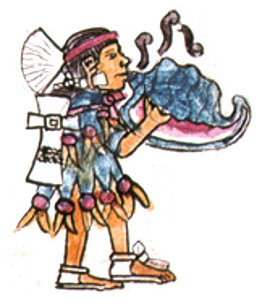
The most subtle element of this icon is that Xochipilli is also the patron of the number seven. With the god in his circular wreath of flowers as a central “dot,” the six cameos around him comprise that numeral.  My only regret is that I couldn’t find a way to include a procession (as shown in Codex Magliabechiano) with a little guy blowing on a conch-shell trumpet:

Conch-shell Trumpeter

#

More Aztec Whoopee

Here we go again! My informational art exhibit YE GODS! ICONS OF AZTEC DEITIES will show for the fourth time at NEW MEXICO HIGHLANDS UNIVERSITY in beautiful Las Vegas NM from September 30 to November 2, 2019 at BURRIS HALL GALLERY, 903 National Avenue.

In 2018 the first 15 icons showed at El Museo Cultural de Santa Fe and at Northern New Mexico College in Española, and in 2019, with the addition of #16 (TECCIZTECATL & METZTLI, Deities of the Moon), they were displayed at Santa Fe Community College. This iteration at NMHU will include another new icon, #17:  TEPEYOLLOTL, Heart of the Mountain, the god of caves, volcanoes, and a bunch of other neat stuff.

Currently working on the next icon for the coloring book, #18: XOCHIPILLI, Prince of Flowers, I’ve broken out of my alphabetical sequence to manifest the splendid deity that I consider my personal patron (appearing above in my website banner).  I’m also breaking several Aztec iconographic conventions for this one, not the least of which is running wild with floral motifs.  One of my favorite details is a tiny Aztec bee:

Aztec Bee

You’ll just have to wait a while to see the rest of this literally iconoclastic icon.

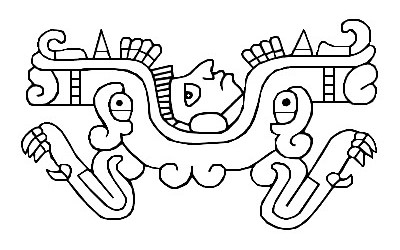
Along with the NMHU show, I’ll give a slide lecture on the Aztec Codices for their Art in the Americas class and a gallery talk for their Día de los Muertos celebration on November 1, just ahead of a concert to be directed by my music prof friend Andre Garcia-Nuthmann. Of course, Mictlantecuhtli, Lord of the Land of the Dead, will be featured, as will Tepeyollotl, Heart of the Mountain, who guards the entrance to Mictlan.  That dire place is always shown as the mouth of the monstrous, hermaphroditic Lord of the Earth, Tlaltecuhtli:

Entrance to Mictlan

Meanwhile efforts continue to line up more venues for the show, including other educational institutions around New Mexico. If anybody out there has hot ideas for presenters anywhere else, sic them on me!  I’ve been trying to interest places in surrounding states but so far have struck out.  (Read that as:  My approaches have been roundly ignored.)  I’d really love to hang the show at Mexico City’s National Museum of Anthropology, but I expect the materials should be translated into Spanish, actually not such a bad idea…

#

Exultate Jubilate

I’m totally exultant! Yesterday I discovered that in July wonderful WordPress has started registering downloads.  This is a ginormous deal since for the past five years all I could do was hope (pray and wish) that you folks out there were taking the fabulous stuff I’ve been trying to give away on this website.  Now I’m jubilant that you apparently are indeed and may actually have been accepting my gifts in the past.  Not to be greedy, but I’d love to get some comments back about my artwork and writing—appreciation, criticism, gratitude, or whatever.

There were some splendid surprises in the first six weeks of download data. I’d been pleased with getting an enormous number of hits (from literally all over the world) on my Aztec materials, and now I find that they’re being downloaded like hotcakes.  To my joy, the treatise The Aztec Codices and encyclopedia The Aztec Pantheon seem hugely popular, but even better, the YE GODS! coloring book is flying out the door, both as the collection, The Aztec Icons, and as individual black and white images.

Through Google Image searches, I’d already observed that my earlier four-color images of Aztec deities were being used for various purposes like T-shirt designs and other graphics, and now I see that they’re still being downloaded frequently. As hoped, my art is now truly taking on a life of its own in the wide world—beyond the several exhibitions of icons I’ve managed to organize.  The next show will be at New Mexico Highlands University in Las Vegas NM this October.

The other thrill is that folks are also taking my books. No longer do I feel like a writer scribbling invisibly in the wilderness.  Folks are downloading my first novel Bat in a Whirlwind, my first memoir There Was a Ship, and the nonfiction books: Remember Native America, Celebrate Native America, and Getting Get.  My second novel Divine Debauch is only available through an online publisher, but some have linked to that too.  Weirdly, my most popular book seems to be the biography Ms. Yvonne, The Secret Life of My Mother.  Go figure.

Now I can even look forward to reports of folks accessing my Pre-Columbian artifact drawings and related Indian Mounds photos, as well as images of my sculptures, photographic art, shorter writings, and my long, fascinating, and sometimes sordid life.  Of course, you can also feel free to download my shorter, but still fascinating and sometimes sordid blog posts—like this one.

Now back to work on my next memoir titled “Lord Wind, My Second Coming Out” and on Aztec Icon #18, Xochipilli, Prince of Flowers.

#

Icon #17 – TEPEYOLLOTL, Heart of the Mountain

So… It’s been another long haul to complete the next icon for my coloring book YE GODS! Something like four months, but no apologies.  I’ve had to take a lot of sanity breaks—to continue writing on my next memoir and to deal with the sorrows of life.  Namely, in late March, at the tender age of 18 my eldest grandson Ike chose to end his life.  We know nothing about why but can only respect, accept, and lament his decision.  That’s my reason for tearfully dedicating this Icon #17 – Tepeyollotl, Heart of the Mountain to him.

Tepeyollotl, Heart of the Mountain

Tepeyollotl (Heart of the Mountain) {te-pe-yol-lotł} is the god of caves/mines and echoes and causes earthquakes, avalanches, and volcanos.  As the Lord of Jewels and underground treasures, he is the male spirit of the earth and a nagual of the hermaphroditic Tlaltecuhtli, Lord of the Earth.  A deity of witchcraft, he cures and causes diseases and guards the entrance to Mictlan (the Land of the Dead). Tepeyollotl is the ancestral were-jaguar and may be the God L of the Maya. Also a nagual of Tezcatlipoca, he is the Jaguar of the Night whose roaring heralds the sunrise, and as 8th lord of the night he is sometimes depicted as a jaguar leaping toward the rising sun.  

I’ve already posted a couple pieces about this icon in process, The Divine Volcanoes and Jaguars Changing Spots, and the above caption gives the rest of the information I’ve learned about this deity. On the coloring book page I’ve now listed a free download of it with caption and models, and when it comes back home to me in vectors from Bangladesh, I’ll add the two versions for sizable prints.

###

Jaguars Changing Spots

I seem to be at my stellar best when I’m boring folks with useless information—or at least with stuff they don’t give a rat’s patootie about. The following verbiage may well fall into both categories.  And since it’s on the Internet, there’s the distinct possibility (but minuscule probability) of boring millions of readers to tears.  What more could I hope for as I hold forth on jaguars’ spots?  I bet you’ve never given that esoteric subject even a nanosecond’s thought.

But I have. For some years, as you likely don’t know, I’ve been drawing digital icons of Aztec deities for a coloring book called YE GODS! Since the jaguar is a major mythological figure for most of the ancient cultures of the Americas (see A Roar of Jaguars), I had to come to terms with how it was depicted in the iconography of those cultures.  In fact, as the Lord of the Animals, the jaguar was my first try at digital drawing.

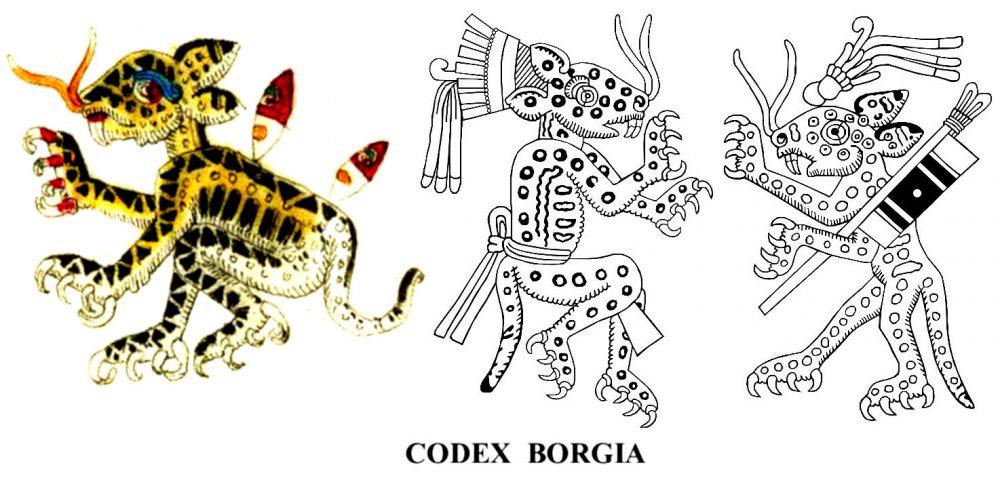
Already well versed in the iconography of the few Aztec codices that survived the Conquest of that empire by the Spanish, I wasn’t terribly impressed by their renderings of the unique and complex pattern of the jaguar’s pelt. For the most part the ancient Aztec artists made do with a simple scattering of spots looking a lot like those of the Old World leopard.In the Codex Borgia, a more elaborate picture-book, the pelt was sometimes depicted in greater complexity. I chose to use two of those stronger patterns for figures in my later icon of the deities of the moon, but the first pattern was just too weirdly abstract, if oddly more realistic.

For my first digital drawing (eventually used in the icon for OCELOTL), I pompously tried to reproduce a naturalistic jaguar pelt—and believe I did a decent job. It convinced me of the amazing power of computer imaging and kicked off the whole coloring book project.  Having mastered the pattern, I used it also for a seat-cushion in the icon for the goddess CHANTICO (also see the icon for MICTLANTECUHTLI), and for a detail of a jaguar-warrior in that for the god CHALCHIUHTOTOLIN.

Chantico and Jaguar Warrior

At present I’m in the final throes of the icon for TEPEYOLLOTL (see The Divine Volcanoes), who is a were-jaguar (an anthropomorphic creature), appearing in a number of the codices.

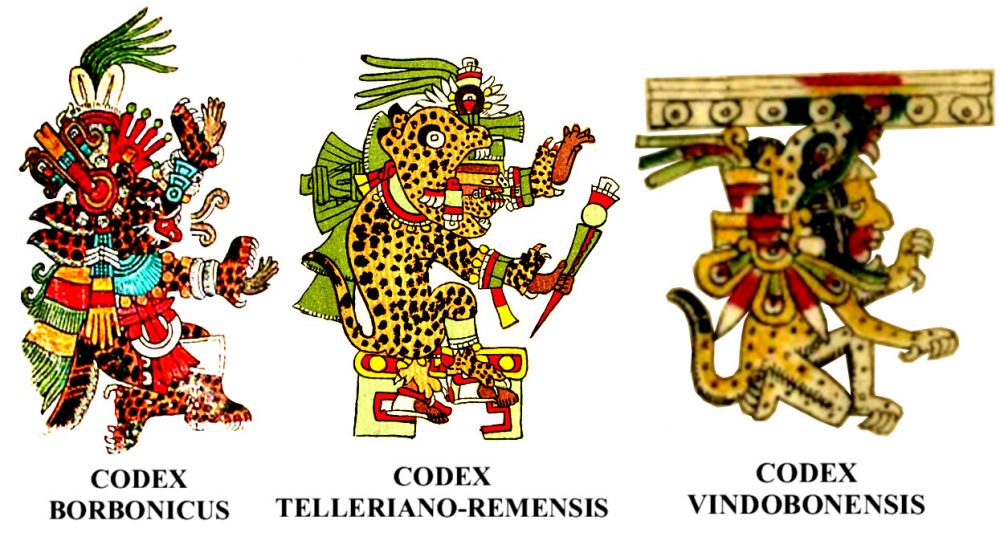
Here comes another sneak preview. There are two jaguars in this icon.  I chose to use the Nuttall jaguar, radically restructured, for the leaping one and the Vindobonensis figure as model for the god himself—with a pelt based on one of the Borgia examples.

Leaping Jaguar and Tepeyollotl

This illustration shows that I haven’t yet completed Tepeyollotl’s face, though I have already given him an aesthetic nose-job. While the open-ring pattern may not be any more naturalistic than the plain spots on the Vindobonensis model, I did that on purpose—for the coloring.

I’ve only given explicit directions for coloring the icons in a few cases. First, for the pelt in OCELOTL, I described the animal’s range of coloration from rusty gold to white.  For the icon of EHECATL, I explained that scallop shells come in black, white, and all shades of the rainbow, though very dark and dusky like in the last hues of twilight.  For TEPEYOLLOTL, I will direct the colorist to make those open rings various colors as in these almost hallucinatory images:

In this second Telleriano example, the spots are inexplicably green, and in the psychedelic Aubin figure red, blue, and gold. (By the way, the general Aubin style of illustration might most kindly be called “casual:” Note the incomplete claws, stubby tail, and curious wrinkles on its back.)

The rationale for vari-colored spots on my Tepeyollotl (which was completed in June 2019) is that, among several other mythical qualities, he’s the Lord of Jewels. Also, any deity worth its salt really should be hallucinatory, psychedelic, and/or surreal.

###

The Divine Volcanoes Popocatepetl and Itzaccihuatl

For too long I’ve telling folks I’m still plugging away on Icon #17 for the YE GODS! coloring book, and now I can change my tune. At last I’m on the home stretch!  Just one more vignette and the figure of Tepeyollotl Himself, the Heart of the Mountain.  (I seem to have been keeping the deity itself for the last to be informed by the story of the surrounding details.)

So now it’s high time I give you something in the way of a sneak preview of #17: the Mountain.  Actually it’s the two divine volcanoes that loom dangerously over Ciudad de México, deified as Popocatepetl (Smoking Mountain) and Itzaccihuatl (Obsidian Lady).

Popocatepetl and Itzaccihuatl

Here they are shown in the style of Codex Nuttall, Popocatepetl in its smoking majesty and Itzaccihuatl as a bonafide, stern-visaged goddess. Her codex model is iconographically notable being one of the few full-faced figures to be found in Aztec 2-D graphic art.  The Maya also preferred profiles (those marvelous foreheads!).  3-D sculpture was of course a different story.

The stylized sigils appearing in each of the “hills” are authentic names of real places. Apart from the self-evident symbol for Popocatepetl, I don’t have a clue what places the others intend.

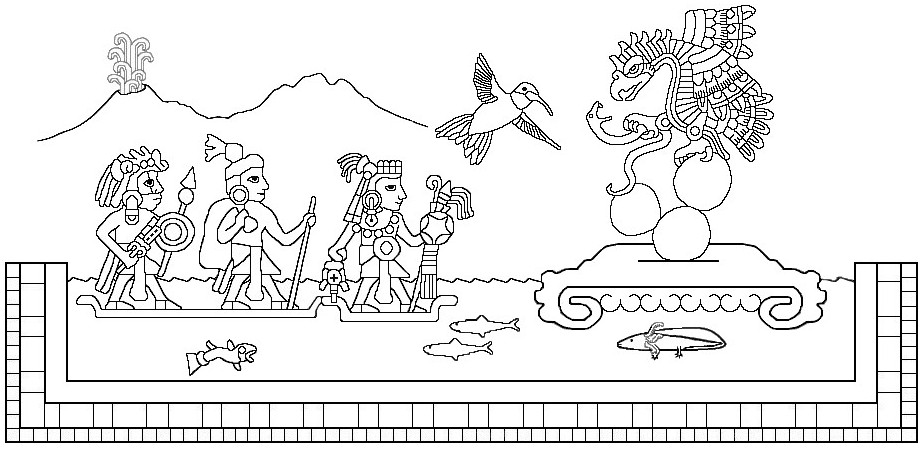
The above is my second treatment of the divine volcanoes. The first was for a vignette in Icon #7 Huitzilopochtli, Hummingbird of the South, showing the arrival of the Aztecs at Tenochtitlan:

Arrival of Aztecs at Tenochtitlan

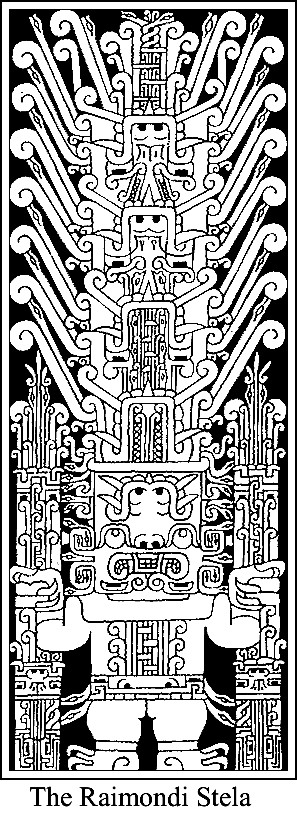
In the upcoming icon, beneath these volcanoes resides the Heart of the Mountain. Don’t let this be a spoiler, but you need to know that Tepeyollotl, as most often depicted in the Aztec codices, will be a were-jaguar, an ancient mythological being with possible roots three thousand years before in Peru.  Check out this boggling image of the Raimondi Stela from Chavín de Huantar.

###

Aztec Icon #16 – TONATIUH and METZTLI, Deities of the Sun and Moon

It’s been about nine months since the last addition to my coloring book YE GODS! Icons of Aztec Deities, #15, Quiahuitl, God of Rain. After completing it back last April, I had to focus on setting up the two-month Ye Gods! exhibition in Santa Fe, as well as prepare and deliver several lectures.  Then everything else, including work on my second memoir, had to be put on hold while I concentrated for three months on re-translating an opera from Russian (which will be produced by the New Orleans Opera in February, 2020).  Meanwhile I also set up the exhibition for another month in nearby Española.  Busy boy, no?

Finally by late November, I got back to drawing, and now I’m thrilled to announce that #16 is finished at last. (At first I thought it was Tecciztecatl and Metztli, Deities of the Moon, but much later I’ve now discovered that it is Tonatiuh and Metztli, Deities of the Sun and Moon.)

TONATIUH & METZTLI

At first I worte that Tecciztecatl {tek-seez-te-katł}, the son of Tlaloc and Chalchiuhtlicue, is a god of hunters and appears as things shining in the night. In the Nahua cosmology, when Quetzalcoatl and Ehecatl created the current Fifth Sun, Tecciztecatl wanted to become the new sun, but he hesitated to jump into the sacred fire, whereupon the young god Nanahuatzin leapt into the flames to become Tonatiuh, the Fifth Sun.  When Tecciztecatl followed, he took second place as the moon. Well, it turns out that the little guy throwing himself into the fire here is actually Nanahuatzin, and the male deity here is Tonatiuh, the sun, in the pair with the moon.

Metztli {mets-tłee} is the ancestral moon goddess probably inherited from ancient Teotihuacan and/or the Maya’s lunar goddess Ix Chel.  Long after the Nahuas demoted Metztli to merely being the consort of Tecciztecatl (in Tonalamatl Aubin), and replaced her with Tecciztecatl in several other codices, the later Aztecs tried to replace her completely with (the severed head of) Coyolxauhqui, the sister dismembered by their supreme god Huitzilopochtli.

Tecciztecatl was stuck into the sacred calendar (tonalpohualli) as one of the patrons, frequently in the company of Tonatiuh, of the thirteen-day week One Death, which is shown in the encircling day-signs.  It should be noted that there are thirteen days between the full and dark of the moon.  The Mesoamerican cultures saw a rabbit in the full moon (top), and the serpent of the night devouring the rabbit (bottom) represents the dark of the moon.  Incidentally, the nocturnal jaguar was closely connected with the moon, and the conch shell was the standard symbol of the moon.

I fired the drawing off to my dear friend Sagar in Bangladesh for him to work his vectorizing magic on it, and he did the trick.  I’m currently (in January) posting the jpeg version with caption and sources on the coloring book page and have now (in April) have added the vectorized versions to the list of various sizes available for free download.

In my strict alphabetical sequence, the next deity to tackle is Tepeyollotl, Heart of the Mountain, who has several dramatic aspects.  You can check out my earlier image of this god among the Aztec images from the old book on the calendar.  If the creek don’t rise, I’d like to get his icon done by April.  Once again meanwhile, in my multi-tasking fashion, I’ll be arranging more venues for the expanded exhibition and lectures—and forging onward in my memoir. Call me driven, but I’d love to finish that by next year.