With this posting, I’m starting a series of blogs on galleries of (variously repaired, refurbished, and redrawn) images of Aztec deities. My purpose is to present an overview of each divinity as envisioned by the original scribe/artists. Collected from the few original manuscripts (codices) that survived the book burnings in the Spanish conquest, I hope these dramatic images will provide the modern viewer with vivid mental pictures of the ancient religion/mythology.
There has been much recent work in reconstructing and reinterpreting the Aztec gods and goddesses, but most of it has been in terms of romanticized, politicized, fantasized, and “psychedelicized” treatments. My repairs, refurbishing, and redrawing attempt to re-vision these deities as originally created by the scribe/artists and illuminate the mysterious ancient rituals and iconographic conventions.
Let me begin with a group of “calendric” deities called the Lords of Five. For the Aztecs, the number five symbolized sufficiency, like the five fingers on a hand, and anything more was excessive. (The numeral five was written by five dots in a row.) Excess was perceived as a danger, and punishment was a natural consequence. The Lords of Five were also called the Ahuiateteo, deities embodying all types of pleasure (physical and mental), who also were charged with punishing excessive indulgence, frequently with illness or bad luck.
Click HERE to view/download the illustrated .pdf file called The Aztec Ahuiateteo. Envision…
Completing projects, I generally try to take a brief armchair vacation and then switch gears to address others waiting their turn. For instance, when I wrapped up my four-year Tonalamatl recreation last summer, I diddled for a week or so in the garden and then resumed my senile reminiscing for KID STUFF. With that fun analysis of my innocent childhood done, I took a week or so of restorative naps and lazy lying about.
Re-energized, I’ve moved on to a much-needed revision of my illustrated encyclopedia of Aztec deities called YE GODS! The Aztec Pantheon. The first edition from ten years ago is still available and frequently downloaded as a comprehensive reference, but I’m rather abashed by its limited scope and frequent errors and omissions. I pulled it together way back then in the early research for my coloring book YE GODS! Icons of Aztec Deities.
My vast stock of information on and images of the many Aztec gods and goddesses will provide galleries of authentic images of Aztec deities from the several surviving codices (manuscripts) for folks to form meaningful mental images of the strange gods and goddesses. This revision will probably take a considerable period of time, and I’ll be issuing the galleries with encyclopedic comments individually in blog posts. Look for the first posting shortly to be called The Aztec Lords of Five.
Meanwhile, as mental health breaks from these fits of Aztec mythology, I’d once planned more memoirs to fill in some blank periods of my relative youth, but I don’t think I ought to spend my few remaining years in such self-centered attention. Instead, I’ve decided to turn to historical fiction, a project long inspired by a fascinating old book by the notorious Immanuel Velikovsky. The chapters of this future novel, I plan to alternate with Aztec encyclopedic entries.
If and when I finish the Pantheon revision, I’ll start drawing icons for my coloring book again. Several important and dramatic deities remain to be envisioned ceremonially like Tlazolteotl, Xochiquetzal, Xolotl, Xiuhtecuhtli, etc. When I’ve multi-tasked through this aggressive agenda—should I live so long—we’ll see what comes next. Should there indeed be a future…
The nineteenth trecena (13-day “week”) of the Aztec Tonalpohualli (ceremonial count of days) is called Eagle for its first numbered day, which is the 15th day of the veintena (20-day “month”). In Nahuatl, Eagle is Cuauhtli. It was known as Men(Eagle, Sage or Wise One) in Yucatec Maya and Tz’ikin (Eagle) in Quiché Maya.
Ever since the Maya, the day Eagle has signified bravery, lofty ideals, acuity of vision and mind. The Eagle was seen as an avatar of the sun and emblematic of high authority. The elite order of Eagle Knights was prominent in Aztec society. The day-sign was anatomically connected to various parts of the body, including the right ear and right foot. The patron of the day Eagle is Xipe Totec, the god of Spring and renewal, who was seen as patron of the Dog Trecena.
PATRON DEITY RULING THE EAGLE TRECENA
Xochiquetzal (Flower Feather) is the ever-young goddess of love, beauty, sexuality, and fertility. She protects young mothers in pregnancy and childbirth and is patron of weaving, embroidery, artisans, artists, and prostitutes. Her day-name is Ce Mazatl (One Deer). Reflecting her intense sexuality, among her several reputed husbands/lovers were her twin brother Xochipilli, Tlaloc, Tezcatlipoca, Centeotl, and Xiuhtecuhtli. However, despite her patronage of fertility, I’ve not seen any reports of progeny. Very recently, I was advised that Tezcatlipoca is a possibly secondary/minor patron of the trecena in one of his many nagual disguises.
AUGURIES OF THE EAGLE TRECENA
By Marguerite Paquin, author of “Manual for the Soul: A Guide to the Energies of Life: How Sacred Mesoamerican Calendrics Reveal Patterns of Destiny” https://whitepuppress.ca/manual-for-the-soul/
Theme: Supremacy/War, Lofty Vision. The juxtaposition of the “supremacy” oriented energies of the Eagle with a patron energy of a goddess aligned with artistry and creativity, brings to mind the idea that women who died in childbirth were seen as “warriors” and, like warriors who died in battle, were esteemed for their bravery. The “creativity” component may refer to the valor and creativity involved in bringing forth new life. This combination of energies places emphasis on the courage needed to overcome obstacles and move life forward despite enormous challenges. Power, military strength, and transformative action are often highlighted during this period.
Further to how these energies connect with world events, see the Maya Count of Days Horoscope blog at whitepuppress.ca/horoscope/ Look for the Men (Eagle) trecena.
THE 13 NUMBERED DAYS IN THE EAGLE TRECENA
The Aztec Tonalpohualli, like the ancestral Maya calendar, is counted through the sequence of 20 named days of the agricultural “month” (veintena), of which there are 18 in the solar year. Starting with 1 Eagle, it continues with: 2 Vulture, 3 Earthquake, 4 Flint, 5 Rain, 6 Flower, 7 Crocodile, 8 Wind, 9 House, 10 Lizard, 11 Snake, 12 Death, and 13 Deer.
There are a few special days in the Eagle trecena: One Eagle (in Nahuatl Ce Cuauhtli) – Day-name of one of the Cihuateteo, spirits of women who died in childbirth. It’s also associated with Cihuacoatl (Snake Woman), a goddess of fertility, motherhood, midwives, and sweat baths.
Three Earthquake (in Nahuatl Yeyi Ollin) and Seven Crocodile (in Nahuatl Chicome Cipactli) – Noted in the Florentine Codex as special days for bathing newborns and celebrating births.
THE TONALAMATL (BOOK OF DAYS)
Several of the surviving so-called Aztec codices (some originating from other cultures like the Mixtec) have Tonalamatl sections laying out the trecenas of the Tonalpohualli on separate pages. In Codex Borbonicus and Tonalamatl Aubin, the first two pages are missing; Codex Telleriano-Remensis and Codex Rios are each lacking various pages (fortunately not the same ones); and in Codex Borgia and Codex Vaticanus all 20 pages are extant. (The Tonalpohualli is also presented in a spread-sheet fashion in Codex Borgia, Codex Vaticanus, and Codex Cospi, but that format apparently serves other purposes.)
TONALAMATL BALTHAZAR
As described in my earlier blog The Aztec Calendar – My Obsession, some thirty years ago—on the basis of very limited ethnographic information and iconographic models —I presumed to create my own version of a Tonalamatl, publishing it in 1993 as Celebrate Native America!
When I drew Xochiquetzal so long ago, I knew only her many-plumed image from Codex Borbonicus (see below) and simplified that model, omitting her lascivious snake. I replaced the flower stalks sticking out of her mouth with one of the few iconographic conventions I knew of, the song-symbol cuciatl. However, I mistakenly turned the front stalk from under her throne into a flower when it was in fact a centipede representing the Underworld.
#
TONALAMATL BORGIA (re-created by Richard Balthazar from Codex Borgia)
Aztec Calendar – Eagle Trecena -Tonalamatl Borgia
The Codex Borgia version of Xochiquetzal on the left is downright punk with her intricate facial tattoos, but she displays no specific emblems of her divine identity. In fact, her Earth Monster headdress would be more appropriate for Chalchiuhtlicue. The matrix in the lower center could suggest her patronage of weaving, but I think it’s in fact a game-board for patolli because she’s also patron of gaming. The four hemispheres may be playing pieces for the game.
At first, I was confused by the lack of emblems specific to Tezcatlipoca on the figure on the right—other than the black body and smoky curls around his eye. Then a knowledgeable friend advised that this was in fact a nagual of the otherwise invisible Tezcatlipoca, Ixtlilton (Small Black Face), also known as Tlaltetecuin (Lord of the Black Water Tlilatl). The symbolic item at top center is his scrying bowl or jar of dark water used for hydromancy, diagnosing ailments and prescribing cures. A gentle god of medicine and healing specifically in relation to children, Ixtlilton brought them peaceful sleep at night. Like Tezcatlipoca, Ixtlilton was a deity of divination, Tezcatlipoca consulting his obsidian mirror, and Ixtlilton studying reflections in dark water. He was also a god of dance and music sometimes called the brother of Five Flower (a nagual of Xochipilli)
The divinatory relationship between Xochiquetzal and Tezcatlipoca isn’t clear to me, other than in their being erstwhile consorts. I may not have my mythological wires straight, but I gather Xochiquetzal was once upon a time the wife of the Storm God Tlaloc (see the Rain trecena) who ruled in the Third Sun (Four Rain), a happy era perhaps set historically in ancient Teotihuacan. However, the nefarious Tezcatlipoca abducted her, and Tlaloc flew into an inordinate rage, destroying his idyllic world with a rain of fire (volcano). Its poor people became butterflies, dogs, or birds, some say turkeys. Afterwards, Tlaloc apparently married Chalchiuhtlicue (see the Reed trecena), who became the ruler of the Fourth Sun (Four Water). Meanwhile, the philandering Tezcatlipoca apparently moved on to an affair with Tlazolteotl (see Deer and Earthquake trecenas). Quite a family saga…
#
TONALAMATL YOAL (compiled and re-created by Richard Balthazar on the basis of Codex Telleriano-Remensis and Codex Rios)
Aztec Calendar – Eagle Trecena – Tonalamatl Yoal
The Yoal version of Xochiquetzal (on the left), like most deities in this tonalamatl, is loaded down with identifying motifs, including the facial tattoos. Here, she’s accompanied by an Underworld centipede under her throne, a libidinous snake looking out from between her thighs, a weirdly colored jaguar in her bustle, an eagle in her headdress, and an exorbitant display of quetzal plumes.
Xochiquetzal’s skirt is a beautiful example of her weaving prowess, and that blue thing in one of her left hands may well be a loom comb, a tool used to move weft yarns into place. That still doesn’t explain a similar (banded) object held by Chalchiuhtlicue in the Yoal Reed trecena, but it’s my best guess. In any event, this goddess is even grander than the Borbonicus image (see below) that inspired my own version.
The surreal deity on the right is not named in Codex Telleriano-Remensis, but in Codex Rios it’s labelled generically as Tezcatlipoca, its obvious nagual status indicated by a smoking mirror in the headdress. The anomalous creature in which the deity is disguised bears no relation to Borgia’s Ixtlilton or to any other known nagual of the Invisible One.
Some scholars suggest that this is a coyote—reflecting Tezcatlipoca’s talent for shape-shifting—like his walk-on appearance as a vulture in the Earthquake trecena. However, while this head might be canine, the ears are totally wrong, as are its eagle talons/claws and feline tail. Then there are those blue things stuck all over it (chips of turquoise or lapis?) which turn it into some mythical jeweled creature. Of course, such scholarly suggestions (like most scholarship) are simply authoritative guesswork, and I don’t require final answers to mysteries.
#
OTHER TONALAMATLS
Tonalamatl Aubin patron panel for Eagle trecena
As a mythical jeweled creature, that in Tonalamatl Aubin sports red, gold, and blue jewels. It’s clearly no coyote, looking more like a jaguar with anatomically proper claws though with too short a tail. Note also the contrast with the true jaguar pelt it sits on. Its sketchy headdress resembles in form that of Borgia’s Ixtlilton, but nothing about it suggests Tezcatlipoca. Just a regular old jeweled critter?
On the right side, an understated Xochiquetzal at least has a fat centipede under her throne and an eagle in her headdress but is sorely lacking in quetzal plumes and imagination in her facial tattoo. Oddly, I think that thing she holds with both hands is an animal-headed digging stick, which doesn’t seem to relate to any of her themes.
The square would seem to be another patolli board, and the ballcourt design in the upper left is a new emblem, reflecting Xochiquetzal’s additional patronage (along with Xochipilli’s) of the sacred ballgame tlachtli. The decapitated individual may indicate the traditional fate of losers at tlachtli. (I’m not aware of her predilection for that style of sacrifice otherwise. However, somewhere long ago I read of a ritual sacrifice to her of a female, the victim’s flayed skin being donned by her priestess. Oh, my, the wild and crazy things goddesses do in the privacy of their temples…)
#
Codex Borbonicus patron panel for Eagle trecena
The image of Xochiquetzal in Codex Borbonicus is one of the most famous in Aztec iconography, obviously a bit more subtle than my old one and not as exuberant as that in Tonalamatl Yoal. But she does have a rather sexy snake. The major item to note is that most of her feathers are red. Deities usually wear green quetzal plumes like those in the topknots here, and the quetzal apparently only has little red feathers on its breast. These big red feathers probably come from the scarlet macaw, a bird sacred to her brother/spouse Xochipilli.
Almost lost among the twenty ritual items, the de-emphasized jeweled beast is still anomalous: coyote-like ears but a jaguar tail and avian claws. Whatever it’s supposed to mean, I guess it does so minimally. The three symbolic motifs we saw in the Aubin panel, the patolli gameboard, beheaded ballgame loser, and schematic ballcourt, are grouped at the top of this panel. In the upper right corner is a reference to Xochiquetzal’s importance as a patron of sex. The couple modestly hidden behind a blanket is the standard symbol of marriage (or intercourse). Seen in the Yoal panel for the Crocodile trecena, it also appears in several other codices.
The other items of the conglom don’t bear discussion, except to note the Borbonicus fondness for scorpions which appear in many of its patron panels.
#
Codex Vaticanus patron panel for Eagle trecena
Once again, Codex Vaticanus closely reflects the elements of Tonalamatl Borgia. This Xochiquetzal again has complex tattoos and an Earth Monster headdress. However, now she clearly dominates the secondary figure of Ixtlilton, that nagual of Tezcatlipoca identified by the Black Water Tlilatl above. The position of his arms akimbo (very like his posture in the Borgia panel) reminds me of the dancing figure in the Borgia Flower trecena whom I took to be his purported brother Five Flower (Macuil Xochitl). That deity, this one, and the Borgia Ixtlilton all have unusual face-paint patterns around their mouths that suggest a brotherly relationship—or at least more identity confusion among the minor-deity crowd.
#
As far as patrons of the Eagle trecena go, these various naguals of Tezcatlipoca don’t seem to contribute much to the trecena’s themes of Supremacy/War and Lofty Vision. Maybe Ixtlilton and the jeweled beast really were included merely to reflect Xochiquetzal’s romantic history with Tezcatlipoca. After all, that would tie in well with her divine sexuality and beauty. Dr. Paquin also suggests that Ixtlilton/Tlaltetecuin (and the jeweled beasts) are acting as cheerleaders for Xochiquetzal, dancing to ward off harmful influences and maintain her high position of supreme strategist in oversight of the game of life-death-resurrection.
###
You can view all the calendar pages I’ve completed up to this point in the Tonalamatl gallery.
The eighteenth trecena (13-day “week”) of the Aztec Tonalpohualli (ceremonial count of days) is called Wind for its first numbered day, which is the 2nd day of the veintena (20-day “month”). In Nahuatl, Wind is Ehecatl. It was known as Ik’ (Wind, Breath, Spirit) in Yucatec Maya, and Iq’ (Strong Wind) in Quiché Maya. The patron of the day Wind is Quetzalcoatl (See Icon #14), also patron of the Jaguar Trecena, and the eponymous wind deity Ehecatl (See Icon #5), the Breath of Life and spirit of the Tree of Life itself, is his principal nagual (manifestation).
PATRON DEITY RULING THE WIND TRECENA
Chantico, the Lady of the House (See Icon #4), is the goddess of fire (both in the home/hearth and in the earth), representing the feminine side of life (cooking, eating, and domesticity), the waters of birth, the fire of spirit, fertility and self-sacrifice. Her consort is variously seen as Xiuhtecuhtli, Lord of Fire and patron of the Snake Trecena, or as Tepeyollotl, Heart of the Mountain, the god of volcanoes (See Icon #17) and a patron of the Deer Trecena.
AUGURIES OF THE WIND TRECENA
By Marguerite Paquin, author of “Manual for the Soul: A Guide to the Energies of Life: How Sacred Mesoamerican Calendrics Reveal Patterns of Destiny” https://whitepuppress.ca/manual-for-the-soul/
Theme: Inspiration, Communication, Necromancy. Traditionally associated with the magical arts, this trecena was used by diviners to select propitious days on which to perform rituals. As Ehecatl represents the divine wind of the spirit, this energy is associated with life, breath, inspiration, and communication, but it can also conjure up storms and bring great change. Under the influence of Chantico, goddess of fire, the Wind trecena can often breathe new life into ideas, and inspire activities aligned with heart-felt communication and the provision of comfort. Use of the magical arts during this period could also help to bring nourishment for the spirit.
Further to how these energies connect with world events, see the Maya Count of Days Horoscope blog at whitepuppress.ca/horoscope/ Look for the Ik’ trecena.
THE 13 NUMBERED DAYS IN THE WIND TRECENA
The Aztec Tonalpohualli, like the ancestral Maya calendar, is counted through the sequence of 20 named days of the agricultural “month” (veintena), of which there are 18 in the solar year. Starting with 1 Wind, it continues the trecena with: 2 House, 3 Lizard, 4 Snake, 5 Death, 6 Deer, 7 Rabbit, 8 Water, 9 Dog, 10 Monkey, 11 Grass, 12 Reed, and 13 Jaguar.
There are two special days in the Wind trecena: One Wind (in Nahuatl Ce Ehecatl) -traditional day for offerings to be made to Quetzalcoatl. The day appropriately introduces a trecena devoted to sorcery and necromancy.
Nine Dog (in Nahuatl Chicnahui Itzcuintli) – the festival day of magicians, perhaps because the patron of the number Nine was the great Quetzalcoatl himself, and Dog (Xolotl) was a divine magician. Significantly, it is also the birth-day-name of Chantico, the trecena’s patron.
THE TONALAMATL (BOOK OF DAYS)
Several of the surviving so-called Aztec codices (some originating from other cultures like the Mixtec) have Tonalamatl sections laying out the trecenas of the Tonalpohualli on separate pages. In Codex Borbonicus and Tonalamatl Aubin, the first two pages are missing; Codex Telleriano-Remensis and Codex Rios are each lacking various pages (fortunately not the same ones); and in Codex Borgia and Codex Vaticanus all 20 pages are extant. (The Tonalpohualli is also presented in a spread-sheet fashion in Codex Borgia, Codex Vaticanus, and Codex Cospi, but that format apparently serves other purposes.)
TONALAMATL BALTHAZAR
As described in my earlier blog The Aztec Calendar – My Obsession, some thirty years ago—on the basis of very limited ethnographic information and iconographic models —I presumed to create my own version of a Tonalamatl, publishing it in 1993 as Celebrate Native America!
At the time, I didn’t know about Chantico’s importance as a volcano goddess, and my version of her is a quintessentially Codex Nuttall matron tending a stylized hearth-fire. I acknowledged her domestic role by including the weaving spindle—a detail far more appropriate for the goddess Tlazolteotl. The golden bird in her headdress is probably completely out of place, but her jaguar-pelt throne is perfectly appropriate for a goddess. In my Icon #4, I posed Chantico in an ornamental house (temple), which must have been aesthetically successful because that was the one icon banner stolen from the last venue of my YE GODS! show.
#
TONALAMATL BORGIA (re-created by Richard Balthazar from Codex Borgia)
Aztec Calendar – Wind Trecena -Tonalamatl Borgia
The Wind Trecena page in Codex Borgia shows Chantico, sometimes called the Lady of Jewels (Lady of Wealth) as ornately adorned with what may be numerous pearls, but there is little else to identify her. Her nose ornament is a little too generic to serve that purpose, and the enigmatic item (inverted pot?) under her throne doesn’t help either.
More to the point, the three ornate symbols in the center of the panel are glyphs illustrating Chantico’s realms of power. At the top center is a burning temple, metaphorical for fire in the earth (volcano), and in the center is the fire in a hearth/container, both with orangish and gray curlicues of flame and smoke. The large conch at bottom center is probably a reverent gesture or reference to Quetzalcoatl on his special day One Wind.
Much more puzzling than the upside-down pot is the emphatic image on the right side of the panel: an inverted person seemingly falling across a mat or piece of fabric, most definitely not dead—which falling headfirst usually signified—and holding bouquets of vegetation and brightly flowering penitential thorns. Not much to go on here for what this apparently important third of the patron panel might mean. The commentary by Bruce Byland in the Diaz & Rodgers restoration of Codex Borgia doesn’t devote even one syllable to this intriguing detail.
#
TONALAMATL YOAL (compiled and re-created by Richard Balthazar on the basis of Codex Telleriano-Remensis and Codex Rios)
Aztec Calendar – Wind Trecena – Tonalamatl Yoal
As usual, in its images of deities for the Wind Trecena, Codex Telleriano-Remensis (and consequently Codex Rios) didn’t skimp on displaying emblems, symbols, and traditional regalia, though the codex-artists didn’t always agree on details. The figures recreated here are based mostly on T/R images with occasional minutiae from Rios. Both figures, of course, had to undergo radical orthopedic surgery for iconographic anatomical awkwardness.
In any case, the paired images make a striking combination. Let’s come back later to the guy on the right and scope out the divine Chantico on the left. Would you look at that headdress! A dark-feathered and be-sea-shelled crest of quetzal plumes pours forth streams of fire and water, creating an elegant atl-tlachinolli (water-fire) glyph—as discussed in the Snake Trecena—usuallya symbol of war, but here I think it represents the waters of birth and fire of spirit, attributes of the goddess. Her facial markings and matching ear- and nose-pieces are unusual, but the most disturbing (and unique) detail is her set of Tlaloc-like fangs. How does one fit that sinister motif into Chantico’s official hagiography?
Now we can check out the guy on the right, a figure most unusually in a decorative frame. The little day-sign attached to the back of his head is One Reed—which was used in the Snake Trecena to identify Tlahuizcalpantecuhtli, a nagual of Quetzalcoatl. However, this seems to be Quetzalcoatl himself, probably in honor of his One Wind Festival. Strong evidence is the circular pendant, serpent accessories, black body, and tri-colored face. In fact, Quetzalcoatl was known as One Reed in central Mexico from the ancient Toltec tradition (and in more southerly areas with even older Maya traditions as Nine Wind).
The notations on the T/R and Rios pages (in Spanish and Italian) clearly name the guy Quetzalcoatl but only comment on the frame as his casa de oro. But there’s no way the little falling guy in Borgia can be construed as the great god Quetzalcoatl nor can that decorative mat compare to this deity’s golden house. Whatever Borgia meant by that strange scene may have been used by the T/R artist as an excuse to celebrate Quetzalcoatl as a star of the trecena.
#
OTHER TONALAMATLS
Tonalamatl Aubin patron panel for Wind trecena
The patron panel in Tonalamatl Aubin merely complicates the situation, presenting an upright little guy with bouquets and without any emblems of Quetzalcoatl—though now in a casa de oro. That motif may bode a deeper significance than even Borgia’s fancy mat. Thinking at first that Yoal’s One Reed glyph might in fact identify Tlahuizcalpantecuhtli, I wondered if maybe the casa de oro could represent the House of the Dawn. That motif also has a connection to Quetzalcoatl as the planet Venus, but I know of no connection between Chantico and dawn. The matter of the little guy remains mysterious.
The hearth fire at the top center is of course symbolic of Chantico, whose plumed headdress is similar to that worn by both figures in the Yoal panel. Her atl-tlachinolli glyph and skull-bustle are repeated here, but the conch over her head seems damaged. The big serpent under her throne must symbolize emphatic sexuality, but I can’t explain the pile of something or other pierced by penitential thorns. The central offering bowl seems rather pitiful, as do the grotesque hands and feet on both figures. Overall, this patron panel isn’t particularly inspiring.
#
Codex Borbonicus patron panel for Wind trecena
On the other hand, the patron panel from Codex Borbonicus is enchantingly ornate. It presents another casa de oro on the left with a common mortal who carries a standard bouquet/weapon and incense bag but again wears the Yoal-style plumed headdress. He does nothing to clarify the mystery. On the right, Chantico sports great bunches of quetzal plumes, another dramatic atl-tlachinolli glyph, and under her throne familiar plumed tassels with seashells. Her unusual sitting posture (hovering above instead of in front of the throne) may be intended to add to her ethereal/divine presence. That nose-clamp looks painful.
The scattered conglom of ritual items raises several questions. Starting in the upper left, what’s the significance of the day-sign One Crocodile (first day of the tonalpohualli)? Or of the standard-design rock/stone. No idea… Top center may be a glyphic hearth-fire. On the lower left seems to be an incense burner, but the leafy swatches beside it are inscrutable. The mounded item just above may be a metaphor for fire in the earth (volcano) and could relate to Aubin’s pile of something or other. But most iconic is the little frilled circle in the center with a star or divine eye in the middle. A traditional symbol of magic or sorcery, it’s the only reference in these patron panels to this trecena’s theme of necromancy.
#
Codex Vaticanus patron panel for Wind trecena
The patron panel from Codex Vaticanus again repeats the inventory of motifs from Borgia, including burning temple, hearth-fire, and conch. But it deepens the mystery of what the little guy represents. Here, he’s a blue figure (possibly a corpse?) in what looks like a box rather than on a mat or in a casa de oro. Still no answers… Apart from her fancy skirt, cape, and body-tattoos, Chantico is pretty plain. Her sitting with feet forward is most unusual, and the confusion of her arms detracts from any divine magnificence.
#
My ancient intuition about Chantico was apparently right on making her a normal, stylish woman. Appropriately, some patron panels give her dramatic emblems I didn’t know about like plumed headdress, fire-water glyph, and power symbols of hearth-fires and volcanoes. While her Borgia portrait is glamorous, her image in Yoal is more ornamental than most calendrical deities in that tonalamatl. Her pairing with the cameo of Quetzalcoatl makes one of the more exquisite Yoal panels, but we can’t take that to mean that he’s also a patron of the trecena. This guy One Reed seems more like a Master of Ceremonies for the magicians’ fiesta week. Maybe the strange little guys in the other tonalamatls are sorcerer-performers.
###
You can view all the calendar pages I’ve completed up to this point in the Tonalamatl gallery.
After wrapping up my little piece about Morning Star mythology in Pre-Columbian America, I turned back to re-creating Aztec codex pages from the calendar and my work on the Vulture trecena (13-day ‘week’), its patron being the god of the Evening Star. The detailed process of pixelating is fairly time-consuming and lends itself to much cogitation and curiosity about the deity at hand. But first some Maya stuff on the Evening Star.
Lady Evening Star of Yaxchilan
No surprise, but my internet search provided precious few hits for Maya Evening Star, the only one being for a Maya queen of Yaxchilan named Great Skull and known as Lady Evening Star. Here’s some fancy ancient royalty gossip: A princess from the formidable city-state Calakmul, she married the ruler of Yaxchilan, Itzamnaaj B’alam III (Shield Jaguar the Great), was the mother of Yaxun B’alam IV (Bird Jaguar) and ruled 742-751 CE until her son’s maturity.
Apart from being the title of a regal queen, other Maya concepts of the Evening Star, if there were any, have been lost to the fires of history. Unless they were carved in stone like this portrait of Lady Evening Star on Stela 35 from Yaxchilan. References on Venus, a hugely important theme in Maya astronomy and culture, rarely even mention the Evening Star, though the Maya well knew it was related to the Morning Star as another phase of that planet.
I have no doubt that the famous Dresden Codex probably discusses the Evening Star, but I can’t read through those boggling glyphs looking for mentions and have no idea what it was called in either the Yucatec or Quiché Maya languages. But I really wanted to find out something of the history and mythology of my Vulture trecena patron.
That’s why I went back to my program from the Getty Museum show of the Maya Codex of Mexico (the Grolier Codex), a Maya-Toltec document dating 1021-1154 CE, where in the fragmentary pages on the cycles of Venus, I’d found the Morning Star image that inspired my earlier blog. In fact, for the Evening Star phases, the Maya Codex contains three gruesome images that show a deity with a death’s-head/skull-face. The best preserved presents a deity holding up a victim/prisoner’s bleeding head, apparently having recently decapitated the poor fellow with a large flint knife in his other hand. The skull-faces no doubt mean that the Maya identified the Evening Star is an entity of the Underworld (Xibalba), which wasn’t necessarily a bad thing. They considered life and death a mystical continuum.
Evening Star, Codex Maya de Mexico
The Underworld connection could well belong to an original Maya notion of the Evening Star. In later traditions, it was considered the guide/companion of the sun on its nightly journey through the Underworld. The earlier Maya may well have had a similar myth for the bright star that followed the setting sun. I hesitate to speculate on the Maya meaning of the victim in this scene, but it bears witness to the long-standing tradition of human sacrifice in Mesoamerica. Natural phenomena (like the movement of the sun, the rain, etc.) always came at a price in human blood.
Though the Maya Codex shows the Morning and Evening phases of Venus as different types of figures (including a being with a mask suggestive of a storm-deity), they understood well that it was all the same planet. Maybe Chak Ek’ was actually the deity of Venus itself, making no distinction between its phases: 236 days as Morning Star, 90 days in superior conjunction (behind the Sun), 250 days as Evening Star, and 8 days in inferior conjunction (passing between Earth and Sun). That would explain finding no evidence of separate deities, but of course finding no evidence of something doesn’t prove the absence of that something.
Similarly, I’ve found nothing on what the Venus-phases meant to the culture of Teotihuacan, which certainly revered the planet as the god Quetzalcoatl. That central Mexican metropolis possibly also didn’t separately deify the Morning and Evening Stars. However, the Maya Codex indicates that by Toltec times the concepts of the two phases were diverging, at least in their visualizations. At some time in succeeding centuries, later Nahua cultures evidently completed the separation, generating the new deity Tlahuizcalpantecuhtli (Lord of the House of the Dawn) for the Morning Star and another called Xolotl for the Evening Star.
Oddly, they deified the dog as the Evening Star—literally the apotheosis of dog! In two of the surviving “Aztec” codices, the new god appears in strikingly similar poses vividly recalling the decapitation motif in the Maya Codex. The earlier Underworld connection of the Evening Star is suggested by the night-capes both of these Xolotls wear.
Two Xolotls with Victims, Codex Fejervary-Mayer l., Codex Vaticanus r.
Since so little is known about the Maya Evening Star, most authorities like to extrapolate the later mythology of Xolotl back into that period, but I wonder if such lore was in fact inherited. The Maya indeed revered the dog as a guide, companion, protector and bringer of light to darkness, which may have involved escorting the sun through the night. However, Xolotl’s role as psychopomp for souls through the Land of the Dead (Mictlan), eerily paralleling the Hellenic concept of Cerberus in Hades and the Egyptian god Anubis, may well be a later elaboration.
A specific Maya reference to the dog is four images on pp. 25, 26, 27 & 28 of the Dresden Codex shown in relation to rituals for celebrating new years, but I don’t know how that might fit into the ancestry of Xolotl. In any case, they underline the cultural importance of the dog.
Xolotl appears relatively often in the surviving codices, in all but one instance in the guise of a dog. In Codex Borgia the dog-god occurs three times in its typically ornamented style, one too damaged to make out any details. The figure on the left below appears in the “magical journey” sequence, and the central image is from a “heaven temple.” The Sun symbol on its back refers to escorting the Sun through the Underworld at night. Earlier in the codex, as patron of the day Earthquake, Xolotl appears uniquely as a deformed human—which is no doubt why scholars have called him the deity of monstrosities, including twins. (The twin theme obviously refers to the close relationship between the Evening and Morning Stars.)
Three Xolotls, Codex Borgia
In two other codices, Xolotl is depicted as a fairly naturalistic dog, unfortunately not naturalistic enough to discern its breed. In the Nahuatl language, “dog” is Itzcuintli, but that’s also a generic term. These images only indicate some sort of a shaggy dog, not at all like the hairless canine Xoloitzcuintli (named for the god) which has been designated the national dog of Mexico. These dogs also look nothing like the small chihuahua which was apparently raised for eating. The spiked collar on the left example I expect is an abstracted “night-sun” symbol, and the explicit anatomy of the central figure is hard to overlook.
Three Naturalistic Xolotls, Two (l.) from Codex Vaticanusand One (r.) from Codex Laud
Said to have come from the area of Veracruz, Codex Fejervary-Mayer conversely presents Xolotl as a full-fledged, anthropomorphic canine deity ensconced in an elegant temple. In addition, the codex contains several pages with this Xolotl in various aggressive postures, (including eating someone’s head!), which recall panels of Morning Star violence. In one, Tlahuizcalpantecuhtli mysteriously wears a dog’s head. These Codex F-M scenes may indicate a lingering conceptual overlap between the two phases of Venus in a distant conservative area of Mexico.
Two Xolotls, Codex Fejervary-Mayer
The scene on the right surely relates to the earlier images with victim, but here blood issues from his body like from a heart sacrifice. Another conservative aspect of Codex F-M iconography is that, except for the first one holding the victim and heart, its Xolotl dog-gods all have the same head—basically that of those anthropomorphic New-Year dogs in the Dresden Codex. Here we see examples of mythological evolution in action.
In codices with tonalamatls (books of the Aztec Calendar), Xolotl is celebrated as the patron of the Vulture trecena and formally consecrated as the god-dog, often enthroned.
Three Divine Xolotls, (l – r)Codices Borbonicus, Borgia and Vaticanus
Besides their masses of divine regalia, all three wear the conch-shell pendant (‘wind-jewel’) symbolizing their connection to Quetzalcoatl/Venus, but none is breed-specific. Curiously, the Vaticanus example is swaddled in a traditional corpse-bundle, perhaps a veiled reference to the Evening Star’s Underworld connection. Now that’s a trio of indisputably alpha dogs!
In its Vulture trecena patron panel, Codex Telleriano-Remensis, an early post-Conquest text painted on European paper, takes the dog to a yet higher level of glory, presenting a fantastic, iconic, metaphorical scene of Xolotl as the brilliant Evening Star with a gleaming Sun (Tonatiuh) setting into the gaping maw of Tlaltecuhtli, Lord of the Earth.
Evening Star with Setting Sun From Codex Telleriano-Remensis (re-creation)
Personally, as an opinionated artist, I think this eye-boggling panel is an absolute epitome of Aztec iconography. You’re welcome to your own opinion. Meanwhile, I’ll note that here Xolotl looks absurdly like a Pekinese, but that makes no difference to the spectacular metaphor.
#
Unlike the myths of the Morning Star, it’s surprising that with the celebrity of Xolotl in Mesoamerica, the Evening Star cult didn’t spread into North America. However, the dog’s traditional loyalty, companionship, guidance and protection was generally appreciated by tribes across the whole continent, and sometimes it was included in rituals and ceremonies. I’ve only found a few legendary references from the Ojibwe and Pawnee (usually about wife or daughter of the Evening Star) and one from the Algonquin about an Osseo, Son of the Evening Star, but there’s no connection to a dog. It seems that Xolotl’s godhead was only valid in Mexico.
But that hasn’t mattered much. All across North America, dogs domesticated humans beings and became de facto gods in their own right, ruling their mortal owners’ Morning (days) and Evening (nights) and living (for the most part) idle lives of divine luxury. Their worshipful care consumes an enormous sector of the economy, I’d bet grossly larger even than that for religious institutions—an apotheosis without even needing an Evening Star mystique or human sacrifice.
The fourteenth trecena (13-day “week”) of the Aztec Tonalpohualli (ceremonial count of days) is called Dogfor its first numbered day, which is the 10th day of the veintena (20-day “month”). In the Nahuatl language, Dog is Itzcuintli, and it’s known as Ok in Yucatec Maya and Tz’i’ in Quiché Maya.
Understandably, the day Dog is connected anatomically with the nose (i.e., the olfactory sense) and symbolizes protection, loyalty, companionship, comfort, compassion, watchfulness, and devotion. It guards households and lineages as well as the portal between worlds, conducting the sun through Underworld at night and leading souls of the dead to Mictlan. In those functions, Dog represents a light in the dark and night vision. As the psychopomp (guide) in Mictlan, that Dog is a breed called Xoloitzcuintli, the “Mexican hairless” dog, named for the dog-god Xolotl, also an Underworld figure. Meanwhile, the Xoloitzcuintli is Mexico’s national dog and a symbol of Mexico City. Per Fr. Duran’s 16th-century account, people born on a Dog day will be courageous and generous, ascend in the world, and have many children.
In line with the Dog’s duties in the Underworld, the patron of that day is Mictlantecuhtli, Lord of the Land of the Dead (See Icon #10), a patron of the Flint trecena.
PATRON DEITY RULING THE DOG TRECENA
The patron of the Dog Trecena is Xipe Totec, god of liberation, rebirth, and springtime. He’s the lord of nature, agriculture, and vegetation and patron of gold- and silver-smiths and the day Eagle. Counter-intuitively he’s the god that invented warfare. In another paradox, as lord of the sunset, Xipe Totec is called the Red Tezcatlipoca (a nagual of that god) but also seen—along with Tlahuizcalpantecuhtli (see Snake trecena)—as a god of the East. Symbolizing renewal, like an ear of maize stripped out of its husk, he (and his cult’s priests) often wore the skins of flayed sacrificial victims. He brings and cures rashes, boils, pimples, inflammations, and eye infections.
AUGURIES OF DOG TRECENA
By Marguerite Paquin, author of “Manual for the Soul: A Guide to the Energies of Life: How Sacred Mesoamerican Calendrics Reveal Patterns of Destiny” https://whitepuppress.ca/manual-for-the-soul/
Overseen by the Lord of Renewal and the life-affirming Feathered Serpent, this fire-oriented trecena tends to be oriented around the renewal of leadership, the forging of new directions, and the restoration of life. One of the key symbols associated with this time frame is a dog holding a torch, bringing light into darkness and showing the way. As guidance, justice, and forgiveness tend to be prominent themes in this period, it’s a good time to slough off the old, burn away transgressions, and take steps towards new possibilities.
Further to how these energies connect with world events, see the Maya Count of Days Horoscope blog at whitepuppress.ca/horoscope/ Look for the Ok trecena.
THE 13 NUMBERED DAYS IN THE DOG TRECENA
The Aztec Tonalpohualli, like the ancestral Maya calendar, is counted through the sequence of 20 named days of the agricultural “month” (veintena), of which there are 18 in the solar year. Starting with the 10th day of the current veintena, 1 Dog, this trecena counts: 2 Monkey, 3 Grass, 4 Reed, 5 Jaguar, 6 Eagle, 7 Vulture, 8 Earthquake, 9 Flint, 10 Rain, 11 Flower, 12 Crocodile, and 13 Wind.
Special days in the Dog trecena:
One Dog (in Nahuatl Ce Itzcuintli)—According to the Florentine Codex, this was a great feast day dedicated to Xiuhtecuhtli, the lord of fire, when people fed the fire with offerings (including decorative paper arrays) and incense. On this day rulers were elected, a court of justice sentenced wrong-doers, and minor offenders were released and absolved of transgressions.
Four Reed (in Nahuatl Nahui Acatl) was known as “the ruler’s day sign,” the day when new lords and rulers were installed, and tribute was paid to them. It was also a propitious day for the drilling of a New Fire because nahui acatl also meant “fire drills in all 4 directions.”
THE TONALAMATL (BOOK OF DAYS)
Several of the surviving so-called Aztec codices (some originating from other cultures like the Mixtec) have Tonalamatl sections laying out the trecenas of the Tonalpohualli on separate pages. In Codex Borbonicus and Tonalamatl Aubin, the first two pages are missing; Codex Telleriano-Remensis and Codex Rios are each lacking various pages (fortunately not the same ones); and in Codex Borgia and Codex Vaticanus all 20 pages are extant. (The Tonalpohualli is also presented in a spread-sheet fashion in Codex Borgia, Codex Vaticanus, and Codex Cospi, but that format apparently serves other purposes.)
TONALAMATL BALTHAZAR
As described in my earlier blog The Aztec Calendar – My Obsession, some thirty years ago—on the basis of very limited ethnographic information and iconographic models —I presumed to create my own version of a Tonalamatl, publishing it in 1993 as Celebrate Native America!
Aztec Calendar – Dog trecena – Tonalamatl Balthazar
In my image of Xipe Totec, modelled on Codex Borbonicus (see below), I stuck close to its form but in my ignorant enthusiasm played with psychedelic colors that broke iconographic traditions. Instead of the usual yellow or brown flayed skin and red body, I chose a dramatic red skin and white body; unaware of the cultural significance of his green quetzal plumes, I gave him multi-colored crests; and rather than his standard red-and-white streamers and scarf, I fancied him up with wildly colorful decorations. Note the sunset scene on his back-flap, the eagle on his shield (as patron of that day-sign), and other unwitting departures from tradition. Inspired by the spring connection, I gave him a nice “bouquet” of greenery to hold, indicating his lordship of nature and vegetation. Despite all the heresies (blasphemies?), I think my Xipe Totec is a great vision of this outrageous divinity. Now for some “dogmatic” views.
#
TONALAMATL BORGIA (re-created by Richard Balthazar from Codex Borgia)
Aztec Calendar – Dog trecena – Tonalamatl Borgia
Though this elegant Borgia image of Xipe Totec on the left doesn’t wear a victim’s flayed skin, he displays his standard red-and-white accessories. Some other traditional motifs are the convex red curve down his face and the bundle of arrows in his hand (signaling his connection to warfare and lordship). Most unusual is his stupendous crown, unlike anything I’ve ever seen elsewhere on any deity. His strange Y-shaped nosepiece only occurs in some of his Borgia portraits (including in the final Rabbit trecena). It’s another unique puzzle.
Amongst the ritual items in the center of this panel, the pointed red-and-white striped scepter is an emblem of Xipe Totec in his images in many codices. In some, it’s a full-scale staff with one or two points and in some the circular motif is an open oblong shape. Beyond a diagnostic of this deity, I’ve yet to figure out the significance of this scepter/staff and probably never will.
The figure on the right Dr. Paquin and many scholars see as a Feathered Serpent (Quetzalcoatl), a deity of “many faces.” (See Icon #14). I find it puzzling, first because if it’s supposed to be “life-affirming,” why is it eating the little guy? That doesn’t seem to embody the trecena’s theme of forgiveness. But I mostly question why it has a claw-footed leg (one only!) and a crocodilian head (without a snake’s fangs). Frankly, it looks to me more like an Earth Monster (Cipactli) shown often in the codices with a single leg and crocodilian snout and representing the mouth of the Underworld which both devours and produces life. That ties in well with the themes of renewal and rebirth. Another interpretation is that it may be a fire-serpent (Xiuhcoatl) relating to Xipe Totec’s militarism. In any case, I won’t presume to decide this eminently debatable issue.
Looking for an answer to the puzzle of that Y-shaped nosepiece, I checked out other images of Xipe Totec and found another Borgia portrait of him as patron of the day Eagle.
Xipe Totec as Patron of Day Eagle (Codex Borgia)
Imagine my revulsion to see him holding a severed arm, the hand pinching his nose as though to block a stench. In fact, the wearing of a (rotting) human skin must have stunk to high heaven. Like a clothespin, that Y-shaped nosepiece must have served the same purpose. And then just imagine my surprise to see again in the upper register the one-clawed serpent, this time either eating or spitting out a rabbit. As the parallel day-Eagle patron panel in Codex Vaticanus portrays these very same motifs, there must be a deeper relationship between Xipe Totec and the ambiguous creature beyond their companionship in the Dog trecena. Again, renewal and rebirth?
#
TONALAMATL YOAL (compiled and re-created by Richard Balthazar on the basis of Codex Telleriano-Remensis and Codex Rios)
Aztec Calendar – Dog trecena – Tonalamatl Yoal
This dramatic image on the right is virtually identical in both source codices, a plumed, legless serpent devouring a little guy. Its head looks more like a snake, but it still lacks a serpent’s fangs. No doubt this is the good reason scholars see it as the Feathered Serpent (Quetzalcoatl). The discrepancy may lie in slight doctrinal differences between the areas where the codices were drawn, but either way, I figure the creature/deity still represents renewal and rebirth.
On the other hand, in terms of iconographic detail, the figure of Xipe Totec on the left is much more “dogmatic” than those in Borgia. In particular, he wears the (stinky) flayed skin, here in a pale yellow like that worn by Tlazolteotl in the Earthquake trecena, and I’ve given him the brown eagle-feathered skirt which Rios will give him later in the Rabbit trecena.
Most intriguing is his shield with the unusual, divided device, and I’m puzzled by the bundle of arrows (reeds) without arrow heads. Since his Telleriano-Remensis page is missing, I had to rely on the Rios copy, and instead of its murky brownish tones, I’ve colored many of his ornaments in his trademark red-and-white. My big question is how come, when Xipe Totec isn’t a lord of the day, he’s holding a totem bird? Such a blue bird is normally brandished by Xiuhtecuhtli, but in that case it should more properly be a blue hummingbird and not a parrot. I suppose this might simply be another instance of doctrinal difference—or iconographic confusion.
#
OTHER TONALAMATLS
Tonalamatl Aubin patron panel for Dog trecena
Speaking of iconographic confusion, in this patron panel from Tonalamatl Aubin, the expected Feathered Serpent or Earth Monster is now a hungry (fanged) blob of eagle feathers, so we can’t tell which it’s meant to be. Xipe Totec here wears another flayed skin and more brown eagle feathers and carries a shield with a divided device, different than the one in Yoal but similar.
Note the dog behind his head for the trecena, the eagle in the upper left for his day, and that extraneous blue-beaked bird-head. Apropos extraneous, what’s that “Four Earthquake” day-sign on the left? That’s the name of the current Fifth Sun, and Xipe Totec has no connection to that legend. Even more inexplicable is the number eight at the bottom unattached to any day-sign.
#
Codex Borbonicus patron panel for Dog trecena
Here’s the Codex Borbonicus model for my trippy Xipe Totec. Even without my psychedelic colors, he’s at least as dramatic and much more authentically detailed. One thing I didn’t understand in my version was the smoking mirror on his head (symbolic of his being the Red Tezcatlipoca). I didn’t and still don’t recognize the scepter in this image, and that was another excuse for giving mine the bouquet of greenery.
The odd little symbol on the banner is totally unfamiliar, but it must be rather important being attached to the concentric shield smack in the middle of the composition. A sort of two-legged ankh? Meanwhile, the One Dog day-sign attached to the shield makes sense for the trecena. Again, I’m mystified by the Four Earthquake day-sign attached to his foot and wonder if that Three Eagle day-sign might be his day-name. I haven’t run across any for him before.
Observe the suggestive bucket of blood by his left foot and the inscrutable item with ten dots and the peak of his traditional staff on top. In the upper right corner is a decapitated green parrot-like bird which I assume means birds may have been a premium sacrifice to the deity. (This detail may well explain that bird-head in the Aubin panel above.)
Since it has no leg at all, we probably should accept Xipe Totec’s plumed companion as the Feathered Serpent/Quetzalcoatl, a clue to that identity being the adjacent double-headed serpent seen in Quetzalcoatl’s headdress in the Jaguar trecena. However, this feathered creature’s head, nose, and dentition are distinctly feline. In any case, the mystical creature fits beautifully into the long history of images of the Plumed Serpent.
#
Codex Vaticanus patron panel for Dog trecena
This patron panel from Codex Vaticanus I’ve rectified and restored slightly. Regarding Xipe Totec on the right, one wonders if the Vaticanus artist simply got on an easy “corpse-bundle” kick after Itztlacoliuhqui in the Lizard trecena and similarly bundling up Tlazolteotl in the Earthquake trecena. (The same funerary device will be used later for some reason for Xolotl in the Vulture trecena.) However, here I think it may signify Xipe Totec’s powers of rebirth. To be reborn, I suppose even a deity would have to die. Though he wears no emblematic regalia beyond the red stripe down his face, this god is well identified by his traditional candy-striped staff and standard bundle of arrows. On the left we once again find a one-legged Earth Monster reiterating the ambiguity of this subsidiary patron of the Dog trecena. For the purpose of divination, take your pick.
#
Something about these images of Xipe Totec troubles me. Namely, if he’s supposed to be the deity of springtime, nature, agriculture, and vegetation, there are no iconographic references to any of that. Apart from a suspiciously intimate relationship with the Earth Monster, all I see are military and lordship symbols. Perhaps the underlying message of nature is dramatized by the monster/serpent creature eating the little guy (and rabbit)—showing that philosophically speaking, life lives on life. Or if I might use a stronger, but still appropriate idiom: dog eat dog. So, my invented bouquet of greenery in the deity’s hand turns out to be quite apropos.
As for that ambiguous serpentine creature, I’ve concluded that its one leg is actually an epitome of intentional ideoplastic art. As remarked in the Jaguar trecena, that’s an image meant to be understood in intended detail rather than as optically accurate. Here the viewer’s quick brain automatically, unconsciously creates an invisible second leg immediately behind the one in front, a neat trick that makes drawing things in natural perspective conveniently unnecessary.
###
You can view all the calendar pages I’ve completed up to this point in the Tonalamatl gallery.
Recently there have been a bunch of media stories about new twists on the out-of-Africa theories of the spread of early humans across the globe, and I’m surprised that invested anthropological authorities are actually considering alternatives to their sacrosanct interpretations about human history. Even more surprising is their grudging recognition that human populations seem to have left Asia and crossed Beringia into the Americas long before 12,000 BC, that set-in-stone date they gamble their scholarly reputations on.
It seems that writing history is actually a game of creating explanations to be assumed true until proven mistaken. In fact, like all things past or future, history is purely immanent—existing only in the mind, and that immanent universe is truly infinite, everything possible. Historians can guess with impunity about past events, and the burden of disproof lies with those who disagree.
I have no difficulty with human populations leaving Asia whenever and spreading south down the American continents (all the way to Tierra del Fuego!), nor with of dozens of primordial populations coming across oceans to the “New World” from Asia, Africa, the Middle East, and Europe. Scholars vociferously deny or simply ignore most of them. Recently, their denial of well-documented Pre-Columbian Viking voyages has been faltering—and they’ve started romanticizing these murderous marauders as handsome, heroic explorers. But you have only to read “The Farfarers” by Farley Mowat to learn the ugly truth about the rapacious Northmen.
Wherever they came from, it’s clear that roving bands of feral humans spread thickly across the American continents. For the most part, those populations seem to have settled permanently into their new locales like water filling low places. But there’s also been a great deal of sloshing around, overflowing into other catchments, draining in various directions, and even drying up or soaking into the earth, often leaving only their “ruins” and cultural artifacts.
My decades of interest in Panamerican prehistory have led me to learn of (and conjure up) some immanent cases of that inter- and intracontinental slosh of peoples on the move. I will now pull together what I think I know about the migrations and interchanges of peoples in the Americas. We need to discuss this immanently important, rarely mentioned subject. Let me begin.
#
Chapter I: The Pacific Littoral
The spectacularly long Pacific coastline (from Tierra del Fuego north to Alaska) has been a sailing route for millennia but is rarely mentioned by historians except for the travels of later European mariners/explorers. From earliest times, the peoples of Peru, Ecuador, and Colombia were seafarers, sailing the shores for fishing and trade. The route north to Mesoamerica is how the art of metalworking came there from the Andes and how the staple crop maize was taken south from Guatemala to South America.
Story #1: CIRCUMSTANTIAL EVIDENCE
Through geographical detective work, I deduced that boatloads of missionaries, merchants, and/or migrants from Chavín de Huantar in Peru (c. 1,500 BC) brought the sacred ceremonial calendar and other cultural concepts probably to Mesoamerica, possibly to ancient Izapa in Guatemala. From there, the complex is thought to have crossed the Isthmus of Tehuantepec into the Vera Cruz lowlands to the timeless Olmecs. I’ve already told this quite believable story in back in 2018.
Story #2: RELIABLE TESTIMONY
In the first millennium AD when the Maya civilization was in full Classic swing with warring kingdoms in Yucatan and Guatemala, I claim that refugee Maya peoples fled by boat along the Pacific littoral, settling at spots in western Mexico and farther north on the California and Pacific Northwest coasts. I base my claim on the report of Capt. Meriwether Lewis in “The Journals of Lewis and Clark” (ed. Bernard DeVoto) from March 19, 1805, where he wrote (sic!):
The Killamucks, Clatsops, Chinooks, Cathlahmahs, and Wâc-ki-a-cums resemble each other as well in their persons and dress as in their habits and manners. their complexion is not remarkable, being the usual copper brown of most of the tribes of North America. they are low in statu[r]e, reather diminutive, and illy shapen; poss[ess]ing thick broad flat feet, thick ankles, crooked legs wide mouths thick lips, nose moderately large, fleshey, wide at the extremity with large nostrils, black eyes and black coarse hair. their eyes are sometimes of a dark yellowish brown the puple black. the most remarkable trait in their physiognomy is the peculiar flatness and width of forehead which they artificially obtain by compressing the head between two boards while in a state of infancy and from which it never afterwards perfectly recovers. this is a custom among all the nations we have met with West of the Rocky mountains. I have observed the heads of many infants, after this singular bandage has been dismissed, or about the age of 10 or eleven months, that were not more than two inches thick about the upper edge of the forehead and reather thiner still higher. from the top of the head to the extremity of the nose is one straight line. this is done in order to give a greater width to the forehead, which they much admire. this process seems to be continued longer with their female than their mail children, and neither appear to suffer any pain from the operation. it is from this peculiar form of the head that the nations East of the Rocky mountains, call all the nations on this side, except the Aliohtans or snake Indians, by the generic name of Flatheads.
As others surely have, I’ll note Capt. Lewis has described here in exquisite detail the traditional Maya practice of skull deformation. It seems reasonable to me that this widespread cultural practice in the American West could have come from coastal colonies of refugee Maya. The also widespread practice of nose-piercing (as in the Nez Perce tribe and others) could just as easily have been brought by such “civilized” immigrants to the northern forests and mountains.
Story #3:A WILD GUESS
Toltec pressure and even later Aztec aggression no doubt also drove other peoples of western Mexico north in their boats along the ancient Maya route to the Pacific Northwest. I base this intuitive hunch on a linguistic coincidence (which I usually tend to dismiss).
The city of Seattle was named for the “chief” of a Native American tribe on the Olympic Peninsula. Phonetically, “Seattle” amounts to se-atl, and Ce Atl is the Nahuatl day-name (One Water) of the goddess of water, Chalchiuhtlicue, the Jade Skirt. As a name for a “town” or chief, One Water seems quite appropriate for a Nahua “colony” in that eminently watery area. But again, I’ve already told this and Story #2 back in 2018.
DNA tests should be run on Northwest tribes to look for markers of Mesoamerican populations. It would also make sense to compare the languages of those tribes with those of Mesoamerican peoples. (There’s a distinctly Nahuatl-ish sound to the names of the Tlingit and Kwakiutl tribes.)
Story #4:AN EPIC ESCAPE
Let’s back up some centuries and return to the Andes. In book “Advanced Civilizations of Prehistoric America,” Frank Joseph, an independent researcher cold-shouldered by academics, discusses the Huari of the Lake Titicaca area (often called the Wari) and the neighboring Llacuaz people, observing that their principle currency was the spiny oyster Spondylus princeps shell.
That seashell was sometimes found along their coast, but their main source was from the distant north in the Sea of Cortez. In the latter centuries of the first millennium CE, Joseph proposes that these peoples sailed those thousands of miles to collect their “money” and meanwhile “explored” up the Colorado and Green Rivers across Arizona. The Llacuaz established colonies in the Green River basin, and the Huari pushed on into northwestern New Mexico where, by the early ninth century, they started building vast structures at Chaco Canyon.
Joseph suggests that when the Chimu (possibly Chinese!) invaded Peru c. 1,000 CE, establishing a civilization centered at Chan Chan, they drove the Huari and Llacuaz out of their Lake Titicaca home area. Many thousands of refugees boarded their reed boats and balsa rafts and fled north to their distant colonies in North America. The Llacuaz, superb hydrological engineers, became the Hohokam civilization—whose descendants are the Pima and Papago tribes.
The refugee Huari people must have exploded the population at Chaco Canyon, and these “Anasazi” spread out across the Four Corners area, an ancestral culture for the present-day Puebloan peoples. Joseph points out that Chaco architecture (like Pueblo Bonito) replicates their traditional styles in Peru—the D-shaped, multi-storied “apartment complexes” and particularly the round, sunken “kivas” which are now culturally central to their Puebloan descendants.
This is the only “origin story” I’ve found for the ancient civilizations of the American Southwest. Though it involves migration across mind-boggling distances (think of the vast spread of the Indo-Europeans out of Central Asia across Europe and India!), it makes ultimate sense and comes with some dramatic evidence. Until someone offers a better story, I’ll go with this one.
#
Chapter II: The Gulf of Mexico
The Gulf of Mexico and Caribbean Sea, enclosed by the archipelago of the Greater and Lesser Antilles, amounted to a prehistoric American “mediterranean” arena of cultures. Sea-faring peoples like the Maya of Mesoamerica and the Arawaks and Caribes of the South and Central American coasts roved around the basin, not unlike Old World traffic on its Mediterranean Sea.
Story #5: THE SANCTUARY
As well as along the Pacific littoral, Maya refugees from civil violence (like the Itza and other Maya peoples) also fled into the American Southeast. In Florida, Georgia, Tennessee, and along the Gulf coast, they settled among resident “natives.” As early as 200 CE, the immigrants brought their mound/pyramid and artistic traditions, contributing to Mississippian culture. See my “Remember Native America!” and my ethnographic essay. I should note that the skull-deformation and nose-piercing mentioned above in Story #2 also occurred in many parts of the world, including among early immigrants into the American Southeast.
Another independent researcher (of Creek heritage), Richard Thornton, writes a blog called “The Americas Revealed,” which I’ve followed for several years. Though vociferously opposed and denied by academic authorities, he discusses the Maya, Arawaks, and Caribes also penetrating in early centuries into the Southeast, and as an accomplished city planner and archaeologist, he has modelled their traditional towns and architecture at archaeological sites in the area.
As well as the early Maya, Thornton says that later Mesoamericans such as the Totonacs and Huastecs also fled the depredations of Toltec and Aztec imperialists and trekked around the Gulf into the Southeast, adding their cultures into the melting pot that would produce the Native American stew of tribes like the Creek, Choctaw, Chickasaw, Caddo, and others. Some retained legends of their migrations from specific locales in Mesoamerica.
In addition, citing serious linguistic evidence, Thornton says that a South American people called the Panoans migrated from Ecuador and Peru into the Southeast and brought their own seasoning into the melting pot. At first there seemed not to have been much friction or violence between the many disparate cultures, each group continuing their ethnic lifeways in their own immigrant communities. Densely scattered across the landscape, they were like the Maya’s decentralized urban pattern of town-states, some bonafide cities with pyramid/temple and plaza complexes.
#
Chapter III: Cross-Country Migrations
Thus far we’ve seen sea-rovers on the Pacific littoral and around the American Mediterranean Gulf, and now let’s talk about the land-roving folk within the continents. I know virtually nothing about peoples moving around in South America but suspect a considerable flow between the Amazonian and Pacific slopes of the Andes. However, I’ve just read somewhere that in distant millennia the first peoples of Mesoamerica migrated there from South America. I think they’re talking around 6,000 BP, so that sounds perfectly feasible. Why not?
Story #6: LATECOMERS
Meanwhile, I do know bits and pieces about the land-rovers of North America (besides all that about primordial folk from Asia spreading south through the continents). One bit is a widely discussed issue in American archaeology: Very late, around 13-1400 AD, a small group of Athabaskans (originally of course from Siberia) left their subarctic home in far northwest North America and migrated into the American Southwest, specifically into the Four Corners area, to become today’s Navajo and Apache tribes.
Strategically, these Athabaskans arrived soon after the Chaco civilization “disappeared,” and they were bitter enemies of the remnant populations of Anasazi, the Pueblos along the Rio Grande, and the Hopi in Arizona. In view of this historical migration, I find it curious that Navajo mythology has that people emerging from under the earth somewhere, maybe near Shiprock (a volcanic core mountain) in northwestern New Mexico. However, many peoples the world over claim to have come into this world from the underworld.
Story #7: THE STEW
Meanwhile, in the same centuries, as the Mississippian civilization in the American Southeast (and the Caribe kingdoms in the Antilles) grew more warlike with rival city-states (much like the earlier Maya situation perhaps), various peoples moved around to elude their oppressors. Many migrated across the Mississippi River onto the plains. Thornton tells of the People of the Eagle (Kansa) from central Georgia who moved into what would become Kansas.
By the early 1600s, under pressures of aggressive neighbors and newcoming land-hungry European invaders, some Mississippian folks evacuated the Carolina coast and moved way out onto the plains of the Dakotas. In that strange new environment, they mastered the Europeans’ horse culture and became the Sioux, the quintessential Plains Indian.
Over the centuries, many other ethnic communities in the vast Southeastern woodlands certainly must have upped and gone somewhere else for whatever reason, stirring up the stew of peoples. For instance, in the early 18th century various Southeastern peoples pressed south into La Florida (by then thoroughly depopulated by disease and Spanish occupation) to become the Seminoles.
In the 17th and 18th centuries, probably inspired by contacts with European concepts, many polities in the central Southeast coalesced into the Creek Confederacy, which for a long time constituted an autonomous “country” west of the European colonies along the Atlantic coast. After battling these “Five Civilized Tribes” for several years in the Creek (and Seminole) Wars, General Andrew Jackson became President of the US of A and in one of the hugest land-grabs in history, exiled the Southeastern peoples to the new “Indian Territory,” part of the recent Louisiana Purchase. Between 1830 and 1850, some 60,000 native people took the Trail of Tears hundreds of miles west to Oklahoma, a forced migration on which thousands died.
During the 18th century, before the coastal European colonies had fully occupied Appalachia, a large tribe from the Canadian Maritimes spread south down the mountain chain and by late in the century had encountered the confederated tribes, probably with considerable friction. These were the Cherokee, who now claim to have lived in the Southeast “for thousands of years” and would usurp the history of the diverse “native” tribes. Indeed, some Cherokee joined them on the Trail of Tears. Those remaining in the western Carolinas and elsewhere soon were accepted by the US of A as a “civilized” (pacified) tribe, and in turn they accepted the new country’s dominion.
Story #8: RITUAL JOURNEYS
The culture and cosmology of the Hopi people, an affiliation of several clans now living in northeastern Arizona, is based on migrations. A legend has them migrating from somewhere in the far south, either South America, Central America, or Mexico. In the first case, they may have left Peru along with the Huari and Llacuaz refugees (Story #4), having settled on the desert mesas at roughly the same time in the late first millennium CE when the others were colonizing southern Arizona and Chaco Canyon. Significantly, Hopi architecture with its multi-storied communal dwellings and circular kivas closely reflects Chaco traditions.
Coincidentally, their migration seems also to have involved a long ocean voyage, but some folks theorize that the Hopi sailed all the way from Asia or elsewhere. For linguistic reasons, I incline to the Peruvian story. We don’t know what language was spoken by the immigrant Chaco people, but I bet it was one of the Uto-Aztecan family—since the linguistically related Utes and Shoshoni tribes were likely early offshoots of the Chaco civilization, and the Hopi language is also Uto-Aztecan. (I’m not sure how the Puebloan languages would fit into this matrix.)
On another hand, in the same way as the Navajo and many other peoples, the Hopi “mythology” has their clans emerging from a hole in the earth (cave?) called the “sipapu” located somewhere near those same desert mesas. Then their principle deity Masau-u then sent the many clans on individual ritual migrations to the four ends of the earth and back in order to find their promised land. Surprisingly, after hiking from seas to shining seas, the clans eventually converged again on those same desolate mesas, founding their town of Oraibi around 1100 CE.
Each migrating to the four ends of the earth, the several Hopi clans must have encountered many other peoples, like the Toltecs in Mexico and the Mississippian cities in the Southeast. The possible histories of cultural contacts are legion. Meanwhile, those migrating clans often left petroglyphic evidence of their passing through many areas with their identifying symbols.
Story #9:LEGENDARY MIGRATION
When I ran across “The History of the Indies of New Spain” by Fr. Diego Durán (1537-1588) around 50 years ago, I was enchanted by his detailed account of the legendary migration of the Aztecs into Anahuac (the Valley of Mexico).
The migration legend is intertwined with the mythology of the Mexica’s main deity, the war god Huitzilopochtli, Hummingbird of the South. Leaving their previous home around 1200 CE, he led the Mexica migration for well over a century to finally find their promised land on a swampy island in Lake Texcoco in 1325 CE. Within a century, they’d built a huge city on that island called Tenochtitlan, Place of the Cactus, and had begun assembling an empire based on trade and military might—which in 1519 fell victim to Cortez and his Spanish conquistadores.
The legend describes the impossibly violent birth of Huitzilopochtli at a place where the Mexica were living called Chicomoztoc (Seven Caves) and his autocratic and arbitrary leadership of the nomadic migrants, who settled down in various places for lengthy periods to sow and harvest crops. On their travels, they pillaged the “Red City” (possibly the site in Chihuahua known as Casas Grandes or Paquimé), and they vandalized many resident populations, gaining a reputation as utterly uncivilized barbarians. For an egregiously atrocious offense against the ruler of a city on the lake, they were driven out onto the island where they found the prophesied eagle on a cactus eating a snake. That iconic image is now an official symbol of the Mexican state.
It’s intriguing to know that during their migration and in Anahuac, the Mexica spoke essentially the same language as resident populations, a dialect of Nahuatl—because those peoples had earlier also migrated south from Chicomoztoc. Duran tells us that by 820 CE the first six “nations” (tribes or clans) started sequentially leaving the Seven Caves: the Xochimilca, Chalca, Tecpanecs, Colhua, Tlalhuica, and Tlaxcalans. Settled down again after long wanderings, the several clans established large cities around Lake Texcoco and in various other central areas of Mexico. The Mexica were just the long last tribe to leave the Caves.
This shared history of migration seems to say that the language of the Chaco civilization must have in fact been (as suggested in Story #8) Uto-Aztecan, another dialect of Nahuatl, and it raises again the question of the Huari (Peruvian) language. That question gets complicated by the fact that the Toltec civilization (900-1160 CE) also spoke Nahuatl. An “empire” centered at Tula just north of Lake Texcoco and at Chichen Itza in the Yucatan, they could have also been migrants from the far north—or just as easily, like Chaco, an early invasion or colonization of Huari from Peru, refugees or otherwise. The time frames suggest maybe the earlier Seven Caves migrants had a hand in the destruction of the Toltecs. Remember, history is but an immanent story.
This is not to imply that Chicomoztoc might have been Chaco Canyon. At Chaco, there may have been seven great-house pueblos, but they were nothing like caves. My radical theory is that Chicomoztoc was the several cliff-dwelling towns of Mesa Verde, a major outlier of the Chaco civilization with a real road connecting the centers. That makes vastly more sense to me than the mound-site in Wisconsin ridiculously called Aztalan or some vague spot lost in the deserts of Sonora/Chichimeca. Until someone can convince me otherwise, I’ll go with Mesa Verde.
A deeper legend has the Mexica (and other tribes) coming originally from a place called Aztlan, a “place of whiteness” or “place of herons.” Some speculate it’s somewhere in northwestern Mexico or the American Southwest. In that legend, the peoples lived at a large lake and were driven out by enemies, forced to make a long sea-voyage and then wander lost in deserts—before finally getting to Chicomoztoc. This “place of herons” scenario closely parallels the Huari fleeing before the Chimu from Lake Titicaca to Chaco, and if Chicomoztoc was in fact Mesa Verde, all the puzzle pieces fall neatly into place. Ergo, Aztlan looks like it was Lake Titicaca, and the Huari probably spoke a version of Nahuatl. That story works just fine for me.
#
Epilogue
In Story #7: The Stew, I unavoidably remarked on some migrations spurred by cultural pressure of post-Columbian European invaders, like that of the Sioux and the tragic Trail of Tears in the 19th century, but the countless forced migrations of native peoples in recent centuries (like the Navajo to Bosque Redondo) are far more than I can bear to think about.
When Cristóbal Colón arrived in 1492, he and his family immediately started colón-izing the indigenes of the Greater Antilles (Cuba, Puerto Rico, Jamaica, and Hispaniola) by enslaving, slaughtering, and driving them to escape into the interiors of North and South America. As soon as they were decimated or totally wiped out, black slaves were imported from Africa to work the Spanish mines and sugar plantations on the islands. This was just the first small step in the European displacement and destruction of native populations across the American hemisphere.
The thirteenth trecena (13-day “week”) of the Aztec Tonalpohualli (ceremonial count of days) is called Earthquake (or Motion/Movement)for its first numbered day, which is the 17th day of the veintena (20-day “month”). In the Nahuatl language Earthquake is Ollin, and it’s known as Kab’an in Yucatec Maya and No’j in Quiché Maya.
Nineteen of the 20 day-signs of the vientena are glyphs based on concrete things or items, but the one for the day Earthquake is something else entirely, the symbol of an abstract “think” (i.e., a thought or concept). The lobed or flanged form can rotate as needed but varies stylistically across the codices, while usually retaining a similar shape in each one:
Variations of the Day-Sign Earthquake
The enormously embellished symbol for Earthquake in the center of the Stone of the Suns is literally the day-sign “Four Earthquake,” day-name of the current Fifth Sun (which occurs in the Jaguar Trecena), and the central face is that of its titular deity Tonatiuh. Within its four lobes are the day-names of the previous four Suns (starting on upper right and moving counterclockwise): Four Jaguar, Four Wind, Four Rain, and Four Water.
The divine patron of the day Earthquake is Xolotl, god of the Evening Star, who will be seen later as patron of the Vulture Trecena. Sometimes called Quetzalcoatl’s evil twin, he’s the deity of malice, treachery and danger and represents the darkness of the unconscious.
PATRON DEITY RULING THE EARTHQUAKE TRECENA
The patron of the Earthquake Trecena is the far less dire goddess Tlazolteotl (Goddess of Filth), whom we’ve already seen as a patron of the Deer Trecena (in Borgia) and Reed Trecena (in Yoal). Her unprecedented patronage of two (or three) trecenas suggests that she’s one of the most important (powerful) deities in the Aztec pantheon. To recap, Tlazolteotl is goddess of fertility and sexuality, motherhood, midwives, and domestic crafts like weaving, as well as patron of witchcraft and fortune-tellers and of lechery and unlawful love, including adulterers and sexual misdeeds. She cures diseases, particularly venereal, and as the goddess of purification and bathing, forgives sins. People confess their sins to her only once in their life, usually at the very last moment, and besides that rite (which Spanish clergy recognized as parallel to their sacrament of confession), her rituals include offerings of urine and excrement. One of several earthmothers, Tlazolteotl is reputedly the mother (sire unknown) of the maize deities Centeotl and Chicomecoatl. She’s also 7th lord of the night and patron of the mystical number 5.
AUGURIES OF EARTHQUAKE TRECENA
By Marguerite Paquin, author of “Manual for the Soul: A Guide to the Energies of Life: How Sacred Mesoamerican Calendrics Reveal Patterns of Destiny” https://whitepuppress.ca/manual-for-the-soul/
The theme of this trecena is evolutionary movement. It’s associated with the opening and closing of major eras within the Maya Calendar system and aligned with re-birth or emergence, which can sometimes manifest as world-shaping beginnings and endings. Traditionally this was a generative period during which “confessional rites” were conducted, possibly tied in with the fertile forces of “evolutionary movement” that can bring forth significant change. This would be a good trecena for “stock-taking” and for making “evolutionary” leaps forward.
Further to how these energies connect with world events, see the Maya Count of Days Horoscope blog at whitepuppress.ca/horoscope/ Look for the Kab’an trecena.
THE 13 NUMBERED DAYS IN THE EARTHQUAKE TRECENA
The Aztec Tonalpohualli, like the ancestral Maya calendar, is counted through the sequence of 20 named days of the agricultural “month” (veintena), of which there are 18 in the solar year. Starting with the 17th day of the preceding veintena, 1 Earthquake, this trecena continues with 2 Flint, 3 Rain, 4 Flower, 5 Crocodile, 6 Wind, 7 House, 8 Lizard, 9 Snake, 10 Death, 11 Deer, 12 Rabbit, and 13 Water.
There are only two relatively special days in the Earthquake trecena:
Four Flower (in Nahuatl Nahui Xochitl)—important for the Maya as 4 Ajaw, though some of its significance may have survived into later cultures. Dr. Paquin advises that the energy of the day was associated with the beginning and ending of eras. For the Maya, their Fourth World was created on 4 Ajaw in 3114 BC, and after a long-count cycle of 5126 years, a 4 Ajaw day brought the conclusion to that era on 12/21/2012 when a new Maya Calendar era began.
Twelve Rabbit (in Nahuatl Mahtlactli ihuan ome Tochtli)—day-name of the Rabbit in the Moon as seen in the Borgia Death Trecena. I’ve no idea how the day may have been celebrated, but as a Rabbit-god of intoxication, Twelve Rabbit was likely the deity of lunacy (moon-madness).
THE TONALAMATL (BOOK OF DAYS)
Several of the surviving so-called Aztec codices (some originating from other cultures like the Mixtec) have Tonalamatl sections laying out the trecenas of the Tonalpohualli on separate pages. In Codex Borbonicus and Tonalamatl Aubin, the first two pages are missing; Codex Telleriano-Remensis and Codex Rios are each lacking various pages (fortunately not the same ones); and in Codex Borgia and Codex Vaticanus all 20 pages are extant. (The Tonalpohualli is also presented in a spread-sheet fashion in Codex Borgia, Codex Vaticanus, and Codex Cospi, but that format apparently serves other purposes.)
TONALAMATL BALTHAZAR
As described in my earlier blog The Aztec Calendar – My Obsession, some thirty years ago—on the basis of very limited ethnographic information and iconographic models —I presumed to create my own version of a Tonalamatl, publishing it in 1993 as Celebrate Native America!
As the patron of the Earthquake trecena, I based my Tlazolteotl rather loosely on the Codex Borbonicus patron panel (see below), at the time the only readily available image of the goddess. I didn’t realize that the frontal view was absolutely unique in Aztec iconography (meanwhile with a standard profile face). Much later I found a similar Codex Borgia example and a couple in Codex Laud, but Tlazolteotl seems the only deity ever to appear in a “crotch-shot,” which perhaps follows from her role as a mother-goddess. Certain female figures in Codex Nuttall sit with legs crossed in front but with upper body in profile.
I took the Borbonicus image as license to include the new-born infant but didn’t realize the symbolism of crescents and gave her a stepped nosepiece appropriate for Chalchiuhtlicue. The rest of her regalia is my invention, again inspired by figures in Codex Nuttall. I’m not sure how she wound up with that menacing Borgia mouth, but many women have admired this image.
#
TONALAMATL BORGIA (re-created by Richard Balthazar from Codex Borgia)
In the Borgia panel, the only symbolic markers for Tlazolteotl on the left are the three crescents on her clothing, the crescent nosepiece, and the black coloration around her mouth (indicative of her eating the filth of peoples’ sins). Those were apparently considered sufficient to distinguish her under the fairly standard details of regalia and throne.
In the center, the mysterious snake (with stars) was a real puzzle for me until a knowledgeable friend explained that white-striped, red snakes are sacrificial; the odd brown and grey strips of jaguar fur below are fire and smoke. (See them also in central temple scene in the Crocodile trecena.) But why does the snake have three fangs? Also, those aren’t three tongues—just the long bottom one is. I believe that the two brown items represent the snake’s hissing, like the animal-howl symbols in the Deer, Flower, and Monkey trecenas. The large central figure is probably equivalently significant for divination as the other two elements in this elegant panel.
On the right, the third element of temple with ornate bird was also a puzzle for me until I looked closely and realized that under all that stylization was a vulture. The head is much like that of the Borgia day-sign for Vulture (Cozcacuauhtli)—with ears no less! The clincher was the dirty beak. Species identification aside, the vulture’s divinatory significance must come from its meaning as a day-sign: cleansing, purification, and prosperity—reinforcing those defining characteristics of Tlazolteotl. (She’s also a goddess of luxury, which is why I gave my version a fancy fan.)
#
TONALAMATL YOAL (compiled and re-created by Richard Balthazar on the basis of Codex Telleriano-Remensis and Codex Rios)
The slapdash sketch of Tlazolteotl in Codex Telleriano-Remensis looks like it was drawn by an artist either with palsy or psychedelically inebriated, distorting her proportions and features and loading her down with identifiers. In “copying” it, the poor Italian artist-copyist for Rios tried with limited success to simplify the mess. I’ve given her more realistic and readable details like some in her bust as seventh Lord of the Night (top row, fourth from the left, and last on lower right). She’s one of the more complicated and enigmatic figures in Tonalamatl Yoal.
To allay any confusion about who she might be, there’s that billboard/banner on her back with 15 crescents, and for consistency, I gave her the standard crescent nosepiece. Reflecting her connection to luxury (mentioned above), she wears a long “granny” skirt with layers of tassels, as well as a sacred jaguar-pelt apron and bustle. This heavy skirt explains her unusual stance as though walking—instead of the standard dancing posture of most figures. The spindles and tassels in her headdress and on her earplug (like those in her image as Night Lord) indicate that she’s the patron of weaving, often called Ixcuina, goddess of cotton.
However, the top half of her body is clothed in the flayed human skin of a (female) sacrifice. See the dangling extra hands and flaccid breasts. Wearing a flayed skin is an attribute of the god Xipe Totec, but it occasionally adorns Tlazolteotl as well. The difference here is that her own body seems to have been flayed (arms and legs), which means that maybe she’s wearing her own skin. How’s that for a horrific scenario? Though the flesh marks might resemble the speckles on her cotton tassels, I’ve given them a red overtone like the flaying marks on Itztlacoliuhqui in the Lizard trecena. The only way I can explain those little shells stuck all over her is that perhaps they’re what was used to flay her. Ouch!
Moving on, consider that bowl of offerings she extends (to the other figure?), a grisly collection of dead baby-head, severed hand, heart, and probably the tail-end of a sacrificed snake. A sharp contrast to her simple, elegant image in Borgia, this gruesome detail is best overlooked. But it’s impossible to overlook the strange circular, apparently transparent, item that magnifies part of her hand and the offering bowl, an enigmatic anachronism if I’ve ever seen one. We have no evidence that the Aztecs had or knew anything about lenses. The Rios artist must have thought the same because this mysterious detail was omitted in that copy. Kudos to whomever can explain this weirdness. Or is this just more psychedelic inebriation?
Assuming that whoever drew the T-R goddess also drew that codex’s image of the “bird-man,” a page which is sadly missing from the document, the Rios copyist probably had to deal with another lot of hallucinatory details. So, we can’t be sure how accurately this guy got copied. In particular, the bird-costume doesn’t relate to any recognizable avian species.
Its brown plumage looks like that of the eagle in the Monkey trecena, but that topknot is outrageously unreal, and the black-striped eye (which may well have been in the T-R original) doesn’t help at all. Guessing from the bird in Borgia, maybe this is supposed to be a vulture too, the fantasy of an artist unfamiliar with the species. There are no vultures in Mexico (or in Italy) that even vaguely resemble this big bird. Also, all vultures seem to have longer, thinner beaks, usually of whitish or darker hue, not gold.
The Rios copy explicitly identifies the figure as Tezcatlipoca, and so a vulture makes sense as the disguise of this invisible deity, since he’s never shown as an eagle. Only that be-ribboned circular pendant is (not exclusively) a diagnostic, but the long nose-bar is uncharacteristic. The artist gave the figure a muddy greyish skin and brownish gold face, but I decided to use the vaguely mauve tone of Quetzalcoatl’s skin in the Jaguar trecena to indicate the supernatural status of this disguised deity.
For divinatory purposes, I expect we should consider themes that the day Vulture shares with Tezcatlipoca, whatever they might be. Besides this appearance in a vulture-suit and his weird epiphany in the Borgia Lizard trecena to support his nagual Itztlacoliuhqui, the invisible Tezcatlipoca will show up again later as the Black One in the Borgia Eagle trecena and in his jaguar disguise in the other tonalamatls. In other trecenas he appears only as a nagual, like Tepeyollotl in the Deer trecena and Chalchiuhtotolin in the Water trecena. Occurring (even in disguise or symbol) in four trecenas must mean that Tezcatlipoca is about as big a shot as a deity can get. He and Tlazolteotl together make a major power couple.
#
OTHER TONALAMATLS
Tonalamatl Aubin patron panel for Earthquake trecena
In the patron panel in Tonalamatl Aubin, we find many already familiar motifs in its typically careless execution, both with Tlazolteotl on the right and the other two symbolic elements, though reversed from Borgia’s layout. The deity’s accoutrements (including a flayed skin) are quite like those in Yoal, as well as that honking crescent nosepiece just so we don’t forget who she is. New is the symbol of her lascivious sexuality: a snake under her throne. Note she even has an offering bowl with a heart and severed hand. I question her need for that loincloth—and in particular, those two little footprints in the upper right. My intuition says they signify ritual pilgrimages to her holy places. Any ideas about the little loop of ribbon over her head?
The juxtaposed temple on the left, far less ornate than the one in Borgia, holds another bird of anomalous species, but presumably a vulture. It’s crowned with more outrageous plumes and as an earplug (without an ear!) wears a smoking mirror, trademark of the ephemeral Tezcatlipoca. So, we’re seeing some pretty consistent themes—at least until we look at the central element reflecting the sacrificial snake in Borgia. Here there’s no snake but two intertwined “beings,” the taller one, who may be flayed and wears a crude Ehecatl (life) mask, holds aloft in his right hand an outsized xiuhcoatl (fire-serpent) weapon, symbol of divine power, and carries in his left an incense bag for worship. This is where I must leave further interpretation to you.
#
Codex Borbonicus patron panel for Earthquake trecena
In the patron panel in Codex Borbonicus, the monumental full-frontal image of Tlazolteotl, as mentioned earlier, is the source of my own image of the goddess, though I obviously ignored her emphatic iconography—like the dozens of crescents, voluminous draperies of cotton (a true Cotton Queen!), several decorative spindles, and grisly details of the flayed skin she wears over her own flayed body. Missing are the many shells (flaying tools) we saw in both Yoal and Aubin, but other familiar elements can be seen in the scattered conglom: offerings of a head and heart (lower right), sacrificed snake (lower left), and pilgrimage footprints (top center). Particularly significant is the day-sign 9 Reed by her left foot—her sometimes day-name. The spilling bowl of water (upper right) clearly relates to her purification function.
The ornamental bird on the right (with human hands and feet) has generic brown plumage, but its head (apart from the familiar black stripe) looks like a standard eagle. Nevertheless, this many-plumed bird again must be a vulture disguise of Tezcatlipoca—judging by the be-ribboned circular pendant and smoking mirror trademark on its head. The panel also reflects the tripartite layout of Borgia and Aubin with the central pair of intertwined serpent and centipede. The serpent here represents life (like the Ehecatl figure in Aubin), and the centipede is an ancient symbol (since Maya times) of the Underworld.
#
Codex Vaticanus patron panel for Earthquake trecena
The Codex Vaticanus artist apparently opted for simplicity. The goddess has only the blackened mouth and crescent nosepiece to identify her, and she’s wrapped in a corpse-bundle, maybe as a reflection of Itztlacoliuhqui in the Lizard trecena. Little attention was devoted to the sacrificial snake in the center, and the bird in the decorative temple is evidently a real vulture—note the dirty beak. Its red topknot and clawed wings, however, are ornithologically hard to explain.
#
This review of the Earthquake trecena indicates that we need to add a new (stealth) patron for the time period, the invisible, transcendental Tezcatlipoca (See my Icon #19.)—in his disguise as a vulture. His close association with Tlazolteotl makes me wonder if maybe there’s some mythological hanky-panky going on between the two of them. After all, she’s also the patron of promiscuity and adultery, and he’s a famous seducer. (Might he be the father of Centeotl and Chicomecoatl?)
###
You can view all the calendar pages I’ve completed up to this point in the Tonalamatl gallery.
The eleventh trecena (13-day “week”) of the Aztec Tonalpohualli (ceremonial count of days) is called Monkeyfor its first numbered day, which is also the 11th day of the veintena (20-day “month”). In the Nahuatl language Monkey is Ozomatli, and it’s known as Chuwen in Yucatec Maya and B’atz in Quiché Maya.
The day Monkey, one of the five days symbolizing the direction West, is considered a good day to start a journey. In some codices, birth almanacs indicate that a child born on a Monkey day would be ill-favored, though dramatic, clever, and charming. In general, Monkey is a day for creating, playing, celebrating, fun, frivolity, and merriment. (For some arcane reason, it’s paired anatomically with the left arm.)
This Aztec concept was clearly inherited from the earlier Maya, for whom the Monkey represented cleverness and mental agility, creativity, capriciousness, playfulness, and cleverly weaving things/themes together. Monkeys were also viewed negatively as tricksters, for their child-like behavior and magical stratagems. As tricksters they were associated with drunkenness, capriciousness, and licentiousness, behaving sometimes with reckless abandon.
The Maya concept of Monkey was shaped by their mythical Monkey Twins, Hun B’atz and Hun Choven (One Monkey and One Artisan), the talented older half-brothers of the celebrated Hero Twins, Hunahpu and Xbalanque. In the Classic Maya Popol Vuh, the account of Quiché Maya creation, these Monkey Twins were scribes and sages, as well as musicians, flautists, singers, carvers, ball players, and diviners. They were also comedians of ritual humor, famous for mocking political positions, and interpreters of sacred knowledge. The tradition connecting monkeys and artists/craftsmen survived across the many centuries into Aztec culture.
The patron of the day Monkey is Xochipilli, the Flower Prince (See Icon #18). god of the arts, fertility (agriculture and flowers), happiness/ecstasy, dreams/hallucinations, and indiscriminate sexuality.
PATRON DEITY RULING THE TRECENA
The divine patron of the Monkey trecena is Patecatl, the god of medicine, surgery, and, most importantly, the alcoholic drink Pulque (octli) and psychedelic herbs. (See Icon #13.) Both the drink and the psychedelics are crucial elements in Aztec religious ceremonies. With his wife Mayauel (goddess of Pulque and patron of the Grass trecena), he’s the father of the 400 Rabbits, the libidinous deities of all sorts of drunkenness.
AUGURIES OF MONKEY TRECENA
By Marguerite Paquin, author of “Manual for the Soul: A Guide to the Energies of Life: How Sacred Mesoamerican Calendrics Reveal Patterns of Destiny” https://whitepuppress.ca/manual-for-the-soul/
The theme of this trecena is Creation and Play. In the “Chilam Balam of Chumayel” it’s referred to as the “Creation” trecena initiating a 20-day month (uinal) in the Maya calendar, and the time period aligns with high creativity and “time weaving.” The tie-ins with pulque and “monkey business” suggest an association with healing and even re-invention through play and artistry. While “anything is possible” during this period, there’s also potential for both intoxication and reckless abandon. Overall, this period is associated with good fortune and the arts—a good time to give oneself permission to play!
Further to how these energies connect with world events, see the Maya Count of Days Horoscope blog at whitepuppress.ca/horoscope/. The Maya equivalent is the Chuwen trecena.
THE 13 NUMBERED DAYS IN THE MONKEY TRECENA
The Aztec Tonalpohualli, like the ancestral Maya calendar, is counted through the sequence of 20 named days of the agricultural “month” (veintena), of which there are 18 in the solar year. Starting with the 11th day of the current veintena, 1 Monkey, this trecena continues with 2 Grass, 3 Reed, 4 Jaguar, 5 Eagle, 6 Vulture, 7 Earthquake, 8 Flint, 9 Rain, 10 Flower, 11 Crocodile, 12 Wind, and 13 House.
In general Aztec calendrics there are only two days in this trecena of particular import, One Monkey and Four Jaguar. However, for the ancient Maya, as the middle point in the calendar, One Monkey had been seen as the center of the Tree of Life, symbolic of the creative forces of the universe, the day of magic and potential, like a conductor or overseer of the process of creation to unfold over the next 20 days. In this context, it’s instructive to remark on all the thirteen days in their “Creation” trecena. Please forgive my amateur editorializing on the steps in the cosmological sequence kindly provided by Dr. Paquin.
One Monkey (in Nahuatl Ce Ozomatli) is the day-name of one of the Cihuateteo who, to judge by her day-name, was perhaps a licentious trickster. She was apparently paired with Five Rabbit (Macuil Tochtli), one of the Ahuiateteo, a god of drunkenness. Also, according to the chronicler Sahagun, anyone born on One Monkey was regarded favorably and would entertain others, likely becoming a singer, dancer, or scribe and producing some work of art. In the Florentine Codex, One Monkey is also connected with Aztec singers, dancers, and painters, much like the earlier day One Flower (See Flower Trecena).
(in Yucatec Maya 1 Chuwen), according to the “Chilam Balam of Chumayel,” the first day in the Creation sequence when 1 Monkey “manifested himself in his divinity and created Heaven and Earth.”
Two Grass (in Yucatec Maya 2 Eb’) the day when the first pyramid (aka the first staircase) was made to descend “from the heart of the heavens.”
Three Reed (in Yucatec Maya 3 B’en) the day when “all things” of heaven and earth and the seas were made. Note that Heaven and Earth had already been created on 1 Chuwen—with a pyramid/staircase constructed between them on 2 Eb’.
Four Jaguar (in Nahuatl Nahui Ocelotl) is the day-name of the First Sun (Era), a world created by Tezcatlipoca after defeating the Earth Monster (Cipactli) and losing his left foot in the battle. He ruled that Sun, which was peopled by giants and ultimately destroyed by divine jaguars. The day-sign Four Jaguar appears in the center of the Stone of the Suns.
(in Yucatec Maya 4 Ix) the day when the separation of Heaven and Earth took place. Note that the two realms were already separate and linked only by the aforementioned staircase or pyramid. I find this sequence of creation not a little confusing.
Five Eagle (in Yucatec Maya 5 Men) the day when “everything” was made. How this relates to 3 B’en isn’t clear, “all things” apparently being construed as somehow different than “everything.”
Six Vulture (in Yucatec Maya 6 Kib’) the day when the first candle was made, when it became light, and “when there was neither sun nor moon.” Again, it’s unclear what such a candle was to bring the light when there “was neither sun nor moon.”
Seven Earthquake (in Yucatec Maya 7 Kab’an) the day when honey was first created and the earth was born. I can’t even guess what that “honey” was (since honey bees were an Old World species), and the notion of the earth being born rather than created is intriguing. One wonders who its parents might have been. Besides, the earth had already been created on 1 Chuwen.
Eight Flint (in Yucatec Maya 8 Etz’nab) the day when “he rooted hands and feet upon earth” and made birds. We can only assume that “he” was 1 Monkey.
Nine Rain (in Yucatec Maya 9 Kawak) the day when, for the first time, there was an attempt to create hell. This step in the Creation sequence is fraught with questions: Why create hell in the first place, and why did this first attempt fail? We can only assume that this “hell” was supposed to be the Underworld, Xibalba.
Ten Flower (in Yucatec Maya 10 Ajaw) the day when “wicked men went to hell.” We’re missing something in this Creation sequence because men had not yet been created, wicked or otherwise, and the attempt to create hell the day before had failed. The text tries to explain this discrepancy by adding “because the holy God had not yet appeared,” but that only adds to the confusion. Who was the “holy God? If it was 1 Monkey, he had indeed already “rooted” on earth on 8 Etz’nab, and we haven’t heard about any other deity yet. Some accounts apparently translate this explanation as “so they might not be noticed,” but that only makes things even murkier: noticed by whom?
Eleven Crocodile (in Yucatec Maya 11 Imix) the day when rocks and trees were formed. This may relate to the Aztec concept of Tezcatlipoca building the world of the First Sun on the back of Cipactli, the Earth Monster.
Twelve Wind (in Yucatec Maya 12 Ik’) the day when the breath of life was created. It’s interesting that birds had already been created on 8 Etz’nab; on 10 Ajaw there were wicked men to go to a hell that hadn’t been successfully created; and trees had been created on 11 Imix. The Maya must not have considered birds and trees as being truly alive.
Thirteen House (in Yucatec Maya 13 Ak’b’al) the day when man was shaped from water and moistened clay. This is an iconic way to wrap up the trecena’s creation sequence, but there remain enormous inconsistencies. Vaguely parallel to the Judeo-Christian 7-day account in the Book of Genesis, this Maya sequence doesn’t mention a Garden of Eden—or Elohim—but maybe those details will emerge in the first seven days of the Lizard trecena to follow.
THE TONALAMATL (BOOK OF DAYS)
Several of the surviving so-called Aztec codices (some originating from other cultures like the Mixtec) have Tonalamatl sections laying out the trecenas of the Tonalpohualli on separate pages. In Codex Borbonicus and Tonalamatl Aubin, the first two pages are missing; Codex Telleriano-Remensis and Codex Rios are each lacking various pages (fortunately not the same ones); and in Codex Borgia and Codex Vaticanus all 20 pages are extant. (The Tonalpohualli is also presented in a spread-sheet fashion in Codex Borgia, Codex Vaticanus, and Codex Cospi, but that format apparently serves other purposes.)
TONALAMATL BALTHAZAR
As described in my earlier blog The Aztec Calendar – My Obsession, some thirty years ago—on the basis of very limited ethnographic information and iconographic models —I presumed to create my own version of a Tonalamatl, publishing it in 1993 as Celebrate Native America!
Again, when I made my version of the Monkey trecena, I knew nothing about Patecatl and simply relied on Codex Nuttall for a figure of a male deity, properly enthroned:
I’m gratified that totally by accident I gave him a fairly appropriate nosepiece, but there’s yet another accidental item worth noting. To represent Patecatl’s patronage of herbs, I constructed a plant, and to my surprise, the combination of green and red made the plant’s red stalk come across as brown—a serendipitous psychedelic effect.
#
TONALAMATL BORGIA (re-created by Richard Balthazar from Codex Borgia)
The figure of Patecatl on the left has nothing in particular to identify him. In fact, the nosepiece, the crescent designs on his “skirt,” and his awkward teeth look a lot like the goddess Tlazolteotl in the Deer trecena. Like in my concocted version, the Borgia artist seems not to have had a clear iconographic concept of this deity, adorning him with standard, if androgynous, regalia.
The intricate jaguar on the right is nowhere mentioned as a patron of this trecena, but we’ll see him again later. It’s curious that in the Deer trecena, Tlazolteotl is also paired with the jaguar of the night, Tepeyollotl, Heart of the Mountain. This one would seem to be the deity Ocelotl, Lord of the Animals (See Icon #11), possibly reflecting the special day Four Jaguar. The many sacrificial knives attached to its body must emphasize its divine nature, but who knows what the banner signifies? Note that this image ignores the real animal’s muscular proportions and especially its powerful jaw (with one of the strongest bites in the animal kingdom).
Meanwhile, the pattern of this jaguar’s bright pelt is even more highly stylized than that of Tlazolteotl’s jaguar of the night, which is darker and somewhat less intricate. In most Aztec images of a jaguar, the codex artists never attempt a naturalistic treatment of the animal’s complex and varying coloration and markings. In “Jaguars Changing Spots,” I’ve discussed the various Aztec treatments of its natural patterns as shown in this collection:
Natural Patterns of the Pelt of Jaguars
Quite conspicuous as the centerpiece of this patron panel, the assemblage of shield, arrows, and ceremonial objects is one of the more ostentatious in the Tonalamatl Borgia, of which there are many. I can’t rightly explain what all the material represents or signifies but have decided to call the whole kit and kaboodle simply a “conglom” (i.e., a conglomeration of assorted symbolic items). I suspect that such congloms were intended primarily as decorations.
#
TONALAMATL YOAL (compiled and re-created by Richard Balthazar on the basis of Codex Telleriano-Remensis and Codex Rios)
Aztec Calendar – Monkey trecena – Tonalamatl Yoal
As opposed to his anonymous image in the Borgia version above, the figure of Patecatl here on the left wears a load of regalia, probably to make the god of medicine look divine, hoping some of the symbols will indicate who he is. In fact, that crescent nosepiece we’ve seen before is an identifier of this patron god. In this mix of iconographic items, there are several items normally emblematic of other gods. On top of his outsized headdress, there’s a spiked crown like that of Mictlantecuhtli, Lord of the Night in the upper corners, and that flowering shinbone in front of it is a sure signal of Quetzalcoatl. But that stalked flowery ornament sticking out front is a true indication of Patecatl.
That’s just the top of the headdress. Below that, we find an elaborate bow construction which in earlier calendrical images identifies Ehecatl/Quetzalcoatl. Then comes the standard divine fore- and aft-flanged fans that appear with several of the Lords of the Night above. I’m at a loss to decode the oddly decorated base of his crown with those almost googly eyes, and the necklace of cowry shells strongly suggests Quetzalcoatl again. But the flint-bladed club in the god’s left hand we’ll see again as another emblem of Patecatl. (Maybe it’s an Aztec scalpel for his surgical magic.) Likewise, the feathered fan/wing of apparent eagle-feathers on his back seems to be his symbol, and the unusual, frilled bag an appropriately shamanic “medicine-pouch.” His red face looks awfully fierce, and ironically, as in the Borgia image, he direly needs orthodontic work.
The Yoal patron is again juxtaposed with a banner-bearing jaguar—as well as with a banner-waving eagle, the Lords of the Animals and Birds respectively. Their lordliness is emphasized by their nearly free-form headdresses and “bustles, and both are seriously anthropomorphic with human faces—a frequent motif in images of “jaguar- and eagle-men” and animal headdresses. These can be men in jaguar/eagle costumes or “were-creatures” like were-wolves, etc. Note this jaguar has human hands but jaguar feet. In the crude Telleriano-Remensis and Rios originals, the eagle also had hands, which I judiciously chose to replace with proper claws.
Speaking of crude originals, whoever drew these two lordly beasts in Telleriano-Remensis surely probably wasn’t the one who portrayed Patecatl. The god’s image was awkward enough, but nowhere near as sketchy and slap-dash as that jaguar and eagle. The images in Rios could have been by the same artist as they are equally blurry (and sloppy). I had no choice but to completely re-envision this divine pair, of course using the original motifs and positions and improvising more naturalistic details. In particular, in my jaguar I combined the white fringes of the stylized Borgia creature with the feline’s more normal muscular proportions, and to guild the lily, I gave it one of those natural pelt-patterns. But I still wonder what those banners might signify.
#
OTHER TONALAMATLS
Tonalamatl Aubin patron panel for Monkey trecena
In the Tonalamatl Aubin Patecatl is recognizable by his crescent nose-piece, eagle-feather fan on his back, and spiked crest of Mictlantecuhtli in his headdress. But the Xiuhcoatl he’s waving and the cross symbols on his sandals are usually suggestive of Quetzalcoatl. It’s rather odd that he has no eyes. The day-night symbol (sun-stars) is a surprise, but the jaguar and eagle are now familiar motifs, and they are both closely connected to the diurnal cycle, the jaguar with the night and the eagle with the day—possibly also their significance in the Tonalamatl Yoal.
#
Codex Borbonicus patron panel for Monkey trecena
The patron panel in Codex Borbonicus also features a jaguar and eagle with headdresses and “bustles” a bit simpler than those in Tonalamatl Yoal. Each again carries a banner; in Aubin those were blank, and in fact, in the Yoal originals they were also blank, but I gave them these Borbonicus stripes. Logically, the jaguar’s black stripes could correlate with the night and the eagle’s red with the day, reflecting the prominent central day-night symbol.
The figure of Patecatl on the left is adorned with the same borrowed spiked crest, bows, and shinbone and is identified by the stalked flower in his headdress, crescent nosepiece, flint-bladed club in his hand, and frilled medicine-bag pendant. Meanwhile, the rest of the panel is basically a dis-integrated conglom with much miscellanea, probably representing medicinal concoctions. The little pot below the day-night symbol definitely holds magic mushrooms. On the medicinal pulque pot in the lower left is a Monkey day-sign for the Monkey trecena.
#
Codex Vaticanus patron panel for Monkey trecena
The Codex Vaticanus patron panel reverses the Borgia layout and radically changes the figure of Patecatl, leaving only the crescent nosepiece to identify him. His pose on the throne and complete swaddling almost suggest a funereal corpse-bundle, which doesn’t make much sense. In later Vaticanus trecenas, for some reason we’ll see some deities even more severely wrapped.
Another radical aspect of this patron panel is that the figures don’t face each other. In the Borgia panel, the jaguar’s banner embodies the diurnal cycle with black stripes with a red spot, but here it’s merely black for the night. Ignoring that tongue, this jaguar is stylized much the same as in Borgia—until one looks at those claws. Most Aztec jaguars are usually portrayed with four claws, three in front and one in back, but the real jaguar paw has five digits, four claws in front and the fifth, a “dew-claw,” further up the wrist/ankle much like in this image. Only the dew-claw is supposed to be turned forward like the fourth in earlier images. This Vaticanus jaguar only has five claws on one paw, and the rest have four… As we’ve seen with the issue of pelt-patterns, naturalism wasn’t a particularly strong parameter for Aztec artists. (Remember my earlier discussion in the Jaguar trecena of “ideoplastic” art? This is a prime example.)
#
Now it’s time to reveal my takeaway from this long discussion of the symbols and emblems in this Monkey trecena. For one thing, in the five Aztec codex patron panels I’ve noticed nothing at all to do with the ancient Maya Creation trecena, but the continuity of Monkey symbolism from Maya down to Aztec is really noteworthy. I can’t give you any examples of monkeys from the Teotihuacan civilization, roughly contemporaneous with the Maya, but that culture used the same calendar and probably would’ve held Monkey traditions like those of the Maya.
After the long hegemony of Teotihuacan in the valley of Mexico, for more centuries, the Toltec empire continued the sacred calendar and kept Monkey connections with artists and craftsmen. The Toltecs were considered masterful painters and scribes, carvers and builders, skillful in whatever they did. Much later, the Aztecs celebrated all things historically Toltec (toltecayotl) and of course, inherited the calendar’s Monkey business. Unfortunately, the Monkey wound up losing his role in Mesoamerican cosmology as the mythical Creator—to later upstarts called Tezcatlipoca, Quetzalcoatl, and others. Across the centuries, many other Maya traditions naturally faded away or were usurped by new myths (like the Nahuatl/Aztec cosmology of the Five Suns overtaking the Maya Creation legend), making for many gaps in connections between the Maya and the Aztec eras.
The Tonalpohualli, the ceremonial count of days, I consider the principal thread of continuity running through Mesoamerican history, with roots far back into the Olmec era—and possibly even deeper into pre-history. (See my ancient blog/rant “Source of Aztec Calendar.”) As both Day and Trecena in that monumental temporal ideology, the creative, playful Monkey also became a major cultural theme, maybe not as fierce or existential, but as consistent as the jaguar and plumed serpent.
As the patron of the Monkey trecena, Patecatl is a fairly innocuous, almost anonymous, figure with vague iconography (except in Yoal), though I expect he was very highly regarded for his pharmaceutical blessings. He and his wife Mayauel (again see Grass Trecena) probably threw some wild pulque parties—which I’m sure made them both very popular deities to worship.
Judging by these five codex panels, I suggest we add the divine jaguar as the secondary patron of this trecena, either as Lord of the Animals (including Man), as the symbol of night, or both. Along with the day-night symbol in two panels, the day-eagle in three of them argues that the diurnal cycle was especially important for divination of this time-period. I prefer to think of this strikingly illustrated trecena as a ritual prayer for the good health of all creatures 24/7, or in Aztec terms 22/13.
#
UPCOMING ATTRACTION
The calendar’s twelfth trecena will be that of Lizard with the existential deity Tezcatlipoca (Smoking Mirror) and his nagualItztlacoliuhqui (Curved Obsidian Blade) as patrons. Here’s where things start getting weird. Stay tuned.
#
You can view all the calendar pages I’ve completed up to this point in the Tonalamatl gallery.
The tenth trecena (13-day “week”) of the Aztec Tonalpohualli (ceremonial count of days) is called Flintfor its first numbered day, which is also the 18th day of the veintena (20-day “month”). In the Nahuatl language Flint is Tecpatl, and it’s known asEtz’nab’ in Yucatec Maya and Tijax (Knife-edge) in Quiché.
The day Flint portends great riches and pride but also destruction and punishment. It’s almost logically associated anatomically with the teeth. The usual day-sign (or glyph) for Flint is the sacrificial knife with a face, including teeth (fangs), and sometimes divine ornaments. The flint knife is personified (or deified) as a nagual of Tezcatlipoca, Itztlacoliuhqui,Curved Obsidian Blade, god of stone, cold, sin, and human misery, but also of objectivity and blind justice. (See vignette at top center in Icon #19, and the Blade will be met again soon as a patron of the 12thtrecena Lizard.) The day Flint’s patron is Chalchiuhtotolin, the Jade Turkey (See Icon #3), also a nagual of Tezcatlipoca and patron of the power and glory of young warriors, particularly of the famous Jaguar Warriors of the Night. He’ll be seen later as patron of the 17thtrecena Water, the “Turkey” in his name relating to the little known, brilliantly colored ocellated turkey.
PATRON DEITIES RULING THE TRECENA
A patron of the Flint trecena is Mictlantecuhtli, Lord of the Land of the Dead (Mictlan) the most prominent of several deities of death, 5thLord of the Night, Lord of Number Six, and patron of the day Dog. (See Icon #10.) Images in Codex Magliabechiano show that the Death Lord’s worship involved ritual cannibalism. Counter-intuitively, in the Aztec view, skulls and skeletons were symbols of fertility, health, and abundance, a sentiment still evident in the Mexican holiday Día de los Muertos. Souls of those who die normal deaths (i.e., are not ritually commended to some god’s heaven), must climb eight hills and cross nine rivers in four days to reach Mictlan, an empty place of darkness. The owl (as a symbol of sorcery and the night) and vile insects like spiders and millipedes are closely associated with Mictlan.
Another patron of the trecena is Tonatiuh, god of the current Fifth Sun (Four Earthquake), whose visage reputedly glares from the center of the Stone of the Suns. (Also see him in Icon #16 in company with the lunar goddess Metztli.) In the creation of the Fifth Sun, a young god named Nanahuatzin leapt into the cosmic conflagration to become the sun (Tonatiuh). Lord of Number Four with a Quail as his totem bird, Tonatiuh rules the idyllic Fourth Heaven for the souls of heroes, warriors killed in battle, heart-sacrifices to ensure the continuation of the sun, and those dying in childbirth. I assume that means both babies and mothers, so the five warrior spirits, the dangerous Cihuateteo, probably dwell in the Fourth Heaven as well.
AUGURIES OF FLINT TRECENA
By Marguerite Paquin, author of “Manual for the Soul: A Guide to the Energies of Life: How Sacred Mesoamerican Calendrics Reveal Patterns of Destiny” https://whitepuppress.ca/manual-for-the-soul/
The theme of this trecena is Sacrifice and Separation. The symbols of knife, knife-edge, and flint represent the opening energies of this period, a time-frame tending to highlight sudden change. The flint’s dramatic sharpness and flashiness can manifest itself through “shocking” events, often involving conflict or dualities between opposing forces, as reflected by the trecena’s patrons (life-sun vs death-darkness). Although separation and difference is a strong theme at this time, these energies can also be the spark to initiate new thoughts or actions.
Further to how these energies connect with world events, see the Maya Count of Days Horoscope blog at whitepuppress.ca/horoscope/. The Maya equivalent is the Etz’nab’ trecena.
THE 13 NUMBERED DAYS IN THE FLINT TRECENA
The Aztec Tonalpohualli, like the ancestral Maya calendar, is counted through the sequence of 20 named days of the agricultural “month” (veintena), of which there are 18 in the solar year. Starting with the 18th day of the current veintena, 1 Flint, this trecena continues with 2 Rain, 3 Flower, 4 Crocodile, 5 Wind, 6 House, 7 Lizard, 8 Snake, 9 Death, 10 Deer, 11 Rabbit, 12 Water, and 13 Dog.
Again there are several important days in the Flint trecena:
One Flint (in Nahuatl Ce Tecpatl) is the ceremonial day-name of Huitzilopochtli, Hummingbird of the South, the principal god of the Aztec nation. It’s also an alternate day-name for Mixcoatl, the Cloud Serpent, a major deity of the Mixtec who retained much cultural and doctrinal independence from the imperial Aztec. For the official cult, Quetzalcoatl and Tezcatlipoca were born of the creative pair Ometeotl on other days, but for another they were born on One Flint of the celestial goddess Citlalicue, the Star Skirt, as depicted in Plate 32 of Codex Borgia. As a year-name, in the Aztecs’ deep mythology/history One Flint was the first historic year when the Mexica came into power in Tenochtitlan and thus a symbol of their imperial destiny. In that function it appears near the center on the Stone of the Suns.
Four Crocodile (in Nahuatl Nahui Cipactli) is another of Xiuhtecuhtli’s ceremonial day-names (besides One Rabbit as noted in the Snake trecena).
Five Wind (in Nahuatl Macuil Ehecatl) is the Mixtec day-name of Tlaloc.
Nine Death (in Nahuatl Chicnahui Miquitztli) I read somewhere long ago was either the day-name of Mictlantecuhtli himself or of another important Death Lord. Whichever…
Thirteen Dog (in Nahuatl Mahtlactli Ihuan Yeyi Itzcuintli) in Maya mythology as 13 Ok was associated with the birth of their Maize God Hun Hunahpu. Even after several centuries, the Aztecs probably associated the day with their own maize god Centeotl. (See the Grass trecena.)
THE TONALAMATL (BOOK OF DAYS)
Several of the surviving so-called Aztec codices (some originating from other cultures like the Mixtec) have Tonalamatl sections laying out the trecenas of the Tonalpohualli on separate pages. In Codex Borbonicus and Tonalamatl Aubin, the first two pages are missing; Codex Telleriano-Remensis and Codex Rios are each lacking various pages (fortunately not the same ones); and in Codex Borgia and Codex Vaticanus all 20 pages are extant. (The Tonalpohualli is also presented in a spread-sheet fashion in Codex Borgia, Codex Vaticanus, and Codex Cospi, but that format apparently serves other purposes.)
TONALAMATL BALTHAZAR
As described in my earlier blog The Aztec Calendar – My Obsession, some thirty years ago—on the basis of very limited ethnographic information and iconographic models —I presumed to create my own version of a Tonalamatl, publishing it in 1993 as Celebrate Native America!
When I made my version of the Flint trecena back around 1990, I didn’t know about Tonatiuh being another of its patrons and simply focused on Mictlantecuhtli. As usual in that uninformed time, I relied heavily on Codex Nuttall for image (and posture), working with regalia from various figures. At least I knew him as patron of the day Dog and invented an appropriately canine headdress. As Death Lords go, I think mine shows a good bit of skeletal glory.
In this trecena, we encounter the sun-god Tonatiuh for the second time: He was the primary patron of the earlier Death trecena on the right side of the panel. There he wears vaguely different regalia and is in the classical “dancing” pose, but in both of these images his red face-paint pattern is the same. The main differences are in their pendants and the thematic flints in this one’s headdress. This one’s odd “flower” on a stalk must mean something about this trecena, and the unusual version of speech symbol (cuciatl) likely does too.
Here Tonatiuh is on the left side of the panel, but I don’t think that means he’s necessarily the “secondary” patron. Though on the right side, Mictlantecuhtli may not be really the “primary” patron. Considering the auguries of this trecena, these two deities probably share primacy, balanced as they are on the flint’s knife-edge of opposing forces.
As the only image of Mictlantecuhtli in the tonalamatl, this one is outstanding in its gruesome glory. I particularly love his medusa-like locks with stars which probably imply that he’s a Night Lord. The pointy thing in his headdress, his usual ornament, is almost irrelevant in view of his standard bare skull (with spots of rot). Besides the surreal eyes in the skull, the detail that really gives me the creeps is that long, pointy tongue! Less disturbing is the fountain of blood rising behind him. We’re all familiar with how bloodthirsty death is…
In general, the iconography of figures in Tonalamatl Borgia is superbly detailed, if often badly obscured by damage to the pages. The lower part of this page has suffered terribly; particularly the original details of Mictlantecuhtli’s jaguar throne are barely discernible. Consequently, this re-creation is improvised from the blurred confusion of splotches and lacunae. I settled on a combination of the Diaz & Rogers imagination and that in the anonymous facsimile, both of which came up with an inexplicable fat fish.
I can only guess at the fish’s significance: Maybe those other artists intended it to relate to the eerily similar stylized human heart in sacrifice scenes like that in Codex Magliabechiano, p. 133:
Heart-sacrifice Scene from Codex Magliabechiano
Viewing the area under high magnification, I can almost see the blur as a skull with gaping jaws like those of the Death Lord above, which would make sense since the Lord often sits on a skull or has one in his “bustle” (like mine above).
Such speculation aside, I won’t even guess at the meaning of the tasseled square figure and flag-like item with patterned piece that hang in front of Mictlantecuhtli. But the central scene is unmistakably a ritual sacrifice by drowning, tying right in with the trecena’s other theme of sacrifice. Both patrons watch with obvious approval of the ritual, but one wonders why.
The soul of the drowned sacrifice won’t be going either to Tonatiuh’s idyllic Fourth Heaven or to Mictlantecuhtli’s desolate Mictlan, but to the joyful Eighth Heaven of Tlaloc, Tlalocan. I suspect that the act of sacrifice itself goes to keeping the Fifth Sun up in the sky as well as to slaking the blood-thirst of Death. In this context, it’s tempting to suggest that as he’s Lord of Number Six, Mictlantecuhtli’s miserable Mictlan might actually be the Sixth Heaven, so to speak…
#
TONALAMATL YOAL (compiled and re-created by Richard Balthazar on the basis of Codex Telleriano-Remensis and Codex Rios)
Aztec Calendar – Flint trecena – Tonalamatl Yoal
In Codex Telleriano-Remensis, the left-hand page of the Flint trecena with Tonatiuh is missing, so this image is based solely on the Codex Rios copy which goes wild with his divine regalia. With the major sunburst on his back as an unmistakable identifier, he lacks Borgia’s red face-paint design, likely because in the Rios image his whole body is dark red. I’ve chosen a ruddy flesh tone to avoid losing detail in monochrome darkness and have changed only the awkward length of his arms and angle of his scepter, which may be a version of the Fire Serpent.
However, the right-hand pages with Mictlantecuhtli still exist in both codices, the original and copy being almost identical in detail of regalia, skeletal limbs, and partially hidden skull beneath. But in Telleriano-Remensis, there’s a skull in his “bustle,” and in Rios (as here) it’s a dog’s head to indicate the day of which he’s patron. The circular orange items may intend marigolds, which are still considered a flower related to the Underworld.
In this Yoal image, I’ve changed the Death Lord’s ghastly brown and black visages with skeletal jaws to give him the human face of his bust above (top row, fifth from left) as Lord of the Night since they already share many details of headdress. As I’ve discussed in a blog “The Faces of Death,” this “living” face of the Night Lord is a break with the iconographic tradition of his face being almost everywhere else a skull. Another unusual detail is his blue-peaked cap—for some reason just like that of Xiuhtecuhtli in the first and tenth positions.
#
OTHER TONALAMATLS
Tonalamatl Aubin patron panel for Flint trecena
The patron deities in the Tonalamatl Aubin are the usual suspects—with a few differences from the preceding Flint trecenas. On the left, Tonatiuh has no throne and only a few red marks on his face, and part of the regalia on his back has been omitted, apparently for lack of space on the page. Oddly, he has only one arm… Tonatiuh now wears a recognizable pendant but has no other identifiers—except for the partial sun-symbol below. On the right, this Mictlantecuhtli also has a “living” face as well as fleshed-out limbs, and at least the pointy thing in his headdress is familiar. (I can’t imagine what the Aubin artist had in mind to make his left foot black.)
The central scene of sacrifice presents a curious variation. The victim clings to a “tree” of some ceremonial sort, apparently to eventually sink into the water and drown. I wonder why part of the “basin” was painted green and about that bundle beside it with someone’s hindquarters sticking out—quite puzzling. Even more puzzling are the two snakes, the brown living one with Tonatiuh and the clearly defunct white one under Mictlantecuhtli. But there’s no one to ask…
#
Codex Borbonicus patron panel for Flint trecena
The patron panel for the Flint trecena in Codex Borbonicus explicitly shows the ordeal nature of the drowning sacrifice. Here the victim clings to a smooth pole, possibly even a greased one, until sliding down into the water to provide an entertaining public spectacle. The attendant patrons “dance” in celebration of the ritual. This short-armed Mictlantecuhtli on the right has both skull and skeletal limbs, as well as a mop of dark hair with stars.
On the other hand, this Tonatiuh on the right isn’t as recognizable; his Fire Serpent scepter is no sure identifier. Rather than a sun-symbol, the semi-circular thing on his back looks more like that strange thing on Tlahuizcalpantecuhtli in the Snake trecena, but this one has an out-of-place skull on it. Even the semi-circle at top center isn’t a sun symbol, but one of the night, relating to the Night Lord Mictlantecuhtli. Apparently, the patrons are considered much less important than the central sacrifice scene.
Meanwhile, the profusion of other items in this panel suggests other considerations. Take for instance the vignette on the upper left of a person half-engulfed in some container, which harks back to the “packaged” body in the Aubin panel. When a motif appears again in separate situations, one has to assume that it has important symbolic significance—and when it’s repeated like the two blue creatures (also seen before) or the two pots of water. Those repetitive blue symbols around the pole of sacrifice surely aren’t there for gratuitous decoration, but I’m at a total loss for their meanings.
Note the little spear-bearer on the lower left. I’d bet he’s there to indicate the Flint trecena with his flint spearhead. However, I can’t explain the presence of that Venus-related scorpion over his head. It’s the same as the one with the Morning Star in the Snake panel. Has the Borbonicus artist gotten his dogmas mixed up? As a grace note, check out the little snake hovering over Tonatiuh’s head—reminiscent of that Aubin snake with him. But there’s no one to ask…
#
Codex Vaticanus patron panel for Flint trecena
The Codex Vaticanus patron panel for the Flint trecena is a slight rearrangement of what we saw in the Borgia panel, switching sides for the patrons but adding nothing new. The original panel was laid out with much wider spaces, squeezing off parts of Mictlantecuhtli’s regalia like what may have been another “pointy thing” in his headdress. For convenience and aesthetics, I brought the elements closer together and touched up several broken lines and blotched colors. Again, the central ritual sacrifice seems of exceeding importance, and once again the victim’s drowning is being graciously assisted. After all, his death will keep Tonatiuh turning in the sky, and Mictlantecuhtli will be happy to take his bones home to Mictlan.
#
This survey of the Flint trecena’s patron panels certainly corroborates Dr. Paquin’s main themes of sacrifice and separation and well illustrates canonical (if at times confused) iconography across the various codices. Stylistic differences ultimately don’t really matter all that much.
#
UPCOMING ATTRACTION
The calendar’s eleventh trecena will be that of Monkey, its patron being Patecatl, god of medicine as well as of intoxicants like pulque and psychedelic herbs. Stay tuned.
#
You can view all the calendar pages I’ve completed up to this point in the Tonalamatl gallery.

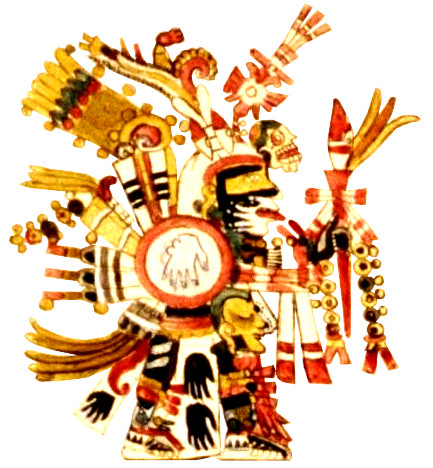
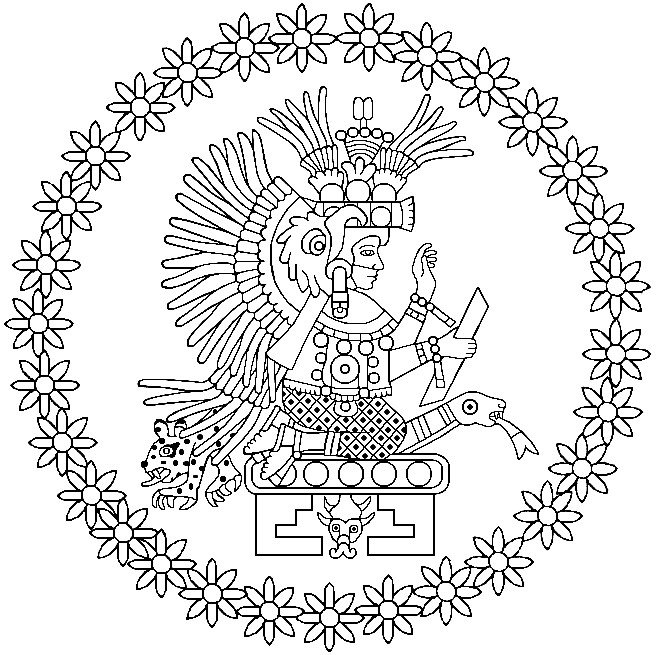


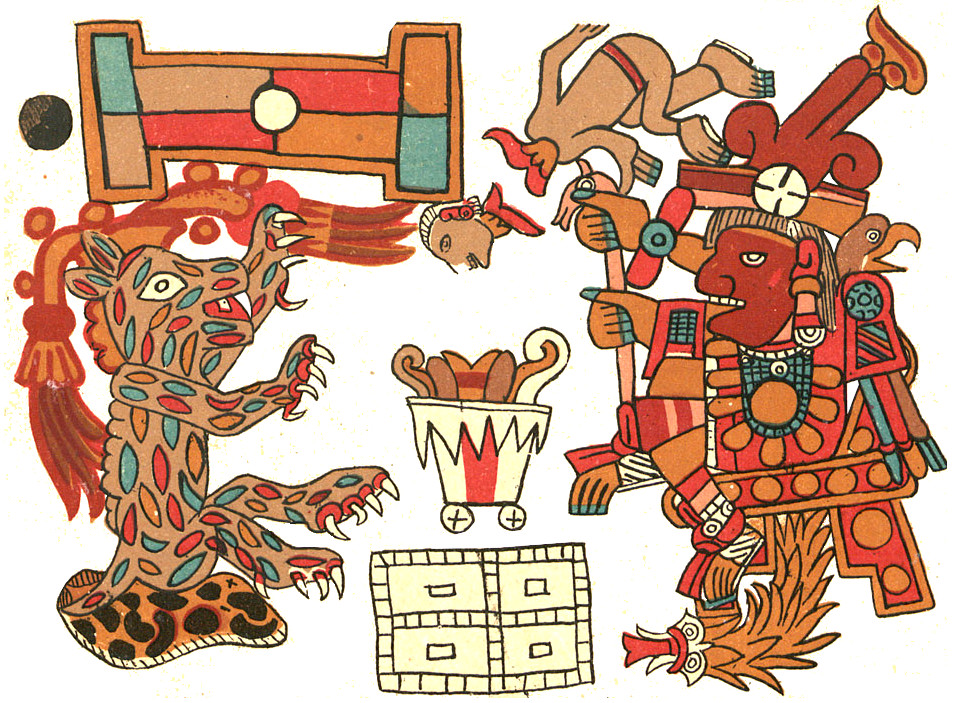


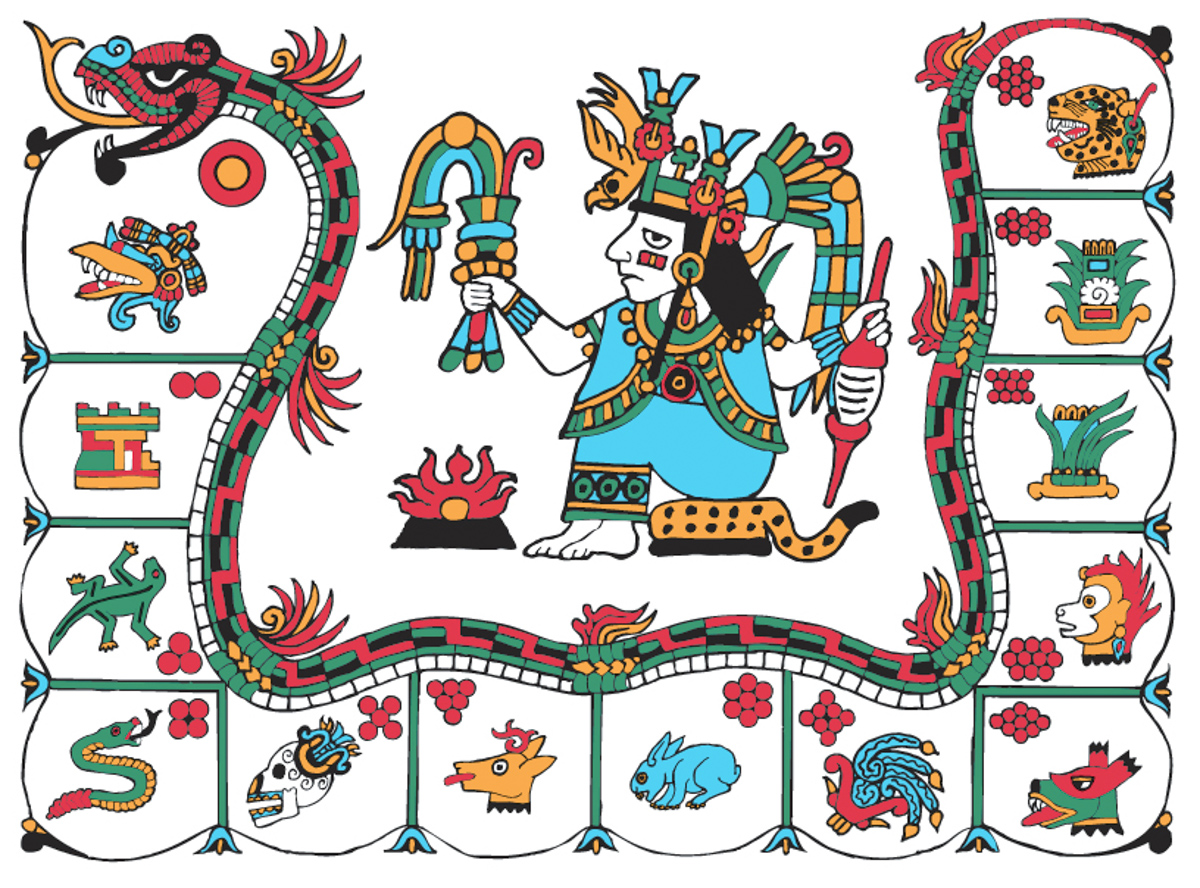
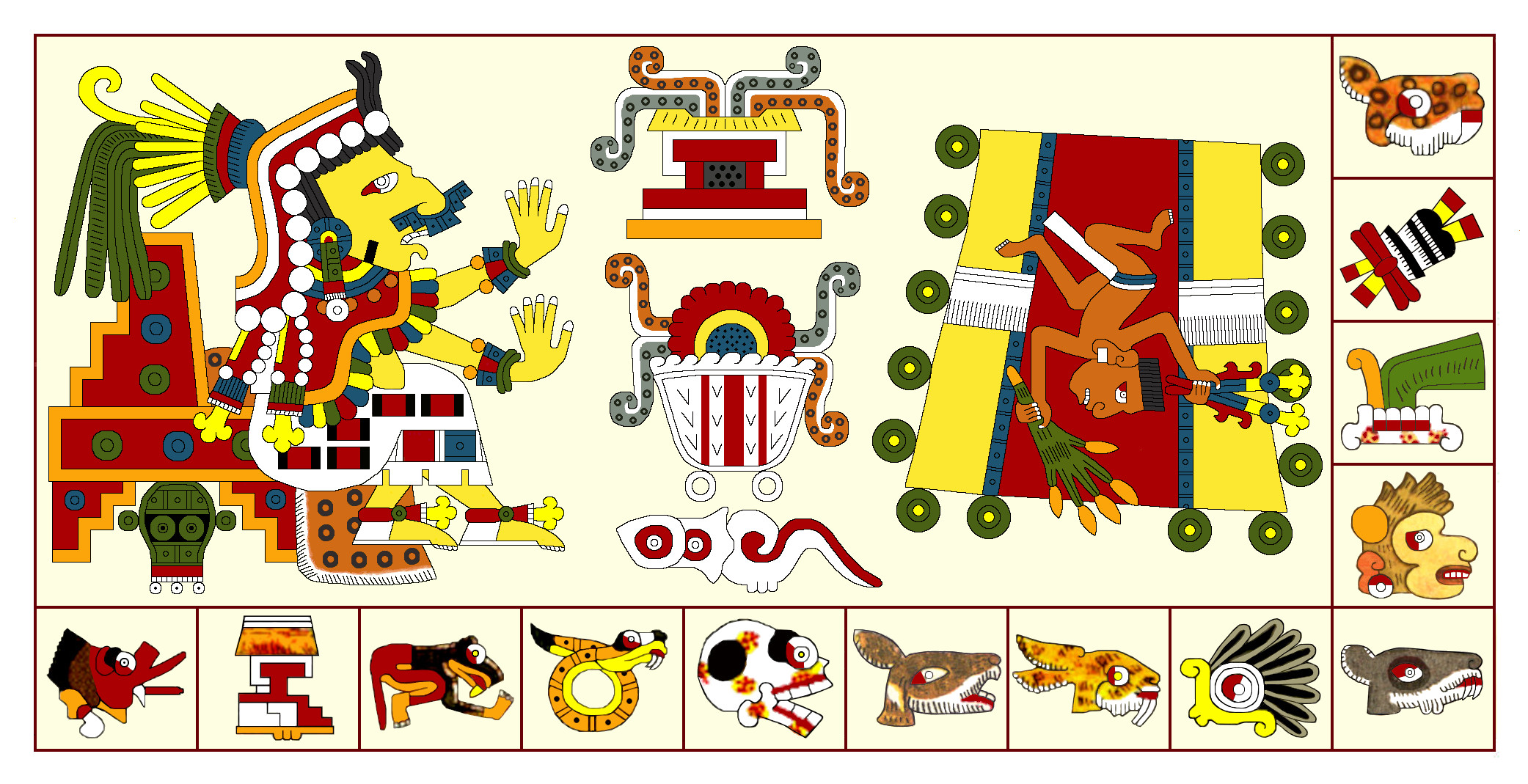
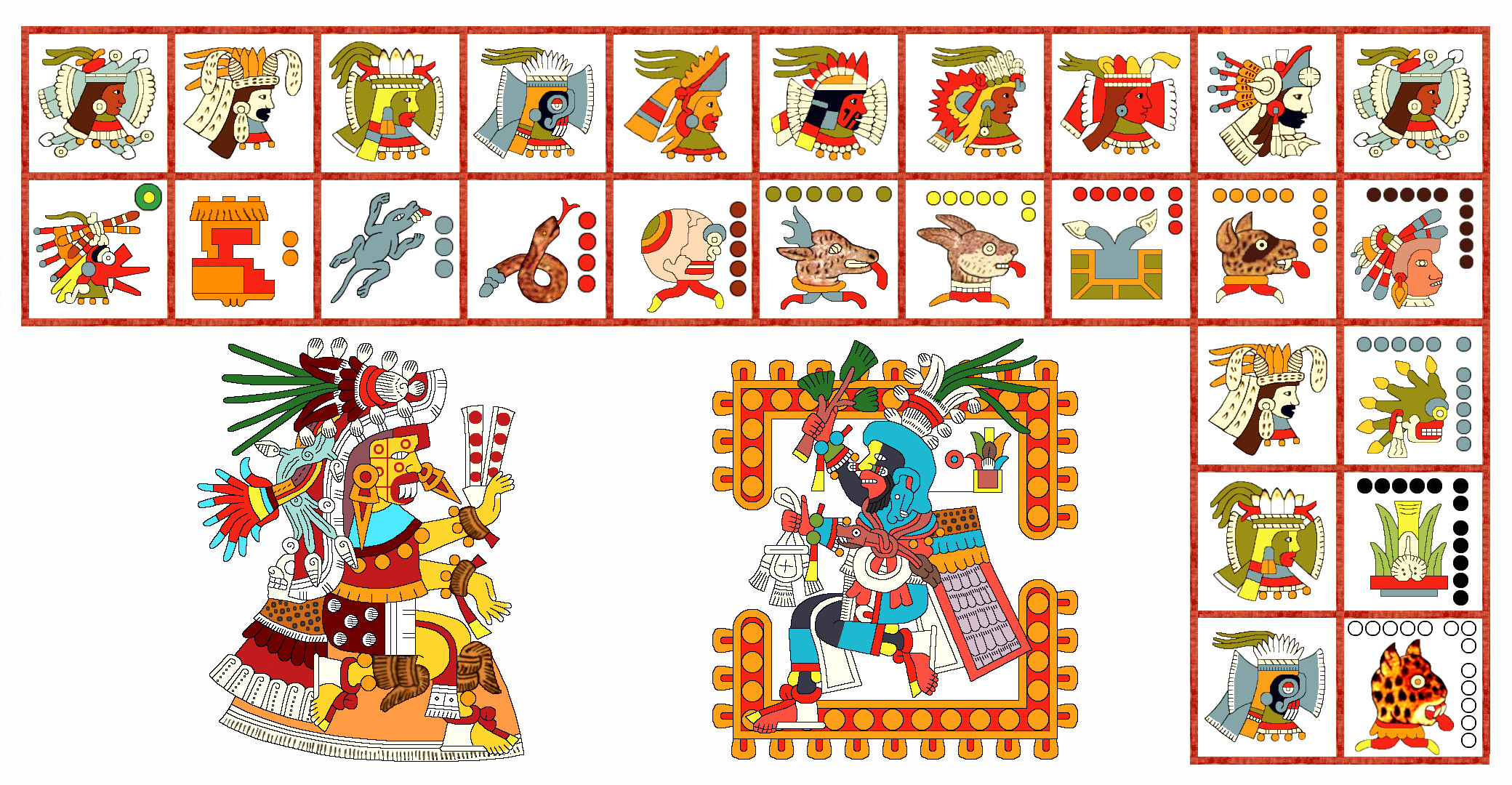

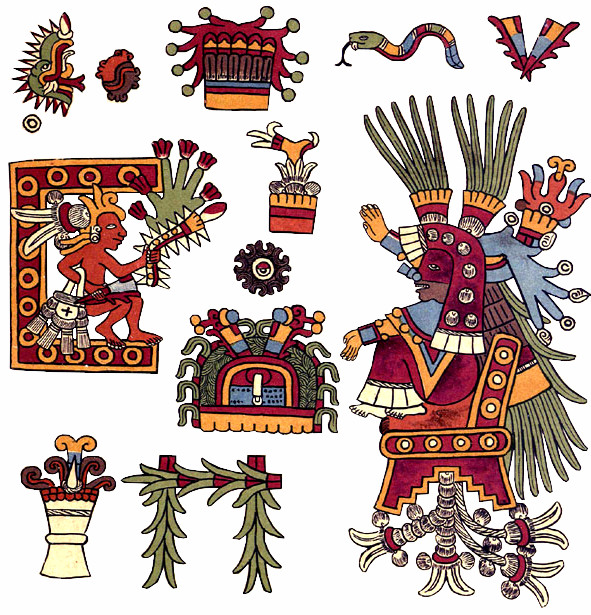


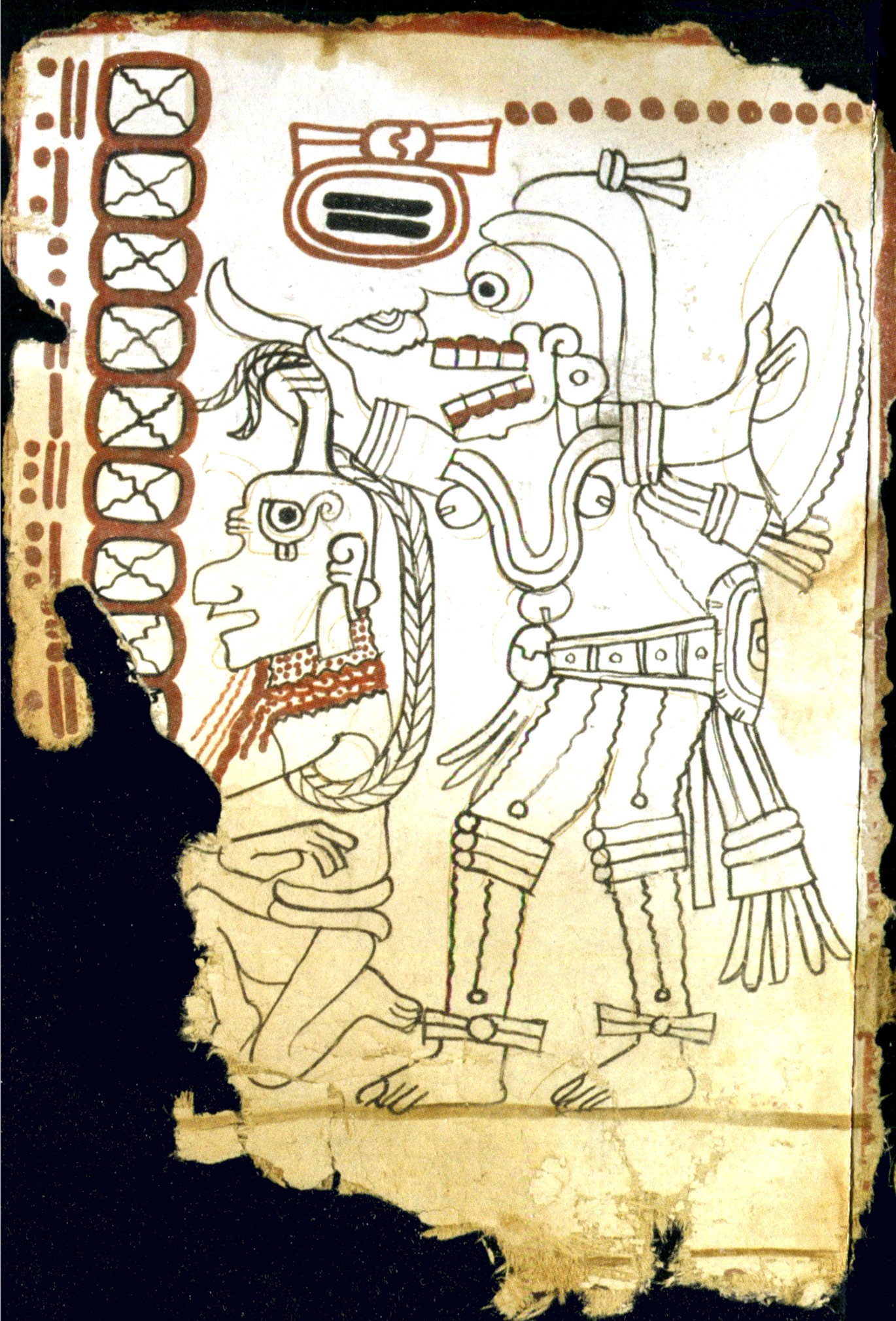


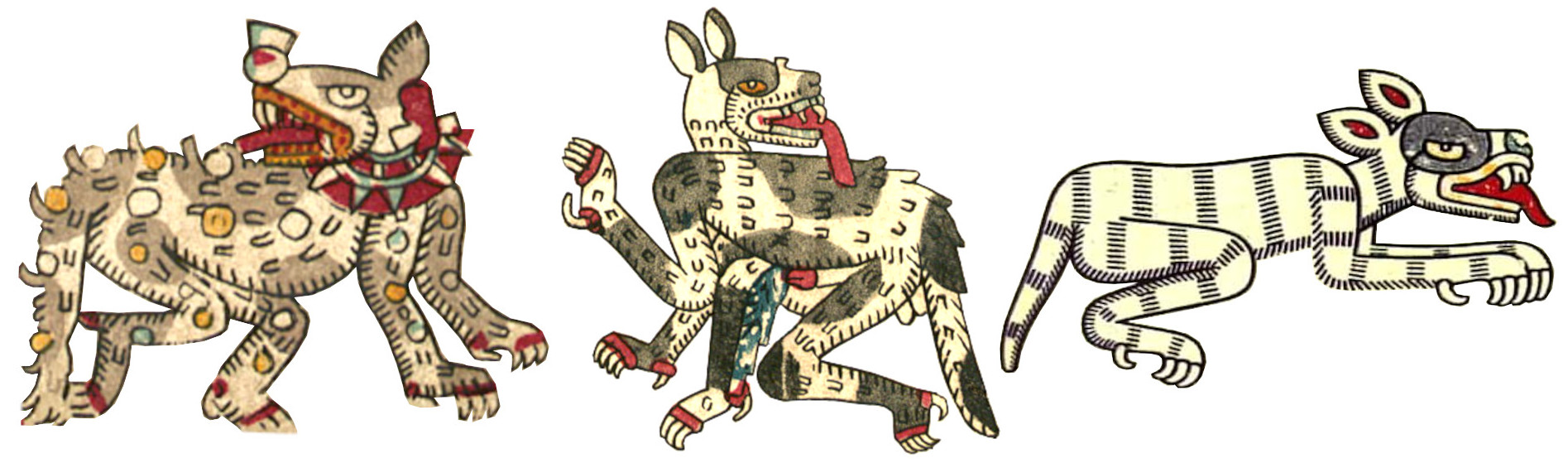
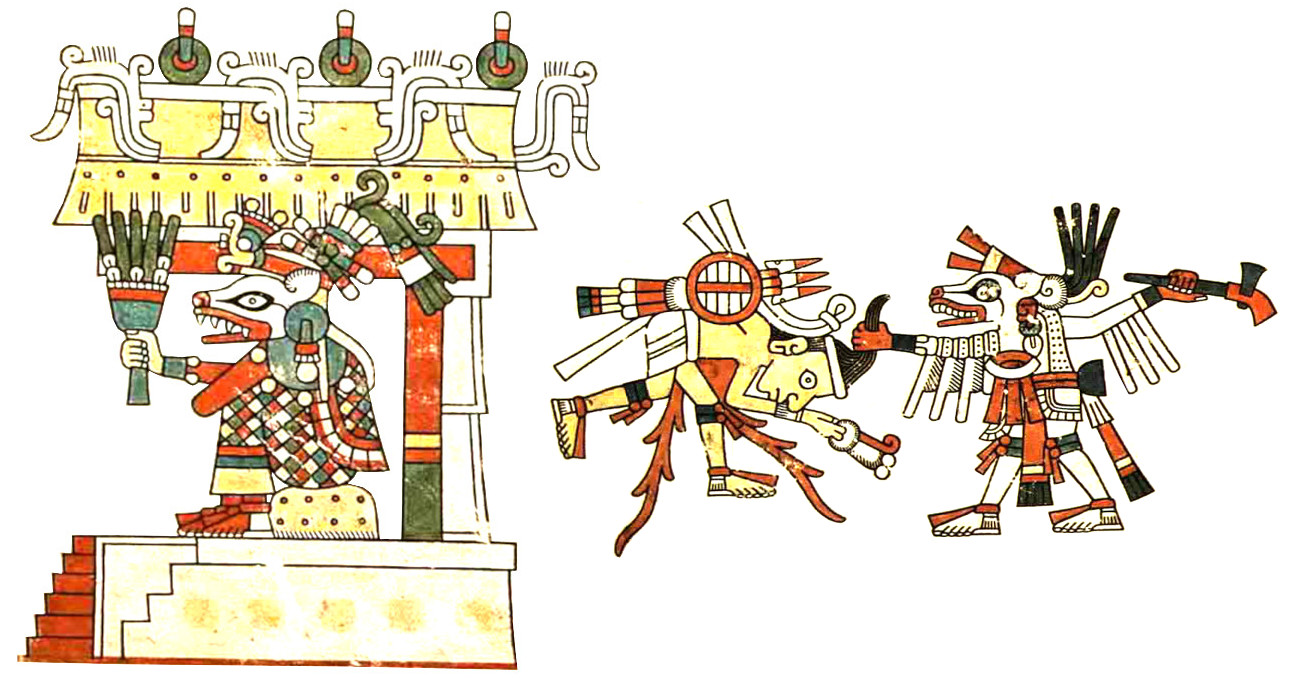


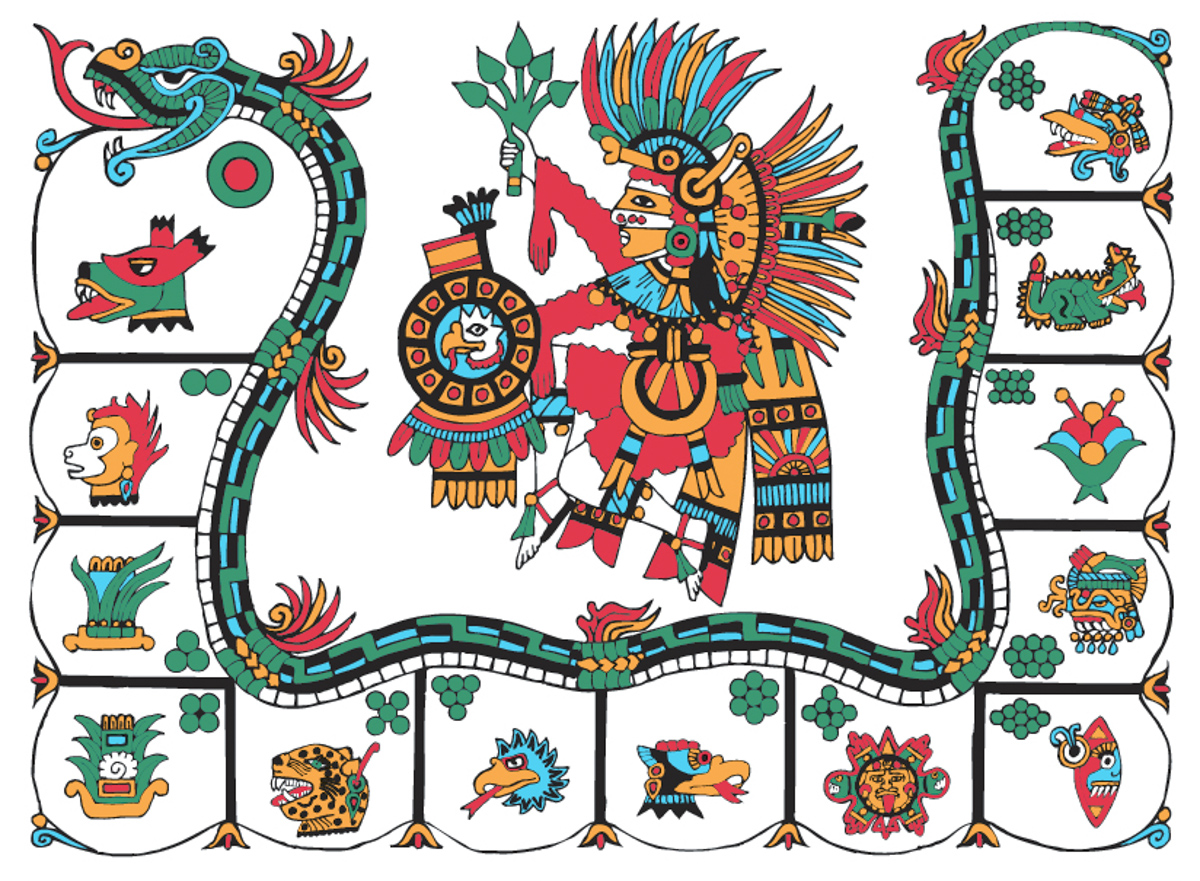


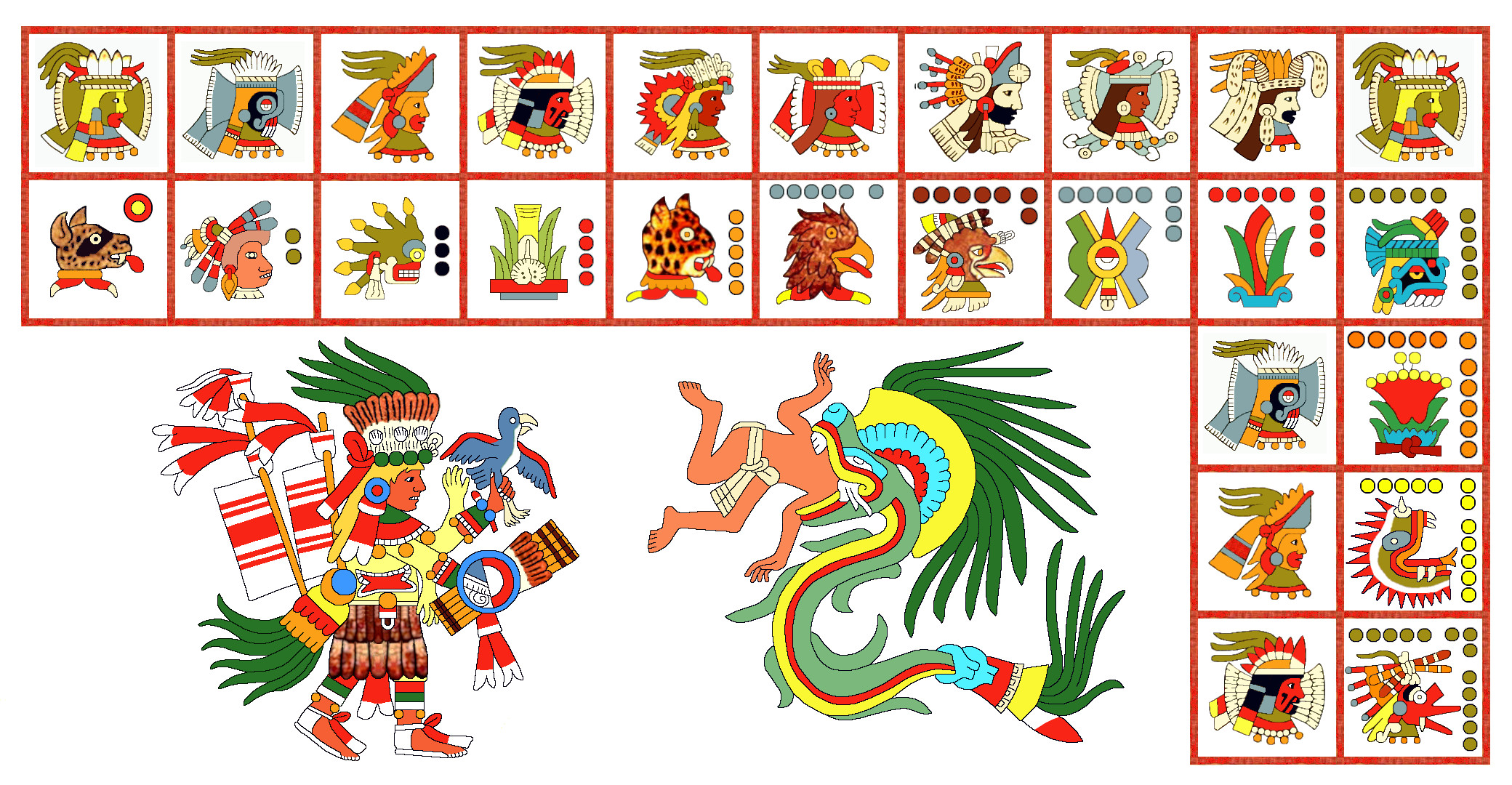
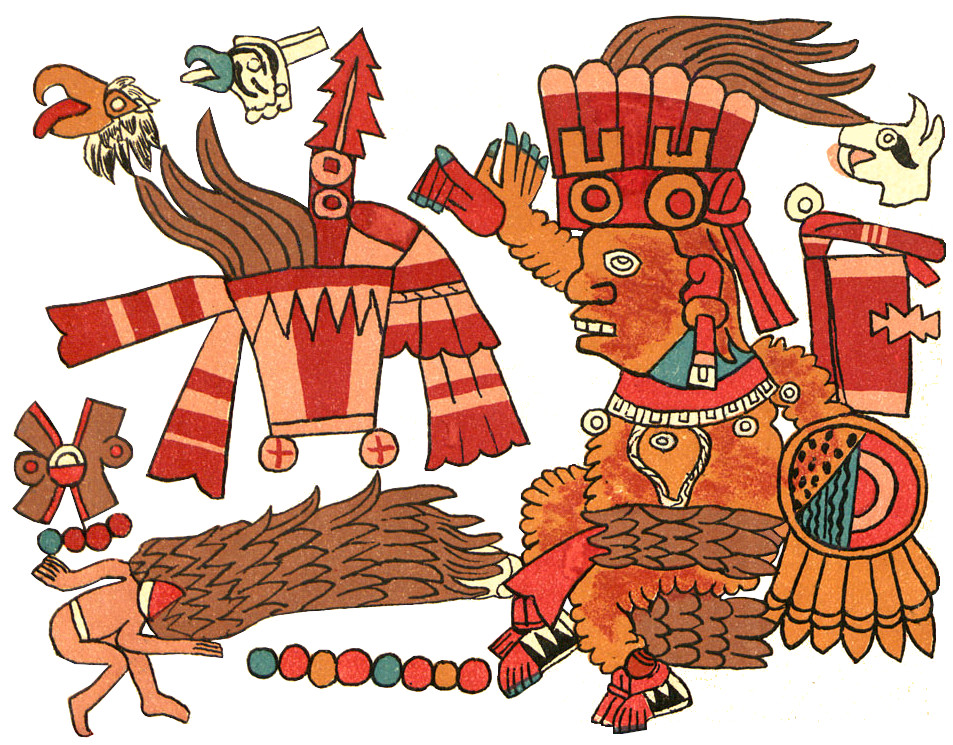

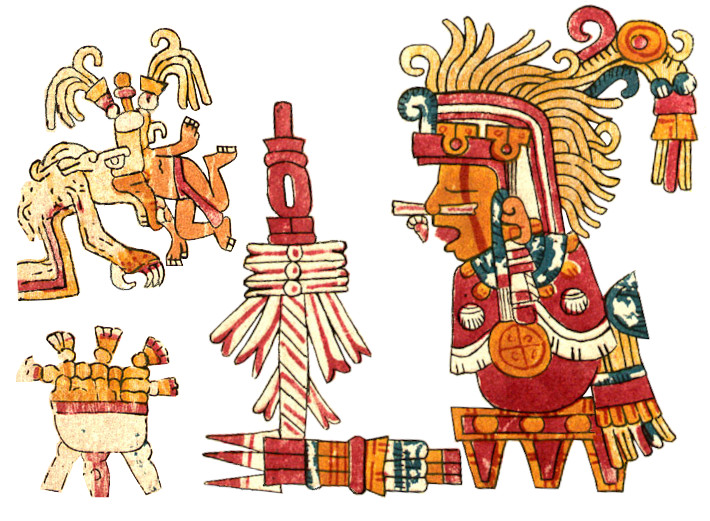


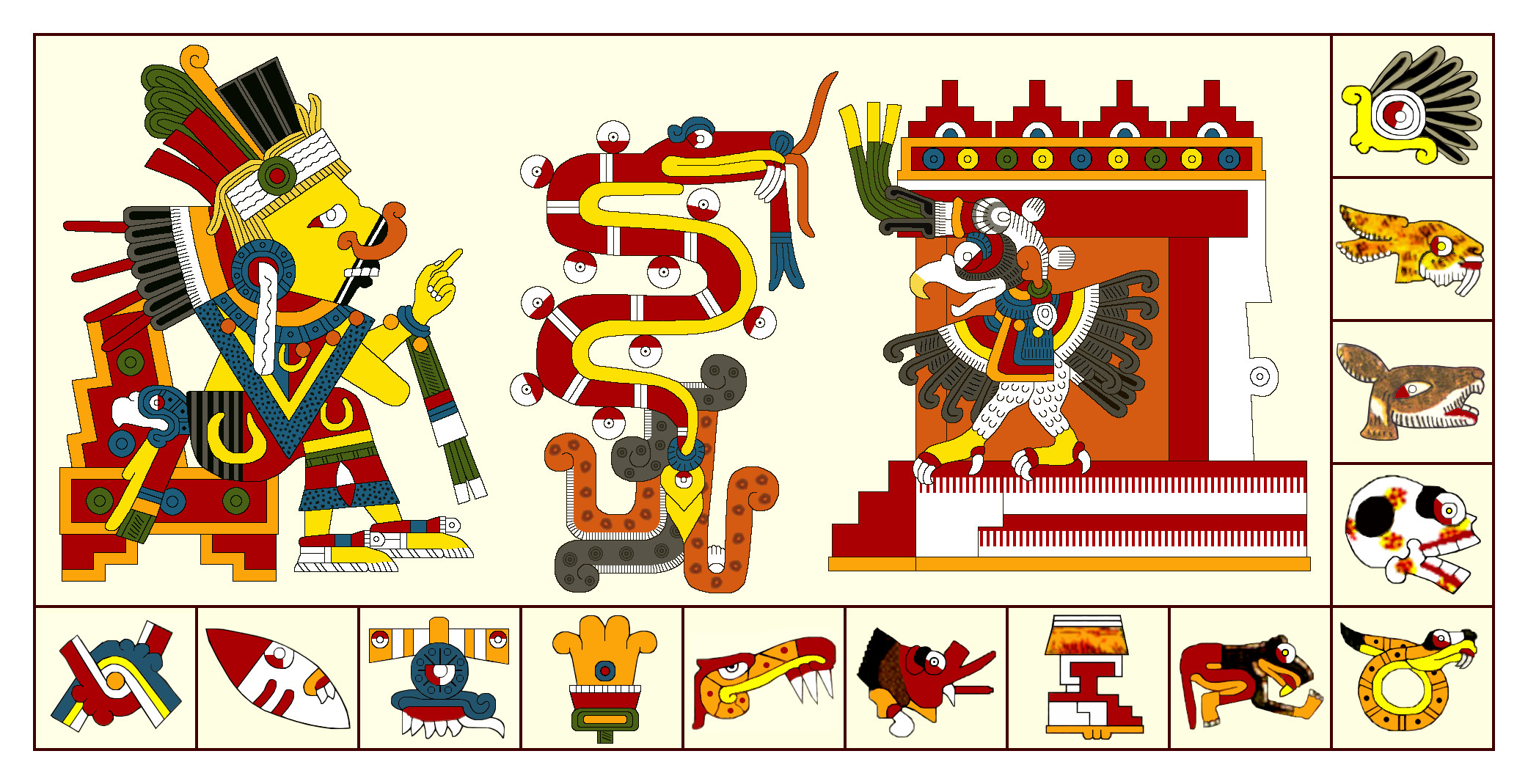


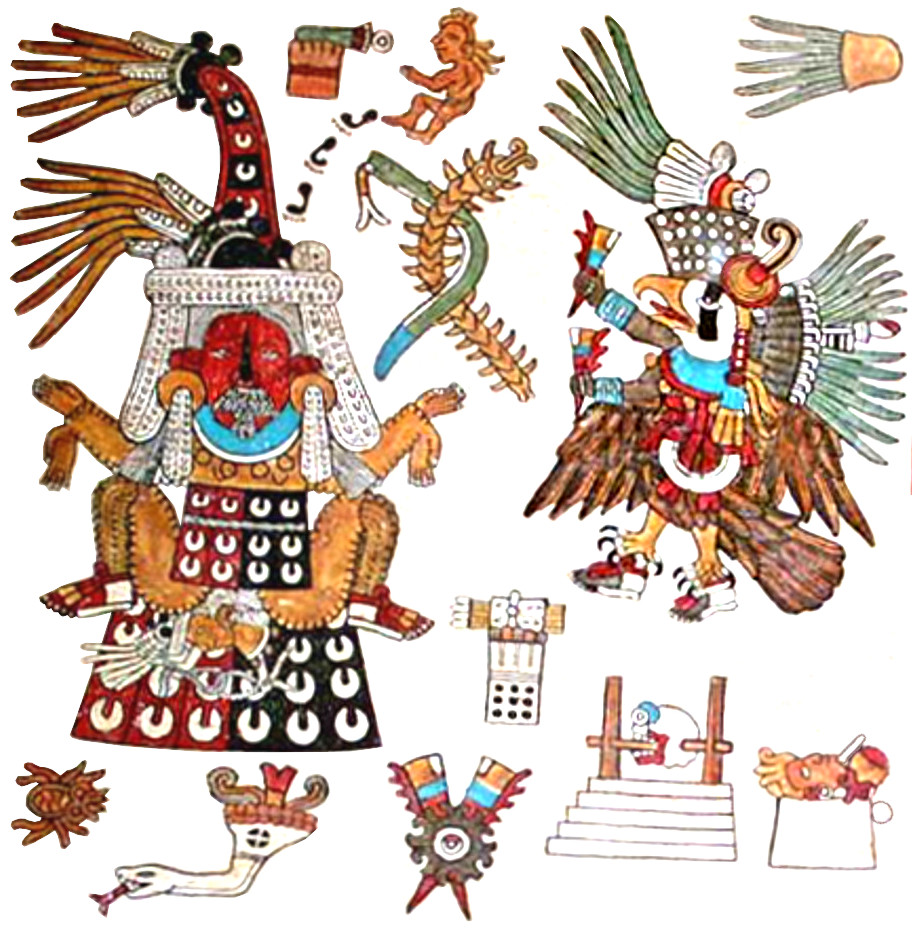


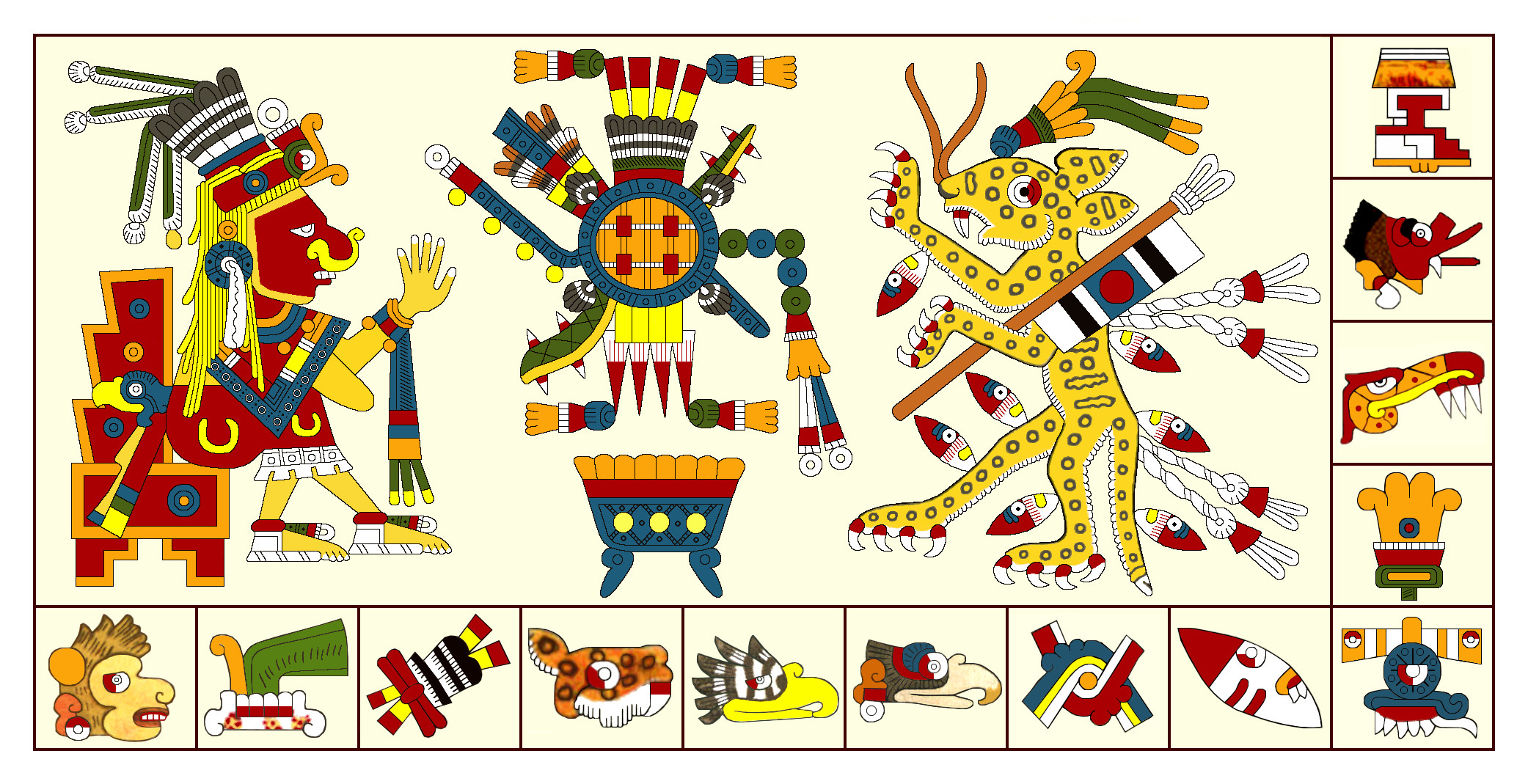


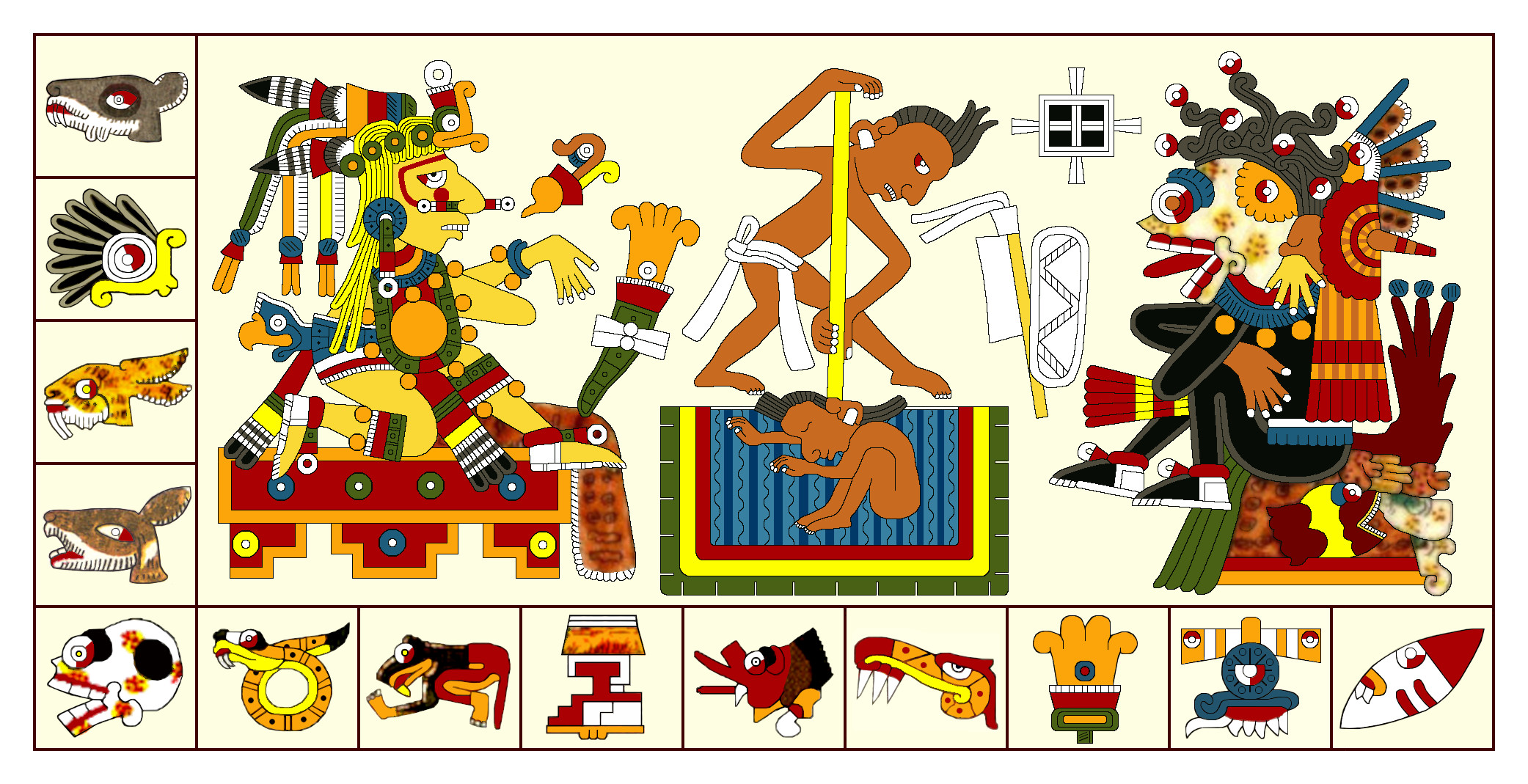
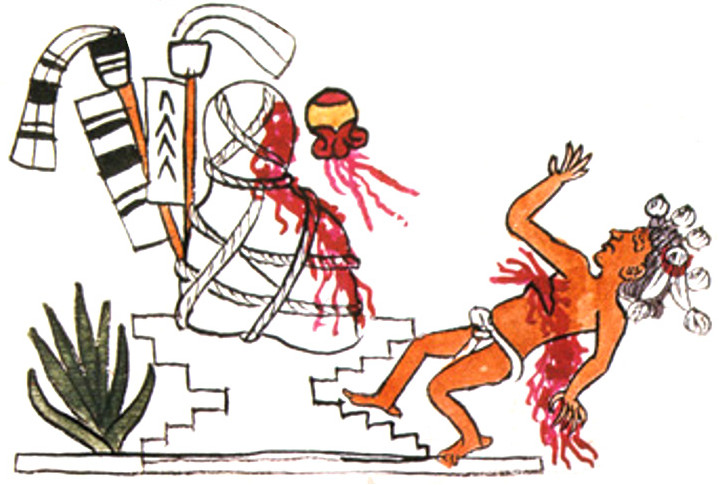


 Richard Balthazar


