Not quite the same as holding a tiger by the tail, but grabbing an armadillo’s tail was the wildest adventure of my first year on the Gulf Coast of Texas. I’ve now wrapped up the next, fourth installment of my childhood memoir KID STUFF which deals with when I was a witless eleven, seventy-two years ago.
SOUTHLAWN I – SUDDEN SABBATICAL describes missing out on the first semester of fifth grade—a surprise that proved an absolute boon for my education. It also gave me lots of time for beach, swimming, and fishing adventures, so much different than the fun I’d known before in rural Indiana. In fact, the sabbatical started opening my eyes to the wide, wonderful world around me.
Once again, I find it my old man’s duty to write in memoriam about a beloved spirit from long ago who has now left me behind on this plane of existence. Jane Rose Sallis (November 12, 1942-August 14, 2024) and I were students respectively at Newcomb College and Tulane University in New Orleans. We caroused frantically in the French Quarter, tremendously close friends and dancing partners, all through the spring, summer, and fall of 1962. It was her dire misfortune that Jane fell in love with me, a wild queer boy too besotted by my newly realized homosexuality to recognize this golden chance to love her back.
Many years later, I wrote in “Divine Debauch” about my dissolute youth in the sailor bars on Decatur Street, a memoir in the form of a semi-epistolary, multiple-narrator novel. The chapter covering Jane’s and my still-born romance is called “November Someteenth.” (Click HERE to read or download the chapter.) I dared to write it in her voice, telling exactly in truth how it played out, trying to understand that powerful experience from her point of view. While it’s the sordid tale of my own depravity, I believe looking at it through her eyes was as close and intimate as we ever got.
Being in a novel, her character was named Rose, and my name as protagonist was Tommy Youngblood, stolen from a real friend from high school. Tommy appeared in a cameo in my other memoir-novel “Bat in a Whirlwind.” Meanwhile, the Ben who kept watch over Rose had previously been me as the protagonist of that book, now a Tulane student. I brought him in to give Rose and Ben the beautiful romance Jane and I never had. Such is the special magic allowed the novelist-memoirist. Sadly, I can’t go back and write in a great love affair for us.
Jane and I in the Gin Mill, 1962
After we split up that evening in the Napoleon House, Jane retreating to her quiet, sane life and I off to debauch in La Marina, we remained friends for two more years till graduation. Once graduated, she married an aspiring writer named Jim and moved away to Iowa City for his writing career. I went to Seattle for graduate school (and profound trauma—as narrated in my memoir “There Was a Ship).”
At the end of 1965 I passed through Iowa City and visited Jane over a cup of tea, learning that she’d just had a baby boy. It was awkward, considering that I too was now married—and expecting a child. I doubt Jane appreciated my apparent reversion to heterosexuality, but I couldn’t explain how it was a terrible trap I’d fallen into. Consequently, neither of us spoke much about the past—or the present, and afterwards we lost contact.
Honest to John, I have no idea how we re-connected, but in the early 90s we did. Jane came to visit Santa Fe, and we spent several afternoons together catching up. She’d divorced Jim many years before, lost her son Dylan to suicide when he was around 15, started working in one of Seattle’s serious wealth-producing industries, retired well-provided for, and bought a house in San Miguel de Allende, Mexico. Our talks as 50-year-olds were warm but again focused solely on present concerns and plans. I sensed her lack of surprise that I’d left my wife and family long before to resume gay relationships. After her visit, for the next 30 years we remained in close, if sporadic, email touch.
Jane Rose Sallis at her Birthday Party, 2020
When I finished the first version of “Divine Debauch” in like 2000, I sent Jane a copy, pointing out her chapter. She wrote back that she’d read that chapter, and that was indeed how she remembered our misbegotten love affair. Our time together in the sailor bars had been the most exciting experience in her life, but she tried never to think about the past. I suppose she felt hers was too boring and painful, but my gay past felt endlessly fascinating.
In our communications, I never reminisced with Jane, simply reporting on my odd plant-vendor work and progress on writing projects—and sending her an occasional piece of my weird Aztec artwork. I was pleased that her comfortable, beautiful life in splendid San Miguel was so full of philanthropic activity and blest with puppies that always featured on her Christmas cards.
When I sent my recent birthday wishes and heard nothing back, I soon learned that my “first girlfriend” had passed away. We’d never kissed.
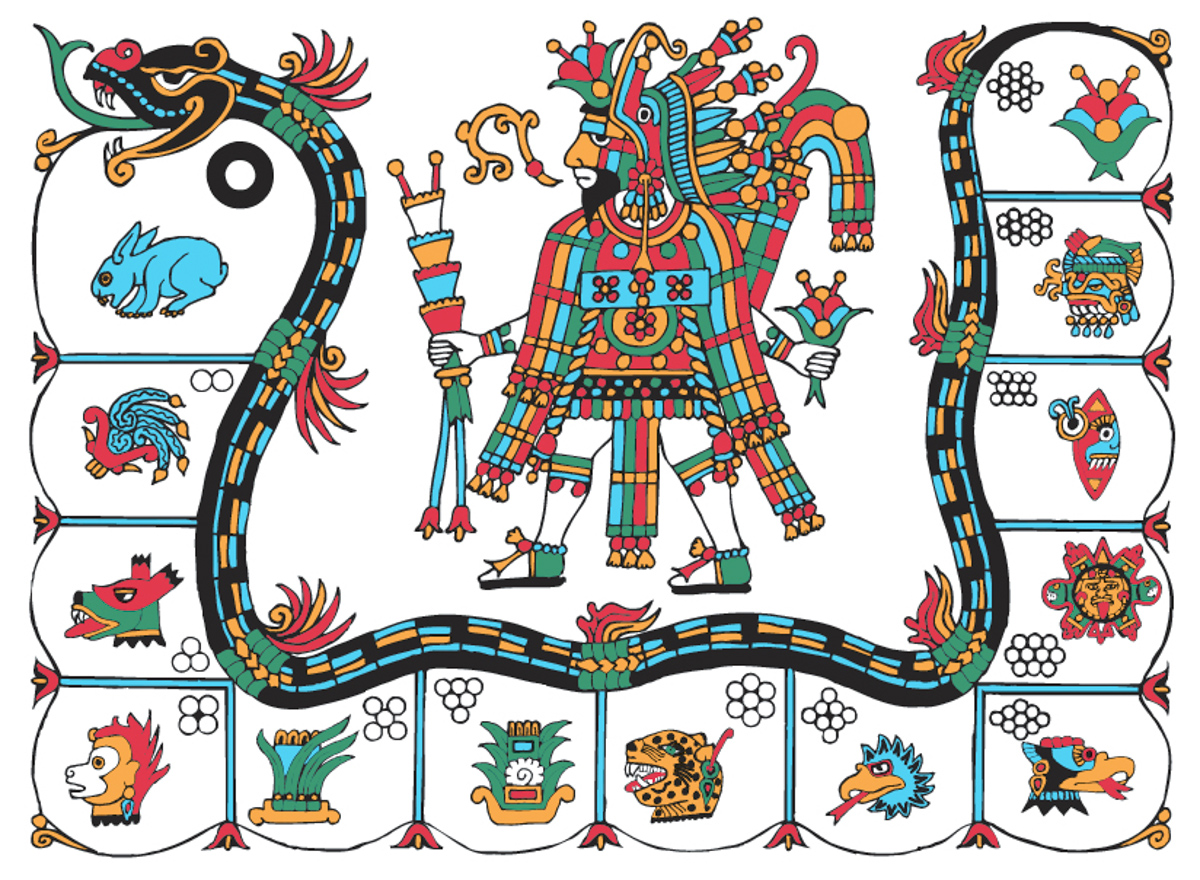
The twentieth and final trecena (13-day “week”) of the Aztec Tonalpohualli (ceremonial count of days) is called Rabbit for its first numbered day, which is the 8th day of the veintena (20-day “month”). In Nahuatl, Rabbit is Tochtli. It was known as Lamat(Venus, Star) in Yucatec Maya, and K’anil (or Q’anil) (Seed of Life) in Quiché Maya.
The day Rabbit signifies self-sacrifice and service to something greater than oneself. Counter-intuitively, Rabbits were seen as gods of drunkenness, the Centzon Totochtin (400 rabbits) being patrons of all kinds of intoxication or inebriation. The principle rabbit deity was 2 Rabbit (Ome Tochtli or Tepoztecatl). The Aztecs counted “rabbits” for intoxication levels, from 25 rabbits for mild intoxication to 400 rabbits for complete drunkenness. Vessels for the drinking alcoholic pulque often bear rabbit symbolism and/or a crescent moon symbol called the yacametztli—relating to the goddess of the moon Metztli. In fact, Mesoamerican cultures envisioned the figure of a rabbit in the moon, which I’ve surmised was day-named 12 Rabbit.
The patron of the day Rabbit is Mayauel, the goddess of intoxication/pulque and its source, the maguey plant. Seen previously as patron of the Grass Trecena, she’s the purported mother of the Centzon Totochtin, apparently by the deity Patecatl, god of medicine and pharmaceutical intoxication. Other sources suggest that the Cloud Serpent, Mixcoatl, sired some of them, but Aztec paternity wasn’t thoroughly documented, and Mayauel was a hospitable goddess.
PATRON DEITIES RULING THE RABBIT TRECENA
One of the patrons of the Rabbit trecena is Xiuhtecuhtli (Lord of Fire and Time), whom we’ve seen in the Snake trecena. As god of the Center and the Pole Star, he’s an A-list celebrity deity. The other is variously Itztapaltotec, Stone Slab Lord, or Xipe Totec, Lord of Renewal and Liberation. The first is a nagual (manifestation) of the second and deifies the sacrificial knife.
AUGURIES OF THE RABBIT TRECENA
By Marguerite Paquin, author of “Manual for the Soul: A Guide to the Energies of Life: How Sacred Mesoamerican Calendrics Reveal Patterns of Destiny” https://whitepuppress.ca/manual-for-the-soul/
Theme: Leadership and Renewal. During this final trecena in the 260-day cycle, the emphasis is on completion and “cutting away” what is no longer needed, in order to facilitate new growth. This can be an intense period, as combat in some areas could intensify, leading to important conclusions, as the stage is being set for new beginnings to follow in the next trecena. During this period signs or signals may appear that could indicate what lies ahead or new potentialities. This is a good time to watch for signs of change and growth, and a good time to make important decisions in preparation for the new cycle about to begin.
Further to how these energies connect with world events, see the Maya Count of Days Horoscope blog at whitepuppress.ca/horoscope/ Look for the Lamat trecena.
THE 13 NUMBERED DAYS IN THE RABBIT TRECENA
The Aztec Tonalpohualli, like the ancestral Maya calendar, is counted through the sequence of 20 named days of the agricultural “month” (veintena), of which there are 18 in the solar year. Starting with 1 Rabbit, it continues with: 2 Water, 3 Dog, 4 Monkey, 5 Grass, 6 Reed, 7 Jaguar, 8 Eagle, 9 Vulture, 10 Earthquake, 11 Flint, 12 Rain, and ultimately 13 Flower.
There are a few special days in the Rabbit trecena:
One Rabbit (in Nahuatl Ce Tochtli) – a date in the mythic Aztec past when the cosmos was created by gods; also, one of Xiuhtecuhtli’s calendric names.
Five Grass (in Nahuatl Macuil Malinalli) – one of the five male Ahuiateteo/Macuiltonaleque (Lords of the Number 5), usually paired with the female Cihuateotl One Eagle.
Thirteen Flower (in Nahuatl Mahtlactli ihuan yeyi) – a ritually significant day of completion for the 260-day cycle; also associated with period endings, often marking the completion of significant “bundles” of time.
THE TONALAMATL (BOOK OF DAYS)
Several of the surviving so-called Aztec codices (some originating from other cultures like the Mixtec) have Tonalamatl sections laying out the trecenas of the Tonalpohualli on separate pages. In Codex Borbonicus and Tonalamatl Aubin, the first two pages are missing; Codex Telleriano-Remensis and Codex Rios are each lacking various pages (fortunately not the same ones); and in Codex Borgia and Codex Vaticanus all 20 pages are extant. (The Tonalpohualli is also presented in a spread-sheet fashion in Codex Borgia, Codex Vaticanus, and Codex Cospi, but that format apparently serves other purposes.)
TONALAMATL BALTHAZAR
As described in my earlier blog The Aztec Calendar – My Obsession, some thirty-five years ago—on the basis of very limited ethnographic information and iconographic models —I created my own version of a Tonalamatl, publishing it in 1993 as Celebrate Native America!
When I started drawing my tonalamatl, I did the pages in colored pencil, often producing several versions in different color schemes in a palette of four chromatic colors (with some black and white as well): gold—for gods, red—for blood, green—for jade, and blue for turquoise. Each deity had a primary color with a secondary and highlights of the others. For the last trecena, I used models and motifs from Codex Nutall and tried to make it an even balance of all four colors. Maybe I succeeded because everyone admired this image especially.
On the first nineteen trecenas, I followed the limited information available about their patrons (not knowing all of them). Many I created from scratch from Nutall images and sketchy clues on iconography. A few were based on images from Codex Borbonicus found in old books. When I got to the last one, Rabbit, the scholarship said only that its patron was the sacrificial knife, and I found only one gruesome image, probably the monster from Tonalamatl Aubin. (See below.) As an artist, I was aesthetically and philosophically offended and decided to turn heretic.
I installed my own choice of a god as patron of the last trecena, someone considerably more appetizing. Xochipilli, the Flower Prince, is god of art, dance, beauty, ecstasy, sleep, and dreams/hallucinations. In addition, he’s variously patron of homosexuals and male prostitutes; god of fertility (agricultural produce and gardens); patron of writing, painting, and song; and god of games (including the sacred ball-game tlachtli), feasting, and frivolity. His twin sister/wife is Xochiquetzal, patron of the preceding Eagle trecena.
So much for authenticity. The neglected Flower Prince is an eminently worthy “calendar prince.” (You can see the true trecena patrons in the tonalamatls of the historical codices that follow.)
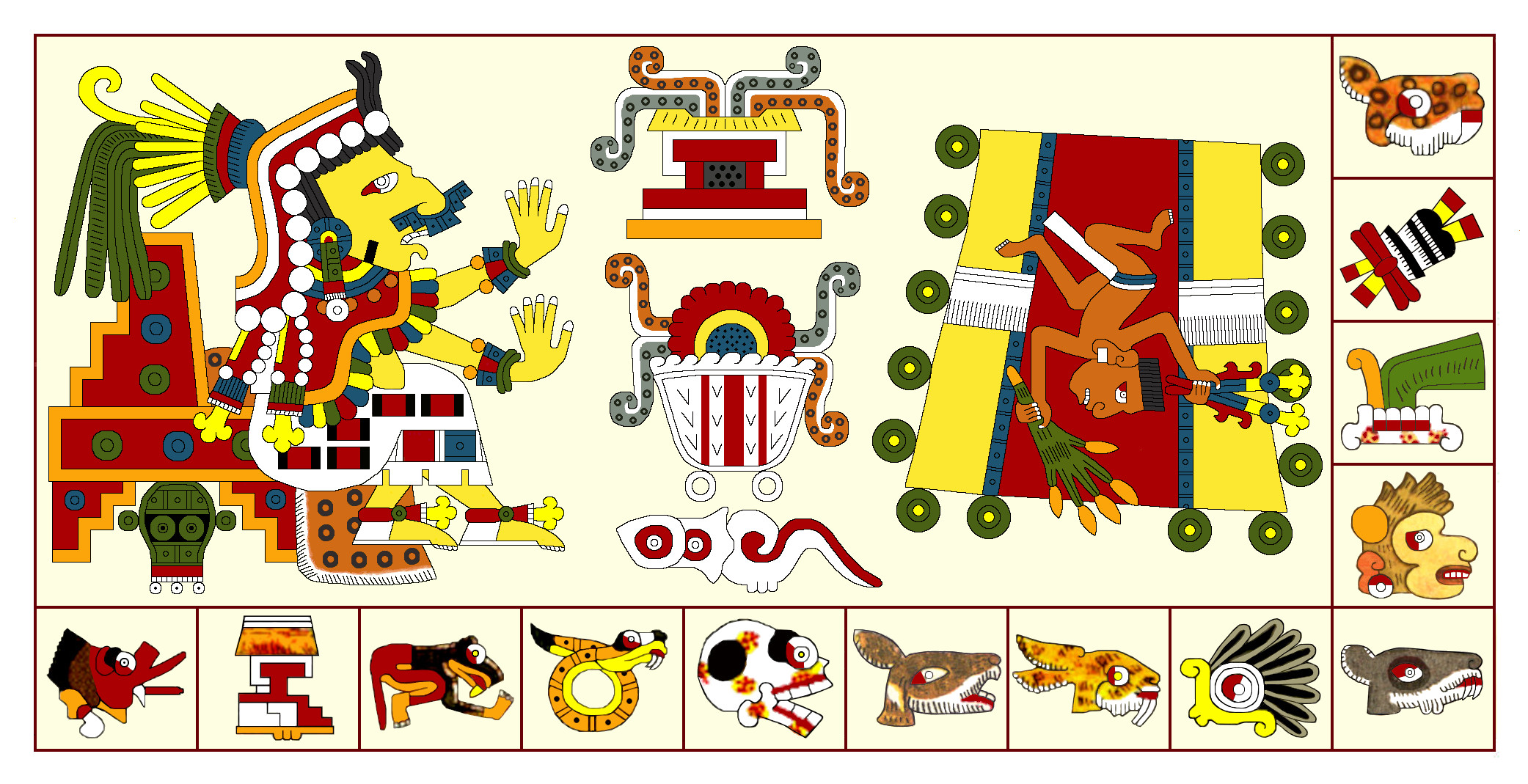
The page for the Rabbit trecena from Codex Borgia, which I hadn’t seen thirty-five years ago, portrays its orthodox patrons in typically ornate style. Xiuhtecuhtli on the left is loaded down with divine regalia, some of it the same as in his image with the Snake trecena, and in similar coloration. The only truly emblematic piece is his square pectoral, apparently a heavily stylized war-butterfly motif inherited from the ancient Maya. I find his headdress curious in reflecting that of Ixtlilton in the preceding Eagle trecena. Maybe the artist enjoyed drawing those motifs.
On the right side, we have one of the more spectacular images of Xipe Totec illustrating his traditional red and white ornaments and staff. It’s in a much different style than his image as patron of the Dog trecena, sharing only the unique nose-clamp. In this Borgia portrait, he’s definitely the “flayed god,” like a priest in the skin of a sacrificial victim.
If I’d known about this panel, I might have avoided heresy by making Xipe Totec the patron of my Rabbit trecena, but I’d already used him for Dog and wouldn’t have wanted to repeat patrons anyway. The same argument holds for Xiuhtecuhtli already having appeared in Snake. In any case, while perhaps not as eye-catching as Chalchiuhtotolin in the Water trecena, Borgia’s two lords for the final Rabbit trecena are about as stylistically exquisite as its deities get.
#
TONALAMATL YOAL (compiled and re-created by Richard Balthazar on the basis of Codex Telleriano-Remensis and Codex Rios)
Aztec Calendar – Rabbit Trecena – Tonalamatl Yoal
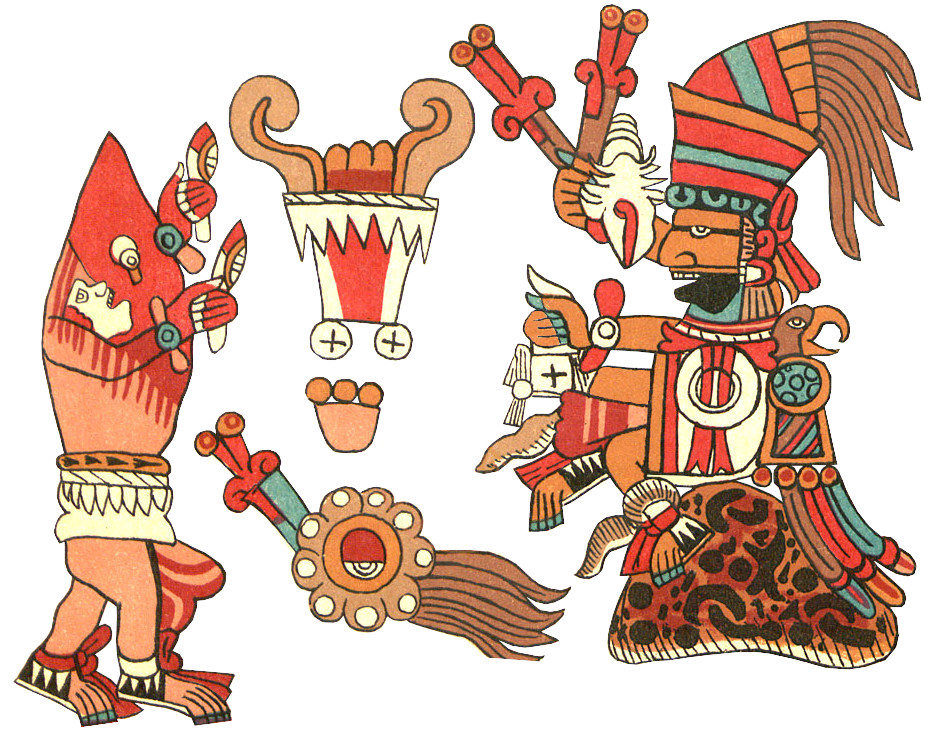
Here we see on the left the ominously named Itztapaltotec, Stone Slab Lord, himself, the sacrificial knife that grossed me out. This one looks like a guy in a flint knife (tecpatl) costume with flayed arms hanging from his own like an appropriately nagual hybrid of Xipe Totec. He holds an emblematic red and white staff, but I can’t fathom the conch shell in his other left hand.
On the right side sits Xiuhtecuhtli more or less enthroned, which is the first remarkable detail. Almost all the Yoal deities are either standing (like Itztapaltotec) or in what I call the “dancing” pose with bent knees. Only the Cihuateotl in the Flower trecena and Xochiquetzal in the Eagle trecena sit back on their feet, standard female posture, (especially in Codex Nutall where males sit cross-legged.) Adding to this iconographic weirdness, note that Xiuhtecuhtli’s right leg and foot are hidden by the left—an absolutely ideoplastic device.
Above and beyond that odd detail, the Lord of Fire is decked out in opulent finery. Check out that wild serpent/crocodile head by his ear, possibly a plug ornament. His extravagant array of Quetzal plumes splays more feathers than even Xochiquetzal in the Eagle trecena, and between him and Stone Slab they wear more than in any other Yoal patron panel. The artist may have overdone the plumage because in his tailpiece and bustle the feathers had to overlap—a definite problem for Aztec iconography. One of the plumes in the back-fan even droops behind another!
Passing by his war-butterfly pendant, we see in his lower right hand what looks surreally like a rattlesnake with an animal head. It’s in fact a ritual “shaman stick.” More usually it’s called a “deer stick,” though many don’t look at all like a deer’s head. Plain ones were often used for digging, but the rattles on this one were probably there to make magical noises.
In the original, the scepter in the god’s other right hand was terribly drawn and unrecognizable, and I substituted the finer Xiuhcoatl (fire-serpent) he holds in the Snake trecena. The strange position of his fingers—as though holding on to a ring—is an exact duplication of that detail in his Borgia icon. There I simply wondered about it, but seeing it again here, I begin to suspect that there’s some symbolic importance attached to it. I guess we’ll never know.
Moving on to the divine face, I confess to doing radical plastic surgery on the original which looked insanely like the cartoon character Homer Simpson. That simply wouldn’t do! Then I borrowed the face-painting pattern again from his image in Snake. The result was a respectable deity worthy of his portentous headdress (like that worn by him and Mictlantecuhtli in the upper row as lords of the night). According to Gordon Whittaker in “Deciphering Aztec Hieroglyphs,” that turquoise diadem with curved point in front is literally a hieroglyph for “Lord” or “ruler.” Whittaker adds that the Nahuatl word is teykw-tli pronounced in two syllables if you can wrap your tongue around that. Colloquially, that’s te-cuh-tli, as in Xiuhtecuhtli (fire/turquoise-lord).
As with Tonalamatl Borgia, Tonalamatl Yoal went all out on the patrons of the Rabbit trecena, lavishing them with divine detail. The tonalamatl presents many elegant figures, but in my opinion, only the panel for the Vulture trecena (Evening Star and Setting Sun) can compare to this ornate, many-plumed pair. The inspirations behind the Yoal trecena pages are superbly artistic visions of glorious mythological beings.
The twenty striking patron pairs in the Yoal tonalamatl encapsulate the traditional iconography of those Aztec deities. Having worked closely with the original codex images to re-create their conceptual inspirations, I can say that the later images in the series became progressively more awkward and crude, their construction often downright ramshackle. This suggests to me that other artists may have taken over some panels—or maybe the artist simply slacked off in his work—or equally probable, the artist got drunk or stoned.
In my careful estimation however, the Yoal artist(s)’s concept and vision of the trecena patrons were nevertheless sublime. Sadly, they just lacked the means, skill, medium, and (possibly) the reverence needed to manifest their deities magnificently. I’m thrilled to have turned those flawed visions into the Tonalamatl Yoal, a new treasure in the canon of Aztec art.
#
OTHER TONALAMATLS
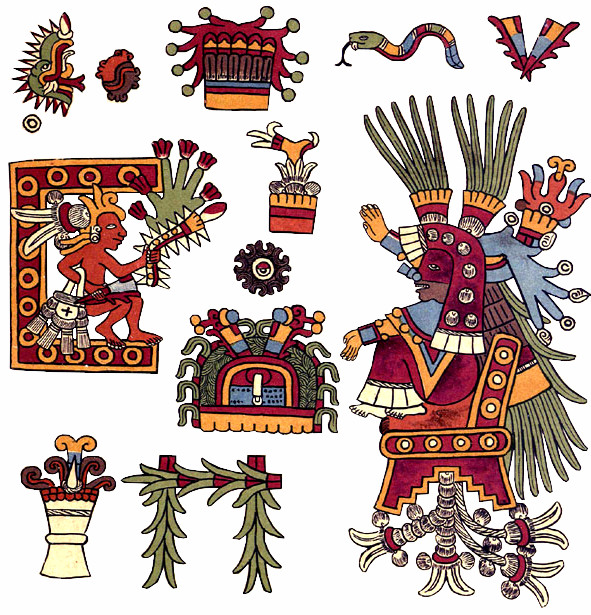
Tonalamatl Aubin patron panel for Rabbit Trecena
The only thing that identifies Xiuhtecuhtli in the Tonalamatl Aubin patron panel is his black face-paint. The generic circular pendant could belong to many deities. On the other hand, the figure on the left is clearly Itztapaltotec, a frighteningly personified sacrificial knife with a surreal face on his shoulder. The item at top center is a hearth-vessel with smoke, fire and possibly incense, but I won’t attempt to identify the other elements.
This patron panel and that for the Water trecena (with Chalchiuhtotolin) are the two most disappointing instances in the Tonalamatl Aubin. Most of the other panels are passingly ornate, while often awkward and distorted. In my humble opinion, this tonalamatl is the least impressive of the several we have seen. It was painted pre-Conquest in the neighboring state of Tlaxcala and as such may represent a crude, provincial document. Its value for scholarship is that it represents the shared themes and motifs across the “religious” territory of central Mexico.
#
Codex Borbonicus patron panel for Rabbit Trecena
The panel for this last trecena in Codex Borbonicus is artfully done, supplying the figure of Xiuhtecuhtli that I used as a model in the earlier Snake Trecena in my old tonalamatl. Oddly, I don’t believe I saw this decorative image of Itztapaltotec way back then. I was so taken my Xochipilli apostasy that I probably would’ve ignored the fancy fellow anyway. Though some of the surviving panels in Borbonicus present stunning figures (like Itztlacoliuhqui in the Lizard Trecena), this beautiful pairing of patrons has to be the most impactful composition of the lot.
The patrons’ emblematic paraphernalia is easily recognizable, as are many of the items in the neatly organized conglom. I’m intrigued by the bottom center item resembling a hill or mountain place-symbol with tooth-like appendages (which Whittaker has identified as hieroglyphs meaning “at”) and part of its vegetative detail in utter disarray. Most notable is the curved “deer-stick” hovering over Itztapaltotec’s flint knife, simpler than that in the Yoal panel, but scarcely more deer-like. This one is probably a common digging stick but might still be magical.
Combining these patron panels with a crowded matrix of delicately drawn days, 9 night-lords, and 13 day-lords with their totem-birds, the tonalamatl in Codex Borbonicus stands in my modest opinion as a consummate masterpiece of Aztec art and culture.
#
Codex Vaticanus patron panel for Rabbit Trecena
In Codex Vaticanus, the patron pair for the Rabbit Trecena again is well balanced, as in the other tonalamatls, to formally wrap up the last of the trecenas. In its characteristic rough caricature style, Vaticanus again closely follows the images and themes of Tonalamatl Borgia, Xipe Totec and Xiuhtecuhtli simply having switched sides. In its series of trecena panels, Vaticanus faithfully reflects the calendrical “dogma” in the more ornamental Borgia panels. The codices share certain other sections, but each also presents a lot of its own mythological material. Perhaps the calendrical orthodoxy can be explained by both codices having come from Puebla, possibly from the same priestly school (calmecac).
But the tonalamatl in Codex Vaticanus does more than simply restate the Borgia images. In particular, it created that uniquely surreal vision of Itzpapalotl for the House Trecena and produced its own exquisite versions of deities like Chalchiuhtotolin and Xolotl for the Water and Vulture trecenas. In addition, in its other sections, Vaticanus presents incomparably elegant artwork on deities like Tlaloc and Tlahuizcalpantecuhtli. The codex is a veritable goldmine of mythological and ethnological details. One just has to get used to its stylistic strangeness, like the blue finger- and toe-nails.
#
Tonalamatl Borgia is my proudest achievement in this series of re-created Aztec art. Like the Vaticanus version of the trecenas, it’s set amongst several other ritual and religious sections of the codex, many of stupendous artistry. Though several other historical codices are also iconographically superlative, like Fejervary-Mayer and Laud, to my mind, Codex Borgia is the premiere artistic relic of pre-Columbian Mesoamerica.
Unfortunately, over five centuries the document has seriously deteriorated with whole sections of images worn away, the colors of its inks fading and failing, and some pages torn or even burned. Mostly, what we can see nowadays of Codex Borgia (and many other codices) is from the incredible facsimile editions of Joseph Florimond Loubat (1837-1921), an American bibliophile. He faithfully reproduced the Aztec documents in their exact conditions at the end of the nineteenth century, which meant that any earlier deterioration was also reproduced. In 1993 a full-color restoration of the Codex Borgia was published by Giselle Díaz & Alan Rodgers, restoring most dilapidated areas and repairing lost coloration in facsimile fashion.
My re-creations of Tonalamatl Borgia have played somewhat more freely with its colors. I’ve interpreted various shades of greys, browns, and golds in the Loubat facsimiles as deteriorated original blues and greens and in a few instances introduced colors not available to the Aztec artists (like the purples with Chalchiuhtotolin in the Water Trecena). My purpose was to present the deities in authentic but new, vibrant images untouched by the passing centuries.
A curious feature of the Tonalamatl Borgia is that some of its decorative patron panels seem to suggest an underlying narrative, in particular that for the Snake Trecena. Other panels include mysterious and beautiful symbolic items (though not as many as in Codex Borbonicus), and a number of the Borgia deities, like Chalchiuhtlicue in the Reed Trecena and Tlaloc in the Rain Trecena, are perfectly monumental. In summation, I believe that this Tonalamatl Borgia deserves a place of honor amongst the world’s very best religious art.
#
AFTERWORD by Marguerite Paquin, PhD.
I would like to express my deepest thanks to Richard for his extremely valuable contributions to my Maya Count of Days Horoscope blog. This began in early December of 2019, when he allowed me to use his Tonalamatl Balthazar image for the Chikchan trecena as an illustration for the blog. (https://whitepuppress.ca/the-chikchan-lifeforce-trecena-dec-10-22-2019/) The evolution of imagery continued from there as he developed and refined his work.
After the inclusion of one full cycle of his Tonalamatl Balthazar, I began including his early renditions of the Codex Borgia in the blog. At first the images were somewhat sketchy (but valuable nonetheless) but over the years he kept refining them, and the full set is now gorgeously complete. I am blessed to have them available for my blog, as they allow my readers to see at a glance the nature of the energies that I discuss every 13 days.
When Richard began adding descriptions of his work (regarding the evolution of the images, and the detailing that was included) in his own site, this added yet another layer of interest. I am extremely appreciative of Richard’s talent, research, formidable attention to detail, and generosity in this regard, and have no doubt that the ancients who devised these images in the first place would be proud. Muchas gracias, Richard!
###
You can view all the calendar pages from the Balthazar, Borgia, and Yoal Tonalamatls in the Tonalamatl gallery.
A couple of weeks ago, with my mind disengaged from those weighty matters, I happened to notice something discarded in the bathroom waste basket, a wad of my hair, part of my COVID coiffure probably grown in 2022 and 23, for what that’s worth archivally. A friend at the gym had kindly trimmed the shaggy back of my neck and accidentally clipped too much off.
Recognizing the dramatic ambiguity of the word “snarl,” I scanned it at a high resolution:
The Snarl
Feel free to see this image as homage to Edvard Munch’s painting “The Scream.” Look very closely and you’ll see an occasional strand of silver, not bad for coming off the head of an 83-year-old man. The subtlety and grace of this image impress the heck out of me.
The Snarl might well be a milestone in a new genre of contemporary art maybe called Spontaneous or Impromptu Art. It’s closely related to my sculptures from some decades ago (found-object assemblages), amongst which were some provocatively shaped stones:
Creeping Creature and Calf
Also, on my tramps across the New Mexico hills, I frequently found flattened coils or tangles of wires in intriguing, impromptu designs:
This Mortal Coil
Like with The Snarl, my artistry is simply in recognizing their spontaneous artistic essence.
I’m happy to report wrapping up the third Nowlin Road segment of my childhood memoir KID STUFF which I’m calling “Playmate.” It covers my ages 8 to 10 (third and fourth grade) when I started being aware of the larger world and other people in it. What happened in that brief period wasn’t very dramatic but certainly had ramifications for my future life.
I’m also happy to advise that my innocence remained intact in spite of Catholic school, television, an intense friendship, and the overture of a pubescent neighbor girl. Read all about it.
Recently I found the obituary of my best friend from high school, Dennis (January 30, 1942 – October 10, 2023), dated almost a year ago. All through this past year, I’d had a sneaky feeling he’d probably passed on. We hadn’t been in contact for a couple years—ever since I wrote that I’d always wished he were my brother. Denny replied that we’d always be brothers—in Christ. While not exactly the terminology I had in mind, I took it in the intimate spirit intended.
In those years since 1960 after we parted, Dennis now lives on only in the memories of his wife, children, and grandchildren as the Navy guy, new husband and family man, long-time worker in the paper mill in Ashdown, retiree with work-related Parkinson’s, and a happy fisherman out in the backwoods of Arkansas. May they long remember him, but I know how quickly fond family memories can fade away to ancient photographs or vague anecdotes, even in one year.
Over those years, I visited Denny a few times, first in the mid-70’s when we were both still young. At his new house I briefly saw his teenaged son (his spitting image), and at the paper mill we had a few fond moments together. Our next meeting was around our 50th class reunion (2010) when we rode on a parade float together. Some years later, I met him and his wife Esther at a fishing camp at White Cliffs, and on yet another drive-by I stopped in at their new house. I was sorely distressed by my friend’s Parkinson’s affliction, but he seemed to be medicating it well.
We had only two early years together when my Denny was the handsome high school boy, Halloween King, volley-ball player, joker, and unspeakably sexy tease. Now that teenaged Halloween King is mine and mine alone, like the heroic ephebe on a Grecian urn, eternally young and incorruptible. With Denny’s passing one year ago, my old novella BAT IN A WHIRLWIND has now become a veritable monument to my beloved best buddy, our newly true love story. With no one to refute my blatant fictions, the adolescent passions of our avatars Danny and Ben are for all intents and purposes factual history.
Here follow some preview scenes. For our whole love story and poignant memories of Denny, please read the book.
1. THE CHASE
Along the parking area in front of the café there was this huge chain strung up between big cement posts. They were sitting on the great links down by the rosebush. I sat next to Danny so my leg pushed up against his. He threw his arm over my shoulder and squeezed my neck. It felt so good I thought I was going to faint, but then I realized it was the smelly cigar.
They were talking about Terry’s hot ’57 Chevy parked right there in front of us, all shiny and black. Naturally I myself knew nothing about cars beyond what I could read on the hood. But I felt perfectly content listening to my good buddy chatter about whatever, as long as he kept his arm around my neck.
When Terry went back inside for a snack, Danny punched me on the arm, and I chased him across the road to our Desoto, down the way to the Phillips 66 station and around the pumps, back across the highway, up past the café, and around some cars. He finally let me catch him around the corner where Melvin, the night cook, parked his new red Plymouth. We collapsed on its shiny hood, breathless from running and laughing.
#
2. AT SCHOOL
At school I waited out front for Danny. He came ambling up the walk under the oak trees whistling “Red River Valley.” He was so hot-looking it should be illegal. Danny’s flattop was a shade darker than mine with just a hint of a ducktail in back. That point of hair on his nape didn’t look sissy at all. Actually, it was pretty darned sexy.
He had to go to the office and get him a newspaper article for Civics class. I already had mine, a short thing about Congress passing some bill. Afterwards, we hung out by the lockers, and he leaned lazily up against one. Something made me poke his stomach. Wiggling his hips, he asked, “Want something?” Then he blushed like crazy, his cheeks the color of cherries…
Going to our regular assembly seats, now on the very first row being seniors, he brushed my face with his red sweater in passing, and I caught a brief flower-like fragrance. Waiting for the assembly to start, Danny looked over at Betty Lou with intense carnal interest. I whispered, “There’s a little muscle in your cheek that’s quivering.”
He didn’t take his eyes off of her and said, “That ain’t the only one. Boy, I could make do with just half of her.”
Deadpan, I asked, “Right or left?” Danny cracked up.
#
3. THE INDIAN WELL
Noticing the shallow Indian well full of leaves, Danny said it sure looked like a great place for a nap. So, I pushed him in, and he pulled me tumbling after. Wrestling around, I took to tickling Danny in the ribs, and he struggled, laughing and begging me to quit. Tears glistened in his brown eyes. When I stopped, he instantly jumped me and pinned me flat on my back, knees on my elbows so I couldn’t tickle anymore.
Danny leaned over me, grinning mischievously, and stroked my furry cheek. “I love your fuzz,” he said, laughed, and asked, “Wanna know what I wished?” I nodded. “Here, I’ll show you,” he said with a sly smile and popped open the buttons on his fly. His pecker stood right up in the air, maybe six inches from my nose, a lot bigger than mine. He moaned and said, “My balls are about to explode!”
All my blessed bliss of the day was blown away by his cock sticking out of his pants like a dark-headed snake. How could temptation ambush me so soon after being made pure again? Why did the devil use my beloved friend to lure me into sin? When Danny started touching himself impurely, I struggled out from under him, protesting that what he was doing was a sin.
“Maybe for you, Benny babe,” he said, rolling over in the leaves, and kept on moving his hand. “But I think it’s like a little bit of heaven.”
“Well, I’m not going to watch,” I protested in a fit of virtue and walked over to stare at the trunk of the white oak. Hearing Danny’s sweet groans, I had to struggle not to get hard myself. Listening to a bird singing somewhere didn’t help. Then a deep grunt.
When Danny climbed out of the leaf-well, he was handsomer than ever, his eyes brown and shining. How could I love him so much in spite of his sinful ways? I rumpled his soft hair to show I loved him anyway.
My latest memoir, KID STUFF, progresses slowly in between drawing for my TONALAMATL project, writing on other stuff, and seasonal gardening. (In that arena, besides the swaths of golden aspens on the mountains, we’re now well into autumn colors down here in town.)
Rocky Mountain Asters (foreground) Maximilian Sunflowers (background)
For the memoir, I’m now posting the second mini chapter called BIG BRO which covers my few relatively idyllic years between five and eight. They were years of minor traumas, dramas, and challenges, the most serious but least impactful being a concerted but unsuccessful effort by the Catholic church to indoctrinate my heathen little head.
Little Dick at Eight
The most traumatic but least important experience of that period was in the first grade when, like a naughty kitten, I lost my mitten and feared I’d have no pie. In fact, I got more pie than I needed and by eight had gotten downright plump. The most painful but least meaningful drama was my first time away from the family at Cub Scout camp when I was too shy to use the latrine.
The funniest adventure in those few years of empty-headed childhood was a snowy sleighride that went terribly wrong. On the other hand, the most serious and meaningful episode in those few years was being rescued from drowning by my heroic father. That was essentially our closest relationship moment in all the too few years of his life.
Check out BIG BRO for a few minutes of old snapshots and fond, if vague, memories of a childhood well before the age of reason, if such a theoretical age indeed exists.
The nineteenth trecena (13-day “week”) of the Aztec Tonalpohualli (ceremonial count of days) is called Eagle for its first numbered day, which is the 15th day of the veintena (20-day “month”). In Nahuatl, Eagle is Cuauhtli. It was known as Men(Eagle, Sage or Wise One) in Yucatec Maya and Tz’ikin (Eagle) in Quiché Maya.
Ever since the Maya, the day Eagle has signified bravery, lofty ideals, acuity of vision and mind. The Eagle was seen as an avatar of the sun and emblematic of high authority. The elite order of Eagle Knights was prominent in Aztec society. The day-sign was anatomically connected to various parts of the body, including the right ear and right foot. The patron of the day Eagle is Xipe Totec, the god of Spring and renewal, who was seen as patron of the Dog Trecena.
PATRON DEITY RULING THE EAGLE TRECENA
Xochiquetzal (Flower Feather) is the ever-young goddess of love, beauty, sexuality, and fertility. She protects young mothers in pregnancy and childbirth and is patron of weaving, embroidery, artisans, artists, and prostitutes. Her day-name is Ce Mazatl (One Deer). Reflecting her intense sexuality, among her several reputed husbands/lovers were her twin brother Xochipilli, Tlaloc, Tezcatlipoca, Centeotl, and Xiuhtecuhtli. However, despite her patronage of fertility, I’ve not seen any reports of progeny. Very recently, I was advised that Tezcatlipoca is a possibly secondary/minor patron of the trecena in one of his many nagual disguises.
AUGURIES OF THE EAGLE TRECENA
By Marguerite Paquin, author of “Manual for the Soul: A Guide to the Energies of Life: How Sacred Mesoamerican Calendrics Reveal Patterns of Destiny” https://whitepuppress.ca/manual-for-the-soul/
Theme: Supremacy/War, Lofty Vision. The juxtaposition of the “supremacy” oriented energies of the Eagle with a patron energy of a goddess aligned with artistry and creativity, brings to mind the idea that women who died in childbirth were seen as “warriors” and, like warriors who died in battle, were esteemed for their bravery. The “creativity” component may refer to the valor and creativity involved in bringing forth new life. This combination of energies places emphasis on the courage needed to overcome obstacles and move life forward despite enormous challenges. Power, military strength, and transformative action are often highlighted during this period.
Further to how these energies connect with world events, see the Maya Count of Days Horoscope blog at whitepuppress.ca/horoscope/ Look for the Men (Eagle) trecena.
THE 13 NUMBERED DAYS IN THE EAGLE TRECENA
The Aztec Tonalpohualli, like the ancestral Maya calendar, is counted through the sequence of 20 named days of the agricultural “month” (veintena), of which there are 18 in the solar year. Starting with 1 Eagle, it continues with: 2 Vulture, 3 Earthquake, 4 Flint, 5 Rain, 6 Flower, 7 Crocodile, 8 Wind, 9 House, 10 Lizard, 11 Snake, 12 Death, and 13 Deer.
There are a few special days in the Eagle trecena: One Eagle (in Nahuatl Ce Cuauhtli) – Day-name of one of the Cihuateteo, spirits of women who died in childbirth. It’s also associated with Cihuacoatl (Snake Woman), a goddess of fertility, motherhood, midwives, and sweat baths.
Three Earthquake (in Nahuatl Yeyi Ollin) and Seven Crocodile (in Nahuatl Chicome Cipactli) – Noted in the Florentine Codex as special days for bathing newborns and celebrating births.
THE TONALAMATL (BOOK OF DAYS)
Several of the surviving so-called Aztec codices (some originating from other cultures like the Mixtec) have Tonalamatl sections laying out the trecenas of the Tonalpohualli on separate pages. In Codex Borbonicus and Tonalamatl Aubin, the first two pages are missing; Codex Telleriano-Remensis and Codex Rios are each lacking various pages (fortunately not the same ones); and in Codex Borgia and Codex Vaticanus all 20 pages are extant. (The Tonalpohualli is also presented in a spread-sheet fashion in Codex Borgia, Codex Vaticanus, and Codex Cospi, but that format apparently serves other purposes.)
TONALAMATL BALTHAZAR
As described in my earlier blog The Aztec Calendar – My Obsession, some thirty years ago—on the basis of very limited ethnographic information and iconographic models —I presumed to create my own version of a Tonalamatl, publishing it in 1993 as Celebrate Native America!
When I drew Xochiquetzal so long ago, I knew only her many-plumed image from Codex Borbonicus (see below) and simplified that model, omitting her lascivious snake. I replaced the flower stalks sticking out of her mouth with one of the few iconographic conventions I knew of, the song-symbol cuciatl. However, I mistakenly turned the front stalk from under her throne into a flower when it was in fact a centipede representing the Underworld.
#
TONALAMATL BORGIA (re-created by Richard Balthazar from Codex Borgia)
Aztec Calendar – Eagle Trecena -Tonalamatl Borgia
The Codex Borgia version of Xochiquetzal on the left is downright punk with her intricate facial tattoos, but she displays no specific emblems of her divine identity. In fact, her Earth Monster headdress would be more appropriate for Chalchiuhtlicue. The matrix in the lower center could suggest her patronage of weaving, but I think it’s in fact a game-board for patolli because she’s also patron of gaming. The four hemispheres may be playing pieces for the game.
At first, I was confused by the lack of emblems specific to Tezcatlipoca on the figure on the right—other than the black body and smoky curls around his eye. Then a knowledgeable friend advised that this was in fact a nagual of the otherwise invisible Tezcatlipoca, Ixtlilton (Small Black Face), also known as Tlaltetecuin (Lord of the Black Water Tlilatl). The symbolic item at top center is his scrying bowl or jar of dark water used for hydromancy, diagnosing ailments and prescribing cures. A gentle god of medicine and healing specifically in relation to children, Ixtlilton brought them peaceful sleep at night. Like Tezcatlipoca, Ixtlilton was a deity of divination, Tezcatlipoca consulting his obsidian mirror, and Ixtlilton studying reflections in dark water. He was also a god of dance and music sometimes called the brother of Five Flower (a nagual of Xochipilli)
The divinatory relationship between Xochiquetzal and Tezcatlipoca isn’t clear to me, other than in their being erstwhile consorts. I may not have my mythological wires straight, but I gather Xochiquetzal was once upon a time the wife of the Storm God Tlaloc (see the Rain trecena) who ruled in the Third Sun (Four Rain), a happy era perhaps set historically in ancient Teotihuacan. However, the nefarious Tezcatlipoca abducted her, and Tlaloc flew into an inordinate rage, destroying his idyllic world with a rain of fire (volcano). Its poor people became butterflies, dogs, or birds, some say turkeys. Afterwards, Tlaloc apparently married Chalchiuhtlicue (see the Reed trecena), who became the ruler of the Fourth Sun (Four Water). Meanwhile, the philandering Tezcatlipoca apparently moved on to an affair with Tlazolteotl (see Deer and Earthquake trecenas). Quite a family saga…
#
TONALAMATL YOAL (compiled and re-created by Richard Balthazar on the basis of Codex Telleriano-Remensis and Codex Rios)
Aztec Calendar – Eagle Trecena – Tonalamatl Yoal
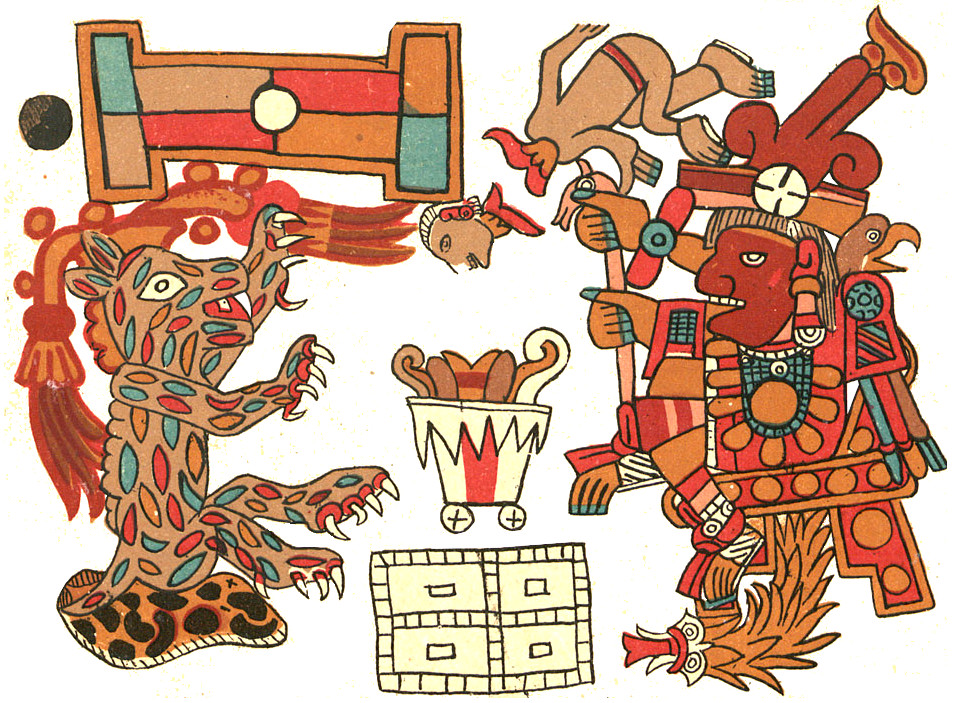
The Yoal version of Xochiquetzal (on the left), like most deities in this tonalamatl, is loaded down with identifying motifs, including the facial tattoos. Here, she’s accompanied by an Underworld centipede under her throne, a libidinous snake looking out from between her thighs, a weirdly colored jaguar in her bustle, an eagle in her headdress, and an exorbitant display of quetzal plumes.
Xochiquetzal’s skirt is a beautiful example of her weaving prowess, and that blue thing in one of her left hands may well be a loom comb, a tool used to move weft yarns into place. That still doesn’t explain a similar (banded) object held by Chalchiuhtlicue in the Yoal Reed trecena, but it’s my best guess. In any event, this goddess is even grander than the Borbonicus image (see below) that inspired my own version.
The surreal deity on the right is not named in Codex Telleriano-Remensis, but in Codex Rios it’s labelled generically as Tezcatlipoca, its obvious nagual status indicated by a smoking mirror in the headdress. The anomalous creature in which the deity is disguised bears no relation to Borgia’s Ixtlilton or to any other known nagual of the Invisible One.
Some scholars suggest that this is a coyote—reflecting Tezcatlipoca’s talent for shape-shifting—like his walk-on appearance as a vulture in the Earthquake trecena. However, while this head might be canine, the ears are totally wrong, as are its eagle talons/claws and feline tail. Then there are those blue things stuck all over it (chips of turquoise or lapis?) which turn it into some mythical jeweled creature. Of course, such scholarly suggestions (like most scholarship) are simply authoritative guesswork, and I don’t require final answers to mysteries.
#
OTHER TONALAMATLS
Tonalamatl Aubin patron panel for Eagle trecena
As a mythical jeweled creature, that in Tonalamatl Aubin sports red, gold, and blue jewels. It’s clearly no coyote, looking more like a jaguar with anatomically proper claws though with too short a tail. Note also the contrast with the true jaguar pelt it sits on. Its sketchy headdress resembles in form that of Borgia’s Ixtlilton, but nothing about it suggests Tezcatlipoca. Just a regular old jeweled critter?
On the right side, an understated Xochiquetzal at least has a fat centipede under her throne and an eagle in her headdress but is sorely lacking in quetzal plumes and imagination in her facial tattoo. Oddly, I think that thing she holds with both hands is an animal-headed digging stick, which doesn’t seem to relate to any of her themes.
The square would seem to be another patolli board, and the ballcourt design in the upper left is a new emblem, reflecting Xochiquetzal’s additional patronage (along with Xochipilli’s) of the sacred ballgame tlachtli. The decapitated individual may indicate the traditional fate of losers at tlachtli. (I’m not aware of her predilection for that style of sacrifice otherwise. However, somewhere long ago I read of a ritual sacrifice to her of a female, the victim’s flayed skin being donned by her priestess. Oh, my, the wild and crazy things goddesses do in the privacy of their temples…)
#
Codex Borbonicus patron panel for Eagle trecena
The image of Xochiquetzal in Codex Borbonicus is one of the most famous in Aztec iconography, obviously a bit more subtle than my old one and not as exuberant as that in Tonalamatl Yoal. But she does have a rather sexy snake. The major item to note is that most of her feathers are red. Deities usually wear green quetzal plumes like those in the topknots here, and the quetzal apparently only has little red feathers on its breast. These big red feathers probably come from the scarlet macaw, a bird sacred to her brother/spouse Xochipilli.
Almost lost among the twenty ritual items, the de-emphasized jeweled beast is still anomalous: coyote-like ears but a jaguar tail and avian claws. Whatever it’s supposed to mean, I guess it does so minimally. The three symbolic motifs we saw in the Aubin panel, the patolli gameboard, beheaded ballgame loser, and schematic ballcourt, are grouped at the top of this panel. In the upper right corner is a reference to Xochiquetzal’s importance as a patron of sex. The couple modestly hidden behind a blanket is the standard symbol of marriage (or intercourse). Seen in the Yoal panel for the Crocodile trecena, it also appears in several other codices.
The other items of the conglom don’t bear discussion, except to note the Borbonicus fondness for scorpions which appear in many of its patron panels.
#
Codex Vaticanus patron panel for Eagle trecena
Once again, Codex Vaticanus closely reflects the elements of Tonalamatl Borgia. This Xochiquetzal again has complex tattoos and an Earth Monster headdress. However, now she clearly dominates the secondary figure of Ixtlilton, that nagual of Tezcatlipoca identified by the Black Water Tlilatl above. The position of his arms akimbo (very like his posture in the Borgia panel) reminds me of the dancing figure in the Borgia Flower trecena whom I took to be his purported brother Five Flower (Macuil Xochitl). That deity, this one, and the Borgia Ixtlilton all have unusual face-paint patterns around their mouths that suggest a brotherly relationship—or at least more identity confusion among the minor-deity crowd.
#
As far as patrons of the Eagle trecena go, these various naguals of Tezcatlipoca don’t seem to contribute much to the trecena’s themes of Supremacy/War and Lofty Vision. Maybe Ixtlilton and the jeweled beast really were included merely to reflect Xochiquetzal’s romantic history with Tezcatlipoca. After all, that would tie in well with her divine sexuality and beauty. Dr. Paquin also suggests that Ixtlilton/Tlaltetecuin (and the jeweled beasts) are acting as cheerleaders for Xochiquetzal, dancing to ward off harmful influences and maintain her high position of supreme strategist in oversight of the game of life-death-resurrection.
###
You can view all the calendar pages I’ve completed up to this point in the Tonalamatl gallery.
Back in 2022, I wrapped up my sixth volume of memoir, GAY GEISHA, calling it quits at the half-way point in my eighty-some years. The first half of my life (1942-1982) was unusual and fascinating enough to recall, but the latter half (1982-2022) is way too boring to bother with.
Besides, all kinds of people have written reams about the plague years and the liberated lives of youths in this new century, and I know very little about either subject anyway. These past two good years of focused artwork are at last leading to completion of my Tonalamatl project and series of trecena blogs, and now I find myself slipping back into memoir mode again.
I recently picked up an old book-awarded memoir by a late gay author and read about his tormented gay life set almost in my timeframe. Suffocated by a suburban, middle-class upbringing and rigid religious environment of elite privilege, the author called his closeted youth an internal exile, imprisonment. This is of course exactly the kind of thing that commercial publishing loves because the righteous straight world thinks we gay folks deserve to agonize.
Dickie with Toy, 1943
Well, the comparison with my own young life couldn’t be sharper. I never lived in a closet—because I grew up “normally” (though saddled at first by an insane religion). When I “came out,” it was a natural evolution, like the metamorphosis of a caterpillar into a butterfly—without guilt or opposition—and my gay environment was truly exciting, picturesque, and historic. Such a story is simply too positive, upbeat, and way too real for commercial publication. Not nearly enough angst.
That’s why I’m slipping back into the memoir frame of mind. We need us a good memoir of growing up normally, of a childhood without precocious agonies of sexual- or gender-identity confusion, without moral or social conflict. I need to write about the mind-boggling innocence of my childhood, dig deeper into the ancient material of MS YVONNE, The Secret Life of My Mother, and mine the primitive Arkansas years of my semi-fictional BAT IN A WHIRLWIND.
Already I’ve written several pages of an illustrated first chapter of KID STUFF called The Id-Kid, planning a clutch of half a dozen or more, and as usual posting each as it’s completed. Please be patient.
Just for reference, my other memoirs are DIVINE DEBAUCH, THERE WAS A SHIP, and LORD WIND. You’ll only find anguish of a sort in THERE WAS A SHIP. They’re all celebrations of gay life and so aren’t commercially attractive. Again, far too little guilt and grief.
The eighteenth trecena (13-day “week”) of the Aztec Tonalpohualli (ceremonial count of days) is called Wind for its first numbered day, which is the 2nd day of the veintena (20-day “month”). In Nahuatl, Wind is Ehecatl. It was known as Ik’ (Wind, Breath, Spirit) in Yucatec Maya, and Iq’ (Strong Wind) in Quiché Maya. The patron of the day Wind is Quetzalcoatl (See Icon #14), also patron of the Jaguar Trecena, and the eponymous wind deity Ehecatl (See Icon #5), the Breath of Life and spirit of the Tree of Life itself, is his principal nagual (manifestation).
PATRON DEITY RULING THE WIND TRECENA
Chantico, the Lady of the House (See Icon #4), is the goddess of fire (both in the home/hearth and in the earth), representing the feminine side of life (cooking, eating, and domesticity), the waters of birth, the fire of spirit, fertility and self-sacrifice. Her consort is variously seen as Xiuhtecuhtli, Lord of Fire and patron of the Snake Trecena, or as Tepeyollotl, Heart of the Mountain, the god of volcanoes (See Icon #17) and a patron of the Deer Trecena.
AUGURIES OF THE WIND TRECENA
By Marguerite Paquin, author of “Manual for the Soul: A Guide to the Energies of Life: How Sacred Mesoamerican Calendrics Reveal Patterns of Destiny” https://whitepuppress.ca/manual-for-the-soul/
Theme: Inspiration, Communication, Necromancy. Traditionally associated with the magical arts, this trecena was used by diviners to select propitious days on which to perform rituals. As Ehecatl represents the divine wind of the spirit, this energy is associated with life, breath, inspiration, and communication, but it can also conjure up storms and bring great change. Under the influence of Chantico, goddess of fire, the Wind trecena can often breathe new life into ideas, and inspire activities aligned with heart-felt communication and the provision of comfort. Use of the magical arts during this period could also help to bring nourishment for the spirit.
Further to how these energies connect with world events, see the Maya Count of Days Horoscope blog at whitepuppress.ca/horoscope/ Look for the Ik’ trecena.
THE 13 NUMBERED DAYS IN THE WIND TRECENA
The Aztec Tonalpohualli, like the ancestral Maya calendar, is counted through the sequence of 20 named days of the agricultural “month” (veintena), of which there are 18 in the solar year. Starting with 1 Wind, it continues the trecena with: 2 House, 3 Lizard, 4 Snake, 5 Death, 6 Deer, 7 Rabbit, 8 Water, 9 Dog, 10 Monkey, 11 Grass, 12 Reed, and 13 Jaguar.
There are two special days in the Wind trecena: One Wind (in Nahuatl Ce Ehecatl) -traditional day for offerings to be made to Quetzalcoatl. The day appropriately introduces a trecena devoted to sorcery and necromancy.
Nine Dog (in Nahuatl Chicnahui Itzcuintli) – the festival day of magicians, perhaps because the patron of the number Nine was the great Quetzalcoatl himself, and Dog (Xolotl) was a divine magician. Significantly, it is also the birth-day-name of Chantico, the trecena’s patron.
THE TONALAMATL (BOOK OF DAYS)
Several of the surviving so-called Aztec codices (some originating from other cultures like the Mixtec) have Tonalamatl sections laying out the trecenas of the Tonalpohualli on separate pages. In Codex Borbonicus and Tonalamatl Aubin, the first two pages are missing; Codex Telleriano-Remensis and Codex Rios are each lacking various pages (fortunately not the same ones); and in Codex Borgia and Codex Vaticanus all 20 pages are extant. (The Tonalpohualli is also presented in a spread-sheet fashion in Codex Borgia, Codex Vaticanus, and Codex Cospi, but that format apparently serves other purposes.)
TONALAMATL BALTHAZAR
As described in my earlier blog The Aztec Calendar – My Obsession, some thirty years ago—on the basis of very limited ethnographic information and iconographic models —I presumed to create my own version of a Tonalamatl, publishing it in 1993 as Celebrate Native America!
At the time, I didn’t know about Chantico’s importance as a volcano goddess, and my version of her is a quintessentially Codex Nuttall matron tending a stylized hearth-fire. I acknowledged her domestic role by including the weaving spindle—a detail far more appropriate for the goddess Tlazolteotl. The golden bird in her headdress is probably completely out of place, but her jaguar-pelt throne is perfectly appropriate for a goddess. In my Icon #4, I posed Chantico in an ornamental house (temple), which must have been aesthetically successful because that was the one icon banner stolen from the last venue of my YE GODS! show.
#
TONALAMATL BORGIA (re-created by Richard Balthazar from Codex Borgia)
Aztec Calendar – Wind Trecena -Tonalamatl Borgia
The Wind Trecena page in Codex Borgia shows Chantico, sometimes called the Lady of Jewels (Lady of Wealth) as ornately adorned with what may be numerous pearls, but there is little else to identify her. Her nose ornament is a little too generic to serve that purpose, and the enigmatic item (inverted pot?) under her throne doesn’t help either.
More to the point, the three ornate symbols in the center of the panel are glyphs illustrating Chantico’s realms of power. At the top center is a burning temple, metaphorical for fire in the earth (volcano), and in the center is the fire in a hearth/container, both with orangish and gray curlicues of flame and smoke. The large conch at bottom center is probably a reverent gesture or reference to Quetzalcoatl on his special day One Wind.
Much more puzzling than the upside-down pot is the emphatic image on the right side of the panel: an inverted person seemingly falling across a mat or piece of fabric, most definitely not dead—which falling headfirst usually signified—and holding bouquets of vegetation and brightly flowering penitential thorns. Not much to go on here for what this apparently important third of the patron panel might mean. The commentary by Bruce Byland in the Diaz & Rodgers restoration of Codex Borgia doesn’t devote even one syllable to this intriguing detail.
#
TONALAMATL YOAL (compiled and re-created by Richard Balthazar on the basis of Codex Telleriano-Remensis and Codex Rios)
Aztec Calendar – Wind Trecena – Tonalamatl Yoal
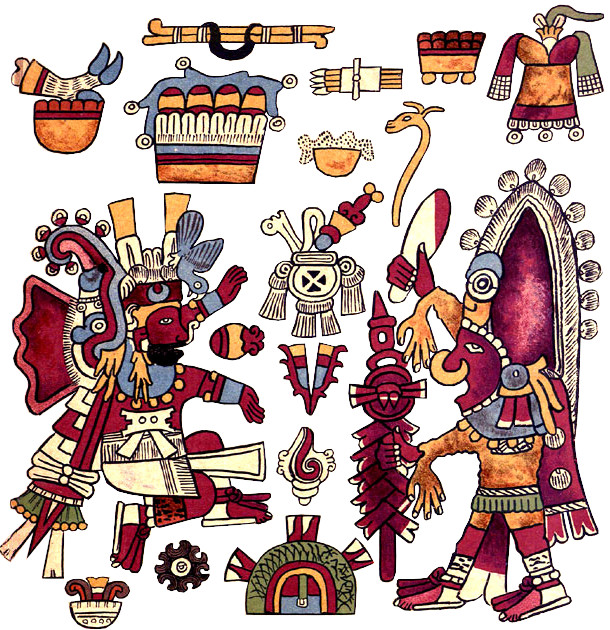
As usual, in its images of deities for the Wind Trecena, Codex Telleriano-Remensis (and consequently Codex Rios) didn’t skimp on displaying emblems, symbols, and traditional regalia, though the codex-artists didn’t always agree on details. The figures recreated here are based mostly on T/R images with occasional minutiae from Rios. Both figures, of course, had to undergo radical orthopedic surgery for iconographic anatomical awkwardness.
In any case, the paired images make a striking combination. Let’s come back later to the guy on the right and scope out the divine Chantico on the left. Would you look at that headdress! A dark-feathered and be-sea-shelled crest of quetzal plumes pours forth streams of fire and water, creating an elegant atl-tlachinolli (water-fire) glyph—as discussed in the Snake Trecena—usuallya symbol of war, but here I think it represents the waters of birth and fire of spirit, attributes of the goddess. Her facial markings and matching ear- and nose-pieces are unusual, but the most disturbing (and unique) detail is her set of Tlaloc-like fangs. How does one fit that sinister motif into Chantico’s official hagiography?
Now we can check out the guy on the right, a figure most unusually in a decorative frame. The little day-sign attached to the back of his head is One Reed—which was used in the Snake Trecena to identify Tlahuizcalpantecuhtli, a nagual of Quetzalcoatl. However, this seems to be Quetzalcoatl himself, probably in honor of his One Wind Festival. Strong evidence is the circular pendant, serpent accessories, black body, and tri-colored face. In fact, Quetzalcoatl was known as One Reed in central Mexico from the ancient Toltec tradition (and in more southerly areas with even older Maya traditions as Nine Wind).
The notations on the T/R and Rios pages (in Spanish and Italian) clearly name the guy Quetzalcoatl but only comment on the frame as his casa de oro. But there’s no way the little falling guy in Borgia can be construed as the great god Quetzalcoatl nor can that decorative mat compare to this deity’s golden house. Whatever Borgia meant by that strange scene may have been used by the T/R artist as an excuse to celebrate Quetzalcoatl as a star of the trecena.
#
OTHER TONALAMATLS
Tonalamatl Aubin patron panel for Wind trecena
The patron panel in Tonalamatl Aubin merely complicates the situation, presenting an upright little guy with bouquets and without any emblems of Quetzalcoatl—though now in a casa de oro. That motif may bode a deeper significance than even Borgia’s fancy mat. Thinking at first that Yoal’s One Reed glyph might in fact identify Tlahuizcalpantecuhtli, I wondered if maybe the casa de oro could represent the House of the Dawn. That motif also has a connection to Quetzalcoatl as the planet Venus, but I know of no connection between Chantico and dawn. The matter of the little guy remains mysterious.
The hearth fire at the top center is of course symbolic of Chantico, whose plumed headdress is similar to that worn by both figures in the Yoal panel. Her atl-tlachinolli glyph and skull-bustle are repeated here, but the conch over her head seems damaged. The big serpent under her throne must symbolize emphatic sexuality, but I can’t explain the pile of something or other pierced by penitential thorns. The central offering bowl seems rather pitiful, as do the grotesque hands and feet on both figures. Overall, this patron panel isn’t particularly inspiring.
#
Codex Borbonicus patron panel for Wind trecena
On the other hand, the patron panel from Codex Borbonicus is enchantingly ornate. It presents another casa de oro on the left with a common mortal who carries a standard bouquet/weapon and incense bag but again wears the Yoal-style plumed headdress. He does nothing to clarify the mystery. On the right, Chantico sports great bunches of quetzal plumes, another dramatic atl-tlachinolli glyph, and under her throne familiar plumed tassels with seashells. Her unusual sitting posture (hovering above instead of in front of the throne) may be intended to add to her ethereal/divine presence. That nose-clamp looks painful.
The scattered conglom of ritual items raises several questions. Starting in the upper left, what’s the significance of the day-sign One Crocodile (first day of the tonalpohualli)? Or of the standard-design rock/stone. No idea… Top center may be a glyphic hearth-fire. On the lower left seems to be an incense burner, but the leafy swatches beside it are inscrutable. The mounded item just above may be a metaphor for fire in the earth (volcano) and could relate to Aubin’s pile of something or other. But most iconic is the little frilled circle in the center with a star or divine eye in the middle. A traditional symbol of magic or sorcery, it’s the only reference in these patron panels to this trecena’s theme of necromancy.
#
Codex Vaticanus patron panel for Wind trecena
The patron panel from Codex Vaticanus again repeats the inventory of motifs from Borgia, including burning temple, hearth-fire, and conch. But it deepens the mystery of what the little guy represents. Here, he’s a blue figure (possibly a corpse?) in what looks like a box rather than on a mat or in a casa de oro. Still no answers… Apart from her fancy skirt, cape, and body-tattoos, Chantico is pretty plain. Her sitting with feet forward is most unusual, and the confusion of her arms detracts from any divine magnificence.
#
My ancient intuition about Chantico was apparently right on making her a normal, stylish woman. Appropriately, some patron panels give her dramatic emblems I didn’t know about like plumed headdress, fire-water glyph, and power symbols of hearth-fires and volcanoes. While her Borgia portrait is glamorous, her image in Yoal is more ornamental than most calendrical deities in that tonalamatl. Her pairing with the cameo of Quetzalcoatl makes one of the more exquisite Yoal panels, but we can’t take that to mean that he’s also a patron of the trecena. This guy One Reed seems more like a Master of Ceremonies for the magicians’ fiesta week. Maybe the strange little guys in the other tonalamatls are sorcerer-performers.
###
You can view all the calendar pages I’ve completed up to this point in the Tonalamatl gallery.