Stone Age Gay History

It’s always bittersweet to gaze down the deep well of the past and spy ancient moments still fresh and vivid after many decades. That happened just now as I started reading a book by Jim Downs called “STAND BY ME, The Forgotten History of Gay Liberation,” Basic Books, 2016.

So far I’ve read only up to page 7 of the Introduction. In those first pages I was touched that a guy probably born around 1980 found it important in 2005 to research gay history from the 70’s—and amused how the author considered that decade “ancient” gay history.  Taking that view, I guess I came out in the Stone Age (1961).

In the next couple pages Downs immediately placed the libertine gay lifestyle of the 70’s in the context of the ensuing plague of the 80’s. My memories of the 70’s aren’t distorted by knowing what was to come.  I saw a future promising ever more joyful liberation.

My experience of that decade was hardly as wild—or sordid—as what the author read about, largely in New York. In DC where I lived, things were more civilized:  We lived exactly the kind of gay culture and community that Downs will probably describe in pages to come.  He wrote, “I wanted to show how the 1970s was more than a night in a bathhouse.” So I look forward to reading his view of the history I lived.

He included New Orleans in his research, which pleased me much, and after another paragraph hit me over the head with “the fire in New Orleans that killed 32 people on June 24, 1973.” I then noted that the Up Stairs Lounge is to be the subject of Chapter I:  The Largest Massacre of Gay People in American History.  Tragically, scarcely a year after his book came out, that was no longer true.  There was that horrific slaughter at the Pulse nightclub in Orlando.

I haven’t yet read beyond that mention of the Up Stairs Lounge because I’ve found myself once again staring down that well. Living in New Orleans in 1972, I hung out in the Up Stairs Lounge, but a year before the atrocity, I moved to DC…  I’m almost afraid to read Chapter I.

Already on page two, Downs had remarked that “…gay people across the country had a responsibility to document the past and to tell our own history.” For more than 30 years I’ve taken that responsibility quite seriously in two novels.  First drafted in 1985, one was rewritten a number of times and eventually became “Bat in a Whirlwind.”  About an unconsciously gay teenager in the backwoods in the 50’s, you might say it was set in the Jurassic era of gay history.

My second novel, “Divine Debauch,” is about the gay Stone Age, that decade before Stonewall, in the fairyland of the French Quarter. There was definitely some gay history going on even then.  I’m a veteran victim of the infamous raid on the Quorum Club in June, 1964.  Just like the episode in my recent post “Got Laid,” I marginally fictionalized that raid in the novel.

Briefly, my Quorum experience happened like this: A female friend Linda and I shared a horoscope, and that day in the newspaper we were stringently warned to stay at home.  We usually went out dancing in La Casa de los Marinos but decided to do as we were told and sat around my apartment listening to records and reading.

Getting rather bored later that evening, Linda convinced me to walk her over to the Quorum Club on Esplanade to look for our friend Gia. The club was a small, low-key coffee-house which scandalously also served black folks.  As a matter of fact, that evening a black musician named Babe Stovall was playing on his guitar.

Because of defying our horoscope, Linda and I walked in a bit apprehensively and looked around for Gia. She wasn’t there, but a (black) friend of mine mentioned that she might be upstairs at George’s party.  So we trudged up the stairs and mingled our way through those also racially mixed festivities without finding our friend.

We were standing out on the rear balcony when folks in the front room started yelling, “Police!” I made to escape by climbing down into the neighbor’s patio, but Linda was too scared.  So I gallantly stayed with her, and we nervously awaited our fate.

The cops herded us all out of the apartment (past poor George lying on the carpet with blood all over his face) and downstairs to the Club, where they separated the men and women and loaded about 75 of us into various paddy-wagons. At the jail they put the sexes and races into separate cells, whites on one side of the aisle and blacks on the other.

In my white guys’ cell I got into a bridge game with some others, including a drug dealer who was awaiting transfer to Leavenworth. Meanwhile, the girls started singing “We Shall Overcome!” and the black guys all stripped butt-naked and started swinging on the bars.

The cops kept yelling at us to shut up, to no avail, and then with a fire hose they washed us up against the bars. That ruined our bridge game and swept away most of the black guys’ clothes.  The pile of glistening black bodies was better than a wet dream.

Finally they let us each make our one phone call. I called my apartment and asked my lover Eric to get my stash of money and come bail us out.  When he got there, he said, “I can’t believe you hide your money in your bedpost!”

The next day the story was on the front page of the newspaper. It began:  “Last night the New Orleans Police raided a noted center of communist, homosexual, integrationist activity…” and reported that we were ridiculously charged with “being loud and boisterous.”  Ironically, at the time I was a student (and teacher) of Russian at Tulane, and so the cops figured me for the translator for the local communist cell.

For the next couple weeks till our hearing I lived under police surveillance as a suspected commie. They apparently didn’t care that I was a flaming faggot.  Cop cars tailed me down the streets of the Quarter, but I’d walk on the wrong-way streets to evade them.  And they didn’t dare follow me into my sailor dives on the “Wild Side” of Decatur Street.

Just before our hearing, miraculously, the Civil Rights Act passed, and the DA Jim Garrison (remember him?), quickly got the charges against us dropped. Apropos of Jim Garrison, in the summer of 1963 when my then lover Alphonse got thrown in jail, I had to call up his father’s friend Clay Shaw to spring him from the clink.  That was only about three months before the Kennedy assassination, another of my close brushes with fame, or infamy as the case may be.

While maybe not strictly gay history, this tale was definitely the historical experience of a gay boy in the Stone Age. You’ll find another, the story of my getting finessed back into the closet, in my first memoir “There Was a Ship.”  The second, set in the fabled 70’s, will be the story of my second coming-out into that newly liberated world.

I guess I’m now ready to read on in Jim Downs’ history book.

Got Laid

My new online friend Walter recently posted about his basically traumatic “coming out” experience and made me realize that I had sunken that piece of my history in my novel and memoir, which so few folks will ever read. So I’m going to follow his suit and give you the following brief narrative of my deflowering.

GOT LAID

            In the upside down year of 1961, there I was:  19 years young and a student at wonderful Tulane University in incredible New Orleans, but—to my immense regret—with my cherry still intact.  In fact, my cherry was not only intact but immaculate and overly ripe.  I was getting sick and tired of the whole boring condition.

During my freshman year I’d gotten to know a guy down the hall in my dorm.  David was a good-looking blond kid from Houston, who let me in on the secret that he was “gay” and introduced me to his lover Paul, a florist.  Once they invited me to dinner at Paul’s apartment in the Garden District along with some other gay guys.  They all seemed so normal except for calling each other ‘dear’ and ‘sweetheart’ a lot.

The concept of two guys loving each other was utterly new to me, though not particularly disturbing.  Telling myself to be open-minded about it, I recalled the confusing love I’d felt for my best friend in high school.  After the party, reasoning it through as logically as I could, I came to the inescapable conclusion that I too must be gay.  Suddenly I appreciated all the cute guys around campus with different eyes.

After some months of waiting impatiently for true love to find me, my newly awakened longings soon became torments. Soon, I told myself, soon I will meet a beautiful boy, fall in love, and kiss him. The fantasy played like a rock and roll romance.  Many were the imagined scenarios I spun around naked guys in the showers and infatuations with angelic classmates, but all spring semester and into summer school, no beautiful boy ever showed up to love me.

One Wednesday evening late in sweltering June, I went with my roommate Roger and a couple other dorm guys to see Ingmar Bergman’s movie “Virgin Spring.”  It was traumatic for a sensitive college student like me, and the brutal images of the rape of that young girl haunted me on the sidewalk back to our dorm.  My friends were all quiet too.  Riding up in the elevator with them, I finally decided emphatically that I didn’t want to be a virgin anymore.

Once back in our double dorm room, Roger immediately went about his mathematical studies, which consisted of playing solitaire.  I showered, shaved, and put on my green corduroy jeans and fancy blue nylon shirt.  This was as fashionable as a country boy could manage.  Without looking up from his cards, Roger asked, “Got a date?”

“Maybe,” I replied mysteriously and left.

I already knew where to meet somebody.  David and Paul had once taken me into the wicked French Quarter to a dark little bar on St. Peter St. called the Gaslight Inn.  (One of the most marvelous things about New Orleans back then was that the legal drinking age was 18!)  So I hopped on the Freret bus to Canal Street, intent on finding a guy to cure my acute virginity problem.  Walking into the Quarter down noisy Bourbon Street through the jostling crowds and ignoring brief glimpses of bare, gyrating dancers in the strip joints, I felt my whole world turning upside down.  I was stepping off into the unknown, and it was exhilarating.

The Gaslight Inn was nestled right next door to the bustling collegiate bar Pat O’Brien’s.  When there before with David and Paul, I was nervous at first, but it turned out to be not at all intimidating.  The strangest thing had been a Hawaiian boy called Pineapple, who looked and talked just like a girl.  After a moment’s trepidation, I walked alone into the bar.

It was dark and full of smoke with men milling about.  No Pineapple.  How very dashing I felt walking right up to the bar and ordering a vodka and tonic.  Without looking directly at anyone, I took my drink over to a stool along the wall under the window—with no idea of what to do next.  Even though I was a nice looking kid with a good build and big blue eyes, no one seemed to be paying any attention to me.

Maybe I should just watch for someone attractive, I reasoned, and go up and introduce myself. No, that’s too forward—and too embarrassing.  It’s not very easy to see anyone in the dimness anyway.  By the time I’d finished my drink, my courage was definitely flagging, and I thought sadly of heading on back home to the dorm.

“Need another drink?” a voice asked from my blind side.  I turned to find a young man in the shadows, smiling at me.  “What was it?” the fellow asked, taking my glass.

“Vodka and tonic,” I managed to remember.  He went off to the bar before I could really make out what he looked like. Probably just a waiter pushing drinks, I figured.

Soon he returned with a drink in each hand.  Apparently he wasn’t a waiter.  Now I could see that he was pleasantly good looking, with dark hair in a crew cut.  After a polite thanks for the drink, I hadn’t a clue what to say.

In my silence, he said, “My name is Harry.”

Actually, I hadn’t thought about having to identify myself.  Not to give out my name in a gay bar, I lied, “I’m Roger.”  Meanwhile, I looked Harry over some more:  fairly tall, grey-green eyes, older—at least in his mid-20’s.  My next lie was that I was visiting my aunt here in New Orleans and lived out in the woods in Mississippi.  With that basic adjustment, I told him about things from back when I was a kid in Arkansas.  Harry told me he worked in an insurance office and used to live in Pensacola on the beach.

At his insistence, we each had another drink.  I was already feeling a buzz.  We engaged in further pleasant conversation, but it didn’t look to me like Harry was interested in me romantically.  And while I liked his company, there wasn’t that crazy kind of desire I’d felt for certain gorgeous guys at school.  I started to feel a little put out.  All this talking had kept me from watching out for a pretty boy.  I began to have more disconsolate thoughts about going home. Can’t catch a fish every time you go fishing.

Then Harry asked, “Can I take you home with me, Roger?”

Taken aback by the strange name and surprised to have come so suddenly upon this Rubicon, I forced back the fear and said, “Yeah, that would be nice.”

“Then let’s go!” Harry left his half-finished drink on the windowsill and pulled me by the hand.  I followed him out the door onto crowded St. Peter, not even checking if anybody at Pat O’Brien’s might have seen me coming out of that shady little place.

#

            Amidst the slumber of the late-night city, all was quiet, candlelit amber and cool in Harry’s apartment at the Claiborne Towers.  The room was full of plants with only a low light in one corner.  I lay naked on the sheets beside Harry, by no means asleep.  He was definitely dozing, draped over my arm.  I couldn’t fall asleep because I felt I really had to go home to the dorm—it must have been 3 or 4 o’clock, but I had no desire to move.  The warmth of Harry touching my shoulder and thigh was so new and delicious.  Finally, I’d tasted a man’s body, smelled his cinnamon fragrance, and it was far better than I could ever have imagined.

It had been nothing at all like the struggle and violence in that disturbing movie.  Funny how easy everything was when I’d worried so much about what to do.  Like a bumpkin at a banquet, I’d simply done whatever Harry did—which meant a lot of incredible caresses on tender, secret places I’d never touched before.  All that symmetry naturally led to the infamous sixty-nine position.  I must have done it right because we came together, and I didn’t even choke.  Stunning, the sheer reality of sucking on a guy’s cock.

I was glad, too, that there hadn’t been any kissing. Kissing is something for being in love, I figured, and all this with Harry was simply sex.  Still, he’d been tender, and so I was too.  Now I felt so amazingly happy having this wonderful connection with another guy and holding him close.  After a bit, Harry awoke, and I said, “I’ve got to go home.  My aunt expects me back.”

Harry didn’t protest, probably used to strange boys leaving in the night.  I got up on the window side of the bed.  The man still lay there, lithe in the shadows and amber light, the plants vague, soft masses of light and dark around him.  There was a tiny glint in his eye as I stood there naked—oddly without shyness.  “Roger, you sure are hot!” he sighed.

Embarrassed by his compliment, I dressed while Harry watched me from the bed with appreciative smiles.  I wondered about telling him that this was my very first time.  Tying my second shoe, I decided not to. Better just a pleasant goodbye, I decided, and drift out into the night like all the other boys who must have been hot in his bed before me.

While Harry still lay there naked, I gave him a friendly handshake and let myself out the door.  Out in the hallway, I chortled to myself, Well, that was that—another virginity nicely disposed of in the Claiborne Towers.

After Harry’s great air-conditioning, outside on the street the New Orleans night startled me with its sultriness.  On the empty early-morning bus I dozed contentedly in the heat until my stop at school.  Only when stumbling down McAlister Drive did the full import of it strike me right between the eyes with a blow of wonder and happiness. No longer a virgin! I rejoiced.  That painful, troublesome barrier is now behind me!”

As I tiptoed into our dorm room, the real Roger rolled over on his side in his narrow bed, waking enough to mumble, “What you been doing?”

Walking out of my clothes on the way from the door, I answered, “Got laid.”  Then I crawled into the sack, and there wasn’t another peep from the miserable virgin.

I never saw Harry again, nor did I ever go back to the Gaslight Inn—largely because it closed down soon after.  Instead I went out to Dixie’s Bar of Music on the opposite corner of Bourbon and St. Peter or hung out in the Latin and Greek sailor dives on Decatur Street, where my carousing was a depraved combination of Fellini’s movie “La Dolce Vita” and the novels of Jean Genet.

###

Aztec Icon #15 – QUIAHUITL, God of Rain

I’ve just checked the date when I posted Icon #14, Quetzalcoatl, for my serialized coloring book YE GODS! and must hang my head in shame that it’s taken me nearly six months to finish Icon #15, Quiahuitl, God of Rain. I understand that nobody out there has been waiting with baited breath to see my latest work of genius, but I managed to draw the earlier deities much more quickly, 14 of them in 3 ½ years.  My excuses are that this past winter I spent a lot of time on my second memoir, and for what it’s worth, this icon turned out to be just about as detailed as Icon #11, Ocelotl (Jaguar).  There’s a lot going on in it.

Quiahuitl, God of Rain

This icon is available as 8X10 with a caption/sources page by clicking here.

In the central image, Quiahuitl {kee-a-hweetł} is shown emerging from the Underworld, rising up out of the maw of the Earth Monster.  The Aztecs understood that moisture mysteriously rises from the earth to the sky (the crest across the top), where the god turns it into rain.  Every locale had its own Quiahuitl to conjure and appease, as indicated by drops falling on trees which symbolize the cardinal directions.

Quiahuitl is of crucial importance to the cultivation of maize, and the lower panel is a homage to that crop. In the center, the plant grows out of another Earth Monster, and on it perches a mythical bird, which is actually a motif inherited from the ancient Maya, Itzamnaaj—the Bird of the Sun.  Just above it is another nod to the Maya, the head of a centipede which they saw as the face of the Underworld.  On the left is Chicomecoatl (Seven Snake), chief of the several goddesses of maize, and on the right is Centeotl, the main god of maize.

But that’s not all. The four big dots indicate that the god is also a day-sign in the ritual calendar, Four Rain (Nahui Quiahuitl).  You’ve already seen the same thing in the icons of Four Water, Four Wind, and Four Jaguar.  I haven’t yet made it alphabetically to the god Tonatiuh and Four Earthquake, the Fifth Sun, our current era.

Anyway, Four Rain is the day-name of the earlier Third Sun (era), a paradise ruled by the Storm God Tlaloc. However, when Tezcatlipoca abducted his wife Xochiquetzal, Tlaloc destroyed that world in a rain of fire.  Its poor humans were turned into butterflies, birds, dogs, and turkeys—which I rather doubt was a great deal of help in the rain of fire.

As I said before, there’s a lot going on in this icon, and there were times I wondered if I was ever going to complete it. Besides, all these past months we’ve been suffering severe drought, and I started to fear it was because I hadn’t finished the god’s icon.  Well, I finally did it last night—and it still hasn’t rained!  I’ve done what I could…

This morning I fired #15 off to my digital wizard in Bangladesh to be turned into a vector drawing, which will be added to the coloring book page.  Then it will follow the other 14 to my print shop. At Santa Fe Signs & Images, they’re being printed on 3’ x 4’ vinyl banners for my upcoming exhibition.

NEWS FLASH!

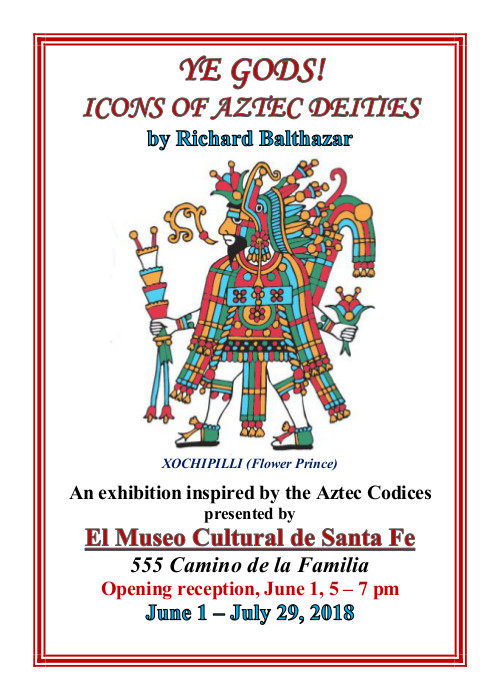
I’ve recently arranged to have a show of my coloring book pages to be called YE GODS! Icons of Aztec Deities.  It will be at El Museo Cultural de Santa Fe, opening June 1, 2018 and running through July 29.  There’s much to be done in preparation, of course, and I’ve at least gotten calendar listings out to the media.

Now come the million details, and I seriously doubt that I’ll even get started on Icon #16, Tecciztecatl, God of the Moon, till later in the summer. According to the original project plan, I’ve still got 11 icons to go, which at this rate will take a minimum of three more years, maybe four.  What the hell!  I’ll only be 80!

###

Ancestors, Level 1, My Parents

To explain: I’ve just enjoyed a new contact with a young man in Miami about my image of the Aztec deity Xochipilli, who appears (above) on the masthead of my webpages and blogs. As the god of homosexuals (and a whole lot more), the Prince of Flowers has long been my patron. Unfortunately, he sits down by the end of the alphabet (with the other x’s), and it’ll be a couple years till I get around to doing his icon for my coloring book YE GODS!

My new friend Walter identifies as a pagan and practitioner of the Unnamed Path, which sounds quite like mine, though I didn’t think to name my path. We’re both on the beautiful paths (as the Navajo would say, walking in beauty) for men who love men. You can find Walter on his splendid path at http://sacredbonfire.com.  Meanwhile, as a headline on his emails, he includes, “The ancestors are speaking. Are you listening?”

Struck by that profound question, I realized that for a long time that I’ve been dancing around the urge to blog about my ancestors. So far I haven’t written much about them, except in that biography: “Ms Yvonne, The Secret Life of My Mother.” I was too focused on my own terribly fascinating self to pay any attention to the sources of my miraculous being.

Understandably, in researching the biography, I learned a great deal about my parents, as well as about my roots in the generations before them. In that writing, I organized the boxes of old family photographs and in the process quickly became an expert photo-restorer. The art is very like painting, just as aesthetically fulfilling, and playing with pixels to reconstruct an ancestor’s face creates intense emotional connections with the subject, let me tell you. Suffice it to say, I now have plenty photo-paintings to illustrate blogs about several levels of my ancestry.

Naturally, we’ll start at level 1 with my parents, who were people I’d never really known before that research and restoration of their images. I was simply a kid, and they were folks who took care of me. There was no discussion of who they were then or in their pasts, and the oblivious child never even wondered, too busy wondering who I was.

My mother, Yvonne Marie Trinité, was born on January 18, 1919 in Baltimore, Maryland. I discovered that she was quite a fashionable young woman in the thirties who led a nicely sociable life with a number of boyfriends. When she was nineteen, in 1938, a beau took her boating on the Chesapeake and snapped a tiny shot of a virtual goddess of the sea. Retrieving it from a miniature print (1 sq. in) in a foggy blur, I’ve put it up on my refrigerator where I can thank her every morning for solving my life.

Yvonne by the sea, 1938

Meanwhile, over in Wisconsin my future father, Raymond John Balthazor, was born on January 30, 1916 in the village of Bear Creek, and the family soon moved to the big city of Fond du Lac. In school he came down with scarlet fever, an often fatal disease from which he recovered—but with a damaged heart. In 1939, after taking courses at a business college, Ray landed a job with Social Security in Baltimore and had a (retouched) portrait taken for the announcement in the Fond du Lac newspaper. He was a good-looking young man of twenty-three.

Ray, 1939

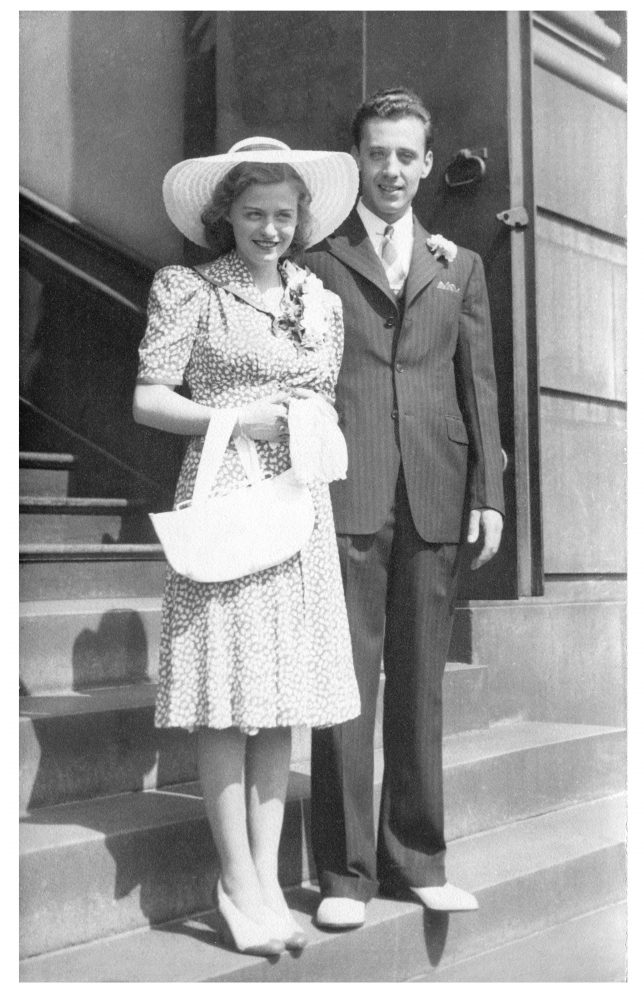
That’s why Ray and Yvonne met, but further details of their romance are unavailable. They were married on Wednesday, June 19, 1940, both dressed up in the high style of the period:

Wedding of Yvonne and Ray, 1940

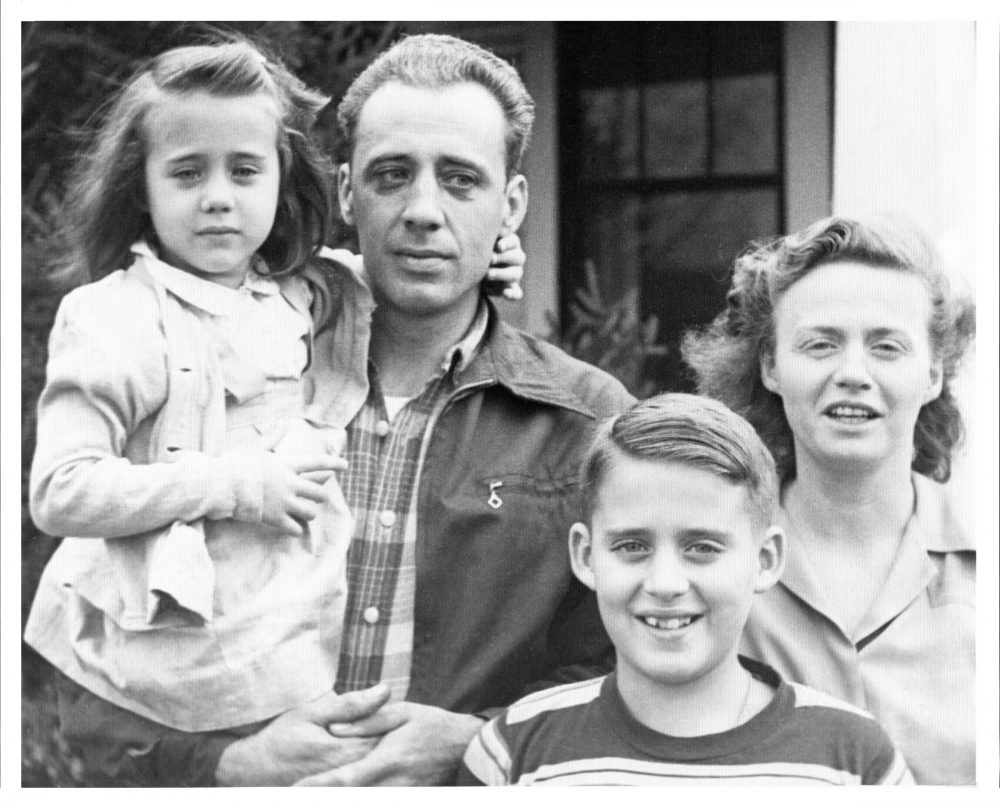
True to form, kids came along, first me in 1942 and then my sister Judy in 1947. In 1952 the family moved to LaMarque, Texas for Daddy’s job as a tax accountant in a chemical plant. When we’d moved into our new house, a neighbor took a picture of us for posterity. Notice that at 36 Daddy was already going grey:

The Balthazors in LaMarque, 1952

For two years in Texas we had a fairly normal nuclear family life, but then in 1954 Daddy took us off into the woods of Arkansas to a truck-stop café on Highway 74. Thereafter, our familial relations essentially disintegrated, but that’s another story I’ve reflected in my autobiographical novella “Bat in a Whirlwind.” After I left home for college at eighteen in 1960, Daddy only lived another six years, dying of heart problems at only 50.

In 1971, after five years of widowhood, at 52 Mother married a Texan named Bill Tapp, but only a year later was abandoned by that husband. Afterward, she enjoyed single life in New Orleans for another 42 years, her favorite activity being square-dancing. Yvonne’s really big adventure was surviving Hurricane Katrina in 2005. She kept on square-dancing right up to 93, as in this 2011 snapshot by a dancer friend when she was 92. In early 2013 Yvonne died peacefully at 94.

Yvonne at 92, 2011

###

Ancient Coin Found in Ann Arbor MI

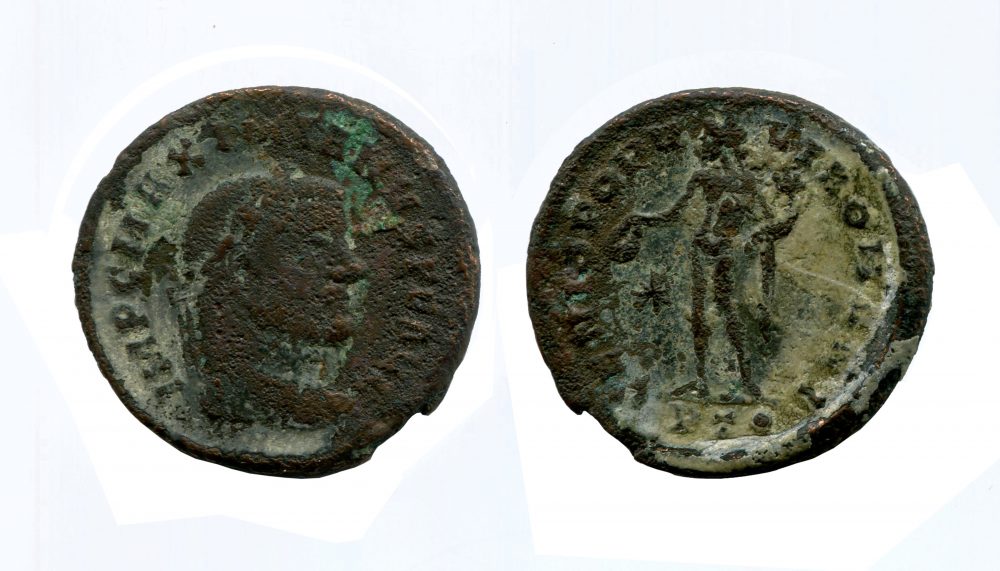
While a grad student at the University of Michigan, in the summer of 1967 I moved with my young family into a new subdivision on a sloping street in Ann Arbor. Perched on the gentle slope on a pad levelled by a slight scraping into the rise behind, the house backed up to the low, rounded crown of the hill overgrown with brush and bushes.  I immediately planted some flowers in the strip of freshly disturbed soil between the house and the newly laid sidewalk.  In my digging, I came upon an obviously ancient, apparently bronze coin.  I washed the loose soil off of it but didn’t disturb the lighter-colored material encrusting about 75% of the piece.


The coin notably measures precisely 1 inch in diameter. At first I put the coin in with other keepsakes and then some decades ago placed it in a small plastic bag with a note of where it was found.  For the past 50 years it has been only very minimally handled and shown to just a few friends as the one true mystery in my life.

In past years I occasionally read about Roman coins being found around the American Midwest, mostly along major river valleys, and marveled that I too had found one. Mine was found in the low hills of southern Michigan but not far from the Huron River.  Reading more recently about mounting evidence for a Roman presence in pre-Columbian America, I tried to identify my coin by researching the databases of the American Numismatic Society but was overwhelmed by their 42,000 + examples of Roman coinage.

After inspecting only a couple thousand of the coins in their collection, I noted that in the mostly illegible legends on mine the “IMP” on the obverse is standard for “Emperor.” Meanwhile, I found no portraits resembling the head, none with that tassel or braid at the back of the head, and none with that decidedly un-Roman nose.  On the reverse, the standing figure differs in posture from more usual standing figures of Apollo and holds something like a bag in the right hand and possibly a floral bundle in the left arm.  Also, the legend or symbols uniquely continue beneath the figure’s feet, and a strange rayed symbol peeks through the encrustation by the knee.

I’m sending this description and image to the following authorities in hopes:

1) that the American Numismatics Society will authoritatively identify this coin;

2) that the Kelsey Museum of Archaeology will advise on appropriate steps for analysis and conservation and suggest means for further research at the discovery site;

3) that the Historical Society of Michigan will advise me of similar or related finds in the state and suggest an appropriate repository for the artifact; and

4) that the City of Ann Arbor will facilitate any further research at the discovery site and any publicity that might follow.

Meanwhile, I’m posting this letter on my website www.richardbalthazar.com and requesting similar input from the Internet world at large.  Please email me at rbalthazar @ msn.com.  I will incorporate any responses in more web postings and plan to publish an article on the artifact in the magazine “Ancient American.”

About the discovery site, I researched my old address on Google Earth and found the house still there. The low hill behind is still undeveloped after these 50 years and covered with large trees.  After some decades of researching Indian mounds (and publishing the book “Remember Native America, The Earthworks of Ancient America”), I reasonably suspect that the hilltop could well be a mound containing far more prehistoric material than a single coin.


Our Exploitative Healthcare System

My first inclination was to write a letter to my doctor (probably a capable, dedicated, and intelligent man), calling a spade a spade, but then I reconsidered. No matter his many sterling qualities, my doctor is by definition a part of, or at least an accomplice in, the situation.  My rant would surely fall on deaf ears.  Instead, I’ll broadcast my cynical remarks here on my virtually unread blog, where at least someone might hear my voice crying in the wilderness.

Late last week I got a second attack of gout in my right big toe, a stereotypical condition surrounded by a great deal of mythology, rumor, and medical lore. A close friend with the same problem in the same place advised that his VA doctor had prescribed him a generic drug called Allopurinol which costs only $5 a bottle.  He reported that one tablet generally relieves the condition immediately and recommended that I get a prescription for it too.  Or he’d be happy to give me a pill or two out of his stash.

Trying to play the medical game by its rules, yesterday I called to ask my doctor (with whom I’d already discussed the first attack) to issue a prescription for the miracle pill, but he was away for the week, and though this second attack was sure to fade within a few days, I left a message with full details of the VA doctor and the friend’s experience.

My call was returned by a registered nurse who advised that they wouldn’t write the prescription unless I came in for an examination. The sub-text of her response came in loud and clear:  “We won’t do anything unless we add our own bill to the cost of the prescription.”

When I advised that in that case, I would go ahead and borrow pills from my friend, the nurse got uptight, sternly admonishing me not to take anyone else’s medication. I asked why—since it had been prescribed by a “real” doctor and was very effective for the same problem.

The nurse dithered about how there “could be” horrible interactions with my blood pressure medication, citing “studies” of that specific combination of medications (which I find highly unlikely), but offering no specifics of such interactions or statistics. What I heard was “Be afraid!  Avoid the slightest, even infinitesimal danger!”  (Frankly, every time I get into my car, I’m conscious of putting myself in a position of extreme danger.  Every time I walk out my front door…  Every time I get out of bed in the morning…  By definition, life is unsafe.)

I advised that I’ve now (with my doctor’s agreement and under his supervision) almost completely weaned my system from that poisonous blood pressure pill, so the danger of any interaction is probably even less than negligible. (I’m now down to 1/8 of the low dosage originally prescribed years ago by a nurse-practitioner for only slightly elevated readings, which have never improved or gotten any worse.  Even at the time, I understood that it was her professional duty simply to enroll me as a regular contributor to the pharmaceutical industry.)

The nurse responded that nevertheless I was still on the medication and should be very afraid. Ratcheting up the pressure to an almost hysterical level, she gratuitously added that some interactions could even be fatal.  Again there were no specifics or statistics, just alarmist jargon.  Recognizing this tactic as standard practice in our current culture of fear, I noted that over-the-counter herbal supplements, while much less effective than Allopurinol, are widely available, but there are such studies or warnings about them.

Ignoring those unprofessional remedies (at higher cost than Allopurinol with sales income not accruing to the pharmaceutical industry), she again urged me to “make an appointment” (i.e., make an extra payment to them) to talk about treatment and a prescription. I advised that I wouldn’t waste either their or my limited time on the issue of taking a single pill of proven effectiveness for a common, otherwise pharmaceutically untreatable, condition.

She countered with an irritated threat “to tell on me” by writing up our conversation for my doctor. I told the nurse to feel free to do so, just as I felt free to call my friend for some of his pills.  When we ended the call, her frustration was palpable.  She’d missed a possible sale!

When I rang up my friend right afterwards, he wasn’t home, and so I figured I’d call him today. When I got up this morning, the gout was gone, so the entire charade was moot.

However, the charade was a dramatic illustration of the basic problem with our healthcare industry. Like other for-profit businesses, healthcare providers’ real purpose is to generate sales, not service.  Aided by the FDA, they collude with the pharmaceutical industry to “hook” people on their monopolistic products.  (Witness the current opioid epidemic.)  And both collude with the insurance industry (the stock in trade of which is fear), to kick back to each other on their sales and ultimately inflate costs to the consumer/patient.

This unholy trinity has our economy by the throat. In the name of public benefit, they exploit the population for private gain, just as other industries exploit our natural resources (the public’s treasures) for private gain.  The fatal flaw in our government and economic system is that private enterprise is inimical to public benefit.  But I’ve already ranted about that in an earlier blog  or two.

Would anyone care to try and disabuse me of these dire and hopeless notions?

#

Aztec Gods of the Directions

When they founded Tenochtitlan c. 1325 CE, the Aztec barbarians adopted the traditional Mesoamerican temporal and spatial concepts of ceremonial calendar and cardinal directions.

The 260-day Aztec Turquoise Year or tonalpohualli (ceremonial count of days) is based on 20 numbered sets of 13 called trecenas, through which the 20 named days of the solar month are counted cyclically. That’s about as clearly as I can describe it. Some of the few surviving codices (ancient documents) include individual pages of the trecenas with their patron deities.

Some codices also have pages with the 260 days laid out in spreadsheet fashion with five rows of 52 columns in four sets of 13, Here’s a sample section from Codex Vaticanus laying out the first set of 13 columns (trecenas 1, 5, 9, 13 and 17):

vaticanus first section

First Section of Spreadsheet Calendar, Codex Vaticanus

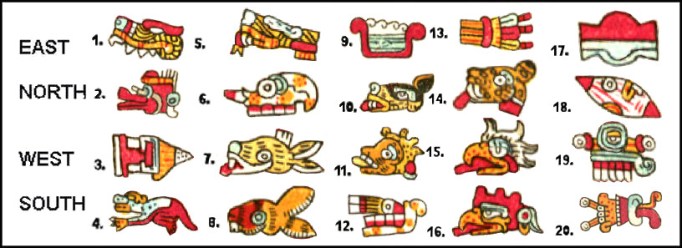
One reads left to right starting with day One Crocodile on the bottom row at lower left; after counting the 52 days in that row, we come back to the second row from the bottom beginning with Reed. Repeating that process, the count returns to the first column to resume with the days One Snake, One Earthquake, and One Water. The blocks of four columns of five days repeat 13 times—only in varying internal sequences—symbolizing the four cardinal directions:

days of direction - Vaticanus

Vaticanus Day-Signs Corresponding to Cardinal Directions

Numbered per their position in the 20-day “month,” these are East: Crocodile, Snake, Water, Reed, Earthquake; North: Wind, Death, Dog, Jaguar, Flint; West: House, Deer, Monkey, Eagle, Rain; South: Lizard, Rabbit, Grass, Vulture, and Flower.

These four cardinal directions are also characterized by colors: East—red; North—black; West—white; and South—blue. This color scheme correlates to the emblematic colors of the Aztec gods of the directions: Xipe Totec, God of the East—the Red Tezcatlipoca; Tezcatlipoca, God of the North—the Black Tezcatlipoca; Quetzalcoatl, God of the West—the White Tezcatlipoca; and Huitzilopochtli, God of the South—the Blue Tezcatlipoca.

Aztec Gods of the Directions

The traditional spatial matrix inherited by the Aztecs also included a fifth direction—the Center—which they saw as ruled by Xiuhtecuhtli, the Lord of Fire/Turquoise.

Xiuhtecuhtli - Lord of the Turquoise - (God of Fire)

XIUHTECUHTLI, God of the Center

With the Mexica’s tribal War God Huitzilopochtli ruling the South, this is emphatically the Aztec empire’s imperial vision of the divine quartet/quintet. Wondering what earlier deity may have ruled the South before, I looked at p. 1 of Codex Fejervary-Mayer, a document thought to have originated in the Veracruz region. It lays out the directions with pairs of patrons, totemic trees, and birds. However here, it’s Tezcatlipoca dominating the Center. (Apologies for the scruffy image, but I’ve got neither time nor energy to “re-create” it.)

fm01

The Five Directions, Codex Fejervary-Mayer, p. 1

The orientation of the directions is a bit different than our common Eurocentric model, rotated one notch counterclockwise. Here East is at the top, West at the bottom; South is on the right, North on the left. Besides the totemic birds and trees, the busy diagram includes much calendrical symbolism, including the days of the directions, year-bearers, and what-not.

By the way, the South tree is a “sacred” Theobroma (Food of the Gods) cacao tree with its chocolate pods. The totem on the North is a spiky ceiba tree (Kapok) which the Maya saw as the great tree at the center of the world—connecting the Underworld and the Sky World (heavens), its trunk representing the world of humans, animals, etc.

The pairs of patron deities in each lobe include only two of our divine quartet of Tezcatlipocas. In the top East lobe, on the right stands Xipe Totec, our Red Tezcatlipoca, with his Flint headdress, and I’d bet his companion is the sun god Tonatiuh, god of the Fifth Sun. In the left North lobe, the upper deity is a simple version of our Black Tezcatlipoca, and the lower one looks like the mighty Tlaloc, God of Storms. The rest of the patrons are different.

The South lobe on the right tells us who must have ruled that direction before the Aztecs inserted their Huitzilopochtli: the upper Mictlantecuhtli, Lord of the Land of the Dead, and the lower Centeotl, God of Maize. The Aztecs gave them both the boot… In addition, the West lobe on the bottom holds no White Tezcatlipoca, Quetzalcoatl, showing instead a surprising pair of patrons from pre-Aztec mythology. On the right (upside down) is Chalchiuhtlicue, the Jade Skirt, Goddess of Water, and on the left Tlazolteotl, Goddess of Filth, a major mother deity.

The reputedly misogynist Aztecs seem to have impeached these two great goddesses to install the famous Maya/Teotihuacan/Toltec Plumed Serpent as their deity of the West, as the White Tezcatlipoca. Speaking of misogyny, in another religious coup, the new empire tried to depose the Goddess of the Moon (Ixchel to the Maya and Metztli in Teotihuacan) from her traditional role as patron of the calendar’s Death Trecena and then made their own Tecciztecatl into the God of the Moon. (Metztli can still be seen in the calendar in Codex Telleriano-Remensis.)

The Aztecs were also conservative, if not reactionary, in other ways, like in celebrating their culture as the culmination of the “golden” ages of Teotihuacan and the Toltecs. Witness their great cult of Quetzalcoatl and abject “idolatry” of Tezcatlipoca, also inherited from the Toltecs. Since time immemorial, he and Quetzalcoatl were seen as each other’s twin and nemesis, and in their roster of the gods of the directions, the Aztecs enshrined that primordial conflict. That they apparently replaced the Smoking Mirror with Xiuhtecuhtli as God of the Center is surprising, and it’s even more so that they didn’t make Huitzilopochtli Center and give someone else South. But winners always get to write their own version of history—and religion.

###

Still Dancing


Aztec God of Dance – The Old Coyote

When I started this multi-faceted blog back in early 2014, I wrote the first couple posts about my life-long OCD (obsessive-compulsive dancing). First was the one explaining my personal motto: There’s dance in the old dame yet. The second was about nightlife and my history of dancing in dives and jive-joints.  Then I got distracted by subjects in history, politics, and art.  Now it’s high time to catch up on public dancing in Santa Fe (NM—not CA, FL, TX, or elsewhere).

I last wrote on the subject four years ago when we actually had two dance clubs in town: the gay bar Blue Rooster (successor to the Rouge Cat) and a new straight nightclub called the Skylight.  To my dismay, within a few months the Blue Rooster closed down (cold-cocked?), and I had no choice but to dance among the straight young things at the Skylight to considerably less danceable music.  Any port in a storm.

Happily, the SCOTUS decision legalizing gay marriage soon caused a sea-change in social attitudes about gays, and we became much more accepted in straight venues like the Skylight. It wasn’t uncommon to see guys and gals dancing with each other, respectively—or even sharing PDAs (public displays of affection).  In this newly comfortable environment, I’d go out to dance almost weekly (whenever the old man has the energy) for many wonderful carouses.

The only fly in the ointment at the Skylight was the music. In my adolescence I’d been an avid American Bandstand rock’n’roll-er and then switched to Latin wildness for a few years in college.  Only much later, I got hooked on disco, and that was my main style for some decades.  However, disco music at the Skylight was only painfully occasional.

The more frequent music there was hip-hop, rap, and metal, which didn’t particularly ring my bell. Fortunately, at times they played Latin (called Hispanic here), which took me back to my debauched youth in frenetic cumbias and exuberant merengues.  And with an effort of sheer will, I tried to get into the new EDM (electronic dance music), which only sometimes was danceable.  Like the little girl with the curl, when it was good, it was excellent, but when it was bad, it was perfectly horrid—and way too loud.

All my life dancing has been a philosophical thing (I dance, therefore I am!)  Or maybe better, a spiritual practice (To dance is to live!).  Spiritually speaking, I’m a dervish.  As I’ve explained in my second memoir (in process), “…unlike ball-room and folk dancing, both Apollonian in their structure, synchronization, and impeccability of movement, my dance is free-form and unrestrained, responding on a visceral level to rhythms and melodies and surrendering to the divine frenzy of Dionysius.”  Call me a maenad!

Then came that Saturday night in early December last when I ambled down Don Gaspar happily anticipating another divine frenzy. Only to find the Skylight’s big iron gates closed up with a huge chain and padlock!  Stunned, I staggered up San Francisco Street to the Plaza (with its outrageous holiday lights), and ran into Brandi, Santa Fe’s prima donna drag celebrity, who confirmed that our nightclub was indeed closed down totally.  Nowhere to go but home, bereft.

After a few weeks of complaining to all and sundry about the loss of the Skylight and dancing at home in solitary splendor to reggae and Salsa Sabrosa (on KUNM), a dear friend mentioned a group called Embody Dance that meets weekly on Thursdays at the Railyard Performance Space. Their website sounded very like a group I’d visited back last spring for a splendid ecstatic experience.  Though I’d put myself on their mailing list, I never heard from them again.

The last Thursday of 2017 I showed up for a session of Embody Dance and was thrilled to find the perfect venue for my OCD: shoeless, unspeaking, and idiosyncratically undisciplined, with adventurous and dance-inspiring music.  In the delightfully diverse company of some sixty folks, for two non-stop hours I surrendered to the divine frenzy and left feeling perfectly fulfilled.

The next Thursday, the first in 2018, I went back to Embody Dance and jubilated again with an even larger crowd, some of whom were maybe even as old as I! After sixty years of dancing, I finally feel like I’ve come home.  Tonight I’ll be doing the mad maenad thing again.

#

Aztec Icon #14 – QUETZALCOATL, Plumed Serpent

Sorry to take so long to finish the 14th icon for my coloring book YE GODS!  My work was delayed by that time-consuming thing called life.  Anyway, the icon’s done and my digital wizard has turned it into vector drawings for free sizing.  Here you have the most famous Aztec deity of all, QUETZALCOATL, the Plumed Serpent:

Quetzalcoatl, Plumed Serpent

QUETZALCOATL (Plumed Serpent) {ke-tsal-ko-atł} is the god of intelligence, learning, writing, arts and crafts, the calendar, priests, and merchants and was the bringer of maize to mankind.  Opposed to human sacrifice, he is called the White Tezcatlipoca and is the 9th lord of the day and god of the West. As the planet Venus, he is known as Tlahuizcalpantecuhtli, the morning star, and his twin Xolotl is the evening star.  He ruled the Second Sun (Four Wind) and created the current Fifth Sun (Four Earthquake) by using his own blood to give new life to the bones in Mictlan.  He was known as Kukulcan to the Maya and a major deity in Teotihuacan, and Quetzalcoatl was the traditional name/title of the Toltec rulers of Tula.

This icon is available as 8X10 with a caption/sources page by clicking here.  The freely sizable vector versions are available by clicking here.

By way of explaining this new icon, I must first thank Eliseo Rosales, a tattoo artist in California, for his suggestions, particularly for the design on the pedestal and for the important theme of maize.

The central figure of Quetzalcoatl is based on an image from Codex Borbonicus with details of costume and accoutrements mostly from Codex Magliabechiano, though the serpent on his back is adapted from those on the Stone of the Suns. Don’t be surprised by his beard, which occurs in other codex images:  According to some, he was supposedly blond and white-skinned.

In his left hand, the deity holds the weapon known as Xiuhcoatl (Fire Serpent), and on his shield is his standard ‘cross’ symbol. His peaked cap of jaguar pelt is apparently a Huastec influence.  Sprouting from his forehead is a ritual ‘blooming shinbone,’ the significance of which escapes me.  The numeral by his left foot is Nine, of which he is the patron, and the day-sign One Reed directly over his head is his ceremonial day-name.

Now for the other motifs. The pedestal, as mentioned above, illustrates the depth of the history of the Plumed Serpent.  It comes from the frieze on the Temple of Quetzalcoatl in Xochicalco (c. 1000 AD), which was a city/culture that arose in the aftermath of the Classic civilizations of the Maya and Teotihuacan.  As evidence of his even deeper history, the two heads flanking his day-name are views of sculptures on the Temple of Quetzalcoatl in Teotihuacan (c. 600 AD).  The paired feathered serpents on his either side are taken from Codex Borbonicus and Codex Telleriano-Remensis, and the paired quetzal birds are merely grace-notes.

The border design is adapted from one of his images in Codex Telleriano-Remensis. The day-signs embedded in it represent the ceremonial calendar which the deity brought into Mexico in the dim past.  Each group of five days represents a direction in the Aztecs’ odd world-view.  At the bottom is West, of which he is the patron.  At the top is East, on the left North, and on the right South, the standard Aztec spatial orientation as it was also for the Maya.

Drawn respectively from the Cospi, Vaticanus, and Borgia codices, the standing deities in the upper section are: on the left, Tlahuizcalpantecuhtli, Lord of the House of Dawn (as the Morning Star), on the right Xolotl (as the Evening Star), and at the top his nagual (manifestation) as Ehecatl, God of the Wind.

In the upper corners are scenes representing his gift of maize to mankind. On the left is Tlaloc, the Storm (Rain) God, nurturing the goddess of maize Chicomecoatl, and on the right is the goddess of flowing water Chalchiuhtlicue tending the god of maize Centeotl.

That’s all the mythology I could manage to cram into this icon. Surely it’s enough.

#

Another note of interest about Quetzalcoatl. In the September, 2017 issue of ANCIENT AMERICAN magazine, my article just appeared entitled “The Plumed Serpent in North America.”  Click here to check out a copy.

My Jubilee

Recently having turned 75, I think that respectable age qualifies for a jubilee celebration. At least I’m jubilant.  To celebrate this auspicious occasion, I had a portrait taken by the talented local photographer Carolyn Wright of the Photography Studio.  For the first time ever, I must say that this picture does me justice, and I’ve already featured it on my homepage.

Richard Balthazar, Writer and Artist

I jubilate in celebration of my many blessings:

First, having grown up, had a family, and gotten old in this country (USA)—where I’ve been ostensibly free, in spite of spending most of my life as an outlaw (gay), and could make a reasonable living doing what I like (arts, education, horticulture…). That covers many bases.

Next, having been in extraordinarily good health all my life. There have been a few medical emergencies and curable conditions, but especially in these later years I seem to have crafted a very healthful diet and regimen of physical activity (gym and dancing).  I try not to be too proud of my deceptively youthful (and handsome) appearance above and am more than happy to tell anyone my anti-aging secret (Kombucha).

Also, having had such exciting experiences, like trips all over around this country and into Canada and Mexico, fascinating festivals (esp. Mardi Gras and lots of Gay Pride celebrations), and wonderful performances by fantastic artists. I’ve lived a culturally rich life style.

On this my jubilee, I also jubilate big time over the exceptional things I’ve accomplished, though they may not have made me rich or famous. My jubilee is the perfect time to toot my own horn—since nobody else is going to.  So here goes:  Toot!

  1. Won an essay contest in high school (1958) and represented Arkansas representative at the First National Youth Conference on the Atom in Atlantic City. I still have my essay on atomic energy, and its blue-ink penmanship still reads intelligently, if archaically.
  2. Sailed gaily through college at Tulane in the early 1960’s with a double major in Russian and French Quarter debauchery and made Phi Beta Kappa.
  3. Wrote a Master’s thesis and a few doctoral dissertations in the later 60’s, contributing exactly nothing to world knowledge, but they got me a job teaching at a university.
  4. Appeared in theatrical productions: ballet (peasant in Coppelia, 1970), play (sailor in The Tempest, 1971), and operas (extra in Prokofiev’s War and Peace at Wolftrap, 1975, and supernumerary cardinal in Lalo’s Le Roi d’Ys, 1980, on Broadway, no less).
  5. Coached the Paul Hill Chorale to sing Kabalevsky’s Requiem in Russian at the Kennedy Center In 1975 and translated for the composer in interviews and social occasions.
  6. Was a stage interpreter with the Bolshoi Opera in Lincoln and Kennedy Centers In 1976 and got to watch their repertoire many times over (from down-stage left).
  7. Translated Tchaikovsky’s opera Maid of Orleans into English for productions by the Canadian Opera Company, 1978, and Detroit Opera Theatre, 1979. This was my first truly artistic achievement, a triumph of rhymed triplets in iambic pentameter. Toot-toot!  I’ve included a poetical excerpt in my Public Library for your enjoyment.
  8. Wrote the play The Special Case, a detective drama drawn from Dostoevsky’s novel Crime and Punishment, which was produced by the Santa Fe Community Theatre in 1990 and ran for two weeks to no reviews. An actor praised it as “a Russian Colombo.” Yes.  It can be read (and is available free for production) in my Public Library.
  9. Discovered the suppressed subject of the Indian Mounds, spent about 15 years researching them, and finally published Remember Native America, a mound travelogue, in 1992. It has since been superseded by much more research and revision of timelines, but all the same, it’s available here for free download.
  10. Discovered the neglected subject of the Aztec calendar, spent some five years drawing, and published Celebrate Native America, a new book of days, in 1993 with my artwork and an abortive attempt to proclaim a Sixth Sun, also available here for free download.
  11. Created a unique and exciting profession in 1997, spending 15 years as the Used Plant Man  (or the Iris Man in summer), a plant recycler at the Farmers Market, maybe not an artistic achievement, but I spread beautiful iris all over town. Good enough.
  12. Built an innovative greenhouse in 2000, a semi-subterranean, ecologically efficient structure for raising cacti, succulents, and ornamentals for market. Again maybe not artistic, but it was definitely an architectural achievement .
  13. Wrote the novella Bat in a Whirlwind (over about 30 years), an autobiographical story of almost coming out in the backwoods, published electronically on this website, 2015. Click here for free download.
  14. Wrote the novel Divine Debauch (over maybe 25 years), fictionalizing my dissolute years in the French Quarter, published by AuthorHouse.com , 2005. It really needs a rewrite, but I haven’t the energy or time. Meanwhile, it’s still a great gay read.
  15. Wrote the handbook Getting Get, a glossary of the English verb, (after 40 years of linguistic research), published by AuthorHouse.com , 2006, but also available electronically for free by clicking here.  Frankly, it’s my work of genius.
  16. Wrote the memoir There Was a Ship covering my time in in Seattle (1965-66), published electronically on this website, 2016. Click here for free download. It’s the story of a gay man going (kicking and screaming) back into the closet.
  17. Wrote the biography Ms. Yvonne, the secret life of my mother, published electronically on this website, 2016. Click here for free download. It was fascinating detective work and much photo restoration to uncover the life of a survivor of Hurricane Katrina.
  18. Wrote the unique reference on the Aztecs, YE GODS! an illustrated encyclopedia of deities, an essay on the surviving Pre-Conquest codices, and a coloring book of thirteen of my icon drawings based on images in the codices, published electronically on this website, 2017. Click here for free download of the separate sections.

Goodness! That was almost a whole horn concerto of jubilee toots.


I won’t be able toot about anything else for a while. I’ve only just begun a second memoir, this one about gay life in the carefree 1970’s, and there are still 13 more icons to draw for YE GODS!  You’ll be the first to hear about any new achievements.