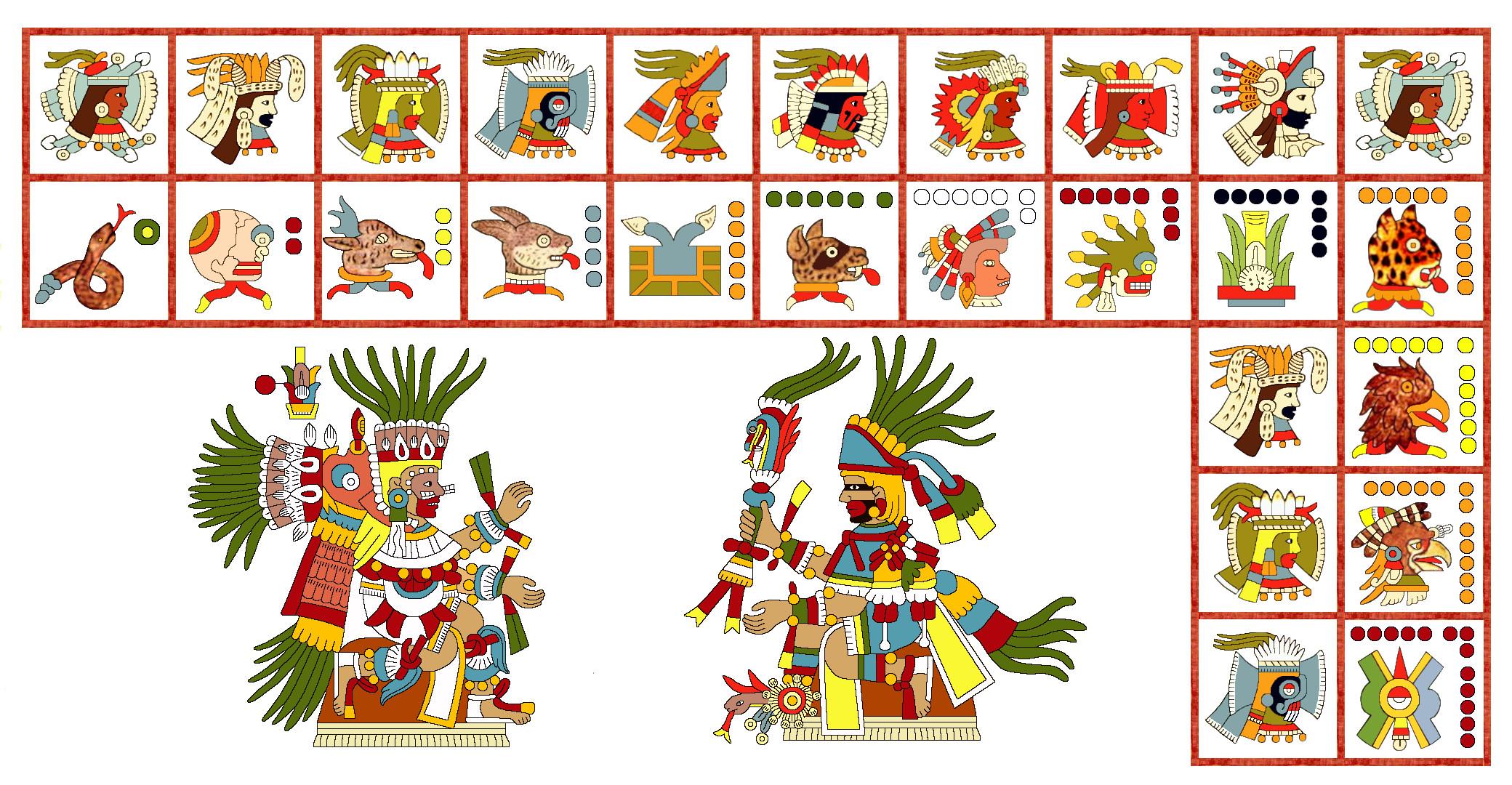
Aztec Calendar – Rabbit Trecena

The twentieth and final trecena (13-day “week”) of the Aztec Tonalpohualli (ceremonial count of days) is called Rabbit for its first numbered day, which is the 8th day of the veintena (20-day “month”). In Nahuatl, Rabbit is Tochtli. It was known as Lamat (Venus, Star) in Yucatec Maya, and K’anil (or Q’anil) (Seed of Life) in Quiché Maya.

The day Rabbit signifies self-sacrifice and service to something greater than oneself. Counter-intuitively, Rabbits were seen as gods of drunkenness, the Centzon Totochtin (400 rabbits) being patrons of all kinds of intoxication or inebriation. The principle rabbit deity was 2 Rabbit (Ome Tochtli or Tepoztecatl). The Aztecs counted “rabbits” for intoxication levels, from 25 rabbits for mild intoxication to 400 rabbits for complete drunkenness. Vessels for the drinking alcoholic pulque often bear rabbit symbolism and/or a crescent moon symbol called the yacametztli—relating to the goddess of the moon Metztli. In fact, Mesoamerican cultures envisioned the figure of a rabbit in the moon, which I’ve surmised was day-named 12 Rabbit.

The patron of the day Rabbit is Mayauel, the goddess of intoxication/pulque and its source, the maguey plant. Seen previously as patron of the Grass Trecena, she’s the purported mother of the Centzon Totochtin, apparently by the deity Patecatl, god of medicine and pharmaceutical intoxication. Other sources suggest that the Cloud Serpent, Mixcoatl, sired some of them, but Aztec paternity wasn’t thoroughly documented, and Mayauel was a hospitable goddess.

PATRON DEITIES RULING THE RABBIT TRECENA

One of the patrons of the Rabbit trecena is Xiuhtecuhtli (Lord of Fire and Time), whom we’ve seen in the Snake trecena. As god of the Center and the Pole Star, he’s an A-list celebrity deity. The other is variously Itztapaltotec, Stone Slab Lord, or Xipe Totec, Lord of Renewal and Liberation. The first is a nagual (manifestation) of the second and deifies the sacrificial knife.

AUGURIES OF THE RABBIT TRECENA

By Marguerite Paquin, author of “Manual for the Soul: A Guide to the Energies of Life: How Sacred Mesoamerican Calendrics Reveal Patterns of Destiny”
https://whitepuppress.ca/manual-for-the-soul/

Theme: Leadership and Renewal. During this final trecena in the 260-day cycle, the emphasis is on completion and “cutting away” what is no longer needed, in order to facilitate new growth. This can be an intense period, as combat in some areas could intensify, leading to important conclusions, as the stage is being set for new beginnings to follow in the next trecena. During this period signs or signals may appear that could indicate what lies ahead or new potentialities. This is a good time to watch for signs of change and growth, and a good time to make important decisions in preparation for the new cycle about to begin.

Further to how these energies connect with world events, see the Maya Count of Days Horoscope blog at whitepuppress.ca/horoscope/  Look for the Lamat trecena.

THE 13 NUMBERED DAYS IN THE RABBIT TRECENA

The Aztec Tonalpohualli, like the ancestral Maya calendar, is counted through the sequence of 20 named days of the agricultural “month” (veintena), of which there are 18 in the solar year. Starting with 1 Rabbit, it continues with: 2 Water, 3 Dog, 4 Monkey, 5 Grass, 6 Reed, 7 Jaguar, 8 Eagle, 9 Vulture, 10 Earthquake, 11 Flint, 12 Rain, and ultimately 13 Flower.

There are a few special days in the Rabbit trecena:

One Rabbit (in Nahuatl Ce Tochtli) – a date in the mythic Aztec past when the cosmos was created by gods; also, one of Xiuhtecuhtli’s calendric names.

Five Grass (in Nahuatl Macuil Malinalli) – one of the five male Ahuiateteo/Macuiltonaleque (Lords of the Number 5), usually paired with the female Cihuateotl One Eagle.

Thirteen Flower (in Nahuatl Mahtlactli ihuan yeyi) – a ritually significant day of completion for the 260-day cycle; also associated with period endings, often marking the completion of significant “bundles” of time.

THE TONALAMATL (BOOK OF DAYS)

Several of the surviving so-called Aztec codices (some originating from other cultures like the Mixtec) have Tonalamatl sections laying out the trecenas of the Tonalpohualli on separate pages. In Codex Borbonicus and Tonalamatl Aubin, the first two pages are missing; Codex Telleriano-Remensis and Codex Rios are each lacking various pages (fortunately not the same ones); and in Codex Borgia and Codex Vaticanus all 20 pages are extant. (The Tonalpohualli is also presented in a spread-sheet fashion in Codex Borgia, Codex Vaticanus, and Codex Cospi, but that format apparently serves other purposes.)

TONALAMATL BALTHAZAR

As described in my earlier blog The Aztec Calendar – My Obsession, some thirty-five years ago—on the basis of very limited ethnographic information and iconographic models —I created my own version of a Tonalamatl, publishing it in 1993 as Celebrate Native America!

When I started drawing my tonalamatl, I did the pages in colored pencil, often producing several versions in different color schemes in a palette of four chromatic colors (with some black and white as well): gold—for gods, red—for blood, green—for jade, and blue for turquoise. Each deity had a primary color with a secondary and highlights of the others. For the last trecena, I used models and motifs from Codex Nutall and tried to make it an even balance of all four colors. Maybe I succeeded because everyone admired this image especially.

On the first nineteen trecenas, I followed the limited information available about their patrons (not knowing all of them). Many I created from scratch from Nutall images and sketchy clues on iconography. A few were based on images from Codex Borbonicus found in old books. When I got to the last one, Rabbit, the scholarship said only that its patron was the sacrificial knife, and I found only one gruesome image, probably the monster from Tonalamatl Aubin. (See below.) As an artist, I was aesthetically and philosophically offended and decided to turn heretic.

I installed my own choice of a god as patron of the last trecena, someone considerably more appetizing. Xochipilli, the Flower Prince, is god of art, dance, beauty, ecstasy, sleep, and dreams/hallucinations. In addition, he’s variously patron of homosexuals and male prostitutes; god of fertility (agricultural produce and gardens); patron of writing, painting, and song; and god of games (including the sacred ball-game tlachtli), feasting, and frivolity. His twin sister/wife is Xochiquetzal, patron of the preceding Eagle trecena.

So much for authenticity. The neglected Flower Prince is an eminently worthy “calendar prince.” (You can see the true trecena patrons in the tonalamatls of the historical codices that follow.)
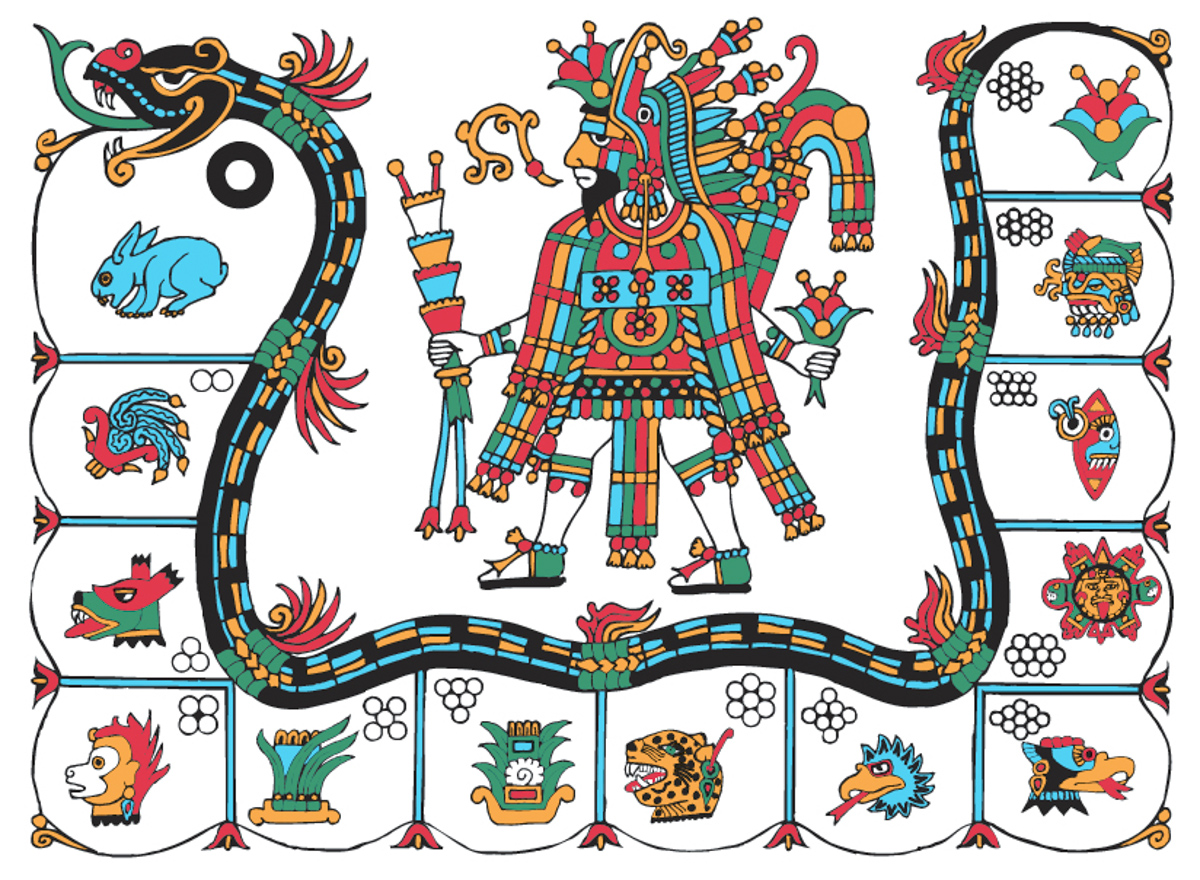
Aztec Calendar – Rabbit trecena – Tonalamatl Balthazar

#

TONALAMATL BORGIA (re-created by Richard Balthazar from Codex Borgia)

Aztec Calendar – Rabbit Trecena -Tonalamatl Borgia

The page for the Rabbit trecena from Codex Borgia, which I hadn’t seen thirty-five years ago, portrays its orthodox patrons in typically ornate style. Xiuhtecuhtli on the left is loaded down with divine regalia, some of it the same as in his image with the Snake trecena, and in similar coloration. The only truly emblematic piece is his square pectoral, apparently a heavily stylized war-butterfly motif inherited from the ancient Maya. I find his headdress curious in reflecting that of Ixtlilton in the preceding Eagle trecena. Maybe the artist enjoyed drawing those motifs.

On the right side, we have one of the more spectacular images of Xipe Totec illustrating his traditional red and white ornaments and staff. It’s in a much different style than his image as patron of the Dog trecena, sharing only the unique nose-clamp. In this Borgia portrait, he’s definitely the “flayed god,” like a priest in the skin of a sacrificial victim.

If I’d known about this panel, I might have avoided heresy by making Xipe Totec the patron of my Rabbit trecena, but I’d already used him for Dog and wouldn’t have wanted to repeat patrons anyway. The same argument holds for Xiuhtecuhtli already having appeared in Snake. In any case, while perhaps not as eye-catching as Chalchiuhtotolin in the Water trecena, Borgia’s two lords for the final Rabbit trecena are about as stylistically exquisite as its deities get.  

#

TONALAMATL YOAL (compiled and re-created by Richard Balthazar on the basis of
Codex Telleriano-Remensis and Codex Rios)

Aztec Calendar – Rabbit Trecena – Tonalamatl Yoal

Here we see on the left the ominously named Itztapaltotec, Stone Slab Lord, himself, the sacrificial knife that grossed me out. This one looks like a guy in a flint knife (tecpatl) costume with flayed arms hanging from his own like an appropriately nagual hybrid of Xipe Totec. He holds an emblematic red and white staff, but I can’t fathom the conch shell in his other left hand.

On the right side sits Xiuhtecuhtli more or less enthroned, which is the first remarkable detail. Almost all the Yoal deities are either standing (like Itztapaltotec) or in what I call the “dancing” pose with bent knees. Only the Cihuateotl in the Flower trecena and Xochiquetzal in the Eagle trecena sit back on their feet, standard female posture, (especially in Codex Nutall where males sit cross-legged.) Adding to this iconographic weirdness, note that Xiuhtecuhtli’s right leg and foot are hidden by the left—an absolutely ideoplastic device.

Above and beyond that odd detail, the Lord of Fire is decked out in opulent finery. Check out that wild serpent/crocodile head by his ear, possibly a plug ornament. His extravagant array of Quetzal plumes splays more feathers than even Xochiquetzal in the Eagle trecena, and between him and Stone Slab they wear more than in any other Yoal patron panel. The artist may have overdone the plumage because in his tailpiece and bustle the feathers had to overlap—a definite problem for Aztec iconography. One of the plumes in the back-fan even droops behind another!

Passing by his war-butterfly pendant, we see in his lower right hand what looks surreally like a rattlesnake with an animal head. It’s in fact a ritual “shaman stick.” More usually it’s called a “deer stick,” though many don’t look at all like a deer’s head. Plain ones were often used for digging, but the rattles on this one were probably there to make magical noises.

In the original, the scepter in the god’s other right hand was terribly drawn and unrecognizable, and I substituted the finer Xiuhcoatl (fire-serpent) he holds in the Snake trecena. The strange position of his fingers—as though holding on to a ring—is an exact duplication of that detail in his Borgia icon. There I simply wondered about it, but seeing it again here, I begin to suspect that there’s some symbolic importance attached to it. I guess we’ll never know.

Moving on to the divine face, I confess to doing radical plastic surgery on the original which looked insanely like the cartoon character Homer Simpson. That simply wouldn’t do! Then I borrowed the face-painting pattern again from his image in Snake. The result was a respectable deity worthy of his portentous headdress (like that worn by him and Mictlantecuhtli in the upper row as lords of the night). According to Gordon Whittaker in “Deciphering Aztec Hieroglyphs,” that turquoise diadem with curved point in front is literally a hieroglyph for “Lord” or “ruler.” Whittaker adds that the Nahuatl word is teykw-tli pronounced in two syllables if you can wrap your tongue around that. Colloquially, that’s te-cuh-tli, as in Xiuhtecuhtli (fire/turquoise-lord).

As with Tonalamatl Borgia, Tonalamatl Yoal went all out on the patrons of the Rabbit trecena, lavishing them with divine detail. The tonalamatl presents many elegant figures, but in my opinion, only the panel for the Vulture trecena (Evening Star and Setting Sun) can compare to this ornate, many-plumed pair. The inspirations behind the Yoal trecena pages are superbly artistic visions of glorious mythological beings.    

The twenty striking patron pairs in the Yoal tonalamatl encapsulate the traditional iconography of those Aztec deities. Having worked closely with the original codex images to re-create their conceptual inspirations, I can say that the later images in the series became progressively more awkward and crude, their construction often downright ramshackle. This suggests to me that other artists may have taken over some panels—or maybe the artist simply slacked off in his work—or equally probable, the artist got drunk or stoned.

In my careful estimation however, the Yoal artist(s)’s concept and vision of the trecena patrons were nevertheless sublime. Sadly, they just lacked the means, skill, medium, and (possibly) the reverence needed to manifest their deities magnificently. I’m thrilled to have turned those flawed visions into the Tonalamatl Yoal, a new treasure in the canon of Aztec art.    

#

OTHER TONALAMATLS
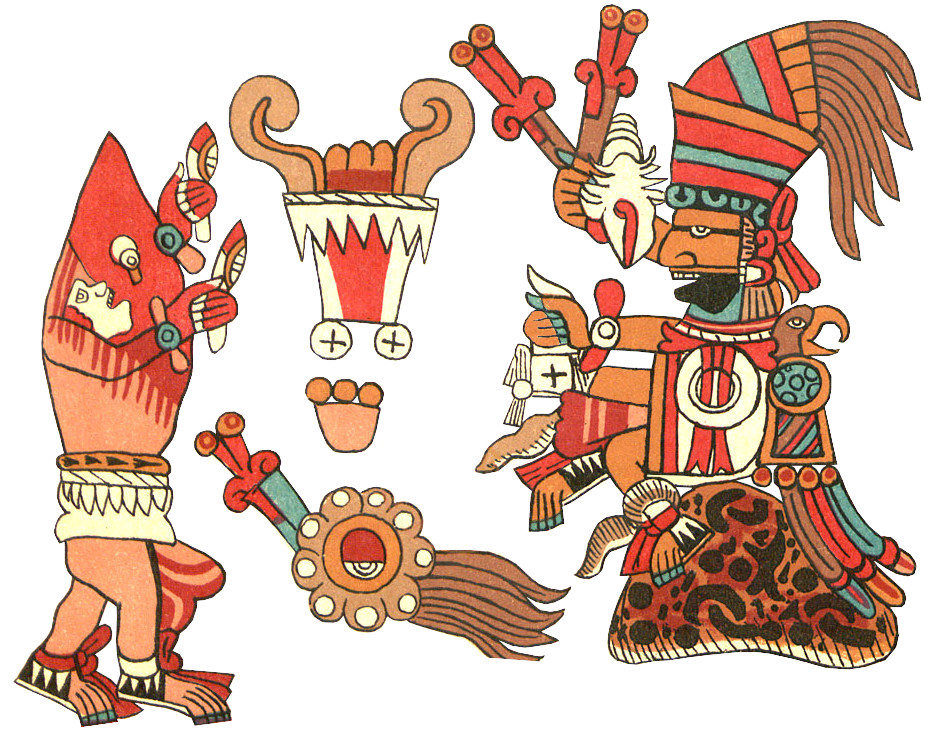
Tonalamatl Aubin patron panel for Rabbit Trecena

The only thing that identifies Xiuhtecuhtli in the Tonalamatl Aubin patron panel is his black face-paint. The generic circular pendant could belong to many deities. On the other hand, the figure on the left is clearly Itztapaltotec, a frighteningly personified sacrificial knife with a surreal face on his shoulder. The item at top center is a hearth-vessel with smoke, fire and possibly incense, but I won’t attempt to identify the other elements.

This patron panel and that for the Water trecena (with Chalchiuhtotolin) are the two most disappointing instances in the Tonalamatl Aubin. Most of the other panels are passingly ornate, while often awkward and distorted. In my humble opinion, this tonalamatl is the least impressive of the several we have seen. It was painted pre-Conquest in the neighboring state of Tlaxcala and as such may represent a crude, provincial document. Its value for scholarship is that it represents the shared themes and motifs across the “religious” territory of central Mexico.

#
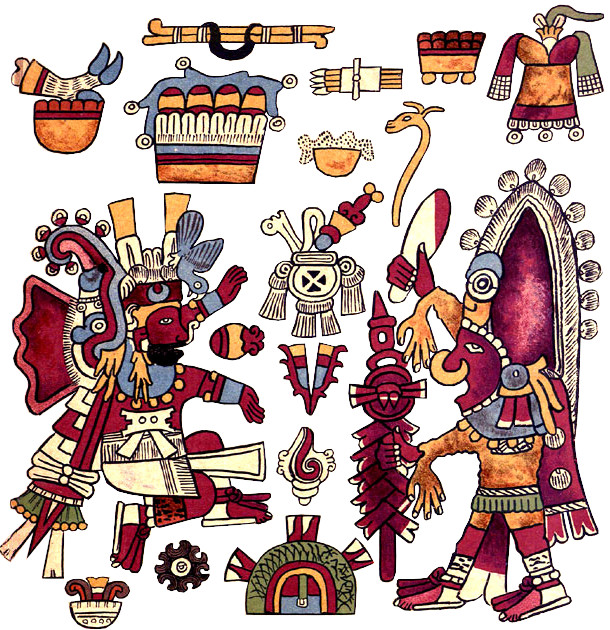
Codex Borbonicus patron panel for Rabbit Trecena

The panel for this last trecena in Codex Borbonicus is artfully done, supplying the figure of Xiuhtecuhtli that I used as a model in the earlier Snake Trecena in my old tonalamatl. Oddly, I don’t believe I saw this decorative image of Itztapaltotec way back then. I was so taken my Xochipilli apostasy that I probably would’ve ignored the fancy fellow anyway. Though some of the surviving panels in Borbonicus present stunning figures (like Itztlacoliuhqui in the Lizard Trecena), this beautiful pairing of patrons has to be the most impactful composition of the lot.

The patrons’ emblematic paraphernalia is easily recognizable, as are many of the items in the neatly organized conglom. I’m intrigued by the bottom center item resembling a hill or mountain place-symbol with tooth-like appendages (which Whittaker has identified as hieroglyphs meaning “at”) and part of its vegetative detail in utter disarray. Most notable is the curved “deer-stick” hovering over Itztapaltotec’s flint knife, simpler than that in the Yoal panel, but scarcely more deer-like. This one is probably a common digging stick but might still be magical.

Combining these patron panels with a crowded matrix of delicately drawn days, 9 night-lords, and 13 day-lords with their totem-birds, the tonalamatl in Codex Borbonicus stands in my modest opinion as a consummate masterpiece of Aztec art and culture.

#

Codex Vaticanus patron panel for Rabbit Trecena

In Codex Vaticanus, the patron pair for the Rabbit Trecena again is well balanced, as in the other tonalamatls, to formally wrap up the last of the trecenas. In its characteristic rough caricature style, Vaticanus again closely follows the images and themes of Tonalamatl Borgia, Xipe Totec and Xiuhtecuhtli simply having switched sides. In its series of trecena panels, Vaticanus faithfully reflects the calendrical “dogma” in the more ornamental Borgia panels. The codices share certain other sections, but each also presents a lot of its own mythological material. Perhaps the calendrical orthodoxy can be explained by both codices having come from Puebla, possibly from the same priestly school (calmecac).

But the tonalamatl in Codex Vaticanus does more than simply restate the Borgia images. In particular, it created that uniquely surreal vision of Itzpapalotl for the House Trecena and produced its own exquisite versions of deities like Chalchiuhtotolin and Xolotl for the Water and Vulture trecenas. In addition, in its other sections, Vaticanus presents incomparably elegant artwork on deities like Tlaloc and Tlahuizcalpantecuhtli. The codex is a veritable goldmine of mythological and ethnological details. One just has to get used to its stylistic strangeness, like the blue finger- and toe-nails.     

#

Tonalamatl Borgia is my proudest achievement in this series of re-created Aztec art. Like the Vaticanus version of the trecenas, it’s set amongst several other ritual and religious sections of the codex, many of stupendous artistry. Though several other historical codices are also iconographically superlative, like Fejervary-Mayer and Laud, to my mind, Codex Borgia is the premiere artistic relic of pre-Columbian Mesoamerica.

Unfortunately, over five centuries the document has seriously deteriorated with whole sections of images worn away, the colors of its inks fading and failing, and some pages torn or even burned. Mostly, what we can see nowadays of Codex Borgia (and many other codices) is from the incredible facsimile editions of Joseph Florimond Loubat (1837-1921), an American bibliophile. He faithfully reproduced the Aztec documents in their exact conditions at the end of the nineteenth century, which meant that any earlier deterioration was also reproduced. In 1993 a full-color restoration of the Codex Borgia was published by Giselle Díaz & Alan Rodgers, restoring most dilapidated areas and repairing lost coloration in facsimile fashion.

My re-creations of Tonalamatl Borgia have played somewhat more freely with its colors. I’ve interpreted various shades of greys, browns, and golds in the Loubat facsimiles as deteriorated original blues and greens and in a few instances introduced colors not available to the Aztec artists (like the purples with Chalchiuhtotolin in the Water Trecena). My purpose was to present the deities in authentic but new, vibrant images untouched by the passing centuries.

A curious feature of the Tonalamatl Borgia is that some of its decorative patron panels seem to suggest an underlying narrative, in particular that for the Snake Trecena. Other panels include mysterious and beautiful symbolic items (though not as many as in Codex Borbonicus), and a number of the Borgia deities, like Chalchiuhtlicue in the Reed Trecena and Tlaloc in the Rain Trecena, are perfectly monumental. In summation, I believe that this Tonalamatl Borgia deserves a place of honor amongst the world’s very best religious art.       

#

AFTERWORD
by Marguerite Paquin, PhD.

I would like to express my deepest thanks to Richard for his extremely valuable contributions to my Maya Count of Days Horoscope blog. This began in early December of 2019, when he allowed me to use his Tonalamatl Balthazar image for the Chikchan trecena as an illustration for the blog. (https://whitepuppress.ca/the-chikchan-lifeforce-trecena-dec-10-22-2019/) The evolution of imagery continued from there as he developed and refined his work.

After the inclusion of one full cycle of his Tonalamatl Balthazar, I began including his early renditions of the Codex Borgia in the blog. At first the images were somewhat sketchy (but valuable nonetheless) but over the years he kept refining them, and the full set is now gorgeously complete. I am blessed to have them available for my blog, as they allow my readers to see at a glance the nature of the energies that I discuss every 13 days.

When Richard began adding descriptions of his work (regarding the evolution of the images, and the detailing that was included) in his own site, this added yet another layer of interest. I am extremely appreciative of Richard’s talent, research, formidable attention to detail, and generosity in this regard, and have no doubt that the ancients who devised these images in the first place would be proud. Muchas gracias, Richard!

###

You can view all the calendar pages from the Balthazar, Borgia, and Yoal Tonalamatls
in the
Tonalamatl gallery.

Aztec Calendar – Snake Trecena

The ninth trecena (13-day “week”) of the Aztec Tonalpohualli (ceremonial count of days) is called Snake for its first numbered day, which is also the 5th day of the veintena (20-day “month”). In the Nahuatl language Snake is Coatl, and it’s known as Chikchan in Yucatec Maya and Can in Quiché.

For the Aztecs the Snake symbolizes mystical power, and it’s probably no accident that it was associated with the male genitalia. The patron of the day Snake is Chalchiuhtlicue, goddess of flowing water (see Reed trecena). Images of the snake are frequent in the codices simply as reminders of divine power. It’s often a manifestation of Quetzalcoatl, the Plumed Serpent, and the core element of the divine weapon wielded by many deities, the Xiuhcoatl or Fire Serpent.

PATRON DEITIES RULING THE TRECENA

The principal patron of the Snake trecena is Xiuhtecuhtli, the Lord of Fire—or alternatively, of Turquoise (a homonym). As the latter, he is the lord of time and the sacred calendar, the Turquoise Year (tonalpohualli), in which capacity he determines mortals’ day of death and watches over departed souls on their journey to Mictlan. Also lord of the blue sky of day, Xiuhtecuhtli symbolizes the unfathomable, the limitless, unity, and completion. In Aztec astronomy, he’s lord of the Pole Star, the center of all things, and spindle of the universe. In addition, he’s both the Lord of the number 1 (with the Blue Hummingbird as his totem bird) and first Lord of the Night. Historically, Xiuhtecuhtli is a new, younger version of the ancestral deity of fire, Huehueteotl (the Old God). His birth day-name is One Rabbit.

The secondary patron of this trecena is Tlahuizcalpantecuhtli (Lord of the House of the Dawn), a nagual of Quetzalcoatl representing the planet Venus as the Morning Star. He’s symbolic of re-emergence, of the triumph of life over death. Meanwhile, he’s a dangerous deity, his gaze very destructive for both mortals and gods. Legend has him shooting a dart at the Sun, Tonatiuh, who throws it back at him but hits instead Itztlacoliuhqui (Curved Obsidian Blade), the god of stone and cold, a nagual of Tezcatlipoca. After Tlahuizcalpantecuhtli periodically disappears from the eastern morning sky to descend into the Underworld, he’s replaced in the western evening sky by Xolotl, the Evening Star. The Lord of the number 12 with (logically) the Quetzal as his totem bird, Tlahuizcalpantecuhtli’s birth day-name is One Reed.

AUGURIES OF SNAKE TRECENA

By Marguerite Paquin, author of “Manual for the Soul: A Guide to the Energies of Life: How Sacred Mesoamerican Calendrics Reveal Patterns of Destiny”
https://whitepuppress.ca/manual-for-the-soul/

This dynamic trecena’s theme is emergence and liberation. The energies associated with this trecena are strongly aligned with Lifeforce, Fertility, Sacred Authority, Justice, Liberation, Cyclical Regeneration, and the promulgation of higher knowledge. A sense of new vitality or awakening to new ideas often accompanies this time frame, suggesting that transcendent events, possibly of a world-shaping nature, could manifest during this period, opening up the realm of new possibilities.

Further to how these energies connect with world events, see the Maya Count of Days Horoscope blog at whitepuppress.ca/horoscope/. The Maya equivalent is the Chikchan trecena.

THE 13 NUMBERED DAYS IN THE SNAKE TRECENA

The Aztec Tonalpohualli, like the ancestral Maya calendar, is counted through the sequence of 20 named days of the agricultural “month” (veintena), of which there are 18 in the solar year. Starting with the 5th day of the current veintena, 1 Snake, this trecena continues with 2 Death, 3 Deer, 4 Rabbit, 5 Water, 6 Dog, 7 Monkey, 8 Grass, 9 Reed, 10 Jaguar, 11 Eagle, 12 Vulture, and 13 Earthquake.

There are four important days in the Snake trecena:

One Snake (in Nahuatl Ce Coatl) was noted in the Florentine Codex as traditionally a favorable day for merchants/traders (pochteca), travelers, and armies to “set forth to far lands.” In that spirit, the Codex indicates that One Snake was often the occasion for declaring of war. It is significant that in 1521 this was the day the Aztecs surrendered to Hernan Cortés and his conquistadores at Tenochtitlan after being defeated in a fierce battle.

Seven Monkey (in Nahuatl Chicome Ozomatli)is traditionally associated with wealth and prosperity. This day-sign appears on the Aztec Calendar Stone, below the central face.

Eight Grass (in Nahuatl Chicueyi Malinalli), according to some sources, is an alternate birth day-name of the goddess Chalchiuhtlicue, generally called One Water (again see Reed Trecena).

Nine Reed (in Nahuatl Chicnahui Acatl) is the birth day-name of the Earth Goddess Tlazolteotl, Goddess of Filth (see Deer Trecena). On this day, gifts of cacao, precious feathers, and flowers are offered to her.

THE TONALAMATL (BOOK OF DAYS)

Several of the surviving so-called Aztec codices (some originating from other cultures like the Mixtec) have Tonalamatl sections laying out the trecenas of the Tonalpohualli on separate pages. In Codex Borbonicus and Tonalamatl Aubin, the first two pages are missing; Codex Telleriano-Remensis and Codex Rios are each lacking various pages (fortunately not the same ones); and in Codex Borgia and Codex Vaticanus all 20 pages are extant. (The Tonalpohualli is also presented in a spread-sheet fashion in Codex Borgia, Codex Vaticanus, and Codex Cospi, but that format apparently serves other purposes.)

TONALAMATL BALTHAZAR

As described in my earlier blog The Aztec Calendar – My Obsession, some thirty years ago—on the basis of very limited ethnographic information and iconographic models —I presumed to create my own version of a Tonalamatl, publishing it in 1993 as Celebrate Native America!

My version of the Snake trecena portrays Xiuhtecuhtli in a wild interpretation of his image in Codex Borbonicus, mixing a fancy snake on his back from the Stone of the Suns with a flaming crest much like Quetzalcoatl’s plumes in the Jaguar Trecena. Obviously, I took the turquoise and fire homonyms to heart in the coloration and wisely incorporated his traditional pendant plaque.  I really should have made the bird totem on his forehead blue, and I have no idea where I got the shield design with the sun motif. Though I hadn’t seen any other images of the deity, I think my fantasy makes a very convincing Lord of Fire.

Aztec Calendar – Snake trecena – Tonalamatl Balthazar

#

TONALAMATL BORGIA (re-created by Richard Balthazar from Codex Borgia)

Aztec Calendar – Snake Trecena – Tonalamatl Borgia

The Snake trecena page in Codex Borgia is the busiest one in its tonalamatl and raises a huge number of questions, both mythological and iconographic. It definitely begs a narrative.

Let’s start with the primary patron (the big red guy on the right), Xiuhtecuhtli himself enthroned and looking very pensive or stern/aggravated. In the original, his image is quite deteriorated, his regalia blurred and spotty. In their restoration of the Codex Borgia (Dover Publications, 1993), Gisele Diaz & Alan Rodgers have been inventive in restoring his ornaments, some of which I’ve used; another anonymous facsimile made other choices; and I’ve made my own in some places.

The best example is the feathery thing on his back, the top of which in the original is basically blank (or worn away?). Diaz and Rodgers fill it with rows of short lines; the other facsimile intimates a spiral of same. My close study of the blankness found tiny indications of a possible second row of lines, but I’ve left the rest blank. Another problematic motif is that odd thing on his forehead, maybe a bird, which would make sense as his totem, but it looks nothing like any other bird I’ve ever seen in any of the codices.

When we consider the mass of material adjacent to the deity, things get really mysterious, like that slanting bundle of jaguar hide and spotted blue strips (with a surreal bird’s head) running behind Xiuhtecuhtli’s shoulder. We’ll see something similar in the Vaticanus patron panel later. Does it mean something that the water (from above) flows into the bundle and deity, rather than away from him as from Tlaloc in the Rain Trecena and Chalchiuhtlicue in the Reed Trecena? The two arrows in the stream are almost to be expected as power symbols.

However, that ornamental scorpion is a major enigma. Since the scorpion apparently has had obscure connections with the planet Venus ever since Maya times, Tlahuizcalpantecuhtli being the Morning Star is probably the key. The scorpion’s sting would be a fine material metaphor for the Morning Star’s divinely destructive gaze. Also, I’m puzzled by the patterns of squared and spiral water flowing at/onto Xiuhtecuhtli.

Briefly, the other major enigma is the central vacant throne, the jaguar pelt indicating that there should be some deity sitting there. Who?

Now let’s talk about the secondary patron with the tongue-twisting name, Tlahuizcalpantecuhtli, sitting gingerly on the jaguar seat on the left. The only evidence of his identity is the headdress with the long spokes and feathery crown. Otherwise, he’s just an innocent little blond guy with standard Aztec finery. His hands-in-the-air gesture certainly must mean something like, “I know nothing about it!” “What did you expect?” “Who cares?” Or perhaps a hundred other probably dismissive comments relating to the vacant throne or to the flood dousing the Lord of Fire. Between Xiuhtecuhtli’s pout/glower and Tlahuizcalpantecuhtli’s nonchalance, some story is definitely going on in this page, but it would take an Aztec priest to provide an exegesis.

I must confess that I made the personal choice to color the Morning Star’s “mask” in a pleasant light blue as opposed to the depressing grey or brown to be seen in images that follow. The little flag on his nose-piece is actually indicative of Tezcatlipoca, but this might just be a convenient decoration. Meanwhile, his predominantly white body and clothing are most unusual for deities in Codex Borgia. Maybe the artist simply left him unfinished—too busy with Xiuhtecuhtli? In any case, we’ll see more detail in later images of this god.

#

TONALAMATL YOAL (compiled and re-created by Richard Balthazar on the basis of
Codex Telleriano-Remensis and Codex Rios)

Aztec Calendar – Snake Trecena – Tonalamatl Yoal

Speaking of detail, the image of Tlahuizcalpantecuhtli on the left in this Telleriano-Remensis and Rios vision has them in spades, including a little One Reed identifier hovering overhead. The toothy feathered snake-monster on his back probably underlines his relationship to Quetzalcoatl (whose birth day-name is Nine Wind but sometimes called One Reed). As they will also occur in later images, the tear-drop motifs in his headdress (and in the snake’s) are other identifiers. Note his brown mask and mostly white raiment. Here his hand-gestures seem simply formulaic for his “dancing” or sitting posture on the standard place symbol/glyph.

On the right, Xiuhtecuhtli also “dances” or sits on a place symbol and wears ornate regalia. His headdress is very like that on his bust as Night-Lord (fifth from the left in the top row). The Telleriano-Remensis page with his image is missing, and I’ve had to base this representation on the uninspired Rios copy, supplementing it with details from elsewhere in T-R—like the fiery Xiuhcoatl he wields in his raised right hand. In his image in both T-R and Rios for the Pachtontli (Teotleco) solar vientena, Xiuhtecuhtli wears a flaming serpent on his back, but I thought that would be a little too much here. However, in both of those images one of his feet is the mystical water-fire symbol (atl-tlachinolli), which I’ve inserted as the Fire Lord’s right foot. Note his red and black face-paint as in the Borgia version—and in the following examples.

#

OTHER TONALAMATLS

Tonalamatl Aubin patron panel for Snake Trecena

Once again, the patron panel in Tonalamatl Aubin gives one serious aesthetic pause. It’s got most of the canonical elements, but they seem viewed through a strange (psychedelic?) lens. Of course, there’s fair reason to believe that psychoactive drugs were involved. Here, the patrons of the trecena have switched sides and seats, and the head of Tlahuizcalpantecuhtli (recognizable by the brown mask and teardrop ornaments in his headdress) is grossly distorted. Borgia’s vast flow of water has now become a mere spurt as part of the Morning Star’s headdress—another instance of the atl-tlachinolli water-fire symbol.

Meanwhile, Xiuhtecuhtli on the left has the standard red and black face and a fire-snake “cape,” and he holds his blue bird totem, which is by no stretch of the imagination a hummingbird. And by the way, I sort of hoped to see an empty throne and miss the scorpion.

Most startling is the fact that Tlahuizcalpantecuhtli has been flayed—sacrificially skinned! (In his Rios copy he is also flayed, but in the T-R original, only his hand shows the red stripes. I chose to ignore those details in Tonalamatl Yoal as too much information.) Here there’s no way around the ritual flaying of this deity. In fact, in several Borgia images of Tlahuizcalpantecuhtli he’s been skinned. In Vaticanus there are also many such images, as well as a section of five panels with the flayed deity attacking various people, places, and even a jaguar.  In each of those he wears an odd eyepiece representing his dangerous gaze. (These five panels also appear in Codex Cospi in much different style and similar detail but without the flaying.)

Tlahuizcalpantecuhtli: Borgia (l.); Vaticanus (r.)

The consistent representation of Tlahuizcalpantecuhtli as flayed suggests a close relationship with Xipe Totec, the Flayed God, whom we will see later as a patron of the 20th trecena, Rabbit. His virtues of fertility, renewal, and spring are broadly discussed in the “The Flayed God” by Roberta H. and Peter T. Markman (HarperSanFrancisco, 1992), who note that several other deities are also shown in the codices as flayed. I’ve found many skinned images of Tlaloc, Mixcoatl, Tlazolteotl, and even some of the Cihuateteo and Ahuiateteo.

I think the flaying of victims and deities must have been a transcendent sign/symbol of holiness—like the ubiquitous western tradition of the halo—and suspect that Xipe Totec, who usually only wears their skins, is the “high priest” of the bloody sect. Tlahuizcalpantecuhtli seems to be the principal flayed god in the pantheon. I wonder why he, the Morning Star, would be chosen for such grisly glory. Maybe because he’s a nagual of the great god Quetzalcoatl?

#

Codex Borbonicus patron panel for Snake Trecena

That being said, in the tonalamatl of Codex Borbonicus, Tlahuizcalpantecuhtli (back on the left side) is once again white-skinned in largely white clothes—maybe meaning his Borgia image was in fact completed. He wears his usual brown mask and has teardrop designs in his headdress, appearing in a constellation of motifs: water flowing at/onto the Lord of Fire (with arrows); some kind of a watery link (like the odd item at the center of the Aubin panel) to a throne (vacant but for a pile of ritual offerings); and what looks like a spider but is really a scorpion, both arachnids. Under high magnification one can see a tail/stinger curved up across its body. This is all stuff we already know from the Borgia panel, but I’ve never seen that surreal blue pointy-nose mask-thing on the back of his head before. Might it relate to his dangerous gaze?

With all that symbolic paraphernalia, Tlahuizcalpantecuhtli seriously overshadows Xiuhtecuhtli, who sports only that fire-snake on his back (the model for my own trecena above), the beautiful Borbonicus-blue totem bird on his brow and plaque-pendant. The artist apparently didn’t care much about this supposedly primary patron, grotesquely distorting his torso and shrinking his arms and hands—in contrast to complex and careful execution of the secondary patron.

As a post-script to this description, note the snake in the lower left denoting the trecena and the blue creature on the lower right. Whatever its species, it’s the same as the blue animal held by Tlahuizcalpantecuhtli in the Aubin panel. Like the vacant throne and scorpion, such repeated motifs surely must mean something integral to the implied narrative.

#

Codex Vaticanus patron panel for Snake Trecena

The Codex Vaticanus patron panel for the Snake trecena is obviously badly “weathered,” and I’ve tried to touch it up, restoring most faded and broken lines and filling in some of the color, except for the spotty flow of water. The patrons have switched sides once more, Xiuhtecuhtli in a divinely complex headdress brooding over Tlahuizcalpantecuhtli, who’s appropriately flayed now. We’ve again got the main narrative motifs, including Borgia’s strange staff with curls (but no weird bird’s head), the flow of water with scorpion and arrows, and the vacant throne—clearly a retelling of the same old story. The staff and flow of water being placed subtly in the foreground in this panel tells me they’re probably the main theme of the implied narrative.

But here the scorpion- and arrow-laden flood (apparently summoned by Tlahuizcalpantecuhtli) no longer flows at/onto Xiuhtecuhtli, instead getting “swallowed up” by the staff itself. Perhaps that motif is the Fire Lord’s symbolic “spindle of the universe” neutralizing the flood—or maybe the smoke-like staff is a stylized column of his divine fire? If the latter, then we’re again looking at an enormous atl-tlachinolli, which I’m told is a symbol of war. Does that mean the Morning Star is challenging the Pole Star for supremacy (the empty throne) of the sky? Or maybe that’s way too metaphysical.

#

Let me try another reading: perhaps this is all about Tlahuizcalpantecuhtli trying to take over the primary patronage of the trecena from Xiuhtecuhtli, in the Borgia panel sitting nonchalantly on his modest jaguar seat but ready to jump onto the empty throne, while Xiuhtecuhtli scowls at him and fends off his flood. In the Yoal panel, the Fire Lord is still on the prominent right, but One Reed displays imposing glitz with his serpent-monster cape. The two have switched sides in the Aubin panel, where Tlahuizcalpantecuhtli now sits on the primary throne, with Xiuhtecuhtli on the secondary jaguar seat. Back on the left side in Borbonicus, Tlahuizcalpantecuhtli with all his paraphernalia has basically usurped the panel from the battered Xiuhtecuhtli, having physical possession of the throne at least, and in Vaticanus he holds off the Fire Lord with the huge war symbol, the trecena’s throne now his for the taking.

Such are my amateur shots at playing Aztec priest, whether or not either of these stories is true. Either way, the roles of primary and secondary patron of this trecena aren’t exactly clear-cut, not that it makes a great deal of difference.

The flayed Tlahuizcalpantecuhtli is the main evidence I see of Dr. Paquin’s ancient Maya themes for this trecena of fertility, emergence, and liberation. Xiuhtecuhtli’s divinatory significance for authority, justice, and higher knowledge is nebulous. And my tentative readings have little to do with any Maya themes. After the several intervening centuries, I wouldn’t be surprised if the later Aztec iteration of this trecena’s themes might be substantially different than the Maya. Perhaps now it’s about confrontation, ambition, and power. After all, the Snake’s all about power, One Snake’s a great day for a war, and Tlahuizcalpantecuhtli is well known as a very aggressive deity, a holy terror. Maybe Xiuhtecuhtli represents the unified center of reality, and the bellicose Morning Star represents the antithetical force of chaos and anarchy, another elemental dichotomy like water and fire. Maybe not…

#

UPCOMING ATTRACTION

The calendar’s tenth trecena will be that of Flint, its patrons being the existential Lord of the Land of the Dead, Mictlantecuhtli, and the mighty Tonatiuh, God of the Fifth Sun. Stay tuned.

#

You can view all the calendar pages I’ve completed up to this point in the Tonalamatl gallery.

Aztec Lords of the Night

In Codices Borgia and Vaticanus, the 13-day ceremonial week (trecena) is laid out in a complex day-count (tonalpohualli) with a panel presenting its divine ruler(s) or patron(s). In Codex Borbonicus and Tonalamatl Aubin, both the Lords of the Day (with their totem birds) and Lords of the Night are included but aren’t very easy to differentiate/identify. In its spreadsheet-format calendar, Codex Cospi also inserts the Lords of the Night in equally sketchy heads and symbols.

Meanwhile, Codices Telleriano-Remensis and Rios (an Italian copy of the former) accompany the trecena day-counts with the nine Lords of the Night. They appear in a super-cycle sequence that takes several 260-day ceremonial years (calendar rounds) to complete. In that sequence, each one presides over the whole night, and in the same sequence, one presides over each of the nine hours of the night. (Point of curious information: The Aztecs counted 13 daylight hours and 9 hours of darkness, so the actual length of an hour varied proportionately and by season.)

In the T-R and Rios codices, the Night Lords are sloppily drawn, even slap-dash, though with consistent, if careless, motifs. I’ve chosen to refine their iconographic images, giving them more realistic faces like in Codices Fejervary-Mayer and/or Laud:

1st Lord—Xiuhtecuhtli—Lord of the Turquoise/Fire. The peaked headdress and red ribbon are standard emblems of this deity who represents the center of time and space.

2nd Lord—Itztli—Obsidian (Knife). I don’t know what the standard black markings on his face might signify, but those things in his “hat” are sacrificial knives.

3rd Lord—Pilzintecuhtli—Young Lord, God of the planet Mercury. He’s also a “sun-lord” as shown by the sun in his headdress.

4th Lord—Centeotl—God of Maize. Check out the indicative cobs of maize in his headdress.

5th Lord—Mictlantecuhtli—Lord of the Land of the Dead. This human image is most unusual for a face of death; usually he’s a skull on a skeleton. (See my Icon #10.)

6th Lord—Chalchiuhtlicue—Jade Skirt, Goddess of Flowing Water. (See my Icon #2.) Females could also be Lords since tecuhtli actually means more like “ruler.” (She may be the ancestral Great Goddess from ancient Teotihuacan.)

7th Lord—Tlazolteotl—Goddess of Filth (literally). Her mouth is black from eating people’s filth/sins. In her headdress are spindles of spun cotton and tassels of unspun, showing that she’s also the goddess of weaving.

8th Lord—Tepeyollotl—Heart of the Mountain, God of Caves/Volcanos/Earthquakes and Jaguar of the Night. I can’t explain his tri-color face in these calendars. (See my Icon #17.)

9th Lord—Tlaloc—God of Storms. His goggle-eyed, long-toothed visage is emblematic in most codex contexts. (See my Icon #20.)

For the 2nd Lord of the Night, some sources name Tezcatlipoca, the Smoking Mirror (See my Icon #19) in place of Itztli, but that’s based solely on his image on the Night Lord page in Codex Borgia (p. 14) showing them in full figure. In fact, Itztli is a principal nagual (manifestation) of the “Black One,” who’s supposedly invisible. The Borgia figure has a sacrificial knife as one of his feet, so it clearly intends to be Itztli.

#

Recently my knowledgeable Mayanist friend mentioned that the unusual 52-count of solar years (“Aztec Century”) in Codex Borbonicus accompanies each year with a Night Lord, though in a strange sequence/cycle unlike that for the day-count, and he explained the basis for it. I’d never paid that year-count much attention, and his explanation was an eye-opener. The 52- count of solar years (not of 260-day ceremonial years!) in that codex appears on two pages (pp. 21 & 22), each with 26 years in their ritual count in a system related to the day-count.

Four of the days in the 20-day month of the solar calendar are (for very complicated, but comprehensible reasons) are chosen as “year-bearers:” Rabbit, Reed, Flint, and House. In that order, they’re counted in cycles of 13, i.e. One Rabbit, Two Reed, Three Flint, Four House, Five Rabbit, Six Reed, etc. Like the trecena process in the ceremonial day-count, this produces four trecenas of years, which I call “trecades.”

Curiously, the century cycle is structured just like a cross-counted deck of playing cards with Rabbit = Clubs, Reed = Diamonds, Flint = Hearts (appropriately), and House = Spades. In this correspondence, the numbers work as well: 1 = Ace, 11 = Jack, 12 = Queen, and 13=King. By the way, in the following image of the first half of the cycle, the central panel portrays the goddess of the night Oxomoco (on the left, strewing stars like seeds) and the god of the day Cipactonal (on the right, burning incense).

First Half of the Aztec “Century” Count, Codex Borbonicus, p. 21

This first page of the count lays out the One Rabbit and One Reed sequences, each with a Night Lord as principle divine patron of that year:

Clockwise from lower left
One Rabbit—Mictlantecuhtli
Two Reed—Piltzintecuhtli
Three Flint—Tlaloc
Four House—Tlazolteotl
Five Rabbit—Centeotl
Six Reed—Xiuhtecuhtli
Seven Flint—Tepeyollotl
Eight House—Mictlantecuhtli
Nine Rabbit—Piltzintecuhtli
Ten Reed—Tlaloc
Eleven Flint—Chalchiuhtlicue
Twelve House—Centeotl
Thirteen Rabbit—Xiuhtecuhtli

Clockwise from upper right
One Reed—Tepeyollotl
Two Flint—Mictlantecuhtli
Three House—Piltzintecuhtli
Four Rabbit—Tlaloc
Five Reed—Chalchiuhtlicue
Six Flint—Centeotl
Seven House—Piltzintecuhtli
Eight Rabbit—Tepeyollotl
Nine Reed—Mictlantecuhtli
Ten Flint—Itztli
Eleven House—Tlaloc
Twelve Rabbit—Chalchiuhtlicue
Thirteen Reed—Centeotl

The little glyphs of these Night Lords are fairly consistent, though sometimes hard to recognize. Note the three stylized place symbols (for Seven Flint, One Reed, and Eight Rabbit), which represent a mountain with a heart emblem (i.e., Tepeyollotl, Heart of the Mountain). Also note that 10 Flint is accompanied by a stylized sacrificial knife (i.e., Itztli).

The busts of the other Lords are mostly recognizable by their regalia, except for confusing variations in the four differing instances of Pilzintecuhtli (Two Reed, Nine Rabbit, Three House, and Seven House) and the two of Xiuhtecuhtli (Six Reed and Thirteen Rabbit). Further confusion is caused by the fact that Xiuhtecuhtli in Six Reed and Pilzintecuhtli in Seven House are both singing/speaking. We just have to learn to live with these inconsistencies.

The second half of the count occurs on p. 22, presenting the One Flint and One House sequences, each year again with its patron Night Lord in an entirely different selection. You can make your own list of patrons. The system for assigning annual Night Lord patrons is another tie-in with the ceremonial day-count. Each year (like One Rabbit, Two Reed, etc.) is paired with the Night Lord for the corresponding numbered day in its trecena (Mictlantecuhtli, Pilzintecuhtli, etc.)

Because of the nine-cycle of Night Lords in the tonalpohualli and the 52 years in the century, the year patrons don’t work out evenly or in a logical pattern. Some appear 6 times, some 5. Of course, the nine-cycle also doesn’t quite fit in the tonalpohualli itself (260 / 9 = 28.89), and it can only accomplish a full cycle in 9 years (28.89 X 9 = 260). That means that the first ceremonial year ends with Tepeyollotl on Thirteen Flower, and the second year starts with Tlaloc on one Crocodile. The ninth year will finally end with Tlaloc on Thirteen Flower.

Consequently, the sequence of Night Lords from which the annual patrons are selected exists only in the first calendar round of the standard tonalpohualli. In the next eight rounds, the days all have different Lords of the Night as patrons. Does this mean that the years in the next eight centuries had different patrons too? Then the tenth century returns to the first distribution. This odd cycle means that the Aztecs may have counted a “nonennium” of 468 years (9 X 52 = 468), or perhaps the repeating tenth century constituted a true millennium of 520 years.

Perhaps they did—I’ve seen somewhere that they considered the previous four Suns/eras (Four Jaguar, Four Wind, Four Rain, and Four Water) to have lasted 520 years. In that case, since we don’t know exactly when the Fifth Sun (Four Earthquake) began, it probably ended officially at some point in the 16th or 17th Gregorian century.

I have no difficulty personally in construing the Fifth Sun as starting on or around 1000 CE during the Toltec dominance and ending in 1519 CE when the invaders obliterated the Aztec empire. If so, a Sixth Sun (which for obvious symbolic reasons I would choose to call Four Death) may have begun in 1520—to end in or around 2040 CE. In another 16 years, we may move into a Seventh Sun (which I would hopefully call Four Flower). Once again, we could be looking at a Mesoamerican cycle ending, this time as an Aztec prophecy.

###