Completing projects, I generally try to take a brief armchair vacation and then switch gears to address others waiting their turn. For instance, when I wrapped up my four-year Tonalamatl recreation last summer, I diddled for a week or so in the garden and then resumed my senile reminiscing for KID STUFF. With that fun analysis of my innocent childhood done, I took a week or so of restorative naps and lazy lying about.
Re-energized, I’ve moved on to a much-needed revision of my illustrated encyclopedia of Aztec deities called YE GODS! The Aztec Pantheon. The first edition from ten years ago is still available and frequently downloaded as a comprehensive reference, but I’m rather abashed by its limited scope and frequent errors and omissions. I pulled it together way back then in the early research for my coloring book YE GODS! Icons of Aztec Deities.
My vast stock of information on and images of the many Aztec gods and goddesses will provide galleries of authentic images of Aztec deities from the several surviving codices (manuscripts) for folks to form meaningful mental images of the strange gods and goddesses. This revision will probably take a considerable period of time, and I’ll be issuing the galleries with encyclopedic comments individually in blog posts. Look for the first posting shortly to be called The Aztec Lords of Five.
Meanwhile, as mental health breaks from these fits of Aztec mythology, I’d once planned more memoirs to fill in some blank periods of my relative youth, but I don’t think I ought to spend my few remaining years in such self-centered attention. Instead, I’ve decided to turn to historical fiction, a project long inspired by a fascinating old book by the notorious Immanuel Velikovsky. The chapters of this future novel, I plan to alternate with Aztec encyclopedic entries.
If and when I finish the Pantheon revision, I’ll start drawing icons for my coloring book again. Several important and dramatic deities remain to be envisioned ceremonially like Tlazolteotl, Xochiquetzal, Xolotl, Xiuhtecuhtli, etc. When I’ve multi-tasked through this aggressive agenda—should I live so long—we’ll see what comes next. Should there indeed be a future…
This fifth chapter of KID STUFF deals with a single year of my juvenile life.
SOUTHLAWN II – A DORKIER DORK describes the brief, busy year when I was eleven. Though widely read, I was still cluelessly naïve about life, love, and the world and was just starting to discover the wonders of music, song, and dance. It was a splendidly exciting time.
Not that I was a prodigy, but I had inspiration and aspirations that could have gone somewhere. When Daddy suddenly took us away from Southlawn Circle, at almost twelve, my promising childhood ended abruptly—like a budding flower yanked out of the ground by its roots.
Not quite the same as holding a tiger by the tail, but grabbing an armadillo’s tail was the wildest adventure of my first year on the Gulf Coast of Texas. I’ve now wrapped up the next, fourth installment of my childhood memoir KID STUFF which deals with when I was a witless eleven, seventy-two years ago.
SOUTHLAWN I – SUDDEN SABBATICAL describes missing out on the first semester of fifth grade—a surprise that proved an absolute boon for my education. It also gave me lots of time for beach, swimming, and fishing adventures, so much different than the fun I’d known before in rural Indiana. In fact, the sabbatical started opening my eyes to the wide, wonderful world around me.
Once again, I find it my old man’s duty to write in memoriam about a beloved spirit from long ago who has now left me behind on this plane of existence. Jane Rose Sallis (November 12, 1942-August 14, 2024) and I were students respectively at Newcomb College and Tulane University in New Orleans. We caroused frantically in the French Quarter, tremendously close friends and dancing partners, all through the spring, summer, and fall of 1962. It was her dire misfortune that Jane fell in love with me, a wild queer boy too besotted by my newly realized homosexuality to recognize this golden chance to love her back.
Many years later, I wrote in “Divine Debauch” about my dissolute youth in the sailor bars on Decatur Street, a memoir in the form of a semi-epistolary, multiple-narrator novel. The chapter covering Jane’s and my still-born romance is called “November Someteenth.” (Click HERE to read or download the chapter.) I dared to write it in her voice, telling exactly in truth how it played out, trying to understand that powerful experience from her point of view. While it’s the sordid tale of my own depravity, I believe looking at it through her eyes was as close and intimate as we ever got.
Being in a novel, her character was named Rose, and my name as protagonist was Tommy Youngblood, stolen from a real friend from high school. Tommy appeared in a cameo in my other memoir-novel “Bat in a Whirlwind.” Meanwhile, the Ben who kept watch over Rose had previously been me as the protagonist of that book, now a Tulane student. I brought him in to give Rose and Ben the beautiful romance Jane and I never had. Such is the special magic allowed the novelist-memoirist. Sadly, I can’t go back and write in a great love affair for us.
Jane and I in the Gin Mill, 1962
After we split up that evening in the Napoleon House, Jane retreating to her quiet, sane life and I off to debauch in La Marina, we remained friends for two more years till graduation. Once graduated, she married an aspiring writer named Jim and moved away to Iowa City for his writing career. I went to Seattle for graduate school (and profound trauma—as narrated in my memoir “There Was a Ship).”
At the end of 1965 I passed through Iowa City and visited Jane over a cup of tea, learning that she’d just had a baby boy. It was awkward, considering that I too was now married—and expecting a child. I doubt Jane appreciated my apparent reversion to heterosexuality, but I couldn’t explain how it was a terrible trap I’d fallen into. Consequently, neither of us spoke much about the past—or the present, and afterwards we lost contact.
Honest to John, I have no idea how we re-connected, but in the early 90s we did. Jane came to visit Santa Fe, and we spent several afternoons together catching up. She’d divorced Jim many years before, lost her son Dylan to suicide when he was around 15, started working in one of Seattle’s serious wealth-producing industries, retired well-provided for, and bought a house in San Miguel de Allende, Mexico. Our talks as 50-year-olds were warm but again focused solely on present concerns and plans. I sensed her lack of surprise that I’d left my wife and family long before to resume gay relationships. After her visit, for the next 30 years we remained in close, if sporadic, email touch.
Jane Rose Sallis at her Birthday Party, 2020
When I finished the first version of “Divine Debauch” in like 2000, I sent Jane a copy, pointing out her chapter. She wrote back that she’d read that chapter, and that was indeed how she remembered our misbegotten love affair. Our time together in the sailor bars had been the most exciting experience in her life, but she tried never to think about the past. I suppose she felt hers was too boring and painful, but my gay past felt endlessly fascinating.
In our communications, I never reminisced with Jane, simply reporting on my odd plant-vendor work and progress on writing projects—and sending her an occasional piece of my weird Aztec artwork. I was pleased that her comfortable, beautiful life in splendid San Miguel was so full of philanthropic activity and blest with puppies that always featured on her Christmas cards.
When I sent my recent birthday wishes and heard nothing back, I soon learned that my “first girlfriend” had passed away. We’d never kissed.
A couple of weeks ago, with my mind disengaged from those weighty matters, I happened to notice something discarded in the bathroom waste basket, a wad of my hair, part of my COVID coiffure probably grown in 2022 and 23, for what that’s worth archivally. A friend at the gym had kindly trimmed the shaggy back of my neck and accidentally clipped too much off.
Recognizing the dramatic ambiguity of the word “snarl,” I scanned it at a high resolution:
The Snarl
Feel free to see this image as homage to Edvard Munch’s painting “The Scream.” Look very closely and you’ll see an occasional strand of silver, not bad for coming off the head of an 83-year-old man. The subtlety and grace of this image impress the heck out of me.
The Snarl might well be a milestone in a new genre of contemporary art maybe called Spontaneous or Impromptu Art. It’s closely related to my sculptures from some decades ago (found-object assemblages), amongst which were some provocatively shaped stones:
Creeping Creature and Calf
Also, on my tramps across the New Mexico hills, I frequently found flattened coils or tangles of wires in intriguing, impromptu designs:
This Mortal Coil
Like with The Snarl, my artistry is simply in recognizing their spontaneous artistic essence.
Back in 2022, I wrapped up my sixth volume of memoir, GAY GEISHA, calling it quits at the half-way point in my eighty-some years. The first half of my life (1942-1982) was unusual and fascinating enough to recall, but the latter half (1982-2022) is way too boring to bother with.
Besides, all kinds of people have written reams about the plague years and the liberated lives of youths in this new century, and I know very little about either subject anyway. These past two good years of focused artwork are at last leading to completion of my Tonalamatl project and series of trecena blogs, and now I find myself slipping back into memoir mode again.
I recently picked up an old book-awarded memoir by a late gay author and read about his tormented gay life set almost in my timeframe. Suffocated by a suburban, middle-class upbringing and rigid religious environment of elite privilege, the author called his closeted youth an internal exile, imprisonment. This is of course exactly the kind of thing that commercial publishing loves because the righteous straight world thinks we gay folks deserve to agonize.
Dickie with Toy, 1943
Well, the comparison with my own young life couldn’t be sharper. I never lived in a closet—because I grew up “normally” (though saddled at first by an insane religion). When I “came out,” it was a natural evolution, like the metamorphosis of a caterpillar into a butterfly—without guilt or opposition—and my gay environment was truly exciting, picturesque, and historic. Such a story is simply too positive, upbeat, and way too real for commercial publication. Not nearly enough angst.
That’s why I’m slipping back into the memoir frame of mind. We need us a good memoir of growing up normally, of a childhood without precocious agonies of sexual- or gender-identity confusion, without moral or social conflict. I need to write about the mind-boggling innocence of my childhood, dig deeper into the ancient material of MS YVONNE, The Secret Life of My Mother, and mine the primitive Arkansas years of my semi-fictional BAT IN A WHIRLWIND.
Already I’ve written several pages of an illustrated first chapter of KID STUFF called The Id-Kid, planning a clutch of half a dozen or more, and as usual posting each as it’s completed. Please be patient.
Just for reference, my other memoirs are DIVINE DEBAUCH, THERE WAS A SHIP, and LORD WIND. You’ll only find anguish of a sort in THERE WAS A SHIP. They’re all celebrations of gay life and so aren’t commercially attractive. Again, far too little guilt and grief.
The eighteenth trecena (13-day “week”) of the Aztec Tonalpohualli (ceremonial count of days) is called Wind for its first numbered day, which is the 2nd day of the veintena (20-day “month”). In Nahuatl, Wind is Ehecatl. It was known as Ik’ (Wind, Breath, Spirit) in Yucatec Maya, and Iq’ (Strong Wind) in Quiché Maya. The patron of the day Wind is Quetzalcoatl (See Icon #14), also patron of the Jaguar Trecena, and the eponymous wind deity Ehecatl (See Icon #5), the Breath of Life and spirit of the Tree of Life itself, is his principal nagual (manifestation).
PATRON DEITY RULING THE WIND TRECENA
Chantico, the Lady of the House (See Icon #4), is the goddess of fire (both in the home/hearth and in the earth), representing the feminine side of life (cooking, eating, and domesticity), the waters of birth, the fire of spirit, fertility and self-sacrifice. Her consort is variously seen as Xiuhtecuhtli, Lord of Fire and patron of the Snake Trecena, or as Tepeyollotl, Heart of the Mountain, the god of volcanoes (See Icon #17) and a patron of the Deer Trecena.
AUGURIES OF THE WIND TRECENA
By Marguerite Paquin, author of “Manual for the Soul: A Guide to the Energies of Life: How Sacred Mesoamerican Calendrics Reveal Patterns of Destiny” https://whitepuppress.ca/manual-for-the-soul/
Theme: Inspiration, Communication, Necromancy. Traditionally associated with the magical arts, this trecena was used by diviners to select propitious days on which to perform rituals. As Ehecatl represents the divine wind of the spirit, this energy is associated with life, breath, inspiration, and communication, but it can also conjure up storms and bring great change. Under the influence of Chantico, goddess of fire, the Wind trecena can often breathe new life into ideas, and inspire activities aligned with heart-felt communication and the provision of comfort. Use of the magical arts during this period could also help to bring nourishment for the spirit.
Further to how these energies connect with world events, see the Maya Count of Days Horoscope blog at whitepuppress.ca/horoscope/ Look for the Ik’ trecena.
THE 13 NUMBERED DAYS IN THE WIND TRECENA
The Aztec Tonalpohualli, like the ancestral Maya calendar, is counted through the sequence of 20 named days of the agricultural “month” (veintena), of which there are 18 in the solar year. Starting with 1 Wind, it continues the trecena with: 2 House, 3 Lizard, 4 Snake, 5 Death, 6 Deer, 7 Rabbit, 8 Water, 9 Dog, 10 Monkey, 11 Grass, 12 Reed, and 13 Jaguar.
There are two special days in the Wind trecena: One Wind (in Nahuatl Ce Ehecatl) -traditional day for offerings to be made to Quetzalcoatl. The day appropriately introduces a trecena devoted to sorcery and necromancy.
Nine Dog (in Nahuatl Chicnahui Itzcuintli) – the festival day of magicians, perhaps because the patron of the number Nine was the great Quetzalcoatl himself, and Dog (Xolotl) was a divine magician. Significantly, it is also the birth-day-name of Chantico, the trecena’s patron.
THE TONALAMATL (BOOK OF DAYS)
Several of the surviving so-called Aztec codices (some originating from other cultures like the Mixtec) have Tonalamatl sections laying out the trecenas of the Tonalpohualli on separate pages. In Codex Borbonicus and Tonalamatl Aubin, the first two pages are missing; Codex Telleriano-Remensis and Codex Rios are each lacking various pages (fortunately not the same ones); and in Codex Borgia and Codex Vaticanus all 20 pages are extant. (The Tonalpohualli is also presented in a spread-sheet fashion in Codex Borgia, Codex Vaticanus, and Codex Cospi, but that format apparently serves other purposes.)
TONALAMATL BALTHAZAR
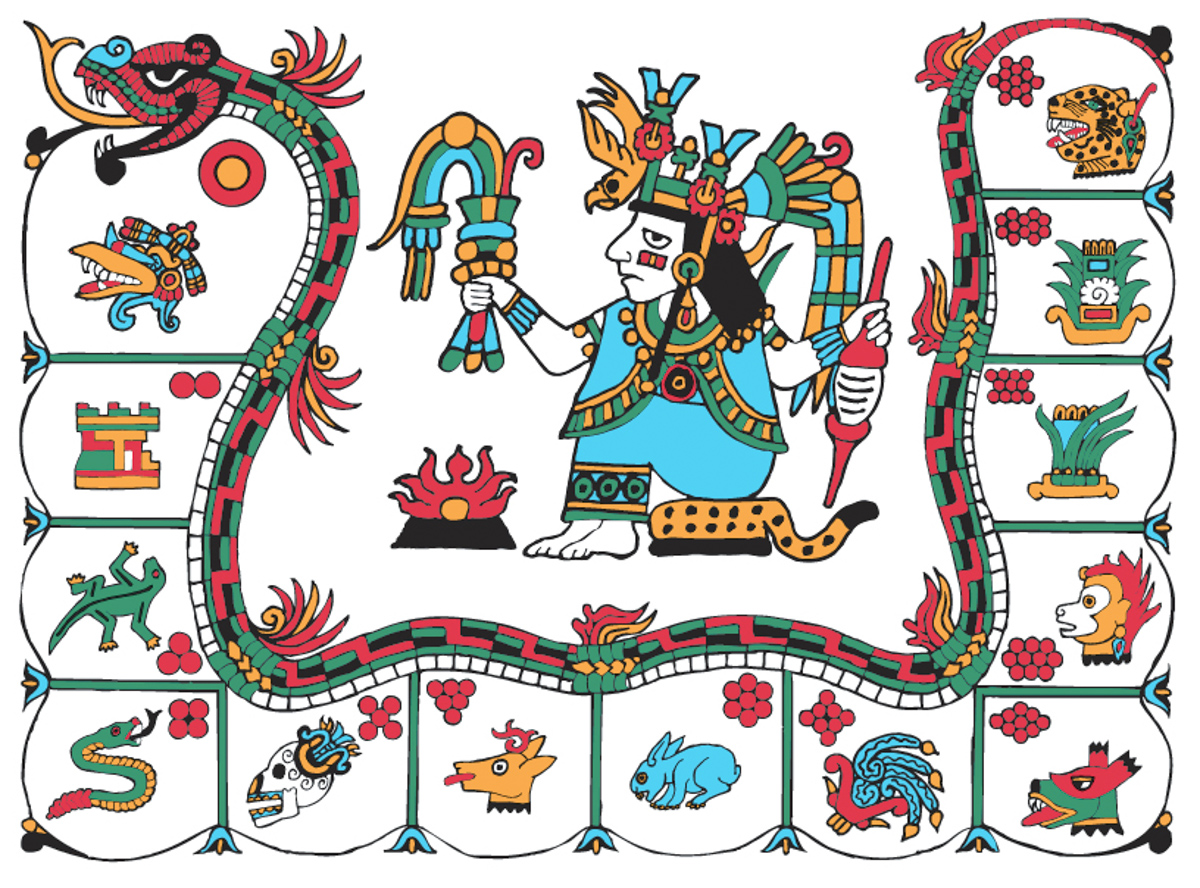
As described in my earlier blog The Aztec Calendar – My Obsession, some thirty years ago—on the basis of very limited ethnographic information and iconographic models —I presumed to create my own version of a Tonalamatl, publishing it in 1993 as Celebrate Native America!
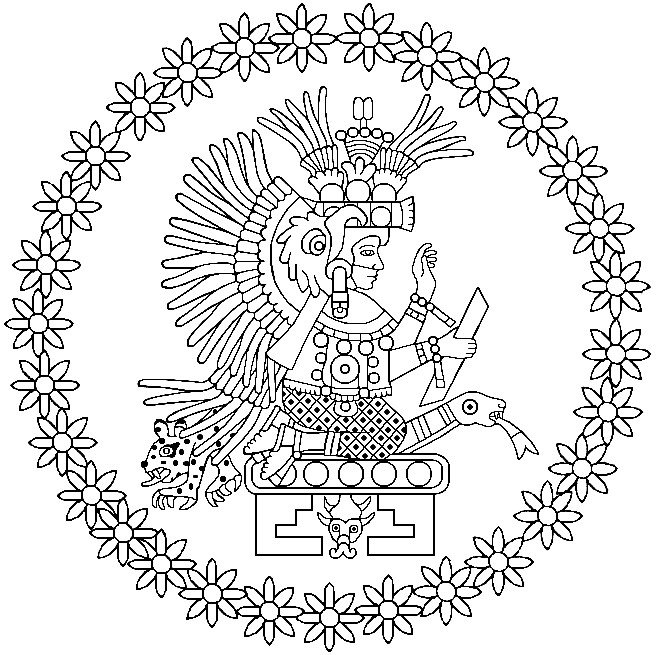
At the time, I didn’t know about Chantico’s importance as a volcano goddess, and my version of her is a quintessentially Codex Nuttall matron tending a stylized hearth-fire. I acknowledged her domestic role by including the weaving spindle—a detail far more appropriate for the goddess Tlazolteotl. The golden bird in her headdress is probably completely out of place, but her jaguar-pelt throne is perfectly appropriate for a goddess. In my Icon #4, I posed Chantico in an ornamental house (temple), which must have been aesthetically successful because that was the one icon banner stolen from the last venue of my YE GODS! show.
#
TONALAMATL BORGIA (re-created by Richard Balthazar from Codex Borgia)
Aztec Calendar – Wind Trecena -Tonalamatl Borgia
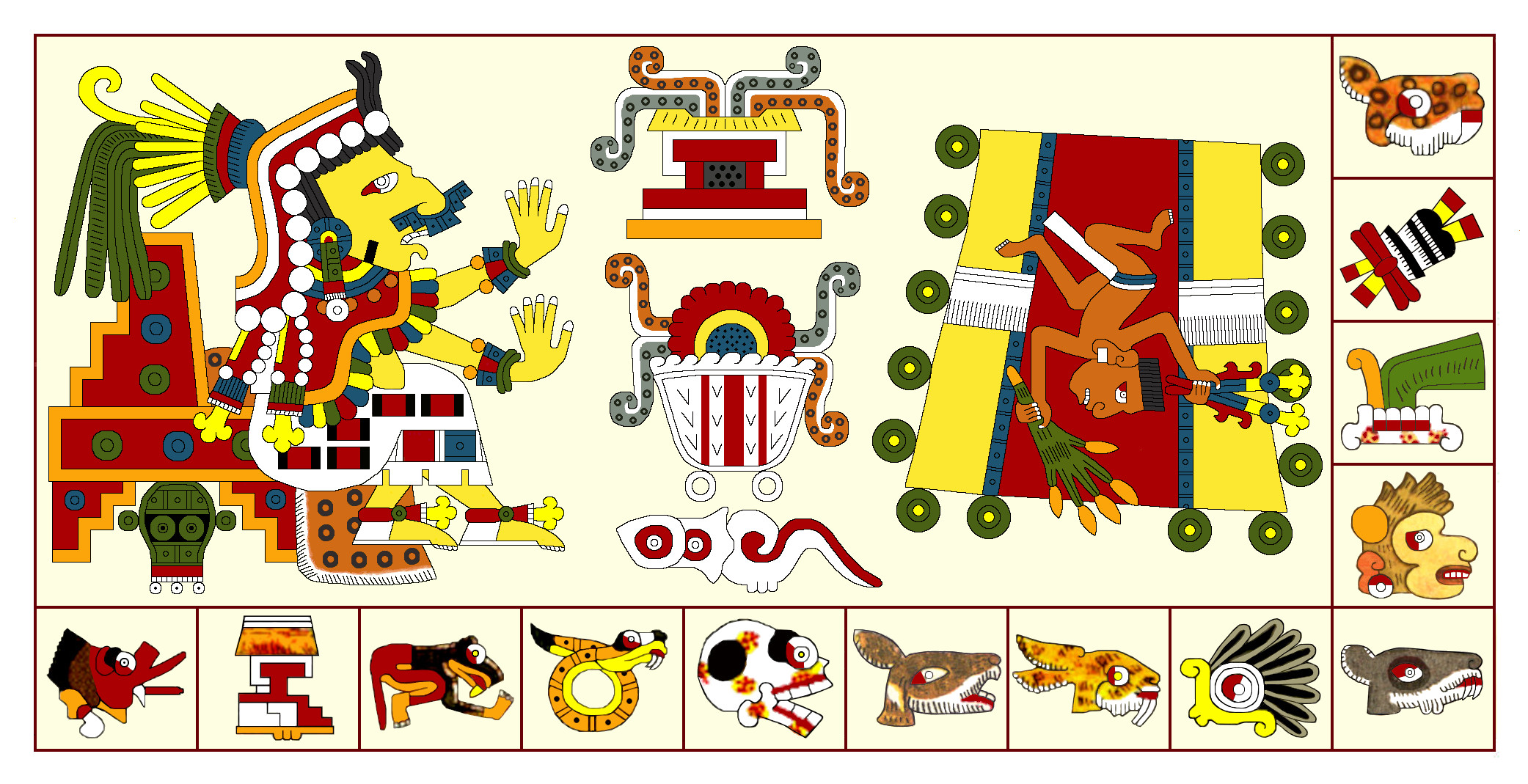
The Wind Trecena page in Codex Borgia shows Chantico, sometimes called the Lady of Jewels (Lady of Wealth) as ornately adorned with what may be numerous pearls, but there is little else to identify her. Her nose ornament is a little too generic to serve that purpose, and the enigmatic item (inverted pot?) under her throne doesn’t help either.
More to the point, the three ornate symbols in the center of the panel are glyphs illustrating Chantico’s realms of power. At the top center is a burning temple, metaphorical for fire in the earth (volcano), and in the center is the fire in a hearth/container, both with orangish and gray curlicues of flame and smoke. The large conch at bottom center is probably a reverent gesture or reference to Quetzalcoatl on his special day One Wind.
Much more puzzling than the upside-down pot is the emphatic image on the right side of the panel: an inverted person seemingly falling across a mat or piece of fabric, most definitely not dead—which falling headfirst usually signified—and holding bouquets of vegetation and brightly flowering penitential thorns. Not much to go on here for what this apparently important third of the patron panel might mean. The commentary by Bruce Byland in the Diaz & Rodgers restoration of Codex Borgia doesn’t devote even one syllable to this intriguing detail.
#
TONALAMATL YOAL (compiled and re-created by Richard Balthazar on the basis of Codex Telleriano-Remensis and Codex Rios)
Aztec Calendar – Wind Trecena – Tonalamatl Yoal
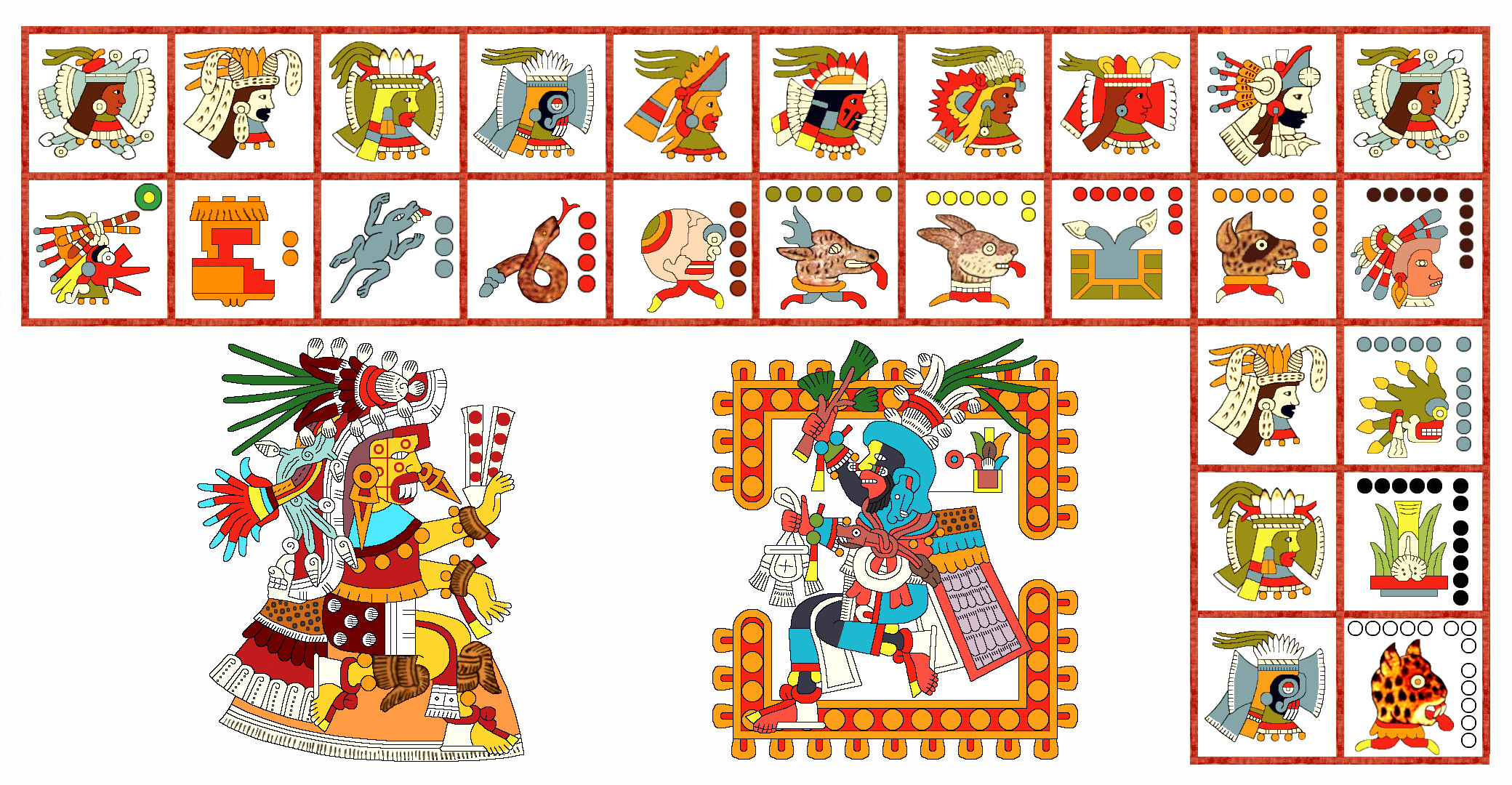
As usual, in its images of deities for the Wind Trecena, Codex Telleriano-Remensis (and consequently Codex Rios) didn’t skimp on displaying emblems, symbols, and traditional regalia, though the codex-artists didn’t always agree on details. The figures recreated here are based mostly on T/R images with occasional minutiae from Rios. Both figures, of course, had to undergo radical orthopedic surgery for iconographic anatomical awkwardness.
In any case, the paired images make a striking combination. Let’s come back later to the guy on the right and scope out the divine Chantico on the left. Would you look at that headdress! A dark-feathered and be-sea-shelled crest of quetzal plumes pours forth streams of fire and water, creating an elegant atl-tlachinolli (water-fire) glyph—as discussed in the Snake Trecena—usuallya symbol of war, but here I think it represents the waters of birth and fire of spirit, attributes of the goddess. Her facial markings and matching ear- and nose-pieces are unusual, but the most disturbing (and unique) detail is her set of Tlaloc-like fangs. How does one fit that sinister motif into Chantico’s official hagiography?
Now we can check out the guy on the right, a figure most unusually in a decorative frame. The little day-sign attached to the back of his head is One Reed—which was used in the Snake Trecena to identify Tlahuizcalpantecuhtli, a nagual of Quetzalcoatl. However, this seems to be Quetzalcoatl himself, probably in honor of his One Wind Festival. Strong evidence is the circular pendant, serpent accessories, black body, and tri-colored face. In fact, Quetzalcoatl was known as One Reed in central Mexico from the ancient Toltec tradition (and in more southerly areas with even older Maya traditions as Nine Wind).
The notations on the T/R and Rios pages (in Spanish and Italian) clearly name the guy Quetzalcoatl but only comment on the frame as his casa de oro. But there’s no way the little falling guy in Borgia can be construed as the great god Quetzalcoatl nor can that decorative mat compare to this deity’s golden house. Whatever Borgia meant by that strange scene may have been used by the T/R artist as an excuse to celebrate Quetzalcoatl as a star of the trecena.
#
OTHER TONALAMATLS
Tonalamatl Aubin patron panel for Wind trecena
The patron panel in Tonalamatl Aubin merely complicates the situation, presenting an upright little guy with bouquets and without any emblems of Quetzalcoatl—though now in a casa de oro. That motif may bode a deeper significance than even Borgia’s fancy mat. Thinking at first that Yoal’s One Reed glyph might in fact identify Tlahuizcalpantecuhtli, I wondered if maybe the casa de oro could represent the House of the Dawn. That motif also has a connection to Quetzalcoatl as the planet Venus, but I know of no connection between Chantico and dawn. The matter of the little guy remains mysterious.
The hearth fire at the top center is of course symbolic of Chantico, whose plumed headdress is similar to that worn by both figures in the Yoal panel. Her atl-tlachinolli glyph and skull-bustle are repeated here, but the conch over her head seems damaged. The big serpent under her throne must symbolize emphatic sexuality, but I can’t explain the pile of something or other pierced by penitential thorns. The central offering bowl seems rather pitiful, as do the grotesque hands and feet on both figures. Overall, this patron panel isn’t particularly inspiring.
#
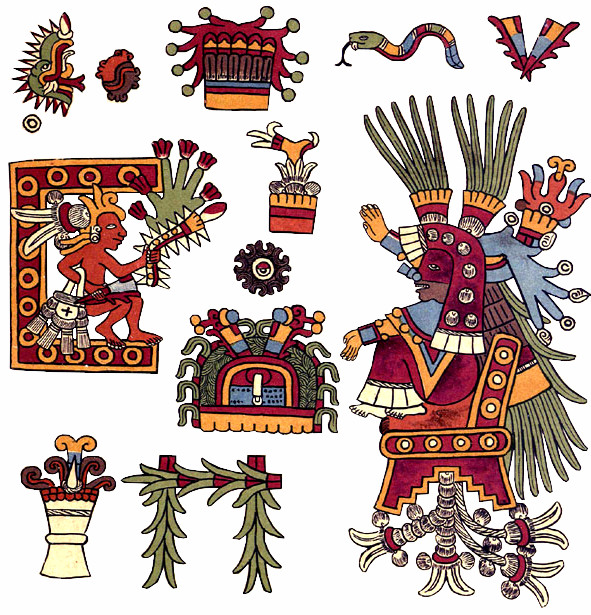
Codex Borbonicus patron panel for Wind trecena
On the other hand, the patron panel from Codex Borbonicus is enchantingly ornate. It presents another casa de oro on the left with a common mortal who carries a standard bouquet/weapon and incense bag but again wears the Yoal-style plumed headdress. He does nothing to clarify the mystery. On the right, Chantico sports great bunches of quetzal plumes, another dramatic atl-tlachinolli glyph, and under her throne familiar plumed tassels with seashells. Her unusual sitting posture (hovering above instead of in front of the throne) may be intended to add to her ethereal/divine presence. That nose-clamp looks painful.
The scattered conglom of ritual items raises several questions. Starting in the upper left, what’s the significance of the day-sign One Crocodile (first day of the tonalpohualli)? Or of the standard-design rock/stone. No idea… Top center may be a glyphic hearth-fire. On the lower left seems to be an incense burner, but the leafy swatches beside it are inscrutable. The mounded item just above may be a metaphor for fire in the earth (volcano) and could relate to Aubin’s pile of something or other. But most iconic is the little frilled circle in the center with a star or divine eye in the middle. A traditional symbol of magic or sorcery, it’s the only reference in these patron panels to this trecena’s theme of necromancy.
#
Codex Vaticanus patron panel for Wind trecena
The patron panel from Codex Vaticanus again repeats the inventory of motifs from Borgia, including burning temple, hearth-fire, and conch. But it deepens the mystery of what the little guy represents. Here, he’s a blue figure (possibly a corpse?) in what looks like a box rather than on a mat or in a casa de oro. Still no answers… Apart from her fancy skirt, cape, and body-tattoos, Chantico is pretty plain. Her sitting with feet forward is most unusual, and the confusion of her arms detracts from any divine magnificence.
#
My ancient intuition about Chantico was apparently right on making her a normal, stylish woman. Appropriately, some patron panels give her dramatic emblems I didn’t know about like plumed headdress, fire-water glyph, and power symbols of hearth-fires and volcanoes. While her Borgia portrait is glamorous, her image in Yoal is more ornamental than most calendrical deities in that tonalamatl. Her pairing with the cameo of Quetzalcoatl makes one of the more exquisite Yoal panels, but we can’t take that to mean that he’s also a patron of the trecena. This guy One Reed seems more like a Master of Ceremonies for the magicians’ fiesta week. Maybe the strange little guys in the other tonalamatls are sorcerer-performers.
###
You can view all the calendar pages I’ve completed up to this point in the Tonalamatl gallery.
After wrapping up my little piece about Morning Star mythology in Pre-Columbian America, I turned back to re-creating Aztec codex pages from the calendar and my work on the Vulture trecena (13-day ‘week’), its patron being the god of the Evening Star. The detailed process of pixelating is fairly time-consuming and lends itself to much cogitation and curiosity about the deity at hand. But first some Maya stuff on the Evening Star.
Lady Evening Star of Yaxchilan
No surprise, but my internet search provided precious few hits for Maya Evening Star, the only one being for a Maya queen of Yaxchilan named Great Skull and known as Lady Evening Star. Here’s some fancy ancient royalty gossip: A princess from the formidable city-state Calakmul, she married the ruler of Yaxchilan, Itzamnaaj B’alam III (Shield Jaguar the Great), was the mother of Yaxun B’alam IV (Bird Jaguar) and ruled 742-751 CE until her son’s maturity.
Apart from being the title of a regal queen, other Maya concepts of the Evening Star, if there were any, have been lost to the fires of history. Unless they were carved in stone like this portrait of Lady Evening Star on Stela 35 from Yaxchilan. References on Venus, a hugely important theme in Maya astronomy and culture, rarely even mention the Evening Star, though the Maya well knew it was related to the Morning Star as another phase of that planet.
I have no doubt that the famous Dresden Codex probably discusses the Evening Star, but I can’t read through those boggling glyphs looking for mentions and have no idea what it was called in either the Yucatec or Quiché Maya languages. But I really wanted to find out something of the history and mythology of my Vulture trecena patron.
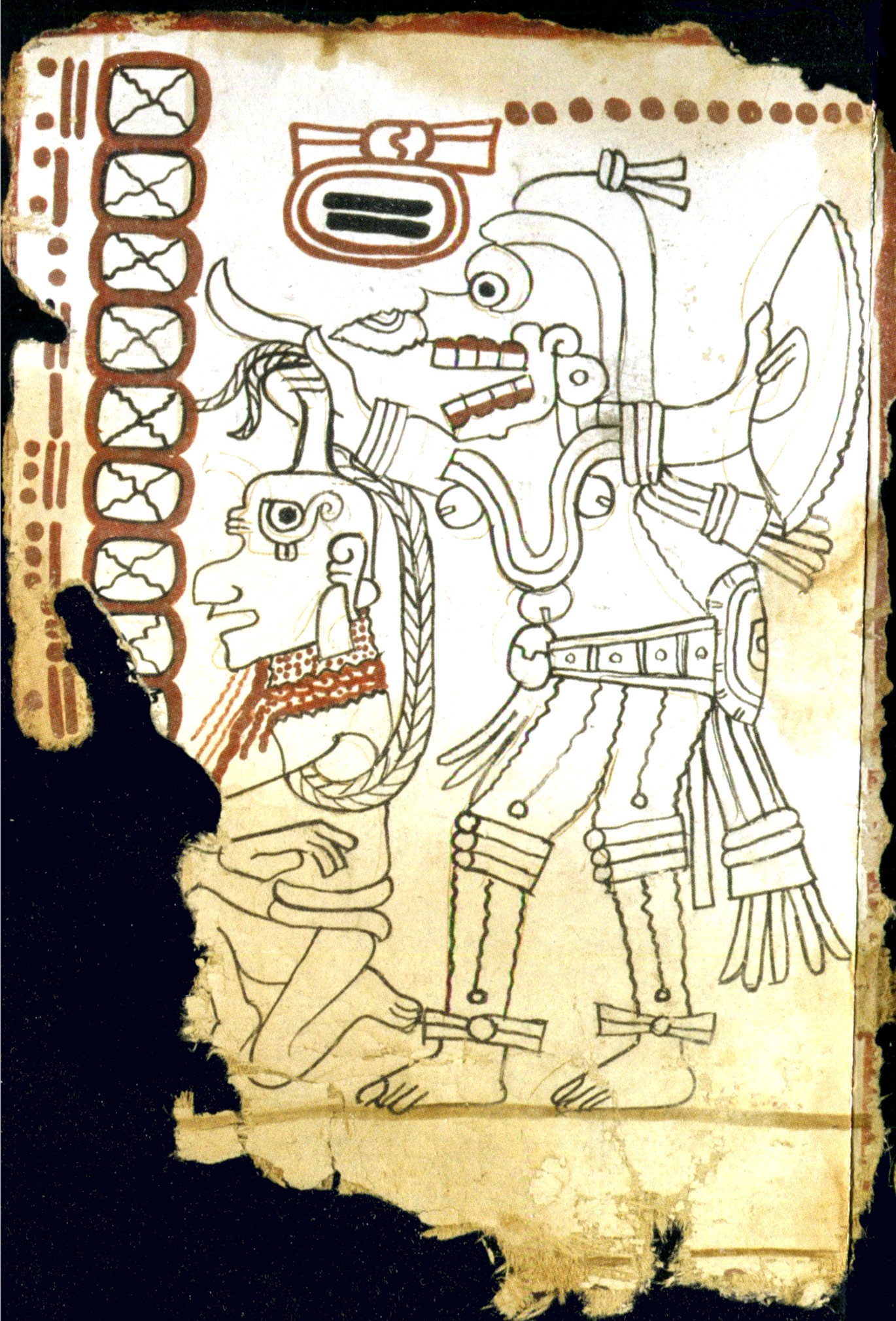
That’s why I went back to my program from the Getty Museum show of the Maya Codex of Mexico (the Grolier Codex), a Maya-Toltec document dating 1021-1154 CE, where in the fragmentary pages on the cycles of Venus, I’d found the Morning Star image that inspired my earlier blog. In fact, for the Evening Star phases, the Maya Codex contains three gruesome images that show a deity with a death’s-head/skull-face. The best preserved presents a deity holding up a victim/prisoner’s bleeding head, apparently having recently decapitated the poor fellow with a large flint knife in his other hand. The skull-faces no doubt mean that the Maya identified the Evening Star is an entity of the Underworld (Xibalba), which wasn’t necessarily a bad thing. They considered life and death a mystical continuum.
Evening Star, Codex Maya de Mexico
The Underworld connection could well belong to an original Maya notion of the Evening Star. In later traditions, it was considered the guide/companion of the sun on its nightly journey through the Underworld. The earlier Maya may well have had a similar myth for the bright star that followed the setting sun. I hesitate to speculate on the Maya meaning of the victim in this scene, but it bears witness to the long-standing tradition of human sacrifice in Mesoamerica. Natural phenomena (like the movement of the sun, the rain, etc.) always came at a price in human blood.
Though the Maya Codex shows the Morning and Evening phases of Venus as different types of figures (including a being with a mask suggestive of a storm-deity), they understood well that it was all the same planet. Maybe Chak Ek’ was actually the deity of Venus itself, making no distinction between its phases: 236 days as Morning Star, 90 days in superior conjunction (behind the Sun), 250 days as Evening Star, and 8 days in inferior conjunction (passing between Earth and Sun). That would explain finding no evidence of separate deities, but of course finding no evidence of something doesn’t prove the absence of that something.
Similarly, I’ve found nothing on what the Venus-phases meant to the culture of Teotihuacan, which certainly revered the planet as the god Quetzalcoatl. That central Mexican metropolis possibly also didn’t separately deify the Morning and Evening Stars. However, the Maya Codex indicates that by Toltec times the concepts of the two phases were diverging, at least in their visualizations. At some time in succeeding centuries, later Nahua cultures evidently completed the separation, generating the new deity Tlahuizcalpantecuhtli (Lord of the House of the Dawn) for the Morning Star and another called Xolotl for the Evening Star.
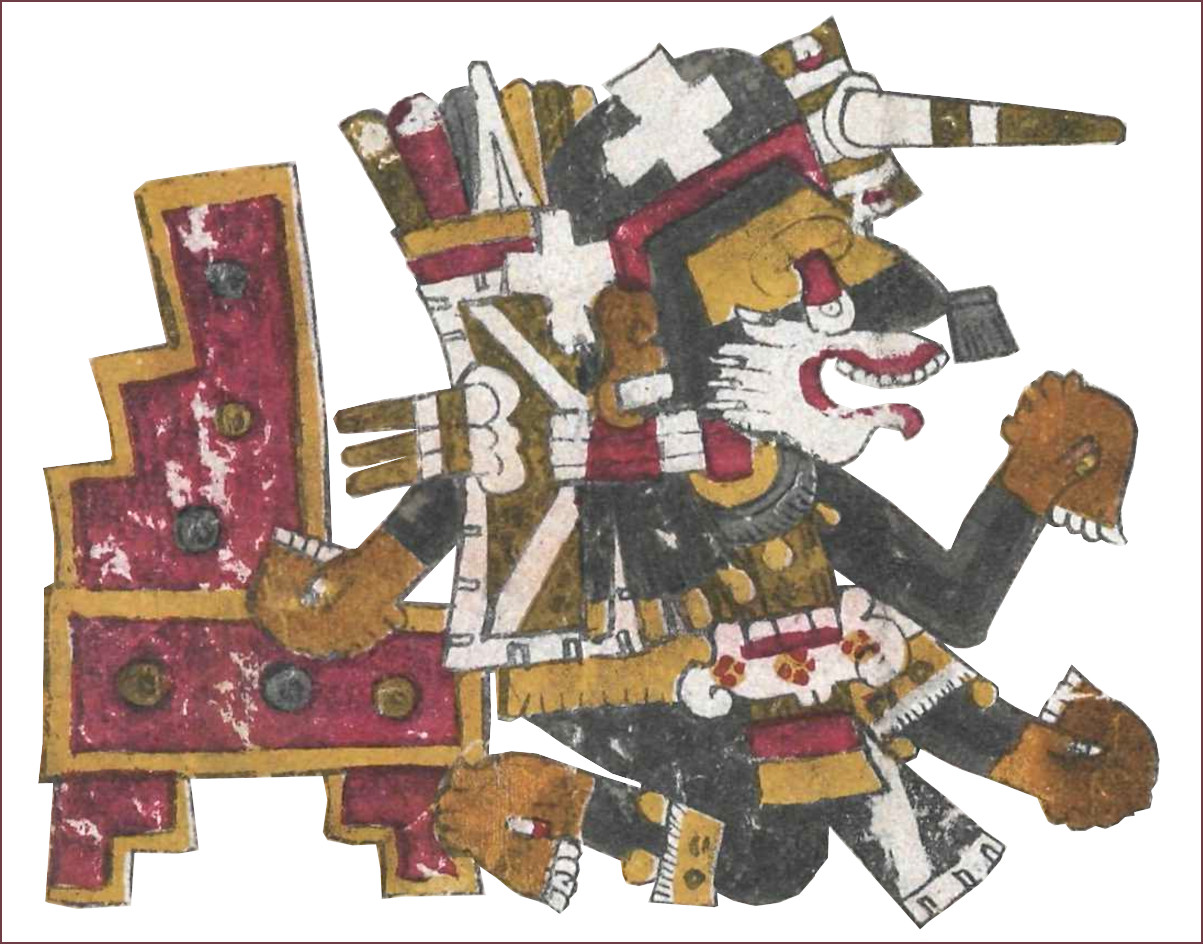
Oddly, they deified the dog as the Evening Star—literally the apotheosis of dog! In two of the surviving “Aztec” codices, the new god appears in strikingly similar poses vividly recalling the decapitation motif in the Maya Codex. The earlier Underworld connection of the Evening Star is suggested by the night-capes both of these Xolotls wear.
Two Xolotls with Victims, Codex Fejervary-Mayer l., Codex Vaticanus r.
Since so little is known about the Maya Evening Star, most authorities like to extrapolate the later mythology of Xolotl back into that period, but I wonder if such lore was in fact inherited. The Maya indeed revered the dog as a guide, companion, protector and bringer of light to darkness, which may have involved escorting the sun through the night. However, Xolotl’s role as psychopomp for souls through the Land of the Dead (Mictlan), eerily paralleling the Hellenic concept of Cerberus in Hades and the Egyptian god Anubis, may well be a later elaboration.
A specific Maya reference to the dog is four images on pp. 25, 26, 27 & 28 of the Dresden Codex shown in relation to rituals for celebrating new years, but I don’t know how that might fit into the ancestry of Xolotl. In any case, they underline the cultural importance of the dog.
Xolotl appears relatively often in the surviving codices, in all but one instance in the guise of a dog. In Codex Borgia the dog-god occurs three times in its typically ornamented style, one too damaged to make out any details. The figure on the left below appears in the “magical journey” sequence, and the central image is from a “heaven temple.” The Sun symbol on its back refers to escorting the Sun through the Underworld at night. Earlier in the codex, as patron of the day Earthquake, Xolotl appears uniquely as a deformed human—which is no doubt why scholars have called him the deity of monstrosities, including twins. (The twin theme obviously refers to the close relationship between the Evening and Morning Stars.)
Three Xolotls, Codex Borgia
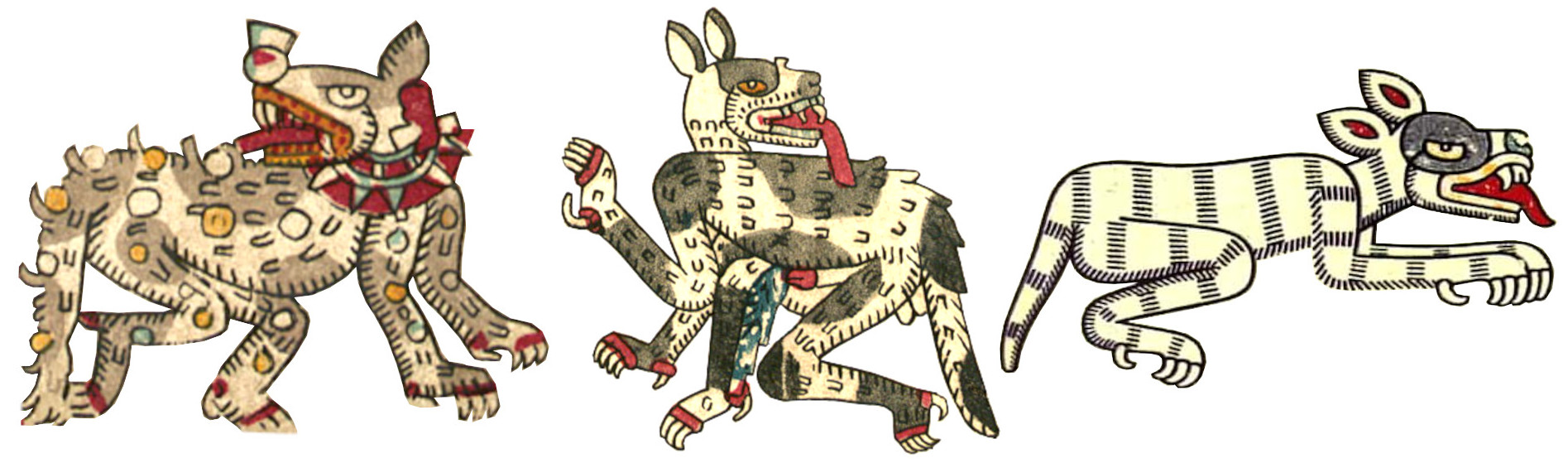
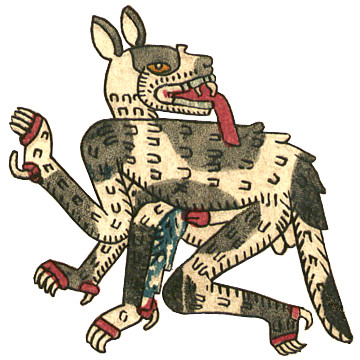
In two other codices, Xolotl is depicted as a fairly naturalistic dog, unfortunately not naturalistic enough to discern its breed. In the Nahuatl language, “dog” is Itzcuintli, but that’s also a generic term. These images only indicate some sort of a shaggy dog, not at all like the hairless canine Xoloitzcuintli (named for the god) which has been designated the national dog of Mexico. These dogs also look nothing like the small chihuahua which was apparently raised for eating. The spiked collar on the left example I expect is an abstracted “night-sun” symbol, and the explicit anatomy of the central figure is hard to overlook.
Three Naturalistic Xolotls, Two (l.) from Codex Vaticanusand One (r.) from Codex Laud
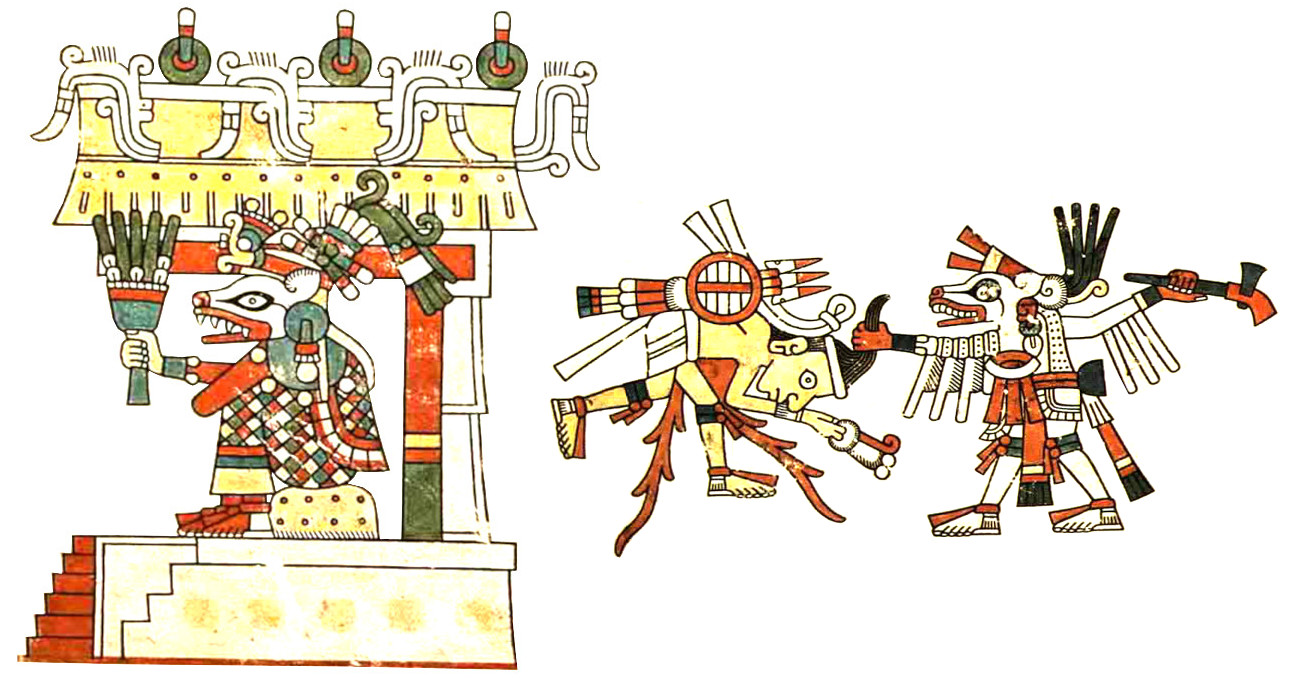
Said to have come from the area of Veracruz, Codex Fejervary-Mayer conversely presents Xolotl as a full-fledged, anthropomorphic canine deity ensconced in an elegant temple. In addition, the codex contains several pages with this Xolotl in various aggressive postures, (including eating someone’s head!), which recall panels of Morning Star violence. In one, Tlahuizcalpantecuhtli mysteriously wears a dog’s head. These Codex F-M scenes may indicate a lingering conceptual overlap between the two phases of Venus in a distant conservative area of Mexico.
Two Xolotls, Codex Fejervary-Mayer
The scene on the right surely relates to the earlier images with victim, but here blood issues from his body like from a heart sacrifice. Another conservative aspect of Codex F-M iconography is that, except for the first one holding the victim and heart, its Xolotl dog-gods all have the same head—basically that of those anthropomorphic New-Year dogs in the Dresden Codex. Here we see examples of mythological evolution in action.
In codices with tonalamatls (books of the Aztec Calendar), Xolotl is celebrated as the patron of the Vulture trecena and formally consecrated as the god-dog, often enthroned.
Three Divine Xolotls, (l – r)Codices Borbonicus, Borgia and Vaticanus
Besides their masses of divine regalia, all three wear the conch-shell pendant (‘wind-jewel’) symbolizing their connection to Quetzalcoatl/Venus, but none is breed-specific. Curiously, the Vaticanus example is swaddled in a traditional corpse-bundle, perhaps a veiled reference to the Evening Star’s Underworld connection. Now that’s a trio of indisputably alpha dogs!
In its Vulture trecena patron panel, Codex Telleriano-Remensis, an early post-Conquest text painted on European paper, takes the dog to a yet higher level of glory, presenting a fantastic, iconic, metaphorical scene of Xolotl as the brilliant Evening Star with a gleaming Sun (Tonatiuh) setting into the gaping maw of Tlaltecuhtli, Lord of the Earth.
Evening Star with Setting Sun From Codex Telleriano-Remensis (re-creation)
Personally, as an opinionated artist, I think this eye-boggling panel is an absolute epitome of Aztec iconography. You’re welcome to your own opinion. Meanwhile, I’ll note that here Xolotl looks absurdly like a Pekinese, but that makes no difference to the spectacular metaphor.
#
Unlike the myths of the Morning Star, it’s surprising that with the celebrity of Xolotl in Mesoamerica, the Evening Star cult didn’t spread into North America. However, the dog’s traditional loyalty, companionship, guidance and protection was generally appreciated by tribes across the whole continent, and sometimes it was included in rituals and ceremonies. I’ve only found a few legendary references from the Ojibwe and Pawnee (usually about wife or daughter of the Evening Star) and one from the Algonquin about an Osseo, Son of the Evening Star, but there’s no connection to a dog. It seems that Xolotl’s godhead was only valid in Mexico.
But that hasn’t mattered much. All across North America, dogs domesticated humans beings and became de facto gods in their own right, ruling their mortal owners’ Morning (days) and Evening (nights) and living (for the most part) idle lives of divine luxury. Their worshipful care consumes an enormous sector of the economy, I’d bet grossly larger even than that for religious institutions—an apotheosis without even needing an Evening Star mystique or human sacrifice.
The sixteenth trecena (13-day “week”) of the Aztec Tonalpohualli (ceremonial count of days) is called Vulturefor its first numbered day, which is coincidentally the 16th day of the veintena (20-day “month”). In Nahuatl, Vulture is Cozcacuauhtli.However, for the Maya, the day apparently had only a peripheral association with the vulture and was known as Kib’ (Wax or Candle) in Yucatec and Ajmac (Owl or “sinner”) in Quiché with different significance. Per Dr. Paquin’s fine book (cited below), the Maya saw Kib’ as connected with the four Bacabs (directions or sky-bearers) and associated it with incense, the “soul force” of the universe, and notably bees.
On the other hand, the Aztec saw the day Vulture connected with the spiritual realm, restoring order and balance, and prosperity. Folks born on a Vulture day would be vigorous, prudent, wise, and good teachers and advisors. Those born on One Vulture would be happy, wealthy, admired, and lucky in business. Anatomically, the day was connected with the right ear.
PATRON DEITY RULING THE VULTURE TRECENA
The patron of the trecena is Xolotl, the Evening Star, god of twins, often called the “Evil Twin” of Quetzalcoatl (by the goddess Chimalma, while other lore has them borne by Ometeotl, the Creative Pair). Still other lore says Xolotl and Tlahuizcalpantecuhtli (Morning Star) are the real twins, though the Morning Star is the more dangerous/evil, and what’s more they’re both naguals of Quetzalcoatl (Venus). Also, reflecting the Maya Hero Twins, Quetzalcoatl and Tezcatlipoca are supposedly the famous twins, which further obfuscates divine family trees.
Usually, twins were seen as monstrosities, one of the two often killed at birth, and so Xolotl is called the deity of monstrosities. Adding to his “evil” reputation, he’s considered the god of malice and treachery, representing the bestial side of people, the opposite of intellect.
Recalling the European three-headed dog Cerberus in Hades and the jackal/dog Anubis in ancient Egypt’s Duat, Xolotl is most often depicted as a dog—who serves as psychopomp of souls in Mictlan. In the same way, when the Cihuateteo have brought the sun to its setting, the dog-god escorts Tonatiuh on his nightly journey through the Underworld. The setting sun-god is called Tlalchi-Tonatiuh, Sun close to (or under) the Earth, and is occasionally thought of as an ephemeral “patron” of the Vulture trecena.
AUGURIES OF THE VULTURE TRECENA
By Marguerite Paquin, author of “Manual for the Soul: A Guide to the Energies of Life: How Sacred Mesoamerican Calendrics Reveal Patterns of Destiny” https://whitepuppress.ca/manual-for-the-soul/
Trecena theme: Mischief, Duality, Transformation. With the patron deities of this trecena both representing of the close proximity of the sun to the earth, it is not unusual to see some tendency towards “fire in the earth” during this period. These energies seem to underscore the dualistic nature of this trecena, metaphorically suggestive of the sun’s journey through the underworld, and its struggle towards rebirth. This can precipitate havoc, often of an intense or fiery nature, often involving some form of duality. However, the ultimate purpose is often transmutation, a push towards the birth of something new, as suggested by the initiating energy of Kib’, the Vulture energy that is ultimately oriented towards a restoration of order.
Further to how these energies connect with world events, see the Maya Count of Days Horoscope blog at whitepuppress.ca/horoscope/ Look for the Kib’ trecena.
THE 13 NUMBERED DAYS IN THE VULTURE TRECENA
The Aztec Tonalpohualli, like the ancestral Maya calendar, is counted through the sequence of 20 named days of the agricultural “month” (veintena), of which there are 18 in the solar year. Starting with the 16th day of the veintena, 1 Vulture, it continues: 2 Earthquake, 3 Flint, 4 Rain, 5 Flower, 6 Crocodile, 7 Wind, 8 House, 9 Lizard, 10 Snake, 11 Death, 12 Deer, and 13 Rabbit.
There are two special days in the Vulture trecena:
Four Rain (in Nahuatl Nahui Quiahuitl) – Featured on the Stone of the Suns, this is the day-name of the idyllic Third Sun/Era ruled by the Storm God Tlaloc. However, when Tezcatlipoca abducted his wife Xochiquetzal, the angry deity destroyed the world in a rain of fire (probably a volcano). Its people became butterflies, dogs, or birds—some say turkeys.
Five Flower (in Nahuatl Macuil Xochitl) is patron of games (particularly patolli) and gambling, music and singing, who brings and cures hemorrhoids and venereal diseases. He’s one of the five Ahuiateteo (Gods of pleasure and excess thereof). So far we’ve seen Five Lizard, Five Vulture, and Five Rabbit, and we’ll meet Five Grass in the last trecena, Rabbit. They are sometimes also called the Macuiltonaleque (Lords of Number 5) who escort the sun (Tonatiuh) across the day-sky and deliver him to the five Cihuateteo to prepare him for sunset, whereupon Xolotl takes him through the Underworld night.
THE TONALAMATL (BOOK OF DAYS)
Several of the surviving so-called Aztec codices (some originating from other cultures like the Mixtec) have Tonalamatl sections laying out the trecenas of the Tonalpohualli on separate pages. In Codex Borbonicus and Tonalamatl Aubin, the first two pages are missing; Codex Telleriano-Remensis and Codex Rios are each lacking various pages (fortunately not the same ones); and in Codex Borgia and Codex Vaticanus all 20 pages are extant. (The Tonalpohualli is also presented in a spread-sheet fashion in Codex Borgia, Codex Vaticanus, and Codex Cospi, but that format apparently serves other purposes.)
TONALAMATL BALTHAZAR
As described in my earlier blog The Aztec Calendar – My Obsession, some thirty years ago—on the basis of very limited ethnographic information and iconographic models —I presumed to create my own version of a Tonalamatl, publishing it in 1993 as Celebrate Native America!
In those dark ages of the early 90s, my information on most Aztec deities was severely limited. I’d read about Xolotl being the Evening Star and god of monstrosities but had no clue about his canine or solar characteristics. Reacting solely to a comment about his “reversed hands and feet” (but unaware that iconographically a great many divine hands and feet got reversed), I once again gathered regalia and motifs from Codex Nuttall, without realizing its appropriateness made up a wicked kind of Tlaloc mask, and to ice the cake, gave my Xolotl a hunched back. Though terribly inaccurate in detail, the result was sufficiently monstrous for its purpose. In fact, you’ll see shortly that it’s rather nicer than a disturbing authentic image of Xolotl Deformed.
The Vulture trecena panel in Codex Borgia is a great piece of positive PR for Xolotl showing an almost cuddly puppy-dog (major fangs and jaguar claws notwithstanding). It avoids implying any sinister aspect, except perhaps the bloody teardrop. Meanwhile, his nagual-connection to Quetzalcoatl is stressed by that god’s emblematic conch-shell pendant (wind-jewel).
Xolotl is obviously the sole patron in this panel, the other items being simply ritual details. The Earthquake day-sign by his foot indicates his patronage of that day, and the four dots specify the day-name of the current Fifth Sun. The deer-leg in the bowl above is a frequent offering to deities, but I can’t even guess what the bag of plumes might mean. The chopped-up snake we now know as a common symbol of sacrifice. Overall, the panel makes a pretty poster.
However, Codex Borgia doesn’t always issue pretty propaganda for Xolotl. Other pages may well have been drawn by different artists—like the panel depicting Xolotl as patron of the day Earthquake. Rather than as a dog, it shows him as a deformed monstrosity:
Xolotl Deformed, Codex Borgia
Here the bloody teardrop has become a drooping eyeball which a dubious legend ascribes to his “crying his eyes out” when at the creation of the Fifth Sun, Ehecatl supposedly massacred various gods. I frankly can’t accept that wild story, nor the claim that Xolotl was also murdered by the Wind God and turned into an axolotl (a “water-dog” salamander). After all, who would now lead Tonatiuh through the Underworld at night (or souls through Mictlan)?
There’s a lot of confused lore about Xolotl, often cited by Spanish priests/ethnographers for nefarious reasons, including a claim that he helped Quetzalcoatl bring the bones of people from the Fourth Sun up from Mictlan to create the people of the Fifth Sun. In much more likely fact, it’s actually Ehecatl who made that arrangement with Mictlancihuatl, the Lady of Mictlan. As well, being the Breath of Life, Ehecatl is an extremely unlikely mass murderer. Conversely, Spanish writers tried to whitewash Quetzalcoatl as being opposed to human sacrifice—in order to use him in their catechism as a Christ-figure.
By the way, the drooping eyeball might symbolize an Underworld connection. It’s emblematic of the Cihuateteo and shown in Borgia Plate 42 on several figures being “generated” by a death-deity. The hand across Xolotl’s lower face is essentially an emblem of the Ahuiateteo, and these two details may intend his connection with those other escorts of Tonatiuh.
#
TONALAMATL YOAL (compiled and re-created by Richard Balthazar on the basis of Codex Telleriano-Remensis and Codex Rios)
Aztec Calendar –Vulture trecena – Tonalamatl Yoal
Talk about pretty posters! I think this Tonalamatl Yoal patron panel takes the cake, so to speak. In Yoal’s colorful, fancy style, a super-ornate Xolotl (nothing at all sinister here) is paired with an equally ornate Tlalchi-Tonatiuh as the sun sinking into the gaping maw of Tlaltecuhtli, Lord of the Earth. It’s a stunning image of the Evening Star at the ephemeral moment of sunset, epitomizing the myth of Xolotl as the sun’s companion through the night.
In this regard, let me opine that the artist(s) of Tonalamatl Yoal had splendid artistic concepts for their trecena patron pairs—which were unfortunately isolated on separate pages—but frankly they lacked the technical expertise to fully achieve those concepts. That’s why I felt justified in “re-creating” their images—to make them more of what the original artist(s) must have had in mind. Their original sketchy, careless images simply couldn’t convey the art of their vision.
I hesitate to comment more on this panel but must. You will note that in Yoal’s fashion, the figure of Xolotl is heavily loaded with divine regalia, naturally including several items associated with Quetzalcoatl. Curious is the inclusion in his headdress of a bunch of unspun cotton and a spindle of spun thread, generally emblems of the goddess Tlazolteotl. But even more curious is the fact that Xolotl’s canine head looks very like a Pekinese, another cuddly puppy.
This gorgeous image of Tlalchi-Tonatiuh wears a Tlaloc-like mask with a goggle-eye but remarkably has no traditional fangs. Though Codex Rios annotated this figure (in Italian) as “Tlachitonalie,” I didn’t know what that meant, and several years ago I took this to be the God of Rain Quiahuitl to use for my Icon #15. Now I understand that it’s in fact the setting sun, and the rain-mask is probably connected with the sun’s watery route through Mictlan (where nine rivers must be crossed). Live and learn. However, I’ve yet to learn what that strange item is protruding from his mouth with all the shell ornaments. No clue…
#
OTHER TONALAMATLS
Tonalamatl Aubin patron panel for Vulture trecena
Forget cuddly puppies in the Tonalamatl Aubin panel. Here Xolotl is so clumsily (one might say monstrously) drawn that he scarcely even resembles a dog. At least the three crosses on his regalia, the wind-jewel pendant, and the bow in his headdress connect him to Quetzalcoatl. Meanwhile, the little Tlalchi-Tonatiuh on the left with a full Tlaloc face wears a “night-sun” symbol and sinks into the merely schematic mouth of Tlaltecuhtli. The unusual border of flowing water may well be one of the rivers of Mictlan.
So far, so un-impressive. However, I’m struck by the free-floating items. The little bundle of sticks with a carrying strap is rather innocuous and uninteresting, but the chili pepper is quite emphatic. This is the first time I’ve seen one depicted in the codices, and other culinary ingredients are usually shown all together in a bowl or pot. This chili probably has some ritual significance. Maybe the inherent penance of eating something so hot?
This panel is perhaps the most disappointing in the whole troubling Aubin series. But that’s just me with my modern refined aesthetic. This Tonalamatl was painted in the state of Tlaxcala, and maybe the Tlaxcalans back then found it hugely beautiful. Eye of the beholder and all that…
#
Codex Borbonicus patron panel for Vulture trecena
The sunset theme is repeated in Codex Borbonicus, also with a Mictlan-river border, which like in Aubin is unique in its series of trecena patron panels. This Tlalchi-Tonatiuh with a bestial head and unknown something protruding from its mouth resembles Tlaloc or Quiahuitl only in the goggle eye. An exquisite “night-sun” symbol replaces its body as it sinks into the maw of an ornate Tlaltecuhtli. Paired with an ornamented Xolotl as a cute dog (Chihuahua?), this panel is a great metaphorical sunset with Evening Star, but I feel the Yoal panel outshines it vastly.
The conglom of ritual items is familiar: a deer-leg offering (as in Borgia and Aubin) and a wrapped bundle of sticks (as in Aubin). Occurring twice now, the latter must surely mean something divinatory. I’m amused by the impertinent snake in the incense bag—and struck by another penitential chili pepper! This intricate panel is perhaps the clearest example of iconographic connections between Tonalamatl Aubin and Codex Borbonicus.
#
Codex Vaticanus patron panel for Vulture trecena
As often noted before, iconographic connections between Codex Borgia and Codex Vaticanus are obvious in the Vulture trecena panel, portraying basically the same motifs in their individual styles. This Vaticanus Xolotl isn’t quite as cuddly as the Borgia version, but it’s elegantly adorned (with another emblematic wind-jewel). Its body being wrapped in a corpse bundle might lead one to think the Vaticanus artist simply got hooked on this simplistic device (after four other panels with the motif), but I believe it was used here with reason. Like in Borgia, there’s no reference to Tlalchi-Tonatiuh, and the corpse bundle establishes Xolotl’s important connection to the Underworld. I’ve taken the liberty of seriously restoring and rectifying this panel because it’s such a striking image of a mythical dog—worthy of a tattoo.
#
I’m still staggered by the jewel-like Yoal sunset scene with Xolotl as the Evening Star, but after this review of the Vulture trecena patron panels, I can’t help but conclude that the dog-god has been mythologically maligned. I’ve seen nothing to indicate malice, treachery, or even mischief. Though he might represent the animal and anti-intellectual aspects of nature, I expect that his monstrous reputation rests in that one Borgia image as patron of the day Earthquake. In the parallel day-panel in Vaticanus, he’s an almost naturalistic, enthusiastic hound:
Xolotl, Codex Vaticanus
###
You can view all the calendar pages I’ve completed up to this point in the Tonalamatl gallery.
Significantly, in the Aztec calendar March 6, 2024, was the day Ome Acatl (Two Reed) and my 115th birthday in that ceremonial cycle of 260-day years. In our western calendar, I’ve recently celebrated my 81st birthday, wrapping up nine cycles of nine Gregorian years and starting in on my tenth cycle. The nine include a first inchoate period of childhood and eight discrete personas. For lack of a better description, I’m calling this new ninth persona the venerable iconographer, researcher, and/or historical theorist. We’ll just have to wait and see how that pans out.
Here’s an illustrated summary of my nine cycles for easy reference.
Cowboy at 3 or 4
Inchoate Childhood in almost rural Indiana (9 years)—Little can be said about Dickie except that he was the bright but spoiled son of Yvonne and Ray. You can read about him between the lines of my memoir-biography “Ms. Yvonne, the Secret Life of My Mother.”
Class Picture at 15
Cute, clueless kid in the backwoods of Arkansas (9 years)—At 15 with a stylish flattop hairdo, Richard was an outstanding student, accomplished loner, and an avid rock’n’roll dancer, usually solo. He had the misfortune of being raised Catholic and being futilely in love with Annette Funicello. You can read about my adolescent traumas in my semi-fictional novel “Bat in a Whirlwind.”
At 21 in the House of the Rising Sun
Wild faerie slut in New Orleans’ French Quarter (5 years)—Shown here in 1963 in his apartment at 387 Audubon Street, Rick had just turned 21, was majoring in Russian at Tulane University, spent nights dancing in Latin and Greek sailor bars, and had urges to art and literature. In this photo he’s stunned by frenzied sex with a football-player named Tom. Such sordid adventures are described in my second semi-fictional novel “Divine Debauch.”
Early 1968 with Aimee
Reluctant father and Slavic scholar in northern universities (6 years)—Richie is pictured here in early 1968 at 25 with younger daughter Aimée in apartment on East Kingsley in Ann Arbor MI. On my marriage to Barbara and birth of older daughter Jacqueline, read my first real memoir “There Was a Ship.”
Single again in 1970 in Milwaukee
Hippie poet, footloose and feckless (2 years)—Photographed in December 1970 at 28 in his Bellevue apartment in Milwaukee by his mother on a visit, Richie was again stunned, first by the welcome shock of being divorced and second, by a passionate affair with a ballet dancer named Kenny. These two years of that and other love affairs are detailed in my second memoir “Lord Wind.”
In 1978 at Logan Circle
Courtesan in a Victorian mansion at Logan Circle in Washington DC (9 years)—Shown in 1978 at 36 in publicity photo for performance of his translation of Tchaikovsky’s opera “Joan of Arc” by the Canadian Opera Company in Toronto, Richard was now a professional arts administrator with OPERA America. My libidinous lifestyle in the 70s, DC’s golden age of gay liberation, is celebrated in my third memoir “Gay Geisha.”
At Gay Freedom Parade in Denver
Mature gay gentleman working in various glamorous cities (16 years)—Taken in 1982 when Richard was 40 at the Denver Gay Freedom Parade in a Denver Post front-page picture—with his partner Ernesto. He’d been working for the Central City Opera House and later would work in other arts organizations. Recent exposure to ancient American earthworks eventually led to my first nonfiction book in 1992, “Remember Native America!” Discovery of the Aztec Calendar in the late 80s led to my second in 1993: “Celebrate Native America!”
In 2006 with Baby Jade Tree
Grandfatherly gay character, the Used Plant Man of Santa Fe (16 years)—Taken in 2006 at 64 for an article in The New Mexican on Babylon Gardens, Richard had now become a grandfather four times over. I’d also written another nonfiction book, “Getting Get,” was still an avid disco dancer, gave shows of my sculpture (found-object assemblage), and was working on the above novels and memoirs.
Widely unknown elder writer and artist (10 years)—Pictured here in 2020 at the age of 78 in New Orleans for a new production of “Joan of Arc” (by the New Orleans Opera), Richard was retired from business and now spent his time in (Aztec) drawing and finishing the above novels and memoirs. In the later 20-teens, my show YE GODS! (Icons of Aztec Deities) enjoyed seven venues across NM before being closed down by the pandemic. It also hampered my ecstatic dance activities, but the solitude facilitated my blogging and artwork on Aztec themes.


















 Richard Balthazar

