The Mighty Morning Star

For at least 35 years, I’ve been fascinated by the art and iconography of the Aztecs of central Mexico, specifically by their ceremonial calendar, and didn’t pay much attention to that of the Maya from several hundred years earlier of Yucatan and Guatemala. I saw little connection between cultures beyond the philosophical structure of the ceremonial calendar that had passed down over millennia from the even earlier Olmec through both the Maya and Teotihuacan to the Toltecs and on to the Nahuatl peoples and late-coming Aztecs. But that was just because I was resolutely ignorant of Mesoamerican history.

Of course, I’d seen a few examples of the art of the earlier cultures, mostly pieces of Maya murals from San Bartolo and Bonampak:

Details of the San Bartolo and Bonampak Maya Murals

While remarkably elegant, they didn’t seem to relate much to my favorite Aztec styles and subjects. The same could be said about my passing acquaintance with the few Maya codices that survived the Spanish book burnings like the Madrid and Dresden codices. I never even bothered to look into the Paris codex.

Details of the Madrid and Dresden Maya Codices

Though impressed with these later Postclassic documents, I left ancient Maya art and mythology to other friends and scholars and blithely continued my intimacies with the Aztec calendar and their wild deities, assuming little iconographic continuity over the intervening centuries.

My ill-informed attitude changed when a kind friend returned from a show at the Getty Museum in Los Angeles in early January 2023 with the program for “Códice Maya de México” (Maya Codex of Mexico). A fourth surviving codex I hadn’t known about, it was only discovered in 1965 and previously called the Grolier Codex. The document has been dated to between 1021 and 1154 CE, earlier the other three Maya codices.

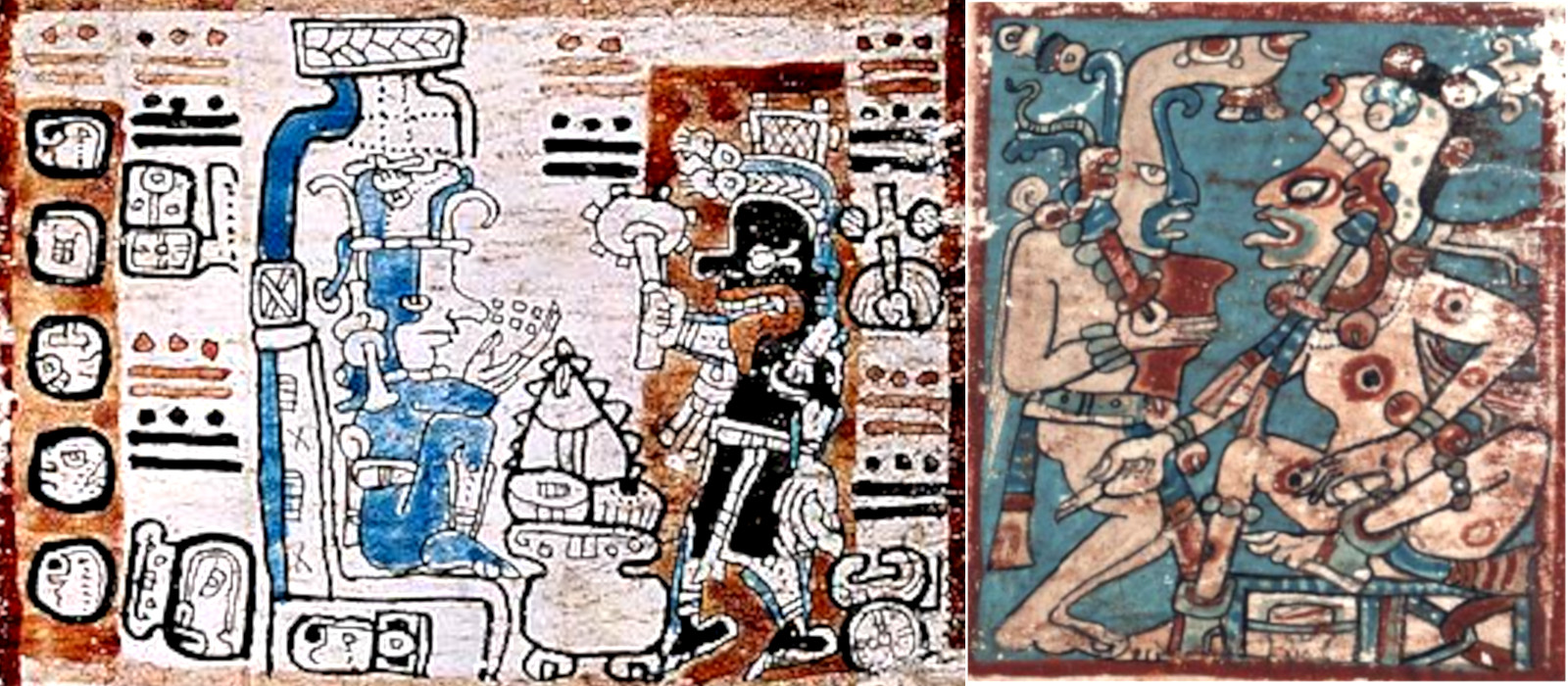
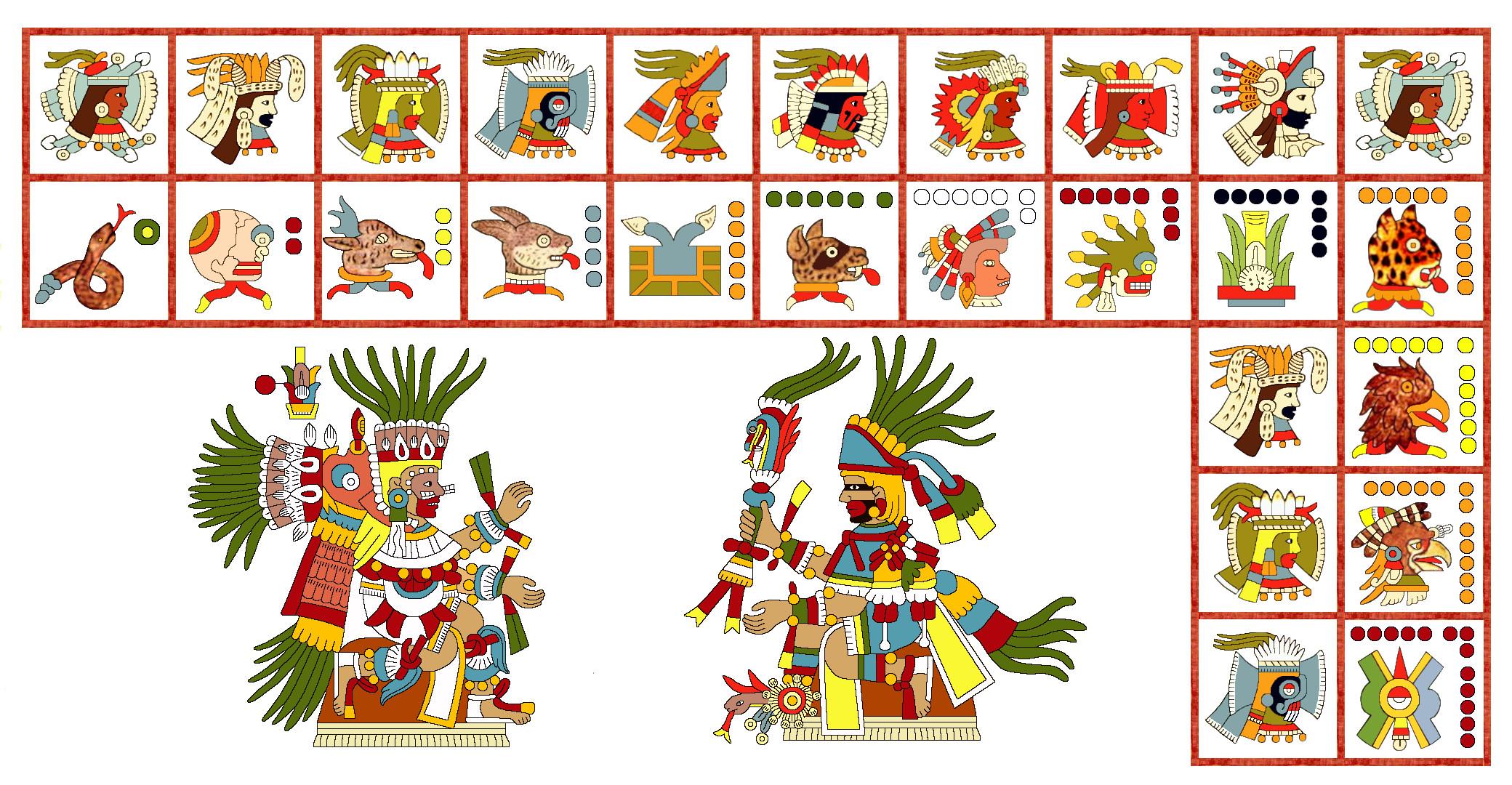
The severely damaged manuscript tracks and predicts the movements of the planet Venus (also the subject of the Dresden Codex), a prime concern of the Maya for both agriculture and divination. Its ten fragmentary panels deal with Inferior and Superior conjunctions, Evening Star, and Morning Star, each with thirteen of the same Maya calendrical day-signs in various disordered numerical sequences. The program explains that each date “marks the crucial first day of a phase of Venus.”

I can’t pretend to understand the astronomical system, but the deities accompanying the phases with their personal regalia and ritual activities were strikingly familiar, also hinting of the art of Teotihuacan and Toltec. Their headdresses, ornaments, pendants, and weapons—as well as bound prisoners— could easily be Aztec images. The panel that particularly held my eye was page 8, the second one dealing with the Morning Star phase:

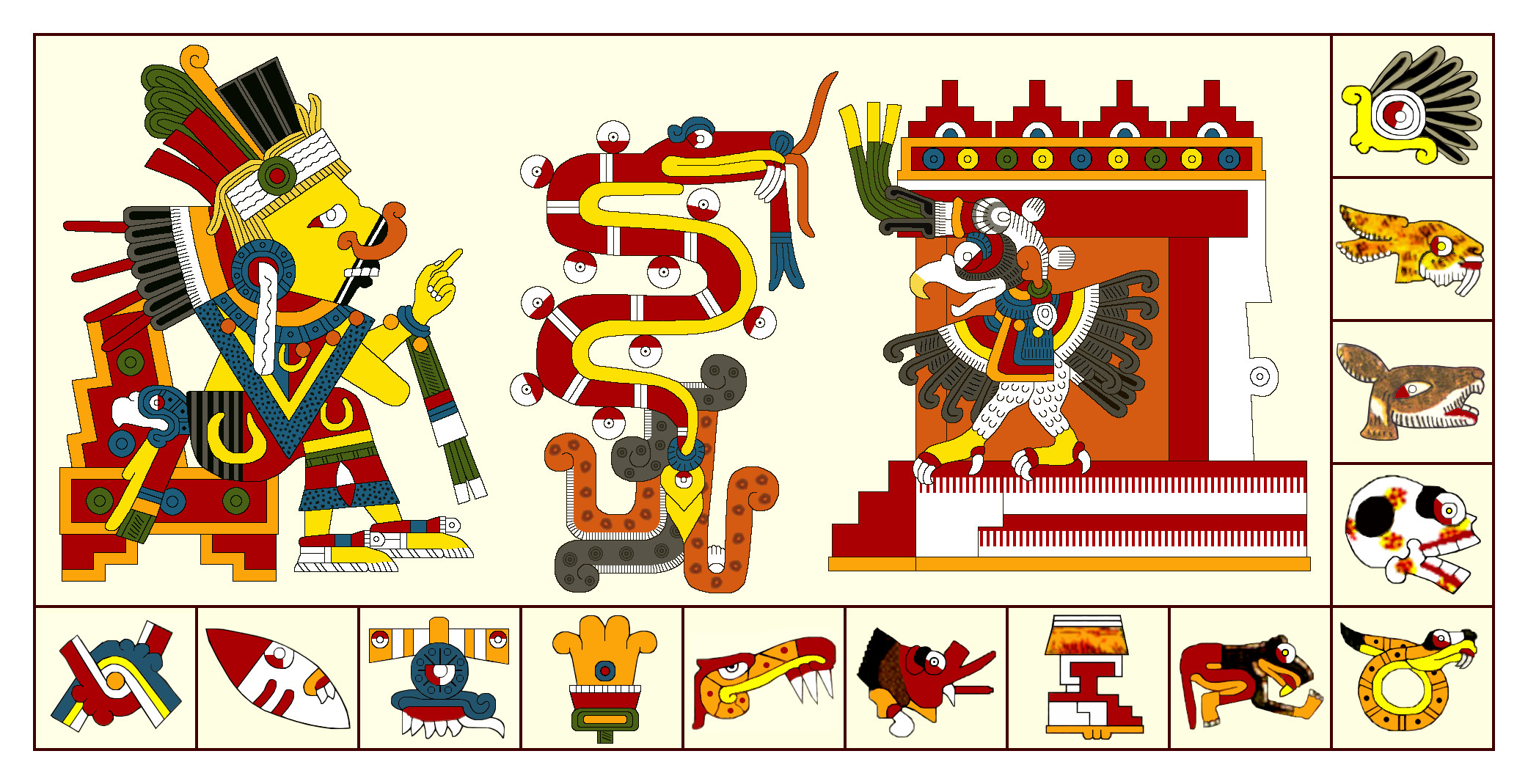
Panel 8 of the Maya Codex of Mexico

The repeating day-glyph is Kib—corresponding to the Aztec Cozcacuauhtli (Vulture)—and the sequence 10, 5, 13, 8, 4, etc. (if that’s the direction the count runs), mystifies me. The eagle-clawed deity with bird headdress must surely be the Maya god of the Morning Star known as Chak Ek’. The arrow/spear that he shot into the temple is a familiar motif in the Aztec codices from centuries later.

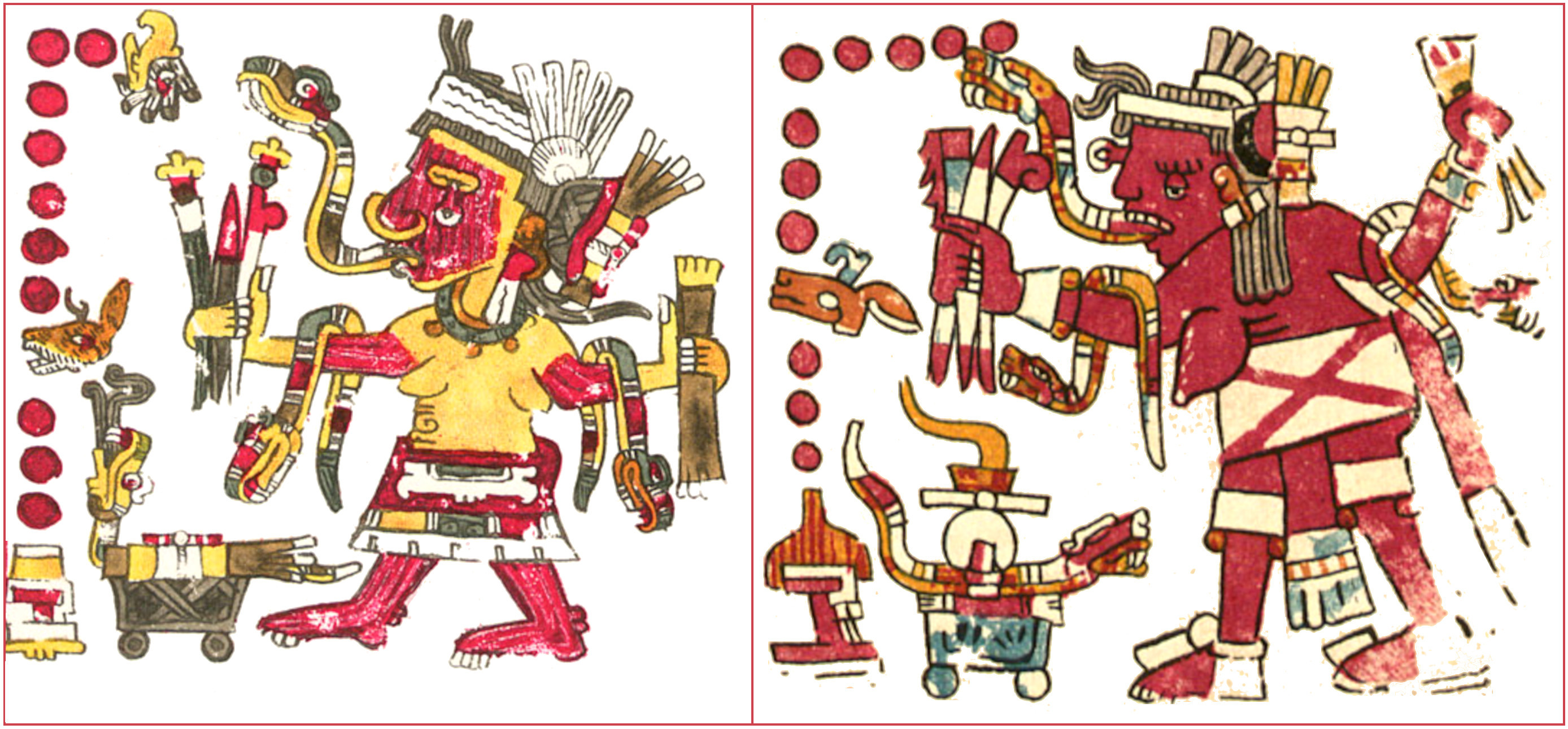
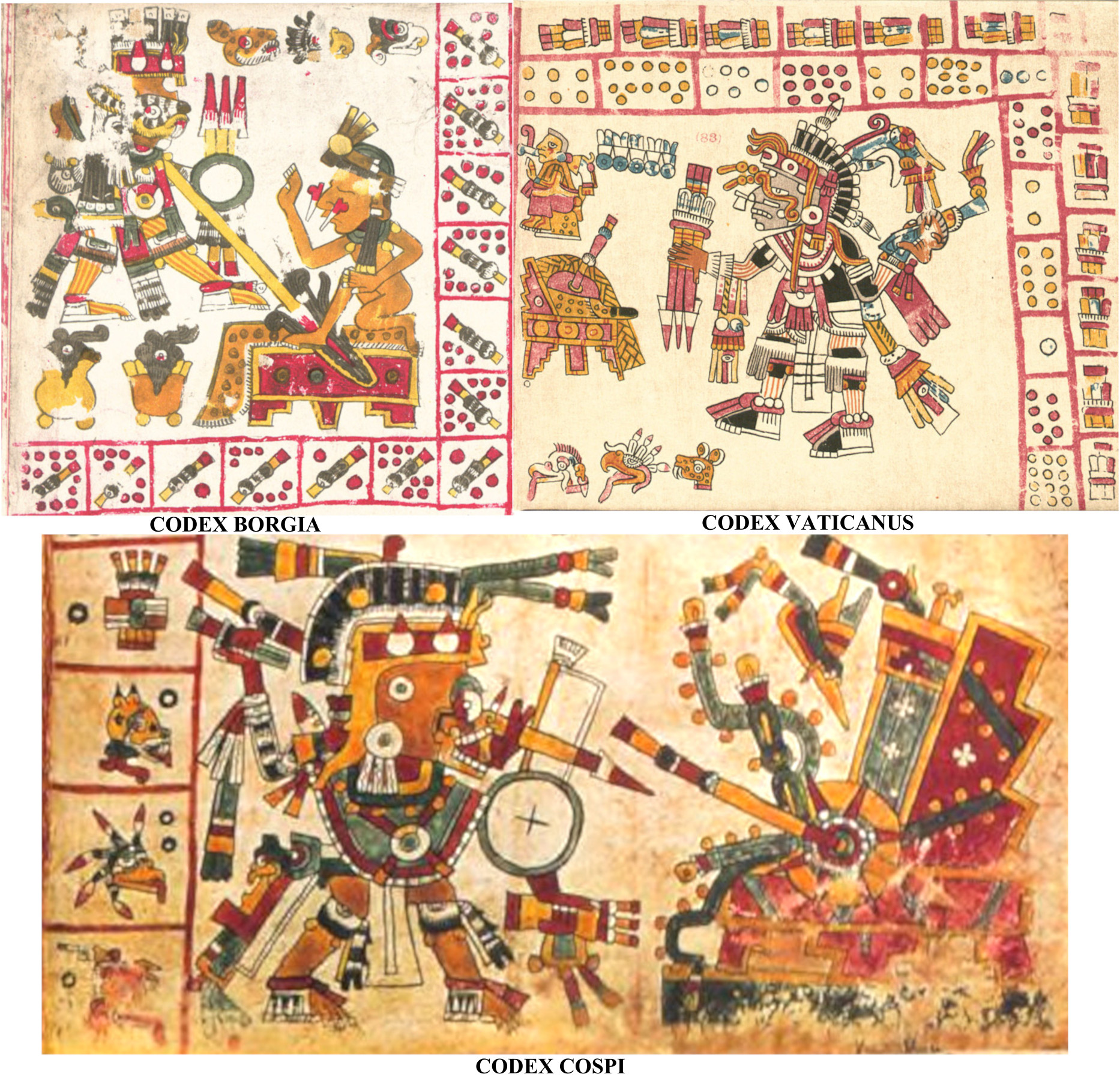
That and the structure of repeating numbered day-signs recall five mysterious panels in Codex Borgia of Tlahuizcalpantecuhtli (Lord of the House of the Dawn—the Morning Star) attacking gods and places in this way. Checking into those panels, I found them each also accompanied by odd sequences of the same, though different, day-signs. What’s more, similar sets of Morning Star panels in both Codex Vaticanus and Codex Cospi apparently also reflect the Maya theme.

However, while the Maya panels involve the seven day-signs Wind, Lizard, Rabbit, Grass, Jaguar, Vulture, and Flint, the Aztec panels use five different day-signs: Crocodile, Snake, Water, Reed, and Earthquake. So, the Aztecs clearly were using the numbered-day structure of these Morning Star panels for some purpose other than astronomy.

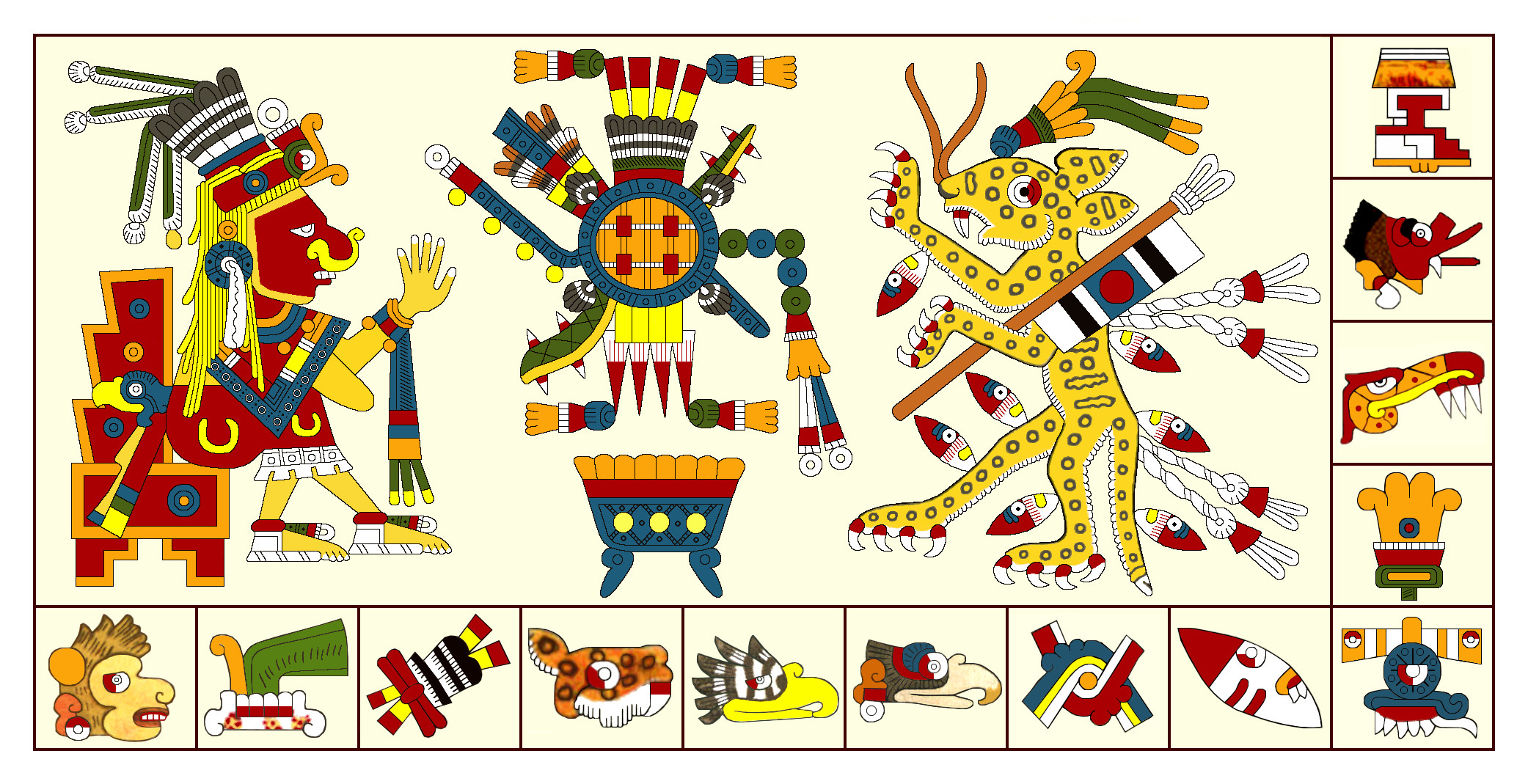
Morning Star Panels with Day-Sign Crocodile

This first set displays an oddly numbered sequence of Crocodile day-signs with the next three day-signs (Wind, House, and Lizard) appearing inside the main panel. The numbering runs clockwise in Borgia from lower right (1, 8, 2, 9, 3, 10, etc.), and counterclockwise in Vaticanus from the same position. This turns out to be the sequence of the day-sign’s occurrence in the calendar count (tonalpohualli), not any notation of Venus cycles.

Meanwhile, in the Cospi version, the lower half of a double panel, the border shows successive days in their properly numbered calendrical order, and with the other half above is a curious sequence of 1 Snake, 6 Death, 7 Deer, and 8 Rabbit. The other Cospi panels for 1 Water, 1Reed, and 1 Earthquake take the odd count through Flower, sorely confusing the basic principle.

All five day-signs, Crocodile, Snake, Water, Reed, and Earthquake symbolize East, which is perfectly fitting for the Morning Star. The border sequences are ordered lists of all calendar days relating to East, and the three other days shown inside the panels represent the other directions:

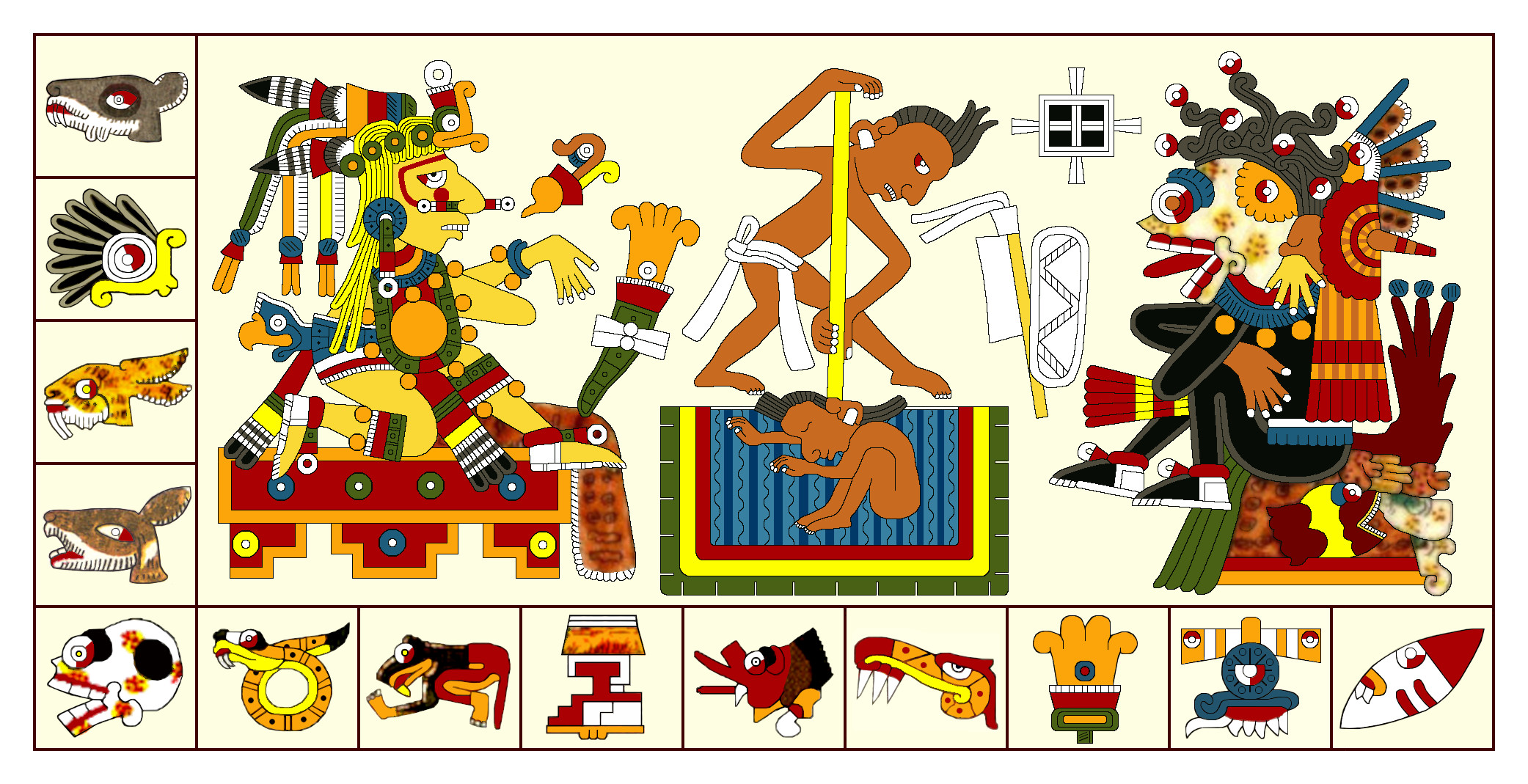
Now let’s consider the narrative content of the Crocodile (above) and other panels in this series:

Morning Star Panels with Day-Sign Snake

Morning Star Panels with Day-Sign Water

Morning Star Panels with Day-Sign Reed
Morning Star Panels with Day-Sign Earthquake

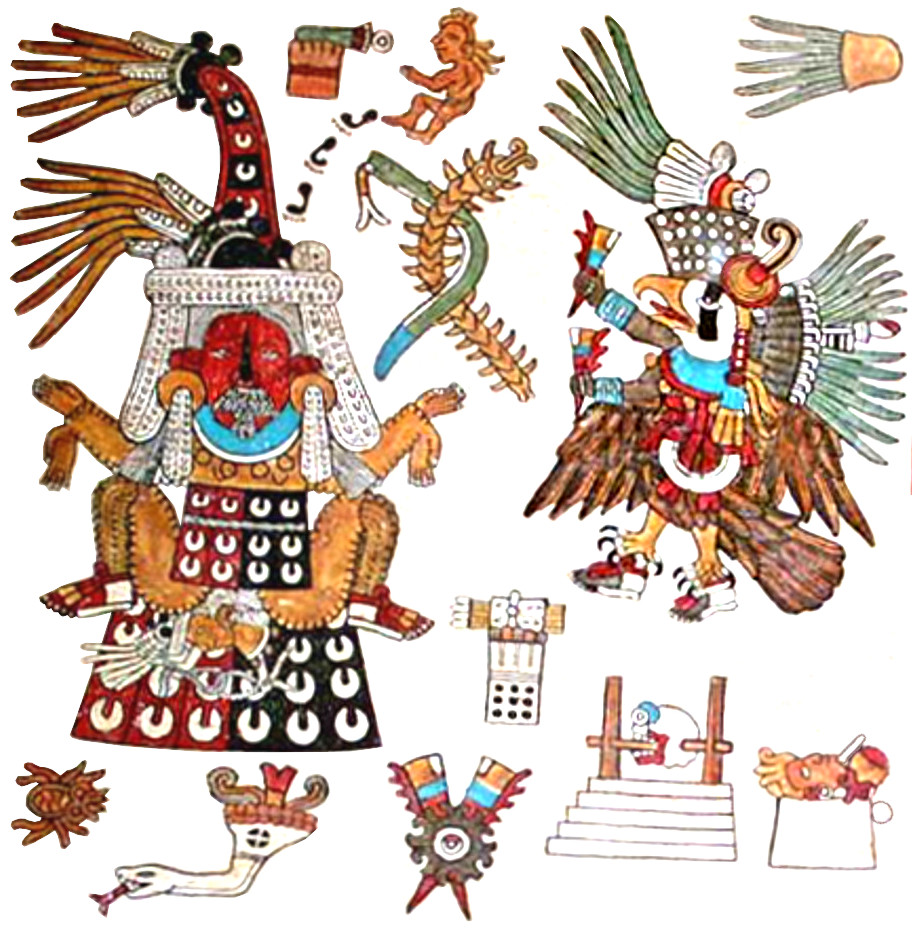
In the Borgia series, Tlahuizcalpantecuhtli appears in various guises, a Death god, Eagle, Dog, Rabbit, and another Death god. In Vaticanus, he’s a consistent image of a flayed deity with “dangerous” eyes, and in Cospi he’s more or less the same Death god. In all of these images, he attacks someone or something with a spear. Apparently, bellicosity implies great power.

Considering his victims confuses things. In the Borgia Crocodile set, he attacks Chalchiuhtlicue, in Vaticanus some male god (maybe Xochipilli), and in Cospi Centeotl. In the Snake set, the Borgia victim is Tezcatlipoca, and in Vaticanus and Cospi Chalchiuhtlicue. In the Water set, in Borgia he attacks Centeotl, but in Vaticanus and Cospi the throne of a water deity (Tlaloc?). In all the Reed sets, he attacks the throne of some deity, and in the Earthquake set, he strikes a military symbol in Borgia and the divine jaguar of rulership in the others.

That variation in victims doesn’t explain why the Morning Star is so aggressively pugnacious, but it certainly helps understand how Tlahuizcalpantecuhtli had the chutzpah to attack the Sun God Tonatiuh during the creation of the Fifth Sun. Ever since Maya times, the Morning Star seems to have been a mighty bad boy much to be feared. In Aztec mythology he became an important nagual (manifestation) of the great god Quetzalcoatl, the Plumed Serpent.

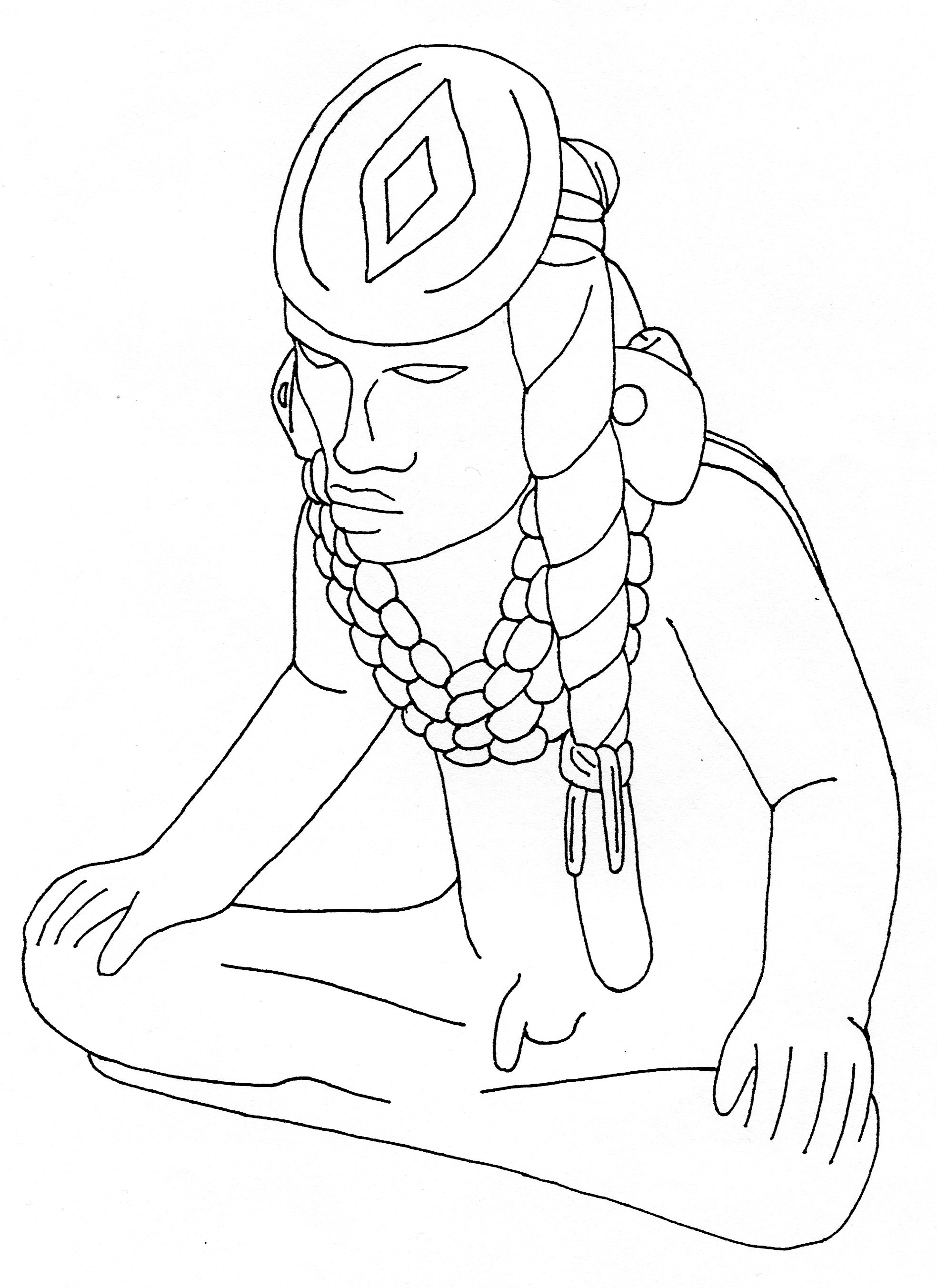
On his way to Aztec fame, during the earlier Toltec (Postclassic) era, the cult of the Morning Star was apparently carried in the 12th century by those trader/warriors to the Mississippian civilization in North America. An effigy pipe called “Big Boy” from that period was found at Spiro OK in an astronomical arrangement representing creation myths. It portrays Morningstar, a mythical warrior also known as Redhorn.

Mississippian Effigy Pipe “Big Boy” (drawing by author)

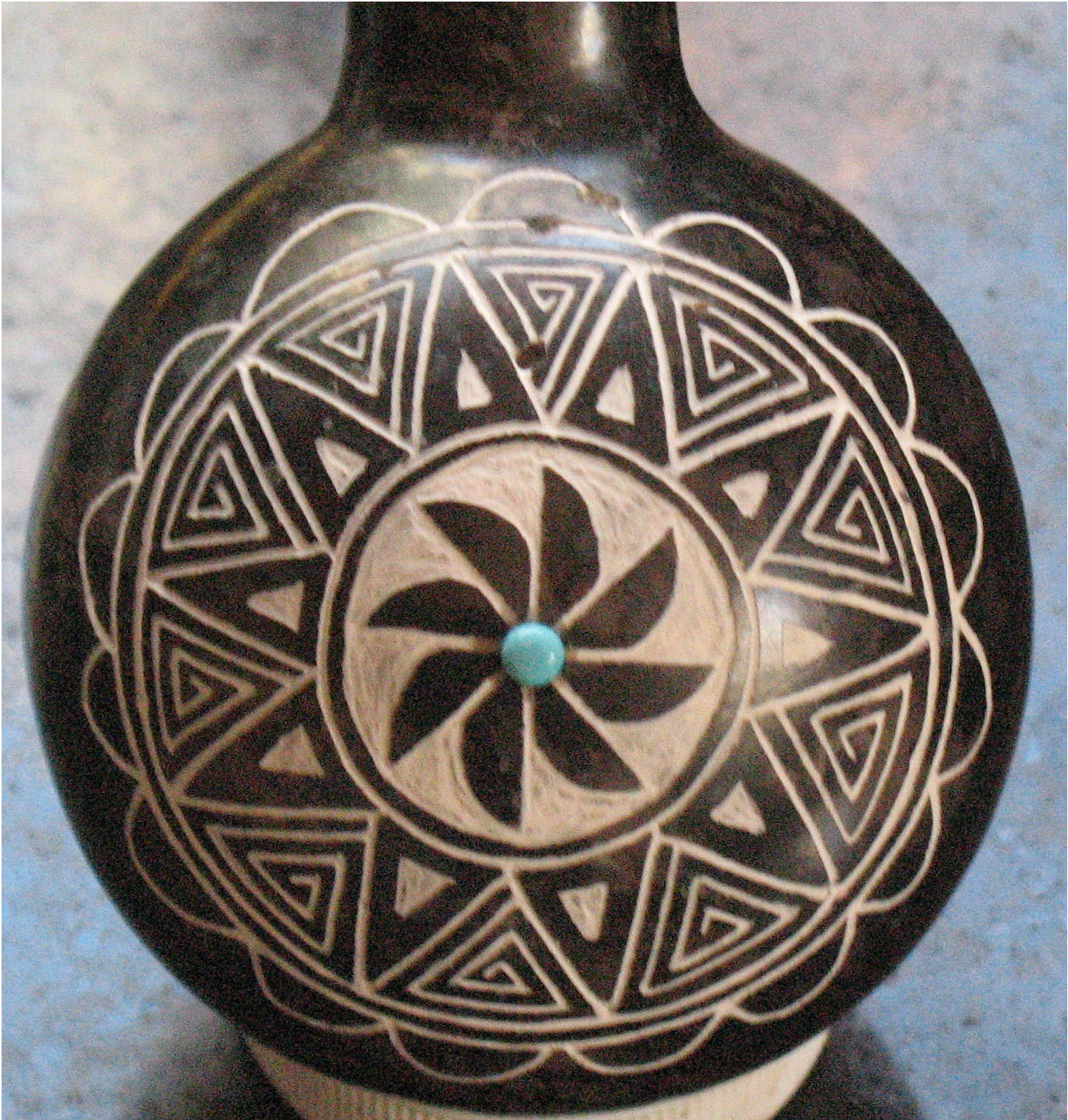
The Morning Star was also a Mississippian culture hero referred to as Birdman, and imagery of him with wings and clawed feet like the Maya Chak Ek’ is found in rock art, shell gorgets, and copper ornaments throughout the Mississippian area. In the mythologies of later tribes, he’s a prominent deity/hero: Apisirahts for the Blackfoot and either male or female deities for the Iroquois, Wichita, Pawnee, Ojibwe, Crow, and other tribes. In the Southwest, the Tewa have a Morning Star god called ‘Agojo so’jo (Big Star), a messenger of the Sun associated with warfare. Obviously, for at least a thousand years, the Morning Star has been a mighty myth of the Americas, and it’s still revered among Native American artists.

Morning Star Design by Contemporary Acoma Artist Irvin J. Louis, c. 2022

#

Aztec Calendar – Lizard Trecena

The twelfth trecena (13-day “week”) of the Aztec Tonalpohualli (ceremonial count of days) is called Lizard for its first numbered day, which is the 4th day of the veintena (20-day “month”). In the Nahuatl language Lizard is Cuetzpallin, and it’s known as K’an in Yucatec Maya and K’at in Quiché Maya.

Pre-Conquest Codex drawings of the anatomical connection of the day Lizard are indecisive at best. Codex Rios points to the abdominal region of a male body, perhaps intimating the intestines—or the womb in a female? I can find no diagram of specific female anatomy, but the vagina is at times linked to a flower. In Codex Borgia plate 17, the Lizard is apparently “tied” (modestly under his loin flap) to Tezcatlipoca’s male genitalia (testicles?) and in plate 72 explicitly to his penis; in Borgia 53 it’s again linked explicitly to the penis. In plate 75 of Codex Vaticanus, it’s at Ehecatl’s left hand and in Borgia 73 at Mictlantecuhtli’s. (Meanwhile, in Borgia 17 the snake appears suggestively on his loin flap and in Borgia 73 as Ehecatl’s tongue and in Vaticanus 75 as Mictlantecuhtli’s.) I think it’s safe to say that the Aztecs broadly linked the Lizard to sexual organs, be they whichever, and concomitantly to reproduction and fertility.

My learned colleague Dr. Paquin advises that from the Maya perspective, K’an is about the germination of corn (maize) in the womb of the Earth, with emphasis on growth potential. From that to the Aztec concept of Lizard as representing sex and reproduction is but an intuitive step. Dr. Paquin also notes that one reference remarks, “those born under the sign One Lizard were forceful and alert, and sound of body, and that falling down will not injure them any more than a lizard would be hurt if it falls from a high to a low place.” Also, a Mayan elder wrote that K’an-born people “possess a powerful energy that allows them to overcome obstacles.” Dr. Paquin also advised, “I have found many, many examples of K’an-born people being overwhelmingly wealthy—as if there is no limit to their ability to germinate into enormous opulence whatever they touch.” How much of that was relevant to later Aztec thought is debatable.

Not surprisingly, the divine patron of the day Lizard is Huehuecoyotl, the Old Coyote (See Icon #6), the god of sexual indulgence (as well as of music, dance, storytelling, and choral singing), seen earlier as patron of the Flower Trecena.

PATRON DEITY RULING THE TRECENA

In my research long ago, the patron of the Lizard Trecena was identified as Tezcatlipoca, the Smoking Mirror (See Icon #19), deity of fate and bringer of war and change. The 10th lord of the day and god of the North, he protects slaves and is patron of magicians, sorcery, and divination, as well as bringing and curing diseases.

However, more recently another patron of the trecena has been recognized: Itztlacoliuhqui, the Curved Obsidian Blade. Maybe reflecting the Maya God Q, he’s the deity of stone, frost, ice, cold, sin, punishment, castigation, and human misery, but also of objectivity and blind-folded justice. Spawned by a conflict between Tlahuizcalpantecuhtli, Lord of the House of the Dawn (See the Snake Trecena), and Tonatiuh, God of the Fifth Sun (See the Death Trecena), the Obsidian Blade somehow wound up as one of the naguals (manifestations) of Tezcatlipoca. His complicated heritage suggests a subconscious Aztec tendency to syncretism also involving Quetzalcoatl, the Plumed Serpent, creator of the Fifth Sun, who, as the planet Venus is the “overlord” of his nagual Tlahuizcalpantecuhtli, and possibly a twin/nemesis of Tezcatlipoca. The Aztec deities have subtle ways of blending and merging into an amorphous theological stew.

AUGURIES OF LIZARD TRECENA

By Marguerite Paquin, author of “Manual for the Soul: A Guide to the Energies of Life: How Sacred Mesoamerican Calendrics Reveal Patterns of Destiny”
https://whitepuppress.ca/manual-for-the-soul/

The first half of this trecena extends the “anything is possible” sequence that gives birth to the 20-day Maya month (uinal) as begun in the Monkey trecena, and now the emphasis is more of a cautionary nature. The theme of this trecena is about the germination of new ideas or directions, but it can also be a time of “testing.” In this period, careful nurturing of new ideas and staying vigilant is advised in order to help the “seeds of the new” to take root and flourish.

Further to how these energies connect with world events, see the Maya Count of Days Horoscope blog at whitepuppress.ca/horoscope/. The Maya equivalent is the K’an trecena.

THE 13 NUMBERED DAYS IN THE LIZARD TRECENA

The Aztec Tonalpohualli, like the ancestral Maya calendar, is counted through the sequence of 20 named days of the agricultural “month” (veintena), of which there are 18 in the solar year. Starting with the 4th day of the preceding veintena, 1 Lizard, this trecena continues with 2 Snake, 3 Death, 4 Deer, 5 Rabbit, 6 Water, 7 Dog, 8 Monkey, 9 Grass, 10 Reed, 11 Jaguar, 12 Eagle, and 13 Vulture.

In general Aztec calendrics there’s only one day in this trecena of particular import, Five Rabbit. However, for the ancient Maya in the “Chilam Balam of Chumayel,” the first seven days continue their “Creation” sequence, as once again kindly provided by Dr. Paquin. These later steps in the Maya sequence are just as vague, convoluted, and confused as the first thirteen in the Monkey Trecena. It’s small wonder that later Aztec lore apparently forgot that obscure ancient mythology, opting for the dramatic tale of Tezcatlipoca creating the First Sun, Four Jaguar (Nahui Ocelotl), in the process losing his left foot in battle with the Earth Monster Cipactli.

One Lizard (in Yucatec Maya 1 K’an) the day when the Creator deity was troubled (as in his spirit afflicted), and he first created anger (perhaps first felt anger) “because of the evil that he had created.” In the preceding trecena on the day Nine Rain, there was an attempt at creating hell, (the Underworld or Xibalba), and on Ten Flower as yet uncreated wicked men went there. Speaking of convolutions, evil doesn’t appear until tomorrow, Two Snake, and it’s intriguing that the Creator got angry for what “he” hadn’t done yet.

Two Snake (in Yucatec Maya 2 Chikchan) the day when evil appeared and was discovered by men. So, it was only now that men could be wicked enough to go to hell back on Ten Flower.

Three Death (in Yucatec Maya 3 Kimi) the day when the first death was invented. So, the wicked went to hell yesterday (or four days before) but only died today. One gets the feeling that perhaps this Maya creation sequence somehow runs halfway backwards in time.

Four Deer (in Yucatec Maya 4 Manik’) is a Creation-sequence day left blank in the Chilam Balam manuscript but thought to be something like “Spirit passing over.” Maybe it’s simply the Maya Creator’s “day of rest” like the Judeo-Christian Seventh Day, a Sabbath or sabbatical.

Five Rabbit (in Nahuatl Macuil Tochtli) is the day-name of one of the five Ahuiateteo or male deities of pleasure/excess, a big shot among the 400 rabbit-gods of intoxication and often paired with One Monkey (See Monkey Trecena), one of the female Cihuateteo.

(in Yucatec Maya 5 Lamat) is the day when the seven great waters of the sea were established. Remember that “all things” and “everything” had been created separately on two other days earlier in the sequence. So, were the waters only now gathered together into the “seven great waters”—into seas already created on Three Reed? Speaking of confusion…

Six Water (in Yucatec Maya 6 Muluk) the day when all the valleys were submerged before the world had awakened. Why were the valleys submerged when the waters had only yesterday been “established” in their great seas? The “breath of life” had already been created on Twelve Wind, and there’s been no mention of the earth being asleep till now. In fact, it’s long been a busy place what with being born on Seven Earthquake and being luxuriously furnished with rocks, trees, animals, birds, and man on other earlier days.

Seven Dog (in Yucatec Maya 7 Ok) the day when “occurred the invention of the word of God” when the uinal (the 20-day monthly cycle) was created, and all was set in order.” Inventing the word of God is a hard act to follow—or believe.

Incidentally, the trecena includes two more days significant for the ancient Maya but of no apparent import for the Aztecs:

Eight Monkey (in Yucatec Maya 8 Chuwen or in Quiché Maya 8 Batz’) is still a major ceremonial day for the Guatemalan Maya, sometimes referred to as the Maya New Year, primarily focused on celebrating the renewal of the sacred calendar.

Nine Grass (in Yucatec Maya 9 Eb’) was the day-name of a Maya goddess of Death and the fertile earth, as well as an oracle. I haven’t seen any Aztec notice of this goddess, but that might well be the day-name of Huitzilopochtli’s sister Malinalxochitl (Grass Flower), a sorceress and goddess of snakes, scorpions, and insects of the desert. If not, no matter…

THE TONALAMATL (BOOK OF DAYS)

Several of the surviving so-called Aztec codices (some originating from other cultures like the Mixtec) have Tonalamatl sections laying out the trecenas of the Tonalpohualli on separate pages. In Codex Borbonicus and Tonalamatl Aubin, the first two pages are missing; Codex Telleriano-Remensis and Codex Rios are each lacking various pages (fortunately not the same ones); and in Codex Borgia and Codex Vaticanus all 20 pages are extant. (The Tonalpohualli is also presented in a spread-sheet fashion in Codex Borgia, Codex Vaticanus, and Codex Cospi, but that format apparently serves other purposes.)

TONALAMATL BALTHAZAR

As described in my earlier blog The Aztec Calendar – My Obsession, some thirty years ago—on the basis of very limited ethnographic information and iconographic models —I presumed to create my own version of a Tonalamatl, publishing it in 1993 as Celebrate Native America!

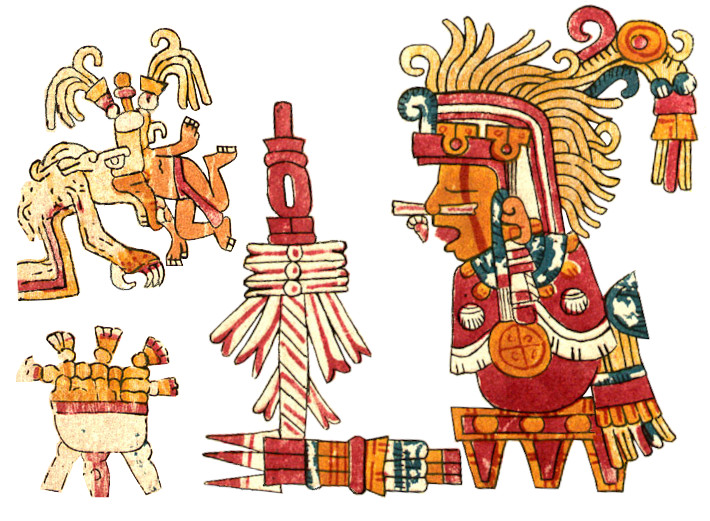
As mentioned above, when I drew my version of the Lizard Trecena (in colored pencil) over 30 years ago, its patron was generally seen as Tezcatlipoca, the Smoking Mirror. The only codex image I’d found of the Black One was a figure from plate 21 in Codex Borgia, which I reversed and doctored up with a bigger and more ornate shield and arrows, enhanced with subtle detail changes, and gave lots of blue (to go better with black). My unwitting iconographic mistake was to omit the traditional yellow stripes on his face. With the eponymous smoking mirror as a left foot, my image thus wove in the story of his epic battle with the Earth Monster and (again unwittingly) incorporated several of the deity’s traditional emblems. He’s a real showstopper.

Aztec Calendar – Lizard trecena – Tonalamatl Balthazar

#

TONALAMATL BORGIA (re-created by Richard Balthazar from Codex Borgia)

Aztec Calendar –Lizard trecena – Tonalamatl Borgia

The figure of Tezcatlipoca on the right in this patron panel from the Tonalamatl Borgia is the only one to be found in the surviving Tonalamatls, and it’s likely why earlier scholars called him the patron of the Lizard Trecena. Other figures of this deity occur in Codex Borgia in many contexts, most similar (like my own above), but in fact he was reputed to be invisible, in rituals his presence merely indicated by the mystical appearance of a right-foot print in a box of sand.

Invisibility made it easy for Tezcatlipoca to manifest as various naguals including Tepeyollotl, Heart of the Mountain (patron of the Deer Trecena); Chalchiuhtotolin, the Jade Turkey (patron of the upcoming Water Trecena); Itztli, god of sacrifice and another form of Tecpatl, the sacrificial knife.; Xipe Totec, the Flayed God or Red Tezcatlipoca (patron of the upcoming Dog Trecena); and of course his companion in this patron panel, Itztlacoliuhqui, the Curved Obsidian Blade.

Being the “jaguar of the night,” the figure stands on the thatched roof of the night sky (as does Tepeyollotl in the Deer Trecena). I suspect that this added “pedestal” is why the codex artist fore-shortened the god’s traditionally larger plumed back-bundle. Unfortunately, the original codex image is severely damaged, particularly in this ornament and around his hindquarters. So, I’ve reconstructed it, his skirt, and tail-flap using details from other Borgia images. By the way, the item in his painfully twisted upper hand is apparently a scepter of divine power/rulership.

Meanwhile, Itztlacoliuhqui enthroned on the left is one of the more elegant and enigmatic images of this unusual deity. Unique among Aztec deities, no item of human form (except an elemental head) detracts from this image as an abstract, divine idol. Elsewhere in Borgia as patron of the day Reed, he looks like Tezcatlipoca but still wears the blindfold of objectivity.

Among other odd items of the Blade’s paraphernalia, the most telling is that arrow/dart stuck in his head, whereon hangs the tale of the celestial conflict mentioned earlier. In short, when Quetzalcoatl/Ehecatl created the Fifth world, a young god named Nanahuatzin leapt into the cosmic conflagration to become the new sun (Tonatiuh) and then refused to move until the other gods recognized his supremacy. Unwilling to kowtow, Tlahuizcalpantecuhtli (the Morning Star) shot an arrow at Tonatiuh, which that god caught and threw back at him, hitting the Lord of the House of the Dawn in the forehead. To redeem the situation, Tonatiuh turned the target into a new god, a nagual illogically of Tezcatlipoca, namely Itztlacoliuhqui. I can’t explain why the arrow is broken here, except maybe to make it fit on the page.

The rest of the panel is comfortably uncluttered. The ornamental pulque pot is likely homage to the intoxicated Five Rabbit just below it, but the other two items bear comment. The inverted (empty) vase at the top probably intends to warn people about what recklessness can cause if they’re not cautious in generating new ideas and directions (not to mention opulence). The falling figure may indicate someone in a situation out of their control (a victim of fate). Usually, falling indicates a deceased person (with closed eyes), but this one’s eyes are open. We’ll come to understand this motif better with evidence from other tonalamatls.

#

TONALAMATL YOAL (compiled and re-created by Richard Balthazar on the basis of
Codex Telleriano-Remensis and Codex Rios)

Aztec Calendar – Lizard trecena – Tonalamatl Yoal

The more human image of Itztlacoliuhqui on the left is heavily loaded down with divine accoutrements. Here the blind, black-striped face wears an abstract crescent nosepiece instead of a blindfold, and the legendary arrow is now a large ornate spear. A curious detail is that the left side of his/its body has been flayed, and strips of flayed skin are evidently included in the headdress and profusion of flaps and scarves (no doubt as signs of holiness). The flaying may also refer to his connection with Tlahuizcalpantecuhtli, who’s almost always represented thus. In his right hand is a swatch of straw or broom thought to indicate cleaning/clearing required before “germination of new ideas or directions;” in the Borgia panel it’s probably reflected in that idol’s straw cape.

The two human figures on the right immediately clarify the meaning of Borgia’s falling fellow. They represent Itztlacoliuhqui’s symbolism of justice and/or castigation and punishment of sin. Both stoning and strangling were standard Aztec methods of execution, which I strongly suspect didn’t come with the religious benefits of sacrificial rites. Note these two figures’ eyes are closed indicating death. While this trecena generously portends the “nurturing of new ideas,” it clearly doesn’t pretend to be gentle or forgiving. Of course, objective justice rarely is.

The Codex Rios copies of this trecena page are exceptionally blurry and careless, and I relied solely on the Telleriano-Remensis original for this re-creation. An innovation was making the bladed crest on his headdress black to indicate obsidian, which various sources claim as an iconographic attribute of Itztlacoliuhqui. However, in other images the points are normally left white, the primary color of this deity. My other innovation was to reposition his left arm so that it wasn’t jutting from his forehead, a frequent problem with Aztec-style figures.

#

OTHER TONALAMATLS

Tonalamatl Aubin patron panel for Lizard trecena

In the Tonalamatl Aubin, the Blade is almost entirely white with only red points on the obsidian crest of the standard headdress (struck with only a small arrow). Here his whole body, eyeless face, and headdress are flayed. In the upper hand is evidently the broom (on an arm typically and weirdly coming out of his forehead). The two (deformed) humans seem to be bleeding from punishment, maybe for disporting with pulque and some kind of flower or fruit, but they’re still alive. The four small bleeding items beg explanation, particularly the front half of the snake. Whoever uses these panels for divination will just have to make what they will of such details.

#

Codex Borbonicus patron panel for Lizard trecena

The patron panel in Codex Borbonicus presents yet another elegant and enigmatic figure of Itztlacoliuhqui. This time he has a human body, a crescent nosepiece as in Yoal, and again only a small arrow piercing his headdress, and he holds a rather large broom for sweeping the way clean. His mostly white raiment of bands, sashes, and pointy ornaments conveys an appropriate sense of crystalline cold and ice. Some sources suggest that the bumpy texture of his legs and arms represents a covering of unspun cotton (tlazolli) destined to be “ordered” as spun cotton (ichcatl). I find that interpretation strained, but this texture doesn’t look anything like the striped flaying we’ve seen in his other images.

As in most Borbonicus patron panels, lots of ritual objects are shown in a scattered conglom, including two little executed folks on the lower right, some inverted containers (pulque and water), and another front half of a snake, for whatever that might mean. Oddly, on the lower left where the symbol of the trecena is usually placed, instead of a lizard, we find a two-headed snake. Quite curious, in the upper center the arrow has a side-notched flint point I’ve not seen in other Aztec instances. Even odder, at the bottom center is an inscrutable animal head (a deer?). Have fun interpreting this arcane collection.

#

Codex Vaticanus patron panel for Lizard trecena

The Codex Vaticanus patron panel more or less restates the Borgia version—minus the big cheese, Tezcatlipoca—again leaving his nagual Itztlacoliuhqui as undisputed patron of the trecena. Only this time, the blind “idol” is even more abstracted, looking like a standard corpse bundle with a broken arrow stuck in the top. This tells me that the deity of stone, cold, etc., must be dead, not a god of Death but a defunct god, which is a passing strange concept. But an arrow in the head is usually lethal, and the dead can afford to be objective.

#

Put simply, the Lizard Trecena is an optimistic, if rather gruesome, time period in the Aztec calendar. Our discussion has now set the record straight that the ominous Curved Obsidian Blade is its sole patron, and sinners should beware. Fortunately, it only lasts for 13 days…

#

UPCOMING ATTRACTION

The calendar’s thirteenth trecena will be that of Earthquake (or Motion/Movement) with Tlazolteotl, Goddess of Filth, again as its patron. (She was also a patron of the Deer Trecena.)

#

You can view all the calendar pages I’ve completed up to this point in the Tonalamatl gallery.
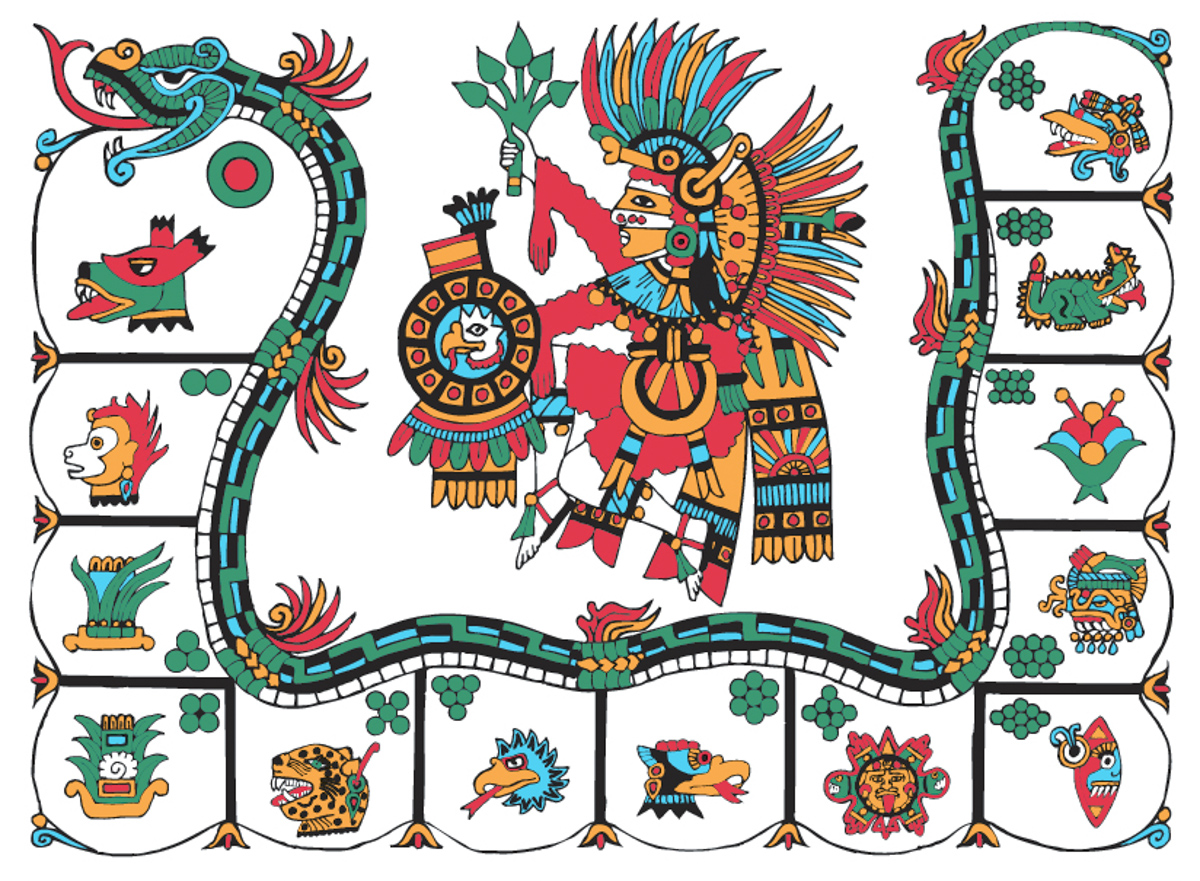
Aztec Calendar – Monkey Trecena

The eleventh trecena (13-day “week”) of the Aztec Tonalpohualli (ceremonial count of days) is called Monkey for its first numbered day, which is also the 11th day of the veintena (20-day “month”). In the Nahuatl language Monkey is Ozomatli, and it’s known as Chuwen in Yucatec Maya and B’atz in Quiché Maya.

The day Monkey, one of the five days symbolizing the direction West, is considered a good day to start a journey. In some codices, birth almanacs indicate that a child born on a Monkey day would be ill-favored, though dramatic, clever, and charming. In general, Monkey is a day for creating, playing, celebrating, fun, frivolity, and merriment. (For some arcane reason, it’s paired anatomically with the left arm.)

This Aztec concept was clearly inherited from the earlier Maya, for whom the Monkey represented cleverness and mental agility, creativity, capriciousness, playfulness, and cleverly weaving things/themes together. Monkeys were also viewed negatively as tricksters, for their child-like behavior and magical stratagems. As tricksters they were associated with drunkenness, capriciousness, and licentiousness, behaving sometimes with reckless abandon.

The Maya concept of Monkey was shaped by their mythical Monkey Twins, Hun B’atz and Hun Choven (One Monkey and One Artisan), the talented older half-brothers of the celebrated Hero Twins, Hunahpu and Xbalanque. In the Classic Maya Popol Vuh, the account of Quiché Maya creation, these Monkey Twins were scribes and sages, as well as musicians, flautists, singers, carvers, ball players, and diviners. They were also comedians of ritual humor, famous for mocking political positions, and interpreters of sacred knowledge. The tradition connecting monkeys and artists/craftsmen survived across the many centuries into Aztec culture.

The patron of the day Monkey is Xochipilli, the Flower Prince (See Icon #18). god of the arts, fertility (agriculture and flowers), happiness/ecstasy, dreams/hallucinations, and indiscriminate sexuality.

PATRON DEITY RULING THE TRECENA

The divine patron of the Monkey trecena is Patecatl, the god of medicine, surgery, and, most importantly, the alcoholic drink Pulque (octli) and psychedelic herbs. (See Icon #13.) Both the drink and the psychedelics are crucial elements in Aztec religious ceremonies. With his wife Mayauel (goddess of Pulque and patron of the Grass trecena), he’s the father of the 400 Rabbits, the libidinous deities of all sorts of drunkenness.

AUGURIES OF MONKEY TRECENA

By Marguerite Paquin, author of “Manual for the Soul: A Guide to the Energies of Life: How Sacred Mesoamerican Calendrics Reveal Patterns of Destiny”
https://whitepuppress.ca/manual-for-the-soul/

The theme of this trecena is Creation and Play. In the “Chilam Balam of Chumayel” it’s referred to as the “Creation” trecena initiating a 20-day month (uinal) in the Maya calendar, and the time period aligns with high creativity and “time weaving.” The tie-ins with pulque and “monkey business” suggest an association with healing and even re-invention through play and artistry. While “anything is possible” during this period, there’s also potential for both intoxication and reckless abandon. Overall, this period is associated with good fortune and the arts—a good time to give oneself permission to play!

Further to how these energies connect with world events, see the Maya Count of Days Horoscope blog at whitepuppress.ca/horoscope/. The Maya equivalent is the Chuwen trecena.

THE 13 NUMBERED DAYS IN THE MONKEY TRECENA

The Aztec Tonalpohualli, like the ancestral Maya calendar, is counted through the sequence of 20 named days of the agricultural “month” (veintena), of which there are 18 in the solar year. Starting with the 11th day of the current veintena, 1 Monkey, this trecena continues with 2 Grass, 3 Reed, 4 Jaguar, 5 Eagle, 6 Vulture, 7 Earthquake, 8 Flint, 9 Rain, 10 Flower, 11 Crocodile, 12 Wind, and 13 House.

In general Aztec calendrics there are only two days in this trecena of particular import, One Monkey and Four Jaguar. However, for the ancient Maya, as the middle point in the calendar, One Monkey had been seen as the center of the Tree of Life, symbolic of the creative forces of the universe, the day of magic and potential, like a conductor or overseer of the process of creation to unfold over the next 20 days. In this context, it’s instructive to remark on all the thirteen days in their “Creation” trecena. Please forgive my amateur editorializing on the steps in the cosmological sequence kindly provided by Dr. Paquin.

One Monkey (in Nahuatl Ce Ozomatli) is the day-name of one of the Cihuateteo who, to judge by her day-name, was perhaps a licentious trickster. She was apparently paired with Five Rabbit (Macuil Tochtli), one of the Ahuiateteo, a god of drunkenness. Also, according to the chronicler Sahagun, anyone born on One Monkey was regarded favorably and would entertain others, likely becoming a singer, dancer, or scribe and producing some work of art. In the Florentine Codex, One Monkey is also connected with Aztec singers, dancers, and painters, much like the earlier day One Flower (See Flower Trecena).

            (in Yucatec Maya 1 Chuwen), according to the “Chilam Balam of Chumayel,” the first day in the Creation sequence when 1 Monkey “manifested himself in his divinity and created Heaven and Earth.”

Two Grass (in Yucatec Maya 2 Eb’) the day when the first pyramid (aka the first staircase) was made to descend “from the heart of the heavens.”

Three Reed (in Yucatec Maya 3 B’en) the day when “all things” of heaven and earth and the seas were made. Note that Heaven and Earth had already been created on 1 Chuwen—with a pyramid/staircase constructed between them on 2 Eb’.

Four Jaguar (in Nahuatl Nahui Ocelotl) is the day-name of the First Sun (Era), a world created by Tezcatlipoca after defeating the Earth Monster (Cipactli) and losing his left foot in the battle. He ruled that Sun, which was peopled by giants and ultimately destroyed by divine jaguars. The day-sign Four Jaguar appears in the center of the Stone of the Suns.

            (in Yucatec Maya 4 Ix) the day when the separation of Heaven and Earth took place. Note that the two realms were already separate and linked only by the aforementioned staircase or pyramid. I find this sequence of creation not a little confusing.

Five Eagle (in Yucatec Maya 5 Men) the day when “everything” was made. How this relates to 3 B’en isn’t clear, “all things” apparently being construed as somehow different than “everything.”

Six Vulture (in Yucatec Maya 6 Kib’) the day when the first candle was made, when it became light, and “when there was neither sun nor moon.” Again, it’s unclear what such a candle was to bring the light when there “was neither sun nor moon.”

Seven Earthquake (in Yucatec Maya 7 Kab’an) the day when honey was first created and the earth was born. I can’t even guess what that “honey” was (since honey bees were an Old World species), and the notion of the earth being born rather than created is intriguing. One wonders who its parents might have been. Besides, the earth had already been created on 1 Chuwen.

Eight Flint (in Yucatec Maya 8 Etz’nab) the day when “he rooted hands and feet upon earth” and made birds. We can only assume that “he” was 1 Monkey.

Nine Rain (in Yucatec Maya 9 Kawak) the day when, for the first time, there was an attempt to create hell. This step in the Creation sequence is fraught with questions: Why create hell in the first place, and why did this first attempt fail? We can only assume that this “hell” was supposed to be the Underworld, Xibalba.

Ten Flower (in Yucatec Maya 10 Ajaw) the day when “wicked men went to hell.” We’re missing something in this Creation sequence because men had not yet been created, wicked or otherwise, and the attempt to create hell the day before had failed. The text tries to explain this discrepancy by adding “because the holy God had not yet appeared,” but that only adds to the confusion. Who was the “holy God? If it was 1 Monkey, he had indeed already “rooted” on earth on 8 Etz’nab, and we haven’t heard about any other deity yet. Some accounts apparently translate this explanation as “so they might not be noticed,” but that only makes things even murkier: noticed by whom?

Eleven Crocodile (in Yucatec Maya 11 Imix) the day when rocks and trees were formed. This may relate to the Aztec concept of Tezcatlipoca building the world of the First Sun on the back of Cipactli, the Earth Monster.

Twelve Wind (in Yucatec Maya 12 Ik’) the day when the breath of life was created. It’s interesting that birds had already been created on 8 Etz’nab; on 10 Ajaw there were wicked men to go to a hell that hadn’t been successfully created; and trees had been created on 11 Imix. The Maya must not have considered birds and trees as being truly alive.

Thirteen House (in Yucatec Maya 13 Ak’b’al) the day when man was shaped from water and moistened clay. This is an iconic way to wrap up the trecena’s creation sequence, but there remain enormous inconsistencies. Vaguely parallel to the Judeo-Christian 7-day account in the Book of Genesis, this Maya sequence doesn’t mention a Garden of Eden—or Elohim—but maybe those details will emerge in the first seven days of the Lizard trecena to follow.

THE TONALAMATL (BOOK OF DAYS)

Several of the surviving so-called Aztec codices (some originating from other cultures like the Mixtec) have Tonalamatl sections laying out the trecenas of the Tonalpohualli on separate pages. In Codex Borbonicus and Tonalamatl Aubin, the first two pages are missing; Codex Telleriano-Remensis and Codex Rios are each lacking various pages (fortunately not the same ones); and in Codex Borgia and Codex Vaticanus all 20 pages are extant. (The Tonalpohualli is also presented in a spread-sheet fashion in Codex Borgia, Codex Vaticanus, and Codex Cospi, but that format apparently serves other purposes.)

TONALAMATL BALTHAZAR

As described in my earlier blog The Aztec Calendar – My Obsession, some thirty years ago—on the basis of very limited ethnographic information and iconographic models —I presumed to create my own version of a Tonalamatl, publishing it in 1993 as Celebrate Native America!

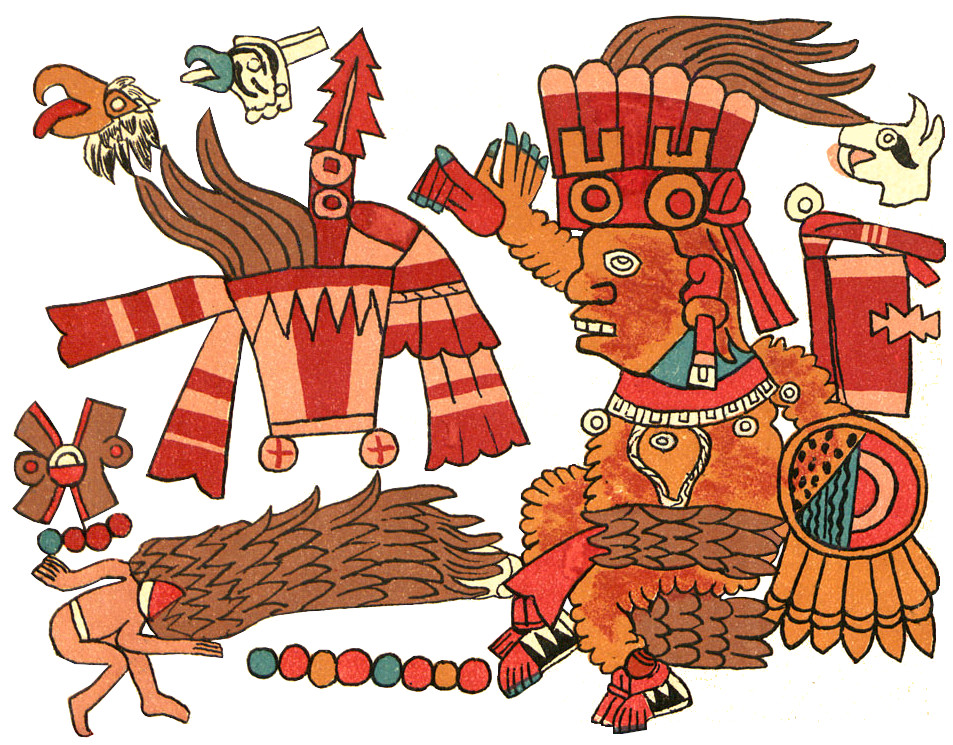
Again, when I made my version of the Monkey trecena, I knew nothing about Patecatl and simply relied on Codex Nuttall for a figure of a male deity, properly enthroned:

Aztec Calendar – Monkey trecena – Tonalamatl Balthazar

I’m gratified that totally by accident I gave him a fairly appropriate nosepiece, but there’s yet another accidental item worth noting. To represent Patecatl’s patronage of herbs, I constructed a plant, and to my surprise, the combination of green and red made the plant’s red stalk come across as brown—a serendipitous psychedelic effect.

#

TONALAMATL BORGIA (re-created by Richard Balthazar from Codex Borgia)

Aztec Calendar – Monkey trecena – Tonalamatl Borgia

The figure of Patecatl on the left has nothing in particular to identify him. In fact, the nosepiece, the crescent designs on his “skirt,” and his awkward teeth look a lot like the goddess Tlazolteotl in the Deer trecena. Like in my concocted version, the Borgia artist seems not to have had a clear iconographic concept of this deity, adorning him with standard, if androgynous, regalia.

The intricate jaguar on the right is nowhere mentioned as a patron of this trecena, but we’ll see him again later. It’s curious that in the Deer trecena, Tlazolteotl is also paired with the jaguar of the night, Tepeyollotl, Heart of the Mountain. This one would seem to be the deity Ocelotl, Lord of the Animals (See Icon #11), possibly reflecting the special day Four Jaguar. The many sacrificial knives attached to its body must emphasize its divine nature, but who knows what the banner signifies? Note that this image ignores the real animal’s muscular proportions and especially its powerful jaw (with one of the strongest bites in the animal kingdom).

Meanwhile, the pattern of this jaguar’s bright pelt is even more highly stylized than that of Tlazolteotl’s jaguar of the night, which is darker and somewhat less intricate. In most Aztec images of a jaguar, the codex artists never attempt a naturalistic treatment of the animal’s complex and varying coloration and markings. In “Jaguars Changing Spots,” I’ve discussed the various Aztec treatments of its natural patterns as shown in this collection:

Natural Patterns of the Pelt of Jaguars

Quite conspicuous as the centerpiece of this patron panel, the assemblage of shield, arrows, and ceremonial objects is one of the more ostentatious in the Tonalamatl Borgia, of which there are many. I can’t rightly explain what all the material represents or signifies but have decided to call the whole kit and kaboodle simply a “conglom” (i.e., a conglomeration of assorted symbolic items). I suspect that such congloms were intended primarily as decorations.

#

TONALAMATL YOAL (compiled and re-created by Richard Balthazar on the basis of
Codex Telleriano-Remensis and Codex Rios)

Aztec Calendar – Monkey trecena – Tonalamatl Yoal

As opposed to his anonymous image in the Borgia version above, the figure of Patecatl here on the left wears a load of regalia, probably to make the god of medicine look divine, hoping some of the symbols will indicate who he is. In fact, that crescent nosepiece we’ve seen before is an identifier of this patron god. In this mix of iconographic items, there are several items normally emblematic of other gods. On top of his outsized headdress, there’s a spiked crown like that of Mictlantecuhtli, Lord of the Night in the upper corners, and that flowering shinbone in front of it is a sure signal of Quetzalcoatl. But that stalked flowery ornament sticking out front is a true indication of Patecatl.

That’s just the top of the headdress. Below that, we find an elaborate bow construction which in earlier calendrical images identifies Ehecatl/Quetzalcoatl. Then comes the standard divine fore- and aft-flanged fans that appear with several of the Lords of the Night above. I’m at a loss to decode the oddly decorated base of his crown with those almost googly eyes, and the necklace of cowry shells strongly suggests Quetzalcoatl again. But the flint-bladed club in the god’s left hand we’ll see again as another emblem of Patecatl. (Maybe it’s an Aztec scalpel for his surgical magic.) Likewise, the feathered fan/wing of apparent eagle-feathers on his back seems to be his symbol, and the unusual, frilled bag an appropriately shamanic “medicine-pouch.” His red face looks awfully fierce, and ironically, as in the Borgia image, he direly needs orthodontic work.

The Yoal patron is again juxtaposed with a banner-bearing jaguar—as well as with a banner-waving eagle, the Lords of the Animals and Birds respectively. Their lordliness is emphasized by their nearly free-form headdresses and “bustles, and both are seriously anthropomorphic with human faces—a frequent motif in images of “jaguar- and eagle-men” and animal headdresses. These can be men in jaguar/eagle costumes or “were-creatures” like were-wolves, etc. Note this jaguar has human hands but jaguar feet. In the crude Telleriano-Remensis and Rios originals, the eagle also had hands, which I judiciously chose to replace with proper claws.

Speaking of crude originals, whoever drew these two lordly beasts in Telleriano-Remensis surely probably wasn’t the one who portrayed Patecatl. The god’s image was awkward enough, but nowhere near as sketchy and slap-dash as that jaguar and eagle. The images in Rios could have been by the same artist as they are equally blurry (and sloppy). I had no choice but to completely re-envision this divine pair, of course using the original motifs and positions and improvising more naturalistic details. In particular, in my jaguar I combined the white fringes of the stylized Borgia creature with the feline’s more normal muscular proportions, and to guild the lily, I gave it one of those natural pelt-patterns. But I still wonder what those banners might signify.

#

OTHER TONALAMATLS

Tonalamatl Aubin patron panel for Monkey trecena

In the Tonalamatl Aubin Patecatl is recognizable by his crescent nose-piece, eagle-feather fan on his back, and spiked crest of Mictlantecuhtli in his headdress. But the Xiuhcoatl he’s waving and the cross symbols on his sandals are usually suggestive of Quetzalcoatl. It’s rather odd that he has no eyes. The day-night symbol (sun-stars) is a surprise, but the jaguar and eagle are now familiar motifs, and they are both closely connected to the diurnal cycle, the jaguar with the night and the eagle with the day—possibly also their significance in the Tonalamatl Yoal.

#

Codex Borbonicus patron panel for Monkey trecena

The patron panel in Codex Borbonicus also features a jaguar and eagle with headdresses and “bustles” a bit simpler than those in Tonalamatl Yoal. Each again carries a banner; in Aubin those were blank, and in fact, in the Yoal originals they were also blank, but I gave them these Borbonicus stripes. Logically, the jaguar’s black stripes could correlate with the night and the eagle’s red with the day, reflecting the prominent central day-night symbol.

The figure of Patecatl on the left is adorned with the same borrowed spiked crest, bows, and shinbone and is identified by the stalked flower in his headdress, crescent nosepiece, flint-bladed club in his hand, and frilled medicine-bag pendant. Meanwhile, the rest of the panel is basically a dis-integrated conglom with much miscellanea, probably representing medicinal concoctions. The little pot below the day-night symbol definitely holds magic mushrooms. On the medicinal pulque pot in the lower left is a Monkey day-sign for the Monkey trecena.

#

Codex Vaticanus patron panel for Monkey trecena

The Codex Vaticanus patron panel reverses the Borgia layout and radically changes the figure of Patecatl, leaving only the crescent nosepiece to identify him. His pose on the throne and complete swaddling almost suggest a funereal corpse-bundle, which doesn’t make much sense. In later Vaticanus trecenas, for some reason we’ll see some deities even more severely wrapped.

Another radical aspect of this patron panel is that the figures don’t face each other. In the Borgia panel, the jaguar’s banner embodies the diurnal cycle with black stripes with a red spot, but here it’s merely black for the night. Ignoring that tongue, this jaguar is stylized much the same as in Borgia—until one looks at those claws. Most Aztec jaguars are usually portrayed with four claws, three in front and one in back, but the real jaguar paw has five digits, four claws in front and the fifth, a “dew-claw,” further up the wrist/ankle much like in this image. Only the dew-claw is supposed to be turned forward like the fourth in earlier images. This Vaticanus jaguar only has five claws on one paw, and the rest have four… As we’ve seen with the issue of pelt-patterns, naturalism wasn’t a particularly strong parameter for Aztec artists. (Remember my earlier discussion in the Jaguar trecena of “ideoplastic” art? This is a prime example.)

#

Now it’s time to reveal my takeaway from this long discussion of the symbols and emblems in this Monkey trecena. For one thing, in the five Aztec codex patron panels I’ve noticed nothing at all to do with the ancient Maya Creation trecena, but the continuity of Monkey symbolism from Maya down to Aztec is really noteworthy. I can’t give you any examples of monkeys from the Teotihuacan civilization, roughly contemporaneous with the Maya, but that culture used the same calendar and probably would’ve held Monkey traditions like those of the Maya.

After the long hegemony of Teotihuacan in the valley of Mexico, for more centuries, the Toltec empire continued the sacred calendar and kept Monkey connections with artists and craftsmen. The Toltecs were considered masterful painters and scribes, carvers and builders, skillful in whatever they did. Much later, the Aztecs celebrated all things historically Toltec (toltecayotl) and of course, inherited the calendar’s Monkey business. Unfortunately, the Monkey wound up losing his role in Mesoamerican cosmology as the mythical Creator—to later upstarts called Tezcatlipoca, Quetzalcoatl, and others. Across the centuries, many other Maya traditions naturally faded away or were usurped by new myths (like the Nahuatl/Aztec cosmology of the Five Suns overtaking the Maya Creation legend), making for many gaps in connections between the Maya and the Aztec eras.

The Tonalpohualli, the ceremonial count of days, I consider the principal thread of continuity running through Mesoamerican history, with roots far back into the Olmec era—and possibly even deeper into pre-history. (See my ancient blog/rant “Source of Aztec Calendar.”) As both Day and Trecena in that monumental temporal ideology, the creative, playful Monkey also became a major cultural theme, maybe not as fierce or existential, but as consistent as the jaguar and plumed serpent.

As the patron of the Monkey trecena, Patecatl is a fairly innocuous, almost anonymous, figure with vague iconography (except in Yoal), though I expect he was very highly regarded for his pharmaceutical blessings. He and his wife Mayauel (again see Grass Trecena) probably threw some wild pulque parties—which I’m sure made them both very popular deities to worship.

Judging by these five codex panels, I suggest we add the divine jaguar as the secondary patron of this trecena, either as Lord of the Animals (including Man), as the symbol of night, or both. Along with the day-night symbol in two panels, the day-eagle in three of them argues that the diurnal cycle was especially important for divination of this time-period. I prefer to think of this strikingly illustrated trecena as a ritual prayer for the good health of all creatures 24/7, or in Aztec terms 22/13.

#

UPCOMING ATTRACTION

The calendar’s twelfth trecena will be that of Lizard with the existential deity Tezcatlipoca (Smoking Mirror) and his nagual Itztlacoliuhqui (Curved Obsidian Blade) as patrons. Here’s where things start getting weird. Stay tuned.

#

You can view all the calendar pages I’ve completed up to this point in the Tonalamatl gallery.

Official Disinformation

Disinformation can be presented in many forms. Besides outright untruths, perhaps the most insidious are incomplete or cherry-picked facts, often legitimized by subtle weasel words, distractions from the matter at hand, and unsubstantiated conclusions.

A case in point is a brief reader-question and expert-answer in a prestigious national magazine popularizing history, science, etc. The reader asked if American Indians had a written language. That question should have opened up a very large can of worms. The responding “cultural specialist” from an important museum framed the answer narrowly by stating: “The Timucua were among the first to have a written system…”

Without identifying the Timucua, the respondent hid behind the weasel word “among” to remark on a Franciscan missionary in 1595 at St. Augustine in Florida developing that system for the native population. This was followed by remarks sanctified by ethnographic authorities on the Cherokee syllabary invented by Sequoyah over 200 years later in 1821. This simple answer was perhaps factual but essentially dis-informative.

Perhaps there was an early Franciscan missionary in that fanatically Jesuit Spanish colony on the Florida coast, but his using the Latin alphabet to write their language was of dubious and short-lived benefit for the natives themselves. By 1600, the Timucua people had been exterminated by diseases and genocidal violence.

Behind that weasel word “among,” several facts of singular importance to the reader’s question were omitted. In “America B.C.” by Barry Fell (1976), a scholarly book denigrated and dismissed by said ethnographic authorities, a lengthy discussion with comparative examples shows that the Micmac peoples of Maine and the Canadian Maritimes had a hieroglyphic writing system with clear relations to the Egyptian! In the early 1700s, a French cleric rendered Psalm 116 in the Micmacs’ well-developed system. Meanwhile, the ancient Egyptian hieroglyphs were not deciphered until 1823 by Champollion. I can’t begin to explain how or when this happened, but the Micmac had at some time long before 1595 clearly made this writing system their own.

The most subtle weasel word involved in the cultural specialist’s answer to the reader’s question was “American Indian.” The expert quickly limited the question to North American indigenous peoples, conveniently ignoring indigenes of the rest of the Americas. I’ve not encountered any evidence of writing systems in South America, but the late Michael Coe and several other noted scholars of Mesoamerica have now decoded the hieroglyphic writing system of the Maya, revealing detailed histories of their lost worlds from some two thousand years ago.

To return to the famous Cherokee syllabary created by Sequoyah, there has been fascinating research on the Pre-Columbian peoples of the (North) American Southeast by Richard Thornton (https://apalacheresearch.com) showing that the peoples of the Creek Confederacy had in earlier centuries developed a syllabary of their own. Apparently, Sequoyah used that unique creation in formulating his system. This appropriation of native history to the Cherokee nation is part and parcel of their wider cultural/historical imperialism. In spite of their claim to have lived in the area “for thousands of years,” the Cherokee only immigrated into the Southeast (from Canada) in the 19th century after the United States government had mostly cleared it of other indigenous tribes following the Creek Wars and the Trail of Tears.

But I’m not through exposing official disinformation. The Timucua people in the specialist’s answer were a major mound-building culture in the Southeast well beyond the St. Augustine area. We know most about them from the artist, Jacques LeMoyne, who accompanied the refugee Huguenots who were (among) the first French to settle in the New World.

Under Rene de Laudonniére, they established Fort Caroline in 1564; the Spanish founded St. Augustine in 1565 and proceeded to slaughter and/or drive the French out. LeMoyne painted scenes of the Timucua like this later engraving of Laudonniére with Atore, son of the native “king of kings” Satouriona, at the column raised by the earlier French explorer Jean Ribault, image courtesy of Wikipedia:

Now we come to official disinformation in the form of alternative truth. Jean Ribault reportedly planted this column at the mouth of what he called the River May. Establishment dogma was that this was the St. John’s River in Florida, and in the first half of the last century the impartial State of Florida and City of Jacksonville jumped on that interpretation to “reconstruct” Fort Caroline there as a historical attraction. Again through the research of Richard Thornton, it’s now clear that Fort Caroline was in fact built at the mouth of the Altamaha River in southern Georgia near present-day Savannah. For purposes of the almighty tourist dollars, however, the official disinformation still stands.

My point in this tirade is that we shouldn’t blindly accept simple answers to complicated questions. Behind every supposedly historical fact, there’s usually a whole world of extenuating circumstances and alternative explanations that are derided and denied by establishment authorities. We always have to dig deeper to discover the real truth—and try to figure out who benefits how by promoting official disinformation.

###

Aztec Calendar – Flint Trecena

The tenth trecena (13-day “week”) of the Aztec Tonalpohualli (ceremonial count of days) is called Flint for its first numbered day, which is also the 18th day of the veintena (20-day “month”). In the Nahuatl language Flint is Tecpatl, and it’s known as Etz’nab’ in Yucatec Maya and Tijax (Knife-edge) in Quiché.

The day Flint portends great riches and pride but also destruction and punishment. It’s almost logically associated anatomically with the teeth. The usual day-sign (or glyph) for Flint is the sacrificial knife with a face, including teeth (fangs), and sometimes divine ornaments. The flint knife is personified (or deified) as a nagual of Tezcatlipoca, Itztlacoliuhqui,Curved Obsidian Blade, god of stone, cold, sin, and human misery, but also of objectivity and blind justice. (See vignette at top center in Icon #19, and the Blade will be met again soon as a patron of the 12th trecena Lizard.) The day Flint’s patron is Chalchiuhtotolin, the Jade Turkey (See Icon #3), also a nagual of Tezcatlipoca and patron of the power and glory of young warriors, particularly of the famous Jaguar Warriors of the Night. He’ll be seen later as patron of the 17th trecena Water, the “Turkey” in his name relating to the little known, brilliantly colored ocellated turkey.

PATRON DEITIES RULING THE TRECENA

A patron of the Flint trecena is Mictlantecuhtli, Lord of the Land of the Dead (Mictlan) the most prominent of several deities of death, 5th Lord of the Night, Lord of Number Six, and patron of the day Dog. (See Icon #10.) Images in Codex Magliabechiano show that the Death Lord’s worship involved ritual cannibalism. Counter-intuitively, in the Aztec view, skulls and skeletons were symbols of fertility, health, and abundance, a sentiment still evident in the Mexican holiday Día de los Muertos. Souls of those who die normal deaths (i.e., are not ritually commended to some god’s heaven), must climb eight hills and cross nine rivers in four days to reach Mictlan, an empty place of darkness. The owl (as a symbol of sorcery and the night) and vile insects like spiders and millipedes are closely associated with Mictlan.

Another patron of the trecena is Tonatiuh, god of the current Fifth Sun (Four Earthquake), whose visage reputedly glares from the center of the Stone of the Suns. (Also see him in Icon #16 in company with the lunar goddess Metztli.) In the creation of the Fifth Sun, a young god named Nanahuatzin leapt into the cosmic conflagration to become the sun (Tonatiuh). Lord of Number Four with a Quail as his totem bird, Tonatiuh rules the idyllic Fourth Heaven for the souls of heroes, warriors killed in battle, heart-sacrifices to ensure the continuation of the sun, and those dying in childbirth. I assume that means both babies and mothers, so the five warrior spirits, the dangerous Cihuateteo, probably dwell in the Fourth Heaven as well.

AUGURIES OF FLINT TRECENA

By Marguerite Paquin, author of “Manual for the Soul: A Guide to the Energies of Life: How Sacred Mesoamerican Calendrics Reveal Patterns of Destiny”
https://whitepuppress.ca/manual-for-the-soul/

The theme of this trecena is Sacrifice and Separation. The symbols of knife, knife-edge, and flint represent the opening energies of this period, a time-frame tending to highlight sudden change. The flint’s dramatic sharpness and flashiness can manifest itself through “shocking” events, often involving conflict or dualities between opposing forces, as reflected by the trecena’s patrons (life-sun vs death-darkness). Although separation and difference is a strong theme at this time, these energies can also be the spark to initiate new thoughts or actions.

Further to how these energies connect with world events, see the Maya Count of Days Horoscope blog at whitepuppress.ca/horoscope/. The Maya equivalent is the Etz’nab’ trecena.

THE 13 NUMBERED DAYS IN THE FLINT TRECENA

The Aztec Tonalpohualli, like the ancestral Maya calendar, is counted through the sequence of 20 named days of the agricultural “month” (veintena), of which there are 18 in the solar year. Starting with the 18th day of the current veintena, 1 Flint, this trecena continues with 2 Rain, 3 Flower, 4 Crocodile, 5 Wind, 6 House, 7 Lizard, 8 Snake, 9 Death, 10 Deer, 11 Rabbit, 12 Water, and 13 Dog.

Again there are several important days in the Flint trecena:


One Flint (in Nahuatl Ce Tecpatl) is the ceremonial day-name of Huitzilopochtli, Hummingbird of the South, the principal god of the Aztec nation. It’s also an alternate day-name for Mixcoatl, the Cloud Serpent, a major deity of the Mixtec who retained much cultural and doctrinal independence from the imperial Aztec. For the official cult, Quetzalcoatl and Tezcatlipoca were born of the creative pair Ometeotl on other days, but for another they were born on One Flint of the celestial goddess Citlalicue, the Star Skirt, as depicted in Plate 32 of Codex Borgia. As a year-name, in the Aztecs’ deep mythology/history One Flint was the first historic year when the Mexica came into power in Tenochtitlan and thus a symbol of their imperial destiny. In that function it appears near the center on the Stone of the Suns.

Four Crocodile (in Nahuatl Nahui Cipactli) is another of Xiuhtecuhtli’s ceremonial day-names (besides One Rabbit as noted in the Snake trecena).

Five Wind (in Nahuatl Macuil Ehecatl) is the Mixtec day-name of Tlaloc.

Nine Death (in Nahuatl Chicnahui Miquitztli) I read somewhere long ago was either the day-name of Mictlantecuhtli himself or of another important Death Lord. Whichever…

Thirteen Dog (in Nahuatl Mahtlactli Ihuan Yeyi Itzcuintli) in Maya mythology as 13 Ok was associated with the birth of their Maize God Hun Hunahpu. Even after several centuries, the Aztecs probably associated the day with their own maize god Centeotl. (See the Grass trecena.)

THE TONALAMATL (BOOK OF DAYS)

Several of the surviving so-called Aztec codices (some originating from other cultures like the Mixtec) have Tonalamatl sections laying out the trecenas of the Tonalpohualli on separate pages. In Codex Borbonicus and Tonalamatl Aubin, the first two pages are missing; Codex Telleriano-Remensis and Codex Rios are each lacking various pages (fortunately not the same ones); and in Codex Borgia and Codex Vaticanus all 20 pages are extant. (The Tonalpohualli is also presented in a spread-sheet fashion in Codex Borgia, Codex Vaticanus, and Codex Cospi, but that format apparently serves other purposes.)

TONALAMATL BALTHAZAR

As described in my earlier blog The Aztec Calendar – My Obsession, some thirty years ago—on the basis of very limited ethnographic information and iconographic models —I presumed to create my own version of a Tonalamatl, publishing it in 1993 as Celebrate Native America!

When I made my version of the Flint trecena back around 1990, I didn’t know about Tonatiuh being another of its patrons and simply focused on Mictlantecuhtli. As usual in that uninformed time, I relied heavily on Codex Nuttall for image (and posture), working with regalia from various figures. At least I knew him as patron of the day Dog and invented an appropriately canine headdress. As Death Lords go, I think mine shows a good bit of skeletal glory.

Aztec Calendar – Flint trecena – Tonalamatl Balthazar

#

TONALAMATL BORGIA (re-created by Richard Balthazar from Codex Borgia)

Aztec Calendar – Flint trecena – Tonalamatl Borgia

In this trecena, we encounter the sun-god Tonatiuh for the second time: He was the primary patron of the earlier Death trecena on the right side of the panel. There he wears vaguely different regalia and is in the classical “dancing” pose, but in both of these images his red face-paint pattern is the same. The main differences are in their pendants and the thematic flints in this one’s headdress. This one’s odd “flower” on a stalk must mean something about this trecena, and the unusual version of speech symbol (cuciatl) likely does too.

Here Tonatiuh is on the left side of the panel, but I don’t think that means he’s necessarily the “secondary” patron. Though on the right side, Mictlantecuhtli may not be really the “primary” patron. Considering the auguries of this trecena, these two deities probably share primacy, balanced as they are on the flint’s knife-edge of opposing forces.

As the only image of Mictlantecuhtli in the tonalamatl, this one is outstanding in its gruesome glory. I particularly love his medusa-like locks with stars which probably imply that he’s a Night Lord. The pointy thing in his headdress, his usual ornament, is almost irrelevant in view of his standard bare skull (with spots of rot). Besides the surreal eyes in the skull, the detail that really gives me the creeps is that long, pointy tongue! Less disturbing is the fountain of blood rising behind him. We’re all familiar with how bloodthirsty death is…

In general, the iconography of figures in Tonalamatl Borgia is superbly detailed, if often badly obscured by damage to the pages. The lower part of this page has suffered terribly; particularly the original details of Mictlantecuhtli’s jaguar throne are barely discernible. Consequently, this re-creation is improvised from the blurred confusion of splotches and lacunae. I settled on a combination of the Diaz & Rogers imagination and that in the anonymous facsimile, both of which came up with an inexplicable fat fish.

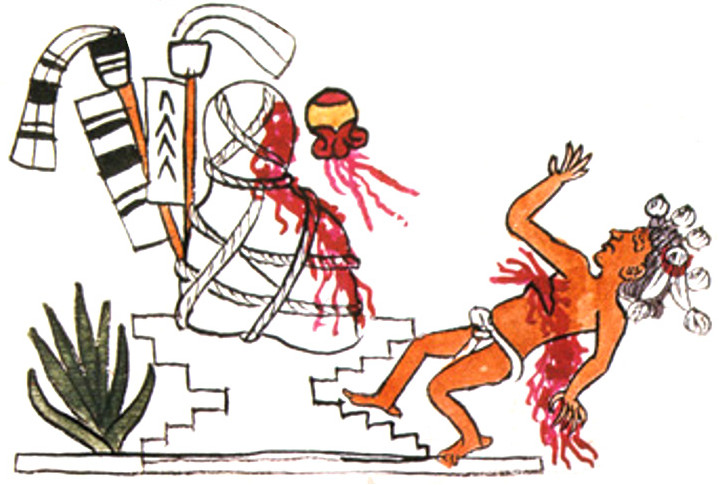
I can only guess at the fish’s significance: Maybe those other artists intended it to relate to the eerily similar stylized human heart in sacrifice scenes like that in Codex Magliabechiano, p. 133:

Heart-sacrifice Scene from Codex Magliabechiano

Viewing the area under high magnification, I can almost see the blur as a skull with gaping jaws like those of the Death Lord above, which would make sense since the Lord often sits on a skull or has one in his “bustle” (like mine above).

Such speculation aside, I won’t even guess at the meaning of the tasseled square figure and flag-like item with patterned piece that hang in front of Mictlantecuhtli. But the central scene is unmistakably a ritual sacrifice by drowning, tying right in with the trecena’s other theme of sacrifice. Both patrons watch with obvious approval of the ritual, but one wonders why.

The soul of the drowned sacrifice won’t be going either to Tonatiuh’s idyllic Fourth Heaven or to Mictlantecuhtli’s desolate Mictlan, but to the joyful Eighth Heaven of Tlaloc, Tlalocan. I suspect that the act of sacrifice itself goes to keeping the Fifth Sun up in the sky as well as to slaking the blood-thirst of Death. In this context, it’s tempting to suggest that as he’s Lord of Number Six, Mictlantecuhtli’s miserable Mictlan might actually be the Sixth Heaven, so to speak…

#

TONALAMATL YOAL (compiled and re-created by Richard Balthazar on the basis of
Codex Telleriano-Remensis and Codex Rios)

Aztec Calendar – Flint trecena – Tonalamatl Yoal

In Codex Telleriano-Remensis, the left-hand page of the Flint trecena with Tonatiuh is missing, so this image is based solely on the Codex Rios copy which goes wild with his divine regalia. With the major sunburst on his back as an unmistakable identifier, he lacks Borgia’s red face-paint design, likely because in the Rios image his whole body is dark red. I’ve chosen a ruddy flesh tone to avoid losing detail in monochrome darkness and have changed only the awkward length of his arms and angle of his scepter, which may be a version of the Fire Serpent.

However, the right-hand pages with Mictlantecuhtli still exist in both codices, the original and copy being almost identical in detail of regalia, skeletal limbs, and partially hidden skull beneath. But in Telleriano-Remensis, there’s a skull in his “bustle,” and in Rios (as here) it’s a dog’s head to indicate the day of which he’s patron. The circular orange items may intend marigolds, which are still considered a flower related to the Underworld.

In this Yoal image, I’ve changed the Death Lord’s ghastly brown and black visages with skeletal jaws to give him the human face of his bust above (top row, fifth from left) as Lord of the Night since they already share many details of headdress. As I’ve discussed in a blog “The Faces of Death,” this “living” face of the Night Lord is a break with the iconographic tradition of his face being almost everywhere else a skull. Another unusual detail is his blue-peaked cap—for some reason just like that of Xiuhtecuhtli in the first and tenth positions.

#

OTHER TONALAMATLS

Tonalamatl Aubin patron panel for Flint trecena

The patron deities in the Tonalamatl Aubin are the usual suspects—with a few differences from the preceding Flint trecenas. On the left, Tonatiuh has no throne and only a few red marks on his face, and part of the regalia on his back has been omitted, apparently for lack of space on the page. Oddly, he has only one arm… Tonatiuh now wears a recognizable pendant but has no other identifiers—except for the partial sun-symbol below. On the right, this Mictlantecuhtli also has a “living” face as well as fleshed-out limbs, and at least the pointy thing in his headdress is familiar. (I can’t imagine what the Aubin artist had in mind to make his left foot black.)

The central scene of sacrifice presents a curious variation. The victim clings to a “tree” of some ceremonial sort, apparently to eventually sink into the water and drown. I wonder why part of the “basin” was painted green and about that bundle beside it with someone’s hindquarters sticking out—quite puzzling. Even more puzzling are the two snakes, the brown living one with Tonatiuh and the clearly defunct white one under Mictlantecuhtli. But there’s no one to ask…

#

Codex Borbonicus patron panel for Flint trecena

The patron panel for the Flint trecena in Codex Borbonicus explicitly shows the ordeal nature of the drowning sacrifice. Here the victim clings to a smooth pole, possibly even a greased one, until sliding down into the water to provide an entertaining public spectacle. The attendant patrons “dance” in celebration of the ritual. This short-armed Mictlantecuhtli on the right has both skull and skeletal limbs, as well as a mop of dark hair with stars.

On the other hand, this Tonatiuh on the right isn’t as recognizable; his Fire Serpent scepter is no sure identifier. Rather than a sun-symbol, the semi-circular thing on his back looks more like that strange thing on Tlahuizcalpantecuhtli in the Snake trecena, but this one has an out-of-place skull on it. Even the semi-circle at top center isn’t a sun symbol, but one of the night, relating to the Night Lord Mictlantecuhtli. Apparently, the patrons are considered much less important than the central sacrifice scene.

Meanwhile, the profusion of other items in this panel suggests other considerations. Take for instance the vignette on the upper left of a person half-engulfed in some container, which harks back to the “packaged” body in the Aubin panel. When a motif appears again in separate situations, one has to assume that it has important symbolic significance—and when it’s repeated like the two blue creatures (also seen before) or the two pots of water. Those repetitive blue symbols around the pole of sacrifice surely aren’t there for gratuitous decoration, but I’m at a total loss for their meanings.

Note the little spear-bearer on the lower left. I’d bet he’s there to indicate the Flint trecena with his flint spearhead. However, I can’t explain the presence of that Venus-related scorpion over his head. It’s the same as the one with the Morning Star in the Snake panel. Has the Borbonicus artist gotten his dogmas mixed up? As a grace note, check out the little snake hovering over Tonatiuh’s head—reminiscent of that Aubin snake with him. But there’s no one to ask…

#

Codex Vaticanus patron panel for Flint trecena

The Codex Vaticanus patron panel for the Flint trecena is a slight rearrangement of what we saw in the Borgia panel, switching sides for the patrons but adding nothing new. The original panel was laid out with much wider spaces, squeezing off parts of Mictlantecuhtli’s regalia like what may have been another “pointy thing” in his headdress. For convenience and aesthetics, I brought the elements closer together and touched up several broken lines and blotched colors. Again, the central ritual sacrifice seems of exceeding importance, and once again the victim’s drowning is being graciously assisted. After all, his death will keep Tonatiuh turning in the sky, and Mictlantecuhtli will be happy to take his bones home to Mictlan.

#

This survey of the Flint trecena’s patron panels certainly corroborates Dr. Paquin’s main themes of sacrifice and separation and well illustrates canonical (if at times confused) iconography across the various codices. Stylistic differences ultimately don’t really matter all that much.

#

UPCOMING ATTRACTION

The calendar’s eleventh trecena will be that of Monkey, its patron being Patecatl, god of medicine as well as of intoxicants like pulque and psychedelic herbs. Stay tuned.

#

You can view all the calendar pages I’ve completed up to this point in the Tonalamatl gallery.

Aztec Calendar – Snake Trecena

The ninth trecena (13-day “week”) of the Aztec Tonalpohualli (ceremonial count of days) is called Snake for its first numbered day, which is also the 5th day of the veintena (20-day “month”). In the Nahuatl language Snake is Coatl, and it’s known as Chikchan in Yucatec Maya and Can in Quiché.

For the Aztecs the Snake symbolizes mystical power, and it’s probably no accident that it was associated with the male genitalia. The patron of the day Snake is Chalchiuhtlicue, goddess of flowing water (see Reed trecena). Images of the snake are frequent in the codices simply as reminders of divine power. It’s often a manifestation of Quetzalcoatl, the Plumed Serpent, and the core element of the divine weapon wielded by many deities, the Xiuhcoatl or Fire Serpent.

PATRON DEITIES RULING THE TRECENA

The principal patron of the Snake trecena is Xiuhtecuhtli, the Lord of Fire—or alternatively, of Turquoise (a homonym). As the latter, he is the lord of time and the sacred calendar, the Turquoise Year (tonalpohualli), in which capacity he determines mortals’ day of death and watches over departed souls on their journey to Mictlan. Also lord of the blue sky of day, Xiuhtecuhtli symbolizes the unfathomable, the limitless, unity, and completion. In Aztec astronomy, he’s lord of the Pole Star, the center of all things, and spindle of the universe. In addition, he’s both the Lord of the number 1 (with the Blue Hummingbird as his totem bird) and first Lord of the Night. Historically, Xiuhtecuhtli is a new, younger version of the ancestral deity of fire, Huehueteotl (the Old God). His birth day-name is One Rabbit.

The secondary patron of this trecena is Tlahuizcalpantecuhtli (Lord of the House of the Dawn), a nagual of Quetzalcoatl representing the planet Venus as the Morning Star. He’s symbolic of re-emergence, of the triumph of life over death. Meanwhile, he’s a dangerous deity, his gaze very destructive for both mortals and gods. Legend has him shooting a dart at the Sun, Tonatiuh, who throws it back at him but hits instead Itztlacoliuhqui (Curved Obsidian Blade), the god of stone and cold, a nagual of Tezcatlipoca. After Tlahuizcalpantecuhtli periodically disappears from the eastern morning sky to descend into the Underworld, he’s replaced in the western evening sky by Xolotl, the Evening Star. The Lord of the number 12 with (logically) the Quetzal as his totem bird, Tlahuizcalpantecuhtli’s birth day-name is One Reed.

AUGURIES OF SNAKE TRECENA

By Marguerite Paquin, author of “Manual for the Soul: A Guide to the Energies of Life: How Sacred Mesoamerican Calendrics Reveal Patterns of Destiny”
https://whitepuppress.ca/manual-for-the-soul/

This dynamic trecena’s theme is emergence and liberation. The energies associated with this trecena are strongly aligned with Lifeforce, Fertility, Sacred Authority, Justice, Liberation, Cyclical Regeneration, and the promulgation of higher knowledge. A sense of new vitality or awakening to new ideas often accompanies this time frame, suggesting that transcendent events, possibly of a world-shaping nature, could manifest during this period, opening up the realm of new possibilities.

Further to how these energies connect with world events, see the Maya Count of Days Horoscope blog at whitepuppress.ca/horoscope/. The Maya equivalent is the Chikchan trecena.

THE 13 NUMBERED DAYS IN THE SNAKE TRECENA

The Aztec Tonalpohualli, like the ancestral Maya calendar, is counted through the sequence of 20 named days of the agricultural “month” (veintena), of which there are 18 in the solar year. Starting with the 5th day of the current veintena, 1 Snake, this trecena continues with 2 Death, 3 Deer, 4 Rabbit, 5 Water, 6 Dog, 7 Monkey, 8 Grass, 9 Reed, 10 Jaguar, 11 Eagle, 12 Vulture, and 13 Earthquake.

There are four important days in the Snake trecena:

One Snake (in Nahuatl Ce Coatl) was noted in the Florentine Codex as traditionally a favorable day for merchants/traders (pochteca), travelers, and armies to “set forth to far lands.” In that spirit, the Codex indicates that One Snake was often the occasion for declaring of war. It is significant that in 1521 this was the day the Aztecs surrendered to Hernan Cortés and his conquistadores at Tenochtitlan after being defeated in a fierce battle.

Seven Monkey (in Nahuatl Chicome Ozomatli)is traditionally associated with wealth and prosperity. This day-sign appears on the Aztec Calendar Stone, below the central face.

Eight Grass (in Nahuatl Chicueyi Malinalli), according to some sources, is an alternate birth day-name of the goddess Chalchiuhtlicue, generally called One Water (again see Reed Trecena).

Nine Reed (in Nahuatl Chicnahui Acatl) is the birth day-name of the Earth Goddess Tlazolteotl, Goddess of Filth (see Deer Trecena). On this day, gifts of cacao, precious feathers, and flowers are offered to her.

THE TONALAMATL (BOOK OF DAYS)

Several of the surviving so-called Aztec codices (some originating from other cultures like the Mixtec) have Tonalamatl sections laying out the trecenas of the Tonalpohualli on separate pages. In Codex Borbonicus and Tonalamatl Aubin, the first two pages are missing; Codex Telleriano-Remensis and Codex Rios are each lacking various pages (fortunately not the same ones); and in Codex Borgia and Codex Vaticanus all 20 pages are extant. (The Tonalpohualli is also presented in a spread-sheet fashion in Codex Borgia, Codex Vaticanus, and Codex Cospi, but that format apparently serves other purposes.)

TONALAMATL BALTHAZAR

As described in my earlier blog The Aztec Calendar – My Obsession, some thirty years ago—on the basis of very limited ethnographic information and iconographic models —I presumed to create my own version of a Tonalamatl, publishing it in 1993 as Celebrate Native America!

My version of the Snake trecena portrays Xiuhtecuhtli in a wild interpretation of his image in Codex Borbonicus, mixing a fancy snake on his back from the Stone of the Suns with a flaming crest much like Quetzalcoatl’s plumes in the Jaguar Trecena. Obviously, I took the turquoise and fire homonyms to heart in the coloration and wisely incorporated his traditional pendant plaque.  I really should have made the bird totem on his forehead blue, and I have no idea where I got the shield design with the sun motif. Though I hadn’t seen any other images of the deity, I think my fantasy makes a very convincing Lord of Fire.

Aztec Calendar – Snake trecena – Tonalamatl Balthazar

#

TONALAMATL BORGIA (re-created by Richard Balthazar from Codex Borgia)

Aztec Calendar – Snake Trecena – Tonalamatl Borgia

The Snake trecena page in Codex Borgia is the busiest one in its tonalamatl and raises a huge number of questions, both mythological and iconographic. It definitely begs a narrative.

Let’s start with the primary patron (the big red guy on the right), Xiuhtecuhtli himself enthroned and looking very pensive or stern/aggravated. In the original, his image is quite deteriorated, his regalia blurred and spotty. In their restoration of the Codex Borgia (Dover Publications, 1993), Gisele Diaz & Alan Rodgers have been inventive in restoring his ornaments, some of which I’ve used; another anonymous facsimile made other choices; and I’ve made my own in some places.

The best example is the feathery thing on his back, the top of which in the original is basically blank (or worn away?). Diaz and Rodgers fill it with rows of short lines; the other facsimile intimates a spiral of same. My close study of the blankness found tiny indications of a possible second row of lines, but I’ve left the rest blank. Another problematic motif is that odd thing on his forehead, maybe a bird, which would make sense as his totem, but it looks nothing like any other bird I’ve ever seen in any of the codices.

When we consider the mass of material adjacent to the deity, things get really mysterious, like that slanting bundle of jaguar hide and spotted blue strips (with a surreal bird’s head) running behind Xiuhtecuhtli’s shoulder. We’ll see something similar in the Vaticanus patron panel later. Does it mean something that the water (from above) flows into the bundle and deity, rather than away from him as from Tlaloc in the Rain Trecena and Chalchiuhtlicue in the Reed Trecena? The two arrows in the stream are almost to be expected as power symbols.

However, that ornamental scorpion is a major enigma. Since the scorpion apparently has had obscure connections with the planet Venus ever since Maya times, Tlahuizcalpantecuhtli being the Morning Star is probably the key. The scorpion’s sting would be a fine material metaphor for the Morning Star’s divinely destructive gaze. Also, I’m puzzled by the patterns of squared and spiral water flowing at/onto Xiuhtecuhtli.

Briefly, the other major enigma is the central vacant throne, the jaguar pelt indicating that there should be some deity sitting there. Who?

Now let’s talk about the secondary patron with the tongue-twisting name, Tlahuizcalpantecuhtli, sitting gingerly on the jaguar seat on the left. The only evidence of his identity is the headdress with the long spokes and feathery crown. Otherwise, he’s just an innocent little blond guy with standard Aztec finery. His hands-in-the-air gesture certainly must mean something like, “I know nothing about it!” “What did you expect?” “Who cares?” Or perhaps a hundred other probably dismissive comments relating to the vacant throne or to the flood dousing the Lord of Fire. Between Xiuhtecuhtli’s pout/glower and Tlahuizcalpantecuhtli’s nonchalance, some story is definitely going on in this page, but it would take an Aztec priest to provide an exegesis.

I must confess that I made the personal choice to color the Morning Star’s “mask” in a pleasant light blue as opposed to the depressing grey or brown to be seen in images that follow. The little flag on his nose-piece is actually indicative of Tezcatlipoca, but this might just be a convenient decoration. Meanwhile, his predominantly white body and clothing are most unusual for deities in Codex Borgia. Maybe the artist simply left him unfinished—too busy with Xiuhtecuhtli? In any case, we’ll see more detail in later images of this god.

#

TONALAMATL YOAL (compiled and re-created by Richard Balthazar on the basis of
Codex Telleriano-Remensis and Codex Rios)

Aztec Calendar – Snake Trecena – Tonalamatl Yoal

Speaking of detail, the image of Tlahuizcalpantecuhtli on the left in this Telleriano-Remensis and Rios vision has them in spades, including a little One Reed identifier hovering overhead. The toothy feathered snake-monster on his back probably underlines his relationship to Quetzalcoatl (whose birth day-name is Nine Wind but sometimes called One Reed). As they will also occur in later images, the tear-drop motifs in his headdress (and in the snake’s) are other identifiers. Note his brown mask and mostly white raiment. Here his hand-gestures seem simply formulaic for his “dancing” or sitting posture on the standard place symbol/glyph.

On the right, Xiuhtecuhtli also “dances” or sits on a place symbol and wears ornate regalia. His headdress is very like that on his bust as Night-Lord (fifth from the left in the top row). The Telleriano-Remensis page with his image is missing, and I’ve had to base this representation on the uninspired Rios copy, supplementing it with details from elsewhere in T-R—like the fiery Xiuhcoatl he wields in his raised right hand. In his image in both T-R and Rios for the Pachtontli (Teotleco) solar vientena, Xiuhtecuhtli wears a flaming serpent on his back, but I thought that would be a little too much here. However, in both of those images one of his feet is the mystical water-fire symbol (atl-tlachinolli), which I’ve inserted as the Fire Lord’s right foot. Note his red and black face-paint as in the Borgia version—and in the following examples.

#

OTHER TONALAMATLS

Tonalamatl Aubin patron panel for Snake Trecena

Once again, the patron panel in Tonalamatl Aubin gives one serious aesthetic pause. It’s got most of the canonical elements, but they seem viewed through a strange (psychedelic?) lens. Of course, there’s fair reason to believe that psychoactive drugs were involved. Here, the patrons of the trecena have switched sides and seats, and the head of Tlahuizcalpantecuhtli (recognizable by the brown mask and teardrop ornaments in his headdress) is grossly distorted. Borgia’s vast flow of water has now become a mere spurt as part of the Morning Star’s headdress—another instance of the atl-tlachinolli water-fire symbol.

Meanwhile, Xiuhtecuhtli on the left has the standard red and black face and a fire-snake “cape,” and he holds his blue bird totem, which is by no stretch of the imagination a hummingbird. And by the way, I sort of hoped to see an empty throne and miss the scorpion.

Most startling is the fact that Tlahuizcalpantecuhtli has been flayed—sacrificially skinned! (In his Rios copy he is also flayed, but in the T-R original, only his hand shows the red stripes. I chose to ignore those details in Tonalamatl Yoal as too much information.) Here there’s no way around the ritual flaying of this deity. In fact, in several Borgia images of Tlahuizcalpantecuhtli he’s been skinned. In Vaticanus there are also many such images, as well as a section of five panels with the flayed deity attacking various people, places, and even a jaguar.  In each of those he wears an odd eyepiece representing his dangerous gaze. (These five panels also appear in Codex Cospi in much different style and similar detail but without the flaying.)

Tlahuizcalpantecuhtli: Borgia (l.); Vaticanus (r.)

The consistent representation of Tlahuizcalpantecuhtli as flayed suggests a close relationship with Xipe Totec, the Flayed God, whom we will see later as a patron of the 20th trecena, Rabbit. His virtues of fertility, renewal, and spring are broadly discussed in the “The Flayed God” by Roberta H. and Peter T. Markman (HarperSanFrancisco, 1992), who note that several other deities are also shown in the codices as flayed. I’ve found many skinned images of Tlaloc, Mixcoatl, Tlazolteotl, and even some of the Cihuateteo and Ahuiateteo.

I think the flaying of victims and deities must have been a transcendent sign/symbol of holiness—like the ubiquitous western tradition of the halo—and suspect that Xipe Totec, who usually only wears their skins, is the “high priest” of the bloody sect. Tlahuizcalpantecuhtli seems to be the principal flayed god in the pantheon. I wonder why he, the Morning Star, would be chosen for such grisly glory. Maybe because he’s a nagual of the great god Quetzalcoatl?

#

Codex Borbonicus patron panel for Snake Trecena

That being said, in the tonalamatl of Codex Borbonicus, Tlahuizcalpantecuhtli (back on the left side) is once again white-skinned in largely white clothes—maybe meaning his Borgia image was in fact completed. He wears his usual brown mask and has teardrop designs in his headdress, appearing in a constellation of motifs: water flowing at/onto the Lord of Fire (with arrows); some kind of a watery link (like the odd item at the center of the Aubin panel) to a throne (vacant but for a pile of ritual offerings); and what looks like a spider but is really a scorpion, both arachnids. Under high magnification one can see a tail/stinger curved up across its body. This is all stuff we already know from the Borgia panel, but I’ve never seen that surreal blue pointy-nose mask-thing on the back of his head before. Might it relate to his dangerous gaze?

With all that symbolic paraphernalia, Tlahuizcalpantecuhtli seriously overshadows Xiuhtecuhtli, who sports only that fire-snake on his back (the model for my own trecena above), the beautiful Borbonicus-blue totem bird on his brow and plaque-pendant. The artist apparently didn’t care much about this supposedly primary patron, grotesquely distorting his torso and shrinking his arms and hands—in contrast to complex and careful execution of the secondary patron.

As a post-script to this description, note the snake in the lower left denoting the trecena and the blue creature on the lower right. Whatever its species, it’s the same as the blue animal held by Tlahuizcalpantecuhtli in the Aubin panel. Like the vacant throne and scorpion, such repeated motifs surely must mean something integral to the implied narrative.

#

Codex Vaticanus patron panel for Snake Trecena

The Codex Vaticanus patron panel for the Snake trecena is obviously badly “weathered,” and I’ve tried to touch it up, restoring most faded and broken lines and filling in some of the color, except for the spotty flow of water. The patrons have switched sides once more, Xiuhtecuhtli in a divinely complex headdress brooding over Tlahuizcalpantecuhtli, who’s appropriately flayed now. We’ve again got the main narrative motifs, including Borgia’s strange staff with curls (but no weird bird’s head), the flow of water with scorpion and arrows, and the vacant throne—clearly a retelling of the same old story. The staff and flow of water being placed subtly in the foreground in this panel tells me they’re probably the main theme of the implied narrative.

But here the scorpion- and arrow-laden flood (apparently summoned by Tlahuizcalpantecuhtli) no longer flows at/onto Xiuhtecuhtli, instead getting “swallowed up” by the staff itself. Perhaps that motif is the Fire Lord’s symbolic “spindle of the universe” neutralizing the flood—or maybe the smoke-like staff is a stylized column of his divine fire? If the latter, then we’re again looking at an enormous atl-tlachinolli, which I’m told is a symbol of war. Does that mean the Morning Star is challenging the Pole Star for supremacy (the empty throne) of the sky? Or maybe that’s way too metaphysical.

#

Let me try another reading: perhaps this is all about Tlahuizcalpantecuhtli trying to take over the primary patronage of the trecena from Xiuhtecuhtli, in the Borgia panel sitting nonchalantly on his modest jaguar seat but ready to jump onto the empty throne, while Xiuhtecuhtli scowls at him and fends off his flood. In the Yoal panel, the Fire Lord is still on the prominent right, but One Reed displays imposing glitz with his serpent-monster cape. The two have switched sides in the Aubin panel, where Tlahuizcalpantecuhtli now sits on the primary throne, with Xiuhtecuhtli on the secondary jaguar seat. Back on the left side in Borbonicus, Tlahuizcalpantecuhtli with all his paraphernalia has basically usurped the panel from the battered Xiuhtecuhtli, having physical possession of the throne at least, and in Vaticanus he holds off the Fire Lord with the huge war symbol, the trecena’s throne now his for the taking.

Such are my amateur shots at playing Aztec priest, whether or not either of these stories is true. Either way, the roles of primary and secondary patron of this trecena aren’t exactly clear-cut, not that it makes a great deal of difference.

The flayed Tlahuizcalpantecuhtli is the main evidence I see of Dr. Paquin’s ancient Maya themes for this trecena of fertility, emergence, and liberation. Xiuhtecuhtli’s divinatory significance for authority, justice, and higher knowledge is nebulous. And my tentative readings have little to do with any Maya themes. After the several intervening centuries, I wouldn’t be surprised if the later Aztec iteration of this trecena’s themes might be substantially different than the Maya. Perhaps now it’s about confrontation, ambition, and power. After all, the Snake’s all about power, One Snake’s a great day for a war, and Tlahuizcalpantecuhtli is well known as a very aggressive deity, a holy terror. Maybe Xiuhtecuhtli represents the unified center of reality, and the bellicose Morning Star represents the antithetical force of chaos and anarchy, another elemental dichotomy like water and fire. Maybe not…

#

UPCOMING ATTRACTION

The calendar’s tenth trecena will be that of Flint, its patrons being the existential Lord of the Land of the Dead, Mictlantecuhtli, and the mighty Tonatiuh, God of the Fifth Sun. Stay tuned.

#

You can view all the calendar pages I’ve completed up to this point in the Tonalamatl gallery.
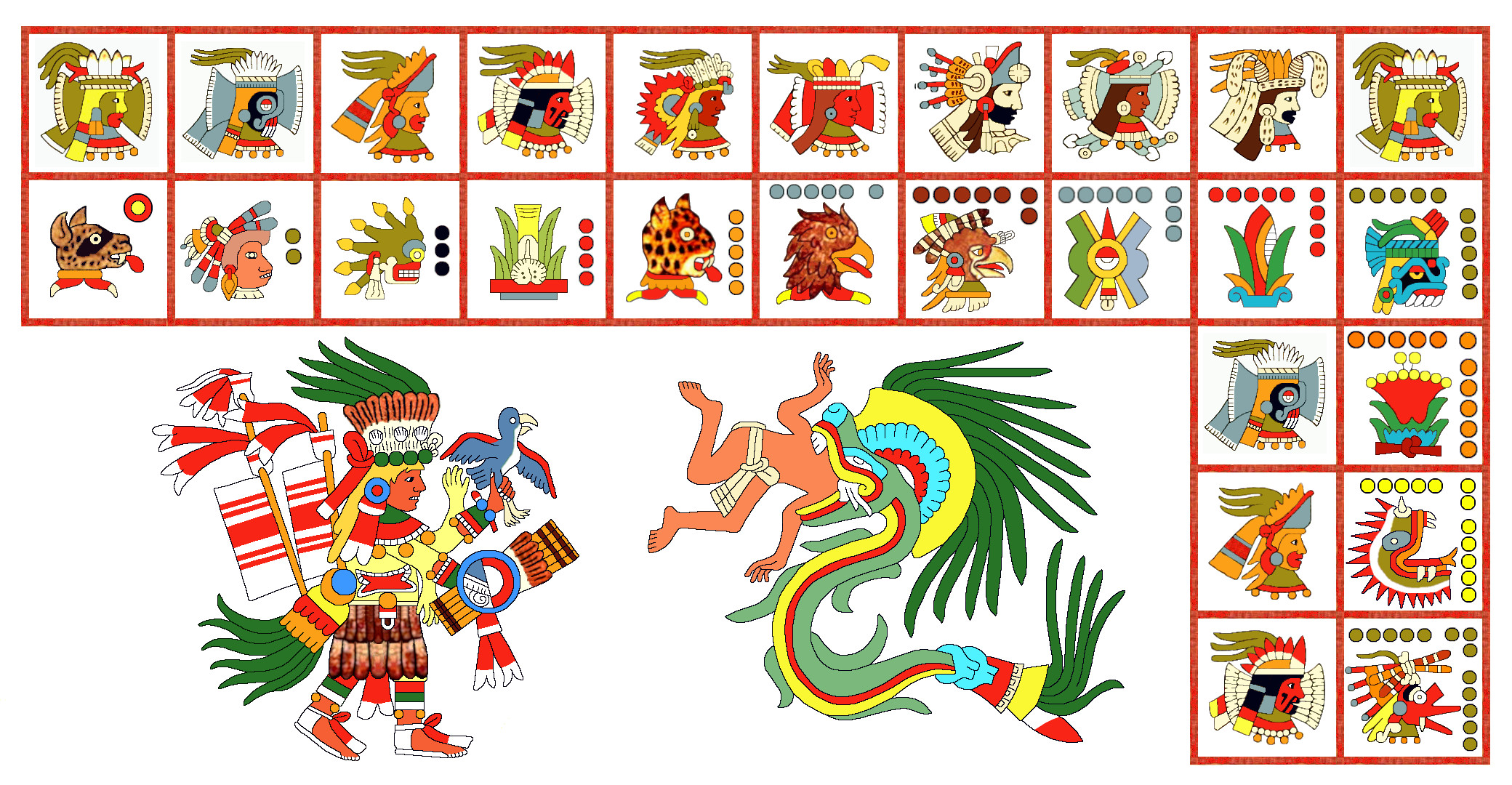
More on the Lunar Bunny

Besides for my motto, I’m indebted to the alley cat Mehitabel (“Archy & Mehitabel” by Don Marquis—1928) for stating our existential problem: “the eternal struggle between art and life.”

In early September I got word I had to move out of my penthouse apartment on Alicia Street. That same day I arranged with my daughter to rent the house she owns on Gilmore Street next door to her place. Moving there took some three months, meanwhile putting my projects on the back burner. Said projects included the ninth in my series of re-creations of trecena pages from the Aztec calendar (see the eighth, the Grass trecena) and a third short story about the old man dancing (see the second story “Better Buy a Dozen”).

Shortly before Thanksgiving when I’d finally gotten on top of the domestic trauma, I came down with Covid, fortunately only a mild case of exhaustion and congestion, with some ten days in isolation/recuperation. Off and on during the month, I managed to play with a few pixels on the Snake trecena re-creation from Codex Borgia (see “The Aztec Codices”) and to sketch out a couple paragraphs on the story.

“Clean” again (and resettled), I jumped back into the artistic fray, already making good progress on the Snake trecena. In addition, yesterday I posted a blog on 12/6/22 in the Aztec calendar as the day Ce Ollin (One Earthquake), when I became Pilzincoyotl (the Young Coyote), a deity of dance and nagual of Xochipilli (the Flower Prince).

While we’re on the subject of the current trecena in the Aztec calendar, I note that this Friday, 12/9/22 will be the day Nahui Xochitl (Four Flower). That’s the day-name in my private universe for the Sixth Sun—as proclaimed in my post “The Old Queen’s Proclamation,” which means we will have completed four cycles of the new era. You’re free to celebrate as you will this day of hope for a beautiful new world.

Now let me add some Aztec information that my devoted readers may have missed. Nearly four years ago in 2018, I posted “Ancient America-Asia Coincidences” about the Mesoamerican concept of a Rabbit in the Moon. At that point, I was working on Icon #16 (for my YE GODS! coloring book) and presented my drawing of the full moon:

Back then I was intending that icon to represent the god and goddess of the moon, Tecciztecatl and Metztli, but early last year (1/21) I discovered that I’d been mistaken (see my blog post “To Err is Human”)—that the god in the Codex Telleriano-Remensis whom I’d used for a model wasn’t Tecciztecatl but Tonatiuh, the god of the sun. Oh, well…

After that, back in May 2022, while working on the Death trecena re-creation, I discovered that the calendrical day-name of the Rabbit in the Moon is apparently 12 Rabbit! That day comes up in the current trecena on 12/17/22—a great day to celebrate the lunar bunny:

The Lunar Bunny – 12 Rabbit

How’s that for truly esoteric information!?

#

Making Lemonade

            Despite historic obstacles, 2020 turned out to be a very successful and productive year for me, both artistically and personally. It started with a celebration for completing Aztec Icon #18 – XOCHIPILLI, the Prince of Flowers on the last day of 2019. I’d first drawn this sun god thirty years ago for my book of days. The black and white icon, infinitely more complicated than this old four-color image, breaks all sorts of Aztec iconographic norms and conventions. Go to the link above to see this iconoclastic addition to the coloring book YE GODS!

Xochipilli – The Prince of Flowers – (God of pleasure, feasting, and dancing)

            On New Year’s Day, 2020 I posted the Flower Prince but still had much to do before adding his icon to my “travelling” exhibition YE GODS! Icons of Aztec Deities. In mid-January I mounted this show of large-scale banners at its seventh venue in a conference center—with the help of a tall French fellow I’d met during its sixth appearance.

            We’d hung the show by January 18 (for my mother’s 101st birthday), and I turned to our trip for the New Orleans Opera premiere of my new translation of Tchaikovsky’s heroic opera JOAN OF ARC on February 2 & 9. My clan gathered for the occasion at the Mahalia Jackson Theatre, and I enjoyed their acclaims, as well as those of appreciative audiences. I believe my linguistic work has turned the composer’s simply inspired piece into a masterpiece.

            By Monday, February 11, I was gratefully back in Santa Fe for my comfortable retired life in my eyrie apartment, my Casa Arriba penthouse high above the world. With a gratified sigh of relief, I slipped back into my splendid routines of writing/drawing, gym, dinners out, and especially the ecstatic dancing on Wednesday and Thursday evenings.

Casa Arriba

            After a couple leisurely weeks, I started on my second memoir, picking up my sordid tale of after marriage when I came out for the second time. Covering the next two traumatic and extremely sexual years of my fourth persona (the HIPPIE POET, footloose and feckless), I pretentiously included my own poetry, a device stolen from “Dr. Zhivago.” My routines and retrospective writing trance held me nicely right up almost to the middle of March.

            In my Mesoamerican fascination, I consider Friday, March 13, 2020 or the Aztec day Four Rain to have been the emphatic end of the Fifth Sun, the Sixth Sun starting on Saturday.  Suffice it to say that Friday the Thirteenth brought enormous turmoil into my life when my gym closed down due to a virus they were already calling a pandemic.

            On March 14, 2020 everything locked down (my show as well), and since then I’ve fortunately been living safely and comfortably in Casa Arriba. The loss of gym, dinners out, and ecstatic dancing has left me with only the splendid routine of writing and drawing. Right away I replaced my gym workouts with walking/running around the nearby track, but I could do nothing about the sauna except miss it miserably. Cooking simply, I didn’t miss restaurant food—just my regular companions at meals. I was driven to solo dancing to radio reggae and salsa in my living room and to sorely missing all the young bacchantes at Paradiso.

            I joked about going into solitary confinement but didn’t really feel that way. I deeply appreciated being made to step away from the world’s sound and fury, to take care of my physical needs simply in solitary peace, and to do my work on my natural schedule without distractions. I found it fascinating to watch my hair grow, now longer than it’s ever been, and I rather like it. Perversely, I didn’t feel lonely, isolated, or confined at all, but instead felt blessedly secluded, a secular anchorite. Six decades later, this new Sixth Sun feels like a confirmation and redemption of my solitary youth in backwoods Arkansas.

            Staying snugly at home (except for walks at the track and to grocery stores), let me focus on the memoir, which I titled LORD WIND, alternating between writing it and drawing on Icon #19 – TEZCATLIPOCA, The Smoking Mirror. By mid-May I’d finished and posted the icon, which went much deeper into the god’s story than this old drawing for the book of days.

Tezcatlipoca – Smoking Mirror – (Lord of the Night Sky)

  And by early June I’d finished the memoir. Rejoicing, I posted LORD WIND on the web as individual chapters or entire text.

           On the urging of my French friend, in June I began conjuring up visions of Tlaloc, the God of Storms, and at the same time started the third volume of memoir, soon entitled GAY GEISHA, about my stylish gay life in Washington DC in the 1970s. Once again, for sanity’s sake, over the next months I switched back and forth between creative processes.

            Meanwhile, a few important things happened in the solitude of October. First, I rode my bike to the Convention Center and voted early against the scumbag, whereupon I put it and its filth out of mind. Next, I finally struck my icon show after nine months’ lockdown—with the kind assistance of my tall grandson. Then, accepting that my life was utterly changed for the foreseeable future, I gave him my little red car and happily became a true pedestrian.

            In mid-November I started posting chapters of GAY GEISHA serially and by mid-December had published eight covering about a quarter of the decade. The switch then back to the icon was for a final push, aiming to finish it by New Year’s. I didn’t quite make it though. Only the other day, almost two weeks into 2021, I finally wrapped Tlaloc up, though he doesn’t look much like my first fanciful drawing of him for that old book of days. Still, that goggle-eye and fangs are standard features.

Tlaloc – (God of Rain)

            Please allow me to count Aztec Icon #20 – TLALOC, God of Storms, as an accomplishment for wretched but productive 2020. (I’ll post it very soon.) I’m tremendously gratified by creating my three icons, memoirs of gay liberation, and the operatic masterpiece.

#

Tlalocan II – The Drawing

After showing you my reconfiguration of the Teotihuacan mural of Tlalocan in early July, it took me these past three months to turn it into a black-and-white drawing. As such, it will become the lower register in Icon #20 for my digital coloring book YE GODS!

For several centuries the enormous city-state of Teotihuacan “ruled” central Mexico (and parts of the Maya world as well). Painted about 1,500 years ago, the tremendously ornate mural is a fascinating window into that vanished metropolis, a panorama of its people enjoying afterlife in the paradise of their water (storm) god—whom a thousand years later the Aztecs called Tlaloc. My drawing gives you an intimate look at the actual people who lived in the Place of the Gods. (It’s greatly reduced in this illustration, but you can click here to download a full-scale image—at almost three feet long and one foot high.)

Tlalocan – The Paradise of Tlaloc

Within that eye-boggling border, the first telling detail to notice is that there are no women, which may say something about a sexist society in Teotihuacan. Of course Tlaloc’s Eighth Heaven was reserved for victims of drowning and children sacrificed for life-giving rain, but one thinks maybe some women might also have drowned and girl-children been sacrificed too. In all likelihood (if the eschatology of Teotihuacan is reflected in that of the Aztecs), women may well have had their own paradise among the thirteen heavens. But there’s no mural of that one.

The Aztecs definitely inherited the concept of Tlalocan from Teotihuacan, and the iconography of the ancestral water (storm) god is also clearly reflected in that of the much later Aztecs.

Teotihuacan Water and Rain Gods

Tlaloc’s goggle-eyes and fangs crossed the centuries into the figure from Codex Borgia, as well as the head-pitcher he holds for pouring out water:

Aztec Tlaloc and Quiahuitl Day-signs

Teotihuacan’s rain-god image carries over directly into the Aztecs’ golden Four Rain sign (day-name of the Third Sun) on their Stone of the Suns. The Rain day-sign to its right is based on it—drawn thirty years ago for my book of days before I ever learned of the raindrops on the Teotihuacan image. The two lower signs are stylized versions for the calendars in the Fejervary-Mayer and Vaticanus codices; those in other calendars are similar, but often less formal.

Now let’s look into this window on the people of Teotihuacan. First, check out their quite varied fashions in clothing:

Teotihuacan Fashions

Not surprising are the loincloths or breechclouts worn by figures on the left with varying numbers of sashes. Note that children can be nude or just wear “panties.” But then the costumes get weird, like the top center fellow wearing a midriff T-shirt and toreador pants and the guy just below with a full-length T. The runner to his right may be wearing similar pants, but he also has gloves. The guy below is wearing “clam-digger” pants with breechclout; the guy with the tears (ignore those for now) only wears gloves and socks/slippers, as does the cross-legged kid below. On the far right the top figure wears shirt and pants under a loincloth, and the lower figure wears pants/leggings under a kilt with sash.

The variety of outfits may have to do with social classes—or maybe not. But I can say that the cross-legged kid in gloves and socks is remarkably unique in being presented full-face. All the other faces are done in profile—the standard view used by the Aztecs for faces and bodies as well. However, the ancient artist made free to show figures frontally and from many other realistic angles, an iconographic freedom apparently lost over the centuries.

Note also the varying hairstyles: Figures are frequently bald (or with shaved heads?), but many have hairdos of various lengths. The kilted fellow on lower right may be an elder with receding hairline and gray hair. In the mural you can’t tell if the guy at center-top has a topknot or feather headdress. Speaking of hairstyles and headdresses, there is also a wide assortment of such on other figures which again may have something to do with class or occupation—or maybe not.

Teotihuacan Headgear

Here we see several types of hats, headbands, skullcaps, and turbans. Notable is the figure on the upper left wearing an ear-flare, the only one in the whole mural—a fashion that became almost universal under the Aztecs—but there are no nose ornaments. Again, note the cross-legged kid on the lower right wearing what looks like a slightly cocked beret. The flirtatious fellow to his left possibly sports a half-Mohawk crest—or a feathered hat?

So now we know what (at least male) Teotihuacanos looked like! Here are a couple vignettes of their playful activities:

                    Teotihuacan Dancers

  Teotihuacan Toss

 Both of these group activities well illustrate the ancient artist’s stylistic freedom, as well as elements of perspective that the Aztecs would never have attempted. (The curlicues are shouts or songs of joy—a convention that totally carried over into Aztec iconography.) The scene of the tossing is probably celebratory—as happens in many cultures—and not a punishment like that undergone by Sancho Panza in “Don Quixote.”

Now we come to some distinctly odd images that I have a hard time parsing:

             Teotihuacan Oddities

This guy with the tears (in gloves and socks) seems to be singing loudly or shouting, but why is he crying and waving a branch, and what’s he got flowing from his chest? In the mural the flow doesn’t seem to be blood, and why should it be? The guy with the long stuff flowing from his head (hair?) seems to be chewing on a stick (sugarcane?). The four fellows holding each other’s wrists maybe are playing some game? Since this is in Tlalocan, whatever’s going on must surely be joyful fun.

I hope my little drawing has given you some visual notion of the lost and almost forgotten world of Teotihuacan.

#

Tlalocan – The Paradise of Tlaloc

Occasionally I’ve interrupted drawing for my coloring book to remark on particularly interesting details (like the Divine Volcanoes and Visions of Tezcatlipoca), and here I go again.

The icon I’m working on right now is for Tlaloc, God of Storms (as well as rain and weather in general), a very ancient deity with antecedents among the Maya as Chak and in Teotihuacan, his actual name unknown, at least a thousand years before the Aztecs. In conceptualizing the icon, I’m including as the base register an image of Tlalocan, the Paradise of Tlaloc, adapted from a mural at Teotihuacan (c. 500 CE).

In my process, I first gather, massage and manipulate source material to create a layout. After settling on the composition, I turn the images into line drawings. Working with a mural from Teotihuacan—and snitching a neat piece of Codex Vindobonensis—I’ve reconfigured it to be what I call the Tlalocan, the Paradise of Tlaloc, restoring the heavily damaged left half:

Teotihuacan Mural Reconfigured by Richard Balthazar

Keep in mind that the Teotihuacan mural (with an obfuscating deep red background), was painted some 1,500 years ago—before European monks ever started illuminating manuscripts.

Some scholars argue that this mural represents the sacred Water Mountain—Cerro Gordo behind the city—and was associated with the (also nameless) Great Goddess. While her mural is positioned right above this one, I heartily disagree and have removed the arguable “mountain,” moving in the centerpiece from the upper border (enlarged), an indubitable image of the fanged, goggle-eyed deity the later Aztecs dubbed Tlaloc.

The deity also holds “head”-pitchers like those Tlaloc holds in Codex Borgia pouring water onto the maize-fields. As well, the dedication to Tlaloc is tripled by the matching busts of the iconic water deity in the upper corners. In upper center, I’ve installed an anachronistic Mouth of the Earth pouring forth water (from Vindobonensis). The name Tlaloc means “He of the Earth.”

I have no problem with Cerro Gordo being the sacred Water Mountain of Teotihuacan. That nearby massif may well have sourced lots of springs and streams, and I gather there’s evidence of intensive agricultural terracing and other works on its slopes and summit. The original Water Mountain image in the mural I assert to be in fact the way of entry into the afterlife of Tlalocan. The figures in its waters aren’t just gaily swimming around but struggling, sinking, maybe drowning, and ultimately erupting into the Paradise of the god later known as Tlaloc. Note the attempted life-saving. I found the image nice but unnecessary. After all we’re worshipping LKA Tlaloc here.

“Water Mountain” from Original Mural at Teotihuacan

Circumstantially, priority entry into Tlalocan, a joyful place of games, butterflies and flowers, was granted to victims of drowning, then to children sacrificed to Tlaloc—note the many children in the mural’s pastiche—and only afterwards to victims of certain diseases such as leprosy. Those less than enviable passports aside, Tlaloc’s 8th heaven (out of the 13), was a great place to wind up, all dancing, singing, and having fun. In the other heavens, not so much…

If you squint at the little figures in the mural, you’ll see groups engaging in several games. On the far left it’s with soccer-type balls while another guy runs in perhaps a hybrid of bowling and hopscotch. Moving to the right, we come to a bunch of dancers, and beside them a guy getting tossed into the air. On the deity’s crest, four fellows play perhaps some version of leapfrog. On their right, kids play marbles, and four guys play on something maybe related to a teeter-totter.

Historically significant are those little curlicues issuing from the figures’ mouths, the symbol for song: These folks are rejoicing, singing out their joy. Even the birds I lifted from the Great Goddess mural are singing as on far right. (In the original a tiny worm also sings!) I know this symbol because it’s widespread in the Aztec codices of a thousand years later meaning the same.

I’m taken with the little guy on the lower right bending to admire a flower. This stretch of plants and figures has been called a scene of farming, but that’s just nonsense. Farming in heaven? The man standing on the far right might be yodeling, and the kid under the bush is merrily waving a flower, not particularly agrarian activities. Various other figures scattered around seem to be telling stories or doing tricks. A good time is being had by all.

Generally, I try not to engage in much speculation, but this time it’s terribly tempting. Let me suggest an intriguing possibility. Perhaps with the Water Mountain adjacent to their prosperous city the Teotihuacanos came to think of their world as literally Tlalocan on earth. Maybe they didn’t, but Mesoamerican history could have—taking that long-gone civilization into their cosmology as the Third Sun, Four Rain.

According to the Aztecs, Four Rain was ruled by Tlaloc while consorting with Xochiquetzal (Flower Feather), who might have been the Great Goddess, though She was usually seen as the proto-Chalchiuhtlicue (Jade Skirt). Lore has it that when Tezcatlipoca (The Smoking Mirror) abducted his goddess, Tlaloc raged and destroyed the Third Sun in a rain of fire.

This apocalyptic detail suggests another possibility. I’ve read that right around 600 CE there was a major eruption of Popocatepetl which, besides raining fire, spread a pyroclastic flood of toxic gases all over the valley of Anahuac (Mexico). Is it just coincidence that at exactly this time the civilization and people of Teotihuacan vanished?

Just wondering…

#