Aztec Gods of the Directions

When they founded Tenochtitlan c. 1325 CE, the Aztec barbarians adopted the traditional Mesoamerican temporal and spatial concepts of ceremonial calendar and cardinal directions.

The 260-day Aztec Turquoise Year or tonalpohualli (ceremonial count of days) is based on 20 numbered sets of 13 called trecenas, through which the 20 named days of the solar month are counted cyclically. That’s about as clearly as I can describe it. Some of the few surviving codices (ancient documents) include individual pages of the trecenas with their patron deities.

Some codices also have pages with the 260 days laid out in spreadsheet fashion with five rows of 52 columns in four sets of 13, Here’s a sample section from Codex Vaticanus laying out the first set of 13 columns (trecenas 1, 5, 9, 13 and 17):

vaticanus first section

First Section of Spreadsheet Calendar, Codex Vaticanus

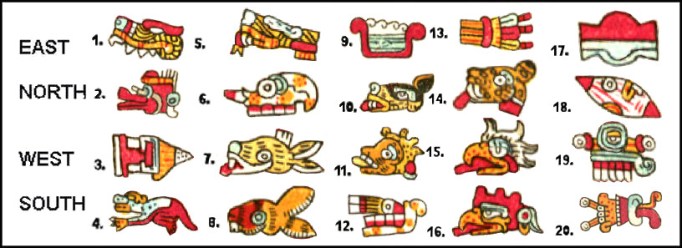
One reads left to right starting with day One Crocodile on the bottom row at lower left; after counting the 52 days in that row, we come back to the second row from the bottom beginning with Reed. Repeating that process, the count returns to the first column to resume with the days One Snake, One Earthquake, and One Water. The blocks of four columns of five days repeat 13 times—only in varying internal sequences—symbolizing the four cardinal directions:
days of direction - Vaticanus

Vaticanus Day-Signs Corresponding to Cardinal Directions

Numbered per their position in the 20-day “month,” these are East: Crocodile, Snake, Water, Reed, Earthquake; North: Wind, Death, Dog, Jaguar, Flint; West: House, Deer, Monkey, Eagle, Rain; South: Lizard, Rabbit, Grass, Vulture, and Flower.

These four cardinal directions are also characterized by colors: East—red; North—black; West—white; and South—blue. This color scheme correlates to the emblematic colors of the Aztec gods of the directions: Xipe Totec, God of the East—the Red Tezcatlipoca; Tezcatlipoca, God of the North—the Black Tezcatlipoca; Quetzalcoatl, God of the West—the White Tezcatlipoca; and Huitzilopochtli, God of the South—the Blue Tezcatlipoca.

Aztec Gods of the Directions

The traditional spatial matrix inherited by the Aztecs also included a fifth direction—the Center—which they saw as ruled by Xiuhtecuhtli, the Lord of Fire/Turquoise.

Xiuhtecuhtli - Lord of the Turquoise - (God of Fire)

XIUHTECUHTLI, God of the Center

With the Mexica’s tribal War God Huitzilopochtli ruling the South, this is emphatically the Aztec empire’s imperial vision of the divine quartet/quintet. Wondering what earlier deity may have ruled the South before, I looked at p. 1 of Codex Fejervary-Mayer, a document thought to have originated in the Veracruz region. It lays out the directions with pairs of patrons, totemic trees, and birds. However here, it’s Tezcatlipoca dominating the Center. (Apologies for the scruffy image, but I’ve got neither time nor energy to “re-create” it.)

fm01

The Five Directions, Codex Fejervary-Mayer, p. 1

The orientation of the directions is a bit different than our common Eurocentric model, rotated one notch counterclockwise. Here East is at the top, West at the bottom; South is on the right, North on the left. Besides the totemic birds and trees, the busy diagram includes much calendrical symbolism, including the days of the directions, year-bearers, and what-not.

By the way, the South tree is a “sacred” Theobroma (Food of the Gods) cacao tree with its chocolate pods. The totem on the North is a spiky ceiba tree (Kapok) which the Maya saw as the great tree at the center of the world—connecting the Underworld and the Sky World (heavens), its trunk representing the world of humans, animals, etc.

The pairs of patron deities in each lobe include only two of our divine quartet of Tezcatlipocas. In the top East lobe, on the right stands Xipe Totec, our Red Tezcatlipoca, with his Flint headdress, and I’d bet his companion is the sun god Tonatiuh, god of the Fifth Sun. In the left North lobe, the upper deity is a simple version of our Black Tezcatlipoca, and the lower one looks like the mighty Tlaloc, God of Storms. The rest of the patrons are different.

The South lobe on the right tells us who must have ruled that direction before the Aztecs inserted their Huitzilopochtli: the upper Mictlantecuhtli, Lord of the Land of the Dead, and the lower Centeotl, God of Maize. The Aztecs gave them both the boot… In addition, the West lobe on the bottom holds no White Tezcatlipoca, Quetzalcoatl, showing instead a surprising pair of patrons from pre-Aztec mythology. On the right (upside down) is Chalchiuhtlicue, the Jade Skirt, Goddess of Water, and on the left Tlazolteotl, Goddess of Filth, a major mother deity.

The reputedly misogynist Aztecs seem to have impeached these two great goddesses to install the famous Maya/Teotihuacan/Toltec Plumed Serpent as their deity of the West, as the White Tezcatlipoca. Speaking of misogyny, in another religious coup, the new empire tried to depose the Goddess of the Moon (Ixchel to the Maya and Metztli in Teotihuacan) from her traditional role as patron of the calendar’s Death Trecena and then made their own Tecciztecatl into the God of the Moon. (Metztli can still be seen in the calendar in Codex Telleriano-Remensis.)

The Aztecs were also conservative, if not reactionary, in other ways, like in celebrating their culture as the culmination of the “golden” ages of Teotihuacan and the Toltecs. Witness their great cult of Quetzalcoatl and abject “idolatry” of Tezcatlipoca, also inherited from the Toltecs. Since time immemorial, he and Quetzalcoatl were seen as each other’s twin and nemesis, and in their roster of the gods of the directions, the Aztecs enshrined that primordial conflict. That they apparently replaced the Smoking Mirror with Xiuhtecuhtli as God of the Center is surprising, and it’s even more so that they didn’t make Huitzilopochtli Center and give someone else South. But winners always get to write their own version of history—and religion.

###

Aztec Icon #14 – QUETZALCOATL, Plumed Serpent

Sorry to take so long to finish the 14th icon for my coloring book YE GODS!  My work was delayed by that time-consuming thing called life.  Anyway, the icon’s done and my digital wizard has turned it into vector drawings for free sizing.  Here you have the most famous Aztec deity of all, QUETZALCOATL, the Plumed Serpent:

Quetzalcoatl, Plumed Serpent

QUETZALCOATL (Plumed Serpent) {ke-tsal-ko-atł} is the god of intelligence, learning, writing, arts and crafts, the calendar, priests, and merchants and was the bringer of maize to mankind.  Opposed to human sacrifice, he is called the White Tezcatlipoca and is the 9th lord of the day and god of the West. As the planet Venus, he is known as Tlahuizcalpantecuhtli, the morning star, and his twin Xolotl is the evening star.  He ruled the Second Sun (Four Wind) and created the current Fifth Sun (Four Earthquake) by using his own blood to give new life to the bones in Mictlan.  He was known as Kukulcan to the Maya and a major deity in Teotihuacan, and Quetzalcoatl was the traditional name/title of the Toltec rulers of Tula.

This icon is available as 8X10 with a caption/sources page by clicking here.  The freely sizable vector versions are available by clicking here.

By way of explaining this new icon, I must first thank Eliseo Rosales, a tattoo artist in California, for his suggestions, particularly for the design on the pedestal and for the important theme of maize.

The central figure of Quetzalcoatl is based on an image from Codex Borbonicus with details of costume and accoutrements mostly from Codex Magliabechiano, though the serpent on his back is adapted from those on the Stone of the Suns. Don’t be surprised by his beard, which occurs in other codex images:  According to some, he was supposedly blond and white-skinned.

In his left hand, the deity holds the weapon known as Xiuhcoatl (Fire Serpent), and on his shield is his standard ‘cross’ symbol. His peaked cap of jaguar pelt is apparently a Huastec influence.  Sprouting from his forehead is a ritual ‘blooming shinbone,’ the significance of which escapes me.  The numeral by his left foot is Nine, of which he is the patron, and the day-sign One Reed directly over his head is his ceremonial day-name.

Now for the other motifs. The pedestal, as mentioned above, illustrates the depth of the history of the Plumed Serpent.  It comes from the frieze on the Temple of Quetzalcoatl in Xochicalco (c. 1000 AD), which was a city/culture that arose in the aftermath of the Classic civilizations of the Maya and Teotihuacan.  As evidence of his even deeper history, the two heads flanking his day-name are views of sculptures on the Temple of Quetzalcoatl in Teotihuacan (c. 600 AD).  The paired feathered serpents on his either side are taken from Codex Borbonicus and Codex Telleriano-Remensis, and the paired quetzal birds are merely grace-notes.

The border design is adapted from one of his images in Codex Telleriano-Remensis. The day-signs embedded in it represent the ceremonial calendar which the deity brought into Mexico in the dim past.  Each group of five days represents a direction in the Aztecs’ odd world-view.  At the bottom is West, of which he is the patron.  At the top is East, on the left North, and on the right South, the standard Aztec spatial orientation as it was also for the Maya.

Drawn respectively from the Cospi, Vaticanus, and Borgia codices, the standing deities in the upper section are: on the left, Tlahuizcalpantecuhtli, Lord of the House of Dawn (as the Morning Star), on the right Xolotl (as the Evening Star), and at the top his nagual (manifestation) as Ehecatl, God of the Wind.

In the upper corners are scenes representing his gift of maize to mankind. On the left is Tlaloc, the Storm (Rain) God, nurturing the goddess of maize Chicomecoatl, and on the right is the goddess of flowing water Chalchiuhtlicue tending the god of maize Centeotl.

That’s all the mythology I could manage to cram into this icon. Surely it’s enough.

#

Another note of interest about Quetzalcoatl. In the September, 2017 issue of ANCIENT AMERICAN magazine, my article just appeared entitled “The Plumed Serpent in North America.”  Click here to check out a copy.

My Jubilee

Recently having turned 75, I think that respectable age qualifies for a jubilee celebration. At least I’m jubilant.  To celebrate this auspicious occasion, I had a portrait taken by the talented local photographer Carolyn Wright of the Photography Studio.  For the first time ever, I must say that this picture does me justice, and I’ve already featured it on my homepage.

Richard Balthazar, Writer and Artist

I jubilate in celebration of my many blessings:

First, having grown up, had a family, and gotten old in this country (USA)—where I’ve been ostensibly free, in spite of spending most of my life as an outlaw (gay), and could make a reasonable living doing what I like (arts, education, horticulture…). That covers many bases.

Next, having been in extraordinarily good health all my life. There have been a few medical emergencies and curable conditions, but especially in these later years I seem to have crafted a very healthful diet and regimen of physical activity (gym and dancing).  I try not to be too proud of my deceptively youthful (and handsome) appearance above and am more than happy to tell anyone my anti-aging secret (Kombucha).

Also, having had such exciting experiences, like trips all over around this country and into Canada and Mexico, fascinating festivals (esp. Mardi Gras and lots of Gay Pride celebrations), and wonderful performances by fantastic artists. I’ve lived a culturally rich life style.

On this my jubilee, I also jubilate big time over the exceptional things I’ve accomplished, though they may not have made me rich or famous. My jubilee is the perfect time to toot my own horn—since nobody else is going to.  So here goes:  Toot!

  1. Won an essay contest in high school (1958) and represented Arkansas representative at the First National Youth Conference on the Atom in Atlantic City. I still have my essay on atomic energy, and its blue-ink penmanship still reads intelligently, if archaically.
  2. Sailed gaily through college at Tulane in the early 1960’s with a double major in Russian and French Quarter debauchery and made Phi Beta Kappa.
  3. Wrote a Master’s thesis and a few doctoral dissertations in the later 60’s, contributing exactly nothing to world knowledge, but they got me a job teaching at a university.
  4. Appeared in theatrical productions: ballet (peasant in Coppelia, 1970), play (sailor in The Tempest, 1971), and operas (extra in Prokofiev’s War and Peace at Wolftrap, 1975, and supernumerary cardinal in Lalo’s Le Roi d’Ys, 1980, on Broadway, no less).
  5. Coached the Paul Hill Chorale to sing Kabalevsky’s Requiem in Russian at the Kennedy Center In 1975 and translated for the composer in interviews and social occasions.
  6. Was a stage interpreter with the Bolshoi Opera in Lincoln and Kennedy Centers In 1976 and got to watch their repertoire many times over (from down-stage left).
  7. Translated Tchaikovsky’s opera Maid of Orleans into English for productions by the Canadian Opera Company, 1978, and Detroit Opera Theatre, 1979. This was my first truly artistic achievement, a triumph of rhymed triplets in iambic pentameter. Toot-toot!  I’ve included a poetical excerpt in my Public Library for your enjoyment.
  8. Wrote the play The Special Case, a detective drama drawn from Dostoevsky’s novel Crime and Punishment, which was produced by the Santa Fe Community Theatre in 1990 and ran for two weeks to no reviews. An actor praised it as “a Russian Colombo.” Yes.  It can be read (and is available free for production) in my Public Library.
  9. Discovered the suppressed subject of the Indian Mounds, spent about 15 years researching them, and finally published Remember Native America, a mound travelogue, in 1992. It has since been superseded by much more research and revision of timelines, but all the same, it’s available here for free download.
  10. Discovered the neglected subject of the Aztec calendar, spent some five years drawing, and published Celebrate Native America, a new book of days, in 1993 with my artwork and an abortive attempt to proclaim a Sixth Sun, also available here for free download.
  11. Created a unique and exciting profession in 1997, spending 15 years as the Used Plant Man  (or the Iris Man in summer), a plant recycler at the Farmers Market, maybe not an artistic achievement, but I spread beautiful iris all over town. Good enough.
  12. Built an innovative greenhouse in 2000, a semi-subterranean, ecologically efficient structure for raising cacti, succulents, and ornamentals for market. Again maybe not artistic, but it was definitely an architectural achievement .
  13. Wrote the novella Bat in a Whirlwind (over about 30 years), an autobiographical story of almost coming out in the backwoods, published electronically on this website, 2015. Click here for free download.
  14. Wrote the novel Divine Debauch (over maybe 25 years), fictionalizing my dissolute years in the French Quarter, published by AuthorHouse.com , 2005. It really needs a rewrite, but I haven’t the energy or time. Meanwhile, it’s still a great gay read.
  15. Wrote the handbook Getting Get, a glossary of the English verb, (after 40 years of linguistic research), published by AuthorHouse.com , 2006, but also available electronically for free by clicking here.  Frankly, it’s my work of genius.
  16. Wrote the memoir There Was a Ship covering my time in in Seattle (1965-66), published electronically on this website, 2016. Click here for free download. It’s the story of a gay man going (kicking and screaming) back into the closet.
  17. Wrote the biography Ms. Yvonne, the secret life of my mother, published electronically on this website, 2016. Click here for free download. It was fascinating detective work and much photo restoration to uncover the life of a survivor of Hurricane Katrina.
  18. Wrote the unique reference on the Aztecs, YE GODS! an illustrated encyclopedia of deities, an essay on the surviving Pre-Conquest codices, and a coloring book of thirteen of my icon drawings based on images in the codices, published electronically on this website, 2017. Click here for free download of the separate sections.

Goodness! That was almost a whole horn concerto of jubilee toots.


I won’t be able toot about anything else for a while. I’ve only just begun a second memoir, this one about gay life in the carefree 1970’s, and there are still 13 more icons to draw for YE GODS!  You’ll be the first to hear about any new achievements.

YE GODS! THE AZTEC CODICES

Here it is at last, the third part of YE GODS!  This is the promised illustrated commentary on the Aztec Picture-Books, a unique discussion with examples of the fifteen codices that survived the book-burning during the Spanish Conquest of Mexico.  I can guarantee you’ll never have seen anything like this in terms of art history, mythology, and Aztec ethnography.

Click here to view or download YE GODS!  THE AZTEC CODICES

Or click here to visit the cover page for the new section

It’s been a couple months since I last posted anything, (not that anybody out there really cares, I suspect), but the time has been well spent on completing this project, in and around many other developments in my life.  Not the least of those was running around trying to set up an exhibition of the Aztec Icons, without success to date, and to interest a local non-profit publisher in making a book on the whole three-part YE GODS! shebang (which never materialized).  The next epiphany of 13 icons still remains to be drawn.

In other developments, it took these couple months to move to a new apartment, including some weeks to move my iris garden to the new place.  It’s splendid with a huge balcony/porch and a big area for a garden and enormously convenient to my gym and other amenities.

In terms of iris, I’m thrilled to report that after five years of looking and wheedling, I’ve finally found someone to start up my plant recycling business again.  A young fellow named Aaron jumped in with his shovel and has already been selling iris on Craigslist like hotcakes.  He plans on selling at farmers markets around here and should do a land-office business, so to speak.

Now my big plan is to go with the family for a vacation during the first week of July at Hot Springs, Arkansas.  It should be a sentimental time because it’s quite close to my childhood home in the southwestern woods of that state.  Maybe I can even get my grandsons to read BAT IN A WHIRLWIND!

Coloring Book Overhaul – The Aztec Icons

BIG NEWS FOR ALL YOU COLORING ENTHUSIASTS! Whether you’re new to this website, have just been keeping your eye on it, or have actually colored some of my unusual icons of Aztec deities, you’ll find my overhauled coloring book now has a lot more to offer.

There are 13 icons currently completed (but there will be 19 by May, 2020!), each is now accompanied by a page with its descriptive caption and full-color images from the Aztec Codices that served as models for drawing the icon. Those images will give a good idea of the varying styles of the ancient picture-books and maybe even suggest authentic colors to use in your own coloring.

Check out this example of the caption/model page for CHALCHIUTLICUE, the Jade Skirt.

caption-model page for Chalchiuhtlicue

As before, all the icons can be viewed or downloaded individually from the coloring book page, either as a pdf file with caption/models page or as freely sizable vector drawings. But now they are also all bundled together into an actual book:  YE GODS!  THE AZTEC ICONS.

But that’s almost the least of the overhauls. In addition to that book, there is now a major revision and expansion of the earlier catalog and appendix—a complete illustrated encyclopedia of essentially all the Aztec deities:  YE GODS!  THE AZTEC PANTHEON.

Its 88 alphabetical entries include some 1,300+ divinities (depending on how you count), and there’s usually an authentic image for each selected from the Aztec Codices. Again, the images illustrate their varying styles and provide even more suggestions for coloring the icons.

Here’s a sample page from the encyclopedia:

sample page – The Aztec Pantheon

Of itself, YE GODS! THE AZTEC PANTHEON amounts to a crash course in ancient Mexican mythology, history, culture, and art.  YE GODS!  THE AZTEC ICONS takes this another step further—into illustrating details of Aztec society.

For perhaps excessive example, with Huehuecoyotl, the Old Coyote, there are vignettes of people playing musical instruments, singing, and dancing; with Huitzilopochtli, Hummingbird of the South, there’s a pictorial narrative of the legendary migration of the Aztecs to Tenochtitlan; with Mictlantecuhtli, Lord of the Land of the Dead, there’s a vague map of the soul’s way to Mictlan; and with Patecatl, God of Medicine, there are scenes of medical practices and medicinal herbs. Each icon contains its own type of social commentary.

I haven’t quite started on Aztec Icon #14: Quetzalcoatl, the Plumed Serpent, but hope to do so shortly.  In the meantime, I’m working on yet a third component of my Aztec project, another section on the Aztec Codices themselves.  It will be a description of and commentary on each of the 15 surviving picture-books, including sample pages and Internet sources to view the whole documents.  I perhaps unrealistically hope to complete it in the next couple months, and guess what:  I’ll call it YE GODS!  THE AZTEC CODICES.  Watch for a post announcing it.

###

Aztec Icon #13 – PATECATL, God of Medicine

So—six weeks now seems to be my new average to produce an Aztec icon for the coloring book YE GODS! Here’s Icon #13, PATECATL, which I drew on my old system (GNU) and believe it or not, using the mouse in my left hand.  Back while drawing #12 I started getting pains in my right hand from all the clicking—so I switched.  Nothing to it!

This is a standard pixelated image, and it’s currently winging its electronic way to my graphic wizard for conversion to vectors. The vectorized files for #12, OMETEOTL, have now been added to the list on the coloring book page, where you can also view and download all the previous icons.

To download this one as a pdf file with a page of caption and model images from the Aztec Codices, just right-click here and select “Save as.”  You can also download it in freely sizable vector drawings from the coloring book page.

Patecatl, God of Medicine

Patecatl, God of Medicine

PATECATL

God of Medicine

PATECATL {pa-te-katł} is the god of healing and fertility, medicine (herbology) and surgery, who gives comfort in illness. Logically he is patron of day Grass.  Husband of MAYAUEL, he is the father of the Centzon Totochtin (400 Rabbits), the gods of drunkenness led by Ome Tochtli (Two Rabbit). As well as being a pulque god like his wife, he’s the deity of intoxication by peyote, hallucinogenic mushrooms, and psychotropic herbs such as datura (jimson weed), morning glory, and marijuana. These plants were used in healing, fortune telling, shamanic magic, and public religious ceremonies, hopefully also to tranquilize sacrificial victims and enhance the sacramental nature of the ritual.

***

There are several points of interest in this icon:

  1. The god’s physiognomy is iconographically authentic, quite the way he appears in Codex Borgia, nose, buck-teeth, and all. His eye is just as baleful in the model, where (as is often the case with gods, male and female) it’s horribly blood-shot. I won’t even guess what that’s all about.  Also, since it’s so obvious here, in general the Aztecs didn’t bother with the difference between right and left feet, but they usually tried to distinguish between right and left hands.
  2. The vignettes in the upper section of the icon are based on medicinal scenes from various codices, including Nuttall, Borgia, Fejervary-Mayer, Vaticanus, and even the post-Conquest Florentine Codex.
  3. The vignette of nose-piercing is remarkable for two reasons. In the Nuttall model, the patient is not only bearded, but black. Throughout the codices there are frequent black personages, both human and divine, and indisputable beards.  Make of that what you will.
  4. The plants scattered around the icon are actual medicinals, several adapted from early herbal illustrations, from Nuttall, and from nature.
  5. Meant as a House of Healing, the temple in the upper right may be a bit over the top ornamentally, but it’s stylistically real.  The figure of the snake ingesting a rabbit is based on a page from Vaticanus, where an eagle is also seizing the snake.  I’ve included it to symbolize life as a food cycle, very much the way the Aztecs saw it.

Aztec Icon #12 – OMETEOTL, Deity of Two

Well, in a mere three months I’ve managed to finish Icon #12, OMETEOTL for the coloring book YE GODS!  Actually it took only about six weeks because I spent the other six weeks trying to work out a computer system upgrade.  I’ve been using the freeware GIMP (Gnu Image Manipulation Program), but a fantastic artist-friend convinced me to buy an iMac and look into another program for drawing.

After some weeks taking a community college course in Adobe Photoshop, I took a preliminary look at Adobe Illustrator—without being particularly impressed. I still have to take tutorials in Illustrator, particularly about drawing in vectors, but in the meantime I’m continuing my artwork on GIMP (on my PC) and relying on my graphic magician to turn stuff into vectors for me.

So herewith I’m posting the standard .pdf of this icon, and when my wizard has done his trick, I’ll provide the vector drawing in the various sizes. (Again, if you want his contact for similar vectorizing work, contact me at “rbalthazar” @ msn.com.)  You can also view and download the previous 11 icons from the coloring book page.

To download this one as a pdf file with a page of caption and model images from the Aztec Codices, just right-click here and select “Save as.”  You can also download it in freely sizable vector drawings from the coloring book page.


Ometeotl, Deity of Two

Ometeotl, Deity of Two

OMETEOTL

Deity of Two

 OMETEOTL {o-me-te-otł} is the creative pair of Omecihuatl (Lady of Two) and Ometecuhtli (Lord of Two), conjoined as the supreme creator and parent(s) of the primary Aztec gods.  This deity of duality is transcendental, without cult, rites, or temples and exists somewhere beyond the stars.  Also known as Tonacacihuatl and Tonacatecuhtli (Lady/Lord of Sustenance), as Ilamacihuatl and Ilamatecuhtli (Lady/Lord of Creation), and as Citlalicue and Citlalatonac (deities of the stars), OMETEOTL represents unity through sexual dualism. The pair rules the highest (13th) heaven of Omeyocan where unborn souls reside. Omecihuatl chooses the days for their birth and consequently their fates.

***

I should probably explain a few things about this icon. First off, the 20 symbols arrayed around the periphery are the day-names of the month.  The Aztecs named the days of their month and counted the days of their week (13).

The sequence starts with the second up from the bottom on the right side and proceeds counter-clockwise to end in the lower right corner: Cipactli (Crocodile), Ehecatl (Wind), Calli (House), Cuetzpallin (Lizard), Coatl (Snake), Miquitzli (Death), Mazatl (Deer), Tochtli (Rabbit), Atl (Water), Itzcuintli (Dog), Ozomatli (Monkey), Malinalli (Grass), Acatl (Reed), Ocelotl (Jaguar), Cuauhtli (Eagle), Cozcacuauhtli (Vulture), Ollin (Earthquake), Tecpatl (Flint), Quiahuitl (Rain), and Xochitl (Flower).

The days in the middle of each side are also the year-bearers for the 52-year count, starting at the top and again going counter-clockwise: Rabbit, Reed, Flint, and House.

Meanwhile, the little creatures being “spit out” by the odd serpents all wear the traditional mask of Ehecatl, God of the Wind, (See Icon #5), who is the life spirit. So these “breezes” represent the new (or recycled?) souls being born.  They have claws, I assume, because most supernatural beings seem to have them.  They are based on images from Codex Borgia.

The four smaller gods represent the primary god-descendants of Ometeotl. Again counter-clockwise from lower right:  Tlaloc (based on Codex Borgia), Quetzalcoatl (based on Codex Borbonicus), and Tlahuizcalpantecuhtli (based on Codex Borbonicus).  I had intended the last to be Xiuhtecuhtli, but I made a mistake in identification.

The medallion at top center is based on an enigmatic design from Codex Borgia which I take to represent the concept of duality. The dual image of Ometeotl is drawn from Codex Fejervary-Mayer, the only image I’ve ever been able to find of that transcendent deity.  Otherwise, I haven’t a clue about the horn-like thing that Omecihuatl holds or what it may signify.


Aztec deities in vector drawings

Great news for all you coloring enthusiasts out there! I’ve now managed to get the icons of Aztec deities for the coloring book YE GODS! turned into vector drawings.  This may not sound like a big deal, but it actually is because the lines are now clean-edged, and the .pdf files can be enlarged or shrunk without affecting line-quality.  At least that’s what they tell me…

(The work of converting all my insane pixel drawings into vectors was done magnificently and quickly by a brave young fellow in a distant country, saving me many months of boggling labor. Contact me, rbalthazar at msn.com, for his details.)

On the coloring book page, as well as below, I now include three free download options for the icons completed thus far. The regular download is still for the original 8X10 pixel-image with title and caption.  In addition, you can choose an 8X10 vector drawing or another at 16X20, which will no doubt be much better for coloring the intricate details.  But you can also size these vectorized images however you wish.  Go for it!

(to download, right-click on link and select “Save as”)

(Images on pages are in pixels and sized at 8” x 10” w/ captions for legal paper at 300 dpi.  You can also download the images as vector drawings in two sizes which can be enlarged or shrunk with consistent line quality.)

#1 Atl                                      Page 1 with caption         8X10 vector           16X20 vector

#2 Chalchiuhtlicue              Page 2 with caption         8X10 vector           16X20 vector

#3 Chalchiuhtotolin            Page 3 with caption         8X10 vector           16X20 vector

#4 Chantico                          Page 4 with caption         8X10 vector           16X20 vector

#5 Ehecatl                             Page 5 with caption         8X10 vector           16X20 vector

#6 Huehuecoyotl                 Page 6 with caption         8X10 vector           16X20 vector

#7 Huitzilopochtli               Page 7 with caption         8X10 vector           16X20 vector

#8 Itzpapalotl                      Page 8 with caption         8X10 vector           16X20 vector

#9 Mayauel                          Page 9 with caption         8X10 vector           16X20 vector

#10 Mictlantecuhtli            Page 10 with caption       8X10 vector           16X20 vector

#11 Ocelotl                            Page 11 with caption       8X10 vector           16X20 vector

***

By the way, here’s a progress report on the next icon for YE GODS! I’m about half-way through Aztec icon #12, OMETEOTL, the Deity of Two.  A “duity” (duality) deity, if you will, it’s a composite of Ometecuhtli and Omecihuatl, the Lord and Lady of Two.  Here’s a little detail which I interpret from a page in Codex Borgia as a symbol of duity.

Aztec duity symbol

Aztec duity symbol


Aztec Icon #11 – OCELOTL (Jaguar), Lord of the Animals

At long last –Aztec Icon #11: OCELOTL, Lord of the Animals.  In the midst of other projects and family stuff, it’s taken me all summer to finish this icon for the coloring book YE GODS!  THE AZTEC ICONS.  Not for lack of effort but the enormous amount thereof.  Actually I’d already done the jaguar rampant a couple years ago, my first drawing directly to digital.  Thanks to my freeware graphics program GIMP, in rendering this boggling Mesoamerican zoo, I’ve discovered almost godlike powers over pixels.  But I try to be a beneficent deity.

The vast amount of effort came first in locating historical images of creatures in the ancient codices for stylistic models. Those I couldn’t find had to be drawn from photographed nature.  Actually, my iconic jaguar is a departure from Aztec style in its naturalistic treatment.  While there are many jaguars in the codices, in my opinion they all look too “cartoonish” to make an impressive deity.  Besides, I liked the challenge of creating the pelt pattern for the little Jaguar Knights in the Chalchiuhtotolin icon.  The regalia indicates the creature’s divine nature, and the wavy fork at its muzzle is the symbol of its howl.

Please note the large “dots” at each corner of the icon. They are the Aztec number four, and this is the calendrical day-name Four Jaguar, the First Sun (World) in the Mesoamerican cosmological sequence.  That very first YE GODS! icon of Atl was the day-name Four Water, the Fourth Sun, and the fifth icon of Ehecatl was the day-name Four Wind, the Second Sun.  You’ll have to wait a bit for the third and fifth Suns later in this series.

Ocelotl is lord of all animals:  those belonging to Huixtocihuatl, Lady of Salt (Goddess of the Sea on the upper left); those belonging to Tlaltecuhtli, the hermaphroditic Lord of the Earth (on upper right); and those of the air ruled by Quetzalcoatl, the Plumed Serpent (at top).

The split circle over the deity’s head is the traditional symbol of day and night, showing its lordship over diurnal and nocturnal animals, the jaguar itself being nocturnal. The eagle to the left represents the Aztecs’ main god Huitzilopochtli as the sun at midday, and my very own “batterfly” on the right is Itzpapalotl, Goddess of the Night Sky, who was often depicted as butterfly, bat, and/or bird.

Ocelotl is also lord of the strange animal Man, as can be seen in the vignette at the bottom depicting the legendary creation of man from a primordial tree as shown in Mixtec codices.

By the way, I’ll note that the Aztecs adopted most of their cosmology and “religion” from the peoples living then and earlier in central Mexico like the Mixtec, Zapotec, Huastec, Toltec, etc., etc.—as had they from the even more ancient Teotihuacan and Maya. In the long history of Mesoamerican civilizations, their underlying myths have mostly been related, even inherited.

Ocelotl, the Jaguar, is a mythology from deep in history. The earliest (in Mesoamerica) Olmec famously revered the Jaguar (jaguar-headed babies?), and may have named the day in the calendar for it.  Or maybe not.  Elsewhere I’ve suggested that the Mesoamerican calendar could have come from South America, from the even earlier Chavín civilization, and curiously, the Jaguar-Man was also a prominent feature of that culture.  Just saying…  Deep history.

Some other notes on my Mexican menagerie: I can’t even identify some of the animals or birds, especially the silly little bugs.  That odd creature at the end of the deity’s tail is the salamander called in Nahuatl axolotl.  My Monarch butterfly (center left, just above the stunning Turkey) is geographically appropriate, as are my several other nature drawings of Mexican fauna, including the quetzal birds (top right).  Don’t overlook the Xoloitzcuintli, national dog of Mexico, at the Jaguar’s left foot.  Can you identify any more of the critters in this montage?

(You can still see or download the previous ten icons in the YE GODS! series by clicking on them in the list on the page for the coloring book.)

ICON #11: OCELOTL

(Lord of the Animals)

To download this icon as a pdf file with a page of caption and model images from the Aztec Codices, right click here and select “Save Target (or Link) As.”  You can also download it in freely sizable vector drawings from the coloring book page.

OCELOTL (Jaguar), Lord of the Animals

OCELOTL (Jaguar), Lord of the Animals

OCELOTL {o-se-lotł} (Jaguar) is the Aztecs’ deity of all animals of land, sea, and air. It is a nagual of the god TEZCATLIPOCA who created the First Sun, Nahui Ocelotl (Four Jaguar), a world peopled by giants who were devoured by divine jaguars.  Ocelotl, the 14th day of the month, was usually a lucky day, but anyone born on the day Ce Ocelotl (One Jaguar) was destined for sacrifice to one god or another.  OCELOTL is patron of scouts and warriors, and the elite corps of warriors of the night were known as the Jaguar Knights.  Ever since the Maya, in Mesoamerica jaguar pelts in shades of tawny gold to white were the sacred possessions of priests and royalty.


Huixtocihuatl and Mictlancihuatl, Aztec goddesses

No, I haven’t been on vacation since the middle of May. Well, actually I did go away with family for a week at the beginning of July to a beach house in Galveston.  Just a week though.  Otherwise I’ve been making good progress on the eleventh icon (Ocelotl-Jaguar) for my YE GODS! coloring book and restoring photographs by the dozen for a biography of my mother, which I hope to finish by October and publish under Writing.  As if that weren’t enough of an excuse for no blog postings these three months, I’ve also been dealing with some medical issues I won’t bore you with, except to say they involved surgery and prescription for a blood thinner.  No fun whatsoever.

Meanwhile, I’ve wondered what to write about next. I considered a lament about the current sad climate for dance in Santa Fe, but you don’t want to read about my withering opinion of what they’re calling nightlife and dance music nowadays.  Rants about today’s absurd political situation seemed particularly egregious, and philosophical essays seemed pointless.  I’ve been planning to write about 30 years ago, but that purely autobiographical subject, while formative and somewhat dramatic, isn’t all that exciting.  So I’ll fall back on my eccentric art for a topic.

Sorry about taking so long on the Ocelotl icon, but it demands an exorbitant number of elements. The Jaguar being the Aztec’s main animal deity, lord of the animals, I’ve got to include as many of the animals indigenous to Mexico as I can manage.  It’s been a hoot drawing them:  armadillo, peccary, xoloitzcuintli, quetzal, turkey, iguana, tortoise, coati, etc. There are several yet to go, like pelican and giant anteater. It will present the Mesoamerican biota of creatures of the land, air, and sea.

To show this inclusiveness, I’ve drawn Tlaltecuhtli, the androgynous deity of the earth (the land); Quetzalcoatl, the composite deity of the sky (the air); and Huixtocihuatl, the Lady of Salt (the sea). In addition, in the tenth icon of Mictlantecuhtli I included a new cameo of the Lady of the Land of the Dead, Mictlancihuatl.

Since these two divine Ladies don’t figure in the Aztec ceremonial calendar, they didn’t make it into my batch of illustrations for that 1993 book. So here for your delectation are images of two more Aztec goddesses:

Huixtocihuatl, Lady of Salt, and Mictlancihuatl, Lady of the Land of the Dead

Huixtocihuatl, Lady of Salt, and Mictlancihuatl, Lady of the Land of the Dead