Coloring Book Overhaul – The Aztec Icons

BIG NEWS FOR ALL YOU COLORING ENTHUSIASTS! Whether you’re new to this website, have just been keeping your eye on it, or have actually colored some of my unusual icons of Aztec deities, you’ll find my overhauled coloring book now has a lot more to offer.

There are 13 icons currently completed (but there will be 19 by May, 2020!), each is now accompanied by a page with its descriptive caption and full-color images from the Aztec Codices that served as models for drawing the icon. Those images will give a good idea of the varying styles of the ancient picture-books and maybe even suggest authentic colors to use in your own coloring.

Check out this example of the caption/model page for CHALCHIUTLICUE, the Jade Skirt.

caption-model page for Chalchiuhtlicue

As before, all the icons can be viewed or downloaded individually from the coloring book page, either as a pdf file with caption/models page or as freely sizable vector drawings. But now they are also all bundled together into an actual book:  YE GODS!  THE AZTEC ICONS.

But that’s almost the least of the overhauls. In addition to that book, there is now a major revision and expansion of the earlier catalog and appendix—a complete illustrated encyclopedia of essentially all the Aztec deities:  YE GODS!  THE AZTEC PANTHEON.

Its 88 alphabetical entries include some 1,300+ divinities (depending on how you count), and there’s usually an authentic image for each selected from the Aztec Codices. Again, the images illustrate their varying styles and provide even more suggestions for coloring the icons.

Here’s a sample page from the encyclopedia:

sample page – The Aztec Pantheon

Of itself, YE GODS! THE AZTEC PANTHEON amounts to a crash course in ancient Mexican mythology, history, culture, and art.  YE GODS!  THE AZTEC ICONS takes this another step further—into illustrating details of Aztec society.

For perhaps excessive example, with Huehuecoyotl, the Old Coyote, there are vignettes of people playing musical instruments, singing, and dancing; with Huitzilopochtli, Hummingbird of the South, there’s a pictorial narrative of the legendary migration of the Aztecs to Tenochtitlan; with Mictlantecuhtli, Lord of the Land of the Dead, there’s a vague map of the soul’s way to Mictlan; and with Patecatl, God of Medicine, there are scenes of medical practices and medicinal herbs. Each icon contains its own type of social commentary.

I haven’t quite started on Aztec Icon #14: Quetzalcoatl, the Plumed Serpent, but hope to do so shortly.  In the meantime, I’m working on yet a third component of my Aztec project, another section on the Aztec Codices themselves.  It will be a description of and commentary on each of the 15 surviving picture-books, including sample pages and Internet sources to view the whole documents.  I perhaps unrealistically hope to complete it in the next couple months, and guess what:  I’ll call it YE GODS!  THE AZTEC CODICES.  Watch for a post announcing it.

###

Aztec Icon #13 – PATECATL, God of Medicine

So—six weeks now seems to be my new average to produce an Aztec icon for the coloring book YE GODS! Here’s Icon #13, PATECATL, which I drew on my old system (GNU) and believe it or not, using the mouse in my left hand.  Back while drawing #12 I started getting pains in my right hand from all the clicking—so I switched.  Nothing to it!

This is a standard pixelated image, and it’s currently winging its electronic way to my graphic wizard for conversion to vectors. The vectorized files for #12, OMETEOTL, have now been added to the list on the coloring book page, where you can also view and download all the previous icons.

To download this one as a pdf file with a page of caption and model images from the Aztec Codices, just right-click here and select “Save as.”  You can also download it in freely sizable vector drawings from the coloring book page.

Patecatl, God of Medicine

Patecatl, God of Medicine

PATECATL

God of Medicine

PATECATL {pa-te-katł} is the god of healing and fertility, medicine (herbology) and surgery, who gives comfort in illness. Logically he is patron of day Grass.  Husband of MAYAUEL, he is the father of the Centzon Totochtin (400 Rabbits), the gods of drunkenness led by Ome Tochtli (Two Rabbit). As well as being a pulque god like his wife, he’s the deity of intoxication by peyote, hallucinogenic mushrooms, and psychotropic herbs such as datura (jimson weed), morning glory, and marijuana. These plants were used in healing, fortune telling, shamanic magic, and public religious ceremonies, hopefully also to tranquilize sacrificial victims and enhance the sacramental nature of the ritual.

***

There are several points of interest in this icon:

  1. The god’s physiognomy is iconographically authentic, quite the way he appears in Codex Borgia, nose, buck-teeth, and all. His eye is just as baleful in the model, where (as is often the case with gods, male and female) it’s horribly blood-shot. I won’t even guess what that’s all about.  Also, since it’s so obvious here, in general the Aztecs didn’t bother with the difference between right and left feet, but they usually tried to distinguish between right and left hands.
  2. The vignettes in the upper section of the icon are based on medicinal scenes from various codices, including Nuttall, Borgia, Fejervary-Mayer, Vaticanus, and even the post-Conquest Florentine Codex.
  3. The vignette of nose-piercing is remarkable for two reasons. In the Nuttall model, the patient is not only bearded, but black. Throughout the codices there are frequent black personages, both human and divine, and indisputable beards.  Make of that what you will.
  4. The plants scattered around the icon are actual medicinals, several adapted from early herbal illustrations, from Nuttall, and from nature.
  5. Meant as a House of Healing, the temple in the upper right may be a bit over the top ornamentally, but it’s stylistically real.  The figure of the snake ingesting a rabbit is based on a page from Vaticanus, where an eagle is also seizing the snake.  I’ve included it to symbolize life as a food cycle, very much the way the Aztecs saw it.

Aztec Icon #12 – OMETEOTL, Deity of Two

Well, in a mere three months I’ve managed to finish Icon #12, OMETEOTL for the coloring book YE GODS!  Actually it took only about six weeks because I spent the other six weeks trying to work out a computer system upgrade.  I’ve been using the freeware GIMP (Gnu Image Manipulation Program), but a fantastic artist-friend convinced me to buy an iMac and look into another program for drawing.

After some weeks taking a community college course in Adobe Photoshop, I took a preliminary look at Adobe Illustrator—without being particularly impressed. I still have to take tutorials in Illustrator, particularly about drawing in vectors, but in the meantime I’m continuing my artwork on GIMP (on my PC) and relying on my graphic magician to turn stuff into vectors for me.

So herewith I’m posting the standard .pdf of this icon, and when my wizard has done his trick, I’ll provide the vector drawing in the various sizes. (Again, if you want his contact for similar vectorizing work, contact me at “rbalthazar” @ msn.com.)  You can also view and download the previous 11 icons from the coloring book page.

To download this one as a pdf file with a page of caption and model images from the Aztec Codices, just right-click here and select “Save as.”  You can also download it in freely sizable vector drawings from the coloring book page.


Ometeotl, Deity of Two

Ometeotl, Deity of Two

OMETEOTL

Deity of Two

 OMETEOTL {o-me-te-otł} is the creative pair of Omecihuatl (Lady of Two) and Ometecuhtli (Lord of Two), conjoined as the supreme creator and parent(s) of the primary Aztec gods.  This deity of duality is transcendental, without cult, rites, or temples and exists somewhere beyond the stars.  Also known as Tonacacihuatl and Tonacatecuhtli (Lady/Lord of Sustenance), as Ilamacihuatl and Ilamatecuhtli (Lady/Lord of Creation), and as Citlalicue and Citlalatonac (deities of the stars), OMETEOTL represents unity through sexual dualism. The pair rules the highest (13th) heaven of Omeyocan where unborn souls reside. Omecihuatl chooses the days for their birth and consequently their fates.

***

I should probably explain a few things about this icon. First off, the 20 symbols arrayed around the periphery are the day-names of the month.  The Aztecs named the days of their month and counted the days of their week (13).

The sequence starts with the second up from the bottom on the right side and proceeds counter-clockwise to end in the lower right corner: Cipactli (Crocodile), Ehecatl (Wind), Calli (House), Cuetzpallin (Lizard), Coatl (Snake), Miquitzli (Death), Mazatl (Deer), Tochtli (Rabbit), Atl (Water), Itzcuintli (Dog), Ozomatli (Monkey), Malinalli (Grass), Acatl (Reed), Ocelotl (Jaguar), Cuauhtli (Eagle), Cozcacuauhtli (Vulture), Ollin (Earthquake), Tecpatl (Flint), Quiahuitl (Rain), and Xochitl (Flower).

The days in the middle of each side are also the year-bearers for the 52-year count, starting at the top and again going counter-clockwise: Rabbit, Reed, Flint, and House.

Meanwhile, the little creatures being “spit out” by the odd serpents all wear the traditional mask of Ehecatl, God of the Wind, (See Icon #5), who is the life spirit. So these “breezes” represent the new (or recycled?) souls being born.  They have claws, I assume, because most supernatural beings seem to have them.  They are based on images from Codex Borgia.

The four smaller gods represent the primary god-descendants of Ometeotl. Again counter-clockwise from lower right:  Tlaloc (based on Codex Borgia), Quetzalcoatl (based on Codex Borbonicus), and Tlahuizcalpantecuhtli (based on Codex Borbonicus).  I had intended the last to be Xiuhtecuhtli, but I made a mistake in identification.

The medallion at top center is based on an enigmatic design from Codex Borgia which I take to represent the concept of duality. The dual image of Ometeotl is drawn from Codex Fejervary-Mayer, the only image I’ve ever been able to find of that transcendent deity.  Otherwise, I haven’t a clue about the horn-like thing that Omecihuatl holds or what it may signify.


Aztec deities in vector drawings

Great news for all you coloring enthusiasts out there! I’ve now managed to get the icons of Aztec deities for the coloring book YE GODS! turned into vector drawings.  This may not sound like a big deal, but it actually is because the lines are now clean-edged, and the .pdf files can be enlarged or shrunk without affecting line-quality.  At least that’s what they tell me…

(The work of converting all my insane pixel drawings into vectors was done magnificently and quickly by a brave young fellow in a distant country, saving me many months of boggling labor. Contact me, rbalthazar at msn.com, for his details.)

On the coloring book page, as well as below, I now include three free download options for the icons completed thus far. The regular download is still for the original 8X10 pixel-image with title and caption.  In addition, you can choose an 8X10 vector drawing or another at 16X20, which will no doubt be much better for coloring the intricate details.  But you can also size these vectorized images however you wish.  Go for it!

(to download, right-click on link and select “Save as”)

(Images on pages are in pixels and sized at 8” x 10” w/ captions for legal paper at 300 dpi.  You can also download the images as vector drawings in two sizes which can be enlarged or shrunk with consistent line quality.)

#1 Atl                                      Page 1 with caption         8X10 vector           16X20 vector

#2 Chalchiuhtlicue              Page 2 with caption         8X10 vector           16X20 vector

#3 Chalchiuhtotolin            Page 3 with caption         8X10 vector           16X20 vector

#4 Chantico                          Page 4 with caption         8X10 vector           16X20 vector

#5 Ehecatl                             Page 5 with caption         8X10 vector           16X20 vector

#6 Huehuecoyotl                 Page 6 with caption         8X10 vector           16X20 vector

#7 Huitzilopochtli               Page 7 with caption         8X10 vector           16X20 vector

#8 Itzpapalotl                      Page 8 with caption         8X10 vector           16X20 vector

#9 Mayauel                          Page 9 with caption         8X10 vector           16X20 vector

#10 Mictlantecuhtli            Page 10 with caption       8X10 vector           16X20 vector

#11 Ocelotl                            Page 11 with caption       8X10 vector           16X20 vector

***

By the way, here’s a progress report on the next icon for YE GODS! I’m about half-way through Aztec icon #12, OMETEOTL, the Deity of Two.  A “duity” (duality) deity, if you will, it’s a composite of Ometecuhtli and Omecihuatl, the Lord and Lady of Two.  Here’s a little detail which I interpret from a page in Codex Borgia as a symbol of duity.

Aztec duity symbol

Aztec duity symbol


Aztec Icon #11 – OCELOTL (Jaguar), Lord of the Animals

At long last –Aztec Icon #11: OCELOTL, Lord of the Animals.  In the midst of other projects and family stuff, it’s taken me all summer to finish this icon for the coloring book YE GODS!  THE AZTEC ICONS.  Not for lack of effort but the enormous amount thereof.  Actually I’d already done the jaguar rampant a couple years ago, my first drawing directly to digital.  Thanks to my freeware graphics program GIMP, in rendering this boggling Mesoamerican zoo, I’ve discovered almost godlike powers over pixels.  But I try to be a beneficent deity.

The vast amount of effort came first in locating historical images of creatures in the ancient codices for stylistic models. Those I couldn’t find had to be drawn from photographed nature.  Actually, my iconic jaguar is a departure from Aztec style in its naturalistic treatment.  While there are many jaguars in the codices, in my opinion they all look too “cartoonish” to make an impressive deity.  Besides, I liked the challenge of creating the pelt pattern for the little Jaguar Knights in the Chalchiuhtotolin icon.  The regalia indicates the creature’s divine nature, and the wavy fork at its muzzle is the symbol of its howl.

Please note the large “dots” at each corner of the icon. They are the Aztec number four, and this is the calendrical day-name Four Jaguar, the First Sun (World) in the Mesoamerican cosmological sequence.  That very first YE GODS! icon of Atl was the day-name Four Water, the Fourth Sun, and the fifth icon of Ehecatl was the day-name Four Wind, the Second Sun.  You’ll have to wait a bit for the third and fifth Suns later in this series.

Ocelotl is lord of all animals:  those belonging to Huixtocihuatl, Lady of Salt (Goddess of the Sea on the upper left); those belonging to Tlaltecuhtli, the hermaphroditic Lord of the Earth (on upper right); and those of the air ruled by Quetzalcoatl, the Plumed Serpent (at top).

The split circle over the deity’s head is the traditional symbol of day and night, showing its lordship over diurnal and nocturnal animals, the jaguar itself being nocturnal. The eagle to the left represents the Aztecs’ main god Huitzilopochtli as the sun at midday, and my very own “batterfly” on the right is Itzpapalotl, Goddess of the Night Sky, who was often depicted as butterfly, bat, and/or bird.

Ocelotl is also lord of the strange animal Man, as can be seen in the vignette at the bottom depicting the legendary creation of man from a primordial tree as shown in Mixtec codices.

By the way, I’ll note that the Aztecs adopted most of their cosmology and “religion” from the peoples living then and earlier in central Mexico like the Mixtec, Zapotec, Huastec, Toltec, etc., etc.—as had they from the even more ancient Teotihuacan and Maya. In the long history of Mesoamerican civilizations, their underlying myths have mostly been related, even inherited.

Ocelotl, the Jaguar, is a mythology from deep in history. The earliest (in Mesoamerica) Olmec famously revered the Jaguar (jaguar-headed babies?), and may have named the day in the calendar for it.  Or maybe not.  Elsewhere I’ve suggested that the Mesoamerican calendar could have come from South America, from the even earlier Chavín civilization, and curiously, the Jaguar-Man was also a prominent feature of that culture.  Just saying…  Deep history.

Some other notes on my Mexican menagerie: I can’t even identify some of the animals or birds, especially the silly little bugs.  That odd creature at the end of the deity’s tail is the salamander called in Nahuatl axolotl.  My Monarch butterfly (center left, just above the stunning Turkey) is geographically appropriate, as are my several other nature drawings of Mexican fauna, including the quetzal birds (top right).  Don’t overlook the Xoloitzcuintli, national dog of Mexico, at the Jaguar’s left foot.  Can you identify any more of the critters in this montage?

(You can still see or download the previous ten icons in the YE GODS! series by clicking on them in the list on the page for the coloring book.)

ICON #11: OCELOTL

(Lord of the Animals)

To download this icon as a pdf file with a page of caption and model images from the Aztec Codices, right click here and select “Save Target (or Link) As.”  You can also download it in freely sizable vector drawings from the coloring book page.

OCELOTL (Jaguar), Lord of the Animals

OCELOTL (Jaguar), Lord of the Animals

OCELOTL {o-se-lotł} (Jaguar) is the Aztecs’ deity of all animals of land, sea, and air. It is a nagual of the god TEZCATLIPOCA who created the First Sun, Nahui Ocelotl (Four Jaguar), a world peopled by giants who were devoured by divine jaguars.  Ocelotl, the 14th day of the month, was usually a lucky day, but anyone born on the day Ce Ocelotl (One Jaguar) was destined for sacrifice to one god or another.  OCELOTL is patron of scouts and warriors, and the elite corps of warriors of the night were known as the Jaguar Knights.  Ever since the Maya, in Mesoamerica jaguar pelts in shades of tawny gold to white were the sacred possessions of priests and royalty.


Huixtocihuatl and Mictlancihuatl, Aztec goddesses

No, I haven’t been on vacation since the middle of May. Well, actually I did go away with family for a week at the beginning of July to a beach house in Galveston.  Just a week though.  Otherwise I’ve been making good progress on the eleventh icon (Ocelotl-Jaguar) for my YE GODS! coloring book and restoring photographs by the dozen for a biography of my mother, which I hope to finish by October and publish under Writing.  As if that weren’t enough of an excuse for no blog postings these three months, I’ve also been dealing with some medical issues I won’t bore you with, except to say they involved surgery and prescription for a blood thinner.  No fun whatsoever.

Meanwhile, I’ve wondered what to write about next. I considered a lament about the current sad climate for dance in Santa Fe, but you don’t want to read about my withering opinion of what they’re calling nightlife and dance music nowadays.  Rants about today’s absurd political situation seemed particularly egregious, and philosophical essays seemed pointless.  I’ve been planning to write about 30 years ago, but that purely autobiographical subject, while formative and somewhat dramatic, isn’t all that exciting.  So I’ll fall back on my eccentric art for a topic.

Sorry about taking so long on the Ocelotl icon, but it demands an exorbitant number of elements. The Jaguar being the Aztec’s main animal deity, lord of the animals, I’ve got to include as many of the animals indigenous to Mexico as I can manage.  It’s been a hoot drawing them:  armadillo, peccary, xoloitzcuintli, quetzal, turkey, iguana, tortoise, coati, etc. There are several yet to go, like pelican and giant anteater. It will present the Mesoamerican biota of creatures of the land, air, and sea.

To show this inclusiveness, I’ve drawn Tlaltecuhtli, the androgynous deity of the earth (the land); Quetzalcoatl, the composite deity of the sky (the air); and Huixtocihuatl, the Lady of Salt (the sea). In addition, in the tenth icon of Mictlantecuhtli I included a new cameo of the Lady of the Land of the Dead, Mictlancihuatl.

Since these two divine Ladies don’t figure in the Aztec ceremonial calendar, they didn’t make it into my batch of illustrations for that 1993 book. So here for your delectation are images of two more Aztec goddesses:

Huixtocihuatl, Lady of Salt, and Mictlancihuatl, Lady of the Land of the Dead

Huixtocihuatl, Lady of Salt, and Mictlancihuatl, Lady of the Land of the Dead


Aztec Icon #10 – MICTLANTECUHTLI, Lord of the Land of the Dead

Though there were times when I wondered if I’d ever finish this drawing, I’ve actually managed to complete the next icon in the series for the coloring book YE GODS!  THE AZTEC ICONS.

This icon of the Lord of Mictlan, the Land of the Dead, contains a lot more mythological narrative than even hinted in the caption.  Starting at the upper left and moving clockwise around the temple, dead persons enter Mictlan at the mouth of the Underworld.  Then the monstrous deity Xolotl serves as their guide (psychopomp), and the dog Itzcuintli is their companion through Mictlan, where they must climb eight hills and cross nine rivers (in four days).  The realm of Mictlantecuhtli is an empty place of darkness, dust, and vermin/vile insects (centipedes and scorpions among others), but that’s where most people had to go after death.  I wonder why they ever bothered to struggle over all those hills and rivers just to get to a nowhere like that.

Meanwhile, in the center of the lower register the wind deity Ehecatl (nagual of Quetzalcoatl) negotiates with the Lady of the Land of the Dead, Mictlancihuatl, for the bones from the Fourth Sun (Four Water).  He then breathes life into those bones to create the people for the current Fifth Sun (Four Earthquake).

(You can still see or download the previous nine icons by clicking on them in the list on the page for the coloring book.)

ICON #10: MICTLANTECUHTLI

(Lord of the Land of the Dead)

To download this icon as a pdf file with a page of caption and model images from the Aztec Codices, right click here and select “Save Target (or Link) As.”  You can also download it in freely sizable vector drawings from the coloring book page.

Mictlantecuhtli, Lord of the Land of the Dead

Mictlantecuhtli, Lord of the Land of the Dead

MICTLANTECUHTLI {meek-tłan-te-kooh-tłee} is the most prominent of several deities of death, 5th lord of the night, and 6th lord of the day.  His worship reputedly involved ritual cannibalism.  (Counter-intuitively, skulls and skeletons were symbols of fertility, health, and abundance.) His wife is Mictlancihuatl.  Only souls who died normal deaths went to the Land of the Dead, Mictlan; souls of heroes, warriors, sacrificial victims, or who die in childbirth joined TONATIUH in the Fourth Heaven, and those who drown went to TLALOC’s Eighth Heaven, the paradisiacal Tlalocan.

Source of Aztec Calendar

A friend mentioned that the Aztec ceremonial calendar of 260 days might be based on the zenithal passage of the sun at some particular latitude. I calculated:  260 calendar days / 365.25 solar days = 0.7118 of the annual cycle X 93.6 degrees per year (back and forth between the Tropics) = 66.62834 X .5 = 33.3142 degrees – 23.4 from Tropic of Capricorn to Equator = 9.9142 degrees N (9o 54’ 51”).  I was surprised that this latitude runs through Costa Rica.

Reading the book “Cycles of the Sun, Mysteries of the Moon” by Vincent H. Malmström (University of Texas Press, 1997), I was even more surprised that the professor of geography announced the latitude as 14.8 degrees N, without showing calculations. He then identified the pre-Olmec site of Izapa as where the calendar was probably invented.  By my count, at 14.8 degrees N, the southern lap of the sun’s cycle lasts about 297 days.  That’s way off.

Let’s assume that the invention of the calendar happened 1400—1100 BC to allow time for it to get to Izapa and, as Malmström so reasonably proposes, cross over the Isthmus of Tehuantepec into the early Olmec area. But there were pre-Olmec cultures all along the Pacific coast from Mexico through Guatemala, El Salvador, Honduras, Nicaragua, and down into Costa Rica.  As a matter of fact, in Costa Rica the Las Mercedes site (from 1500 BC) lies on the slope of the (active) Turrialba volcano at 10.167 degrees N.  It’s worth noting that Turrialba’s peak is at 10.01 degrees N, so Las Mercedes is directly east, which would make for a huge gnomon.

Now I read in “The Art of Mesoamerica” by Mary Ellen Miller (Third Edition, Thames & Hudson, 2001) that the unworkable Izapa proposition has survived in scholarship for at least four more years. But this author proposes the human nine-month birth cycle as more likely.  I calculate 9 x 30 days = 270—close but no cigar, and too variable.  Miller argues that a zenithal source of the ceremonial count “seems an unlikely basis for a calendar first recorded to the north of the 15-degree latitude.”  Given the astronomical bent of the ancients, I’d say it’s an exquisitely likely basis for a calendar, whenever or wherever first conceived or recorded.

IF the 260-day ceremonial calendar was based on the sun’s zenithal passage, THEN it must have been invented at a latitude where that time period obtained—approximately 9.9 degrees.  That latitude also runs along the Caribbean across the northern sections of Colombia and Venezuela, but there don’t seem to be any significant culture sites in those areas from appropriate times.

If not in Costa Rica, then how about at 9.9142 degrees South? That imaginary line runs across the Amazon basin just slightly north of the Beni region in Brazil and Bolivia —which by the way hosted an enormous hydrological culture from 4000 BC to 1300 AD(!).  Though they built canals, causeways, raised fields and living sites, we essentially know nothing about them.

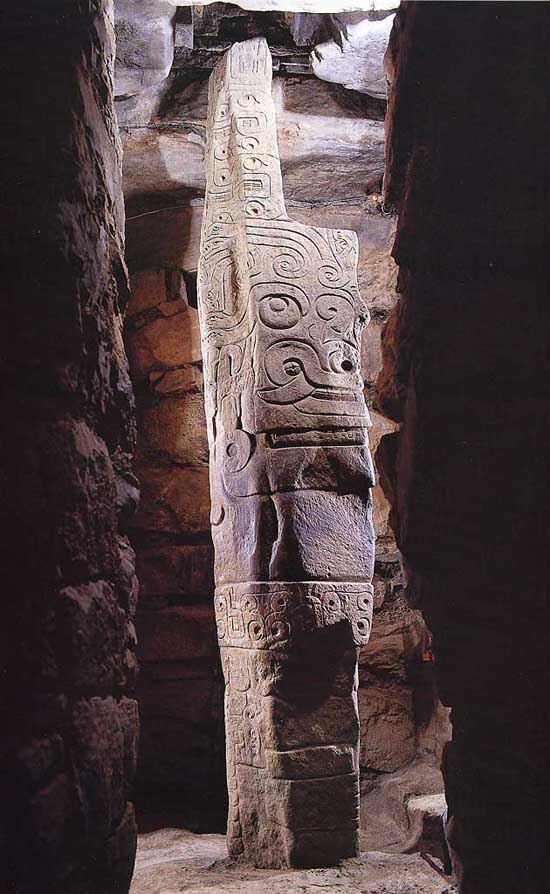
That latitude also crosses the Andes in Peru, running right through Chavín de Huantar in the Ancash valley. It was the main site of the earliest South American civilization (1200—400 BC), which occupied many other sites in the region and along the coast.  Other sites were even older though, like El Paraíso (2500—1100 BC).  But the Chavín culture was the first to produce distinctive art and ceremonial architecture, specifically truncated pyramids.  Chavín de Huantar lies directly east of an Andean peak which again could serve as a magnificent gnomon.

Significantly, there are many obelisk– and slab-shaped stelae/gnomons at the site, the main one being the Lanzon stela, a 15+-foot stone spire with wonderful decorative carvings. It stands within a pit in the “temple” and extends up through a hole in the roof, a foolproof way to demonstrate the exact zenithal passage of the sun.  By the way, the figure carved on the stela points eloquently upward with one hand and downward with the other.  Of course, this site’s 260 days between the sun’s passages are on its northern lap between the Tropics.

I propose that Chavín de Huantar was the birthplace of the 260-day calendar, which probably was what caused its rise in ceremonial importance around 1200 BC, turning it into the cultural and religious hub of that first civilization and a destination for pilgrimages and rituals. Even though no archaeological traces of a 260-day calendar have been found amongst these non-literate Andean civilizations, they may well have observed it religiously alongside the solar calendar, which is precisely how it worked later in Mexico.  And it got to Mexico by sea.

The Chavín and other even earlier Pacific coastal cultures were accomplished sea-faring folk using balsa-wood rafts and boats. (Balsa trees grow all along the coasts of South and Central America.)  There was a lot of maritime activity, trade, and exchange among the various cultures long before the Chavín.  In the dim past maize was brought from Mexico to the Andes, and the art of metal-working passed in the opposite direction. The Pacific coast from western Mexico down to northern Chile was one enormous “economic zone” of productive ecologies between sea and mountains.  The Chavín were the first efflorescence of those cultures (fertilized by contacts with the Beni?), and wherever they went, they understandably preached their religious calendar.

Besides the calendar, the Chavín spread other concepts of their culture and art all along the coast. Their pyramids and intricate figures and motifs of jaguars, caimans, and serpents bear a distinct resemblance to the architecture, themes, and imagery of the later Maya and other Mexican cultures.  The Chavín anthropomorphic jaguar and truncated pyramid must surely have accompanied the ceremonial calendar across the Isthmus of Tehuantepec to inspire the Olmec—and subsequent Mesoamerican cultures.

Aztec Icon #9. – MAYAUEL, Goddess of Pulque

After along haul of boggling detail, I’ve completed another icon in the series for the coloring book YE GODS!  THE AZTEC ICONS.  That makes nine in two years.  Only 17 to go.  Good thing I’m patient—and persistent.

The icon of this popular goddess of drunkenness (as well as intoxication by other drugs), was a lot of fun to draw if only because of all the drunken rabbits. She herself is based on an image from Codex Rios with details from Codex Laud and Codex Nuttall, and the vignettes come from various other sources like Codex Vindobonensis.  It was also a rare chance to draw the other hallucinogens:  psilocybin mushrooms, Datura and morning glory flowers, peyote cactus, and marijuana leaves.  The two little blooming peyotes are drawn from plants I used to have in my greenhouse.  The flowers are pink.

(You can still see or download the previous eight icons by clicking on them in the list on the page for the coloring book.)

ICON #9: MAYAUEL

(Goddess of Pulque)

To download this icon as a .pdf file with a page of caption and model images from the Aztec Codices, right click here and select “Save Target (or Link) As.”  You can also download it in freely sizable vector drawings from the coloring book  page.

mayauel icon

MAYAUEL is the personification of the maguey plant and a maternal and fertility goddess connected with nourishment. Besides fibers for ropes and cloth, the most important maguey product is the alcoholic beverage pulque (or octli).  As a pulque goddess, she is often depicted with many breasts to feed her children, the Centzon Totochtin (400 Rabbits), octli gods that cause drunkenness.  (Drinking was generally only permitted in ceremonies, but the elderly were free to drink whenever they wished.  There were rabbit deities for all kinds of intoxication.)  With the birth-name of Eight Flint, she also protects mature wombs and probably is the wife of PATECATL.


A Decade Ago

Two weeks into the New Year may be a bit late, but I’m inclined to reminisce about life as I knew it a decade ago. I feel like, you know, doing some spontaneous memoir-izing.  Indulge a few fond ‘memoiries,’ if you will.  Let’s look back on when I was still the Grandfatherly Gay Character around Santa Fe, 2005-2006, sole proprietor and employee of Babylon Gardens Salvage Nursery.  Oddly, of my two previous careers, it was the most wonderful and fulfilling.

Though I’d supposedly “retired” on early Social Security in 2004 from a long career of arts administration, I‘d kept on working half-time in local nonprofit organizations (including education, health care, and philanthropy), for minimal compensation, of course. For some years I’d been happily working on grants and technical assistance programs with the Santa Fe Community Foundation and then in April 2006 decided to move over to manage a new state-wide organization of nonprofits called NGO-NM.  The sad finale to my illustrious administrative career was having to close that worthy effort down at the end of the year.  I still have the incised plastic door-plaque somewhere.

My 2005-6 season (speaking both academically and organizationally) started quite dramatically in August with Hurricane Katrina. Residing in Metairie, my elderly mother (87) lived through it, sheltering at Bonabelle High School.  Of course, that’s a remarkable story in itself.  When she finally made it here to New Mexico—on her own! —to stay with me, I convinced her to write about the historic event for her descendants.  Soon I should type it up and post it for them and you.

In late November 2005 when at least Metairie was back to functioning again, I drove Mother home. Miraculously her home was essentially undamaged, no flooding at all as it stands atop a vestigial ridge between Lake Pontchartrain and the Mississippi.  A few blocks north or south had been six feet under water.  Personally, I’m inclined to attribute her good fortune to a Kwan Yin I’d given her.  Compassionately, the female Buddha still stood on a console directly across from a thin aluminum picture window to the southeast, having apparently peacefully faced down Katrina, the monster storm of the new century.  Meanwhile the big maple at that corner of the house had snapped off about four feet above the ground and merely fallen on the yard.

As if I weren’t being creative enough with the organization work, soon as I got back to Santa Fe for the holidays with my local family (grandson then just over three), I went back to work on my weird linguistic hobby of some 40 years, a structural definition of the innocuous English verb ‘get.’ By the time I started with NGO-NM, it was ready to publish with http://www.AuthorHouse.com, then under a different name, entitled “Getting Get, the Glossary of a Wild Verb,” which came online in November.  Sometimes since, I’ve humbly suggested to forbearing friends that this absurd little pamphlet could well be my work of genius.  If only anyone but I were eccentric enough to see its simple profundity.

NEWS FLASH:

GETTING GET is posted on this website for free download.

Just right click here and do it.

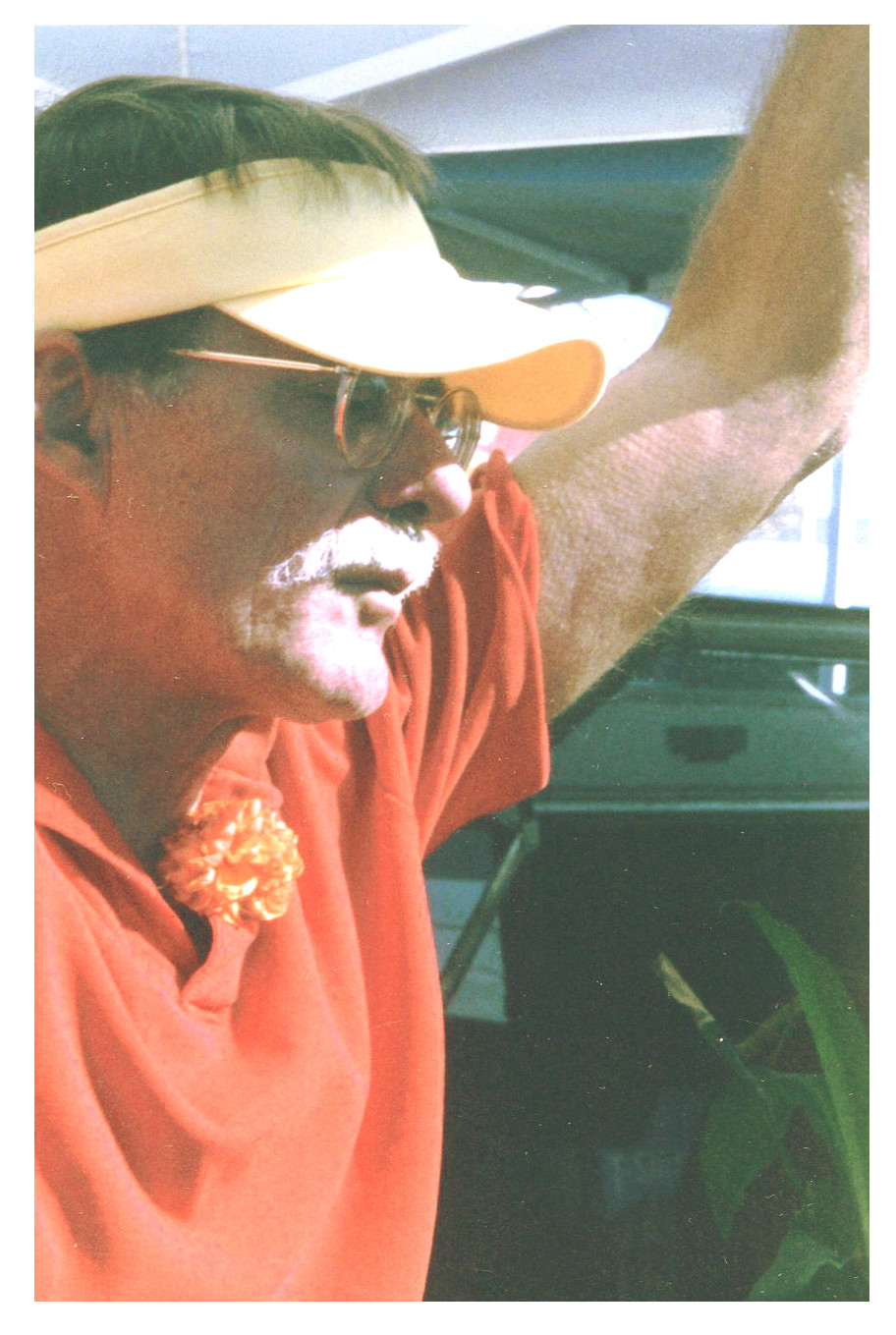
You probably already know, however, that Santa Fe’s notorious for poor folks having to work multiple jobs to get by. Accordingly, besides organizing stuff and defining the wild verb, I spent a miraculous third half of my time as the famous Used Plant Man at the Santa Fe Farmers Market.  In honor of my signature product, in the summers I turned into the infamous Iris Man.

Every Saturday morning, and Tuesdays in summers, I peddled previously-nurtured, restored, or recycled house plants. Not mention that in my spare time I did what I cleverly and artistically called ‘land-shaping,’ which involved terracing, rock walls, and laying flagstone patios.  In other words, I played around digging in various folks’ yards, gardens, and sandboxes.

2005 in the greenhole

2005 in the greenhole

2005 in my booth

2005 in my booth

That greenhouse was of my own design and construction. I called it my ‘greenhole,’ literally a hole I dug six feet deep and slapped a plastic roof over it .

The Greenhole

The Greenhole

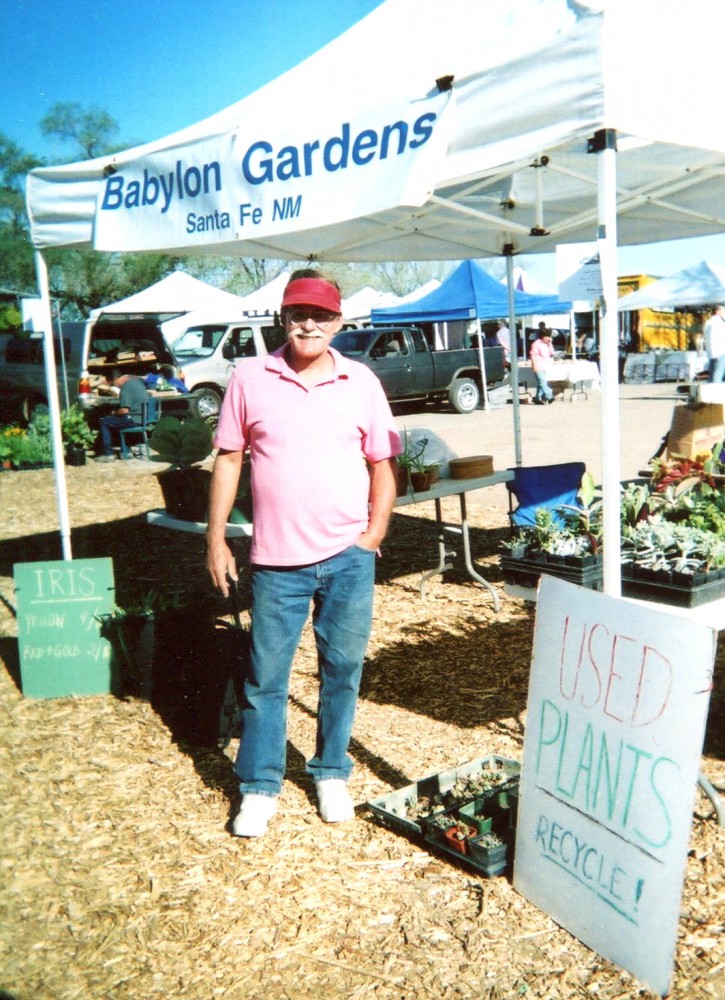
The only other infrastructure for the business were folding tables, a portable pop-up tent with the proud banner of Babylon Gardens,

2006 booth at Farmers Market

2006 booth at Farmers Market

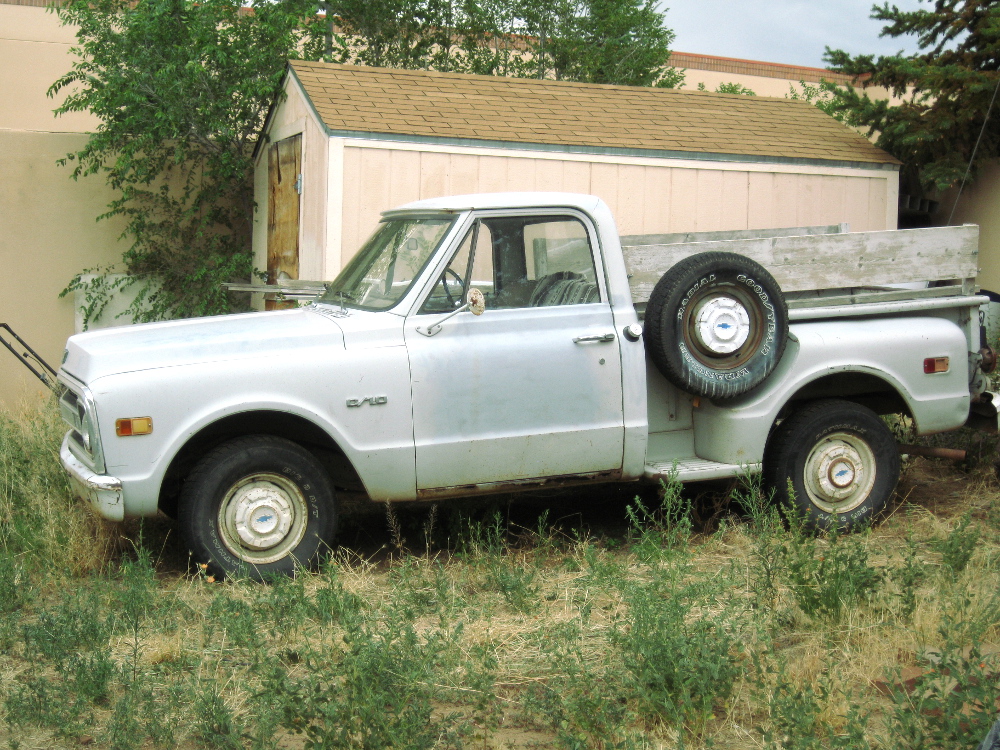
And the gallant Grover (the Grey, like Gandalf), a 1970 Chevy C-10 pickup. Grover hauled load after load of plants and paraphernalia through so many pre-dawns and then stood nearby for thousands of touristic snapshots of a typical Santa Fe scene.

Grover the Grey

Grover the Grey

As if doing meaningful work for society, publishing a fantastic book, and selling spectacular plants weren’t enough, in June, 2006 I came out as an artist in an art show for the Santa Fe Gay Pride celebration. I’d earned the gay category 45 years earlier, also in June.  I showed three pieces:  the assemblage shrine Bull of the Sun, the carved sandstone Venus, and my very first piece of digital art, the cover for my novel “Gymnopedie.”

NEWS FLASH:

“Gymnopedie” the novel has been withdrawn from publication and

rewritten as a backwoods novella called “Bat in a Whirlwind,”

available for free download by right-clicking here.

2006 publicity with baby jade

2006 publicity with baby jade

While we’re at it, I want to share with you a picture of one of my favorite plants in the greenhole. Soon I really should do a post with more stuff on the wondrous plants I had in there.  This one has an outrageous Latin name I loved reciting to folks:  pachyphytum oviferum amethystinum (fat-leafed, egg-shaped, amethyst).  Here it is in bloom in 2005.

Pachyphytum Oviferum Amethystinum

Pachyphytum Oviferum Amethystinum

The Farmers Market always went outdoors somewhere in late April around my birthday, and in both the 2005 and 2006 seasons that was on the wide-open corner of Guadalupe and Cerrillos skirting the railroad tracks behind SITE Santa Fe. In my humble used plant vendor opinion that point out there in view of two busy streets was the perfect, I mean the ideal, location for our wonderful community market.

In years past we’d simply popped up our tents, if we had one, further north along the tracks across Paseo de Peralta behind Santa Fe Clay. (And in years before my time, it had been in the parking lot of Sanbusco Center.)  Now almost all the vendors, including makeshift Babylon Gardens, flew a white canopy like a flag to be seen from all around.  We were truly a spectacle of folk life that made me proud.

As a matter of fact, it seemed a vindication of the pleasure a certain clueless kid once enjoyed in peddling peaches in a booth beside the highway. It was that splendid interaction with people around a subject you deeply love and the thrilling opportunity to share the work of your own hands with them.  Every day, even the slow ones, I loved the glory of hawking my beautiful plants, talking about them and how they like to be treated.  In a word, it was a trip.

Ironically, the fortuitous move from the hinterlands of the railyard up to this prime spot was caused by big city projects afoot for the neglected old railyard. I believe the powers that be moved the Market out where people could see it to get support for the new building they were preparing in those same hinterlands as an indoor place for us in the winters.

Among other opponents of that project, I felt the current arrangement, as I said before, was ideal. For the winter seasons, we’d been going indoors at El Museo Cultural, and vended there happily, even with poor lighting and no call for flashy tents.  It felt very folksy, local farmer cultural.

But the majority of vendors, or at least the power that were at the time, had their hearts set on a fancy market hall like in Boston or Seattle or wherever. This ambition caused a whole bunch of trouble, but don’t get me started.

(Can’t help it. For just a few repercussions.  Before the building was even done, the Trust for Public Land and other powers kicked the Market off that superb spot on the busy corner to make the new Railyard Park.  I suggested, clearly not vociferously enough, that they design that great space on the corner for a fancy open market plaza for us farmers and for other fairs on other days.  Irony Alert:  My sweet old vending space is now in a rotunda of rose gardens where few people care to walk.  Roses to be smelled and not sold.

Kicking us out made the Market wander for a couple summers around parking lots. The summer beside the DeVargas Center was a huge come-down, but in more levels of irony, our summer of 2008 in the almost ideal PERA lot was the most spectacular in the history of my unorthodox nursery.  To make matters worse for us gypsy farmers, for some reason we also lost the El Museo space and had to spend a winter in a grungy industrial place on Cerrillos Road.  Again the irony, it had once upon a time been a gay nightclub, the Cargo Club, I think it was called.  Or Club Luna?  I’d gone there only a few times to dance.)

At any rate, between Market days Grover and I would tootle all over town and even out to Espanola or Eldorado to grub freely in folks’ iris beds or do plant rescues or paid land-shaping jobs. It was a splendid gimmick, an ingenious concept if I say so myself.  I provided a free, much-appreciated community service and turned my (minimal) physical labor into totally free merchandise.  No overhead except gas for good old Grover.  Good job for an old guy.

Frequently folks gave me way more plants than I could ever hope to sell at the Market. Like 500 lb. of blue iris?  I’d just give them away.  Once I got a whole greenhouse collection from an estate and recycled (propagated) thousands of new plants to give away to garden clubs, school classes, and anybody I could foist them off on.  I always kept a FREE box at my booth, and folks checked it frequently for adoptions.  I joked that I was a “philplanthropist.”

Sometimes I’d simply show up at a business or office building, like that time at the Toney Anaya Building when I marched in and told the receptionist, “I’ve got a giant jade tree that wants to live in your lobby.” A couple times I simply arranged for gigantic plants to go to great spots like at the Capitol complex or other public spaces.  They had to do the hauling though.

A decade ago I was a plant freak in his element, and my only problem was believing what a happy old man I was. Even older now, I’m still a happy fellow—and I believe it.