Aztec Gods of the Directions

When they founded Tenochtitlan c. 1325 CE, the Aztec barbarians adopted the traditional Mesoamerican temporal and spatial concepts of ceremonial calendar and cardinal directions.

The 260-day Aztec Turquoise Year or tonalpohualli (ceremonial count of days) is based on 20 numbered sets of 13 called trecenas, through which the 20 named days of the solar month are counted cyclically. That’s about as clearly as I can describe it. Some of the few surviving codices (ancient documents) include individual pages of the trecenas with their patron deities.

Some codices also have pages with the 260 days laid out in spreadsheet fashion with five rows of 52 columns in four sets of 13, Here’s a sample section from Codex Vaticanus laying out the first set of 13 columns (trecenas 1, 5, 9, 13 and 17):

vaticanus first section

First Section of Spreadsheet Calendar, Codex Vaticanus

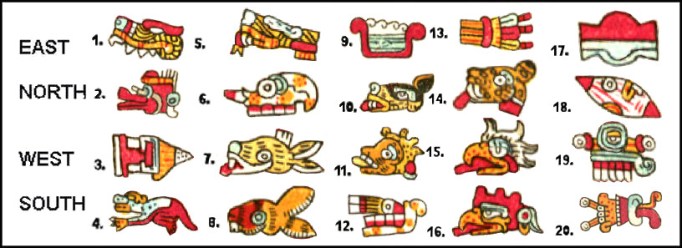
One reads left to right starting with day One Crocodile on the bottom row at lower left; after counting the 52 days in that row, we come back to the second row from the bottom beginning with Reed. Repeating that process, the count returns to the first column to resume with the days One Snake, One Earthquake, and One Water. The blocks of four columns of five days repeat 13 times—only in varying internal sequences—symbolizing the four cardinal directions:

days of direction - Vaticanus

Vaticanus Day-Signs Corresponding to Cardinal Directions

Numbered per their position in the 20-day “month,” these are East: Crocodile, Snake, Water, Reed, Earthquake; North: Wind, Death, Dog, Jaguar, Flint; West: House, Deer, Monkey, Eagle, Rain; South: Lizard, Rabbit, Grass, Vulture, and Flower.

These four cardinal directions are also characterized by colors: East—red; North—black; West—white; and South—blue. This color scheme correlates to the emblematic colors of the Aztec gods of the directions: Xipe Totec, God of the East—the Red Tezcatlipoca; Tezcatlipoca, God of the North—the Black Tezcatlipoca; Quetzalcoatl, God of the West—the White Tezcatlipoca; and Huitzilopochtli, God of the South—the Blue Tezcatlipoca.

Aztec Gods of the Directions

The traditional spatial matrix inherited by the Aztecs also included a fifth direction—the Center—which they saw as ruled by Xiuhtecuhtli, the Lord of Fire/Turquoise.

Xiuhtecuhtli - Lord of the Turquoise - (God of Fire)

XIUHTECUHTLI, God of the Center

With the Mexica’s tribal War God Huitzilopochtli ruling the South, this is emphatically the Aztec empire’s imperial vision of the divine quartet/quintet. Wondering what earlier deity may have ruled the South before, I looked at p. 1 of Codex Fejervary-Mayer, a document thought to have originated in the Veracruz region. It lays out the directions with pairs of patrons, totemic trees, and birds. However here, it’s Tezcatlipoca dominating the Center. (Apologies for the scruffy image, but I’ve got neither time nor energy to “re-create” it.)

fm01

The Five Directions, Codex Fejervary-Mayer, p. 1

The orientation of the directions is a bit different than our common Eurocentric model, rotated one notch counterclockwise. Here East is at the top, West at the bottom; South is on the right, North on the left. Besides the totemic birds and trees, the busy diagram includes much calendrical symbolism, including the days of the directions, year-bearers, and what-not.

By the way, the South tree is a “sacred” Theobroma (Food of the Gods) cacao tree with its chocolate pods. The totem on the North is a spiky ceiba tree (Kapok) which the Maya saw as the great tree at the center of the world—connecting the Underworld and the Sky World (heavens), its trunk representing the world of humans, animals, etc.

The pairs of patron deities in each lobe include only two of our divine quartet of Tezcatlipocas. In the top East lobe, on the right stands Xipe Totec, our Red Tezcatlipoca, with his Flint headdress, and I’d bet his companion is the sun god Tonatiuh, god of the Fifth Sun. In the left North lobe, the upper deity is a simple version of our Black Tezcatlipoca, and the lower one looks like the mighty Tlaloc, God of Storms. The rest of the patrons are different.

The South lobe on the right tells us who must have ruled that direction before the Aztecs inserted their Huitzilopochtli: the upper Mictlantecuhtli, Lord of the Land of the Dead, and the lower Centeotl, God of Maize. The Aztecs gave them both the boot… In addition, the West lobe on the bottom holds no White Tezcatlipoca, Quetzalcoatl, showing instead a surprising pair of patrons from pre-Aztec mythology. On the right (upside down) is Chalchiuhtlicue, the Jade Skirt, Goddess of Water, and on the left Tlazolteotl, Goddess of Filth, a major mother deity.

The reputedly misogynist Aztecs seem to have impeached these two great goddesses to install the famous Maya/Teotihuacan/Toltec Plumed Serpent as their deity of the West, as the White Tezcatlipoca. Speaking of misogyny, in another religious coup, the new empire tried to depose the Goddess of the Moon (Ixchel to the Maya and Metztli in Teotihuacan) from her traditional role as patron of the calendar’s Death Trecena and then made their own Tecciztecatl into the God of the Moon. (Metztli can still be seen in the calendar in Codex Telleriano-Remensis.)

The Aztecs were also conservative, if not reactionary, in other ways, like in celebrating their culture as the culmination of the “golden” ages of Teotihuacan and the Toltecs. Witness their great cult of Quetzalcoatl and abject “idolatry” of Tezcatlipoca, also inherited from the Toltecs. Since time immemorial, he and Quetzalcoatl were seen as each other’s twin and nemesis, and in their roster of the gods of the directions, the Aztecs enshrined that primordial conflict. That they apparently replaced the Smoking Mirror with Xiuhtecuhtli as God of the Center is surprising, and it’s even more so that they didn’t make Huitzilopochtli Center and give someone else South. But winners always get to write their own version of history—and religion.

###

Still Dancing


Aztec God of Dance – The Old Coyote

When I started this multi-faceted blog back in early 2014, I wrote the first couple posts about my life-long OCD (obsessive-compulsive dancing). First was the one explaining my personal motto: There’s dance in the old dame yet. The second was about nightlife and my history of dancing in dives and jive-joints.  Then I got distracted by subjects in history, politics, and art.  Now it’s high time to catch up on public dancing in Santa Fe (NM—not CA, FL, TX, or elsewhere).

I last wrote on the subject four years ago when we actually had two dance clubs in town: the gay bar Blue Rooster (successor to the Rouge Cat) and a new straight nightclub called the Skylight.  To my dismay, within a few months the Blue Rooster closed down (cold-cocked?), and I had no choice but to dance among the straight young things at the Skylight to considerably less danceable music.  Any port in a storm.

Happily, the SCOTUS decision legalizing gay marriage soon caused a sea-change in social attitudes about gays, and we became much more accepted in straight venues like the Skylight. It wasn’t uncommon to see guys and gals dancing with each other, respectively—or even sharing PDAs (public displays of affection).  In this newly comfortable environment, I’d go out to dance almost weekly (whenever the old man has the energy) for many wonderful carouses.

The only fly in the ointment at the Skylight was the music. In my adolescence I’d been an avid American Bandstand rock’n’roll-er and then switched to Latin wildness for a few years in college.  Only much later, I got hooked on disco, and that was my main style for some decades.  However, disco music at the Skylight was only painfully occasional.

The more frequent music there was hip-hop, rap, and metal, which didn’t particularly ring my bell. Fortunately, at times they played Latin (called Hispanic here), which took me back to my debauched youth in frenetic cumbias and exuberant merengues.  And with an effort of sheer will, I tried to get into the new EDM (electronic dance music), which only sometimes was danceable.  Like the little girl with the curl, when it was good, it was excellent, but when it was bad, it was perfectly horrid—and way too loud.

All my life dancing has been a philosophical thing (I dance, therefore I am!)  Or maybe better, a spiritual practice (To dance is to live!).  Spiritually speaking, I’m a dervish.  As I’ve explained in my second memoir (in process), “…unlike ball-room and folk dancing, both Apollonian in their structure, synchronization, and impeccability of movement, my dance is free-form and unrestrained, responding on a visceral level to rhythms and melodies and surrendering to the divine frenzy of Dionysius.”  Call me a maenad!

Then came that Saturday night in early December last when I ambled down Don Gaspar happily anticipating another divine frenzy. Only to find the Skylight’s big iron gates closed up with a huge chain and padlock!  Stunned, I staggered up San Francisco Street to the Plaza (with its outrageous holiday lights), and ran into Brandi, Santa Fe’s prima donna drag celebrity, who confirmed that our nightclub was indeed closed down totally.  Nowhere to go but home, bereft.

After a few weeks of complaining to all and sundry about the loss of the Skylight and dancing at home in solitary splendor to reggae and Salsa Sabrosa (on KUNM), a dear friend mentioned a group called Embody Dance that meets weekly on Thursdays at the Railyard Performance Space. Their website sounded very like a group I’d visited back last spring for a splendid ecstatic experience.  Though I’d put myself on their mailing list, I never heard from them again.

The last Thursday of 2017 I showed up for a session of Embody Dance and was thrilled to find the perfect venue for my OCD: shoeless, unspeaking, and idiosyncratically undisciplined, with adventurous and dance-inspiring music.  In the delightfully diverse company of some sixty folks, for two non-stop hours I surrendered to the divine frenzy and left feeling perfectly fulfilled.

The next Thursday, the first in 2018, I went back to Embody Dance and jubilated again with an even larger crowd, some of whom were maybe even as old as I! After sixty years of dancing, I finally feel like I’ve come home.  Tonight I’ll be doing the mad maenad thing again.

#

Aztec Icon #14 – QUETZALCOATL, Plumed Serpent

Sorry to take so long to finish the 14th icon for my coloring book YE GODS!  My work was delayed by that time-consuming thing called life.  Anyway, the icon’s done and my digital wizard has turned it into vector drawings for free sizing.  Here you have the most famous Aztec deity of all, QUETZALCOATL, the Plumed Serpent:

Quetzalcoatl, Plumed Serpent

QUETZALCOATL (Plumed Serpent) {ke-tsal-ko-atł} is the god of intelligence, learning, writing, arts and crafts, the calendar, priests, and merchants and was the bringer of maize to mankind.  Opposed to human sacrifice, he is called the White Tezcatlipoca and is the 9th lord of the day and god of the West. As the planet Venus, he is known as Tlahuizcalpantecuhtli, the morning star, and his twin Xolotl is the evening star.  He ruled the Second Sun (Four Wind) and created the current Fifth Sun (Four Earthquake) by using his own blood to give new life to the bones in Mictlan.  He was known as Kukulcan to the Maya and a major deity in Teotihuacan, and Quetzalcoatl was the traditional name/title of the Toltec rulers of Tula.

This icon is available as 8X10 with a caption/sources page by clicking here.  The freely sizable vector versions are available by clicking here.

By way of explaining this new icon, I must first thank Eliseo Rosales, a tattoo artist in California, for his suggestions, particularly for the design on the pedestal and for the important theme of maize.

The central figure of Quetzalcoatl is based on an image from Codex Borbonicus with details of costume and accoutrements mostly from Codex Magliabechiano, though the serpent on his back is adapted from those on the Stone of the Suns. Don’t be surprised by his beard, which occurs in other codex images:  According to some, he was supposedly blond and white-skinned.

In his left hand, the deity holds the weapon known as Xiuhcoatl (Fire Serpent), and on his shield is his standard ‘cross’ symbol. His peaked cap of jaguar pelt is apparently a Huastec influence.  Sprouting from his forehead is a ritual ‘blooming shinbone,’ the significance of which escapes me.  The numeral by his left foot is Nine, of which he is the patron, and the day-sign One Reed directly over his head is his ceremonial day-name.

Now for the other motifs. The pedestal, as mentioned above, illustrates the depth of the history of the Plumed Serpent.  It comes from the frieze on the Temple of Quetzalcoatl in Xochicalco (c. 1000 AD), which was a city/culture that arose in the aftermath of the Classic civilizations of the Maya and Teotihuacan.  As evidence of his even deeper history, the two heads flanking his day-name are views of sculptures on the Temple of Quetzalcoatl in Teotihuacan (c. 600 AD).  The paired feathered serpents on his either side are taken from Codex Borbonicus and Codex Telleriano-Remensis, and the paired quetzal birds are merely grace-notes.

The border design is adapted from one of his images in Codex Telleriano-Remensis. The day-signs embedded in it represent the ceremonial calendar which the deity brought into Mexico in the dim past.  Each group of five days represents a direction in the Aztecs’ odd world-view.  At the bottom is West, of which he is the patron.  At the top is East, on the left North, and on the right South, the standard Aztec spatial orientation as it was also for the Maya.

Drawn respectively from the Cospi, Vaticanus, and Borgia codices, the standing deities in the upper section are: on the left, Tlahuizcalpantecuhtli, Lord of the House of Dawn (as the Morning Star), on the right Xolotl (as the Evening Star), and at the top his nagual (manifestation) as Ehecatl, God of the Wind.

In the upper corners are scenes representing his gift of maize to mankind. On the left is Tlaloc, the Storm (Rain) God, nurturing the goddess of maize Chicomecoatl, and on the right is the goddess of flowing water Chalchiuhtlicue tending the god of maize Centeotl.

That’s all the mythology I could manage to cram into this icon. Surely it’s enough.

#

Another note of interest about Quetzalcoatl. In the September, 2017 issue of ANCIENT AMERICAN magazine, my article just appeared entitled “The Plumed Serpent in North America.”  Click here to check out a copy.

My Jubilee

Recently having turned 75, I think that respectable age qualifies for a jubilee celebration. At least I’m jubilant.  To celebrate this auspicious occasion, I had a portrait taken by the talented local photographer Carolyn Wright of the Photography Studio.  For the first time ever, I must say that this picture does me justice, and I’ve already featured it on my homepage.

Richard Balthazar, Writer and Artist

I jubilate in celebration of my many blessings:

First, having grown up, had a family, and gotten old in this country (USA)—where I’ve been ostensibly free, in spite of spending most of my life as an outlaw (gay), and could make a reasonable living doing what I like (arts, education, horticulture…). That covers many bases.

Next, having been in extraordinarily good health all my life. There have been a few medical emergencies and curable conditions, but especially in these later years I seem to have crafted a very healthful diet and regimen of physical activity (gym and dancing).  I try not to be too proud of my deceptively youthful (and handsome) appearance above and am more than happy to tell anyone my anti-aging secret (Kombucha).

Also, having had such exciting experiences, like trips all over around this country and into Canada and Mexico, fascinating festivals (esp. Mardi Gras and lots of Gay Pride celebrations), and wonderful performances by fantastic artists. I’ve lived a culturally rich life style.

On this my jubilee, I also jubilate big time over the exceptional things I’ve accomplished, though they may not have made me rich or famous. My jubilee is the perfect time to toot my own horn—since nobody else is going to.  So here goes:  Toot!

  1. Won an essay contest in high school (1958) and represented Arkansas representative at the First National Youth Conference on the Atom in Atlantic City. I still have my essay on atomic energy, and its blue-ink penmanship still reads intelligently, if archaically.
  2. Sailed gaily through college at Tulane in the early 1960’s with a double major in Russian and French Quarter debauchery and made Phi Beta Kappa.
  3. Wrote a Master’s thesis and a few doctoral dissertations in the later 60’s, contributing exactly nothing to world knowledge, but they got me a job teaching at a university.
  4. Appeared in theatrical productions: ballet (peasant in Coppelia, 1970), play (sailor in The Tempest, 1971), and operas (extra in Prokofiev’s War and Peace at Wolftrap, 1975, and supernumerary cardinal in Lalo’s Le Roi d’Ys, 1980, on Broadway, no less).
  5. Coached the Paul Hill Chorale to sing Kabalevsky’s Requiem in Russian at the Kennedy Center In 1975 and translated for the composer in interviews and social occasions.
  6. Was a stage interpreter with the Bolshoi Opera in Lincoln and Kennedy Centers In 1976 and got to watch their repertoire many times over (from down-stage left).
  7. Translated Tchaikovsky’s opera Maid of Orleans into English for productions by the Canadian Opera Company, 1978, and Detroit Opera Theatre, 1979. This was my first truly artistic achievement, a triumph of rhymed triplets in iambic pentameter. Toot-toot!  I’ve included a poetical excerpt in my Public Library for your enjoyment.
  8. Wrote the play The Special Case, a detective drama drawn from Dostoevsky’s novel Crime and Punishment, which was produced by the Santa Fe Community Theatre in 1990 and ran for two weeks to no reviews. An actor praised it as “a Russian Colombo.” Yes.  It can be read (and is available free for production) in my Public Library.
  9. Discovered the suppressed subject of the Indian Mounds, spent about 15 years researching them, and finally published Remember Native America, a mound travelogue, in 1992. It has since been superseded by much more research and revision of timelines, but all the same, it’s available here for free download.
  10. Discovered the neglected subject of the Aztec calendar, spent some five years drawing, and published Celebrate Native America, a new book of days, in 1993 with my artwork and an abortive attempt to proclaim a Sixth Sun, also available here for free download.
  11. Created a unique and exciting profession in 1997, spending 15 years as the Used Plant Man  (or the Iris Man in summer), a plant recycler at the Farmers Market, maybe not an artistic achievement, but I spread beautiful iris all over town. Good enough.
  12. Built an innovative greenhouse in 2000, a semi-subterranean, ecologically efficient structure for raising cacti, succulents, and ornamentals for market. Again maybe not artistic, but it was definitely an architectural achievement .
  13. Wrote the novella Bat in a Whirlwind (over about 30 years), an autobiographical story of almost coming out in the backwoods, published electronically on this website, 2015. Click here for free download.
  14. Wrote the novel Divine Debauch (over maybe 25 years), fictionalizing my dissolute years in the French Quarter, published by AuthorHouse.com , 2005. It really needs a rewrite, but I haven’t the energy or time. Meanwhile, it’s still a great gay read.
  15. Wrote the handbook Getting Get, a glossary of the English verb, (after 40 years of linguistic research), published by AuthorHouse.com , 2006, but also available electronically for free by clicking here.  Frankly, it’s my work of genius.
  16. Wrote the memoir There Was a Ship covering my time in in Seattle (1965-66), published electronically on this website, 2016. Click here for free download. It’s the story of a gay man going (kicking and screaming) back into the closet.
  17. Wrote the biography Ms. Yvonne, the secret life of my mother, published electronically on this website, 2016. Click here for free download. It was fascinating detective work and much photo restoration to uncover the life of a survivor of Hurricane Katrina.
  18. Wrote the unique reference on the Aztecs, YE GODS! an illustrated encyclopedia of deities, an essay on the surviving Pre-Conquest codices, and a coloring book of thirteen of my icon drawings based on images in the codices, published electronically on this website, 2017. Click here for free download of the separate sections.

Goodness! That was almost a whole horn concerto of jubilee toots.


I won’t be able toot about anything else for a while. I’ve only just begun a second memoir, this one about gay life in the carefree 1970’s, and there are still 13 more icons to draw for YE GODS!  You’ll be the first to hear about any new achievements.

More Indian Mounds

It’s been a good while since my last posting in June about the Aztec Codices, but that doesn’t seem to have bothered my multitudinous non-readers worldwide.

Shortly after that, I went on the family vacation I mentioned in the first week in July. We went to a place on a lake near Hot Spring, Arkansas and had a lovely rural time of it, though we came home with a bunch of chiggers.

While there, we visited the Toltec Mounds Archeological State Park near Little Rock, a site I’d never seen before, though I’d included a drawing of it in my old book on the Indian mounds called “Remember Native America.” It was a rainy afternoon, but I still managed to take some pictures of two of the surviving pyramids, which I’ve finally managed to figure out how to add to the Gallery of Indian Mounds.

AR one pyramid, Toltec Mounds

AR another pyramid, Toltec Mounds

The Toltec mounds (no connection whatsoever to the Toltecs of Mexico) are an early Mississippian site, abandoned by 1050 AD, which may actually be related to the Mayan civilization. It might well have developed under the influence of Maya or Teotihuacan traders, or even migrations at the collapse of those civilizations around 800 AD.  We’ll just have to see what further research makes of that possible connection.

Meanwhile, I’ve also uncovered a number of earlier photos (slides) I took of other mound sites and have also added them to the Gallery: more from Moundville AL, Cahokia IL, Marietta OH, Crystal River FL, and Nanih Waya MS.  Check them out.

Which brings us back to my suggestion from when I put the Gallery together nearly four years ago: Surely there are other folks out there who have good pictures of Indian mounds, and I would love to include them in the Gallery.  Email them to me at rbalthazar @ msn.com with the state and site name.  I’ll plug them in to this collection, which as far as I know, is the only one of its kind.

YE GODS! THE AZTEC CODICES

Here it is at last, the third part of YE GODS!  This is the promised illustrated commentary on the Aztec Picture-Books, a unique discussion with examples of the fifteen codices that survived the book-burning during the Spanish Conquest of Mexico.  I can guarantee you’ll never have seen anything like this in terms of art history, mythology, and Aztec ethnography.

Click here to view or download YE GODS!  THE AZTEC CODICES

Or click here to visit the cover page for the new section

It’s been a couple months since I last posted anything, (not that anybody out there really cares, I suspect), but the time has been well spent on completing this project, in and around many other developments in my life.  Not the least of those was running around trying to set up an exhibition of the Aztec Icons, without success to date, and to interest a local non-profit publisher in making a book on the whole three-part YE GODS! shebang (which never materialized).  The next epiphany of 13 icons still remains to be drawn.

In other developments, it took these couple months to move to a new apartment, including some weeks to move my iris garden to the new place.  It’s splendid with a huge balcony/porch and a big area for a garden and enormously convenient to my gym and other amenities.

In terms of iris, I’m thrilled to report that after five years of looking and wheedling, I’ve finally found someone to start up my plant recycling business again.  A young fellow named Aaron jumped in with his shovel and has already been selling iris on Craigslist like hotcakes.  He plans on selling at farmers markets around here and should do a land-office business, so to speak.

Now my big plan is to go with the family for a vacation during the first week of July at Hot Springs, Arkansas.  It should be a sentimental time because it’s quite close to my childhood home in the southwestern woods of that state.  Maybe I can even get my grandsons to read BAT IN A WHIRLWIND!

Coloring Book Overhaul – The Aztec Icons

BIG NEWS FOR ALL YOU COLORING ENTHUSIASTS! Whether you’re new to this website, have just been keeping your eye on it, or have actually colored some of my unusual icons of Aztec deities, you’ll find my overhauled coloring book now has a lot more to offer.

There are 13 icons currently completed (but there will be 19 by May, 2020!), each is now accompanied by a page with its descriptive caption and full-color images from the Aztec Codices that served as models for drawing the icon. Those images will give a good idea of the varying styles of the ancient picture-books and maybe even suggest authentic colors to use in your own coloring.

Check out this example of the caption/model page for CHALCHIUTLICUE, the Jade Skirt.

caption-model page for Chalchiuhtlicue

As before, all the icons can be viewed or downloaded individually from the coloring book page, either as a pdf file with caption/models page or as freely sizable vector drawings. But now they are also all bundled together into an actual book:  YE GODS!  THE AZTEC ICONS.

But that’s almost the least of the overhauls. In addition to that book, there is now a major revision and expansion of the earlier catalog and appendix—a complete illustrated encyclopedia of essentially all the Aztec deities:  YE GODS!  THE AZTEC PANTHEON.

Its 88 alphabetical entries include some 1,300+ divinities (depending on how you count), and there’s usually an authentic image for each selected from the Aztec Codices. Again, the images illustrate their varying styles and provide even more suggestions for coloring the icons.

Here’s a sample page from the encyclopedia:

sample page – The Aztec Pantheon

Of itself, YE GODS! THE AZTEC PANTHEON amounts to a crash course in ancient Mexican mythology, history, culture, and art.  YE GODS!  THE AZTEC ICONS takes this another step further—into illustrating details of Aztec society.

For perhaps excessive example, with Huehuecoyotl, the Old Coyote, there are vignettes of people playing musical instruments, singing, and dancing; with Huitzilopochtli, Hummingbird of the South, there’s a pictorial narrative of the legendary migration of the Aztecs to Tenochtitlan; with Mictlantecuhtli, Lord of the Land of the Dead, there’s a vague map of the soul’s way to Mictlan; and with Patecatl, God of Medicine, there are scenes of medical practices and medicinal herbs. Each icon contains its own type of social commentary.

I haven’t quite started on Aztec Icon #14: Quetzalcoatl, the Plumed Serpent, but hope to do so shortly.  In the meantime, I’m working on yet a third component of my Aztec project, another section on the Aztec Codices themselves.  It will be a description of and commentary on each of the 15 surviving picture-books, including sample pages and Internet sources to view the whole documents.  I perhaps unrealistically hope to complete it in the next couple months, and guess what:  I’ll call it YE GODS!  THE AZTEC CODICES.  Watch for a post announcing it.

###

History Redux

This morning over my grapefruit, I serendipitously read an essay that ruined my breakfast with the bitter taste of irony. The quotes that follow have been redacted to mask the actual subject.  Please read them and guess who.  Afterwards, I’ll reveal his identity and that of the writer, publication, and other references.

“[The subject]…arrived on the national scene just in time to capitalize on the [current ‘scare’].  An unprincipled political opportunist, he began to make an issue of [purported enemies]…, thereby drawing attention to himself and nurturing his hopes for a continuing political career.

“…[He] made a speech during which he [claimed to have a list of people] known to be [enemies].  [At the time] this was not at all an illegal affiliation, but the [group] was certainly a suspicious [class of people].  …that list itself never existed.  It was a fiction, a prop for [his] political theater. … But that hardly mattered.  With his trumped-up list, [he] had struck a mindless nerve in the body politic, and the Age of [Fear] had acquired its messiah, a leader of the yelping pack.

“[He] proved himself a master of reckless accusation, unabashed equivocation, and outright lying.  He determined guilt by association and made liberal use of innuendo, half-truth, character assassination, and intimidation.  When officials questioned his allegations, [he] countered by questioning their loyalty and their intentions.  Since he … was the champion of the [anti-enemies], anyone who raised any doubts about him was interfering with his patriotic work, seeking, presumably, to stop him in this noble pursuit.  Those who[m] [he] cast aspersions upon were often unemployed or disgraced shortly thereafter.

“Many people recognized at once that [he] was a fraud…

“Chairing a committee charged with investigating [his] allegations, [the Chair] issued a report … that found not a shred of evidence in support of his charges.  He was effectively branded a liar.

“[His] reaction to this supposed reverse is instructive. [He] said, ‘The most loyal stooges of the [enemy] could not have done a better job of giving a clean bill of health to [foreign enemies] in this country.’  [The committee chair] was giving ‘aid and comfort’ to the enemies of the United States.  …he said, ‘let me make it clear … that this fight against [the enemy] shall not stop, regardless of what any group … may do.’  He was undaunted and undeterred.

“He was a genius at manipulating the news media. He understood, apparently, that the press was a knee-jerk institution.  [He] quickly mastered the techniques necessary to dominate the news.  He would call a press conference to announce that he would have a press conference the next day, and the day’s papers would carry headlines heavy with proclamatory import…  And when some allegation of his was proven completely wrong, [he] simply shifted his attack and targeted a new victim.  The sensation of his new charges drew fresh headlines, displacing stories about his errors.  His was the tactic of a guerrilla raider, and he used it time and again with astonishing effectiveness.

“[He] was by no means laying waste to cherished American freedoms without being criticized. Many newspapers attacked him on their editorial pages—while giving him headlines on their front pages—but nationally prominent political figures were slow in rising to the challenge.  When a [prominent journalist] fired a shot or two, [he] rounded on him.  He insinuated that [the journalist] was a tool of [the enemy] and advised people [to boycott the writer’s sponsor].

“Television journalists were nearly silent. Finally…one of the most prestigious journalists in the world attacked [him] … [with] an exposé [that] alternated film clips of [him] making charges and assertions with shots of [the journalist], live, presenting the contradictory facts.  The relentless rhythm of lie refuted by truth again and again drummed in the flagrancy of [his] perfidy.  Given [his] power, going on the air with any sort of an attack at that time took guts.

“…With many of the journalistic fraternity, [a syndicated cartoonist] had long ago recognized that he was at least a charlatan and perhaps a monstrous one, spewing the sulfurous fumes of intimidating invective with every press conference…ripe as a subject for satirical ridicule. [He] was still riding high, with his minions and his actions claiming headlines daily on the front pages of the nation’s papers.

“[The cartoonist] conjures up nightmares of book burning, evoking memories of the Nazi regime in the 1930’s.

“On various editorial pages throughout the land some perceptive souls recognized that [he] was employing methods that had been used to advantage…earlier by an Austrian paper-hanger and his gang in Nazi Germany.”

Okay, no matter your obvious first guess, this damning verbiage was actually about Senator Joseph R. McCarthy of Wisconsin in the early 1950’s. The [enemies] weren’t foreign terrorists but Communists.  The truth-finding committee chair was Senator Millard Tydings of Maryland, and the brave journalist was Edward R. Murrow.  The [syndicated cartoonist] wasn’t Gary Trudeau in “Doonesbury,” but Walt Kelly in “Pogo.”  The prophetic essay, ironically titled “Swamp Talk” by R. C. Harvey, appeared in “Pogo, Evidence to the Contrary,” the Complete Syndicated Comic Strips, Vol.  3, published by Fantagraphics in 2014.

Let’s remember the quote from philosopher, essayist, poet and novelist George Santayana:

            Those who cannot remember the past are condemned to repeat it.

The horror is that historical travesties seem to get worse with each new iteration. Elevating travesty to tragedy, our current villain hasn’t been discredited and disgraced, but has managed through demagoguery, hate, and lies to become, as Pogo might say, President of the ever-lovin’ blue-eyed U. S. and A, and now our nationable future looks dog-bone miserabobble.

Honestly, I don’t blame those terrified, thoughtless, and forgetful folks who voted for him. It’s the fault of all those apathetic and forgetful folks who didn’t vote for anybody.  And the fault of the craven cowards in Congress who are letting their rogue elephrump run rampant in our beloved Okefenokee.


Aztec Icon #13 – PATECATL, God of Medicine

So—six weeks now seems to be my new average to produce an Aztec icon for the coloring book YE GODS! Here’s Icon #13, PATECATL, which I drew on my old system (GNU) and believe it or not, using the mouse in my left hand.  Back while drawing #12 I started getting pains in my right hand from all the clicking—so I switched.  Nothing to it!

This is a standard pixelated image, and it’s currently winging its electronic way to my graphic wizard for conversion to vectors. The vectorized files for #12, OMETEOTL, have now been added to the list on the coloring book page, where you can also view and download all the previous icons.

To download this one as a pdf file with a page of caption and model images from the Aztec Codices, just right-click here and select “Save as.”  You can also download it in freely sizable vector drawings from the coloring book page.

Patecatl, God of Medicine

Patecatl, God of Medicine

PATECATL

God of Medicine

PATECATL {pa-te-katł} is the god of healing and fertility, medicine (herbology) and surgery, who gives comfort in illness. Logically he is patron of day Grass.  Husband of MAYAUEL, he is the father of the Centzon Totochtin (400 Rabbits), the gods of drunkenness led by Ome Tochtli (Two Rabbit). As well as being a pulque god like his wife, he’s the deity of intoxication by peyote, hallucinogenic mushrooms, and psychotropic herbs such as datura (jimson weed), morning glory, and marijuana. These plants were used in healing, fortune telling, shamanic magic, and public religious ceremonies, hopefully also to tranquilize sacrificial victims and enhance the sacramental nature of the ritual.

***

There are several points of interest in this icon:

  1. The god’s physiognomy is iconographically authentic, quite the way he appears in Codex Borgia, nose, buck-teeth, and all. His eye is just as baleful in the model, where (as is often the case with gods, male and female) it’s horribly blood-shot. I won’t even guess what that’s all about.  Also, since it’s so obvious here, in general the Aztecs didn’t bother with the difference between right and left feet, but they usually tried to distinguish between right and left hands.
  2. The vignettes in the upper section of the icon are based on medicinal scenes from various codices, including Nuttall, Borgia, Fejervary-Mayer, Vaticanus, and even the post-Conquest Florentine Codex.
  3. The vignette of nose-piercing is remarkable for two reasons. In the Nuttall model, the patient is not only bearded, but black. Throughout the codices there are frequent black personages, both human and divine, and indisputable beards.  Make of that what you will.
  4. The plants scattered around the icon are actual medicinals, several adapted from early herbal illustrations, from Nuttall, and from nature.
  5. Meant as a House of Healing, the temple in the upper right may be a bit over the top ornamentally, but it’s stylistically real.  The figure of the snake ingesting a rabbit is based on a page from Vaticanus, where an eagle is also seizing the snake.  I’ve included it to symbolize life as a food cycle, very much the way the Aztecs saw it.

Now Some Uncommon Sense

[If anybody knows how to bring my recent essay and this post to the attention of the President-Elect, I (and possibly the world) would be tremendously grateful.  I don’t “tweet” and hope I never have to, and besides these matters aren’t such as can be expressed in that limited medium.] 

#

            When I posted that rant the other day about public enterprise, I wanted to stop thinking about the political situation here in the US, but all the same I kept on thinking that this is the only way we’re ever going to fix our terminally infected system.

Otherwise, we’ll remain colonies of corporations until they’ve drained our personal lifeblood and absconded with all our national treasures, our common wealth.  Next, and this abomination is already in progress, they’ll try to do the same to the whole world.

Playing the cards they were dealt by the obsolete tradition of private enterprise and the short-sightedness of our Founding Fathers about economic psychodynamics, corporations have been running the Roman gambit to control and exploit their captive public:  bread and circus.

Corporate agri-business has been keeping the American populace too well fed (to judge by our obesity epidemic), and corporate media entertain us within an inch of our lives.  We are inundated and consumed by movies, politics, news, sports, sensationalism, nonsense, and most obnoxiously, the celebrity syndrome, video games, and social networking.

As a result, our people are stunned, hypnotized, and incapable of thinking for themselves or questioning our nation’s critically ill condition.  This sickness requires intensive treatment, even radical surgery, to set new rules of play.  In this life-and-death game of providing public benefit, the public good must always trump private interest, or it’s all over.

I haven’t been a supporter of President-Elect Trump for more reasons than I can count, but I have to acknowledge his election, however it was accomplished, and rightfully expect real results on his promises to “fix the system.”  He hasn’t explained what he hopes to do about it, but I maintain that this public enterprise ideology is his and our country’s best and perhaps only bet.  Besides, it’s also a sure way to renew our country’s greatness.

My uncommon sense says, counter-intuitively, that evolving this private enterprise economy into a dependable, productive system of public life-support will probably take an autocratically inclined oligarch who intimately understands it, is not beholden to any of its special interests, and has the courage and chutzpah to do what’s absolutely necessary for the public good.  Run-of-the-mill politicians wouldn’t even try.

Call me Machiavelli, but any presidential prince who would rein in the corporate nobility and their colluding politicians will have to use all and any strategies and tools available, within humanitarian and ethical limits, of course.  The American Evolution of our economy to public benevolence will be, without exaggeration, the biggest social advance in human history.

This new ideology of public enterprise will also serve well for any government with the best interests of its people at heart, be it a democracy, autocracy, theocracy, or whatever.  Modestly, I foresee our American Evolution inspiring the “benevolution” of economies around the world and bringing unprecedented global prosperity.  And seriously, I’d call the uncommon person who creates such a brave new world order a super-hero.

# # #