Aztec Calendar – Eagle Trecena

The nineteenth trecena (13-day “week”) of the Aztec Tonalpohualli (ceremonial count of days) is called Eagle for its first numbered day, which is the 15th day of the veintena (20-day “month”). In Nahuatl, Eagle is Cuauhtli. It was known as Men (Eagle, Sage or Wise One) in Yucatec Maya and Tz’ikin (Eagle) in Quiché Maya.

Ever since the Maya, the day Eagle has signified bravery, lofty ideals, acuity of vision and mind. The Eagle was seen as an avatar of the sun and emblematic of high authority. The elite order of Eagle Knights was prominent in Aztec society. The day-sign was anatomically connected to various parts of the body, including the right ear and right foot. The patron of the day Eagle is Xipe Totec, the god of Spring and renewal, who was seen as patron of the Dog Trecena.

PATRON DEITY RULING THE EAGLE TRECENA

Xochiquetzal (Flower Feather) is the ever-young goddess of love, beauty, sexuality, and fertility. She protects young mothers in pregnancy and childbirth and is patron of weaving, embroidery, artisans, artists, and prostitutes. Her day-name is Ce Mazatl (One Deer). Reflecting her intense sexuality, among her several reputed husbands/lovers were her twin brother Xochipilli, Tlaloc, Tezcatlipoca, Centeotl, and Xiuhtecuhtli. However, despite her patronage of fertility, I’ve not seen any reports of progeny. Very recently, I was advised that Tezcatlipoca is a possibly secondary/minor patron of the trecena in one of his many nagual disguises.

AUGURIES OF THE EAGLE TRECENA

By Marguerite Paquin, author of “Manual for the Soul: A Guide to the Energies of Life: How Sacred Mesoamerican Calendrics Reveal Patterns of Destiny”
https://whitepuppress.ca/manual-for-the-soul/

Theme: Supremacy/War, Lofty Vision. The juxtaposition of the “supremacy” oriented energies of the Eagle with a patron energy of a goddess aligned with artistry and creativity, brings to mind the idea that women who died in childbirth were seen as “warriors” and, like warriors who died in battle, were esteemed for their bravery. The “creativity” component may refer to the valor and creativity involved in bringing forth new life. This combination of energies places emphasis on the courage needed to overcome obstacles and move life forward despite enormous challenges. Power, military strength, and transformative action are often highlighted during this period.

Further to how these energies connect with world events, see the Maya Count of Days Horoscope blog at whitepuppress.ca/horoscope/  Look for the Men (Eagle) trecena.

THE 13 NUMBERED DAYS IN THE EAGLE TRECENA

The Aztec Tonalpohualli, like the ancestral Maya calendar, is counted through the sequence of 20 named days of the agricultural “month” (veintena), of which there are 18 in the solar year. Starting with 1 Eagle, it continues with: 2 Vulture, 3 Earthquake, 4 Flint, 5 Rain, 6 Flower, 7 Crocodile, 8 Wind, 9 House, 10 Lizard, 11 Snake, 12 Death, and 13 Deer.

There are a few special days in the Eagle trecena:
One Eagle (in Nahuatl Ce Cuauhtli) – Day-name of one of the Cihuateteo, spirits of women who died in childbirth. It’s also associated with Cihuacoatl (Snake Woman), a goddess of fertility, motherhood, midwives, and sweat baths.

Three Earthquake (in Nahuatl Yeyi Ollin) and Seven Crocodile (in Nahuatl Chicome Cipactli) Noted in the Florentine Codex as special days for bathing newborns and celebrating births.

THE TONALAMATL (BOOK OF DAYS)

Several of the surviving so-called Aztec codices (some originating from other cultures like the Mixtec) have Tonalamatl sections laying out the trecenas of the Tonalpohualli on separate pages. In Codex Borbonicus and Tonalamatl Aubin, the first two pages are missing; Codex Telleriano-Remensis and Codex Rios are each lacking various pages (fortunately not the same ones); and in Codex Borgia and Codex Vaticanus all 20 pages are extant. (The Tonalpohualli is also presented in a spread-sheet fashion in Codex Borgia, Codex Vaticanus, and Codex Cospi, but that format apparently serves other purposes.)

TONALAMATL BALTHAZAR

As described in my earlier blog The Aztec Calendar – My Obsession, some thirty years ago—on the basis of very limited ethnographic information and iconographic models —I presumed to create my own version of a Tonalamatl, publishing it in 1993 as Celebrate Native America!

Aztec Calendar – Eagle trecena – Tonalamatl Balthazar

When I drew Xochiquetzal so long ago, I knew only her many-plumed image from Codex Borbonicus (see below) and simplified that model, omitting her lascivious snake. I replaced the flower stalks sticking out of her mouth with one of the few iconographic conventions I knew of, the song-symbol cuciatl. However, I mistakenly turned the front stalk from under her throne into a flower when it was in fact a centipede representing the Underworld.

#

TONALAMATL BORGIA (re-created by Richard Balthazar from Codex Borgia)

Aztec Calendar – Eagle Trecena -Tonalamatl Borgia

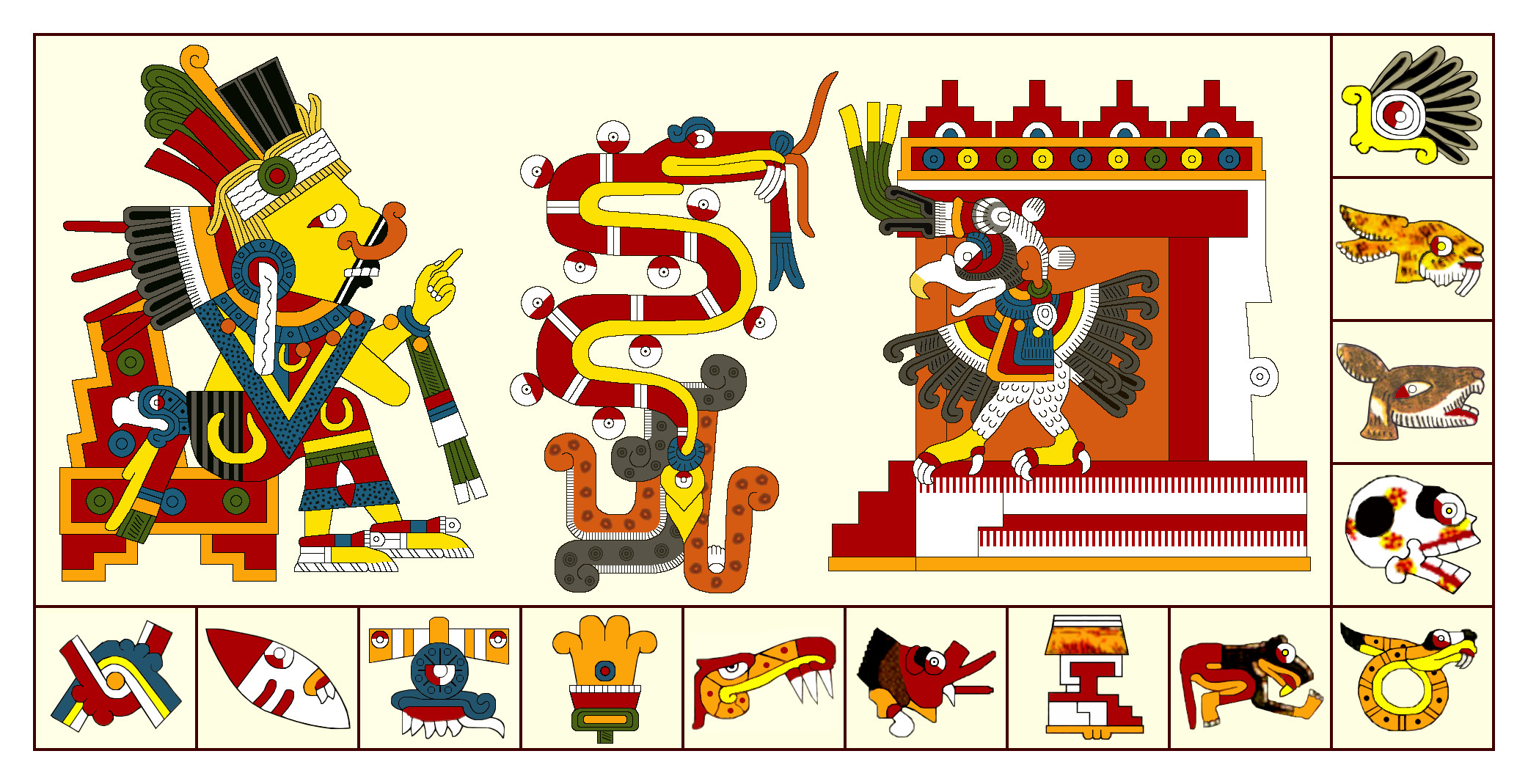
The Codex Borgia version of Xochiquetzal on the left is downright punk with her intricate facial tattoos, but she displays no specific emblems of her divine identity. In fact, her Earth Monster headdress would be more appropriate for Chalchiuhtlicue. The matrix in the lower center could suggest her patronage of weaving, but I think it’s in fact a game-board for patolli because she’s also patron of gaming. The four hemispheres may be playing pieces for the game.

At first, I was confused by the lack of emblems specific to Tezcatlipoca on the figure on the right—other than the black body and smoky curls around his eye. Then a knowledgeable friend advised that this was in fact a nagual of the otherwise invisible Tezcatlipoca, Ixtlilton (Small Black Face), also known as Tlaltetecuin (Lord of the Black Water Tlilatl). The symbolic item at top center is his scrying bowl or jar of dark water used for hydromancy, diagnosing ailments and prescribing cures. A gentle god of medicine and healing specifically in relation to children, Ixtlilton brought them peaceful sleep at night. Like Tezcatlipoca, Ixtlilton was a deity of divination, Tezcatlipoca consulting his obsidian mirror, and Ixtlilton studying reflections in dark water. He was also a god of dance and music sometimes called the brother of Five Flower (a nagual of Xochipilli)

The divinatory relationship between Xochiquetzal and Tezcatlipoca isn’t clear to me, other than in their being erstwhile consorts. I may not have my mythological wires straight, but I gather Xochiquetzal was once upon a time the wife of the Storm God Tlaloc (see the Rain trecena) who ruled in the Third Sun (Four Rain), a happy era perhaps set historically in ancient Teotihuacan. However, the nefarious Tezcatlipoca abducted her, and Tlaloc flew into an inordinate rage, destroying his idyllic world with a rain of fire (volcano). Its poor people became butterflies, dogs, or birds, some say turkeys. Afterwards, Tlaloc apparently married Chalchiuhtlicue (see the Reed trecena), who became the ruler of the Fourth Sun (Four Water). Meanwhile, the philandering Tezcatlipoca apparently moved on to an affair with Tlazolteotl (see Deer and Earthquake trecenas). Quite a family saga…

#

TONALAMATL YOAL (compiled and re-created by Richard Balthazar on the basis of
Codex Telleriano-Remensis and Codex Rios)

Aztec Calendar – Eagle Trecena – Tonalamatl Yoal

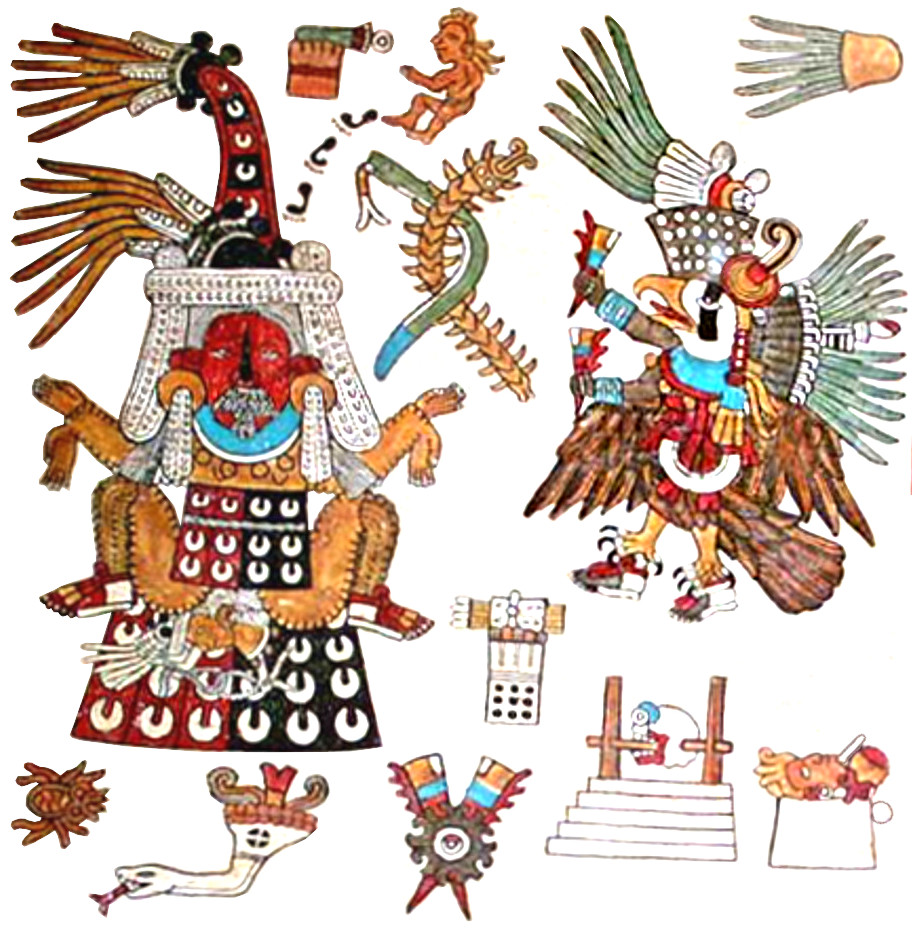
The Yoal version of Xochiquetzal (on the left), like most deities in this tonalamatl, is loaded down with identifying motifs, including the facial tattoos. Here, she’s accompanied by an Underworld centipede under her throne, a libidinous snake looking out from between her thighs, a weirdly colored jaguar in her bustle, an eagle in her headdress, and an exorbitant display of quetzal plumes.

Xochiquetzal’s skirt is a beautiful example of her weaving prowess, and that blue thing in one of her left hands may well be a loom comb, a tool used to move weft yarns into place. That still doesn’t explain a similar (banded) object held by Chalchiuhtlicue in the Yoal Reed trecena, but it’s my best guess. In any event, this goddess is even grander than the Borbonicus image (see below) that inspired my own version.

The surreal deity on the right is not named in Codex Telleriano-Remensis, but in Codex Rios it’s labelled generically as Tezcatlipoca, its obvious nagual status indicated by a smoking mirror in the headdress. The anomalous creature in which the deity is disguised bears no relation to Borgia’s Ixtlilton or to any other known nagual of the Invisible One.

Some scholars suggest that this is a coyote—reflecting Tezcatlipoca’s talent for shape-shifting—like his walk-on appearance as a vulture in the Earthquake trecena. However, while this head might be canine, the ears are totally wrong, as are its eagle talons/claws and feline tail. Then there are those blue things stuck all over it (chips of turquoise or lapis?) which turn it into some mythical jeweled creature. Of course, such scholarly suggestions (like most scholarship) are simply authoritative guesswork, and I don’t require final answers to mysteries.

#

OTHER TONALAMATLS
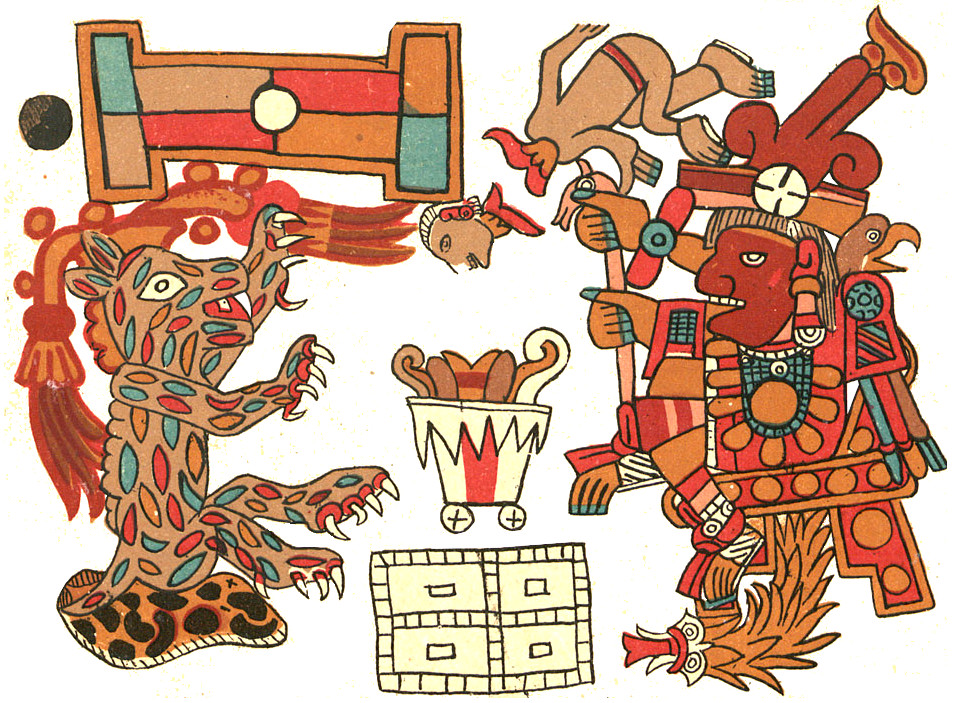
Tonalamatl Aubin patron panel for Eagle trecena

As a mythical jeweled creature, that in Tonalamatl Aubin sports red, gold, and blue jewels. It’s clearly no coyote, looking more like a jaguar with anatomically proper claws though with too short a tail. Note also the contrast with the true jaguar pelt it sits on. Its sketchy headdress resembles in form that of Borgia’s Ixtlilton, but nothing about it suggests Tezcatlipoca. Just a regular old jeweled critter?

On the right side, an understated Xochiquetzal at least has a fat centipede under her throne and an eagle in her headdress but is sorely lacking in quetzal plumes and imagination in her facial tattoo. Oddly, I think that thing she holds with both hands is an animal-headed digging stick, which doesn’t seem to relate to any of her themes.

The square would seem to be another patolli board, and the ballcourt design in the upper left is a new emblem, reflecting Xochiquetzal’s additional patronage (along with Xochipilli’s) of the sacred ballgame tlachtli. The decapitated individual may indicate the traditional fate of losers at tlachtli. (I’m not aware of her predilection for that style of sacrifice otherwise. However, somewhere long ago I read of a ritual sacrifice to her of a female, the victim’s flayed skin being donned by her priestess. Oh, my, the wild and crazy things goddesses do in the privacy of their temples…)

#

Codex Borbonicus patron panel for Eagle trecena

The image of Xochiquetzal in Codex Borbonicus is one of the most famous in Aztec iconography, obviously a bit more subtle than my old one and not as exuberant as that in Tonalamatl Yoal. But she does have a rather sexy snake. The major item to note is that most of her feathers are red. Deities usually wear green quetzal plumes like those in the topknots here, and the quetzal apparently only has little red feathers on its breast. These big red feathers probably come from the scarlet macaw, a bird sacred to her brother/spouse Xochipilli.

Almost lost among the twenty ritual items, the de-emphasized jeweled beast is still anomalous: coyote-like ears but a jaguar tail and avian claws. Whatever it’s supposed to mean, I guess it does so minimally. The three symbolic motifs we saw in the Aubin panel, the patolli gameboard, beheaded ballgame loser, and schematic ballcourt, are grouped at the top of this panel. In the upper right corner is a reference to Xochiquetzal’s importance as a patron of sex. The couple modestly hidden behind a blanket is the standard symbol of marriage (or intercourse). Seen in the Yoal panel for the Crocodile trecena, it also appears in several other codices.

The other items of the conglom don’t bear discussion, except to note the Borbonicus fondness for scorpions which appear in many of its patron panels.

#

Codex Vaticanus patron panel for Eagle trecena

Once again, Codex Vaticanus closely reflects the elements of Tonalamatl Borgia. This Xochiquetzal again has complex tattoos and an Earth Monster headdress. However, now she clearly dominates the secondary figure of Ixtlilton, that nagual of Tezcatlipoca identified by the Black Water Tlilatl above. The position of his arms akimbo (very like his posture in the Borgia panel) reminds me of the dancing figure in the Borgia Flower trecena whom I took to be his purported brother Five Flower (Macuil Xochitl). That deity, this one, and the Borgia Ixtlilton all have unusual face-paint patterns around their mouths that suggest a brotherly relationship—or at least more identity confusion among the minor-deity crowd.

#

As far as patrons of the Eagle trecena go, these various naguals of Tezcatlipoca don’t seem to contribute much to the trecena’s themes of Supremacy/War and Lofty Vision. Maybe Ixtlilton and the jeweled beast really were included merely to reflect Xochiquetzal’s romantic history with Tezcatlipoca. After all, that would tie in well with her divine sexuality and beauty. Dr. Paquin also suggests that Ixtlilton/Tlaltetecuin (and the jeweled beasts) are acting as cheerleaders for Xochiquetzal, dancing to ward off harmful influences and maintain her high position of supreme strategist in oversight of the game of life-death-resurrection.

###

You can view all the calendar pages I’ve completed up to this point in the Tonalamatl gallery.

Aztec Calendar – Water Trecena

The seventeenth trecena (13-day “week”) of the Aztec Tonalpohualli (ceremonial count of days) is called Water for its first numbered day, which is coincidentally the 9th day of the veintena (20-day “month”). In Nahuatl, Water is Atl. It was known as Muluk (Water) in Yucatec Maya and Toj (Rain or “Thunderpain”) in Quiché Maya.

The Aztecs saw the day Water, typically shown as a container spilling water, as connected with the flow/passage through life and time as well as purification and the accumulation of resources and potentials. It’s associated anatomically with the back of the head/hair. The divine patron of the day is Xiuhtecuhtli, the Lord of Fire/Turquoise, who’s a patron of the Snake trecena.

PATRON DEITY RULING THE WATER TRECENA

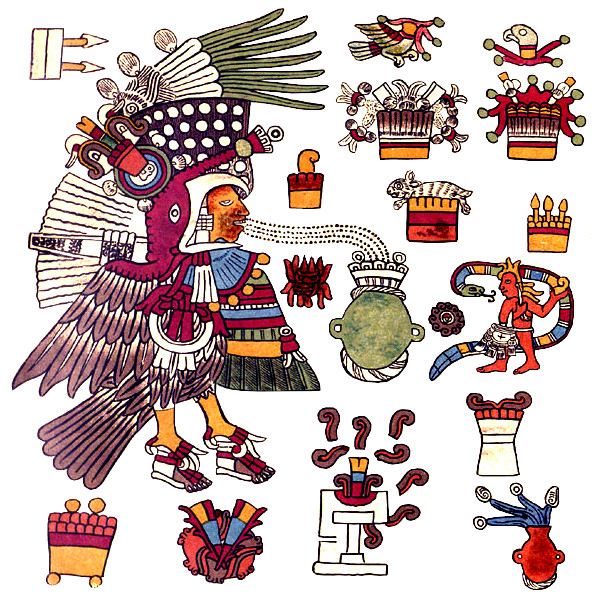
Chalchiuhtotolin (see Icon #3), the Jade (or Jeweled) Turkey, is another nagual (manifestation) of Tezcatlipoca (see Lizard trecena). As the magnificent patron of his Jaguar Warriors of the Night and of military power and glory, it cleanses them of contamination, absolves them of guilt, and overcomes their fates. Appropriately it’s the patron of the day Flint, the sacrificial knife.

Though symbolic of sustenance and abundance, Chalchiuhtotolin is also associated with disease and pestilence, a creature of death and decay, regeneration and transformation. Chalchiuhtotolin is also linked to the earth’s fertility, agricultural cycles, and the natural order of life and death. Appeasing Chalchiuhtotolin was believed to ensure a smooth transition for the deceased into the afterlife and promote fertility and abundance in the earthly realm.

AUGURIES OF THE WATER TRECENA

By Marguerite Paquin, author of “Manual for the Soul: A Guide to the Energies of Life: How Sacred Mesoamerican Calendrics Reveal Patterns of Destiny”
https://whitepuppress.ca/manual-for-the-soul/

Trecena theme: Generative Vitality, Purification. This life-giving time frame has a generative “firewater” aspect to its energy, representative of the original creation forces that sparked life itself. There is a strong sense of abundance associated with these forces, but these energies can also be “electrical” in the sense that they can “spark” important events, often associated with stimulation and cleansing. Like water itself, this period holds the potential to create pathways that can shape or change the world. This trecena has also been associated with omens.

Further to how these energies connect with world events, see the Maya Count of Days Horoscope blog at whitepuppress.ca/horoscope/  Look for the Muluk trecena.

THE 13 NUMBERED DAYS IN THE WATER TRECENA

The Aztec Tonalpohualli, like the ancestral Maya calendar, is counted through the sequence of 20 named days of the agricultural “month” (veintena), of which there are 18 in the solar year. Starting with 1 Water, it continues the trecena with: 2 Dog, 3 Monkey, 4 Grass, 5 Reed, 6 Jaguar, 7 Eagle, 8 Vulture, 9 Earthquake, 10 Flint, 11 Rain, 12 Flower, and 13 Crocodile.

There’s one special day in the Water trecena:

One Water (in Nahuatl Ce Atl) –the day-name of Chalchiuhtlicue, the Jade Skirt, the patron of the Reed trecena. In the Florentine Codex, it’s noted as a feast day for those involved in the water industries, but I can only speculate what those were.

THE TONALAMATL (BOOK OF DAYS)

Several of the surviving so-called Aztec codices (some originating from other cultures like the Mixtec) have Tonalamatl sections laying out the trecenas of the Tonalpohualli on separate pages. In Codex Borbonicus and Tonalamatl Aubin, the first two pages are missing; Codex Telleriano-Remensis and Codex Rios are each lacking various pages (fortunately not the same ones); and in Codex Borgia and Codex Vaticanus all 20 pages are extant. (The Tonalpohualli is also presented in a spread-sheet fashion in Codex Borgia, Codex Vaticanus, and Codex Cospi, but that format apparently serves other purposes.)

TONALAMATL BALTHAZAR

As described in my earlier blog The Aztec Calendar – My Obsession, some thirty years ago—on the basis of very limited ethnographic information and iconographic models —I presumed to create my own version of a Tonalamatl, publishing it in 1993 as Celebrate Native America!

Aztec Calendar – Water trecena – Tonalamatl Balthazar

Yet again, I knew nothing about traditional images of the Jade Turkey and simply played with a Nuttall-style guy in a turkey-suit, the dominant green color reflecting the “jade.” Only many years later did I discover true details of this deity’s mythology—and the unusual type of turkey it references. The following patron panels will explain a lot of little-known turkey-trivia.

#

TONALAMATL BORGIA (re-created by Richard Balthazar from Codex Borgia)

Aztec Calendar – Water trecena – Tonalamatl Borgia

Besides the “Jade Turkey,” Chalchiuhtotolin is also called the “Jeweled Turkey”—referring to Meleagris ocellata, an endangered species native to Yucatan, Belize, and Guatemala and named for “eyes” on its imposing fan of tail feathers. With stunning blue-to-purple-to-green plumage, this rara avis is a distant cry from the standard “Thanksgiving” turkey (Meleagris gallopavo).

Ocellated Turkey

Surely known personally to the Maya but likely only mythically in Mexico, this rare bird as patron of the Water trecena shows its ancient heritage. The peoples of Mexico found significant sustenance and abundance in its drabber but larger cousin, the Wild Turkey, ancestor of our even bigger domestic turkey. But they “idolized” a mythical jeweled fowl that could be called the “Turquoise Turkey” (Xiuhtotolin). Coincidentally and appropriately, that could also mean “Fire Turkey.” Since the bodies of ocellata were many shades of iridescent emerald-green, simply “Jade Turkey” is its best label.

The color palettes of codex artists included very few shades of blue which differed over time and area. The Maya had a famous blue of unknown source, and the Mexicans later achieved a generous blue like in Codex Borbonicus. In Codex Borgia, most intended blues have degraded into shades of grey (as have any hues of green into brownish-golds). Codex Laud and Codex Fejervary-Mayer use a dark greenish or slate tone for blues and/or greens, with other colors fairly vivid. In Vaticanus b (predominantly cochineal red and brownish gold), they managed some subdued blues and greens almost like highlights. But a true turquoise was way out of an artist’s reach, not to mention any shade of purple.

That made it essentially impossible to depict Chalchiuhtotolin in all its iridescence. The Jade Turkey mostly appears in codices with a red head and brownish feathers, like their common farmyard gobblers. But in Codex Borgia, the mythical bird has a stylized ocellated fantail (now become blacks and greys) and brownish-gold medallions for the glowing green on its breast.

I chose to color our divine bird naturalistically—i.e., just about as supernaturally as it gets, that turquoise head and purplish tail. I wonder about that suspicious ear on the back of its head. Turkeys don’t have ears like mammals. And what’s that big tassel-thing on its breast? Well, recently I learned about turkeys’ beards. When toms (and some hens) get on in years, they can grow a long spike of feathers straight out from their breasts. That ornament and a many-eyed fan makes a formidable fowl of military majesty, a great patron for the Jaguar Warriors of the Night.

Chalchiuhtotolin seriously dominates this patron panel, especially with all that stuff the deity is evidently exhaling. The upper curlicues we now know are grey smoke and orangish fire, which makes sense for a “Fire Turkey,” a fire-breathing warrior-bird, but the curly thing caught in the disembodied claw sure doesn’t. Hanging right there in the center of the panel, it must be primally important, maybe a hieroglyphic message or utterance by the deity. Or it may be simply an abstraction for the wide range of calls, cackles, and gobbles that turkeys make.

Meanwhile, the surreal item on the right invites more interpretation. No doubt, it involves two spotted serpent tails encircling a body of water. However, the snakes’ heads lift up between knobbed sides like spouts of water (with eyes and mouths!) and top off with big flowers. The motif of a snake containing a volume of water is also seen in ancient Maya iconography—and this is after all, the Water trecena. Gathering and containing water, the essence of accumulation, provides the Jade Turkey’s abundance. So, here there be water-serpents.

Which raises a neat linguistic point: At a recent lecture, I learned that in Aztec iconography many of the images are actually hieroglyphs, pictorially and/or phonetically significant. For instance, a pot or jug with water splashing out of it can be read as a word in Nahuatl. The first syllable of their word for pot/jug/jar is co-,and their word for ‘water’ is atl. So, co-atl spells ‘snake.’ This item is in fact a decorative and emphatic hieroglyph for ‘water-serpent.’

This page for the Water trecena I consider perhaps the most glorious in the Tonalamatl Borgia, not only for its intended colors but for its surrealism. Even without the appended material and fancy water-serpent glyph, this image of Chalchiuhtotolin is inarguably the apotheosis of the turkey. (Worshipping it is a whole lot kinder—and respectful—than cooking it for dinner.)

#

TONALAMATL YOAL (compiled and re-created by Richard Balthazar on the basis of
Codex Telleriano-Remensis and Codex Rios)

Aztec Calendar –Water trecena – Tonalamatl Yoal

This series of compiled trecena pages that I call Tonalamatl Yoal opts for a far less naturalistic image of an ocellata with the brown feathers and red head of the common gallopavo. However, there’s no clear reason for its yellow feet or the epaulets on its wings. The “jeweled” aspect of divine Chalchiuhtotolin is shown by the jade pendants on its plumage and probably the turquoise collar, but I can’t explain the apron of quetzal plumes that almost hides its jaguar-pelt “pants.” Those may indicate its nagual connection to Tezcatlipoca as does the variant smoking mirror in its headdress—a logical source of the flame and smoke seen before as the breath of the Borgia bird. Apart from the shape of the head, this heavily stylized portrayal of the deity doesn’t look much like a turkey, especially that tail, but it’s certainly an elegant fowl.

Instead of any water-serpent reference, on the right side is another figure of a human worshipper performing a ritual blood sacrifice like the guy in the Jaguar trecena. That one (with the same bound hairdo but no headdress) pierces his tongue with a pointed stick. This one jabs himself in the ear with a sharpened flowering shinbone—oddly emblematic of Quetzalcoatl, as are the two ornamental conch shells. The devout fellow also offers the deity a fancy incense bag.

Though it shares the stage here with a worshipper, Chalchiuhtotolin is clearly the sole patron of this Water trecena. As before with the tongue-piercer with Quetzalcoatl in the Jaguar trecena, this ear-stabber may merely indicate the preferred method of blood-sacrifice to the Jade Turkey. I haven’t studied the matter, but I suspect the Aztecs had prescribed rituals of phlebotomy for specific deities, including slicing other body-parts, flagellation, flaying, and eye-poking (like in the Flower trecena). It was obviously a great culture for masochists.

#

OTHER TONALAMATLS

Tonalamatl Aubin patron panel for Water trecena

It’s no surprise that the turkey in the Tonalamatl Aubin patron panel can scarcely be called elegant. Looking more like a limp rubber chicken, it’s nevertheless supposed to be the divine Chalchiuhtotolin as shown by a half-hearted smoking mirror in its headdress. While the little guy pretends to stab his ear, three awkward conch shells seem to relate to familiar water-serpent symbols. Apparently, the Aubin artist(s) held Chalchiuhtotolin in only minimal awe.

#

Codex Borbonicus patron panel for Water trecena

The Jade Turkey in the Codex Borbonicus patron panel, however, is rather awesome with an ornate smoking mirror and Tezcatlipoca’s beribboned circular pendant. Its anthropomorphic nature (a guy in a turkey suit) nicely justifies my own even more awesome interpretation in Tonalamatl Balthazar. In the crowd of ritual paraphernalia, I wonder about that central green pulque pot; is he drinking from it or vomiting into it? The little guy on the right of it with the colorful snake is again stabbing an ear and carrying an incense bag and a conch shell. The co-atl glyph in the lower right corner must refer to both the Water trecena and water-serpent, and fire and smoke issue from a burning temple. The cluster of symbols (including a familiar scorpion) might be elements of some hieroglyphic sentence.

#

Codex Vaticanus patron panel for Water trecena

In Codex Vaticanus, the Jade Turkey distinctly reflects the Borgia image, some blue in the fantail with stylized “eyes, a geometrically abstracted wing, and a small beard on its breast. One gets the feeling that the artist probably intended to paint the white spaces in ocellata colors but didn’t get around to it. (I’m tempted to finish the job but have other fish to fry right now.)

The cluster of motifs above its head also reflects the Borgia image: plumes of smoke and fire and stylized water-serpent heads (without faces) capped with flowers. In this instance, the red “walls” of the waterspouts are evidently penitential thorns, explaining the knobbed structures in Borgia. Most interesting is the curly exhalation with stars attached grasped again in a disembodied claw; it suggests darkness or night, possibly explaining the enigmatic brown Borgia detail. The deity was sometimes called the “Precious Night Turkey”—maybe since Tezcatlipoca was the god of the night or for its patronage of the Jaguar Warriors of the Night.

This Vaticanus Chalchiuhtotolin is exceptional, both in stylized detail and in being the sole image in the patron panel. Displaying no specific emblem of Tezcatlipoca, this Jade Turkey seems (like the Borgia bird) to proclaim its independent divinity.

#

I’m impressed by the virtuosity of the Vaticanus artist(s) in stylizing certain animals like the dog (discussed in the previous Vulture trecena) and this Jade Turkey. Elsewhere in the codex they have twice drawn turkeys in the context of their patronage of the day Flint, on pp. 29 and 93:

Two Turkeys, Codex Vaticanus

From different sections of the codex but in similar poses (and both sporting impressive beards), these two gobblers may well have been drawn by different artists in slightly different personal styles. The one on the left is clearly a common variety tom, but apart from the necessarily red head, the one on the right looks to be an authentic ocellata with the eyes on its fantail and more intricate plumage. Perhaps the magnificent trecena patron image was created by yet a third artist, someone more fluent in religious symbolism.

###

You can view all the calendar pages I’ve completed up to this point in the Tonalamatl gallery.

Aztec Calendar – Earthquake Trecena

The thirteenth trecena (13-day “week”) of the Aztec Tonalpohualli (ceremonial count of days) is called Earthquake (or Motion/Movement) for its first numbered day, which is the 17th day of the veintena (20-day “month”). In the Nahuatl language Earthquake is Ollin, and it’s known as Kab’an in Yucatec Maya and No’j in Quiché Maya.

Nineteen of the 20 day-signs of the vientena are glyphs based on concrete things or items, but the one for the day Earthquake is something else entirely, the symbol of an abstract “think” (i.e., a thought or concept). The lobed or flanged form can rotate as needed but varies stylistically across the codices, while usually retaining a similar shape in each one:

Variations of the Day-Sign Earthquake

The enormously embellished symbol for Earthquake in the center of the Stone of the Suns is literally the day-sign “Four Earthquake,” day-name of the current Fifth Sun (which occurs in the Jaguar Trecena), and the central face is that of its titular deity Tonatiuh. Within its four lobes are the day-names of the previous four Suns (starting on upper right and moving counterclockwise): Four Jaguar, Four Wind, Four Rain, and Four Water.

The divine patron of the day Earthquake is Xolotl, god of the Evening Star, who will be seen later as patron of the Vulture Trecena. Sometimes called Quetzalcoatl’s evil twin, he’s the deity of malice, treachery and danger and represents the darkness of the unconscious.

PATRON DEITY RULING THE EARTHQUAKE TRECENA

The patron of the Earthquake Trecena is the far less dire goddess Tlazolteotl (Goddess of Filth), whom we’ve already seen as a patron of the Deer Trecena (in Borgia) and Reed Trecena (in Yoal). Her unprecedented patronage of two (or three) trecenas suggests that she’s one of the most important (powerful) deities in the Aztec pantheon. To recap, Tlazolteotl is goddess of fertility and sexuality, motherhood, midwives, and domestic crafts like weaving, as well as patron of witchcraft and fortune-tellers and of lechery and unlawful love, including adulterers and sexual misdeeds. She cures diseases, particularly venereal, and as the goddess of purification and bathing, forgives sins. People confess their sins to her only once in their life, usually at the very last moment, and besides that rite (which Spanish clergy recognized as parallel to their sacrament of confession), her rituals include offerings of urine and excrement. One of several earthmothers, Tlazolteotl is reputedly the mother (sire unknown) of the maize deities Centeotl and Chicomecoatl. She’s also 7th lord of the night and patron of the mystical number 5.

AUGURIES OF EARTHQUAKE TRECENA

By Marguerite Paquin, author of “Manual for the Soul: A Guide to the Energies of Life: How Sacred Mesoamerican Calendrics Reveal Patterns of Destiny”
https://whitepuppress.ca/manual-for-the-soul/

The theme of this trecena is evolutionary movement. It’s associated with the opening and closing of major eras within the Maya Calendar system and aligned with re-birth or emergence, which can sometimes manifest as world-shaping beginnings and endings. Traditionally this was a generative period during which “confessional rites” were conducted, possibly tied in with the fertile forces of “evolutionary movement” that can bring forth significant change. This would be a good trecena for “stock-taking” and for making “evolutionary” leaps forward.

Further to how these energies connect with world events, see the Maya Count of Days Horoscope blog at whitepuppress.ca/horoscope/  Look for the Kab’an trecena.

THE 13 NUMBERED DAYS IN THE EARTHQUAKE TRECENA

The Aztec Tonalpohualli, like the ancestral Maya calendar, is counted through the sequence of 20 named days of the agricultural “month” (veintena), of which there are 18 in the solar year. Starting with the 17th day of the preceding veintena, 1 Earthquake, this trecena continues with 2 Flint, 3 Rain, 4 Flower, 5 Crocodile, 6 Wind, 7 House, 8 Lizard, 9 Snake, 10 Death, 11 Deer, 12 Rabbit, and 13 Water.

There are only two relatively special days in the Earthquake trecena:

Four Flower (in Nahuatl Nahui Xochitl)—important for the Maya as 4 Ajaw, though some of its significance may have survived into later cultures. Dr. Paquin advises that the energy of the day was associated with the beginning and ending of eras. For the Maya, their Fourth World was created on 4 Ajaw in 3114 BC, and after a long-count cycle of 5126 years, a 4 Ajaw day brought the conclusion to that era on 12/21/2012 when a new Maya Calendar era began.

Twelve Rabbit (in Nahuatl Mahtlactli ihuan ome Tochtli)—day-name of the Rabbit in the Moon as seen in the Borgia Death Trecena. I’ve no idea how the day may have been celebrated, but as a Rabbit-god of intoxication, Twelve Rabbit was likely the deity of lunacy (moon-madness).

THE TONALAMATL (BOOK OF DAYS)

Several of the surviving so-called Aztec codices (some originating from other cultures like the Mixtec) have Tonalamatl sections laying out the trecenas of the Tonalpohualli on separate pages. In Codex Borbonicus and Tonalamatl Aubin, the first two pages are missing; Codex Telleriano-Remensis and Codex Rios are each lacking various pages (fortunately not the same ones); and in Codex Borgia and Codex Vaticanus all 20 pages are extant. (The Tonalpohualli is also presented in a spread-sheet fashion in Codex Borgia, Codex Vaticanus, and Codex Cospi, but that format apparently serves other purposes.)

TONALAMATL BALTHAZAR

As described in my earlier blog The Aztec Calendar – My Obsession, some thirty years ago—on the basis of very limited ethnographic information and iconographic models —I presumed to create my own version of a Tonalamatl, publishing it in 1993 as Celebrate Native America!

Aztec Calendar –Earthquake trecena – Tonalamatl Balthazar

As the patron of the Earthquake trecena, I based my Tlazolteotl rather loosely on the Codex Borbonicus patron panel (see below), at the time the only readily available image of the goddess. I didn’t realize that the frontal view was absolutely unique in Aztec iconography (meanwhile with a standard profile face). Much later I found a similar Codex Borgia example and a couple in Codex Laud, but Tlazolteotl seems the only deity ever to appear in a “crotch-shot,” which perhaps follows from her role as a mother-goddess. Certain female figures in Codex Nuttall sit with legs crossed in front but with upper body in profile.

I took the Borbonicus image as license to include the new-born infant but didn’t realize the symbolism of crescents and gave her a stepped nosepiece appropriate for Chalchiuhtlicue. The rest of her regalia is my invention, again inspired by figures in Codex Nuttall. I’m not sure how she wound up with that menacing Borgia mouth, but many women have admired this image.

#

TONALAMATL BORGIA (re-created by Richard Balthazar from Codex Borgia)

Aztec Calendar –Earthquake trecena – Tonalamatl Borgia

In the Borgia panel, the only symbolic markers for Tlazolteotl on the left are the three crescents on her clothing, the crescent nosepiece, and the black coloration around her mouth (indicative of her eating the filth of peoples’ sins). Those were apparently considered sufficient to distinguish her under the fairly standard details of regalia and throne.

In the center, the mysterious snake (with stars) was a real puzzle for me until a knowledgeable friend explained that white-striped, red snakes are sacrificial; the odd brown and grey strips of jaguar fur below are fire and smoke. (See them also in central temple scene in the Crocodile trecena.) But why does the snake have three fangs? Also, those aren’t three tongues—just the long bottom one is. I believe that the two brown items represent the snake’s hissing, like the animal-howl symbols in the Deer, Flower, and Monkey trecenas. The large central figure is probably equivalently significant for divination as the other two elements in this elegant panel.

On the right, the third element of temple with ornate bird was also a puzzle for me until I looked closely and realized that under all that stylization was a vulture. The head is much like that of the Borgia day-sign for Vulture (Cozcacuauhtli)—with ears no less! The clincher was the dirty beak. Species identification aside, the vulture’s divinatory significance must come from its meaning as a day-sign: cleansing, purification, and prosperity—reinforcing those defining characteristics of Tlazolteotl. (She’s also a goddess of luxury, which is why I gave my version a fancy fan.)

#

TONALAMATL YOAL (compiled and re-created by Richard Balthazar on the basis of
Codex Telleriano-Remensis and Codex Rios)

Aztec Calendar – Earthquake trecena – Tonalamatl Yoal

The slapdash sketch of Tlazolteotl in Codex Telleriano-Remensis looks like it was drawn by an artist either with palsy or psychedelically inebriated, distorting her proportions and features and loading her down with identifiers. In “copying” it, the poor Italian artist-copyist for Rios tried with limited success to simplify the mess. I’ve given her more realistic and readable details like some in her bust as seventh Lord of the Night (top row, fourth from the left, and last on lower right). She’s one of the more complicated and enigmatic figures in Tonalamatl Yoal.

To allay any confusion about who she might be, there’s that billboard/banner on her back with 15 crescents, and for consistency, I gave her the standard crescent nosepiece. Reflecting her connection to luxury (mentioned above), she wears a long “granny” skirt with layers of tassels, as well as a sacred jaguar-pelt apron and bustle. This heavy skirt explains her unusual stance as though walking—instead of the standard dancing posture of most figures. The spindles and tassels in her headdress and on her earplug (like those in her image as Night Lord) indicate that she’s the patron of weaving, often called Ixcuina, goddess of cotton.

However, the top half of her body is clothed in the flayed human skin of a (female) sacrifice. See the dangling extra hands and flaccid breasts. Wearing a flayed skin is an attribute of the god Xipe Totec, but it occasionally adorns Tlazolteotl as well. The difference here is that her own body seems to have been flayed (arms and legs), which means that maybe she’s wearing her own skin. How’s that for a horrific scenario? Though the flesh marks might resemble the speckles on her cotton tassels, I’ve given them a red overtone like the flaying marks on Itztlacoliuhqui in the Lizard trecena. The only way I can explain those little shells stuck all over her is that perhaps they’re what was used to flay her. Ouch!

Moving on, consider that bowl of offerings she extends (to the other figure?), a grisly collection of dead baby-head, severed hand, heart, and probably the tail-end of a sacrificed snake. A sharp contrast to her simple, elegant image in Borgia, this gruesome detail is best overlooked. But it’s impossible to overlook the strange circular, apparently transparent, item that magnifies part of her hand and the offering bowl, an enigmatic anachronism if I’ve ever seen one. We have no evidence that the Aztecs had or knew anything about lenses. The Rios artist must have thought the same because this mysterious detail was omitted in that copy. Kudos to whomever can explain this weirdness. Or is this just more psychedelic inebriation?

Assuming that whoever drew the T-R goddess also drew that codex’s image of the “bird-man,” a page which is sadly missing from the document, the Rios copyist probably had to deal with another lot of hallucinatory details. So, we can’t be sure how accurately this guy got copied. In particular, the bird-costume doesn’t relate to any recognizable avian species.

Its brown plumage looks like that of the eagle in the Monkey trecena, but that topknot is outrageously unreal, and the black-striped eye (which may well have been in the T-R original) doesn’t help at all. Guessing from the bird in Borgia, maybe this is supposed to be a vulture too, the fantasy of an artist unfamiliar with the species. There are no vultures in Mexico (or in Italy) that even vaguely resemble this big bird. Also, all vultures seem to have longer, thinner beaks, usually of whitish or darker hue, not gold.

The Rios copy explicitly identifies the figure as Tezcatlipoca, and so a vulture makes sense as the disguise of this invisible deity, since he’s never shown as an eagle. Only that be-ribboned circular pendant is (not exclusively) a diagnostic, but the long nose-bar is uncharacteristic. The artist gave the figure a muddy greyish skin and brownish gold face, but I decided to use the vaguely mauve tone of Quetzalcoatl’s skin in the Jaguar trecena to indicate the supernatural status of this disguised deity.

For divinatory purposes, I expect we should consider themes that the day Vulture shares with Tezcatlipoca, whatever they might be. Besides this appearance in a vulture-suit and his weird epiphany in the Borgia Lizard trecena to support his nagual Itztlacoliuhqui, the invisible Tezcatlipoca will show up again later as the Black One in the Borgia Eagle trecena and in his jaguar disguise in the other tonalamatls. In other trecenas he appears only as a nagual, like Tepeyollotl in the Deer trecena and Chalchiuhtotolin in the Water trecena. Occurring (even in disguise or symbol) in four trecenas must mean that Tezcatlipoca is about as big a shot as a deity can get. He and Tlazolteotl together make a major power couple.

#

OTHER TONALAMATLS

Tonalamatl Aubin patron panel for Earthquake trecena

In the patron panel in Tonalamatl Aubin, we find many already familiar motifs in its typically careless execution, both with Tlazolteotl on the right and the other two symbolic elements, though reversed from Borgia’s layout. The deity’s accoutrements (including a flayed skin) are quite like those in Yoal, as well as that honking crescent nosepiece just so we don’t forget who she is. New is the symbol of her lascivious sexuality: a snake under her throne. Note she even has an offering bowl with a heart and severed hand. I question her need for that loincloth—and in particular, those two little footprints in the upper right. My intuition says they signify ritual pilgrimages to her holy places. Any ideas about the little loop of ribbon over her head?

The juxtaposed temple on the left, far less ornate than the one in Borgia, holds another bird of anomalous species, but presumably a vulture. It’s crowned with more outrageous plumes and as an earplug (without an ear!) wears a smoking mirror, trademark of the ephemeral Tezcatlipoca. So, we’re seeing some pretty consistent themes—at least until we look at the central element reflecting the sacrificial snake in Borgia. Here there’s no snake but two intertwined “beings,” the taller one, who may be flayed and wears a crude Ehecatl (life) mask, holds aloft in his right hand an outsized xiuhcoatl (fire-serpent) weapon, symbol of divine power, and carries in his left an incense bag for worship. This is where I must leave further interpretation to you.

#

Codex Borbonicus patron panel for Earthquake trecena

In the patron panel in Codex Borbonicus, the monumental full-frontal image of Tlazolteotl, as mentioned earlier, is the source of my own image of the goddess, though I obviously ignored her emphatic iconography—like the dozens of crescents, voluminous draperies of cotton (a true Cotton Queen!), several decorative spindles, and grisly details of the flayed skin she wears over her own flayed body. Missing are the many shells (flaying tools) we saw in both Yoal and Aubin, but other familiar elements can be seen in the scattered conglom: offerings of a head and heart (lower right), sacrificed snake (lower left), and pilgrimage footprints (top center). Particularly significant is the day-sign 9 Reed by her left foot—her sometimes day-name. The spilling bowl of water (upper right) clearly relates to her purification function.

The ornamental bird on the right (with human hands and feet) has generic brown plumage, but its head (apart from the familiar black stripe) looks like a standard eagle. Nevertheless, this many-plumed bird again must be a vulture disguise of Tezcatlipoca—judging by the be-ribboned circular pendant and smoking mirror trademark on its head. The panel also reflects the tripartite layout of Borgia and Aubin with the central pair of intertwined serpent and centipede. The serpent here represents life (like the Ehecatl figure in Aubin), and the centipede is an ancient symbol (since Maya times) of the Underworld.

#

Codex Vaticanus patron panel for Earthquake trecena

The Codex Vaticanus artist apparently opted for simplicity. The goddess has only the blackened mouth and crescent nosepiece to identify her, and she’s wrapped in a corpse-bundle, maybe as a reflection of Itztlacoliuhqui in the Lizard trecena. Little attention was devoted to the sacrificial snake in the center, and the bird in the decorative temple is evidently a real vulture—note the dirty beak. Its red topknot and clawed wings, however, are ornithologically hard to explain.

#

This review of the Earthquake trecena indicates that we need to add a new (stealth) patron for the time period, the invisible, transcendental Tezcatlipoca (See my Icon #19.)—in his disguise as a vulture. His close association with Tlazolteotl makes me wonder if maybe there’s some mythological hanky-panky going on between the two of them. After all, she’s also the patron of promiscuity and adultery, and he’s a famous seducer. (Might he be the father of Centeotl and Chicomecoatl?)

###

You can view all the calendar pages I’ve completed up to this point in the Tonalamatl gallery.

Aztec Calendar – Lizard Trecena

The twelfth trecena (13-day “week”) of the Aztec Tonalpohualli (ceremonial count of days) is called Lizard for its first numbered day, which is the 4th day of the veintena (20-day “month”). In the Nahuatl language Lizard is Cuetzpallin, and it’s known as K’an in Yucatec Maya and K’at in Quiché Maya.

Pre-Conquest Codex drawings of the anatomical connection of the day Lizard are indecisive at best. Codex Rios points to the abdominal region of a male body, perhaps intimating the intestines—or the womb in a female? I can find no diagram of specific female anatomy, but the vagina is at times linked to a flower. In Codex Borgia plate 17, the Lizard is apparently “tied” (modestly under his loin flap) to Tezcatlipoca’s male genitalia (testicles?) and in plate 72 explicitly to his penis; in Borgia 53 it’s again linked explicitly to the penis. In plate 75 of Codex Vaticanus, it’s at Ehecatl’s left hand and in Borgia 73 at Mictlantecuhtli’s. (Meanwhile, in Borgia 17 the snake appears suggestively on his loin flap and in Borgia 73 as Ehecatl’s tongue and in Vaticanus 75 as Mictlantecuhtli’s.) I think it’s safe to say that the Aztecs broadly linked the Lizard to sexual organs, be they whichever, and concomitantly to reproduction and fertility.

My learned colleague Dr. Paquin advises that from the Maya perspective, K’an is about the germination of corn (maize) in the womb of the Earth, with emphasis on growth potential. From that to the Aztec concept of Lizard as representing sex and reproduction is but an intuitive step. Dr. Paquin also notes that one reference remarks, “those born under the sign One Lizard were forceful and alert, and sound of body, and that falling down will not injure them any more than a lizard would be hurt if it falls from a high to a low place.” Also, a Mayan elder wrote that K’an-born people “possess a powerful energy that allows them to overcome obstacles.” Dr. Paquin also advised, “I have found many, many examples of K’an-born people being overwhelmingly wealthy—as if there is no limit to their ability to germinate into enormous opulence whatever they touch.” How much of that was relevant to later Aztec thought is debatable.

Not surprisingly, the divine patron of the day Lizard is Huehuecoyotl, the Old Coyote (See Icon #6), the god of sexual indulgence (as well as of music, dance, storytelling, and choral singing), seen earlier as patron of the Flower Trecena.

PATRON DEITY RULING THE TRECENA

In my research long ago, the patron of the Lizard Trecena was identified as Tezcatlipoca, the Smoking Mirror (See Icon #19), deity of fate and bringer of war and change. The 10th lord of the day and god of the North, he protects slaves and is patron of magicians, sorcery, and divination, as well as bringing and curing diseases.

However, more recently another patron of the trecena has been recognized: Itztlacoliuhqui, the Curved Obsidian Blade. Maybe reflecting the Maya God Q, he’s the deity of stone, frost, ice, cold, sin, punishment, castigation, and human misery, but also of objectivity and blind-folded justice. Spawned by a conflict between Tlahuizcalpantecuhtli, Lord of the House of the Dawn (See the Snake Trecena), and Tonatiuh, God of the Fifth Sun (See the Death Trecena), the Obsidian Blade somehow wound up as one of the naguals (manifestations) of Tezcatlipoca. His complicated heritage suggests a subconscious Aztec tendency to syncretism also involving Quetzalcoatl, the Plumed Serpent, creator of the Fifth Sun, who, as the planet Venus is the “overlord” of his nagual Tlahuizcalpantecuhtli, and possibly a twin/nemesis of Tezcatlipoca. The Aztec deities have subtle ways of blending and merging into an amorphous theological stew.

AUGURIES OF LIZARD TRECENA

By Marguerite Paquin, author of “Manual for the Soul: A Guide to the Energies of Life: How Sacred Mesoamerican Calendrics Reveal Patterns of Destiny”
https://whitepuppress.ca/manual-for-the-soul/

The first half of this trecena extends the “anything is possible” sequence that gives birth to the 20-day Maya month (uinal) as begun in the Monkey trecena, and now the emphasis is more of a cautionary nature. The theme of this trecena is about the germination of new ideas or directions, but it can also be a time of “testing.” In this period, careful nurturing of new ideas and staying vigilant is advised in order to help the “seeds of the new” to take root and flourish.

Further to how these energies connect with world events, see the Maya Count of Days Horoscope blog at whitepuppress.ca/horoscope/. The Maya equivalent is the K’an trecena.

THE 13 NUMBERED DAYS IN THE LIZARD TRECENA

The Aztec Tonalpohualli, like the ancestral Maya calendar, is counted through the sequence of 20 named days of the agricultural “month” (veintena), of which there are 18 in the solar year. Starting with the 4th day of the preceding veintena, 1 Lizard, this trecena continues with 2 Snake, 3 Death, 4 Deer, 5 Rabbit, 6 Water, 7 Dog, 8 Monkey, 9 Grass, 10 Reed, 11 Jaguar, 12 Eagle, and 13 Vulture.

In general Aztec calendrics there’s only one day in this trecena of particular import, Five Rabbit. However, for the ancient Maya in the “Chilam Balam of Chumayel,” the first seven days continue their “Creation” sequence, as once again kindly provided by Dr. Paquin. These later steps in the Maya sequence are just as vague, convoluted, and confused as the first thirteen in the Monkey Trecena. It’s small wonder that later Aztec lore apparently forgot that obscure ancient mythology, opting for the dramatic tale of Tezcatlipoca creating the First Sun, Four Jaguar (Nahui Ocelotl), in the process losing his left foot in battle with the Earth Monster Cipactli.

One Lizard (in Yucatec Maya 1 K’an) the day when the Creator deity was troubled (as in his spirit afflicted), and he first created anger (perhaps first felt anger) “because of the evil that he had created.” In the preceding trecena on the day Nine Rain, there was an attempt at creating hell, (the Underworld or Xibalba), and on Ten Flower as yet uncreated wicked men went there. Speaking of convolutions, evil doesn’t appear until tomorrow, Two Snake, and it’s intriguing that the Creator got angry for what “he” hadn’t done yet.

Two Snake (in Yucatec Maya 2 Chikchan) the day when evil appeared and was discovered by men. So, it was only now that men could be wicked enough to go to hell back on Ten Flower.

Three Death (in Yucatec Maya 3 Kimi) the day when the first death was invented. So, the wicked went to hell yesterday (or four days before) but only died today. One gets the feeling that perhaps this Maya creation sequence somehow runs halfway backwards in time.

Four Deer (in Yucatec Maya 4 Manik’) is a Creation-sequence day left blank in the Chilam Balam manuscript but thought to be something like “Spirit passing over.” Maybe it’s simply the Maya Creator’s “day of rest” like the Judeo-Christian Seventh Day, a Sabbath or sabbatical.

Five Rabbit (in Nahuatl Macuil Tochtli) is the day-name of one of the five Ahuiateteo or male deities of pleasure/excess, a big shot among the 400 rabbit-gods of intoxication and often paired with One Monkey (See Monkey Trecena), one of the female Cihuateteo.

(in Yucatec Maya 5 Lamat) is the day when the seven great waters of the sea were established. Remember that “all things” and “everything” had been created separately on two other days earlier in the sequence. So, were the waters only now gathered together into the “seven great waters”—into seas already created on Three Reed? Speaking of confusion…

Six Water (in Yucatec Maya 6 Muluk) the day when all the valleys were submerged before the world had awakened. Why were the valleys submerged when the waters had only yesterday been “established” in their great seas? The “breath of life” had already been created on Twelve Wind, and there’s been no mention of the earth being asleep till now. In fact, it’s long been a busy place what with being born on Seven Earthquake and being luxuriously furnished with rocks, trees, animals, birds, and man on other earlier days.

Seven Dog (in Yucatec Maya 7 Ok) the day when “occurred the invention of the word of God” when the uinal (the 20-day monthly cycle) was created, and all was set in order.” Inventing the word of God is a hard act to follow—or believe.

Incidentally, the trecena includes two more days significant for the ancient Maya but of no apparent import for the Aztecs:

Eight Monkey (in Yucatec Maya 8 Chuwen or in Quiché Maya 8 Batz’) is still a major ceremonial day for the Guatemalan Maya, sometimes referred to as the Maya New Year, primarily focused on celebrating the renewal of the sacred calendar.

Nine Grass (in Yucatec Maya 9 Eb’) was the day-name of a Maya goddess of Death and the fertile earth, as well as an oracle. I haven’t seen any Aztec notice of this goddess, but that might well be the day-name of Huitzilopochtli’s sister Malinalxochitl (Grass Flower), a sorceress and goddess of snakes, scorpions, and insects of the desert. If not, no matter…

THE TONALAMATL (BOOK OF DAYS)

Several of the surviving so-called Aztec codices (some originating from other cultures like the Mixtec) have Tonalamatl sections laying out the trecenas of the Tonalpohualli on separate pages. In Codex Borbonicus and Tonalamatl Aubin, the first two pages are missing; Codex Telleriano-Remensis and Codex Rios are each lacking various pages (fortunately not the same ones); and in Codex Borgia and Codex Vaticanus all 20 pages are extant. (The Tonalpohualli is also presented in a spread-sheet fashion in Codex Borgia, Codex Vaticanus, and Codex Cospi, but that format apparently serves other purposes.)

TONALAMATL BALTHAZAR

As described in my earlier blog The Aztec Calendar – My Obsession, some thirty years ago—on the basis of very limited ethnographic information and iconographic models —I presumed to create my own version of a Tonalamatl, publishing it in 1993 as Celebrate Native America!

As mentioned above, when I drew my version of the Lizard Trecena (in colored pencil) over 30 years ago, its patron was generally seen as Tezcatlipoca, the Smoking Mirror. The only codex image I’d found of the Black One was a figure from plate 21 in Codex Borgia, which I reversed and doctored up with a bigger and more ornate shield and arrows, enhanced with subtle detail changes, and gave lots of blue (to go better with black). My unwitting iconographic mistake was to omit the traditional yellow stripes on his face. With the eponymous smoking mirror as a left foot, my image thus wove in the story of his epic battle with the Earth Monster and (again unwittingly) incorporated several of the deity’s traditional emblems. He’s a real showstopper.

Aztec Calendar – Lizard trecena – Tonalamatl Balthazar

#

TONALAMATL BORGIA (re-created by Richard Balthazar from Codex Borgia)

Aztec Calendar –Lizard trecena – Tonalamatl Borgia

The figure of Tezcatlipoca on the right in this patron panel from the Tonalamatl Borgia is the only one to be found in the surviving Tonalamatls, and it’s likely why earlier scholars called him the patron of the Lizard Trecena. Other figures of this deity occur in Codex Borgia in many contexts, most similar (like my own above), but in fact he was reputed to be invisible, in rituals his presence merely indicated by the mystical appearance of a right-foot print in a box of sand.

Invisibility made it easy for Tezcatlipoca to manifest as various naguals including Tepeyollotl, Heart of the Mountain (patron of the Deer Trecena); Chalchiuhtotolin, the Jade Turkey (patron of the upcoming Water Trecena); Itztli, god of sacrifice and another form of Tecpatl, the sacrificial knife.; Xipe Totec, the Flayed God or Red Tezcatlipoca (patron of the upcoming Dog Trecena); and of course his companion in this patron panel, Itztlacoliuhqui, the Curved Obsidian Blade.

Being the “jaguar of the night,” the figure stands on the thatched roof of the night sky (as does Tepeyollotl in the Deer Trecena). I suspect that this added “pedestal” is why the codex artist fore-shortened the god’s traditionally larger plumed back-bundle. Unfortunately, the original codex image is severely damaged, particularly in this ornament and around his hindquarters. So, I’ve reconstructed it, his skirt, and tail-flap using details from other Borgia images. By the way, the item in his painfully twisted upper hand is apparently a scepter of divine power/rulership.

Meanwhile, Itztlacoliuhqui enthroned on the left is one of the more elegant and enigmatic images of this unusual deity. Unique among Aztec deities, no item of human form (except an elemental head) detracts from this image as an abstract, divine idol. Elsewhere in Borgia as patron of the day Reed, he looks like Tezcatlipoca but still wears the blindfold of objectivity.

Among other odd items of the Blade’s paraphernalia, the most telling is that arrow/dart stuck in his head, whereon hangs the tale of the celestial conflict mentioned earlier. In short, when Quetzalcoatl/Ehecatl created the Fifth world, a young god named Nanahuatzin leapt into the cosmic conflagration to become the new sun (Tonatiuh) and then refused to move until the other gods recognized his supremacy. Unwilling to kowtow, Tlahuizcalpantecuhtli (the Morning Star) shot an arrow at Tonatiuh, which that god caught and threw back at him, hitting the Lord of the House of the Dawn in the forehead. To redeem the situation, Tonatiuh turned the target into a new god, a nagual illogically of Tezcatlipoca, namely Itztlacoliuhqui. I can’t explain why the arrow is broken here, except maybe to make it fit on the page.

The rest of the panel is comfortably uncluttered. The ornamental pulque pot is likely homage to the intoxicated Five Rabbit just below it, but the other two items bear comment. The inverted (empty) vase at the top probably intends to warn people about what recklessness can cause if they’re not cautious in generating new ideas and directions (not to mention opulence). The falling figure may indicate someone in a situation out of their control (a victim of fate). Usually, falling indicates a deceased person (with closed eyes), but this one’s eyes are open. We’ll come to understand this motif better with evidence from other tonalamatls.

#

TONALAMATL YOAL (compiled and re-created by Richard Balthazar on the basis of
Codex Telleriano-Remensis and Codex Rios)

Aztec Calendar – Lizard trecena – Tonalamatl Yoal

The more human image of Itztlacoliuhqui on the left is heavily loaded down with divine accoutrements. Here the blind, black-striped face wears an abstract crescent nosepiece instead of a blindfold, and the legendary arrow is now a large ornate spear. A curious detail is that the left side of his/its body has been flayed, and strips of flayed skin are evidently included in the headdress and profusion of flaps and scarves (no doubt as signs of holiness). The flaying may also refer to his connection with Tlahuizcalpantecuhtli, who’s almost always represented thus. In his right hand is a swatch of straw or broom thought to indicate cleaning/clearing required before “germination of new ideas or directions;” in the Borgia panel it’s probably reflected in that idol’s straw cape.

The two human figures on the right immediately clarify the meaning of Borgia’s falling fellow. They represent Itztlacoliuhqui’s symbolism of justice and/or castigation and punishment of sin. Both stoning and strangling were standard Aztec methods of execution, which I strongly suspect didn’t come with the religious benefits of sacrificial rites. Note these two figures’ eyes are closed indicating death. While this trecena generously portends the “nurturing of new ideas,” it clearly doesn’t pretend to be gentle or forgiving. Of course, objective justice rarely is.

The Codex Rios copies of this trecena page are exceptionally blurry and careless, and I relied solely on the Telleriano-Remensis original for this re-creation. An innovation was making the bladed crest on his headdress black to indicate obsidian, which various sources claim as an iconographic attribute of Itztlacoliuhqui. However, in other images the points are normally left white, the primary color of this deity. My other innovation was to reposition his left arm so that it wasn’t jutting from his forehead, a frequent problem with Aztec-style figures.

#

OTHER TONALAMATLS

Tonalamatl Aubin patron panel for Lizard trecena

In the Tonalamatl Aubin, the Blade is almost entirely white with only red points on the obsidian crest of the standard headdress (struck with only a small arrow). Here his whole body, eyeless face, and headdress are flayed. In the upper hand is evidently the broom (on an arm typically and weirdly coming out of his forehead). The two (deformed) humans seem to be bleeding from punishment, maybe for disporting with pulque and some kind of flower or fruit, but they’re still alive. The four small bleeding items beg explanation, particularly the front half of the snake. Whoever uses these panels for divination will just have to make what they will of such details.

#

Codex Borbonicus patron panel for Lizard trecena

The patron panel in Codex Borbonicus presents yet another elegant and enigmatic figure of Itztlacoliuhqui. This time he has a human body, a crescent nosepiece as in Yoal, and again only a small arrow piercing his headdress, and he holds a rather large broom for sweeping the way clean. His mostly white raiment of bands, sashes, and pointy ornaments conveys an appropriate sense of crystalline cold and ice. Some sources suggest that the bumpy texture of his legs and arms represents a covering of unspun cotton (tlazolli) destined to be “ordered” as spun cotton (ichcatl). I find that interpretation strained, but this texture doesn’t look anything like the striped flaying we’ve seen in his other images.

As in most Borbonicus patron panels, lots of ritual objects are shown in a scattered conglom, including two little executed folks on the lower right, some inverted containers (pulque and water), and another front half of a snake, for whatever that might mean. Oddly, on the lower left where the symbol of the trecena is usually placed, instead of a lizard, we find a two-headed snake. Quite curious, in the upper center the arrow has a side-notched flint point I’ve not seen in other Aztec instances. Even odder, at the bottom center is an inscrutable animal head (a deer?). Have fun interpreting this arcane collection.

#

Codex Vaticanus patron panel for Lizard trecena

The Codex Vaticanus patron panel more or less restates the Borgia version—minus the big cheese, Tezcatlipoca—again leaving his nagual Itztlacoliuhqui as undisputed patron of the trecena. Only this time, the blind “idol” is even more abstracted, looking like a standard corpse bundle with a broken arrow stuck in the top. This tells me that the deity of stone, cold, etc., must be dead, not a god of Death but a defunct god, which is a passing strange concept. But an arrow in the head is usually lethal, and the dead can afford to be objective.

#

Put simply, the Lizard Trecena is an optimistic, if rather gruesome, time period in the Aztec calendar. Our discussion has now set the record straight that the ominous Curved Obsidian Blade is its sole patron, and sinners should beware. Fortunately, it only lasts for 13 days…

#

UPCOMING ATTRACTION

The calendar’s thirteenth trecena will be that of Earthquake (or Motion/Movement) with Tlazolteotl, Goddess of Filth, again as its patron. (She was also a patron of the Deer Trecena.)

#

You can view all the calendar pages I’ve completed up to this point in the Tonalamatl gallery.

Aztec Lords of the Night

In Codices Borgia and Vaticanus, the 13-day ceremonial week (trecena) is laid out in a complex day-count (tonalpohualli) with a panel presenting its divine ruler(s) or patron(s). In Codex Borbonicus and Tonalamatl Aubin, both the Lords of the Day (with their totem birds) and Lords of the Night are included but aren’t very easy to differentiate/identify. In its spreadsheet-format calendar, Codex Cospi also inserts the Lords of the Night in equally sketchy heads and symbols.

Meanwhile, Codices Telleriano-Remensis and Rios (an Italian copy of the former) accompany the trecena day-counts with the nine Lords of the Night. They appear in a super-cycle sequence that takes several 260-day ceremonial years (calendar rounds) to complete. In that sequence, each one presides over the whole night, and in the same sequence, one presides over each of the nine hours of the night. (Point of curious information: The Aztecs counted 13 daylight hours and 9 hours of darkness, so the actual length of an hour varied proportionately and by season.)

In the T-R and Rios codices, the Night Lords are sloppily drawn, even slap-dash, though with consistent, if careless, motifs. I’ve chosen to refine their iconographic images, giving them more realistic faces like in Codices Fejervary-Mayer and/or Laud:

1st Lord—Xiuhtecuhtli—Lord of the Turquoise/Fire. The peaked headdress and red ribbon are standard emblems of this deity who represents the center of time and space.

2nd Lord—Itztli—Obsidian (Knife). I don’t know what the standard black markings on his face might signify, but those things in his “hat” are sacrificial knives.

3rd Lord—Pilzintecuhtli—Young Lord, God of the planet Mercury. He’s also a “sun-lord” as shown by the sun in his headdress.

4th Lord—Centeotl—God of Maize. Check out the indicative cobs of maize in his headdress.

5th Lord—Mictlantecuhtli—Lord of the Land of the Dead. This human image is most unusual for a face of death; usually he’s a skull on a skeleton. (See my Icon #10.)

6th Lord—Chalchiuhtlicue—Jade Skirt, Goddess of Flowing Water. (See my Icon #2.) Females could also be Lords since tecuhtli actually means more like “ruler.” (She may be the ancestral Great Goddess from ancient Teotihuacan.)

7th Lord—Tlazolteotl—Goddess of Filth (literally). Her mouth is black from eating people’s filth/sins. In her headdress are spindles of spun cotton and tassels of unspun, showing that she’s also the goddess of weaving.

8th Lord—Tepeyollotl—Heart of the Mountain, God of Caves/Volcanos/Earthquakes and Jaguar of the Night. I can’t explain his tri-color face in these calendars. (See my Icon #17.)

9th Lord—Tlaloc—God of Storms. His goggle-eyed, long-toothed visage is emblematic in most codex contexts. (See my Icon #20.)

For the 2nd Lord of the Night, some sources name Tezcatlipoca, the Smoking Mirror (See my Icon #19) in place of Itztli, but that’s based solely on his image on the Night Lord page in Codex Borgia (p. 14) showing them in full figure. In fact, Itztli is a principal nagual (manifestation) of the “Black One,” who’s supposedly invisible. The Borgia figure has a sacrificial knife as one of his feet, so it clearly intends to be Itztli.

#

Recently my knowledgeable Mayanist friend mentioned that the unusual 52-count of solar years (“Aztec Century”) in Codex Borbonicus accompanies each year with a Night Lord, though in a strange sequence/cycle unlike that for the day-count, and he explained the basis for it. I’d never paid that year-count much attention, and his explanation was an eye-opener. The 52- count of solar years (not of 260-day ceremonial years!) in that codex appears on two pages (pp. 21 & 22), each with 26 years in their ritual count in a system related to the day-count.

Four of the days in the 20-day month of the solar calendar are (for very complicated, but comprehensible reasons) are chosen as “year-bearers:” Rabbit, Reed, Flint, and House. In that order, they’re counted in cycles of 13, i.e. One Rabbit, Two Reed, Three Flint, Four House, Five Rabbit, Six Reed, etc. Like the trecena process in the ceremonial day-count, this produces four trecenas of years, which I call “trecades.”

Curiously, the century cycle is structured just like a cross-counted deck of playing cards with Rabbit = Clubs, Reed = Diamonds, Flint = Hearts (appropriately), and House = Spades. In this correspondence, the numbers work as well: 1 = Ace, 11 = Jack, 12 = Queen, and 13=King. By the way, in the following image of the first half of the cycle, the central panel portrays the goddess of the night Oxomoco (on the left, strewing stars like seeds) and the god of the day Cipactonal (on the right, burning incense).

First Half of the Aztec “Century” Count, Codex Borbonicus, p. 21

This first page of the count lays out the One Rabbit and One Reed sequences, each with a Night Lord as principle divine patron of that year:

Clockwise from lower left
One Rabbit—Mictlantecuhtli
Two Reed—Piltzintecuhtli
Three Flint—Tlaloc
Four House—Tlazolteotl
Five Rabbit—Centeotl
Six Reed—Xiuhtecuhtli
Seven Flint—Tepeyollotl
Eight House—Mictlantecuhtli
Nine Rabbit—Piltzintecuhtli
Ten Reed—Tlaloc
Eleven Flint—Chalchiuhtlicue
Twelve House—Centeotl
Thirteen Rabbit—Xiuhtecuhtli

Clockwise from upper right
One Reed—Tepeyollotl
Two Flint—Mictlantecuhtli
Three House—Piltzintecuhtli
Four Rabbit—Tlaloc
Five Reed—Chalchiuhtlicue
Six Flint—Centeotl
Seven House—Piltzintecuhtli
Eight Rabbit—Tepeyollotl
Nine Reed—Mictlantecuhtli
Ten Flint—Itztli
Eleven House—Tlaloc
Twelve Rabbit—Chalchiuhtlicue
Thirteen Reed—Centeotl

The little glyphs of these Night Lords are fairly consistent, though sometimes hard to recognize. Note the three stylized place symbols (for Seven Flint, One Reed, and Eight Rabbit), which represent a mountain with a heart emblem (i.e., Tepeyollotl, Heart of the Mountain). Also note that 10 Flint is accompanied by a stylized sacrificial knife (i.e., Itztli).

The busts of the other Lords are mostly recognizable by their regalia, except for confusing variations in the four differing instances of Pilzintecuhtli (Two Reed, Nine Rabbit, Three House, and Seven House) and the two of Xiuhtecuhtli (Six Reed and Thirteen Rabbit). Further confusion is caused by the fact that Xiuhtecuhtli in Six Reed and Pilzintecuhtli in Seven House are both singing/speaking. We just have to learn to live with these inconsistencies.

The second half of the count occurs on p. 22, presenting the One Flint and One House sequences, each year again with its patron Night Lord in an entirely different selection. You can make your own list of patrons. The system for assigning annual Night Lord patrons is another tie-in with the ceremonial day-count. Each year (like One Rabbit, Two Reed, etc.) is paired with the Night Lord for the corresponding numbered day in its trecena (Mictlantecuhtli, Pilzintecuhtli, etc.)

Because of the nine-cycle of Night Lords in the tonalpohualli and the 52 years in the century, the year patrons don’t work out evenly or in a logical pattern. Some appear 6 times, some 5. Of course, the nine-cycle also doesn’t quite fit in the tonalpohualli itself (260 / 9 = 28.89), and it can only accomplish a full cycle in 9 years (28.89 X 9 = 260). That means that the first ceremonial year ends with Tepeyollotl on Thirteen Flower, and the second year starts with Tlaloc on one Crocodile. The ninth year will finally end with Tlaloc on Thirteen Flower.

Consequently, the sequence of Night Lords from which the annual patrons are selected exists only in the first calendar round of the standard tonalpohualli. In the next eight rounds, the days all have different Lords of the Night as patrons. Does this mean that the years in the next eight centuries had different patrons too? Then the tenth century returns to the first distribution. This odd cycle means that the Aztecs may have counted a “nonennium” of 468 years (9 X 52 = 468), or perhaps the repeating tenth century constituted a true millennium of 520 years.

Perhaps they did—I’ve seen somewhere that they considered the previous four Suns/eras (Four Jaguar, Four Wind, Four Rain, and Four Water) to have lasted 520 years. In that case, since we don’t know exactly when the Fifth Sun (Four Earthquake) began, it probably ended officially at some point in the 16th or 17th Gregorian century.

I have no difficulty personally in construing the Fifth Sun as starting on or around 1000 CE during the Toltec dominance and ending in 1519 CE when the invaders obliterated the Aztec empire. If so, a Sixth Sun (which for obvious symbolic reasons I would choose to call Four Death) may have begun in 1520—to end in or around 2040 CE. In another 16 years, we may move into a Seventh Sun (which I would hopefully call Four Flower). Once again, we could be looking at a Mesoamerican cycle ending, this time as an Aztec prophecy.

###

Icon #19 – TEZCATLIPOCA, the Smoking Mirror

I’m happy to announce the completion of Icon #19 – Tezcatlipoca, the Smoking Mirror. Once again, the designs and motifs in this icon are drawn from images in the surviving pre-Conquest Aztec codices. It and the preceding 18 icons can be downloaded as .pdf files with captions from the YE GODS! coloring book page.

Tezcatlipoca, the Smoking Mirror

First, I should offer some tips for coloring if you’re so inclined:

1) The black stripes on the faces of the upper left and right figures should be paired with yellow, which is the emblematic color-scheme for this deity; in the original, the upper central figure is mostly white with a few color highlights—at your discretion.

2) All those sacrificial knives (flints) in the borders are supposed to be half white and half red, in whatever pattern you choose.

3) The patterns on the limbs and face of the main figure are supposed to be red tattoos; I should also note that in the original he has brown hair.

4) The hair-like figure flowing from the head of the monster should be red blood as well as the apparent stream from the deity’s severed leg. The rest of the colors are up to you.

The horned owl at top center is Tezcatlipoca’s personal “volatile” symbol (many deities have one). The upper figures are some of his various manifestations. The main scene is the story of the god’s battle with the Earth Monster (Cipactli) in which he lost a foot and then created the First Sun (or world), Four Jaguar, on her back. The day-signs along the bottom are those representing the direction North, with Jaguar numbered as four to name the Sun being created just above. The dots along the side are the numeral 10, of which Tezcatlipoca is patron, and they also indicate that he is the 10th lord of the Day.

That should be enough to get you going. As soon as I can, I’ll post the icon on the coloring book page in vectors so it can be sized freely with no change in line quality. Now, when I’ve caught my breath, I’ll move on to Icon #20 – Tlaloc, the Storm God.

Visions of Tezcatlipoca

In the couple months since my last posting about the Maid in New Orleans, my self-incarceration for the Corona virus has made it easy to focus on the last chapters of my second memoir “Lord Wind” (soon to be posted for free download), and drawing on Icon #19: Tezcatlipoca, the Smoking Mirror, for the coloring book YE GODS!

Like the 18 previous deities in the series, this icon is modelled on images from the few surviving Aztec codices and reflects the mythology summarized in my illustrated encyclopedia of the Aztec pantheon. The icon will present several visions of Tezcatlipoca, who is sometimes called The Black One. I offer here two of the vignettes as “teasers.”

The first is Tezcatlipoca as an eagle, which is based on an image from a calendar week in Codex Rios. I’ve re-created this unusual manifestation of the deity using the stylistics of Codex Nuttall and certain motifs from Codex Borgia. (The eagle is a symbol of power and dominance.)

Tezcatlipoca as eagle

The second is Tezcatlipoca manifesting as Itztlacoliuhqui (Curved Obsidian Blade), who is the god of stone, cold, sin, punishment, objectivity, and blind justice. This surreal image is a re-working of one from Codex Borbonicus, though similar, sometimes even more surreal, details can be found in other codices as well. It presents some striking innovations in the stylebook of Aztec iconography and raises questions about certain motifs. Your guess about what they mean is as good as mine.

Tezcatlipoca as Itztlacoliuhqui

One of these solitary days I’ll finish this icon. I’m still waiting for some final tweaks on the vectors for Icon #18: Xochipilli, Prince of Flowers. Meanwhile, like everything else, my show of larger icons at the Ohkay Casino and Conference Center has been locked down… In this “unprecedented” viral situation, the show of smaller icons lies in storage with no prospective venues.

I have no options but to keep on with the drawing—next will be Tlaloc, the Storm God—and like Candide, work in my garden. My 35 varieties of iris are just now coming into bloom to bring joy to this best of all possible worlds.

#