Aztec Calendar – Flint Trecena

The tenth trecena (13-day “week”) of the Aztec Tonalpohualli (ceremonial count of days) is called Flint for its first numbered day, which is also the 18th day of the veintena (20-day “month”). In the Nahuatl language Flint is Tecpatl, and it’s known as Etz’nab’ in Yucatec Maya and Tijax (Knife-edge) in Quiché.

The day Flint portends great riches and pride but also destruction and punishment. It’s almost logically associated anatomically with the teeth. The usual day-sign (or glyph) for Flint is the sacrificial knife with a face, including teeth (fangs), and sometimes divine ornaments. The flint knife is personified (or deified) as a nagual of Tezcatlipoca, Itztlacoliuhqui,Curved Obsidian Blade, god of stone, cold, sin, and human misery, but also of objectivity and blind justice. (See vignette at top center in Icon #19, and the Blade will be met again soon as a patron of the 12th trecena Lizard.) The day Flint’s patron is Chalchiuhtotolin, the Jade Turkey (See Icon #3), also a nagual of Tezcatlipoca and patron of the power and glory of young warriors, particularly of the famous Jaguar Warriors of the Night. He’ll be seen later as patron of the 17th trecena Water, the “Turkey” in his name relating to the little known, brilliantly colored ocellated turkey.

PATRON DEITIES RULING THE TRECENA

A patron of the Flint trecena is Mictlantecuhtli, Lord of the Land of the Dead (Mictlan) the most prominent of several deities of death, 5th Lord of the Night, Lord of Number Six, and patron of the day Dog. (See Icon #10.) Images in Codex Magliabechiano show that the Death Lord’s worship involved ritual cannibalism. Counter-intuitively, in the Aztec view, skulls and skeletons were symbols of fertility, health, and abundance, a sentiment still evident in the Mexican holiday Día de los Muertos. Souls of those who die normal deaths (i.e., are not ritually commended to some god’s heaven), must climb eight hills and cross nine rivers in four days to reach Mictlan, an empty place of darkness. The owl (as a symbol of sorcery and the night) and vile insects like spiders and millipedes are closely associated with Mictlan.

Another patron of the trecena is Tonatiuh, god of the current Fifth Sun (Four Earthquake), whose visage reputedly glares from the center of the Stone of the Suns. (Also see him in Icon #16 in company with the lunar goddess Metztli.) In the creation of the Fifth Sun, a young god named Nanahuatzin leapt into the cosmic conflagration to become the sun (Tonatiuh). Lord of Number Four with a Quail as his totem bird, Tonatiuh rules the idyllic Fourth Heaven for the souls of heroes, warriors killed in battle, heart-sacrifices to ensure the continuation of the sun, and those dying in childbirth. I assume that means both babies and mothers, so the five warrior spirits, the dangerous Cihuateteo, probably dwell in the Fourth Heaven as well.

AUGURIES OF FLINT TRECENA

By Marguerite Paquin, author of “Manual for the Soul: A Guide to the Energies of Life: How Sacred Mesoamerican Calendrics Reveal Patterns of Destiny”
https://whitepuppress.ca/manual-for-the-soul/

The theme of this trecena is Sacrifice and Separation. The symbols of knife, knife-edge, and flint represent the opening energies of this period, a time-frame tending to highlight sudden change. The flint’s dramatic sharpness and flashiness can manifest itself through “shocking” events, often involving conflict or dualities between opposing forces, as reflected by the trecena’s patrons (life-sun vs death-darkness). Although separation and difference is a strong theme at this time, these energies can also be the spark to initiate new thoughts or actions.

Further to how these energies connect with world events, see the Maya Count of Days Horoscope blog at whitepuppress.ca/horoscope/. The Maya equivalent is the Etz’nab’ trecena.

THE 13 NUMBERED DAYS IN THE FLINT TRECENA

The Aztec Tonalpohualli, like the ancestral Maya calendar, is counted through the sequence of 20 named days of the agricultural “month” (veintena), of which there are 18 in the solar year. Starting with the 18th day of the current veintena, 1 Flint, this trecena continues with 2 Rain, 3 Flower, 4 Crocodile, 5 Wind, 6 House, 7 Lizard, 8 Snake, 9 Death, 10 Deer, 11 Rabbit, 12 Water, and 13 Dog.

Again there are several important days in the Flint trecena:


One Flint (in Nahuatl Ce Tecpatl) is the ceremonial day-name of Huitzilopochtli, Hummingbird of the South, the principal god of the Aztec nation. It’s also an alternate day-name for Mixcoatl, the Cloud Serpent, a major deity of the Mixtec who retained much cultural and doctrinal independence from the imperial Aztec. For the official cult, Quetzalcoatl and Tezcatlipoca were born of the creative pair Ometeotl on other days, but for another they were born on One Flint of the celestial goddess Citlalicue, the Star Skirt, as depicted in Plate 32 of Codex Borgia. As a year-name, in the Aztecs’ deep mythology/history One Flint was the first historic year when the Mexica came into power in Tenochtitlan and thus a symbol of their imperial destiny. In that function it appears near the center on the Stone of the Suns.

Four Crocodile (in Nahuatl Nahui Cipactli) is another of Xiuhtecuhtli’s ceremonial day-names (besides One Rabbit as noted in the Snake trecena).

Five Wind (in Nahuatl Macuil Ehecatl) is the Mixtec day-name of Tlaloc.

Nine Death (in Nahuatl Chicnahui Miquitztli) I read somewhere long ago was either the day-name of Mictlantecuhtli himself or of another important Death Lord. Whichever…

Thirteen Dog (in Nahuatl Mahtlactli Ihuan Yeyi Itzcuintli) in Maya mythology as 13 Ok was associated with the birth of their Maize God Hun Hunahpu. Even after several centuries, the Aztecs probably associated the day with their own maize god Centeotl. (See the Grass trecena.)

THE TONALAMATL (BOOK OF DAYS)

Several of the surviving so-called Aztec codices (some originating from other cultures like the Mixtec) have Tonalamatl sections laying out the trecenas of the Tonalpohualli on separate pages. In Codex Borbonicus and Tonalamatl Aubin, the first two pages are missing; Codex Telleriano-Remensis and Codex Rios are each lacking various pages (fortunately not the same ones); and in Codex Borgia and Codex Vaticanus all 20 pages are extant. (The Tonalpohualli is also presented in a spread-sheet fashion in Codex Borgia, Codex Vaticanus, and Codex Cospi, but that format apparently serves other purposes.)

TONALAMATL BALTHAZAR

As described in my earlier blog The Aztec Calendar – My Obsession, some thirty years ago—on the basis of very limited ethnographic information and iconographic models —I presumed to create my own version of a Tonalamatl, publishing it in 1993 as Celebrate Native America!

When I made my version of the Flint trecena back around 1990, I didn’t know about Tonatiuh being another of its patrons and simply focused on Mictlantecuhtli. As usual in that uninformed time, I relied heavily on Codex Nuttall for image (and posture), working with regalia from various figures. At least I knew him as patron of the day Dog and invented an appropriately canine headdress. As Death Lords go, I think mine shows a good bit of skeletal glory.

Aztec Calendar – Flint trecena – Tonalamatl Balthazar

#

TONALAMATL BORGIA (re-created by Richard Balthazar from Codex Borgia)
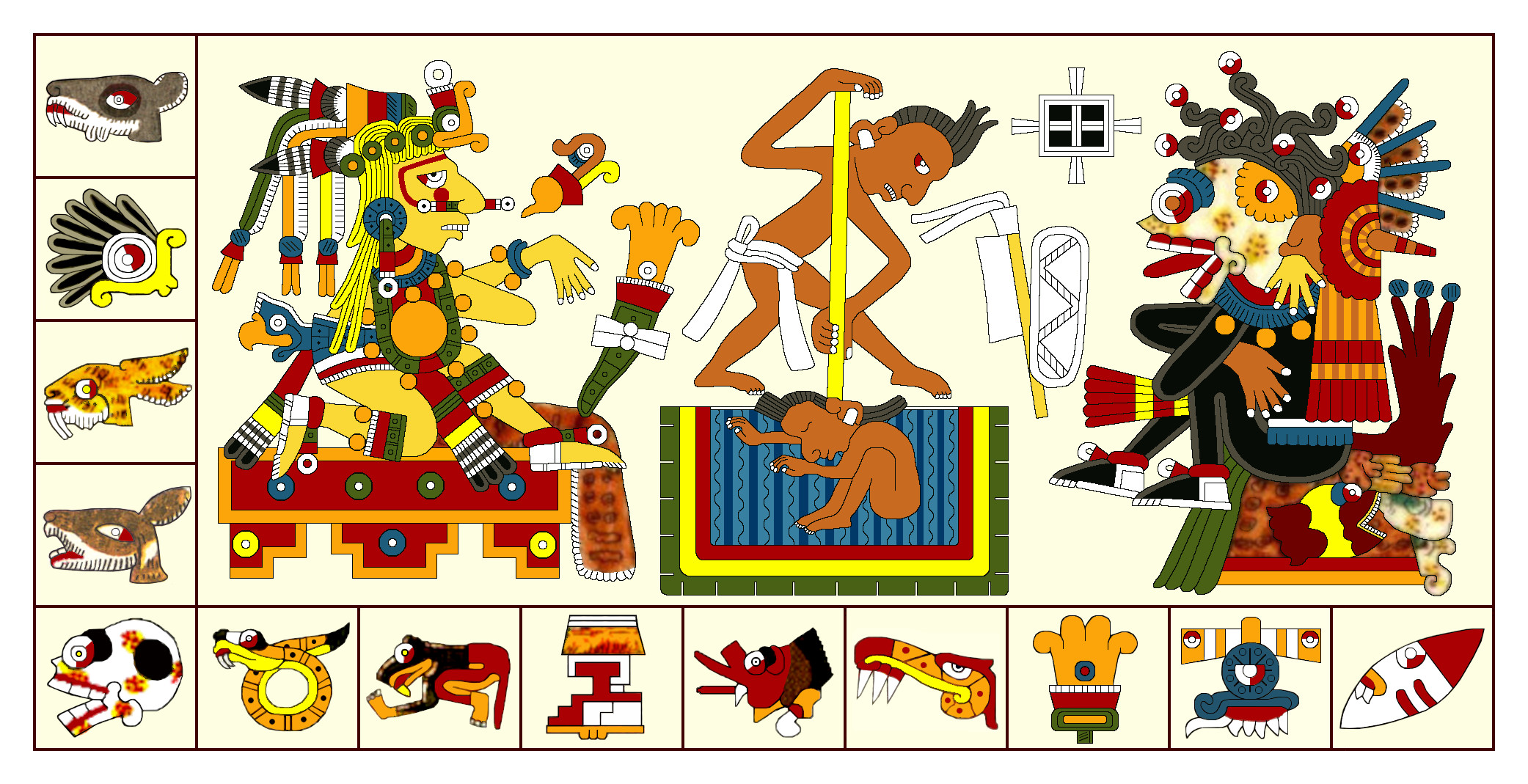
Aztec Calendar – Flint trecena – Tonalamatl Borgia

In this trecena, we encounter the sun-god Tonatiuh for the second time: He was the primary patron of the earlier Death trecena on the right side of the panel. There he wears vaguely different regalia and is in the classical “dancing” pose, but in both of these images his red face-paint pattern is the same. The main differences are in their pendants and the thematic flints in this one’s headdress. This one’s odd “flower” on a stalk must mean something about this trecena, and the unusual version of speech symbol (cuciatl) likely does too.

Here Tonatiuh is on the left side of the panel, but I don’t think that means he’s necessarily the “secondary” patron. Though on the right side, Mictlantecuhtli may not be really the “primary” patron. Considering the auguries of this trecena, these two deities probably share primacy, balanced as they are on the flint’s knife-edge of opposing forces.

As the only image of Mictlantecuhtli in the tonalamatl, this one is outstanding in its gruesome glory. I particularly love his medusa-like locks with stars which probably imply that he’s a Night Lord. The pointy thing in his headdress, his usual ornament, is almost irrelevant in view of his standard bare skull (with spots of rot). Besides the surreal eyes in the skull, the detail that really gives me the creeps is that long, pointy tongue! Less disturbing is the fountain of blood rising behind him. We’re all familiar with how bloodthirsty death is…

In general, the iconography of figures in Tonalamatl Borgia is superbly detailed, if often badly obscured by damage to the pages. The lower part of this page has suffered terribly; particularly the original details of Mictlantecuhtli’s jaguar throne are barely discernible. Consequently, this re-creation is improvised from the blurred confusion of splotches and lacunae. I settled on a combination of the Diaz & Rogers imagination and that in the anonymous facsimile, both of which came up with an inexplicable fat fish.

I can only guess at the fish’s significance: Maybe those other artists intended it to relate to the eerily similar stylized human heart in sacrifice scenes like that in Codex Magliabechiano, p. 133:
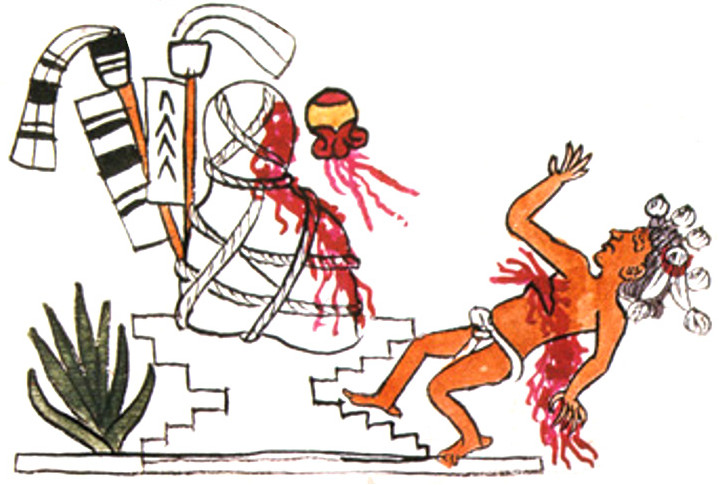
Heart-sacrifice Scene from Codex Magliabechiano

Viewing the area under high magnification, I can almost see the blur as a skull with gaping jaws like those of the Death Lord above, which would make sense since the Lord often sits on a skull or has one in his “bustle” (like mine above).

Such speculation aside, I won’t even guess at the meaning of the tasseled square figure and flag-like item with patterned piece that hang in front of Mictlantecuhtli. But the central scene is unmistakably a ritual sacrifice by drowning, tying right in with the trecena’s other theme of sacrifice. Both patrons watch with obvious approval of the ritual, but one wonders why.

The soul of the drowned sacrifice won’t be going either to Tonatiuh’s idyllic Fourth Heaven or to Mictlantecuhtli’s desolate Mictlan, but to the joyful Eighth Heaven of Tlaloc, Tlalocan. I suspect that the act of sacrifice itself goes to keeping the Fifth Sun up in the sky as well as to slaking the blood-thirst of Death. In this context, it’s tempting to suggest that as he’s Lord of Number Six, Mictlantecuhtli’s miserable Mictlan might actually be the Sixth Heaven, so to speak…

#

TONALAMATL YOAL (compiled and re-created by Richard Balthazar on the basis of
Codex Telleriano-Remensis and Codex Rios)

Aztec Calendar – Flint trecena – Tonalamatl Yoal

In Codex Telleriano-Remensis, the left-hand page of the Flint trecena with Tonatiuh is missing, so this image is based solely on the Codex Rios copy which goes wild with his divine regalia. With the major sunburst on his back as an unmistakable identifier, he lacks Borgia’s red face-paint design, likely because in the Rios image his whole body is dark red. I’ve chosen a ruddy flesh tone to avoid losing detail in monochrome darkness and have changed only the awkward length of his arms and angle of his scepter, which may be a version of the Fire Serpent.

However, the right-hand pages with Mictlantecuhtli still exist in both codices, the original and copy being almost identical in detail of regalia, skeletal limbs, and partially hidden skull beneath. But in Telleriano-Remensis, there’s a skull in his “bustle,” and in Rios (as here) it’s a dog’s head to indicate the day of which he’s patron. The circular orange items may intend marigolds, which are still considered a flower related to the Underworld.

In this Yoal image, I’ve changed the Death Lord’s ghastly brown and black visages with skeletal jaws to give him the human face of his bust above (top row, fifth from left) as Lord of the Night since they already share many details of headdress. As I’ve discussed in a blog “The Faces of Death,” this “living” face of the Night Lord is a break with the iconographic tradition of his face being almost everywhere else a skull. Another unusual detail is his blue-peaked cap—for some reason just like that of Xiuhtecuhtli in the first and tenth positions.

#

OTHER TONALAMATLS

Tonalamatl Aubin patron panel for Flint trecena

The patron deities in the Tonalamatl Aubin are the usual suspects—with a few differences from the preceding Flint trecenas. On the left, Tonatiuh has no throne and only a few red marks on his face, and part of the regalia on his back has been omitted, apparently for lack of space on the page. Oddly, he has only one arm… Tonatiuh now wears a recognizable pendant but has no other identifiers—except for the partial sun-symbol below. On the right, this Mictlantecuhtli also has a “living” face as well as fleshed-out limbs, and at least the pointy thing in his headdress is familiar. (I can’t imagine what the Aubin artist had in mind to make his left foot black.)

The central scene of sacrifice presents a curious variation. The victim clings to a “tree” of some ceremonial sort, apparently to eventually sink into the water and drown. I wonder why part of the “basin” was painted green and about that bundle beside it with someone’s hindquarters sticking out—quite puzzling. Even more puzzling are the two snakes, the brown living one with Tonatiuh and the clearly defunct white one under Mictlantecuhtli. But there’s no one to ask…

#

Codex Borbonicus patron panel for Flint trecena

The patron panel for the Flint trecena in Codex Borbonicus explicitly shows the ordeal nature of the drowning sacrifice. Here the victim clings to a smooth pole, possibly even a greased one, until sliding down into the water to provide an entertaining public spectacle. The attendant patrons “dance” in celebration of the ritual. This short-armed Mictlantecuhtli on the right has both skull and skeletal limbs, as well as a mop of dark hair with stars.

On the other hand, this Tonatiuh on the right isn’t as recognizable; his Fire Serpent scepter is no sure identifier. Rather than a sun-symbol, the semi-circular thing on his back looks more like that strange thing on Tlahuizcalpantecuhtli in the Snake trecena, but this one has an out-of-place skull on it. Even the semi-circle at top center isn’t a sun symbol, but one of the night, relating to the Night Lord Mictlantecuhtli. Apparently, the patrons are considered much less important than the central sacrifice scene.

Meanwhile, the profusion of other items in this panel suggests other considerations. Take for instance the vignette on the upper left of a person half-engulfed in some container, which harks back to the “packaged” body in the Aubin panel. When a motif appears again in separate situations, one has to assume that it has important symbolic significance—and when it’s repeated like the two blue creatures (also seen before) or the two pots of water. Those repetitive blue symbols around the pole of sacrifice surely aren’t there for gratuitous decoration, but I’m at a total loss for their meanings.

Note the little spear-bearer on the lower left. I’d bet he’s there to indicate the Flint trecena with his flint spearhead. However, I can’t explain the presence of that Venus-related scorpion over his head. It’s the same as the one with the Morning Star in the Snake panel. Has the Borbonicus artist gotten his dogmas mixed up? As a grace note, check out the little snake hovering over Tonatiuh’s head—reminiscent of that Aubin snake with him. But there’s no one to ask…

#

Codex Vaticanus patron panel for Flint trecena

The Codex Vaticanus patron panel for the Flint trecena is a slight rearrangement of what we saw in the Borgia panel, switching sides for the patrons but adding nothing new. The original panel was laid out with much wider spaces, squeezing off parts of Mictlantecuhtli’s regalia like what may have been another “pointy thing” in his headdress. For convenience and aesthetics, I brought the elements closer together and touched up several broken lines and blotched colors. Again, the central ritual sacrifice seems of exceeding importance, and once again the victim’s drowning is being graciously assisted. After all, his death will keep Tonatiuh turning in the sky, and Mictlantecuhtli will be happy to take his bones home to Mictlan.

#

This survey of the Flint trecena’s patron panels certainly corroborates Dr. Paquin’s main themes of sacrifice and separation and well illustrates canonical (if at times confused) iconography across the various codices. Stylistic differences ultimately don’t really matter all that much.

#

UPCOMING ATTRACTION

The calendar’s eleventh trecena will be that of Monkey, its patron being Patecatl, god of medicine as well as of intoxicants like pulque and psychedelic herbs. Stay tuned.

#

You can view all the calendar pages I’ve completed up to this point in the Tonalamatl gallery.

The Faces of Death

In this dire virus situation, we are all looking death in the face, but we can’t really see what it looks like wearing a mask and standing at a sociable distance. So I tried to get an up-close look at the face of death through the sanitized lens of Aztec art. They were intimate with that inevitable fact of life and drew many detailed pictures of it.

In their calendars, the Aztecs represented the day Death, Miquitzli, the sixth in their 20-day month, as a skull, often fancifully ornamented:

Signs for the Aztec Day Death

While the examples from Codex Cospi are the most varied and almost playful, they’re not exactly “fun” or amenable. Not that they were supposed to be… By the way, notice the tassels fed through the earlobes. Ears on a skull? This could become a new fashion fad!

The Aztecs also personified, or if you will, deified death as Mictlantecuhtli, Lord of the Land of the Dead (Mictlan). He was portrayed in various styles with many common motifs as a skeleton, often with a sacrificial knife for a nose and a semi-circular headdress, usually with a central spike. (Note two incipient examples of the spike among the Cospi signs above.) In Codex Borgia, he often wears a hand as a tassel through his earlobe. In the display below I skipped the skeletons and show only the skulls. None of them is particularly warm and cuddly, but again I guess Death’s heads simply aren’t.

Heads of Aztec Lord of Death

These gruesome images, which underlie many Day of the Dead graphics, weren’t especially frightening for the Aztecs who had a deep reverence for Mictlantecuhtli, even to the point of ritual cannibalism. I felt a similar, though not so hungry, reverence a few years ago when I drew the icon for the Lord of Death. He’s existentially pretty grand, but his beckoning gesture isn’t very enticing. Note the spiked ornament and the Magliabechiano headdress. Besides a vaguely realistic jaguar pelt, I used my artistic license to hang that spider web across his midriff. Oh, and those are eyeballs hanging from his cape. They do look a bit like googly eyes.

Aztec Lord of Death

These boney specters were the way I saw the Aztec face of Death until quite recently when I decided to re-create the book of days (tonalamatl) in the Codex Rios. I suddenly got glimpses of his real face instead of a fleshless skull.

They say that Codex Rios (one of the zillions of documents held by the Vatican Library) is a 16th-century Italian copy of the more or less pre-conquest codex called Telleriano-Remensis. As a copy it wasn’t terribly faithful, taking many liberties with images—some really worked; some didn’t—and making several mistakes in the numbering of days. But it was good that Rios took liberties because T-R is crude artistically speaking, though at times the copy itself was sloppy.

The T-R tonalamatl was drawn in pieces, each 13-day week (trecena) laid out with the first five days and main patron on one page and the last eight on another with the second patron/symbol. Rios followed that format exactly. In my re-creation, the weeks will be presented whole on their own pages to give an integral view of the time periods and supernatural characteristics.

The T-R and Rios tonalamatls include the nine Lords of the Night in sequence with the days, a cycle taking many years to complete (9 Lords/260 days). These Lords also appear (very sketchily) in Codex Cospi and in the complicated layouts of Codex Borbonicus and Tonalamatl Aubin along with Lords of the Day and totem birds, but in T-R/Rios the Lords of the Night are shown prominently alone in distinctive portrait busts.

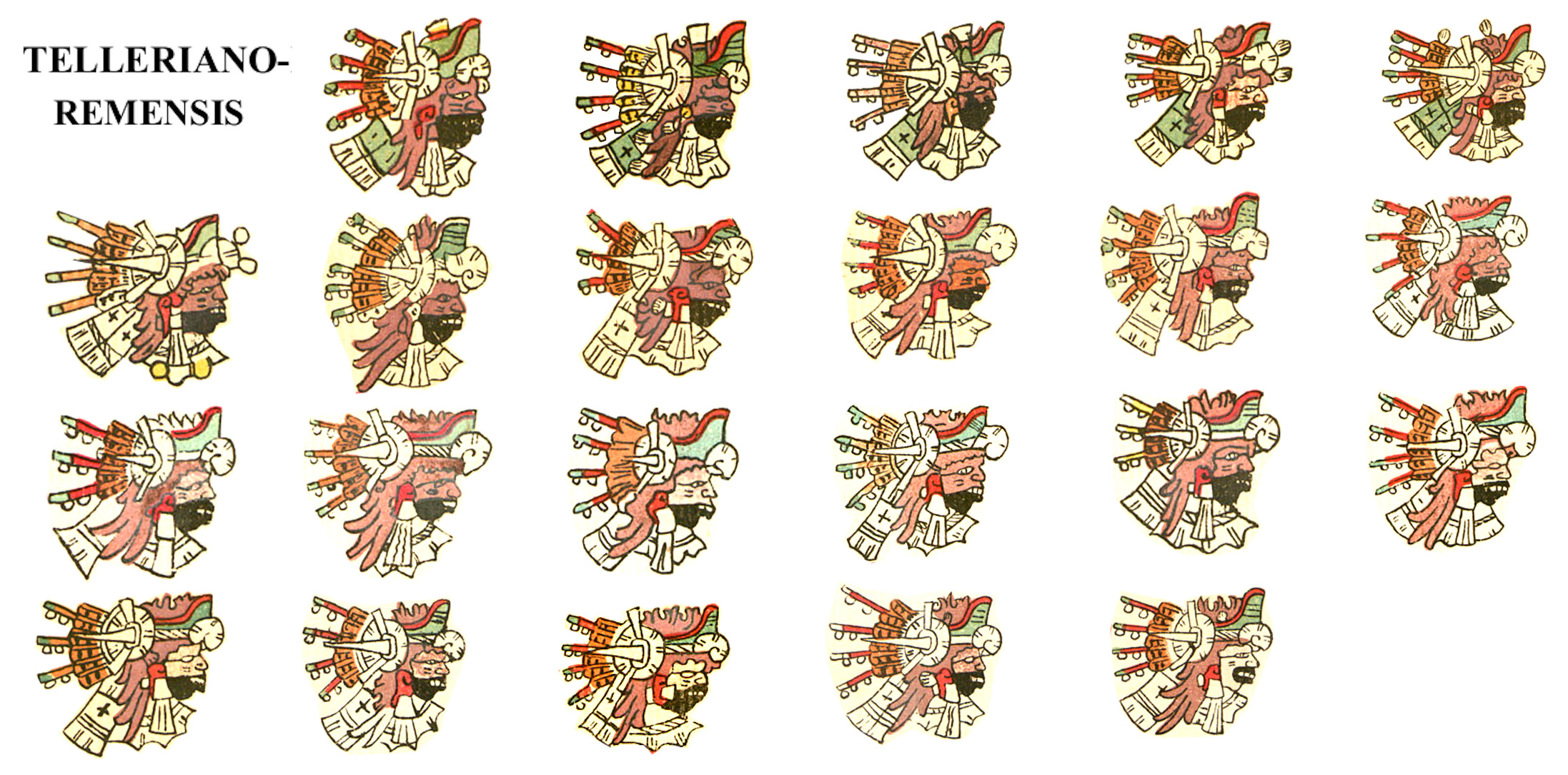
The fifth Lord of the Night—and Lord of the fifth (mid-night) hour of the night—is none other than Mictlantecuhtli. He occurs 29 times during most of the 260-day years. In T-R he’s rendered as a full-fleshed “person” with remarkably consistent accoutrements. There are only 22 faces of Lord Death below because I don’t have copies of a few of the T-R pages. I doubt the missing pages will contain any surprises:

Faces of the Lord of Mictlan (Codex Telleriano-Remensis)

Again, the headdress with spiked ornament is standard, as well as a black lower face. Since these are given in order, there seems to be a greater finesse in the first several busts, if only for the green on the scarf “flaps.” The artist probably got tired as the days rolled by.

Note the plus signs on most of the scarves—they’re NOT crosses but a geometric motif possibly having to do with the four directions and center. Most consistent are the profiles of the Lord. The protruding mouth and often pendulous lower lip must have some iconographic significance, but unless it’s meant to convey menace, I haven’t a clue. Note also the almost identical noses—which appear on several other T-R Lords of the Night. This ancient artist had a clear template.

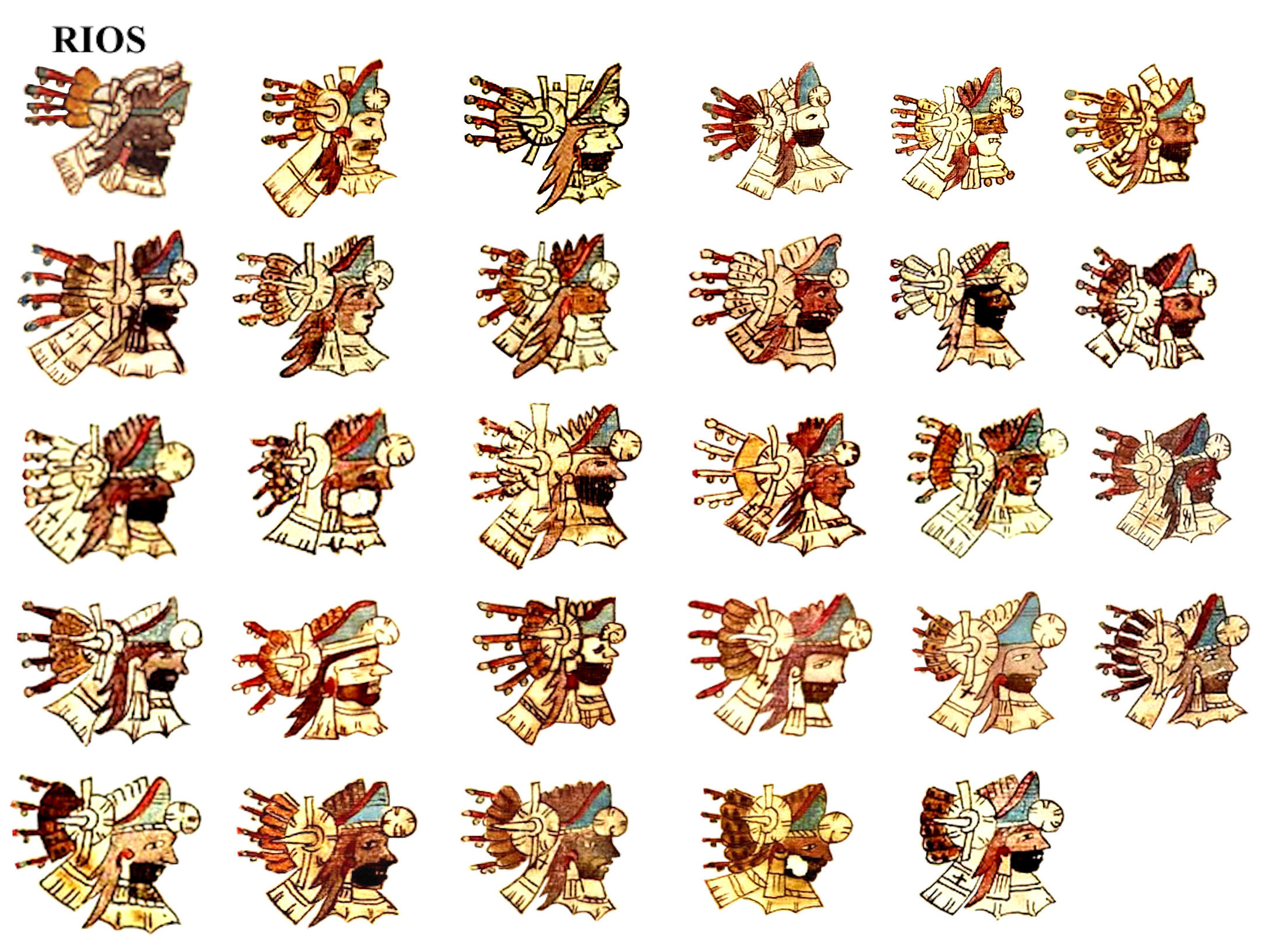
On the other hand, the artist(s) of the Codex Rios copy did not have a standard physiognomy for Mictlantecuhtli. Even standard formats in Rios tend to vary widely in execution and detail. As well, the artist(s) had to squeeze the day- and deity-images to accommodate notes (in Italian) naming the days and good, bad, or indifferent luck. With mostly consistent traditional ornamentation, the faces of Death in Rios are strongly individual:

Faces of the Lord of Mictlan (Codex Rios)

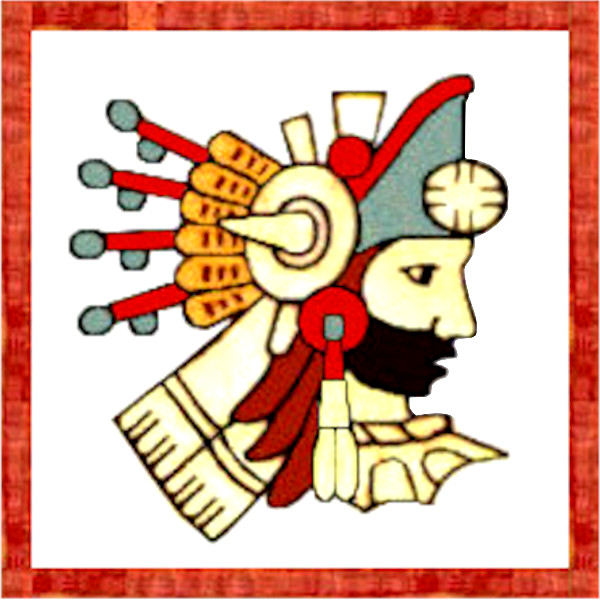
In my re-creation of the Rios tonalamatl, I won’t render all the variant images of the deities but will repeat an established portrait of each one using the modern magic of copying. I cherry-picked among the above 29 images to choose my favorite details and distilled them down to this interpretation of Mictlantecuhtli, the face of Death.

Lord of Mictlan

When I peered through Aztec art and discovered this evocative human face, I fell in love with lovely Death. Now I can look this beautiful Lord in the eye and happily know he awaits. I plan on making him wait for a great long while, but when he beckons, it will be good to fall into his arms.

#

Aztec Lords of the Night

In Codices Borgia and Vaticanus, the 13-day ceremonial week (trecena) is laid out in a complex day-count (tonalpohualli) with a panel presenting its divine ruler(s) or patron(s). In Codex Borbonicus and Tonalamatl Aubin, both the Lords of the Day (with their totem birds) and Lords of the Night are included but aren’t very easy to differentiate/identify. In its spreadsheet-format calendar, Codex Cospi also inserts the Lords of the Night in equally sketchy heads and symbols.

Meanwhile, Codices Telleriano-Remensis and Rios (an Italian copy of the former) accompany the trecena day-counts with the nine Lords of the Night. They appear in a super-cycle sequence that takes several 260-day ceremonial years (calendar rounds) to complete. In that sequence, each one presides over the whole night, and in the same sequence, one presides over each of the nine hours of the night. (Point of curious information: The Aztecs counted 13 daylight hours and 9 hours of darkness, so the actual length of an hour varied proportionately and by season.)

In the T-R and Rios codices, the Night Lords are sloppily drawn, even slap-dash, though with consistent, if careless, motifs. I’ve chosen to refine their iconographic images, giving them more realistic faces like in Codices Fejervary-Mayer and/or Laud:

1st Lord—Xiuhtecuhtli—Lord of the Turquoise/Fire. The peaked headdress and red ribbon are standard emblems of this deity who represents the center of time and space.

2nd Lord—Itztli—Obsidian (Knife). I don’t know what the standard black markings on his face might signify, but those things in his “hat” are sacrificial knives.

3rd Lord—Pilzintecuhtli—Young Lord, God of the planet Mercury. He’s also a “sun-lord” as shown by the sun in his headdress.

4th Lord—Centeotl—God of Maize. Check out the indicative cobs of maize in his headdress.

5th Lord—Mictlantecuhtli—Lord of the Land of the Dead. This human image is most unusual for a face of death; usually he’s a skull on a skeleton. (See my Icon #10.)

6th Lord—Chalchiuhtlicue—Jade Skirt, Goddess of Flowing Water. (See my Icon #2.) Females could also be Lords since tecuhtli actually means more like “ruler.” (She may be the ancestral Great Goddess from ancient Teotihuacan.)

7th Lord—Tlazolteotl—Goddess of Filth (literally). Her mouth is black from eating people’s filth/sins. In her headdress are spindles of spun cotton and tassels of unspun, showing that she’s also the goddess of weaving.

8th Lord—Tepeyollotl—Heart of the Mountain, God of Caves/Volcanos/Earthquakes and Jaguar of the Night. I can’t explain his tri-color face in these calendars. (See my Icon #17.)

9th Lord—Tlaloc—God of Storms. His goggle-eyed, long-toothed visage is emblematic in most codex contexts. (See my Icon #20.)

For the 2nd Lord of the Night, some sources name Tezcatlipoca, the Smoking Mirror (See my Icon #19) in place of Itztli, but that’s based solely on his image on the Night Lord page in Codex Borgia (p. 14) showing them in full figure. In fact, Itztli is a principal nagual (manifestation) of the “Black One,” who’s supposedly invisible. The Borgia figure has a sacrificial knife as one of his feet, so it clearly intends to be Itztli.

#

Recently my knowledgeable Mayanist friend mentioned that the unusual 52-count of solar years (“Aztec Century”) in Codex Borbonicus accompanies each year with a Night Lord, though in a strange sequence/cycle unlike that for the day-count, and he explained the basis for it. I’d never paid that year-count much attention, and his explanation was an eye-opener. The 52- count of solar years (not of 260-day ceremonial years!) in that codex appears on two pages (pp. 21 & 22), each with 26 years in their ritual count in a system related to the day-count.

Four of the days in the 20-day month of the solar calendar are (for very complicated, but comprehensible reasons) are chosen as “year-bearers:” Rabbit, Reed, Flint, and House. In that order, they’re counted in cycles of 13, i.e. One Rabbit, Two Reed, Three Flint, Four House, Five Rabbit, Six Reed, etc. Like the trecena process in the ceremonial day-count, this produces four trecenas of years, which I call “trecades.”

Curiously, the century cycle is structured just like a cross-counted deck of playing cards with Rabbit = Clubs, Reed = Diamonds, Flint = Hearts (appropriately), and House = Spades. In this correspondence, the numbers work as well: 1 = Ace, 11 = Jack, 12 = Queen, and 13=King. By the way, in the following image of the first half of the cycle, the central panel portrays the goddess of the night Oxomoco (on the left, strewing stars like seeds) and the god of the day Cipactonal (on the right, burning incense).

First Half of the Aztec “Century” Count, Codex Borbonicus, p. 21

This first page of the count lays out the One Rabbit and One Reed sequences, each with a Night Lord as principle divine patron of that year:

Clockwise from lower left
One Rabbit—Mictlantecuhtli
Two Reed—Piltzintecuhtli
Three Flint—Tlaloc
Four House—Tlazolteotl
Five Rabbit—Centeotl
Six Reed—Xiuhtecuhtli
Seven Flint—Tepeyollotl
Eight House—Mictlantecuhtli
Nine Rabbit—Piltzintecuhtli
Ten Reed—Tlaloc
Eleven Flint—Chalchiuhtlicue
Twelve House—Centeotl
Thirteen Rabbit—Xiuhtecuhtli

Clockwise from upper right
One Reed—Tepeyollotl
Two Flint—Mictlantecuhtli
Three House—Piltzintecuhtli
Four Rabbit—Tlaloc
Five Reed—Chalchiuhtlicue
Six Flint—Centeotl
Seven House—Piltzintecuhtli
Eight Rabbit—Tepeyollotl
Nine Reed—Mictlantecuhtli
Ten Flint—Itztli
Eleven House—Tlaloc
Twelve Rabbit—Chalchiuhtlicue
Thirteen Reed—Centeotl

The little glyphs of these Night Lords are fairly consistent, though sometimes hard to recognize. Note the three stylized place symbols (for Seven Flint, One Reed, and Eight Rabbit), which represent a mountain with a heart emblem (i.e., Tepeyollotl, Heart of the Mountain). Also note that 10 Flint is accompanied by a stylized sacrificial knife (i.e., Itztli).

The busts of the other Lords are mostly recognizable by their regalia, except for confusing variations in the four differing instances of Pilzintecuhtli (Two Reed, Nine Rabbit, Three House, and Seven House) and the two of Xiuhtecuhtli (Six Reed and Thirteen Rabbit). Further confusion is caused by the fact that Xiuhtecuhtli in Six Reed and Pilzintecuhtli in Seven House are both singing/speaking. We just have to learn to live with these inconsistencies.

The second half of the count occurs on p. 22, presenting the One Flint and One House sequences, each year again with its patron Night Lord in an entirely different selection. You can make your own list of patrons. The system for assigning annual Night Lord patrons is another tie-in with the ceremonial day-count. Each year (like One Rabbit, Two Reed, etc.) is paired with the Night Lord for the corresponding numbered day in its trecena (Mictlantecuhtli, Pilzintecuhtli, etc.)

Because of the nine-cycle of Night Lords in the tonalpohualli and the 52 years in the century, the year patrons don’t work out evenly or in a logical pattern. Some appear 6 times, some 5. Of course, the nine-cycle also doesn’t quite fit in the tonalpohualli itself (260 / 9 = 28.89), and it can only accomplish a full cycle in 9 years (28.89 X 9 = 260). That means that the first ceremonial year ends with Tepeyollotl on Thirteen Flower, and the second year starts with Tlaloc on one Crocodile. The ninth year will finally end with Tlaloc on Thirteen Flower.

Consequently, the sequence of Night Lords from which the annual patrons are selected exists only in the first calendar round of the standard tonalpohualli. In the next eight rounds, the days all have different Lords of the Night as patrons. Does this mean that the years in the next eight centuries had different patrons too? Then the tenth century returns to the first distribution. This odd cycle means that the Aztecs may have counted a “nonennium” of 468 years (9 X 52 = 468), or perhaps the repeating tenth century constituted a true millennium of 520 years.

Perhaps they did—I’ve seen somewhere that they considered the previous four Suns/eras (Four Jaguar, Four Wind, Four Rain, and Four Water) to have lasted 520 years. In that case, since we don’t know exactly when the Fifth Sun (Four Earthquake) began, it probably ended officially at some point in the 16th or 17th Gregorian century.

I have no difficulty personally in construing the Fifth Sun as starting on or around 1000 CE during the Toltec dominance and ending in 1519 CE when the invaders obliterated the Aztec empire. If so, a Sixth Sun (which for obvious symbolic reasons I would choose to call Four Death) may have begun in 1520—to end in or around 2040 CE. In another 16 years, we may move into a Seventh Sun (which I would hopefully call Four Flower). Once again, we could be looking at a Mesoamerican cycle ending, this time as an Aztec prophecy.

###

More Aztec Whoopee

Here we go again! My informational art exhibit YE GODS! ICONS OF AZTEC DEITIES will show for the fourth time at NEW MEXICO HIGHLANDS UNIVERSITY in beautiful Las Vegas NM from September 30 to November 2, 2019 at BURRIS HALL GALLERY, 903 National Avenue.

In 2018 the first 15 icons showed at El Museo Cultural de Santa Fe and at Northern New Mexico College in Española, and in 2019, with the addition of #16 (TECCIZTECATL & METZTLI, Deities of the Moon), they were displayed at Santa Fe Community College. This iteration at NMHU will include another new icon, #17:  TEPEYOLLOTL, Heart of the Mountain, the god of caves, volcanoes, and a bunch of other neat stuff.

Currently working on the next icon for the coloring book, #18: XOCHIPILLI, Prince of Flowers, I’ve broken out of my alphabetical sequence to manifest the splendid deity that I consider my personal patron (appearing above in my website banner).  I’m also breaking several Aztec iconographic conventions for this one, not the least of which is running wild with floral motifs.  One of my favorite details is a tiny Aztec bee:

Aztec Bee

You’ll just have to wait a while to see the rest of this literally iconoclastic icon.

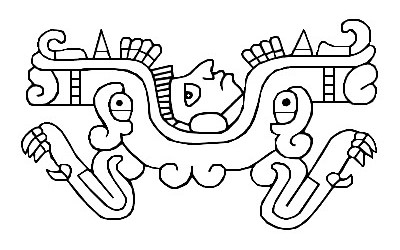
Along with the NMHU show, I’ll give a slide lecture on the Aztec Codices for their Art in the Americas class and a gallery talk for their Día de los Muertos celebration on November 1, just ahead of a concert to be directed by my music prof friend Andre Garcia-Nuthmann. Of course, Mictlantecuhtli, Lord of the Land of the Dead, will be featured, as will Tepeyollotl, Heart of the Mountain, who guards the entrance to Mictlan.  That dire place is always shown as the mouth of the monstrous, hermaphroditic Lord of the Earth, Tlaltecuhtli:

Entrance to Mictlan

Meanwhile efforts continue to line up more venues for the show, including other educational institutions around New Mexico. If anybody out there has hot ideas for presenters anywhere else, sic them on me!  I’ve been trying to interest places in surrounding states but so far have struck out.  (Read that as:  My approaches have been roundly ignored.)  I’d really love to hang the show at Mexico City’s National Museum of Anthropology, but I expect the materials should be translated into Spanish, actually not such a bad idea…

#

Aztec Icon #10 – MICTLANTECUHTLI, Lord of the Land of the Dead

Though there were times when I wondered if I’d ever finish this drawing, I’ve actually managed to complete the next icon in the series for the coloring book YE GODS!  THE AZTEC ICONS.

This icon of the Lord of Mictlan, the Land of the Dead, contains a lot more mythological narrative than even hinted in the caption.  Starting at the upper left and moving clockwise around the temple, dead persons enter Mictlan at the mouth of the Underworld.  Then the monstrous deity Xolotl serves as their guide (psychopomp), and the dog Itzcuintli is their companion through Mictlan, where they must climb eight hills and cross nine rivers (in four days).  The realm of Mictlantecuhtli is an empty place of darkness, dust, and vermin/vile insects (centipedes and scorpions among others), but that’s where most people had to go after death.  I wonder why they ever bothered to struggle over all those hills and rivers just to get to a nowhere like that.

Meanwhile, in the center of the lower register the wind deity Ehecatl (nagual of Quetzalcoatl) negotiates with the Lady of the Land of the Dead, Mictlancihuatl, for the bones from the Fourth Sun (Four Water).  He then breathes life into those bones to create the people for the current Fifth Sun (Four Earthquake).

(You can still see or download the previous nine icons by clicking on them in the list on the page for the coloring book.)

ICON #10: MICTLANTECUHTLI

(Lord of the Land of the Dead)

To download this icon as a pdf file with a page of caption and model images from the Aztec Codices, right click here and select “Save Target (or Link) As.”  You can also download it in freely sizable vector drawings from the coloring book page.

Mictlantecuhtli, Lord of the Land of the Dead

Mictlantecuhtli, Lord of the Land of the Dead

MICTLANTECUHTLI {meek-tłan-te-kooh-tłee} is the most prominent of several deities of death, 5th lord of the night, and 6th lord of the day.  His worship reputedly involved ritual cannibalism.  (Counter-intuitively, skulls and skeletons were symbols of fertility, health, and abundance.) His wife is Mictlancihuatl.  Only souls who died normal deaths went to the Land of the Dead, Mictlan; souls of heroes, warriors, sacrificial victims, or who die in childbirth joined TONATIUH in the Fourth Heaven, and those who drown went to TLALOC’s Eighth Heaven, the paradisiacal Tlalocan.