Though there was no hierarchy amongst the several powerful Aztec goddesses, the oldest and most widely respected female deity was Chalchiuhtlicue, the Jade Skirt. She represented the benefits of flowing water as well as its ruthless power. In other contexts, she embodied the feminine phenomena of child-bearing and motherhood.
The Jade Skirt was frequently depicted in the codices as shown in the latest gallery The Aztec Goddess of Water.
With this posting, I’m starting a series of blogs on galleries of (variously repaired, refurbished, and redrawn) images of Aztec deities. My purpose is to present an overview of each divinity as envisioned by the original scribe/artists. Collected from the few original manuscripts (codices) that survived the book burnings in the Spanish conquest, I hope these dramatic images will provide the modern viewer with vivid mental pictures of the ancient religion/mythology.
There has been much recent work in reconstructing and reinterpreting the Aztec gods and goddesses, but most of it has been in terms of romanticized, politicized, fantasized, and “psychedelicized” treatments. My repairs, refurbishing, and redrawing attempt to re-vision these deities as originally created by the scribe/artists and illuminate the mysterious ancient rituals and iconographic conventions.
Let me begin with a group of “calendric” deities called the Lords of Five. For the Aztecs, the number five symbolized sufficiency, like the five fingers on a hand, and anything more was excessive. (The numeral five was written by five dots in a row.) Excess was perceived as a danger, and punishment was a natural consequence. The Lords of Five were also called the Ahuiateteo, deities embodying all types of pleasure (physical and mental), who also were charged with punishing excessive indulgence, frequently with illness or bad luck.
Click HERE to view/download the illustrated .pdf file called The Aztec Ahuiateteo. Envision…
Completing projects, I generally try to take a brief armchair vacation and then switch gears to address others waiting their turn. For instance, when I wrapped up my four-year Tonalamatl recreation last summer, I diddled for a week or so in the garden and then resumed my senile reminiscing for KID STUFF. With that fun analysis of my innocent childhood done, I took a week or so of restorative naps and lazy lying about.
Re-energized, I’ve moved on to a much-needed revision of my illustrated encyclopedia of Aztec deities called YE GODS! The Aztec Pantheon. The first edition from ten years ago is still available and frequently downloaded as a comprehensive reference, but I’m rather abashed by its limited scope and frequent errors and omissions. I pulled it together way back then in the early research for my coloring book YE GODS! Icons of Aztec Deities.
My vast stock of information on and images of the many Aztec gods and goddesses will provide galleries of authentic images of Aztec deities from the several surviving codices (manuscripts) for folks to form meaningful mental images of the strange gods and goddesses. This revision will probably take a considerable period of time, and I’ll be issuing the galleries with encyclopedic comments individually in blog posts. Look for the first posting shortly to be called The Aztec Lords of Five.
Meanwhile, as mental health breaks from these fits of Aztec mythology, I’d once planned more memoirs to fill in some blank periods of my relative youth, but I don’t think I ought to spend my few remaining years in such self-centered attention. Instead, I’ve decided to turn to historical fiction, a project long inspired by a fascinating old book by the notorious Immanuel Velikovsky. The chapters of this future novel, I plan to alternate with Aztec encyclopedic entries.
If and when I finish the Pantheon revision, I’ll start drawing icons for my coloring book again. Several important and dramatic deities remain to be envisioned ceremonially like Tlazolteotl, Xochiquetzal, Xolotl, Xiuhtecuhtli, etc. When I’ve multi-tasked through this aggressive agenda—should I live so long—we’ll see what comes next. Should there indeed be a future…
The twentieth and final trecena (13-day “week”) of the Aztec Tonalpohualli (ceremonial count of days) is called Rabbit for its first numbered day, which is the 8th day of the veintena (20-day “month”). In Nahuatl, Rabbit is Tochtli. It was known as Lamat(Venus, Star) in Yucatec Maya, and K’anil (or Q’anil) (Seed of Life) in Quiché Maya.
The day Rabbit signifies self-sacrifice and service to something greater than oneself. Counter-intuitively, Rabbits were seen as gods of drunkenness, the Centzon Totochtin (400 rabbits) being patrons of all kinds of intoxication or inebriation. The principle rabbit deity was 2 Rabbit (Ome Tochtli or Tepoztecatl). The Aztecs counted “rabbits” for intoxication levels, from 25 rabbits for mild intoxication to 400 rabbits for complete drunkenness. Vessels for the drinking alcoholic pulque often bear rabbit symbolism and/or a crescent moon symbol called the yacametztli—relating to the goddess of the moon Metztli. In fact, Mesoamerican cultures envisioned the figure of a rabbit in the moon, which I’ve surmised was day-named 12 Rabbit.
The patron of the day Rabbit is Mayauel, the goddess of intoxication/pulque and its source, the maguey plant. Seen previously as patron of the Grass Trecena, she’s the purported mother of the Centzon Totochtin, apparently by the deity Patecatl, god of medicine and pharmaceutical intoxication. Other sources suggest that the Cloud Serpent, Mixcoatl, sired some of them, but Aztec paternity wasn’t thoroughly documented, and Mayauel was a hospitable goddess.
PATRON DEITIES RULING THE RABBIT TRECENA
One of the patrons of the Rabbit trecena is Xiuhtecuhtli (Lord of Fire and Time), whom we’ve seen in the Snake trecena. As god of the Center and the Pole Star, he’s an A-list celebrity deity. The other is variously Itztapaltotec, Stone Slab Lord, or Xipe Totec, Lord of Renewal and Liberation. The first is a nagual (manifestation) of the second and deifies the sacrificial knife.
AUGURIES OF THE RABBIT TRECENA
By Marguerite Paquin, author of “Manual for the Soul: A Guide to the Energies of Life: How Sacred Mesoamerican Calendrics Reveal Patterns of Destiny” https://whitepuppress.ca/manual-for-the-soul/
Theme: Leadership and Renewal. During this final trecena in the 260-day cycle, the emphasis is on completion and “cutting away” what is no longer needed, in order to facilitate new growth. This can be an intense period, as combat in some areas could intensify, leading to important conclusions, as the stage is being set for new beginnings to follow in the next trecena. During this period signs or signals may appear that could indicate what lies ahead or new potentialities. This is a good time to watch for signs of change and growth, and a good time to make important decisions in preparation for the new cycle about to begin.
Further to how these energies connect with world events, see the Maya Count of Days Horoscope blog at whitepuppress.ca/horoscope/ Look for the Lamat trecena.
THE 13 NUMBERED DAYS IN THE RABBIT TRECENA
The Aztec Tonalpohualli, like the ancestral Maya calendar, is counted through the sequence of 20 named days of the agricultural “month” (veintena), of which there are 18 in the solar year. Starting with 1 Rabbit, it continues with: 2 Water, 3 Dog, 4 Monkey, 5 Grass, 6 Reed, 7 Jaguar, 8 Eagle, 9 Vulture, 10 Earthquake, 11 Flint, 12 Rain, and ultimately 13 Flower.
There are a few special days in the Rabbit trecena:
One Rabbit (in Nahuatl Ce Tochtli) – a date in the mythic Aztec past when the cosmos was created by gods; also, one of Xiuhtecuhtli’s calendric names.
Five Grass (in Nahuatl Macuil Malinalli) – one of the five male Ahuiateteo/Macuiltonaleque (Lords of the Number 5), usually paired with the female Cihuateotl One Eagle.
Thirteen Flower (in Nahuatl Mahtlactli ihuan yeyi) – a ritually significant day of completion for the 260-day cycle; also associated with period endings, often marking the completion of significant “bundles” of time.
THE TONALAMATL (BOOK OF DAYS)
Several of the surviving so-called Aztec codices (some originating from other cultures like the Mixtec) have Tonalamatl sections laying out the trecenas of the Tonalpohualli on separate pages. In Codex Borbonicus and Tonalamatl Aubin, the first two pages are missing; Codex Telleriano-Remensis and Codex Rios are each lacking various pages (fortunately not the same ones); and in Codex Borgia and Codex Vaticanus all 20 pages are extant. (The Tonalpohualli is also presented in a spread-sheet fashion in Codex Borgia, Codex Vaticanus, and Codex Cospi, but that format apparently serves other purposes.)
TONALAMATL BALTHAZAR
As described in my earlier blog The Aztec Calendar – My Obsession, some thirty-five years ago—on the basis of very limited ethnographic information and iconographic models —I created my own version of a Tonalamatl, publishing it in 1993 as Celebrate Native America!
When I started drawing my tonalamatl, I did the pages in colored pencil, often producing several versions in different color schemes in a palette of four chromatic colors (with some black and white as well): gold—for gods, red—for blood, green—for jade, and blue for turquoise. Each deity had a primary color with a secondary and highlights of the others. For the last trecena, I used models and motifs from Codex Nutall and tried to make it an even balance of all four colors. Maybe I succeeded because everyone admired this image especially.
On the first nineteen trecenas, I followed the limited information available about their patrons (not knowing all of them). Many I created from scratch from Nutall images and sketchy clues on iconography. A few were based on images from Codex Borbonicus found in old books. When I got to the last one, Rabbit, the scholarship said only that its patron was the sacrificial knife, and I found only one gruesome image, probably the monster from Tonalamatl Aubin. (See below.) As an artist, I was aesthetically and philosophically offended and decided to turn heretic.
I installed my own choice of a god as patron of the last trecena, someone considerably more appetizing. Xochipilli, the Flower Prince, is god of art, dance, beauty, ecstasy, sleep, and dreams/hallucinations. In addition, he’s variously patron of homosexuals and male prostitutes; god of fertility (agricultural produce and gardens); patron of writing, painting, and song; and god of games (including the sacred ball-game tlachtli), feasting, and frivolity. His twin sister/wife is Xochiquetzal, patron of the preceding Eagle trecena.
So much for authenticity. The neglected Flower Prince is an eminently worthy “calendar prince.” (You can see the true trecena patrons in the tonalamatls of the historical codices that follow.)
The page for the Rabbit trecena from Codex Borgia, which I hadn’t seen thirty-five years ago, portrays its orthodox patrons in typically ornate style. Xiuhtecuhtli on the left is loaded down with divine regalia, some of it the same as in his image with the Snake trecena, and in similar coloration. The only truly emblematic piece is his square pectoral, apparently a heavily stylized war-butterfly motif inherited from the ancient Maya. I find his headdress curious in reflecting that of Ixtlilton in the preceding Eagle trecena. Maybe the artist enjoyed drawing those motifs.
On the right side, we have one of the more spectacular images of Xipe Totec illustrating his traditional red and white ornaments and staff. It’s in a much different style than his image as patron of the Dog trecena, sharing only the unique nose-clamp. In this Borgia portrait, he’s definitely the “flayed god,” like a priest in the skin of a sacrificial victim.
If I’d known about this panel, I might have avoided heresy by making Xipe Totec the patron of my Rabbit trecena, but I’d already used him for Dog and wouldn’t have wanted to repeat patrons anyway. The same argument holds for Xiuhtecuhtli already having appeared in Snake. In any case, while perhaps not as eye-catching as Chalchiuhtotolin in the Water trecena, Borgia’s two lords for the final Rabbit trecena are about as stylistically exquisite as its deities get.
#
TONALAMATL YOAL (compiled and re-created by Richard Balthazar on the basis of Codex Telleriano-Remensis and Codex Rios)
Aztec Calendar – Rabbit Trecena – Tonalamatl Yoal
Here we see on the left the ominously named Itztapaltotec, Stone Slab Lord, himself, the sacrificial knife that grossed me out. This one looks like a guy in a flint knife (tecpatl) costume with flayed arms hanging from his own like an appropriately nagual hybrid of Xipe Totec. He holds an emblematic red and white staff, but I can’t fathom the conch shell in his other left hand.
On the right side sits Xiuhtecuhtli more or less enthroned, which is the first remarkable detail. Almost all the Yoal deities are either standing (like Itztapaltotec) or in what I call the “dancing” pose with bent knees. Only the Cihuateotl in the Flower trecena and Xochiquetzal in the Eagle trecena sit back on their feet, standard female posture, (especially in Codex Nutall where males sit cross-legged.) Adding to this iconographic weirdness, note that Xiuhtecuhtli’s right leg and foot are hidden by the left—an absolutely ideoplastic device.
Above and beyond that odd detail, the Lord of Fire is decked out in opulent finery. Check out that wild serpent/crocodile head by his ear, possibly a plug ornament. His extravagant array of Quetzal plumes splays more feathers than even Xochiquetzal in the Eagle trecena, and between him and Stone Slab they wear more than in any other Yoal patron panel. The artist may have overdone the plumage because in his tailpiece and bustle the feathers had to overlap—a definite problem for Aztec iconography. One of the plumes in the back-fan even droops behind another!
Passing by his war-butterfly pendant, we see in his lower right hand what looks surreally like a rattlesnake with an animal head. It’s in fact a ritual “shaman stick.” More usually it’s called a “deer stick,” though many don’t look at all like a deer’s head. Plain ones were often used for digging, but the rattles on this one were probably there to make magical noises.
In the original, the scepter in the god’s other right hand was terribly drawn and unrecognizable, and I substituted the finer Xiuhcoatl (fire-serpent) he holds in the Snake trecena. The strange position of his fingers—as though holding on to a ring—is an exact duplication of that detail in his Borgia icon. There I simply wondered about it, but seeing it again here, I begin to suspect that there’s some symbolic importance attached to it. I guess we’ll never know.
Moving on to the divine face, I confess to doing radical plastic surgery on the original which looked insanely like the cartoon character Homer Simpson. That simply wouldn’t do! Then I borrowed the face-painting pattern again from his image in Snake. The result was a respectable deity worthy of his portentous headdress (like that worn by him and Mictlantecuhtli in the upper row as lords of the night). According to Gordon Whittaker in “Deciphering Aztec Hieroglyphs,” that turquoise diadem with curved point in front is literally a hieroglyph for “Lord” or “ruler.” Whittaker adds that the Nahuatl word is teykw-tli pronounced in two syllables if you can wrap your tongue around that. Colloquially, that’s te-cuh-tli, as in Xiuhtecuhtli (fire/turquoise-lord).
As with Tonalamatl Borgia, Tonalamatl Yoal went all out on the patrons of the Rabbit trecena, lavishing them with divine detail. The tonalamatl presents many elegant figures, but in my opinion, only the panel for the Vulture trecena (Evening Star and Setting Sun) can compare to this ornate, many-plumed pair. The inspirations behind the Yoal trecena pages are superbly artistic visions of glorious mythological beings.
The twenty striking patron pairs in the Yoal tonalamatl encapsulate the traditional iconography of those Aztec deities. Having worked closely with the original codex images to re-create their conceptual inspirations, I can say that the later images in the series became progressively more awkward and crude, their construction often downright ramshackle. This suggests to me that other artists may have taken over some panels—or maybe the artist simply slacked off in his work—or equally probable, the artist got drunk or stoned.
In my careful estimation however, the Yoal artist(s)’s concept and vision of the trecena patrons were nevertheless sublime. Sadly, they just lacked the means, skill, medium, and (possibly) the reverence needed to manifest their deities magnificently. I’m thrilled to have turned those flawed visions into the Tonalamatl Yoal, a new treasure in the canon of Aztec art.
#
OTHER TONALAMATLS
Tonalamatl Aubin patron panel for Rabbit Trecena
The only thing that identifies Xiuhtecuhtli in the Tonalamatl Aubin patron panel is his black face-paint. The generic circular pendant could belong to many deities. On the other hand, the figure on the left is clearly Itztapaltotec, a frighteningly personified sacrificial knife with a surreal face on his shoulder. The item at top center is a hearth-vessel with smoke, fire and possibly incense, but I won’t attempt to identify the other elements.
This patron panel and that for the Water trecena (with Chalchiuhtotolin) are the two most disappointing instances in the Tonalamatl Aubin. Most of the other panels are passingly ornate, while often awkward and distorted. In my humble opinion, this tonalamatl is the least impressive of the several we have seen. It was painted pre-Conquest in the neighboring state of Tlaxcala and as such may represent a crude, provincial document. Its value for scholarship is that it represents the shared themes and motifs across the “religious” territory of central Mexico.
#
Codex Borbonicus patron panel for Rabbit Trecena
The panel for this last trecena in Codex Borbonicus is artfully done, supplying the figure of Xiuhtecuhtli that I used as a model in the earlier Snake Trecena in my old tonalamatl. Oddly, I don’t believe I saw this decorative image of Itztapaltotec way back then. I was so taken my Xochipilli apostasy that I probably would’ve ignored the fancy fellow anyway. Though some of the surviving panels in Borbonicus present stunning figures (like Itztlacoliuhqui in the Lizard Trecena), this beautiful pairing of patrons has to be the most impactful composition of the lot.
The patrons’ emblematic paraphernalia is easily recognizable, as are many of the items in the neatly organized conglom. I’m intrigued by the bottom center item resembling a hill or mountain place-symbol with tooth-like appendages (which Whittaker has identified as hieroglyphs meaning “at”) and part of its vegetative detail in utter disarray. Most notable is the curved “deer-stick” hovering over Itztapaltotec’s flint knife, simpler than that in the Yoal panel, but scarcely more deer-like. This one is probably a common digging stick but might still be magical.
Combining these patron panels with a crowded matrix of delicately drawn days, 9 night-lords, and 13 day-lords with their totem-birds, the tonalamatl in Codex Borbonicus stands in my modest opinion as a consummate masterpiece of Aztec art and culture.
#
Codex Vaticanus patron panel for Rabbit Trecena
In Codex Vaticanus, the patron pair for the Rabbit Trecena again is well balanced, as in the other tonalamatls, to formally wrap up the last of the trecenas. In its characteristic rough caricature style, Vaticanus again closely follows the images and themes of Tonalamatl Borgia, Xipe Totec and Xiuhtecuhtli simply having switched sides. In its series of trecena panels, Vaticanus faithfully reflects the calendrical “dogma” in the more ornamental Borgia panels. The codices share certain other sections, but each also presents a lot of its own mythological material. Perhaps the calendrical orthodoxy can be explained by both codices having come from Puebla, possibly from the same priestly school (calmecac).
But the tonalamatl in Codex Vaticanus does more than simply restate the Borgia images. In particular, it created that uniquely surreal vision of Itzpapalotl for the House Trecena and produced its own exquisite versions of deities like Chalchiuhtotolin and Xolotl for the Water and Vulture trecenas. In addition, in its other sections, Vaticanus presents incomparably elegant artwork on deities like Tlaloc and Tlahuizcalpantecuhtli. The codex is a veritable goldmine of mythological and ethnological details. One just has to get used to its stylistic strangeness, like the blue finger- and toe-nails.
#
Tonalamatl Borgia is my proudest achievement in this series of re-created Aztec art. Like the Vaticanus version of the trecenas, it’s set amongst several other ritual and religious sections of the codex, many of stupendous artistry. Though several other historical codices are also iconographically superlative, like Fejervary-Mayer and Laud, to my mind, Codex Borgia is the premiere artistic relic of pre-Columbian Mesoamerica.
Unfortunately, over five centuries the document has seriously deteriorated with whole sections of images worn away, the colors of its inks fading and failing, and some pages torn or even burned. Mostly, what we can see nowadays of Codex Borgia (and many other codices) is from the incredible facsimile editions of Joseph Florimond Loubat (1837-1921), an American bibliophile. He faithfully reproduced the Aztec documents in their exact conditions at the end of the nineteenth century, which meant that any earlier deterioration was also reproduced. In 1993 a full-color restoration of the Codex Borgia was published by Giselle Díaz & Alan Rodgers, restoring most dilapidated areas and repairing lost coloration in facsimile fashion.
My re-creations of Tonalamatl Borgia have played somewhat more freely with its colors. I’ve interpreted various shades of greys, browns, and golds in the Loubat facsimiles as deteriorated original blues and greens and in a few instances introduced colors not available to the Aztec artists (like the purples with Chalchiuhtotolin in the Water Trecena). My purpose was to present the deities in authentic but new, vibrant images untouched by the passing centuries.
A curious feature of the Tonalamatl Borgia is that some of its decorative patron panels seem to suggest an underlying narrative, in particular that for the Snake Trecena. Other panels include mysterious and beautiful symbolic items (though not as many as in Codex Borbonicus), and a number of the Borgia deities, like Chalchiuhtlicue in the Reed Trecena and Tlaloc in the Rain Trecena, are perfectly monumental. In summation, I believe that this Tonalamatl Borgia deserves a place of honor amongst the world’s very best religious art.
#
AFTERWORD by Marguerite Paquin, PhD.
I would like to express my deepest thanks to Richard for his extremely valuable contributions to my Maya Count of Days Horoscope blog. This began in early December of 2019, when he allowed me to use his Tonalamatl Balthazar image for the Chikchan trecena as an illustration for the blog. (https://whitepuppress.ca/the-chikchan-lifeforce-trecena-dec-10-22-2019/) The evolution of imagery continued from there as he developed and refined his work.
After the inclusion of one full cycle of his Tonalamatl Balthazar, I began including his early renditions of the Codex Borgia in the blog. At first the images were somewhat sketchy (but valuable nonetheless) but over the years he kept refining them, and the full set is now gorgeously complete. I am blessed to have them available for my blog, as they allow my readers to see at a glance the nature of the energies that I discuss every 13 days.
When Richard began adding descriptions of his work (regarding the evolution of the images, and the detailing that was included) in his own site, this added yet another layer of interest. I am extremely appreciative of Richard’s talent, research, formidable attention to detail, and generosity in this regard, and have no doubt that the ancients who devised these images in the first place would be proud. Muchas gracias, Richard!
###
You can view all the calendar pages from the Balthazar, Borgia, and Yoal Tonalamatls in the Tonalamatl gallery.
The eighteenth trecena (13-day “week”) of the Aztec Tonalpohualli (ceremonial count of days) is called Wind for its first numbered day, which is the 2nd day of the veintena (20-day “month”). In Nahuatl, Wind is Ehecatl. It was known as Ik’ (Wind, Breath, Spirit) in Yucatec Maya, and Iq’ (Strong Wind) in Quiché Maya. The patron of the day Wind is Quetzalcoatl (See Icon #14), also patron of the Jaguar Trecena, and the eponymous wind deity Ehecatl (See Icon #5), the Breath of Life and spirit of the Tree of Life itself, is his principal nagual (manifestation).
PATRON DEITY RULING THE WIND TRECENA
Chantico, the Lady of the House (See Icon #4), is the goddess of fire (both in the home/hearth and in the earth), representing the feminine side of life (cooking, eating, and domesticity), the waters of birth, the fire of spirit, fertility and self-sacrifice. Her consort is variously seen as Xiuhtecuhtli, Lord of Fire and patron of the Snake Trecena, or as Tepeyollotl, Heart of the Mountain, the god of volcanoes (See Icon #17) and a patron of the Deer Trecena.
AUGURIES OF THE WIND TRECENA
By Marguerite Paquin, author of “Manual for the Soul: A Guide to the Energies of Life: How Sacred Mesoamerican Calendrics Reveal Patterns of Destiny” https://whitepuppress.ca/manual-for-the-soul/
Theme: Inspiration, Communication, Necromancy. Traditionally associated with the magical arts, this trecena was used by diviners to select propitious days on which to perform rituals. As Ehecatl represents the divine wind of the spirit, this energy is associated with life, breath, inspiration, and communication, but it can also conjure up storms and bring great change. Under the influence of Chantico, goddess of fire, the Wind trecena can often breathe new life into ideas, and inspire activities aligned with heart-felt communication and the provision of comfort. Use of the magical arts during this period could also help to bring nourishment for the spirit.
Further to how these energies connect with world events, see the Maya Count of Days Horoscope blog at whitepuppress.ca/horoscope/ Look for the Ik’ trecena.
THE 13 NUMBERED DAYS IN THE WIND TRECENA
The Aztec Tonalpohualli, like the ancestral Maya calendar, is counted through the sequence of 20 named days of the agricultural “month” (veintena), of which there are 18 in the solar year. Starting with 1 Wind, it continues the trecena with: 2 House, 3 Lizard, 4 Snake, 5 Death, 6 Deer, 7 Rabbit, 8 Water, 9 Dog, 10 Monkey, 11 Grass, 12 Reed, and 13 Jaguar.
There are two special days in the Wind trecena: One Wind (in Nahuatl Ce Ehecatl) -traditional day for offerings to be made to Quetzalcoatl. The day appropriately introduces a trecena devoted to sorcery and necromancy.
Nine Dog (in Nahuatl Chicnahui Itzcuintli) – the festival day of magicians, perhaps because the patron of the number Nine was the great Quetzalcoatl himself, and Dog (Xolotl) was a divine magician. Significantly, it is also the birth-day-name of Chantico, the trecena’s patron.
THE TONALAMATL (BOOK OF DAYS)
Several of the surviving so-called Aztec codices (some originating from other cultures like the Mixtec) have Tonalamatl sections laying out the trecenas of the Tonalpohualli on separate pages. In Codex Borbonicus and Tonalamatl Aubin, the first two pages are missing; Codex Telleriano-Remensis and Codex Rios are each lacking various pages (fortunately not the same ones); and in Codex Borgia and Codex Vaticanus all 20 pages are extant. (The Tonalpohualli is also presented in a spread-sheet fashion in Codex Borgia, Codex Vaticanus, and Codex Cospi, but that format apparently serves other purposes.)
TONALAMATL BALTHAZAR
As described in my earlier blog The Aztec Calendar – My Obsession, some thirty years ago—on the basis of very limited ethnographic information and iconographic models —I presumed to create my own version of a Tonalamatl, publishing it in 1993 as Celebrate Native America!
At the time, I didn’t know about Chantico’s importance as a volcano goddess, and my version of her is a quintessentially Codex Nuttall matron tending a stylized hearth-fire. I acknowledged her domestic role by including the weaving spindle—a detail far more appropriate for the goddess Tlazolteotl. The golden bird in her headdress is probably completely out of place, but her jaguar-pelt throne is perfectly appropriate for a goddess. In my Icon #4, I posed Chantico in an ornamental house (temple), which must have been aesthetically successful because that was the one icon banner stolen from the last venue of my YE GODS! show.
#
TONALAMATL BORGIA (re-created by Richard Balthazar from Codex Borgia)
Aztec Calendar – Wind Trecena -Tonalamatl Borgia
The Wind Trecena page in Codex Borgia shows Chantico, sometimes called the Lady of Jewels (Lady of Wealth) as ornately adorned with what may be numerous pearls, but there is little else to identify her. Her nose ornament is a little too generic to serve that purpose, and the enigmatic item (inverted pot?) under her throne doesn’t help either.
More to the point, the three ornate symbols in the center of the panel are glyphs illustrating Chantico’s realms of power. At the top center is a burning temple, metaphorical for fire in the earth (volcano), and in the center is the fire in a hearth/container, both with orangish and gray curlicues of flame and smoke. The large conch at bottom center is probably a reverent gesture or reference to Quetzalcoatl on his special day One Wind.
Much more puzzling than the upside-down pot is the emphatic image on the right side of the panel: an inverted person seemingly falling across a mat or piece of fabric, most definitely not dead—which falling headfirst usually signified—and holding bouquets of vegetation and brightly flowering penitential thorns. Not much to go on here for what this apparently important third of the patron panel might mean. The commentary by Bruce Byland in the Diaz & Rodgers restoration of Codex Borgia doesn’t devote even one syllable to this intriguing detail.
#
TONALAMATL YOAL (compiled and re-created by Richard Balthazar on the basis of Codex Telleriano-Remensis and Codex Rios)
Aztec Calendar – Wind Trecena – Tonalamatl Yoal
As usual, in its images of deities for the Wind Trecena, Codex Telleriano-Remensis (and consequently Codex Rios) didn’t skimp on displaying emblems, symbols, and traditional regalia, though the codex-artists didn’t always agree on details. The figures recreated here are based mostly on T/R images with occasional minutiae from Rios. Both figures, of course, had to undergo radical orthopedic surgery for iconographic anatomical awkwardness.
In any case, the paired images make a striking combination. Let’s come back later to the guy on the right and scope out the divine Chantico on the left. Would you look at that headdress! A dark-feathered and be-sea-shelled crest of quetzal plumes pours forth streams of fire and water, creating an elegant atl-tlachinolli (water-fire) glyph—as discussed in the Snake Trecena—usuallya symbol of war, but here I think it represents the waters of birth and fire of spirit, attributes of the goddess. Her facial markings and matching ear- and nose-pieces are unusual, but the most disturbing (and unique) detail is her set of Tlaloc-like fangs. How does one fit that sinister motif into Chantico’s official hagiography?
Now we can check out the guy on the right, a figure most unusually in a decorative frame. The little day-sign attached to the back of his head is One Reed—which was used in the Snake Trecena to identify Tlahuizcalpantecuhtli, a nagual of Quetzalcoatl. However, this seems to be Quetzalcoatl himself, probably in honor of his One Wind Festival. Strong evidence is the circular pendant, serpent accessories, black body, and tri-colored face. In fact, Quetzalcoatl was known as One Reed in central Mexico from the ancient Toltec tradition (and in more southerly areas with even older Maya traditions as Nine Wind).
The notations on the T/R and Rios pages (in Spanish and Italian) clearly name the guy Quetzalcoatl but only comment on the frame as his casa de oro. But there’s no way the little falling guy in Borgia can be construed as the great god Quetzalcoatl nor can that decorative mat compare to this deity’s golden house. Whatever Borgia meant by that strange scene may have been used by the T/R artist as an excuse to celebrate Quetzalcoatl as a star of the trecena.
#
OTHER TONALAMATLS
Tonalamatl Aubin patron panel for Wind trecena
The patron panel in Tonalamatl Aubin merely complicates the situation, presenting an upright little guy with bouquets and without any emblems of Quetzalcoatl—though now in a casa de oro. That motif may bode a deeper significance than even Borgia’s fancy mat. Thinking at first that Yoal’s One Reed glyph might in fact identify Tlahuizcalpantecuhtli, I wondered if maybe the casa de oro could represent the House of the Dawn. That motif also has a connection to Quetzalcoatl as the planet Venus, but I know of no connection between Chantico and dawn. The matter of the little guy remains mysterious.
The hearth fire at the top center is of course symbolic of Chantico, whose plumed headdress is similar to that worn by both figures in the Yoal panel. Her atl-tlachinolli glyph and skull-bustle are repeated here, but the conch over her head seems damaged. The big serpent under her throne must symbolize emphatic sexuality, but I can’t explain the pile of something or other pierced by penitential thorns. The central offering bowl seems rather pitiful, as do the grotesque hands and feet on both figures. Overall, this patron panel isn’t particularly inspiring.
#
Codex Borbonicus patron panel for Wind trecena
On the other hand, the patron panel from Codex Borbonicus is enchantingly ornate. It presents another casa de oro on the left with a common mortal who carries a standard bouquet/weapon and incense bag but again wears the Yoal-style plumed headdress. He does nothing to clarify the mystery. On the right, Chantico sports great bunches of quetzal plumes, another dramatic atl-tlachinolli glyph, and under her throne familiar plumed tassels with seashells. Her unusual sitting posture (hovering above instead of in front of the throne) may be intended to add to her ethereal/divine presence. That nose-clamp looks painful.
The scattered conglom of ritual items raises several questions. Starting in the upper left, what’s the significance of the day-sign One Crocodile (first day of the tonalpohualli)? Or of the standard-design rock/stone. No idea… Top center may be a glyphic hearth-fire. On the lower left seems to be an incense burner, but the leafy swatches beside it are inscrutable. The mounded item just above may be a metaphor for fire in the earth (volcano) and could relate to Aubin’s pile of something or other. But most iconic is the little frilled circle in the center with a star or divine eye in the middle. A traditional symbol of magic or sorcery, it’s the only reference in these patron panels to this trecena’s theme of necromancy.
#
Codex Vaticanus patron panel for Wind trecena
The patron panel from Codex Vaticanus again repeats the inventory of motifs from Borgia, including burning temple, hearth-fire, and conch. But it deepens the mystery of what the little guy represents. Here, he’s a blue figure (possibly a corpse?) in what looks like a box rather than on a mat or in a casa de oro. Still no answers… Apart from her fancy skirt, cape, and body-tattoos, Chantico is pretty plain. Her sitting with feet forward is most unusual, and the confusion of her arms detracts from any divine magnificence.
#
My ancient intuition about Chantico was apparently right on making her a normal, stylish woman. Appropriately, some patron panels give her dramatic emblems I didn’t know about like plumed headdress, fire-water glyph, and power symbols of hearth-fires and volcanoes. While her Borgia portrait is glamorous, her image in Yoal is more ornamental than most calendrical deities in that tonalamatl. Her pairing with the cameo of Quetzalcoatl makes one of the more exquisite Yoal panels, but we can’t take that to mean that he’s also a patron of the trecena. This guy One Reed seems more like a Master of Ceremonies for the magicians’ fiesta week. Maybe the strange little guys in the other tonalamatls are sorcerer-performers.
###
You can view all the calendar pages I’ve completed up to this point in the Tonalamatl gallery.
The seventeenth trecena (13-day “week”) of the Aztec Tonalpohualli (ceremonial count of days) is called Waterfor its first numbered day, which is coincidentally the 9th day of the veintena (20-day “month”). In Nahuatl, Water is Atl.It was known as Muluk (Water) in Yucatec Maya and Toj (Rain or “Thunderpain”) in Quiché Maya.
The Aztecs saw the day Water, typically shown as a container spilling water, as connected with the flow/passage through life and time as well as purification and the accumulation of resources and potentials. It’s associated anatomically with the back of the head/hair. The divine patron of the day is Xiuhtecuhtli, the Lord of Fire/Turquoise, who’s a patron of the Snake trecena.
PATRON DEITY RULING THE WATER TRECENA
Chalchiuhtotolin (see Icon #3), the Jade (or Jeweled) Turkey, is another nagual (manifestation) of Tezcatlipoca (see Lizard trecena). As the magnificent patron of his Jaguar Warriors of the Night and of military power and glory, it cleanses them of contamination, absolves them of guilt, and overcomes their fates. Appropriately it’s the patron of the day Flint, the sacrificial knife.
Though symbolic of sustenance and abundance, Chalchiuhtotolin is also associated with disease and pestilence, a creature of death and decay, regeneration and transformation. Chalchiuhtotolin is also linked to the earth’s fertility, agricultural cycles, and the natural order of life and death. Appeasing Chalchiuhtotolin was believed to ensure a smooth transition for the deceased into the afterlife and promote fertility and abundance in the earthly realm.
AUGURIES OF THE WATER TRECENA
By Marguerite Paquin, author of “Manual for the Soul: A Guide to the Energies of Life: How Sacred Mesoamerican Calendrics Reveal Patterns of Destiny” https://whitepuppress.ca/manual-for-the-soul/
Trecena theme: Generative Vitality, Purification. This life-giving time frame has a generative “firewater” aspect to its energy, representative of the original creation forces that sparked life itself. There is a strong sense of abundance associated with these forces, but these energies can also be “electrical” in the sense that they can “spark” important events, often associated with stimulation and cleansing. Like water itself, this period holds the potential to create pathways that can shape or change the world. This trecena has also been associated with omens.
Further to how these energies connect with world events, see the Maya Count of Days Horoscope blog at whitepuppress.ca/horoscope/ Look for the Muluk trecena.
THE 13 NUMBERED DAYS IN THE WATER TRECENA
The Aztec Tonalpohualli, like the ancestral Maya calendar, is counted through the sequence of 20 named days of the agricultural “month” (veintena), of which there are 18 in the solar year. Starting with 1 Water, it continues the trecena with: 2 Dog, 3 Monkey, 4 Grass, 5 Reed, 6 Jaguar, 7 Eagle, 8 Vulture, 9 Earthquake, 10 Flint, 11 Rain, 12 Flower, and 13 Crocodile.
There’s one special day in the Water trecena:
One Water (in Nahuatl Ce Atl) –the day-name of Chalchiuhtlicue, the Jade Skirt, the patron of the Reed trecena. In the Florentine Codex, it’s noted as a feast day for those involved in the water industries, but I can only speculate what those were.
THE TONALAMATL (BOOK OF DAYS)
Several of the surviving so-called Aztec codices (some originating from other cultures like the Mixtec) have Tonalamatl sections laying out the trecenas of the Tonalpohualli on separate pages. In Codex Borbonicus and Tonalamatl Aubin, the first two pages are missing; Codex Telleriano-Remensis and Codex Rios are each lacking various pages (fortunately not the same ones); and in Codex Borgia and Codex Vaticanus all 20 pages are extant. (The Tonalpohualli is also presented in a spread-sheet fashion in Codex Borgia, Codex Vaticanus, and Codex Cospi, but that format apparently serves other purposes.)
TONALAMATL BALTHAZAR
As described in my earlier blog The Aztec Calendar – My Obsession, some thirty years ago—on the basis of very limited ethnographic information and iconographic models —I presumed to create my own version of a Tonalamatl, publishing it in 1993 as Celebrate Native America!
Aztec Calendar – Water trecena – Tonalamatl Balthazar
Yet again, I knew nothing about traditional images of the Jade Turkey and simply played with a Nuttall-style guy in a turkey-suit, the dominant green color reflecting the “jade.” Only many years later did I discover true details of this deity’s mythology—and the unusual type of turkey it references. The following patron panels will explain a lot of little-known turkey-trivia.
#
TONALAMATL BORGIA (re-created by Richard Balthazar from Codex Borgia)
Aztec Calendar – Water trecena – Tonalamatl Borgia
Besides the “Jade Turkey,” Chalchiuhtotolin is also called the “Jeweled Turkey”—referring to Meleagris ocellata, an endangered species native to Yucatan, Belize, and Guatemala and named for “eyes” on its imposing fan of tail feathers. With stunning blue-to-purple-to-green plumage, this rara avis is a distant cry from the standard “Thanksgiving” turkey (Meleagris gallopavo).
Ocellated Turkey
Surely known personally to the Maya but likely only mythically in Mexico, this rare bird as patron of the Water trecena shows its ancient heritage. The peoples of Mexico found significant sustenance and abundance in its drabber but larger cousin, the Wild Turkey, ancestor of our even bigger domestic turkey. But they “idolized” a mythical jeweled fowl that could be called the “Turquoise Turkey” (Xiuhtotolin). Coincidentally and appropriately, that could also mean “Fire Turkey.” Since the bodies of ocellata were many shades of iridescent emerald-green, simply “Jade Turkey” is its best label.
The color palettes of codex artists included very few shades of blue which differed over time and area. The Maya had a famous blue of unknown source, and the Mexicans later achieved a generous blue like in Codex Borbonicus. In Codex Borgia, most intended blues have degraded into shades of grey (as have any hues of green into brownish-golds). Codex Laud and Codex Fejervary-Mayer use a dark greenish or slate tone for blues and/or greens, with other colors fairly vivid. In Vaticanus b (predominantly cochineal red and brownish gold), they managed some subdued blues and greens almost like highlights. But a true turquoise was way out of an artist’s reach, not to mention any shade of purple.
That made it essentially impossible to depict Chalchiuhtotolin in all its iridescence. The Jade Turkey mostly appears in codices with a red head and brownish feathers, like their common farmyard gobblers. But in Codex Borgia, the mythical bird has a stylized ocellated fantail (now become blacks and greys) and brownish-gold medallions for the glowing green on its breast.
I chose to color our divine bird naturalistically—i.e., just about as supernaturally as it gets, that turquoise head and purplish tail. I wonder about that suspicious ear on the back of its head. Turkeys don’t have ears like mammals. And what’s that big tassel-thing on its breast? Well, recently I learned about turkeys’ beards. When toms (and some hens) get on in years, they can grow a long spike of feathers straight out from their breasts. That ornament and a many-eyed fan makes a formidable fowl of military majesty, a great patron for the Jaguar Warriors of the Night.
Chalchiuhtotolin seriously dominates this patron panel, especially with all that stuff the deity is evidently exhaling. The upper curlicues we now know are grey smoke and orangish fire, which makes sense for a “Fire Turkey,” a fire-breathing warrior-bird, but the curly thing caught in the disembodied claw sure doesn’t. Hanging right there in the center of the panel, it must be primally important, maybe a hieroglyphic message or utterance by the deity. Or it may be simply an abstraction for the wide range of calls, cackles, and gobbles that turkeys make.
Meanwhile, the surreal item on the right invites more interpretation. No doubt, it involves two spotted serpent tails encircling a body of water. However, the snakes’ heads lift up between knobbed sides like spouts of water (with eyes and mouths!) and top off with big flowers. The motif of a snake containing a volume of water is also seen in ancient Maya iconography—and this is after all, the Water trecena. Gathering and containing water, the essence of accumulation, provides the Jade Turkey’s abundance. So, here there be water-serpents.
Which raises a neat linguistic point: At a recent lecture, I learned that in Aztec iconography many of the images are actually hieroglyphs, pictorially and/or phonetically significant. For instance, a pot or jug with water splashing out of it can be read as a word in Nahuatl. The first syllable of their word for pot/jug/jar is co-,and their word for ‘water’ is atl. So, co-atl spells ‘snake.’ This item is in fact a decorative and emphatic hieroglyph for ‘water-serpent.’
This page for the Water trecena I consider perhaps the most glorious in the Tonalamatl Borgia, not only for its intended colors but for its surrealism. Even without the appended material and fancy water-serpent glyph, this image of Chalchiuhtotolin is inarguably the apotheosis of the turkey. (Worshipping it is a whole lot kinder—and respectful—than cooking it for dinner.)
#
TONALAMATL YOAL (compiled and re-created by Richard Balthazar on the basis of Codex Telleriano-Remensis and Codex Rios)
Aztec Calendar –Water trecena – Tonalamatl Yoal
This series of compiled trecena pages that I call Tonalamatl Yoal opts for a far less naturalistic image of an ocellata with the brown feathers and red head of the common gallopavo. However, there’s no clear reason for its yellow feet or the epaulets on its wings. The “jeweled” aspect of divine Chalchiuhtotolin is shown by the jade pendants on its plumage and probably the turquoise collar, but I can’t explain the apron of quetzal plumes that almost hides its jaguar-pelt “pants.” Those may indicate its nagual connection to Tezcatlipoca as does the variant smoking mirror in its headdress—a logical source of the flame and smoke seen before as the breath of the Borgia bird. Apart from the shape of the head, this heavily stylized portrayal of the deity doesn’t look much like a turkey, especially that tail, but it’s certainly an elegant fowl.
Instead of any water-serpent reference, on the right side is another figure of a human worshipper performing a ritual blood sacrifice like the guy in the Jaguar trecena. That one (with the same bound hairdo but no headdress) pierces his tongue with a pointed stick. This one jabs himself in the ear with a sharpened flowering shinbone—oddly emblematic of Quetzalcoatl, as are the two ornamental conch shells. The devout fellow also offers the deity a fancy incense bag.
Though it shares the stage here with a worshipper, Chalchiuhtotolin is clearly the sole patron of this Water trecena. As before with the tongue-piercer with Quetzalcoatl in the Jaguar trecena, this ear-stabber may merely indicate the preferred method of blood-sacrifice to the Jade Turkey. I haven’t studied the matter, but I suspect the Aztecs had prescribed rituals of phlebotomy for specific deities, including slicing other body-parts, flagellation, flaying, and eye-poking (like in the Flower trecena). It was obviously a great culture for masochists.
#
OTHER TONALAMATLS
Tonalamatl Aubin patron panel for Water trecena
It’s no surprise that the turkey in the Tonalamatl Aubin patron panel can scarcely be called elegant. Looking more like a limp rubber chicken, it’s nevertheless supposed to be the divine Chalchiuhtotolin as shown by a half-hearted smoking mirror in its headdress. While the little guy pretends to stab his ear, three awkward conch shells seem to relate to familiar water-serpent symbols. Apparently, the Aubin artist(s) held Chalchiuhtotolin in only minimal awe.
#
Codex Borbonicus patron panel for Water trecena
The Jade Turkey in the Codex Borbonicus patron panel, however, is rather awesome with an ornate smoking mirror and Tezcatlipoca’s beribboned circular pendant. Its anthropomorphic nature (a guy in a turkey suit) nicely justifies my own even more awesome interpretation in Tonalamatl Balthazar. In the crowd of ritual paraphernalia, I wonder about that central green pulque pot; is he drinking from it or vomiting into it? The little guy on the right of it with the colorful snake is again stabbing an ear and carrying an incense bag and a conch shell. The co-atl glyph in the lower right corner must refer to both the Water trecena and water-serpent, and fire and smoke issue from a burning temple. The cluster of symbols (including a familiar scorpion) might be elements of some hieroglyphic sentence.
#
Codex Vaticanus patron panel for Water trecena
In Codex Vaticanus, the Jade Turkey distinctly reflects the Borgia image, some blue in the fantail with stylized “eyes, a geometrically abstracted wing, and a small beard on its breast. One gets the feeling that the artist probably intended to paint the white spaces in ocellata colors but didn’t get around to it. (I’m tempted to finish the job but have other fish to fry right now.)
The cluster of motifs above its head also reflects the Borgia image: plumes of smoke and fire and stylized water-serpent heads (without faces) capped with flowers. In this instance, the red “walls” of the waterspouts are evidently penitential thorns, explaining the knobbed structures in Borgia. Most interesting is the curly exhalation with stars attached grasped again in a disembodied claw; it suggests darkness or night, possibly explaining the enigmatic brown Borgia detail. The deity was sometimes called the “Precious Night Turkey”—maybe since Tezcatlipoca was the god of the night or for its patronage of the Jaguar Warriors of the Night.
This Vaticanus Chalchiuhtotolin is exceptional, both in stylized detail and in being the sole image in the patron panel. Displaying no specific emblem of Tezcatlipoca, this Jade Turkey seems (like the Borgia bird) to proclaim its independent divinity.
#
I’m impressed by the virtuosity of the Vaticanus artist(s) in stylizing certain animals like the dog (discussed in the previous Vulture trecena) and this Jade Turkey. Elsewhere in the codex they have twice drawn turkeys in the context of their patronage of the day Flint, on pp. 29 and 93:
Two Turkeys, Codex Vaticanus
From different sections of the codex but in similar poses (and both sporting impressive beards), these two gobblers may well have been drawn by different artists in slightly different personal styles. The one on the left is clearly a common variety tom, but apart from the necessarily red head, the one on the right looks to be an authentic ocellata with the eyes on its fantail and more intricate plumage. Perhaps the magnificent trecena patron image was created by yet a third artist, someone more fluent in religious symbolism.
###
You can view all the calendar pages I’ve completed up to this point in the Tonalamatl gallery.
The sixteenth trecena (13-day “week”) of the Aztec Tonalpohualli (ceremonial count of days) is called Vulturefor its first numbered day, which is coincidentally the 16th day of the veintena (20-day “month”). In Nahuatl, Vulture is Cozcacuauhtli.However, for the Maya, the day apparently had only a peripheral association with the vulture and was known as Kib’ (Wax or Candle) in Yucatec and Ajmac (Owl or “sinner”) in Quiché with different significance. Per Dr. Paquin’s fine book (cited below), the Maya saw Kib’ as connected with the four Bacabs (directions or sky-bearers) and associated it with incense, the “soul force” of the universe, and notably bees.
On the other hand, the Aztec saw the day Vulture connected with the spiritual realm, restoring order and balance, and prosperity. Folks born on a Vulture day would be vigorous, prudent, wise, and good teachers and advisors. Those born on One Vulture would be happy, wealthy, admired, and lucky in business. Anatomically, the day was connected with the right ear.
PATRON DEITY RULING THE VULTURE TRECENA
The patron of the trecena is Xolotl, the Evening Star, god of twins, often called the “Evil Twin” of Quetzalcoatl (by the goddess Chimalma, while other lore has them borne by Ometeotl, the Creative Pair). Still other lore says Xolotl and Tlahuizcalpantecuhtli (Morning Star) are the real twins, though the Morning Star is the more dangerous/evil, and what’s more they’re both naguals of Quetzalcoatl (Venus). Also, reflecting the Maya Hero Twins, Quetzalcoatl and Tezcatlipoca are supposedly the famous twins, which further obfuscates divine family trees.
Usually, twins were seen as monstrosities, one of the two often killed at birth, and so Xolotl is called the deity of monstrosities. Adding to his “evil” reputation, he’s considered the god of malice and treachery, representing the bestial side of people, the opposite of intellect.
Recalling the European three-headed dog Cerberus in Hades and the jackal/dog Anubis in ancient Egypt’s Duat, Xolotl is most often depicted as a dog—who serves as psychopomp of souls in Mictlan. In the same way, when the Cihuateteo have brought the sun to its setting, the dog-god escorts Tonatiuh on his nightly journey through the Underworld. The setting sun-god is called Tlalchi-Tonatiuh, Sun close to (or under) the Earth, and is occasionally thought of as an ephemeral “patron” of the Vulture trecena.
AUGURIES OF THE VULTURE TRECENA
By Marguerite Paquin, author of “Manual for the Soul: A Guide to the Energies of Life: How Sacred Mesoamerican Calendrics Reveal Patterns of Destiny” https://whitepuppress.ca/manual-for-the-soul/
Trecena theme: Mischief, Duality, Transformation. With the patron deities of this trecena both representing of the close proximity of the sun to the earth, it is not unusual to see some tendency towards “fire in the earth” during this period. These energies seem to underscore the dualistic nature of this trecena, metaphorically suggestive of the sun’s journey through the underworld, and its struggle towards rebirth. This can precipitate havoc, often of an intense or fiery nature, often involving some form of duality. However, the ultimate purpose is often transmutation, a push towards the birth of something new, as suggested by the initiating energy of Kib’, the Vulture energy that is ultimately oriented towards a restoration of order.
Further to how these energies connect with world events, see the Maya Count of Days Horoscope blog at whitepuppress.ca/horoscope/ Look for the Kib’ trecena.
THE 13 NUMBERED DAYS IN THE VULTURE TRECENA
The Aztec Tonalpohualli, like the ancestral Maya calendar, is counted through the sequence of 20 named days of the agricultural “month” (veintena), of which there are 18 in the solar year. Starting with the 16th day of the veintena, 1 Vulture, it continues: 2 Earthquake, 3 Flint, 4 Rain, 5 Flower, 6 Crocodile, 7 Wind, 8 House, 9 Lizard, 10 Snake, 11 Death, 12 Deer, and 13 Rabbit.
There are two special days in the Vulture trecena:
Four Rain (in Nahuatl Nahui Quiahuitl) – Featured on the Stone of the Suns, this is the day-name of the idyllic Third Sun/Era ruled by the Storm God Tlaloc. However, when Tezcatlipoca abducted his wife Xochiquetzal, the angry deity destroyed the world in a rain of fire (probably a volcano). Its people became butterflies, dogs, or birds—some say turkeys.
Five Flower (in Nahuatl Macuil Xochitl) is patron of games (particularly patolli) and gambling, music and singing, who brings and cures hemorrhoids and venereal diseases. He’s one of the five Ahuiateteo (Gods of pleasure and excess thereof). So far we’ve seen Five Lizard, Five Vulture, and Five Rabbit, and we’ll meet Five Grass in the last trecena, Rabbit. They are sometimes also called the Macuiltonaleque (Lords of Number 5) who escort the sun (Tonatiuh) across the day-sky and deliver him to the five Cihuateteo to prepare him for sunset, whereupon Xolotl takes him through the Underworld night.
THE TONALAMATL (BOOK OF DAYS)
Several of the surviving so-called Aztec codices (some originating from other cultures like the Mixtec) have Tonalamatl sections laying out the trecenas of the Tonalpohualli on separate pages. In Codex Borbonicus and Tonalamatl Aubin, the first two pages are missing; Codex Telleriano-Remensis and Codex Rios are each lacking various pages (fortunately not the same ones); and in Codex Borgia and Codex Vaticanus all 20 pages are extant. (The Tonalpohualli is also presented in a spread-sheet fashion in Codex Borgia, Codex Vaticanus, and Codex Cospi, but that format apparently serves other purposes.)
TONALAMATL BALTHAZAR
As described in my earlier blog The Aztec Calendar – My Obsession, some thirty years ago—on the basis of very limited ethnographic information and iconographic models —I presumed to create my own version of a Tonalamatl, publishing it in 1993 as Celebrate Native America!
In those dark ages of the early 90s, my information on most Aztec deities was severely limited. I’d read about Xolotl being the Evening Star and god of monstrosities but had no clue about his canine or solar characteristics. Reacting solely to a comment about his “reversed hands and feet” (but unaware that iconographically a great many divine hands and feet got reversed), I once again gathered regalia and motifs from Codex Nuttall, without realizing its appropriateness made up a wicked kind of Tlaloc mask, and to ice the cake, gave my Xolotl a hunched back. Though terribly inaccurate in detail, the result was sufficiently monstrous for its purpose. In fact, you’ll see shortly that it’s rather nicer than a disturbing authentic image of Xolotl Deformed.
The Vulture trecena panel in Codex Borgia is a great piece of positive PR for Xolotl showing an almost cuddly puppy-dog (major fangs and jaguar claws notwithstanding). It avoids implying any sinister aspect, except perhaps the bloody teardrop. Meanwhile, his nagual-connection to Quetzalcoatl is stressed by that god’s emblematic conch-shell pendant (wind-jewel).
Xolotl is obviously the sole patron in this panel, the other items being simply ritual details. The Earthquake day-sign by his foot indicates his patronage of that day, and the four dots specify the day-name of the current Fifth Sun. The deer-leg in the bowl above is a frequent offering to deities, but I can’t even guess what the bag of plumes might mean. The chopped-up snake we now know as a common symbol of sacrifice. Overall, the panel makes a pretty poster.
However, Codex Borgia doesn’t always issue pretty propaganda for Xolotl. Other pages may well have been drawn by different artists—like the panel depicting Xolotl as patron of the day Earthquake. Rather than as a dog, it shows him as a deformed monstrosity:
Xolotl Deformed, Codex Borgia
Here the bloody teardrop has become a drooping eyeball which a dubious legend ascribes to his “crying his eyes out” when at the creation of the Fifth Sun, Ehecatl supposedly massacred various gods. I frankly can’t accept that wild story, nor the claim that Xolotl was also murdered by the Wind God and turned into an axolotl (a “water-dog” salamander). After all, who would now lead Tonatiuh through the Underworld at night (or souls through Mictlan)?
There’s a lot of confused lore about Xolotl, often cited by Spanish priests/ethnographers for nefarious reasons, including a claim that he helped Quetzalcoatl bring the bones of people from the Fourth Sun up from Mictlan to create the people of the Fifth Sun. In much more likely fact, it’s actually Ehecatl who made that arrangement with Mictlancihuatl, the Lady of Mictlan. As well, being the Breath of Life, Ehecatl is an extremely unlikely mass murderer. Conversely, Spanish writers tried to whitewash Quetzalcoatl as being opposed to human sacrifice—in order to use him in their catechism as a Christ-figure.
By the way, the drooping eyeball might symbolize an Underworld connection. It’s emblematic of the Cihuateteo and shown in Borgia Plate 42 on several figures being “generated” by a death-deity. The hand across Xolotl’s lower face is essentially an emblem of the Ahuiateteo, and these two details may intend his connection with those other escorts of Tonatiuh.
#
TONALAMATL YOAL (compiled and re-created by Richard Balthazar on the basis of Codex Telleriano-Remensis and Codex Rios)
Aztec Calendar –Vulture trecena – Tonalamatl Yoal
Talk about pretty posters! I think this Tonalamatl Yoal patron panel takes the cake, so to speak. In Yoal’s colorful, fancy style, a super-ornate Xolotl (nothing at all sinister here) is paired with an equally ornate Tlalchi-Tonatiuh as the sun sinking into the gaping maw of Tlaltecuhtli, Lord of the Earth. It’s a stunning image of the Evening Star at the ephemeral moment of sunset, epitomizing the myth of Xolotl as the sun’s companion through the night.
In this regard, let me opine that the artist(s) of Tonalamatl Yoal had splendid artistic concepts for their trecena patron pairs—which were unfortunately isolated on separate pages—but frankly they lacked the technical expertise to fully achieve those concepts. That’s why I felt justified in “re-creating” their images—to make them more of what the original artist(s) must have had in mind. Their original sketchy, careless images simply couldn’t convey the art of their vision.
I hesitate to comment more on this panel but must. You will note that in Yoal’s fashion, the figure of Xolotl is heavily loaded with divine regalia, naturally including several items associated with Quetzalcoatl. Curious is the inclusion in his headdress of a bunch of unspun cotton and a spindle of spun thread, generally emblems of the goddess Tlazolteotl. But even more curious is the fact that Xolotl’s canine head looks very like a Pekinese, another cuddly puppy.
This gorgeous image of Tlalchi-Tonatiuh wears a Tlaloc-like mask with a goggle-eye but remarkably has no traditional fangs. Though Codex Rios annotated this figure (in Italian) as “Tlachitonalie,” I didn’t know what that meant, and several years ago I took this to be the God of Rain Quiahuitl to use for my Icon #15. Now I understand that it’s in fact the setting sun, and the rain-mask is probably connected with the sun’s watery route through Mictlan (where nine rivers must be crossed). Live and learn. However, I’ve yet to learn what that strange item is protruding from his mouth with all the shell ornaments. No clue…
#
OTHER TONALAMATLS
Tonalamatl Aubin patron panel for Vulture trecena
Forget cuddly puppies in the Tonalamatl Aubin panel. Here Xolotl is so clumsily (one might say monstrously) drawn that he scarcely even resembles a dog. At least the three crosses on his regalia, the wind-jewel pendant, and the bow in his headdress connect him to Quetzalcoatl. Meanwhile, the little Tlalchi-Tonatiuh on the left with a full Tlaloc face wears a “night-sun” symbol and sinks into the merely schematic mouth of Tlaltecuhtli. The unusual border of flowing water may well be one of the rivers of Mictlan.
So far, so un-impressive. However, I’m struck by the free-floating items. The little bundle of sticks with a carrying strap is rather innocuous and uninteresting, but the chili pepper is quite emphatic. This is the first time I’ve seen one depicted in the codices, and other culinary ingredients are usually shown all together in a bowl or pot. This chili probably has some ritual significance. Maybe the inherent penance of eating something so hot?
This panel is perhaps the most disappointing in the whole troubling Aubin series. But that’s just me with my modern refined aesthetic. This Tonalamatl was painted in the state of Tlaxcala, and maybe the Tlaxcalans back then found it hugely beautiful. Eye of the beholder and all that…
#
Codex Borbonicus patron panel for Vulture trecena
The sunset theme is repeated in Codex Borbonicus, also with a Mictlan-river border, which like in Aubin is unique in its series of trecena patron panels. This Tlalchi-Tonatiuh with a bestial head and unknown something protruding from its mouth resembles Tlaloc or Quiahuitl only in the goggle eye. An exquisite “night-sun” symbol replaces its body as it sinks into the maw of an ornate Tlaltecuhtli. Paired with an ornamented Xolotl as a cute dog (Chihuahua?), this panel is a great metaphorical sunset with Evening Star, but I feel the Yoal panel outshines it vastly.
The conglom of ritual items is familiar: a deer-leg offering (as in Borgia and Aubin) and a wrapped bundle of sticks (as in Aubin). Occurring twice now, the latter must surely mean something divinatory. I’m amused by the impertinent snake in the incense bag—and struck by another penitential chili pepper! This intricate panel is perhaps the clearest example of iconographic connections between Tonalamatl Aubin and Codex Borbonicus.
#
Codex Vaticanus patron panel for Vulture trecena
As often noted before, iconographic connections between Codex Borgia and Codex Vaticanus are obvious in the Vulture trecena panel, portraying basically the same motifs in their individual styles. This Vaticanus Xolotl isn’t quite as cuddly as the Borgia version, but it’s elegantly adorned (with another emblematic wind-jewel). Its body being wrapped in a corpse bundle might lead one to think the Vaticanus artist simply got hooked on this simplistic device (after four other panels with the motif), but I believe it was used here with reason. Like in Borgia, there’s no reference to Tlalchi-Tonatiuh, and the corpse bundle establishes Xolotl’s important connection to the Underworld. I’ve taken the liberty of seriously restoring and rectifying this panel because it’s such a striking image of a mythical dog—worthy of a tattoo.
#
I’m still staggered by the jewel-like Yoal sunset scene with Xolotl as the Evening Star, but after this review of the Vulture trecena patron panels, I can’t help but conclude that the dog-god has been mythologically maligned. I’ve seen nothing to indicate malice, treachery, or even mischief. Though he might represent the animal and anti-intellectual aspects of nature, I expect that his monstrous reputation rests in that one Borgia image as patron of the day Earthquake. In the parallel day-panel in Vaticanus, he’s an almost naturalistic, enthusiastic hound:
Xolotl, Codex Vaticanus
###
You can view all the calendar pages I’ve completed up to this point in the Tonalamatl gallery.
The fifteenth trecena (13-day “week”) of the Aztec Tonalpohualli (ceremonial count of days) is called Housefor its first numbered day, which is the 3rd day of the veintena (20-day “month”). In Nahuatl, House is Calli, and it’s known as Ak’b’al in Yucatec Maya and Ak’ab’al in Quiché.
My early research told me that for the Aztecs, the day House represents nobility and intelligence. Its sign is a stylized house (calli) or temple (teocalli); educational centers were a telpochcalli, and priests were trained in the calmecac. My great Maya advisor, Dr. Paquin, tells me that they considered Ak’b’al to represent a sanctuary or place of retreat, a place for contemplation, study, and creative exploration. She adds that the day also represents the night and darkness, i.e., the magical nocturnal realm. How much of that made it into Aztec symbology, one wonders, but they associated the day House anatomically with the right eye. The patron of the day is the Heart of the Mountain, Tepeyollotl (See Icon #17), god of caves (speaking of sanctuary/retreat), who appeared in the Deer trecena as Jaguar of the Night, another rather appropriate detail.
PATRON DEITY RULING THE HOUSE TRECENA
The ruler of the House trecena is the frankly frightening Itzpapalotl (the Obsidian Butterfly), the ancestral goddess of the stars (Milky Way), lady of mystery and death—but perversely, also of beauty and fertility. (See Icon #8.) Patron of the day Cozcacuauhtli (Vulture), she’s a fearsome warrior who rules over the paradise of Tamoanchan for victims of infant mortality. She may be the mother of Mixcoatl, the Cloud Serpent, and is a patron of the dire sisterhood of Cihuateteo (Divine Women), warrior spirits of women who die in childbirth. She’s patron and leader of the Tzitzimime, star demons that come down and devour people during solar eclipses. Like them, Itzpapalotl can be depicted with a skull-face and butterfly or eagle wings, but she can also be a beautiful woman. Below, we’ll see her in all those aspects—and as a surreal nightmare!
AUGURIES OF HOUSE TRECENA
By Marguerite Paquin, author of “Manual for the Soul: A Guide to the Energies of Life: How Sacred Mesoamerican Calendrics Reveal Patterns of Destiny” https://whitepuppress.ca/manual-for-the-soul/
The theme of the House trecena is Darkness, Mystery, Trauma, and Challenge. Overseen by a deity who appears to represent the struggles of the soul as it strives to overcome the traumas and tribulations of life, this trecena often places emphasis on events and issues that have significant moral and ethical implications for humanity. Personal sacrifices and “warrior” instincts may be needed to navigate through the challenges of the earthly realm. This is a good period for reflection, assessment, and soul-searching in order to find new ways to move through the darkness and into the light.
Further to how these energies connect with world events, see the Maya Count of Days Horoscope blog at whitepuppress.ca/horoscope/ Look for the Ak’b’al trecena.
THE 13 NUMBERED DAYS IN THE HOUSE TRECENA
The Aztec Tonalpohualli, like the ancestral Maya calendar, is counted through the sequence of 20 named days of the agricultural “month” (veintena), of which there are 18 in the solar year. Starting with the 3rd day of the current veintena, 1 House, it continues: 2 Lizard, 3 Snake, 4 Death, 5 Deer, 6 Rabbit, 7 Water, 8 Dog, 9 Monkey, 10 Grass, 11 Reed, 12 Jaguar, and 13 Eagle.
There’s one special day in the House trecena:
One House (in Nahuatl Ce Calli)—Day-name of one of the five main Cihuateteo (Divine Women), spirits of women who die in childbirth. Except for One Eagle (Ce Cuauhtli), we’ve seen all the others in their respective trecenas: One Deer (Ce Mazatl), One Monkey (Ce Ozomatli), and One Rain (Ce Quiahuitl). The picture below shows a Cihuateotl, One Deer, seen in two codices with clearly very orthodox iconography. They mainly differ in which way the snakes hang from their arms and the patterns on their skirts. The bloody teardrops are emblematic of the Cihuateteo as spirits of the Underworld (Mictlan).
A Cihuateotl: Codex Borgia (l.), Codex Vaticanus (r.)
Somewhere I read that One House may be the day-name of Itzpapalotl herself, so that could in truth be a cameo appearance of the goddess in the Flower trecena as a seductive woman. Meanwhile, Tlazolteotl is sometimes called a Cihuateotl, but I’d bet as the celebrity mother-goddess, she’s probably another patron of the five Divine Women.
Lore has it that especially on their name-day nights, the Cihuateteo lurk at crossroads to seduce and murder men or to capture young children—so they can become mothers. Although honored as fallen warriors, they’re sometimes shown with skeletal faces and clawed feet and hands, goddesses of the twilight. Their supernatural chore is to conduct the sun into the underworld at the end of the day—then go out and haunt the crossroads like bogey-mamas.
THE TONALAMATL (BOOK OF DAYS)
Several of the surviving so-called Aztec codices (some originating from other cultures like the Mixtec) have Tonalamatl sections laying out the trecenas of the Tonalpohualli on separate pages. In Codex Borbonicus and Tonalamatl Aubin, the first two pages are missing; Codex Telleriano-Remensis and Codex Rios are each lacking various pages (fortunately not the same ones); and in Codex Borgia and Codex Vaticanus all 20 pages are extant. (The Tonalpohualli is also presented in a spread-sheet fashion in Codex Borgia, Codex Vaticanus, and Codex Cospi, but that format apparently serves other purposes.)
TONALAMATL BALTHAZAR
As described in my earlier blog The Aztec Calendar – My Obsession, some thirty years ago—on the basis of very limited ethnographic information and iconographic models —I presumed to create my own version of a Tonalamatl, publishing it in 1993 as Celebrate Native America!
Aztec Calendar – House trecena – Tonalamatl Balthazar
After trying my best to be authentic in portraying the first fourteen trecena patrons, I indulged in a bit of imagination in this representation of Itzpapalotl, modelled on the Codex Borbonicus image (See below). However, fascinated by her “butterfly” persona, I replaced her Borbonicus bird-wings with those of a tropical butterfly called Armandia Lidderdalei. Please forgive my artistic license. Meanwhile, I cued to her claws in the Borbonicus panel (for which she’s called “the Clawed Butterfly”), though confusing jaguar claws and eagle talons. Noting a reference to her “skeletal face,” I gave her one not unlike that in the following Borgia image.
The result is probably the most gruesomely gorgeous deity I’ve ever drawn. By the way, that’s a sacrificial knife she holds in her left hand/claw. I adapted this image for my coloring-book series Ye Gods! Icons of Aztec Deities (2017-2020), and it was the big hit of the show. In fact, an arts-for-youth group used the black-and-white image as a “cartoon” for their huge rainbow-winged mural of the goddess that can still be seen from the highway. I greatly appreciate the anonymous recognition and welcome anyone’s use of my artwork however they like.
#
TONALAMATL BORGIA (re-created by Richard Balthazar from Codex Borgia)
Aztec Calendar – House trecena – Tonalamatl Borgia
Compared to my Itzpapalotl, this one in Tonalamatl Borgia is merely pretty ghastly, just enough for the leader of the Star Demons (Tzitzimime, singular Tzitzimitl). In the following image I drew from the Post-Conquest Codex Tudela, they look fairly grisly, like a Mesoamerican Medusa.
A Tzitzimitl, Star Demon
Honestly, I can think of little else to say about this ghastly Itzpapalotl. The central motifs embody her message of mystery and darkness: her temple of night/stars, an overthrown throne and dead guy, and a fellow blindfolded for some reason. (Sometimes a blindfold indicates weeping—but then why’s he crying?) On the other hand, the tree with a monster-head for roots is an ancient symbol that occurs often in codices, also bleeding, sometimes chopped/wounded by a deity. The motif is inherited from Maya iconography where a crocodile (caiman) head represents the Earth Monster, out of which grows the Tree of Life. The bleeding, monster-rooted tree also appears with Itzpapalotl in her day-Vulture patron panels both in Borgia and Vaticanus.
#
TONALAMATL YOAL (compiled and re-created by Richard Balthazar on the basis of Codex Telleriano-Remensis and Codex Rios)
Aztec Calendar – House trecena – Tonalamatl Yoal
In both the Telleriano-Remensis and Rios versions, the intricate figure of Itzpapalotl includes her eponymous butterfly, though stylized within an inch of its insect life as a clawed bug with an outrageously unreal head (triple fangs and star-studded antennae!). For my Tonalamatl Yoal, I gave it the elongated and segmented abdomen added in the Rios copy reflecting a simple arc in Telleriano-Remensis, and I made it blue to suggest a psychedelic dragonfly. If you’re going to hallucinate, you might as well go all the way.
As far as claws go, notice that these are distinctly avian as opposed to the jaguar type in Borgia. Relying on her exuberant accessories in Telleriano-Remensis, I merely replaced some shapeless golden baubles on her unusual furry anklets and wristlets with symbolic stars and gave her a skirt, blouse and mantle in an appropriate night pattern borrowed from Borgia’s temple. Maybe we could also call her Itztlicue (Obsidian Skirt).
While the green plumes are standard ceremonial quetzal feathers, the brown ones in headdress and bustle would seem to be those of the Vulture, the day of which she’s the patron. In the course of re-positioning the goddess’s arms, I emphasized her reputedly alluring femininity by exposing her breast in an iconographically acceptable way, but that doesn’t do very much to beautify her sardonic, toothy grin. Overall, Itzpapalotl is one scary mother of mystery and darkness, an impressive Cihuateotl or Tzitzimitl.
Rather than a monster-head, this bleeding tree has a mass of normal roots and so maybe doesn’t refer to the ancestral Maya theme. Its luxurious display of many kinds of stylized fruit and flowers is in no way botanically realistic but tells us this is still a Tree of Life. Its divinatory purport is unclear (mysterious), and why the pretty thing been chopped in half is still unknown (another mystery). Thus it’s a fitting patron-companion for Itzpapalotl.
#
OTHER TONALAMATLS
Tonalamatl Aubin patron panel for House trecena
The panel in Tonalamatl Aubin leaves no doubt that the central blooming, fruited Tree of Life (again chopped in half) is some kind of a secondary patron of the House trecena. This one is bigger than Itzpapalotl, who’s relatively plain, except for many vulture feathers and bird-claws. In Aubin’s typical awkward stylization, I’d be hard-pressed to call her an attractive woman. Her lack of divine ornamentation suggests to me that the artist was way more concerned symbolically with the Tree and other divinatory clues in the trecena panel.
In terms of clues, I’m genuinely puzzled by the white thing she holds, possibly a conch shell, but the wrong shape and of inscrutable significance. The inverted pot of water and snake-head censer are common motifs, but that strange blue bar with bows in the dead center is a profound mystery. Another such bar is held by Chalchiuhtlicue in the Yoal Reed trecena, where I figured it was a blade of some sort. Maybe this one is too, considering the beheaded sacrificial bird…
And considering the decapitated human figure on the left, which must certainly be important for the auguries of this trecena. With the blindfolded head floating above, it easily reflects the impending fate of that blindfolded figure in Borgia. The detail of two serpents “bleeding” out of the guy’s severed neck is particularly striking because I’ve only seen it elsewhere in that famous huge (8.3 ft.) statue of Coatlicue, the Snake Skirt, sometimes reputed to be mother of the gods and mortals. I think that coincidence is mostly stylistic and has little to do with Itzpapalotl.
#
Codex Borbonicus patron panel for House trecena
This eagle- (or vulture-) winged figure of Itzpapalotl in Codex Borbonicus was the model for my butterfly version of the goddess, though I ignored those furry wrist- and ankle-bands also seen in Yoal and opted for the skeletal face from Borgia. Here in the upper left, her companion Tree of Life with its severely stylized blossoms is planted in a fancy pot and has again been cut in half. However, rather than bleeding, the base has grown new flowering shoots, whatever that might mean for interpretations.
The dispersed conglom of familiar ritual items includes a beheaded eagle (with blade), incense bag, serpent, etc., as well as the scorpion seen in many Borbonicus patron panels. Most notable is on the lower left where a blindfolded guy lies on a temple of the starry night with two snakes wrapped around his neck, harking directly back to the Aubin image. Perhaps this was to indicate a severed neck without removing the head? In any case, this assemblage fairly well restates all the themes in the Borgia panel—except for the enigmatic overthrown throne.
As in most Borbonicus patron panels there are graphic discrepancies and distortions that I’ve not bothered to remark upon, but in this one, I challenge you to discover the glaring error. Did you find it? Answer: Itzpapalotl’s clawed right hand has a real thumb. The artist may have simply forgotten to color it like a claw. Not that it makes much difference to this elegant image of the goddess of the stars.
#
Codex Vaticanus patron panel for House trecena
As might be expected, Codex Vaticanus returns to the canonical motifs of Tonalamatl Borgia, simply rearranged and severely re-visioned. The gruesome goddess has here become a surreal monster worthy of a nightmare. It has a crocodilian head (with an insect’s antennae), a lizard-like body with jaguar claws, and a radiating “wing” not at all like that of a bird or butterfly. In fact, it looks more like a dinosaur’s bony crest. This Itzpapalotl gets my vote as the freakiest freak in the in the whole freaking Aztec pantheon.
I can’t imagine what to make of the geometric item behind the throne—or why this “bug-zilla” is urinating so copiously. A similar composite creature portrays Itzpapalotl in a Vaticanus panel as patron of the day Vulture. For a long while, I assumed this thing was the god of monstrosities, Xolotl, and only in reviewing the House trecena panels did I realize my mistake. Now I know.
It’s interesting that this patron panel once again emphasizes the overthrown throne and dead and blindfolded guys—but still doesn’t explain their divinatory significance. And odd how it greatly de-emphasizes the bleeding Tree of Life with its little caiman-head root.
#
These five authentic patron panels show the remarkable orthodoxy of the ceremonial calendar, only differing in small details and degrees of emphasis. In this House trecena, of course, the threatening goddess Itzpapalotl in her wildly varying manifestations is effectively balanced by the positive, hopeful Tree of Life—which leaves the prophetic doors wide open. Meanwhile, considering these demonic images of Itzpapalotl (and Tzitzimime), I can almost understand how the Spanish priests might call the thousands of codices they burned “devil books.”
###
You can view all the calendar pages I’ve completed up to this point in the Tonalamatl gallery.
The fourteenth trecena (13-day “week”) of the Aztec Tonalpohualli (ceremonial count of days) is called Dogfor its first numbered day, which is the 10th day of the veintena (20-day “month”). In the Nahuatl language, Dog is Itzcuintli, and it’s known as Ok in Yucatec Maya and Tz’i’ in Quiché Maya.
Understandably, the day Dog is connected anatomically with the nose (i.e., the olfactory sense) and symbolizes protection, loyalty, companionship, comfort, compassion, watchfulness, and devotion. It guards households and lineages as well as the portal between worlds, conducting the sun through Underworld at night and leading souls of the dead to Mictlan. In those functions, Dog represents a light in the dark and night vision. As the psychopomp (guide) in Mictlan, that Dog is a breed called Xoloitzcuintli, the “Mexican hairless” dog, named for the dog-god Xolotl, also an Underworld figure. Meanwhile, the Xoloitzcuintli is Mexico’s national dog and a symbol of Mexico City. Per Fr. Duran’s 16th-century account, people born on a Dog day will be courageous and generous, ascend in the world, and have many children.
In line with the Dog’s duties in the Underworld, the patron of that day is Mictlantecuhtli, Lord of the Land of the Dead (See Icon #10), a patron of the Flint trecena.
PATRON DEITY RULING THE DOG TRECENA
The patron of the Dog Trecena is Xipe Totec, god of liberation, rebirth, and springtime. He’s the lord of nature, agriculture, and vegetation and patron of gold- and silver-smiths and the day Eagle. Counter-intuitively he’s the god that invented warfare. In another paradox, as lord of the sunset, Xipe Totec is called the Red Tezcatlipoca (a nagual of that god) but also seen—along with Tlahuizcalpantecuhtli (see Snake trecena)—as a god of the East. Symbolizing renewal, like an ear of maize stripped out of its husk, he (and his cult’s priests) often wore the skins of flayed sacrificial victims. He brings and cures rashes, boils, pimples, inflammations, and eye infections.
AUGURIES OF DOG TRECENA
By Marguerite Paquin, author of “Manual for the Soul: A Guide to the Energies of Life: How Sacred Mesoamerican Calendrics Reveal Patterns of Destiny” https://whitepuppress.ca/manual-for-the-soul/
Overseen by the Lord of Renewal and the life-affirming Feathered Serpent, this fire-oriented trecena tends to be oriented around the renewal of leadership, the forging of new directions, and the restoration of life. One of the key symbols associated with this time frame is a dog holding a torch, bringing light into darkness and showing the way. As guidance, justice, and forgiveness tend to be prominent themes in this period, it’s a good time to slough off the old, burn away transgressions, and take steps towards new possibilities.
Further to how these energies connect with world events, see the Maya Count of Days Horoscope blog at whitepuppress.ca/horoscope/ Look for the Ok trecena.
THE 13 NUMBERED DAYS IN THE DOG TRECENA
The Aztec Tonalpohualli, like the ancestral Maya calendar, is counted through the sequence of 20 named days of the agricultural “month” (veintena), of which there are 18 in the solar year. Starting with the 10th day of the current veintena, 1 Dog, this trecena counts: 2 Monkey, 3 Grass, 4 Reed, 5 Jaguar, 6 Eagle, 7 Vulture, 8 Earthquake, 9 Flint, 10 Rain, 11 Flower, 12 Crocodile, and 13 Wind.
Special days in the Dog trecena:
One Dog (in Nahuatl Ce Itzcuintli)—According to the Florentine Codex, this was a great feast day dedicated to Xiuhtecuhtli, the lord of fire, when people fed the fire with offerings (including decorative paper arrays) and incense. On this day rulers were elected, a court of justice sentenced wrong-doers, and minor offenders were released and absolved of transgressions.
Four Reed (in Nahuatl Nahui Acatl) was known as “the ruler’s day sign,” the day when new lords and rulers were installed, and tribute was paid to them. It was also a propitious day for the drilling of a New Fire because nahui acatl also meant “fire drills in all 4 directions.”
THE TONALAMATL (BOOK OF DAYS)
Several of the surviving so-called Aztec codices (some originating from other cultures like the Mixtec) have Tonalamatl sections laying out the trecenas of the Tonalpohualli on separate pages. In Codex Borbonicus and Tonalamatl Aubin, the first two pages are missing; Codex Telleriano-Remensis and Codex Rios are each lacking various pages (fortunately not the same ones); and in Codex Borgia and Codex Vaticanus all 20 pages are extant. (The Tonalpohualli is also presented in a spread-sheet fashion in Codex Borgia, Codex Vaticanus, and Codex Cospi, but that format apparently serves other purposes.)
TONALAMATL BALTHAZAR
As described in my earlier blog The Aztec Calendar – My Obsession, some thirty years ago—on the basis of very limited ethnographic information and iconographic models —I presumed to create my own version of a Tonalamatl, publishing it in 1993 as Celebrate Native America!
Aztec Calendar – Dog trecena – Tonalamatl Balthazar
In my image of Xipe Totec, modelled on Codex Borbonicus (see below), I stuck close to its form but in my ignorant enthusiasm played with psychedelic colors that broke iconographic traditions. Instead of the usual yellow or brown flayed skin and red body, I chose a dramatic red skin and white body; unaware of the cultural significance of his green quetzal plumes, I gave him multi-colored crests; and rather than his standard red-and-white streamers and scarf, I fancied him up with wildly colorful decorations. Note the sunset scene on his back-flap, the eagle on his shield (as patron of that day-sign), and other unwitting departures from tradition. Inspired by the spring connection, I gave him a nice “bouquet” of greenery to hold, indicating his lordship of nature and vegetation. Despite all the heresies (blasphemies?), I think my Xipe Totec is a great vision of this outrageous divinity. Now for some “dogmatic” views.
#
TONALAMATL BORGIA (re-created by Richard Balthazar from Codex Borgia)
Aztec Calendar – Dog trecena – Tonalamatl Borgia
Though this elegant Borgia image of Xipe Totec on the left doesn’t wear a victim’s flayed skin, he displays his standard red-and-white accessories. Some other traditional motifs are the convex red curve down his face and the bundle of arrows in his hand (signaling his connection to warfare and lordship). Most unusual is his stupendous crown, unlike anything I’ve ever seen elsewhere on any deity. His strange Y-shaped nosepiece only occurs in some of his Borgia portraits (including in the final Rabbit trecena). It’s another unique puzzle.
Amongst the ritual items in the center of this panel, the pointed red-and-white striped scepter is an emblem of Xipe Totec in his images in many codices. In some, it’s a full-scale staff with one or two points and in some the circular motif is an open oblong shape. Beyond a diagnostic of this deity, I’ve yet to figure out the significance of this scepter/staff and probably never will.
The figure on the right Dr. Paquin and many scholars see as a Feathered Serpent (Quetzalcoatl), a deity of “many faces.” (See Icon #14). I find it puzzling, first because if it’s supposed to be “life-affirming,” why is it eating the little guy? That doesn’t seem to embody the trecena’s theme of forgiveness. But I mostly question why it has a claw-footed leg (one only!) and a crocodilian head (without a snake’s fangs). Frankly, it looks to me more like an Earth Monster (Cipactli) shown often in the codices with a single leg and crocodilian snout and representing the mouth of the Underworld which both devours and produces life. That ties in well with the themes of renewal and rebirth. Another interpretation is that it may be a fire-serpent (Xiuhcoatl) relating to Xipe Totec’s militarism. In any case, I won’t presume to decide this eminently debatable issue.
Looking for an answer to the puzzle of that Y-shaped nosepiece, I checked out other images of Xipe Totec and found another Borgia portrait of him as patron of the day Eagle.
Xipe Totec as Patron of Day Eagle (Codex Borgia)
Imagine my revulsion to see him holding a severed arm, the hand pinching his nose as though to block a stench. In fact, the wearing of a (rotting) human skin must have stunk to high heaven. Like a clothespin, that Y-shaped nosepiece must have served the same purpose. And then just imagine my surprise to see again in the upper register the one-clawed serpent, this time either eating or spitting out a rabbit. As the parallel day-Eagle patron panel in Codex Vaticanus portrays these very same motifs, there must be a deeper relationship between Xipe Totec and the ambiguous creature beyond their companionship in the Dog trecena. Again, renewal and rebirth?
#
TONALAMATL YOAL (compiled and re-created by Richard Balthazar on the basis of Codex Telleriano-Remensis and Codex Rios)
Aztec Calendar – Dog trecena – Tonalamatl Yoal
This dramatic image on the right is virtually identical in both source codices, a plumed, legless serpent devouring a little guy. Its head looks more like a snake, but it still lacks a serpent’s fangs. No doubt this is the good reason scholars see it as the Feathered Serpent (Quetzalcoatl). The discrepancy may lie in slight doctrinal differences between the areas where the codices were drawn, but either way, I figure the creature/deity still represents renewal and rebirth.
On the other hand, in terms of iconographic detail, the figure of Xipe Totec on the left is much more “dogmatic” than those in Borgia. In particular, he wears the (stinky) flayed skin, here in a pale yellow like that worn by Tlazolteotl in the Earthquake trecena, and I’ve given him the brown eagle-feathered skirt which Rios will give him later in the Rabbit trecena.
Most intriguing is his shield with the unusual, divided device, and I’m puzzled by the bundle of arrows (reeds) without arrow heads. Since his Telleriano-Remensis page is missing, I had to rely on the Rios copy, and instead of its murky brownish tones, I’ve colored many of his ornaments in his trademark red-and-white. My big question is how come, when Xipe Totec isn’t a lord of the day, he’s holding a totem bird? Such a blue bird is normally brandished by Xiuhtecuhtli, but in that case it should more properly be a blue hummingbird and not a parrot. I suppose this might simply be another instance of doctrinal difference—or iconographic confusion.
#
OTHER TONALAMATLS
Tonalamatl Aubin patron panel for Dog trecena
Speaking of iconographic confusion, in this patron panel from Tonalamatl Aubin, the expected Feathered Serpent or Earth Monster is now a hungry (fanged) blob of eagle feathers, so we can’t tell which it’s meant to be. Xipe Totec here wears another flayed skin and more brown eagle feathers and carries a shield with a divided device, different than the one in Yoal but similar.
Note the dog behind his head for the trecena, the eagle in the upper left for his day, and that extraneous blue-beaked bird-head. Apropos extraneous, what’s that “Four Earthquake” day-sign on the left? That’s the name of the current Fifth Sun, and Xipe Totec has no connection to that legend. Even more inexplicable is the number eight at the bottom unattached to any day-sign.
#
Codex Borbonicus patron panel for Dog trecena
Here’s the Codex Borbonicus model for my trippy Xipe Totec. Even without my psychedelic colors, he’s at least as dramatic and much more authentically detailed. One thing I didn’t understand in my version was the smoking mirror on his head (symbolic of his being the Red Tezcatlipoca). I didn’t and still don’t recognize the scepter in this image, and that was another excuse for giving mine the bouquet of greenery.
The odd little symbol on the banner is totally unfamiliar, but it must be rather important being attached to the concentric shield smack in the middle of the composition. A sort of two-legged ankh? Meanwhile, the One Dog day-sign attached to the shield makes sense for the trecena. Again, I’m mystified by the Four Earthquake day-sign attached to his foot and wonder if that Three Eagle day-sign might be his day-name. I haven’t run across any for him before.
Observe the suggestive bucket of blood by his left foot and the inscrutable item with ten dots and the peak of his traditional staff on top. In the upper right corner is a decapitated green parrot-like bird which I assume means birds may have been a premium sacrifice to the deity. (This detail may well explain that bird-head in the Aubin panel above.)
Since it has no leg at all, we probably should accept Xipe Totec’s plumed companion as the Feathered Serpent/Quetzalcoatl, a clue to that identity being the adjacent double-headed serpent seen in Quetzalcoatl’s headdress in the Jaguar trecena. However, this feathered creature’s head, nose, and dentition are distinctly feline. In any case, the mystical creature fits beautifully into the long history of images of the Plumed Serpent.
#
Codex Vaticanus patron panel for Dog trecena
This patron panel from Codex Vaticanus I’ve rectified and restored slightly. Regarding Xipe Totec on the right, one wonders if the Vaticanus artist simply got on an easy “corpse-bundle” kick after Itztlacoliuhqui in the Lizard trecena and similarly bundling up Tlazolteotl in the Earthquake trecena. (The same funerary device will be used later for some reason for Xolotl in the Vulture trecena.) However, here I think it may signify Xipe Totec’s powers of rebirth. To be reborn, I suppose even a deity would have to die. Though he wears no emblematic regalia beyond the red stripe down his face, this god is well identified by his traditional candy-striped staff and standard bundle of arrows. On the left we once again find a one-legged Earth Monster reiterating the ambiguity of this subsidiary patron of the Dog trecena. For the purpose of divination, take your pick.
#
Something about these images of Xipe Totec troubles me. Namely, if he’s supposed to be the deity of springtime, nature, agriculture, and vegetation, there are no iconographic references to any of that. Apart from a suspiciously intimate relationship with the Earth Monster, all I see are military and lordship symbols. Perhaps the underlying message of nature is dramatized by the monster/serpent creature eating the little guy (and rabbit)—showing that philosophically speaking, life lives on life. Or if I might use a stronger, but still appropriate idiom: dog eat dog. So, my invented bouquet of greenery in the deity’s hand turns out to be quite apropos.
As for that ambiguous serpentine creature, I’ve concluded that its one leg is actually an epitome of intentional ideoplastic art. As remarked in the Jaguar trecena, that’s an image meant to be understood in intended detail rather than as optically accurate. Here the viewer’s quick brain automatically, unconsciously creates an invisible second leg immediately behind the one in front, a neat trick that makes drawing things in natural perspective conveniently unnecessary.
###
You can view all the calendar pages I’ve completed up to this point in the Tonalamatl gallery.
For at least 35 years, I’ve been fascinated by the art and iconography of the Aztecs of central Mexico, specifically by their ceremonial calendar, and didn’t pay much attention to that of the Maya from several hundred years earlier of Yucatan and Guatemala. I saw little connection between cultures beyond the philosophical structure of the ceremonial calendar that had passed down over millennia from the even earlier Olmec through both the Maya and Teotihuacan to the Toltecs and on to the Nahuatl peoples and late-coming Aztecs. But that was just because I was resolutely ignorant of Mesoamerican history.
Of course, I’d seen a few examples of the art of the earlier cultures, mostly pieces of Maya murals from San Bartolo and Bonampak:
Details of the San Bartolo and Bonampak Maya Murals
While remarkably elegant, they didn’t seem to relate much to my favorite Aztec styles and subjects. The same could be said about my passing acquaintance with the few Maya codices that survived the Spanish book burnings like the Madrid and Dresden codices. I never even bothered to look into the Paris codex.
Details of the Madrid and Dresden Maya Codices
Though impressed with these later Postclassic documents, I left ancient Maya art and mythology to other friends and scholars and blithely continued my intimacies with the Aztec calendar and their wild deities, assuming little iconographic continuity over the intervening centuries.
My ill-informed attitude changed when a kind friend returned from a show at the Getty Museum in Los Angeles in early January 2023 with the program for “Códice Maya de México” (Maya Codex of Mexico). A fourth surviving codex I hadn’t known about, it was only discovered in 1965 and previously called the Grolier Codex. The document has been dated to between 1021 and 1154 CE, earlier the other three Maya codices.
The severely damaged manuscript tracks and predicts the movements of the planet Venus (also the subject of the Dresden Codex), a prime concern of the Maya for both agriculture and divination. Its ten fragmentary panels deal with Inferior and Superior conjunctions, Evening Star, and Morning Star, each with thirteen of the same Maya calendrical day-signs in various disordered numerical sequences. The program explains that each date “marks the crucial first day of a phase of Venus.”
I can’t pretend to understand the astronomical system, but the deities accompanying the phases with their personal regalia and ritual activities were strikingly familiar, also hinting of the art of Teotihuacan and Toltec. Their headdresses, ornaments, pendants, and weapons—as well as bound prisoners— could easily be Aztec images. The panel that particularly held my eye was page 8, the second one dealing with the Morning Star phase:
Panel 8 of the Maya Codex of Mexico
The repeating day-glyph is Kib—corresponding to the Aztec Cozcacuauhtli (Vulture)—and the sequence 10, 5, 13, 8, 4, etc. (if that’s the direction the count runs), mystifies me. The eagle-clawed deity with bird headdress must surely be the Maya god of the Morning Star known as Chak Ek’. The arrow/spear that he shot into the temple is a familiar motif in the Aztec codices from centuries later.
That and the structure of repeating numbered day-signs recall five mysterious panels in Codex Borgia of Tlahuizcalpantecuhtli (Lord of the House of the Dawn—the Morning Star) attacking gods and places in this way. Checking into those panels, I found them each also accompanied by odd sequences of the same, though different, day-signs. What’s more, similar sets of Morning Star panels in both Codex Vaticanus and Codex Cospi apparently also reflect the Maya theme.
However, while the Maya panels involve the seven day-signs Wind, Lizard, Rabbit, Grass, Jaguar, Vulture, and Flint, the Aztec panels use five different day-signs: Crocodile, Snake, Water, Reed, and Earthquake. So, the Aztecs clearly were using the numbered-day structure of these Morning Star panels for some purpose other than astronomy.
Morning Star Panels with Day-Sign Crocodile
This first set displays an oddly numbered sequence of Crocodile day-signs with the next three day-signs (Wind, House, and Lizard) appearing inside the main panel. The numbering runs clockwise in Borgia from lower right (1, 8, 2, 9, 3, 10, etc.), and counterclockwise in Vaticanus from the same position. This turns out to be the sequence of the day-sign’s occurrence in the calendar count (tonalpohualli), not any notation of Venus cycles.
Meanwhile, in the Cospi version, the lower half of a double panel, the border shows successive days in their properly numbered calendrical order, and with the other half above is a curious sequence of 1 Snake, 6 Death, 7 Deer, and 8 Rabbit. The other Cospi panels for 1 Water, 1Reed, and 1 Earthquake take the odd count through Flower, sorely confusing the basic principle.
All five day-signs, Crocodile, Snake, Water, Reed, and Earthquake symbolize East, which is perfectly fitting for the Morning Star. The border sequences are ordered lists of all calendar days relating to East, and the three other days shown inside the panels represent the other directions:
Now let’s consider the narrative content of the Crocodile (above) and other panels in this series:
Morning Star Panels with Day-Sign Snake
Morning Star Panels with Day-Sign Water
Morning Star Panels with Day-Sign Reed
Morning Star Panels with Day-Sign Earthquake
In the Borgia series, Tlahuizcalpantecuhtli appears in various guises, a Death god, Eagle, Dog, Rabbit, and another Death god. In Vaticanus, he’s a consistent image of a flayed deity with “dangerous” eyes, and in Cospi he’s more or less the same Death god. In all of these images, he attacks someone or something with a spear. Apparently, bellicosity implies great power.
Considering his victims confuses things. In the Borgia Crocodile set, he attacks Chalchiuhtlicue, in Vaticanus some male god (maybe Xochipilli), and in Cospi Centeotl. In the Snake set, the Borgia victim is Tezcatlipoca, and in Vaticanus and Cospi Chalchiuhtlicue. In the Water set, in Borgia he attacks Centeotl, but in Vaticanus and Cospi the throne of a water deity (Tlaloc?). In all the Reed sets, he attacks the throne of some deity, and in the Earthquake set, he strikes a military symbol in Borgia and the divine jaguar of rulership in the others.
That variation in victims doesn’t explain why the Morning Star is so aggressively pugnacious, but it certainly helps understand how Tlahuizcalpantecuhtli had the chutzpah to attack the Sun God Tonatiuh during the creation of the Fifth Sun. Ever since Maya times, the Morning Star seems to have been a mighty bad boy much to be feared. In Aztec mythology he became an important nagual (manifestation) of the great god Quetzalcoatl, the Plumed Serpent.
On his way to Aztec fame, during the earlier Toltec (Postclassic) era, the cult of the Morning Star was apparently carried in the 12th century by those trader/warriors to the Mississippian civilization in North America. An effigy pipe called “Big Boy” from that period was found at Spiro OK in an astronomical arrangement representing creation myths. It portrays Morningstar, a mythical warrior also known as Redhorn.
Mississippian Effigy Pipe “Big Boy”
(drawing by author)
The Morning Star was also a Mississippian culture hero referred to as Birdman, and imagery of him with wings and clawed feet like the Maya Chak Ek’ is found in rock art, shell gorgets, and copper ornaments throughout the Mississippian area. In the mythologies of later tribes, he’s a prominent deity/hero: Apisirahts for the Blackfoot and either male or female deities for the Iroquois, Wichita, Pawnee, Ojibwe, Crow, and other tribes. In the Southwest, the Tewa have a Morning Star god called ‘Agojo so’jo (Big Star), a messenger of the Sun associated with warfare. Obviously, for at least a thousand years, the Morning Star has been a mighty myth of the Americas, and it’s still revered among Native American artists.
Morning Star Design by Contemporary Acoma Artist Irvin J. Louis, c. 2022

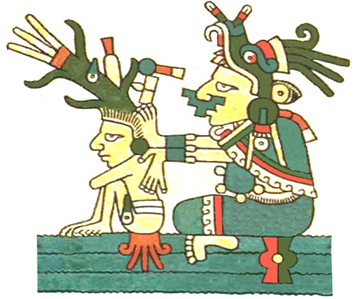
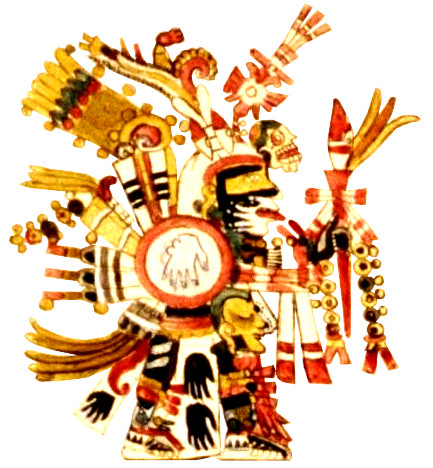
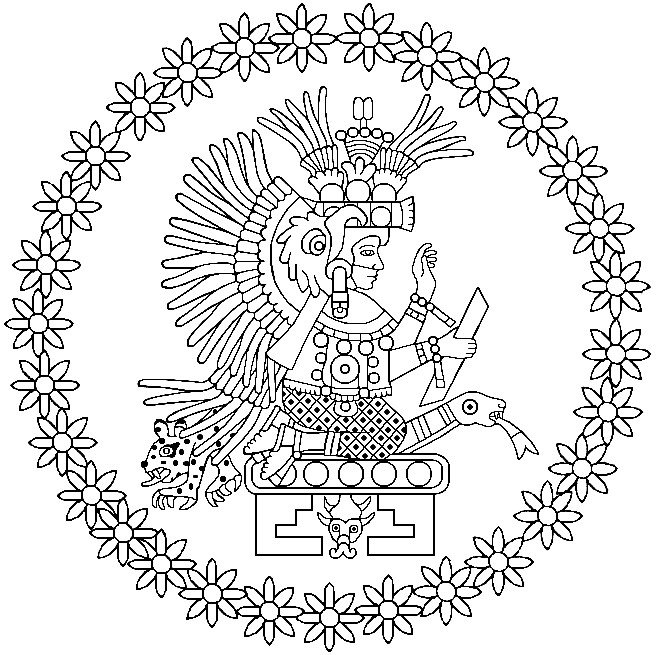
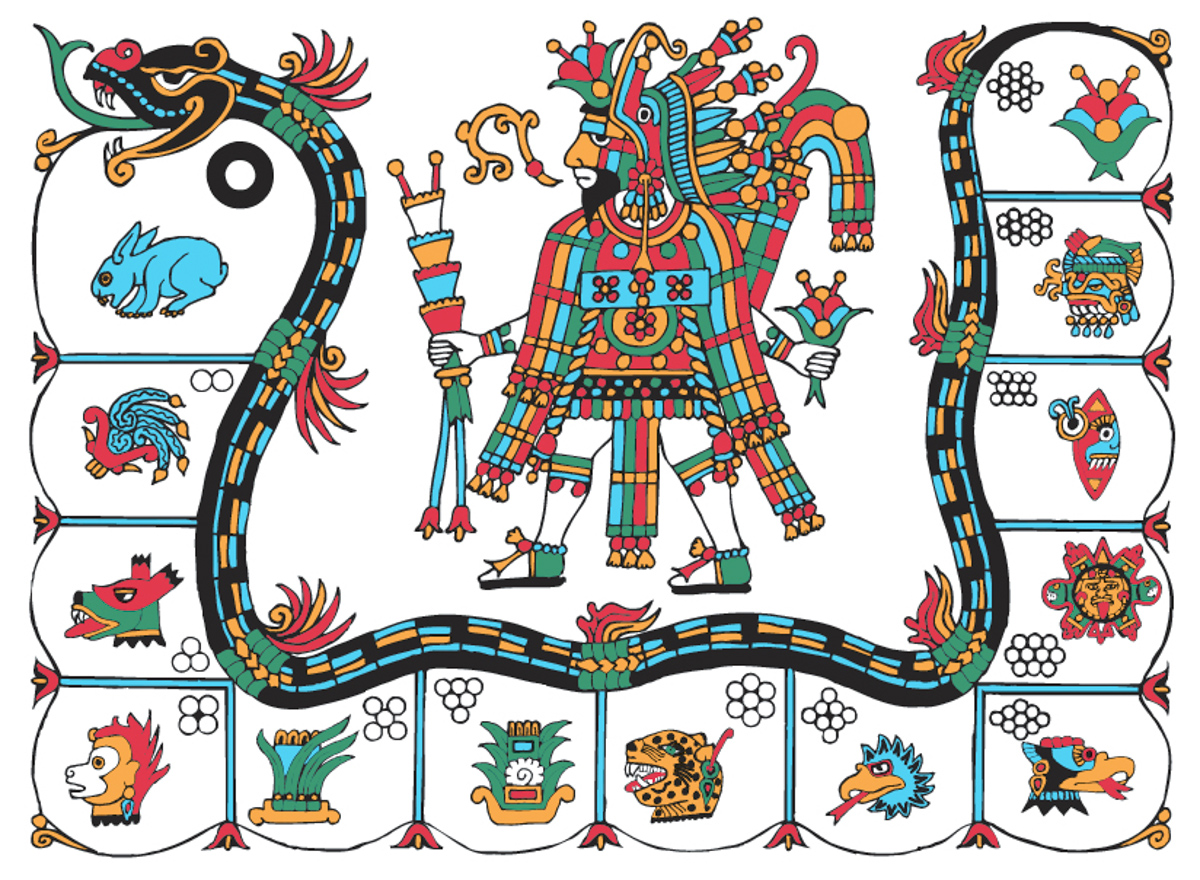


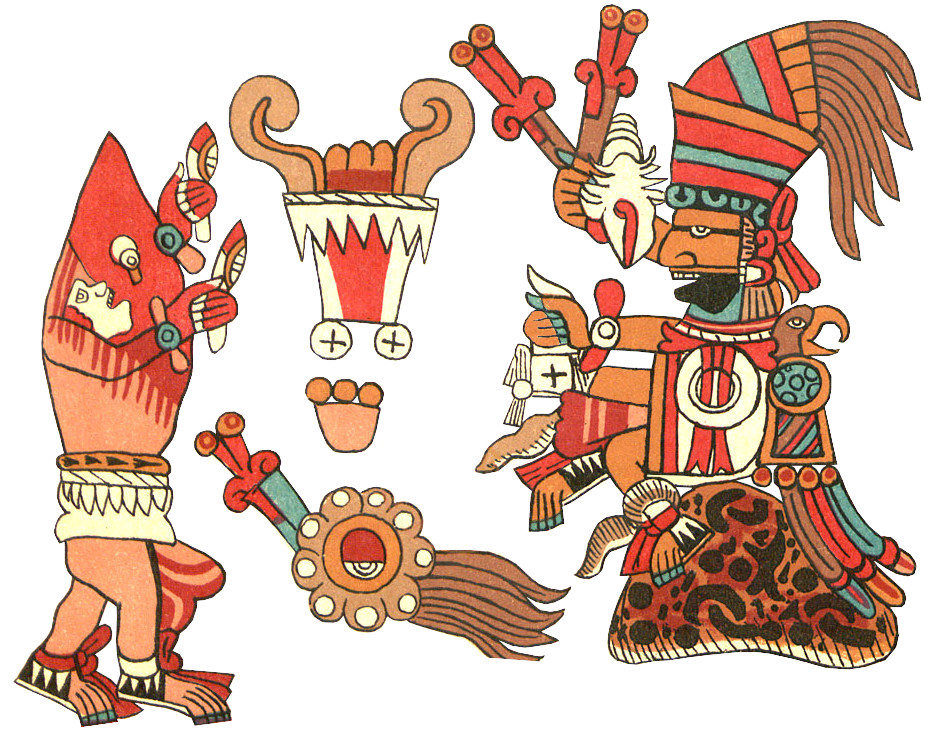
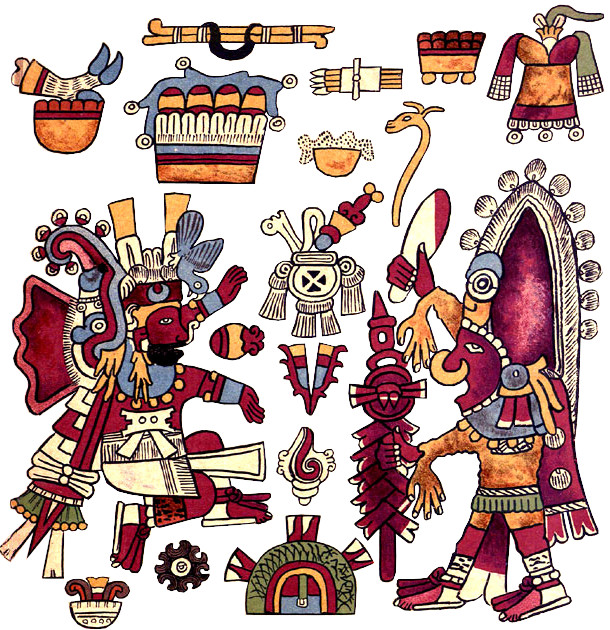

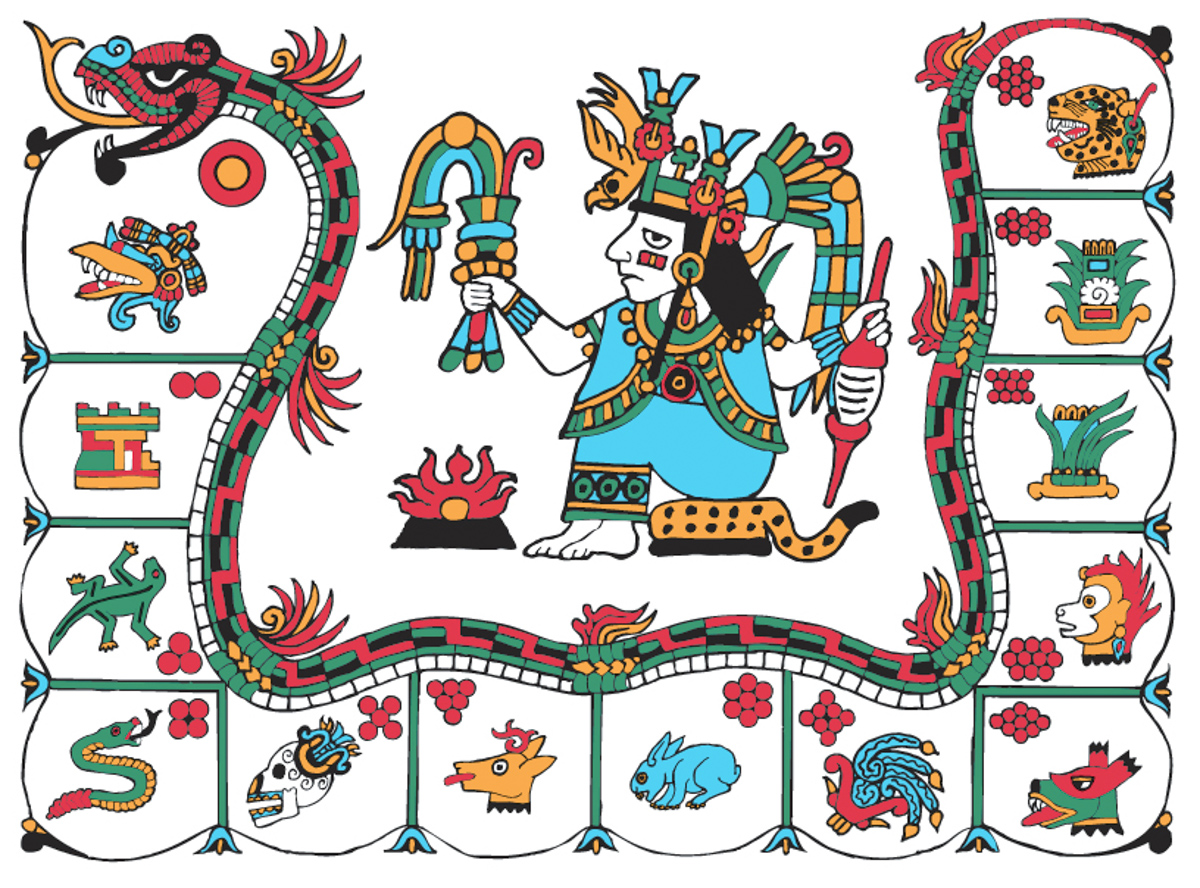
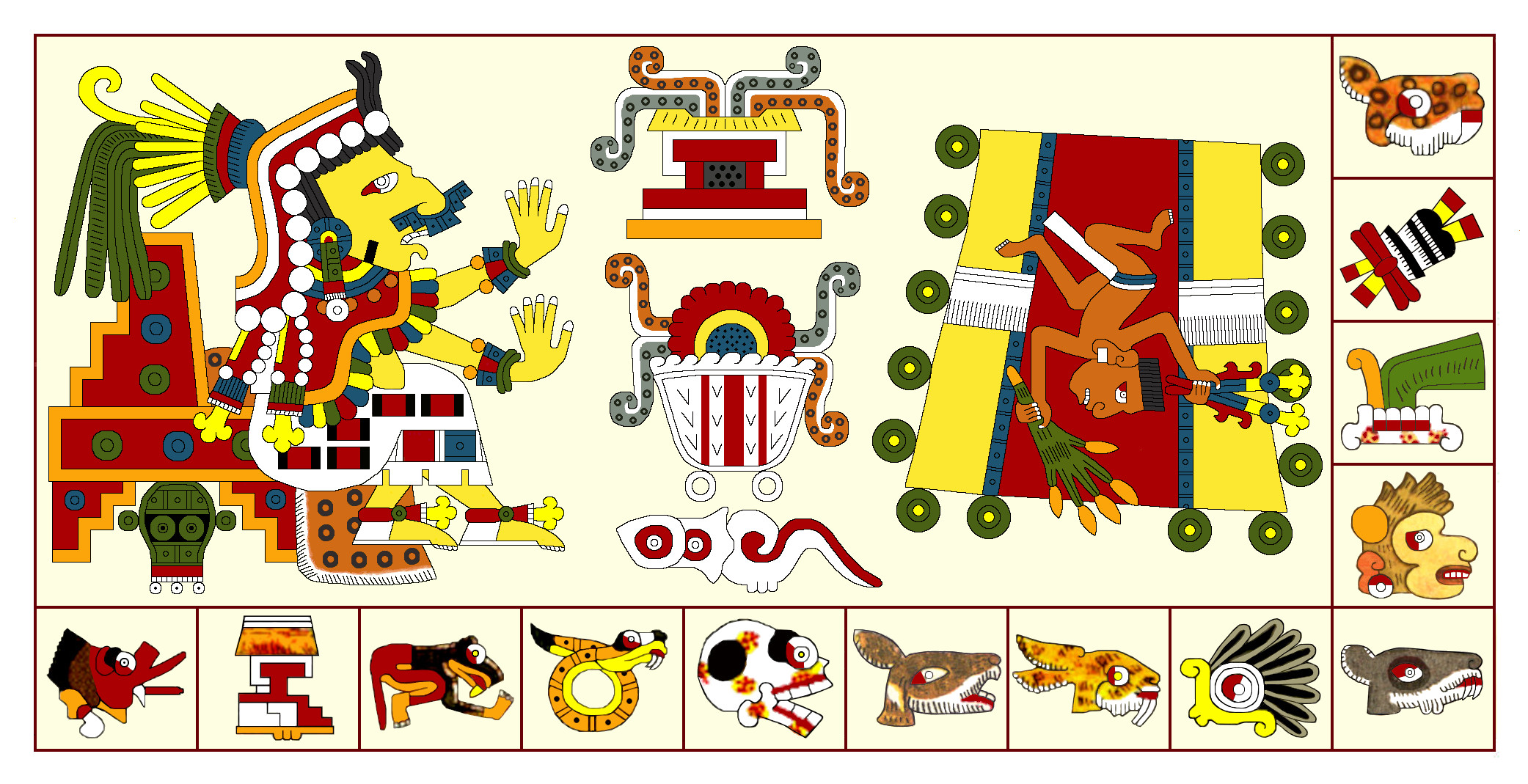
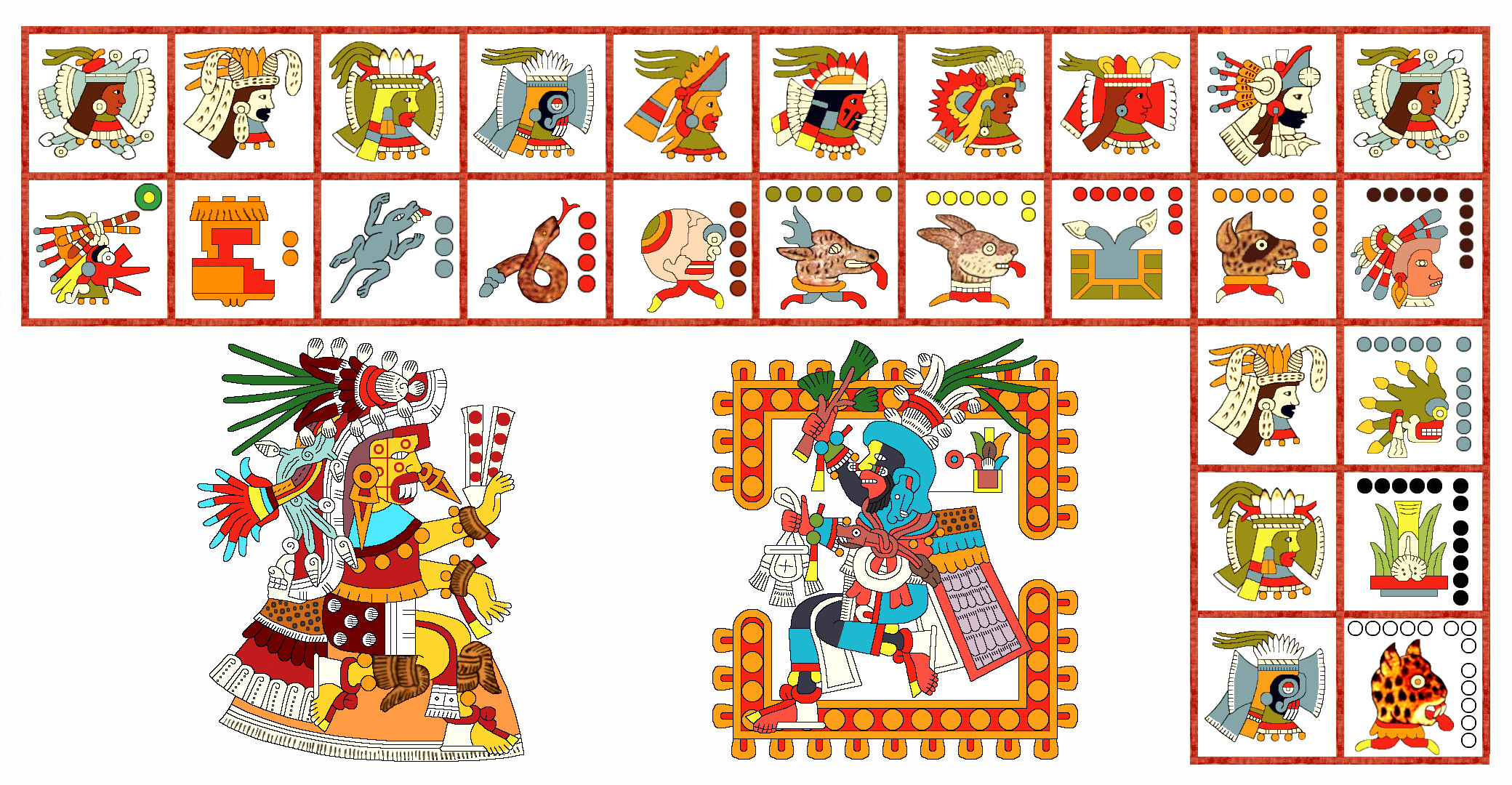

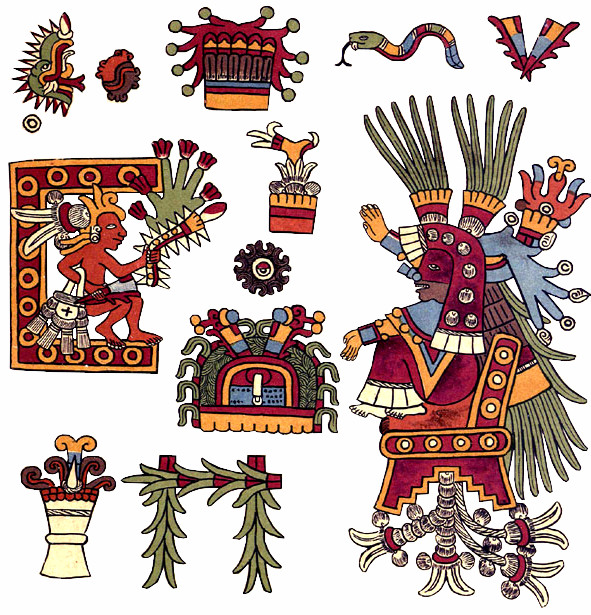


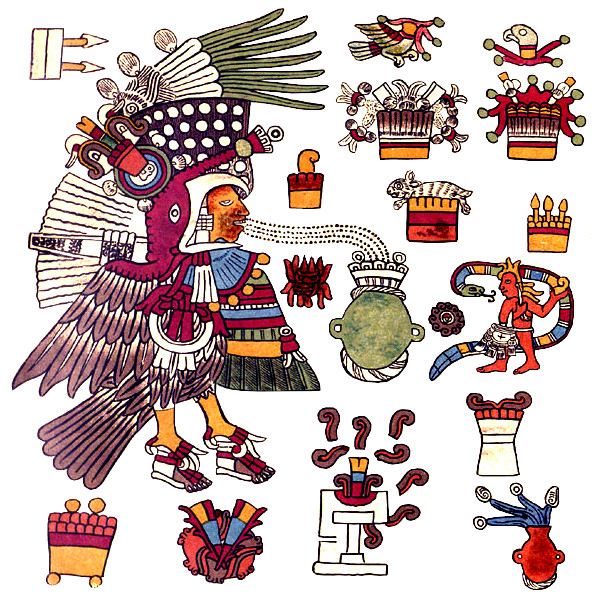


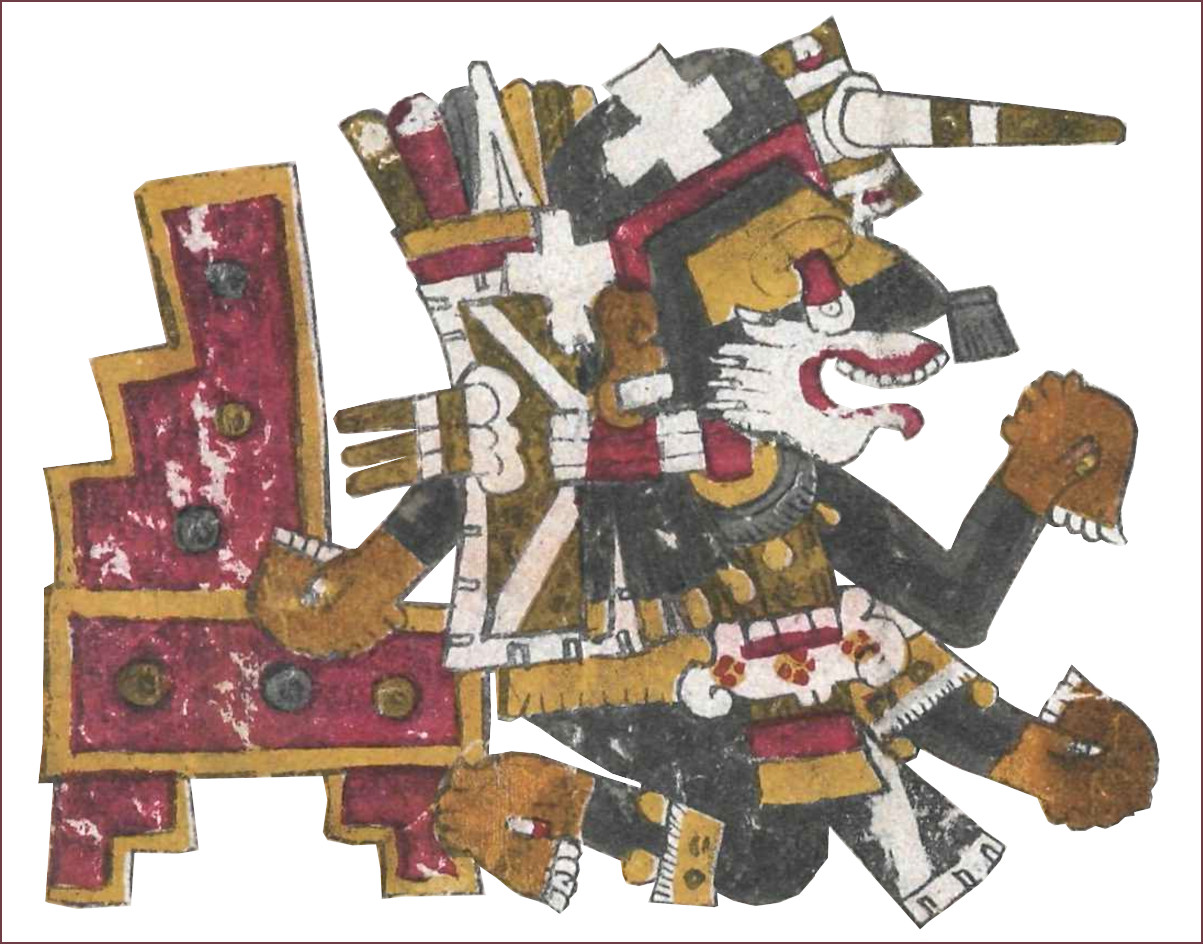


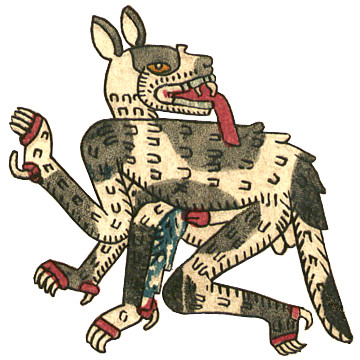
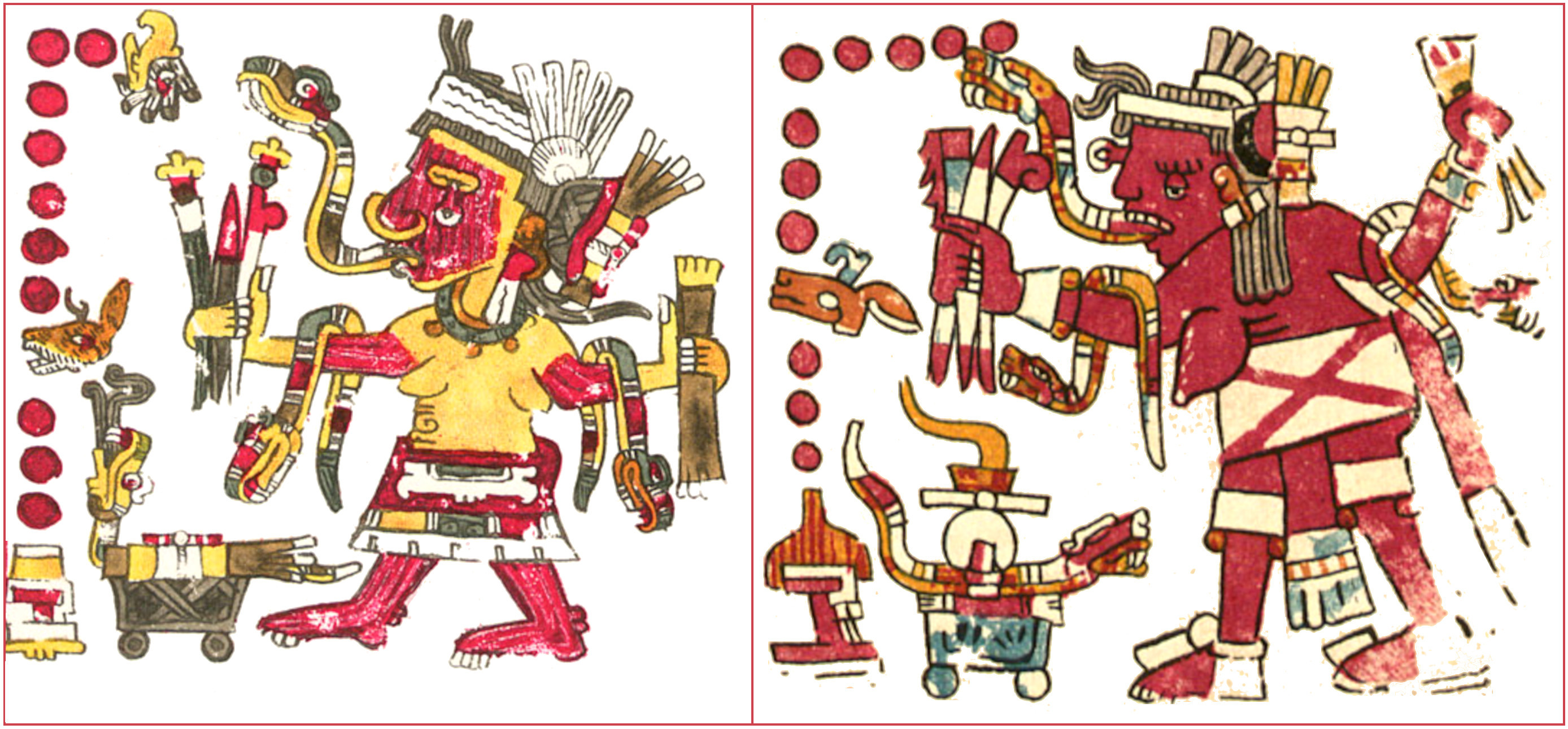


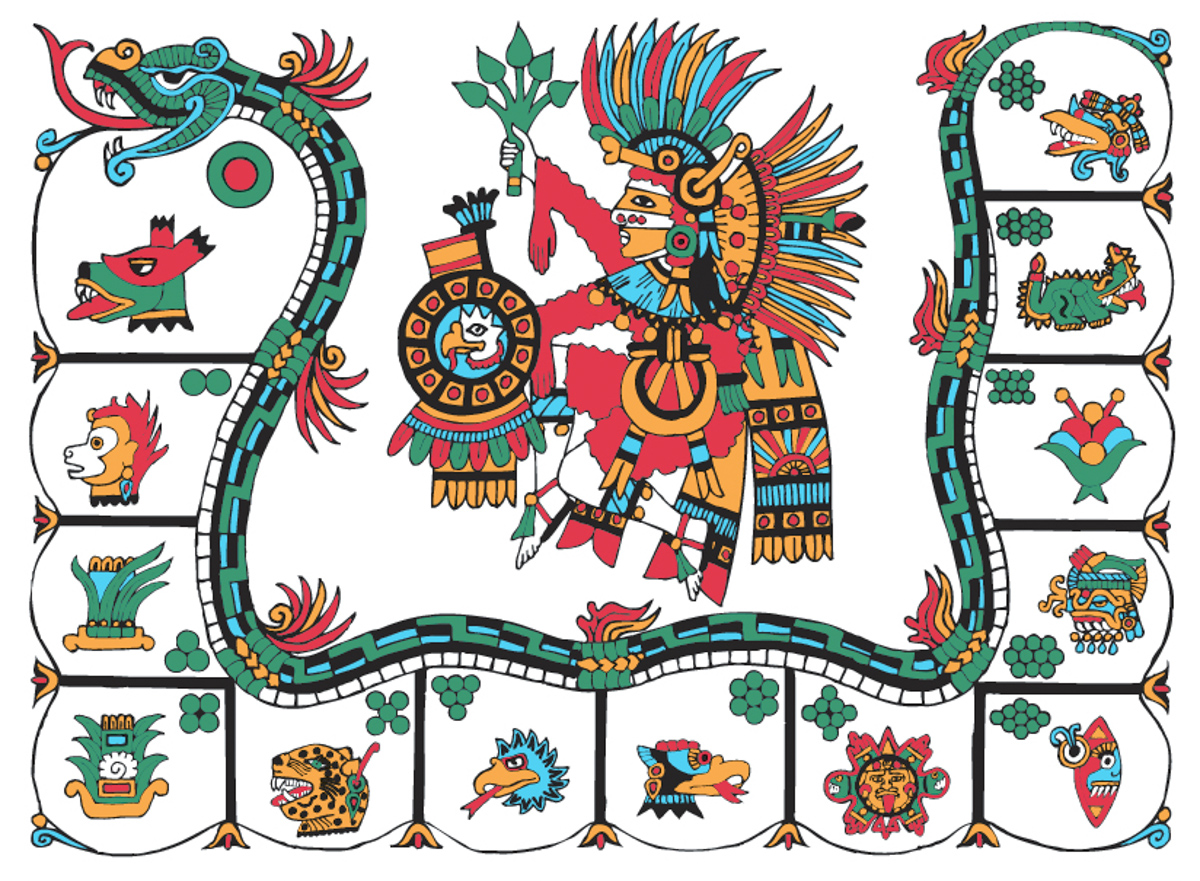


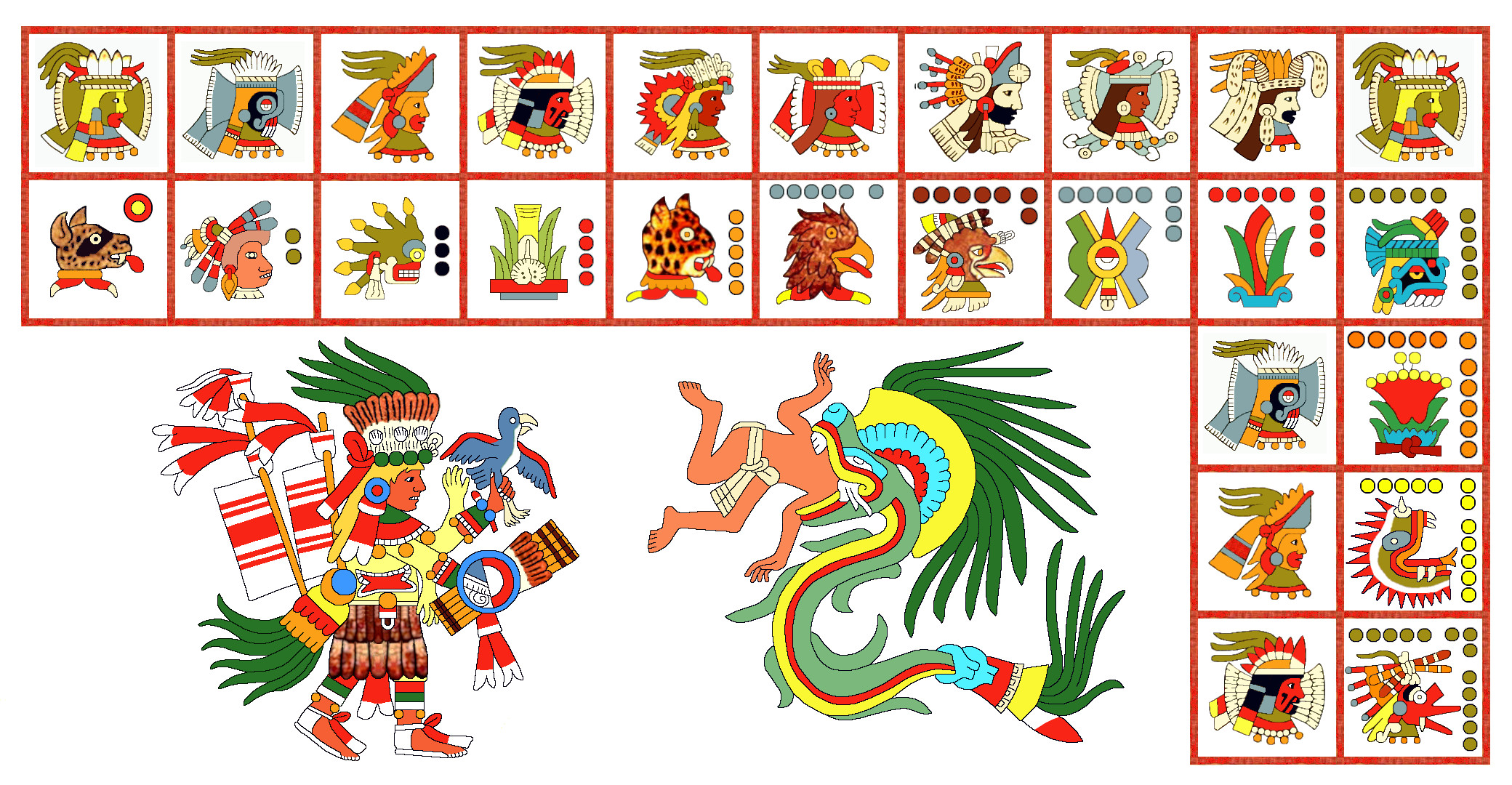
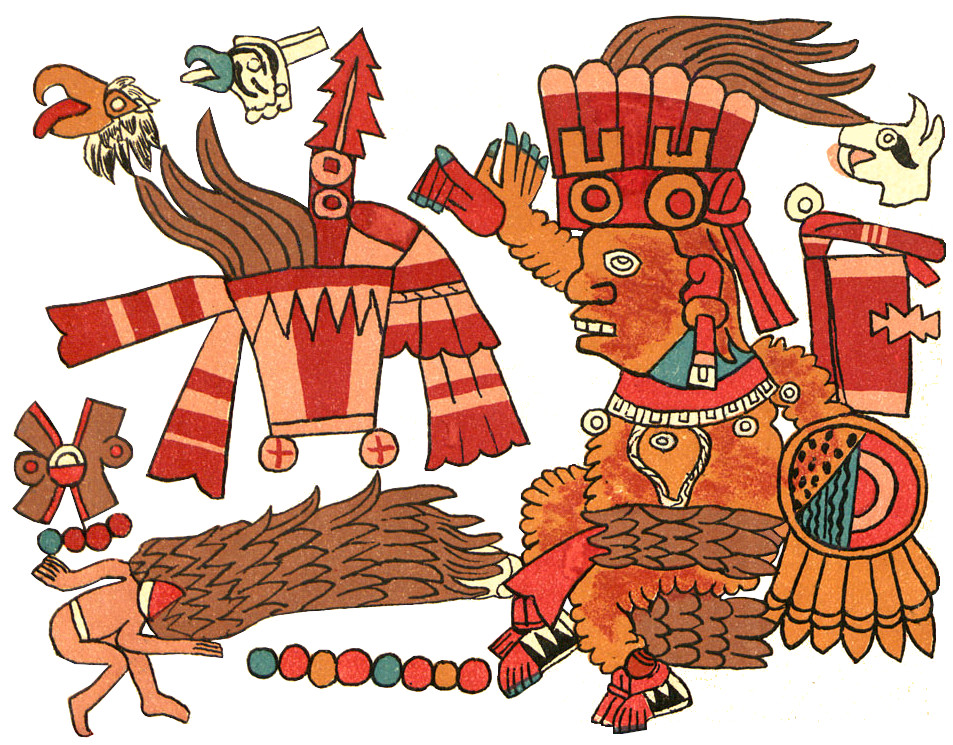

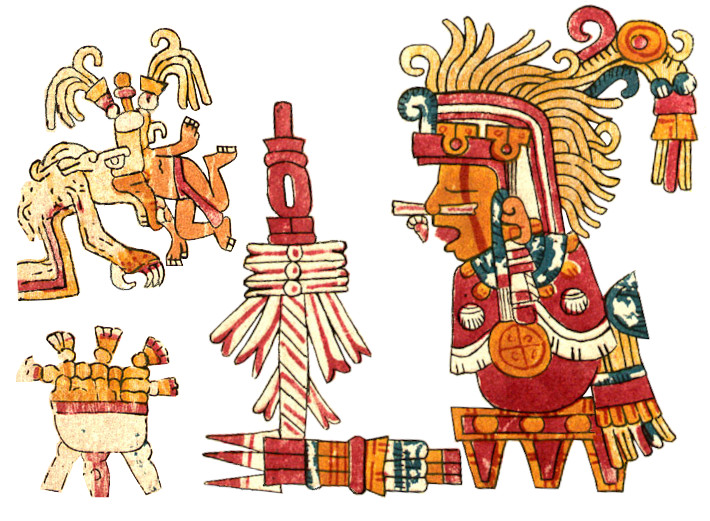

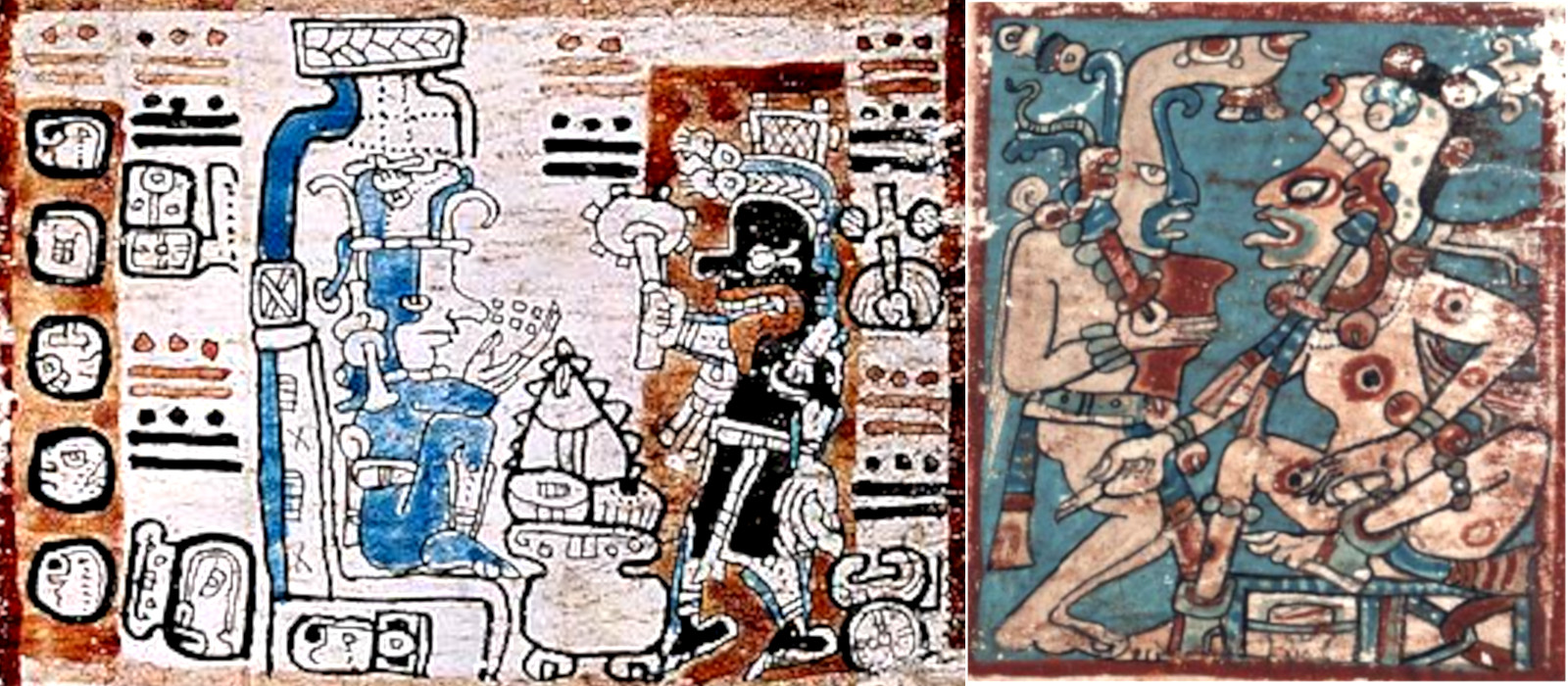


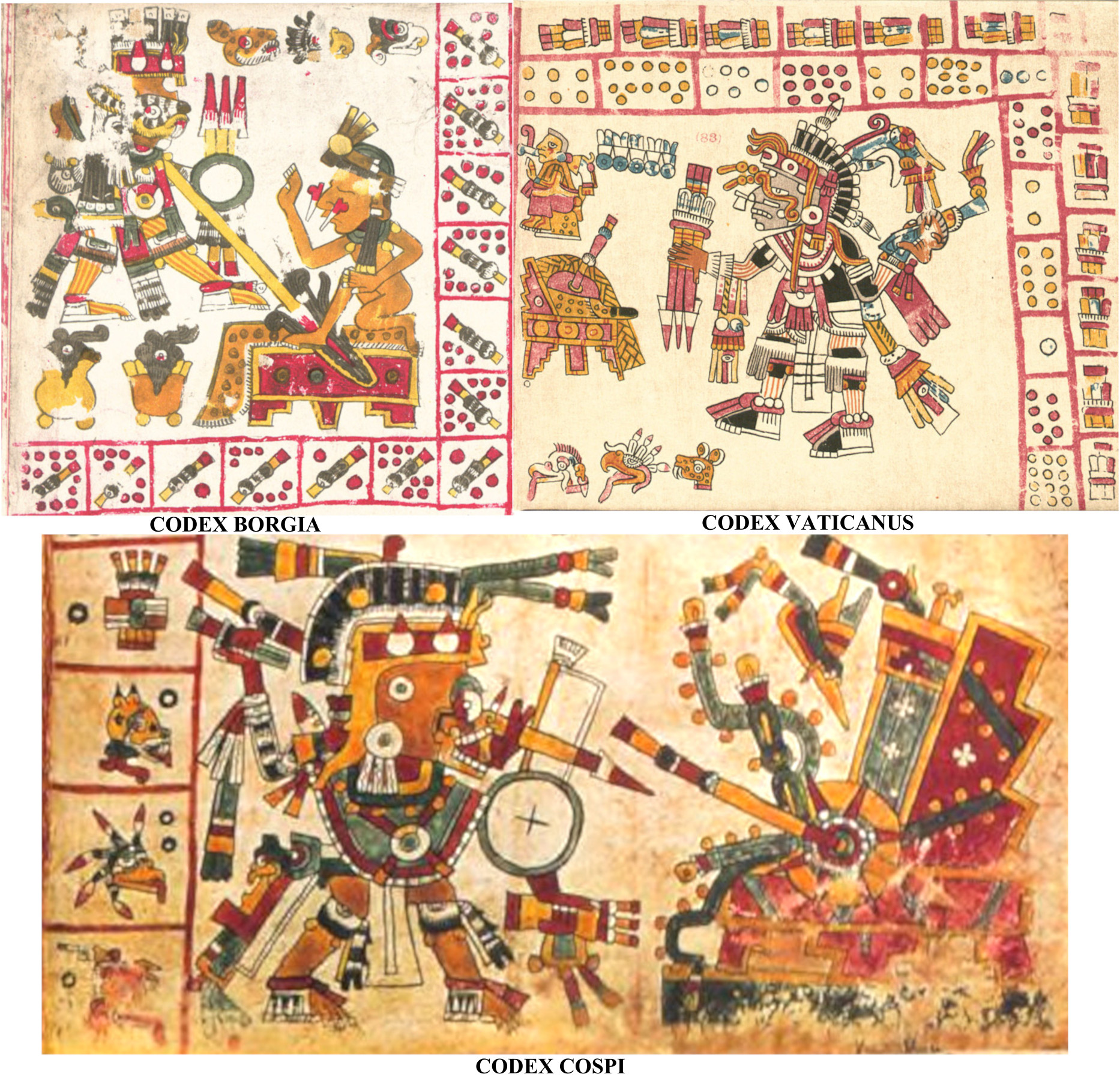

 Richard Balthazar

