Violence and Fear in America

I’m really upset—I’ve had it with all this violence.  Here comes my rant.

Actually I’ve been bothered and tormented about violence for 14 years—ever since the catastrophe of 9/11.  That was a social blow we could well have quickly recovered from, had not the terrified powers that were (and still are) used it (and still use it) to terrorize the population (ever since).  In truth, that apocalyptic event was a decisive and lasting victory for the reputed “terrorists,” whoever they may have been (or be).

Those Powers That Be (PTB) have been terrorizing our people by constantly reminding us of the threat of random violence at any time or place.  Any exposure to violence gives it a toehold in our consciousness, an inroad into our awareness, and that is in no way a good thing.  Violence is as contagious as any black plague, maybe more, and way more lethal.

It almost goes without saying that the normal animal and human emotional response to violence is fear.  How one manifests that emotion makes all the difference:  resistance, defense, retreat, or terror (surrender).  These are all fear-based reactions.

Fear has now become the basis of our whole culture or if you will, civilization.  It’s really big business embracing our whole way of life.  Actually it’s several mega-industries:  the insurance industry, the security and policing industries, the medical and pharmaceutical industries, the military industry, the political industry, the media and advertising industries, and the entertainment and sports industries.  Those are just the big kahunas in the economic ocean of fear.  I won’t even try to list all the other fish in this frightful sea.

To return to those constant reminders of the threat of random violence, just think for a moment on how in the past 14 years news reporting has been ramping up intensity and volume of stories about horrific slaughters and atrocities, now with mass shootings almost a weekly spectacle.

Sensational coverage of this supposedly important news has been commandeering the airwaves with continuous mind-numbing video loops and litanies of ominous, hypnotic memes.  And now with the San Bernardino abomination, it has suddenly turned into a reality show with live feeds to the gory details of police action, investigation, supposition, and philosophical commentary.  The insistent message is simple:  This could happen to you.  Be afraid—be very afraid.

Heeding that warning, people now seem to be hiding themselves away in their safe-haven homes.  Sadly, rather than use this private time for interpersonal or personal relations or activities, most turn to the TV and Internet for immersive, violence-based entertainment.  This is a vicious circle, a self-reinforcing mechanism for terrorizing folks.  Plain and simple, we’re being brain-washed, no, make that force-fed, with images and thoughts of violence at every turn, news programs, action dramas, sitcoms, and even in commercials.

Of course, this begs the question:  Why do folks willingly, even compulsively, watch violence?   Frankly, I believe that watching violence is the same as watching pornography—just as vicarious and shameful.  They both pander to the negative, atavistic side of the human being and awaken similar bestial emotions.  And both are super-addictive.

So where does a fearful population go from here?  Seems to me, there are three ways to go.  My preference is to close my eyes and ears to the insidious message, living my life without fear of threats and surviving or not.  Of course, you could always retreat like Gollum deeper into the bowels of the earth with your precious screen still spewing its poison, but then there is nowhere to go but even deeper down.

The third option might be to negotiate with the PTB, trading off our rights and humanity for security.  Maybe that’s what the PTB have had in mind all along.  Just saying.

Such horrible bargains have been struck many times in the course of history.  Remember the Romans’ pacification of their population with bread and circus (which was simply glorified violence)?  Nowadays it’s junk food and TV (even more vilely violent).  Don’t forget the relative social security of medieval feudalism or the prosperity of empires, of course at the cost of personal liberty.  Some monarchs or dictators have occasionally provided reasonable peace and security at the cost of social freedom, and theocratic states still sell protection for total control of their people’s thoughts and behavior.

Personally I’m not going to settle for any of those raw deals.  Again, my choice is to live without fear.  Whether or not I fear it, my future lies solely in the hands of Providence.  We get what we’ll get, and pre-emptive fear of dire possibilities is a miserable waste of time.  Most won’t even happen, and if one does, well, that’s the way the cookie crumbles.

My personal mantra is Frank Herbert’s transcendent dictum in “Dune:” “I must not fear. Fear is the mind-killer. Fear is the little-death that brings total obliteration. I will face my fear. I will permit it to pass over me and through me. And when it has gone past I will turn the inner eye to see its path. Where the fear has gone there will be nothing. Only I will remain.”

To break this cycle of fear-inducing violence, we’ve got to deny it any place in our spirit, banish it from our thoughts and fantasies, and quell our instinctual fears.  We must shut out society’s pervasive drone of violence and create a new personal music, a true entertainment for our fearless minds.  For my own part, I’ve recently taken up nonchalant whistling.

Again it almost goes without saying that my strong (and realistically rational) opinions about today’s atmosphere of fear aren’t going to change squat.   My only (perfectly realistic) fear is that the terrorized people of the world might surrender their lives and liberty to the PTB for a pittance of dubious security.  Believe me, folks, surrender won’t banish fear—or violence.

Meanwhile I’ll just whistle a happy tune, letting that fear pass over and through me, and only I will remain, a free human being.

Aztec Icon #7 – HUITZILOPOCHTLI, Hummingbird of the South

Let’s get back to my coloring book of Aztec icons called YE GODS!  THE AZTEC ICONS.  Here comes the big guy, the patron deity of the Aztec tribe (the Mexica), a war god, oddly named for a tiny bird.

In all good conscience, I must apologize for the exuberance of miniature detail in this drawing, but it’s all necessary to tell his story. The motifs in the icon are modelled on images from several codices too numerous to mention.  If you find the vignettes too tiny to work with, all I can suggest is to blow the image up to maybe 200X.

Meanwhile, since this icon is so detailed, I’ll give some more notes below, after the caption.

Don’t worry, you can still see or download the previous six icons by clicking on them in the list on the page for the coloring book .

ICON #7: HUITZILOPOCHTLI

(Hummingbird of the South)

To download this icon as a pdf file with a page of caption and model images from the Aztec Codices, right click here and select “Save Target (or Link) As.”  You can also download it in freely sizable vector drawings from the coloring book page.

huitzilopochtli

HUITZILOPOCHTLI {hwee-tsil-o-poch-tłee} is the god of war, power, force, action, accomplishment, and nobility, as well as patron of the city of Tenochtitlan and god of the South. As patron god of the Mexica (Aztecs), he was credited with both their victories and defeats on the battlefield, requiring sacrificial human hearts in either case. He is sometimes called the Blue Tezcatlipoca, the sun at mid-day, and as Lord of the warriors of the day, the Eagle Knights, he wields the Xiuhcoatl (Fire Snake) with which he slew his 400 brothers.  Son of Coatlicue (Snake Skirt), he led the Mexica people on their epic migration from legendary Chicomoztoc (Seven Caves) into the Valley of Anahuac.

###

NOTES TO ICON #7:

The god surmounts a symbol of the sun at zenith. Central above him rises the Tree (cacao) of the South in which sits an unidentified Bird of the South.  To the left of it crouches an Eagle Knight, and to the left is the god’s birth day-name, One Flint.

The figured frame, starting on the upper left and running traditionally counterclockwise, presents episodes in the many-year migration of the Mexica. Largely it reflects Fray Durán’s account in his 16th-century “History of the Aztecs.”  The vignettes down the left side represent:

  • Departure from the mythical homeland of Aztalan and long wandering in the desert.
  • Settling down in Chicomoztoc (Seven Caves) for many years.
  • Birth there of Huitzilopochtli (including the beheading of the god’s mother Coatlicue and slaughter of his multitudinous brothers).
  • Migrating on and conquering the Red City (probably Gran Chichimec in Sonora).
  • Abandoning the god’s sorceress sister Malinalxochitl.
  • Settling down at Coatepec and executing the god’s conspirator sister Coyolxauhqui.
  • Migrating on and killing the god’s nephew Copil, son of Malinalxochitl.
  • Flaying the “Woman of Discord,” daughter of the king of the city of Colhuacan.
  • The five day-signs, Lizard, Rabbit, Grass, Vulture, and Flower (bottom center) are symbols of the South as well, noting the direction of the migration.

Rising from the lower right, the vignettes represent:

  • Arrival of the Mexica at Tenochtitlan, Place of the Cactus, an island in Lake Texcoco (with volcanoes Popocatepetl and Itzacihuatl in the background).
  • Merchants (pochteca) with their god Yacatecuhtli trading with many cities.
  • Warriors conquering many other cities.
  • Warriors capturing prisoners for sacrifice.
  • Priest sacrificing people atop the double temple of Huitzilopochtli and the storm god Tlaloc, now known as El Templo Mayor in Mexico City.

Aztec Icon #6 – HUEHUECOYOTL, The Old Coyote

I guess it’s time to post the next Aztec icon in my coloring book called YE GODS!  THE AZTEC ICONS.  Looking almost Egyptian with the animal head, this one emphasizes dancing, music, and sex, which is a combination close to my heart. I must admit to identifying closely with this deity while drawing him. It’s full of the music of Aztec instruments and singing, all shown in graphic symbols. Details are based on various codices, but mostly Codex Borbonicus.

Don’t worry, you can still see or download the previous five icons by clicking on them in the list on the page for the coloring book.

ICON #6: HUEHUECOYOTL

(The Old Coyote)

To download this icon as a pdf file with a page of caption and model images from the Aztec Codices, right click here and select “Save Target (or Link) As.”  You can also download it in freely sizable vector drawings from the coloring book page.

huehuecoyotl icon

HUEHUECOYOTL (Old Coyote) {hwe-hwe-koy-otł} is the trickster god of mischief and pranks and can lead one into trouble. (His tricks on other gods often backfired.) Patron of the day Lizard, along with Macuil Cuetzpallin (Five Lizard), he’s a deity of sexual indulgence, and with XOCHIPILLI and Macuil Xochitl (Five Flower), he’s also a deity of music, dance, storytelling, and choral singing. Personifying astuteness, pragmatism, worldly wisdom, male beauty, sexuality, and youth, he’s a balance of old and new, worldly and spiritual, male and female, and youth and old age. He is a shape-shifter, turning into animals or humans with sexual partners female or male of any species. Among his male lovers were XOCHIPILLI and Opochtli, god of hunting. He brings unexpected pleasure, sorrow, and strange happenings, and people appealed to him to mitigate or reverse their fates.

Aztec Icon #5 – EHECATL, God of Wind

Hold on to your hats! Here comes a wild wind. Actually the fifth icon for the coloring book YE GODS! THE AZTEC ICONS is the Aztec God of Wind, Ehecatl. My apologies that he’s going to be crazy to color, but I didn’t exactly make him up. The deity’s image is quite authentic, based on one with very similar detail from Codex Borgia.

Don’t worry, you can still see or download the previous four icons by clicking on them in the list on the coloring book page.

ICON #5: EHECATL

(God of the Wind)

To download this icon as a pdf file with a page of caption and model images from the Aztec Codices, right click here and select “Save Target (or Link) As.”  You can also download it in freely sizable vector drawings from the coloring book page.

ehecatl icon

EHECATL {e-he-katł} is the deified element of air and the breath of life. He’s a nagual of QUETZALCOATL, whom he helped create the current Fifth Sun by breathing life back into the bones in Mictlan. He is the god of secrets and mystery, intelligence, and spiritual life. Only smoke, feathers, and birds should be sacrificed to him. His temples were round, sometimes with protruding masks for the wind to blow through. His breath moves the sun and drives the high clouds and rain across the sky. Ehecatl is the 2nd day of the month, and Nahui Ehecatl (Four Wind) was the day-name for the Second Sun, a world ruled by QUETZALCOATL. When that Sun was destroyed by the eponymous wind (hurricane), its people were turned into monkeys.

Aztec Icon #4 – CHANTICO, Lady of the House

In the eternal struggle between life and art, I’ve been much occupied recently by life, the daily doing of things, most with pleasure, and some with stoic duty. So it’s been a while since I last managed to post something. Now with my ailing computer almost healed, I’ll launch the fourth Aztec icon for my coloring book YE GODS!  THE AZTEC ICONS.

Remember, that’s 4 of a planned 26. At the moment I’ve mostly completed the fifth and sixth and am half-way through the seventh. Don’t worry, you can still see the third icon by clicking here or any of the first three through the list on the coloring book page.

ICON #4: CHANTICO

(The Lady of the House)

To download this icon as a pdf file with a page of caption and model images from the Aztec Codices, right click here and select “Save Target (or Link) As.”  You can also download it in freely sizable vector drawings from the coloring book page.

Chantico icon

CHANTICO, The Lady of the House {chan-tee-ko} is the goddess of fire in the family hearth and fire of the spirit, as well as fire of the earth (volcanoes), and logically the wife of XIUHTECUHTLI, the god of fire. Patroness of cooking, eating, domesticity, and weaving she represents the feminine side of life, fertility, and the waters of birth. She is also the goddess of precious things, the lady wealth and jewels, defensive of her possessions and vindictive with gods or mortals who take her treasures. Her own particular omen-bird (parrot?) is attached to her headdress. (Each deity has one.) The jaguar-pelt seat indicates a divine or royal being.

Free Book on Indian Mounds

GIVEAWAY #1

REMEMBER NATIVE AMERICA! The Earthworks of Ancient America

By Richard Balthazar

Five Flower Press, 1992

I’m pleased and proud to announce that I’ve now scanned the pages of this long out-of-print book for digital distribution.  It’s available now for free download as a pdf file.  All you have to do is right click here and select “Save Target (or Link) As.”

Surveying the periods and traditions of earthworking in Eastern North America, the book is an album of more than 120 monumental earthworks in 20 states:  conical burial mounds, embanked circles and geometrical figures, animal effigies, platforms, and pyramids.

These earthworks are shown in rare surveys, maps, drawings, and photographs, many reprinted from “Ancient Monuments of the Mississippi Valley” (1841), by E. G. Squier and E. H. Davis, which is itself now available online.  Others come from “Report on the Mound Explorations” by Cyrus Thomas (in the 1890-91 Annual Report of the Bureau of Ethnology) which is also now available online.  One of my favorite Squier surveys is the map of Newark works in Ohio:

Newark Works, Ohio

Newark Works, Ohio

Some of the photographs of mounds are my own, and those and many others I’ve taken of mound sites since are included on this website in my Gallery of Indian Mounds.  Here’s one of the newer ones, a shot of the splendid Pocahontas Mound, a pyramid in Mississippi.

MS Pocahontas pyramid

MS Pocahontas pyramid

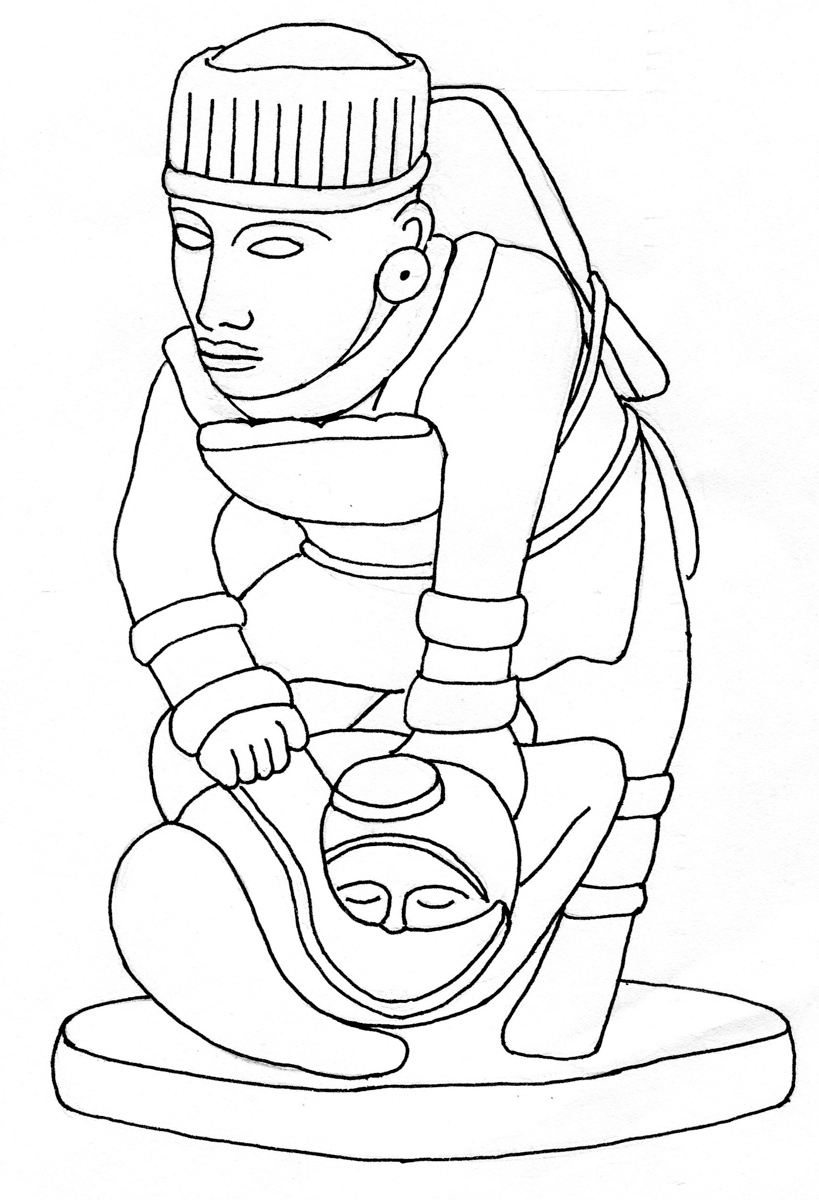
In addition, the book presents a bunch of my line-drawings of artifacts found in mound excavations.  They and many more are up for easy individual download in my Gallery of Pre-Columbian Artifacts.  One of my favorites, albeit disturbing, is a curiously Toltec-looking warrior about to behead a captive.

Warrior, Spiro OK

Warrior, Spiro OK

For free download of REMEMBER NATIVE AMERICA! as a pdf file, just right click here and select “Save Target (or Link) As.”

Now I’m going to steal this opportune moment and bore you with my rant about earthworking, which I believe is a truly primordial human instinct.  Man, the animal who makes things, had to start somewhere.  Originally, of course, things could only be made out of animal material, plant material, stone, or earth, and most of that only after first making the tools or utensils necessary for the manufacture.  Since anything that worked, even plain old stones and sticks, would suffice for the job of moving dirt around, I suspect that the first implements (besides clubs for bonking folks and things) were probably whatever could be used to dig up food roots or enlarge shelters.

It’s but one short step from moving dirt around to piling it up.  As far as we know, people started constructing earthworks several thousand years ago in most parts of the world.  Everywhere you look, they raised piles of dirt in one form or another, often as tomb monuments.  The ziggurats of Sumer were simply piles of mud bricks.  Did the ancient Egyptians build in stone because you can’t effectively pile up sand?  Just wondering.

The impetus to heap up piles of dirt may well have come from observing nature.  Anthills and all that.  Also, it stand to reason that if you’re digging a hole for some reason, you’ve got to put the dirt somewhere.  What’s more, the primordial mind probably saw hills and mountains as the handiwork of some deity or other, and so raising earthen mounds likely had religious purpose, sympathetic magic and such.  Piling the dirt in special shapes would only add to the symbolism, and it seems that the very location and orientation of the piles often was astronomically or socially significant.

I’ll end this rant by noting that ceramic technology is also in fact earthworking, another part of Man’s artistic relationship with the Earth.