Ancestors, My Fore-Folks

So I’m finally getting around to following up on my earlier blog: Ancestors, Level 1, My Parents. To be gender-neutral, this one will be a composite about my “Fore-Folks” going back a few generations.  On my maternal side, I’ve had the enormous help of second cousin Gus who at 94 still lives in Baltimore and has been keeping track of all the descendants of his grandfather (and my great-grandfather) Eugene Trinité.  He has sent me photos of even more fore-folks.  But let me proceed properly:  backwards.

My maternal grandmother Freda Marie Rosenbauer was born March 20, 1895. Freda’s father was Otto William Rosenbauer (great-grandfather), who was born in Austria in 1868. It seems his wife Marie (née Pemsel) was born in 1869 in Germany.  Probably around 1890 they immigrated to Baltimore, Maryland, met, and early in that decade were married.  Otto was a Victorian silversmith and a partner in A. G. Schultz & Co.  That famous company made repoussé sterling hollowware that now sells for large sums.  That’s as far back as I can take Freda’s line.
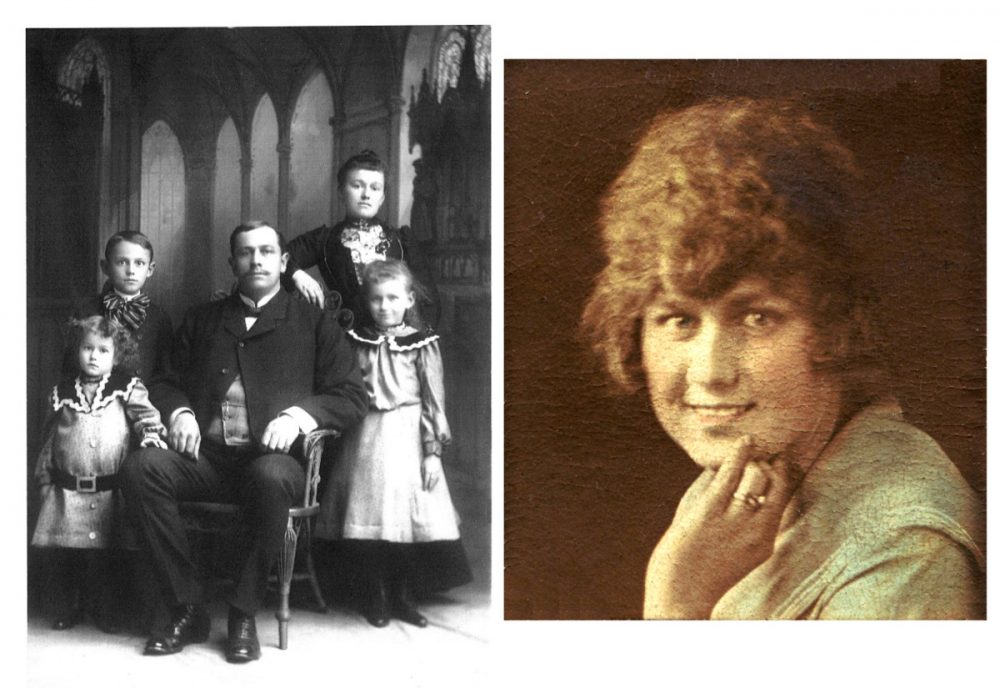
Otto and Marie Rosenbauer with family, 1905; Freda Rosenbauer, 1910

My maternal grandfather George Marius Trinité, was born on May 15, 1890 in Providence RI. He married Freda on March 29, 1917, just in the nick of time before the US entered WWI.  Just saying…

George and Freda Trinite, 1956

George had a printing shop which I well remember from our rare visits to Baltimore (Ballmer). What I remember most fondly was their big house on Elsinore Avenue (near Druid Hill “Droodle” Park)—and tricking Grampa George by emptying out walnuts (his favorite treat) and gluing the shell-halves back together. Out in the hall, I laughed secretly at his startled exclamations each time he cracked a nut and found it empty.  Freda passed in 1970 and George in 1975.

With my cousin’s help, I have a bit more about George’s line. His parents were Eugene Charles Trinité (b. 10/27/1857) and Johanna Von Euw (b. 8/4/1863) (great-grandparents).

Eugene Trinite and Johanna Von Euw

I’m not sure when exactly, but somewhere in the 1880’s Eugene left Paris and moved to the US, I assume meeting Johanna in Rhode Island and proceeding to have several children, including George and the mother of Cousin Gus, Jeannette. In Paris and in Baltimore, Eugene was a lithographer, which makes George’s choice of a printing career something of a tradition, I guess.
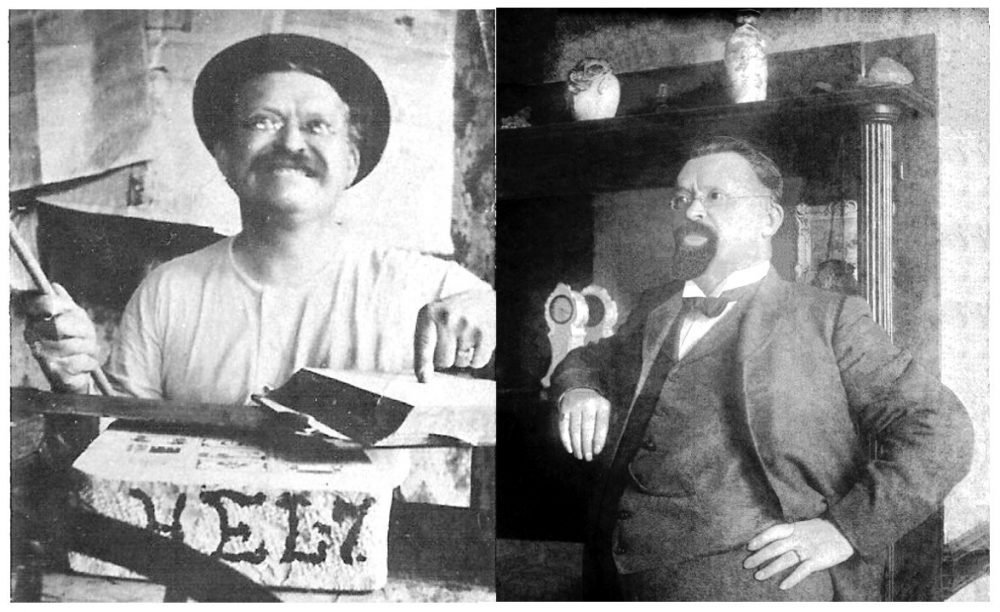
Eugene Trinite as lithographer in Paris; Eugene at mantel in Baltimore

Gus also sent me old photos of two of my great-great-grandmothers, Eugene’s mother Marie Josephine Carlavan and Johanna’s mother Rosa Von Euw. I know virtually nothing about these imposing ladies except that someone has laboriously traced Rosa’s line way back to something like 1204!  It would be fascinating to know who Eugene’s father and Mr. Von Euw (great-great-grandfathers) were and from whom they came, but no such luck.

Great-great-grandmothers Marie Josephine Carlavan and Rosa Von Euw

On the Wisconsin paternal side, I have fewer photos, but a bit more genealogical information. My father’s mother Ella Josephine Perry (Paré) was born as ninth of ten children on May 21, 1893.  Meanwhile, Joseph Raymond Balthazor (AKA Jody), was born a month earlier as fourth of eleven children on April 25, 1893.  I learned somewhere that Jody was a bar-keep (saloon owner).  There were, of course, myriad taverns all over Wisconsin—until Prohibition nixed that line of work.  Adaptable, Grampa Jody transitioned to being a storekeeper.  I never saw much of my Balthazor grandparents, except when I was quite small.  Ella passed in 1958, and Jody in 1960.

Jody and Ella Balthazor

Jody’s mother was Melvina Joubert (born 4/9/1870), and Ella’s mother was Delsina Joubert. Since Melvina and Delsina (great-grandmothers) apparently were sisters, my grandparents were cousins.  We have to remember that Bear Creek was a tiny town…  Ella’s father was Louis (Loudacicus) Paré (great-grandfather), who was born 5/1/1844 in Canada, but there’s no further information on this branch of the family tree.

Jody’s father was John Balthazor (born 3/22/1865—great-grandfather) of New London, Wisconsin.  He was the son of Joseph Balthazar (born 11/28/1841—great-great-grandfather) and Margaret Guyette (b. 10/9/1843), whose parents were Joseph Guyette (born 10/19/1810 in Montreal—great-great-great-grandfather) and Madaleine LaValk (birthdate unavailable).

Joseph and Margaret Balthazar (Great-great-grandparents

Note how the spelling changed, probably due to the illiteracy of the parties involved—and watch what happens as we go back in time. Joseph Balthazar was the son of Michel (Mitchell) Beltazar/Beltezar (b. 1816—great-great-great-grandfather) and Rosalie Plante (b. 1815) of Iberville, Quebec.  And Michel was the son of Martin Balthazard (great-great-great-great-grandfather) and Sophie Herbert (dates unknown).

Somewhere I’ve filed (and lost) materials on the generations of B-lt-z-rs during the 17th and 18th centuries who came from central France to Canada early in the 1600’s, most likely to Quebec City (f. 1608).  For US-historical reference, Jamestown and Santa Fe both were founded in 1607.

Those early fore-fathers went by very French names like Jean Baptiste Balthazar. In the many generations leading up to Martin in Wisconsin, the tribe spread to Montreal (f. 1642), the nearby little town of Iberville, and across Canada.  Some of the family must have also been amongst the Acadians who were expelled from Nova Scotia to Louisiana by the British in 1751—since Balthazar is not an unusual name amongst modern Cajuns.  In all likelihood, my fore-folks were also involved in 1775 defense of Quebec and Montreal against the invasion by the Revolutionary American Colonists.  Meanwhile, those pioneer generations before Martin in the wild woods of Canada almost certainly involved Native American mothers, tribes unknown.

I have to ask myself what I’ve inherited from that horde of fore-folks besides the exotic name. Well, for one thing, I’ve got a slightly darker skin-tone than most white guys, and for another, my “artistic” inclination may be inherited from Otto, Eugene, and George.  But beyond that, I can’t say where my “brains” came from.  I suspect they’re my own creation.

What I really have to wonder is who all those fore-folks really were. They lived in worlds utterly different from this one I live in and undoubtedly lived lives utterly different than my own.  I’m sure my own grandsons in their new worlds wonder the same about me.  And the lives they’re living are definitely different than mine.

###
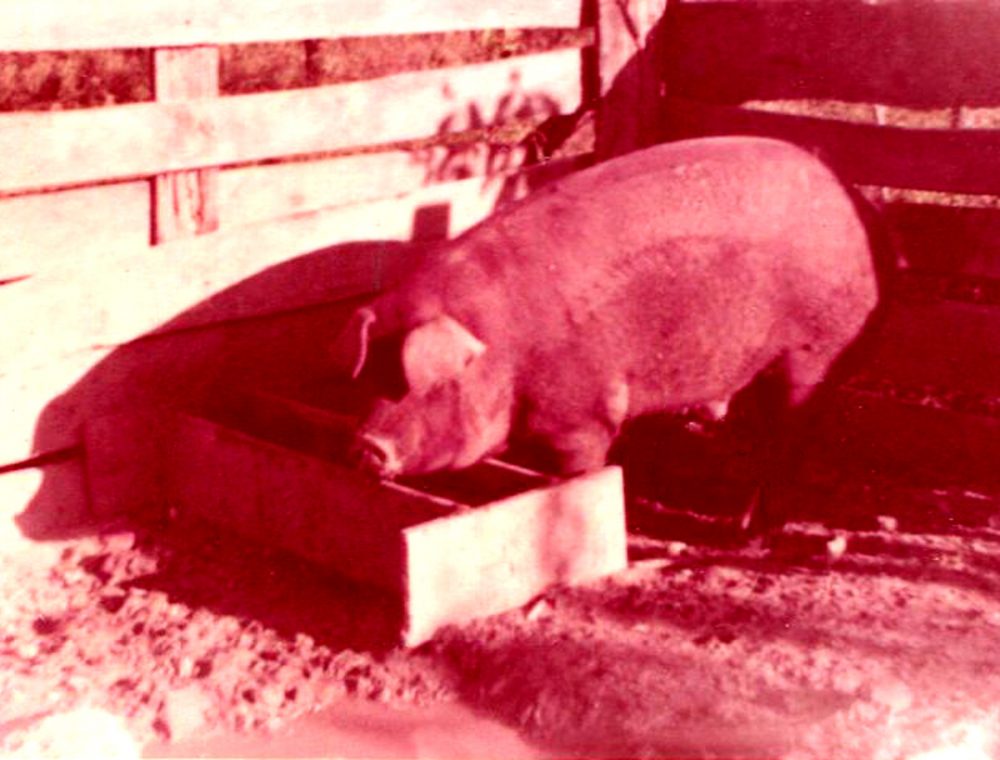
Hog Heaven

An earlier mention of my prize-winning Poland China hog named Cornpone (the Magnificent) made me a bit sentimental about pigs. So, I went to my archive of photos and pulled out the snapshot I took of him dated September 28, 1957.

Cornpone, Champion Poland China hog, 1957

Oddly, after these 61 years the Kodacolor print has taken on the true color of the subject, a magenta-toned sepia. It lends the memory a certain monumentality.  He is standing by his trough in which I would dump a daily bucket of slops (scraps from our truck stop café across the highway) and mix nice messes of special mash to make him fat.

Cornpone’s pen was a good-sized area next to that for Daddy’s twelve brindle hunting hounds. The picture was taken from the edge of his wallow in the foreground.  I’d also bring buckets of water every day to keep it suitably muddy, and he’d loll around in the muck, grunting and snorting.  That’s where I learned the truth of the old saw “happy as a pig in hot mud.”

We kept our herd of several hogs (the pinker variety) in a pen down past the pasture at the edge of the woods—where their stench couldn’t reach up to the house or yard. It was also my exhausting duty to haul many buckets of slops to them each day and to keep their wallow wet.

Periodically we’d slaughter maybe three of the herd at a time, and neighbor folks from around helped with the hot and heavy work. First, Daddy would lean over the fence with his rifle and shoot a hog between the eyes.  It would drop like a rock.  Then he’d jump in and slit its throat, letting the blood run into the wallow.

A few of the men would drag the carcass out of the pen and up the hill to where some huge iron pots were boiling on wood fires. They’d haul the hog up on ropes over a tree limb and lower it into the boiling water for a moment to scald the hair off.  Then they’d hang it up from another branch for the butchering.

When they’d spit the stomach open, I was always grossed out by the cascade of guts but had to help with sorting out the intestines for sausage-casings. Brandishing great knives, they’d toss slabs of hog-fat into another iron pot to render out the lard and make chitlings (pork rinds).

The butchering would take most of a day, and it was quite a community party. We’d wrap up the cuts of hams, loins, and so on to put in our big walk-in cooler, and folks would take turns on the big grinder making sausage.  The neighbors were happy to get shares of the meat and buckets of lard for their work.  And we had loads of fresh pork to sell in the café.

Cornpone didn’t share the rustic fate of our common hogs. That fall we took him to the Sevier County Fair in DeQueen, Arkansas, where he won the Blue Ribbon.  After his big win, he went to a more sophisticated hog heaven.  Being a simple country boy of fifteen, I sold my champion hog to a meatpacker and bought myself a pair of cowboy boots with turquoise tops.  My young feet outgrew them within a year.

#

Souvenirs of Logan Circle

On reading my most recent blog about gay life in Washington DC in the Neolithic (the 1970’s) in our faerie castle the Four Belles (1320 Rhode Island Ave NW), a friend suggested that I write more about the Centennial chandelier. I’m happy to do so, but actually I want to write more in general about memories of Logan Circle and my salvage activities.

(At that time, DC was in the throes of urban renewal and tearing down entire blocks of abandoned Victorian houses. Our most urgent battle around Logan Circle was to keep that from happening to the mansions and apartment buildings there.)

Four Belles carving and 1 & 2 Logan Circle

The photo on the left is a close-up of the carving of four hands with bells from which we took the name of our house. In fact, I found out several years ago from the current owner that the original builder had indeed named it the Four Belles—for his wife and three daughters.  The Second Empire wedding cake house on the right was owned by Lewis Kleiman, the guy who took my publicity shot mentioned before.  I occasionally helped him work on restoring the place, like stripping woodwork and such—but it was like spitting in the sea.

Copper Peak, 1320 RI Ave NW

Lewis also helped me in my salvaging. Early one morning we went in my old blue van (Lavenia Van Dodge) to a ruinous house on Sixth Street and rescued its copper peak to put on the Four Belles.  To get to it, we had to climb the bannister of the collapsed staircase and scramble through a rotten hole in the roof!  The peak is 4 or 5 ft. tall and maybe 6 ft. across the base.


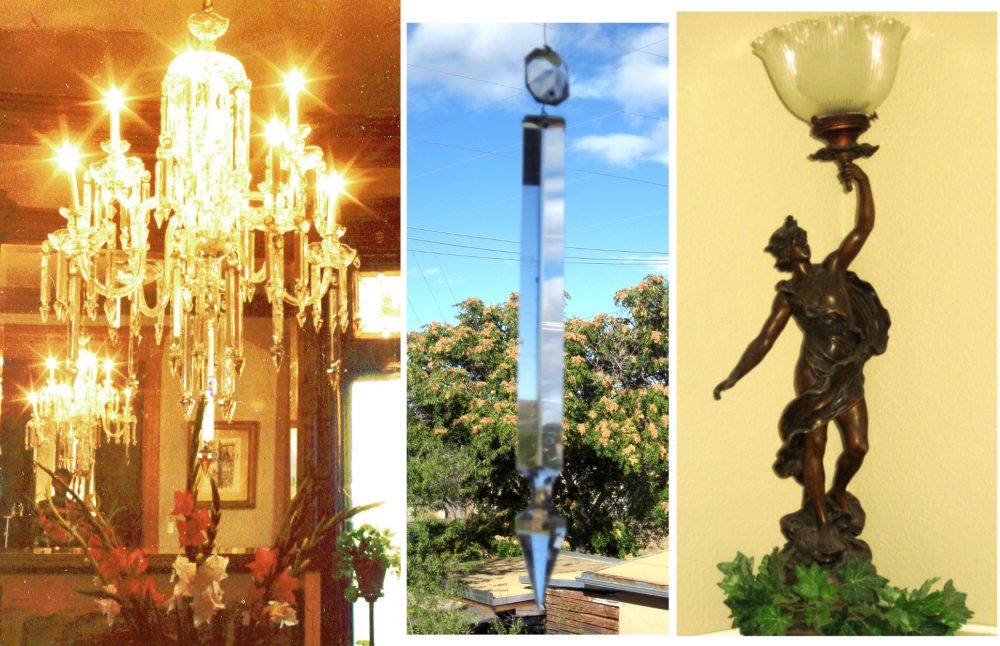
But to return to that Centennial chandelier: As remarked before, it was a gift from France along with the Statue of Liberty.  My housemate Charles, being a historic preservation bigwig, got inside on the renovation of an area in Independence Hall where the Centennial chandelier had been hung and nabbed it for our castle.

Victorian Elegance at the Four Belles

In the photo, the huge Eastlake mirror behind the chandelier was rescued from a doomed house on M Street, along with two fabulous mantles and another mirror in black lacquer. When found, it and its beveled glass had been painted white! It now lives in the Library at Santa Fe’s posh inn and spa at La Posada. So I can occasionally visit my old friend.

In the middle is one of the Baccarat prisms (about 18 in. long) hanging on my porch.  On the right is a lamp (purchased in an antique shop), which is also here in my apartment.  By the French sculptor Auguste Moreau, it sat on the newel post of the tiger-eye oak staircase in our grand reception hall.  A few shadows of the Victorian elegance of the Four Belles.

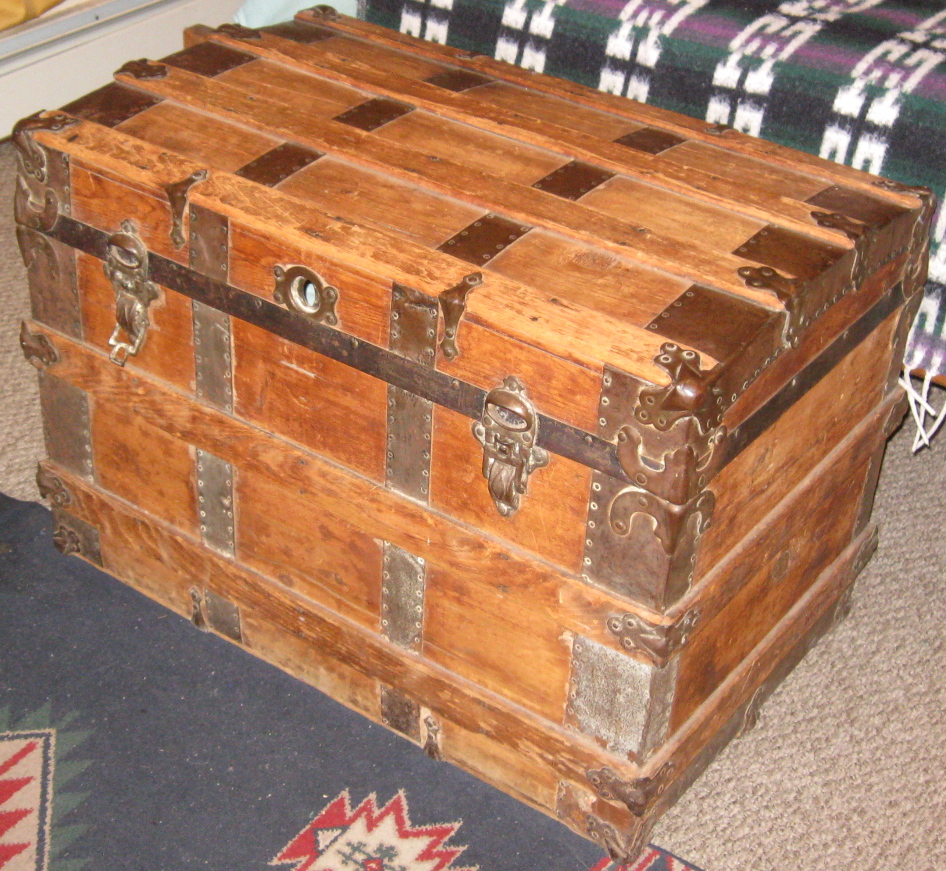
And to return to my salvage activities: Another piece I still have is a trunk I found in 1974 on like the sixth floor of the wracked-out Iowa building also previously mentioned.  I had to remove its shredded canvas covering and live with the raw wood, but after all these decades, it still holds my blankets and linens.  Like that beautiful building, it has survived!

Trunk Found in the Iowa, 1974

There are naturally many stories to be told about salvaging, but I’ll only impose on you with a few. The first was an adventure of saving a plaster ceiling medallion like the one shown below, though I recalling it being a bit more ornate, if you can imagine that:

Victorian Ceiling Medallion

The derelict house was just a few doors down M Street from the one with the mirrors and mantles. I hauled my ladder into its crumbling dining room and proceeded to the cautious work of removing the ceiling medallion.  In the middle of the job, the entire ceiling of plaster and lathe let go of the joists.  There I was standing at the top of the ladder like Atlas holding up a very heavy sky!  With extreme trepidation and caution I tilted the slab to rest one edge on the floor, and with the other side propped on the ladder, I climbed down.  Then it was a fairly simple job to remove the prize and haul it away in trusty old Lavenia Van Dodge.

After untold hours of cleaning and restoration, I gave the medallion to one of the new urban pioneer neighbors around the Circle. Can’t recall who…  That’s what I did with the mantles, fancy woodwork, and such that I salvaged as welcome-wagon gifts.

A major salvage accomplishment was getting into a gorgeous Greek Revival building at, I believe, 12th and O (former home of DC’s black Masonic Lodge), the day before it came down.  They’d abandoned their library, and my friends and I loaded it out of the back window into Lavenia.  In the horde I found among other fascinating volumes a huge tome called “Ancient Monuments of the Mississippi Valley” by Squier and Davis, which led to my 1992 book “Remember Native America.”  (I’d just seen the old public library on Maryland Avenue get knocked down with all the books still in it!)

And one more anecdote: After salvaging some mantles and sets of fabulous glazed tiles from the fireplace surrounds from another house, I went to a dinner party with the family of a lady friend in Alexandria.  Her aged grandmother was our hostess and was fascinated to hear about all my salvaging activity.  When I mentioned the address of that day’s rescues, the grandmother almost had a cardiac:  It was the house where she’d been a little girl, and the room with the green tiles had been her bedroom.  I came back the next day and gave her one of them as a souvenir.

Victorian Glazed Tile from Fireplace Surround

Later, in 1982, I installed several of the tiles around the kitchen sink in my next Victorian, a little Queen Anne in Denver, with this one left over.

#

Ancient Coin Identified

Before revealing the positive ID on that ancient coin I found a half-century ago in Ann Arbor, Michigan, which I also wrote about in Ancient American, Vol. 22, Issue 119, I really must commend that magazine as an excellent forum for dialog among independent researchers. Rather than the establishment authorities that I contacted (with no response), it was readers of Ancient American who told me what I’d found.

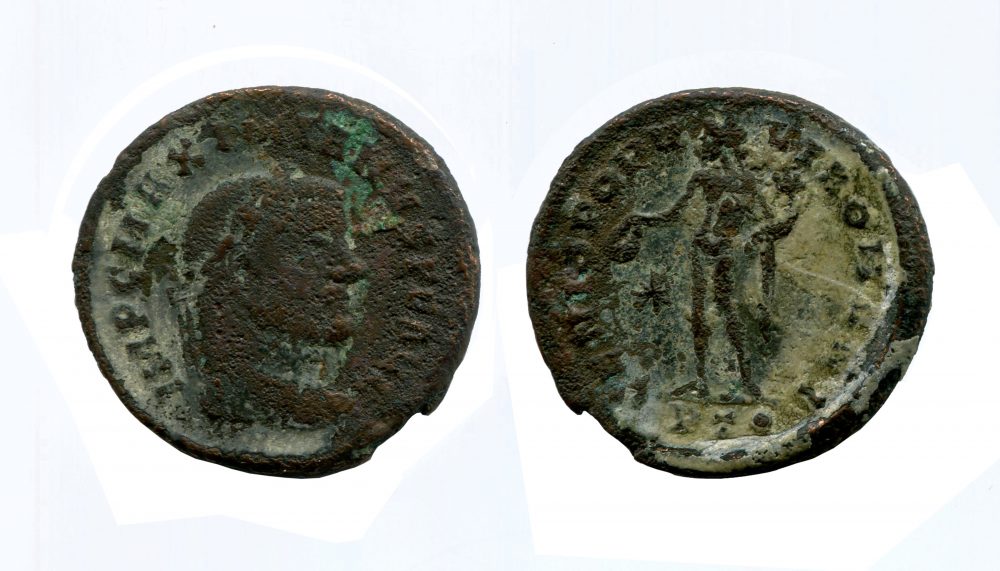
Among other responses with pieces of information, most explicit was the wonderful email from Steve Moore with a photograph of the same coin in fantastic shape:

Roman coin of Maximianus 298-299 AD

and an arcane collectors’ description: “Maximianus (298-299 AD) AE Follis, 9.92 grms, 28 mm,Ticinum mint; Obv.: IMP C MAXIMIANVS PF AVG, Laureate head right.Rev.: GENIO POPV-LIROMANI, Genius naked.” Steve added that the genius is holding a “pater” (plate for offerings) in his right hand. Mystery solved; probably deposited in the early 4th century AD.

A few respondents wrote about who Maximianus was, namely the co-Emperor with Diocletian. A researcher on Roman history, Richard Stross noted that “Rome’s most severe persecution of Christianity was the Great Persecution of AD 303 to 313.” He felt it reasonable that persecuted Christians or supporters of losing political rivals might well have come to this continent. So do I.

I also found Stross’ other thoughts very informative. For instance, about artifact finds, he remarked: “Perishable materials such as wood, cloth, and leather would have rotted. Iron implements generally would have become unrecognizable masses of rust. A small expedition would not build stone buildings, and Romans generally did not use stone for small implements. Gold and silver were rare and expensive, so there would be very little if any on the expedition. The artifacts we would expect to find would be items of bronze, ceramics, or glass. The bronze items, in addition to coins, would be small common articles such as buckles and pins.”

But that’s not all. Stross adds an interesting perspective: “Except for coins, the small bronze artifacts may appear similar to modern scraps of metal. Artifacts of bronze may have been found, but not reported because they were not suspected of being ancient. Roman potshards may have been found, and ignored because they appeared to be broken pieces of modern ceramics. Even an intact cup, bowl, or jug may have appeared to be modern and therefore ignored. An exception would be the small ceramic oil lamps.”

And he knew of such an exception: “It appears that at least one oil lamp may have survived in America. I read a newspaper article in the 1980s of one that was discovered in Chillicothe, Ohio. It was buried several feet deep, so it was not lost recently; it was either lost in ancient times or was intentionally buried. It was examined by an expert, and verified as a genuine antiquity.” Several others have apparently been found…

Some respondents ventured to explain how my coin might have gotten into that flower bed in Ann Arbor. One fellow proposed: “At one time someone made the grand tour of Europe and either found it or bought it as a souvenir. Or perhaps a soldier in WWII found it while on his Tour of Duty over there. Either way, it simply got lost. This would also explain that hoard ‘found’ in 1993 as well as most of the rest.”

Recognizing his facile explanation as Chapter and Verse of the academic dogma, I noted that the site had been in an agricultural field until my house was built, so he quickly revised his scenario to a farmer out plowing who loses his watch-fob. Convenient. The well-trained fellow simply ignored my other note about mineral encrustation from centuries underground.

More charming, if even less credible, was one woman’s “half-cooked, caffeine-induced theory … that early French explorers venturing down into Michigan used the coins to trade with local Native Americans.” I don’t think so. Using Occam’s razor, I’d say my coin was most likely buried in the early 4th century in a small mound on that hilltop overlooking the Huron River.

As a matter of fact, Angelina Spencer wrote that: “I too, along with my brother, found similar coins near a plowed ‘hill’ outside of Monroeville, Ohio near our Huron River.” [She added an intriguing note touching on another important ancient mystery: “Some Firelands settlers accidentally dug up native burials back in the 1800’s (all sitting, facing West), but some were tall with Red hair (whether this is true or hyperbole I do not know). Copper armbands and black pearls were found as well as coins.”]

Some respondents were confident that other artifacts could surely be found on that Ann Arbor hilltop. One fellow, an adept at finding lost objects, virtually guaranteed that gold was to be found there. Now, I’m not particularly allured by “treasure,” but I’m just as certain that other coins are lurking in that vicinity—and maybe an entire burial complex.

All it would take is a good metal detector, appropriate permissions, and someone to wield the machine. There’s bound to be a bunch of accomplished detector folks out there. If such a “someone” wants to take on the project, I might be convinced to supply the address, maybe even convince me to go on the expedition!

#

Heretical History

During my recent exhibition (entitled YE GODS! Icons of Aztec Deities), I gave a series of 15 lectures on the Aztec codices and Aztec mythology, culture, and history, branching out in later sessions to New World history in general. From the beginning, I stressed to my listeners that as an independent researcher and theoretical historian (a “historician”), I like to consider probable answers for puzzling questions which the academic establishment refuses even to recognize. I warned them to get ready to hear some historical heresy.

For example, in lecture 10 (Continuity of Culture and Art in Mesoamerica), I discussed the continuity of the ceremonial calendar from the Olmec through the Maya and into the cultures of central Mexico (culminating in the “Aztec calendar”). Then I proposed that the calendar may well have been invented at Chavín de Huantar in Peru.  I published the convincing circumstantial evidence in the article “Source of the Mesoamerican Ceremonial Calendar” in the magazine Ancient American (Issue No. 115) and noted probable diffusion via sea-farers sailing north up the Pacific coast to reach the early Olmec.  That was Heresy No. 1.

Then in lecture 12 (Mesoamerican Relations with Mississippi), I broke some startling news which was corroborated by the website www.peopleofonefire.com, issued by Richard Thornton, a researcher of Native American heritage.  He has discovered convincing linguistic, DNA, and archaeological evidence that populations from Meso- and South America migrated into the Southeast of North America hundreds of years before the European “discovery.”

Independently, I had previously identified a shell gorget from northwestern Alabama depicting the Mesoamerican Fifth Sun, Four Earthquake, and in my article “Mesoamerican Influences in Mississippi” in Ancient American (Issue 118), I presented ethnographic testimony that (probably under pressure from the aggressive imperialism of the Toltecs), a tribe of Totonacs from Vera Cruz had migrated into the Muscle Shoals area to become the Chikasa (Chickasaw).  Though well-documented, that was Heresy No. 2.

In lecture 14 (Mesoamerican Relations with the Anasazi), I expanded on a proposal by Frank Joseph in “Advanced Civilizations of Prehistoric America” that the Huari of Peru (likely an evolution/reincarnation of the more than three millennia-old culture of Tiwanaku from Lake Titicaca) had migrated up the Pacific coast, through the Sea of Cortez, and up the Colorado River to become the Anasazi of Chaco Canyon. So I was merely guilty of repeating Heresy No. 3.

However, in that context I uttered my own Heresy No. 4: that some populations from the west coast of Mexico may possibly have sailed up the coast and “colonized” the Pacific Northwest.  As I noted to my audience, I made this heretical proposal simply on the basis of a linguistic coincidence (something I generally don’t much appreciate in others’ arguments).

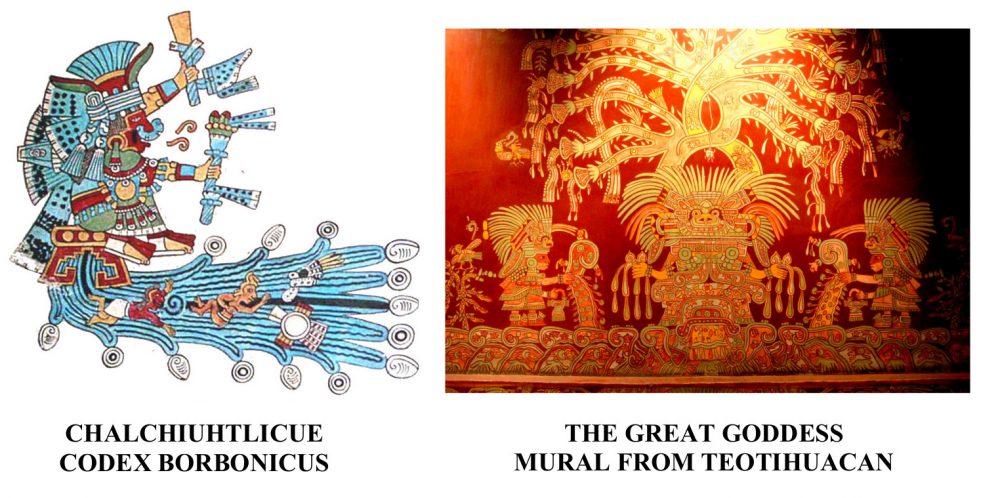
Namely, the city of Seattle was supposedly named for the “chief” of a Native American tribe on the Olympic Peninsula. Well, it just so happens that Ce Atl is the Nahuatl day-name (One Water) of the goddess of water, Chalchiuhtlicue, the Jade Skirt.  She was earlier the Great Goddess of Teotihuacan, likely with the same calendrical name, which may have also held for the Maya goddess of water, but deity names in that even earlier culture are rather confused.

Mesoamerican goddesses of water

As a name for the Pacific Northwest area, a people, an important “town,” or even a chief, One Water seems a legendarily appropriate name for a Mesoamerican “colony” in that area. Such a colony might have happened due to social turmoil amongst the classic Maya, to later aggression by the Toltecs on populations in western Mexico, or even as more recent Aztec (Nahua) imperial “exploration.”  In any case, my heretical suggestion was basically a frivolous “teaser.”

For a couple weeks, that’s what it was for me too, simply an intriguing possibility—until I started reading “The Journals of Lewis and Clark” (edited by Bernard DeVoto). Their first mentions of the Salishan (“Flathead”) tribes in the western Rocky Mountains didn’t give me pause, but when that characteristic kept appearing amongst the tribes down the Columbia River, I had to stop and wonder.

While that exploratory expedition wintered at the mouth of the Columbia, they had much communication and commerce with the many coastal tribes. On March 19, 1805, Captain Lewis took the time (in his fairly “scientific” manner) to write:

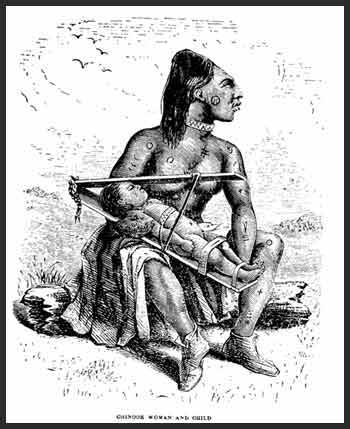
“The Killamucks, Clatsops, Chinooks, Cathlahmahs, and Wâc-ki-a-cums resemble each other as well in their persons and dress as in their habits and manners. their complexion is not remarkable, being the usual copper brown of most of the tribes of North America.  they are low in statu[r]e, reather diminutive, and illy shapen; poss[ess]ing thick broad flat feet, thick ankles, crooked legs wide mouths thick lips, nose moderately large, fleshey, wide at the extremity with large nostrils, black eyes and black coarse hair.  their eyes are sometimes of a dark yellowish brown the puple black.  the most remarkable trait in their physiognomy is the peculiar flatness and width of forehead which they artificially obtain by compressing the head between two boards while in a state of infancy and from which it never afterwards perfectly recovers.  this is a custom among all the nations we have met with West of the Rocky mountains.  I have observed the heads of many infants, after this singular bandage has been dismissed, or about the age of 10 or eleven months, that were not more than two inches thick about the upper edge of the forehead and reather thiner still higher.  from the top of the head to the extremity of the nose is one straight line.  this is done in order to give a greater width to the forehead, which they much admire.  this process seems to be continued longer with their female than their mail children, and neither appear to suffer any pain from the operation.  it is from this peculiar form of the head that the nations East of the Rocky mountains, call all the nations on this side, except the Aliohtans or snake Indians, by the generic name of Flatheads.”

Chinook woman and child

Surely I am not the first to note that Captain Lewis has described in exquisite detail the traditional Maya practice of skull deformation. (That same practice also occurred in other parts of the world and among certain tribes of the American Southeast who—per Heresy No. 2 above—migrated there from Mesoamerica.)  With this official testimony, it seems more than probable that this widespread cultural practice in the Pacific Northwest came from a coastal colony of the Maya. The also widespread practice of nose-piercing (as in the Nez Perce tribe and others) could just as easily have disseminated from such or later Mexican settlements.

Considering this distinct possibility, I believe it’s high time someone ran a DNA study of the surviving Northwest tribes to see if they actually do have markers of Mesoamerican populations. Likewise, it would make sense for someone with the expertise to compare the languages of those tribes with those of Mesoamerican peoples. There is a distinctly Nahuatl-ish sound to the names of the Tlingit and Kwakiutl tribes…

But even without such genetic or linguistic evidence, I will now make bold to propose that there was indeed a Mesoamerican colony (or colonies) on the Pacific Northwest coast. And having uttered that blasphemy, I’ll prepare for the academic inquisition to try and burn me at the stake.

Ancestors, Level 1, My Parents

To explain: I’ve just enjoyed a new contact with a young man in Miami about my image of the Aztec deity Xochipilli, who appears (above) on the masthead of my webpages and blogs. As the god of homosexuals (and a whole lot more), the Prince of Flowers has long been my patron. Unfortunately, he sits down by the end of the alphabet (with the other x’s), and it’ll be a couple years till I get around to doing his icon for my coloring book YE GODS!

My new friend Walter identifies as a pagan and practitioner of the Unnamed Path, which sounds quite like mine, though I didn’t think to name my path. We’re both on the beautiful paths (as the Navajo would say, walking in beauty) for men who love men. You can find Walter on his splendid path at http://sacredbonfire.com.  Meanwhile, as a headline on his emails, he includes, “The ancestors are speaking. Are you listening?”

Struck by that profound question, I realized that for a long time that I’ve been dancing around the urge to blog about my ancestors. So far I haven’t written much about them, except in that biography: “Ms Yvonne, The Secret Life of My Mother.” I was too focused on my own terribly fascinating self to pay any attention to the sources of my miraculous being.

Understandably, in researching the biography, I learned a great deal about my parents, as well as about my roots in the generations before them. In that writing, I organized the boxes of old family photographs and in the process quickly became an expert photo-restorer. The art is very like painting, just as aesthetically fulfilling, and playing with pixels to reconstruct an ancestor’s face creates intense emotional connections with the subject, let me tell you. Suffice it to say, I now have plenty photo-paintings to illustrate blogs about several levels of my ancestry.

Naturally, we’ll start at level 1 with my parents, who were people I’d never really known before that research and restoration of their images. I was simply a kid, and they were folks who took care of me. There was no discussion of who they were then or in their pasts, and the oblivious child never even wondered, too busy wondering who I was.

My mother, Yvonne Marie Trinité, was born on January 18, 1919 in Baltimore, Maryland. I discovered that she was quite a fashionable young woman in the thirties who led a nicely sociable life with a number of boyfriends. When she was nineteen, in 1938, a beau took her boating on the Chesapeake and snapped a tiny shot of a virtual goddess of the sea. Retrieving it from a miniature print (1 sq. in) in a foggy blur, I’ve put it up on my refrigerator where I can thank her every morning for solving my life.

Yvonne by the sea, 1938

Meanwhile, over in Wisconsin my future father, Raymond John Balthazor, was born on January 30, 1916 in the village of Bear Creek, and the family soon moved to the big city of Fond du Lac. In school he came down with scarlet fever, an often fatal disease from which he recovered—but with a damaged heart. In 1939, after taking courses at a business college, Ray landed a job with Social Security in Baltimore and had a (retouched) portrait taken for the announcement in the Fond du Lac newspaper. He was a good-looking young man of twenty-three.

Ray, 1939

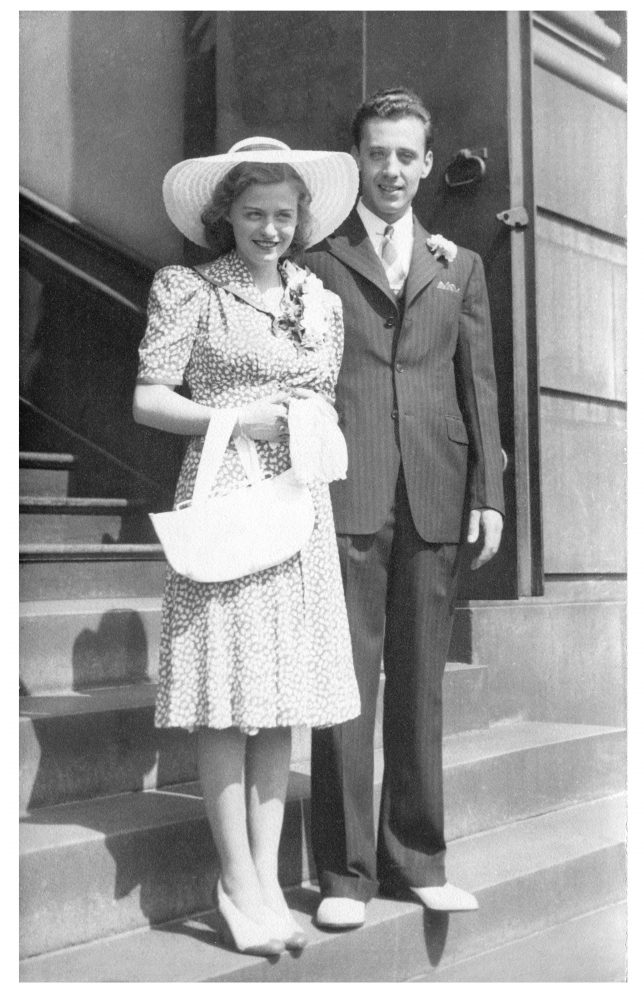
That’s why Ray and Yvonne met, but further details of their romance are unavailable. They were married on Wednesday, June 19, 1940, both dressed up in the high style of the period:

Wedding of Yvonne and Ray, 1940

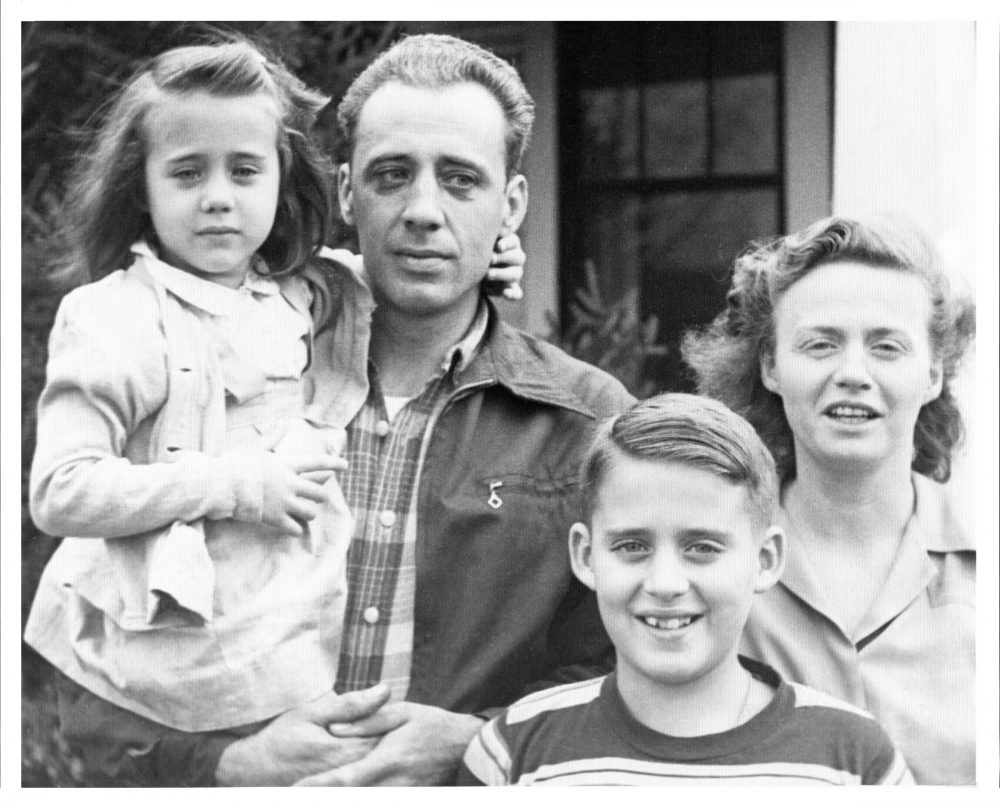
True to form, kids came along, first me in 1942 and then my sister Judy in 1947. In 1952 the family moved to LaMarque, Texas for Daddy’s job as a tax accountant in a chemical plant. When we’d moved into our new house, a neighbor took a picture of us for posterity. Notice that at 36 Daddy was already going grey:

The Balthazors in LaMarque, 1952

For two years in Texas we had a fairly normal nuclear family life, but then in 1954 Daddy took us off into the woods of Arkansas to a truck-stop café on Highway 74. Thereafter, our familial relations essentially disintegrated, but that’s another story I’ve reflected in my autobiographical novella “Bat in a Whirlwind.” After I left home for college at eighteen in 1960, Daddy only lived another six years, dying of heart problems at only 50.

In 1971, after five years of widowhood, at 52 Mother married a Texan named Bill Tapp, but only a year later was abandoned by that husband. Afterward, she enjoyed single life in New Orleans for another 42 years, her favorite activity being square-dancing. Yvonne’s really big adventure was surviving Hurricane Katrina in 2005. She kept on square-dancing right up to 93, as in this 2011 snapshot by a dancer friend when she was 92. In early 2013 Yvonne died peacefully at 94.

Yvonne at 92, 2011

###

Ancient Coin Found in Ann Arbor MI

While a grad student at the University of Michigan, in the summer of 1967 I moved with my young family into a new subdivision on a sloping street in Ann Arbor. Perched on the gentle slope on a pad levelled by a slight scraping into the rise behind, the house backed up to the low, rounded crown of the hill overgrown with brush and bushes.  I immediately planted some flowers in the strip of freshly disturbed soil between the house and the newly laid sidewalk.  In my digging, I came upon an obviously ancient, apparently bronze coin.  I washed the loose soil off of it but didn’t disturb the lighter-colored material encrusting about 75% of the piece.


The coin notably measures precisely 1 inch in diameter. At first I put the coin in with other keepsakes and then some decades ago placed it in a small plastic bag with a note of where it was found.  For the past 50 years it has been only very minimally handled and shown to just a few friends as the one true mystery in my life.

In past years I occasionally read about Roman coins being found around the American Midwest, mostly along major river valleys, and marveled that I too had found one. Mine was found in the low hills of southern Michigan but not far from the Huron River.  Reading more recently about mounting evidence for a Roman presence in pre-Columbian America, I tried to identify my coin by researching the databases of the American Numismatic Society but was overwhelmed by their 42,000 + examples of Roman coinage.

After inspecting only a couple thousand of the coins in their collection, I noted that in the mostly illegible legends on mine the “IMP” on the obverse is standard for “Emperor.” Meanwhile, I found no portraits resembling the head, none with that tassel or braid at the back of the head, and none with that decidedly un-Roman nose.  On the reverse, the standing figure differs in posture from more usual standing figures of Apollo and holds something like a bag in the right hand and possibly a floral bundle in the left arm.  Also, the legend or symbols uniquely continue beneath the figure’s feet, and a strange rayed symbol peeks through the encrustation by the knee.

I’m sending this description and image to the following authorities in hopes:

1) that the American Numismatics Society will authoritatively identify this coin;

2) that the Kelsey Museum of Archaeology will advise on appropriate steps for analysis and conservation and suggest means for further research at the discovery site;

3) that the Historical Society of Michigan will advise me of similar or related finds in the state and suggest an appropriate repository for the artifact; and

4) that the City of Ann Arbor will facilitate any further research at the discovery site and any publicity that might follow.

Meanwhile, I’m posting this letter on my website www.richardbalthazar.com and requesting similar input from the Internet world at large.  Please email me at rbalthazar @ msn.com.  I will incorporate any responses in more web postings and plan to publish an article on the artifact in the magazine “Ancient American.”

About the discovery site, I researched my old address on Google Earth and found the house still there. The low hill behind is still undeveloped after these 50 years and covered with large trees.  After some decades of researching Indian mounds (and publishing the book “Remember Native America, The Earthworks of Ancient America”), I reasonably suspect that the hilltop could well be a mound containing far more prehistoric material than a single coin.


Aztec Icon #14 – QUETZALCOATL, Plumed Serpent

Sorry to take so long to finish the 14th icon for my coloring book YE GODS!  My work was delayed by that time-consuming thing called life.  Anyway, the icon’s done and my digital wizard has turned it into vector drawings for free sizing.  Here you have the most famous Aztec deity of all, QUETZALCOATL, the Plumed Serpent:

Quetzalcoatl, Plumed Serpent

QUETZALCOATL (Plumed Serpent) {ke-tsal-ko-atł} is the god of intelligence, learning, writing, arts and crafts, the calendar, priests, and merchants and was the bringer of maize to mankind.  Opposed to human sacrifice, he is called the White Tezcatlipoca and is the 9th lord of the day and god of the West. As the planet Venus, he is known as Tlahuizcalpantecuhtli, the morning star, and his twin Xolotl is the evening star.  He ruled the Second Sun (Four Wind) and created the current Fifth Sun (Four Earthquake) by using his own blood to give new life to the bones in Mictlan.  He was known as Kukulcan to the Maya and a major deity in Teotihuacan, and Quetzalcoatl was the traditional name/title of the Toltec rulers of Tula.

This icon is available as 8X10 with a caption/sources page by clicking here.  The freely sizable vector versions are available by clicking here.

By way of explaining this new icon, I must first thank Eliseo Rosales, a tattoo artist in California, for his suggestions, particularly for the design on the pedestal and for the important theme of maize.

The central figure of Quetzalcoatl is based on an image from Codex Borbonicus with details of costume and accoutrements mostly from Codex Magliabechiano, though the serpent on his back is adapted from those on the Stone of the Suns. Don’t be surprised by his beard, which occurs in other codex images:  According to some, he was supposedly blond and white-skinned.

In his left hand, the deity holds the weapon known as Xiuhcoatl (Fire Serpent), and on his shield is his standard ‘cross’ symbol. His peaked cap of jaguar pelt is apparently a Huastec influence.  Sprouting from his forehead is a ritual ‘blooming shinbone,’ the significance of which escapes me.  The numeral by his left foot is Nine, of which he is the patron, and the day-sign One Reed directly over his head is his ceremonial day-name.

Now for the other motifs. The pedestal, as mentioned above, illustrates the depth of the history of the Plumed Serpent.  It comes from the frieze on the Temple of Quetzalcoatl in Xochicalco (c. 1000 AD), which was a city/culture that arose in the aftermath of the Classic civilizations of the Maya and Teotihuacan.  As evidence of his even deeper history, the two heads flanking his day-name are views of sculptures on the Temple of Quetzalcoatl in Teotihuacan (c. 600 AD).  The paired feathered serpents on his either side are taken from Codex Borbonicus and Codex Telleriano-Remensis, and the paired quetzal birds are merely grace-notes.

The border design is adapted from one of his images in Codex Telleriano-Remensis. The day-signs embedded in it represent the ceremonial calendar which the deity brought into Mexico in the dim past.  Each group of five days represents a direction in the Aztecs’ odd world-view.  At the bottom is West, of which he is the patron.  At the top is East, on the left North, and on the right South, the standard Aztec spatial orientation as it was also for the Maya.

Drawn respectively from the Cospi, Vaticanus, and Borgia codices, the standing deities in the upper section are: on the left, Tlahuizcalpantecuhtli, Lord of the House of Dawn (as the Morning Star), on the right Xolotl (as the Evening Star), and at the top his nagual (manifestation) as Ehecatl, God of the Wind.

In the upper corners are scenes representing his gift of maize to mankind. On the left is Tlaloc, the Storm (Rain) God, nurturing the goddess of maize Chicomecoatl, and on the right is the goddess of flowing water Chalchiuhtlicue tending the god of maize Centeotl.

That’s all the mythology I could manage to cram into this icon. Surely it’s enough.

#

Another note of interest about Quetzalcoatl. In the September, 2017 issue of ANCIENT AMERICAN magazine, my article just appeared entitled “The Plumed Serpent in North America.”  Click here to check out a copy.

More Indian Mounds

It’s been a good while since my last posting in June about the Aztec Codices, but that doesn’t seem to have bothered my multitudinous non-readers worldwide.

Shortly after that, I went on the family vacation I mentioned in the first week in July. We went to a place on a lake near Hot Spring, Arkansas and had a lovely rural time of it, though we came home with a bunch of chiggers.

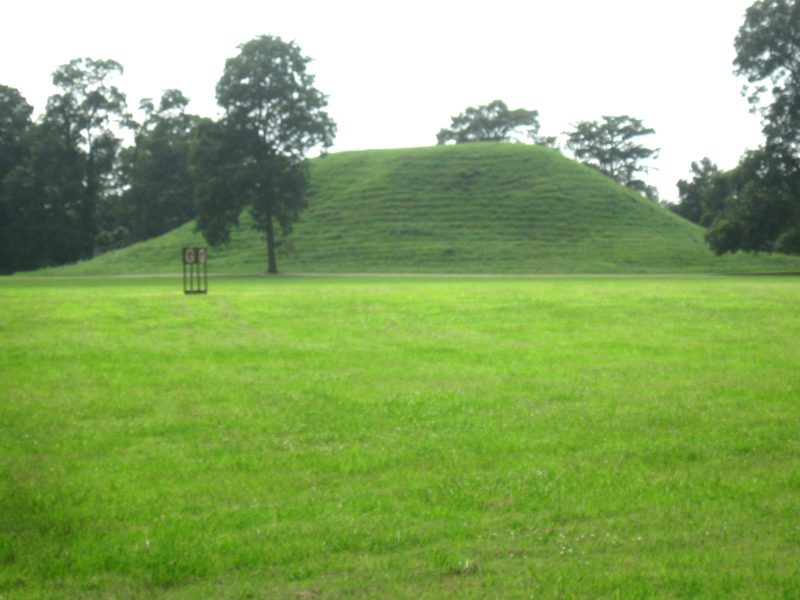
While there, we visited the Toltec Mounds Archeological State Park near Little Rock, a site I’d never seen before, though I’d included a drawing of it in my old book on the Indian mounds called “Remember Native America.” It was a rainy afternoon, but I still managed to take some pictures of two of the surviving pyramids, which I’ve finally managed to figure out how to add to the Gallery of Indian Mounds.

AR one pyramid, Toltec Mounds

AR another pyramid, Toltec Mounds

The Toltec mounds (no connection whatsoever to the Toltecs of Mexico) are an early Mississippian site, abandoned by 1050 AD, which may actually be related to the Mayan civilization. It might well have developed under the influence of Maya or Teotihuacan traders, or even migrations at the collapse of those civilizations around 800 AD.  We’ll just have to see what further research makes of that possible connection.

Meanwhile, I’ve also uncovered a number of earlier photos (slides) I took of other mound sites and have also added them to the Gallery: more from Moundville AL, Cahokia IL, Marietta OH, Crystal River FL, and Nanih Waya MS.  Check them out.

Which brings us back to my suggestion from when I put the Gallery together nearly four years ago: Surely there are other folks out there who have good pictures of Indian mounds, and I would love to include them in the Gallery.  Email them to me at rbalthazar @ msn.com with the state and site name.  I’ll plug them in to this collection, which as far as I know, is the only one of its kind.

YE GODS! THE AZTEC CODICES

Here it is at last, the third part of YE GODS!  This is the promised illustrated commentary on the Aztec Picture-Books, a unique discussion with examples of the fifteen codices that survived the book-burning during the Spanish Conquest of Mexico.  I can guarantee you’ll never have seen anything like this in terms of art history, mythology, and Aztec ethnography.

Click here to view or download YE GODS!  THE AZTEC CODICES

Or click here to visit the cover page for the new section

It’s been a couple months since I last posted anything, (not that anybody out there really cares, I suspect), but the time has been well spent on completing this project, in and around many other developments in my life.  Not the least of those was running around trying to set up an exhibition of the Aztec Icons, without success to date, and to interest a local non-profit publisher in making a book on the whole three-part YE GODS! shebang (which never materialized).  The next epiphany of 13 icons still remains to be drawn.

In other developments, it took these couple months to move to a new apartment, including some weeks to move my iris garden to the new place.  It’s splendid with a huge balcony/porch and a big area for a garden and enormously convenient to my gym and other amenities.

In terms of iris, I’m thrilled to report that after five years of looking and wheedling, I’ve finally found someone to start up my plant recycling business again.  A young fellow named Aaron jumped in with his shovel and has already been selling iris on Craigslist like hotcakes.  He plans on selling at farmers markets around here and should do a land-office business, so to speak.

Now my big plan is to go with the family for a vacation during the first week of July at Hot Springs, Arkansas.  It should be a sentimental time because it’s quite close to my childhood home in the southwestern woods of that state.  Maybe I can even get my grandsons to read BAT IN A WHIRLWIND!