Aztec Calendar – Deer Trecena

The third trecena (13-day “week”) of the Aztec Tonalpohualli (ceremonial count of days) is called Deerfor its first numbered day, which is the 7th day of the veintena (20-day “month”). In the Nahuatl language Deer is Mazatl, and it’s known as Manik’ in Yucatec Maya and Quej in Quiché Maya. As the only other large food-animal in Mesoamerica (the peccary and turkey being much smaller than either), the deer was important protein for the populations, and their relationship to this timid animal is celebrated in many codices, mostly of slaughtering it. The leg (haunch) of the deer is also a frequent motif. Each of the days (tonalli) represents a specific human body part, and the deer is connected with the right leg. Don’t ask why.

PATRON DEITIES RULING THE TRECENA

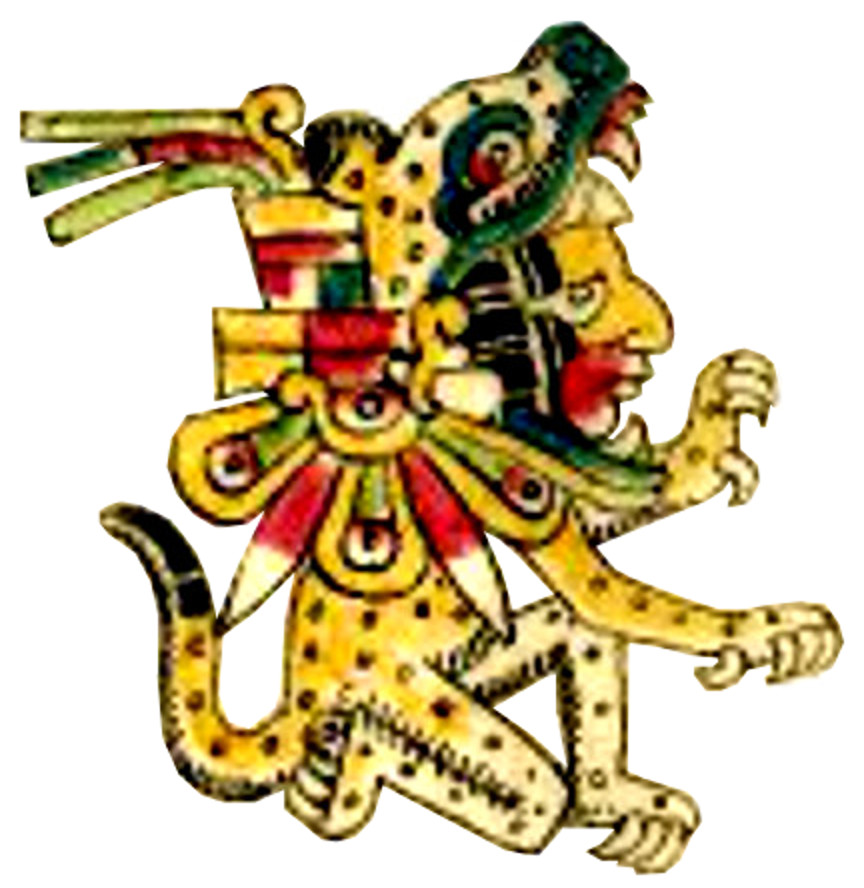
Tepeyollotl (Heart of the Mountain), god of caves and echoes, is the principal patron of the Deer trecena. He causes earthquakes, avalanches, and volcanos, and cures and causes diseases. A deity of witchcraft, he guards the entrance to Mictlan, the Land of the Dead. Possibly God L of the Maya, he may also be the primordial jaguar-man from even deeper in pre-history. As the Jaguar of the Night whose roaring heralds the sunrise, Tepeyollotl is a nagual of Tezcatlipoca, also known as the Lord of Jewels (mines) and 8th lord of the night. (See my Icon #17.)

There is doctrinal disagreement among the codices about the secondary patron of the Deer trecena. In Borgia and Vaticanus, it’s the goddess Tlazolteotl, but in the rest it’s Quetzalcoatl. This may well reflect regional calendar cults. Make of it what you will.

Tlazolteotl (Goddess of Filth) is goddess of fertility and sexuality, motherhood, midwives, and domestic crafts like weaving. On another hand, she is also the patron of witchcraft and fortune-tellers and of lechery and unlawful love, including adulterers and sexual misdeeds. She cures diseases, particularly venereal, and as the goddess of purification and bathing, forgives sins. (Her mouth is usually black from eating all those filthy sins). People confess their sins to her only once in their life, usually at the very last moment, and besides that rite (which Spanish clergy recognized as parallel to their sacrament of confession), her rituals include offerings of urine and excrement. One of several earth-mothers, Tlazolteotl is reputedly the mother of the maize deities Centeotl and Chicomecoatl, though divine genealogy is notoriously nebulous. She is also 7th lord of the night and patron of the number 5. According to some codex images, her day-name may be Nine Reed, which isn’t particularly pertinent to her divinatory significance.

Quetzalcoatl has been discussed at length as the sole patron of the previous Jaguar trecena. There remains little or nothing to add in conjunction with this appearance in a supporting role.

AUGURIES OF DEER TRECENA

By Marguerite Paquin, author of “Manual for the Soul: A Guide to the Energies of Life: How Sacred Mesoamerican Calendrics Reveal Patterns of Destiny”

Another strongly earth-oriented time period, this trecena is aligned with the general idea of “sacrifice and reconciliation.” It is often a period that calls for “give and take,” negotiation, cooperation, and even “forgiveness” in response to events of a high-stakes nature. The idea of the deer working with the hunter to provide a “giveaway” in order to sustain life is a metaphor that could apply here. Emphasis is on working together towards achieving “sacred balance” and harmony with the earth.

Further how these energies connect with world events, see the Maya Count of Days Horoscope blog at whitepuppress.ca/horoscope/. Note that the Maya equivalent is the Manik’ trecena.

THE 13 NUMBERED DAYS IN THE DEER TRECENA

The Aztec Tonalpohualli, like the ancestral Maya calendar, is counted through the sequence of 20 named days of the agricultural “month” (veintena), of which there are 18 in the solar year. Starting with 1 Deer, the trecena continues 2 Rabbit, 3 Water, 4 Dog, 5 Monkey, 6 Grass, 7 Reed, 8 Jaguar, 9 Eagle, 10 Vulture, 11 Earthquake, 12 Flint, and 13 Rain—completing the count before finishing the veintena.

The Deer trecena contains at least two significant days:

One Deer (Ce Mazatl) may be the day-name of Xochiquetzal, the Flower Feather. (Lacking birth certificates, divine birthdays, like genealogies, often depend on cults and are no more certain or verifiable than those of mythical beings in western religious traditions.) She’s the ever-young goddess of love, beauty, female sexuality, and fertility—though her worship involves some surreally gruesome sacrificial rites. Xochiquetzal protects young mothers in pregnancy and childbirth, and is a patron of weaving, embroidery, artisans, artists, and prostitutes. As she’s the patron of the 19th trecena, Eagle, more of her scandalous mythology will be presented there.

One Deer (Ce Mazatl) is also the day-name of one of the Cihuateteo, warrior spirits of women who die in childbirth, who escort the sun from noon to its setting. Demons who cause seizures and insanity, after sunset they go to the crossroads to steal children and seduce men to adultery. Probably a nagualof Xochiquetzal, this one’s area of dangerous influence is beauty, sex, and love. In an image pairing the Cihuateteo with the male Ahuiateteo (gods of pleasure), she’s posed indicatively with Five Lizard (Macuil Cuetzpallin), the deity of sexual excess.

One Deer (Ce Mazatl) is also the day-name in the regional Mixtec tradition for the creative couple, Tonacatecuhtli and Tonacacihuatl (collectively Ometeotl), likely because of the connection between deer and the sun and provision of sustenance. (See the Crocodile trecena.)

Two Rabbit (Ome Tochtli) is the name-day of the principal god of drunkenness, Izquitecatl, one of the innumerable pulque gods known the centzon totochtin (400 rabbits). Among the other 399 rabbit-children of Mayauel and Patecatl who patronize every form of intoxication, alcoholic and herbal, one can name Tezcatzoncatl, Tlilhua, Toltecatl, and Tepoztecatl.

THE TONALAMATL (BOOK OF DAYS)

Several of the surviving so-called Aztec codices (some originating from other cultures like the Mixtec) have Tonalamatl sections laying out the trecenas of the Tonalpohualli on separate pages. In Codex Borbonicus and Tonalamatl Aubin, the first two pages are missing; Codex Telleriano-Remensis and Codex Rios are each lacking various pages (fortunately not the same ones); and in Codex Borgia and Codex Vaticanus all 20 pages are extant. (The Tonalpohualli is also presented in a spread-sheet fashion in Codex Borgia, Codex Vaticanus, and Codex Cospi, but that format apparently serves other purposes.)

TONALAMATL BALTHAZAR

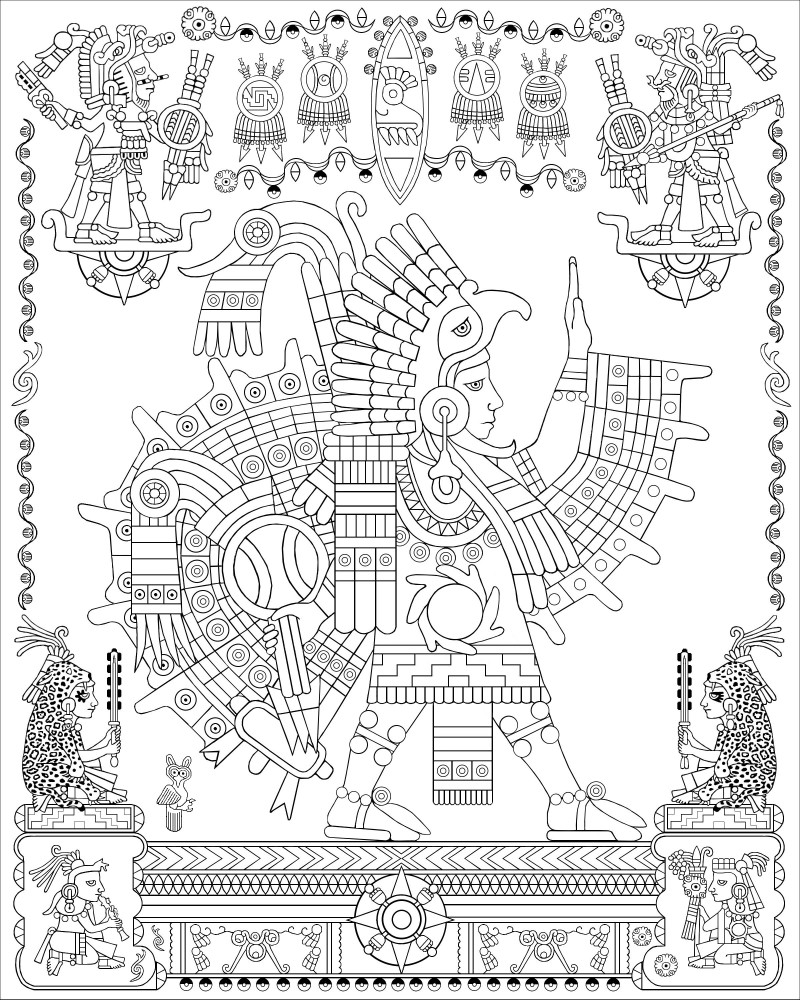
As described in my earlier blog The Aztec Calendar – My Obsession, some thirty years ago—on the basis of very limited ethnographic information and iconographic models —I presumed to create my own version of a Tonalamatl, publishing it in 1993 as Celebrate Native America! With no awareness of secondary patrons, I created an image of Tepeyollotl out of thin air to be the patron deity of the Deer trecena. Well, not quite: I knew what his name meant and that he was the god of volcanos. Working with motifs from Codex Nuttall, I concocted a fairly Mixtec design of angular and stepped patterns with an eruption in his headdress and an abstract pendant suggesting a “heart of the mountain.” Meanwhile, I must have been channeling deep Maya iconography to come up with his front-on cross-legged pose.

Aztec Calendar – Deer trecena – Tonalamatl Balthazar

At this point, I should remark on the layout of the various tonalamatls, about which I had no clue thirty years ago. With the days arranged around three sides of the patron panel, mine was totally unorthodox, resulting in a roughly 3 X 4 height-width ratio. The authentic codices all present their tonalamatls on basically square pages. I’ll explain with each one how that works.

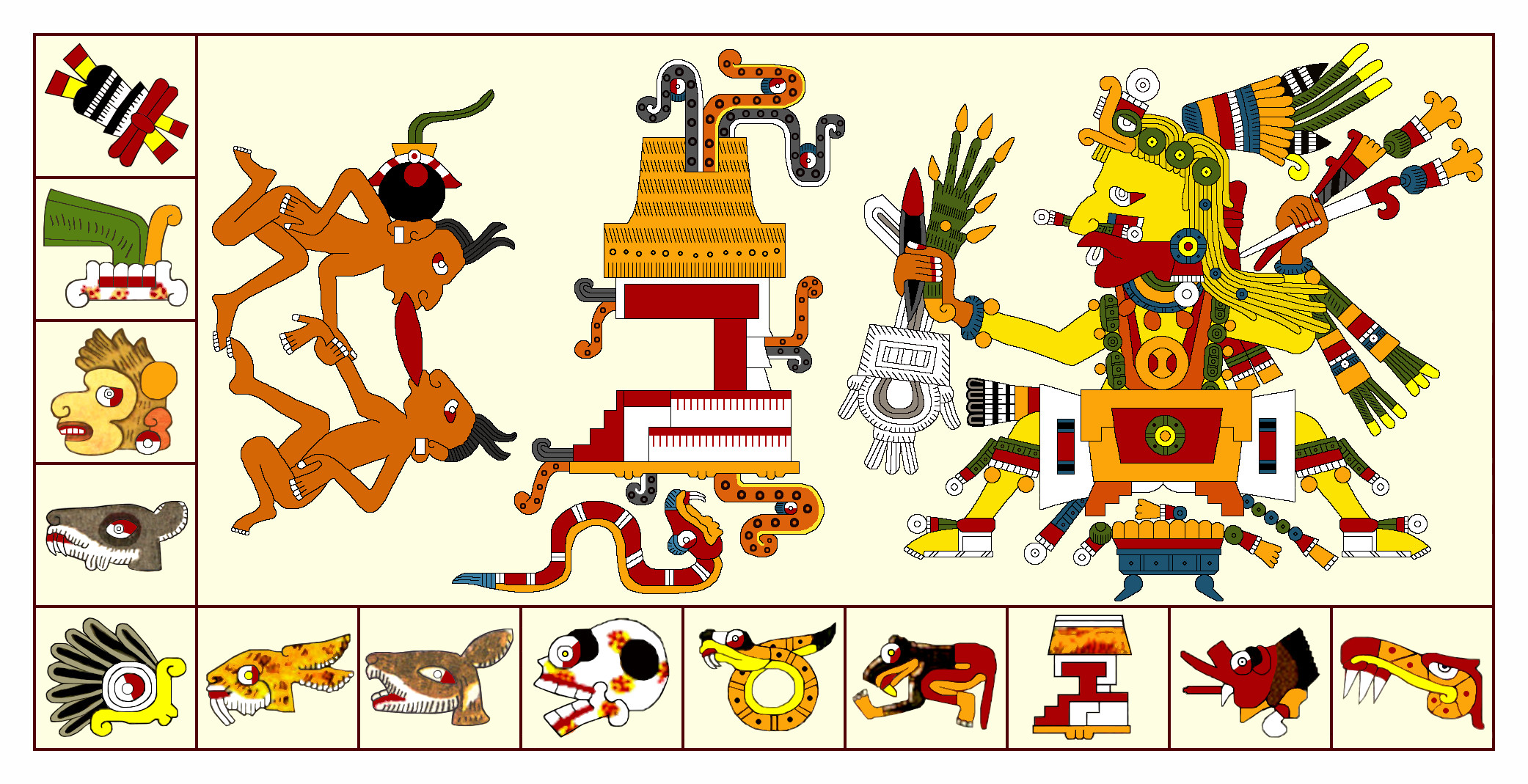
TONALAMATL BORGIA (re-created by Richard Balthazar from Codex Borgia)

Aztec Calendar – Deer Trecena – Tonalamatl Borgia

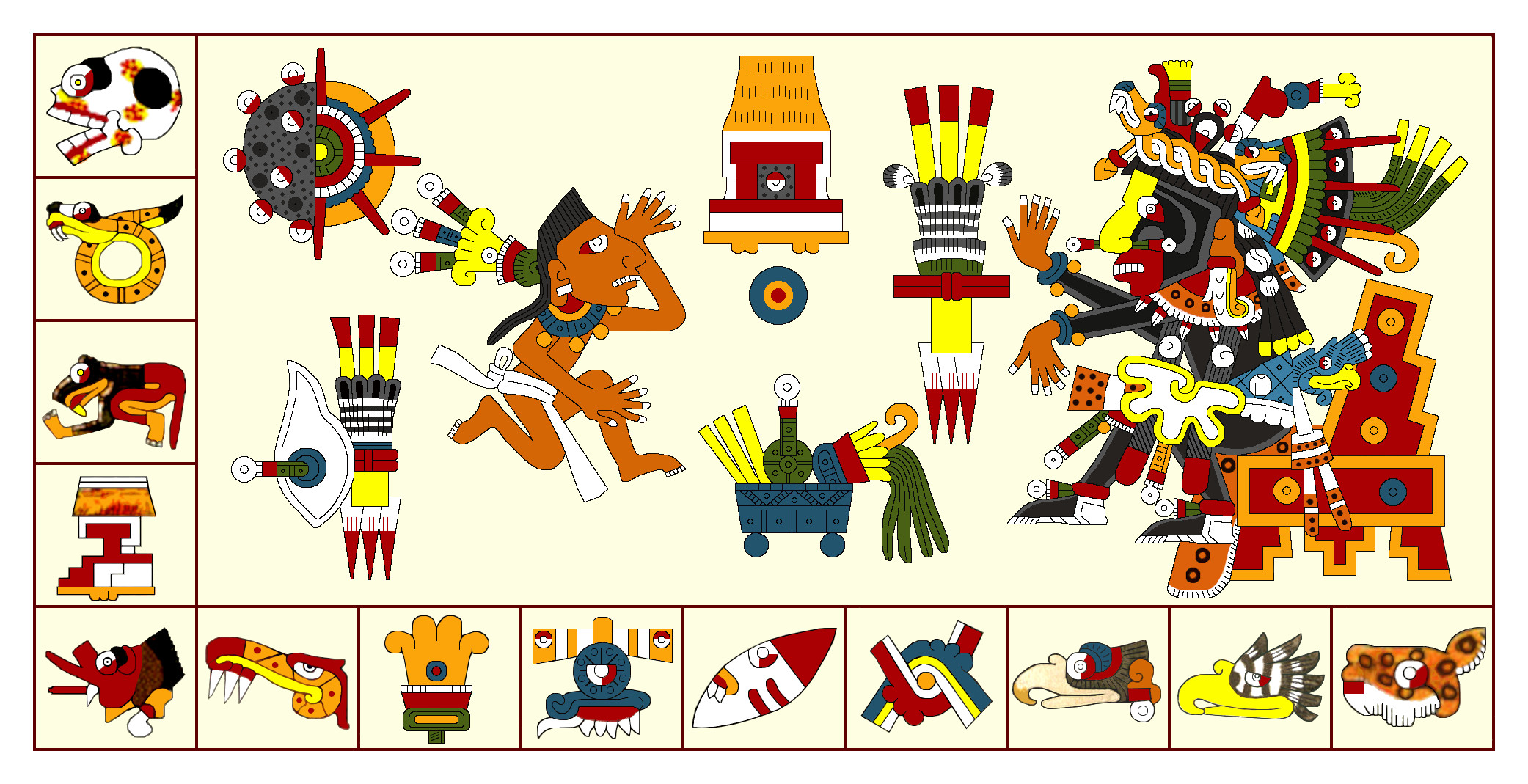
The layout of the Borgia tonalamatl creates square pages by stacking two of the rectangular trecenas. The first ten trecenas run along the bottom of the pages, and then the second ten turns around in boustrophedon fashion to run on top back to the beginning. Thus, the 1st trecena (Crocodile) is capped with the 20th (Rabbit), the 2nd (Jaguar) with the 19th (Eagle), this 3rd (Deer) with the 18th (Wind), and so on. The progression of unnumbered days also switches direction with nine running across the bottom of the panel and four up the side.

In this Borgia trecena Tepeyollotl appears as an in-the-flesh jaguar, which is in keeping with his being the Jaguar of the Night. Note the stars in his jungle/night-sky throne. The golden squiggles rising from his nose represent his roar. Once more, I can’t remark on the fancy paraphernalia floating around in the middle of the panel, except to point out the striped “power serpent” that lurks significantly at the bottom. I wonder what species of snake has that dark tail section. In some other codices the serpents are clearly the quintessential New World rattlesnake, but in Borgia the tails generally have only this dark point, though some flaunt ornamental plumes for tails.

The figure of Tlazolteotl as secondary patron of the trecena displays her emblematic black mouth, her usual curved nose ornament, and a weaving spindle in her headdress. The crescents on her skirt likely refer to her relationship with the moon (menstrual cycles). I have no idea why she’s holding a shield and handful of arrows, but the uniquely trussed-up figure she’s holding by the hair is presumably a sacrificial offering.

Note that the little guy has two right hands. Speaking of which, Tlazolteotl has two left hands, though her supposed right hand is impossibly contorted even for a left one. While I did nothing to “correct” this egregious example of “ideoplasty,” in the interest of aesthetic transparency, I must admit to some artistic plastic surgery on the goddess’s thumbs. In the original image they were both hugely over-sized, that on her left hand twice as large as anatomically proportional. I seriously doubt there was any deeper significance to the monstrous distortion.

TONALAMATL YOAL (compiled and re-created by Richard Balthazar on the basis of Codex

Telleriano-Remensis and Codex Rios)
Aztec Calendar – Deer trecena – Tonalamatl Yoal

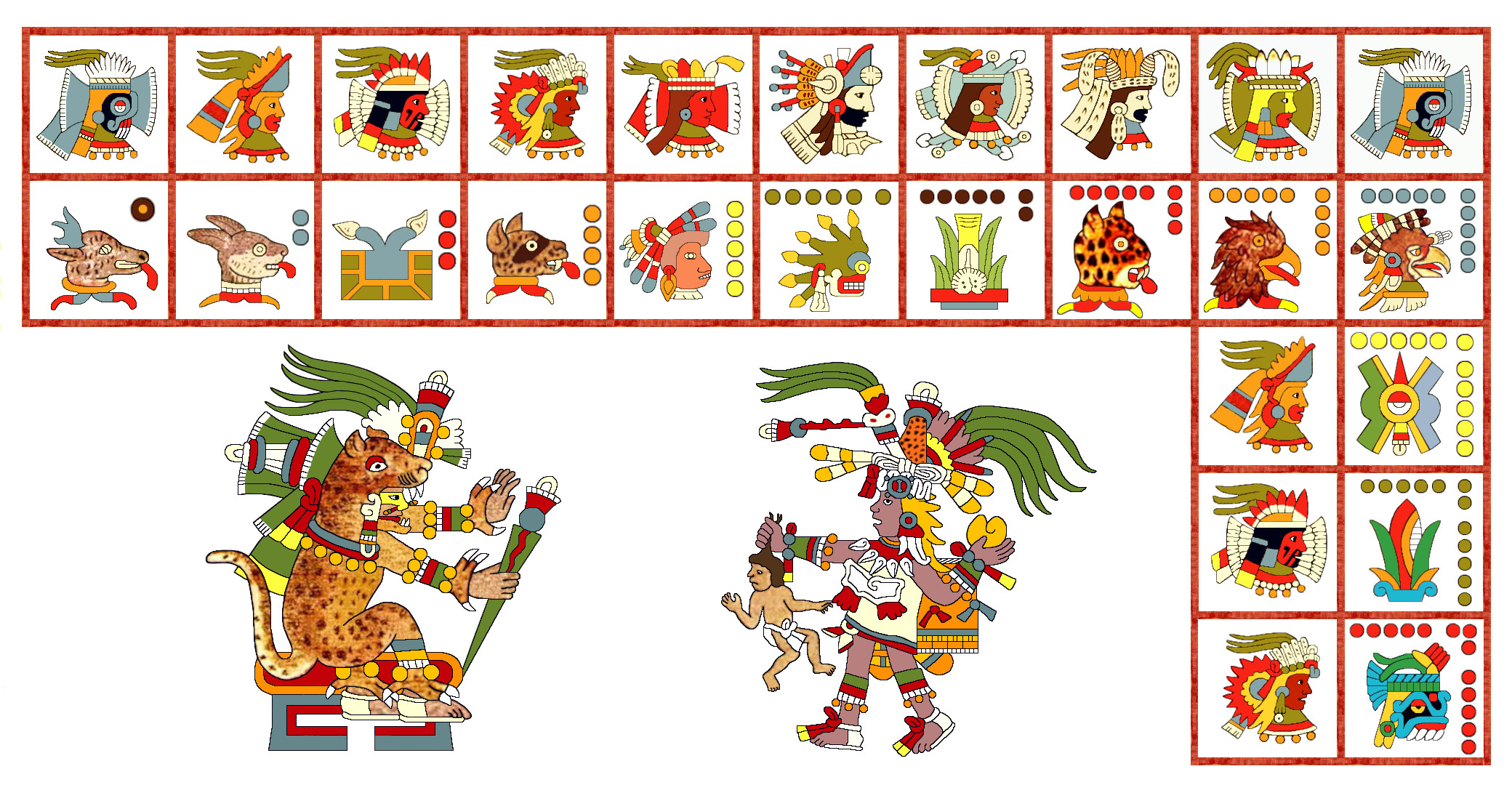
The original two separate pages of Telleriano-Remensis and Rios are essentially square illustrations divided between days five and six, with ten tonalli across the top and three down the side. The lower sections of the separate pages were used for Spanish and Italian commentaries, respectively, with many notes intruding on the images, naming the tonalli, and coding the lords of the night as to good, bad, or indifferent luck. My compilation and re-creation have dispensed with all that archaic clutter.

Observe that the god Tepeyollotl here is in a human form dressed in an entire jaguar pelt, head and claws included. I have greatly refined his face peering from the jaguar’s fanged mouth to reflect his image as 8th lord of the night, second from right on top above the day 9 Eagle. (Note that the third bust from right is Tlazolteotl as 7th lord of the night—with the black mouth and weaving spindles in her headdress.) Again, for transparency, I will admit to giving Tepeyollotl a “correct” right hand with the scepter. Here two left hands were just too jarringly ideoplastic! Otherwise, I strategically adjusted details and made only a few changes to his color scheme.

The figure of Quetzalcoatl as secondary patron is closely related to his image in the Jaguar trecena with outrageous headdress, curious medallion on his forehead, conch-shell pendant, and inexplicable “basket” on his back. Obvious differences are the lack of an Ehecatl-mask and black stripe down the face, the nautilus shell in his left hand (apparently symbolic of eternity), and the sacrificial victim held by the hair in his right hand. While the victim is quite in accordance with the trecena’s theme of sacrifice, it’s disturbing on two counts. Quetzalcoatl is famously opposed to human sacrifice, and the victim seems to be a child—normally sacrificed to Tlaloc.

OTHER TONALAMATLS

As the incomplete Codex Borbonicus and Tonalamatl Aubin start with the Deer trecena, I can now offer their patron panels for comparison. Apart from the differing secondary patrons and graphic styles, they’re remarkably consistent theologically.

The pages of Tonalamatl Aubin are laid out in squares with the patron panel in the upper left corner. Reversing the pattern of Borgia, the tonalli range from upper right with four down that side and nine across the bottom in ranks of four blocks. The first contain the numbered tonalli, the second the lords of the night, the third the lords of the day, and the fourth the totem-birds of the numbers. This results in a densely packed page, an effect only exaggerated by an extremely awkward cartoonish style of the images, particularly of the heads of the lords and birds.

Tonalamatl Aubin Patron Panel – Deer Trecena

Here Tepeyollotl is again an actual jaguar (oddly with only three claws on his forepaws). Apart from another “power serpent” (clearly a rattlesnake), the central paraphernalia is different than that in Borgia, though the conch is a frequent motif. Quetzalcoatl is recognizable as the secondary patron by his simplified headdress, black face-stripe, stylized conch-shell pendant, and in particular by the cross symbols on his sandals. The item in his right hand isn’t recognizable as a nautilus shell, but the victim held by the hair in his left is consistent iconography—and may also be a child. It’s amusing to note the blue finger- and toe-nails.

#

The pages of the tonalamatl section in Codex Borbonicus are also laid out in squares with patron panels in the upper left corners. However, its tonalli range from the lower left with seven across the bottom and six up the right side in ranks of two blocks. In the first blocks are the numbered tonalli with the lords of the night, and in the second are the lords of the day with respective totem-birds. While the style of the relatively large Borbonicus patron panels is ornate and colorful (with a superbly bright shade of blue), the surrounding small figures of tonalli, lords, and birds are so schematic that they’re difficult to distinguish. Nevertheless, the overall effect of the trecena pages is quite dramatic.
Codex Borbonicus Patron Panel – Deer Trecena

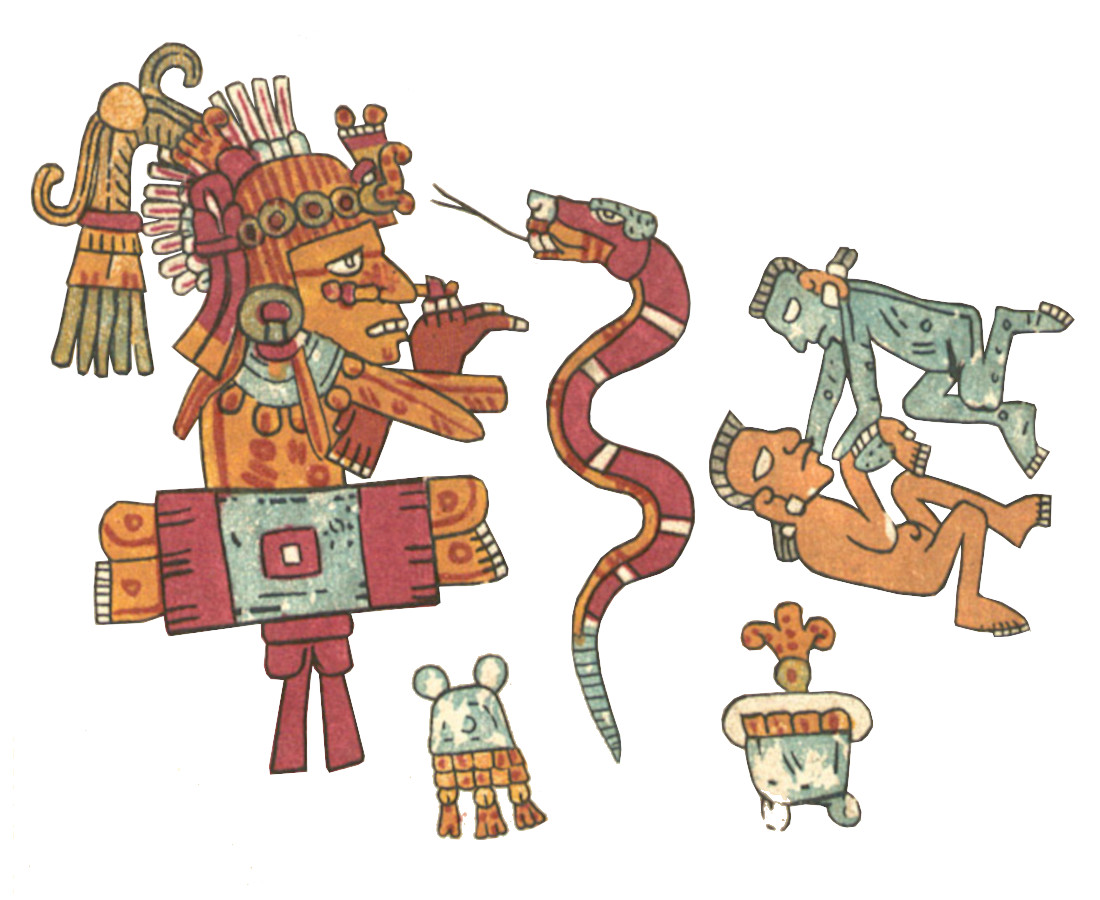
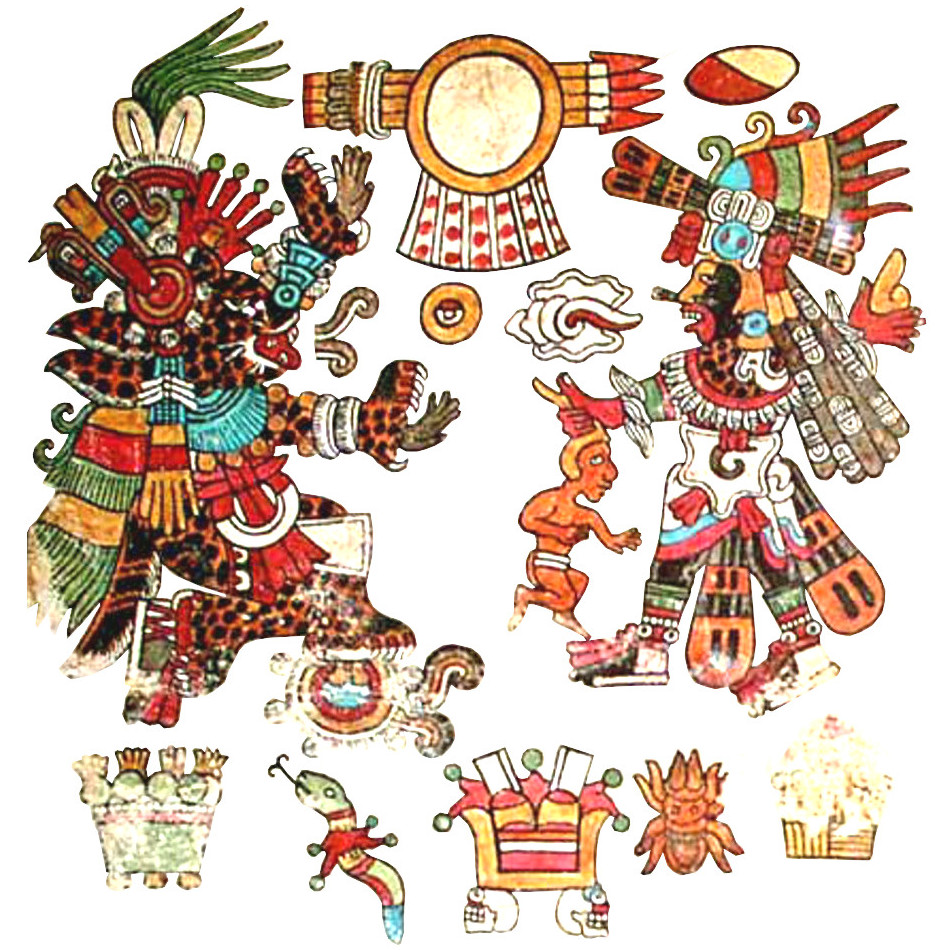
The Borbonicus Deer trecena is the third with Quetzalcoatl as secondary patron. Here the figure is very like the deity in Tonalamatl Yoal, including all the usual insignia, conch pendant, nautilus shell, and childlike sacrificial victim, but his face is the tri-color we saw earlier in the Borgia and Vaticanus images of the god in the Jaguar trecena. The principal patron Tepeyollotl is a hugely ornamented living, roaring jaguar with human hands (two lefts!) and right foot; to indicate that he’s a nagual of Tezcatlipoca, his left foot is replaced by a mystical smoking mirror. Generally indicating divinity, Tepeyollotl’s be-ribboned pendant is also worn by Xiuhtecuhtli, Xipe Totec, Chalchiuhtotolin, and many other deities.

The surrounding paraphernalia is mostly familiar, like the conch and serpent, but new are the fat spider and the sacrificial knife on the upper right. The containers of unidentifiable “stuff” are complicated by damage to the one on the lower right. The smudge continued along under Quetzalcoatl’s feet obscuring apparent Spanish annotations, which were also inserted into the border blocks to count the tonalli and name them. (Though I cleaned up that smudge, I held off doing any “repairs” to these images, but it was sorely tempting.)

#

In the previous Crocodile and Jaguar trecenas, we saw the peculiar, again cartoonish style of Codex Vaticanus, and here it is again in the patron panel for the Deer trecena. Similarly simplistic, the unnumbered tonalli run from the lower right with seven up that side and the remaining six across the top. The resulting square page is dominated by the large patron panel to much the same degree as in a Borgia trecena.
Codex Vaticanus Patron Panel – Deer Trecena

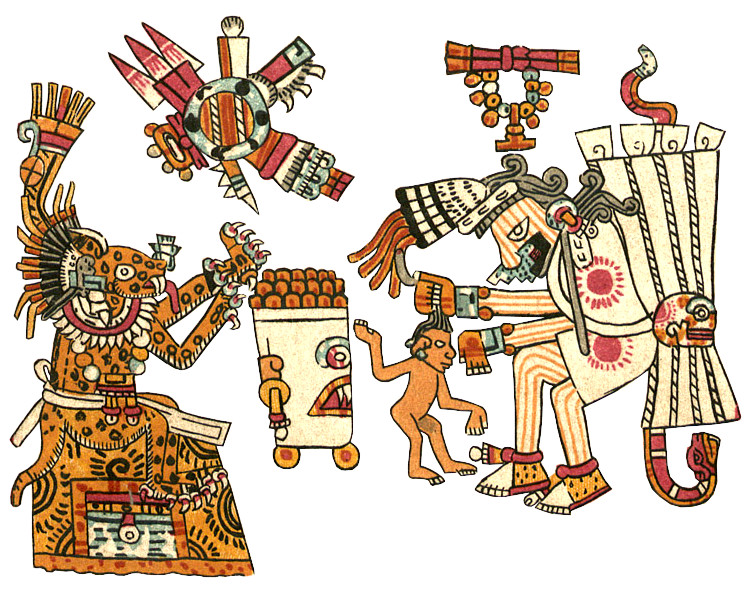
The presence here of Tlazolteotl as secondary patron is more evidence of a close relationship between the Vaticanus and Borgia codices. She is identified only by the black mouth, but she holds the requisite young sacrificial victim. The power serpent in the bundle on her back now seems to be a rattlesnake. Like in Borgia, Tepeyollotl is again a full-scale jaguar without human features. The bluish item above its nose is curiously much the same as that in the Borbonicus patron panel—and disturbingly, the jaguar has five claws on each of its forepaws. Your guess is as good as mine as to what these details might signify.

The extra items are also very similar to some in the Borgia trecena: the shield and arrow bundle and the mysterious beaded loop with bow. The pot harks back to the elegant container in Borgia but now has a fanged face, perhaps relating to the pot in Borbonicus with the skulls for feet.

#

I can only point out these odd details—not explain them. Let’s leave interpretations to those who would use these images for divination (as they were originally intended). Apropos the doctrinal disagreement about secondary patrons mentioned at the beginning of this discussion, we’ve now checked out these six examples of the Deer trecena, and the vote is three for Quetzalcoatl, two for Tlazolteotl, and one abstention. Why don’t we just call it a tie and let would-be fortune-tellers pick and choose their auguries?

Another outcome of comparing these six tonalamatls is that I no longer feel like a heretic for the unique layout of my old Tonalamatl Balthazar. So what if my tonalli range around three sides? There’s nothing sacrosanct about dividing up the thirteen tonalli or the direction they run. I frankly think my modern trecenas are as authoritative and veracious as any of those ancient tonalamatls—and at least as beautiful.

UPCOMING ATTRACTION

The next trecena will be that of Flower with its fun-loving patron Huehuecoyotl (the Old Coyote) and a couple other deities of celebration. Stay tuned!

#

Aztec Calendar – Jaguar Trecena

The second trecena (13-day “week”) of the Aztec Tonalpohualli (ceremonial count of days) is called Jaguar for its first numbered day, which is the 14th day of the veintena (20-day “month”). In the Nahuatl language it is Ocelotl and is referred to as Ix in the Yucatec Maya language and I’x or B’alam in Quiché Maya. Ever since those distant Maya times, jaguar pelts in shades of tawny gold to white have been the sacred possessions of deities, priests, and royalty. For the Aztecs, the nocturnal Jaguar is the patron of scouts and warriors, and the elite corps of warriors of the night is known as the Jaguar Knights.

In Mesoamerica, the Jaguar is deified as Lord of the Animals (see my Icon #11), remarkably including even the human animal. This New World animistic concept contrasts sharply with Old World humanistic notions of homo sapiens as assigned by a divinity to hold dominion over the whole world and all its animal life. (See an enlightening discussion of this profound distinction in the book “Homo Deus, A Brief History of Tomorrow” by Yuval Noah Harari.)

In Nahuatl the day Ocelotl is sometimes called teyolloquani (“magician”) as the Jaguar is a nagual (manifestation) of the god Tezcatlipoca, the Black One, god of magic and divination, as well as of much else. The nagual relationship is a widespread phenomenon of exchange, overlap, or confusion of divine identities apparently reflecting an incipient syncretism in the polytheistic religion of Mesoamerica. (Naguals will be encountered again below and later in many instances.)     

PATRON DEITY RULING THE TRECENA

The patron deity of the Jaguar trecena is Quetzalcoatl, the famous Plumed Serpent, who was the bringer of culture to mankind in Mesoamerica, including the ceremonial calendar and the staple maize. (See my Icon #14.)  He is the nameless god known in that same capacity from Olmec times, as well as Kukulkan (in Yucatec) or Gugumatz (in Quiché) for the Maya and the so-called “feathered serpent” of Teotihuacan. “Quetzalcoatl” was also the standard name/title of rulers of the later Toltecs of Tula.

As the god of learning, writing, arts and crafts, priests, and merchants, Quetzalcoatl is opposed to human sacrifice, content simply with the sacrifice of birds and incense. He embodies the planet Venus, with his nagual Tlahuizcalpantecuhtli (Lord of the House of the Dawn) representing the morning star. (Meanwhile, Xolotl, another nagual of Tezcatlipoca, is considered the evening star.) Quetzalcoatl ruled the Second Sun (Four Wind)—as his main nagual Ehecatl (see below)—and created the current Fifth Sun (Four Earthquake) by using his own blood to give new life to the bones of the people of the Fourth Sun (Four Water)—which were fetched up by Ehecatl from Mictlan, the Land of the Dead. Reflecting another confusing nagual relationship, he’s also called the White Tezcatlipoca but is also irrationally considered the sacred twin of Tezcatlipoca (maybe because of the astronomical relationship with Xolotl), though they were born on different days, and is the sibling of other deities. The divine family tree is a tangled web of parents, siblings, offspring, and naguals.

AUGURIES OF JAGUAR TRECENA

By Marguerite Paquin, author of “Manual for the Soul: A Guide to the Energies of Life: How Sacred Mesoamerican Calendrics Reveal Patterns of Destiny”

Strongly connected with the powers and mysteries of the Earth, the Jaguar trecena brings into play the enchantment, mystery, and power of the Jaguar in combination with Quetzalcoatl, its “sacred twin,” the embodiment of wisdom, light, and life. This combination of the Jaguar’s association with survival, protection, power, and instinct, with the life-aligned forces of the patron energies provides a time frame is highly aligned with both rulership and transformation. The general theme of “posturing or pushing for power and authority” often plays out during this period, with a certain amount of “jostling for position” to bring about Earth-related change.

Further information on how these energies connect with world events can be found in the Maya Count of Days Horoscope blog at whitepuppress.ca/horoscope/. Look for the Ix (Jaguar) trecena.

THE 13 NUMBERED DAYS IN THE JAGUAR TRECENA

The Aztec Tonalpohualli, like the ancestral Maya calendar, is counted through the sequence of 20 named days of the agricultural “month” (veintena), of which there are 18 in the solar year. Starting with 1 Jaguar, this trecena proceeds: 2 Eagle, 3 Vulture, 4 Earthquake, 5 Flint, 6 Rain, and with 7 Flower completes the vientena. Starting again on the next one, the count continues with 8 Crocodile, 9 Rain, 10 House, 11 Lizard, 12 Snake, and 13 Death.

The Jaguar trecena contains three very significant days:

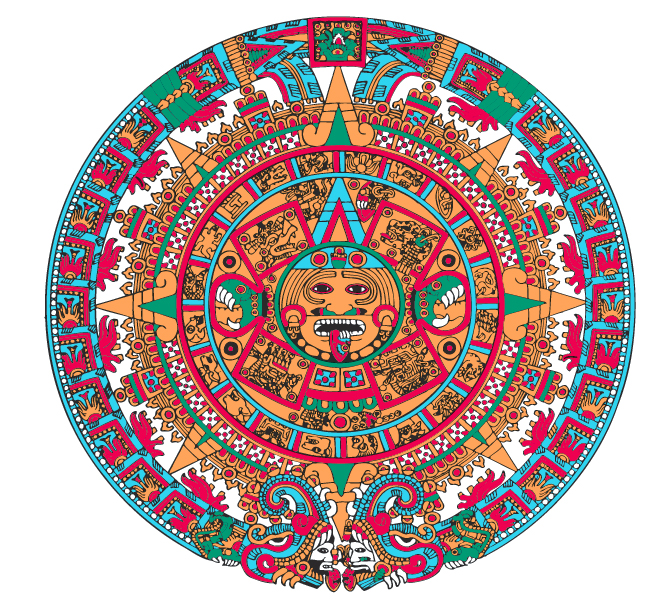
Four Earthquake or Movement (in Nahuatl Nahui Ollin) is the day-name of the Fifth Sun created as described above by Quetzalcoatl. The titular god of this current Sun is Tonatiuh, who became the solar deity by leaping into the creative conflagration (as illustrated in my Icon #16). The face of Tonatiuh is at the center of the Stone of the Suns.

Seven Flower (in Nahuatl Chicome Xochitl) is the day-name of Xochipilli, the Prince of Flowers (subject of my Icon #18). He is the god of a great many things including art, music, dance, games, (homo)sexuality, fertility (flowers and agriculture), beauty, peace, ecstasy, sleep, and dreams/hallucinations.  As patron of writing, painting, and song he manifests as his nagual/alias deity Chicome Xochitl, and in some of his roles as other naguals to be encountered later. The Prince is also a patron of the sacred ballgame tlachtli.

Nine Wind (in Nahuatl Chicnahui Ehecatl) is sometimes called the day-name of Quetzalcoatl, inasmuch as it is actually the day-name of his principle nagual Ehecatl, God of the Wind (air, the breath of life, and spirit) and inspiration/intelligence (see my Icon #5). Note that the day-sign is the stylized head of Ehecatl. The relationship between these two deities is even closer than being naguals of each other, more like a split personality. In actual fact, the existential Ehecatl is much more popular in the codices and rituals than the notorious Quetzalcoatl. (More on this below.)    

THE TONALAMATL (BOOK OF DAYS)

Several of the surviving so-called Aztec codices (some originating from other cultures like the Mixtec) have Tonalamatl sections laying out the trecenas of the Tonalpohualli on separate pages. In Codex Borbonicus and Tonalamatl Aubin, the first two pages are missing; Codex Telleriano-Remensis and Codex Rios are each lacking various pages (fortunately not the same ones); and in Codex Borgia and Codex Vaticanus all 20 pages are extant. (The Tonalpohualli is also presented in a spread-sheet fashion in Codex Borgia, Codex Vaticanus, and Codex Cospi, but that format apparently serves other purposes.)

TONALAMATL BALTHAZAR

As described in my previous blog The Aztec Calendar – My Obsession, some thirty years ago—on the basis of very limited ethnographic information and iconographic models —I presumed to create my own version of a Tonalamatl, publishing it in 1993 as Celebrate Native America! For the patron deity of the Jaguar trecena, I created an image of Quetzalcoatl with a plumed serpent on his back much like the Codex Borbonicus image of Xiuhtecuhtli in its Dog trecena. In my ignorant enthusiasm, I wisely added items of regalia and symbols I’d read about in my limited sources, like the conical Huastec cap (with jaguar fur), flowering shinbone, fire-serpent weapon, cross symbol on his shield, golden beard, and others. In consequence, he wound up looking remarkably authentic in terms of Aztec iconography.

Aztec Calendar – Jaguar trecena – Tonalamatl Balthazar

TONALAMATL BORGIA (re-created by Richard Balthazar from Codex Borgia)

Aztec Calendar – Jaguar Trecena – Tonalamatl Borgia

This Borgia image of Quetzalcoatl wears only a few identifying emblems: the conch-whorl cutout pendant, the double serpent headdress, and sea-shell ornaments. Borgia also uses the black body with grey markings for other deities, apparently to indicate their supernatural nature. Note the jaguar pelt draped over the seat of the god’s throne and the divine fur on his collar. I should point out that for some dramatic reason Borgia almost always “bloodies” the corners of eyes, including those of the day-signs.

I can’t explain the significance of the temple with the star in its doorway or of the other items, but the small human figure deserves comment, at least for the curious fact of his having two left hands. In her monumental book “Descendants of Aztec Pictography,” Elizabeth Hill Boone (who taught art history at my alma mater Tulane University long after my time there) excuses this startling feature intellectually as “ideoplastic:” an image meant to be understood in intended detail rather than as optically accurate. As a latter-day descendant of Aztec pictography myself, I consider two left hands to be like a childish drawing, the artist simply being careless about verisimilitude, especially since this confusion of hands only occurs occasionally.

On the other hand, you will note here with Quetzalcoatl and the little guy, as well as later on everywhere (including in my own Tonalamatl and most other codices) a lack of distinction between figures’ right and left feet. Perhaps this physical discrepancy can appropriately be called ideoplastic because of the pronounced difficulty, if not impossibility, of rendering the toes in proper perspective. One easily gets used to understanding the intended detail.             

TONALAMATL YOAL (compiled and re-created by Richard Balthazar on the basis of Codex Telleriano-Remensis and Codex Rios)

Aztec Calendar – Jaguar trecena – Tonalamatl Yoal

Unlike Borgia’s “plain” image of Quetzalcoatl, this one in Tonalamatl Yoal is loaded with symbols and emblems of the deity, lacking only the double serpent in his stupendous headdress. Like the black body in Borgia, here the unnatural bluish-mauve body indicates his divine nature. The “mound” on which he’s standing/dancing is the symbol of a physical location, often (as in Codex Nuttall) adorned with the emblem of a specific place or town.  I’m unable to explain the apparent basket on his back or the items he holds in his hands, but I should point out that he’s wearing the mask of his nagual Ehecatl. This is in fact the schizoid deity Quetzalcoatl-Ehecatl with emblematic elements of the Wind God’s headdress added to his own. The oddity is the mask’s many teeth—usually Ehecatl has only a single fang as in the day-sign.

Now I should show you what was involved in “compiling” and “re-creating” the images of Quetzalcoatl-Ehecatl from these two codices:

Telleriano- Remensis Comparison with Rios Quetzalcoatl-Ehecatl

To be kind, I can only call the original T-R image on the left crude and its Italian copy in Rios on the right imprecise, if slightly more realistic. By adjusting proportion and orientation and refining detail and color, my work was to turn these primitive sketches into a finished work. The large part of that (here and in most other cases) was correcting the position of the arms. Perhaps reasonably, Dr. Boone cites the distorted connection of limbs to figures’ torsos as another instance of ideoplastic art, but as a contemporary descendant, I’m offended by the contortion. By moving the arms to their natural positions, I can also reveal the profile detail of the face. (In this connection, note that as a stylistic rule, Aztec figures are almost exclusively drawn in profile, which is coincidentally a strict convention shared with ancient Egyptian paintings.)

Now let us consider the attendant figure, which I’ve adapted directly from T-R as more refined and dramatic (more blood!) than the Rios copy. The blood aside, you’ll observe that he has two right hands and misshapen feet, one with six toes! So much for ideoplasticity! Folks indoctrinated in Old World cults would call what this patently human figure is doing–piercing his tongue–doing “penance,” making retribution or punishing himself for inherent and inherited sinfulness, but it’s not.

In the Mesoamerican ethos, he’s sacrificing his sacred life-blood to the deity. Ceremonial blood-letting through the tongue or genitals was practiced since time immemorial to incur the good will of deities or to express gratitude for blessings. Heart sacrifice was a prayer to the gods that they continue the current Sun (world), and through the sacrificial ritual the donor experienced apotheosis with the subject deity. After the rite, quite like any other food animal, the donor’s body was consumed by the animistic population as sacramental communion. (If I might be permitted a personal comment here, I believe that the death of all beings, whether or not eaten afterwards, is apotheosis, the deceased merging with that deity in which they believed.)              

OTHER TONALAMATLS

Since Codex Borbonicus and Tonalamatl Aubin also lack the Jaguar trecena, I can only offer the patron panel from Codex Vaticanus for comparison.

Codex Vaticanus Patron Panel for Jaguar Trecena

The elements of this image are a stylistically different restatement of those in the Borgia panel, lacking only the elegant night-day symbol. Note the close similarity of the bowl of offerings and arrow bundles, including that odd shield-like item pinned to one of them. The attendant figure kneels in exactly the same position; his hands, here now two right ones, are also held in the same position, probably a worshipful gesture (like a salute?) but not overtly suggesting sacrifice as in Yoal. (The position of figures’ hands is apparently symbolic, though poorly understood.)

The figure of Quetzalcoatl is even plainer than in Borgia with only the double serpent in his headdress and a few seashell ornaments, lacking even the conch-shell pendant and divine jaguar pelt accoutrements. He shares the supernatural black body and tri-color face but differs in boasting a beard—a puzzling genetic phenomenon for “native American” males. Another puzzle is the little tag on his nose-bar which is normally emblematic of the god Tezcatlipoca.

I can’t leave this image of Quetzalcoatl without complaining about his arms—and two left hands. Their connection with the deity’s torso is beyond distorted—almost like two left arms. The choice of how to “excuse” this glaring feature is yours: extreme ideoplasty, artistic ineptitude, or proto-Cubism? (In the original Borgia image, the distinction between his arms is unclear against the god’s black body, but it required only a tiny adjustment of the gray outline to line up the figure’s appropriately right and left hands.)

In any case, it’s evident that Codex Borgia and Codex Vaticanus must have been products of the same priestly school. I find it disturbing that in her great book Dr. Boone does not discuss these outstanding examples of pictography, except to dismiss them as “codices of the Borgia group, from the Puebla-Tlaxcala-Mixteca areas south of the valley of Mexico” and merely to include them among “the Mixtec genealogical histories and the divinatory manuscripts of the Borgia Group.” Nor does she even mention Tonalamatl Aubin. Within her very narrow geographic parameters of “Aztec” pictography, she includes much detail on the late Borbonicus, Telleriano-Remensis, Rios, and other codices and refers generously to the much later Magliabechiano, Mendoza, and Tudela manuscripts. However, as an artistic descendant of this fascinating pictography, I would argue that those parameters should embrace a much broader historical period and the wider geographical area of pre-Columbian Mesoamerica.              

UPCOMING ATTRACTION

The next trecena will be that of Deer with scandalous and mysterious patrons: the Goddess of Filth and the Heart of the Mountain. Stay tuned!

#

Mexican Connections

(In this title, I use “Mexican” as an anachronistic term for the pre-Columbian period of Mesoamerican history and as the modern-state designation for the broader Mesoamerican area. By “connections” I intend cultural “influences” and “exchanges”—specifically with the area of the American Southeast.)   

Around four years ago I posted an article entitled appropriately “Mesoamerican Influences in Mississippi” to rave about three dramatic incised shell gorgets (discs of conch shell), which I found on the internet through Google Images. They looked like great evidence of the influence of Mesoamerican cultures on the Mississippian civilization in North America’s Southeast. Perhaps two years later I received an anonymous email from an academic “enforcer” from establishment  archaeology or anthropology intent on “debunking” this evidence.

With no counter-evidence, the writer denied the authenticity of the first gorget and with an almost reasonable but shaky argument refuted the significance of the second. The third gorget, a superb illustration of my point, was simply ignored. Shaken by the inquisitorial tenor of the complaint, I didn’t want to waste my time arguing with a brick wall and took the post down.

Recently I’ve been hugely gratified to find that Richard Thornton of the Apalache Foundation is continuing his ground-breaking research into foreign influences in the ancient American Southeast, including from Europe, South America, and Mesoamerica. Using DNA, physical, architectural, and sociological evidence, he has discussed migrations into the area by bronze-age peoples from Sweden and Ireland, Panoan and Arawak peoples from South America, and many Mesoamerican peoples from “Mexico.”

Mr. Thornton’s research and tribal migration legends reveal several waves of immigration as cultural groups fled from environmental degradation or from the aggression of neighbors. Many ethnic groups fled the dangers of constant warfare between Maya city-states, brutal invasions by militant Toltecs, and genocidal imperialism of Aztecs. In fact, several times over at least two millennia there was a mass exodus of refugees. Per Wikipedia, when the Toltecs invaded the area of Veracruz, most of the indigenous Totonacs fled north to Cempoala. Others continued east along the Gulf Coast, across the Mississippi River, and north into the Tennessee River Valley.

I’ve been re-inspired by Mr. Thornton’s perseverance in the face of animosity from the academic establishment—and by the recent broad acceptance of Mesoamerican inspiration for the pyramid mounds of the Mississippian civilization. (See my 1992 book about Indian Mounds and my Gallery of Indian Mounds.) As a result, I’ve decided to re-post my discussions of these three shell gorgets and let folks make what they will of this evidence of Mexican connections.

THE FIRST GORGET was reportedly found along the Tennessee River in the Muscle Shoals area of northwestern Alabama. The scholarly debunker claimed both it and its provenance were faked, but I have no reason to suspect such pointless fakery, fully accepting Mr. Thornton’s case for “Mexican” immigrants in exactly that area. From the photograph on Google images, I drew this Muscle Shoals gorget:

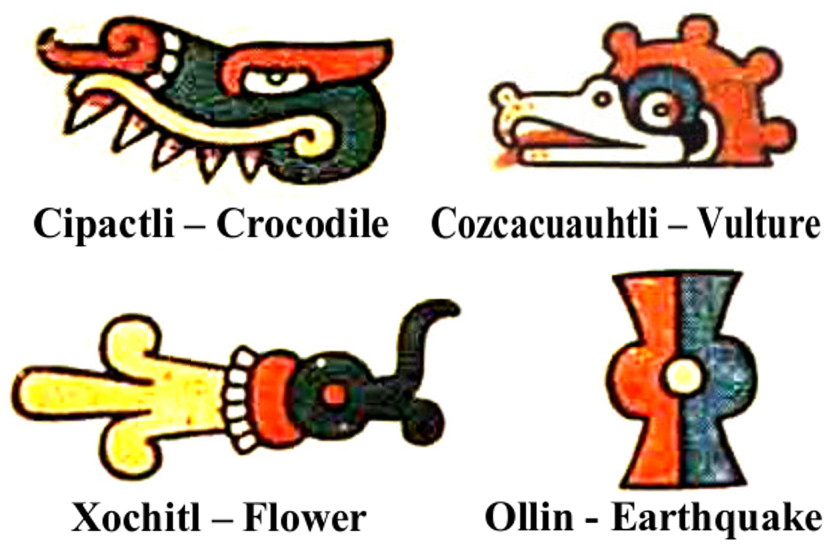
Having spent 30+ years with the art and mythology of ancient “Mexico,” I instantly recognized the designs in the band encircling the very Mississippian-style head. They are standard day-signs from the Aztec ceremonial calendar and virtually identical to those in Codex Fejervary-Mayer. One of the few Mexican manuscripts to survive the Conquest’s book-burning, this Codex is believed to have been created in Veracruz:

Day-signs, Codex Fejervary-Mayer

Crocodile is the first day of the 20-day “month,” and Flower is the last. I can’t say why there are two Flowers, but Vulture is the day right before Earthquake. Meanwhile, the four Earthquake signs are particularly eloquent. In “Mexican” cosmology, Four Earthquake is the day-name of the current Fifth Sun (era or world). Thus the head on the gorget is most likely that of the deity of the Fifth Sun, Tonatiuh, familiar as the face in the Aztec Stone of the Suns which is centered in the decorative day-sign of the Fifth Sun.

I still maintain that this Fifth Sun Gorget is unambiguous, conclusive evidence of Mesoamerican influence in Mississippi.

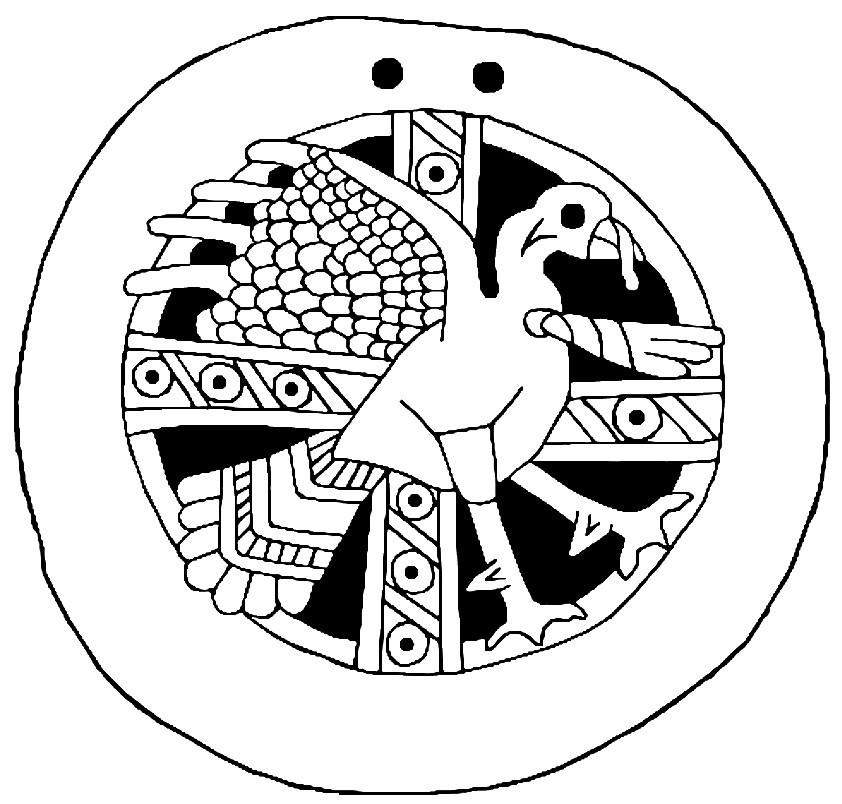
THE SECOND GORGET I again drew from a Google Image. Called simply “Muskogee Creek,” it’s a cut-out of a turkey, also from the Tennessee River Valley in Alabama.

It happens that the turkey was famously the Mexican symbol of war and military glory, like the Aztecs’ god Chalchiuhtotolin, the Jade Turkey. This gorget immediately called to my mind images of turkeys in the Codex Vaticanus and Codex Borgia (both from Puebla), particularly because of the strange protrusion out of the turkey’s breast:

Turkey, Codex Vaticanus

I claimed this gorget as additional proof of a Mesoamerican influence in Mississippi, but my academic assailant argued that the protrusion was a natural feature of all turkeys and no such proof. Raising turkeys as a 4-H adolescent, I never saw such a feather tuft on one, but then my birds had never lived very long before being eaten. Checking internet references, I discovered that as male turkeys age, they do indeed grow a clump of slender, fibrous feathers in the center of their breasts, called a beard or tassel—the longer the beard, the older the turkey. Some, but not all, female turkeys may also grow beards.

Now (coincidentally on this Thanksgiving Day 2021), I have to thank my astute critic kindly for teaching me something new about turkeys. But confounded at the time by his or her (or gender-neutrally their?) argument, I conceded my point and dropped the subject. But now I’ve searched Google Images for other Mississippian turkey gorgets and have only found one of a pair of the iconic birds, neither of which sports a beard. Therefore I’m now reclaiming this Muskogee Creek turkey with its ornamental beard (and militant spurs) as legitimate thematic, iconographic evidence of Mesoamerican influence. Let my fowl-minded critic refute that if they wish.

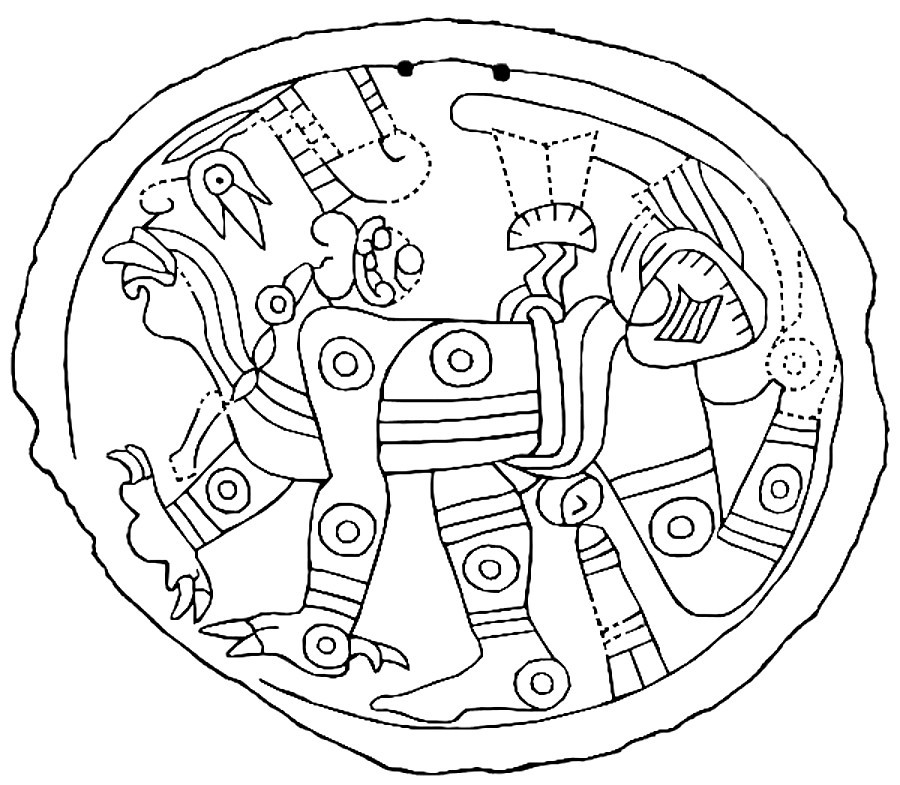
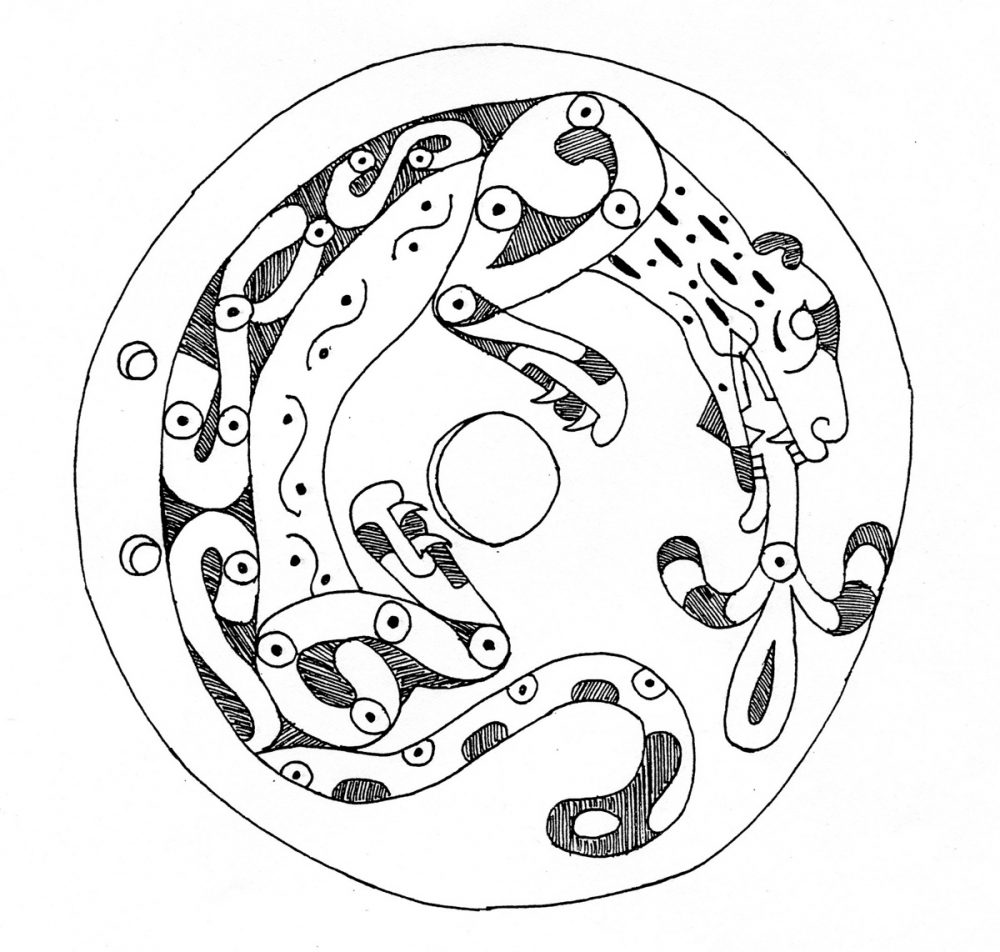
THE THIRD GORGET, this one from Tennessee, presents the quintessentially “Mexican” motif of the anthropomorphic jaguar, shown here again in my drawing.

In the codices (primarily Bodley, Nuttall, and Vindobonensis–all three of Mixtec origin), there are many images of traditional Jaguar Warriors of the Night.

Jaguar Knight, Codex Vindobonensis

The artist of the Tennessee example clearly had the concept down pat but just as clearly wasn’t all that familiar with the real pattern of a jaguar’s pelt. (Nor did the “Mexican” artists manage to realistically illustrate the creature’s rows of rosette designs.) The blending of Mesoamerican and Mississippian traditions is shown by the Tennessee figure’s forked eye.

Newly convinced and content with the evidence of these three shell gorgets, I will simply declare Q.E.D. and include them in my Gallery of Pre-Columbian Artifacts.

ADDITIONAL EVIDENCE OF “CONNECTIONS”

However, still smarting from the academic antagonism directed at my original post, I want to avenge the attack by bringing forth a bit more evidence for Mesoamerican “connections” in the Mississippian area. First, let me note that several other Mississippian shell gorgets also show felines with decorative pelt patterns—surely jaguars, which by then and there must have become purely mythical creatures. A striking example is my (reconstructed) drawing of the Fairfield Gorget from Missouri (an area of many pyramid and platform mounds):

In scholarly mentions of this eye-catching piece, the figure is called a panther, but there’s no known species of such an ornately patterned feline in North America. It can only be a jaguar from Mesoamerica in a Mississippian artist’s fanciful conception.

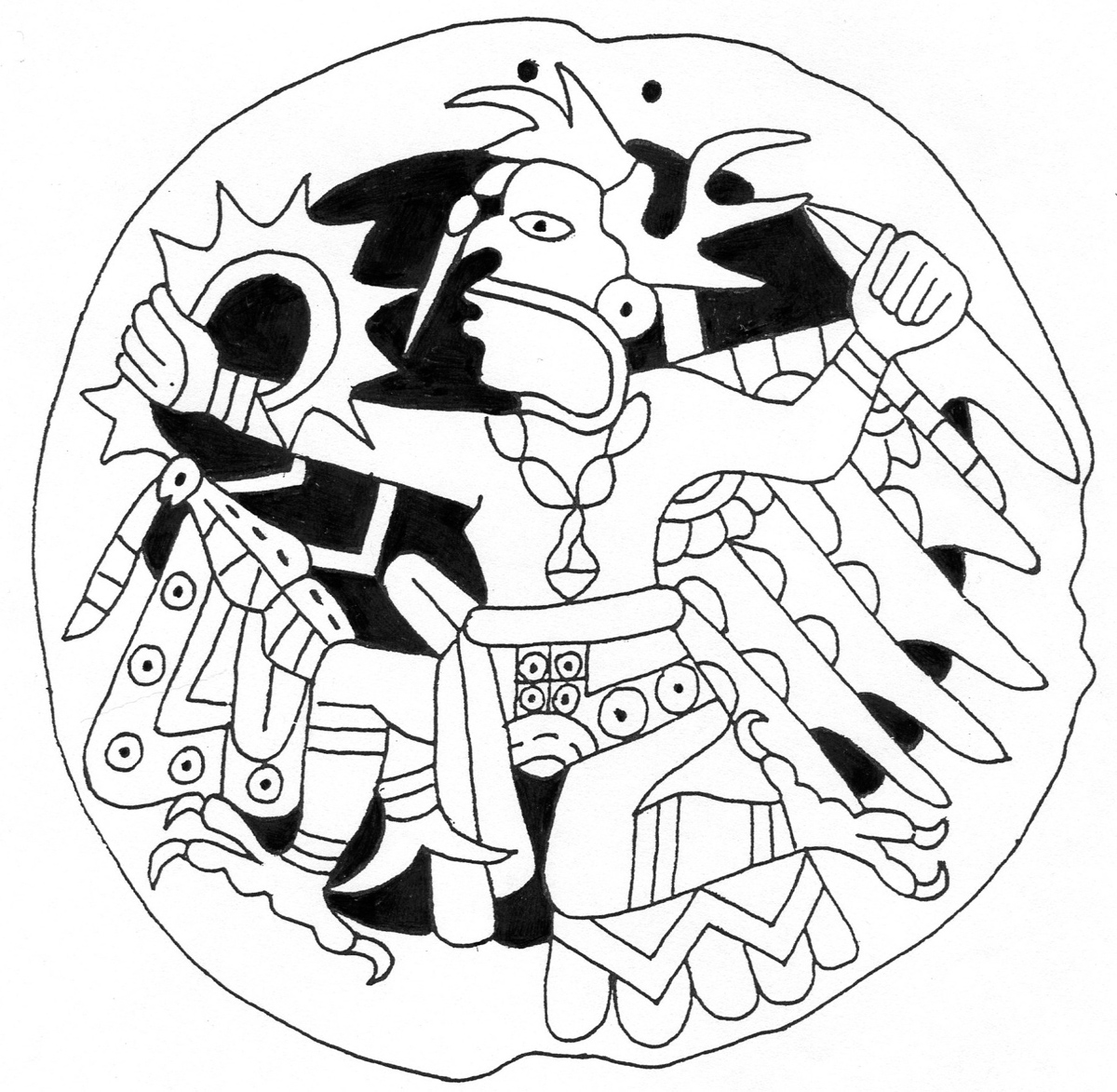
I’ll rest my case with one more example, merely one of several possible. It’s a shell gorget from the Mississippian site of Etowah in northern Georgia (which Mr. Thornton has identified as the town of Etula peopled by immigrants from Mexico):  

This image of a “falcon” warrior displays typical Mississippian details like the beaded forelock and deer-horn headdress, and holds items of debatable significance, but the wing and tail, clawed feet, and posture are standard for the traditional Mexican eagle-warrior:

Eagle Warriors

Codex Nuttall                     Codex Vindobonensis

#

Aztec Calendar – Crocodile Trecena

THE CROCODILE TRECENA

The first trecena (13-day “week”) of the Aztec Tonalpohualli (ceremonial count of days) is called Crocodile for its first numbered day, also the first of the 260-day ritual Turquoise Year. In the Nahuatl language it is Cipactli and is referred to in the ancestral Maya languages as Imix in Yucatec and Imox in Quiché. Crocodile is the mythical Earth Monster which carries the world on its back; it was defeated by the god Tezcatlipoca, who lost his left foot in the battle, to create the First Sun, Four Jaguar (as shown in my Icon #19).

PATRON DEITIES RULING THE TRECENA

The patron deities of the Crocodile trecena are Tonacatecuhtli and Tonacacihuatl (Lord and Lady of Sustenance). Also known as the dualistic deity Ometéotl, the conjoined pair Ometecuhtli and Omecihuatl (Lord and Lady of Two) is the supreme creator and progenitor of the primary Aztec gods. As shown in my Icon #12, they rule the highest (13th) heaven of Omeyocan where unborn souls reside, and Omecihuatl chooses the days for their birth and thus their fates. The pair is also called Ilamatecuhtli and Ilamacihuatl (Lord and Lady of Creation). This deity of duality has no cult, rites, or temples and exists beyond the stars, in which capacity they are Citlalatonac and Citlalicue (Lord and Lady of the Stars).

AUGURIES OF CROCODILE TRECENA

By Marguerite Paquin, author of “Manual for the Soul: A Guide to the Energies of Life: How Sacred Mesoamerican Calendrics Reveal Patterns of Destiny”

The Crocodile trecena is associated with the watery primordial realm or place of origin that was seen as the birthplace and source of nourishment for all life, overseen by the masculine and feminine energies at the nucleus of life, and protected by the fierce Earth Monster. Symbolic of the fertile earth, as well as the cosmos itself, this is a time frame that can set the stage for new beginnings and the development of new possibilities. Although it can be somewhat chaotic as new ideas take shape, this trecena is seen generally as a favorable period representing the “realm of all potential.”

For information on how these energies connect with world events, see Marguerite’s Maya Count of Days Horoscope blog at whitepuppress.ca/horoscope/

THE 13 NUMBERED DAYS IN THE CROCODILE TRECENA

The Aztec Tonalpohualli, like the ancestral Maya calendar, is counted through the sequence of 20 named days of the agricultural “month” (or veintena, of which there are 18 in the solar year). Starting with 1 Crocodile, the trecena continues with 2 Wind, 3 House, 4 Lizard, 5 Snake, 6 Death, 7 Deer, 8 Rabbit, 9 Water, 10 Dog, 11 Monkey, 12 Grass, and 13 Reed. Each day and number have their own patron deity and divinatory significance, and for additional auguries, each is associated with a specific Lord of the Day and a cyclical Lord of the Night.

THE TONALAMATL (BOOK OF DAYS)

Several of the surviving so-called Aztec codices (some originating from other cultures like the Mixtec) have Tonalamatl sections laying out the trecenas of the Tonalpohualli on separate pages. In Codex Borbonicus and Tonalamatl Aubin, the first two pages are missing; Codex Telleriano-Remensis and Codex Rios are each lacking various pages (fortunately not the same ones); and in Codex Borgia and Codex Vaticanus all 20 pages are extant. (The Tonalpohualli is also presented in a spread-sheet fashion in Codex Borgia, Codex Vaticanus, and Codex Cospi, but that format apparently serves other purposes.)

TONALAMATL BALTHAZAR

As described in my previous blog The Aztec Calendar – My Obsession, some thirty years ago—on the basis of very limited ethnographic information and iconographic models —I presumed to create my own version of a Tonalamatl, publishing it in 1993 as Celebrate Native America! In my artistic ignorance—let’s less harshly call it naiveté—I chose as patron of the Crocodile trecena the goddess Omecihuatl (Tonacacihuatl), modelled on the secular Codex Nuttall, which was the only one I’d found. Since most of the other tonalamatls show only Ometecuhtli (Tonacatecuhtli), maybe I unwittingly exercised a bit of much-needed gender balance.

Aztec Calendar – Crocodile trecena – Tonalamatl Balthazar

The serpentine framework for the days was my own fantasy based on the snakes encircling the Stone of the Suns. With my artistic license, I arranged the normally linear number-dots in easily recognizable composite shapes. The ornate regalia and headdress of the goddess are pure Nuttall, but they turned out to be perfectly appropriate for deities. I was mystified by the items she carries, which I later found out are a torch and an incense bag. Live and learn.

TONALAMATL BORGIA (re-created by Richard Balthazar from Codex Borgia)

Aztec Calendar – Crocodile Trecena – Tonalamatl Borgia

Codex Borgia doesn’t indicate the days’ numbers, simply relying on the sequence (starting from lower right in this first half of the Tonalpohualli). In his right hand Tonacatecuhtli holds a fancy incense bag, sacrificial knife, and plant-symbol of life; in his left he holds penitential thorns. I’m unable to explain why he has golden hair or what that temple is with the strange extrusions (some containing stars). However, the serpent below it is a standard symbol of existential power. The two figures on the left would seem to represent the union of duality consistent with the patron deity, but there’s no indication of sexual duality, unless the male is gripping the female’s arm… Why they’re sucking on a sacrificial knife is beyond me, but I recognize the incense-burner on the upper figure’s head, lending the scene a sacred aspect.

You may note a marked difference between the day-signs in this Borgia trecena and those in mine. There is even variation in other Borgia trecenas, and other codices have their own styles. The vientena sequence remains the same, and you’ll just have to get used to the variant day-signs. Oddly, the Borgia day-sign for Deer has no horns.

TONALAMATL YOAL (compiled and re-created by Richard Balthazar on the basis of Codex Telleriano-Remensis and Codex Rios)

Aztec Calendar – Crocodile trecena -Tonalamatl Yoal

I call this Tonalamatl Yoal (Night) because it includes with the days the cycle of the nine Lords of the Night:  Xiuhtecuhtli, Itztli, Pilzintecuhtli, Centeotl, Mictlantecuhtli, Chalchiuhtlicue, Tlazolteotl, Tepeyollotl, and Tlaloc, most of whom will later appear as patrons of other trecenas. Because of the number nine—if my math is correct—the cycle takes nine Turquoise Years to repeat. However, all the extant tonalamatls start with Xiuhtecuhtli, even the Codex Cospi spreadsheet, the only one of those to include the Night Lords.

This tonalamatl righteously presents both Tonacatecuhtli and Tonacacihuatl as patrons of the Crocodile trecena and helpfully includes the dot-numbers for the days. I can only ascribe the omission of Tonacacihuatl as a trecena patron from the other tonalamatls—and the remarkable difference in “divine magnificence” in this one—to a strain of misogyny in the Aztec culture. Perhaps making her the patron in Tonalamatl Balthazar may atone for this in some way.

The central figures more explicitly represent unity in duality, though it’s impossible to determine which is male or female. In Aztec iconography it’s standard to indicate sex by figures behind a blanket, but I have no clue what the “club” between them is—or the items above their heads.

OTHER TONALAMATLS

Since Codex Borbonicus and Tonalamatl Aubin lack the Crocodile trecena, I can only offer the patron panel from Codex Vaticanus for comparison. a much less picturesque image:

Aztec Calendar – Crocodile trecena – Patron Panel from Codex Vaticanus

Note the awkwardly cross-legged figure of Tonacatecuhtli, the power-serpent, and the two figures suggesting unity in duality. These may be vaguely gendered with the upper male gripping the lower female’s arm as in Tonalamatl Borgia. Surely the different colors are supposed to signify something, and one must wonder about the striations on the upper body.

In any case, the iconography and orthodoxy of the Crocodile trecena seems fairly consistent in the extant tonalamatls. I wish we could see the missing patron panels in Codex Borbonicus and Tonalamatl Aubin and would bet that the lost Borbonicus page showed the pair of deities in its typically ornate fashion.

UPCOMING ATTRACTION

The next trecena will be that of Jaguar, its patron the rock-star god Quetzalcoatl, the Plumed Serpent. Soon! Stay tuned!

#

The Aztec Calendar – My Obsession

The Aztec count of days (tonalpohualli in the Nahuatl language) is commonly called the “Aztec Calendar,” a ritual cycle of 260 days in 20 13-day “weeks” or trecenas, its purpose divinatory or prophetic. Like the well-known zodiacal system of horoscopes in which a person is born in one of 12 “houses” with character and fate influenced thereby, the Aztec day on which one is born is that person’s ceremonial name and is believed to determine their character and fate. (You can discover your own Aztec day-name by entering your birth-date at www.azteccalendar.com.)

Calling the Tonalpohualli “Aztec” is in fact a historical misnomer. They inherited the basic ritual of the calendar from the ancient Maya, who in their turn adopted it from the even earlier Olmec. I have found circumstantial evidence that the roots of this Mesoamerican ceremonial calendar may reach still deeper into the past, possibly originating in distant South America. See my blog posting on this iconoclastic theory:  Source of Aztec Calendar.

The way my obsession with the Tonalpohualli came about is a long and probably tedious story, but I’m going to tell it—if only as a cautionary tale about unbridled enthusiasm. Over several decades, my possession by the Aztec muse happened gradually, simple curiosity growing into bemused fascination, to an eccentric fixation, and then to a full-fledged obsession.

Like most folks, in high school I learned about the conquest of the heathen Aztecs by the devout Catholic Conquistador Hernando Cortez in 1519, supposedly thanks merely to his miraculous horses and muskets. (Only in the 90s did I learn that his dramatic victory was actually thanks to10,000 Tlaxcalan warrior allies, and that the godly Conquest destroyed a monumental city, an efflorescent culture on a par with the Roman empire, and untold millions of native peoples.)

In the later 70s I came across a later16th-century narrative by Fray Diego Duran about the arduous legendary migration of the barbarian Aztecs into the Valley of Mexico and was intrigued by the intertwined story of their war-god Huitzilopochtli, Hummingbird of the South. For a while I sketched out a pseudo-sci-fi novel about that journey but finally abandoned the project.

About ten years later, a friend passed me the book “The King Danced in the Marketplace” by Frances Gilmore which gave me somewhat more information on the Conquest, though hardly less fanciful or slanted. In the story of the Aztec ruler Montezuma, the author also made an off-hand comment that the Aztec “century” was only 52 years long, counted in four sequences of thirteen. Being a crypto-mathematician, I was struck by the numerical system—and by the curious fact that it sounded exactly like a deck of playing cards.

That inspiration triggered a creative frenzy in the later 80s. On the model of the century-count, I laid out a deck of cards with eight intersecting suits called Palli for the four 13-year periods. Then, discovering that the ceremonial year was counted in 20 sequences of 13 numbered days, I created another deck called Tonalli (days) to reflect that cycle. Having nowhere to go with these “inventions,” I forged on to design a Tarot-type fortune-telling deck called Ticitl (priest/teacher), a couple unworkable board games, and a set of six-sided dice. I wrote out detailed rules, but frankly, these thirty years later, I can’t remember how the games were supposed to be played.

Samples of Early Games Based on Aztec Calendar

Palli                                     Tonalli                                Ticitl                                    Aztec Dice

Only much later did I come to understand the complicated connection between the 52-year century, the 260-day Tonalpohualli, and the solar year with 18 months of 20 named days. However, in the course of working on those games, I’d drawn all the day signs and several deities, mostly on popular models from the Codex Borbonicus, and when I decided in the early 90s to create my own Aztec Book of Days (published in 1993), all I had to do was lay out the trecenas and draw the other patron deities. Coloring them was time-consuming but great fun.

In those BI (Before Internet) years, finding authentic models for those other Aztec deities was almost impossible. Fortunately, in the University of New Mexico library I found a rare facsimile of the Codex Nuttall, which I photographed and studied for figures, regalia, and paraphernalia. (More than a decade later I happened upon “The Codex Nuttall” in a 1975 Dover edition.)

I had no way of knowing at the time that Nuttall was actually a historical document rather than a ritual model. As a result, my images of the deities largely reflected that secular iconography. However, my skewed artistic inspiration produced 20 trecenas with eye-catching deities which are often viewed on my website www.richardbalthazar.com under “Aztec Images.” (Visitors have often used them with my compliments for design purposes on clothing, other products, and even tattoos.) One of my more imaginative Nuttall-inspired creations was the God of the Moon:

Tecciztecatl – (God of the Moon)

Resting on these Aztec artistic laurels, for the next dozen years or so I turned to sculpture (found-object assemblages). Though focusing on sculpture, I still had the Aztec bug, and amongst many abstract works, I created figures of various Aztec-deities and day-signs. By 2008. my enthusiasm for sculpture faded, and I reverted to my old Aztec obsession, creating another deck of cards. “Six Snake” was much simpler than my earlier calendrical fantasies, composed of 54 cards with six suits of nine in the colors of the rainbow. Intended as a game for children to learn math, it worked on the closed numerological system of collapsing numbers to a single digit, 1 to 9. But the elegant idea proved to be flawed because it could only handle addition and multiplication; subtraction and division were beyond its scope.

After that, in the later AI (After Internet) years, I assembled a complete collection of the other Aztec codices that survived the book-burnings after the Conquest of Mexico and wrote a summary treatise on them: Ye Gods! The Aztec Codices. Studying these hundreds of ancient pages, I identified the vast Aztec assortment of gods and goddesses and posted an illustrated encyclopedia of them on my website: Ye Gods! The Aztec Pantheon.

Over the next several years I used these authentic images to create digital black-and-white icons of 20 deities for a coloring book called Ye Gods! The Aztec Icons.

Detail from Icon for Ehecatl, Aztec God of the Wind

In the midst of these painstaking digital drawings, in 2018 I was once again seized by the mania for cards and made a deck reflecting both the Tonalpohualli and the Aztec concept of specific gods and groups of days representing the cardinal directions. Those cards turned out to be too complicated to play with reasonably, but I presented them in a blog entitled “Aztec Gods of the Directions,” which for some odd reason has become far and away the most popular of my posts.

Aztec Gods of the Directions

Early in that same year, I had my icons printed on large-scale vinyl banners for an informational exhibition called Ye Gods! Icons of Aztec Deities. The exhibition was shown for two years in six venues before tragically being closed down by the covid pandemic in March 2020.

After eight years of drawing icons, this year I turned to re-creating the book of days (tonalamatl) pages from the Codex Borgia for Canadian friend Marguerite Paquin’s use in her blog on current Mayan trecenas, that calendar of course being quite the same as the Aztec. Only last year did I see the faithful full-color restoration/facsimile of the entire Codex Borgia published in 1993 by Gisele Díaz & Alan Rodgers (Dover Publications), but my digital re-creations are much freer in color and “rectified” detail, creating images essentially impossible for the ancient Aztec artists.

Chalchiuhtotolin, The Jade Turkey

In tandem with my Tonalamatl Borgia re-creations, I’m also compiling and re-creating the trecenas from the related Telleriano-Remensis and Rios codices, which both present them on two separate pages. The latter codex is a later 16th-century Italian (slap-dash) copy of the (awkwardly sketchy) former document, and my compiled re-creation attempts visually sophisticated images of their unique day-signs and deities. As this Book of Days also includes the cycle of the nine Lords of the Night, I’m calling it the Tonalamatl Yoal (Night).

As the various trecenas of the Tonalamatls Borgia and Yoal are completed, I’ll post them along with those from my 1993 Tonalamatl Balthazar, present Dr. Paquin’s notes on their auguries, and remark on their iconography.

The obsession endures. When I’ve completed the Tonalamatls (should I live that long), I intend to create another series of 20 icons, this time in color—of the day-signs with their patrons and divinatory details. After that (if the creek don’t rise), I plan to build a complete mandala of the complex Aztec concept of time and space.

#

Born to be Gay – A Theory

1973 spy with mustache

Now, almost fifty years later, I think I can safely disclose a discovery I made as a spy of sorts doing classified research for the Department of Defense (through the Federal Research Division at the Library of Congress). After I abstracted some Russian medical research for no apparent purpose, the Cold War ended, the Soviet Union went belly up, and the information has been ignored, or perhaps even suppressed, ever since.

In a pile of papers, Russian medical folks researched the human X and Y sex chromosomes, the paired combinations of which are known to determine the sex of a child. With one of these chromosomes contributed by each parent, an offspring with X & Y turns out a sexual male, and one with X & X a female, simple enough. (In this scheme there is no option of Y & Y.) Now comes the interesting complication.

The Russian researchers discovered that a significant number of human subjects had more than just two sex chromosomes. They found extra Xs and Ys all over the place. Some folks had two Xs and a Y, an X and two Ys, three Xs, or even multiple extras. Now, almost fifty years later, I can’t recall the statistics of these various combinations, which I assume still exist in the general population in significant numbers, but I do well remember a couple “scientific” observations.

First, the researchers noted multiple combinations often accompanied by hermaphroditism, either morphologically overt or covert. Second, they observed that multiple Y chromosomes often occurred in hyper-masculine males with violent (toxic) temperaments. (They didn’t look into correlations of multiple extra X chromosomes, but I’d bet they result in hyper-feminine females.) These observations are extremely intriguing and deserve more study.

Based in that old research, my theory is that combinations of two Xs and a Y result in the genetic  tendency or predisposition to be gay, sexual morphology dependent on the dominant pairing of chromosomes. For instance, maybe a person with X & Y + X would likely be a gay man, and one with X & X + Y a lesbian. Add in more Xs and Ys, and you might find folks with a genetic inclination to the transexual, a boy or girl in a girl’s or boy’s body.

This theory makes good sense to me and clarifies the relationship between sex and gender. Instead of just swallowing the simplistic X & Y explanation of sex, somebody should do some serious research on these chromosomal combinations. I’m too old and wouldn’t know how.

#

A Culturally Sensitive Mascot

I just heard on NPR about schools all over the place scrambling to find culturally sensitive mascots to replace racially discriminatory figures. I googled college mascots and got a list of a few hundred mascots, only one of which was obviously “racial,” though hardly discriminatory. The rest were frankly cartoonish and some downright stupid, but there’s nothing wrong with that. So I assume they were talking about secondary schools, and I’ve had experience in that arena.

Namely, when my grandson started at a new International Baccalaureate school (in New Mexico), they were all in an uproar about choosing an appropriate mascot, and the principal told me they wanted something truly significant. As an artist/designer, as well as an intellectual and historian, I proposed a mascot embodying the concepts of enlightenment, education, and culture. But the administration buried my proposal and steered the decision into the realm of standard animalistic clichés. They chose an African lion—if only because no other school in town had nabbed that one—which was as locally significant and symbolic as an Antarctic penguin.

The design I proposed was based on an incised drawing on a shell cup found in the Spiro mound in northeastern Oklahoma dating to c. 1200 CE, a winged, horned serpent (rattlesnake) known in Southwestern Native American cultures as an “avanyu,” a water spirit.

AVANYU MASCOT

The figure is an authentic representation of the Olmec/Maya/Aztec deity Quetzalcoatl, the Plumed Serpent, bringer of culture, the calendar, and maize to primordial Mesoamerica. Its horns come from ancient Teotihuacan, and its full-scale wings and “forked” eye are traits encountered in the Mississippian cultures of North America. Literally nothing could be a more culturally sensitive and significant mascot or more relevant to the New World.

In my buried proposal, I suggested that the school’s students could work together to color in the image, decide on a name for it, use it dramatically on school spirit gear, and construct a dragon-like float for parades and sporting events.

My grandson’s school shortsightedly missed the boat. If there’s a school somewhere out there in the market for a meaningful mascot, it’s yours. Email me (rbalthazar@msn.com), and I’ll supply you a drawing in vectors which can be freely sized for whatever you want to do with it.

#

Where No Man Has Gone Before – In Memoriam Philip C. Ritterbush

Phil Ritterbush on Baffin Island

This post is a memorial to an exceptional gentleman who loved me for a moment long ago.

In late 1976, Phil Ritterbush came to a grand dinner at my Victorian house in DC (see my memoir GAY GEISHA), and proved an endearingly interesting fellow. A Rhodes scholar and Yale grad, he’d been a big shot with the Smithsonian Institution, had authored books on the history of science, and now regaled our dinner guests with his mountaineering explorations on glaciers of Baffin Island and Andean peaks in Colombia. Much impressed, I happily offered adventurous Phil hospitality in my jungle boudoir for the night.

Phil sent a polite note of thanks “for a very civilized evening; it is no mean feat to keep a well-set table going in today’s jungles of individualism and naturalism, and the candlelight and classical music carried it to a plane of distinction!” In a second card, he remarked that he “would like very much to become better acquainted” and asked that I give him a call if my commitments left me “a suitable opportunity.” As a busy geisha, I didn’t normally call my guests afterwards, and so I now regret that we never got better acquainted.

With his first note, Phil enclosed several pages which he advised were “not the kind of account one writes for other climbers, who are given to understatement about difficulties and who do not need explanations about how glaciers work.” He’d written a vivid, intensely personal account of a harrowing expedition most likely in the mid-60s that impressed me enormously. It showed me that Phil was the only gentleman I’ve ever met who boldly went, as they say on Star Trek, where no man has gone before.

In his dear memory, I append herewith a very lightly edited copy of Phil’s un-copyrighted essay “TO FARTHER MOUNTAINS: A Baffin Island Chronicle.”

Phil’s expedition ascended a glacier north from Cumberland Sound to a ridge overlooking what is now Auyuittuq National Park (the view in the photo above). Sadly, in the more than half a century since his trek, climate change has caused that glacier and others on those southern slopes to melt away. Near the end of his essay, Phil remarks on sighting to the west a “throne-like snow peak” which may have been what is now called Mount Asgard.

Mount Asgard on Baffin Island

My recent Google search on Philip Christopher Ritterbush told me that he specialized at Yale in 18th Century biology and wrote several books, including “The Art of Organic Forms” (1968). With no details, the Necrology from Yale University advised that Phil died on January 1, 1987. That ceremonious date suggests to my still-romantic mind that my explorer friend may well have perished on a mountaineering adventure. He is not forgotten by the geisha he once loved.

#

Revisiting My Ancient Artistic Triumphs

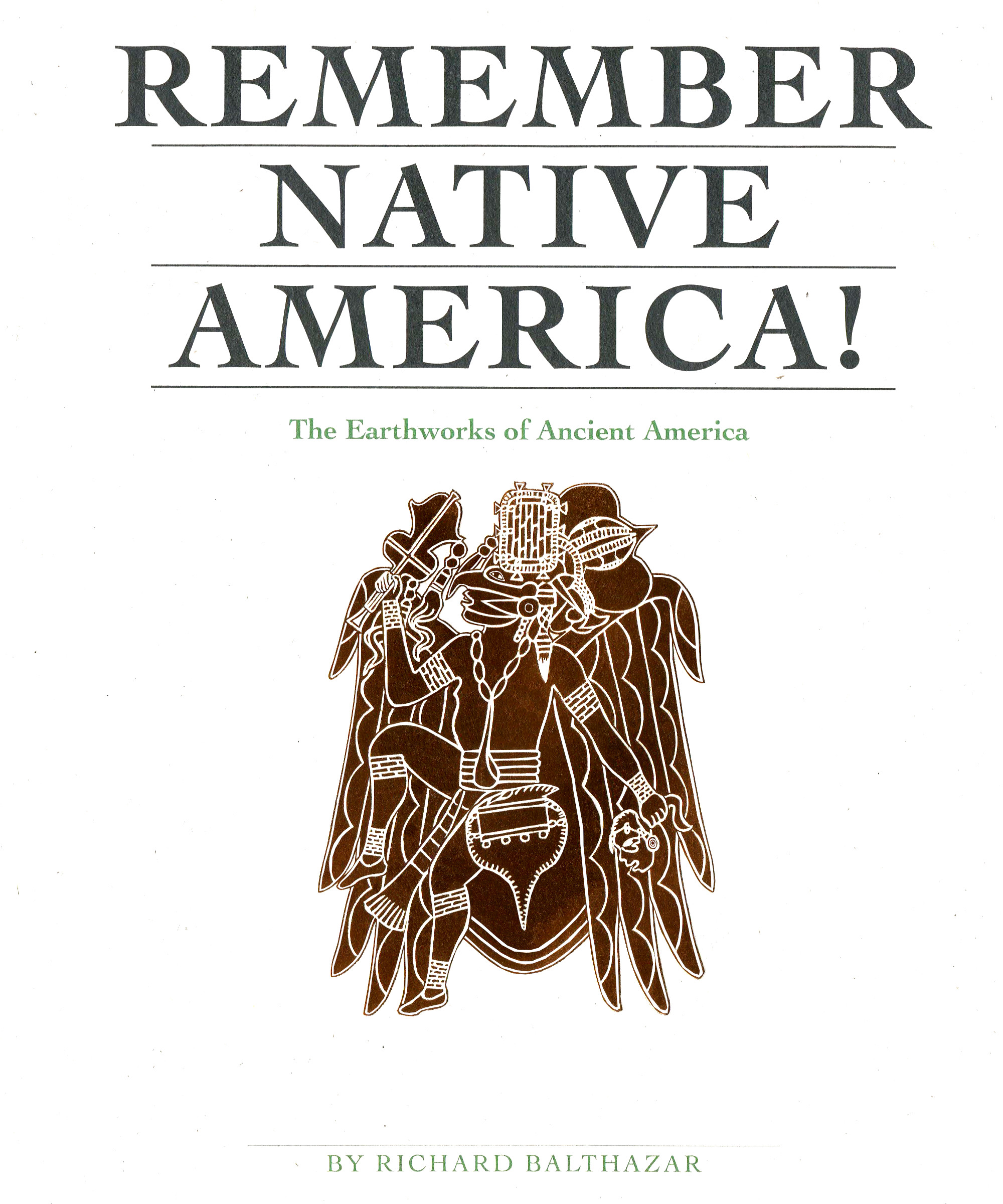
Today I’ve spent an inordinate amount of time fighting to update my Writing webpage, having decided to include pictures of the book covers. That was the first mistake because I wound up spending hours “fixing” the image of a Mississippian Eagle Warrior on the cover of my first book REMEMBER NATIVE AMERICA—a curious experience re-doing digitally what I’d drawn first in pencil I believe in 1988. Talk about ancient history… It really is a remarkable image of a repoussé copper plaque found in a mound at Etowah in Georgia.

I got the idea to do this update to my webpage because I happened to think about the beautiful drawing I did in maybe 2001 for the cover of the book “Gymnopedie,” publication of which I cancelled and then revised as BAT IN A WHIRLWIND.

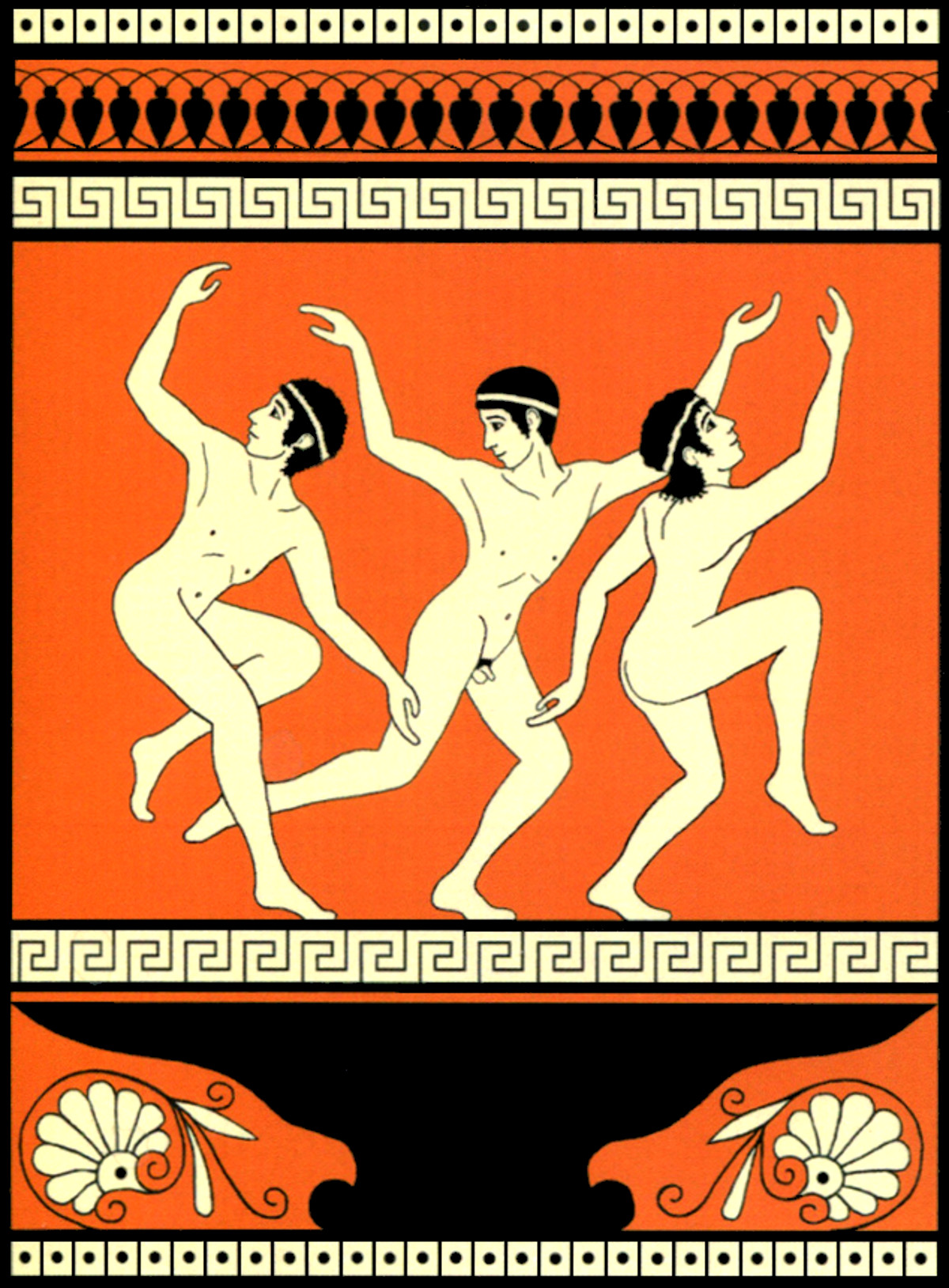
The Etowah Eagle Warrior my book designer converted to digital and produced in a copper stamp. The drawing for the other book, also done in pencil, was scanned to digital by myself, and then worked over by me again in my Gnu Image Manipulation Program (GIMP). (That work was what set me on the road to drawing the icons for my YE GODS! show, as well as all the photo restoration for the biography MS. YVONNE, The Secret Life of My Mother.) The Gymnopedie cover is an illustration of exactly what that Greek word means: a dance by naked boys.

Gymnopedie

Forgive me for feeling sinfully proud of this illustration based on ancient Greek vase-painting. While some of my Aztec icons are outrageous masterpieces, I consider this classical vision right up there with my best work. The motion of their dance is palpable. At least in my opinion…

#

Freedom to Think and Liberty to Act

This morning I was grabbed by a news discussion on NPR about how some groups consider that proposed anti-discrimination legislation would infringe on their constitutionally ordained freedom of religion. Such legislation would in no way prevent these groups from thinking or believing whatever they want, however good or vile, loving or hateful that might be.

That spurious claim of infringement is based on a confusion and conflation of the concepts of freedom and liberty and of thought and action. Everyone in the US is indeed free to think whatever they choose to, no matter its veracity. However, no one in the US is at liberty to act however they choose, no matter their rationale in religious belief or personal inclination.

Our laws are not made to limit freedom of thought/belief but to circumscribe socially acceptable behavior/action. Religious freedom doesn’t mean that any group should be at liberty to infringe on or impact any other segment of society, regardless how devoutly their beliefs are held.

Think anything you like, but for God’s sake, act within the law!

#