Some More Common Sense

It’s been 240 years now since Tom Paine’s “Common Sense” came out, and it’s high time to apply some more of that to what’s going on here in America.  Paine’s little pamphlet helped spark the American Revolution, leading to an enormous step forward in human civilization.  We changed history by creating the first real democracy (only 2,600 years after that of ancient Athens), a government of the people, by the people, and for the people.

All through history rulers have governed by totally controlling their people and all their activities, exploiting them like livestock.  Our Revolution then led into our great Constitution, also a total game-changer by proclaiming the rights of life, liberty, and the pursuit of happiness and promising not to control our thoughts, beliefs, and many individual rights.

This new form of government now controls our lives and activities, (ostensibly by our consent), treating us as citizens rather than subjects, serfs, or slaves, and our revolutionary model has since spawned many other democracies around the world.  But enlightened though it may be, after a couple hundred years, something in our exemplary system is apparently going awry.

Ideally our democracy should be governed by “all the people,” as was mostly possible in tiny Athens, but on today’s mega-scale of everything, that’s pragmatically highly improbable.  Consequently, for a long time our nation has steadily been devolving into a government of the many by the few, especially since fully half of our electorate in the past election was willing to leave their governance to the few.

Democratically speaking, our nation is suffering a severe skew to the few and losing the commitment of far too many.  To cure this life-threatening condition, we must curb, if not curtail, the corrupting influence of money (more exactly, of corporations, the media, and other vested interests), and find ways to engage and invest as many citizens as possible in the system.

Instead, in the last election through fear, demagoguery, and yes, misogyny, we the people handed our country over to the oligarchs.  That’s precisely what happened in idealistic Athens and led them into tyrannies, as has already happened to many of the world’s new democracies.  Just look how quickly the promising Russian democracy degenerated into oligarchy, and those poor people now suffer autocracy once more.

So why does democracy seem pathologically susceptible to the wealthy few?   The US is indeed a government of (nearly all) the people and by (some of) the people, and it claims to be a government for (all) the people.  In other words, the government’s purpose is to benefit us the people.  But there’s a terrible flaw in the system.

To provide those benefits, our nation relies on an economic system based on the concept of private enterprise (capitalism), a system inherited from millennia of common economic practice.  For all its wisdom, our Constitution simply took that for granted, never mentioning or defining an operating principle to be our life-support system.  Recently, for the first time in history, capitalism was threatened (unsuccessfully) by a new concept (communism), but it has since encountered no other rival system and meanwhile remains unexamined and unquestioned.

While our democratic purpose is to benefit the many, capitalism’s purpose is to benefit the few.  That’s a lethal disconnect between public and private intent.  There being no motivation stronger than self-interest, our private enterprise economy is reluctant, recalcitrant, and even unwilling to provide the public benefits which our government requires of it.  Instead, the wealthy few try to limit and control our government to preserve their profits and privileges.

The vast proportion of the profits of private enterprise are “earned” by exploitation of our publicly owned resources and of our citizenry as captive workers and customers.  As a result, our national treasures and we the people are treated by corporations as subject colonies, as sources of unimaginable wealth deserving only the overlords’ charity and forbearance.

Mr Paine said much the same thing about the American colonies under the harsh rule of England and proposed that those little colonies could manage their economy much more productively on their own, without the overlord.  Through our Revolution, we built a new social order, and now we’ve got an opportunity to create an even newer order to do the same.

We the people have empowered our democratic government to direct our activities, namely, our social and economic systems.  As a matter of national security and survival, it has the power to and must draw a formal distinction between private and public enterprise.  It is counter-productive and frankly, unconscionable for industries that exploit our national resources and the life-sustaining needs of us the people to be privately managed—for private benefit.

Our resources and public needs should be managed and benefitted by public enterprise.  While private enterprise must remain possible and be encouraged to provide the niceties and luxuries of personal life, our national treasures belong to us the people.  The time has come for an American Evolution out of capitalism into an economy of publicly managed enterprises.

Held in public trust, those enterprises will most effectively be structured and managed democratically, involving and investing everyone in the industry.  Logically, the government must still direct and coordinate them for national purposes, but the management of those industries must be the responsibility of and to the benefit of the people.

Unless we evolve our economy, our splendid democracy will die.  Call me utopian, but my common sense tells me that converting into a public enterprise economy will be the biggest giant step ever in mankind’s history, a brand new paradigm of human progress.  Our American Evolution will once again set an amazing example for the world—making America not only great again, but spectacularly successful.  We the people can do it.

# # #

Aztec Icon #12 – OMETEOTL, Deity of Two

Well, in a mere three months I’ve managed to finish Icon #12, OMETEOTL for the coloring book YE GODS!  Actually it took only about six weeks because I spent the other six weeks trying to work out a computer system upgrade.  I’ve been using the freeware GIMP (Gnu Image Manipulation Program), but a fantastic artist-friend convinced me to buy an iMac and look into another program for drawing.

After some weeks taking a community college course in Adobe Photoshop, I took a preliminary look at Adobe Illustrator—without being particularly impressed. I still have to take tutorials in Illustrator, particularly about drawing in vectors, but in the meantime I’m continuing my artwork on GIMP (on my PC) and relying on my graphic magician to turn stuff into vectors for me.

So herewith I’m posting the standard .pdf of this icon, and when my wizard has done his trick, I’ll provide the vector drawing in the various sizes. (Again, if you want his contact for similar vectorizing work, contact me at “rbalthazar” @ msn.com.)  You can also view and download the previous 11 icons from the coloring book page.

To download this one as a pdf file with a page of caption and model images from the Aztec Codices, just right-click here and select “Save as.”  You can also download it in freely sizable vector drawings from the coloring book page.


Ometeotl, Deity of Two

Ometeotl, Deity of Two

OMETEOTL

Deity of Two

 OMETEOTL {o-me-te-otł} is the creative pair of Omecihuatl (Lady of Two) and Ometecuhtli (Lord of Two), conjoined as the supreme creator and parent(s) of the primary Aztec gods.  This deity of duality is transcendental, without cult, rites, or temples and exists somewhere beyond the stars.  Also known as Tonacacihuatl and Tonacatecuhtli (Lady/Lord of Sustenance), as Ilamacihuatl and Ilamatecuhtli (Lady/Lord of Creation), and as Citlalicue and Citlalatonac (deities of the stars), OMETEOTL represents unity through sexual dualism. The pair rules the highest (13th) heaven of Omeyocan where unborn souls reside. Omecihuatl chooses the days for their birth and consequently their fates.

***

I should probably explain a few things about this icon. First off, the 20 symbols arrayed around the periphery are the day-names of the month.  The Aztecs named the days of their month and counted the days of their week (13).

The sequence starts with the second up from the bottom on the right side and proceeds counter-clockwise to end in the lower right corner: Cipactli (Crocodile), Ehecatl (Wind), Calli (House), Cuetzpallin (Lizard), Coatl (Snake), Miquitzli (Death), Mazatl (Deer), Tochtli (Rabbit), Atl (Water), Itzcuintli (Dog), Ozomatli (Monkey), Malinalli (Grass), Acatl (Reed), Ocelotl (Jaguar), Cuauhtli (Eagle), Cozcacuauhtli (Vulture), Ollin (Earthquake), Tecpatl (Flint), Quiahuitl (Rain), and Xochitl (Flower).

The days in the middle of each side are also the year-bearers for the 52-year count, starting at the top and again going counter-clockwise: Rabbit, Reed, Flint, and House.

Meanwhile, the little creatures being “spit out” by the odd serpents all wear the traditional mask of Ehecatl, God of the Wind, (See Icon #5), who is the life spirit. So these “breezes” represent the new (or recycled?) souls being born.  They have claws, I assume, because most supernatural beings seem to have them.  They are based on images from Codex Borgia.

The four smaller gods represent the primary god-descendants of Ometeotl. Again counter-clockwise from lower right:  Tlaloc (based on Codex Borgia), Quetzalcoatl (based on Codex Borbonicus), and Tlahuizcalpantecuhtli (based on Codex Borbonicus).  I had intended the last to be Xiuhtecuhtli, but I made a mistake in identification.

The medallion at top center is based on an enigmatic design from Codex Borgia which I take to represent the concept of duality. The dual image of Ometeotl is drawn from Codex Fejervary-Mayer, the only image I’ve ever been able to find of that transcendent deity.  Otherwise, I haven’t a clue about the horn-like thing that Omecihuatl holds or what it may signify.


Aztec deities in vector drawings

Great news for all you coloring enthusiasts out there! I’ve now managed to get the icons of Aztec deities for the coloring book YE GODS! turned into vector drawings.  This may not sound like a big deal, but it actually is because the lines are now clean-edged, and the .pdf files can be enlarged or shrunk without affecting line-quality.  At least that’s what they tell me…

(The work of converting all my insane pixel drawings into vectors was done magnificently and quickly by a brave young fellow in a distant country, saving me many months of boggling labor. Contact me, rbalthazar at msn.com, for his details.)

On the coloring book page, as well as below, I now include three free download options for the icons completed thus far. The regular download is still for the original 8X10 pixel-image with title and caption.  In addition, you can choose an 8X10 vector drawing or another at 16X20, which will no doubt be much better for coloring the intricate details.  But you can also size these vectorized images however you wish.  Go for it!

(to download, right-click on link and select “Save as”)

(Images on pages are in pixels and sized at 8” x 10” w/ captions for legal paper at 300 dpi.  You can also download the images as vector drawings in two sizes which can be enlarged or shrunk with consistent line quality.)

#1 Atl                                      Page 1 with caption         8X10 vector           16X20 vector

#2 Chalchiuhtlicue              Page 2 with caption         8X10 vector           16X20 vector

#3 Chalchiuhtotolin            Page 3 with caption         8X10 vector           16X20 vector

#4 Chantico                          Page 4 with caption         8X10 vector           16X20 vector

#5 Ehecatl                             Page 5 with caption         8X10 vector           16X20 vector

#6 Huehuecoyotl                 Page 6 with caption         8X10 vector           16X20 vector

#7 Huitzilopochtli               Page 7 with caption         8X10 vector           16X20 vector

#8 Itzpapalotl                      Page 8 with caption         8X10 vector           16X20 vector

#9 Mayauel                          Page 9 with caption         8X10 vector           16X20 vector

#10 Mictlantecuhtli            Page 10 with caption       8X10 vector           16X20 vector

#11 Ocelotl                            Page 11 with caption       8X10 vector           16X20 vector

***

By the way, here’s a progress report on the next icon for YE GODS! I’m about half-way through Aztec icon #12, OMETEOTL, the Deity of Two.  A “duity” (duality) deity, if you will, it’s a composite of Ometecuhtli and Omecihuatl, the Lord and Lady of Two.  Here’s a little detail which I interpret from a page in Codex Borgia as a symbol of duity.

Aztec duity symbol

Aztec duity symbol


Ms. Yvonne, The Secret Life of My Mother

Yvonne Trinite Tapp 1938 at age of nineteen

Yvonne Trinite Tapp
1938 at age of nineteen

My mother, YVONNE TRINITÉ TAPP, passed away a few years ago, in March of 2013 to be exact.  Even after relating to her as a mostly negligent son my whole life long, I really didn’t know all that terribly much about her.  Mother never talked about her experiences, ideas, opinions, or feelings, and now that she’s gone, I sorely regret never even thinking to ask.  So her long life has been for all intents and purposes a secret to me and everyone.

But this past January on her would-be 97th birthday, I wondered again about her secret life and realized that I’ve been sitting on cartons of old photographs and decades of her letters.  So I decided to turn detective, ferret out details of her history from the evidence, and write her biography for her many descendants to know about their fore-mother.  I hope other folks will also be interested in her long life well lived.

Those old photographs (and lots of the newer ones) took inordinate amounts of restoration and outright manipulation to be worth looking at. That close work provided me many intriguing clues, mysteries, insights, and new feelings.  It was an intensely emotional journey.

Over the past nine months, I’ve alternated between writing about Mother and drawing three more of my Aztec icons for the coloring book YE GODS! I’m not sure which I spent more time on, but I’ve now finished the pictorial biography:  MS. YVONNE, The Secret Life of My Mother.

Fortunately, Mother left behind two substantial pieces of writing, one of which I made her write for posterity, and the other I found afterwards amongst her effects. So as well as being a photo-documentary, this biography is also in part an autobiography of my mother, with an inescapable element of my own thrown in gratis.

Sorry that I can’t offer you much in the way of thrilling action or daring adventures, of philosophical or social impact, or of romantic or sensual titillation. However, what you’ll find in this pictorial biography is an independent and courageous woman who weathered the often oppressive vicissitudes of the 20th century and early in the 21st survived Hurricane Katrina.

For free download of this biography as a .pdf file, right-click here and select “Save As.” If you left-click, you can open and read it online.  Meanwhile, I may have found a way to convert this and my other books into eBook format (still free) and promise to do so as soon as I can.


Aztec Icon #11 – OCELOTL (Jaguar), Lord of the Animals

At long last –Aztec Icon #11: OCELOTL, Lord of the Animals.  In the midst of other projects and family stuff, it’s taken me all summer to finish this icon for the coloring book YE GODS!  THE AZTEC ICONS.  Not for lack of effort but the enormous amount thereof.  Actually I’d already done the jaguar rampant a couple years ago, my first drawing directly to digital.  Thanks to my freeware graphics program GIMP, in rendering this boggling Mesoamerican zoo, I’ve discovered almost godlike powers over pixels.  But I try to be a beneficent deity.

The vast amount of effort came first in locating historical images of creatures in the ancient codices for stylistic models. Those I couldn’t find had to be drawn from photographed nature.  Actually, my iconic jaguar is a departure from Aztec style in its naturalistic treatment.  While there are many jaguars in the codices, in my opinion they all look too “cartoonish” to make an impressive deity.  Besides, I liked the challenge of creating the pelt pattern for the little Jaguar Knights in the Chalchiuhtotolin icon.  The regalia indicates the creature’s divine nature, and the wavy fork at its muzzle is the symbol of its howl.

Please note the large “dots” at each corner of the icon. They are the Aztec number four, and this is the calendrical day-name Four Jaguar, the First Sun (World) in the Mesoamerican cosmological sequence.  That very first YE GODS! icon of Atl was the day-name Four Water, the Fourth Sun, and the fifth icon of Ehecatl was the day-name Four Wind, the Second Sun.  You’ll have to wait a bit for the third and fifth Suns later in this series.

Ocelotl is lord of all animals:  those belonging to Huixtocihuatl, Lady of Salt (Goddess of the Sea on the upper left); those belonging to Tlaltecuhtli, the hermaphroditic Lord of the Earth (on upper right); and those of the air ruled by Quetzalcoatl, the Plumed Serpent (at top).

The split circle over the deity’s head is the traditional symbol of day and night, showing its lordship over diurnal and nocturnal animals, the jaguar itself being nocturnal. The eagle to the left represents the Aztecs’ main god Huitzilopochtli as the sun at midday, and my very own “batterfly” on the right is Itzpapalotl, Goddess of the Night Sky, who was often depicted as butterfly, bat, and/or bird.

Ocelotl is also lord of the strange animal Man, as can be seen in the vignette at the bottom depicting the legendary creation of man from a primordial tree as shown in Mixtec codices.

By the way, I’ll note that the Aztecs adopted most of their cosmology and “religion” from the peoples living then and earlier in central Mexico like the Mixtec, Zapotec, Huastec, Toltec, etc., etc.—as had they from the even more ancient Teotihuacan and Maya. In the long history of Mesoamerican civilizations, their underlying myths have mostly been related, even inherited.

Ocelotl, the Jaguar, is a mythology from deep in history. The earliest (in Mesoamerica) Olmec famously revered the Jaguar (jaguar-headed babies?), and may have named the day in the calendar for it.  Or maybe not.  Elsewhere I’ve suggested that the Mesoamerican calendar could have come from South America, from the even earlier Chavín civilization, and curiously, the Jaguar-Man was also a prominent feature of that culture.  Just saying…  Deep history.

Some other notes on my Mexican menagerie: I can’t even identify some of the animals or birds, especially the silly little bugs.  That odd creature at the end of the deity’s tail is the salamander called in Nahuatl axolotl.  My Monarch butterfly (center left, just above the stunning Turkey) is geographically appropriate, as are my several other nature drawings of Mexican fauna, including the quetzal birds (top right).  Don’t overlook the Xoloitzcuintli, national dog of Mexico, at the Jaguar’s left foot.  Can you identify any more of the critters in this montage?

(You can still see or download the previous ten icons in the YE GODS! series by clicking on them in the list on the page for the coloring book.)

ICON #11: OCELOTL

(Lord of the Animals)

To download this icon as a pdf file with a page of caption and model images from the Aztec Codices, right click here and select “Save Target (or Link) As.”  You can also download it in freely sizable vector drawings from the coloring book page.

OCELOTL (Jaguar), Lord of the Animals

OCELOTL (Jaguar), Lord of the Animals

OCELOTL {o-se-lotł} (Jaguar) is the Aztecs’ deity of all animals of land, sea, and air. It is a nagual of the god TEZCATLIPOCA who created the First Sun, Nahui Ocelotl (Four Jaguar), a world peopled by giants who were devoured by divine jaguars.  Ocelotl, the 14th day of the month, was usually a lucky day, but anyone born on the day Ce Ocelotl (One Jaguar) was destined for sacrifice to one god or another.  OCELOTL is patron of scouts and warriors, and the elite corps of warriors of the night were known as the Jaguar Knights.  Ever since the Maya, in Mesoamerica jaguar pelts in shades of tawny gold to white were the sacred possessions of priests and royalty.


Huixtocihuatl and Mictlancihuatl, Aztec goddesses

No, I haven’t been on vacation since the middle of May. Well, actually I did go away with family for a week at the beginning of July to a beach house in Galveston.  Just a week though.  Otherwise I’ve been making good progress on the eleventh icon (Ocelotl-Jaguar) for my YE GODS! coloring book and restoring photographs by the dozen for a biography of my mother, which I hope to finish by October and publish under Writing.  As if that weren’t enough of an excuse for no blog postings these three months, I’ve also been dealing with some medical issues I won’t bore you with, except to say they involved surgery and prescription for a blood thinner.  No fun whatsoever.

Meanwhile, I’ve wondered what to write about next. I considered a lament about the current sad climate for dance in Santa Fe, but you don’t want to read about my withering opinion of what they’re calling nightlife and dance music nowadays.  Rants about today’s absurd political situation seemed particularly egregious, and philosophical essays seemed pointless.  I’ve been planning to write about 30 years ago, but that purely autobiographical subject, while formative and somewhat dramatic, isn’t all that exciting.  So I’ll fall back on my eccentric art for a topic.

Sorry about taking so long on the Ocelotl icon, but it demands an exorbitant number of elements. The Jaguar being the Aztec’s main animal deity, lord of the animals, I’ve got to include as many of the animals indigenous to Mexico as I can manage.  It’s been a hoot drawing them:  armadillo, peccary, xoloitzcuintli, quetzal, turkey, iguana, tortoise, coati, etc. There are several yet to go, like pelican and giant anteater. It will present the Mesoamerican biota of creatures of the land, air, and sea.

To show this inclusiveness, I’ve drawn Tlaltecuhtli, the androgynous deity of the earth (the land); Quetzalcoatl, the composite deity of the sky (the air); and Huixtocihuatl, the Lady of Salt (the sea). In addition, in the tenth icon of Mictlantecuhtli I included a new cameo of the Lady of the Land of the Dead, Mictlancihuatl.

Since these two divine Ladies don’t figure in the Aztec ceremonial calendar, they didn’t make it into my batch of illustrations for that 1993 book. So here for your delectation are images of two more Aztec goddesses:

Huixtocihuatl, Lady of Salt, and Mictlancihuatl, Lady of the Land of the Dead

Huixtocihuatl, Lady of Salt, and Mictlancihuatl, Lady of the Land of the Dead


The Iris Man

What a wonderful May! For the first time in maybe ten years I’ve got a stellar flowering of iris.  Every spring the buds would be forming and then it would freeze hard enough in vicious late April to turn their buds into what I disgustedly call “corpsicles.”

I feel so heartily happy about the exceptional display of my iris this year because for a great long while those exquisite flowers/plants provided my livelihood. For fifteen years, as noted elsewhere, I was the Iris Man at the Santa Fe Farmers Market (1997-2012), and these amazing blooms bring back fond memories of the indescribable varieties I sold and the beautiful gardens I worked in.  Driving around town now, I admire iris beds I planted long ago and rejoice in how well they grow.

Well, the Iris Man is back! This year, while the days often got unseasonably warm, it stayed quite cold at night, and I guess that held the rhizomes back a bit.  Also we didn’t get our usual late freeze.  When those enthusiastic bloom stalks started emerging from the fans of leaves, I was on pins and needles watching the weather.  Then each day became a new thrill with the opening of another variety.  They should last another week.

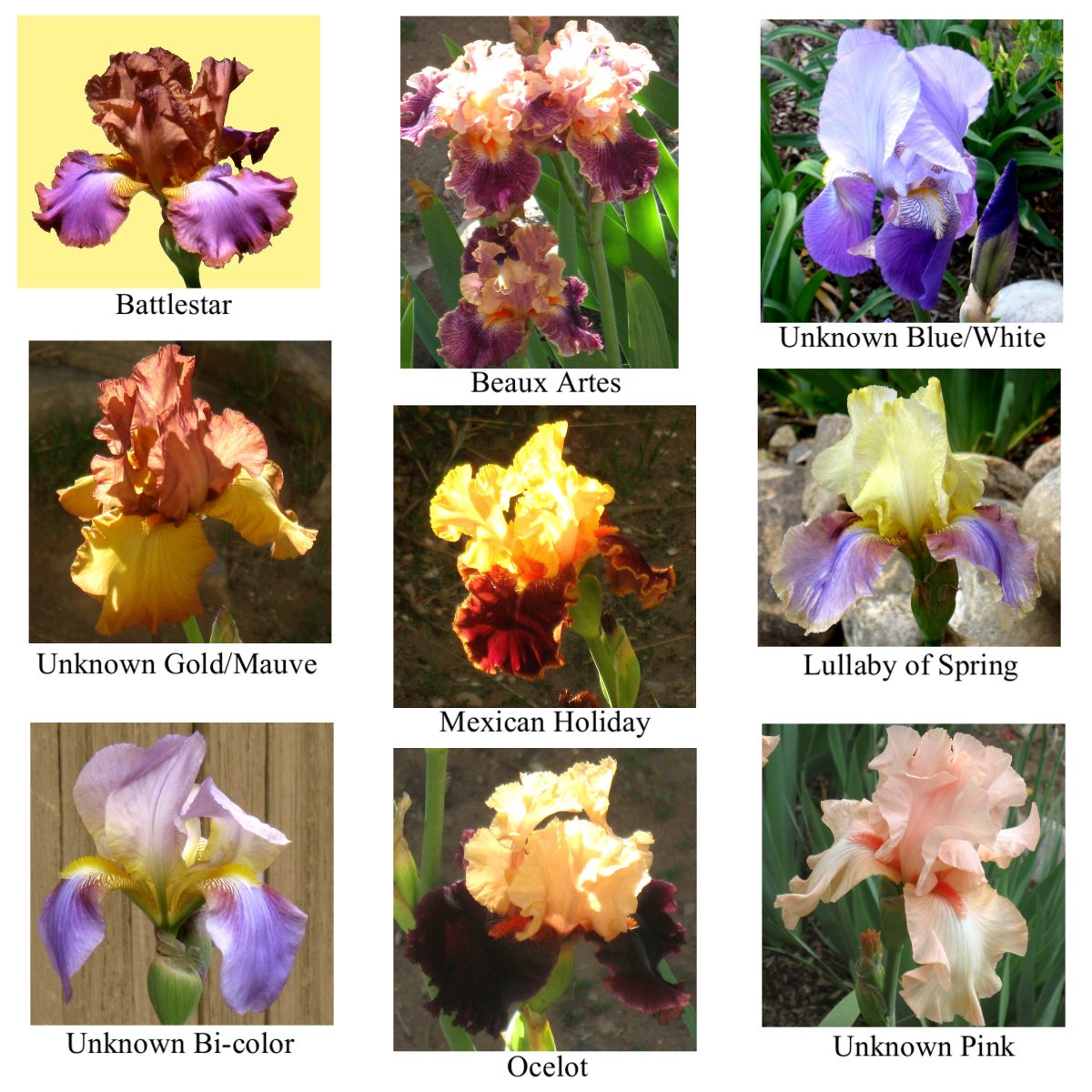
Here are several of my prize varieties with their names—if I know. Could somebody please identify the unknowns for me.  (Use the comment doohickey below.)  I haven’t included the more common yellows, reds, or pinks, though they are all equally gorgeous, if you know what I mean.  I was sad that two of my favorites didn’t make it to flower this year:  Loud Music and Heartbreak Hotel.  Maybe next year.

Iris blooms, 2016

Iris blooms, 2016


Aztec Icon #10 – MICTLANTECUHTLI, Lord of the Land of the Dead

Though there were times when I wondered if I’d ever finish this drawing, I’ve actually managed to complete the next icon in the series for the coloring book YE GODS!  THE AZTEC ICONS.

This icon of the Lord of Mictlan, the Land of the Dead, contains a lot more mythological narrative than even hinted in the caption.  Starting at the upper left and moving clockwise around the temple, dead persons enter Mictlan at the mouth of the Underworld.  Then the monstrous deity Xolotl serves as their guide (psychopomp), and the dog Itzcuintli is their companion through Mictlan, where they must climb eight hills and cross nine rivers (in four days).  The realm of Mictlantecuhtli is an empty place of darkness, dust, and vermin/vile insects (centipedes and scorpions among others), but that’s where most people had to go after death.  I wonder why they ever bothered to struggle over all those hills and rivers just to get to a nowhere like that.

Meanwhile, in the center of the lower register the wind deity Ehecatl (nagual of Quetzalcoatl) negotiates with the Lady of the Land of the Dead, Mictlancihuatl, for the bones from the Fourth Sun (Four Water).  He then breathes life into those bones to create the people for the current Fifth Sun (Four Earthquake).

(You can still see or download the previous nine icons by clicking on them in the list on the page for the coloring book.)

ICON #10: MICTLANTECUHTLI

(Lord of the Land of the Dead)

To download this icon as a pdf file with a page of caption and model images from the Aztec Codices, right click here and select “Save Target (or Link) As.”  You can also download it in freely sizable vector drawings from the coloring book page.

Mictlantecuhtli, Lord of the Land of the Dead

Mictlantecuhtli, Lord of the Land of the Dead

MICTLANTECUHTLI {meek-tłan-te-kooh-tłee} is the most prominent of several deities of death, 5th lord of the night, and 6th lord of the day.  His worship reputedly involved ritual cannibalism.  (Counter-intuitively, skulls and skeletons were symbols of fertility, health, and abundance.) His wife is Mictlancihuatl.  Only souls who died normal deaths went to the Land of the Dead, Mictlan; souls of heroes, warriors, sacrificial victims, or who die in childbirth joined TONATIUH in the Fourth Heaven, and those who drown went to TLALOC’s Eighth Heaven, the paradisiacal Tlalocan.

Source of Aztec Calendar

A friend mentioned that the Aztec ceremonial calendar of 260 days might be based on the zenithal passage of the sun at some particular latitude. I calculated:  260 calendar days / 365.25 solar days = 0.7118 of the annual cycle X 93.6 degrees per year (back and forth between the Tropics) = 66.62834 X .5 = 33.3142 degrees – 23.4 from Tropic of Capricorn to Equator = 9.9142 degrees N (9o 54’ 51”).  I was surprised that this latitude runs through Costa Rica.

Reading the book “Cycles of the Sun, Mysteries of the Moon” by Vincent H. Malmström (University of Texas Press, 1997), I was even more surprised that the professor of geography announced the latitude as 14.8 degrees N, without showing calculations. He then identified the pre-Olmec site of Izapa as where the calendar was probably invented.  By my count, at 14.8 degrees N, the southern lap of the sun’s cycle lasts about 297 days.  That’s way off.

Let’s assume that the invention of the calendar happened 1400—1100 BC to allow time for it to get to Izapa and, as Malmström so reasonably proposes, cross over the Isthmus of Tehuantepec into the early Olmec area. But there were pre-Olmec cultures all along the Pacific coast from Mexico through Guatemala, El Salvador, Honduras, Nicaragua, and down into Costa Rica.  As a matter of fact, in Costa Rica the Las Mercedes site (from 1500 BC) lies on the slope of the (active) Turrialba volcano at 10.167 degrees N.  It’s worth noting that Turrialba’s peak is at 10.01 degrees N, so Las Mercedes is directly east, which would make for a huge gnomon.

Now I read in “The Art of Mesoamerica” by Mary Ellen Miller (Third Edition, Thames & Hudson, 2001) that the unworkable Izapa proposition has survived in scholarship for at least four more years. But this author proposes the human nine-month birth cycle as more likely.  I calculate 9 x 30 days = 270—close but no cigar, and too variable.  Miller argues that a zenithal source of the ceremonial count “seems an unlikely basis for a calendar first recorded to the north of the 15-degree latitude.”  Given the astronomical bent of the ancients, I’d say it’s an exquisitely likely basis for a calendar, whenever or wherever first conceived or recorded.

IF the 260-day ceremonial calendar was based on the sun’s zenithal passage, THEN it must have been invented at a latitude where that time period obtained—approximately 9.9 degrees.  That latitude also runs along the Caribbean across the northern sections of Colombia and Venezuela, but there don’t seem to be any significant culture sites in those areas from appropriate times.

If not in Costa Rica, then how about at 9.9142 degrees South? That imaginary line runs across the Amazon basin just slightly north of the Beni region in Brazil and Bolivia —which by the way hosted an enormous hydrological culture from 4000 BC to 1300 AD(!).  Though they built canals, causeways, raised fields and living sites, we essentially know nothing about them.

That latitude also crosses the Andes in Peru, running right through Chavín de Huantar in the Ancash valley. It was the main site of the earliest South American civilization (1200—400 BC), which occupied many other sites in the region and along the coast.  Other sites were even older though, like El Paraíso (2500—1100 BC).  But the Chavín culture was the first to produce distinctive art and ceremonial architecture, specifically truncated pyramids.  Chavín de Huantar lies directly east of an Andean peak which again could serve as a magnificent gnomon.

Significantly, there are many obelisk– and slab-shaped stelae/gnomons at the site, the main one being the Lanzon stela, a 15+-foot stone spire with wonderful decorative carvings. It stands within a pit in the “temple” and extends up through a hole in the roof, a foolproof way to demonstrate the exact zenithal passage of the sun.  By the way, the figure carved on the stela points eloquently upward with one hand and downward with the other.  Of course, this site’s 260 days between the sun’s passages are on its northern lap between the Tropics.

I propose that Chavín de Huantar was the birthplace of the 260-day calendar, which probably was what caused its rise in ceremonial importance around 1200 BC, turning it into the cultural and religious hub of that first civilization and a destination for pilgrimages and rituals. Even though no archaeological traces of a 260-day calendar have been found amongst these non-literate Andean civilizations, they may well have observed it religiously alongside the solar calendar, which is precisely how it worked later in Mexico.  And it got to Mexico by sea.

The Chavín and other even earlier Pacific coastal cultures were accomplished sea-faring folk using balsa-wood rafts and boats. (Balsa trees grow all along the coasts of South and Central America.)  There was a lot of maritime activity, trade, and exchange among the various cultures long before the Chavín.  In the dim past maize was brought from Mexico to the Andes, and the art of metal-working passed in the opposite direction. The Pacific coast from western Mexico down to northern Chile was one enormous “economic zone” of productive ecologies between sea and mountains.  The Chavín were the first efflorescence of those cultures (fertilized by contacts with the Beni?), and wherever they went, they understandably preached their religious calendar.

Besides the calendar, the Chavín spread other concepts of their culture and art all along the coast. Their pyramids and intricate figures and motifs of jaguars, caimans, and serpents bear a distinct resemblance to the architecture, themes, and imagery of the later Maya and other Mexican cultures.  The Chavín anthropomorphic jaguar and truncated pyramid must surely have accompanied the ceremonial calendar across the Isthmus of Tehuantepec to inspire the Olmec—and subsequent Mesoamerican cultures.

Two Decades Ago

It’s always fun, or at least interesting, to look back over the decades of our lives and see where we were when and what we were experiencing in those bygone days. Not long ago I took a look back a mere decade to a thriving and exciting situation.

Now I want to step back yet another decade and talk about that fascinating time capsule. From September, 1996 to September, 1997, when I was in my mid-fifties, was a year of remarkable transition, though perhaps a stereotypical mid-life crisis. Two decades ago brought the end of my sixth personal era (the Mature Gay Gentleman) and heralded the birth of my seventh persona (the Grandfatherly Gay Character).

That mid-September morn, standing on the sidewalk on Montezuma Avenue outside the La Casa Building (note the poetic persistence of the Aztec and La Casa themes in my life), I watched a huge U-Haul truck drive away with its institutional load. It was hauling the whole of the Western States Arts Federation off to Denver, leaving me and twenty more professional administrators unemployed. Thank you, Newt Gingrich, and your Contract on America. You don’t want to know the gory budgetary details.

As Director of Administration, I’d dutifully organized this planned exodus but also looked around for a commensurate position. I even went to San Francisco to interview with the California Assembly of Local Arts Agencies. But shortly before that interview, after considering the whole San Francisco city/California thing, I decided I didn’t want to leave Santa Fe. Back home that summer, I applied and made the finals for the heads of the McCune Foundation and SITE Santa Fe but lost both bouts.

So that September I went on unemployment and ground out the requisite applications for a certain number of jobs each week, knowing all the while that nobody wanted an overly mature, upper-level, nonprofit arts administrator—with reasonable salary expectations—nor were there any such openings in the first place. As I said before, stereotypical. However, rather than agonize, I decided to go on vacation. After 15 years of hard work, I could take a sabbatical.

At the time, I was driving a silver 1985 Plymouth Horizon and headed west. First stop was the Grand Canyon. In the 70’s I’d hiked down from the North Rim, and in the 80’s from the South Rim. This time I camped on the South Rim and just stayed up there. Still I managed to waste as much film as almost anybody on the unimaginable spectacle. I love this shot from the rim (inner gorge in foreground). Look, 20 years ago you could still see through the pollution to the far North Rim.  Imagine  that.96 grand canyon

Grand Canyon, 1996

Westward-ho, this middle-aged man went on to see the boggling Hoover Dam and then went for a hike at Lake Mead at a spot reputed to be a nudist area. Feeling liberated from work and societal stuffiness, I tromped nude though the scrub willows along the lake. I saw only one odd naked fellow with a tent, whose kind invitation to tea I politely declined. From there I climbed to the top of a low hill to a giant tamarisk tree which served obviously and odorously as rookery for several unkindnesses of ravens. A malevolence of ravens?

Next stop was San Diego. I pitched my tent at the Campground on the Bay in view of Sea World across the water but didn’t go there till a couple days later. Instead, I spent my days at Black’s Beach near La Jolla and Torrey Pines State Park. An honest-to-John nude beach, you get down to it from the high bluff (at least back then) via a fragmented and dubious wooden staircase. Safely down, I shucked clothes and explored the lovely but sparsely populated (late-season) beach, my first time to the actual Pacific. (Puget Sound doesn’t count.) I noted the waves were understated, more like the Gulf than the Atlantic, eponymously pacific surf.

Spreading my towel back near the cliff out of the constant up-draft wind from the sea, I lay there in my splendid nakedness watching the hang-gliders take off from the bluff top and float around in the rising columns of wind like so many colorful seagulls. In skinny strolls along the beach I encountered only a few other bathers enjoying their own private leisure. I’d been advised that gay shenanigans went on back among the occasional dunes, but sandy sex wasn’t and still isn’t my bag. On one of my walks along the water I encountered a guy who was impressed by my cock-a-doodle, even though it wasn’t a Prince Albert.

While in San Diego, I did indeed visit the wonderful Sea World and go to the Zoo, which was almost more than I could handle. Most sentimental was my walk in Balboa Park where some years before my dear old friend Charles ended his troubled days on one of the park benches. Wandering around the city, I found a Kwan Yin to add to my collection, a beautifully brocaded figure riding on a fish-dragon, a good omen for my unemployed future. On the way home, I went by Joshua Tree National Park and took an illegal buff hike among rocks and Joshua trees. Isn’t it odd that only people care about clothes?

Well vacated, I returned to Santa Fe and got back into the swing of making futile job applications to get my meagre unemployment checks. That fall, with the luxury of not working, I started pulling together a draft of my book on ‘get’. (It would take another decade to reach its final form.) By December when public assistance ended, I really had to do something for an income. So I went to work part-time helping my daughter’s young man Rich in his woodworking shop. A totally new experience for me, the complicated job of making cabinets and doors was actually rather relaxing. The sanding and finish work was less fulfilling and far more tedious.

With the New Year and the unaccustomed leisure, I took a trip to Carlsbad Caverns—where I’d once gone with family in like 1953. I think it was an early Monday morning, January 7, when I got there and found the parking lot empty. As a matter of fact, beyond a couple workers at the food service, no one was there. I mean no one. I did a totally private tour through the caverns. It was almost mystical. You could even hear the distant drip of water from stalactites. Around noon, just as I was leaving, another car pulled into the parking lot. Afterwards I took long drives along the eastern and northern escarpments of the Guadalupe Mountains around to Dog Canyon on the west. How marvelous to think of that vast coral reef now thrust up as mountains.

After that special getaway, I returned to Santa Fe and my lot as a part-time carpenter’s helper. It was actually sort of fun work, the only pressure being to do it right, and I enjoyed long talks with the young fellow who had already been Aimée’s main squeeze for ten years. While warm and friendly, he was seriously amused by his girlfriend’s father being a gay man. Life rolled on smoothly for a few months with no other professional prospects, but I must admit that I found the physical labor tiring. So I got the idea of finding someone to share the work with me.

I mentioned my search for relief to an old friend, Peter Igo, a great silk-screen artist, and he suggested a young fellow who’d done some handyman chores for his place in Eldorado. (Peter’s remarkable “grow-hole,” a six-foot deep ditch covered with plastic, is what inspired my digging the “greenhole” several years later, and when he passed from cancer, I salvaged his many plants through Babylon Gardens.)

marc portrait

A posed portrait of Marcelo.  He spoke spectacular English.

When I met in early May with Peter’s handyman, a tall, attractive Brazilian named Marcelo, he seemed interested in the work. The next day, May 10, I took Marc to my special spot on the Santa Cruz River in the Caja de Cundiyo, where we splashed and played in the rushing stream.

97 water games

This is moi in the Cundiyo waterfall. 

Back at home that afternoon, I didn’t decline Marc’s intimate proposition. After all, it had been at least five years since I’d gotten physical with anyone. Well, it turned out that Marc didn’t relieve me of any woodworking duties, but against my better judgment, we entered into an amorous liaison. As liaisons go, this one lasted longer than necessary—enough said. Marcelo is now back in Rio de Janeiro, and I’ve got good reason to think that he regularly checks in on this website. I hope he appreciates this fond mention.

Meanwhile, on May 16 Aimée and Rich got married—after ten years together.

97 Rich and Aimee

 Aimée and Rich, May 16, 1997

The affair was in the garden of our local posh hotel, La Posada de Santa Fe (to whom long before I’d sold a huge Eastlake walnut over-mantle mirror which I’d brought from DC and painstakingly restored). The whole family from both sides showed up for the festivities, and I met Rich’s father Harvey for the first and only time. He looked exactly like Ernest Hemingway. I was resplendent in my tuxedo (not as much as Rich), and still have the rose (like his) that I wore in my lapel. Safely cushioned in a little jar, its pale pink has turned all golden brown after these 20 years. 

Actually I didn’t need any help with the woodworking after all. In June, some old professional friends offered me a job as Business Manager for their cultural nonprofit, Recursos de Santa Fe.  After only a week or so on that job, with great chagrin (for the first time in my life!), I told my friends that I was unable to do the job. What they really needed was an accountant.

No matter—the next week I snatched up another job as assistant to the Dean of the College at the College of Santa Fe. (Both he and the institution are now defunct.) No sooner did I report for work than the Dean took off for the summer to care for his ailing mother. With absolutely no job description and even less orientation, I had to figure out what I was supposed to do to run the academic show. It was fun, not to mention a snap, dealing with the closed universe of students and faculty, and rather pleasant having great clout. Big fish in tiny pond.

So the summer of 1997 turned out to be exceptional. I’d weathered my mid-life crisis and for that matter come out on the other side with a new professional niche—and what’s more, a young boyfriend. (Marc was only 32.)

As soon as the Dean got back, before the fall term was to start, I took my guy from Brazil on a grand tour of our western parks and landmarks. We hit Chaco Canyon, Canyon de Chelly, Hopi-land, Grand Canyon, Monument Valley, Hovenweep, Mesa Verde, and Aztec Ruins. Talk about a lot of film! I wish I could post a whole travelogue of photos of me and my Brazilian, but there simply isn’t space or time to do so.

Of particular note was the morning Marc and I hiked to the bottom of the Grand Canyon, making the descent by 10:30. Shortly after a kindly hiker took this shot of us crossing the bridge over the Colorado River, when we were at Phantom Ranch wading in the creek cooling off our tired dogs, I remarked that we were just about as far from civilization as one could get. Not a minute later from over by the restroom shed a hiker, who had ironically been using the emergency telephone, hollered to his nearby friends: “Hey, guys, Princess Diana was just killed in a car crash!” So much for escaping from civilization. Within mere hours of its occurrence, that earth-shattering news had reached down to us at the very bottom of the Grand Canyon.

bridge over Colorado

Marcelo and me in the Grand Canyon, 1997

When we’d recovered from that culture shock and appropriately mourned the royal passing, Marc and I set off on the ascent. On the climb from Indian Gardens, we stopped frequently to breathe, etc., and made it up to the rim by early evening. We marveled at the 16 miles, the uphill half of which had felt more like 20. Marc said I was in terrific shape for such an old man. (Note the minimal middle-aged spread. I’m proud to have an even smaller paunch now—and to be in even better shape.)

When we got back to Santa Fe, it was high autumn, and my rocky mountain asters were in full spate. In this sweet photo of Marc and me you can also see the golden maximilian sunflowers. Eventually, I’d make hunks of money at the Farmers Market selling them. Also eventually, I’d turn the hillside behind us into a bunch of terraces to display my found-object assemblages which I cleverly call Yard Art. However, I have not yet discovered another boyfriend.

97 asters Marc and me hip-deep in asters