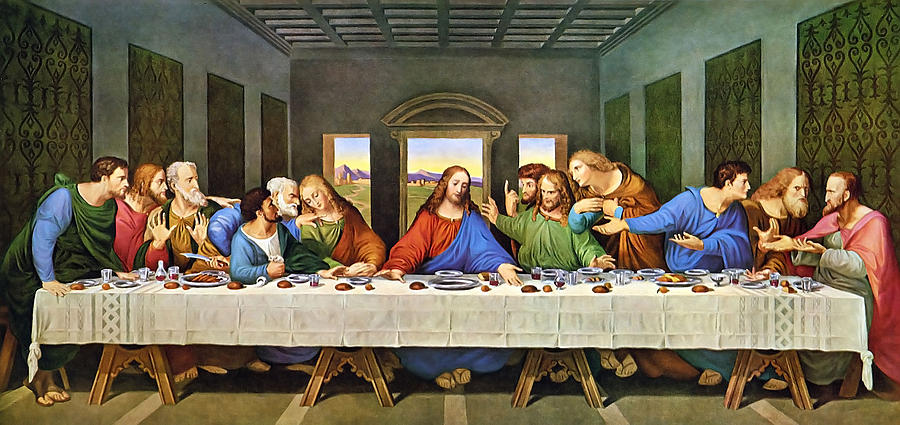
Roll over, Da Vinci! Not to sound pretentious, but I’ve just discovered another masterwork of the Last Supper. Apparently from the late 19th century, this one is probably the artistry of an anonymous nun in a Swiss convent, and it wasn’t painted on a wall but embroidered on a liturgical vestment. Take a look at this baby:
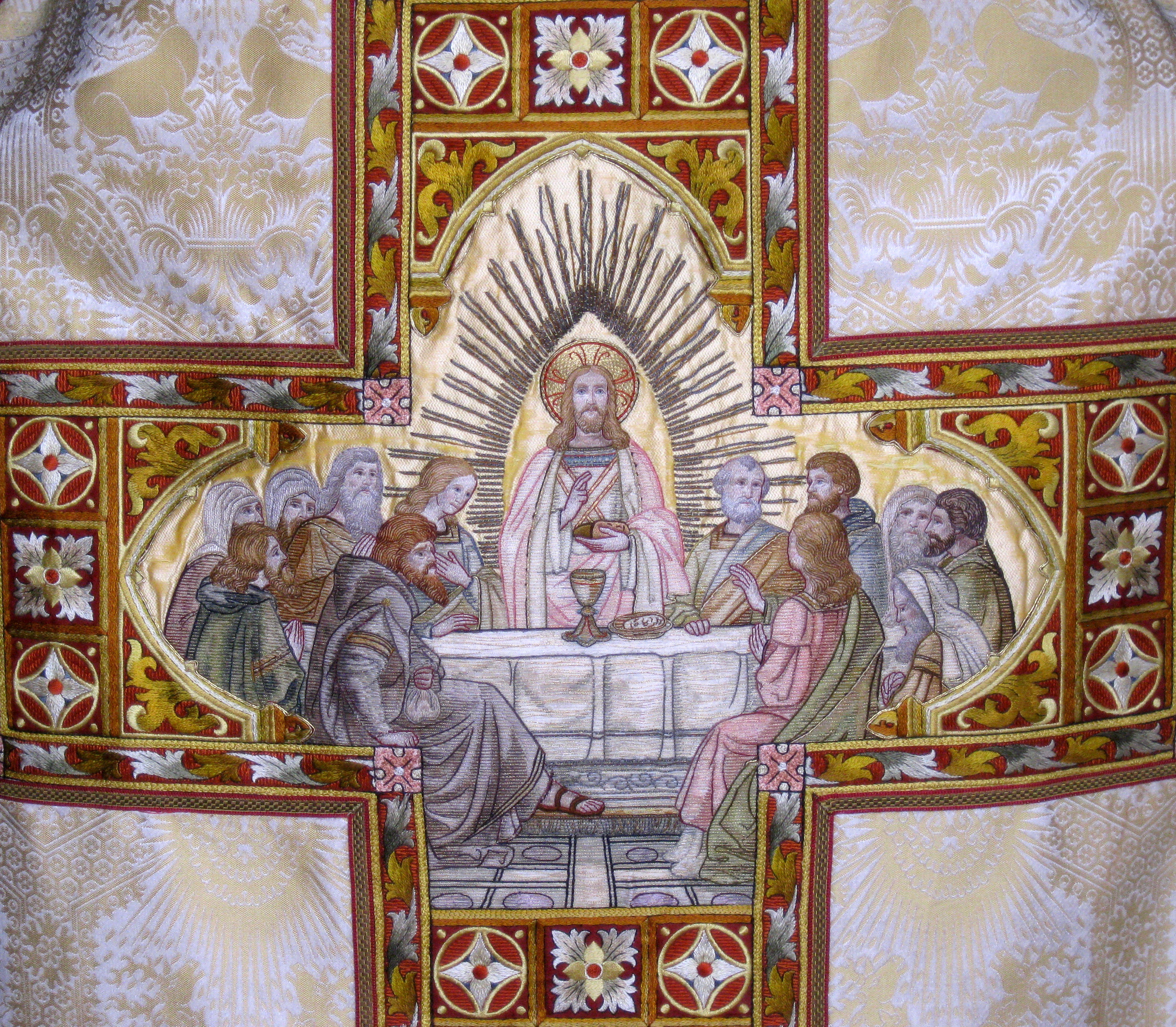
Last Supper embroidery by Fraefel & Co.
The photo is high-resolution, so you can probably zoom in to see the incredible delicacy of the stitchery and execution of the figures.
Of course, it immediately begs comparison with Leonardo’s own masterwork. I’m not sure what similarities there are beyond the groupings on either side of Jesus, with Mary Magdalene on his right. Both works show “The Twelve” counting her, and the Judas figure clutches a bag (of silver pieces) in both, though less clearly in the painting.
The Disciples are presented as quite different physical types in the two artworks. (Check out their incredible faces in those almost microscopic threads!) You can’t really see eye color in the Da Vinci painting, but in the embroidery, most of the figures’ eyes are incongruously blue, and if not grey, in both works most of them have brown or russet hair. Definitely a Eurocentric view of this crowd of ethnically Semitic types.
As well, the energies of the dinner groups are vastly different. Da Vinci’s garrulous, talkative, argumentative apostles surround a resigned, pensive, very human Jesus is seated at a table covered with the remnants of the meal. It is the eloquently human aftermath of the Communion, and just about time to go to the garden of Gethsemane. The painting is a poignant personal moment in the passion of Jesus the man.
In the embroidery they cluster reverently around the table where a divine Jesus stands (in a glorious aura and halo) to bless their Communion of bread and wine. This is the sacramental moment when Jesus the god says, “Take this and eat—this is my body.” This is why I’d really rather call this artwork the New Covenant.
How does all that sound from a life-long fanatical agnostic? Actually, whether you hold by it or not, you’ve got to respect a big honking myth that’s hung on for many thousands of years. The myth of the dying and resurrecting god has been, if you will, resurrected several times in as many parts of the world since mankind began. Often the divine deaths have been much more gruesome than a straight-forward crucifixion. And at least one goddess came back: Inanna/Ishtar/Astarte.
In my humble opinion, it’s human nature to try to explain the inexplicable, to embody the ineluctable, to describe the indescribable, to understand the incomprehensible, and to delimit the infinite—by creating myths. Okay then, if you want to split hairs—by creating religions.
Often beautiful and inspiring (like the present masterpiece of embroidery), these imaginings or faiths, if you prefer, have provided the fabric of all human civilizations, guidance for people to live with one another (or not), answers for life’s unanswerable questions, a focus for spiritual growth and fulfilment, and a sense of the individual’s place (insignificant though it may be) in the cosmos. You’ve got to give them that. But please, we must also weigh those blessings against the immeasurable oppression, death, and destruction that reputedly enlightened faiths still cause in the name of merciful, loving deities. Is that a fair trade? But then life, like trade, isn’t always fair.
In any case, for purposes of encompassing the divinity, I agnostically think that any faith you care to concoct will be no more effective than spitting in the sea.

 Richard Balthazar