
In Aztec culture, notions of time are central and perhaps inordinately important in terms of fate. Life was embedded in and permeated by strict divisions of divinatory time, starting with the agricultural and ceremonial calendars, in which respectively the 20 named days of the “month” (vientena) were counted in 13 numbered days of the “week” (trecena). The basic division of the day was, of course, between day and night (with Cipactonal as god of the daytime and Oxomoco as goddess of the nighttime). This is where things get strange from our modern perspective.
Having no clocks per se to measure passing time, the Aztecs decided there were 13 “hours” in the daytime and 9 in the night. (No doubt, this reflects their 13 heavens and 9 levels of the Underworld.) With only an amorphous measure for a “minute,” they probably never even thought about an Aztec “second.” Their 22-hour diurnal cycle meant their hour in our terms averaged 65½ minutes long, the day lasting 14.18 and night 9.82 of our hours. In any case, their hours must have been only approximate and varied in actual length.
Anyway, a deity was in charge of each day of the trecena, 13 gods or goddesses called Lords of the Day, a list about which, in scholarly fact, there’s some disagreement. The 13 numerals themselves are also ruled by deities, but apparently in a different list. There are also deities in charge of each numbered heaven, but again that list seems to differ substantially. I’ve only seen confused references to various heavens and suspect that the 9 Night Lords might correspond to the 9 levels of the Underworld. But probably not since Mictlantecuhtli is the ruler of not the 5th, but the 9th (lowest) level of Mictlan. Nobody ever said that mythology has to be consistent, and I don’t care to sort out so many lists.
Figuring out the Lords of the Day is work enough. The sequence of full-figured Lords in Codex Borbonicus seems the same as the sketchy heads in Tonalamatl Aubin (with some odd problems there). Looking at an ostensibly authoritative list on Wikipedia, I found a problem in Borbonicus itself: #11 (identified there as Mictlancihuatl, Lady of Mictlan), is evidently not a female and wears a pointy headdress like the one usually associated with Mictlantecuhtli, her consort already listed earlier. Another problem there is with #13 (identified as Citlalicue, Star Skirt), who looks a lot like Mictlancihuatl in Codex Magliabechiano, though I believe Citlalicue is sometimes shown as an Underworld goddess too.
With those questions, I checked the online Mexicolore.co.uk, which complicates the list even further. Instead of #5, Tlazolteotl, they list some deity I’d never heard of: Tonaleque. Instead of #7, Centeotl, they cite Tonacatecuhtli, Lord of Sustenance; for #11, Mictlancihuatl, they insert Yoaltecuhtli, God of Darkness (an odd sort of deity for Day Lord); and for #13, Citlalicue, they propose Ometecuhtli, Lord of Two and the same deity as Tonacatecuhtli–a male. I’m left still wondering about the masculine Mictlancihuatl.
Puzzled, I consulted the premiere authoritative source, “Cycles of Time and Meaning in the Mexican Books of Fate” by Elizabeth Hill Boone, and she helped clarify. For #11, she lists Chalmecatl, He of Chalma, a god of some level of the Underworld indeed related to Mictlantecuhtli. For the feminine #13, Boone’s suggested Ilamatecuhtli should actually be Ilamacihuatl, which is simply another name for Omecihuatl/Tonacacihuatl. As half of Ometeotl, the Deity of Two, the creative pair who birthed the principal gods, co-patron of the Crocodile trecena, and co-ruler of the 13th heaven, she well deserves a slot as a Lord of the Day, especially as #13. I’ve not seen her depicted before as a skeletal deity of the Underworld, but I suppose it could well be she.
I’m happy to include Boone’s #11 and #13 (adjusted) in my roster of the Lords of the Day.
-
- Xiuhtecuhtli, Lord of Fire/Turquoise
- Tlaltecuhtli, Lord of the Earth
- Chalchiuhtlicue, the Jade Skirt, Goddess of Flowing Water
- Tonatiuh, God of the Fifth Sun
- Tlazolteotl, Goddess of Filth
- Mictlantecuhtli, Lord of the Land of the Dead (Mictlan)
- Centeotl, God of Maize
- Tlaloc, God of Storms
- Quetzalcoatl, the Plumed Serpent
- Tezcatlipoca, The Smoking Mirror
- Chalmecatl, He of Chalma, an Underworld deity
- Tlahuizcalpantecuhtli, Lord of the House of the Dawn (Morning Star)
- Omecihuatl, Lady of Two
Here below is my rogues’ gallery of Day Lords as seen in Codex Borbonicus:
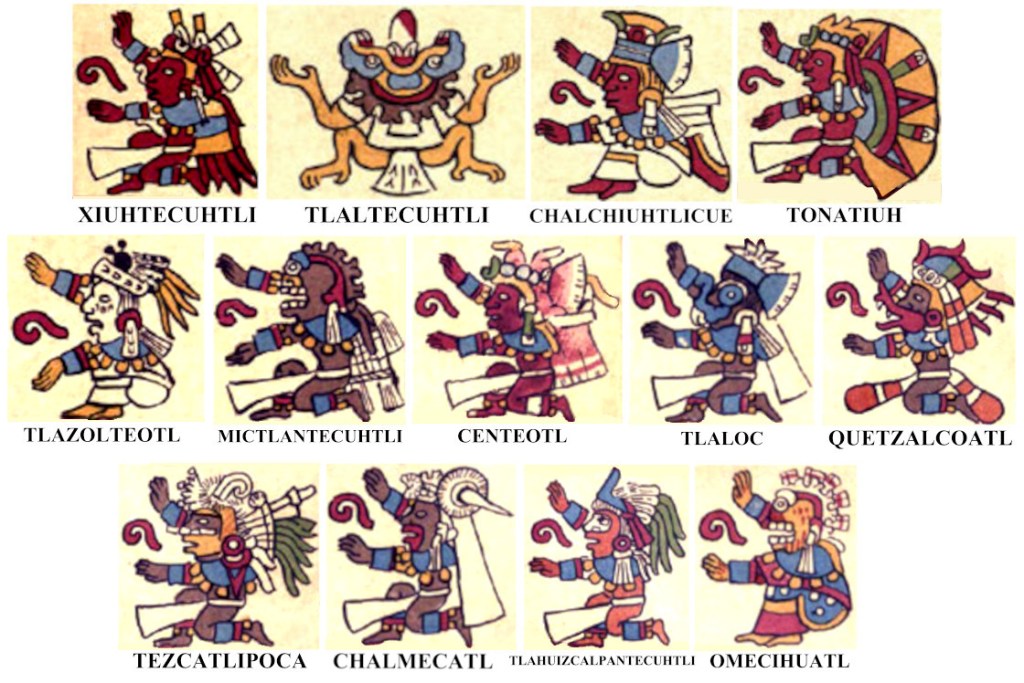
Lords of the Day from Codex Borbonicus
Whoever they are for real, I suggest that these same Day Lords rule the respective 13 daytime hours. Striving for elusive mythological consistency, I’ve also proposed that the 9 nighttime hours are ruled by the 9 Lords of the Night. Maybe, maybe not… The Aztecs tended to complicate their paradigms, some might say unnecessarily.
However, we do know for sure the numerical sequence of totems for the Lords of the Day. These totems are called in the jargon “volatiles” because they’re things that fly: birds and a butterfly. (Apparently other deities also have volatiles, like the bat or vulture of Itzpapalotl, but I’m not all that up on the finer details of Aztec ornithology.) Here are my versions of the volatile totems for the 13 Lords of the Day (whoever they really are), the 13 days of the trecena, and (possibly) the 13 daytime hours. They are drawn on models from Codex Borgia, plate 71.

 Richard Balthazar