History Redux

This morning over my grapefruit, I serendipitously read an essay that ruined my breakfast with the bitter taste of irony. The quotes that follow have been redacted to mask the actual subject.  Please read them and guess who.  Afterwards, I’ll reveal his identity and that of the writer, publication, and other references.

“[The subject]…arrived on the national scene just in time to capitalize on the [current ‘scare’].  An unprincipled political opportunist, he began to make an issue of [purported enemies]…, thereby drawing attention to himself and nurturing his hopes for a continuing political career.

“…[He] made a speech during which he [claimed to have a list of people] known to be [enemies].  [At the time] this was not at all an illegal affiliation, but the [group] was certainly a suspicious [class of people].  …that list itself never existed.  It was a fiction, a prop for [his] political theater. … But that hardly mattered.  With his trumped-up list, [he] had struck a mindless nerve in the body politic, and the Age of [Fear] had acquired its messiah, a leader of the yelping pack.

“[He] proved himself a master of reckless accusation, unabashed equivocation, and outright lying.  He determined guilt by association and made liberal use of innuendo, half-truth, character assassination, and intimidation.  When officials questioned his allegations, [he] countered by questioning their loyalty and their intentions.  Since he … was the champion of the [anti-enemies], anyone who raised any doubts about him was interfering with his patriotic work, seeking, presumably, to stop him in this noble pursuit.  Those who[m] [he] cast aspersions upon were often unemployed or disgraced shortly thereafter.

“Many people recognized at once that [he] was a fraud…

“Chairing a committee charged with investigating [his] allegations, [the Chair] issued a report … that found not a shred of evidence in support of his charges.  He was effectively branded a liar.

“[His] reaction to this supposed reverse is instructive. [He] said, ‘The most loyal stooges of the [enemy] could not have done a better job of giving a clean bill of health to [foreign enemies] in this country.’  [The committee chair] was giving ‘aid and comfort’ to the enemies of the United States.  …he said, ‘let me make it clear … that this fight against [the enemy] shall not stop, regardless of what any group … may do.’  He was undaunted and undeterred.

“He was a genius at manipulating the news media. He understood, apparently, that the press was a knee-jerk institution.  [He] quickly mastered the techniques necessary to dominate the news.  He would call a press conference to announce that he would have a press conference the next day, and the day’s papers would carry headlines heavy with proclamatory import…  And when some allegation of his was proven completely wrong, [he] simply shifted his attack and targeted a new victim.  The sensation of his new charges drew fresh headlines, displacing stories about his errors.  His was the tactic of a guerrilla raider, and he used it time and again with astonishing effectiveness.

“[He] was by no means laying waste to cherished American freedoms without being criticized. Many newspapers attacked him on their editorial pages—while giving him headlines on their front pages—but nationally prominent political figures were slow in rising to the challenge.  When a [prominent journalist] fired a shot or two, [he] rounded on him.  He insinuated that [the journalist] was a tool of [the enemy] and advised people [to boycott the writer’s sponsor].

“Television journalists were nearly silent. Finally…one of the most prestigious journalists in the world attacked [him] … [with] an exposé [that] alternated film clips of [him] making charges and assertions with shots of [the journalist], live, presenting the contradictory facts.  The relentless rhythm of lie refuted by truth again and again drummed in the flagrancy of [his] perfidy.  Given [his] power, going on the air with any sort of an attack at that time took guts.

“…With many of the journalistic fraternity, [a syndicated cartoonist] had long ago recognized that he was at least a charlatan and perhaps a monstrous one, spewing the sulfurous fumes of intimidating invective with every press conference…ripe as a subject for satirical ridicule. [He] was still riding high, with his minions and his actions claiming headlines daily on the front pages of the nation’s papers.

“[The cartoonist] conjures up nightmares of book burning, evoking memories of the Nazi regime in the 1930’s.

“On various editorial pages throughout the land some perceptive souls recognized that [he] was employing methods that had been used to advantage…earlier by an Austrian paper-hanger and his gang in Nazi Germany.”

Okay, no matter your obvious first guess, this damning verbiage was actually about Senator Joseph R. McCarthy of Wisconsin in the early 1950’s. The [enemies] weren’t foreign terrorists but Communists.  The truth-finding committee chair was Senator Millard Tydings of Maryland, and the brave journalist was Edward R. Murrow.  The [syndicated cartoonist] wasn’t Gary Trudeau in “Doonesbury,” but Walt Kelly in “Pogo.”  The prophetic essay, ironically titled “Swamp Talk” by R. C. Harvey, appeared in “Pogo, Evidence to the Contrary,” the Complete Syndicated Comic Strips, Vol.  3, published by Fantagraphics in 2014.

Let’s remember the quote from philosopher, essayist, poet and novelist George Santayana:

            Those who cannot remember the past are condemned to repeat it.

The horror is that historical travesties seem to get worse with each new iteration. Elevating travesty to tragedy, our current villain hasn’t been discredited and disgraced, but has managed through demagoguery, hate, and lies to become, as Pogo might say, President of the ever-lovin’ blue-eyed U. S. and A, and now our nationable future looks dog-bone miserabobble.

Honestly, I don’t blame those terrified, thoughtless, and forgetful folks who voted for him. It’s the fault of all those apathetic and forgetful folks who didn’t vote for anybody.  And the fault of the craven cowards in Congress who are letting their rogue elephrump run rampant in our beloved Okefenokee.

 

Now Some Uncommon Sense

[If anybody knows how to bring my recent essay and this post to the attention of the President-Elect, I (and possibly the world) would be tremendously grateful.  I don’t “tweet” and hope I never have to, and besides these matters aren’t such as can be expressed in that limited medium.] 

#

            When I posted that rant the other day about public enterprise, I wanted to stop thinking about the political situation here in the US, but all the same I kept on thinking that this is the only way we’re ever going to fix our terminally infected system.

Otherwise, we’ll remain colonies of corporations until they’ve drained our personal lifeblood and absconded with all our national treasures, our common wealth.  Next, and this abomination is already in progress, they’ll try to do the same to the whole world.

Playing the cards they were dealt by the obsolete tradition of private enterprise and the short-sightedness of our Founding Fathers about economic psychodynamics, corporations have been running the Roman gambit to control and exploit their captive public:  bread and circus.

Corporate agri-business has been keeping the American populace too well fed (to judge by our obesity epidemic), and corporate media entertain us within an inch of our lives.  We are inundated and consumed by movies, politics, news, sports, sensationalism, nonsense, and most obnoxiously, the celebrity syndrome, video games, and social networking.

As a result, our people are stunned, hypnotized, and incapable of thinking for themselves or questioning our nation’s critically ill condition.  This sickness requires intensive treatment, even radical surgery, to set new rules of play.  In this life-and-death game of providing public benefit, the public good must always trump private interest, or it’s all over.

I haven’t been a supporter of President-Elect Trump for more reasons than I can count, but I have to acknowledge his election, however it was accomplished, and rightfully expect real results on his promises to “fix the system.”  He hasn’t explained what he hopes to do about it, but I maintain that this public enterprise ideology is his and our country’s best and perhaps only bet.  Besides, it’s also a sure way to renew our country’s greatness.

My uncommon sense says, counter-intuitively, that evolving this private enterprise economy into a dependable, productive system of public life-support will probably take an autocratically inclined oligarch who intimately understands it, is not beholden to any of its special interests, and has the courage and chutzpah to do what’s absolutely necessary for the public good.  Run-of-the-mill politicians wouldn’t even try.

Call me Machiavelli, but any presidential prince who would rein in the corporate nobility and their colluding politicians will have to use all and any strategies and tools available, within humanitarian and ethical limits, of course.  The American Evolution of our economy to public benevolence will be, without exaggeration, the biggest social advance in human history.

This new ideology of public enterprise will also serve well for any government with the best interests of its people at heart, be it a democracy, autocracy, theocracy, or whatever.  Modestly, I foresee our American Evolution inspiring the “benevolution” of economies around the world and bringing unprecedented global prosperity.  And seriously, I’d call the uncommon person who creates such a brave new world order a super-hero.

# # #

Some More Common Sense

It’s been 240 years now since Tom Paine’s “Common Sense” came out, and it’s high time to apply some more of that to what’s going on here in America.  Paine’s little pamphlet helped spark the American Revolution, leading to an enormous step forward in human civilization.  We changed history by creating the first real democracy (only 2,600 years after that of ancient Athens), a government of the people, by the people, and for the people.

All through history rulers have governed by totally controlling their people and all their activities, exploiting them like livestock.  Our Revolution then led into our great Constitution, also a total game-changer by proclaiming the rights of life, liberty, and the pursuit of happiness and promising not to control our thoughts, beliefs, and many individual rights.

This new form of government now controls our lives and activities, (ostensibly by our consent), treating us as citizens rather than subjects, serfs, or slaves, and our revolutionary model has since spawned many other democracies around the world.  But enlightened though it may be, after a couple hundred years, something in our exemplary system is apparently going awry.

Ideally our democracy should be governed by “all the people,” as was mostly possible in tiny Athens, but on today’s mega-scale of everything, that’s pragmatically highly improbable.  Consequently, for a long time our nation has steadily been devolving into a government of the many by the few, especially since fully half of our electorate in the past election was willing to leave their governance to the few.

Democratically speaking, our nation is suffering a severe skew to the few and losing the commitment of far too many.  To cure this life-threatening condition, we must curb, if not curtail, the corrupting influence of money (more exactly, of corporations, the media, and other vested interests), and find ways to engage and invest as many citizens as possible in the system.

Instead, in the last election through fear, demagoguery, and yes, misogyny, we the people handed our country over to the oligarchs.  That’s precisely what happened in idealistic Athens and led them into tyrannies, as has already happened to many of the world’s new democracies.  Just look how quickly the promising Russian democracy degenerated into oligarchy, and those poor people now suffer autocracy once more.

So why does democracy seem pathologically susceptible to the wealthy few?   The US is indeed a government of (nearly all) the people and by (some of) the people, and it claims to be a government for (all) the people.  In other words, the government’s purpose is to benefit us the people.  But there’s a terrible flaw in the system.

To provide those benefits, our nation relies on an economic system based on the concept of private enterprise (capitalism), a system inherited from millennia of common economic practice.  For all its wisdom, our Constitution simply took that for granted, never mentioning or defining an operating principle to be our life-support system.  Recently, for the first time in history, capitalism was threatened (unsuccessfully) by a new concept (communism), but it has since encountered no other rival system and meanwhile remains unexamined and unquestioned.

While our democratic purpose is to benefit the many, capitalism’s purpose is to benefit the few.  That’s a lethal disconnect between public and private intent.  There being no motivation stronger than self-interest, our private enterprise economy is reluctant, recalcitrant, and even unwilling to provide the public benefits which our government requires of it.  Instead, the wealthy few try to limit and control our government to preserve their profits and privileges.

The vast proportion of the profits of private enterprise are “earned” by exploitation of our publicly owned resources and of our citizenry as captive workers and customers.  As a result, our national treasures and we the people are treated by corporations as subject colonies, as sources of unimaginable wealth deserving only the overlords’ charity and forbearance.

Mr Paine said much the same thing about the American colonies under the harsh rule of England and proposed that those little colonies could manage their economy much more productively on their own, without the overlord.  Through our Revolution, we built a new social order, and now we’ve got an opportunity to create an even newer order to do the same.

We the people have empowered our democratic government to direct our activities, namely, our social and economic systems.  As a matter of national security and survival, it has the power to and must draw a formal distinction between private and public enterprise.  It is counter-productive and frankly, unconscionable for industries that exploit our national resources and the life-sustaining needs of us the people to be privately managed—for private benefit.

Our resources and public needs should be managed and benefitted by public enterprise.  While private enterprise must remain possible and be encouraged to provide the niceties and luxuries of personal life, our national treasures belong to us the people.  The time has come for an American Evolution out of capitalism into an economy of publicly managed enterprises.

Held in public trust, those enterprises will most effectively be structured and managed democratically, involving and investing everyone in the industry.  Logically, the government must still direct and coordinate them for national purposes, but the management of those industries must be the responsibility of and to the benefit of the people.

Unless we evolve our economy, our splendid democracy will die.  Call me utopian, but my common sense tells me that converting into a public enterprise economy will be the biggest giant step ever in mankind’s history, a brand new paradigm of human progress.  Our American Evolution will once again set an amazing example for the world—making America not only great again, but spectacularly successful.  We the people can do it.

# # #

Ms. Yvonne, The Secret Life of My Mother

Yvonne Trinite Tapp 1938 at age of nineteen

Yvonne Trinite Tapp
1938 at age of nineteen

My mother, YVONNE TRINITÉ TAPP, passed away a few years ago, in March of 2013 to be exact.  Even after relating to her as a mostly negligent son my whole life long, I really didn’t know all that terribly much about her.  Mother never talked about her experiences, ideas, opinions, or feelings, and now that she’s gone, I sorely regret never even thinking to ask.  So her long life has been for all intents and purposes a secret to me and everyone.

But this past January on her would-be 97th birthday, I wondered again about her secret life and realized that I’ve been sitting on cartons of old photographs and decades of her letters.  So I decided to turn detective, ferret out details of her history from the evidence, and write her biography for her many descendants to know about their fore-mother.  I hope other folks will also be interested in her long life well lived.

Those old photographs (and lots of the newer ones) took inordinate amounts of restoration and outright manipulation to be worth looking at. That close work provided me many intriguing clues, mysteries, insights, and new feelings.  It was an intensely emotional journey.

Over the past nine months, I’ve alternated between writing about Mother and drawing three more of my Aztec icons for the coloring book YE GODS! I’m not sure which I spent more time on, but I’ve now finished the pictorial biography:  MS. YVONNE, The Secret Life of My Mother.

Fortunately, Mother left behind two substantial pieces of writing, one of which I made her write for posterity, and the other I found afterwards amongst her effects. So as well as being a photo-documentary, this biography is also in part an autobiography of my mother, with an inescapable element of my own thrown in gratis.

Sorry that I can’t offer you much in the way of thrilling action or daring adventures, of philosophical or social impact, or of romantic or sensual titillation. However, what you’ll find in this pictorial biography is an independent and courageous woman who weathered the often oppressive vicissitudes of the 20th century and early in the 21st survived Hurricane Katrina.

For free download of this biography as a .pdf file, right-click here and select “Save As.” If you left-click, you can open and read it online.  Meanwhile, I may have found a way to convert this and my other books into eBook format (still free) and promise to do so as soon as I can.


Aztec Icon #11 – OCELOTL (Jaguar), Lord of the Animals

At long last –Aztec Icon #11: OCELOTL, Lord of the Animals.  In the midst of other projects and family stuff, it’s taken me all summer to finish this icon for the coloring book YE GODS!  THE AZTEC ICONS.  Not for lack of effort but the enormous amount thereof.  Actually I’d already done the jaguar rampant a couple years ago, my first drawing directly to digital.  Thanks to my freeware graphics program GIMP, in rendering this boggling Mesoamerican zoo, I’ve discovered almost godlike powers over pixels.  But I try to be a beneficent deity.

The vast amount of effort came first in locating historical images of creatures in the ancient codices for stylistic models. Those I couldn’t find had to be drawn from photographed nature.  Actually, my iconic jaguar is a departure from Aztec style in its naturalistic treatment.  While there are many jaguars in the codices, in my opinion they all look too “cartoonish” to make an impressive deity.  Besides, I liked the challenge of creating the pelt pattern for the little Jaguar Knights in the Chalchiuhtotolin icon.  The regalia indicates the creature’s divine nature, and the wavy fork at its muzzle is the symbol of its howl.

Please note the large “dots” at each corner of the icon. They are the Aztec number four, and this is the calendrical day-name Four Jaguar, the First Sun (World) in the Mesoamerican cosmological sequence.  That very first YE GODS! icon of Atl was the day-name Four Water, the Fourth Sun, and the fifth icon of Ehecatl was the day-name Four Wind, the Second Sun.  You’ll have to wait a bit for the third and fifth Suns later in this series.

Ocelotl is lord of all animals:  those belonging to Huixtocihuatl, Lady of Salt (Goddess of the Sea on the upper left); those belonging to Tlaltecuhtli, the hermaphroditic Lord of the Earth (on upper right); and those of the air ruled by Quetzalcoatl, the Plumed Serpent (at top).

The split circle over the deity’s head is the traditional symbol of day and night, showing its lordship over diurnal and nocturnal animals, the jaguar itself being nocturnal. The eagle to the left represents the Aztecs’ main god Huitzilopochtli as the sun at midday, and my very own “batterfly” on the right is Itzpapalotl, Goddess of the Night Sky, who was often depicted as butterfly, bat, and/or bird.

Ocelotl is also lord of the strange animal Man, as can be seen in the vignette at the bottom depicting the legendary creation of man from a primordial tree as shown in Mixtec codices.

By the way, I’ll note that the Aztecs adopted most of their cosmology and “religion” from the peoples living then and earlier in central Mexico like the Mixtec, Zapotec, Huastec, Toltec, etc., etc.—as had they from the even more ancient Teotihuacan and Maya. In the long history of Mesoamerican civilizations, their underlying myths have mostly been related, even inherited.

Ocelotl, the Jaguar, is a mythology from deep in history. The earliest (in Mesoamerica) Olmec famously revered the Jaguar (jaguar-headed babies?), and may have named the day in the calendar for it.  Or maybe not.  Elsewhere I’ve suggested that the Mesoamerican calendar could have come from South America, from the even earlier Chavín civilization, and curiously, the Jaguar-Man was also a prominent feature of that culture.  Just saying…  Deep history.

Some other notes on my Mexican menagerie: I can’t even identify some of the animals or birds, especially the silly little bugs.  That odd creature at the end of the deity’s tail is the salamander called in Nahuatl axolotl.  My Monarch butterfly (center left, just above the stunning Turkey) is geographically appropriate, as are my several other nature drawings of Mexican fauna, including the quetzal birds (top right).  Don’t overlook the Xoloitzcuintli, national dog of Mexico, at the Jaguar’s left foot.  Can you identify any more of the critters in this montage?

(You can still see or download the previous ten icons in the YE GODS! series by clicking on them in the list on the page for the coloring book.)

ICON #11: OCELOTL

(Lord of the Animals)

To download this icon as a pdf file with a page of caption and model images from the Aztec Codices, right click here and select “Save Target (or Link) As.”  You can also download it in freely sizable vector drawings from the coloring book page.

OCELOTL (Jaguar), Lord of the Animals

OCELOTL (Jaguar), Lord of the Animals

OCELOTL {o-se-lotł} (Jaguar) is the Aztecs’ deity of all animals of land, sea, and air. It is a nagual of the god TEZCATLIPOCA who created the First Sun, Nahui Ocelotl (Four Jaguar), a world peopled by giants who were devoured by divine jaguars.  Ocelotl, the 14th day of the month, was usually a lucky day, but anyone born on the day Ce Ocelotl (One Jaguar) was destined for sacrifice to one god or another.  OCELOTL is patron of scouts and warriors, and the elite corps of warriors of the night were known as the Jaguar Knights.  Ever since the Maya, in Mesoamerica jaguar pelts in shades of tawny gold to white were the sacred possessions of priests and royalty.


Aztec Icon #10 – MICTLANTECUHTLI, Lord of the Land of the Dead

Though there were times when I wondered if I’d ever finish this drawing, I’ve actually managed to complete the next icon in the series for the coloring book YE GODS!  THE AZTEC ICONS.

This icon of the Lord of Mictlan, the Land of the Dead, contains a lot more mythological narrative than even hinted in the caption.  Starting at the upper left and moving clockwise around the temple, dead persons enter Mictlan at the mouth of the Underworld.  Then the monstrous deity Xolotl serves as their guide (psychopomp), and the dog Itzcuintli is their companion through Mictlan, where they must climb eight hills and cross nine rivers (in four days).  The realm of Mictlantecuhtli is an empty place of darkness, dust, and vermin/vile insects (centipedes and scorpions among others), but that’s where most people had to go after death.  I wonder why they ever bothered to struggle over all those hills and rivers just to get to a nowhere like that.

Meanwhile, in the center of the lower register the wind deity Ehecatl (nagual of Quetzalcoatl) negotiates with the Lady of the Land of the Dead, Mictlancihuatl, for the bones from the Fourth Sun (Four Water).  He then breathes life into those bones to create the people for the current Fifth Sun (Four Earthquake).

(You can still see or download the previous nine icons by clicking on them in the list on the page for the coloring book.)

ICON #10: MICTLANTECUHTLI

(Lord of the Land of the Dead)

To download this icon as a pdf file with a page of caption and model images from the Aztec Codices, right click here and select “Save Target (or Link) As.”  You can also download it in freely sizable vector drawings from the coloring book page.

Mictlantecuhtli, Lord of the Land of the Dead

Mictlantecuhtli, Lord of the Land of the Dead

MICTLANTECUHTLI {meek-tłan-te-kooh-tłee} is the most prominent of several deities of death, 5th lord of the night, and 6th lord of the day.  His worship reputedly involved ritual cannibalism.  (Counter-intuitively, skulls and skeletons were symbols of fertility, health, and abundance.) His wife is Mictlancihuatl.  Only souls who died normal deaths went to the Land of the Dead, Mictlan; souls of heroes, warriors, sacrificial victims, or who die in childbirth joined TONATIUH in the Fourth Heaven, and those who drown went to TLALOC’s Eighth Heaven, the paradisiacal Tlalocan.

Source of Aztec Calendar

A friend mentioned that the Aztec ceremonial calendar of 260 days might be based on the zenithal passage of the sun at some particular latitude. I calculated:  260 calendar days / 365.25 solar days = 0.7118 of the annual cycle X 93.6 degrees per year (back and forth between the Tropics) = 66.62834 X .5 = 33.3142 degrees – 23.4 from Tropic of Capricorn to Equator = 9.9142 degrees N (9o 54’ 51”).  I was surprised that this latitude runs through Costa Rica.

Reading the book “Cycles of the Sun, Mysteries of the Moon” by Vincent H. Malmström (University of Texas Press, 1997), I was even more surprised that the professor of geography announced the latitude as 14.8 degrees N, without showing calculations. He then identified the pre-Olmec site of Izapa as where the calendar was probably invented.  By my count, at 14.8 degrees N, the southern lap of the sun’s cycle lasts about 297 days.  That’s way off.

Let’s assume that the invention of the calendar happened 1400—1100 BC to allow time for it to get to Izapa and, as Malmström so reasonably proposes, cross over the Isthmus of Tehuantepec into the early Olmec area. But there were pre-Olmec cultures all along the Pacific coast from Mexico through Guatemala, El Salvador, Honduras, Nicaragua, and down into Costa Rica.  As a matter of fact, in Costa Rica the Las Mercedes site (from 1500 BC) lies on the slope of the (active) Turrialba volcano at 10.167 degrees N.  It’s worth noting that Turrialba’s peak is at 10.01 degrees N, so Las Mercedes is directly east, which would make for a huge gnomon.

Now I read in “The Art of Mesoamerica” by Mary Ellen Miller (Third Edition, Thames & Hudson, 2001) that the unworkable Izapa proposition has survived in scholarship for at least four more years. But this author proposes the human nine-month birth cycle as more likely.  I calculate 9 x 30 days = 270—close but no cigar, and too variable.  Miller argues that a zenithal source of the ceremonial count “seems an unlikely basis for a calendar first recorded to the north of the 15-degree latitude.”  Given the astronomical bent of the ancients, I’d say it’s an exquisitely likely basis for a calendar, whenever or wherever first conceived or recorded.

IF the 260-day ceremonial calendar was based on the sun’s zenithal passage, THEN it must have been invented at a latitude where that time period obtained—approximately 9.9 degrees.  That latitude also runs along the Caribbean across the northern sections of Colombia and Venezuela, but there don’t seem to be any significant culture sites in those areas from appropriate times.

If not in Costa Rica, then how about at 9.9142 degrees South? That imaginary line runs across the Amazon basin just slightly north of the Beni region in Brazil and Bolivia —which by the way hosted an enormous hydrological culture from 4000 BC to 1300 AD(!).  Though they built canals, causeways, raised fields and living sites, we essentially know nothing about them.

That latitude also crosses the Andes in Peru, running right through Chavín de Huantar in the Ancash valley. It was the main site of the earliest South American civilization (1200—400 BC), which occupied many other sites in the region and along the coast.  Other sites were even older though, like El Paraíso (2500—1100 BC).  But the Chavín culture was the first to produce distinctive art and ceremonial architecture, specifically truncated pyramids.  Chavín de Huantar lies directly east of an Andean peak which again could serve as a magnificent gnomon.

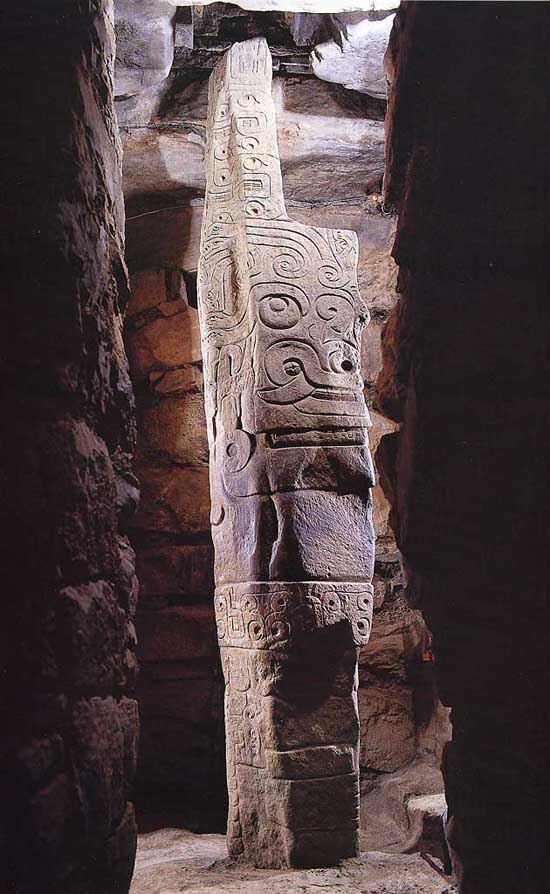
Significantly, there are many obelisk– and slab-shaped stelae/gnomons at the site, the main one being the Lanzon stela, a 15+-foot stone spire with wonderful decorative carvings. It stands within a pit in the “temple” and extends up through a hole in the roof, a foolproof way to demonstrate the exact zenithal passage of the sun.  By the way, the figure carved on the stela points eloquently upward with one hand and downward with the other.  Of course, this site’s 260 days between the sun’s passages are on its northern lap between the Tropics.

I propose that Chavín de Huantar was the birthplace of the 260-day calendar, which probably was what caused its rise in ceremonial importance around 1200 BC, turning it into the cultural and religious hub of that first civilization and a destination for pilgrimages and rituals. Even though no archaeological traces of a 260-day calendar have been found amongst these non-literate Andean civilizations, they may well have observed it religiously alongside the solar calendar, which is precisely how it worked later in Mexico.  And it got to Mexico by sea.

The Chavín and other even earlier Pacific coastal cultures were accomplished sea-faring folk using balsa-wood rafts and boats. (Balsa trees grow all along the coasts of South and Central America.)  There was a lot of maritime activity, trade, and exchange among the various cultures long before the Chavín.  In the dim past maize was brought from Mexico to the Andes, and the art of metal-working passed in the opposite direction. The Pacific coast from western Mexico down to northern Chile was one enormous “economic zone” of productive ecologies between sea and mountains.  The Chavín were the first efflorescence of those cultures (fertilized by contacts with the Beni?), and wherever they went, they understandably preached their religious calendar.

Besides the calendar, the Chavín spread other concepts of their culture and art all along the coast. Their pyramids and intricate figures and motifs of jaguars, caimans, and serpents bear a distinct resemblance to the architecture, themes, and imagery of the later Maya and other Mexican cultures.  The Chavín anthropomorphic jaguar and truncated pyramid must surely have accompanied the ceremonial calendar across the Isthmus of Tehuantepec to inspire the Olmec—and subsequent Mesoamerican cultures.

Aztec Icon #9. – MAYAUEL, Goddess of Pulque

After along haul of boggling detail, I’ve completed another icon in the series for the coloring book YE GODS!  THE AZTEC ICONS.  That makes nine in two years.  Only 17 to go.  Good thing I’m patient—and persistent.

The icon of this popular goddess of drunkenness (as well as intoxication by other drugs), was a lot of fun to draw if only because of all the drunken rabbits. She herself is based on an image from Codex Rios with details from Codex Laud and Codex Nuttall, and the vignettes come from various other sources like Codex Vindobonensis.  It was also a rare chance to draw the other hallucinogens:  psilocybin mushrooms, Datura and morning glory flowers, peyote cactus, and marijuana leaves.  The two little blooming peyotes are drawn from plants I used to have in my greenhouse.  The flowers are pink.

(You can still see or download the previous eight icons by clicking on them in the list on the page for the coloring book.)

ICON #9: MAYAUEL

(Goddess of Pulque)

To download this icon as a .pdf file with a page of caption and model images from the Aztec Codices, right click here and select “Save Target (or Link) As.”  You can also download it in freely sizable vector drawings from the coloring book  page.

mayauel icon

MAYAUEL is the personification of the maguey plant and a maternal and fertility goddess connected with nourishment. Besides fibers for ropes and cloth, the most important maguey product is the alcoholic beverage pulque (or octli).  As a pulque goddess, she is often depicted with many breasts to feed her children, the Centzon Totochtin (400 Rabbits), octli gods that cause drunkenness.  (Drinking was generally only permitted in ceremonies, but the elderly were free to drink whenever they wished.  There were rabbit deities for all kinds of intoxication.)  With the birth-name of Eight Flint, she also protects mature wombs and probably is the wife of PATECATL.


A Decade Ago

Two weeks into the New Year may be a bit late, but I’m inclined to reminisce about life as I knew it a decade ago. I feel like, you know, doing some spontaneous memoir-izing.  Indulge a few fond ‘memoiries,’ if you will.  Let’s look back on when I was still the Grandfatherly Gay Character around Santa Fe, 2005-2006, sole proprietor and employee of Babylon Gardens Salvage Nursery.  Oddly, of my two previous careers, it was the most wonderful and fulfilling.

Though I’d supposedly “retired” on early Social Security in 2004 from a long career of arts administration, I‘d kept on working half-time in local nonprofit organizations (including education, health care, and philanthropy), for minimal compensation, of course. For some years I’d been happily working on grants and technical assistance programs with the Santa Fe Community Foundation and then in April 2006 decided to move over to manage a new state-wide organization of nonprofits called NGO-NM.  The sad finale to my illustrious administrative career was having to close that worthy effort down at the end of the year.  I still have the incised plastic door-plaque somewhere.

My 2005-6 season (speaking both academically and organizationally) started quite dramatically in August with Hurricane Katrina. Residing in Metairie, my elderly mother (87) lived through it, sheltering at Bonabelle High School.  Of course, that’s a remarkable story in itself.  When she finally made it here to New Mexico—on her own! —to stay with me, I convinced her to write about the historic event for her descendants.  Soon I should type it up and post it for them and you.

In late November 2005 when at least Metairie was back to functioning again, I drove Mother home. Miraculously her home was essentially undamaged, no flooding at all as it stands atop a vestigial ridge between Lake Pontchartrain and the Mississippi.  A few blocks north or south had been six feet under water.  Personally, I’m inclined to attribute her good fortune to a Kwan Yin I’d given her.  Compassionately, the female Buddha still stood on a console directly across from a thin aluminum picture window to the southeast, having apparently peacefully faced down Katrina, the monster storm of the new century.  Meanwhile the big maple at that corner of the house had snapped off about four feet above the ground and merely fallen on the yard.

As if I weren’t being creative enough with the organization work, soon as I got back to Santa Fe for the holidays with my local family (grandson then just over three), I went back to work on my weird linguistic hobby of some 40 years, a structural definition of the innocuous English verb ‘get.’ By the time I started with NGO-NM, it was ready to publish with http://www.AuthorHouse.com, then under a different name, entitled “Getting Get, the Glossary of a Wild Verb,” which came online in November.  Sometimes since, I’ve humbly suggested to forbearing friends that this absurd little pamphlet could well be my work of genius.  If only anyone but I were eccentric enough to see its simple profundity.

NEWS FLASH:

GETTING GET is posted on this website for free download.

Just right click here and do it.

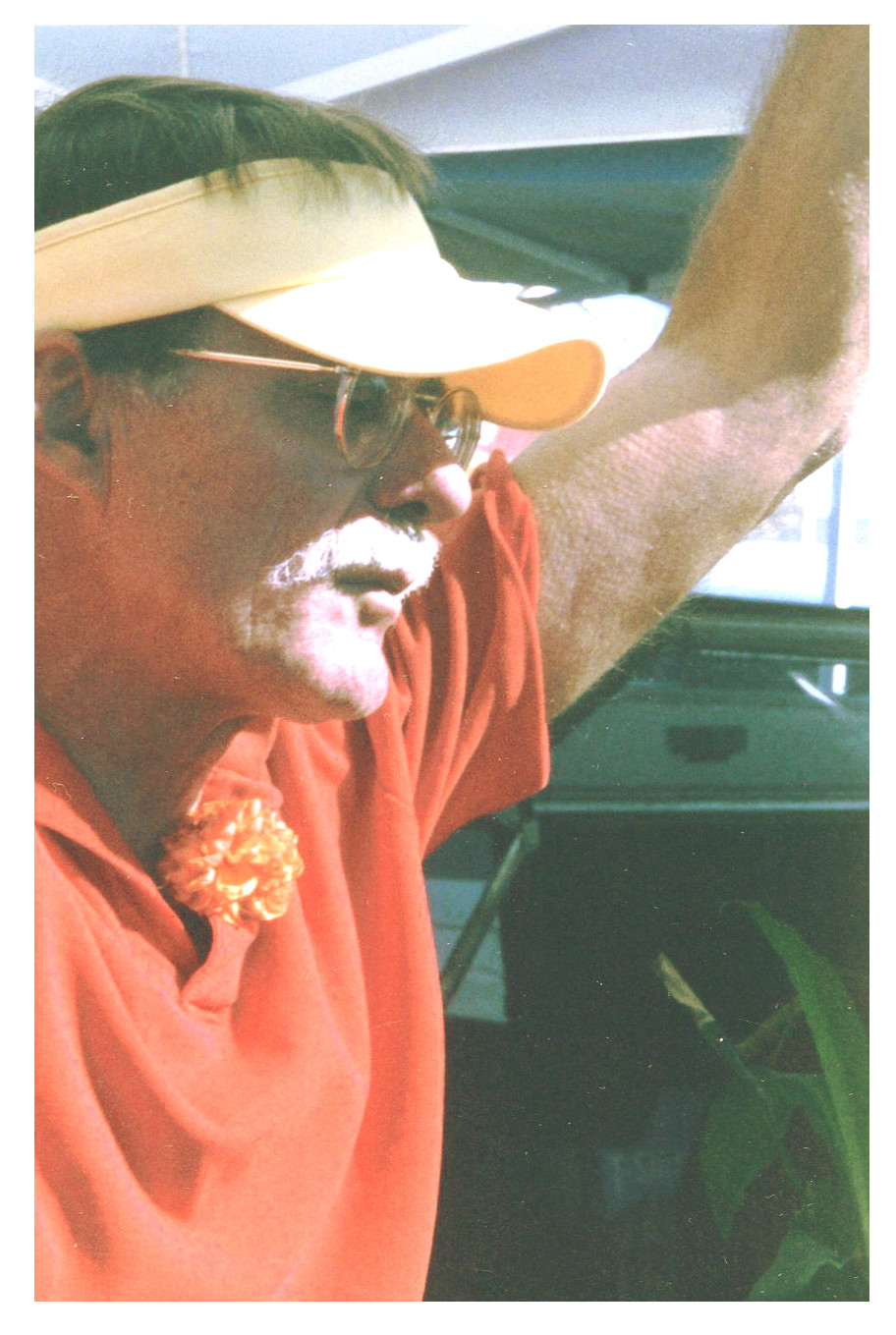
You probably already know, however, that Santa Fe’s notorious for poor folks having to work multiple jobs to get by. Accordingly, besides organizing stuff and defining the wild verb, I spent a miraculous third half of my time as the famous Used Plant Man at the Santa Fe Farmers Market.  In honor of my signature product, in the summers I turned into the infamous Iris Man.

Every Saturday morning, and Tuesdays in summers, I peddled previously-nurtured, restored, or recycled house plants. Not mention that in my spare time I did what I cleverly and artistically called ‘land-shaping,’ which involved terracing, rock walls, and laying flagstone patios.  In other words, I played around digging in various folks’ yards, gardens, and sandboxes.

2005 in the greenhole

2005 in the greenhole

2005 in my booth

2005 in my booth

That greenhouse was of my own design and construction. I called it my ‘greenhole,’ literally a hole I dug six feet deep and slapped a plastic roof over it .

The Greenhole

The Greenhole

The only other infrastructure for the business were folding tables, a portable pop-up tent with the proud banner of Babylon Gardens,

2006 booth at Farmers Market

2006 booth at Farmers Market

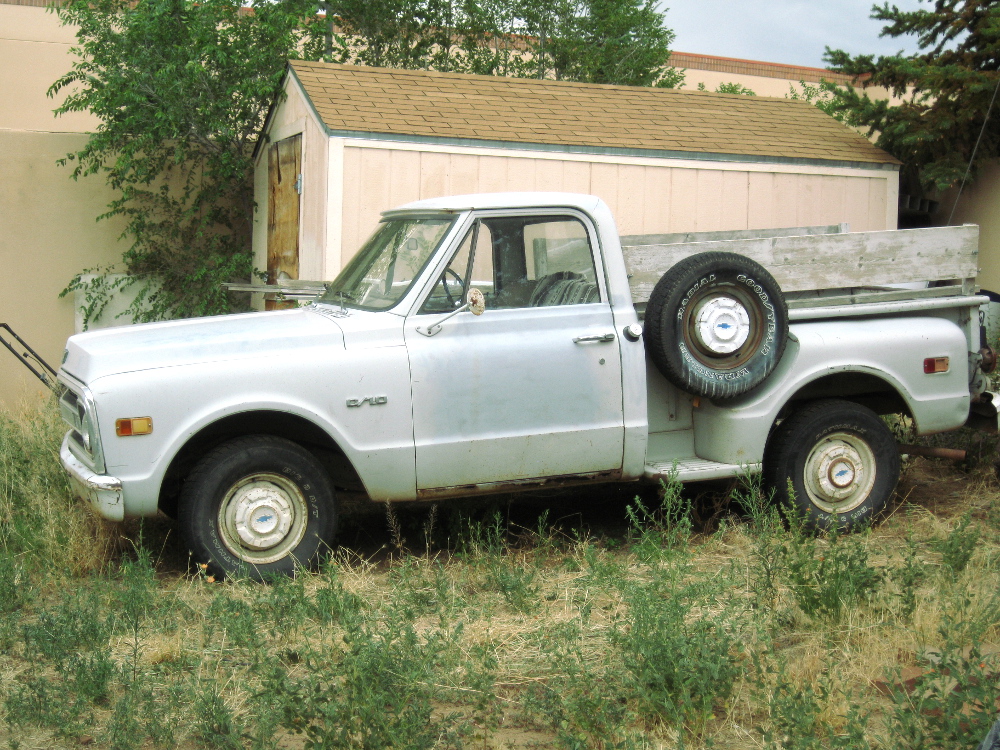
And the gallant Grover (the Grey, like Gandalf), a 1970 Chevy C-10 pickup. Grover hauled load after load of plants and paraphernalia through so many pre-dawns and then stood nearby for thousands of touristic snapshots of a typical Santa Fe scene.

Grover the Grey

Grover the Grey

As if doing meaningful work for society, publishing a fantastic book, and selling spectacular plants weren’t enough, in June, 2006 I came out as an artist in an art show for the Santa Fe Gay Pride celebration. I’d earned the gay category 45 years earlier, also in June.  I showed three pieces:  the assemblage shrine Bull of the Sun, the carved sandstone Venus, and my very first piece of digital art, the cover for my novel “Gymnopedie.”

NEWS FLASH:

“Gymnopedie” the novel has been withdrawn from publication and

rewritten as a backwoods novella called “Bat in a Whirlwind,”

available for free download by right-clicking here.

2006 publicity with baby jade

2006 publicity with baby jade

While we’re at it, I want to share with you a picture of one of my favorite plants in the greenhole. Soon I really should do a post with more stuff on the wondrous plants I had in there.  This one has an outrageous Latin name I loved reciting to folks:  pachyphytum oviferum amethystinum (fat-leafed, egg-shaped, amethyst).  Here it is in bloom in 2005.

Pachyphytum Oviferum Amethystinum

Pachyphytum Oviferum Amethystinum

The Farmers Market always went outdoors somewhere in late April around my birthday, and in both the 2005 and 2006 seasons that was on the wide-open corner of Guadalupe and Cerrillos skirting the railroad tracks behind SITE Santa Fe. In my humble used plant vendor opinion that point out there in view of two busy streets was the perfect, I mean the ideal, location for our wonderful community market.

In years past we’d simply popped up our tents, if we had one, further north along the tracks across Paseo de Peralta behind Santa Fe Clay. (And in years before my time, it had been in the parking lot of Sanbusco Center.)  Now almost all the vendors, including makeshift Babylon Gardens, flew a white canopy like a flag to be seen from all around.  We were truly a spectacle of folk life that made me proud.

As a matter of fact, it seemed a vindication of the pleasure a certain clueless kid once enjoyed in peddling peaches in a booth beside the highway. It was that splendid interaction with people around a subject you deeply love and the thrilling opportunity to share the work of your own hands with them.  Every day, even the slow ones, I loved the glory of hawking my beautiful plants, talking about them and how they like to be treated.  In a word, it was a trip.

Ironically, the fortuitous move from the hinterlands of the railyard up to this prime spot was caused by big city projects afoot for the neglected old railyard. I believe the powers that be moved the Market out where people could see it to get support for the new building they were preparing in those same hinterlands as an indoor place for us in the winters.

Among other opponents of that project, I felt the current arrangement, as I said before, was ideal. For the winter seasons, we’d been going indoors at El Museo Cultural, and vended there happily, even with poor lighting and no call for flashy tents.  It felt very folksy, local farmer cultural.

But the majority of vendors, or at least the power that were at the time, had their hearts set on a fancy market hall like in Boston or Seattle or wherever. This ambition caused a whole bunch of trouble, but don’t get me started.

(Can’t help it. For just a few repercussions.  Before the building was even done, the Trust for Public Land and other powers kicked the Market off that superb spot on the busy corner to make the new Railyard Park.  I suggested, clearly not vociferously enough, that they design that great space on the corner for a fancy open market plaza for us farmers and for other fairs on other days.  Irony Alert:  My sweet old vending space is now in a rotunda of rose gardens where few people care to walk.  Roses to be smelled and not sold.

Kicking us out made the Market wander for a couple summers around parking lots. The summer beside the DeVargas Center was a huge come-down, but in more levels of irony, our summer of 2008 in the almost ideal PERA lot was the most spectacular in the history of my unorthodox nursery.  To make matters worse for us gypsy farmers, for some reason we also lost the El Museo space and had to spend a winter in a grungy industrial place on Cerrillos Road.  Again the irony, it had once upon a time been a gay nightclub, the Cargo Club, I think it was called.  Or Club Luna?  I’d gone there only a few times to dance.)

At any rate, between Market days Grover and I would tootle all over town and even out to Espanola or Eldorado to grub freely in folks’ iris beds or do plant rescues or paid land-shaping jobs. It was a splendid gimmick, an ingenious concept if I say so myself.  I provided a free, much-appreciated community service and turned my (minimal) physical labor into totally free merchandise.  No overhead except gas for good old Grover.  Good job for an old guy.

Frequently folks gave me way more plants than I could ever hope to sell at the Market. Like 500 lb. of blue iris?  I’d just give them away.  Once I got a whole greenhouse collection from an estate and recycled (propagated) thousands of new plants to give away to garden clubs, school classes, and anybody I could foist them off on.  I always kept a FREE box at my booth, and folks checked it frequently for adoptions.  I joked that I was a “philplanthropist.”

Sometimes I’d simply show up at a business or office building, like that time at the Toney Anaya Building when I marched in and told the receptionist, “I’ve got a giant jade tree that wants to live in your lobby.” A couple times I simply arranged for gigantic plants to go to great spots like at the Capitol complex or other public spaces.  They had to do the hauling though.

A decade ago I was a plant freak in his element, and my only problem was believing what a happy old man I was. Even older now, I’m still a happy fellow—and I believe it.

Aztec Icon #8 – Itzpapalotl, The Obsidian Butterfly

It’s been about two months since I’ve been able to celebrate completion of an icon, but here at last is the next in the series for the coloring book  YE GODS! Hooray!  Besides the many days of maniacal drawing, I suffered through some sickness and enjoyed two days in the hospital with a collapsed lung.  Now totally fixed.  So much for daily diary matters.

I think you’ll agree that this icon of the goddess Itzpapalotl, the Obsidian Butterfly, is startling and disturbing, if not frightening, but you should also know that these demonic images are absolutely authentic. Check out google images for Codex Borgia. This lady of mystery and death is a good example of how Aztec deities are a mix-up of what we nowadays rather simplistically call good and evil.  The Aztec aesthetic embraces both the beautiful and hideous, just as their philosophy affirms both life and death.

(You can still see or download the previous seven icons by clicking on them in the list on the page for the coloring book .)

ICON #8: ITZPAPALOTL

(The Obsidian Butterfly)

To download this icon as a pdf file with a page of caption and model images from the Aztec Codices, right click here and select “Save Target (or Link) As.”  You can also download it in freely sizable vector drawings from the coloring book page.

Itzpapalotl, The Obsidian Butterfly

Itzpapalotl, The Obsidian Butterfly

ITZPAPALOTL {eets-pa-pa-lotł} is the ancestral goddess of the stars (Milky Way), lady of mystery and death, but also of beauty and fertility. Patron of the day Cozcacuauhtli (Vulture), she is a fearsome warrior who rules over the paradise of Tamoanchan for victims of infant mortality.  She may be the mother of Mixcoatl, the Cloud Serpent, and is patron of the Cihuateteo, harmful spirits of women who died in childbirth.  She is also one of the Tzitzimime, star demons that devour people during solar eclipses.  She is usually depicted as a skeletal figure with butterfly, eagle, or bat wings but can also be a beautiful, seductive woman.  Sometimes she’s known as the Clawed Butterfly.