The Evening Star – Apotheosis of Dog

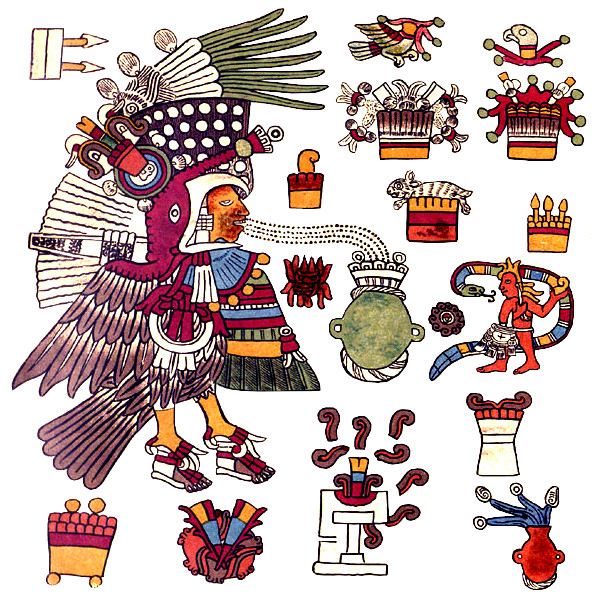
After wrapping up my little piece about Morning Star mythology in Pre-Columbian America, I turned back to re-creating Aztec codex pages from the calendar and my work on the Vulture trecena (13-day ‘week’), its patron being the god of the Evening Star. The detailed process of pixelating is fairly time-consuming and lends itself to much cogitation and curiosity about the deity at hand. But first some Maya stuff on the Evening Star.

Lady Evening Star of Yaxchilan

No surprise, but my internet search provided precious few hits for Maya Evening Star, the only one being for a Maya queen of Yaxchilan named Great Skull and known as Lady Evening Star. Here’s some fancy ancient royalty gossip: A princess from the formidable city-state Calakmul, she married the ruler of Yaxchilan, Itzamnaaj B’alam III (Shield Jaguar the Great), was the mother of Yaxun B’alam IV (Bird Jaguar) and ruled 742-751 CE until her son’s maturity.

Apart from being the title of a regal queen, other Maya concepts of the Evening Star, if there were any, have been lost to the fires of history. Unless they were carved in stone like this portrait of Lady Evening Star on Stela 35 from Yaxchilan. References on Venus, a hugely important theme in Maya astronomy and culture, rarely even mention the Evening Star, though the Maya well knew it was related to the Morning Star as another phase of that planet.

I have no doubt that the famous Dresden Codex probably discusses the Evening Star, but I can’t read through those boggling glyphs looking for mentions and have no idea what it was called in either the Yucatec or Quiché Maya languages. But I really wanted to find out something of the history and mythology of my Vulture trecena patron.

That’s why I went back to my program from the Getty Museum show of the Maya Codex of Mexico (the Grolier Codex), a Maya-Toltec document dating 1021-1154 CE, where in the fragmentary pages on the cycles of Venus, I’d found the Morning Star image that inspired my earlier blog. In fact, for the Evening Star phases, the Maya Codex contains three gruesome images that show a deity with a death’s-head/skull-face. The best preserved presents a deity holding up a victim/prisoner’s bleeding head, apparently having recently decapitated the poor fellow with a large flint knife in his other hand. The skull-faces no doubt mean that the Maya identified the Evening Star is an entity of the Underworld (Xibalba), which wasn’t necessarily a bad thing. They considered life and death a mystical continuum.
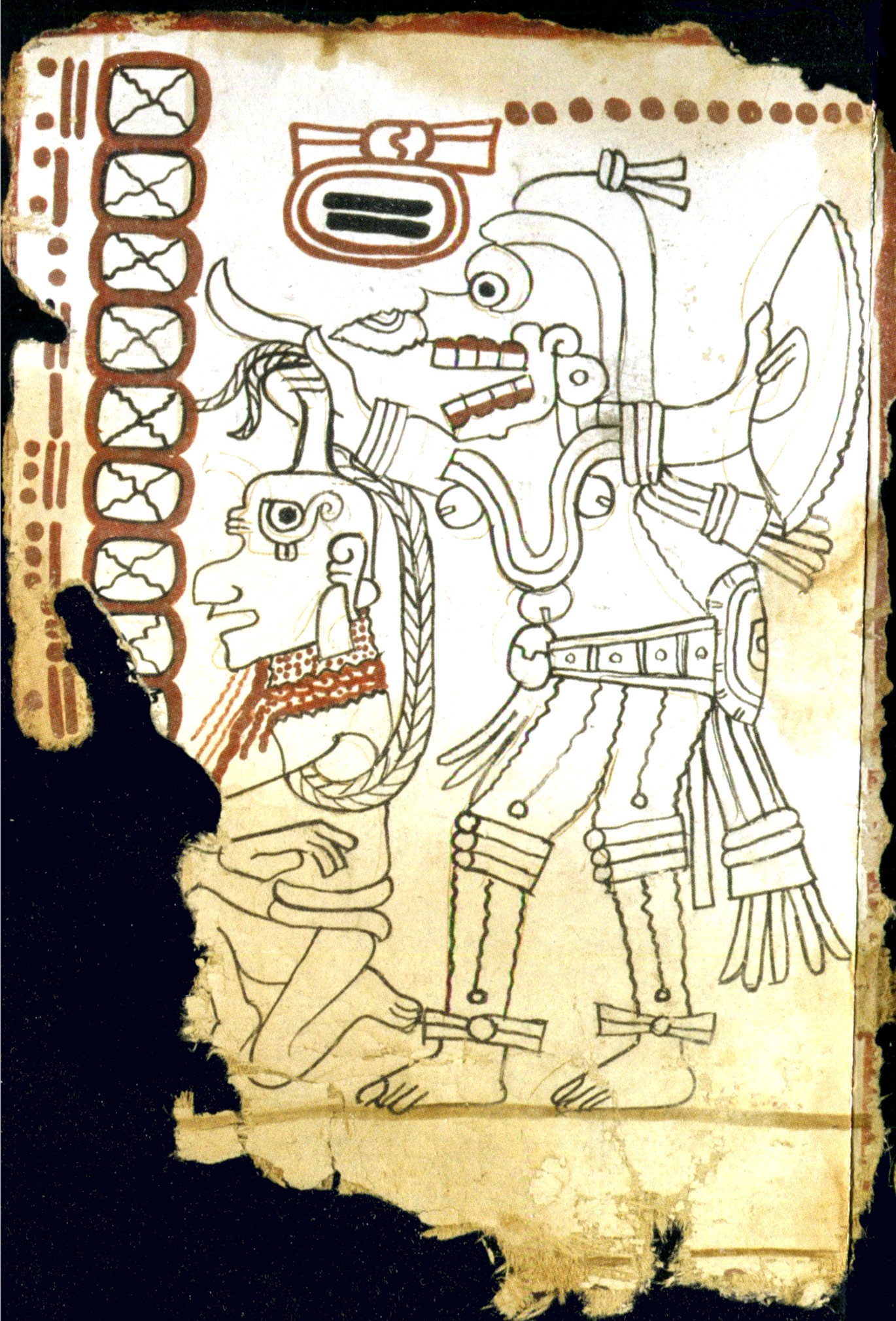
Evening Star, Codex Maya de Mexico

The Underworld connection could well belong to an original Maya notion of the Evening Star. In later traditions, it was considered the guide/companion of the sun on its nightly journey through the Underworld. The earlier Maya may well have had a similar myth for the bright star that followed the setting sun. I hesitate to speculate on the Maya meaning of the victim in this scene, but it bears witness to the long-standing tradition of human sacrifice in Mesoamerica. Natural phenomena (like the movement of the sun, the rain, etc.) always came at a price in human blood.

Though the Maya Codex shows the Morning and Evening phases of Venus as different types of figures (including a being with a mask suggestive of a storm-deity), they understood well that it was all the same planet. Maybe Chak Ek’ was actually the deity of Venus itself, making no distinction between its phases: 236 days as Morning Star, 90 days in superior conjunction (behind the Sun), 250 days as Evening Star, and 8 days in inferior conjunction (passing between Earth and Sun). That would explain finding no evidence of separate deities, but of course finding no evidence of something doesn’t prove the absence of that something.

Similarly, I’ve found nothing on what the Venus-phases meant to the culture of Teotihuacan, which certainly revered the planet as the god Quetzalcoatl. That central Mexican metropolis possibly also didn’t separately deify the Morning and Evening Stars. However, the Maya Codex indicates that by Toltec times the concepts of the two phases were diverging, at least in their visualizations. At some time in succeeding centuries, later Nahua cultures evidently completed the separation, generating the new deity Tlahuizcalpantecuhtli (Lord of the House of the Dawn) for the Morning Star and another called Xolotl for the Evening Star.

Oddly, they deified the dog as the Evening Star—literally the apotheosis of dog! In two of the surviving “Aztec” codices, the new god appears in strikingly similar poses vividly recalling the decapitation motif in the Maya Codex. The earlier Underworld connection of the Evening Star is suggested by the night-capes both of these Xolotls wear.

Two Xolotls with Victims, Codex Fejervary-Mayer l., Codex Vaticanus r.

Since so little is known about the Maya Evening Star, most authorities like to extrapolate the later mythology of Xolotl back into that period, but I wonder if such lore was in fact inherited. The Maya indeed revered the dog as a guide, companion, protector and bringer of light to darkness, which may have involved escorting the sun through the night. However, Xolotl’s role as psychopomp for souls through the Land of the Dead (Mictlan), eerily paralleling the Hellenic concept of Cerberus in Hades and the Egyptian god Anubis, may well be a later elaboration.

A specific Maya reference to the dog is four images on pp. 25, 26, 27 & 28 of the Dresden Codex shown in relation to rituals for celebrating new years, but I don’t know how that might fit into the ancestry of Xolotl. In any case, they underline the cultural importance of the dog.

Xolotl appears relatively often in the surviving codices, in all but one instance in the guise of a dog. In Codex Borgia the dog-god occurs three times in its typically ornamented style, one too damaged to make out any details. The figure on the left below appears in the “magical journey” sequence, and the central image is from a “heaven temple.” The Sun symbol on its back refers to escorting the Sun through the Underworld at night. Earlier in the codex, as patron of the day Earthquake, Xolotl appears uniquely as a deformed human—which is no doubt why scholars have called him the deity of monstrosities, including twins. (The twin theme obviously refers to the close relationship between the Evening and Morning Stars.)

Three Xolotls, Codex Borgia

In two other codices, Xolotl is depicted as a fairly naturalistic dog, unfortunately not naturalistic enough to discern its breed. In the Nahuatl language, “dog” is Itzcuintli, but that’s also a generic term. These images only indicate some sort of a shaggy dog, not at all like the hairless canine Xoloitzcuintli (named for the god) which has been designated the national dog of Mexico. These dogs also look nothing like the small chihuahua which was apparently raised for eating. The spiked collar on the left example I expect is an abstracted “night-sun” symbol, and the explicit anatomy of the central figure is hard to overlook.
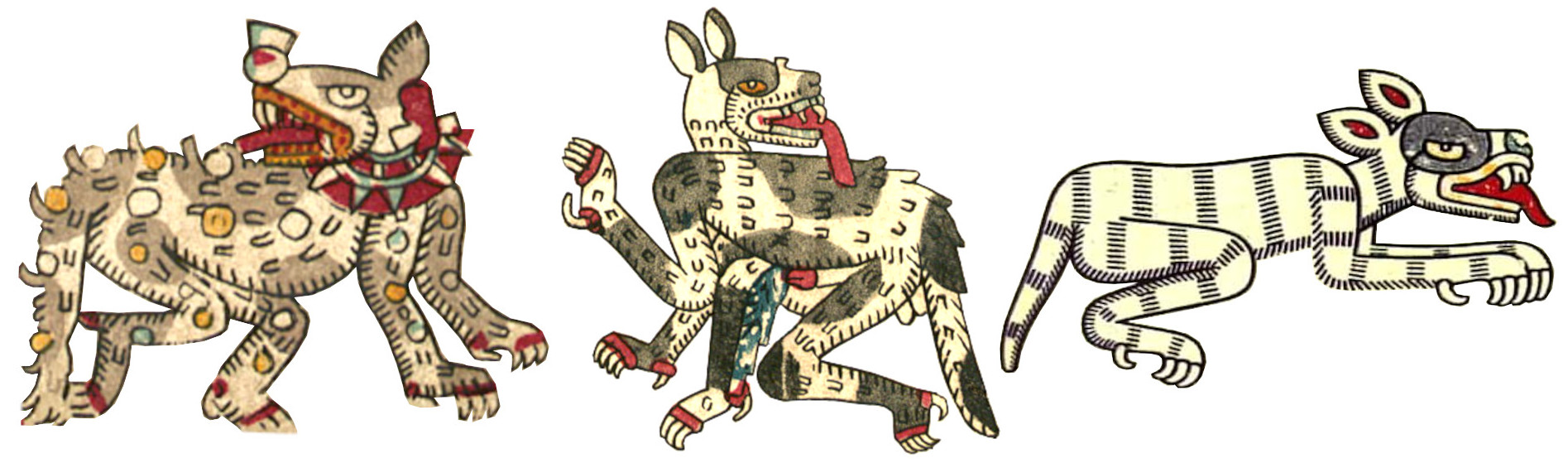
Three Naturalistic Xolotls, Two (l.) from Codex Vaticanus and One (r.) from Codex Laud

Said to have come from the area of Veracruz, Codex Fejervary-Mayer conversely presents Xolotl as a full-fledged, anthropomorphic canine deity ensconced in an elegant temple. In addition, the codex contains several pages with this Xolotl in various aggressive postures, (including eating someone’s head!), which recall panels of Morning Star violence. In one, Tlahuizcalpantecuhtli mysteriously wears a dog’s head. These Codex F-M scenes may indicate a lingering conceptual overlap between the two phases of Venus in a distant conservative area of Mexico.
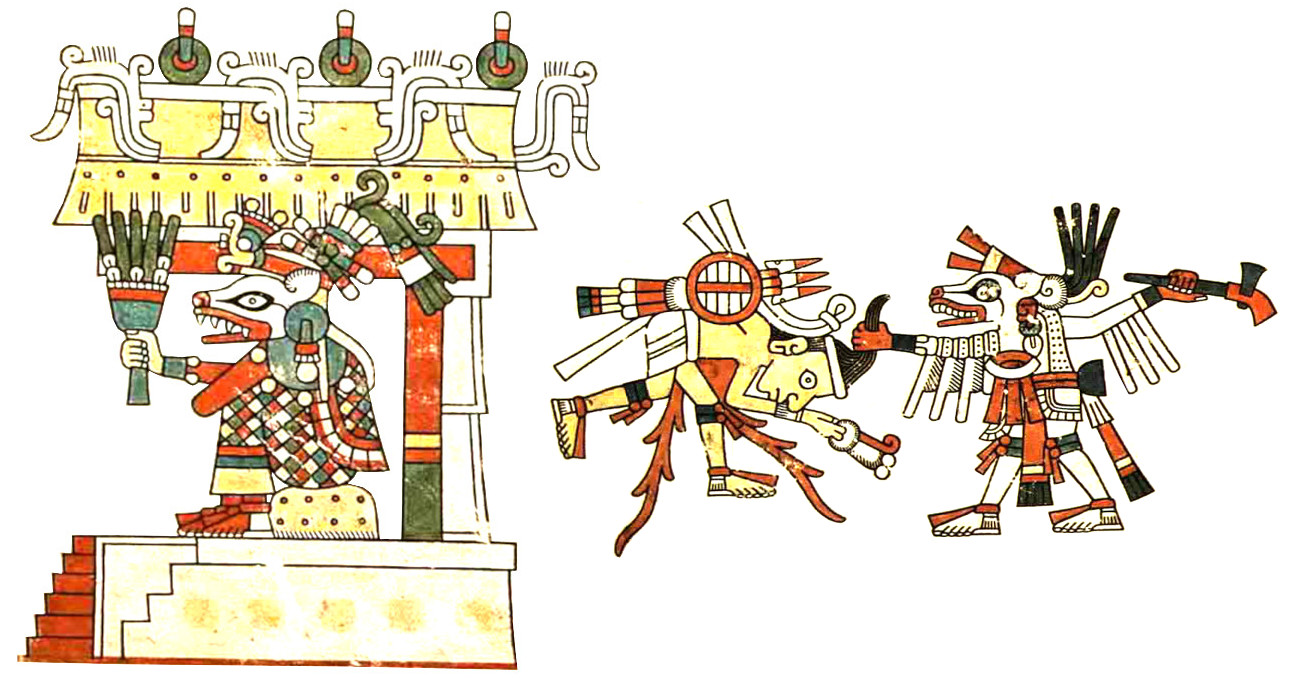
Two Xolotls, Codex Fejervary-Mayer

The scene on the right surely relates to the earlier images with victim, but here blood issues from his body like from a heart sacrifice. Another conservative aspect of Codex F-M iconography is that, except for the first one holding the victim and heart, its Xolotl dog-gods all have the same head—basically that of those anthropomorphic New-Year dogs in the Dresden Codex. Here we see examples of mythological evolution in action.

In codices with tonalamatls (books of the Aztec Calendar), Xolotl is celebrated as the patron of the Vulture trecena and formally consecrated as the god-dog, often enthroned.

Three Divine Xolotls, (l – r) Codices Borbonicus, Borgia and Vaticanus

Besides their masses of divine regalia, all three wear the conch-shell pendant (‘wind-jewel’) symbolizing their connection to Quetzalcoatl/Venus, but none is breed-specific. Curiously, the Vaticanus example is swaddled in a traditional corpse-bundle, perhaps a veiled reference to the Evening Star’s Underworld connection. Now that’s a trio of indisputably alpha dogs!

In its Vulture trecena patron panel, Codex Telleriano-Remensis, an early post-Conquest text painted on European paper, takes the dog to a yet higher level of glory, presenting a fantastic, iconic, metaphorical scene of Xolotl as the brilliant Evening Star with a gleaming Sun (Tonatiuh) setting into the gaping maw of Tlaltecuhtli, Lord of the Earth.

Evening Star with Setting Sun
From Codex Telleriano-Remensis (re-creation)

Personally, as an opinionated artist, I think this eye-boggling panel is an absolute epitome of Aztec iconography. You’re welcome to your own opinion. Meanwhile, I’ll note that here Xolotl looks absurdly like a Pekinese, but that makes no difference to the spectacular metaphor.

#

Unlike the myths of the Morning Star, it’s surprising that with the celebrity of Xolotl in Mesoamerica, the Evening Star cult didn’t spread into North America. However, the dog’s traditional loyalty, companionship, guidance and protection was generally appreciated by tribes across the whole continent, and sometimes it was included in rituals and ceremonies. I’ve only found a few legendary references from the Ojibwe and Pawnee (usually about wife or daughter of the Evening Star) and one from the Algonquin about an Osseo, Son of the Evening Star, but there’s no connection to a dog. It seems that Xolotl’s godhead was only valid in Mexico.

But that hasn’t mattered much. All across North America, dogs domesticated humans beings and became de facto gods in their own right, ruling their mortal owners’ Morning (days) and Evening (nights) and living (for the most part) idle lives of divine luxury. Their worshipful care consumes an enormous sector of the economy, I’d bet grossly larger even than that for religious institutions—an apotheosis without even needing an Evening Star mystique or human sacrifice.

###

Aztec Calendar – Water Trecena

The seventeenth trecena (13-day “week”) of the Aztec Tonalpohualli (ceremonial count of days) is called Water for its first numbered day, which is coincidentally the 9th day of the veintena (20-day “month”). In Nahuatl, Water is Atl. It was known as Muluk (Water) in Yucatec Maya and Toj (Rain or “Thunderpain”) in Quiché Maya.

The Aztecs saw the day Water, typically shown as a container spilling water, as connected with the flow/passage through life and time as well as purification and the accumulation of resources and potentials. It’s associated anatomically with the back of the head/hair. The divine patron of the day is Xiuhtecuhtli, the Lord of Fire/Turquoise, who’s a patron of the Snake trecena.

PATRON DEITY RULING THE WATER TRECENA

Chalchiuhtotolin (see Icon #3), the Jade (or Jeweled) Turkey, is another nagual (manifestation) of Tezcatlipoca (see Lizard trecena). As the magnificent patron of his Jaguar Warriors of the Night and of military power and glory, it cleanses them of contamination, absolves them of guilt, and overcomes their fates. Appropriately it’s the patron of the day Flint, the sacrificial knife.

Though symbolic of sustenance and abundance, Chalchiuhtotolin is also associated with disease and pestilence, a creature of death and decay, regeneration and transformation. Chalchiuhtotolin is also linked to the earth’s fertility, agricultural cycles, and the natural order of life and death. Appeasing Chalchiuhtotolin was believed to ensure a smooth transition for the deceased into the afterlife and promote fertility and abundance in the earthly realm.

AUGURIES OF THE WATER TRECENA

By Marguerite Paquin, author of “Manual for the Soul: A Guide to the Energies of Life: How Sacred Mesoamerican Calendrics Reveal Patterns of Destiny”
https://whitepuppress.ca/manual-for-the-soul/

Trecena theme: Generative Vitality, Purification. This life-giving time frame has a generative “firewater” aspect to its energy, representative of the original creation forces that sparked life itself. There is a strong sense of abundance associated with these forces, but these energies can also be “electrical” in the sense that they can “spark” important events, often associated with stimulation and cleansing. Like water itself, this period holds the potential to create pathways that can shape or change the world. This trecena has also been associated with omens.

Further to how these energies connect with world events, see the Maya Count of Days Horoscope blog at whitepuppress.ca/horoscope/  Look for the Muluk trecena.

THE 13 NUMBERED DAYS IN THE WATER TRECENA

The Aztec Tonalpohualli, like the ancestral Maya calendar, is counted through the sequence of 20 named days of the agricultural “month” (veintena), of which there are 18 in the solar year. Starting with 1 Water, it continues the trecena with: 2 Dog, 3 Monkey, 4 Grass, 5 Reed, 6 Jaguar, 7 Eagle, 8 Vulture, 9 Earthquake, 10 Flint, 11 Rain, 12 Flower, and 13 Crocodile.

There’s one special day in the Water trecena:

One Water (in Nahuatl Ce Atl) –the day-name of Chalchiuhtlicue, the Jade Skirt, the patron of the Reed trecena. In the Florentine Codex, it’s noted as a feast day for those involved in the water industries, but I can only speculate what those were.

THE TONALAMATL (BOOK OF DAYS)

Several of the surviving so-called Aztec codices (some originating from other cultures like the Mixtec) have Tonalamatl sections laying out the trecenas of the Tonalpohualli on separate pages. In Codex Borbonicus and Tonalamatl Aubin, the first two pages are missing; Codex Telleriano-Remensis and Codex Rios are each lacking various pages (fortunately not the same ones); and in Codex Borgia and Codex Vaticanus all 20 pages are extant. (The Tonalpohualli is also presented in a spread-sheet fashion in Codex Borgia, Codex Vaticanus, and Codex Cospi, but that format apparently serves other purposes.)

TONALAMATL BALTHAZAR

As described in my earlier blog The Aztec Calendar – My Obsession, some thirty years ago—on the basis of very limited ethnographic information and iconographic models —I presumed to create my own version of a Tonalamatl, publishing it in 1993 as Celebrate Native America!

Aztec Calendar – Water trecena – Tonalamatl Balthazar

Yet again, I knew nothing about traditional images of the Jade Turkey and simply played with a Nuttall-style guy in a turkey-suit, the dominant green color reflecting the “jade.” Only many years later did I discover true details of this deity’s mythology—and the unusual type of turkey it references. The following patron panels will explain a lot of little-known turkey-trivia.

#

TONALAMATL BORGIA (re-created by Richard Balthazar from Codex Borgia)

Aztec Calendar – Water trecena – Tonalamatl Borgia

Besides the “Jade Turkey,” Chalchiuhtotolin is also called the “Jeweled Turkey”—referring to Meleagris ocellata, an endangered species native to Yucatan, Belize, and Guatemala and named for “eyes” on its imposing fan of tail feathers. With stunning blue-to-purple-to-green plumage, this rara avis is a distant cry from the standard “Thanksgiving” turkey (Meleagris gallopavo).

Ocellated Turkey

Surely known personally to the Maya but likely only mythically in Mexico, this rare bird as patron of the Water trecena shows its ancient heritage. The peoples of Mexico found significant sustenance and abundance in its drabber but larger cousin, the Wild Turkey, ancestor of our even bigger domestic turkey. But they “idolized” a mythical jeweled fowl that could be called the “Turquoise Turkey” (Xiuhtotolin). Coincidentally and appropriately, that could also mean “Fire Turkey.” Since the bodies of ocellata were many shades of iridescent emerald-green, simply “Jade Turkey” is its best label.

The color palettes of codex artists included very few shades of blue which differed over time and area. The Maya had a famous blue of unknown source, and the Mexicans later achieved a generous blue like in Codex Borbonicus. In Codex Borgia, most intended blues have degraded into shades of grey (as have any hues of green into brownish-golds). Codex Laud and Codex Fejervary-Mayer use a dark greenish or slate tone for blues and/or greens, with other colors fairly vivid. In Vaticanus b (predominantly cochineal red and brownish gold), they managed some subdued blues and greens almost like highlights. But a true turquoise was way out of an artist’s reach, not to mention any shade of purple.

That made it essentially impossible to depict Chalchiuhtotolin in all its iridescence. The Jade Turkey mostly appears in codices with a red head and brownish feathers, like their common farmyard gobblers. But in Codex Borgia, the mythical bird has a stylized ocellated fantail (now become blacks and greys) and brownish-gold medallions for the glowing green on its breast.

I chose to color our divine bird naturalistically—i.e., just about as supernaturally as it gets, that turquoise head and purplish tail. I wonder about that suspicious ear on the back of its head. Turkeys don’t have ears like mammals. And what’s that big tassel-thing on its breast? Well, recently I learned about turkeys’ beards. When toms (and some hens) get on in years, they can grow a long spike of feathers straight out from their breasts. That ornament and a many-eyed fan makes a formidable fowl of military majesty, a great patron for the Jaguar Warriors of the Night.

Chalchiuhtotolin seriously dominates this patron panel, especially with all that stuff the deity is evidently exhaling. The upper curlicues we now know are grey smoke and orangish fire, which makes sense for a “Fire Turkey,” a fire-breathing warrior-bird, but the curly thing caught in the disembodied claw sure doesn’t. Hanging right there in the center of the panel, it must be primally important, maybe a hieroglyphic message or utterance by the deity. Or it may be simply an abstraction for the wide range of calls, cackles, and gobbles that turkeys make.

Meanwhile, the surreal item on the right invites more interpretation. No doubt, it involves two spotted serpent tails encircling a body of water. However, the snakes’ heads lift up between knobbed sides like spouts of water (with eyes and mouths!) and top off with big flowers. The motif of a snake containing a volume of water is also seen in ancient Maya iconography—and this is after all, the Water trecena. Gathering and containing water, the essence of accumulation, provides the Jade Turkey’s abundance. So, here there be water-serpents.

Which raises a neat linguistic point: At a recent lecture, I learned that in Aztec iconography many of the images are actually hieroglyphs, pictorially and/or phonetically significant. For instance, a pot or jug with water splashing out of it can be read as a word in Nahuatl. The first syllable of their word for pot/jug/jar is co-,and their word for ‘water’ is atl. So, co-atl spells ‘snake.’ This item is in fact a decorative and emphatic hieroglyph for ‘water-serpent.’

This page for the Water trecena I consider perhaps the most glorious in the Tonalamatl Borgia, not only for its intended colors but for its surrealism. Even without the appended material and fancy water-serpent glyph, this image of Chalchiuhtotolin is inarguably the apotheosis of the turkey. (Worshipping it is a whole lot kinder—and respectful—than cooking it for dinner.)

#

TONALAMATL YOAL (compiled and re-created by Richard Balthazar on the basis of
Codex Telleriano-Remensis and Codex Rios)

Aztec Calendar –Water trecena – Tonalamatl Yoal

This series of compiled trecena pages that I call Tonalamatl Yoal opts for a far less naturalistic image of an ocellata with the brown feathers and red head of the common gallopavo. However, there’s no clear reason for its yellow feet or the epaulets on its wings. The “jeweled” aspect of divine Chalchiuhtotolin is shown by the jade pendants on its plumage and probably the turquoise collar, but I can’t explain the apron of quetzal plumes that almost hides its jaguar-pelt “pants.” Those may indicate its nagual connection to Tezcatlipoca as does the variant smoking mirror in its headdress—a logical source of the flame and smoke seen before as the breath of the Borgia bird. Apart from the shape of the head, this heavily stylized portrayal of the deity doesn’t look much like a turkey, especially that tail, but it’s certainly an elegant fowl.

Instead of any water-serpent reference, on the right side is another figure of a human worshipper performing a ritual blood sacrifice like the guy in the Jaguar trecena. That one (with the same bound hairdo but no headdress) pierces his tongue with a pointed stick. This one jabs himself in the ear with a sharpened flowering shinbone—oddly emblematic of Quetzalcoatl, as are the two ornamental conch shells. The devout fellow also offers the deity a fancy incense bag.

Though it shares the stage here with a worshipper, Chalchiuhtotolin is clearly the sole patron of this Water trecena. As before with the tongue-piercer with Quetzalcoatl in the Jaguar trecena, this ear-stabber may merely indicate the preferred method of blood-sacrifice to the Jade Turkey. I haven’t studied the matter, but I suspect the Aztecs had prescribed rituals of phlebotomy for specific deities, including slicing other body-parts, flagellation, flaying, and eye-poking (like in the Flower trecena). It was obviously a great culture for masochists.

#

OTHER TONALAMATLS

Tonalamatl Aubin patron panel for Water trecena

It’s no surprise that the turkey in the Tonalamatl Aubin patron panel can scarcely be called elegant. Looking more like a limp rubber chicken, it’s nevertheless supposed to be the divine Chalchiuhtotolin as shown by a half-hearted smoking mirror in its headdress. While the little guy pretends to stab his ear, three awkward conch shells seem to relate to familiar water-serpent symbols. Apparently, the Aubin artist(s) held Chalchiuhtotolin in only minimal awe.

#

Codex Borbonicus patron panel for Water trecena

The Jade Turkey in the Codex Borbonicus patron panel, however, is rather awesome with an ornate smoking mirror and Tezcatlipoca’s beribboned circular pendant. Its anthropomorphic nature (a guy in a turkey suit) nicely justifies my own even more awesome interpretation in Tonalamatl Balthazar. In the crowd of ritual paraphernalia, I wonder about that central green pulque pot; is he drinking from it or vomiting into it? The little guy on the right of it with the colorful snake is again stabbing an ear and carrying an incense bag and a conch shell. The co-atl glyph in the lower right corner must refer to both the Water trecena and water-serpent, and fire and smoke issue from a burning temple. The cluster of symbols (including a familiar scorpion) might be elements of some hieroglyphic sentence.

#

Codex Vaticanus patron panel for Water trecena

In Codex Vaticanus, the Jade Turkey distinctly reflects the Borgia image, some blue in the fantail with stylized “eyes, a geometrically abstracted wing, and a small beard on its breast. One gets the feeling that the artist probably intended to paint the white spaces in ocellata colors but didn’t get around to it. (I’m tempted to finish the job but have other fish to fry right now.)

The cluster of motifs above its head also reflects the Borgia image: plumes of smoke and fire and stylized water-serpent heads (without faces) capped with flowers. In this instance, the red “walls” of the waterspouts are evidently penitential thorns, explaining the knobbed structures in Borgia. Most interesting is the curly exhalation with stars attached grasped again in a disembodied claw; it suggests darkness or night, possibly explaining the enigmatic brown Borgia detail. The deity was sometimes called the “Precious Night Turkey”—maybe since Tezcatlipoca was the god of the night or for its patronage of the Jaguar Warriors of the Night.

This Vaticanus Chalchiuhtotolin is exceptional, both in stylized detail and in being the sole image in the patron panel. Displaying no specific emblem of Tezcatlipoca, this Jade Turkey seems (like the Borgia bird) to proclaim its independent divinity.

#

I’m impressed by the virtuosity of the Vaticanus artist(s) in stylizing certain animals like the dog (discussed in the previous Vulture trecena) and this Jade Turkey. Elsewhere in the codex they have twice drawn turkeys in the context of their patronage of the day Flint, on pp. 29 and 93:

Two Turkeys, Codex Vaticanus

From different sections of the codex but in similar poses (and both sporting impressive beards), these two gobblers may well have been drawn by different artists in slightly different personal styles. The one on the left is clearly a common variety tom, but apart from the necessarily red head, the one on the right looks to be an authentic ocellata with the eyes on its fantail and more intricate plumage. Perhaps the magnificent trecena patron image was created by yet a third artist, someone more fluent in religious symbolism.

###

You can view all the calendar pages I’ve completed up to this point in the Tonalamatl gallery.